Mass-Storage Systems
Mr. SUBHASIS DASH
SCHOLE OF COMPUTER
ENGINEERING.
KIIT UNIVERSITY
BHUBANESWAR
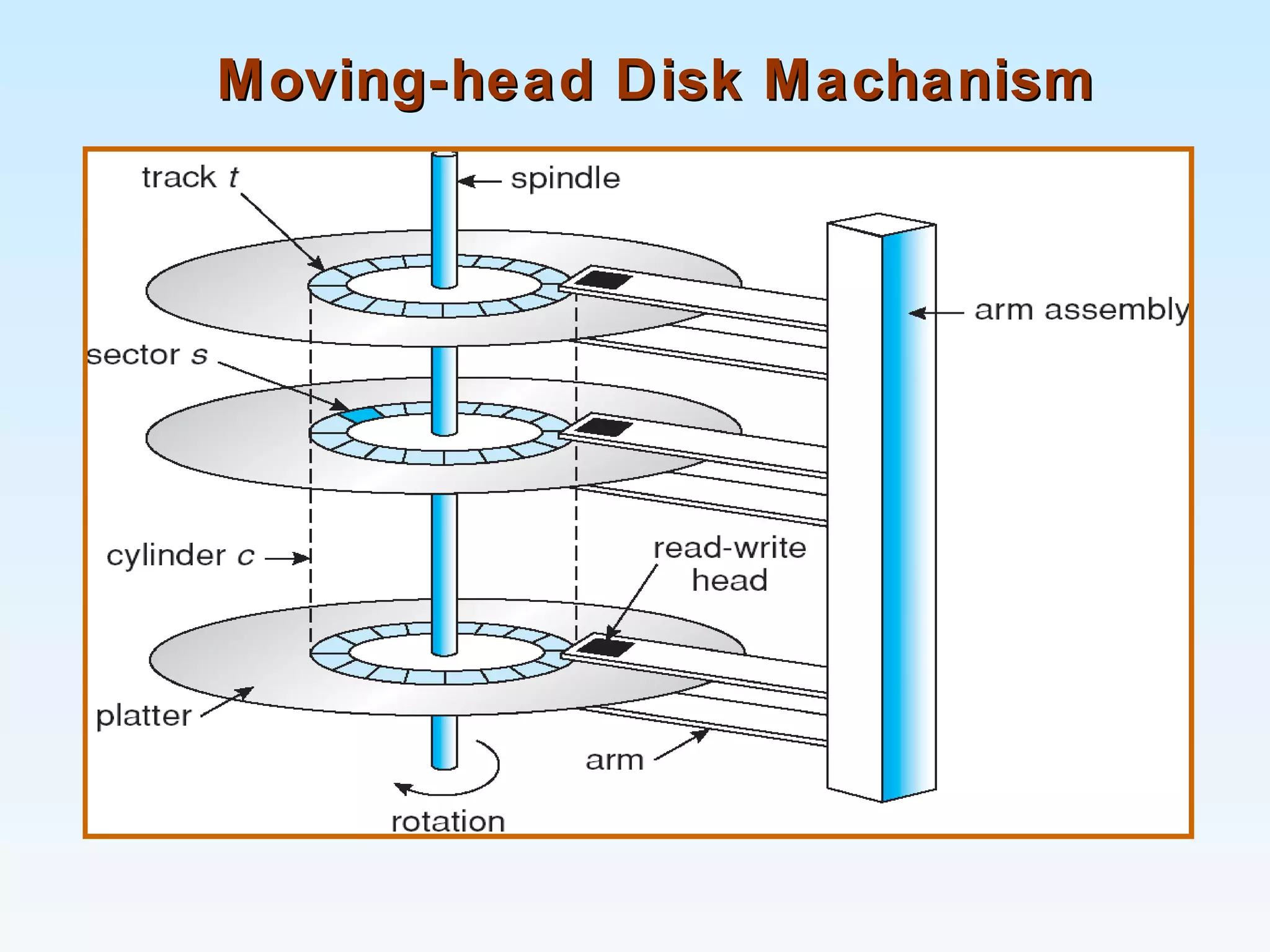
Moving-head Disk MachanismMoving-head Disk Machanism
Disk StructureDisk Structure
Disk drives are addressed as large 1-dimensional arrays of logical
blocks, where the logical block is the smallest unit of transfer.
The 1-dimensional array of logical blocks is mapped into the
sectors of the disk sequentially.
Sector 0 is the first sector of the first track on the outermost
cylinder.
Mapping proceeds in order through that track, then the rest of
the tracks in that cylinder, and then through the rest of the
cylinders from outermost to innermost.
Disk SchedulingDisk Scheduling
The operating system is responsible for using hardware efficiently
— for the disk drives, this means having a fast access time and
disk bandwidth.
Access time has two major components
Seek time is the time for the disk are to move the heads to the
cylinder containing the desired sector.
Rotational latency is the additional time waiting for the disk to
rotate the desired sector to the disk head.
Minimize seek time
Seek time ≈ seek distance
Disk bandwidth is the total number of bytes transferred, divided by
the total time between the first request for service and the
completion of the last transfer.
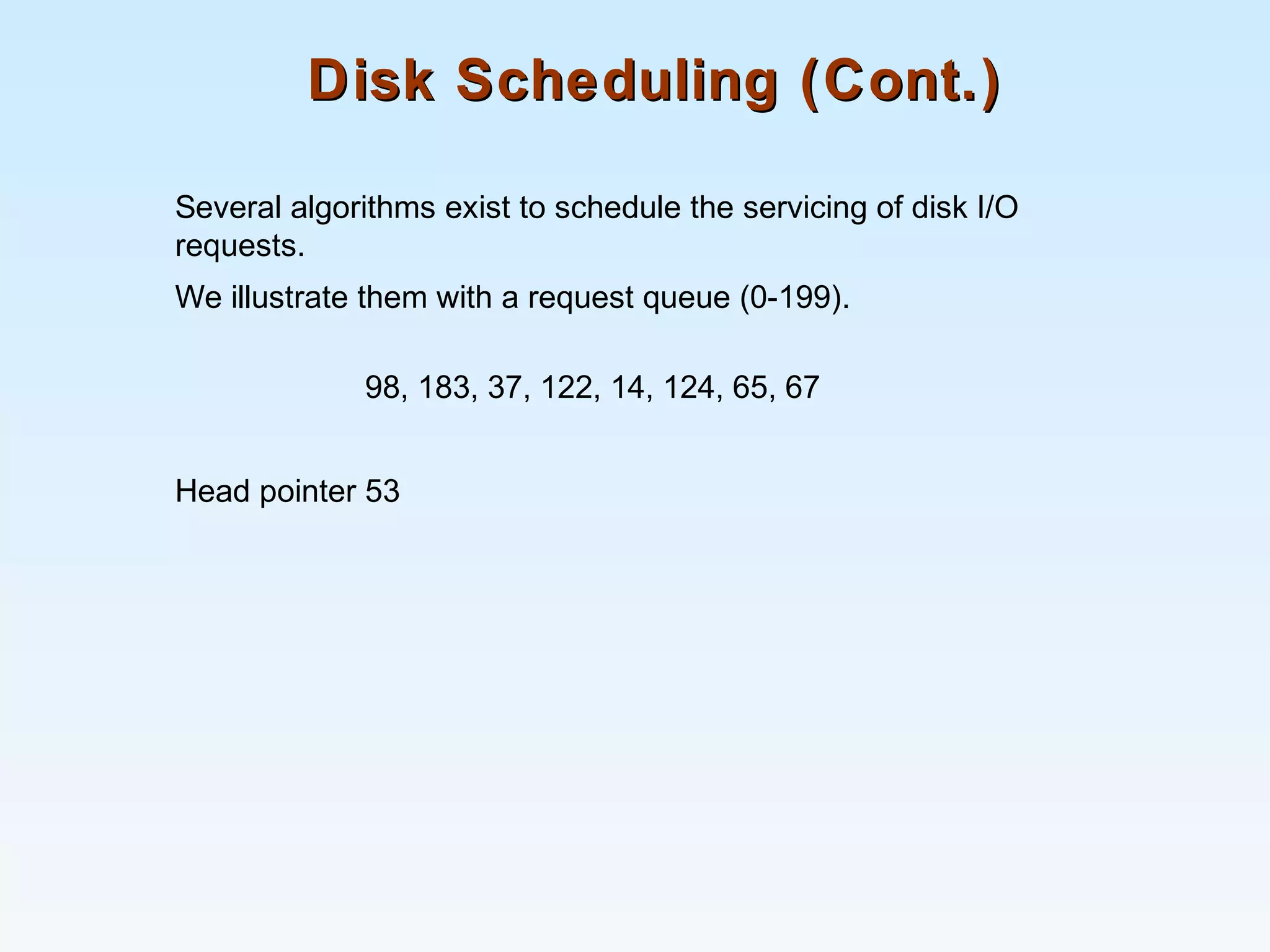
Disk Scheduling (Cont.)Disk Scheduling (Cont.)
Several algorithms exist to schedule the servicing of disk I/O
requests.
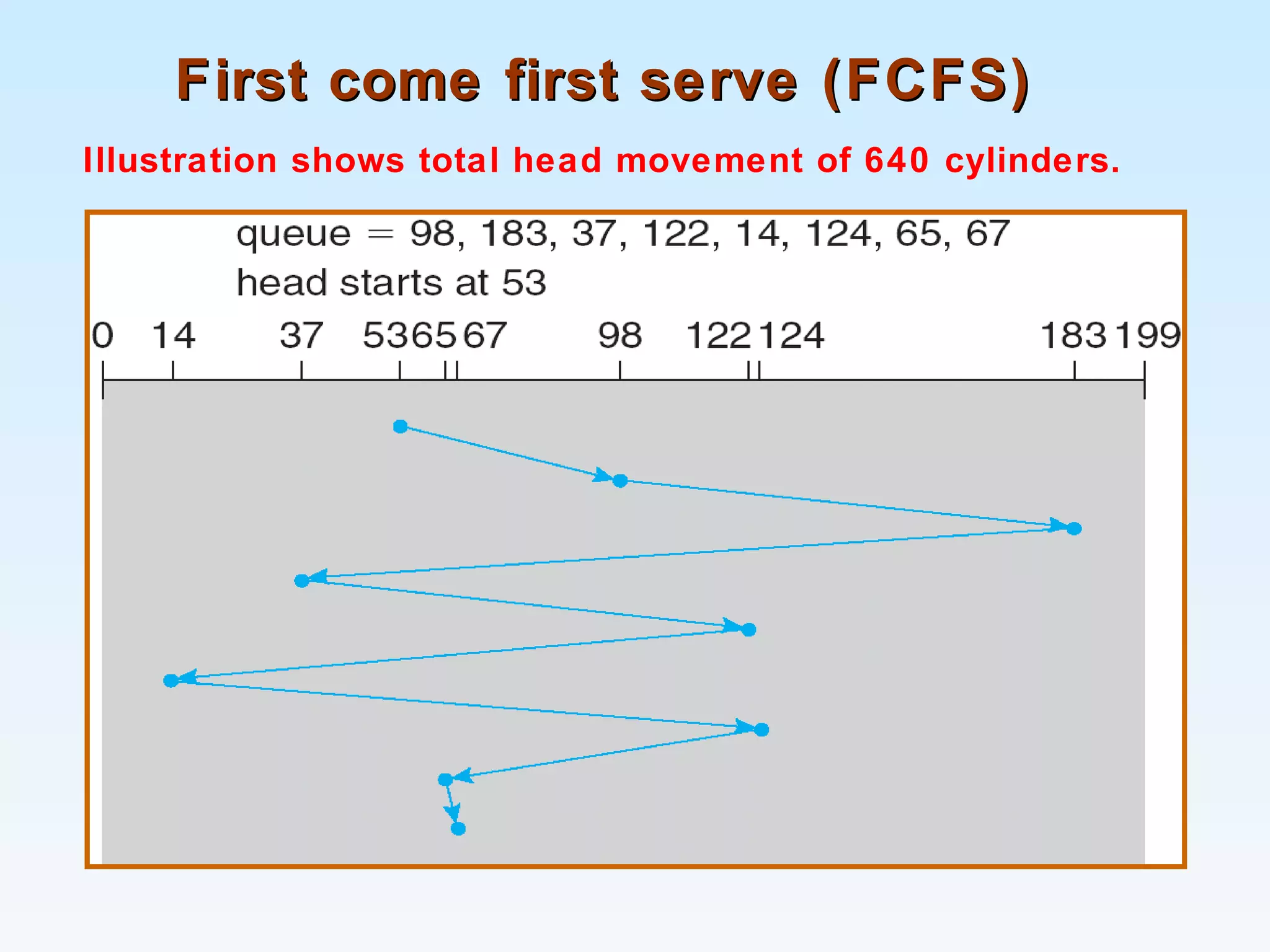
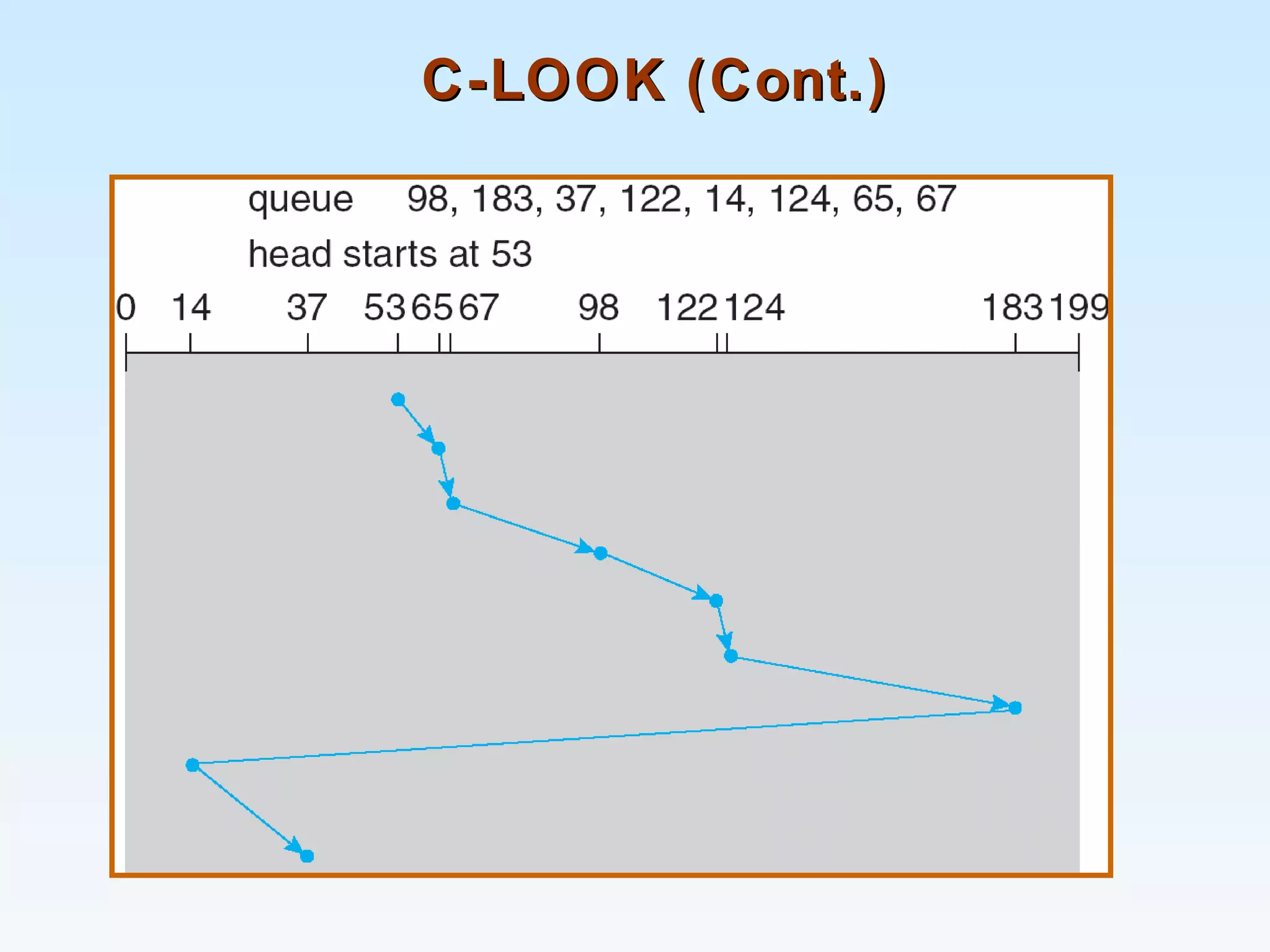
We illustrate them with a request queue (0-199).
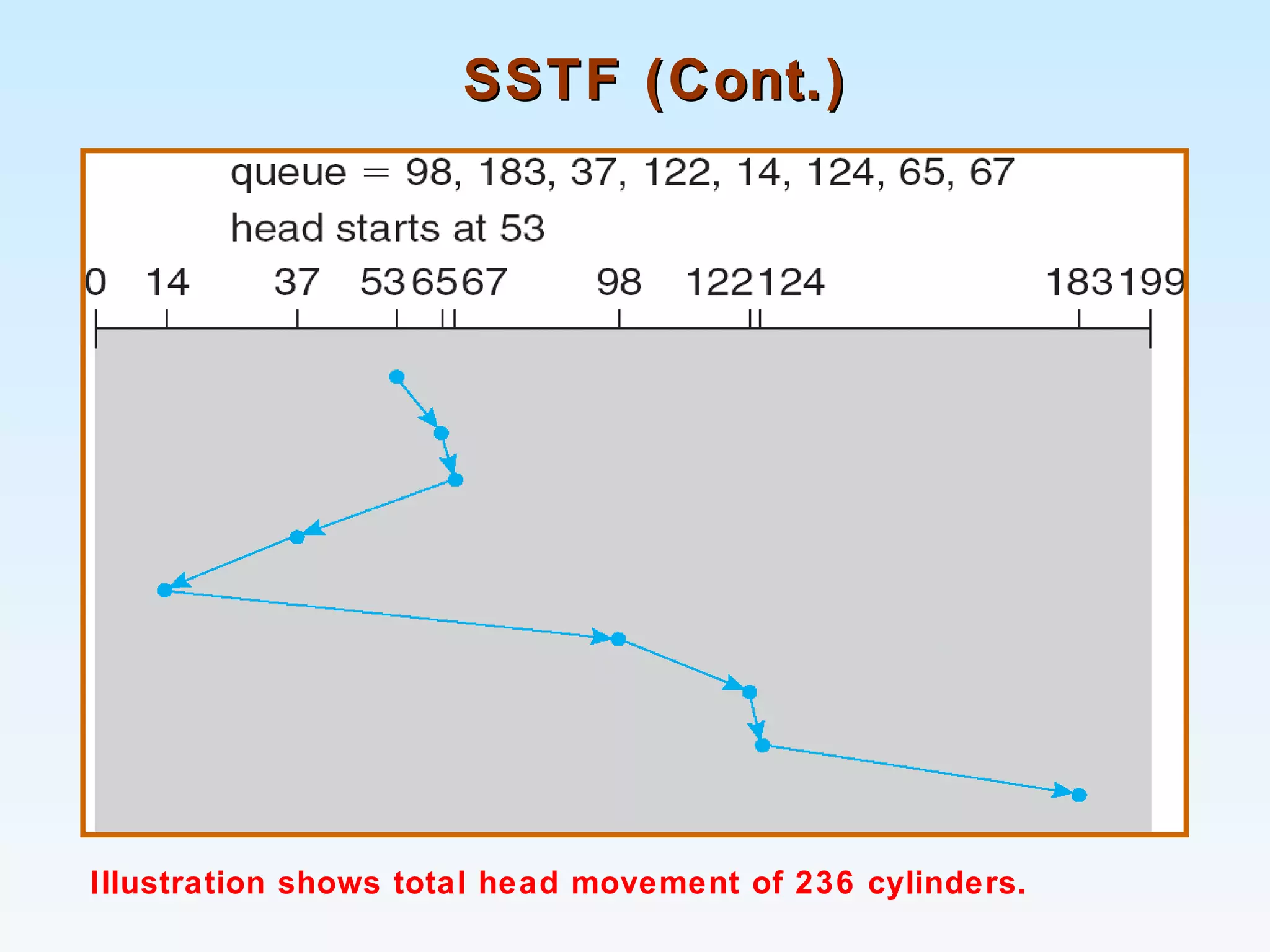
98, 183, 37, 122, 14, 124, 65, 67
Head pointer 53
First come first serve (FCFS)First come first serve (FCFS)
Illustration shows total head movement of 640 cylinders.
Shortest seek time first (SSTF)Shortest seek time first (SSTF)
Selects the request with the minimum seek time from the current
head position.
SSTF scheduling is a form of SJF scheduling; may cause starvation
of some requests.
Illustration shows total head movement of 236 cylinders.
SSTF (Cont.)SSTF (Cont.)
Illustration shows total head movement of 236 cylinders.
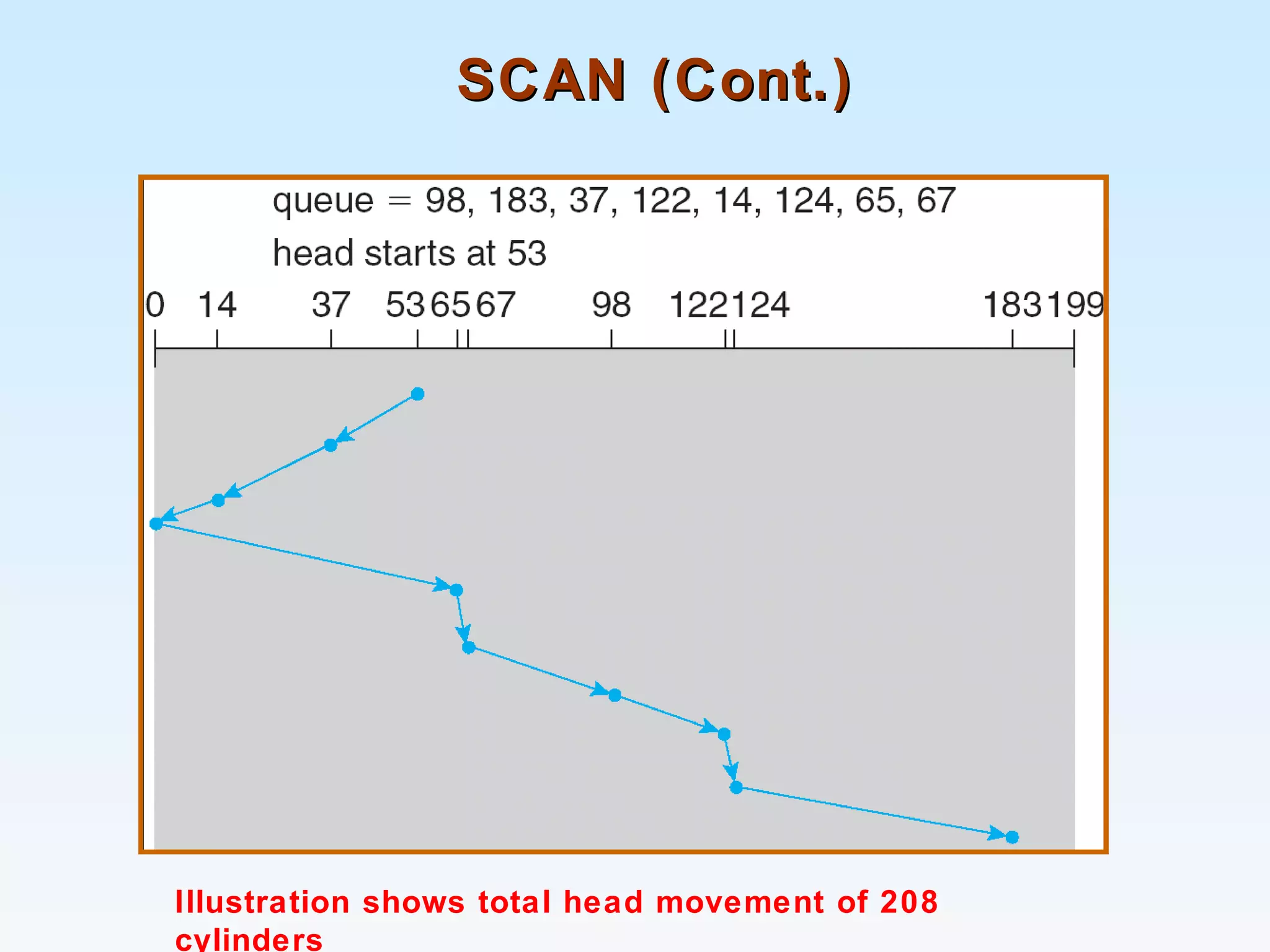
SCAN SchedulingSCAN Scheduling
The disk arm starts at one end of the disk, and
moves toward the other end, servicing requests
until it gets to the other end of the disk, where the
head movement is reversed and servicing
continues.
Sometimes called the elevator algorithm.
Illustration shows total head movement of 208
cylinders.
SCAN (Cont.)SCAN (Cont.)
Illustration shows total head movement of 208
cylinders
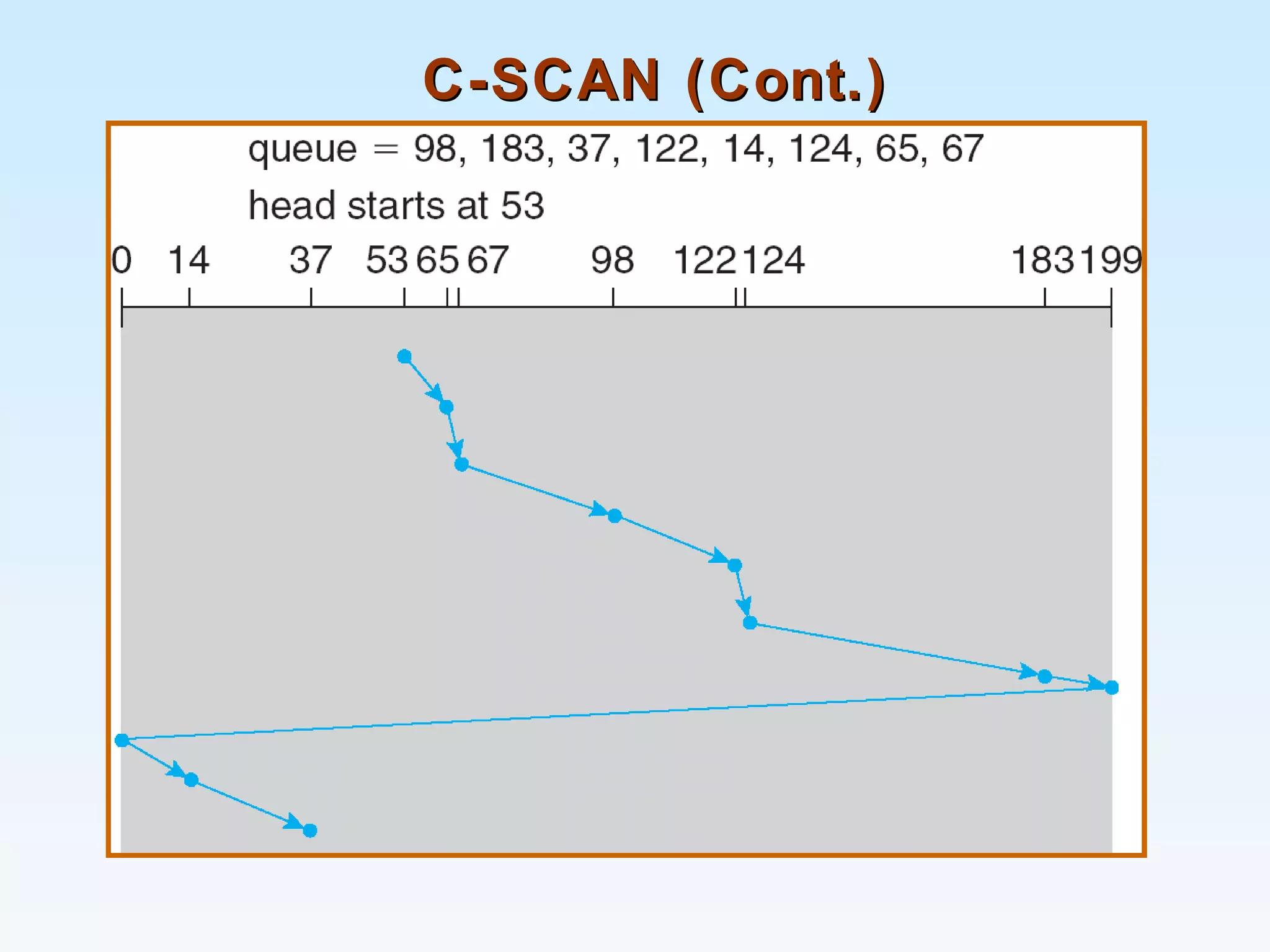
Circular-SCAN Scheduling (C-SCAN)Circular-SCAN Scheduling (C-SCAN)
Provides a more uniform wait time than SCAN.
The head moves from one end of the disk to the
other. servicing requests as it goes. When it
reaches the other end, however, it immediately
returns to the beginning of the disk, without
servicing any requests on the return trip.
Treats the cylinders as a circular list that wraps
around from the last cylinder to the first one.
C-SCAN (Cont.)C-SCAN (Cont.)
Circular –LOOK Scheduling (C-Look)Circular –LOOK Scheduling (C-Look)
Version of C-SCAN
Arm only goes as far as the last request in each
direction, then reverses direction immediately,
without first going all the way to the end of the
disk.
C-LOOK (Cont.)C-LOOK (Cont.)
Selecting a Disk-SchedulingSelecting a Disk-Scheduling
AlgorithmAlgorithm
SSTF is common and has a natural appeal
SCAN and C-SCAN perform better for systems that place a heavy
load on the disk.
Performance depends on the number and types of requests.
Requests for disk service can be influenced by the file-allocation
method.
The disk-scheduling algorithm should be written as a separate
module of the operating system, allowing it to be replaced with a
different algorithm if necessary.
Either SSTF or LOOK is a reasonable choice for the default
algorithm.
End of ChapterEnd of Chapter

Operating System

  • 1.
    Mass-Storage Systems Mr. SUBHASISDASH SCHOLE OF COMPUTER ENGINEERING. KIIT UNIVERSITY BHUBANESWAR
  • 2.
  • 3.
    Disk StructureDisk Structure Diskdrives are addressed as large 1-dimensional arrays of logical blocks, where the logical block is the smallest unit of transfer. The 1-dimensional array of logical blocks is mapped into the sectors of the disk sequentially. Sector 0 is the first sector of the first track on the outermost cylinder. Mapping proceeds in order through that track, then the rest of the tracks in that cylinder, and then through the rest of the cylinders from outermost to innermost.
  • 4.
    Disk SchedulingDisk Scheduling Theoperating system is responsible for using hardware efficiently — for the disk drives, this means having a fast access time and disk bandwidth. Access time has two major components Seek time is the time for the disk are to move the heads to the cylinder containing the desired sector. Rotational latency is the additional time waiting for the disk to rotate the desired sector to the disk head. Minimize seek time Seek time ≈ seek distance Disk bandwidth is the total number of bytes transferred, divided by the total time between the first request for service and the completion of the last transfer.
  • 5.
    Disk Scheduling (Cont.)DiskScheduling (Cont.) Several algorithms exist to schedule the servicing of disk I/O requests. We illustrate them with a request queue (0-199). 98, 183, 37, 122, 14, 124, 65, 67 Head pointer 53
  • 6.
    First come firstserve (FCFS)First come first serve (FCFS) Illustration shows total head movement of 640 cylinders.
  • 7.
    Shortest seek timefirst (SSTF)Shortest seek time first (SSTF) Selects the request with the minimum seek time from the current head position. SSTF scheduling is a form of SJF scheduling; may cause starvation of some requests. Illustration shows total head movement of 236 cylinders.
  • 8.
    SSTF (Cont.)SSTF (Cont.) Illustrationshows total head movement of 236 cylinders.
  • 9.
    SCAN SchedulingSCAN Scheduling Thedisk arm starts at one end of the disk, and moves toward the other end, servicing requests until it gets to the other end of the disk, where the head movement is reversed and servicing continues. Sometimes called the elevator algorithm. Illustration shows total head movement of 208 cylinders.
  • 10.
    SCAN (Cont.)SCAN (Cont.) Illustrationshows total head movement of 208 cylinders
  • 11.
    Circular-SCAN Scheduling (C-SCAN)Circular-SCANScheduling (C-SCAN) Provides a more uniform wait time than SCAN. The head moves from one end of the disk to the other. servicing requests as it goes. When it reaches the other end, however, it immediately returns to the beginning of the disk, without servicing any requests on the return trip. Treats the cylinders as a circular list that wraps around from the last cylinder to the first one.
  • 12.
  • 13.
    Circular –LOOK Scheduling(C-Look)Circular –LOOK Scheduling (C-Look) Version of C-SCAN Arm only goes as far as the last request in each direction, then reverses direction immediately, without first going all the way to the end of the disk.
  • 14.
  • 15.
    Selecting a Disk-SchedulingSelectinga Disk-Scheduling AlgorithmAlgorithm SSTF is common and has a natural appeal SCAN and C-SCAN perform better for systems that place a heavy load on the disk. Performance depends on the number and types of requests. Requests for disk service can be influenced by the file-allocation method. The disk-scheduling algorithm should be written as a separate module of the operating system, allowing it to be replaced with a different algorithm if necessary. Either SSTF or LOOK is a reasonable choice for the default algorithm.
  • 16.