Downloaded 21 times




![Parallel Section (for)#pragmaomp for [clause [clause …] ] { for loop}](https://image.slidesharecdn.com/openmp-100630042142-phpapp02/85/Open-MP-13-320.jpg)
![Parallel Section (sections)#pragmaomp sections [clause [clause …] ] { [#progmaomp section] structured code block}](https://image.slidesharecdn.com/openmp-100630042142-phpapp02/85/Open-MP-14-320.jpg)
![Clausesprivate(var1, …) to block sharing selected values with threadsshared(var1, …)to share selected values with threads schedule(type [, chunk_size])to divide work with threads for equalitystaticdynamic](https://image.slidesharecdn.com/openmp-100630042142-phpapp02/85/Open-MP-15-320.jpg)
![Synchronization (critical section)Declaring critical section in parallel sectionRunning only single thread at moment#pragmaomp critical [(name)]{ structured code block}](https://image.slidesharecdn.com/openmp-100630042142-phpapp02/85/Open-MP-16-320.jpg)


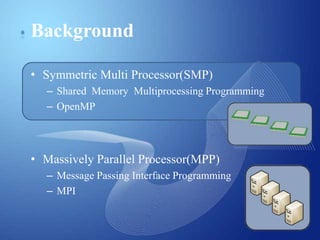
This document provides an overview of multiprocessing programming and OpenMP. It discusses symmetric multiprocessing using shared memory, as well as message passing interface programming. It then covers OpenMP programming models including parallel sections, clauses like private and shared to control data sharing, and synchronization using critical sections. The document aims to eliminate synchronization and dependency through OpenMP directives to generate multi-threaded code supported by compilers.


![What is [Open] MPI?](https://cdn.slidesharecdn.com/ss_thumbnails/test-1230829557420508-1-thumbnail.jpg?width=640&height=640&fit=bounds)


