OPEN DATA – LINK IT!
Dr Armin Haller
Senior Lecturer, ANU
Chair, Australian Government Linked Data Working Group
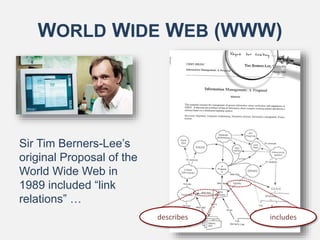
WORLD WIDE WEB (WWW)
Sir Tim Berners-Lee’s
original Proposal of the
World Wide Web in
1989 included “link
relations” …
includesdescribes
… but the WWW used only one
type of link relation
(hyperlinks) for years …
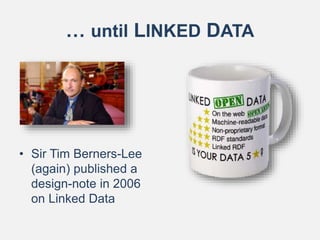
… until LINKED DATA
• Sir Tim Berners-Lee
(again) published a
design-note in 2006
on Linked Data
What is LINKED DATA?
LINKED DATA
• Structured Content → Linked
– Understandable to humans and machines
(machine-readable)
– Discoverable
– Reusable and Shareable
– Presentable
LINKED DATA PRINCIPLES
1. Identify ‘THINGS’
2. Make ‘THINGS’ available online
3. Provide machine-readable information
4. Include links to other ‘THINGS’
1. IDENTIFY ‘THINGS’
• URI – Uniform Resource Identifier
Compact sequence of characters …
… identifies an abstract or physical resource
[RFC3986]
• Linked Data  URI = URL
https://data.naa.gov.au/def/agift/Communications-infrastructure
1. IDENTIFY ‘THINGS’
Identifying and naming real-world and abstract
‘THINGS’ with URIs is extremely powerful,
because:
• it does not require any up-front agreement as
you are the owner of that URI
• others can reuse the URI and make further/other
statements about that ‘THING’
1. IDENTIFY ‘THINGS’
• Government agencies already keep lists of
identifiers for ‘THINGS’ they are responsible
for
• URIs are required for ‘THINGS’
– People, places, companies, products, roads,
hospitals, schools, events, natural resources, etc.
– e.g. ‘AU239’ Sample stored at Geoscience
Australia
• uses unique identifier (URI = URL):
http://pid.geoscience.gov.au/sample/AU239
2. MAKE ‘THINGS’ AVAILABLE
ONLINE
• Put information about these ‘THINGS’
on your website
i.e. when you type …
http://pid.geoscience.gov.au/sample/AU239
… in your browser you should get some
information about Sample AU239
3. PROVIDE MACHINE-READABLE
INFORMATION
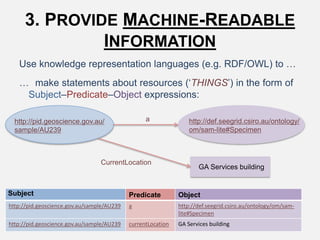
Use knowledge representation languages (e.g. RDF/OWL) to …
… make statements about resources (‘THINGS’) in the form of
Subject–Predicate–Object expressions:
Subject Predicate Object
http://pid.geoscience.gov.au/sample/AU239 a http://def.seegrid.csiro.au/ontology/om/sam-
lite#Specimen
http://pid.geoscience.gov.au/sample/AU239 currentLocation GA Services building
http://pid.geoscience.gov.au/
sample/AU239
http://def.seegrid.csiro.au/ontology/
om/sam-lite#Specimen
a
GA Services building
CurrentLocation
3. PROVIDE MACHINE-READABLE
INFORMATION
Assign meaning to ‘THINGS’ through ontologies (vocabularies)
– set of concepts (shared objects)
– relationships between those concepts (shared predicates)
• e.g. SAM-Lite ontology
http://def.seegrid.csiro.au/ontology/om/sam-lite
– “Specimen” Concept
URI – http://def.seegrid.csiro.au/ontology/om/sam-lite#Specimen
• ”A Specimen is a physical sample, obtained for observation(s)
normally carried out ex-situ, sometimes in a laboratory.”
• A perspective of the concept via attributes / properties: class
of material, current location, sampling elevation, sampling
location, sampling method, sampling time, specimen size …
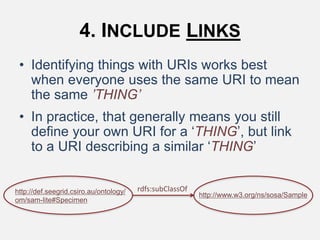
4. INCLUDE LINKS
• Identifying things with URIs works best
when everyone uses the same URI to mean
the same ’THING’
• In practice, that generally means you still
define your own URI for a ‘THING’, but link
to a URI describing a similar ‘THING’
rdfs:subClassOfhttp://def.seegrid.csiro.au/ontology/
om/sam-lite#Specimen
http://www.w3.org/ns/sosa/Sample
Who is using it?
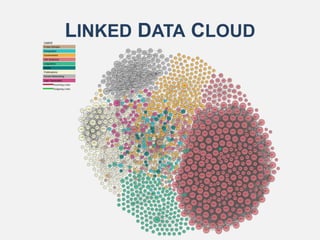
LINKED DATA CLOUD
… but is it largely an
academic exercise?
Yes it was, until SCHEMA.ORG
• In 2011, the major search engines
Google, Bing ,Yahoo, and (later) Yandex
created Schema.org
– Single vocabulary (ontology) across a wide
range of topics
– Includes classes/properties for people,
places, events, products, offers, …
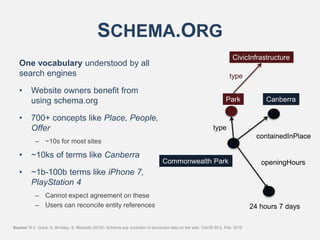
SCHEMA.ORG
One vocabulary understood by all
search engines
• Website owners benefit from
using schema.org
• 700+ concepts like Place, People,
Offer
– ~10s for most sites
• ~10ks of terms like Canberra
• ~1b-100b terms like iPhone 7,
PlayStation 4
– Cannot expect agreement on these
– Users can reconcile entity references
Commonwealth Park
Canberra
24 hours 7 days
containedInPlace
Park
type
openingHours
Source: R.V. Guha, D. Brickley, S. Macbeth (2016). Schema.org: evolution of structured data on the web. CACM 59:2, Feb. 2016
CivicInfrastructure
type
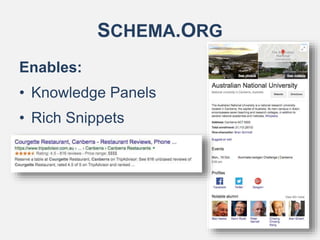
Enables:
• Knowledge Panels
• Rich Snippets
SCHEMA.ORG
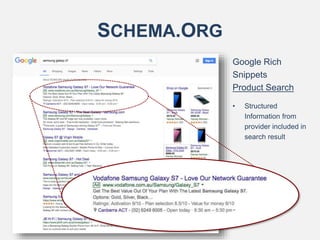
Google Rich
Snippets
Product Search
• Structured
Information from
provider included in
search result
SCHEMA.ORG
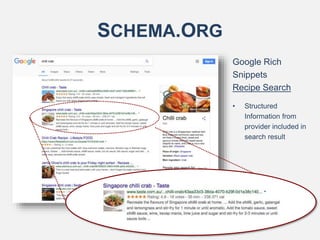
Google Rich
Snippets
Recipe Search
• Structured
Information from
provider included in
search result
SCHEMA.ORG
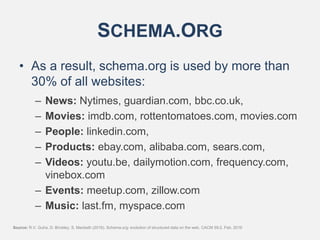
• As a result, schema.org is used by more than
30% of all websites:
– News: Nytimes, guardian.com, bbc.co.uk,
– Movies: imdb.com, rottentomatoes.com, movies.com
– People: linkedin.com,
– Products: ebay.com, alibaba.com, sears.com,
– Videos: youtu.be, dailymotion.com, frequency.com,
vinebox.com
– Events: meetup.com, zillow.com
– Music: last.fm, myspace.com
SCHEMA.ORG
Source: R.V. Guha, D. Brickley, S. Macbeth (2016). Schema.org: evolution of structured data on the web. CACM 59:2, Feb. 2016
… and Governments need to
use Linked Data and
schema.org too!
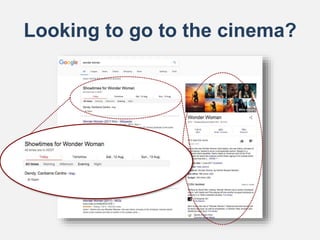
Looking to go to the cinema?
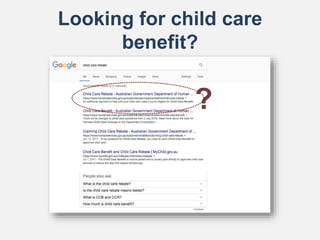
Looking for child care
benefit?
?
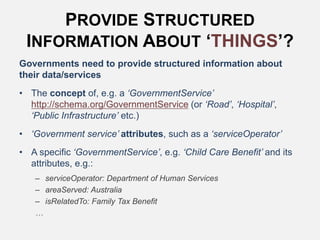
PROVIDE STRUCTURED
INFORMATION ABOUT ‘THINGS’?
Governments need to provide structured information about
their data/services
• The concept of, e.g. a ‘GovernmentService’
http://schema.org/GovernmentService (or ‘Road’, ‘Hospital’,
‘Public Infrastructure’ etc.)
• ‘Government service’ attributes, such as a ‘serviceOperator’
• A specific ‘GovernmentService’, e.g. ‘Child Care Benefit’ and its
attributes, e.g.:
– serviceOperator: Department of Human Services
– areaServed: Australia
– isRelatedTo: Family Tax Benefit
…
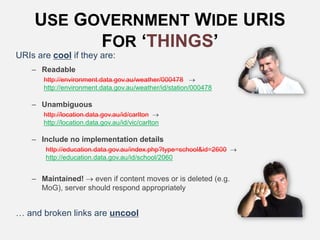
USE GOVERNMENT WIDE URIS
FOR ‘THINGS’
URIs are cool if they are:
– Readable
http://environment.data.gov.au/weather/000478 
http://environment.data.gov.au/weather/id/station/000478
– Unambiguous
http://location.data.gov.au/id/carlton 
http://location.data.gov.au/id/vic/carlton
– Include no implementation details
http://education.data.gov.au/index.php?type=school&id=2600 
http://education.data.gov.au/id/school/2060
– Maintained!  even if content moves or is deleted (e.g.
MoG), server should respond appropriately
… and broken links are uncool
AUSTRALIAN GOVERNMENT LINKED DATA
WORKING GROUP
Community of Commonwealth Government experts and champions, with invited non-
voting participation of individuals, corporations and other entities to:
• Establish technical guidance publishing public sector information using Linked Data
as a delivery technology
• Determine governance rules and processes for the effective management of
Australian Government Linked Data
• Promote Linked Data across the Australian Government
• Engender the development of Linked Data infrastructure
http://linked.data.gov.au/
URI GUIDELINES
• Index of a Dataset: Identifier that names a Linked dataset and
provides metadata of the dataset.
• Real-world ‘Things’ Identifier: Physical and abstract ‘Things’ that
may be referred to in statements.
• Document Identifier: Information on the web about Real World
‘Things’
• Vocabulary identifiers (ontologies, concepts etc.): URIs for classes
and properties describing real-world things
/dataset[/{module}]*/{datasetid} → /dataset/act/schools [Metadata for School Dataset]
/id/{type}/{name} → /id/school/2060 [Canberra Grammar]
/doc/{type}/{name} → /doc/school/2060 [Document about Canberra Grammar]
/def/{scheme}/{concept} → /def/school/phaseOfEducation [Class definition]
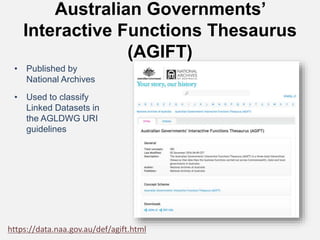
Australian Governments’
Interactive Functions Thesaurus
(AGIFT)
• Published by
National Archives
• Used to classify
Linked Datasets in
the AGLDWG URI
guidelines
https://data.naa.gov.au/def/agift.html
QUESTIONS?
http://linked.data.gov.au
https://github.com/AGLDWG

Open Data - Link it!

  • 1.
    OPEN DATA –LINK IT! Dr Armin Haller Senior Lecturer, ANU Chair, Australian Government Linked Data Working Group
  • 2.
    WORLD WIDE WEB(WWW) Sir Tim Berners-Lee’s original Proposal of the World Wide Web in 1989 included “link relations” … includesdescribes
  • 3.
    … but theWWW used only one type of link relation (hyperlinks) for years …
  • 4.
    … until LINKEDDATA • Sir Tim Berners-Lee (again) published a design-note in 2006 on Linked Data
  • 5.
  • 6.
    LINKED DATA • StructuredContent → Linked – Understandable to humans and machines (machine-readable) – Discoverable – Reusable and Shareable – Presentable
  • 7.
    LINKED DATA PRINCIPLES 1.Identify ‘THINGS’ 2. Make ‘THINGS’ available online 3. Provide machine-readable information 4. Include links to other ‘THINGS’
  • 8.
    1. IDENTIFY ‘THINGS’ •URI – Uniform Resource Identifier Compact sequence of characters … … identifies an abstract or physical resource [RFC3986] • Linked Data  URI = URL https://data.naa.gov.au/def/agift/Communications-infrastructure
  • 9.
    1. IDENTIFY ‘THINGS’ Identifyingand naming real-world and abstract ‘THINGS’ with URIs is extremely powerful, because: • it does not require any up-front agreement as you are the owner of that URI • others can reuse the URI and make further/other statements about that ‘THING’
  • 10.
    1. IDENTIFY ‘THINGS’ •Government agencies already keep lists of identifiers for ‘THINGS’ they are responsible for • URIs are required for ‘THINGS’ – People, places, companies, products, roads, hospitals, schools, events, natural resources, etc. – e.g. ‘AU239’ Sample stored at Geoscience Australia • uses unique identifier (URI = URL): http://pid.geoscience.gov.au/sample/AU239
  • 11.
    2. MAKE ‘THINGS’AVAILABLE ONLINE • Put information about these ‘THINGS’ on your website i.e. when you type … http://pid.geoscience.gov.au/sample/AU239 … in your browser you should get some information about Sample AU239
  • 12.
    3. PROVIDE MACHINE-READABLE INFORMATION Useknowledge representation languages (e.g. RDF/OWL) to … … make statements about resources (‘THINGS’) in the form of Subject–Predicate–Object expressions: Subject Predicate Object http://pid.geoscience.gov.au/sample/AU239 a http://def.seegrid.csiro.au/ontology/om/sam- lite#Specimen http://pid.geoscience.gov.au/sample/AU239 currentLocation GA Services building http://pid.geoscience.gov.au/ sample/AU239 http://def.seegrid.csiro.au/ontology/ om/sam-lite#Specimen a GA Services building CurrentLocation
  • 13.
    3. PROVIDE MACHINE-READABLE INFORMATION Assignmeaning to ‘THINGS’ through ontologies (vocabularies) – set of concepts (shared objects) – relationships between those concepts (shared predicates) • e.g. SAM-Lite ontology http://def.seegrid.csiro.au/ontology/om/sam-lite – “Specimen” Concept URI – http://def.seegrid.csiro.au/ontology/om/sam-lite#Specimen • ”A Specimen is a physical sample, obtained for observation(s) normally carried out ex-situ, sometimes in a laboratory.” • A perspective of the concept via attributes / properties: class of material, current location, sampling elevation, sampling location, sampling method, sampling time, specimen size …
  • 14.
    4. INCLUDE LINKS •Identifying things with URIs works best when everyone uses the same URI to mean the same ’THING’ • In practice, that generally means you still define your own URI for a ‘THING’, but link to a URI describing a similar ‘THING’ rdfs:subClassOfhttp://def.seegrid.csiro.au/ontology/ om/sam-lite#Specimen http://www.w3.org/ns/sosa/Sample
  • 15.
  • 16.
  • 17.
    … but isit largely an academic exercise?
  • 18.
    Yes it was,until SCHEMA.ORG • In 2011, the major search engines Google, Bing ,Yahoo, and (later) Yandex created Schema.org – Single vocabulary (ontology) across a wide range of topics – Includes classes/properties for people, places, events, products, offers, …
  • 19.
    SCHEMA.ORG One vocabulary understoodby all search engines • Website owners benefit from using schema.org • 700+ concepts like Place, People, Offer – ~10s for most sites • ~10ks of terms like Canberra • ~1b-100b terms like iPhone 7, PlayStation 4 – Cannot expect agreement on these – Users can reconcile entity references Commonwealth Park Canberra 24 hours 7 days containedInPlace Park type openingHours Source: R.V. Guha, D. Brickley, S. Macbeth (2016). Schema.org: evolution of structured data on the web. CACM 59:2, Feb. 2016 CivicInfrastructure type
  • 20.
    Enables: • Knowledge Panels •Rich Snippets SCHEMA.ORG
  • 21.
    Google Rich Snippets Product Search •Structured Information from provider included in search result SCHEMA.ORG
  • 22.
    Google Rich Snippets Recipe Search •Structured Information from provider included in search result SCHEMA.ORG
  • 23.
    • As aresult, schema.org is used by more than 30% of all websites: – News: Nytimes, guardian.com, bbc.co.uk, – Movies: imdb.com, rottentomatoes.com, movies.com – People: linkedin.com, – Products: ebay.com, alibaba.com, sears.com, – Videos: youtu.be, dailymotion.com, frequency.com, vinebox.com – Events: meetup.com, zillow.com – Music: last.fm, myspace.com SCHEMA.ORG Source: R.V. Guha, D. Brickley, S. Macbeth (2016). Schema.org: evolution of structured data on the web. CACM 59:2, Feb. 2016
  • 24.
    … and Governmentsneed to use Linked Data and schema.org too!
  • 25.
    Looking to goto the cinema?
  • 26.
    Looking for childcare benefit? ?
  • 27.
    PROVIDE STRUCTURED INFORMATION ABOUT‘THINGS’? Governments need to provide structured information about their data/services • The concept of, e.g. a ‘GovernmentService’ http://schema.org/GovernmentService (or ‘Road’, ‘Hospital’, ‘Public Infrastructure’ etc.) • ‘Government service’ attributes, such as a ‘serviceOperator’ • A specific ‘GovernmentService’, e.g. ‘Child Care Benefit’ and its attributes, e.g.: – serviceOperator: Department of Human Services – areaServed: Australia – isRelatedTo: Family Tax Benefit …
  • 28.
    USE GOVERNMENT WIDEURIS FOR ‘THINGS’ URIs are cool if they are: – Readable http://environment.data.gov.au/weather/000478  http://environment.data.gov.au/weather/id/station/000478 – Unambiguous http://location.data.gov.au/id/carlton  http://location.data.gov.au/id/vic/carlton – Include no implementation details http://education.data.gov.au/index.php?type=school&id=2600  http://education.data.gov.au/id/school/2060 – Maintained!  even if content moves or is deleted (e.g. MoG), server should respond appropriately … and broken links are uncool
  • 29.
    AUSTRALIAN GOVERNMENT LINKEDDATA WORKING GROUP Community of Commonwealth Government experts and champions, with invited non- voting participation of individuals, corporations and other entities to: • Establish technical guidance publishing public sector information using Linked Data as a delivery technology • Determine governance rules and processes for the effective management of Australian Government Linked Data • Promote Linked Data across the Australian Government • Engender the development of Linked Data infrastructure http://linked.data.gov.au/
  • 30.
    URI GUIDELINES • Indexof a Dataset: Identifier that names a Linked dataset and provides metadata of the dataset. • Real-world ‘Things’ Identifier: Physical and abstract ‘Things’ that may be referred to in statements. • Document Identifier: Information on the web about Real World ‘Things’ • Vocabulary identifiers (ontologies, concepts etc.): URIs for classes and properties describing real-world things /dataset[/{module}]*/{datasetid} → /dataset/act/schools [Metadata for School Dataset] /id/{type}/{name} → /id/school/2060 [Canberra Grammar] /doc/{type}/{name} → /doc/school/2060 [Document about Canberra Grammar] /def/{scheme}/{concept} → /def/school/phaseOfEducation [Class definition]
  • 31.
    Australian Governments’ Interactive FunctionsThesaurus (AGIFT) • Published by National Archives • Used to classify Linked Datasets in the AGLDWG URI guidelines https://data.naa.gov.au/def/agift.html
  • 32.