Open Data for Education Linked Shared and
Reusable Data for Teaching and Learning 1st
Edition Dmitry Mouromtsev download
https://textbookfull.com/product/open-data-for-education-linked-
shared-and-reusable-data-for-teaching-and-learning-1st-edition-
dmitry-mouromtsev/
Download full version ebook from https://textbookfull.com
We believe these products will be a great fit for you. Click
the link to download now, or visit textbookfull.com
to discover even more!
Development of Linguistic Linked Open Data Resources
for Collaborative Data Intensive Research in the
Language Sciences 1st Edition Antonio Pareja Lora
https://textbookfull.com/product/development-of-linguistic-
linked-open-data-resources-for-collaborative-data-intensive-
research-in-the-language-sciences-1st-edition-antonio-pareja-
lora/
Linked Data for the Perplexed Librarian ALCTS Monograph
1st Edition Scott Carlson
https://textbookfull.com/product/linked-data-for-the-perplexed-
librarian-alcts-monograph-1st-edition-scott-carlson/
Linked Data Storing Querying and Reasoning 1st Edition
Sherif Sakr
https://textbookfull.com/product/linked-data-storing-querying-
and-reasoning-1st-edition-sherif-sakr/
Teaching physical education for learning Seventh
Edition. Edition Rink
https://textbookfull.com/product/teaching-physical-education-for-
learning-seventh-edition-edition-rink/
Demystifying big data and machine learning for
healthcare 1st Edition Frenzel
https://textbookfull.com/product/demystifying-big-data-and-
machine-learning-for-healthcare-1st-edition-frenzel/
Azure Data Factory Cookbook - Second Edition Dmitry
Foshin
https://textbookfull.com/product/azure-data-factory-cookbook-
second-edition-dmitry-foshin/
Data Stewardship for Open Science : Implementing FAIR
Principles First Edition Mons
https://textbookfull.com/product/data-stewardship-for-open-
science-implementing-fair-principles-first-edition-mons/
Azure Data Factory Cookbook: Data engineers guide to
build and manage ETL and ELT pipelines with data
integration , 2nd Edition Dmitry Foshin
https://textbookfull.com/product/azure-data-factory-cookbook-
data-engineers-guide-to-build-and-manage-etl-and-elt-pipelines-
with-data-integration-2nd-edition-dmitry-foshin/
Feature Engineering for Machine Learning and Data
Analytics First Edition Dong
https://textbookfull.com/product/feature-engineering-for-machine-
learning-and-data-analytics-first-edition-dong/
Dmitry Mouromtsev
Mathieu d’Aquin (Eds.)
Open Data
for Education
State-of-the-Art
Survey
LNCS
9500
123
Linked, Shared, and Reusable Data
for Teaching and Learning
Lecture Notes in Computer Science 9500
Commenced Publication in 1973
Founding and Former Series Editors:
Gerhard Goos, Juris Hartmanis, and Jan van Leeuwen
Editorial Board
David Hutchison
Lancaster University, Lancaster, UK
Takeo Kanade
Carnegie Mellon University, Pittsburgh, PA, USA
Josef Kittler
University of Surrey, Guildford, UK
Jon M. Kleinberg
Cornell University, Ithaca, NY, USA
Friedemann Mattern
ETH Zurich, Zürich, Switzerland
John C. Mitchell
Stanford University, Stanford, CA, USA
Moni Naor
Weizmann Institute of Science, Rehovot, Israel
C. Pandu Rangan
Indian Institute of Technology, Madras, India
Bernhard Steffen
TU Dortmund University, Dortmund, Germany
Demetri Terzopoulos
University of California, Los Angeles, CA, USA
Doug Tygar
University of California, Berkeley, CA, USA
Gerhard Weikum
Max Planck Institute for Informatics, Saarbrücken, Germany
More information about this series at http://www.springer.com/series/7409
Dmitry Mouromtsev • Mathieu d’Aquin (Eds.)
Open Data
for Education
Linked, Shared, and Reusable Data
for Teaching and Learning
123
Editors
Dmitry Mouromtsev
ITMO University
St. Petersburg
Russia
Mathieu d’Aquin
Knowledge Media Institute
Milton Keynes
UK
ISSN 0302-9743 ISSN 1611-3349 (electronic)
Lecture Notes in Computer Science
ISBN 978-3-319-30492-2 ISBN 978-3-319-30493-9 (eBook)
DOI 10.1007/978-3-319-30493-9
Library of Congress Control Number: 2016933113
LNCS Sublibrary: SL3 – Information Systems and Applications, incl. Internet/Web, and HCI
© Springer International Publishing Switzerland 2016
This work is subject to copyright. All rights are reserved by the Publisher, whether the whole or part of the
material is concerned, specifically the rights of translation, reprinting, reuse of illustrations, recitation,
broadcasting, reproduction on microfilms or in any other physical way, and transmission or information
storage and retrieval, electronic adaptation, computer software, or by similar or dissimilar methodology now
known or hereafter developed.
The use of general descriptive names, registered names, trademarks, service marks, etc. in this publication
does not imply, even in the absence of a specific statement, that such names are exempt from the relevant
protective laws and regulations and therefore free for general use.
The publisher, the authors and the editors are safe to assume that the advice and information in this book are
believed to be true and accurate at the date of publication. Neither the publisher nor the authors or the editors
give a warranty, express or implied, with respect to the material contained herein or for any errors or
omissions that may have been made.
Printed on acid-free paper
This Springer imprint is published by Springer Nature
The registered company is Springer International Publishing AG Switzerland
Preface
The amount of open data, including especially linked open data, is constantly
increasing in many domains, especially in the public sector. A great number of private
and public organizations, institutions, and companies open their data and are interested
in efficient solutions for sharing and reuse of published datasets. Obvious benefits come
with opening data for end-users, organizations, and developers, by making it easier to
find, obtain, and use data independently of their origin, the systems used to produce
them, or the applications for which they are intended. This directly connects with the
way the areas of learning, teaching, and education are evolving. Indeed, the activity of
learning is changing very rapidly, especially through the Web, data, and open tech-
nologies. Distance learning is becoming more common, based on openly available
educational resources on the Web and the recently appeared massive open online
courses (MOOC) both in public higher education institutions and private training
centers and organizations.
The primary goal of open data in education is therefore to support these changes
through new methodologies and technologies that support the sharing and distribution
of information about teaching and the subjects of learning. On the practical side, it
serves various purposes such as to help teachers to find and create reusable educational
materials, to assist students and families in their educational decisions throughout their
life, to improve management systems and many others. For this reason the section of
educational open data on the Web has expanded with information about courses and
educational materials that can be accessed by tools and applications as well as, social
and collaborative resources, thus shaping new architectures of open education. The past
few years have demonstrated the growing interest in the topic of educational open data
and the growth of the community. During five successful editions of the LILE (Linked
Learning) workshops, keynotes, paper sessions, and panel discussions have shown the
state of the art and progress in practical work with open data in education. A number of
initiatives were started including community platforms (such as LinkedUniversities.
org), the W3C Open Linked Education Community Group1
, and activities within the
Open Knowledge2
and the VIVO platform3
, to name just a few.
The goal of this book is therefore to act as a snapshot of current activities, and to
share and disseminate the growing collective experience on open and linked data in
education. In this volume we bring together research results, studies, and practical
endeavors from initiatives spread across several countries around the world. These
initiatives are laying the foundations of open and linked data in the education move-
ment, and they are leading the way through innovative applications.
1
https://www.w3.org/community/opened/
2
https://okfn.org/
3
http://www.vivoweb.org
The chapters are selected from extended versions of papers presented at an Open
Data in Education Seminar4
and the LILE workshops during 2014–20155,6
. They have
been chosen to represent the diversity of practices and experiences that exist in the
domain, from the researchers, developers, and community leaders who are pioneering
the use of open and linked data in education.
In the first part of this book, two chapters provide different perspectives on the
current state of the use of linked and open data in education, including the use of
technology and the topics that are being covered.
The second part is to be considered the core of this book as it focuses on the specific,
practical applications that are being put in place to exploit open and linked data in
education today. In these four chapters, applications are presented ranging from the set-
up of open data platforms in educational institutions, to supporting specific learning
activities through the use of online, open data.
Finally, a key element of the evolving world of open data is to ensure the skills and
ability to use such data are there. We therefore focus in the three last chapters of this
book on the other side of open and linked data in education: on teaching the technology
and practices so they can be widely applied, and on the community of practitioners
pushing these practices forward.
We assume the readers of this book are reasonably familiar with modern educational
technologies and Web standards (including basics of the Semantic Web). The chapters
will be of interest, to varying extents, to academic heads and managers; educators,
teachers, and tutors, and start-ups in education; library staff; postgraduates; technology
researchers and professionals; as well as students and learners who are keen to better
understand how the technologies of the Web and linked data can be applied to support
progress in learning and education.
We acknowledge all the contributors and those who spent time on reviewing
chapters and making critical comments and fruitful discussions. First of all we want to
thank the members of numerous projects that have supported the development of the
works presented in this book, including in particular the LUCERO project, the Lin-
kedUp support action, the VIVO project, and some others. We also thank the funders
of these projects, as well as our universities and organizations, especially the Open
University and ITMO University that provided the environment for such projects to
develop. We also want to thank all the members of the various communities dedicated
to making open data in education a reality, including the W3C Open and Linked
Education community group, the Open Knowledge Open Education Group,
LinkedUniversities.org, and LinkedEducation.org. Finally, we thank our families,
friends, and colleagues for their support and positive encouragement.
January 2016 Dmitry Mouromtsev
Mathieu d’Aquin
4
https://linkededucation.wordpress.com/events/open-data-in-education-seminar-st-petersburg/
5
https://linkededucation.wordpress.com/events/lile2014/
6
https://lile2015.wordpress.com/
VI Preface
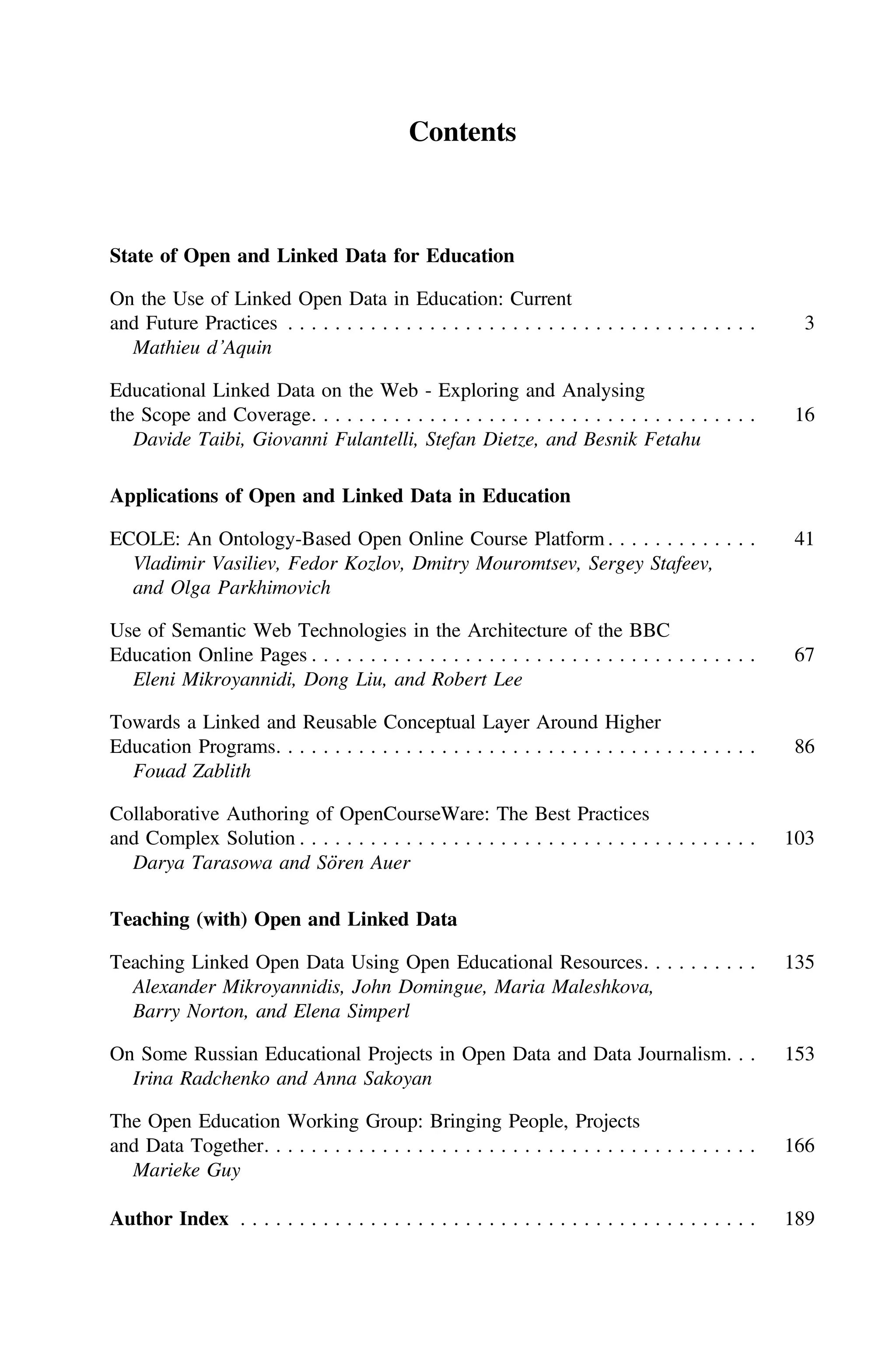
Contents
State of Open and Linked Data for Education
On the Use of Linked Open Data in Education: Current
and Future Practices . . . . . . . . . . . . . . . . . . . . . . . . . . . . . . . . . . . . . . . . 3
Mathieu d’Aquin
Educational Linked Data on the Web - Exploring and Analysing
the Scope and Coverage. . . . . . . . . . . . . . . . . . . . . . . . . . . . . . . . . . . . . . 16
Davide Taibi, Giovanni Fulantelli, Stefan Dietze, and Besnik Fetahu
Applications of Open and Linked Data in Education
ECOLE: An Ontology-Based Open Online Course Platform . . . . . . . . . . . . . 41
Vladimir Vasiliev, Fedor Kozlov, Dmitry Mouromtsev, Sergey Stafeev,
and Olga Parkhimovich
Use of Semantic Web Technologies in the Architecture of the BBC
Education Online Pages . . . . . . . . . . . . . . . . . . . . . . . . . . . . . . . . . . . . . . 67
Eleni Mikroyannidi, Dong Liu, and Robert Lee
Towards a Linked and Reusable Conceptual Layer Around Higher
Education Programs. . . . . . . . . . . . . . . . . . . . . . . . . . . . . . . . . . . . . . . . . 86
Fouad Zablith
Collaborative Authoring of OpenCourseWare: The Best Practices
and Complex Solution . . . . . . . . . . . . . . . . . . . . . . . . . . . . . . . . . . . . . . . 103
Darya Tarasowa and Sören Auer
Teaching (with) Open and Linked Data
Teaching Linked Open Data Using Open Educational Resources. . . . . . . . . . 135
Alexander Mikroyannidis, John Domingue, Maria Maleshkova,
Barry Norton, and Elena Simperl
On Some Russian Educational Projects in Open Data and Data Journalism. . . 153
Irina Radchenko and Anna Sakoyan
The Open Education Working Group: Bringing People, Projects
and Data Together. . . . . . . . . . . . . . . . . . . . . . . . . . . . . . . . . . . . . . . . . . 166
Marieke Guy
Author Index . . . . . . . . . . . . . . . . . . . . . . . . . . . . . . . . . . . . . . . . . . . . 189
State of Open and Linked
Data for Education
On the Use of Linked Open Data in Education:
Current and Future Practices
Mathieu d’Aquin(B)
Knowledge Media Institute, The Open University,
Walton Hall, Milton Keynes, UK
mathieu.daquin@open.ac.uk
Abstract. Education has often been a keen adopter of new informa-
tion and communication technologies. This is not surprising given that
education is all about informing and communicating. Traditionally, edu-
cational institutions produce large volumes of data, much of which is
publicly available, either because it is useful to communicate (e.g. the
course catalogue) or because of external policies (e.g. reports to funding
bodies). Considering the distribution and variety of providers (universi-
ties, schools, governments), topics (disciplines and types of educational
data) and users (students, teachers, parents), education therefore repre-
sents a perfect use case for Linked Open Data. In this chapter, we look
at the growing practices in using Linked Open Data in education, and
how this trend is opening up opportunities for new services and new
scenarios.
Keywords: Linked data · Semantic web · Education · Learning
1 Why Using Linked Data in Education
Traditionally, educational institutions produce large volumes of data, much of
which is publicly available, either because it is useful to communicate (e.g.,
the course catalogue) or because of external policies (e.g., reports to funding
bodies). In this context, open data has an important role to play. Implementing
open data through Linked Data technologies can be summarized as using the
web both as a channel to access data (through URIs supporting the delivery of
structured information) and as a platform for the representation and integration
of data (through creating a graph of links between these data URIs). Considering
the distribution and variety of providers (universities, schools, governments),
topics (disciplines and types of educational data) and users (students, teachers,
parents), education also represents a perfect use case for Linked Open Data [7].
Indeed, the basic idea of Linked Data [9] is to use the architecture of the Web
to share, distribute and interconnect data from various origins into a common,
online environment. It is based on the basic principle that raw data objects are
identified and accessible, similarly to webpages, through Web addresses (URIs),
that deliver the information in a structured, processable and linkable way.
c
 Springer International Publishing Switzerland 2016
D. Mouromtsev and M. d’Aquin (Eds.): Open Data for Education, LNCS 9500, pp. 3–15, 2016.
DOI: 10.1007/978-3-319-30493-9 1
4 M. d’Aquin
This approach has been very successful in the last few years, especially as a
base method for the publication of open data on the Web. Linked Data has
been adopted by government agencies in several countries (prominently, in the
UK and the US) for transparency and public information purposes, by cultural
heritage institutions such as libraries and museum to provide more processable
and integrated information about their collections (see the Europeana project1
for example, or the British Museum Collection2
), by companies in publishing
(for example at Nature, or Elsevier), broadcasting (for example at the BBC),
or retail (for example at BestBuy). As we will see later in this chapter, there is
a growing trend in the use of Linked Data specifically for education, with uni-
versities in particular making their public information (academic programmes,
research outputs, facilities, etc.) available as linked data on the Web (see for
example LinkedUniversities.org).
2 Linked Data - In More Details
The foundation of the Web is that it is a network of documents connected by
hyperlinks. Each document is identified by a Web address, a URI, and might rep-
resent a document which content is encoded using a standard, universally read-
able format (most commonly HTML). The foundation of Linked Data is that data
objects on the Web are identified, similarly to documents, by URIs. The represen-
tation of the data – i.e. the information associated with a data object – is then
represented by Web links, which can themselves be characterised by URIs. This
makes it possible to represent information in such a way that it is materialised as
a graph, where nodes are URIs or literal data values (strings, numbers) and the
edges are links between them.
For example, a university like The Open University3
publishes information
about the courses it offers through its website, as well as using linked data [3]. It
achieves that through assigning to every course a dedicated URI that acts both
as an identifier for the course on the Web, and as a way to address information
about this course. For example, http://data.open.ac.uk/course/aa100 is the URI
for the course with code AA100, which is an undergraduate (level 1) course in
Arts and Humanities, entitled “The arts past and present”. Through the links
between this URI and others, information about this course is being represented
regarding the topics and description of the course, where it is available, how it is
assessed, what course material and open educational resources relate to it, etc.
(see Fig. 1).
While most of the other data objects it relates to are also identified by URIs
within the domain of the Open University, it is important to remark here that
it links to other data sources, such as the UK government’s information about
The Open University or information provided by the Geonames platform about
1
http://www.europeana.eu/.
2
http://collection.britishmuseum.org/.
3
http://www.open.ac.uk.
On the Use of Linked Open Data in Education 5
Fig. 1. Extract of the Linked Data (RDF) representation of the course AA100 “The
Arts Past and Present” at The Open University (from data.open.ac.uk).
the countries in which the course is available. This demonstrates how, from
these basic principles, information originating from widely different systems and
sources can be seamlessly integrated.
Following the base principles described above, the most basic technology
employed to implement linked data is a web-enabled, graph-based data rep-
resentation language: RDF (Resource Description Framework [10]). RDF is in
principle related to XML, but dedicated to the representation of graphs where
nodes are URIs or literal values, and edges are links labelled by URIs. It has
different syntaxes, including an XML-based one, but also others based on listing
the triples [subject, predicate, objects] forming the links in the data.
Another important component of the technological stack for linked data is
the one of vocabularies. Indeed, it is important that data should be shareable
and reusable in a common way across sources and systems. To address that,
languages such as RDF-Schema [2] and OWL (the Web Ontology Language [11])
allow one to define the types of objects that can be encountered in the data (the
classes, e.g. Course, Person, Country, etc.), as well as the types of relationships
that connect these types of objects (the properties, e.g. location, title, employer,
author, etc.).
Finally, another important element of linked data is the way in which, still
relying uniquely on the basic mechanisms of the Web, the data can be consumed.
As we already mentioned, URIs on linked data can be requested to obtain RDF
(most often in its XML syntax). When more flexibility is required, many of the
existing linked data sources offer data endpoint using the standard querying
language and protocol for RDF/Linked Data: SPARQL [12]. Briefly, SPARQL
is both a query language made explicitly to fit the graph data model of RDF,
and a Web protocol dictating the way in which a SPARQL endpoint should be
accessed and queried on the Web. For example, the query:
6 M. d’Aquin
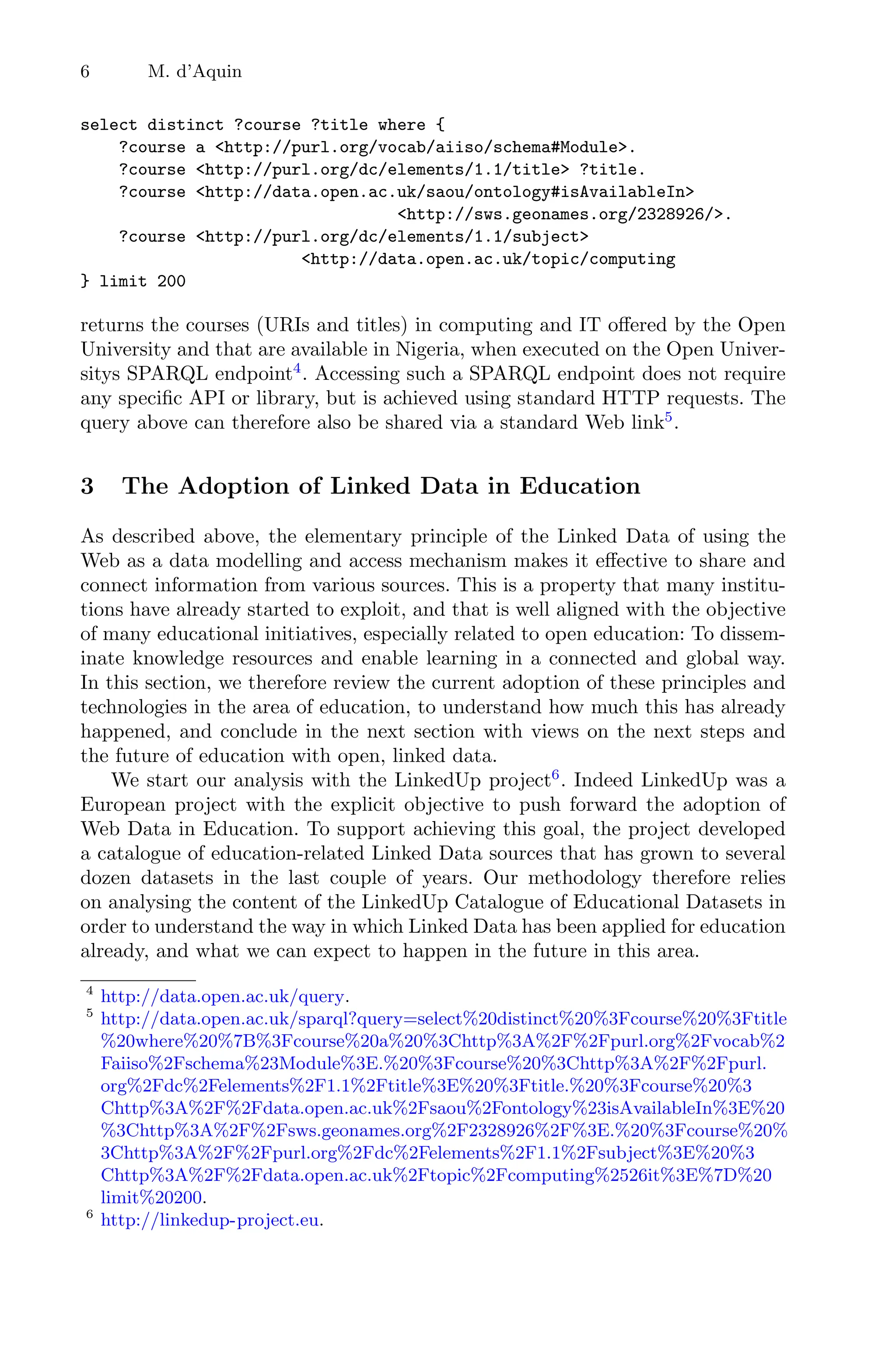
select distinct ?course ?title where {
?course a http://purl.org/vocab/aiiso/schema#Module.
?course http://purl.org/dc/elements/1.1/title ?title.
?course http://data.open.ac.uk/saou/ontology#isAvailableIn
http://sws.geonames.org/2328926/.
?course http://purl.org/dc/elements/1.1/subject
http://data.open.ac.uk/topic/computing
} limit 200
returns the courses (URIs and titles) in computing and IT offered by the Open
University and that are available in Nigeria, when executed on the Open Univer-
sitys SPARQL endpoint4
. Accessing such a SPARQL endpoint does not require
any specific API or library, but is achieved using standard HTTP requests. The
query above can therefore also be shared via a standard Web link5
.
3 The Adoption of Linked Data in Education
As described above, the elementary principle of the Linked Data of using the
Web as a data modelling and access mechanism makes it effective to share and
connect information from various sources. This is a property that many institu-
tions have already started to exploit, and that is well aligned with the objective
of many educational initiatives, especially related to open education: To dissem-
inate knowledge resources and enable learning in a connected and global way.
In this section, we therefore review the current adoption of these principles and
technologies in the area of education, to understand how much this has already
happened, and conclude in the next section with views on the next steps and
the future of education with open, linked data.
We start our analysis with the LinkedUp project6
. Indeed LinkedUp was a
European project with the explicit objective to push forward the adoption of
Web Data in Education. To support achieving this goal, the project developed
a catalogue of education-related Linked Data sources that has grown to several
dozen datasets in the last couple of years. Our methodology therefore relies
on analysing the content of the LinkedUp Catalogue of Educational Datasets in
order to understand the way in which Linked Data has been applied for education
already, and what we can expect to happen in the future in this area.
4
http://data.open.ac.uk/query.
5
http://data.open.ac.uk/sparql?query=select%20distinct%20%3Fcourse%20%3Ftitle
%20where%20%7B%3Fcourse%20a%20%3Chttp%3A%2F%2Fpurl.org%2Fvocab%2
Faiiso%2Fschema%23Module%3E.%20%3Fcourse%20%3Chttp%3A%2F%2Fpurl.
org%2Fdc%2Felements%2F1.1%2Ftitle%3E%20%3Ftitle.%20%3Fcourse%20%3
Chttp%3A%2F%2Fdata.open.ac.uk%2Fsaou%2Fontology%23isAvailableIn%3E%20
%3Chttp%3A%2F%2Fsws.geonames.org%2F2328926%2F%3E.%20%3Fcourse%20%
3Chttp%3A%2F%2Fpurl.org%2Fdc%2Felements%2F1.1%2Fsubject%3E%20%3
Chttp%3A%2F%2Fdata.open.ac.uk%2Ftopic%2Fcomputing%2526it%3E%7D%20
limit%20200.
6
http://linkedup-project.eu.
On the Use of Linked Open Data in Education 7
3.1 The LinkedUp Project and the LinkedUp Catalogue
of Educational Datasets
The LinkedUp Project (Linking Web data for education [8]) was an EU FP7
Coordination and Support Action running from November 2012 to November
2014 which looked at issues around open data in education, with the aim of push-
ing forward the exploitation of the vast amounts of public, open data available
on the Web. The project comprised six pan-European consortium partners led
by the L3S Research Center of the Gottfried Wilhelm Leibniz Universitt Han-
nover and consisting of the Open University UK, the Open Knowledge Foun-
dation, Elsevier, the Open Universiteit Nederland and eXact learning LCMS.
The project also had a number of associated partners with an interest in the
project including the Commonwealth of Learning, Canada, and the Department
of Informatics, PUC-Rio, Brazil.
To aid awareness and use of open and linked data in education, the project
created and has continuously maintained a catalogue and repository of data
relevant and useful to education scenarios. The goal of the LinkedUp Dataset
Catalog (or Linked Education Cloud7
) is to collect and make available, ideally
in an easily usable form, all sorts of data sources of relevance to education, pro-
viding a shared, evolving resource for the community interested in Web data
for education (see Fig. 2). During the project, the technical team has enabled
and encouraged content- and data-providers to contribute new material to the
LinkedUp Dataset Catalog through a series of hands-on workshops and the pro-
motion of community documentation on LinkedUp tools, workflows and lessons
learned.
Datahub.io is probably the most popular registry of global catalogues of
datasets and forms the heart of the Linked Open Data cloud. In the interest
of integrating with other ongoing open data effort, rather than developing in
isolation, the LinkedUp Data Catalog has been created as part of Datahub.io.
It takes the form of a community group in which any dataset can be included,
provided that it is relevant, and the datasets in this group are also visible glob-
ally on the Datahub.io portal. Every dataset is described with a set of basic
metadata and assigned resources. This makes it possible to search for datasets
and employ faceted browsing of the results both globally or specifically in the
Linked Education Cloud. For example, one could search for the word ‘univer-
sity’ in the Linked Education Cloud, and obtain datasets that explicitly mention
‘university’ in their metadata. These results can be further reduced with filters,
for example to include only the ones that provide an example resource in the
RDF/XML format.
One of the key aspects of the design of the LinkedUp catalogue is that it itself
creates a Linked Data resource in addition to the use of Datahub.io. Indeed,
once datasets have been identified and registered, basic metadata related to each
of them, as well as information about their content, are automatically extracted
from Datahub.io and from their SPARQL endpoint. This information is then
7
http://data.linkededucation.org/linkedup/catalog/.
8 M. d’Aquin
Fig. 2. Screenshots of the Web interface to the LinkedUp Catalogue of Datasets for
Education for browsing datasets.
represented in RDF using the VoID vocabulary8
[1] and made available, in a
Linked Data way, through a SPARQL endpoint. It is this SPARQL endpoint
that we use and interrogate to analyse the characteristics of existing datasets for
education in the next section.
3.2 The State of Linked Data in Education
An initial analysis of an earlier version of the catalogue was shown in [5]. It
focused on the connection between datasets through their reuse of common
vocabulary elements. The core figures from that paper are reproduced in Fig. 3
below, showing the network of datasets and there partitioning through the com-
mon reuse of vocabulary elements, and the most commonly used classes/concepts
in these datasets, connected by their co-occurrence.
The current version of the LinkedUp catalogue is however much bigger: It
references 56 different datasets, each with their own SPARQL endpoint. Datasets
are obtained from a variety of sources. As can be seen from Fig. 4 however,
they essentially originate from either universities publishing their own data, or
from repositories of educational or research resources. Government open data
also contribute significantly to datasets related to education, with for example
statistics about the registration and results of educational institutions.
A simple aspect one might want to look at when analysing datasets about
education from the LinkedUp Catalogue is the variety of sizes that the datasets
represent. Each dataset might in particular be divided into multiple sub-graphs,
8
http://www.w3.org/TR/void/.
On the Use of Linked Open Data in Education 9
Fig. 3. Dataset (RDF graphs) connected by their reuse of common classes, and common
concepts (classes) connected by their co-occurrence (from [5]).
Fig. 4. Number of datasets from different areas in the LinkedUp Data Catalogue.
which might relate to different topics or originate from different sources. As
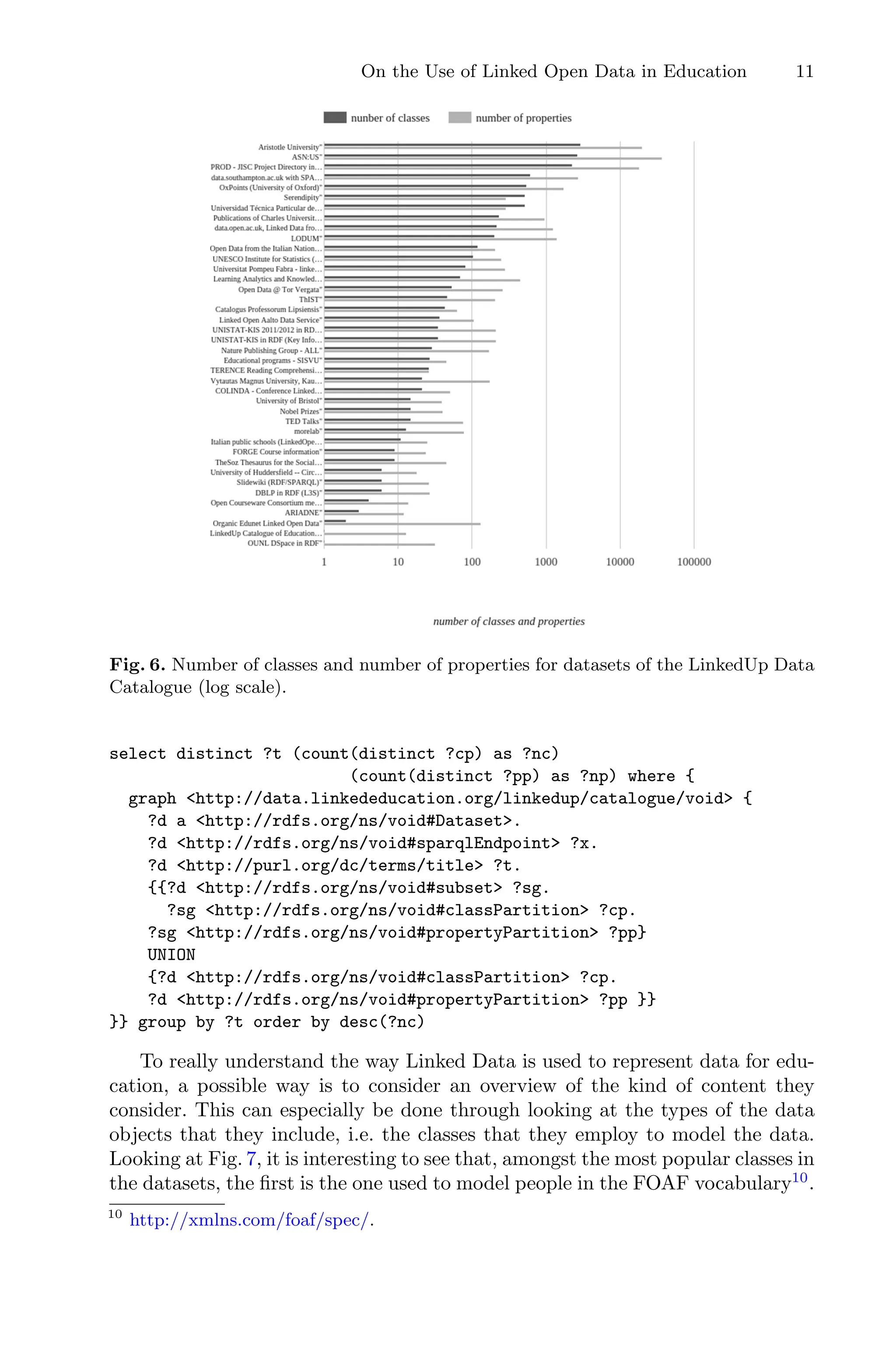
shown in Fig. 5 (which only includes datasets with more than one sub-graph)
the number of graphs included in each dataset can vary enormously (from only
1, to several thousands) depending on the way the dataset has been designed
and constructed. For example, the biggest one in number of graphs from Fig. 5
(SEEK-AT-WD) is constituted through crowdsourcing, and assigns a different
graph to each contribution. Some universities would include in one graph all the
information about all the courses they offer, while others might create a graph
for the representation of each course. As can be seen however, besides datasets
with very large numbers of graphs, or small datasets focusing on a small number
of topics, most datasets are structured using 10 to 100 graphs corresponding to
different aspects of the data (e.g. modules, resources, people, facilities, etc.).
For information, the chart in Fig. 5 is generated from the results of the fol-
lowing query on the SPARQL endpoint of the LinkedUp catalogue9
:
9
http://data.linkededucation.org/linkedup/catalog/sparql/.
10 M. d’Aquin
Fig. 5. Number of RDF graphs for datasets with more than one graph (log scale).
select distinct ?t (count(?sg) as ?n) where {
graph http://data.linkededucation.org/linkedup/catalogue/void {
?d a http://rdfs.org/ns/void#Dataset.
?d http://rdfs.org/ns/void#sparqlEndpoint ?x.
?d http://purl.org/dc/terms/title ?t.
?d http://rdfs.org/ns/void#subset ?sg
}} group by ?t order by desc(?n)
Similarly we can look at the size of dataset through comparing the number of
classes and properties they use. To an extent, the number of classes gives an idea
of the variety of the dataset, while the number of properties indicates a notion
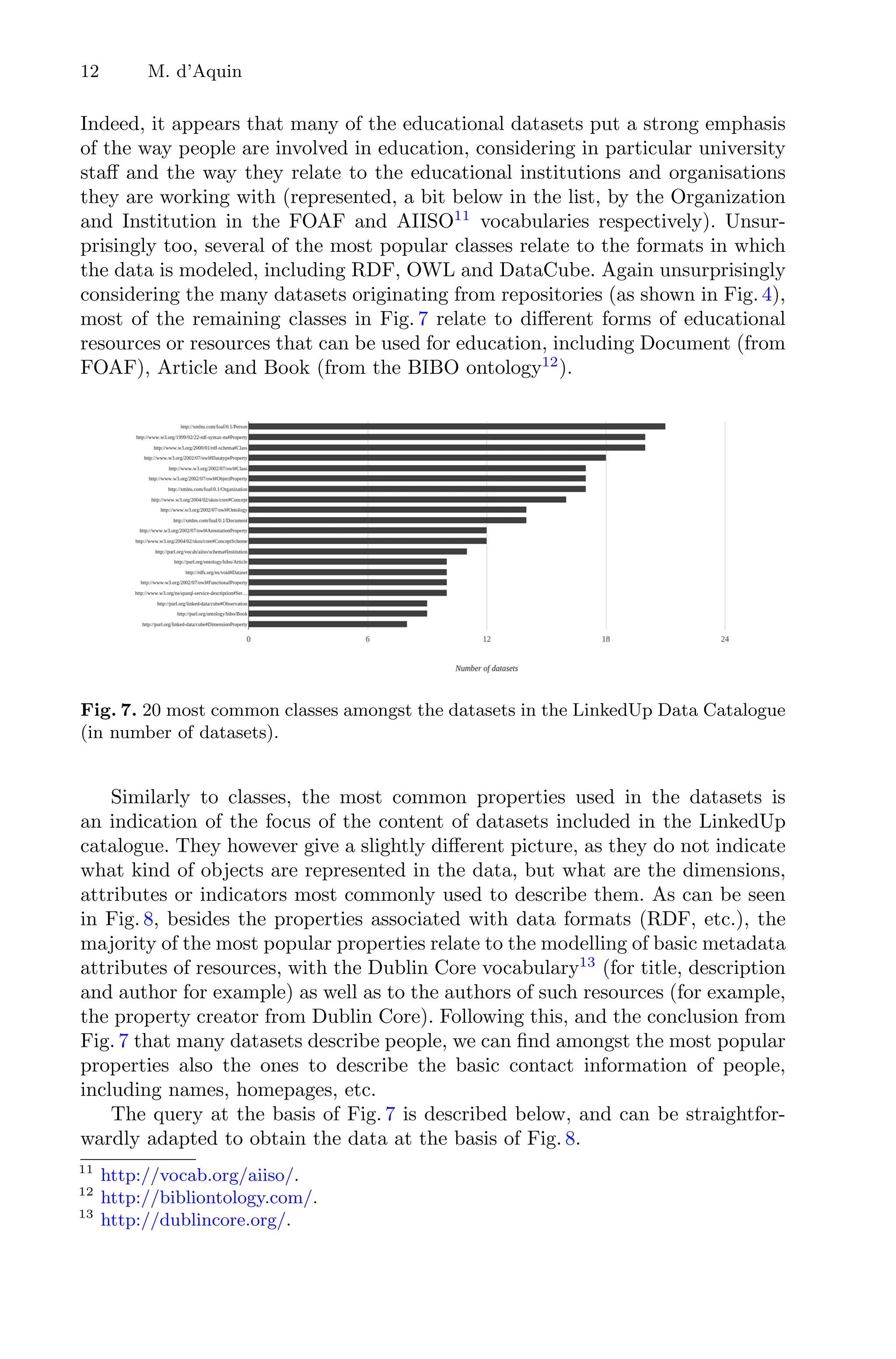
of richness. Figure 6 shows the number of classes and properties of each dataset
that refer to at least 1 class in any of their graphs. Once again, it is clear that
there is a wide variety across the datasets of the LinkedUp Catalogue. Several
datasets cover information about a very small number of classes (sometimes only
one), meaning that the focus on a specific and restricted type of data objects
(for example educational resources). Amongst these focused datasets, some still
use a comparatively large number of properties, indicating that the information
available about each data object in those datasets can be expected to be rich. In
the other end of the spectrum are datasets with a very large number of classes,
which can include dataset representing a thesaurus or classification, where each
topic is a class, or others that generate/use very granular classes to represent
the different types of objects they represent.
To generate the data at the basis of Fig. 6, we used the following SPARQL
query to the SPARQL endpoint of the LinkedUp Data Catalogue:
On the Use of Linked Open Data in Education 11
Fig. 6. Number of classes and number of properties for datasets of the LinkedUp Data
Catalogue (log scale).
select distinct ?t (count(distinct ?cp) as ?nc)
(count(distinct ?pp) as ?np) where {
graph http://data.linkededucation.org/linkedup/catalogue/void {
?d a http://rdfs.org/ns/void#Dataset.
?d http://rdfs.org/ns/void#sparqlEndpoint ?x.
?d http://purl.org/dc/terms/title ?t.
{{?d http://rdfs.org/ns/void#subset ?sg.
?sg http://rdfs.org/ns/void#classPartition ?cp.
?sg http://rdfs.org/ns/void#propertyPartition ?pp}
UNION
{?d http://rdfs.org/ns/void#classPartition ?cp.
?d http://rdfs.org/ns/void#propertyPartition ?pp }}
}} group by ?t order by desc(?nc)
To really understand the way Linked Data is used to represent data for edu-
cation, a possible way is to consider an overview of the kind of content they
consider. This can especially be done through looking at the types of the data
objects that they include, i.e. the classes that they employ to model the data.
Looking at Fig. 7, it is interesting to see that, amongst the most popular classes in
the datasets, the first is the one used to model people in the FOAF vocabulary10
.
10
http://xmlns.com/foaf/spec/.
12 M. d’Aquin
Indeed, it appears that many of the educational datasets put a strong emphasis
of the way people are involved in education, considering in particular university
staff and the way they relate to the educational institutions and organisations
they are working with (represented, a bit below in the list, by the Organization
and Institution in the FOAF and AIISO11
vocabularies respectively). Unsur-
prisingly too, several of the most popular classes relate to the formats in which
the data is modeled, including RDF, OWL and DataCube. Again unsurprisingly
considering the many datasets originating from repositories (as shown in Fig. 4),
most of the remaining classes in Fig. 7 relate to different forms of educational
resources or resources that can be used for education, including Document (from
FOAF), Article and Book (from the BIBO ontology12
).
Fig. 7. 20 most common classes amongst the datasets in the LinkedUp Data Catalogue
(in number of datasets).
Similarly to classes, the most common properties used in the datasets is
an indication of the focus of the content of datasets included in the LinkedUp
catalogue. They however give a slightly different picture, as they do not indicate
what kind of objects are represented in the data, but what are the dimensions,
attributes or indicators most commonly used to describe them. As can be seen
in Fig. 8, besides the properties associated with data formats (RDF, etc.), the
majority of the most popular properties relate to the modelling of basic metadata
attributes of resources, with the Dublin Core vocabulary13
(for title, description
and author for example) as well as to the authors of such resources (for example,
the property creator from Dublin Core). Following this, and the conclusion from
Fig. 7 that many datasets describe people, we can find amongst the most popular
properties also the ones to describe the basic contact information of people,
including names, homepages, etc.
The query at the basis of Fig. 7 is described below, and can be straightfor-
wardly adapted to obtain the data at the basis of Fig. 8.
11
http://vocab.org/aiiso/.
12
http://bibliontology.com/.
13
http://dublincore.org/.
On the Use of Linked Open Data in Education 13
Fig. 8. 40 most common properties amongst the datasets of the LinkedUp Data Cat-
alogue (in number of datasets).
select distinct ?c (count(distinct ?d) as ?n) where {
graph http://data.linkededucation.org/linkedup/catalogue/void {
?d a http://rdfs.org/ns/void#Dataset
{{?d http://rdfs.org/ns/void#subset ?sg.
?sg http://rdfs.org/ns/void#classPartition ?cp.
?cp http://rdfs.org/ns/void#class ?c}
UNION
{?d http://rdfs.org/ns/void#classPartition ?cp.
?cp http://rdfs.org/ns/void#class ?c} }
}
} group by ?c order by desc(?n) limit 20
4 Use and Future of Linked Data in Education
The analysis described above gives a general overview of the state of Linked Data
in education, of the way it is being used and how it can grow further. Indeed,
these datasets represent pioneering initiatives that should carry on growing, and
through understanding the expending practices of Linked Data in education
within these dataset, other can learn from them and have an easier entry point
to join the Linked Education CLoud. A key for this to happen however is for
these practices to be better shared. Indeed, another element shown in the analysis
above is that many of the initiatives at the origin of the considered datasets have
been developed in isolation from each other, with different modeling principles,
designs and vocabularies being used. While it is the nature of Linked Data (and
to an extent of the Web) that it should allow this kind of distribution, some
concertation is still required to ensure that the resulting datasets can be used
jointly in a way which is sufficiently cohesive (see [5]). Several initiatives have
14 M. d’Aquin
emerged that are trying to address this, among which LinkedUniversities.org,
LRMI14
and the W3C Open Linked Education community group15
.
An important aspect of the state of adoption of Linked Data principles and
technologies in education that is not addressed in this chapter is the way it is
being used. Indeed, we focus here on the data available and the way it is being
modelled, and therefore mostly on the data publication process. The consump-
tion of Web Data for education was actually the main objective of the LinkedUp
project, as illustrated by the LinkedUp Challenge: A series of application devel-
opment competition to encourage the creation of innovative solutions in teaching
and learning through the use of Web Data16
. The result is several dozens of appli-
cations at various stages of maturity. These, as well as other examples, show how
some areas are emerging as the key applications of Linked Data in education,
from the basic management and sharing of data in educational institutions (see
for example [4]) to recommendation (see for example [6]).
On of such area which is generating increasing interest is Learning Analyt-
ics. Learning Analytics is about the processing of data about learners and their
environments for the purpose of understanding and optimising learning (see for
example Ferguson, 2012). A lot of both the research-oriented and the practical
work in this area is dedicated to the methods employed for collecting, analysing,
mining or visualising such data in relation to various levels of models of learning,
from the basic information models used to structure the data, to the cognitive
models that are expected to be reflected in the learners activity patterns found
in the data. It therefore about the way to make sense of raw data in terms of
the learners experience, behaviour and knowledge, and Linked Data could rep-
resent an approach for the collection, integration and dissemination of such data
(see dAquin et al., 2014).
References
1. Alexander, K., Hausenblas, M.: Describing linked datasets - on the design and
usage of void, the vocabulary of interlinked datasets. In: Linked Data on the Web
Workshop (LDOW 09), in Conjunction with 18th International World Wide Web
Conference (WWW 2009) (2009)
2. Brickley, D., Guha, R.V.: RDF vocabulary description language 1.0: RDF schema.
W3C recommendation (2004)
3. Daga, E., d’Aquin, M., Adamou, A., Brown, S.: The open university linked data -
data.open.ac.uk. Semantic Web Journal - Interoperability, Usability, Applicability
(2015)
4. d’Aquin, M.: Putting linked data to use in a large higher-education organisation.
In: Interacting with Linked Data at Extended Semantic Web Conference, ESWC
(2012)
5. d’Aquin, M., Adamou, A., Dietze, S.: Assessing the educational linked data land-
scape. In: ACM Web Science (2013)
14
http://www.lrmi.net.
15
https://www.w3.org/community/opened/.
16
http://linkedup-challenge.org.
On the Use of Linked Open Data in Education 15
6. d’Aquin, M., Allocca, C., Collins, T.: Discou: A flexible discovery engine for open
educational resources using semantic indexing and relationship summaries. In:
Demo at International Semantic Web Conference, ISWC (2012)
7. d’Aquin, M., Dietze, S.: Open education: A growing, high impact area for linked
open data. ERCIM News, (96) (2014)
8. Guy, M., M., d’Aquin, S. Dietze, H. Drachsler, E. Herder, E. Parodi.: Linkedup:
Linking open data for education. Ariadne, (72) (2014)
9. Heath, T., Bizer, C.: Linked Data: Evolving the Web Into a Global Data Space.
Synthesis Lectures on the Semantic Web: Theory and Technology, 1st edn. Morgan
and Claypool, San Francisco (2011)
10. Klyne, G., Carroll, J.J.: Resource description framework (RDF): Concepts and
abstract syntax. W3C recommendation (2006)
11. McGuinness, D.L., Van Harmelen, F.: OWL web ontology language overview. W3C
recommendation (2004)
12. PrudHommeaux, E., Seaborne, A.: SPARQL query language for RDF. W3C rec-
ommendation (2008)
Educational Linked Data on the Web -
Exploring and Analysing the Scope
and Coverage
Davide Taibi1()
, Giovanni Fulantelli1
, Stefan Dietze2
,
and Besnik Fetahu2
1
Istituto per le Tecnologie Didattiche, Consiglio Nazionale delle Ricerche,
Palermo, Italy
{davide.taibi,giovanni.fulantelli}@itd.cnr.it
2
L3S Research Center, Hannover, Germany
{dietze,fetahu}@l3s.de
Abstract. Throughout the last few years, the scale and diversity of datasets
published according to Linked Data (LD) principles has increased and also led to
the emergence of a wide range of data of educational relevance. However, suffi-
cient insights into the state, coverage and scope of available educational Linked
Data seem still missing. In this work, we analyse the scope and coverage of
educational linked data on the Web, identifying the most significant resource types
and topics and apparent gaps. As part of our findings, results indicate a prevalent
bias towards data in areas such as the life sciences as well as computing-related
topics. In addition, we investigate the strong correlation of resource types and
topics, where specific types have a tendency to be associated with particular types
of categories, i.e. topics. Given this correlation, we argue that a dataset is best
understood when considering its topics, in the context of its specific resource
types. Based on this finding, we also present a Web data exploration tool, which
builds on these findings and allows users to navigate through educational linked
datasets by considering specific type and topic combinations.
Keywords: Dataset profile  Linked data for education  Linked data explorer
1 Introduction
The diversity of datasets published according to Linked Data (LD) [5–7] principles has
increased in the last few years and also led to the emergence of a wide range of data of
educational relevance [18]. These include open educational resources metadata, sta-
tistical data about the educational sector, video lecture metadata or university data
about courses, research or experts [2]. Initial efforts to collect and catalogue such
datasets have been made through initiatives such as the LinkedUp Data Catalog1
or
related community initiatives2
.
1
http://data.linkededucation.org/linkedup/catalog/.
2
These include, for instance, http://linkededucation.org, http://linkeduniversities.org or the recently
established W3C Community Group on Open Linked Education (http://www.w3.org/community/
opened/).
© Springer International Publishing Switzerland 2016
D. Mouromtsev and M. d’Aquin (Eds.): Open Data for Education, LNCS 9500, pp. 16–37, 2016.
DOI: 10.1007/978-3-319-30493-9_2
However, the state, coverage and scope of available educational Linked Data have
not been widely investigated. Here, in particular questions about the represented
resource types, such as, resource metadata or information about organisations or
people, and topics are of crucial relevance to shape a better understanding about the
state of educationally relevant Linked Data on the Web. Also identifying a dataset
containing resources related to a specific topic is, at present, a challenging activity.
Moreover, the lack of up-to-date and precise descriptive information has exacerbated
this challenge. The mere keywords-based classification derived from the description of
the dataset owner is not sufficient, and for this reason, it is necessary to find new
methods that exploit the characteristics of the resources within the datasets to provide
useful hints about topics covered by datasets and their subsequent classification.
In this direction, authors in [1, 3] proposed an approach to create structured
metadata to describe a dataset by means of topics, defined as DBpedia categories,
where a weighted graph of topics constitutes a dataset profile. Profiles are created by
means of a processing pipeline3
that combines techniques for datasets resource sam-
pling, topic extraction and topic ranking. Topics have been extracted by using named
entity recognition (NER) techniques, where topics are ranked, respectively weighted,
according to their relevance using graph-based algorithms such as PageRank, K-Step
Markov, and HITS.
The limitations of such an approach are related mainly to the following aspects.
First, the meaning of individual topics assigned to a dataset can be highly dependent on
the type of resources they are attached to. Also, the entire topic profile of a dataset is
hard to interpret if categories from different types are considered at the same time. As
an example of the first issue, the same category (e.g. “Technology”) might be asso-
ciated to resources of very different types such as “video” (e.g. in the Yovisto Datset4
)
or “research institution”(e.g. in the CNR dataset5
). Concerning the second issue, the
single topic profile attached for instance to bibliographic datasets (such as: the LAK
dataset6
or Semantic Web Dog Food7
) - in which people (“authors”), organisations
(“affiliations”) and documents (“papers”) are represented– is characterized by the
diversity of its categories (e.g. DBpedia categories: Scientific_disciplines, Data_man-
agement Information_science but also Universities_by_country, Universities_and_
colleges). Indeed, classification of datasets in the LD Cloud is highly specific to the
resource types one is looking at. While one might be interested in the classification of
“persons” listed in one dataset (for instance, to learn more about the origin countries of
authors in DBLP), another one might be interested in the classification of topics
covered by the documents (for instance disciplines of scientific publications) in the
very same dataset.
3
http://data-observatory.org/lod-profiles/profiling.htm.
4
http://www.yovisto.com/.
5
http://data.cnr.it/.
6
http://lak.linkededucation.org.
7
http://data.semanticweb.org.
Educational Linked Data on the Web - Exploring 17
In this paper, we aim at providing a systematic assessment of educational Linked
Data which consider both, represented topics as well as resource types and their cor-
relations. Questions of interest are:
1. Which types and topics are covered by existing educational Linked Data?
2. What are the central topics covered for particular types (e.g. Open Educational
Resources metadata)?
3. Are certain topics underrepresented for certain types, or vice versa?
The approach we propose overcomes the limitations described above by consid-
ering the topic profiles defined in [3] in the context of the resource types they are
associated with. However, the schemas adopted by the datasets of the LD cloud are
heterogeneous, thus making it difficult to compare the topic profiles across datasets.
While there are many overlapping type definitions representing the same or similar real
world entities, such as “documents”, “people”, “organization”, type-specific profiling
relies on type mappings to improve the comparability and interpretation of types and
consequently, profiles. For this aim the explicit mappings and relations declared within
specific schemas (for instance, foaf:Person being a subclass of foaf:Agent) as well as
across schemas (for instance through owl:equivalentClass or rdfs:subClassOf proper-
ties) are crucial.
While relying on explicit type mappings, we have based our work on a set of
datasets where explicit schema mappings are available from earlier work [2]. This
includes education-related datasets identified by the LinkedUp Catalog8
in combination
with the dataset profiles generated by the Linked Data Observatory9
. While the latter
provides topic profiles for the majority of LOD datasets, the LinkedUp Catalog con-
tains explicit schema mappings which were manually created for the most frequent
types in the LinkedUp Catalog.
The next Section provides a broad overview on the educational Linked Data from a
perspective that highlights the relations with the Open Educational Resource world;
then, we provide a thorough state of the art assessment of the coverage and scope of
educational Linked Data in Sect. 3, which answer aforementioned questions. In
addition, we introduce an interactive explorer of educational Linked Data, in Sect. 4,
which aims at providing a resource type-specific view on categories associated with the
datasets in the LinkedUp Catalog.
2 Resources for Education: Linked Data and OER
The Semantic Web, and specifically the possibility to publish data on the Web and
connect them through links (i.e. the Linked Data model), represents one of the most
significant evolution of the Internet, after the idea of the Web itself.
8
http://data.linkededucation.org/linkedup/catalog/.
9
http://data-observatory.org/lod-profiles.
18 D. Taibi et al.
From an educational point of view, both the human-readable and navigable
structure of the Web pages and the machine-processable datasets of LD have opened up
incredible potentials for the implementation of new and effective pedagogical para-
digms [4].
The hypertextual organization of information and knowledge of the Web has
influenced not only the ICT-based educational projects worldwide, but also the pub-
lication of traditional school textbooks, where anchor-like notes appear throughout a
book for immediate references to other related concepts.
In general, the more evident opportunity of the Web for education is a very basic
one, yet extremely important for education: the possibility to publish information that
everybody can access and use to develop knowledge.
Some years after the birth of the Web, under the pressure of economical, philan-
thropic and pedagogical emergencies, the idea to exploit materials published on the
Web for educational purposes brought to the development of the Open Educational
Resources (OER) movement. Since then, hundreds of OER repositories have populated
the Web with resources designed for education.
From a pedagogical perspective, OER have solved some critics related to the use of
Web pages for education, such as the lack of a pedagogical structure to present
information, or the difficulties in identifying the pedagogical scope of a resource
published on the Web. However, the OER movement does not exclude more general
resources accessible through the Web, provided that they are included into usage
patterns designed according to pedagogical criteria. Furthermore, the spectrum of OER
is really wide, ranging from resources produced by academic or educational committed
institutions to user- or crowd-generated resources. This variety of OER is reflected in
the many definitions of OER that can be found in the literature [13–17].
In spite of their tremendous influence on education, OER have also shown some
limits; amongst the others:
– The lack of a sole standard for OER and repositories, which has fragmented the
offer of OER on the Web [8];
– The complexity in handling direct links between OER and, consequently, in finding
semantically related resources.
– The impossibility to guarantee metadata interoperability, due to the proliferation of
educational metadata schemas [9];
– The impossibility to deal with the vast availability of education-related data on the
web.
The Linked Open Data model offers new solutions for educational resources, partly
solving some of the OER limits, still representing a paradigm that complements the
OER one, and does not substitute it.
Amongst the OER issues that can be solved by the LOD approach:
– LOD are interlinked by definition; consequently, algorithms can automatically
identify semantically related resources; in the case of OER, it was necessary to
develop a semantic layer to describe OERs;
Educational Linked Data on the Web - Exploring 19
– Federated query can be used in order to find resources belonging to distinct datasets;
as far as OER are concerned, this was only possible if OER repositories were
federated, e.g. through the OAI PMH which allows the exposition of metadata
through a common protocol;
– LOD provide the solutions to publish education-related data on the web.
For these reasons, the interest of the educational community in LOD has developed
over the years, even sustained by the growing availability of resources published in the
Linked Data format, which has raised from 12 in 2007 up to 570 in 201410
.
The first applications of Linked Data to education focused on the potentials of LD
to solve interoperability issues in the field of TEL (Technology Enhanced Learning). In
the mEducator project [12], data from a number of open TEL data repositories has been
integrated, exposed and enriched by following LD principles. Afterwards, more and
more attention has been paid to the increasing availability of datasets on the Web, and
particularly to the presence of educational information in the linked data landscape.
The LinkedUp project has explicitly aimed at the educational exploitation of
Linked Open Data, and has distinguished two types of linked datasets: datasets directly
related to educational material and institutions, including information from open
educational repositories and data produced by universities; datasets that can be used in
teaching and learning scenarios, while not being directly published for this purpose.
Therefore, the approach followed by the LinkedUp project enhances the general
principle of the OER movement that not only resources explicitly developed for
educational purposes can be used in educational patterns.
From one hand, this is an essential advantage of open education in general; how-
ever, it amplifies some drawbacks that could hinder the potentials of LOD in education:
– Which datasets and resources can be employed in educational contexts? A similar
challenge has been already addressed in the OER world. However, this task presents
a higher degree of complexity for LOD, since the OER movement focuses on the
development of content on pedagogical principles, while generally there is no
pedagogical theory behind the publication of a dataset, and classifying them
becomes more complicated.
– How datasets (and their resources) should be described in order to facilitate their
search (and pedagogical exploitation)? This issue shows one of the main difference
between OERs and LOD. While a bad-described OER can be easily visited by the
end user in order to check if it is suitable for a specific educational project, a
bad-described dataset can be hardly analysed by the end user, and the risk that the
dataset will be ignored is very high.
For these reasons, specific classification mechanisms as the ones described in this
chapter, which highlight the key elements of a dataset, together with search tools based
on the, are extremely important to fully exploit the potentials of LOD in education.
10
source: http://lod-cloud.net/.
20 D. Taibi et al.
3 Analysing the Coverage of Educational Linked Data
In this section, we present the actual analysis of educational Linked Datasets on the
Web, taking into account both topics as well as resource types.
3.1 Data and Method
Topic annotations are provided in the form of DBpedia categories for the majority of
LD datasets, available from the topic profiles11
dataset, further described in [3]. A topic
profile connects a dataset with the topics extracted from the analysis of resource
samples. Since topics are ranked, a topic profile can be seen as a weighted dataset-topic
graph. As such a, topic profile provides a comprehensive overview of the topic cov-
erage of individual datasets. Analysed across a specific set of datasets - as carried out in
this work - topic profiles provide insights into the coverage of such a set of datasets.
While topic annotations are obtained from analysing resources of a particular type,
the semantics of the topic can best be interpreted when considering the type of the
resource. As an example, if the topic “Biology” is associated to a resource of type foaf:
Document, for instance, a scholarly publication, it indicates that this particular resource
is related to biological aspects. In case the “Biology” topic is associated to a foaf:
Organization resource, it is likely referred to a Biology department of a university. Next
to such differences in interpreting topics, the nature of DBpedia categories also differs
significantly across different types. For instance, while actual document-related types
usually are related to topics which indicate some form of subject or domain (such as
“Biology”), resources which represent some notion of organisation or person usually are
characterised through some broader categorisations, such as “Academic_institutions” or
“People_from_Athens”. These fundamental differences are important to understand the
nature of dataset topic profiles and to motivate our adopted methodology.
Since our work considers the investigation of both, topics and types, we use as
additional data source the LinkedUp Catalog8
. Our research investigates 21 datasets,
which is precisely the set of datasets existing in both collections the LinkedUp Catalog
and the Dataset Topic Profiles, as only for these both topic profile and resource type
mapping annotations were available. The complete list of selected datasets is shown in
Table 1. As explained by Fetahu et al. in [3], topic profiles are generated based on
resource samples, where the applied sampling strategies did take into account factors
such as the population size of respective types leading to different sample sizes across
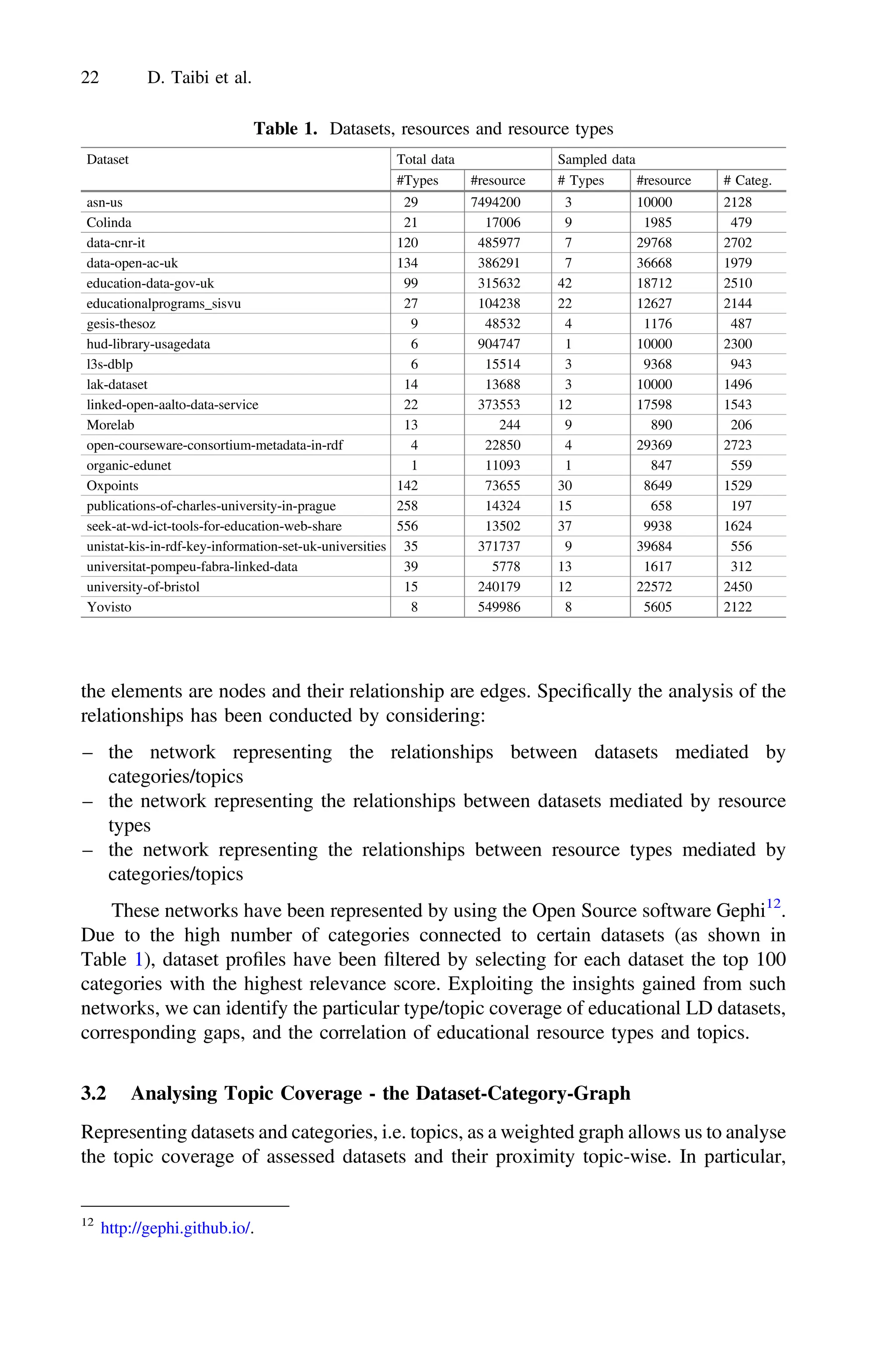
different datasets. Table 1 indicates both the total amount of data and the characteristics
of the automatically computed sample.
The analysis of the relationships between datasets, topics and resource types -
aimed at providing a response to the research questions posed above - has been
undertaken exploiting network analysis theories and methods. Indeed, the connections
between the three investigated notions can be represented by networks, in which
11
http://data.l3s.de/dataset/linked-dataset-profiles.
Educational Linked Data on the Web - Exploring 21
the elements are nodes and their relationship are edges. Specifically the analysis of the
relationships has been conducted by considering:
– the network representing the relationships between datasets mediated by
categories/topics
– the network representing the relationships between datasets mediated by resource
types
– the network representing the relationships between resource types mediated by
categories/topics
These networks have been represented by using the Open Source software Gephi12
.
Due to the high number of categories connected to certain datasets (as shown in
Table 1), dataset profiles have been filtered by selecting for each dataset the top 100
categories with the highest relevance score. Exploiting the insights gained from such
networks, we can identify the particular type/topic coverage of educational LD datasets,
corresponding gaps, and the correlation of educational resource types and topics.
3.2 Analysing Topic Coverage - the Dataset-Category-Graph
Representing datasets and categories, i.e. topics, as a weighted graph allows us to analyse
the topic coverage of assessed datasets and their proximity topic-wise. In particular,
Table 1. Datasets, resources and resource types
Dataset Total data Sampled data
#Types #resource # Types #resource # Categ.
asn-us 29 7494200 3 10000 2128
Colinda 21 17006 9 1985 479
data-cnr-it 120 485977 7 29768 2702
data-open-ac-uk 134 386291 7 36668 1979
education-data-gov-uk 99 315632 42 18712 2510
educationalprograms_sisvu 27 104238 22 12627 2144
gesis-thesoz 9 48532 4 1176 487
hud-library-usagedata 6 904747 1 10000 2300
l3s-dblp 6 15514 3 9368 943
lak-dataset 14 13688 3 10000 1496
linked-open-aalto-data-service 22 373553 12 17598 1543
Morelab 13 244 9 890 206
open-courseware-consortium-metadata-in-rdf 4 22850 4 29369 2723
organic-edunet 1 11093 1 847 559
Oxpoints 142 73655 30 8649 1529
publications-of-charles-university-in-prague 258 14324 15 658 197
seek-at-wd-ict-tools-for-education-web-share 556 13502 37 9938 1624
unistat-kis-in-rdf-key-information-set-uk-universities 35 371737 9 39684 556
universitat-pompeu-fabra-linked-data 39 5778 13 1617 312
university-of-bristol 15 240179 12 22572 2450
Yovisto 8 549986 8 5605 2122
12
http://gephi.github.io/.
22 D. Taibi et al.
Exploring the Variety of Random
Documents with Different Content
daughter she had insisted upon their paying for their board, in this
respect wishing to annoy Marc, who consequently had to make his
wife a considerable allowance out of his meagre salary. Perhaps
Madame Duparque—advised in this matter as in others by her good
friends, those masters of intrigue, whose unseen hands pulled every
string—had hoped that Marc would respond by a refusal, and that a
scandal would ensue. But he could live on very little, and he
consented immediately, as if indeed he were well pleased to remain
the paterfamilias, the worker, and supporter of those who belonged
to him. And although straitened circumstances aggravated his
solitude, the meals he shared with Mignot becoming extremely
frugal, he did not suffer, for it was sufficient for him to know that
Geneviève had appeared moved by his willingness to provide for her,
and that she found in this pecuniary question a motive to approve of
Louise's resolution to pursue her studies in order to ensure her
future. Thus the girl, who had already obtained her elementary
certificate, continued to take lessons from Mademoiselle Mazeline,
preparing herself for the superior certificate examination, which
circumstance gave rise to further disputes with Madame Duparque,
who was exasperated by all the science which it had become the
fashion to impart to young girls, when, in her opinion, the catechism
ought to have sufficed them. And as Louise always answered every
protest in her extremely deferential manner: 'Yes, grandmamma;
certainly, grandmamma,' the old lady grew more exasperated than
ever, and ended by picking quarrels with Geneviève, who, losing
patience, occasionally answered back.
One day while Marc was listening to the news his daughter gave
him, he became quite astonished. 'Does mamma quarrel with
grandmother then?' he inquired.
'Oh, yes, papa. This was even the second or third time. And
mamma, you know, does not beat about the bush. She loses her
temper at once, answers back in a loud voice, and then goes to sulk
in her room as she used to do here before she left.'
Marc listened, unwilling to give utterance to the secret delight, the
hope, which was rising within him.
'And does Madame Berthereau take part in these discussions?' he
resumed.
'Oh, grandmamma Berthereau never says anything. She sides with
mamma and me, I think; but she does not dare to support us openly
for fear of worries.... She looks very sad and very ailing.'
However, months went by, and Marc saw none of his hopes fulfilled.
It must be said that he observed great discretion in questioning his
daughter, for it was repugnant to him to turn her into a kind of spy
for the purpose of keeping himself informed of everything that
occurred in the dismal little house on the Place des Capucins. For
weeks at a time when Louise ceased to speak of her own accord,
Marc relapsed into anxious ignorance, again losing all hope of
Geneviève's return. His only consolation then lay in his daughter's
presence beside him for a few hours on Thursdays and Sundays. On
those days also it occasionally happened that the two chums of the
Beaumont Training College, Joseph Simon and Sébastien Milhomme,
arrived at the Maillebois school about three o'clock, and remained
there until six, happy to meet their friend Louise, who like
themselves was all aglow with youth and courage and faith. Their
long chats were enlivened by merry laughter, which left some gaiety
in the mournful home throughout the ensuing week. Marc, who felt
comforted by these meetings, at times requested Joseph to bring his
sister Sarah from the Lehmanns', and likewise told Sébastien that he
would be happy to see his mother, Madame Alexandre, accompany
him. The schoolmaster would have been delighted to gather a
number of worthy folk, all the forces of the future, around him. At
those affectionate meetings the sympathies of former times revived,
acquiring a strength full of gentleness and gaiety, drawing Sébastien
and Sarah, Joseph and Louise together; while the master, smiling
and content to await victory at the hands of those who represented
to-morrow, allowed good Mother Nature, beneficent love, to do their
work.
All at once, amidst the disheartening delays of the Court of
Cassation, at a moment when courage was forsaking David and
Marc, they received a letter from Delbos acquainting them with
some great news and requesting them to call on him. They did so in
all haste. The great news—destined to burst on Beaumont like a
thunderclap—was that, after a long and cruel struggle, Jacquin, the
diocesan architect and foreman of the jury which had convicted
Simon, had at last felt it absolutely necessary to relieve his
conscience. Very pious, attending confession and Communion, strict
in his faith, and in all respects an upright man, Jacquin had ended
by feeling anxious with respect to his salvation, asking himself
whether, as he was in possession of the truth, it was possible for him
to keep silent any longer without incurring the risk of damnation. It
was said that his confessor, feeling extremely perplexed, not daring
to decide the question himself, had advised him to consult Father
Crabot, and that if the architect had remained silent several months
longer it was on account of the great pressure brought to bear on
him by the Jesuit, who, in the name of the Church's political
interests, had prevented him from speaking out. If, however, Jacquin
was unable to keep his terrible secret any longer, it was precisely by
reason of the anguish he felt as a Christian, one who believed that
the Christ had descended upon earth to ensure the triumph of truth
and justice. And the knowledge which consumed him was that of
Judge Gragnon's illegal communication to the jury in the Simon case
of a document unknown either to the prisoner or to his counsel.
Summoned to the retiring room to enlighten the jurymen respecting
the penalty which might attach to their verdict, the judge had shown
them a letter received by him a moment previously, a letter from
Simon to a friend, followed by a postscript and a paraph, which last
was similar to the one on the copy-slip tendered as evidence. It was
to this same letter and this paraph that Father Philibin had alluded in
his sensational evidence; and now it had been established that if the
body of the letter was indeed in Simon's handwriting, the postscript
and the paraph were assuredly impudent forgeries, in fact gross
ones, by which a child even would hardly have been deceived.
Thus David and Marc found Delbos triumphant: 'Ah! didn't I tell you
so?' he exclaimed. 'That illegal communication is now proved!
Jacquin has written to the President of the Court of Cassation,
confessing the truth, and asking to be heard.... I knew that the
letter was among the papers of the case, for Gragnon had not dared
to destroy it. But how difficult it was to have it produced and
submitted to the examination of experts! I scented a forgery; I felt
that we were confronted by some more of the handiwork of that
terrible Father Philibin! Ah! that man, how heavy and common he
looked! But the more I fathom the affair the greater do his talents,
his suppleness, artfulness, and audacity appear. He was not content
with tearing off the stamped corner of the copy-slip, he also falsified
one of Simon's letters, so arranging matters that this letter might
prevail over the jury at the last moment. Yes, assuredly that forgery
was his work!'
However, David, who had met with so many deceptions, retained
some fears. 'But are you sure,' he asked, 'that Jacquin, who is the
diocesan architect and at the mercy of the priests, will remain firm
to the end?'
'Quite sure. You don't know Jacquin. He is not at the mercy of the
priests; he is one of the few Christians who are governed solely by
their consciences. Some extraordinary things have been told me
respecting his interviews with Father Crabot. At first the Jesuit spoke
in a domineering way, in the name of his imperative Deity, who
forgives and even glorifies the worst deeds when the salvation of the
Church is in question. But Jacquin answered back in the name of a
good and equitable God, the God of the innocent and the just, who
tolerates neither error, nor falsehood, nor crime. I wish I had been
present; that battle between the mere believer and the political
agent of a crumbling religion must have been a fine spectacle.
However, I have been told that it was the Jesuit who ended by
humbling himself, and entreating Jacquin, though he failed to
prevent him from doing his duty——'
'All the same,' Marc interrupted, 'it took Jacquin a very long time to
relieve his conscience.'
'Oh! no doubt; I don't say that his duty became manifest to him at
once. For years, however, he did not know that President Gragnon's
communication was illegal. Almost all jurors are similarly situated;
they know nothing of the law, and take as correct whatever the chief
magistrates may say to them. When Jacquin learnt the truth he
hesitated evidently, and for years and years went about with a
burden on his conscience, saying nothing, however, for fear of
scandal. We shall never know the sufferings and the struggles of
that man, who went regularly to confession and Communion, ever
terrified by the thought that he was perhaps damning himself for all
eternity. However, I can assure you that when he became certain
that the document was a forgery, he no longer hesitated; he
resolved to speak out, even if by doing so he should cause the
cathedral of Saint Maxence to fall, for on no account was he
disposed to disregard what he deemed to be his duty towards God.'
Then Delbos, like a man who, after long efforts, was at last reaching
his goal, gaily summed up the situation, and David and Marc went
off radiant with hope.
But how great was the commotion in Beaumont when Jacquin's
letter to the Court of Cassation, his confession and his offer of
evidence became known. Judge Gragnon hastily closed his doors,
refusing to answer the journalists who applied to him, wrapping
himself, as it were, in haughty silence. He was no longer a jovial,
sarcastic sportsman and pursuer of pretty girls. People said that he
was quite overwhelmed by the blow which had thus fallen on him on
the eve of his retirement from the bench, at the moment when he
was expecting to receive the collar of a Commandership in the
Legion of Honour. Of recent years his wife, the once beautiful
Madame Gragnon, having passed the age for reading poetry with
General Jarousse's young officers, had decided to occupy herself in
converting him, pointing out to him no doubt all the advantages of a
pious old age; and he followed her to confession and Communion,
giving a lofty example of fervent Catholicism, which explained the
passionate zeal with which Father Crabot had tried to prevent
Jacquin from relieving his conscience. The Jesuit, indeed, wished to
save Gragnon, a believer of great importance and influence, of
whom the Church was very proud.
Moreover, the whole judicial world of Beaumont sided with the
presiding judge, defending the conviction and condemnation of
Simon as its own work, its masterpiece, which none might touch
without committing high treason against the country. Behind that
fine assumption of indignation, however, there was base, shivering
dread—dread of the galleys, dread lest the gendarmes should set
their heavy hands some evening on the black or red robes, furred
with ermine, whose wearers had imagined themselves to be above
the laws. The handsome Raoul de La Bissonnière was no longer
public prosecutor at Beaumont, he had been transferred to the
neighbouring Appeal Court of Mornay, where he was growing
embittered by his failure to secure a post in Paris, in spite of all his
suppleness and skill under every succeeding government. On the
other hand, Investigating Magistrate Daix had not quitted the town,
where he had been promoted to the rank of counsellor; but he was
still tortured by his terrible wife, whose ambition and craving for
luxury made his home a hell. It was said that Daix, seized with
remorse like Jacquin, was on the point of throwing off his wife's
acrimonious authority, and relating how he had cowardly yielded to
her representations, and sent Simon for trial, at the very moment
when, from lack of proof, he was about to stay further proceedings.
Thus the Palais de Justice was all agog, swept by gusts of fear and
anger, pending the advent of the cataclysm which would at last
annihilate the ancient worm-eaten framework of so-called human
justice.
The political world of Beaumont was no less shaken, no less
distracted. Lemarrois, the Deputy and Mayor, felt that the Radical
Republican views he had long professed were losing their hold on
the electorate, and that he might be swept away in this supreme
crisis which was bringing the living strength of the people forward.
Thus, in the much-frequented salon of his intelligent wife, the
evolution towards reactionary courses became more pronounced.
Among those now often seen there was Marcilly, once the
representative of the intellectual young men, the hope of the French
mind, but now reduced to a kind of political paralysis, bewildered by
his inability to detect in which direction lay his personal interests,
and forced to inaction by the haunting fear that if he should act in
any particular way he might not be re-elected. Then another visitor
was General Jarousse, who, though a mere cipher, now showed
himself aggressive, spurred on, it seemed, by the perpetual nagging
of his little, dusky, withered wife. And Prefect Hennebise also called
at times, accompanied by the placid Madame Hennebise, each
desiring to live at peace with everybody, such being indeed the wish
of the government, whose motto was: 'No difficulties, only
handshakes and smiles.' There was great fear of 'bad' elections, as
the department was so enfevered by the revival of the Simon affair;
and Marcilly and even Lemarrois, though they did not own it, had
resolved to ally themselves secretly with Hector de Sanglebœuf and
their other reactionary colleagues in order to overcome the Socialist
candidates, particularly Delbos, whose success would become
certain should he succeed in his efforts on behalf of the innocent
prisoner.
All this tended to the confusion which broke out directly people
heard of the intervention of Jacquin, by which the revision of the
case was rendered inevitable. The Simonists triumphed, and for a
few days the anti-Simonists seemed crushed. Nothing else was
talked about on the aristocratic promenade of Les Jaffres; and
though Le Petit Beaumontais, in order to inspirit its readers, declared
every morning that the revision of the case would be refused by a
majority of two to one, the friends of the Church remained plunged
in desolation, for private estimates indicated quite a different result.
Meantime the delight shown among the University men was very
temperate. Nearly all of them were Simonists, but they had hoped in
vain so often that they now scarcely dared to rejoice. Rector Forbes
was relieved to think that he would soon be rid of the case of that
Maillebois schoolmaster, Marc Froment, about whom he was so
frequently assailed by the reactionary forces. In spite of his desire to
meddle with nothing, Forbes had been obliged to confer with Le
Barazer respecting the necessity of an execution; and Le Barazer,
whose own powers of resistance were exhausted, foresaw the
moment when policy would compel him to sacrifice Marc. He had
even mentioned it to Salvan, who had shown deep grief at the
announcement. When, however, Marc came to him with the great
news that made revision certain, the kind-hearted man revived to
gaiety and gave his friend quite a triumphal greeting. He embraced
him and then told him of the threatening danger from which the
favourable decision of the Court of Cassation alone would save him.
'If revision should not be granted, my dear fellow,' he said, 'you
would certainly be revoked, for this time you are deeply involved in
the affair, and all the reactionaries demand your head.... However,
the news you bring pleases me, for you are at last victorious, and
our secular schools triumph.'
'They need to do so,' Marc replied; 'our conquests over error and
ignorance are still so slight in spite of all your efforts to endow the
region with good masters.'
'Certainly a good many lives will be needed; but, no matter, we are
marching on, and we shall reach the goal,' Salvan responded with
his usual gesture expressive of unshakable hope.
Perhaps the best proof that Marc was really victorious was found by
him in the eager manner with which handsome Mauraisin, the
Elementary Inspector, rushed towards him, that same day, just as he
had quitted Salvan.
'Ah! my dear Monsieur Froment, I am very pleased to meet you,' the
Inspector exclaimed. 'We see each other so seldom apart from the
requirements of our duties.'
Since the revival of the affair, mortal anxiety had taken possession of
Mauraisin, who at an earlier stage had openly sided with the anti-
Simonists, convinced as he then was that the priests never allowed
themselves to be beaten. But now, if they should lose the game,
how would he be able to save himself? The idea of not being on the
winning side distressed him greatly.
Though nobody was passing in the street, he leant towards Marc to
whisper in his ear: 'For my part, you know, my dear Froment, I
never doubted Simon's innocence. I was convinced of it at bottom.
Only it is so necessary for public men like ourselves to remain
prudent—is that not so?'
For a long time past Mauraisin had been keeping his eye on Salvan's
post, hoping to secure it in due course; and in view of a possible
triumph of the Simonists he felt it would be as well to side with them
on the eve of victory. But as that victory was not yet quite certain he
did not wish to exhibit himself in their company. So he speedily took
leave of Marc, whispering, as he pressed his hand for the last time,
'Simon's triumph will be a triumph for all of us.'
On returning to Maillebois Marc perceived a change there also.
Darras, the ex-Mayor, whom he chanced to meet, did not rest
content with bowing to him discreetly, according to his wont, but
stopped him in the middle of the high street, and talked and laughed
with him for more than ten minutes. He, Darras, had been a
Simonist at the outset, but since he had lost his position as Mayor he
had put his flag in his pocket, and made it a habit to bolt his door
before divulging what he thought. If, therefore, he now openly
chatted with Marc, it must have been because Simon's acquittal
seemed to him a certainty. As it happened, Philis, the new Mayor,
went by at that moment, gliding swiftly over the pavement with his
head bent and his eyes darting furtive glances around him. This
amused Darras, who with a knowing look at Marc exclaimed: 'What
pleases some displeases others, is it not so, Monsieur Froment? We
all have our turns!'
Indeed a great change in public opinion gradually became manifest.
Day by day for several weeks Marc observed the increasing favour of
the cause he defended. However, the decisive importance of the
success already achieved became most manifest to him when he
received a letter from Baron Nathan, who was again staying at La
Désirade, and who asked him to call there with respect to a prize for
the Communal School, which he, the Baron, desired to found.
Although Nathan, on two or three occasions previously, had given a
hundred francs or so to be distributed in savings-bank deposits
among the best pupils, Marc felt that the offer of a prize at that
juncture was only a pretext. So he repaired to La Désirade full of
wonder and curiosity.
He had not returned thither since the now distant day when he had
accompanied David on his attempt to interest the all-powerful Baron
in the cause of his accused and imprisoned brother. Marc
remembered the most trifling details of that visit, the skilful manner
in which the triumphant Jew, a king of finance and the father-in-law
of a Sanglebœuf, had shaken off the poor Jew, on whom public
execration had fallen. And now, on returning to La Désirade, Marc
found that its majesty and beauty had increased. Recently a million
of francs had been spent on new terraces and new fountains, which
imparted an aspect of sovereign grandeur to the parterres in front of
the château. Encompassed by plashing waters and a galaxy of
marble nymphs, he ended by reaching the steps, where two tall
lackeys, in liveries of green and gold, were waiting. On one of them
conducting him to a little drawing-room, where he was requested to
wait, he remained alone for a moment, and heard a confused
murmur of voices in some neighbouring room. Then two doors were
shut, all became quiet, and finally Baron Nathan entered with
outstretched hand.
'Excuse me for having disturbed you, my dear Monsieur Froment,' he
said, 'but I know how devoted you are to your pupils, and I wish to
double the sum which I have been giving you of recent years. You
are aware that my ideas are broad, that I desire to reward merit
wherever it may be found, apart from all political and religious
questions.... Yes, I make no difference between the congregational
and the secular schools; I am for all France.'
Short and somewhat bent, with a yellow face, a bald cranium, and a
large nose resembling the beak of a bird of prey, Nathan went on
talking, while Marc gazed at him. The schoolmaster knew that of
recent times the Baron had still further enriched himself by stealing
a hundred millions of francs in a colonial affair, a deed of rapine, the
huge booty of which he had been obliged to share with a Catholic
bank. And he had now plunged into fierce reaction, for as new
millions were added to his former ones he became more and more
convinced that priests and soldiers were needed to enable him to
retain his ill-gotten wealth. He was no longer content with having
wormed his way, through his daughter, into the ancient family of the
Sanglebœufs: he now absolutely denied his race, openly displaying a
ferocious anti-Semitism, showing himself a monarchist, a militarist, a
respectful friend of those who in olden time had burnt the Jews.
Nevertheless—and this astonished Marc—Nathan, whatever his
wealth, still retained much of his racial humility. A dread of the
persecutions which had fallen on his ancestors appeared in his
anxious eyes as they glanced at the doors as if he wished to be
ready to slip under a table at the slightest sign of danger.
'So it is settled,' he said, after all sorts of involved explanations, 'and
you will dispose of these two hundred francs yourself, as you please,
for I have perfect confidence in your sagacity.'
Marc thanked him, but still failed to understand the meaning of it all.
Even a politic desire to remain on good terms with everybody, a wish
to be among the Simonists if they should win the battle, did not
explain that flattering and useless appointment, that over-cordial
reception at La Désirade. However, just as the schoolmaster was
retiring, there came an explanation.
Baron Nathan, having accompanied him to the drawing-room door,
detained him there, and with a keen smile, which seemed prompted
by a sudden inspiration, exclaimed: 'My dear Monsieur Froment, I
am going to be very indiscreet.... When I was informed of your
arrival just now, I happened to be with somebody, an important
personage, who exclaimed, Monsieur Froment! Oh! I should be so
pleased to have a moment's conversation with him! A cry from the
heart in fact.'
The Baron paused, waiting a few seconds in the hope that he would
be questioned. Then, as Marc remained silent, he laughed and said
in a jesting way: 'You would be greatly surprised if I told you who
the personage was.' And as the schoolmaster still looked grave,
remaining on the defensive, Nathan blurted out everything: 'It was
Father Crabot. You did not expect that, eh?... But he came to lunch
here this morning. As you may know, he honours my daughter with
his affection, and is a frequent visitor here. Well, he expressed to me
a desire to have some conversation with you. Setting aside all
matters of opinion, he is a man of the rarest merit. Why should you
refuse to see him?'
To this Marc, who at last understood the object of the appointment
given him, and whose curiosity was more and more aroused, quietly
responded: 'But I don't refuse to see Father Crabot. If he has
anything to say to me I will listen to him willingly.'
'Very good, very good!' exclaimed the Baron, delighted with the
success of his diplomacy. 'I will go to tell him.'
Again the two doors opened, one after the other, and a confused
murmur of voices once more reached the little drawing-room. Then
all relapsed into silence, and Marc was left waiting for some time.
Having at last drawn near to the window he saw the persons, whose
voices he had heard, step on to the adjoining terrace. And he
recognised Hector de Sanglebœuf and his wife, the still beautiful
Léa, accompanied by their good friend, the Marchioness de Boise,
who, though her fifty-seventh birthday was now past, remained a
buxom blonde, the ruins of whose beauty were magnificent. Nathan
likewise appeared, and one could also divine that Father Crabot was
standing at the glass door of the grand drawing-room, still talking to
his hosts, who left him in possession of the apartment in order that
he might receive the visitor as if he were at home.
The Marchioness de Boise seemed particularly amused by the
incident. Though she had originally resolved to disappear as soon as
she should be fifty, unwilling as she was to impose too old a mistress
on Hector, she had ended by making the château her permanent
home. Besides, people said that she was still adorable, so why
should she not continue to ensure the happiness of the husband
whose marriage she had so wisely negotiated, and of the wife whose
tender friend she was? Thus age might come but happiness still
reigned at La Désirade, amid its luxurious appointments and Father
Crabot's discreet smiles and pious benisons.
As Marc looked out of the window and observed the terrible
Sanglebœuf waving his arms and shaking his carroty head, it
seemed to him that this clerical champion with the heavy face and
the narrow, stubborn brow was deploring the practice of so much
diplomacy, the honour which Father Crabot accorded to a petty
anarchical schoolmaster by thus receiving him. Sanglebœuf had
never once fought in his cuirassier days, but he always talked of
sabring people. Although the Marchioness, after securing his election
as a deputy, had made him rally to the Republic—in accordance with
the Pope's express commands—he still and ever prated about his
regiment, and flew into a passion whenever there was any question
of the flag. Indeed, he would have committed blunder upon blunder
had it not been for that intelligent Marchioness, and this was one of
the reasons she gave for remaining near him, Again, on this
occasion, she had to intervene and lead him and his wife away,
walking slowly between them, in the direction of the park, and
showing the while much gaiety of mien, and motherliness of manner
towards both.
Baron Nathan, however, had quickly returned to the grand drawing-
room, the glass door of which he closed; and almost immediately
afterwards Marc heard himself called:
'Kindly follow me, my dear Monsieur Froment.'
The Baron led him through a billiard-room; then, having opened the
drawing-room door, drew back and ushered him in, delighted, it
seemed, with the strange part he was playing, his body bowed in a
posture which again showed racial humility reviving in the
triumphant king of finance.
'Please enter—you are awaited.'
Nathan himself did not enter, but discreetly closed the door and
disappeared; while Marc, amazed, found himself in the presence of
Father Crabot, who stood, in his long black gown, in the centre of
the spacious and sumptuous room, hung with crimson and gold. A
moment's silence followed.
The Jesuit, whose noble mien, whose lofty and elegant carriage
Marc well remembered, seemed to him to have greatly aged. His
hair had whitened, and his countenance was ravaged by all the
terrible anxiety he had experienced for some time past. But the
caressing charm of his voice, its grave and captivating modulations,
had remained.
'As circumstances have brought us both to this friendly house,
monsieur,' said he, 'you will perhaps excuse me for having prompted
an interview which I have long desired. I am aware of your merits, I
can render homage to all convictions, when they are sincere, loyal,
and courageous.'
He went on speaking in this strain for some minutes, heaping praises
on his adversary as if to daze him and win him over. But the device
was too familiar and too childish to influence Marc, who, after
bowing politely, quietly awaited the rest, striving even to conceal his
curiosity, for only some very grave reason could have induced such a
man as Father Crabot to run the risk of such an interview.
'How deplorable it is,' the Jesuit at last exclaimed, 'that the
misfortunes of the times should separate minds so fit to understand
each other! Some of the victims of our dissensions are really to be
pitied. For instance, there is President Gragnon——'
Then, as a hasty gesture escaped the schoolmaster, he broke off in
order to interpolate a brief explanation. 'I name him,' he said,
'because I know him well. He is a penitent of mine—a friend. A
loftier soul, a more upright and loyal heart could be found nowhere.
You are aware of the frightful position in which he finds himself—
that charge of prevarication,[2] which means the collapse of his
entire judicial career. He no longer sleeps; you would pity him if you
were to witness his sufferings.'
[2] The word 'Prevarication' is used in a legal sense, as signifying
the betrayal of the interests of one party in a lawsuit by collusion
with the other party. The French call this forfaiture.—Trans.
At last Marc understood everything. They wished to save Gragnon,
who only yesterday had been an all-powerful son of the Church,
which felt it would be grievously maimed if he should be struck
down.
'I can understand his torment,' Marc finally answered, 'but he is
paying the penalty of his transgression. A judge must know the laws,
and the illegal communication of which he was guilty had frightful
consequences.'
'No, no, I assure you, he acted in all simplicity,' the Jesuit exclaimed.
'That letter which he received at the last moment seemed to him
without importance. He still had it in his hand when he was
summoned to the jurymen's retiring room, and he no longer
remembers how it happened that he showed it to them.'
Marc gave a little shrug of the shoulders. 'Well,' he responded, 'he
will only have to tell that to the new judges, if there should be a new
trial.... In any case I hardly understand your intervention with me. I
can do nothing.'
'Oh! do not say that, monsieur! We know how great your power is,
however modest your position may seem to be. And that is why I
thought of applying to you. Throughout this affair all thought and
action and willpower have been centred in you. You are the friend of
the Simon family, which will do whatever you advise. So, come, will
you not spare an unfortunate man, whose ruin is by no means
indispensable for your cause?'
Father Crabot joined his hands and entreated his adversary so
fervently that the latter, again all astonishment, wondered what
could be the real reason of such a desperate appeal, such clumsy
and impolitic insistence. Did the Jesuit feel that the cause he
defended was lost? Did he possess private information which made
him regard revision as a certainty? In any case, matters had come to
such a pass, that he was now ready to leave something to the fire in
order to save the rest. He abandoned his former creatures, who
were now too deeply compromised. That poor Brother Fulgence had
a befogged, unbalanced mind, spoilt by excessive pride; disastrous
consequences had attended his actions. That unfortunate Father
Philibin had always been full of faith, no doubt; but then there were
many gaps in his nature. He was deplorably deficient in moral sense.
As for the disastrous Brother Gorgias, Father Crabot cast him off
entirely; he was one of those adventurous, erring sons of the
Church, who become its curse. And if the Jesuit did not go so far as
to admit the possible innocence of Simon, he was, at least, not far
from believing Brother Gorgias capable of every crime.
'You see, my dear sir,' he said, 'I do not deceive myself; but there
are other men whom it would be really cruel to visit too severely for
mere errors. Help us to save them, and we will requite the service
by ceasing to contend with you in other matters.'
Never had Marc so plainly realised his strength, the very strength of
truth. He answered, engaging in quite a long discussion, desirous as
he was of forming a final opinion with respect to the merits of Father
Crabot. And his stupefaction increased as he fathomed the
extraordinary poverty of argument, the arrant clumsiness too, which
accompanied the vanity of this man, accustomed never to be
contradicted. Was this, then, the profound diplomatist whose crafty
genius was feared by everybody, and the presence of whose hand
was suspected in every incident, as if, indeed, he ruled the world? In
this interview, which had been prepared so clumsily, he showed
himself a poor bewildered individual, committing himself far more
than was necessary, even incompetent to defend his faith against
one who was merely possessed of sense and logic. A mediocrity—
that was what he was—a mediocrity, with a façade of social gifts,
which imposed on the man in the street. His real strength lay in the
stupidity of his flock, the submissiveness with which the faithful bent
low before his statements, which they regarded as being beyond
discussion. And Marc ended by understanding that he was
confronted by a mere show Jesuit, one of those who for decorative
purposes were allowed by their Order to thrust themselves forward,
shine, and charm, while, in the rear, other Jesuits—such, for
instance, as Father Poirier, the Provincial installed at Rozan, whose
name was never mentioned—directed everything like unknown
sovereign rulers hidden away in distant places of retreat.
Father Crabot, however, was shrewd enough to understand at last
that he was taking the wrong course with Marc, and he thereupon
did what he could to recover his lost ground. The whole ended by an
exchange of frigid courtesies. Then Baron Nathan, who must have
remained listening outside the door, reappeared, looking also very
discomfited, with only one remaining anxiety, which was to rid La
Désirade as soon as possible of the presence of that petty
schoolmaster, who was such a fool that he could not even
understand his own interests. He escorted him to the terrace and
watched his departure. And Marc, as he went his way among the
parterres, the plashing waters, and the marble nymphs, again
caught a glimpse of the Marchioness de Boise, laughing
affectionately with her good friends Hector and Léa, as all three
strolled slowly under the far-spreading foliage.
On the evening of that same day Marc repaired to the Rue du Trou,
having given David an appointment at the Lehmanns'. He found
them all in a state of delirious joy, for a telegram from a friend in
Paris had just informed them that the Court of Cassation had at last
pronounced an unanimous judgment, quashing the proceedings of
Beaumont, and sending Simon before the Assize Court of Rozan. For
Marc this news was like a flash of light, and what he had regarded
as Father Crabot's folly seemed to him more excusable than before.
The Jesuit had evidently been well informed; that judgment had
been known to him; and, revision becoming a certainty, he had
simply wished to save those whom he thought might still be saved.
And now, at the Lehmanns', all were weeping with joy, for the long
calamity was over. Wildly did Joseph and Sarah kiss Rachel, their
poor, aged, and exhausted mother. Both children and wife were
intoxicated by the thought of the return of the father, the husband,
for whom they had mourned and longed so much. Outrage and
torture were all forgotten, for acquittal was now certain; nobody
doubted it either at Maillebois or at Beaumont. And David and Marc,
those two brave workers in the cause of justice, also embraced each
other, drawn together by a great impulse of affection and hope.
But, as the days went by, anxiety arose once more. At the penal
settlement yonder Simon had fallen so dangerously ill that for a long
time yet it would be impossible to bring him back to France. Months
and months might elapse before the new trial would begin at Rozan.
And thus all necessary time was given to the spirit of injustice to
revive and spread once more in the midst of mendacity and the
multitude's cowardly ignorance.
III
During the year which followed, a year full of anxiety, uneasiness,
and contention, the Church made a supreme effort to regain her
power. Never had her position been more critical, more threatened,
than during that desperate battle, by which the duration of her
empire might be prolonged for a century, or perhaps two centuries,
should she win it. In order to do so it was necessary she should
continue to educate and train the youth of France, retain her sway
over children and women, and avail herself of the ignorance of the
humble in such wise as to mould them and make them all error,
credulity, and submissiveness, even as she needed them to be in
order to reign. The day when she might be forbidden to teach, when
her schools would be closed, and disappear, would prove for her the
beginning of the end, when she would be annihilated amidst a new
and free people, which would have grown up outside the pale of her
falsehoods, cultivating an ideal of reason and humanity. And the
hour was a grave one. That Simon affair, with the expected return
and triumph of the innocent prisoner, might deal a most terrible blow
to the Congregational schools by glorifying the secular ones.
Meantime Father Crabot, who wished to save Judge Gragnon, was so
compromised himself that he had disappeared from society and
hidden himself, pale and trembling, in his lonely cell. Father Philibin,
who had been consigned to an Italian convent, was spending the
remainder of his days in penitence, unless indeed he were already
dead. Brother Fulgence, removed by his superiors in punishment for
the discredit which had fallen on his school, a third of whose pupils
had already quitted it, was said to have fallen dangerously ill in the
distant department whither he had been sent. Finally, Brother
Gorgias had fled, fearing that he might be arrested, and feeling that
his principals were forsaking him, willing to sacrifice him as an
expiatory victim. And this flight had increased the anxiety of the
defenders of the Church, who lived only with the thought of fighting
a last and merciless battle when the Simon affair should come
before the Rozan Assize Court.
Marc also, while lamenting Simon's ill health, which delayed his
return to France, was preparing for that same battle, fully realising
its decisive importance. Almost every Thursday, sometimes with
David, sometimes alone, he repaired to Beaumont, calling first on
Delbos, to whom he made suggestions, and whom he questioned
about the slightest incidents of the week. And afterwards he went to
see Salvan, who kept him informed of the state of public opinion,
every fluctuation of which set all classes in the town agog. In this
wise, then, one Thursday, Marc paid a visit to the Training College,
and on quitting it went down the Avenue des Jaffres, where, close to
the cathedral of St. Maxence, he was upset by a most unexpected
meeting.
On one of the deserted sidewalks of the avenue, at a spot where
scarcely anybody was ever seen after four o'clock, he perceived
Geneviève seated on a bench, and looking very downcast, weary,
and lonely in the cold shadow falling from the cathedral, whose
proximity encouraged the moss to grow on the trunks of the old
elms.
For a moment Marc remained motionless, quite thunderstruck. He
had met his wife in Maillebois at long intervals, but invariably in the
company of Madame Duparque; and on those occasions she had
passed through the streets with absent-minded eyes, on her way, no
doubt, to some devotional exercise. This time, however, they found
themselves face to face, in perfect solitude, parted by none.
Geneviève had seen him, and was looking at him with an expression
in which he fancied he could detect great suffering, and an
unacknowledged craving for help. Thus he went forward, and even
ventured to seat himself on the same bench, though at some little
distance from her, for fear lest he should frighten her and drive her
away.
Deep silence reigned. It was June, and the sun, descending towards
the horizon in a vast stretch of limpid sky, transpierced the
surrounding foliage with slender golden darts; while little wandering
zephyrs already began to cool the warm afternoon atmosphere. And
Marc still looked at his wife, saying nothing, but feeling deeply
moved as he noticed that she had grown thinner and paler, as if
after a serious illness. Her face, crowned by splendid fair hair, and
with large eyes which once had been all passion and gaiety, had not
only become emaciated, but had acquired an expression of ardent
anxiety, the torment of a parching thirst, which nothing could
assuage. Her eyelids quivered, and two tears, which she vainly tried
to force back, coursed down her cheeks. Then Marc began to speak
—in such a way that it seemed as if he had quitted her only the
previous day, such indeed was his desire to reassure her.
'Is our little Clément well?' he asked.
She did not answer immediately, for she feared, no doubt, that she
might reveal the emotion which was choking her. The little boy, who
had lately completed his fourth year, was no longer at Dherbecourt.
Having removed him from his nurse, Geneviève now kept him with
her in spite of all her grandmother's scoldings.
'He is quite well,' she said at last in a slightly tremulous voice,
though on her side also she strove to affect a kind of indifferent
quietude.
'And our Louise,' Marc resumed, 'are you satisfied with her?'
'Yes: she does not comply with my desires; you have remained the
master of her mind; but she is well behaved, she studies, and I do
not complain of her.'
Silence fell again, embarrassment once more stayed their tongues.
That allusion to their daughter's first Communion, and the terrible
quarrel which had parted them, had been sufficient. Yet the
virulence of that quarrel was necessarily abating day by day, the girl
herself having assumed all responsibility by her quiet resolve to
await her twentieth year before making any formal confession of
religious faith. In her gentle way she had exhausted her mother's
resolution; and indeed a gesture of lassitude had escaped the latter
when speaking of her, as if she had referred to some long-desired
happiness, all hope of which had fled. A few moments went by, and
then Marc gently ventured to put another question to her: 'And you,
my friend, you have been so ill: how are you now?'
She shrugged her shoulders in a hopeless way, and was again
obliged to force back her tears. 'I? Oh, I have long ceased to know
how I am! But no matter, I resign myself to live since God gives me
the strength to do so.'
So great was Marc's distress, so deeply was his whole being stirred
by a quiver of loving compassion at the sight of such great suffering,
that a cry of intense anxiety sprang from his lips: 'Geneviève, my
Geneviève, what ails you? what is your torment? Tell me! Ah, if I
could only console you, and cure you!'
Thus speaking, he came nearer to her on the bench, near enough
indeed to touch the folds of her gown, but she hastily drew back.
'No, no, we have nothing more in common,' she exclaimed. 'You can
no longer do anything for me, my friend, for we belong to different
worlds.... Ah! if I were to tell you! But of what use would it be? You
would not understand me!'
Nevertheless, she went on speaking; and in short and feverish
sentences, never noticing that she was confessing herself, she told
him of her torture, her daily increasing anguish, for she had reached
one of those distressful hours when the heart instinctively opens and
overflows. She related how, unknown to Madame Duparque, she had
escaped that afternoon from Maillebois, in order to speak with a
famous missionary, Father Athanase, whose pious counsels were at
that time revolutionising the pious folk of Beaumont. The missionary
was merely sojourning there for a short time, but it was said that he
had already worked some marvellous cures—a blessing, a prayer,
from his lips having restored angelic calmness to the unappeasable
souls of women who were racked by their yearning for Jesus. And
Geneviève had just left the neighbouring cathedral, where for two
hours she had remained in prayer, after confessing to that holy man
her unquenchable thirst for divine happiness. But he had merely
absolved her for what he called excess of pride and human passion,
and by way of penitence had told her to occupy her mind with
humble duties, such as the care of the poor and the sick. In vain
afterwards had she striven to humble, annihilate herself, in the
darkest, the loneliest chapel of St. Maxence; she had not found
peace, she had not satisfied her hunger; she still glowed with the
same craving—a return for the gift of her whole being to the Deity,
that gift which she had tendered again and again, though never
once had it brought real peace and happiness to her flesh and her
heart.
As Marc listened to what she said, he began to suspect the truth,
and whatever might be his sadness at seeing his Geneviève so
wretched, a quiver of hope arose within him. Plainly enough, neither
Abbé Quandieu nor even Father Théodose had satisfied the intense
need of love that existed in her nature. She had known love, and
she must still love the man, the husband, whom she had quitted,
and who adored her. Mere mystical delights had left her unsatisfied
and irritated. She was now but the proud, stubborn daughter of
Catholicism, who turns desperately to harsher and more frantic
religious practices, as to stronger stupefacients, in order to numb the
bitterness and rebellion induced by increasing disillusion. Everything
pointed to it: the revival of motherliness in her nature, for she had
taken little Clément back, and busied herself with him, and she even
found some consolation in Louise, who exercised a gentle healing
influence over her, leading her back a little more each day towards
the father, the husband. Then, also, there were her dissensions with
her terrible grandmother, and her dawning dislike for the little house
on the Place des Capucins, where she at last felt she could no longer
live, for its coldness, silence, and gloom were deathly. And, after
failing with Abbé Quandieu and Father Théodose, her sufferings had
led her to make a supreme attempt with that powerful missionary, to
whom she had transferred her faith, that miracle-working confessor,
whom she had hastened to consult in secret for fear lest she might
be prevented, and who, by way of relief, had only been able to
prescribe practices which, in the circumstances, were childish.
'But, my Geneviève,' Marc cried again, carried away, losing all
thought of prudence, 'if you are thus beset, thus tortured, it is
because you lack our home! You are too unhappy: come back, come
back, I entreat you!'
Her pride bristled up, however, and she answered: 'No, no, I shall
never go back to you. I am not unhappy: it is untrue. I am punished
for having loved you, for having been part of you, for having had a
share in your crime. Grandmother does right to remind me of it
when I am so weak as to complain. I expiate your sin, God strikes
me to punish you, and it is your poison which burns me beyond
hope of relief.'
'But, my poor wife, all that is monstrous. They are driving you mad!
If it is true that I set a new harvest in you, it is precisely on that
harvest that I rely to ensure our happiness some day. Yes, we
became so blended one with the other that we can never be wholly
parted. And you will end by returning to me: our children will bring
you back. The pretended poison which your foolish grandmother
talks about is our love itself; it is working in your heart, and it will
bring you back.'
'Never!... God would strike us down, both of us,' she retorted. 'You
drove me from our home by your blasphemy. If you had really loved
me, you would not have taken my daughter from me, by refusing to
let her make her first Communion. How can I return to a home of
impiety where it would not even be allowable for me to pray? Ah!
how wretched I am; nobody, nobody loves me, and heaven itself will
not open!'
She burst into sobs. Filled with despair by that frightful cry of
distress Marc felt that it would be useless and cruel to torture her
further. The hour for reunion had not yet come. Silence fell between
them once more, while in the distance, on the Avenue des Jaffres,
the cries of some children at play rose into the limpid evening
atmosphere.
During their impassioned converse they had at last drawn nearer to
each other on the lonely bench; and now, seated side by side, they
seemed to be reflecting, their glances wandering away amid the
golden dust of the sunset. At last Marc spoke again, as if finishing
his thoughts aloud: 'I do not think, my friend, that you gave for a
moment any credit to the abominable charges with which certain
people wished to besmirch me à propos of my brotherly intercourse
with Mademoiselle Mazeline.'
'Oh! no,' Geneviève answered quickly, 'I know you, and I know her.
Do not imagine that I have become so foolish as to believe all that
has been said to me.'
Then with some slight embarrassment she continued: 'It is the same
with me. Some people, I know it, have set me among the flock
which Father Théodose is said to have turned into a kind of cour
galante. In the first place I do not admit that anything of the kind
exists. Father Théodose is, perhaps, rather too proud of his person,
but I believe his faith to be sincere. Besides, I should have known
how to defend myself—you do not doubt it, I hope?'
In spite of his sorrow Marc could not help smiling slightly.
Geneviève's evident embarrassment indicated that there had been
some audacity on the part of the Capuchin, and that she had
checked it. Assuming this to be the case Marc felt the better able to
understand why she was so perturbed and embittered.
'I certainly do not doubt it,' he responded. 'I know you, as you know
me, and I am aware that you are incapable of wrong-doing. I have
no anxiety respecting Father Théodose on your account, whatever
another husband of my acquaintance may have to say.... Yet all the
same I regret that you were so badly advised as to quit worthy Abbé
Quandieu for that handsome monk.'
A fugitive blush which appeared on Geneviève's cheeks while her
husband was speaking told him that he had guessed aright. It was
not without a profound knowledge of woman in her earlier years,
when an amorosa may exist within the penitent, that Father Crabot
had advised Madame Duparque to remove her daughter from the
charge of old Abbé Quandieu and place her in that of handsome
Father Théodose. The Catholic doctors are well aware that love
alone can kill love, and that a woman who loves apart from Christ
never wholly belongs to Christ. The return of Geneviève to her
husband and her sin was fatal unless she should cease to love, or
rather unless she should love elsewhere. But, as it happened, Father
Théodose was not expert in analysing human nature, he had
blundered with respect to the passionate yet loyal penitent confided
to his hands, and had thus precipitated the crisis, provoking
repugnance and rebellion in that distracted, suffering woman, who,
without as yet returning to sober reason, saw the glorious, mystical
stage-scenery of the religion of her childhood collapse around her.
Well pleased with the symptoms which he fancied he could detect,
Marc asked somewhat maliciously: 'And so Father Théodose is no
longer your confessor?'
Welcome to our website – the ideal destination for book lovers and
knowledge seekers. With a mission to inspire endlessly, we offer a
vast collection of books, ranging from classic literary works to
specialized publications, self-development books, and children's
literature. Each book is a new journey of discovery, expanding
knowledge and enriching the soul of the reade
Our website is not just a platform for buying books, but a bridge
connecting readers to the timeless values of culture and wisdom. With
an elegant, user-friendly interface and an intelligent search system,
we are committed to providing a quick and convenient shopping
experience. Additionally, our special promotions and home delivery
services ensure that you save time and fully enjoy the joy of reading.
Let us accompany you on the journey of exploring knowledge and
personal growth!
textbookfull.com

Open Data for Education Linked Shared and Reusable Data for Teaching and Learning 1st Edition Dmitry Mouromtsev

  • 1.
    Open Data forEducation Linked Shared and Reusable Data for Teaching and Learning 1st Edition Dmitry Mouromtsev download https://textbookfull.com/product/open-data-for-education-linked- shared-and-reusable-data-for-teaching-and-learning-1st-edition- dmitry-mouromtsev/ Download full version ebook from https://textbookfull.com
  • 2.
    We believe theseproducts will be a great fit for you. Click the link to download now, or visit textbookfull.com to discover even more! Development of Linguistic Linked Open Data Resources for Collaborative Data Intensive Research in the Language Sciences 1st Edition Antonio Pareja Lora https://textbookfull.com/product/development-of-linguistic- linked-open-data-resources-for-collaborative-data-intensive- research-in-the-language-sciences-1st-edition-antonio-pareja- lora/ Linked Data for the Perplexed Librarian ALCTS Monograph 1st Edition Scott Carlson https://textbookfull.com/product/linked-data-for-the-perplexed- librarian-alcts-monograph-1st-edition-scott-carlson/ Linked Data Storing Querying and Reasoning 1st Edition Sherif Sakr https://textbookfull.com/product/linked-data-storing-querying- and-reasoning-1st-edition-sherif-sakr/ Teaching physical education for learning Seventh Edition. Edition Rink https://textbookfull.com/product/teaching-physical-education-for- learning-seventh-edition-edition-rink/
  • 3.
    Demystifying big dataand machine learning for healthcare 1st Edition Frenzel https://textbookfull.com/product/demystifying-big-data-and- machine-learning-for-healthcare-1st-edition-frenzel/ Azure Data Factory Cookbook - Second Edition Dmitry Foshin https://textbookfull.com/product/azure-data-factory-cookbook- second-edition-dmitry-foshin/ Data Stewardship for Open Science : Implementing FAIR Principles First Edition Mons https://textbookfull.com/product/data-stewardship-for-open- science-implementing-fair-principles-first-edition-mons/ Azure Data Factory Cookbook: Data engineers guide to build and manage ETL and ELT pipelines with data integration , 2nd Edition Dmitry Foshin https://textbookfull.com/product/azure-data-factory-cookbook- data-engineers-guide-to-build-and-manage-etl-and-elt-pipelines- with-data-integration-2nd-edition-dmitry-foshin/ Feature Engineering for Machine Learning and Data Analytics First Edition Dong https://textbookfull.com/product/feature-engineering-for-machine- learning-and-data-analytics-first-edition-dong/
  • 4.
    Dmitry Mouromtsev Mathieu d’Aquin(Eds.) Open Data for Education State-of-the-Art Survey LNCS 9500 123 Linked, Shared, and Reusable Data for Teaching and Learning
  • 5.
    Lecture Notes inComputer Science 9500 Commenced Publication in 1973 Founding and Former Series Editors: Gerhard Goos, Juris Hartmanis, and Jan van Leeuwen Editorial Board David Hutchison Lancaster University, Lancaster, UK Takeo Kanade Carnegie Mellon University, Pittsburgh, PA, USA Josef Kittler University of Surrey, Guildford, UK Jon M. Kleinberg Cornell University, Ithaca, NY, USA Friedemann Mattern ETH Zurich, Zürich, Switzerland John C. Mitchell Stanford University, Stanford, CA, USA Moni Naor Weizmann Institute of Science, Rehovot, Israel C. Pandu Rangan Indian Institute of Technology, Madras, India Bernhard Steffen TU Dortmund University, Dortmund, Germany Demetri Terzopoulos University of California, Los Angeles, CA, USA Doug Tygar University of California, Berkeley, CA, USA Gerhard Weikum Max Planck Institute for Informatics, Saarbrücken, Germany
  • 6.
    More information aboutthis series at http://www.springer.com/series/7409
  • 7.
    Dmitry Mouromtsev •Mathieu d’Aquin (Eds.) Open Data for Education Linked, Shared, and Reusable Data for Teaching and Learning 123
  • 8.
    Editors Dmitry Mouromtsev ITMO University St.Petersburg Russia Mathieu d’Aquin Knowledge Media Institute Milton Keynes UK ISSN 0302-9743 ISSN 1611-3349 (electronic) Lecture Notes in Computer Science ISBN 978-3-319-30492-2 ISBN 978-3-319-30493-9 (eBook) DOI 10.1007/978-3-319-30493-9 Library of Congress Control Number: 2016933113 LNCS Sublibrary: SL3 – Information Systems and Applications, incl. Internet/Web, and HCI © Springer International Publishing Switzerland 2016 This work is subject to copyright. All rights are reserved by the Publisher, whether the whole or part of the material is concerned, specifically the rights of translation, reprinting, reuse of illustrations, recitation, broadcasting, reproduction on microfilms or in any other physical way, and transmission or information storage and retrieval, electronic adaptation, computer software, or by similar or dissimilar methodology now known or hereafter developed. The use of general descriptive names, registered names, trademarks, service marks, etc. in this publication does not imply, even in the absence of a specific statement, that such names are exempt from the relevant protective laws and regulations and therefore free for general use. The publisher, the authors and the editors are safe to assume that the advice and information in this book are believed to be true and accurate at the date of publication. Neither the publisher nor the authors or the editors give a warranty, express or implied, with respect to the material contained herein or for any errors or omissions that may have been made. Printed on acid-free paper This Springer imprint is published by Springer Nature The registered company is Springer International Publishing AG Switzerland
  • 9.
    Preface The amount ofopen data, including especially linked open data, is constantly increasing in many domains, especially in the public sector. A great number of private and public organizations, institutions, and companies open their data and are interested in efficient solutions for sharing and reuse of published datasets. Obvious benefits come with opening data for end-users, organizations, and developers, by making it easier to find, obtain, and use data independently of their origin, the systems used to produce them, or the applications for which they are intended. This directly connects with the way the areas of learning, teaching, and education are evolving. Indeed, the activity of learning is changing very rapidly, especially through the Web, data, and open tech- nologies. Distance learning is becoming more common, based on openly available educational resources on the Web and the recently appeared massive open online courses (MOOC) both in public higher education institutions and private training centers and organizations. The primary goal of open data in education is therefore to support these changes through new methodologies and technologies that support the sharing and distribution of information about teaching and the subjects of learning. On the practical side, it serves various purposes such as to help teachers to find and create reusable educational materials, to assist students and families in their educational decisions throughout their life, to improve management systems and many others. For this reason the section of educational open data on the Web has expanded with information about courses and educational materials that can be accessed by tools and applications as well as, social and collaborative resources, thus shaping new architectures of open education. The past few years have demonstrated the growing interest in the topic of educational open data and the growth of the community. During five successful editions of the LILE (Linked Learning) workshops, keynotes, paper sessions, and panel discussions have shown the state of the art and progress in practical work with open data in education. A number of initiatives were started including community platforms (such as LinkedUniversities. org), the W3C Open Linked Education Community Group1 , and activities within the Open Knowledge2 and the VIVO platform3 , to name just a few. The goal of this book is therefore to act as a snapshot of current activities, and to share and disseminate the growing collective experience on open and linked data in education. In this volume we bring together research results, studies, and practical endeavors from initiatives spread across several countries around the world. These initiatives are laying the foundations of open and linked data in the education move- ment, and they are leading the way through innovative applications. 1 https://www.w3.org/community/opened/ 2 https://okfn.org/ 3 http://www.vivoweb.org
  • 10.
    The chapters areselected from extended versions of papers presented at an Open Data in Education Seminar4 and the LILE workshops during 2014–20155,6 . They have been chosen to represent the diversity of practices and experiences that exist in the domain, from the researchers, developers, and community leaders who are pioneering the use of open and linked data in education. In the first part of this book, two chapters provide different perspectives on the current state of the use of linked and open data in education, including the use of technology and the topics that are being covered. The second part is to be considered the core of this book as it focuses on the specific, practical applications that are being put in place to exploit open and linked data in education today. In these four chapters, applications are presented ranging from the set- up of open data platforms in educational institutions, to supporting specific learning activities through the use of online, open data. Finally, a key element of the evolving world of open data is to ensure the skills and ability to use such data are there. We therefore focus in the three last chapters of this book on the other side of open and linked data in education: on teaching the technology and practices so they can be widely applied, and on the community of practitioners pushing these practices forward. We assume the readers of this book are reasonably familiar with modern educational technologies and Web standards (including basics of the Semantic Web). The chapters will be of interest, to varying extents, to academic heads and managers; educators, teachers, and tutors, and start-ups in education; library staff; postgraduates; technology researchers and professionals; as well as students and learners who are keen to better understand how the technologies of the Web and linked data can be applied to support progress in learning and education. We acknowledge all the contributors and those who spent time on reviewing chapters and making critical comments and fruitful discussions. First of all we want to thank the members of numerous projects that have supported the development of the works presented in this book, including in particular the LUCERO project, the Lin- kedUp support action, the VIVO project, and some others. We also thank the funders of these projects, as well as our universities and organizations, especially the Open University and ITMO University that provided the environment for such projects to develop. We also want to thank all the members of the various communities dedicated to making open data in education a reality, including the W3C Open and Linked Education community group, the Open Knowledge Open Education Group, LinkedUniversities.org, and LinkedEducation.org. Finally, we thank our families, friends, and colleagues for their support and positive encouragement. January 2016 Dmitry Mouromtsev Mathieu d’Aquin 4 https://linkededucation.wordpress.com/events/open-data-in-education-seminar-st-petersburg/ 5 https://linkededucation.wordpress.com/events/lile2014/ 6 https://lile2015.wordpress.com/ VI Preface
  • 11.
    Contents State of Openand Linked Data for Education On the Use of Linked Open Data in Education: Current and Future Practices . . . . . . . . . . . . . . . . . . . . . . . . . . . . . . . . . . . . . . . . 3 Mathieu d’Aquin Educational Linked Data on the Web - Exploring and Analysing the Scope and Coverage. . . . . . . . . . . . . . . . . . . . . . . . . . . . . . . . . . . . . . 16 Davide Taibi, Giovanni Fulantelli, Stefan Dietze, and Besnik Fetahu Applications of Open and Linked Data in Education ECOLE: An Ontology-Based Open Online Course Platform . . . . . . . . . . . . . 41 Vladimir Vasiliev, Fedor Kozlov, Dmitry Mouromtsev, Sergey Stafeev, and Olga Parkhimovich Use of Semantic Web Technologies in the Architecture of the BBC Education Online Pages . . . . . . . . . . . . . . . . . . . . . . . . . . . . . . . . . . . . . . 67 Eleni Mikroyannidi, Dong Liu, and Robert Lee Towards a Linked and Reusable Conceptual Layer Around Higher Education Programs. . . . . . . . . . . . . . . . . . . . . . . . . . . . . . . . . . . . . . . . . 86 Fouad Zablith Collaborative Authoring of OpenCourseWare: The Best Practices and Complex Solution . . . . . . . . . . . . . . . . . . . . . . . . . . . . . . . . . . . . . . . 103 Darya Tarasowa and Sören Auer Teaching (with) Open and Linked Data Teaching Linked Open Data Using Open Educational Resources. . . . . . . . . . 135 Alexander Mikroyannidis, John Domingue, Maria Maleshkova, Barry Norton, and Elena Simperl On Some Russian Educational Projects in Open Data and Data Journalism. . . 153 Irina Radchenko and Anna Sakoyan The Open Education Working Group: Bringing People, Projects and Data Together. . . . . . . . . . . . . . . . . . . . . . . . . . . . . . . . . . . . . . . . . . 166 Marieke Guy Author Index . . . . . . . . . . . . . . . . . . . . . . . . . . . . . . . . . . . . . . . . . . . . 189
  • 12.
    State of Openand Linked Data for Education
  • 13.
    On the Useof Linked Open Data in Education: Current and Future Practices Mathieu d’Aquin(B) Knowledge Media Institute, The Open University, Walton Hall, Milton Keynes, UK mathieu.daquin@open.ac.uk Abstract. Education has often been a keen adopter of new informa- tion and communication technologies. This is not surprising given that education is all about informing and communicating. Traditionally, edu- cational institutions produce large volumes of data, much of which is publicly available, either because it is useful to communicate (e.g. the course catalogue) or because of external policies (e.g. reports to funding bodies). Considering the distribution and variety of providers (universi- ties, schools, governments), topics (disciplines and types of educational data) and users (students, teachers, parents), education therefore repre- sents a perfect use case for Linked Open Data. In this chapter, we look at the growing practices in using Linked Open Data in education, and how this trend is opening up opportunities for new services and new scenarios. Keywords: Linked data · Semantic web · Education · Learning 1 Why Using Linked Data in Education Traditionally, educational institutions produce large volumes of data, much of which is publicly available, either because it is useful to communicate (e.g., the course catalogue) or because of external policies (e.g., reports to funding bodies). In this context, open data has an important role to play. Implementing open data through Linked Data technologies can be summarized as using the web both as a channel to access data (through URIs supporting the delivery of structured information) and as a platform for the representation and integration of data (through creating a graph of links between these data URIs). Considering the distribution and variety of providers (universities, schools, governments), topics (disciplines and types of educational data) and users (students, teachers, parents), education also represents a perfect use case for Linked Open Data [7]. Indeed, the basic idea of Linked Data [9] is to use the architecture of the Web to share, distribute and interconnect data from various origins into a common, online environment. It is based on the basic principle that raw data objects are identified and accessible, similarly to webpages, through Web addresses (URIs), that deliver the information in a structured, processable and linkable way. c Springer International Publishing Switzerland 2016 D. Mouromtsev and M. d’Aquin (Eds.): Open Data for Education, LNCS 9500, pp. 3–15, 2016. DOI: 10.1007/978-3-319-30493-9 1
  • 14.
    4 M. d’Aquin Thisapproach has been very successful in the last few years, especially as a base method for the publication of open data on the Web. Linked Data has been adopted by government agencies in several countries (prominently, in the UK and the US) for transparency and public information purposes, by cultural heritage institutions such as libraries and museum to provide more processable and integrated information about their collections (see the Europeana project1 for example, or the British Museum Collection2 ), by companies in publishing (for example at Nature, or Elsevier), broadcasting (for example at the BBC), or retail (for example at BestBuy). As we will see later in this chapter, there is a growing trend in the use of Linked Data specifically for education, with uni- versities in particular making their public information (academic programmes, research outputs, facilities, etc.) available as linked data on the Web (see for example LinkedUniversities.org). 2 Linked Data - In More Details The foundation of the Web is that it is a network of documents connected by hyperlinks. Each document is identified by a Web address, a URI, and might rep- resent a document which content is encoded using a standard, universally read- able format (most commonly HTML). The foundation of Linked Data is that data objects on the Web are identified, similarly to documents, by URIs. The represen- tation of the data – i.e. the information associated with a data object – is then represented by Web links, which can themselves be characterised by URIs. This makes it possible to represent information in such a way that it is materialised as a graph, where nodes are URIs or literal data values (strings, numbers) and the edges are links between them. For example, a university like The Open University3 publishes information about the courses it offers through its website, as well as using linked data [3]. It achieves that through assigning to every course a dedicated URI that acts both as an identifier for the course on the Web, and as a way to address information about this course. For example, http://data.open.ac.uk/course/aa100 is the URI for the course with code AA100, which is an undergraduate (level 1) course in Arts and Humanities, entitled “The arts past and present”. Through the links between this URI and others, information about this course is being represented regarding the topics and description of the course, where it is available, how it is assessed, what course material and open educational resources relate to it, etc. (see Fig. 1). While most of the other data objects it relates to are also identified by URIs within the domain of the Open University, it is important to remark here that it links to other data sources, such as the UK government’s information about The Open University or information provided by the Geonames platform about 1 http://www.europeana.eu/. 2 http://collection.britishmuseum.org/. 3 http://www.open.ac.uk.
  • 15.
    On the Useof Linked Open Data in Education 5 Fig. 1. Extract of the Linked Data (RDF) representation of the course AA100 “The Arts Past and Present” at The Open University (from data.open.ac.uk). the countries in which the course is available. This demonstrates how, from these basic principles, information originating from widely different systems and sources can be seamlessly integrated. Following the base principles described above, the most basic technology employed to implement linked data is a web-enabled, graph-based data rep- resentation language: RDF (Resource Description Framework [10]). RDF is in principle related to XML, but dedicated to the representation of graphs where nodes are URIs or literal values, and edges are links labelled by URIs. It has different syntaxes, including an XML-based one, but also others based on listing the triples [subject, predicate, objects] forming the links in the data. Another important component of the technological stack for linked data is the one of vocabularies. Indeed, it is important that data should be shareable and reusable in a common way across sources and systems. To address that, languages such as RDF-Schema [2] and OWL (the Web Ontology Language [11]) allow one to define the types of objects that can be encountered in the data (the classes, e.g. Course, Person, Country, etc.), as well as the types of relationships that connect these types of objects (the properties, e.g. location, title, employer, author, etc.). Finally, another important element of linked data is the way in which, still relying uniquely on the basic mechanisms of the Web, the data can be consumed. As we already mentioned, URIs on linked data can be requested to obtain RDF (most often in its XML syntax). When more flexibility is required, many of the existing linked data sources offer data endpoint using the standard querying language and protocol for RDF/Linked Data: SPARQL [12]. Briefly, SPARQL is both a query language made explicitly to fit the graph data model of RDF, and a Web protocol dictating the way in which a SPARQL endpoint should be accessed and queried on the Web. For example, the query:
  • 16.
    6 M. d’Aquin selectdistinct ?course ?title where { ?course a http://purl.org/vocab/aiiso/schema#Module. ?course http://purl.org/dc/elements/1.1/title ?title. ?course http://data.open.ac.uk/saou/ontology#isAvailableIn http://sws.geonames.org/2328926/. ?course http://purl.org/dc/elements/1.1/subject http://data.open.ac.uk/topic/computing } limit 200 returns the courses (URIs and titles) in computing and IT offered by the Open University and that are available in Nigeria, when executed on the Open Univer- sitys SPARQL endpoint4 . Accessing such a SPARQL endpoint does not require any specific API or library, but is achieved using standard HTTP requests. The query above can therefore also be shared via a standard Web link5 . 3 The Adoption of Linked Data in Education As described above, the elementary principle of the Linked Data of using the Web as a data modelling and access mechanism makes it effective to share and connect information from various sources. This is a property that many institu- tions have already started to exploit, and that is well aligned with the objective of many educational initiatives, especially related to open education: To dissem- inate knowledge resources and enable learning in a connected and global way. In this section, we therefore review the current adoption of these principles and technologies in the area of education, to understand how much this has already happened, and conclude in the next section with views on the next steps and the future of education with open, linked data. We start our analysis with the LinkedUp project6 . Indeed LinkedUp was a European project with the explicit objective to push forward the adoption of Web Data in Education. To support achieving this goal, the project developed a catalogue of education-related Linked Data sources that has grown to several dozen datasets in the last couple of years. Our methodology therefore relies on analysing the content of the LinkedUp Catalogue of Educational Datasets in order to understand the way in which Linked Data has been applied for education already, and what we can expect to happen in the future in this area. 4 http://data.open.ac.uk/query. 5 http://data.open.ac.uk/sparql?query=select%20distinct%20%3Fcourse%20%3Ftitle %20where%20%7B%3Fcourse%20a%20%3Chttp%3A%2F%2Fpurl.org%2Fvocab%2 Faiiso%2Fschema%23Module%3E.%20%3Fcourse%20%3Chttp%3A%2F%2Fpurl. org%2Fdc%2Felements%2F1.1%2Ftitle%3E%20%3Ftitle.%20%3Fcourse%20%3 Chttp%3A%2F%2Fdata.open.ac.uk%2Fsaou%2Fontology%23isAvailableIn%3E%20 %3Chttp%3A%2F%2Fsws.geonames.org%2F2328926%2F%3E.%20%3Fcourse%20% 3Chttp%3A%2F%2Fpurl.org%2Fdc%2Felements%2F1.1%2Fsubject%3E%20%3 Chttp%3A%2F%2Fdata.open.ac.uk%2Ftopic%2Fcomputing%2526it%3E%7D%20 limit%20200. 6 http://linkedup-project.eu.
  • 17.
    On the Useof Linked Open Data in Education 7 3.1 The LinkedUp Project and the LinkedUp Catalogue of Educational Datasets The LinkedUp Project (Linking Web data for education [8]) was an EU FP7 Coordination and Support Action running from November 2012 to November 2014 which looked at issues around open data in education, with the aim of push- ing forward the exploitation of the vast amounts of public, open data available on the Web. The project comprised six pan-European consortium partners led by the L3S Research Center of the Gottfried Wilhelm Leibniz Universitt Han- nover and consisting of the Open University UK, the Open Knowledge Foun- dation, Elsevier, the Open Universiteit Nederland and eXact learning LCMS. The project also had a number of associated partners with an interest in the project including the Commonwealth of Learning, Canada, and the Department of Informatics, PUC-Rio, Brazil. To aid awareness and use of open and linked data in education, the project created and has continuously maintained a catalogue and repository of data relevant and useful to education scenarios. The goal of the LinkedUp Dataset Catalog (or Linked Education Cloud7 ) is to collect and make available, ideally in an easily usable form, all sorts of data sources of relevance to education, pro- viding a shared, evolving resource for the community interested in Web data for education (see Fig. 2). During the project, the technical team has enabled and encouraged content- and data-providers to contribute new material to the LinkedUp Dataset Catalog through a series of hands-on workshops and the pro- motion of community documentation on LinkedUp tools, workflows and lessons learned. Datahub.io is probably the most popular registry of global catalogues of datasets and forms the heart of the Linked Open Data cloud. In the interest of integrating with other ongoing open data effort, rather than developing in isolation, the LinkedUp Data Catalog has been created as part of Datahub.io. It takes the form of a community group in which any dataset can be included, provided that it is relevant, and the datasets in this group are also visible glob- ally on the Datahub.io portal. Every dataset is described with a set of basic metadata and assigned resources. This makes it possible to search for datasets and employ faceted browsing of the results both globally or specifically in the Linked Education Cloud. For example, one could search for the word ‘univer- sity’ in the Linked Education Cloud, and obtain datasets that explicitly mention ‘university’ in their metadata. These results can be further reduced with filters, for example to include only the ones that provide an example resource in the RDF/XML format. One of the key aspects of the design of the LinkedUp catalogue is that it itself creates a Linked Data resource in addition to the use of Datahub.io. Indeed, once datasets have been identified and registered, basic metadata related to each of them, as well as information about their content, are automatically extracted from Datahub.io and from their SPARQL endpoint. This information is then 7 http://data.linkededucation.org/linkedup/catalog/.
  • 18.
    8 M. d’Aquin Fig.2. Screenshots of the Web interface to the LinkedUp Catalogue of Datasets for Education for browsing datasets. represented in RDF using the VoID vocabulary8 [1] and made available, in a Linked Data way, through a SPARQL endpoint. It is this SPARQL endpoint that we use and interrogate to analyse the characteristics of existing datasets for education in the next section. 3.2 The State of Linked Data in Education An initial analysis of an earlier version of the catalogue was shown in [5]. It focused on the connection between datasets through their reuse of common vocabulary elements. The core figures from that paper are reproduced in Fig. 3 below, showing the network of datasets and there partitioning through the com- mon reuse of vocabulary elements, and the most commonly used classes/concepts in these datasets, connected by their co-occurrence. The current version of the LinkedUp catalogue is however much bigger: It references 56 different datasets, each with their own SPARQL endpoint. Datasets are obtained from a variety of sources. As can be seen from Fig. 4 however, they essentially originate from either universities publishing their own data, or from repositories of educational or research resources. Government open data also contribute significantly to datasets related to education, with for example statistics about the registration and results of educational institutions. A simple aspect one might want to look at when analysing datasets about education from the LinkedUp Catalogue is the variety of sizes that the datasets represent. Each dataset might in particular be divided into multiple sub-graphs, 8 http://www.w3.org/TR/void/.
  • 19.
    On the Useof Linked Open Data in Education 9 Fig. 3. Dataset (RDF graphs) connected by their reuse of common classes, and common concepts (classes) connected by their co-occurrence (from [5]). Fig. 4. Number of datasets from different areas in the LinkedUp Data Catalogue. which might relate to different topics or originate from different sources. As shown in Fig. 5 (which only includes datasets with more than one sub-graph) the number of graphs included in each dataset can vary enormously (from only 1, to several thousands) depending on the way the dataset has been designed and constructed. For example, the biggest one in number of graphs from Fig. 5 (SEEK-AT-WD) is constituted through crowdsourcing, and assigns a different graph to each contribution. Some universities would include in one graph all the information about all the courses they offer, while others might create a graph for the representation of each course. As can be seen however, besides datasets with very large numbers of graphs, or small datasets focusing on a small number of topics, most datasets are structured using 10 to 100 graphs corresponding to different aspects of the data (e.g. modules, resources, people, facilities, etc.). For information, the chart in Fig. 5 is generated from the results of the fol- lowing query on the SPARQL endpoint of the LinkedUp catalogue9 : 9 http://data.linkededucation.org/linkedup/catalog/sparql/.
  • 20.
    10 M. d’Aquin Fig.5. Number of RDF graphs for datasets with more than one graph (log scale). select distinct ?t (count(?sg) as ?n) where { graph http://data.linkededucation.org/linkedup/catalogue/void { ?d a http://rdfs.org/ns/void#Dataset. ?d http://rdfs.org/ns/void#sparqlEndpoint ?x. ?d http://purl.org/dc/terms/title ?t. ?d http://rdfs.org/ns/void#subset ?sg }} group by ?t order by desc(?n) Similarly we can look at the size of dataset through comparing the number of classes and properties they use. To an extent, the number of classes gives an idea of the variety of the dataset, while the number of properties indicates a notion of richness. Figure 6 shows the number of classes and properties of each dataset that refer to at least 1 class in any of their graphs. Once again, it is clear that there is a wide variety across the datasets of the LinkedUp Catalogue. Several datasets cover information about a very small number of classes (sometimes only one), meaning that the focus on a specific and restricted type of data objects (for example educational resources). Amongst these focused datasets, some still use a comparatively large number of properties, indicating that the information available about each data object in those datasets can be expected to be rich. In the other end of the spectrum are datasets with a very large number of classes, which can include dataset representing a thesaurus or classification, where each topic is a class, or others that generate/use very granular classes to represent the different types of objects they represent. To generate the data at the basis of Fig. 6, we used the following SPARQL query to the SPARQL endpoint of the LinkedUp Data Catalogue:
  • 21.
    On the Useof Linked Open Data in Education 11 Fig. 6. Number of classes and number of properties for datasets of the LinkedUp Data Catalogue (log scale). select distinct ?t (count(distinct ?cp) as ?nc) (count(distinct ?pp) as ?np) where { graph http://data.linkededucation.org/linkedup/catalogue/void { ?d a http://rdfs.org/ns/void#Dataset. ?d http://rdfs.org/ns/void#sparqlEndpoint ?x. ?d http://purl.org/dc/terms/title ?t. {{?d http://rdfs.org/ns/void#subset ?sg. ?sg http://rdfs.org/ns/void#classPartition ?cp. ?sg http://rdfs.org/ns/void#propertyPartition ?pp} UNION {?d http://rdfs.org/ns/void#classPartition ?cp. ?d http://rdfs.org/ns/void#propertyPartition ?pp }} }} group by ?t order by desc(?nc) To really understand the way Linked Data is used to represent data for edu- cation, a possible way is to consider an overview of the kind of content they consider. This can especially be done through looking at the types of the data objects that they include, i.e. the classes that they employ to model the data. Looking at Fig. 7, it is interesting to see that, amongst the most popular classes in the datasets, the first is the one used to model people in the FOAF vocabulary10 . 10 http://xmlns.com/foaf/spec/.
  • 22.
    12 M. d’Aquin Indeed,it appears that many of the educational datasets put a strong emphasis of the way people are involved in education, considering in particular university staff and the way they relate to the educational institutions and organisations they are working with (represented, a bit below in the list, by the Organization and Institution in the FOAF and AIISO11 vocabularies respectively). Unsur- prisingly too, several of the most popular classes relate to the formats in which the data is modeled, including RDF, OWL and DataCube. Again unsurprisingly considering the many datasets originating from repositories (as shown in Fig. 4), most of the remaining classes in Fig. 7 relate to different forms of educational resources or resources that can be used for education, including Document (from FOAF), Article and Book (from the BIBO ontology12 ). Fig. 7. 20 most common classes amongst the datasets in the LinkedUp Data Catalogue (in number of datasets). Similarly to classes, the most common properties used in the datasets is an indication of the focus of the content of datasets included in the LinkedUp catalogue. They however give a slightly different picture, as they do not indicate what kind of objects are represented in the data, but what are the dimensions, attributes or indicators most commonly used to describe them. As can be seen in Fig. 8, besides the properties associated with data formats (RDF, etc.), the majority of the most popular properties relate to the modelling of basic metadata attributes of resources, with the Dublin Core vocabulary13 (for title, description and author for example) as well as to the authors of such resources (for example, the property creator from Dublin Core). Following this, and the conclusion from Fig. 7 that many datasets describe people, we can find amongst the most popular properties also the ones to describe the basic contact information of people, including names, homepages, etc. The query at the basis of Fig. 7 is described below, and can be straightfor- wardly adapted to obtain the data at the basis of Fig. 8. 11 http://vocab.org/aiiso/. 12 http://bibliontology.com/. 13 http://dublincore.org/.
  • 23.
    On the Useof Linked Open Data in Education 13 Fig. 8. 40 most common properties amongst the datasets of the LinkedUp Data Cat- alogue (in number of datasets). select distinct ?c (count(distinct ?d) as ?n) where { graph http://data.linkededucation.org/linkedup/catalogue/void { ?d a http://rdfs.org/ns/void#Dataset {{?d http://rdfs.org/ns/void#subset ?sg. ?sg http://rdfs.org/ns/void#classPartition ?cp. ?cp http://rdfs.org/ns/void#class ?c} UNION {?d http://rdfs.org/ns/void#classPartition ?cp. ?cp http://rdfs.org/ns/void#class ?c} } } } group by ?c order by desc(?n) limit 20 4 Use and Future of Linked Data in Education The analysis described above gives a general overview of the state of Linked Data in education, of the way it is being used and how it can grow further. Indeed, these datasets represent pioneering initiatives that should carry on growing, and through understanding the expending practices of Linked Data in education within these dataset, other can learn from them and have an easier entry point to join the Linked Education CLoud. A key for this to happen however is for these practices to be better shared. Indeed, another element shown in the analysis above is that many of the initiatives at the origin of the considered datasets have been developed in isolation from each other, with different modeling principles, designs and vocabularies being used. While it is the nature of Linked Data (and to an extent of the Web) that it should allow this kind of distribution, some concertation is still required to ensure that the resulting datasets can be used jointly in a way which is sufficiently cohesive (see [5]). Several initiatives have
  • 24.
    14 M. d’Aquin emergedthat are trying to address this, among which LinkedUniversities.org, LRMI14 and the W3C Open Linked Education community group15 . An important aspect of the state of adoption of Linked Data principles and technologies in education that is not addressed in this chapter is the way it is being used. Indeed, we focus here on the data available and the way it is being modelled, and therefore mostly on the data publication process. The consump- tion of Web Data for education was actually the main objective of the LinkedUp project, as illustrated by the LinkedUp Challenge: A series of application devel- opment competition to encourage the creation of innovative solutions in teaching and learning through the use of Web Data16 . The result is several dozens of appli- cations at various stages of maturity. These, as well as other examples, show how some areas are emerging as the key applications of Linked Data in education, from the basic management and sharing of data in educational institutions (see for example [4]) to recommendation (see for example [6]). On of such area which is generating increasing interest is Learning Analyt- ics. Learning Analytics is about the processing of data about learners and their environments for the purpose of understanding and optimising learning (see for example Ferguson, 2012). A lot of both the research-oriented and the practical work in this area is dedicated to the methods employed for collecting, analysing, mining or visualising such data in relation to various levels of models of learning, from the basic information models used to structure the data, to the cognitive models that are expected to be reflected in the learners activity patterns found in the data. It therefore about the way to make sense of raw data in terms of the learners experience, behaviour and knowledge, and Linked Data could rep- resent an approach for the collection, integration and dissemination of such data (see dAquin et al., 2014). References 1. Alexander, K., Hausenblas, M.: Describing linked datasets - on the design and usage of void, the vocabulary of interlinked datasets. In: Linked Data on the Web Workshop (LDOW 09), in Conjunction with 18th International World Wide Web Conference (WWW 2009) (2009) 2. Brickley, D., Guha, R.V.: RDF vocabulary description language 1.0: RDF schema. W3C recommendation (2004) 3. Daga, E., d’Aquin, M., Adamou, A., Brown, S.: The open university linked data - data.open.ac.uk. Semantic Web Journal - Interoperability, Usability, Applicability (2015) 4. d’Aquin, M.: Putting linked data to use in a large higher-education organisation. In: Interacting with Linked Data at Extended Semantic Web Conference, ESWC (2012) 5. d’Aquin, M., Adamou, A., Dietze, S.: Assessing the educational linked data land- scape. In: ACM Web Science (2013) 14 http://www.lrmi.net. 15 https://www.w3.org/community/opened/. 16 http://linkedup-challenge.org.
  • 25.
    On the Useof Linked Open Data in Education 15 6. d’Aquin, M., Allocca, C., Collins, T.: Discou: A flexible discovery engine for open educational resources using semantic indexing and relationship summaries. In: Demo at International Semantic Web Conference, ISWC (2012) 7. d’Aquin, M., Dietze, S.: Open education: A growing, high impact area for linked open data. ERCIM News, (96) (2014) 8. Guy, M., M., d’Aquin, S. Dietze, H. Drachsler, E. Herder, E. Parodi.: Linkedup: Linking open data for education. Ariadne, (72) (2014) 9. Heath, T., Bizer, C.: Linked Data: Evolving the Web Into a Global Data Space. Synthesis Lectures on the Semantic Web: Theory and Technology, 1st edn. Morgan and Claypool, San Francisco (2011) 10. Klyne, G., Carroll, J.J.: Resource description framework (RDF): Concepts and abstract syntax. W3C recommendation (2006) 11. McGuinness, D.L., Van Harmelen, F.: OWL web ontology language overview. W3C recommendation (2004) 12. PrudHommeaux, E., Seaborne, A.: SPARQL query language for RDF. W3C rec- ommendation (2008)
  • 26.
    Educational Linked Dataon the Web - Exploring and Analysing the Scope and Coverage Davide Taibi1() , Giovanni Fulantelli1 , Stefan Dietze2 , and Besnik Fetahu2 1 Istituto per le Tecnologie Didattiche, Consiglio Nazionale delle Ricerche, Palermo, Italy {davide.taibi,giovanni.fulantelli}@itd.cnr.it 2 L3S Research Center, Hannover, Germany {dietze,fetahu}@l3s.de Abstract. Throughout the last few years, the scale and diversity of datasets published according to Linked Data (LD) principles has increased and also led to the emergence of a wide range of data of educational relevance. However, suffi- cient insights into the state, coverage and scope of available educational Linked Data seem still missing. In this work, we analyse the scope and coverage of educational linked data on the Web, identifying the most significant resource types and topics and apparent gaps. As part of our findings, results indicate a prevalent bias towards data in areas such as the life sciences as well as computing-related topics. In addition, we investigate the strong correlation of resource types and topics, where specific types have a tendency to be associated with particular types of categories, i.e. topics. Given this correlation, we argue that a dataset is best understood when considering its topics, in the context of its specific resource types. Based on this finding, we also present a Web data exploration tool, which builds on these findings and allows users to navigate through educational linked datasets by considering specific type and topic combinations. Keywords: Dataset profile Linked data for education Linked data explorer 1 Introduction The diversity of datasets published according to Linked Data (LD) [5–7] principles has increased in the last few years and also led to the emergence of a wide range of data of educational relevance [18]. These include open educational resources metadata, sta- tistical data about the educational sector, video lecture metadata or university data about courses, research or experts [2]. Initial efforts to collect and catalogue such datasets have been made through initiatives such as the LinkedUp Data Catalog1 or related community initiatives2 . 1 http://data.linkededucation.org/linkedup/catalog/. 2 These include, for instance, http://linkededucation.org, http://linkeduniversities.org or the recently established W3C Community Group on Open Linked Education (http://www.w3.org/community/ opened/). © Springer International Publishing Switzerland 2016 D. Mouromtsev and M. d’Aquin (Eds.): Open Data for Education, LNCS 9500, pp. 16–37, 2016. DOI: 10.1007/978-3-319-30493-9_2
  • 27.
    However, the state,coverage and scope of available educational Linked Data have not been widely investigated. Here, in particular questions about the represented resource types, such as, resource metadata or information about organisations or people, and topics are of crucial relevance to shape a better understanding about the state of educationally relevant Linked Data on the Web. Also identifying a dataset containing resources related to a specific topic is, at present, a challenging activity. Moreover, the lack of up-to-date and precise descriptive information has exacerbated this challenge. The mere keywords-based classification derived from the description of the dataset owner is not sufficient, and for this reason, it is necessary to find new methods that exploit the characteristics of the resources within the datasets to provide useful hints about topics covered by datasets and their subsequent classification. In this direction, authors in [1, 3] proposed an approach to create structured metadata to describe a dataset by means of topics, defined as DBpedia categories, where a weighted graph of topics constitutes a dataset profile. Profiles are created by means of a processing pipeline3 that combines techniques for datasets resource sam- pling, topic extraction and topic ranking. Topics have been extracted by using named entity recognition (NER) techniques, where topics are ranked, respectively weighted, according to their relevance using graph-based algorithms such as PageRank, K-Step Markov, and HITS. The limitations of such an approach are related mainly to the following aspects. First, the meaning of individual topics assigned to a dataset can be highly dependent on the type of resources they are attached to. Also, the entire topic profile of a dataset is hard to interpret if categories from different types are considered at the same time. As an example of the first issue, the same category (e.g. “Technology”) might be asso- ciated to resources of very different types such as “video” (e.g. in the Yovisto Datset4 ) or “research institution”(e.g. in the CNR dataset5 ). Concerning the second issue, the single topic profile attached for instance to bibliographic datasets (such as: the LAK dataset6 or Semantic Web Dog Food7 ) - in which people (“authors”), organisations (“affiliations”) and documents (“papers”) are represented– is characterized by the diversity of its categories (e.g. DBpedia categories: Scientific_disciplines, Data_man- agement Information_science but also Universities_by_country, Universities_and_ colleges). Indeed, classification of datasets in the LD Cloud is highly specific to the resource types one is looking at. While one might be interested in the classification of “persons” listed in one dataset (for instance, to learn more about the origin countries of authors in DBLP), another one might be interested in the classification of topics covered by the documents (for instance disciplines of scientific publications) in the very same dataset. 3 http://data-observatory.org/lod-profiles/profiling.htm. 4 http://www.yovisto.com/. 5 http://data.cnr.it/. 6 http://lak.linkededucation.org. 7 http://data.semanticweb.org. Educational Linked Data on the Web - Exploring 17
  • 28.
    In this paper,we aim at providing a systematic assessment of educational Linked Data which consider both, represented topics as well as resource types and their cor- relations. Questions of interest are: 1. Which types and topics are covered by existing educational Linked Data? 2. What are the central topics covered for particular types (e.g. Open Educational Resources metadata)? 3. Are certain topics underrepresented for certain types, or vice versa? The approach we propose overcomes the limitations described above by consid- ering the topic profiles defined in [3] in the context of the resource types they are associated with. However, the schemas adopted by the datasets of the LD cloud are heterogeneous, thus making it difficult to compare the topic profiles across datasets. While there are many overlapping type definitions representing the same or similar real world entities, such as “documents”, “people”, “organization”, type-specific profiling relies on type mappings to improve the comparability and interpretation of types and consequently, profiles. For this aim the explicit mappings and relations declared within specific schemas (for instance, foaf:Person being a subclass of foaf:Agent) as well as across schemas (for instance through owl:equivalentClass or rdfs:subClassOf proper- ties) are crucial. While relying on explicit type mappings, we have based our work on a set of datasets where explicit schema mappings are available from earlier work [2]. This includes education-related datasets identified by the LinkedUp Catalog8 in combination with the dataset profiles generated by the Linked Data Observatory9 . While the latter provides topic profiles for the majority of LOD datasets, the LinkedUp Catalog con- tains explicit schema mappings which were manually created for the most frequent types in the LinkedUp Catalog. The next Section provides a broad overview on the educational Linked Data from a perspective that highlights the relations with the Open Educational Resource world; then, we provide a thorough state of the art assessment of the coverage and scope of educational Linked Data in Sect. 3, which answer aforementioned questions. In addition, we introduce an interactive explorer of educational Linked Data, in Sect. 4, which aims at providing a resource type-specific view on categories associated with the datasets in the LinkedUp Catalog. 2 Resources for Education: Linked Data and OER The Semantic Web, and specifically the possibility to publish data on the Web and connect them through links (i.e. the Linked Data model), represents one of the most significant evolution of the Internet, after the idea of the Web itself. 8 http://data.linkededucation.org/linkedup/catalog/. 9 http://data-observatory.org/lod-profiles. 18 D. Taibi et al.
  • 29.
    From an educationalpoint of view, both the human-readable and navigable structure of the Web pages and the machine-processable datasets of LD have opened up incredible potentials for the implementation of new and effective pedagogical para- digms [4]. The hypertextual organization of information and knowledge of the Web has influenced not only the ICT-based educational projects worldwide, but also the pub- lication of traditional school textbooks, where anchor-like notes appear throughout a book for immediate references to other related concepts. In general, the more evident opportunity of the Web for education is a very basic one, yet extremely important for education: the possibility to publish information that everybody can access and use to develop knowledge. Some years after the birth of the Web, under the pressure of economical, philan- thropic and pedagogical emergencies, the idea to exploit materials published on the Web for educational purposes brought to the development of the Open Educational Resources (OER) movement. Since then, hundreds of OER repositories have populated the Web with resources designed for education. From a pedagogical perspective, OER have solved some critics related to the use of Web pages for education, such as the lack of a pedagogical structure to present information, or the difficulties in identifying the pedagogical scope of a resource published on the Web. However, the OER movement does not exclude more general resources accessible through the Web, provided that they are included into usage patterns designed according to pedagogical criteria. Furthermore, the spectrum of OER is really wide, ranging from resources produced by academic or educational committed institutions to user- or crowd-generated resources. This variety of OER is reflected in the many definitions of OER that can be found in the literature [13–17]. In spite of their tremendous influence on education, OER have also shown some limits; amongst the others: – The lack of a sole standard for OER and repositories, which has fragmented the offer of OER on the Web [8]; – The complexity in handling direct links between OER and, consequently, in finding semantically related resources. – The impossibility to guarantee metadata interoperability, due to the proliferation of educational metadata schemas [9]; – The impossibility to deal with the vast availability of education-related data on the web. The Linked Open Data model offers new solutions for educational resources, partly solving some of the OER limits, still representing a paradigm that complements the OER one, and does not substitute it. Amongst the OER issues that can be solved by the LOD approach: – LOD are interlinked by definition; consequently, algorithms can automatically identify semantically related resources; in the case of OER, it was necessary to develop a semantic layer to describe OERs; Educational Linked Data on the Web - Exploring 19
  • 30.
    – Federated querycan be used in order to find resources belonging to distinct datasets; as far as OER are concerned, this was only possible if OER repositories were federated, e.g. through the OAI PMH which allows the exposition of metadata through a common protocol; – LOD provide the solutions to publish education-related data on the web. For these reasons, the interest of the educational community in LOD has developed over the years, even sustained by the growing availability of resources published in the Linked Data format, which has raised from 12 in 2007 up to 570 in 201410 . The first applications of Linked Data to education focused on the potentials of LD to solve interoperability issues in the field of TEL (Technology Enhanced Learning). In the mEducator project [12], data from a number of open TEL data repositories has been integrated, exposed and enriched by following LD principles. Afterwards, more and more attention has been paid to the increasing availability of datasets on the Web, and particularly to the presence of educational information in the linked data landscape. The LinkedUp project has explicitly aimed at the educational exploitation of Linked Open Data, and has distinguished two types of linked datasets: datasets directly related to educational material and institutions, including information from open educational repositories and data produced by universities; datasets that can be used in teaching and learning scenarios, while not being directly published for this purpose. Therefore, the approach followed by the LinkedUp project enhances the general principle of the OER movement that not only resources explicitly developed for educational purposes can be used in educational patterns. From one hand, this is an essential advantage of open education in general; how- ever, it amplifies some drawbacks that could hinder the potentials of LOD in education: – Which datasets and resources can be employed in educational contexts? A similar challenge has been already addressed in the OER world. However, this task presents a higher degree of complexity for LOD, since the OER movement focuses on the development of content on pedagogical principles, while generally there is no pedagogical theory behind the publication of a dataset, and classifying them becomes more complicated. – How datasets (and their resources) should be described in order to facilitate their search (and pedagogical exploitation)? This issue shows one of the main difference between OERs and LOD. While a bad-described OER can be easily visited by the end user in order to check if it is suitable for a specific educational project, a bad-described dataset can be hardly analysed by the end user, and the risk that the dataset will be ignored is very high. For these reasons, specific classification mechanisms as the ones described in this chapter, which highlight the key elements of a dataset, together with search tools based on the, are extremely important to fully exploit the potentials of LOD in education. 10 source: http://lod-cloud.net/. 20 D. Taibi et al.
  • 31.
    3 Analysing theCoverage of Educational Linked Data In this section, we present the actual analysis of educational Linked Datasets on the Web, taking into account both topics as well as resource types. 3.1 Data and Method Topic annotations are provided in the form of DBpedia categories for the majority of LD datasets, available from the topic profiles11 dataset, further described in [3]. A topic profile connects a dataset with the topics extracted from the analysis of resource samples. Since topics are ranked, a topic profile can be seen as a weighted dataset-topic graph. As such a, topic profile provides a comprehensive overview of the topic cov- erage of individual datasets. Analysed across a specific set of datasets - as carried out in this work - topic profiles provide insights into the coverage of such a set of datasets. While topic annotations are obtained from analysing resources of a particular type, the semantics of the topic can best be interpreted when considering the type of the resource. As an example, if the topic “Biology” is associated to a resource of type foaf: Document, for instance, a scholarly publication, it indicates that this particular resource is related to biological aspects. In case the “Biology” topic is associated to a foaf: Organization resource, it is likely referred to a Biology department of a university. Next to such differences in interpreting topics, the nature of DBpedia categories also differs significantly across different types. For instance, while actual document-related types usually are related to topics which indicate some form of subject or domain (such as “Biology”), resources which represent some notion of organisation or person usually are characterised through some broader categorisations, such as “Academic_institutions” or “People_from_Athens”. These fundamental differences are important to understand the nature of dataset topic profiles and to motivate our adopted methodology. Since our work considers the investigation of both, topics and types, we use as additional data source the LinkedUp Catalog8 . Our research investigates 21 datasets, which is precisely the set of datasets existing in both collections the LinkedUp Catalog and the Dataset Topic Profiles, as only for these both topic profile and resource type mapping annotations were available. The complete list of selected datasets is shown in Table 1. As explained by Fetahu et al. in [3], topic profiles are generated based on resource samples, where the applied sampling strategies did take into account factors such as the population size of respective types leading to different sample sizes across different datasets. Table 1 indicates both the total amount of data and the characteristics of the automatically computed sample. The analysis of the relationships between datasets, topics and resource types - aimed at providing a response to the research questions posed above - has been undertaken exploiting network analysis theories and methods. Indeed, the connections between the three investigated notions can be represented by networks, in which 11 http://data.l3s.de/dataset/linked-dataset-profiles. Educational Linked Data on the Web - Exploring 21
  • 32.
    the elements arenodes and their relationship are edges. Specifically the analysis of the relationships has been conducted by considering: – the network representing the relationships between datasets mediated by categories/topics – the network representing the relationships between datasets mediated by resource types – the network representing the relationships between resource types mediated by categories/topics These networks have been represented by using the Open Source software Gephi12 . Due to the high number of categories connected to certain datasets (as shown in Table 1), dataset profiles have been filtered by selecting for each dataset the top 100 categories with the highest relevance score. Exploiting the insights gained from such networks, we can identify the particular type/topic coverage of educational LD datasets, corresponding gaps, and the correlation of educational resource types and topics. 3.2 Analysing Topic Coverage - the Dataset-Category-Graph Representing datasets and categories, i.e. topics, as a weighted graph allows us to analyse the topic coverage of assessed datasets and their proximity topic-wise. In particular, Table 1. Datasets, resources and resource types Dataset Total data Sampled data #Types #resource # Types #resource # Categ. asn-us 29 7494200 3 10000 2128 Colinda 21 17006 9 1985 479 data-cnr-it 120 485977 7 29768 2702 data-open-ac-uk 134 386291 7 36668 1979 education-data-gov-uk 99 315632 42 18712 2510 educationalprograms_sisvu 27 104238 22 12627 2144 gesis-thesoz 9 48532 4 1176 487 hud-library-usagedata 6 904747 1 10000 2300 l3s-dblp 6 15514 3 9368 943 lak-dataset 14 13688 3 10000 1496 linked-open-aalto-data-service 22 373553 12 17598 1543 Morelab 13 244 9 890 206 open-courseware-consortium-metadata-in-rdf 4 22850 4 29369 2723 organic-edunet 1 11093 1 847 559 Oxpoints 142 73655 30 8649 1529 publications-of-charles-university-in-prague 258 14324 15 658 197 seek-at-wd-ict-tools-for-education-web-share 556 13502 37 9938 1624 unistat-kis-in-rdf-key-information-set-uk-universities 35 371737 9 39684 556 universitat-pompeu-fabra-linked-data 39 5778 13 1617 312 university-of-bristol 15 240179 12 22572 2450 Yovisto 8 549986 8 5605 2122 12 http://gephi.github.io/. 22 D. Taibi et al.
  • 33.
    Exploring the Varietyof Random Documents with Different Content
  • 34.
    daughter she hadinsisted upon their paying for their board, in this respect wishing to annoy Marc, who consequently had to make his wife a considerable allowance out of his meagre salary. Perhaps Madame Duparque—advised in this matter as in others by her good friends, those masters of intrigue, whose unseen hands pulled every string—had hoped that Marc would respond by a refusal, and that a scandal would ensue. But he could live on very little, and he consented immediately, as if indeed he were well pleased to remain the paterfamilias, the worker, and supporter of those who belonged to him. And although straitened circumstances aggravated his solitude, the meals he shared with Mignot becoming extremely frugal, he did not suffer, for it was sufficient for him to know that Geneviève had appeared moved by his willingness to provide for her, and that she found in this pecuniary question a motive to approve of Louise's resolution to pursue her studies in order to ensure her future. Thus the girl, who had already obtained her elementary certificate, continued to take lessons from Mademoiselle Mazeline, preparing herself for the superior certificate examination, which circumstance gave rise to further disputes with Madame Duparque, who was exasperated by all the science which it had become the fashion to impart to young girls, when, in her opinion, the catechism ought to have sufficed them. And as Louise always answered every protest in her extremely deferential manner: 'Yes, grandmamma; certainly, grandmamma,' the old lady grew more exasperated than ever, and ended by picking quarrels with Geneviève, who, losing patience, occasionally answered back. One day while Marc was listening to the news his daughter gave him, he became quite astonished. 'Does mamma quarrel with grandmother then?' he inquired. 'Oh, yes, papa. This was even the second or third time. And mamma, you know, does not beat about the bush. She loses her temper at once, answers back in a loud voice, and then goes to sulk in her room as she used to do here before she left.'
  • 35.
    Marc listened, unwillingto give utterance to the secret delight, the hope, which was rising within him. 'And does Madame Berthereau take part in these discussions?' he resumed. 'Oh, grandmamma Berthereau never says anything. She sides with mamma and me, I think; but she does not dare to support us openly for fear of worries.... She looks very sad and very ailing.' However, months went by, and Marc saw none of his hopes fulfilled. It must be said that he observed great discretion in questioning his daughter, for it was repugnant to him to turn her into a kind of spy for the purpose of keeping himself informed of everything that occurred in the dismal little house on the Place des Capucins. For weeks at a time when Louise ceased to speak of her own accord, Marc relapsed into anxious ignorance, again losing all hope of Geneviève's return. His only consolation then lay in his daughter's presence beside him for a few hours on Thursdays and Sundays. On those days also it occasionally happened that the two chums of the Beaumont Training College, Joseph Simon and Sébastien Milhomme, arrived at the Maillebois school about three o'clock, and remained there until six, happy to meet their friend Louise, who like themselves was all aglow with youth and courage and faith. Their long chats were enlivened by merry laughter, which left some gaiety in the mournful home throughout the ensuing week. Marc, who felt comforted by these meetings, at times requested Joseph to bring his sister Sarah from the Lehmanns', and likewise told Sébastien that he would be happy to see his mother, Madame Alexandre, accompany him. The schoolmaster would have been delighted to gather a number of worthy folk, all the forces of the future, around him. At those affectionate meetings the sympathies of former times revived, acquiring a strength full of gentleness and gaiety, drawing Sébastien and Sarah, Joseph and Louise together; while the master, smiling and content to await victory at the hands of those who represented to-morrow, allowed good Mother Nature, beneficent love, to do their work.
  • 36.
    All at once,amidst the disheartening delays of the Court of Cassation, at a moment when courage was forsaking David and Marc, they received a letter from Delbos acquainting them with some great news and requesting them to call on him. They did so in all haste. The great news—destined to burst on Beaumont like a thunderclap—was that, after a long and cruel struggle, Jacquin, the diocesan architect and foreman of the jury which had convicted Simon, had at last felt it absolutely necessary to relieve his conscience. Very pious, attending confession and Communion, strict in his faith, and in all respects an upright man, Jacquin had ended by feeling anxious with respect to his salvation, asking himself whether, as he was in possession of the truth, it was possible for him to keep silent any longer without incurring the risk of damnation. It was said that his confessor, feeling extremely perplexed, not daring to decide the question himself, had advised him to consult Father Crabot, and that if the architect had remained silent several months longer it was on account of the great pressure brought to bear on him by the Jesuit, who, in the name of the Church's political interests, had prevented him from speaking out. If, however, Jacquin was unable to keep his terrible secret any longer, it was precisely by reason of the anguish he felt as a Christian, one who believed that the Christ had descended upon earth to ensure the triumph of truth and justice. And the knowledge which consumed him was that of Judge Gragnon's illegal communication to the jury in the Simon case of a document unknown either to the prisoner or to his counsel. Summoned to the retiring room to enlighten the jurymen respecting the penalty which might attach to their verdict, the judge had shown them a letter received by him a moment previously, a letter from Simon to a friend, followed by a postscript and a paraph, which last was similar to the one on the copy-slip tendered as evidence. It was to this same letter and this paraph that Father Philibin had alluded in his sensational evidence; and now it had been established that if the body of the letter was indeed in Simon's handwriting, the postscript and the paraph were assuredly impudent forgeries, in fact gross ones, by which a child even would hardly have been deceived.
  • 37.
    Thus David andMarc found Delbos triumphant: 'Ah! didn't I tell you so?' he exclaimed. 'That illegal communication is now proved! Jacquin has written to the President of the Court of Cassation, confessing the truth, and asking to be heard.... I knew that the letter was among the papers of the case, for Gragnon had not dared to destroy it. But how difficult it was to have it produced and submitted to the examination of experts! I scented a forgery; I felt that we were confronted by some more of the handiwork of that terrible Father Philibin! Ah! that man, how heavy and common he looked! But the more I fathom the affair the greater do his talents, his suppleness, artfulness, and audacity appear. He was not content with tearing off the stamped corner of the copy-slip, he also falsified one of Simon's letters, so arranging matters that this letter might prevail over the jury at the last moment. Yes, assuredly that forgery was his work!' However, David, who had met with so many deceptions, retained some fears. 'But are you sure,' he asked, 'that Jacquin, who is the diocesan architect and at the mercy of the priests, will remain firm to the end?' 'Quite sure. You don't know Jacquin. He is not at the mercy of the priests; he is one of the few Christians who are governed solely by their consciences. Some extraordinary things have been told me respecting his interviews with Father Crabot. At first the Jesuit spoke in a domineering way, in the name of his imperative Deity, who forgives and even glorifies the worst deeds when the salvation of the Church is in question. But Jacquin answered back in the name of a good and equitable God, the God of the innocent and the just, who tolerates neither error, nor falsehood, nor crime. I wish I had been present; that battle between the mere believer and the political agent of a crumbling religion must have been a fine spectacle. However, I have been told that it was the Jesuit who ended by humbling himself, and entreating Jacquin, though he failed to prevent him from doing his duty——'
  • 38.
    'All the same,'Marc interrupted, 'it took Jacquin a very long time to relieve his conscience.' 'Oh! no doubt; I don't say that his duty became manifest to him at once. For years, however, he did not know that President Gragnon's communication was illegal. Almost all jurors are similarly situated; they know nothing of the law, and take as correct whatever the chief magistrates may say to them. When Jacquin learnt the truth he hesitated evidently, and for years and years went about with a burden on his conscience, saying nothing, however, for fear of scandal. We shall never know the sufferings and the struggles of that man, who went regularly to confession and Communion, ever terrified by the thought that he was perhaps damning himself for all eternity. However, I can assure you that when he became certain that the document was a forgery, he no longer hesitated; he resolved to speak out, even if by doing so he should cause the cathedral of Saint Maxence to fall, for on no account was he disposed to disregard what he deemed to be his duty towards God.' Then Delbos, like a man who, after long efforts, was at last reaching his goal, gaily summed up the situation, and David and Marc went off radiant with hope. But how great was the commotion in Beaumont when Jacquin's letter to the Court of Cassation, his confession and his offer of evidence became known. Judge Gragnon hastily closed his doors, refusing to answer the journalists who applied to him, wrapping himself, as it were, in haughty silence. He was no longer a jovial, sarcastic sportsman and pursuer of pretty girls. People said that he was quite overwhelmed by the blow which had thus fallen on him on the eve of his retirement from the bench, at the moment when he was expecting to receive the collar of a Commandership in the Legion of Honour. Of recent years his wife, the once beautiful Madame Gragnon, having passed the age for reading poetry with General Jarousse's young officers, had decided to occupy herself in converting him, pointing out to him no doubt all the advantages of a pious old age; and he followed her to confession and Communion,
  • 39.
    giving a loftyexample of fervent Catholicism, which explained the passionate zeal with which Father Crabot had tried to prevent Jacquin from relieving his conscience. The Jesuit, indeed, wished to save Gragnon, a believer of great importance and influence, of whom the Church was very proud. Moreover, the whole judicial world of Beaumont sided with the presiding judge, defending the conviction and condemnation of Simon as its own work, its masterpiece, which none might touch without committing high treason against the country. Behind that fine assumption of indignation, however, there was base, shivering dread—dread of the galleys, dread lest the gendarmes should set their heavy hands some evening on the black or red robes, furred with ermine, whose wearers had imagined themselves to be above the laws. The handsome Raoul de La Bissonnière was no longer public prosecutor at Beaumont, he had been transferred to the neighbouring Appeal Court of Mornay, where he was growing embittered by his failure to secure a post in Paris, in spite of all his suppleness and skill under every succeeding government. On the other hand, Investigating Magistrate Daix had not quitted the town, where he had been promoted to the rank of counsellor; but he was still tortured by his terrible wife, whose ambition and craving for luxury made his home a hell. It was said that Daix, seized with remorse like Jacquin, was on the point of throwing off his wife's acrimonious authority, and relating how he had cowardly yielded to her representations, and sent Simon for trial, at the very moment when, from lack of proof, he was about to stay further proceedings. Thus the Palais de Justice was all agog, swept by gusts of fear and anger, pending the advent of the cataclysm which would at last annihilate the ancient worm-eaten framework of so-called human justice. The political world of Beaumont was no less shaken, no less distracted. Lemarrois, the Deputy and Mayor, felt that the Radical Republican views he had long professed were losing their hold on the electorate, and that he might be swept away in this supreme crisis which was bringing the living strength of the people forward.
  • 40.
    Thus, in themuch-frequented salon of his intelligent wife, the evolution towards reactionary courses became more pronounced. Among those now often seen there was Marcilly, once the representative of the intellectual young men, the hope of the French mind, but now reduced to a kind of political paralysis, bewildered by his inability to detect in which direction lay his personal interests, and forced to inaction by the haunting fear that if he should act in any particular way he might not be re-elected. Then another visitor was General Jarousse, who, though a mere cipher, now showed himself aggressive, spurred on, it seemed, by the perpetual nagging of his little, dusky, withered wife. And Prefect Hennebise also called at times, accompanied by the placid Madame Hennebise, each desiring to live at peace with everybody, such being indeed the wish of the government, whose motto was: 'No difficulties, only handshakes and smiles.' There was great fear of 'bad' elections, as the department was so enfevered by the revival of the Simon affair; and Marcilly and even Lemarrois, though they did not own it, had resolved to ally themselves secretly with Hector de Sanglebœuf and their other reactionary colleagues in order to overcome the Socialist candidates, particularly Delbos, whose success would become certain should he succeed in his efforts on behalf of the innocent prisoner. All this tended to the confusion which broke out directly people heard of the intervention of Jacquin, by which the revision of the case was rendered inevitable. The Simonists triumphed, and for a few days the anti-Simonists seemed crushed. Nothing else was talked about on the aristocratic promenade of Les Jaffres; and though Le Petit Beaumontais, in order to inspirit its readers, declared every morning that the revision of the case would be refused by a majority of two to one, the friends of the Church remained plunged in desolation, for private estimates indicated quite a different result. Meantime the delight shown among the University men was very temperate. Nearly all of them were Simonists, but they had hoped in vain so often that they now scarcely dared to rejoice. Rector Forbes was relieved to think that he would soon be rid of the case of that
  • 41.
    Maillebois schoolmaster, MarcFroment, about whom he was so frequently assailed by the reactionary forces. In spite of his desire to meddle with nothing, Forbes had been obliged to confer with Le Barazer respecting the necessity of an execution; and Le Barazer, whose own powers of resistance were exhausted, foresaw the moment when policy would compel him to sacrifice Marc. He had even mentioned it to Salvan, who had shown deep grief at the announcement. When, however, Marc came to him with the great news that made revision certain, the kind-hearted man revived to gaiety and gave his friend quite a triumphal greeting. He embraced him and then told him of the threatening danger from which the favourable decision of the Court of Cassation alone would save him. 'If revision should not be granted, my dear fellow,' he said, 'you would certainly be revoked, for this time you are deeply involved in the affair, and all the reactionaries demand your head.... However, the news you bring pleases me, for you are at last victorious, and our secular schools triumph.' 'They need to do so,' Marc replied; 'our conquests over error and ignorance are still so slight in spite of all your efforts to endow the region with good masters.' 'Certainly a good many lives will be needed; but, no matter, we are marching on, and we shall reach the goal,' Salvan responded with his usual gesture expressive of unshakable hope. Perhaps the best proof that Marc was really victorious was found by him in the eager manner with which handsome Mauraisin, the Elementary Inspector, rushed towards him, that same day, just as he had quitted Salvan. 'Ah! my dear Monsieur Froment, I am very pleased to meet you,' the Inspector exclaimed. 'We see each other so seldom apart from the requirements of our duties.' Since the revival of the affair, mortal anxiety had taken possession of Mauraisin, who at an earlier stage had openly sided with the anti- Simonists, convinced as he then was that the priests never allowed
  • 42.
    themselves to bebeaten. But now, if they should lose the game, how would he be able to save himself? The idea of not being on the winning side distressed him greatly. Though nobody was passing in the street, he leant towards Marc to whisper in his ear: 'For my part, you know, my dear Froment, I never doubted Simon's innocence. I was convinced of it at bottom. Only it is so necessary for public men like ourselves to remain prudent—is that not so?' For a long time past Mauraisin had been keeping his eye on Salvan's post, hoping to secure it in due course; and in view of a possible triumph of the Simonists he felt it would be as well to side with them on the eve of victory. But as that victory was not yet quite certain he did not wish to exhibit himself in their company. So he speedily took leave of Marc, whispering, as he pressed his hand for the last time, 'Simon's triumph will be a triumph for all of us.' On returning to Maillebois Marc perceived a change there also. Darras, the ex-Mayor, whom he chanced to meet, did not rest content with bowing to him discreetly, according to his wont, but stopped him in the middle of the high street, and talked and laughed with him for more than ten minutes. He, Darras, had been a Simonist at the outset, but since he had lost his position as Mayor he had put his flag in his pocket, and made it a habit to bolt his door before divulging what he thought. If, therefore, he now openly chatted with Marc, it must have been because Simon's acquittal seemed to him a certainty. As it happened, Philis, the new Mayor, went by at that moment, gliding swiftly over the pavement with his head bent and his eyes darting furtive glances around him. This amused Darras, who with a knowing look at Marc exclaimed: 'What pleases some displeases others, is it not so, Monsieur Froment? We all have our turns!' Indeed a great change in public opinion gradually became manifest. Day by day for several weeks Marc observed the increasing favour of the cause he defended. However, the decisive importance of the success already achieved became most manifest to him when he
  • 43.
    received a letterfrom Baron Nathan, who was again staying at La Désirade, and who asked him to call there with respect to a prize for the Communal School, which he, the Baron, desired to found. Although Nathan, on two or three occasions previously, had given a hundred francs or so to be distributed in savings-bank deposits among the best pupils, Marc felt that the offer of a prize at that juncture was only a pretext. So he repaired to La Désirade full of wonder and curiosity. He had not returned thither since the now distant day when he had accompanied David on his attempt to interest the all-powerful Baron in the cause of his accused and imprisoned brother. Marc remembered the most trifling details of that visit, the skilful manner in which the triumphant Jew, a king of finance and the father-in-law of a Sanglebœuf, had shaken off the poor Jew, on whom public execration had fallen. And now, on returning to La Désirade, Marc found that its majesty and beauty had increased. Recently a million of francs had been spent on new terraces and new fountains, which imparted an aspect of sovereign grandeur to the parterres in front of the château. Encompassed by plashing waters and a galaxy of marble nymphs, he ended by reaching the steps, where two tall lackeys, in liveries of green and gold, were waiting. On one of them conducting him to a little drawing-room, where he was requested to wait, he remained alone for a moment, and heard a confused murmur of voices in some neighbouring room. Then two doors were shut, all became quiet, and finally Baron Nathan entered with outstretched hand. 'Excuse me for having disturbed you, my dear Monsieur Froment,' he said, 'but I know how devoted you are to your pupils, and I wish to double the sum which I have been giving you of recent years. You are aware that my ideas are broad, that I desire to reward merit wherever it may be found, apart from all political and religious questions.... Yes, I make no difference between the congregational and the secular schools; I am for all France.'
  • 44.
    Short and somewhatbent, with a yellow face, a bald cranium, and a large nose resembling the beak of a bird of prey, Nathan went on talking, while Marc gazed at him. The schoolmaster knew that of recent times the Baron had still further enriched himself by stealing a hundred millions of francs in a colonial affair, a deed of rapine, the huge booty of which he had been obliged to share with a Catholic bank. And he had now plunged into fierce reaction, for as new millions were added to his former ones he became more and more convinced that priests and soldiers were needed to enable him to retain his ill-gotten wealth. He was no longer content with having wormed his way, through his daughter, into the ancient family of the Sanglebœufs: he now absolutely denied his race, openly displaying a ferocious anti-Semitism, showing himself a monarchist, a militarist, a respectful friend of those who in olden time had burnt the Jews. Nevertheless—and this astonished Marc—Nathan, whatever his wealth, still retained much of his racial humility. A dread of the persecutions which had fallen on his ancestors appeared in his anxious eyes as they glanced at the doors as if he wished to be ready to slip under a table at the slightest sign of danger. 'So it is settled,' he said, after all sorts of involved explanations, 'and you will dispose of these two hundred francs yourself, as you please, for I have perfect confidence in your sagacity.' Marc thanked him, but still failed to understand the meaning of it all. Even a politic desire to remain on good terms with everybody, a wish to be among the Simonists if they should win the battle, did not explain that flattering and useless appointment, that over-cordial reception at La Désirade. However, just as the schoolmaster was retiring, there came an explanation. Baron Nathan, having accompanied him to the drawing-room door, detained him there, and with a keen smile, which seemed prompted by a sudden inspiration, exclaimed: 'My dear Monsieur Froment, I am going to be very indiscreet.... When I was informed of your arrival just now, I happened to be with somebody, an important personage, who exclaimed, Monsieur Froment! Oh! I should be so
  • 45.
    pleased to havea moment's conversation with him! A cry from the heart in fact.' The Baron paused, waiting a few seconds in the hope that he would be questioned. Then, as Marc remained silent, he laughed and said in a jesting way: 'You would be greatly surprised if I told you who the personage was.' And as the schoolmaster still looked grave, remaining on the defensive, Nathan blurted out everything: 'It was Father Crabot. You did not expect that, eh?... But he came to lunch here this morning. As you may know, he honours my daughter with his affection, and is a frequent visitor here. Well, he expressed to me a desire to have some conversation with you. Setting aside all matters of opinion, he is a man of the rarest merit. Why should you refuse to see him?' To this Marc, who at last understood the object of the appointment given him, and whose curiosity was more and more aroused, quietly responded: 'But I don't refuse to see Father Crabot. If he has anything to say to me I will listen to him willingly.' 'Very good, very good!' exclaimed the Baron, delighted with the success of his diplomacy. 'I will go to tell him.' Again the two doors opened, one after the other, and a confused murmur of voices once more reached the little drawing-room. Then all relapsed into silence, and Marc was left waiting for some time. Having at last drawn near to the window he saw the persons, whose voices he had heard, step on to the adjoining terrace. And he recognised Hector de Sanglebœuf and his wife, the still beautiful Léa, accompanied by their good friend, the Marchioness de Boise, who, though her fifty-seventh birthday was now past, remained a buxom blonde, the ruins of whose beauty were magnificent. Nathan likewise appeared, and one could also divine that Father Crabot was standing at the glass door of the grand drawing-room, still talking to his hosts, who left him in possession of the apartment in order that he might receive the visitor as if he were at home.
  • 46.
    The Marchioness deBoise seemed particularly amused by the incident. Though she had originally resolved to disappear as soon as she should be fifty, unwilling as she was to impose too old a mistress on Hector, she had ended by making the château her permanent home. Besides, people said that she was still adorable, so why should she not continue to ensure the happiness of the husband whose marriage she had so wisely negotiated, and of the wife whose tender friend she was? Thus age might come but happiness still reigned at La Désirade, amid its luxurious appointments and Father Crabot's discreet smiles and pious benisons. As Marc looked out of the window and observed the terrible Sanglebœuf waving his arms and shaking his carroty head, it seemed to him that this clerical champion with the heavy face and the narrow, stubborn brow was deploring the practice of so much diplomacy, the honour which Father Crabot accorded to a petty anarchical schoolmaster by thus receiving him. Sanglebœuf had never once fought in his cuirassier days, but he always talked of sabring people. Although the Marchioness, after securing his election as a deputy, had made him rally to the Republic—in accordance with the Pope's express commands—he still and ever prated about his regiment, and flew into a passion whenever there was any question of the flag. Indeed, he would have committed blunder upon blunder had it not been for that intelligent Marchioness, and this was one of the reasons she gave for remaining near him, Again, on this occasion, she had to intervene and lead him and his wife away, walking slowly between them, in the direction of the park, and showing the while much gaiety of mien, and motherliness of manner towards both. Baron Nathan, however, had quickly returned to the grand drawing- room, the glass door of which he closed; and almost immediately afterwards Marc heard himself called: 'Kindly follow me, my dear Monsieur Froment.' The Baron led him through a billiard-room; then, having opened the drawing-room door, drew back and ushered him in, delighted, it
  • 47.
    seemed, with thestrange part he was playing, his body bowed in a posture which again showed racial humility reviving in the triumphant king of finance. 'Please enter—you are awaited.' Nathan himself did not enter, but discreetly closed the door and disappeared; while Marc, amazed, found himself in the presence of Father Crabot, who stood, in his long black gown, in the centre of the spacious and sumptuous room, hung with crimson and gold. A moment's silence followed. The Jesuit, whose noble mien, whose lofty and elegant carriage Marc well remembered, seemed to him to have greatly aged. His hair had whitened, and his countenance was ravaged by all the terrible anxiety he had experienced for some time past. But the caressing charm of his voice, its grave and captivating modulations, had remained. 'As circumstances have brought us both to this friendly house, monsieur,' said he, 'you will perhaps excuse me for having prompted an interview which I have long desired. I am aware of your merits, I can render homage to all convictions, when they are sincere, loyal, and courageous.' He went on speaking in this strain for some minutes, heaping praises on his adversary as if to daze him and win him over. But the device was too familiar and too childish to influence Marc, who, after bowing politely, quietly awaited the rest, striving even to conceal his curiosity, for only some very grave reason could have induced such a man as Father Crabot to run the risk of such an interview. 'How deplorable it is,' the Jesuit at last exclaimed, 'that the misfortunes of the times should separate minds so fit to understand each other! Some of the victims of our dissensions are really to be pitied. For instance, there is President Gragnon——' Then, as a hasty gesture escaped the schoolmaster, he broke off in order to interpolate a brief explanation. 'I name him,' he said, 'because I know him well. He is a penitent of mine—a friend. A
  • 48.
    loftier soul, amore upright and loyal heart could be found nowhere. You are aware of the frightful position in which he finds himself— that charge of prevarication,[2] which means the collapse of his entire judicial career. He no longer sleeps; you would pity him if you were to witness his sufferings.' [2] The word 'Prevarication' is used in a legal sense, as signifying the betrayal of the interests of one party in a lawsuit by collusion with the other party. The French call this forfaiture.—Trans. At last Marc understood everything. They wished to save Gragnon, who only yesterday had been an all-powerful son of the Church, which felt it would be grievously maimed if he should be struck down. 'I can understand his torment,' Marc finally answered, 'but he is paying the penalty of his transgression. A judge must know the laws, and the illegal communication of which he was guilty had frightful consequences.' 'No, no, I assure you, he acted in all simplicity,' the Jesuit exclaimed. 'That letter which he received at the last moment seemed to him without importance. He still had it in his hand when he was summoned to the jurymen's retiring room, and he no longer remembers how it happened that he showed it to them.' Marc gave a little shrug of the shoulders. 'Well,' he responded, 'he will only have to tell that to the new judges, if there should be a new trial.... In any case I hardly understand your intervention with me. I can do nothing.' 'Oh! do not say that, monsieur! We know how great your power is, however modest your position may seem to be. And that is why I thought of applying to you. Throughout this affair all thought and action and willpower have been centred in you. You are the friend of the Simon family, which will do whatever you advise. So, come, will you not spare an unfortunate man, whose ruin is by no means indispensable for your cause?'
  • 49.
    Father Crabot joinedhis hands and entreated his adversary so fervently that the latter, again all astonishment, wondered what could be the real reason of such a desperate appeal, such clumsy and impolitic insistence. Did the Jesuit feel that the cause he defended was lost? Did he possess private information which made him regard revision as a certainty? In any case, matters had come to such a pass, that he was now ready to leave something to the fire in order to save the rest. He abandoned his former creatures, who were now too deeply compromised. That poor Brother Fulgence had a befogged, unbalanced mind, spoilt by excessive pride; disastrous consequences had attended his actions. That unfortunate Father Philibin had always been full of faith, no doubt; but then there were many gaps in his nature. He was deplorably deficient in moral sense. As for the disastrous Brother Gorgias, Father Crabot cast him off entirely; he was one of those adventurous, erring sons of the Church, who become its curse. And if the Jesuit did not go so far as to admit the possible innocence of Simon, he was, at least, not far from believing Brother Gorgias capable of every crime. 'You see, my dear sir,' he said, 'I do not deceive myself; but there are other men whom it would be really cruel to visit too severely for mere errors. Help us to save them, and we will requite the service by ceasing to contend with you in other matters.' Never had Marc so plainly realised his strength, the very strength of truth. He answered, engaging in quite a long discussion, desirous as he was of forming a final opinion with respect to the merits of Father Crabot. And his stupefaction increased as he fathomed the extraordinary poverty of argument, the arrant clumsiness too, which accompanied the vanity of this man, accustomed never to be contradicted. Was this, then, the profound diplomatist whose crafty genius was feared by everybody, and the presence of whose hand was suspected in every incident, as if, indeed, he ruled the world? In this interview, which had been prepared so clumsily, he showed himself a poor bewildered individual, committing himself far more than was necessary, even incompetent to defend his faith against one who was merely possessed of sense and logic. A mediocrity—
  • 50.
    that was whathe was—a mediocrity, with a façade of social gifts, which imposed on the man in the street. His real strength lay in the stupidity of his flock, the submissiveness with which the faithful bent low before his statements, which they regarded as being beyond discussion. And Marc ended by understanding that he was confronted by a mere show Jesuit, one of those who for decorative purposes were allowed by their Order to thrust themselves forward, shine, and charm, while, in the rear, other Jesuits—such, for instance, as Father Poirier, the Provincial installed at Rozan, whose name was never mentioned—directed everything like unknown sovereign rulers hidden away in distant places of retreat. Father Crabot, however, was shrewd enough to understand at last that he was taking the wrong course with Marc, and he thereupon did what he could to recover his lost ground. The whole ended by an exchange of frigid courtesies. Then Baron Nathan, who must have remained listening outside the door, reappeared, looking also very discomfited, with only one remaining anxiety, which was to rid La Désirade as soon as possible of the presence of that petty schoolmaster, who was such a fool that he could not even understand his own interests. He escorted him to the terrace and watched his departure. And Marc, as he went his way among the parterres, the plashing waters, and the marble nymphs, again caught a glimpse of the Marchioness de Boise, laughing affectionately with her good friends Hector and Léa, as all three strolled slowly under the far-spreading foliage. On the evening of that same day Marc repaired to the Rue du Trou, having given David an appointment at the Lehmanns'. He found them all in a state of delirious joy, for a telegram from a friend in Paris had just informed them that the Court of Cassation had at last pronounced an unanimous judgment, quashing the proceedings of Beaumont, and sending Simon before the Assize Court of Rozan. For Marc this news was like a flash of light, and what he had regarded as Father Crabot's folly seemed to him more excusable than before. The Jesuit had evidently been well informed; that judgment had been known to him; and, revision becoming a certainty, he had
  • 51.
    simply wished tosave those whom he thought might still be saved. And now, at the Lehmanns', all were weeping with joy, for the long calamity was over. Wildly did Joseph and Sarah kiss Rachel, their poor, aged, and exhausted mother. Both children and wife were intoxicated by the thought of the return of the father, the husband, for whom they had mourned and longed so much. Outrage and torture were all forgotten, for acquittal was now certain; nobody doubted it either at Maillebois or at Beaumont. And David and Marc, those two brave workers in the cause of justice, also embraced each other, drawn together by a great impulse of affection and hope. But, as the days went by, anxiety arose once more. At the penal settlement yonder Simon had fallen so dangerously ill that for a long time yet it would be impossible to bring him back to France. Months and months might elapse before the new trial would begin at Rozan. And thus all necessary time was given to the spirit of injustice to revive and spread once more in the midst of mendacity and the multitude's cowardly ignorance. III During the year which followed, a year full of anxiety, uneasiness, and contention, the Church made a supreme effort to regain her power. Never had her position been more critical, more threatened, than during that desperate battle, by which the duration of her empire might be prolonged for a century, or perhaps two centuries, should she win it. In order to do so it was necessary she should continue to educate and train the youth of France, retain her sway over children and women, and avail herself of the ignorance of the humble in such wise as to mould them and make them all error, credulity, and submissiveness, even as she needed them to be in order to reign. The day when she might be forbidden to teach, when her schools would be closed, and disappear, would prove for her the
  • 52.
    beginning of theend, when she would be annihilated amidst a new and free people, which would have grown up outside the pale of her falsehoods, cultivating an ideal of reason and humanity. And the hour was a grave one. That Simon affair, with the expected return and triumph of the innocent prisoner, might deal a most terrible blow to the Congregational schools by glorifying the secular ones. Meantime Father Crabot, who wished to save Judge Gragnon, was so compromised himself that he had disappeared from society and hidden himself, pale and trembling, in his lonely cell. Father Philibin, who had been consigned to an Italian convent, was spending the remainder of his days in penitence, unless indeed he were already dead. Brother Fulgence, removed by his superiors in punishment for the discredit which had fallen on his school, a third of whose pupils had already quitted it, was said to have fallen dangerously ill in the distant department whither he had been sent. Finally, Brother Gorgias had fled, fearing that he might be arrested, and feeling that his principals were forsaking him, willing to sacrifice him as an expiatory victim. And this flight had increased the anxiety of the defenders of the Church, who lived only with the thought of fighting a last and merciless battle when the Simon affair should come before the Rozan Assize Court. Marc also, while lamenting Simon's ill health, which delayed his return to France, was preparing for that same battle, fully realising its decisive importance. Almost every Thursday, sometimes with David, sometimes alone, he repaired to Beaumont, calling first on Delbos, to whom he made suggestions, and whom he questioned about the slightest incidents of the week. And afterwards he went to see Salvan, who kept him informed of the state of public opinion, every fluctuation of which set all classes in the town agog. In this wise, then, one Thursday, Marc paid a visit to the Training College, and on quitting it went down the Avenue des Jaffres, where, close to the cathedral of St. Maxence, he was upset by a most unexpected meeting. On one of the deserted sidewalks of the avenue, at a spot where scarcely anybody was ever seen after four o'clock, he perceived
  • 53.
    Geneviève seated ona bench, and looking very downcast, weary, and lonely in the cold shadow falling from the cathedral, whose proximity encouraged the moss to grow on the trunks of the old elms. For a moment Marc remained motionless, quite thunderstruck. He had met his wife in Maillebois at long intervals, but invariably in the company of Madame Duparque; and on those occasions she had passed through the streets with absent-minded eyes, on her way, no doubt, to some devotional exercise. This time, however, they found themselves face to face, in perfect solitude, parted by none. Geneviève had seen him, and was looking at him with an expression in which he fancied he could detect great suffering, and an unacknowledged craving for help. Thus he went forward, and even ventured to seat himself on the same bench, though at some little distance from her, for fear lest he should frighten her and drive her away. Deep silence reigned. It was June, and the sun, descending towards the horizon in a vast stretch of limpid sky, transpierced the surrounding foliage with slender golden darts; while little wandering zephyrs already began to cool the warm afternoon atmosphere. And Marc still looked at his wife, saying nothing, but feeling deeply moved as he noticed that she had grown thinner and paler, as if after a serious illness. Her face, crowned by splendid fair hair, and with large eyes which once had been all passion and gaiety, had not only become emaciated, but had acquired an expression of ardent anxiety, the torment of a parching thirst, which nothing could assuage. Her eyelids quivered, and two tears, which she vainly tried to force back, coursed down her cheeks. Then Marc began to speak —in such a way that it seemed as if he had quitted her only the previous day, such indeed was his desire to reassure her. 'Is our little Clément well?' he asked. She did not answer immediately, for she feared, no doubt, that she might reveal the emotion which was choking her. The little boy, who had lately completed his fourth year, was no longer at Dherbecourt.
  • 54.
    Having removed himfrom his nurse, Geneviève now kept him with her in spite of all her grandmother's scoldings. 'He is quite well,' she said at last in a slightly tremulous voice, though on her side also she strove to affect a kind of indifferent quietude. 'And our Louise,' Marc resumed, 'are you satisfied with her?' 'Yes: she does not comply with my desires; you have remained the master of her mind; but she is well behaved, she studies, and I do not complain of her.' Silence fell again, embarrassment once more stayed their tongues. That allusion to their daughter's first Communion, and the terrible quarrel which had parted them, had been sufficient. Yet the virulence of that quarrel was necessarily abating day by day, the girl herself having assumed all responsibility by her quiet resolve to await her twentieth year before making any formal confession of religious faith. In her gentle way she had exhausted her mother's resolution; and indeed a gesture of lassitude had escaped the latter when speaking of her, as if she had referred to some long-desired happiness, all hope of which had fled. A few moments went by, and then Marc gently ventured to put another question to her: 'And you, my friend, you have been so ill: how are you now?' She shrugged her shoulders in a hopeless way, and was again obliged to force back her tears. 'I? Oh, I have long ceased to know how I am! But no matter, I resign myself to live since God gives me the strength to do so.' So great was Marc's distress, so deeply was his whole being stirred by a quiver of loving compassion at the sight of such great suffering, that a cry of intense anxiety sprang from his lips: 'Geneviève, my Geneviève, what ails you? what is your torment? Tell me! Ah, if I could only console you, and cure you!' Thus speaking, he came nearer to her on the bench, near enough indeed to touch the folds of her gown, but she hastily drew back. 'No, no, we have nothing more in common,' she exclaimed. 'You can
  • 55.
    no longer doanything for me, my friend, for we belong to different worlds.... Ah! if I were to tell you! But of what use would it be? You would not understand me!' Nevertheless, she went on speaking; and in short and feverish sentences, never noticing that she was confessing herself, she told him of her torture, her daily increasing anguish, for she had reached one of those distressful hours when the heart instinctively opens and overflows. She related how, unknown to Madame Duparque, she had escaped that afternoon from Maillebois, in order to speak with a famous missionary, Father Athanase, whose pious counsels were at that time revolutionising the pious folk of Beaumont. The missionary was merely sojourning there for a short time, but it was said that he had already worked some marvellous cures—a blessing, a prayer, from his lips having restored angelic calmness to the unappeasable souls of women who were racked by their yearning for Jesus. And Geneviève had just left the neighbouring cathedral, where for two hours she had remained in prayer, after confessing to that holy man her unquenchable thirst for divine happiness. But he had merely absolved her for what he called excess of pride and human passion, and by way of penitence had told her to occupy her mind with humble duties, such as the care of the poor and the sick. In vain afterwards had she striven to humble, annihilate herself, in the darkest, the loneliest chapel of St. Maxence; she had not found peace, she had not satisfied her hunger; she still glowed with the same craving—a return for the gift of her whole being to the Deity, that gift which she had tendered again and again, though never once had it brought real peace and happiness to her flesh and her heart. As Marc listened to what she said, he began to suspect the truth, and whatever might be his sadness at seeing his Geneviève so wretched, a quiver of hope arose within him. Plainly enough, neither Abbé Quandieu nor even Father Théodose had satisfied the intense need of love that existed in her nature. She had known love, and she must still love the man, the husband, whom she had quitted, and who adored her. Mere mystical delights had left her unsatisfied
  • 56.
    and irritated. Shewas now but the proud, stubborn daughter of Catholicism, who turns desperately to harsher and more frantic religious practices, as to stronger stupefacients, in order to numb the bitterness and rebellion induced by increasing disillusion. Everything pointed to it: the revival of motherliness in her nature, for she had taken little Clément back, and busied herself with him, and she even found some consolation in Louise, who exercised a gentle healing influence over her, leading her back a little more each day towards the father, the husband. Then, also, there were her dissensions with her terrible grandmother, and her dawning dislike for the little house on the Place des Capucins, where she at last felt she could no longer live, for its coldness, silence, and gloom were deathly. And, after failing with Abbé Quandieu and Father Théodose, her sufferings had led her to make a supreme attempt with that powerful missionary, to whom she had transferred her faith, that miracle-working confessor, whom she had hastened to consult in secret for fear lest she might be prevented, and who, by way of relief, had only been able to prescribe practices which, in the circumstances, were childish. 'But, my Geneviève,' Marc cried again, carried away, losing all thought of prudence, 'if you are thus beset, thus tortured, it is because you lack our home! You are too unhappy: come back, come back, I entreat you!' Her pride bristled up, however, and she answered: 'No, no, I shall never go back to you. I am not unhappy: it is untrue. I am punished for having loved you, for having been part of you, for having had a share in your crime. Grandmother does right to remind me of it when I am so weak as to complain. I expiate your sin, God strikes me to punish you, and it is your poison which burns me beyond hope of relief.' 'But, my poor wife, all that is monstrous. They are driving you mad! If it is true that I set a new harvest in you, it is precisely on that harvest that I rely to ensure our happiness some day. Yes, we became so blended one with the other that we can never be wholly parted. And you will end by returning to me: our children will bring
  • 57.
    you back. Thepretended poison which your foolish grandmother talks about is our love itself; it is working in your heart, and it will bring you back.' 'Never!... God would strike us down, both of us,' she retorted. 'You drove me from our home by your blasphemy. If you had really loved me, you would not have taken my daughter from me, by refusing to let her make her first Communion. How can I return to a home of impiety where it would not even be allowable for me to pray? Ah! how wretched I am; nobody, nobody loves me, and heaven itself will not open!' She burst into sobs. Filled with despair by that frightful cry of distress Marc felt that it would be useless and cruel to torture her further. The hour for reunion had not yet come. Silence fell between them once more, while in the distance, on the Avenue des Jaffres, the cries of some children at play rose into the limpid evening atmosphere. During their impassioned converse they had at last drawn nearer to each other on the lonely bench; and now, seated side by side, they seemed to be reflecting, their glances wandering away amid the golden dust of the sunset. At last Marc spoke again, as if finishing his thoughts aloud: 'I do not think, my friend, that you gave for a moment any credit to the abominable charges with which certain people wished to besmirch me à propos of my brotherly intercourse with Mademoiselle Mazeline.' 'Oh! no,' Geneviève answered quickly, 'I know you, and I know her. Do not imagine that I have become so foolish as to believe all that has been said to me.' Then with some slight embarrassment she continued: 'It is the same with me. Some people, I know it, have set me among the flock which Father Théodose is said to have turned into a kind of cour galante. In the first place I do not admit that anything of the kind exists. Father Théodose is, perhaps, rather too proud of his person,
  • 58.
    but I believehis faith to be sincere. Besides, I should have known how to defend myself—you do not doubt it, I hope?' In spite of his sorrow Marc could not help smiling slightly. Geneviève's evident embarrassment indicated that there had been some audacity on the part of the Capuchin, and that she had checked it. Assuming this to be the case Marc felt the better able to understand why she was so perturbed and embittered. 'I certainly do not doubt it,' he responded. 'I know you, as you know me, and I am aware that you are incapable of wrong-doing. I have no anxiety respecting Father Théodose on your account, whatever another husband of my acquaintance may have to say.... Yet all the same I regret that you were so badly advised as to quit worthy Abbé Quandieu for that handsome monk.' A fugitive blush which appeared on Geneviève's cheeks while her husband was speaking told him that he had guessed aright. It was not without a profound knowledge of woman in her earlier years, when an amorosa may exist within the penitent, that Father Crabot had advised Madame Duparque to remove her daughter from the charge of old Abbé Quandieu and place her in that of handsome Father Théodose. The Catholic doctors are well aware that love alone can kill love, and that a woman who loves apart from Christ never wholly belongs to Christ. The return of Geneviève to her husband and her sin was fatal unless she should cease to love, or rather unless she should love elsewhere. But, as it happened, Father Théodose was not expert in analysing human nature, he had blundered with respect to the passionate yet loyal penitent confided to his hands, and had thus precipitated the crisis, provoking repugnance and rebellion in that distracted, suffering woman, who, without as yet returning to sober reason, saw the glorious, mystical stage-scenery of the religion of her childhood collapse around her. Well pleased with the symptoms which he fancied he could detect, Marc asked somewhat maliciously: 'And so Father Théodose is no longer your confessor?'
  • 59.
    Welcome to ourwebsite – the ideal destination for book lovers and knowledge seekers. With a mission to inspire endlessly, we offer a vast collection of books, ranging from classic literary works to specialized publications, self-development books, and children's literature. Each book is a new journey of discovery, expanding knowledge and enriching the soul of the reade Our website is not just a platform for buying books, but a bridge connecting readers to the timeless values of culture and wisdom. With an elegant, user-friendly interface and an intelligent search system, we are committed to providing a quick and convenient shopping experience. Additionally, our special promotions and home delivery services ensure that you save time and fully enjoy the joy of reading. Let us accompany you on the journey of exploring knowledge and personal growth! textbookfull.com