Open Banking Via IBM API Connect
API Connect & DataPower
Ozair Sheikh
Program Director
Shiu-Fun Poon
STSM
IBM’s statements regarding its plans, directions, and intent are subject to change or withdrawal without
notice and at IBM’s sole discretion.
Information regarding potential future products is intended to outline our general product direction and it
should not be relied on in making a purchasing decision.
The information mentioned regarding potential future products is not a commitment, promise, or legal
obligation to deliver any material, code or functionality. Information about potential future products may not
be incorporated into any contract.
The development, release, and timing of any future features or functionality described for our products
remains at our sole discretion.
Performance is based on measurements and projections using standard IBM benchmarks in a controlled
environment. The actual throughput or performance that any user will experience will vary depending upon
many factors, including considerations such as the amount of multiprogramming in the user’s job stream,
the I/O configuration, the storage configuration, and the workload processed. Therefore, no assurance can
be given that an individual user will achieve results similar to those stated here.
2
Please note
• Traditional vs Open Banking platform
• Customer Experience
• IBM API Connect support for Open Banking / PSD2
Agenda
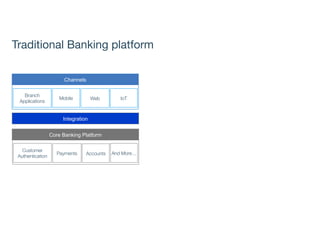
Traditional Banking platform
Branch
Applications
Mobile
Channels
Web IoT
Customer
Authentication
Payments
Core Banking Platform
Accounts And More…
Integration
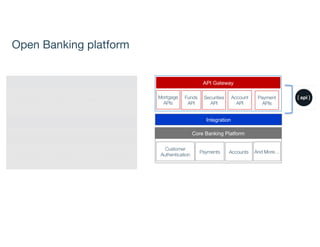
Open Banking platform
Mortgage
APIs
Securities
API
API Gateway
Payment
APIs
Customer
Authentication
Payments
Core Banking Platform
Accounts And More…
Integration
Funds
API
Account
API
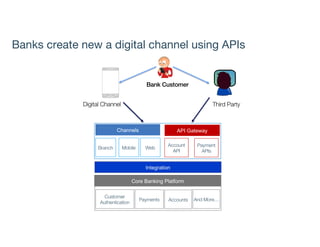
Banks create new a digital channel using APIs
Branch Web
API Gateway
Payment
APIs
Customer
Authentication
Payments
Core Banking Platform
Accounts And More…
Integration
Channels
Mobile
Account
API
Bank Customer
Third PartyDigital Channel
Open Banking Regulation
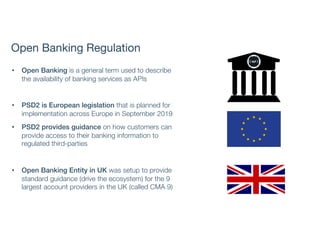
• Open Banking is a general term used to describe
the availability of banking services as APIs
• PSD2 is European legislation that is planned for
implementation across Europe in September 2019
• PSD2 provides guidance on how customers can
provide access to their banking information to
regulated third-parties
• Open Banking Entity in UK was setup to provide
standard guidance (drive the ecosystem) for the 9
largest account providers in the UK (called CMA 9)
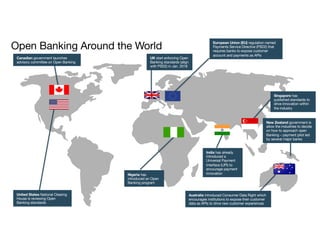
Open Banking Around the World
Canadian government launches
advisory committee on Open Banking
United States National Clearing
House is reviewing Open
Banking standards
UK start enforcing Open
Banking standards (align
with PSD2) in Jan. 2018
Australia introduced Consumer Data Right which
encourages institutions to expose their customer
data as APIs to drive new customer experiences
New Zealand government is
allow the industries to decide
on how to approach open
Banking – payment pilot led
by several major banks
European Union (EU) regulation named
Payments Service Directive (PSD2) that
requires banks to expose customer
account and payments as APIs
India has already
introduced a
Universal Payment
Interface (UPI) to
encourage payment
innovationNigeria has
introduced an Open
Banking program
Singapore has
published standards to
drive innovation within
the industry
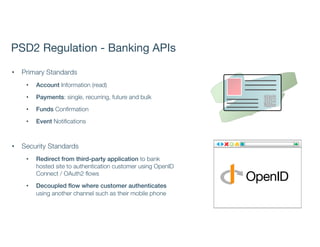
PSD2 Regulation - Banking APIs
• Primary Standards
• Account Information (read)
• Payments: single, recurring, future and bulk
• Funds Confirmation
• Event Notifications
• Security Standards
• Redirect from third-party application to bank
hosted site to authentication customer using OpenID
Connect / OAuth2 flows
• Decoupled flow where customer authenticates
using another channel such as their mobile phone
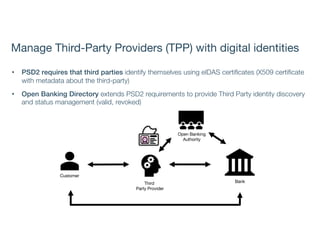
Manage Third-Party Providers (TPP) with digital identities
• PSD2 requires that third parties identify themselves using eIDAS certificates (X509 certificate
with metadata about the third-party)
• Open Banking Directory extends PSD2 requirements to provide Third Party identity discovery
and status management (valid, revoked)
Customer
Open Banking
Authority
BankThird
Party Provider
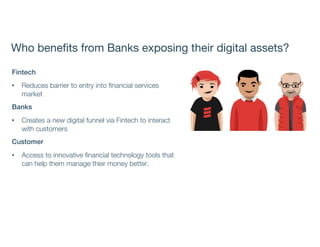
Who benefits from Banks exposing their digital assets?
Fintech
• Reduces barrier to entry into financial services
market
Banks
• Creates a new digital funnel via Fintech to interact
with customers
Customer
• Access to innovative financial technology tools that
can help them manage their money better.
• Traditional vs Open Banking platform
• Customer Experience
• IBM API Connect support for Open Banking / PSD2
Agenda
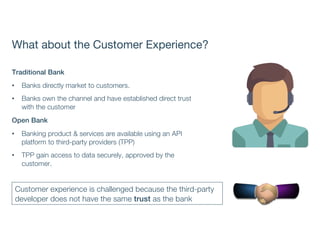
What about the Customer Experience?
Traditional Bank
• Banks directly market to customers.
• Banks own the channel and have established direct trust
with the customer
Open Bank
• Banking product & services are available using an API
platform to third-party providers (TPP)
• TPP gain access to data securely, approved by the
customer.
Customer experience is challenged because the third-party
developer does not have the same trust as the bank
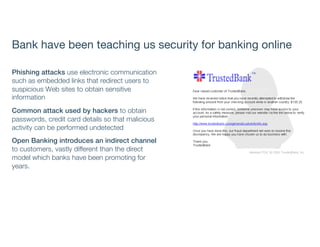
Bank have been teaching us security for banking online
Phishing attacks use electronic communication
such as embedded links that redirect users to
suspicious Web sites to obtain sensitive
information
Common attack used by hackers to obtain
passwords, credit card details so that malicious
activity can be performed undetected
Open Banking introduces an indirect channel
to customers, vastly different than the direct
model which banks have been promoting for
years.
Customer trust is the Key driver for Open Banking success
Banks must ensure customer data is shared
with third party developers only upon customer
consent
Third parties must adhere to GDPR “right to
be forgotten” mandates
User experience and branding is critical when
switching between a third-party and banking
sites
Banks need to understand their
responsibility if the third-party misuses the
data
• Traditional vs Open Banking platform
• Customer Experience
• IBM API Connect support for Open Banking / PSD2
Agenda
17
IBM Thought Leadership in Open Banking
• 35+ banks and banking groups use API Connect for their
PSD2 implementations
• 4 out of the 9 UK banks that launched their Open Banking APIs
in January 2018 are using the IBM API Connect & gateway
technologies
• IBM is market leader in Open Banking implementations across
the world
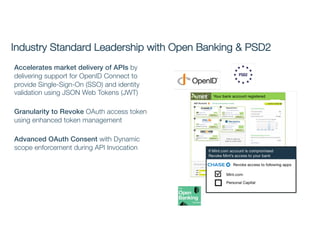
Industry Standard Leadership with Open Banking & PSD2
Accelerates market delivery of APIs by
delivering support for OpenID Connect to
provide Single-Sign-On (SSO) and identity
validation using JSON Web Tokens (JWT)
Granularity to Revoke OAuth access token
using enhanced token management
Advanced OAuth Consent with Dynamic
scope enforcement during API Invocation
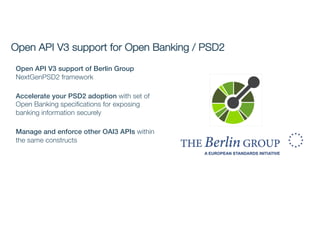
Open API V3 support of Berlin Group
NextGenPSD2 framework
Accelerate your PSD2 adoption with set of
Open Banking specifications for exposing
banking information securely
Manage and enforce other OAI3 APIs within
the same constructs
Open API V3 support for Open Banking / PSD2
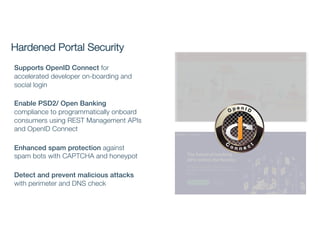
Hardened Portal Security
Supports OpenID Connect for
accelerated developer on-boarding and
social login
Enable PSD2/ Open Banking
compliance to programmatically onboard
consumers using REST Management APIs
and OpenID Connect
Enhanced spam protection against
spam bots with CAPTCHA and honeypot
Detect and prevent malicious attacks
with perimeter and DNS check
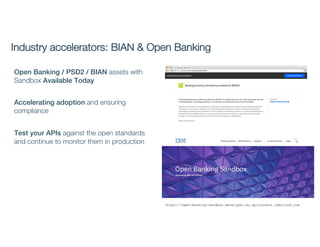
Industry accelerators: BIAN & Open Banking
Open Banking / PSD2 / BIAN assets with
Sandbox Available Today
Accelerating adoption and ensuring
compliance
Test your APIs against the open standards
and continue to monitor them in production
https://open-banking-sandbox.developer.eu.apiconnect.ibmcloud.com
Notices and disclaimers
22
© 2018 International Business Machines Corporation. No part of this
document may be reproduced or transmitted in any form without
written permission from IBM.
U.S. Government Users Restricted Rights — use, duplication or
disclosure restricted by GSA ADP Schedule Contract with IBM.
Information in these presentations (including information relating to
products that have not yet been announced by IBM) has been reviewed
for accuracy as of the date of initial publication and could include
unintentional technical or typographical errors. IBM shall have no
responsibility to update this information. This document is distributed
“as is” without any warranty, either express or implied. In no event,
shall IBM be liable for any damage arising from the use of this
information, including but not limited to, loss of data, business
interruption, loss of profit or loss of opportunity. IBM products and
services are warranted per the terms and conditions of the agreements
under which they are provided.
IBM products are manufactured from new parts or new and used parts.
In some cases, a product may not be new and may have been previously
installed. Regardless, our warranty terms apply.”
Any statements regarding IBM's future direction, intent or product
plans are subject to change or withdrawal without notice.
Performance data contained herein was generally obtained in a
controlled, isolated environments. Customer examples are presented as
illustrations of how those customers have used IBM products and the
results they may have achieved. Actual performance, cost, savings or
other results in other operating environments may vary.
References in this document to IBM products, programs, or services
does not imply that IBM intends to make such products, programs or
services available in all countries in which IBM operates or does
business.
Workshops, sessions and associated materials may have been prepared
by independent session speakers, and do not necessarily reflect the
views of IBM. All materials and discussions are provided for
informational purposes only, and are neither intended to, nor shall
constitute legal or other guidance or advice to any individual participant
or their specific situation.
It is the customer’s responsibility to insure its own compliance
with legal requirements and to obtain advice of competent legal counsel
as to the identification and interpretation of any relevant laws and
regulatory requirements that may affect the customer’s business and
any actions the customer may need to take to comply with such
laws. IBM does not provide legal advice or represent or warrant that its
services or products will ensure that the customer follows any law.
Notices and disclaimers
continued
23
Information concerning non-IBM products was obtained from the
suppliers of those products, their published announcements or other
publicly available sources. IBM has not tested those products about this
publication and cannot confirm the accuracy of performance,
compatibility or any other claims related to non-IBM products.
Questions on the capabilities of non-IBM products should be addressed
to the suppliers of those products. IBM does not warrant the quality of
any third-party products, or the ability of any such third-party products
to interoperate with IBM’s products. IBM expressly disclaims all
warranties, expressed or implied, including but not limited to, the
implied warranties of merchantability and fitness for a purpose.
The provision of the information contained herein is not intended to, and
does not, grant any right or license under any IBM patents, copyrights,
trademarks or other intellectual property right.
IBM, the IBM logo, ibm.com and [names of other referenced IBM
products and services used in the presentation] are trademarks of
International Business Machines Corporation, registered in many
jurisdictions worldwide. Other product and service names might
be trademarks of IBM or other companies. A current list of IBM
trademarks is available on the Web at “Copyright and trademark
information” at: www.ibm.com/legal/copytrade.shtml.
24
®

Open Banking via API Connect & DataPower

  • 1.
    Open Banking ViaIBM API Connect API Connect & DataPower Ozair Sheikh Program Director Shiu-Fun Poon STSM
  • 2.
    IBM’s statements regardingits plans, directions, and intent are subject to change or withdrawal without notice and at IBM’s sole discretion. Information regarding potential future products is intended to outline our general product direction and it should not be relied on in making a purchasing decision. The information mentioned regarding potential future products is not a commitment, promise, or legal obligation to deliver any material, code or functionality. Information about potential future products may not be incorporated into any contract. The development, release, and timing of any future features or functionality described for our products remains at our sole discretion. Performance is based on measurements and projections using standard IBM benchmarks in a controlled environment. The actual throughput or performance that any user will experience will vary depending upon many factors, including considerations such as the amount of multiprogramming in the user’s job stream, the I/O configuration, the storage configuration, and the workload processed. Therefore, no assurance can be given that an individual user will achieve results similar to those stated here. 2 Please note
  • 3.
    • Traditional vsOpen Banking platform • Customer Experience • IBM API Connect support for Open Banking / PSD2 Agenda
  • 4.
    Traditional Banking platform Branch Applications Mobile Channels WebIoT Customer Authentication Payments Core Banking Platform Accounts And More… Integration
  • 5.
    Open Banking platform Mortgage APIs Securities API APIGateway Payment APIs Customer Authentication Payments Core Banking Platform Accounts And More… Integration Funds API Account API
  • 6.
    Banks create newa digital channel using APIs Branch Web API Gateway Payment APIs Customer Authentication Payments Core Banking Platform Accounts And More… Integration Channels Mobile Account API Bank Customer Third PartyDigital Channel
  • 7.
    Open Banking Regulation •Open Banking is a general term used to describe the availability of banking services as APIs • PSD2 is European legislation that is planned for implementation across Europe in September 2019 • PSD2 provides guidance on how customers can provide access to their banking information to regulated third-parties • Open Banking Entity in UK was setup to provide standard guidance (drive the ecosystem) for the 9 largest account providers in the UK (called CMA 9)
  • 8.
    Open Banking Aroundthe World Canadian government launches advisory committee on Open Banking United States National Clearing House is reviewing Open Banking standards UK start enforcing Open Banking standards (align with PSD2) in Jan. 2018 Australia introduced Consumer Data Right which encourages institutions to expose their customer data as APIs to drive new customer experiences New Zealand government is allow the industries to decide on how to approach open Banking – payment pilot led by several major banks European Union (EU) regulation named Payments Service Directive (PSD2) that requires banks to expose customer account and payments as APIs India has already introduced a Universal Payment Interface (UPI) to encourage payment innovationNigeria has introduced an Open Banking program Singapore has published standards to drive innovation within the industry
  • 9.
    PSD2 Regulation -Banking APIs • Primary Standards • Account Information (read) • Payments: single, recurring, future and bulk • Funds Confirmation • Event Notifications • Security Standards • Redirect from third-party application to bank hosted site to authentication customer using OpenID Connect / OAuth2 flows • Decoupled flow where customer authenticates using another channel such as their mobile phone
  • 10.
    Manage Third-Party Providers(TPP) with digital identities • PSD2 requires that third parties identify themselves using eIDAS certificates (X509 certificate with metadata about the third-party) • Open Banking Directory extends PSD2 requirements to provide Third Party identity discovery and status management (valid, revoked) Customer Open Banking Authority BankThird Party Provider
  • 11.
    Who benefits fromBanks exposing their digital assets? Fintech • Reduces barrier to entry into financial services market Banks • Creates a new digital funnel via Fintech to interact with customers Customer • Access to innovative financial technology tools that can help them manage their money better.
  • 12.
    • Traditional vsOpen Banking platform • Customer Experience • IBM API Connect support for Open Banking / PSD2 Agenda
  • 13.
    What about theCustomer Experience? Traditional Bank • Banks directly market to customers. • Banks own the channel and have established direct trust with the customer Open Bank • Banking product & services are available using an API platform to third-party providers (TPP) • TPP gain access to data securely, approved by the customer. Customer experience is challenged because the third-party developer does not have the same trust as the bank
  • 14.
    Bank have beenteaching us security for banking online Phishing attacks use electronic communication such as embedded links that redirect users to suspicious Web sites to obtain sensitive information Common attack used by hackers to obtain passwords, credit card details so that malicious activity can be performed undetected Open Banking introduces an indirect channel to customers, vastly different than the direct model which banks have been promoting for years.
  • 15.
    Customer trust isthe Key driver for Open Banking success Banks must ensure customer data is shared with third party developers only upon customer consent Third parties must adhere to GDPR “right to be forgotten” mandates User experience and branding is critical when switching between a third-party and banking sites Banks need to understand their responsibility if the third-party misuses the data
  • 16.
    • Traditional vsOpen Banking platform • Customer Experience • IBM API Connect support for Open Banking / PSD2 Agenda
  • 17.
    17 IBM Thought Leadershipin Open Banking • 35+ banks and banking groups use API Connect for their PSD2 implementations • 4 out of the 9 UK banks that launched their Open Banking APIs in January 2018 are using the IBM API Connect & gateway technologies • IBM is market leader in Open Banking implementations across the world
  • 18.
    Industry Standard Leadershipwith Open Banking & PSD2 Accelerates market delivery of APIs by delivering support for OpenID Connect to provide Single-Sign-On (SSO) and identity validation using JSON Web Tokens (JWT) Granularity to Revoke OAuth access token using enhanced token management Advanced OAuth Consent with Dynamic scope enforcement during API Invocation
  • 19.
    Open API V3support of Berlin Group NextGenPSD2 framework Accelerate your PSD2 adoption with set of Open Banking specifications for exposing banking information securely Manage and enforce other OAI3 APIs within the same constructs Open API V3 support for Open Banking / PSD2
  • 20.
    Hardened Portal Security SupportsOpenID Connect for accelerated developer on-boarding and social login Enable PSD2/ Open Banking compliance to programmatically onboard consumers using REST Management APIs and OpenID Connect Enhanced spam protection against spam bots with CAPTCHA and honeypot Detect and prevent malicious attacks with perimeter and DNS check
  • 21.
    Industry accelerators: BIAN& Open Banking Open Banking / PSD2 / BIAN assets with Sandbox Available Today Accelerating adoption and ensuring compliance Test your APIs against the open standards and continue to monitor them in production https://open-banking-sandbox.developer.eu.apiconnect.ibmcloud.com
  • 22.
    Notices and disclaimers 22 ©2018 International Business Machines Corporation. No part of this document may be reproduced or transmitted in any form without written permission from IBM. U.S. Government Users Restricted Rights — use, duplication or disclosure restricted by GSA ADP Schedule Contract with IBM. Information in these presentations (including information relating to products that have not yet been announced by IBM) has been reviewed for accuracy as of the date of initial publication and could include unintentional technical or typographical errors. IBM shall have no responsibility to update this information. This document is distributed “as is” without any warranty, either express or implied. In no event, shall IBM be liable for any damage arising from the use of this information, including but not limited to, loss of data, business interruption, loss of profit or loss of opportunity. IBM products and services are warranted per the terms and conditions of the agreements under which they are provided. IBM products are manufactured from new parts or new and used parts. In some cases, a product may not be new and may have been previously installed. Regardless, our warranty terms apply.” Any statements regarding IBM's future direction, intent or product plans are subject to change or withdrawal without notice. Performance data contained herein was generally obtained in a controlled, isolated environments. Customer examples are presented as illustrations of how those customers have used IBM products and the results they may have achieved. Actual performance, cost, savings or other results in other operating environments may vary. References in this document to IBM products, programs, or services does not imply that IBM intends to make such products, programs or services available in all countries in which IBM operates or does business. Workshops, sessions and associated materials may have been prepared by independent session speakers, and do not necessarily reflect the views of IBM. All materials and discussions are provided for informational purposes only, and are neither intended to, nor shall constitute legal or other guidance or advice to any individual participant or their specific situation. It is the customer’s responsibility to insure its own compliance with legal requirements and to obtain advice of competent legal counsel as to the identification and interpretation of any relevant laws and regulatory requirements that may affect the customer’s business and any actions the customer may need to take to comply with such laws. IBM does not provide legal advice or represent or warrant that its services or products will ensure that the customer follows any law.
  • 23.
    Notices and disclaimers continued 23 Informationconcerning non-IBM products was obtained from the suppliers of those products, their published announcements or other publicly available sources. IBM has not tested those products about this publication and cannot confirm the accuracy of performance, compatibility or any other claims related to non-IBM products. Questions on the capabilities of non-IBM products should be addressed to the suppliers of those products. IBM does not warrant the quality of any third-party products, or the ability of any such third-party products to interoperate with IBM’s products. IBM expressly disclaims all warranties, expressed or implied, including but not limited to, the implied warranties of merchantability and fitness for a purpose. The provision of the information contained herein is not intended to, and does not, grant any right or license under any IBM patents, copyrights, trademarks or other intellectual property right. IBM, the IBM logo, ibm.com and [names of other referenced IBM products and services used in the presentation] are trademarks of International Business Machines Corporation, registered in many jurisdictions worldwide. Other product and service names might be trademarks of IBM or other companies. A current list of IBM trademarks is available on the Web at “Copyright and trademark information” at: www.ibm.com/legal/copytrade.shtml.
  • 24.