Open Banking beyond PSD2 in
the EU
Torsten Lodderstedt
@tlodderstedt
yes®
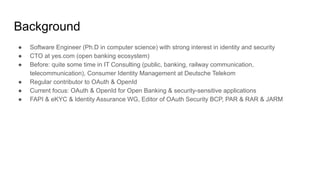
Background
● Software Engineer (Ph.D in computer science) with strong interest in identity and security
● CTO at yes.com (open banking ecosystem)
● Before: quite some time in IT Consulting (public, banking, railway communication,
telecommunication), Consumer Identity Management at Deutsche Telekom
● Regular contributor to OAuth & OpenId
● Current focus: OAuth & OpenId for Open Banking & security-sensitive applications
● FAPI & eKYC & Identity Assurance WG, Editor of OAuth Security BCP, PAR & RAR & JARM
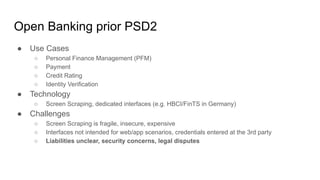
Open Banking prior PSD2
● Use Cases
○ Personal Finance Management (PFM)
○ Payment
○ Credit Rating
○ Identity Verification
● Technology
○ Screen Scraping, dedicated interfaces (e.g. HBCI/FinTS in Germany)
● Challenges
○ Screen Scraping is fragile, insecure, expensive
○ Interfaces not intended for web/app scenarios, credentials entered at the 3rd party
○ Liabilities unclear, security concerns, legal disputes
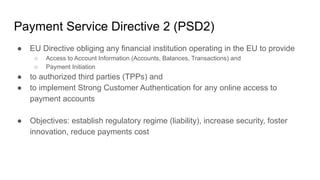
Payment Service Directive 2 (PSD2)
● EU Directive obliging any financial institution operating in the EU to provide
○ Access to Account Information (Accounts, Balances, Transactions) and
○ Payment Initiation
● to authorized third parties (TPPs) and
● to implement Strong Customer Authentication for any online access to
payment accounts
● Objectives: establish regulatory regime (liability), increase security, foster
innovation, reduce payments cost
®
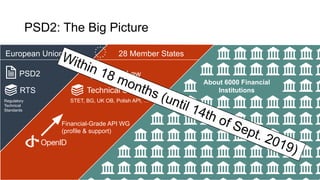
PSD2: The Big Picture
European Union 28 Member States
PSD2
RTS
Regulatory
Technical
Standards
Local Law
Technical Standards
STET, BG, UK OB, Polish API, …
Financial-Grade API WG
(profile & support)
About 6000 Financial
Institutions
Within 18 months (until 14th of Sept. 2019)
PSD2: Status
● In transition phase, not fully operational from a customer’s perspective
● Lack of interoperability across financial institutions and member states
● Alignment among three major API initiatives under the Swift umbrella
○ OpenID Foundation/FAPI invited to contribute security profile
Beyond PSD2 (Scope)
● Different parties with different interests
● Merchants want better payment services (e.g. invoice, deferred, guaranteed)
● Regulator (EBA) wants EU-wide payment scheme based on current accounts
● Traditional TPPs want more data for identity verification, credit scoring &
payments risk assessment
Key Question: Willingness to Pay?
● Financial Institutions want a business case and leverage their tremendous
investments in the open banking infrastructure
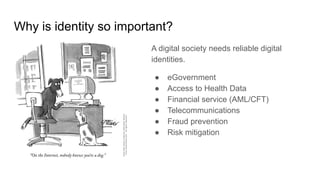
Why is identity so important?
A digital society needs reliable digital
identities.
● eGovernment
● Access to Health Data
● Financial service (AML/CFT)
● Telecommunications
● Fraud prevention
● Risk mitigation
Bank Identity as a Service
● Financial Institutions verify and maintain identity data for every person
authorized for an bank account according to local anti-money laundering law
● This data is bound to online banking user accounts equipped with credentials
for multi factor authentication (SCA in the EU)
● User Account Lifecycle management in place
● Leveraging this assets as Identity Provider to 3rd parties is an opportunity to
provide new services to existing customers and to create a revenue stream
○ Authentication as a Service
○ High Level Identity Assurance
○ Further person-related data (e.g. credit score)
OpenID Connect
● Given most PSD2 APIs are based on OAuth, using OpenID to provide identity
services is the obvious choice
● Challenges with current state of the art
○ Lack of reach - not enough suitable claims sources
○ Lack of interoperability - e.g. data is interpreted based on implicit attestation
● OpenID Foundation has started WG to define OpenID Connect extension for
high-level Identity Assurance
● Suitable for all kinds of IDPs (governments, mobile operators, financial
institutions, …)
®
OpenID Connect 4 Identity Assurance
● Current Draft:
https://openid.net/specs/openid-connect-4-identity-assurance-1_0.html
● Representation for verified claims and associated metadata & evidence
● Enables legal compliance for relevant use cases
● Adopted as Implementer’s Draft
®
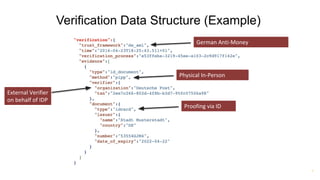
Explicit Attestation
● Trust framework the IDP complies with
● Time of verification
● Verifier: what party verified the user‘s identity
● Evidence: which evidence where used
● Verification Method: how were the evidence verified
®
Verification Data Structure (Example)
German Anti-Money
Laundering Act
Physical In-Person
Proofing
External Verifier
on behalf of IDP
Proofing via ID
Card
®
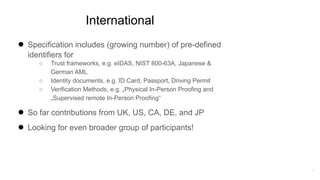
International
● Specification includes (growing number) of pre-defined
identifiers for
○ Trust frameworks, e.g. eIDAS, NIST 800-63A, Japanese &
German AML
○ Identity documents, e.g. ID Card, Passport, Driving Permit
○ Verification Methods, e.g. „Physical In-Person Proofing and
„Supervised remote In-Person Proofing“
● So far contributions from UK, US, CA, DE, and JP
● Looking for even broader group of participants!
®
No Ambiguities
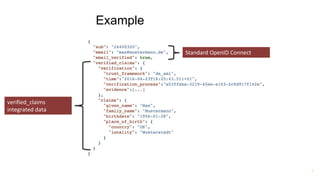
● Claims with attestation are represented in data
structure along with verification metadata
● Also allows to use existing OpenID Connect Claims
alongside verified claims in the same transaction
®
Example
Standard OpenID Connect
Claims
verified_claims
integrated data
structure
®
Privacy Preserving
● RP asks for individual Claims and Verification data elements
● Purpose of inquiry can be conveyed (per transaction or individual claim)
®
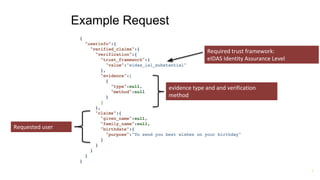
Example Request
Required trust framework:
eIDAS Identity Assurance Level
„substantial“
Requested user
claims
evidence type and and verification
method
but not the evidence itself
®
Versatile
● Representation can be used in a variety of channels (even beyond
OpenID Connect):
○ ID Token
○ User Info
○ Access Tokens
○ Token Introspection Responses
®
Status
● Initial contribution based on implementation experience at yes.com
● Draft quickly evolved through international contributions
● Several implementations of the current draft in progress
● Set up dedicated working group for Identity Assurance
○ Please join!
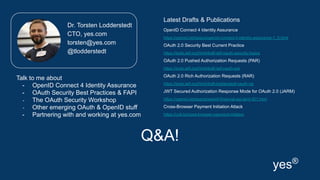
Q&A!
Latest Drafts & Publications
OpenID Connect 4 Identity Assurance
https://openid.net/specs/openid-connect-4-identity-assurance-1_0.html
OAuth 2.0 Security Best Current Practice
https://tools.ietf.org/html/draft-ietf-oauth-security-topics
OAuth 2.0 Pushed Authorization Requests (PAR)
https://tools.ietf.org/html/draft-ietf-oauth-par
OAuth 2.0 Rich Authorization Requests (RAR)
https://tools.ietf.org/html/draft-lodderstedt-oauth-rar
JWT Secured Authorization Response Mode for OAuth 2.0 (JARM)
https://openid.net/specs/openid-financial-api-jarm-ID1.html
Cross-Browser Payment Initiation Attack
https://cutt.ly/cross-browser-payment-initation
Dr. Torsten Lodderstedt
CTO, yes.com
torsten@yes.com
@tlodderstedt
yes®
Talk to me about
- OpenID Connect 4 Identity Assurance
- OAuth Security Best Practices & FAPI
- The OAuth Security Workshop
- Other emerging OAuth & OpenID stuff
- Partnering with and working at yes.com

Open Banking beyond PSD2 in the EU

  • 1.
    Open Banking beyondPSD2 in the EU Torsten Lodderstedt @tlodderstedt yes®
  • 2.
    Background ● Software Engineer(Ph.D in computer science) with strong interest in identity and security ● CTO at yes.com (open banking ecosystem) ● Before: quite some time in IT Consulting (public, banking, railway communication, telecommunication), Consumer Identity Management at Deutsche Telekom ● Regular contributor to OAuth & OpenId ● Current focus: OAuth & OpenId for Open Banking & security-sensitive applications ● FAPI & eKYC & Identity Assurance WG, Editor of OAuth Security BCP, PAR & RAR & JARM
  • 3.
    Open Banking priorPSD2 ● Use Cases ○ Personal Finance Management (PFM) ○ Payment ○ Credit Rating ○ Identity Verification ● Technology ○ Screen Scraping, dedicated interfaces (e.g. HBCI/FinTS in Germany) ● Challenges ○ Screen Scraping is fragile, insecure, expensive ○ Interfaces not intended for web/app scenarios, credentials entered at the 3rd party ○ Liabilities unclear, security concerns, legal disputes
  • 4.
    Payment Service Directive2 (PSD2) ● EU Directive obliging any financial institution operating in the EU to provide ○ Access to Account Information (Accounts, Balances, Transactions) and ○ Payment Initiation ● to authorized third parties (TPPs) and ● to implement Strong Customer Authentication for any online access to payment accounts ● Objectives: establish regulatory regime (liability), increase security, foster innovation, reduce payments cost
  • 5.
    ® PSD2: The BigPicture European Union 28 Member States PSD2 RTS Regulatory Technical Standards Local Law Technical Standards STET, BG, UK OB, Polish API, … Financial-Grade API WG (profile & support) About 6000 Financial Institutions Within 18 months (until 14th of Sept. 2019)
  • 6.
    PSD2: Status ● Intransition phase, not fully operational from a customer’s perspective ● Lack of interoperability across financial institutions and member states ● Alignment among three major API initiatives under the Swift umbrella ○ OpenID Foundation/FAPI invited to contribute security profile
  • 7.
    Beyond PSD2 (Scope) ●Different parties with different interests ● Merchants want better payment services (e.g. invoice, deferred, guaranteed) ● Regulator (EBA) wants EU-wide payment scheme based on current accounts ● Traditional TPPs want more data for identity verification, credit scoring & payments risk assessment Key Question: Willingness to Pay? ● Financial Institutions want a business case and leverage their tremendous investments in the open banking infrastructure
  • 8.
    Why is identityso important? A digital society needs reliable digital identities. ● eGovernment ● Access to Health Data ● Financial service (AML/CFT) ● Telecommunications ● Fraud prevention ● Risk mitigation
  • 9.
    Bank Identity asa Service ● Financial Institutions verify and maintain identity data for every person authorized for an bank account according to local anti-money laundering law ● This data is bound to online banking user accounts equipped with credentials for multi factor authentication (SCA in the EU) ● User Account Lifecycle management in place ● Leveraging this assets as Identity Provider to 3rd parties is an opportunity to provide new services to existing customers and to create a revenue stream ○ Authentication as a Service ○ High Level Identity Assurance ○ Further person-related data (e.g. credit score)
  • 10.
    OpenID Connect ● Givenmost PSD2 APIs are based on OAuth, using OpenID to provide identity services is the obvious choice ● Challenges with current state of the art ○ Lack of reach - not enough suitable claims sources ○ Lack of interoperability - e.g. data is interpreted based on implicit attestation ● OpenID Foundation has started WG to define OpenID Connect extension for high-level Identity Assurance ● Suitable for all kinds of IDPs (governments, mobile operators, financial institutions, …)
  • 11.
    ® OpenID Connect 4Identity Assurance ● Current Draft: https://openid.net/specs/openid-connect-4-identity-assurance-1_0.html ● Representation for verified claims and associated metadata & evidence ● Enables legal compliance for relevant use cases ● Adopted as Implementer’s Draft
  • 12.
    ® Explicit Attestation ● Trustframework the IDP complies with ● Time of verification ● Verifier: what party verified the user‘s identity ● Evidence: which evidence where used ● Verification Method: how were the evidence verified
  • 13.
    ® Verification Data Structure(Example) German Anti-Money Laundering Act Physical In-Person Proofing External Verifier on behalf of IDP Proofing via ID Card
  • 14.
    ® International ● Specification includes(growing number) of pre-defined identifiers for ○ Trust frameworks, e.g. eIDAS, NIST 800-63A, Japanese & German AML ○ Identity documents, e.g. ID Card, Passport, Driving Permit ○ Verification Methods, e.g. „Physical In-Person Proofing and „Supervised remote In-Person Proofing“ ● So far contributions from UK, US, CA, DE, and JP ● Looking for even broader group of participants!
  • 15.
    ® No Ambiguities ● Claimswith attestation are represented in data structure along with verification metadata ● Also allows to use existing OpenID Connect Claims alongside verified claims in the same transaction
  • 16.
  • 17.
    ® Privacy Preserving ● RPasks for individual Claims and Verification data elements ● Purpose of inquiry can be conveyed (per transaction or individual claim)
  • 18.
    ® Example Request Required trustframework: eIDAS Identity Assurance Level „substantial“ Requested user claims evidence type and and verification method but not the evidence itself
  • 19.
    ® Versatile ● Representation canbe used in a variety of channels (even beyond OpenID Connect): ○ ID Token ○ User Info ○ Access Tokens ○ Token Introspection Responses
  • 20.
    ® Status ● Initial contributionbased on implementation experience at yes.com ● Draft quickly evolved through international contributions ● Several implementations of the current draft in progress ● Set up dedicated working group for Identity Assurance ○ Please join!
  • 21.
    Q&A! Latest Drafts &Publications OpenID Connect 4 Identity Assurance https://openid.net/specs/openid-connect-4-identity-assurance-1_0.html OAuth 2.0 Security Best Current Practice https://tools.ietf.org/html/draft-ietf-oauth-security-topics OAuth 2.0 Pushed Authorization Requests (PAR) https://tools.ietf.org/html/draft-ietf-oauth-par OAuth 2.0 Rich Authorization Requests (RAR) https://tools.ietf.org/html/draft-lodderstedt-oauth-rar JWT Secured Authorization Response Mode for OAuth 2.0 (JARM) https://openid.net/specs/openid-financial-api-jarm-ID1.html Cross-Browser Payment Initiation Attack https://cutt.ly/cross-browser-payment-initation Dr. Torsten Lodderstedt CTO, yes.com torsten@yes.com @tlodderstedt yes® Talk to me about - OpenID Connect 4 Identity Assurance - OAuth Security Best Practices & FAPI - The OAuth Security Workshop - Other emerging OAuth & OpenID stuff - Partnering with and working at yes.com