




Jatropha – Zambia’s
first Bio-diesel Feedstock


       Jhonnah Mundike


        Master of Science Thesis
               Stockholm 2009
Jhonnah Mundike


Jatropha – Zambia’s first Bio-diesel Feedstock


                  Supervisor & Examiner:
                      Nils Brandt


              Master of Science Thesis
                    STOCKHOLM 2009


                   PRESENTED AT


  INDUSTRIAL ECOLOGY
ROYAL INSTITUTE OF TECHNOLOGY
TRITA-IM 2009:09
ISSN 1402-7615


Industrial Ecology,
Royal Institute of Technology
www.ima.kth.se
Master of Science Thesis


Jatropha – Zambia’s first Bio-diesel
            Feedstock


                   Prepared By

          Jhonnah Mundike jhonnah@kth.se
             baushi_tinta_boy@yahoo.co.uk

                     Supervisor
               Nils Brandt nilsb@kth.se
          Department of Industrial Ecology
  School of Industrial Engineering and Management


                                             28th May 2009.


                          i
Summary
The purpose of this study was to highlight and bring out the main environmental,
economic and social impacts of the fast developing Jatropha industry in Zambia. The
study addressed key issues related with the Jatropha cultivation, processing and use of
bio-diesel and its by-products. Each of the stages of Jatropha cultivation, conversion
technology and the ultimate use of bio-diesel, glycerine and seedcake were related to
the environmental, economic and social impacts.

Jatropha based bio-diesel production in Zambia has potential to stimulate rural
development, promote agriculture and also helps to diversify Zambia’s economy. The
Jatropha industry has potential to create more jobs than the fossil fuel sector. Locally
produced bio-diesel would reduce reliance on imported fossil oil, which is more
susceptible to external interruptions, ultimately improving on security of supply.
Glycerine and the seedcake have both commercial and economic value within or
outside the country. The environmental impacts among others include reduced end-of-
pipe emissions, soil conservation benefits and ability to minimize desertification.

Key social impacts resulting from the Jatropha industry cannot be traced easily as
actual experiences are yet to be seen and assessed. The issues of threat to food
security and poverty reduction among the poor rural farmers require more time and a
multi-disciplinary approach. The actual positive or negative impacts are projections
that depend on a variety of parameters and factors that may not follow a linear scale.
The use of fertilizer may disadvantage rural farmers, while use of irrigation would
equally impact negatively on them. Intercropping is beneficial to small scale farmers
in the initial years, but may not be feasible later on.

Pro-poor policies and promoting a reliable Jatropha feedstock are some of the ways
that will ensure a vibrant and competitive Jatropha industry in Zambia. Research and
development should be promoted, well co-ordinated and encouraged so that up to date
information is made available for informed decisions as the industry expands.


                                           ii
Table of Contents
Summary ........................................................................................................................ii
Table of Contents ......................................................................................................... iii
Acknowledgements ........................................................................................................ v
List of Acronyms .......................................................................................................... vi
List of Equations ..........................................................................................................vii
List of Figures ..............................................................................................................vii
List of Photographs .................................................................................................... viii
List of Tables ............................................................................................................. viii
1.0      Introduction ........................................................................................................ 1
   1.1      Uses of Jatropha ............................................................................................. 1
   1.2      Aim: ............................................................................................................... 2
      1.2.1      Specific Objectives ................................................................................. 2
      1.2.2      Research Methodology........................................................................... 3
      1.2.3      System Boundary.................................................................................... 3
      1.2.4      Limitations of the Study ......................................................................... 4
   1.3      Brief Overview of Agriculture in Zambia ..................................................... 4
   1.4      Bio-fuels Potential in Zambia ........................................................................ 5
      1.4.1      Local Bio-fuel Industry .......................................................................... 6
   1.5      Principles of Sustainability ............................................................................ 6
   1.6      Bio-fuel Policies............................................................................................. 7
2.0     Jatropha - Historical Background ...................................................................... 8
   2.1      General Description of Jatropha Plant ........................................................... 8
      2.1.1      Generative Propagation (Jatropha Seeds) ............................................ 9
      2.1.2      Vegetative Propagation (Jatropha Cuttings) ......................................... 9
3.0      Questionnaire and Interview Results ............................................................... 18
   3.1      Results from 20 Kalomo Small Scale Jatropha Farmers ............................. 18
   3.2      Results from 15 Kapiri Mposhi Small Scale Jatropha Farmers ................... 21
   3.3      Results from Small Scale Famers under OGS in Luanshya ........................ 24
   3.4      Results from Shakabunda Farm – Masaiti District ...................................... 24
   3.5      Results from Oval Biofuels Limited ............................................................ 26
   3.6      BAZ Annual General Meeting Proceedings in Lusaka................................ 28
4.0      Discussion ........................................................................................................ 30
   4.1      Small Scale Jatropha Farmers ...................................................................... 30
   4.2      Commercial Jatropha Growers .................................................................... 33
   4.3      Social Impacts .............................................................................................. 37
      4.3.1      Implications of OGS ............................................................................. 37
      4.3.2      Food Security ....................................................................................... 38
      4.3.3      Poverty Reduction. ............................................................................... 39
      4.3.4      Labour Requirements ........................................................................... 40
      4.3.5      Land Availability and Landlessness..................................................... 40
      4.3.6      Gender Implications............................................................................. 41
      4.3.7      Domestic Use of Jatropha Seedcake .................................................... 42
      4.3.8      Human Health versus Processing Technology .................................... 43
   4.4      Environmental Impacts ................................................................................ 44
      4.4.1      Land use Patterns versus Marginal Soils ............................................ 44
      4.4.2      Jatropha Impacts on the Soil ............................................................... 45
      4.4.3      Water Requirements and Processing Technology ............................... 46
      4.4.4      Bio-diesel Emissions ............................................................................ 47
      4.4.5      Climate Change ................................................................................... 47


                                                               iii
4.4.6       Desertification and Soil Erosion.......................................................... 48
     4.4.7       Fertilizer Use and Eutrophication ....................................................... 49
     4.4.8       Use of Seedcake as Manure ................................................................. 49
     4.4.9       Jatropha Species Variety versus Oil Yield ........................................... 50
     4.4.10      Threat to Bio-diversity ......................................................................... 50
     4.4.11      Potential Conservation Benefits .......................................................... 51
  4.5      Economic Impacts ........................................................................................ 52
     4.5.1       Saved Costs from Irrigation and Fertilizer.......................................... 52
     4.5.2       Plant Density versus Crop Yield .......................................................... 53
      4.5.3      Direct and Indirect Jobs ...................................................................... 53
      4.5.4      Economic Value of Glycerol and Seedcake ......................................... 54
      4.5.5      Market Development ............................................................................ 54
      4.5.6      Price of Bio-diesel................................................................................ 54
      4.5.7      Security of Supply ................................................................................ 55
   4.6     Policy and Investment .................................................................................. 56
   4.7      Uncertainties in the Jatropha Industry and the role of R&D ....................... 58
   4.8      Key Issues in the Jatropha Industry in Zambia ............................................ 58
5.0     Conclusion ....................................................................................................... 60
6.0     References ........................................................................................................ 61
   6.1      Internet References ...................................................................................... 62
Appendix I: Characteristics of Bio-fuel Policies ......................................................... 65
Appendix II: Comparison of Nutrient Content of Jatropha Seedcake with Chicken and
Cattle Manure............................................................................................................... 66
Appendix III: Effects of Jatropha Cultivation on the Soil ........................................... 67
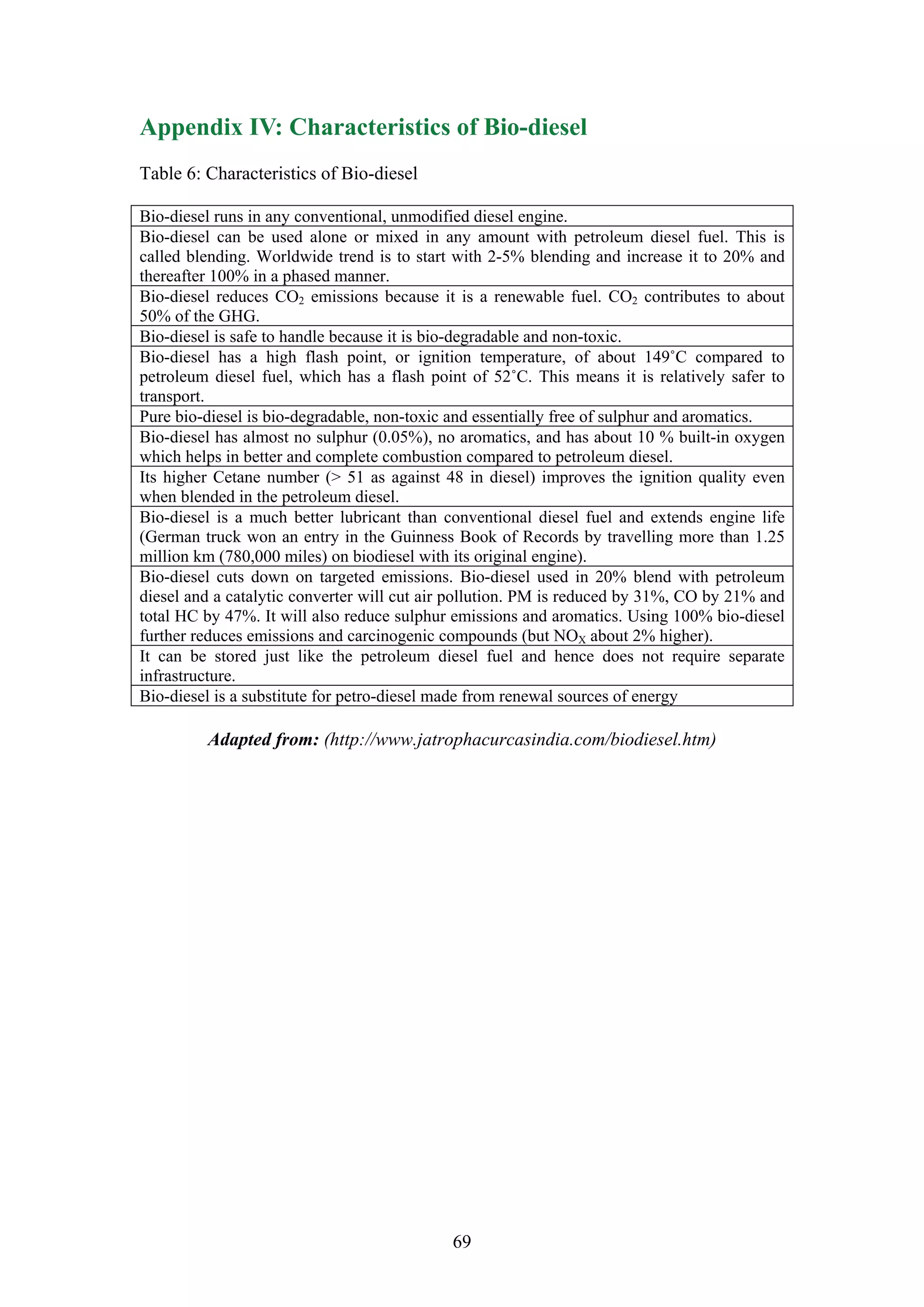
Appendix IV: Characteristics of Bio-diesel ................................................................. 69
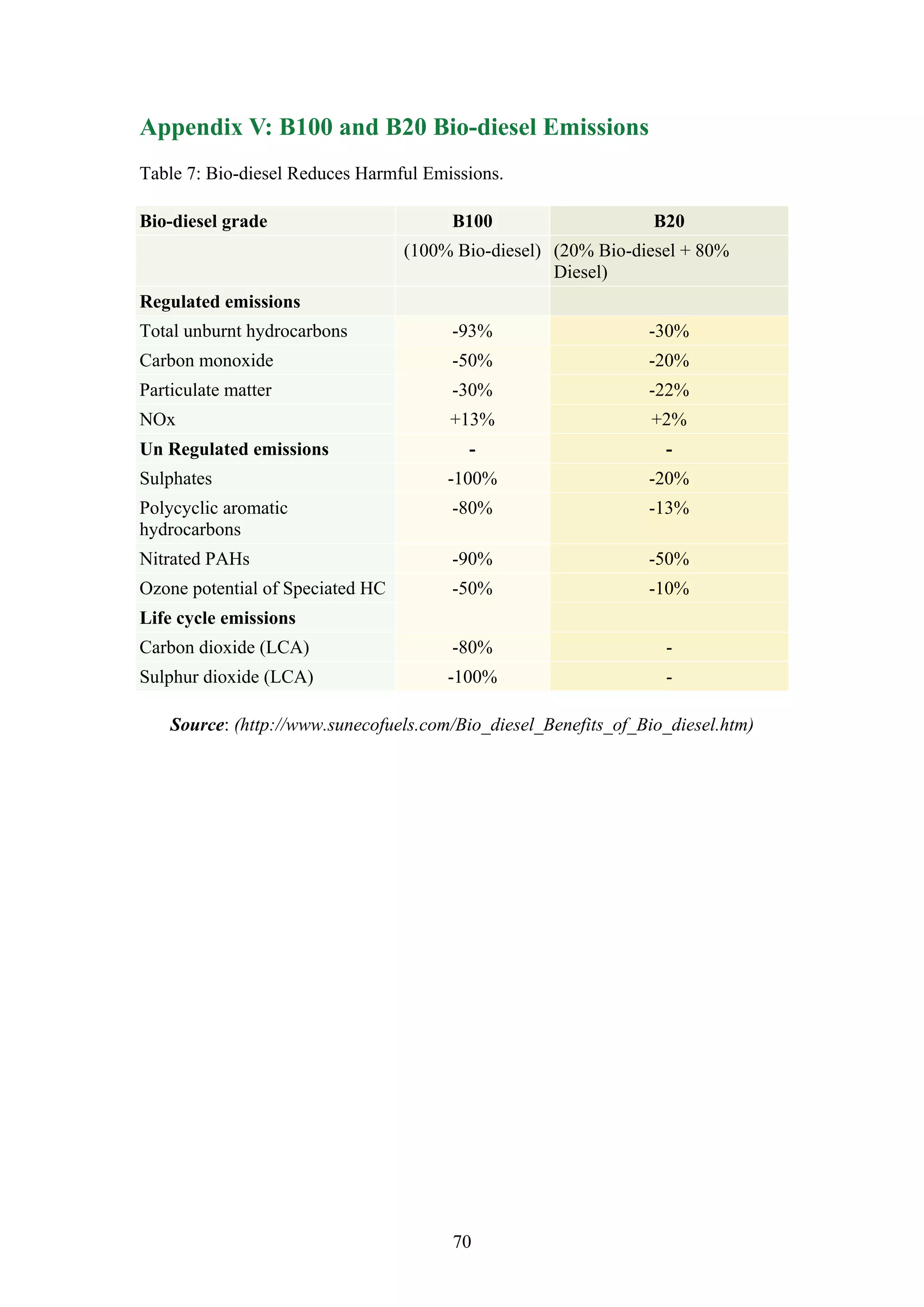
Appendix V: B100 and B20 Bio-diesel Emissions ...................................................... 70
Appendix VI: Questionnaire for Small-Scale Farmers ................................................ 71
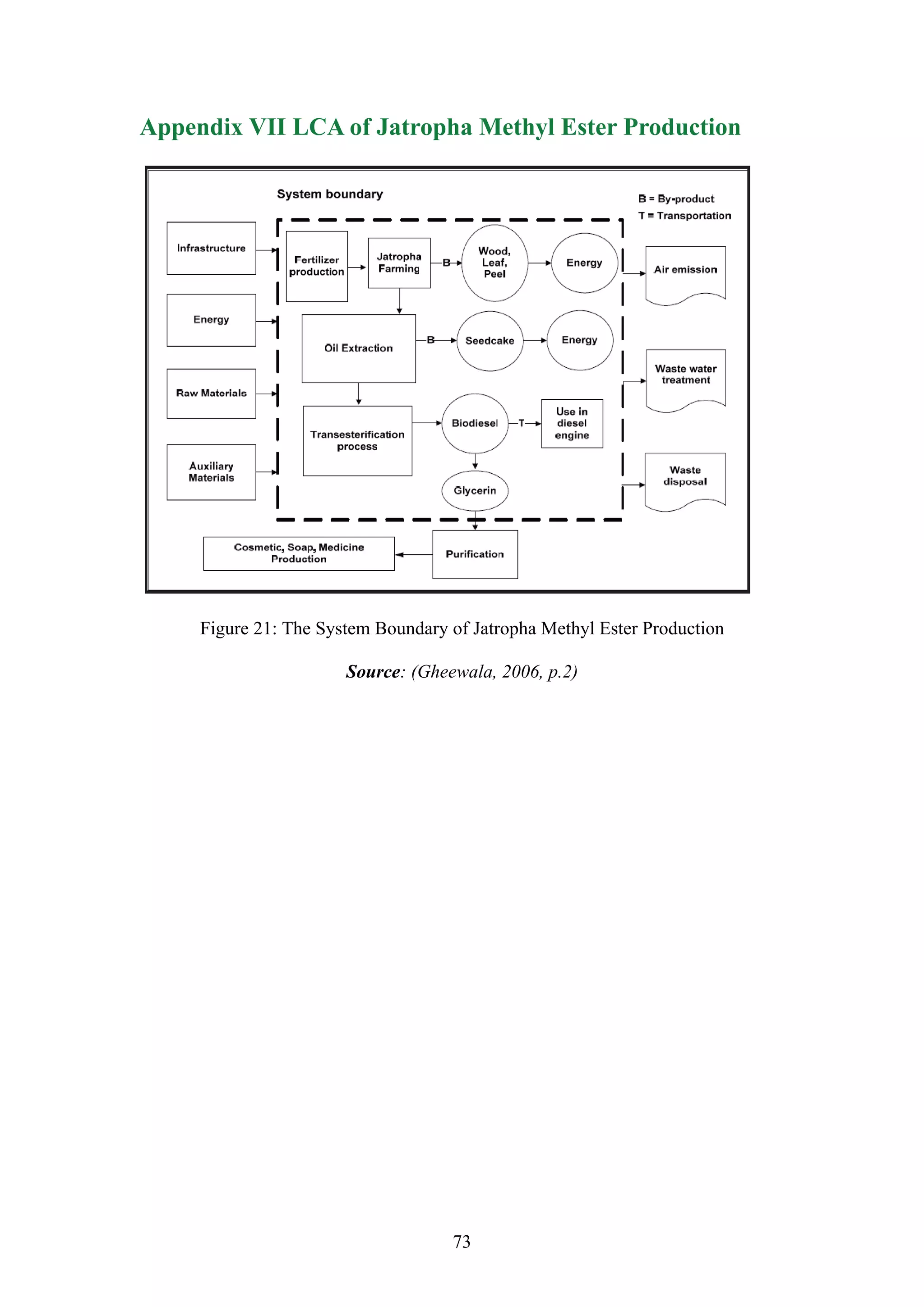
Appendix VII LCA of Jatropha Methyl Ester Production ........................................... 73
Appendix VIII Comparative LCA of GHG emissons of Bio-diesel and Diesel .......... 74
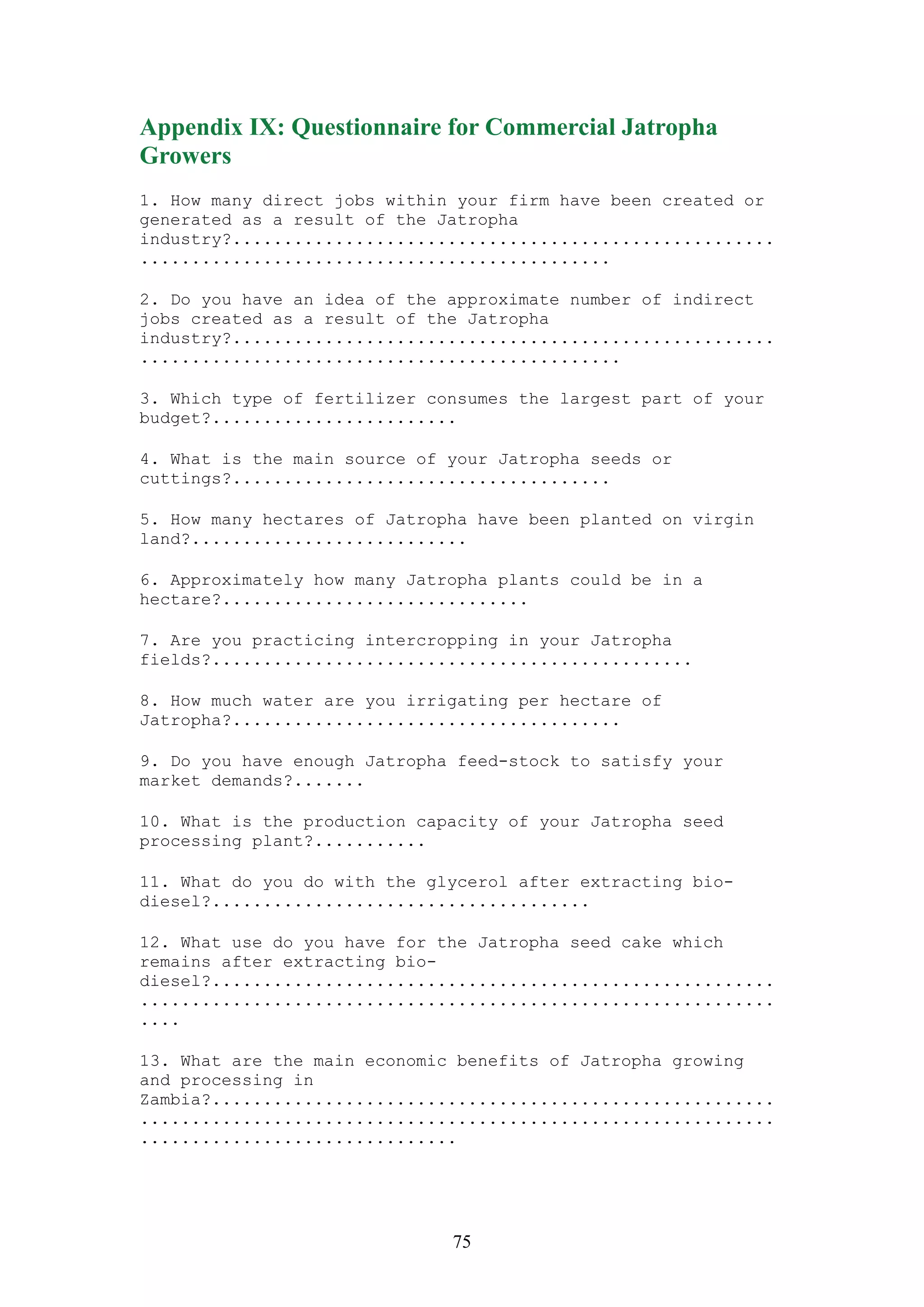
Appendix IX: Questionnaire for Commercial Jatropha Growers ................................ 75


                                                              iv
Acknowledgements
Thanks be to God for the life and good health I have enjoyed while in Sweden. From
August 20, 2007 up to June 1, 2009, God has blessed me with good health, which
enabled me fulfil all academic assignments in a good state of mind both physically
and spiritually. This I do not take for granted! In the absence of life and good health,
nothing is possible!

This study would not have been complete without the professional, technical and
personal inputs of many people. Some of whom are chronicled here below.

I am most grateful to my supervisor, Nils Brandt of the Department of Industrial
Ecology who provided the technical, professional and personal advice and guidance,
from the initial stages up to the last days of this thesis report. Thank you for those e-
mails and meetings in your office. I am equally grateful to Carin Orve of the
Department of Industrial Ecology for all the logistics that contributed to the final
outcome of this report. Special and big thank you to the Swedish Institute (SI), for the
scholarship which financially empowered me during the two years of my stay in
Sweden.

Another person worthy mentioning is my dear wife, Jocelyn who was co-ordinating
the distribution of questionnaires back home in Zambia, to various respondents. The
responses from the questionnaires added sustainability values to the entire report. I am
also highly indebted to the various small-scale Jatropha farmers who spared their
valuable time to respond to my questionnaires. Special thanx to Mrs. M. Munsanje the
Marketing Officer at the MACO in Kapiri Mposhi for linking me up with the Jatropha
farmers.

My course-mates all made the two year programme – Master of Science, Sustainable
Technology (ST-07), a live and practical one, as we spent time together. For those
memorable times during lectures, group assignments, seminars, presentations, study
tours, discussions and examinations, it was a time well-spent! “Tack så mycket,” to
all of you.


                                           v
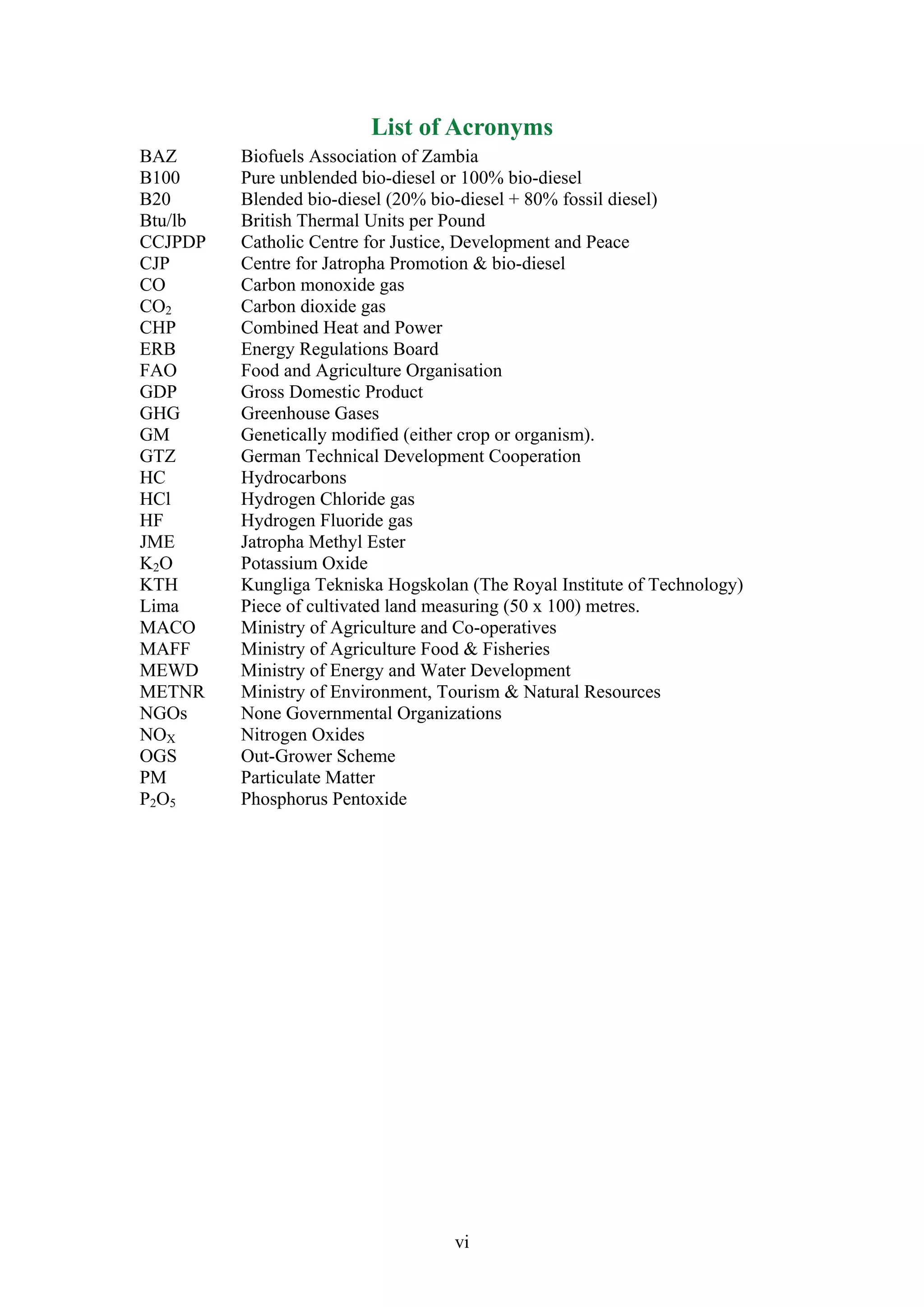
List of Acronyms
BAZ      Biofuels Association of Zambia
B100     Pure unblended bio-diesel or 100% bio-diesel
B20      Blended bio-diesel (20% bio-diesel + 80% fossil diesel)
Btu/lb   British Thermal Units per Pound
CCJPDP   Catholic Centre for Justice, Development and Peace
CJP      Centre for Jatropha Promotion & bio-diesel
CO       Carbon monoxide gas
CO2      Carbon dioxide gas
CHP      Combined Heat and Power
ERB      Energy Regulations Board
FAO      Food and Agriculture Organisation
GDP      Gross Domestic Product
GHG      Greenhouse Gases
GM       Genetically modified (either crop or organism).
GTZ      German Technical Development Cooperation
HC       Hydrocarbons
HCl      Hydrogen Chloride gas
HF       Hydrogen Fluoride gas
JME      Jatropha Methyl Ester
K2O      Potassium Oxide
KTH      Kungliga Tekniska Hogskolan (The Royal Institute of Technology)
Lima     Piece of cultivated land measuring (50 x 100) metres.
MACO     Ministry of Agriculture and Co-operatives
MAFF     Ministry of Agriculture Food & Fisheries
MEWD     Ministry of Energy and Water Development
METNR    Ministry of Environment, Tourism & Natural Resources
NGOs     None Governmental Organizations
NOX      Nitrogen Oxides
OGS      Out-Grower Scheme
PM       Particulate Matter
P2O5     Phosphorus Pentoxide


                                   vi
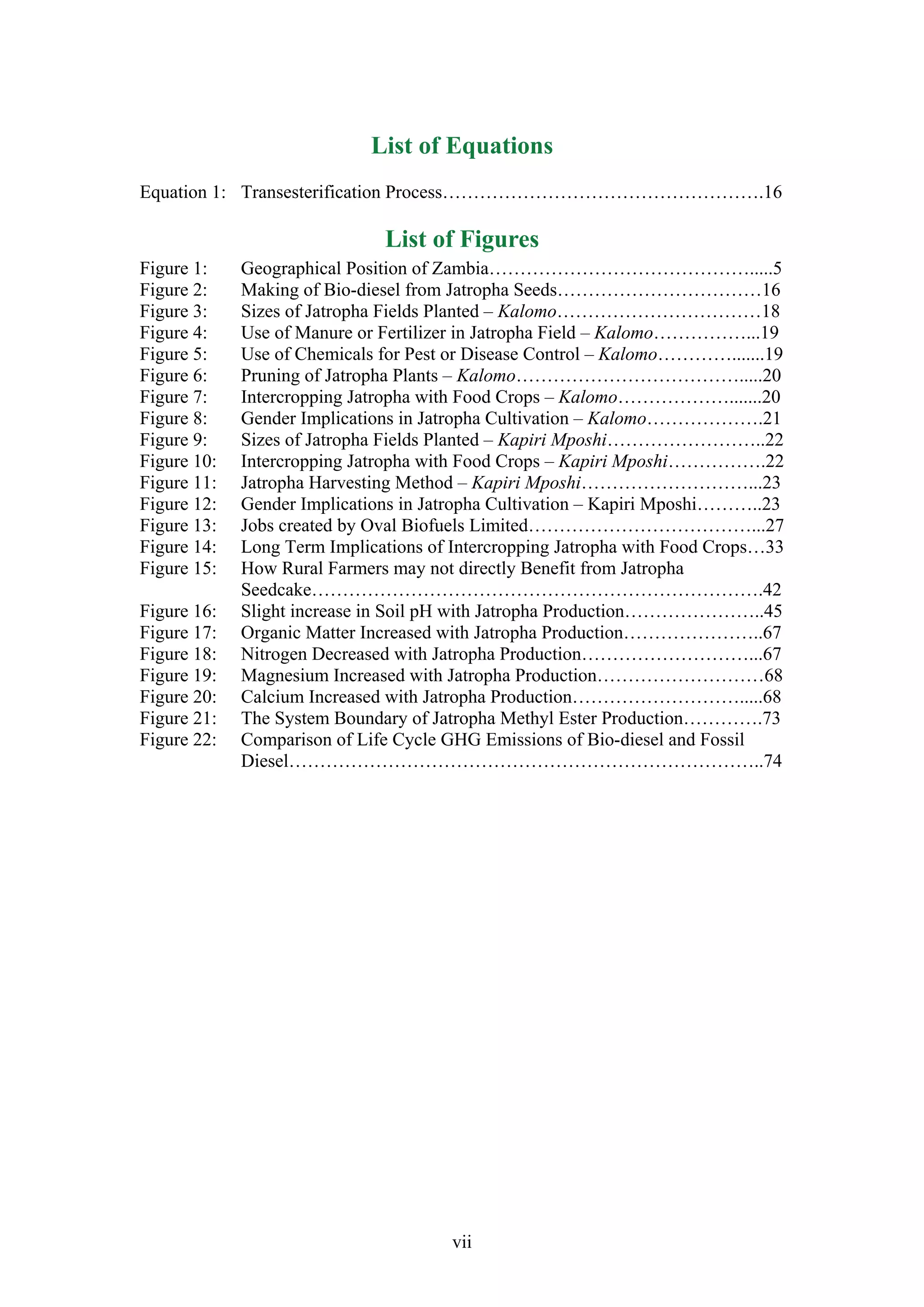
List of Equations
Equation 1: Transesterification Process…………………………………………….16

                              List of Figures
Figure 1:    Geographical Position of Zambia…………………………………….....5
Figure 2:    Making of Bio-diesel from Jatropha Seeds……………………………16
Figure 3:    Sizes of Jatropha Fields Planted – Kalomo……………………………18
Figure 4:    Use of Manure or Fertilizer in Jatropha Field – Kalomo……………...19
Figure 5:    Use of Chemicals for Pest or Disease Control – Kalomo………….......19
Figure 6:    Pruning of Jatropha Plants – Kalomo……………………………….....20
Figure 7:    Intercropping Jatropha with Food Crops – Kalomo……………….......20
Figure 8:    Gender Implications in Jatropha Cultivation – Kalomo……………….21
Figure 9:    Sizes of Jatropha Fields Planted – Kapiri Mposhi……………………..22
Figure 10:   Intercropping Jatropha with Food Crops – Kapiri Mposhi…………….22
Figure 11:   Jatropha Harvesting Method – Kapiri Mposhi………………………...23
Figure 12:   Gender Implications in Jatropha Cultivation – Kapiri Mposhi………..23
Figure 13:   Jobs created by Oval Biofuels Limited………………………………...27
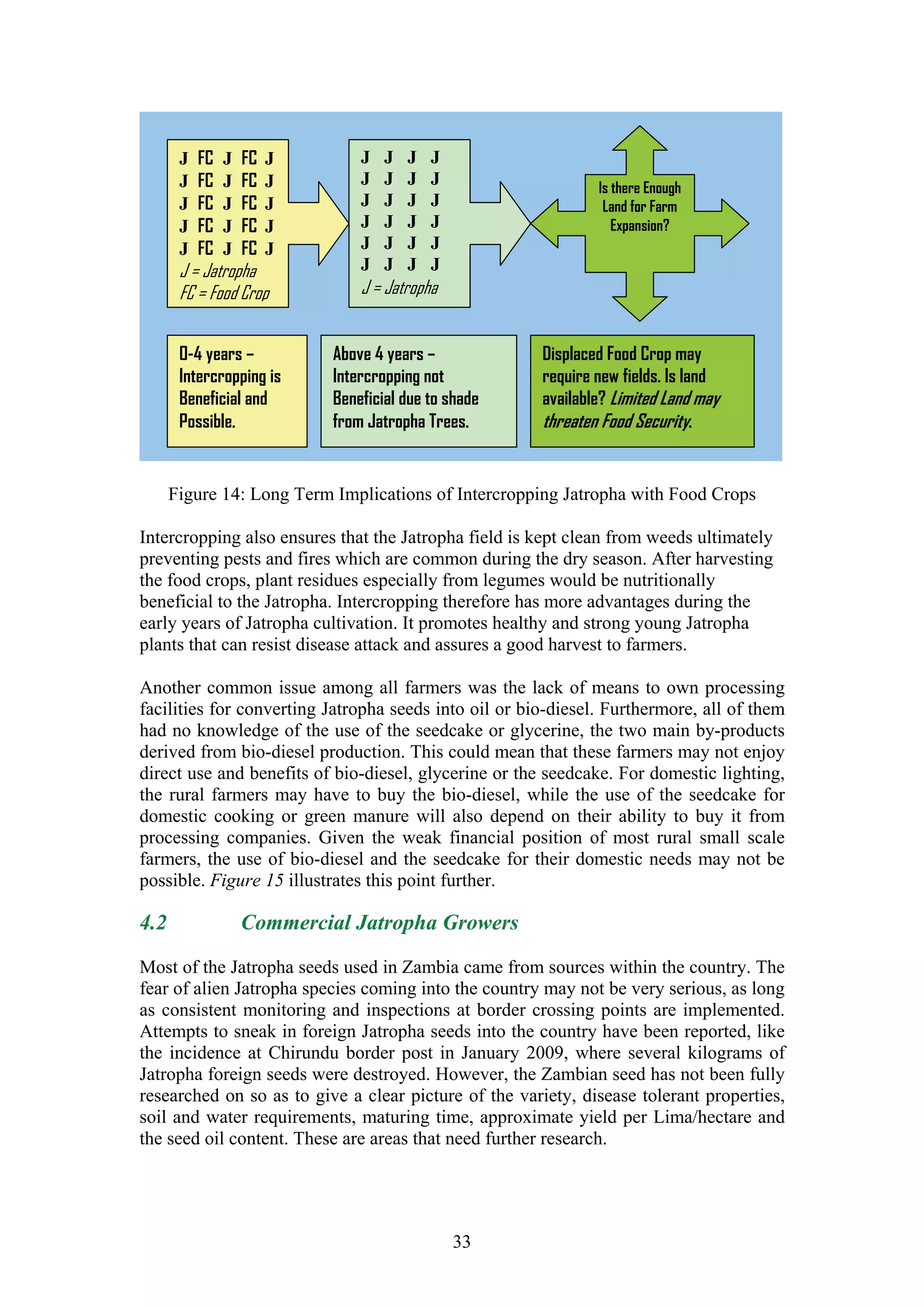
Figure 14:   Long Term Implications of Intercropping Jatropha with Food Crops…33
Figure 15:   How Rural Farmers may not directly Benefit from Jatropha
             Seedcake……………………………………………………………….42
Figure 16:   Slight increase in Soil pH with Jatropha Production…………………..45
Figure 17:   Organic Matter Increased with Jatropha Production…………………..67
Figure 18:   Nitrogen Decreased with Jatropha Production………………………...67
Figure 19:   Magnesium Increased with Jatropha Production………………………68
Figure 20:   Calcium Increased with Jatropha Production……………………….....68
Figure 21:   The System Boundary of Jatropha Methyl Ester Production………….73
Figure 22:   Comparison of Life Cycle GHG Emissions of Bio-diesel and Fossil
             Diesel…………………………………………………………………..74


                                       vii
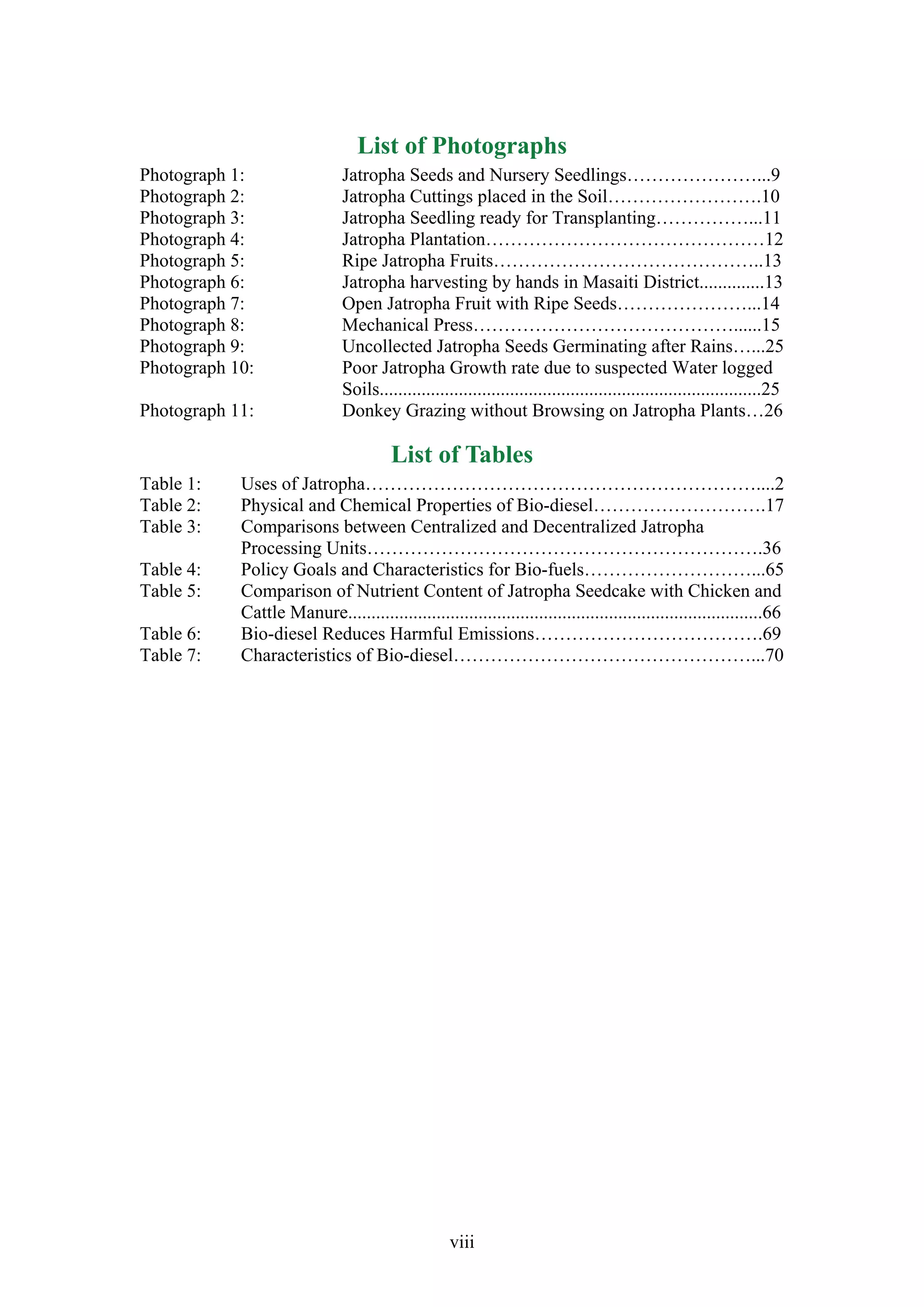
List of Photographs
Photograph 1:                  Jatropha Seeds and Nursery Seedlings…………………...9
Photograph 2:                  Jatropha Cuttings placed in the Soil…………………….10
Photograph 3:                  Jatropha Seedling ready for Transplanting……………...11
Photograph 4:                  Jatropha Plantation………………………………………12
Photograph 5:                  Ripe Jatropha Fruits……………………………………..13
Photograph 6:                  Jatropha harvesting by hands in Masaiti District..............13
Photograph 7:                  Open Jatropha Fruit with Ripe Seeds…………………...14
Photograph 8:                  Mechanical Press……………………………………......15
Photograph 9:                  Uncollected Jatropha Seeds Germinating after Rains…...25
Photograph 10:                 Poor Jatropha Growth rate due to suspected Water logged
                               Soils..................................................................................25
Photograph 11:                 Donkey Grazing without Browsing on Jatropha Plants…26

                                        List of Tables
Table 1:    Uses of Jatropha………………………………………………………....2
Table 2:    Physical and Chemical Properties of Bio-diesel……………………….17
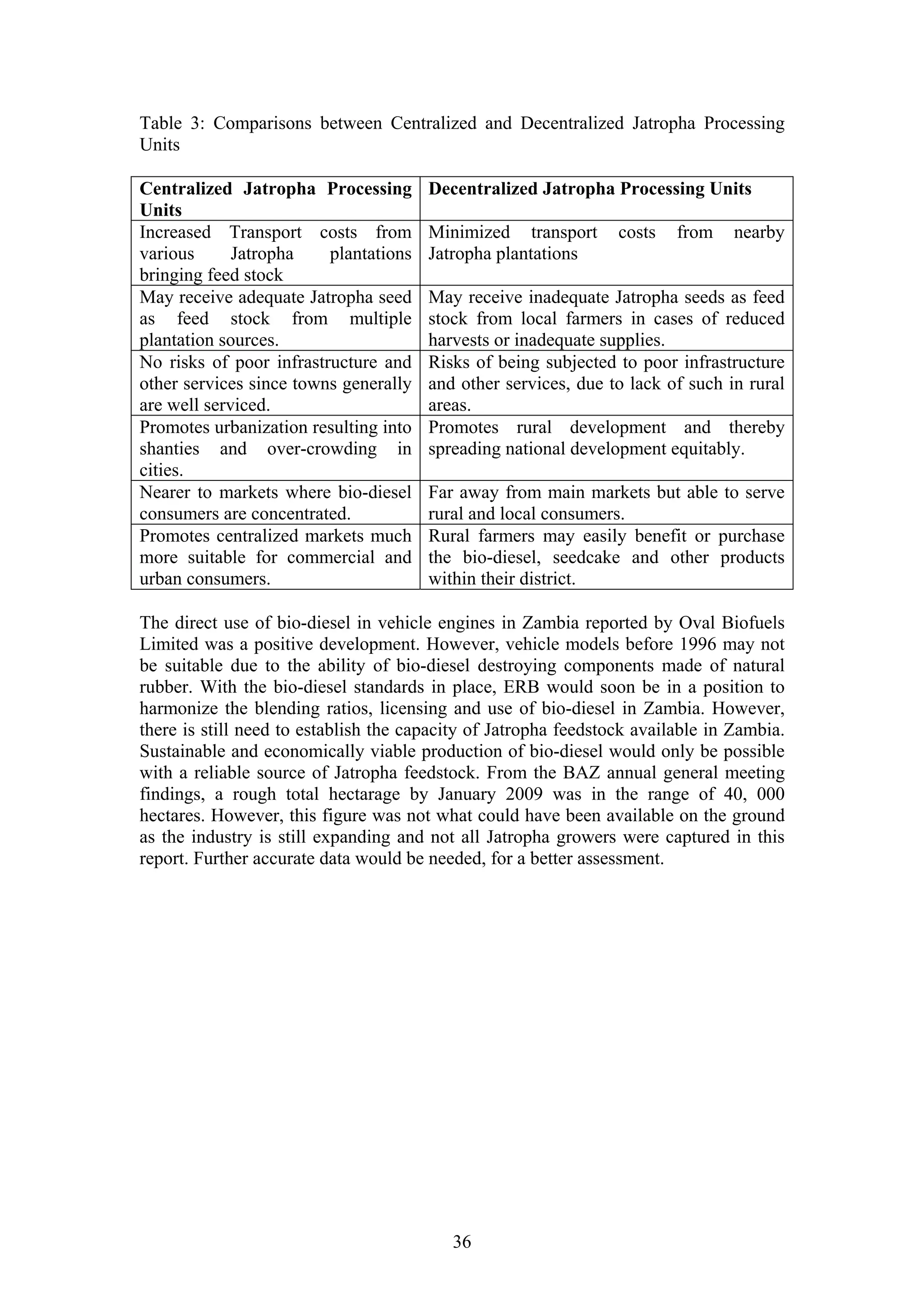
Table 3:    Comparisons between Centralized and Decentralized Jatropha
            Processing Units……………………………………………………….36
Table 4:    Policy Goals and Characteristics for Bio-fuels………………………...65
Table 5:    Comparison of Nutrient Content of Jatropha Seedcake with Chicken and
            Cattle Manure.........................................................................................66
Table 6:    Bio-diesel Reduces Harmful Emissions……………………………….69
Table 7:    Characteristics of Bio-diesel…………………………………………...70


                                                    viii
1.0           Introduction
Jatropha has been grown traditionally in Zambia as hedge or live-fencing against
domestic animals. It has also been grown for medicinal purposes but with very limited
use of the oil for cosmetics especially as a hair and body lotion. From the late 1980s,
Jatropha was grown for mainly soap making at small scale level and domestic lighting
in rural and peri-urban areas. However, of late, Jatropha has been promoted as a bio-
energy plant capable of producing bio-diesel. Apart from bio-diesel, the resultant
Jatropha seedcake and glycerine are said to be of commercial value.

According to Boyle, (2004), energy crops have attracted increased attention in recent
years, for several different reasons: (a) the need for alternatives to fossil fuels, to
reduce net CO2 emissions (b) the search for indigenous alternatives to imported oil (c)
the problem of surplus agricultural land. The relative importance of these has been a
major factor in determining the preferred crops in different countries or regions.

Jumbe (2007, p.9) seems to support this view by stating that “many countries in
Africa have abundant land for growing energy crops for bio-fuels production without
disturbing the traditional farming systems and the ecosystem. This potential can only
be harnessed to benefit the rural masses and facilitate rural economic development if
the regional economic communities in Africa develop a comprehensive regional
strategy, and provide resources and incentives for the development of a vibrant bio-
fuels industry.”

Bio-energy comes from any fuel that is derived from biomass. In other words, it is the
utilization of solar energy that has been bound up in biomass during the process of
photosynthesis. It is a renewable form of energy. There are four main sources of
biomass: forestry and agricultural residues, municipal solid waste, industrial waste,
and specifically grown bio-energy crops. The common examples of bio-fuels include
bio-gas produced from biomass by anaerobic digestion, bio-ethanol derived from
fermentation of mainly sugar and starch crops, bio-diesel produced through
transesterification of plant oil, and second-generation bio-fuels produced from
cellulosic biomass (FAO, 2008).

Even though Zambia is endowed with renewable energy resources which can
sustainably supplement fossil fuels, they have for a long time remained unexploited.
Jatropha was identified as one of the alternative renewable energy sources among
other bio-energy crops. In 2007, Zambia adopted the current National Energy Policy,
whose main goal was to create conditions that will ensure the availability of adequate
supply of energy from various sources. Furthermore, the policy aims at identifying
energy sources which are dependable, at the lowest economic, environmental and
social costs. Being a landlocked country, transporting either crude oil or refined
petroleum products into the country has proved costly for the country. Jatropha based
bio-diesel could be one of the possible renewable energy source.

1.1          Uses of Jatropha

Jatropha is a multi-purpose plant. In Zambia, its use as a live-hedge or fence was to
protect mainly vegetable gardens from domestic animals since it cannot be browsed.


                                          1
As a medicine, it has found its use in treating poisonous snake bites by applying stem
sap on the wound. The fruit has been traditionally used for extracting oil, which was
used as a hair and body lotion. Later on, from about 1986, Jatropha oil was used for
soap making on a small scale level and domestic lighting. The current commercial
realization of the potential of bio-diesel content of Jatropha oil has led to it being
considered as an economically viable bio-energy crop in Zambia.

Table 1: Uses of Jatropha

Jatropha part      Use(s)
Roots              Traditional medicines
Stem/Branches      Liquid sap for treating snake bites and skin rushes
Leaves             Soil enrichment after falling on the ground
Flowers            Very attractive to Honey bees
Seeds              Crushed into Jatropha oil and seedcake
Jatropha oil       Processed into bio-diesel and glycerol/glycerine
Bio-diesel         Directly used in diesel engines or blended with fossil-diesel

                   Used in generator sets and in CHP plants

                   Used for domestic lighting and cooking
Glycerol           Used for manufacturing skin friendly soaps

                   Used for producing cosmetics in the pharmaceutical industry
Seedcake           Very good substrate for bio-gas production

                   Used as green manure due to high nitrogen content

                   Compressed into Jatropha briquettes for domestic heating & cooking

                   Used as animal feed after detoxification

1.2            Aim:

The main goal of the study was to assess the impacts of the Jatropha Industry in
Zambia and how the local policies relate to the concept of Sustainability. The
approach to this concept was according to Brundtland Commission, linking up the
interconnection between economic, environmental and human social issues.

1.2.1          Specific Objectives

In order to fulfil the above stated aim, the following were the specific objectives of
the study:

      •   To investigate the environmental and social impacts of Jatropha from the soil
          to the oil in Zambia.
      •   To assess the economic potential of Jatropha as a bio-energy crop in Zambia.
      •   To investigate the policy and regulatory roles of MEWD, METNR, MAFF &
          ERB in order to promote sustainability in the Jatropha industry in Zambia.


                                            2
1.2.2        Research Methodology

The data collection and sources of information were grouped into two main
categories, being (i) desk-top study and (ii) interviews through questionnaires and
personal contacts.

1.2.2.1      Desk-top Study

The methodology was based on a desktop review of literature, and internet documents
on the Jatropha industry in Zambia. However, the literature review was not just
limited to Zambia, other parts of the world like Asia and some African countries were
included.

1.2.2.2      Questionnaires and Interviews

Primary data was obtained from designed questionnaires. Two sets of questionnaires
were designed in order to obtain information from two main sources, being small
scale farmers and commercial Jatropha growers. The questionnaires were designed in
a simple but well structured format in order to collect information related to
environmental, social and economic impacts of Jatropha from the soil to oil stages.
The details of the questionnaires were included in the appendices (vi) and (ix) of this
report.

One workshop held in Kapiri Mposhi District of the Central Province in July 2008
provided valuable information on the challenges small scale farmers face. Interviews
were also conducted as way of adding value to the process of data collection. The
annual general meeting of BAZ held on January 29th 2009 in Lusaka was another
source of information include in this report. Several large scale Jatropha growers and
stakeholders provided information through recorded interviews.

1.2.3        System Boundary

The case study was confined within Zambia. Due to time and resource constraints,
small scale farmers from Kalomo, Kapiri Mposhi, Masaiti, and Luanshya were
interviewed through personal contact and questionnaires. These areas represent the
southern, central and northern parts of the country. In terms of ecological zones, the
southern part is a low rainfall region; the central is medium, while the northern part
lies within the high rainfall belt.

The scope of the Jatropha study was from the “soil to oil,” that is cultivation of
Jatropha to extraction of bio-diesel. The Jatropha phases or processes involved were
not very detailed, but adequate enough to give a clear overview. Since the Jatropha
industry in Zambia is still in its early stages, the processing technologies may not be
fully representative. The study focused and emphasized on the economic importance,
social and environmental impacts of the Jatropha industry. However, various Jatropha
case studies from other countries were included in this report in order to learn from
them and their experiences. The whole report was not case specific, but took a broader
overview of the Jatropha industry in the country.


                                          3
1.2.4        Limitations of the Study

Several limitations of the study are worthy noting down. The key ones were time,
geographical distance, the newness of the Jatropha industry and some unfavorable
responses from targeted individuals and institutions.

Though the time allocated for the study was from January to June 2009, time seemed
to be too short. Enough time was spent on literature review, while two months were
dedicated to data collection through interviews and questionnaires. The process of
data collection could not be speeded up as the respondents were at liberty to dictate
the pace, while the researcher had to race against time. According to Bell (2008,
p.35), she seems to agree with this matter as she states that “there is never enough
time to do all the work that seems to be essential in order to do a thorough job, but if
you have a handover date, then somehow the work has to be completed in the
specified time.”

The geographical distance between Sweden, where the student researcher was based,
and Zambia, where the data was being collected from, posed a challenge. It was only
possible to travel once for such an important exercise, with no time for follow-ups.
However, everything possible was done within the limited time and resources to
collect as much information as possible.

The newness of the Jatropha industry meant that some data or information was
assumed to be applicable to Zambia, even when it came from other countries.
Moreover, there was very limited written data, authentic enough to be relied upon, so
that certain details were not cross-checked as they would still need further research.
The newness of the Jatropha industry leaves many unanswered questions whose
answers may partly come through research.

One of the main challenges was on the poor or slow responses. Due to poor responses,
especially from government institutions, it was not possible to fully pursue one of the
aims which needed to address the policy implementations and their impacts on the
Jatropha industry. Though there was enough literature review conducted on policies in
the bio-fuels sector, in Africa and in particular Zambia, no data was made available
through interviews or questionnaires. Therefore, policy implementation and their
related impacts on the Jatropha industry in Zambia could not be adequately addressed
in this report.

1.3          Brief Overview of Agriculture in Zambia

Zambia has a land area of 752, 618 km with abundant agricultural resources. The
geographical location is between the latitudes 8 – 18˚S and longitudes 22 – 34˚E. It is
a landlocked country, with no direct access to the sea. It is a geographically
disadvantaged country for exports and imports. Transport is therefore the major cost
for both imported and exported goods and services, with significant impacts on the
socio-economic sectors countrywide. Despite being landlocked, Zambia has a great
potential in agriculture, both rain-fed and irrigation.

Unfortunately, presently most of the agricultural resources are under-utilized with
only 16% of the estimated 9 million hectares of arable land being cultivated. Zambia


                                           4
has an estimated 25% of the Southern African region’s surface water resources.
However, only 5% of the irrigation potential of 423, 000 hectares is being utilized.
These under-utilized land and water resources need to be fully exploited in order to
achieve sustained growth in the agricultural sector (Chizyuka, 2007). Zambia’s
agricultural potential can support food crops and bio-energy crops, if well planned and
managed. “The Government is 110 per cent fully supportive of Jatropha cultivation in
the country hence we have nothing against bio-fuel production,” Mr. Ben Kapita,
Minister of Agriculture, (The Farmers Gazette, September 2007).


                     Figure 1: Geographical position of Zambia

              Source: (http://www.geology.com/world/zambia-map.gif)

1.4          Bio-fuels Potential in Zambia

The main raw materials of bio-fuels in Zambia are from energy crops like sugar cane,
sweet sorghum, cassava, palm-oil and Jatropha. Bio-ethanol is derived from sugar
cane, sweet sorghum and cassava, while bio-diesel is derived from palm-oil and
Jatropha. All these bio-energy crops can be grown in Zambia. While Zambia is
endowed with renewable energy resources that can sustainably supplement fossil
fuels, these resources have remained unexploited.

Recent developments primarily relating to peak oil and the resultant increase in the
price of petroleum and also due to environmental concerns, Jatropha is now at the top
of the bio-fuels prospects for Zambia (Sinkala, 2007). According to the Position
Paper on Jatropha Curcas in Zambia, (2008, p.4), “in 2007, the Zambian
Government adopted the National Energy Policy whose objective was to create
conditions that will ensure the availability of adequate supply of energy from various


                                          5
sources, which are dependable, at the lowest economic, financial, social and
environmental cost consistent with national development goals.” The policy
adequately addresses issues to deal with the bio-fuels industry.

According to the Sustainable Bio-energy Development report by (Kimble, 2008, p.2),
“Energy is essential to development. Countries with access to abundant and affordable
modern energy have significantly larger (GDP), higher per capita income levels,
longer life expectancies, increased literacy rates, and greater educational attainment”.
Zambia could benefit from the development of the bio-fuels sector, more especially
the emerging Jatropha industry.

1.4.1         Local Bio-fuel Industry

There is currently no Jatropha industry as such although a plant is now being
commercialized as a bio-fuel feedstock. Due to the time lag between the time Jatropha
is planted and the time it produces the oil bearing fruit, up to three years, the local bio-
fuel industry has not yet moved into production, but this is just a question of time,
especially in the view of the fact that the Government of the Republic of Zambia has
now put its weight behind the growing of Jatropha (Sinkala, 2007). The Zambian bio-
fuel industry is in its infancy, with Jatropha being at the top of the list of renewable
sources of energy. Jatropha curcas is an under-developed crop that has never been
grown commercially on a large scale. The Jatropha industry is therefore a sunshine
industry with a lot of potential socially, environmentally and economically.

1.5           Principles of Sustainability

According to the famous Brundtland definition of sustainable development, it is
“development that meets the needs of the present without compromising the ability of
future generations to meet their own needs.” Understanding and adopting sustainable
business practices requires a new awareness of the world. It requires a deeper
understanding of how the Earth’s ecosystems operate, and how anthropogenic
processes affect nature's delicate balance. The concept of sustainable development
stresses the interdependence between economic growth and environmental quality,
but it also goes further in demonstrating that the future is uncertain unless we can deal
with issues of equality and inequality throughout the whole world. This adds to the
social dimension of sustainable development.

Energy is central to achieving the inter-related economic, social and environment al
aims of sustainable human development. But if we are to realize this important goal,
the kinds of energy we produce and the ways we use them will have to change
(Wright, 2008). Energy is the engine or main driving force to any kind of
development. The Jatropha industry as a bio-energy sector will therefore play a key
role in Zambia’s development, with economic, social and environmental implications.

The social dimension of sustainability concerns an organization’s impact on the social
systems within which it operates (Stiller, 2008). Social sustainability is related to how
we make choices that affect other humans in our "global community" - the Earth.
Social sustainability is also related to more basic needs of happiness, safety, freedom,
dignity and affection. The environmental dimension of sustainability concerns an
organization’s impact on living and non-living natural systems, including ecosystems,


                                             6
land, air and water. Natural resources are no longer abundant. We are depleting them
at a more rapid rate than they can be replaced in nature. The economic dimension of
sustainability concerns an organization’s impact on the economic circumstances of its
stakeholders and the economic systems (Stiller, 2008).

We must accept that sustainability is not something that will be achieved overnight,
but in the longer term, individual businesses need to look towards new types of
activity, development and growth. This in turn requires them to look at their ethics,
their objectives and their own forms of organization, corporate culture and
communication. Sustainability makes perfect business sense and it will continue to be
a defining characteristic of successful businesses of the future (Welford, 1998).

Jatropha cultivation and its use need comprehensive sustainability criteria just as other
food crops. A careful and detailed assessment of economic, ecological and social
dimensions at the planning and pre-project stages of Jatropha growing is needed to
ensure sustainability. The other area of concern is the role and impact of large
corporations that are rushing to developing countries to invest in the Jatropha
industry. It is hoped that there will be benefits towards improving rural economies.
This is only possible with well established pro-poor local policies that are in line with
principles of sustainability.

1.6          Bio-fuel Policies

Experience to date underscores that policies play a critical role in success or failure
when expanding bio-energy use (Kimble, 2008). Furthermore, policies should stand
the test of time by possessing durable characteristics. Bio-fuel policies should address
critical issues such as feedstock production methods, transformation technologies,
bio-fuel quality standards and testing, pricing mechanism, incentives for bio-fuel
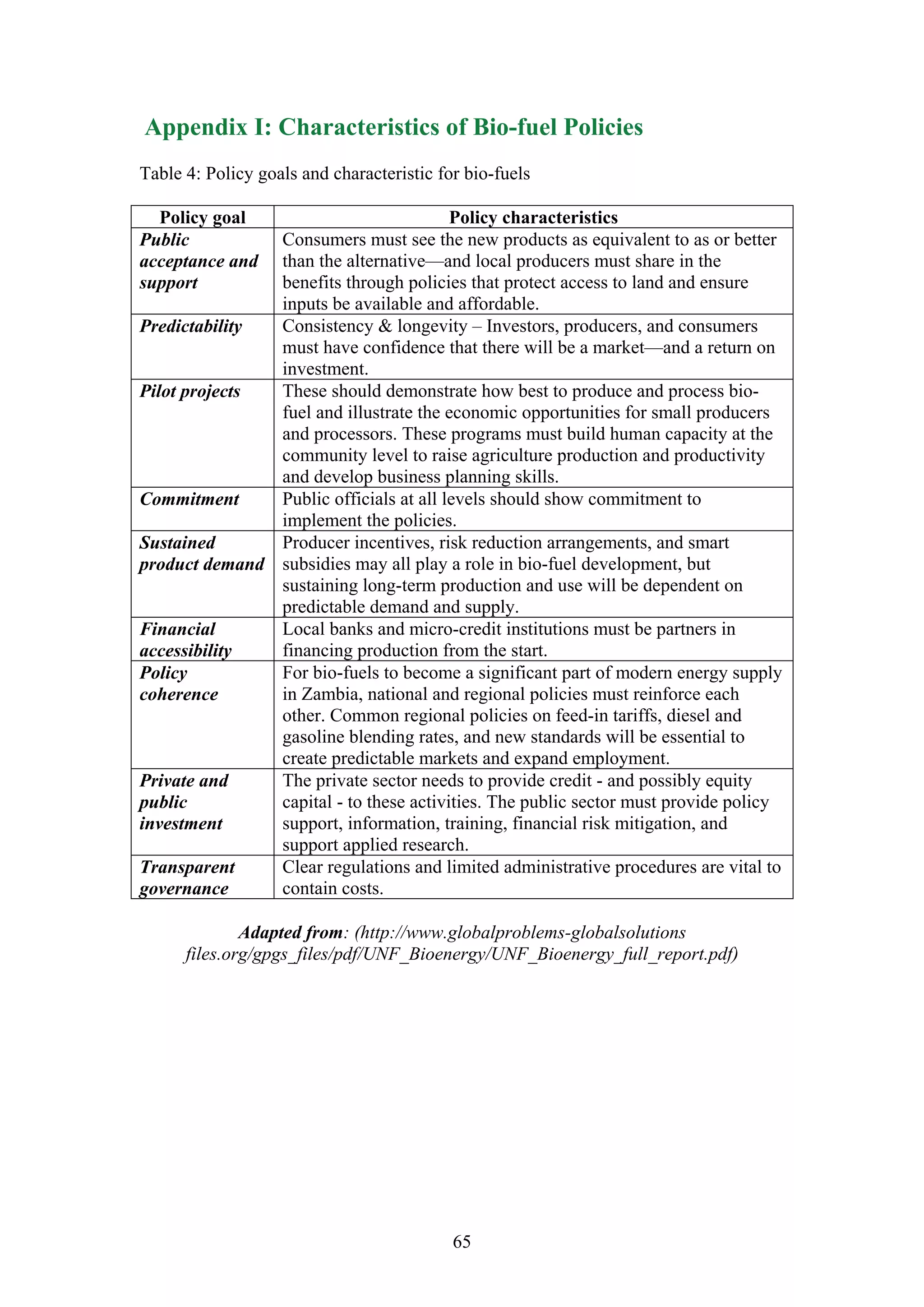
usage and favourable tax regimes. For more details, see table 4 in appendix (i).

The first priority of a bio-fuel policy should be to ensure that the industry develops
sustainably. The problems of the petrol-based economy should not be replaced by
another socially or ecologically undesirable industry. Bio-fuel policies must protect
natural resources and ensure free trade of bio-fuels. Bio-fuel production should be
coupled with social and environmental certification and a credible system to ensure
compliance (Baur et. al, 2007). According to the Position Paper on Jatropha Curcas in
Zambia, (2008, p.4), for the purpose of energy security and global climate change,
Zambia has developed a framework within which the bio-fuels industry can operate,
grow, and contribute positively to the Zambian economy. Jatropha curcas followed by
Palm became the highest ranking for the production of bio-diesel.

In general, bio-fuel policies should address issues of energy production, distribution
and consumption. Since Zambia imports all her fossil fuel needs, Jatropha bio-diesel
needs and other potential sources of bio-fuels need a well structured policy
framework. However, bio-diesel from Jatropha cuts across various government
ministries. During the cultivation up to harvesting, the MAFF is in charge. At this
stage sustainable agricultural policies are needed to address land use, water use, and
issues of food security at family and national level. During the processing of Jatropha
into bio-diesel, and its ultimate use, the MEWD and ERB play a prominent role. The
METNR addresses issues on environmental sustainability from the soil to the oil stage


                                           7
of Jatropha, including the by-product and waste use or disposal. All these government
ministries and agencies need well coordinated policies.

The other areas that bio-fuel policies should address are incentives to investments,
efficiency and emission standards, bio-energy related research and development,
general international trade agreements and marketing, energy diversity and risk
factors, environmental friendly technologies to increase energy supplies and
encourage cleaner, more efficient energy use, air pollution, greenhouse effect (mainly
reducing CO2 emissions), global warming and climate change (Demirbas, 2007).

             2.0           Jatropha - Historical Background
Jatropha is native to Central America and has become naturalized in many tropical
and subtropical areas, including India, Africa, and North America. Originating in the
Caribbean, Jatropha was spread as a valuable hedge plant to Africa and Asia by
Portuguese traders. Since then, Jatropha has historically been planted as a live
hedge/fence by peasant farmers around homes, gardens and fields as it is not browsed
by domestic animals.

Jatropha curcas belongs to the family name Euphorbiaceae. It is known by a variety
of names including Barbados nut, Black vomit nut, Physic nut and Purge nut. In
Zambia, some local names include Umutondo mono and maboono. There are 170
known species of genus Jatropha (Sinkala, 2007). It is believed the plant was
introduced into Zambia about 1850, at about the same as such other crops as maize.
Although Jatropha has been used for various traditional purposes including medicinal,
live hedges and cosmetic since its introduction into Zambia, it has not been
commercialized in the country for anything despite efforts by various organizations
including GTZ and the National Institute for Scientific and Industrial Research.

2.1           General Description of Jatropha Plant

Jatropha develops into a small tree or shrub with very soft wood that can grow near to
8 metres and be productive for 30 years or more.

It has thin, often greenish bark which exudes copious amounts of watery sap when
cut. It has leaves which are dark green; alternate, simple, ovate to slightly lobed with
3-5 indentations. The leaves are up to 15cm wide with petioles 10cm long. The
flowers are yellow to green in colour, born in axils of the leaves and being small is
mostly hidden by foliage (Sinkala, 2007).

Jatropha sheds its leaves during the dry season. It can withstand only a very light frost
that causes it to lose all of its leaves, and the seed yield will probably sharply decline.
Benge (2006, p.4),states that the current distribution shows that introduction has been
most successful in drier regions of the tropics with an average annual rainfall between
300 and 1000mm, and seems to thrive well mainly at lower altitudes

Jatropha is warm loving and is not expected to perform well in areas with low
temperatures or even frost. The Zambian environment generally satisfies the
requirements, making it possible to grow Jatropha any where in the country.


                                            8
2.1.1        Generative Propagation (Jatropha Seeds)

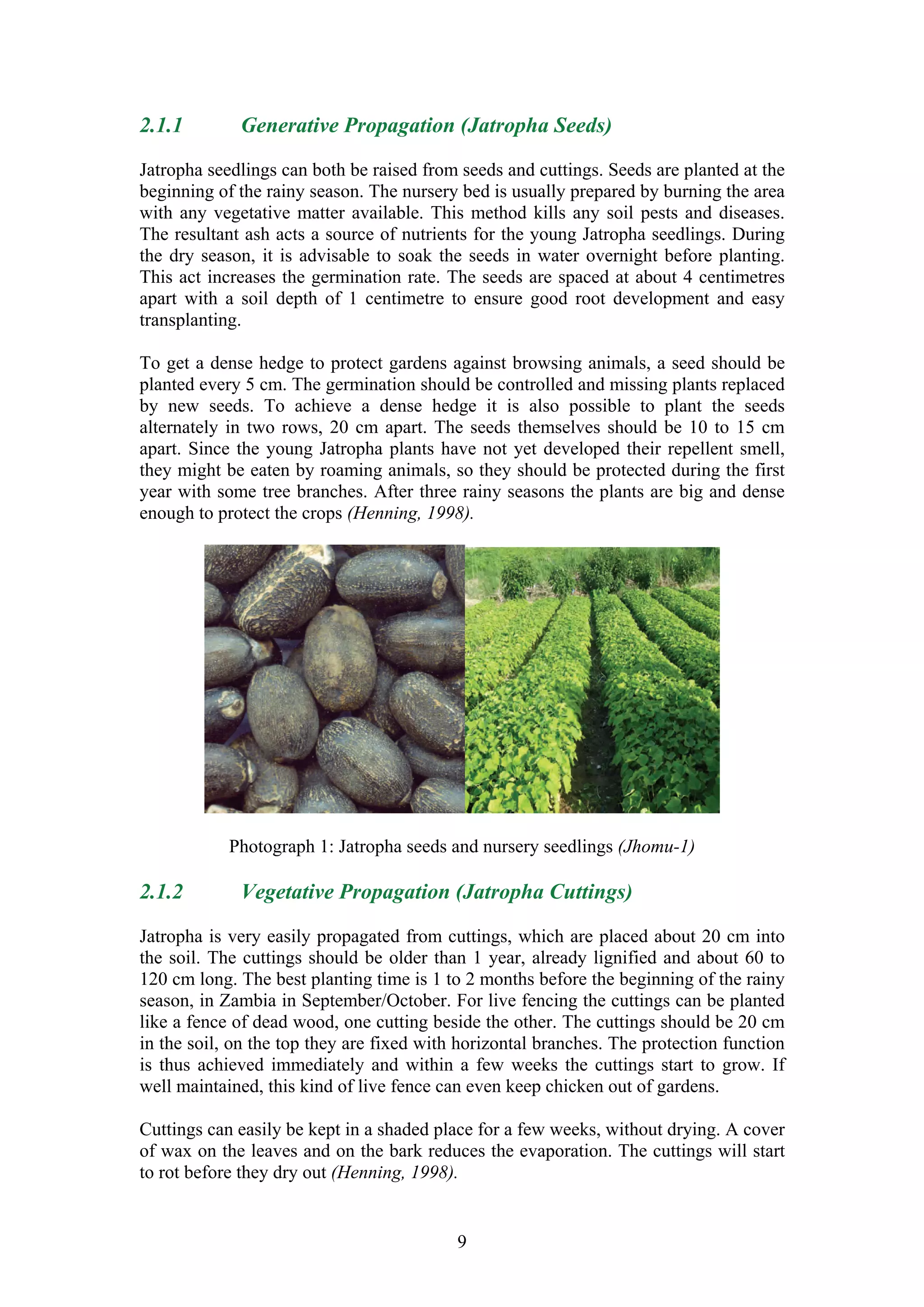
Jatropha seedlings can both be raised from seeds and cuttings. Seeds are planted at the
beginning of the rainy season. The nursery bed is usually prepared by burning the area
with any vegetative matter available. This method kills any soil pests and diseases.
The resultant ash acts a source of nutrients for the young Jatropha seedlings. During
the dry season, it is advisable to soak the seeds in water overnight before planting.
This act increases the germination rate. The seeds are spaced at about 4 centimetres
apart with a soil depth of 1 centimetre to ensure good root development and easy
transplanting.

To get a dense hedge to protect gardens against browsing animals, a seed should be
planted every 5 cm. The germination should be controlled and missing plants replaced
by new seeds. To achieve a dense hedge it is also possible to plant the seeds
alternately in two rows, 20 cm apart. The seeds themselves should be 10 to 15 cm
apart. Since the young Jatropha plants have not yet developed their repellent smell,
they might be eaten by roaming animals, so they should be protected during the first
year with some tree branches. After three rainy seasons the plants are big and dense
enough to protect the crops (Henning, 1998).


            Photograph 1: Jatropha seeds and nursery seedlings (Jhomu-1)

2.1.2        Vegetative Propagation (Jatropha Cuttings)

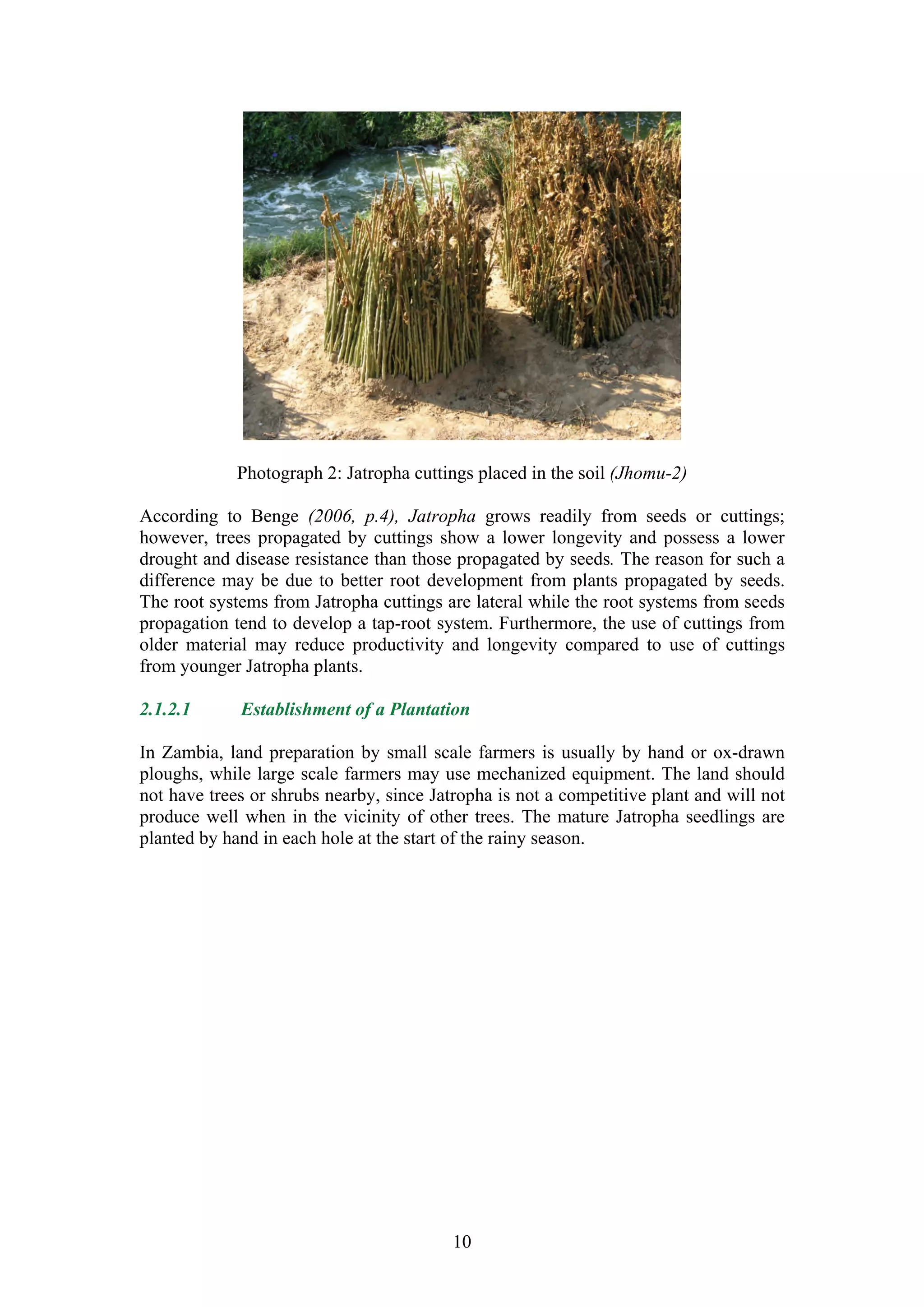
Jatropha is very easily propagated from cuttings, which are placed about 20 cm into
the soil. The cuttings should be older than 1 year, already lignified and about 60 to
120 cm long. The best planting time is 1 to 2 months before the beginning of the rainy
season, in Zambia in September/October. For live fencing the cuttings can be planted
like a fence of dead wood, one cutting beside the other. The cuttings should be 20 cm
in the soil, on the top they are fixed with horizontal branches. The protection function
is thus achieved immediately and within a few weeks the cuttings start to grow. If
well maintained, this kind of live fence can even keep chicken out of gardens.

Cuttings can easily be kept in a shaded place for a few weeks, without drying. A cover
of wax on the leaves and on the bark reduces the evaporation. The cuttings will start
to rot before they dry out (Henning, 1998).


                                           9
Photograph 2: Jatropha cuttings placed in the soil (Jhomu-2)

According to Benge (2006, p.4), Jatropha grows readily from seeds or cuttings;
however, trees propagated by cuttings show a lower longevity and possess a lower
drought and disease resistance than those propagated by seeds. The reason for such a
difference may be due to better root development from plants propagated by seeds.
The root systems from Jatropha cuttings are lateral while the root systems from seeds
propagation tend to develop a tap-root system. Furthermore, the use of cuttings from
older material may reduce productivity and longevity compared to use of cuttings
from younger Jatropha plants.

2.1.2.1      Establishment of a Plantation

In Zambia, land preparation by small scale farmers is usually by hand or ox-drawn
ploughs, while large scale farmers may use mechanized equipment. The land should
not have trees or shrubs nearby, since Jatropha is not a competitive plant and will not
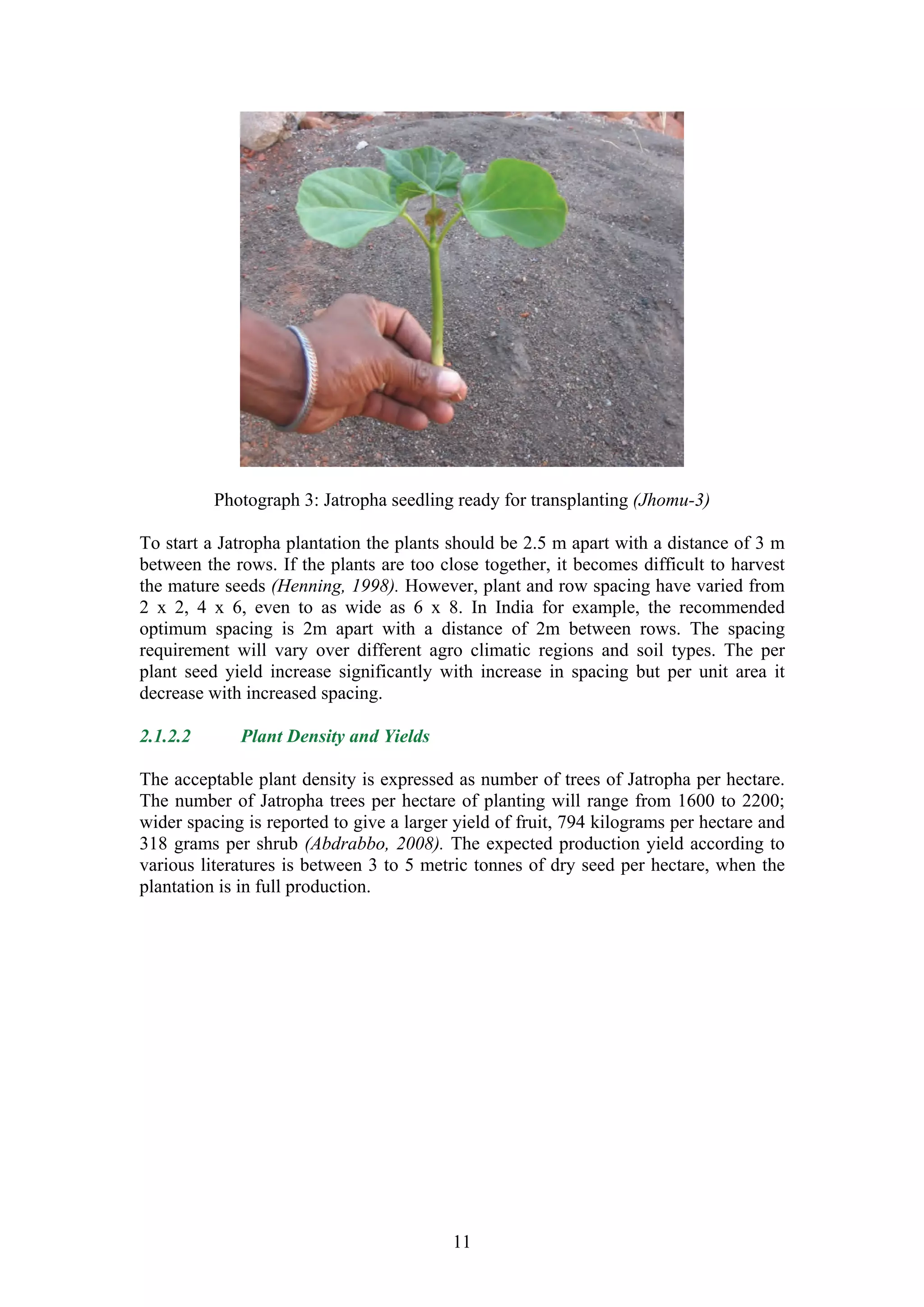
produce well when in the vicinity of other trees. The mature Jatropha seedlings are
planted by hand in each hole at the start of the rainy season.


                                          10
Photograph 3: Jatropha seedling ready for transplanting (Jhomu-3)

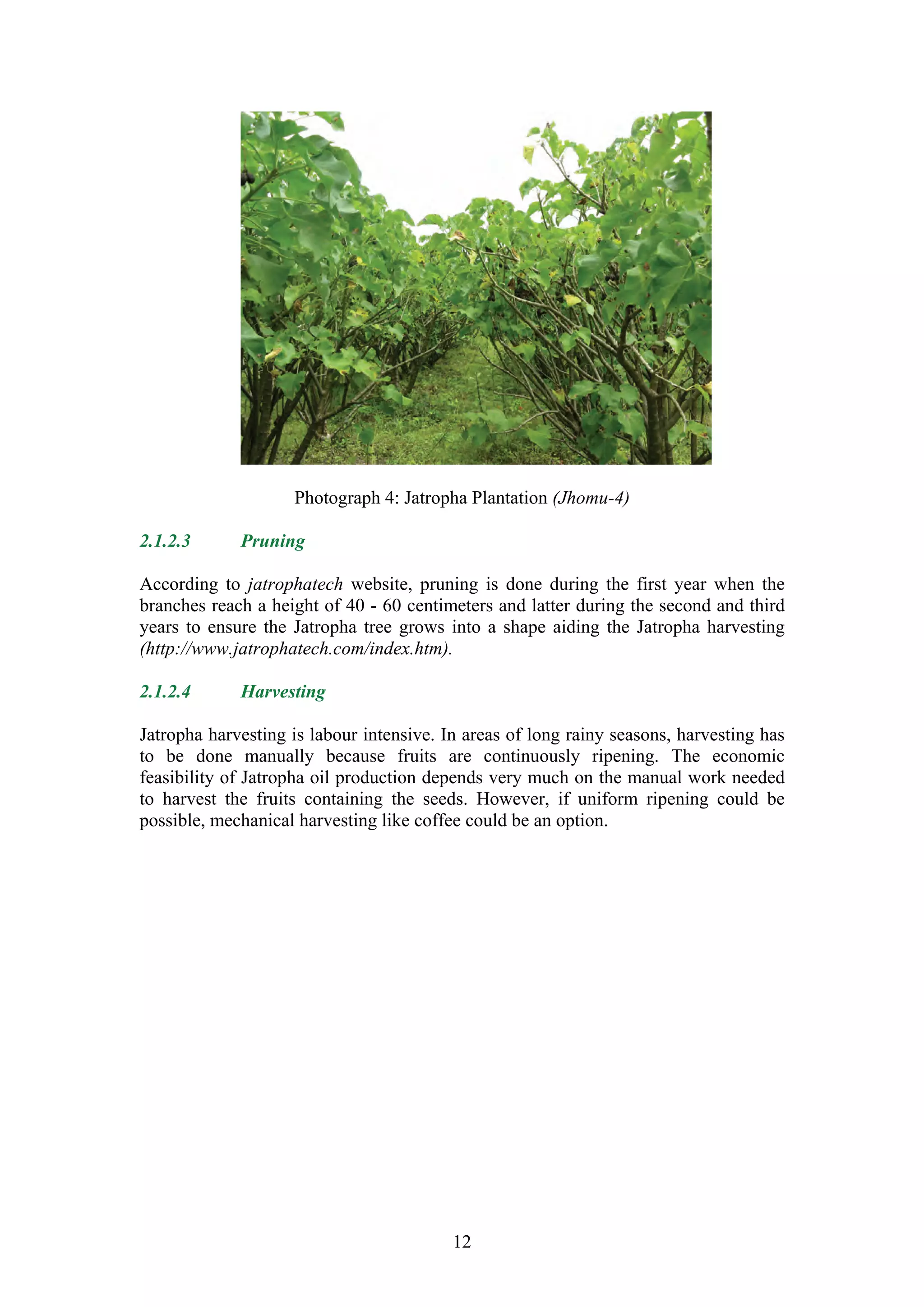
To start a Jatropha plantation the plants should be 2.5 m apart with a distance of 3 m
between the rows. If the plants are too close together, it becomes difficult to harvest
the mature seeds (Henning, 1998). However, plant and row spacing have varied from
2 x 2, 4 x 6, even to as wide as 6 x 8. In India for example, the recommended
optimum spacing is 2m apart with a distance of 2m between rows. The spacing
requirement will vary over different agro climatic regions and soil types. The per
plant seed yield increase significantly with increase in spacing but per unit area it
decrease with increased spacing.

2.1.2.2      Plant Density and Yields

The acceptable plant density is expressed as number of trees of Jatropha per hectare.
The number of Jatropha trees per hectare of planting will range from 1600 to 2200;
wider spacing is reported to give a larger yield of fruit, 794 kilograms per hectare and
318 grams per shrub (Abdrabbo, 2008). The expected production yield according to
various literatures is between 3 to 5 metric tonnes of dry seed per hectare, when the
plantation is in full production.


                                          11
Photograph 4: Jatropha Plantation (Jhomu-4)

2.1.2.3      Pruning

According to jatrophatech website, pruning is done during the first year when the
branches reach a height of 40 - 60 centimeters and latter during the second and third
years to ensure the Jatropha tree grows into a shape aiding the Jatropha harvesting
(http://www.jatrophatech.com/index.htm).

2.1.2.4      Harvesting

Jatropha harvesting is labour intensive. In areas of long rainy seasons, harvesting has
to be done manually because fruits are continuously ripening. The economic
feasibility of Jatropha oil production depends very much on the manual work needed
to harvest the fruits containing the seeds. However, if uniform ripening could be
possible, mechanical harvesting like coffee could be an option.


                                          12
Photograph 5: Ripe Jatropha Fruits (Jhomu-5)

2.1.2.5      Seed Yield

The fruits are small capsule-like and round and are about 2.5 – 4 cm in diameter. They
are green and fleshy when immature, becoming yellow and drying to dark brown
when ripe, and splitting to release 2 or 3 black seeds each about 2cm long and 1cm
thick. The flesh of the opened seed is white and oily in texture. In some parts of
Zambia, yields do vary from 300 g to 9 kg per tree per year. On a hectare basis, this is
between 2 and 5 tons per hectare. The thousand seed weight is put at between 700 –
760 gm and approximately 1370 seeds make a kilogram (Henning, 1998).


      Photograph 6: Jatropha harvesting by hands in Masaiti District (Jhomu-6)


                                          13
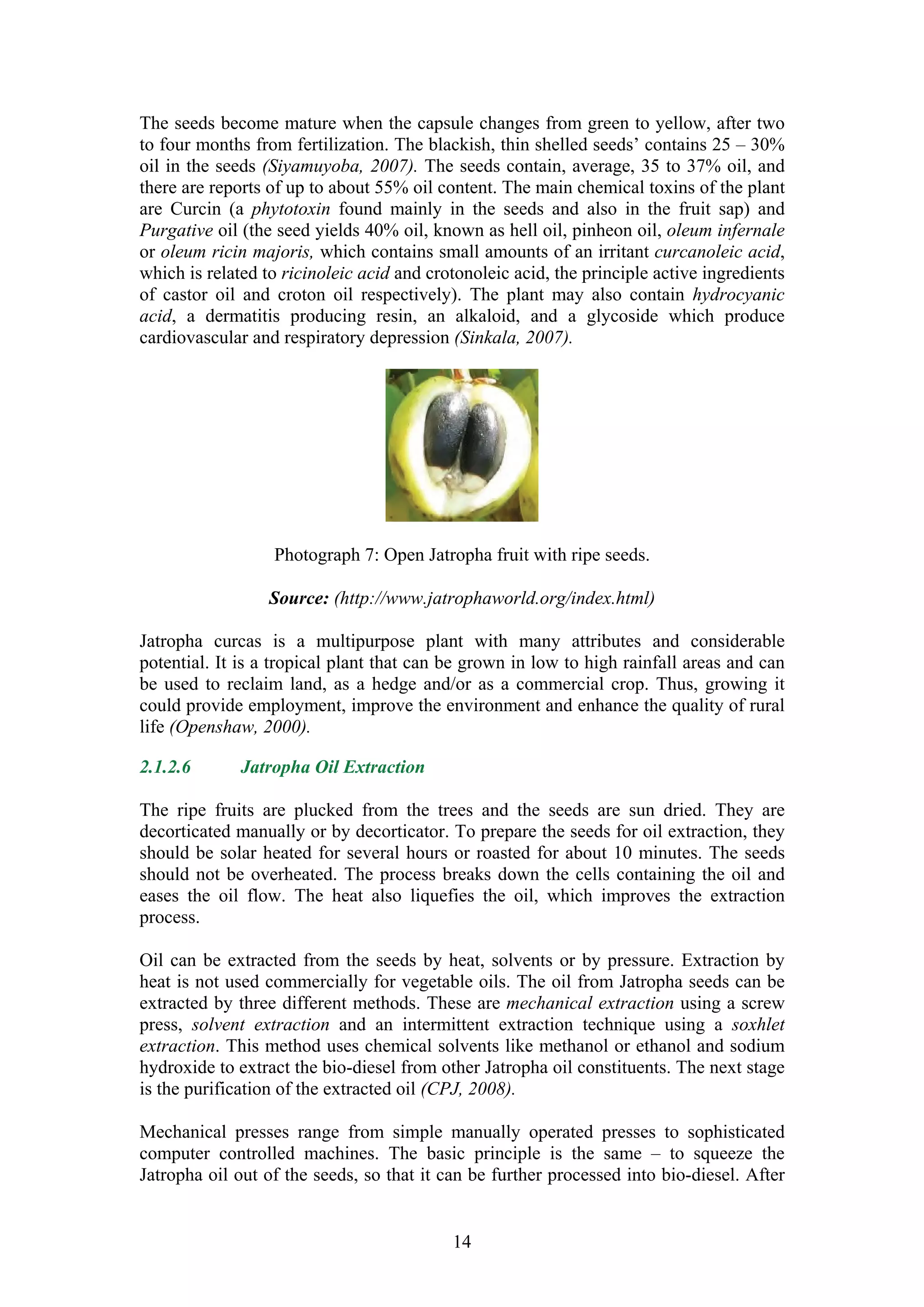
The seeds become mature when the capsule changes from green to yellow, after two
to four months from fertilization. The blackish, thin shelled seeds’ contains 25 – 30%
oil in the seeds (Siyamuyoba, 2007). The seeds contain, average, 35 to 37% oil, and
there are reports of up to about 55% oil content. The main chemical toxins of the plant
are Curcin (a phytotoxin found mainly in the seeds and also in the fruit sap) and
Purgative oil (the seed yields 40% oil, known as hell oil, pinheon oil, oleum infernale
or oleum ricin majoris, which contains small amounts of an irritant curcanoleic acid,
which is related to ricinoleic acid and crotonoleic acid, the principle active ingredients
of castor oil and croton oil respectively). The plant may also contain hydrocyanic
acid, a dermatitis producing resin, an alkaloid, and a glycoside which produce
cardiovascular and respiratory depression (Sinkala, 2007).


                  Photograph 7: Open Jatropha fruit with ripe seeds.

                  Source: (http://www.jatrophaworld.org/index.html)

Jatropha curcas is a multipurpose plant with many attributes and considerable
potential. It is a tropical plant that can be grown in low to high rainfall areas and can
be used to reclaim land, as a hedge and/or as a commercial crop. Thus, growing it
could provide employment, improve the environment and enhance the quality of rural
life (Openshaw, 2000).

2.1.2.6       Jatropha Oil Extraction

The ripe fruits are plucked from the trees and the seeds are sun dried. They are
decorticated manually or by decorticator. To prepare the seeds for oil extraction, they
should be solar heated for several hours or roasted for about 10 minutes. The seeds
should not be overheated. The process breaks down the cells containing the oil and
eases the oil flow. The heat also liquefies the oil, which improves the extraction
process.

Oil can be extracted from the seeds by heat, solvents or by pressure. Extraction by
heat is not used commercially for vegetable oils. The oil from Jatropha seeds can be
extracted by three different methods. These are mechanical extraction using a screw
press, solvent extraction and an intermittent extraction technique using a soxhlet
extraction. This method uses chemical solvents like methanol or ethanol and sodium
hydroxide to extract the bio-diesel from other Jatropha oil constituents. The next stage
is the purification of the extracted oil (CPJ, 2008).

Mechanical presses range from simple manually operated presses to sophisticated
computer controlled machines. The basic principle is the same – to squeeze the
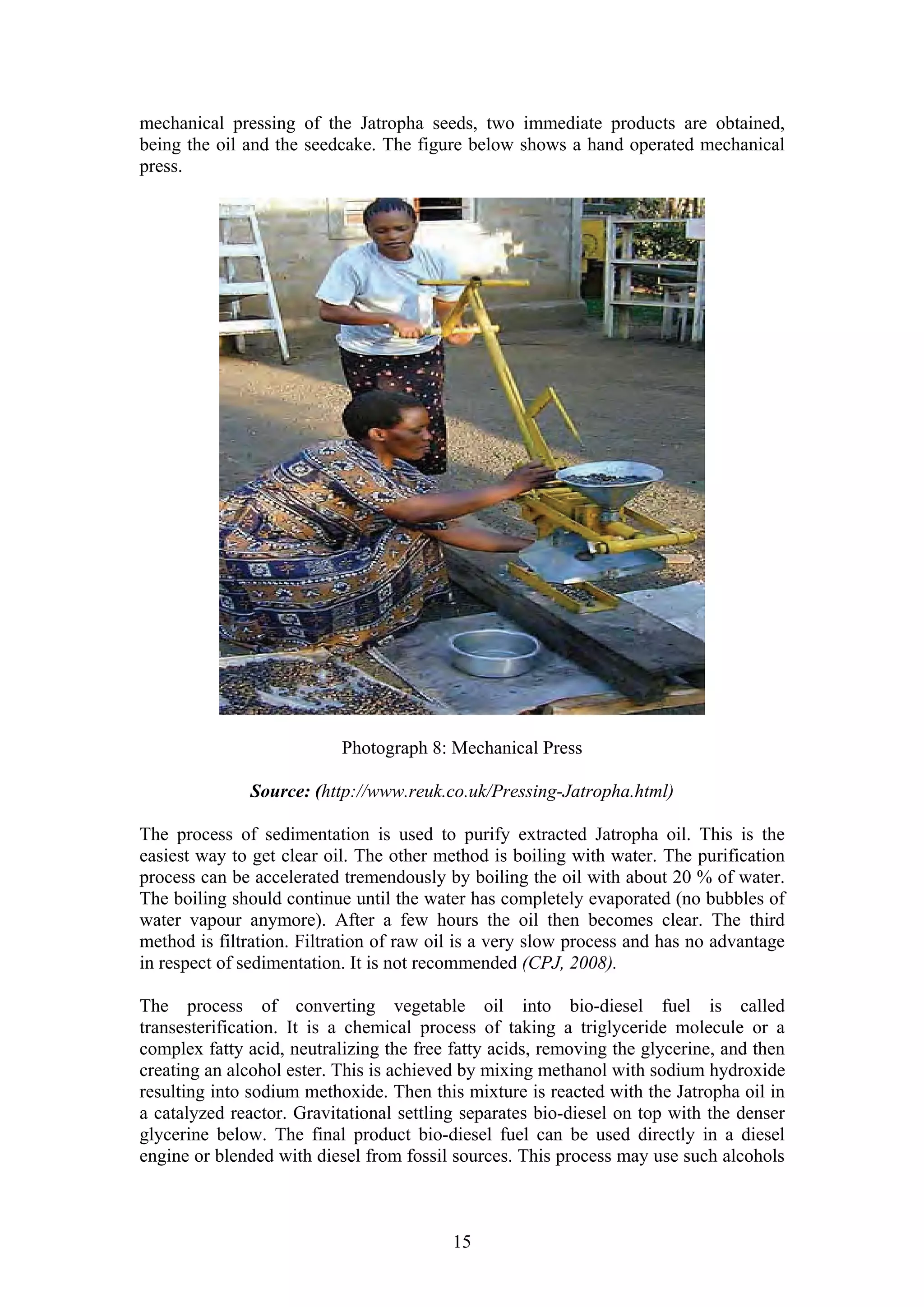
Jatropha oil out of the seeds, so that it can be further processed into bio-diesel. After


                                           14
mechanical pressing of the Jatropha seeds, two immediate products are obtained,
being the oil and the seedcake. The figure below shows a hand operated mechanical
press.


                           Photograph 8: Mechanical Press

              Source: (http://www.reuk.co.uk/Pressing-Jatropha.html)

The process of sedimentation is used to purify extracted Jatropha oil. This is the
easiest way to get clear oil. The other method is boiling with water. The purification
process can be accelerated tremendously by boiling the oil with about 20 % of water.
The boiling should continue until the water has completely evaporated (no bubbles of
water vapour anymore). After a few hours the oil then becomes clear. The third
method is filtration. Filtration of raw oil is a very slow process and has no advantage
in respect of sedimentation. It is not recommended (CPJ, 2008).

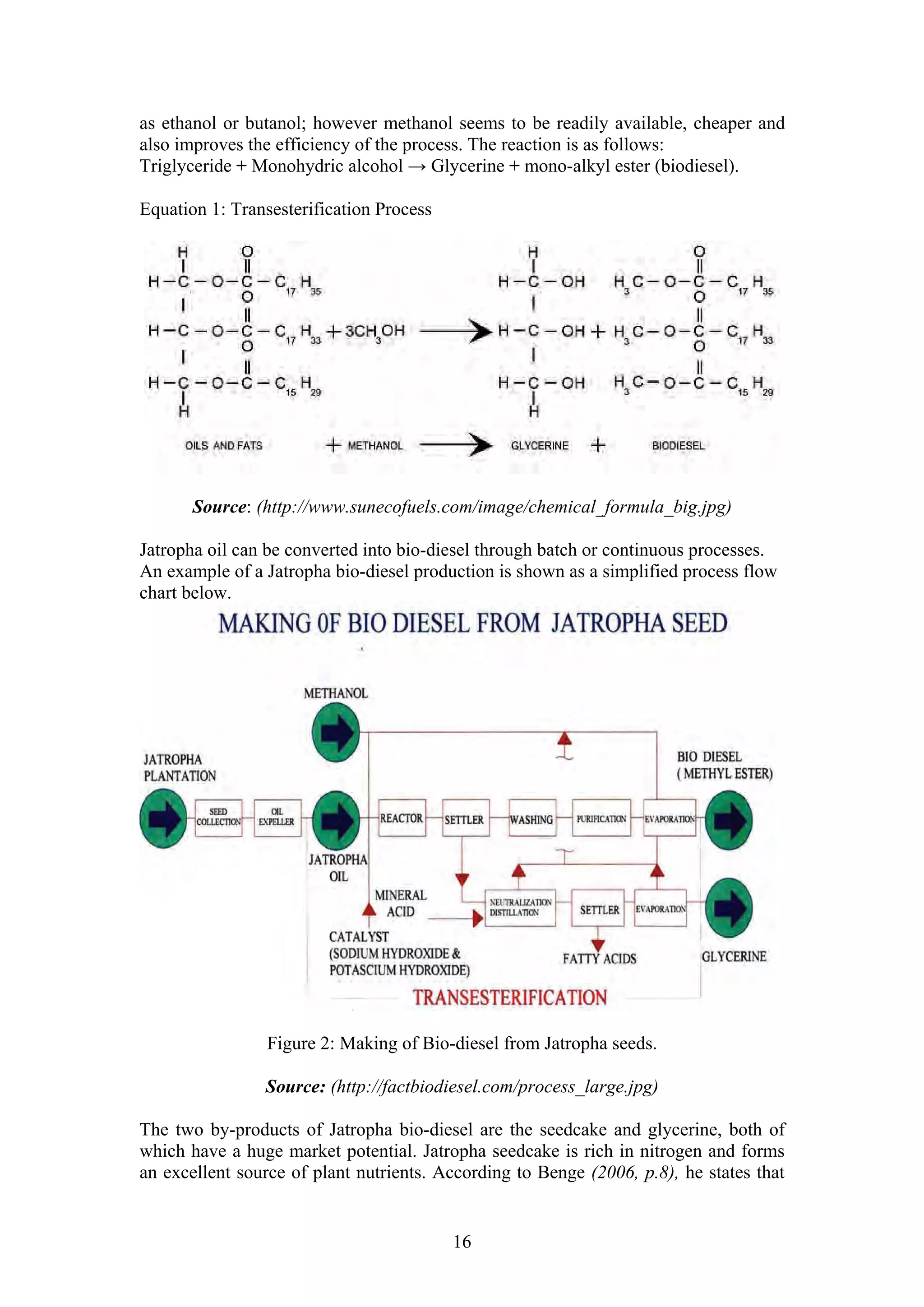
The process of converting vegetable oil into bio-diesel fuel is called
transesterification. It is a chemical process of taking a triglyceride molecule or a
complex fatty acid, neutralizing the free fatty acids, removing the glycerine, and then
creating an alcohol ester. This is achieved by mixing methanol with sodium hydroxide
resulting into sodium methoxide. Then this mixture is reacted with the Jatropha oil in
a catalyzed reactor. Gravitational settling separates bio-diesel on top with the denser
glycerine below. The final product bio-diesel fuel can be used directly in a diesel
engine or blended with diesel from fossil sources. This process may use such alcohols


                                          15
as ethanol or butanol; however methanol seems to be readily available, cheaper and
also improves the efficiency of the process. The reaction is as follows:
Triglyceride + Monohydric alcohol → Glycerine + mono-alkyl ester (biodiesel).

Equation 1: Transesterification Process


       Source: (http://www.sunecofuels.com/image/chemical_formula_big.jpg)

Jatropha oil can be converted into bio-diesel through batch or continuous processes.
An example of a Jatropha bio-diesel production is shown as a simplified process flow
chart below.


                 Figure 2: Making of Bio-diesel from Jatropha seeds.

                Source: (http://factbiodiesel.com/process_large.jpg)

The two by-products of Jatropha bio-diesel are the seedcake and glycerine, both of
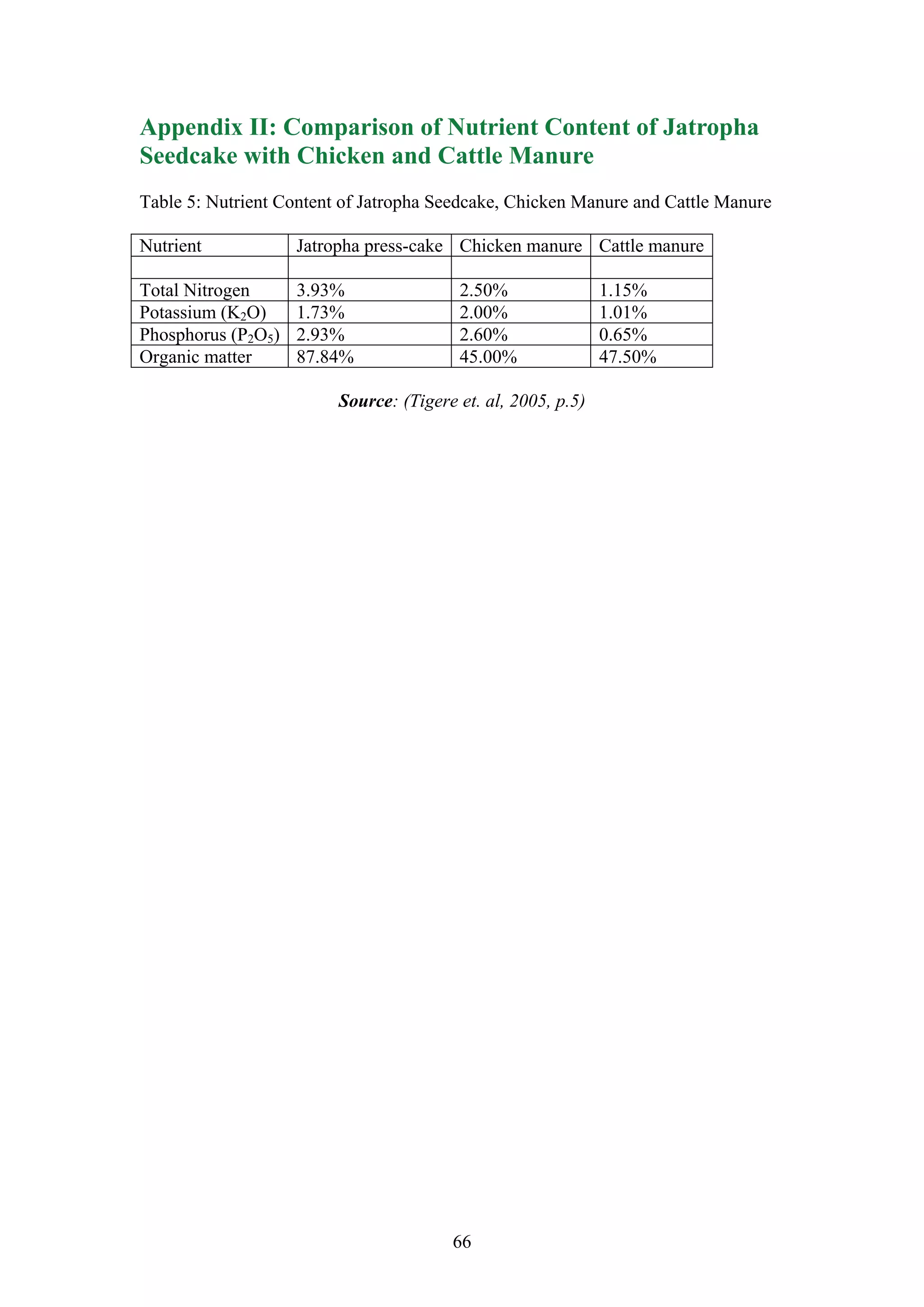
which have a huge market potential. Jatropha seedcake is rich in nitrogen and forms
an excellent source of plant nutrients. According to Benge (2006, p.8), he states that


                                          16
Glycerine, a by-product of the trans-esterification process can be used to either
produce soap or make ethanol through fermentation. It can also be processed into
cosmetics for personal care, in the pharmaceutical industry.

The table below shows the physical and chemical properties of bio-diesel. Detailed
characteristics of bio-diesel can be obtained from table 6 in appendix (iv).

Table 2: Physical and Chemical Properties of Bio-diesel

Properties                                 Values
Specific gravity                           0.87 to 0.89
Kinematic viscosity@ 40°C                  3.7 to 5.8
Cetane number                              46 to 70
Higher heating value (Btu/lb)              16,928 - 17,996
Lower heating value (Btu/lb)               15,700 - 16,735
Sulphur wt %                               0.00 – 0.0024
Cloud point °C                             -11 to 16
Pour point °C                              -15 to 13
Iodine number                              60 – 135

         Source: (http://www.jatrophaworld.org/makingbiodiesel_38.html)


                                         17
3.0                         Questionnaire and Interview Results
The results were obtained from questionnaires administered among small scale
farmers in Kalomo and Kapiri Mposhi. The other results were obtained from recorded
interviews from Luanshya, Masaiti and in Lusaka.

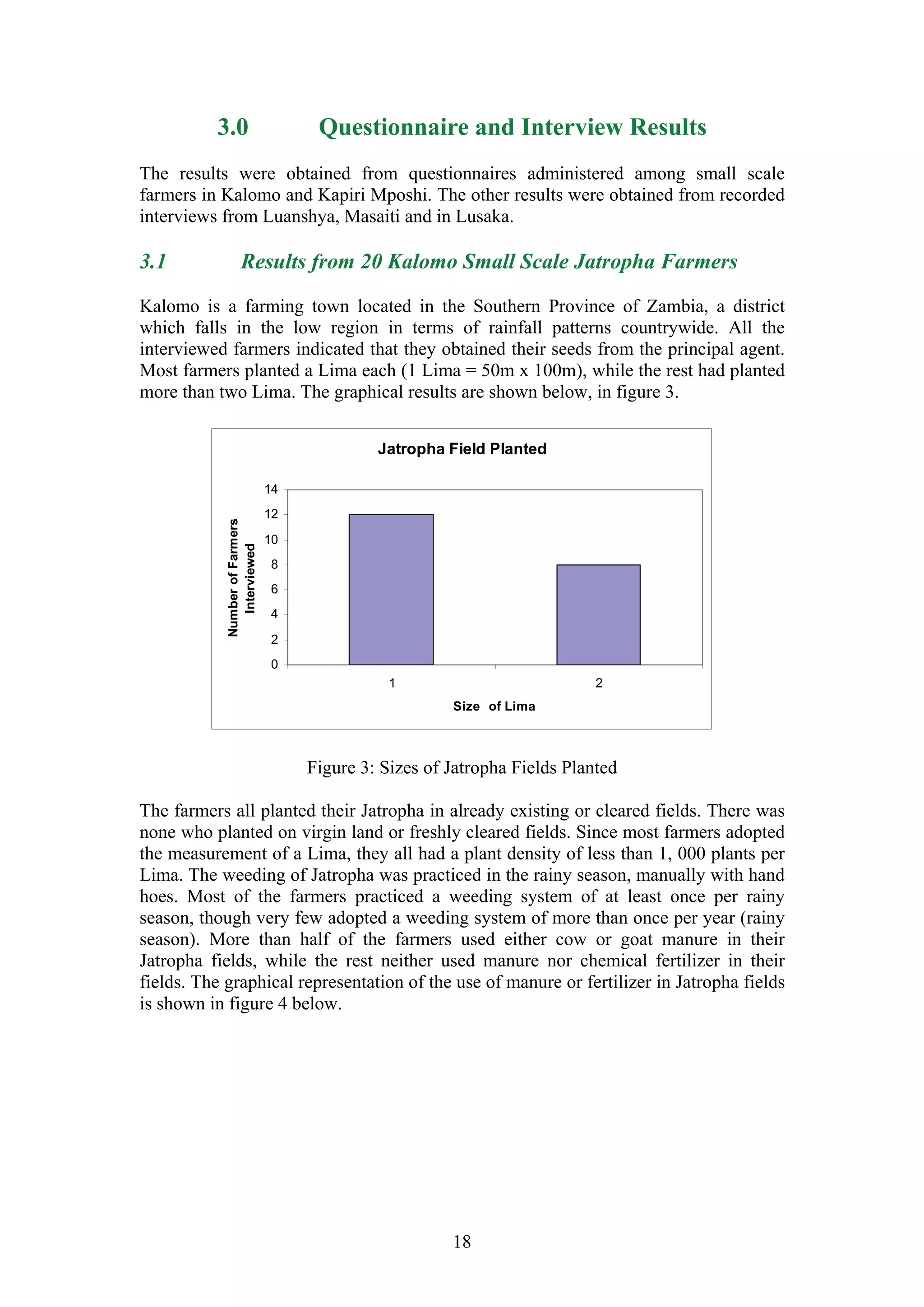
3.1                Results from 20 Kalomo Small Scale Jatropha Farmers

Kalomo is a farming town located in the Southern Province of Zambia, a district
which falls in the low region in terms of rainfall patterns countrywide. All the
interviewed farmers indicated that they obtained their seeds from the principal agent.
Most farmers planted a Lima each (1 Lima = 50m x 100m), while the rest had planted
more than two Lima. The graphical results are shown below, in figure 3.


                                              Jatropha Field Planted

                                14
                                12
            Number of Farmers


                                10
               Interviewed


                                8
                                6
                                4
                                2
                                0
                                                1                           2
                                                        Size of Lima


                                     Figure 3: Sizes of Jatropha Fields Planted

The farmers all planted their Jatropha in already existing or cleared fields. There was
none who planted on virgin land or freshly cleared fields. Since most farmers adopted
the measurement of a Lima, they all had a plant density of less than 1, 000 plants per
Lima. The weeding of Jatropha was practiced in the rainy season, manually with hand
hoes. Most of the farmers practiced a weeding system of at least once per rainy
season, though very few adopted a weeding system of more than once per year (rainy
season). More than half of the farmers used either cow or goat manure in their
Jatropha fields, while the rest neither used manure nor chemical fertilizer in their
fields. The graphical representation of the use of manure or fertilizer in Jatropha fields
is shown in figure 4 below.


                                                        18
Use of Manure or Fertilizer


         Neither using
          Manure nor
         Fertilizer, 35%


                                                          Use of Manure only,
                                                               65%


                 Figure 4: Use of Manure or Fertilizer in Jatropha Field

None of the interviewed farmers in Kalomo area used irrigation in their Jatropha
fields. They all relied on rain-fed water requirements for their Jatropha plants.
Despite, some reported incidences of pests and diseases (termites and red spider
mites); more than half of the farmers had not used any pesticides or fungicides for
pest or disease control. The results are shown in figure 5 below.

                               Use of Chemicals for Pest or Disease Control


                       Using Chemicals,
                             30%


                                                                      Not Using
                                                                    Chemicals, 70%


                 Figure 5: Use of Chemicals for Pest or Disease Control

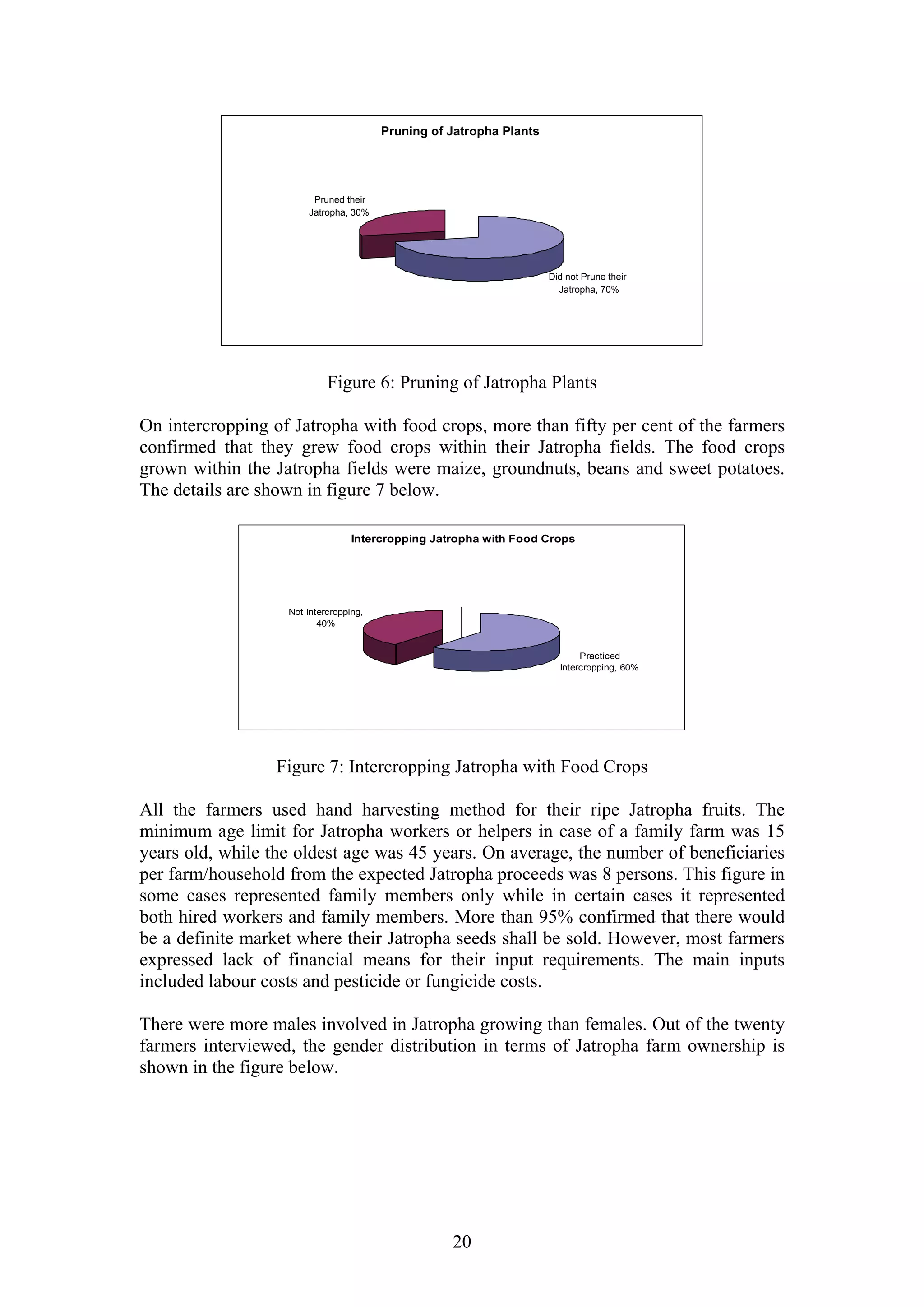
Concerning Jatropha crop management, less than half of the farmers pruned their
Jatropha plants once per annum, in order to encourage more side shoots, while more
than half did not prune their Jatropha plants at all. The results are shown in figure 6
below.


                                                   19
Pruning of Jatropha Plants


                        Pruned their
                       Jatropha, 30%


                                                                     Did not Prune their
                                                                       Jatropha, 70%


                            Figure 6: Pruning of Jatropha Plants

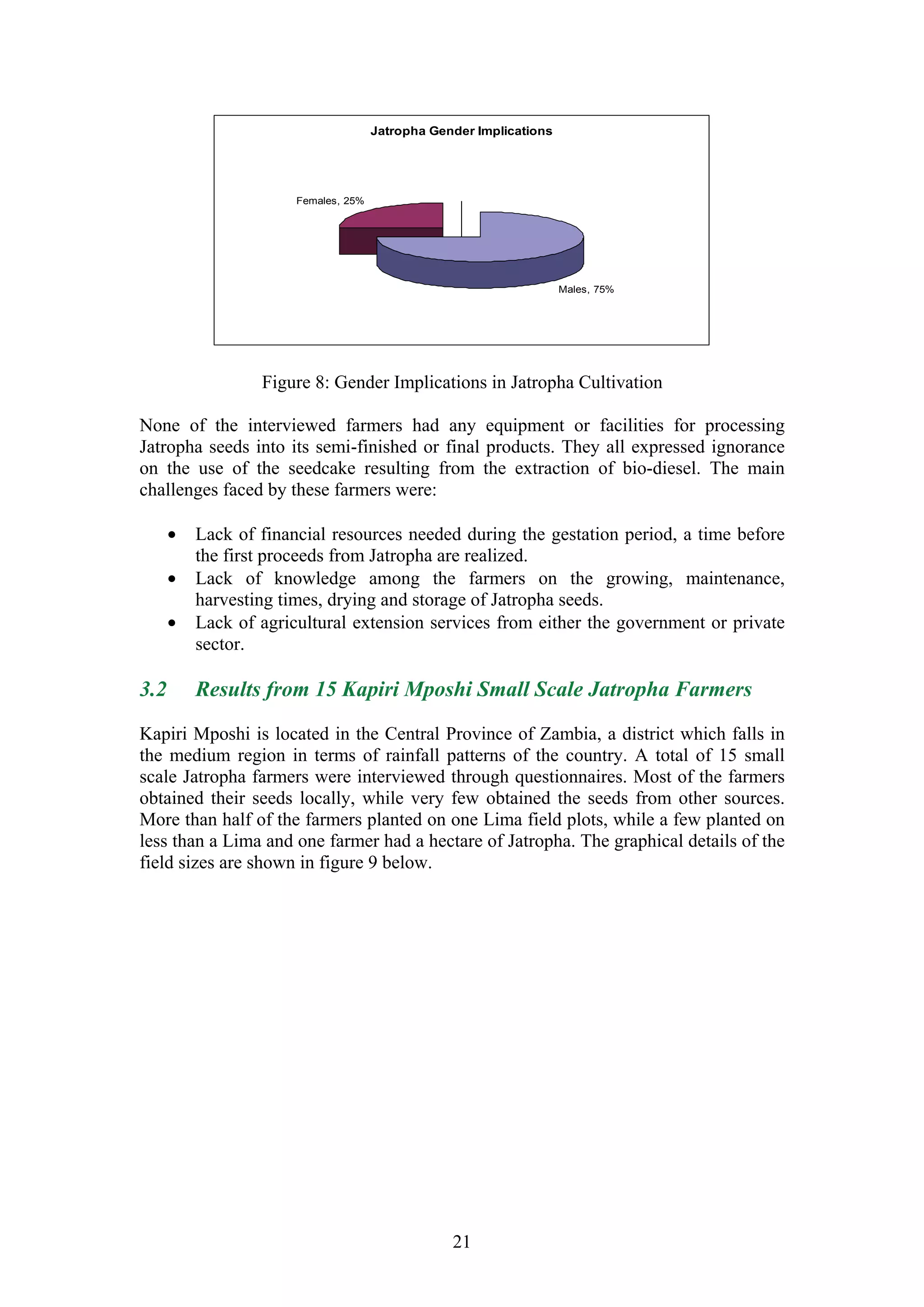
On intercropping of Jatropha with food crops, more than fifty per cent of the farmers
confirmed that they grew food crops within their Jatropha fields. The food crops
grown within the Jatropha fields were maize, groundnuts, beans and sweet potatoes.
The details are shown in figure 7 below.

                                  Intercropping Jatropha with Food Crops


                   Not Intercropping,
                          40%


                                                                            Practiced
                                                                       Intercropping, 60%


                  Figure 7: Intercropping Jatropha with Food Crops

All the farmers used hand harvesting method for their ripe Jatropha fruits. The
minimum age limit for Jatropha workers or helpers in case of a family farm was 15
years old, while the oldest age was 45 years. On average, the number of beneficiaries
per farm/household from the expected Jatropha proceeds was 8 persons. This figure in
some cases represented family members only while in certain cases it represented
both hired workers and family members. More than 95% confirmed that there would
be a definite market where their Jatropha seeds shall be sold. However, most farmers
expressed lack of financial means for their input requirements. The main inputs
included labour costs and pesticide or fungicide costs.

There were more males involved in Jatropha growing than females. Out of the twenty
farmers interviewed, the gender distribution in terms of Jatropha farm ownership is
shown in the figure below.


                                                   20
Jatropha Gender Implications


                       Females, 25%


                                                                     Males, 75%


                  Figure 8: Gender Implications in Jatropha Cultivation

None of the interviewed farmers had any equipment or facilities for processing
Jatropha seeds into its semi-finished or final products. They all expressed ignorance
on the use of the seedcake resulting from the extraction of bio-diesel. The main
challenges faced by these farmers were:

      •   Lack of financial resources needed during the gestation period, a time before
          the first proceeds from Jatropha are realized.
      •   Lack of knowledge among the farmers on the growing, maintenance,
          harvesting times, drying and storage of Jatropha seeds.
      •   Lack of agricultural extension services from either the government or private
          sector.

3.2       Results from 15 Kapiri Mposhi Small Scale Jatropha Farmers

Kapiri Mposhi is located in the Central Province of Zambia, a district which falls in
the medium region in terms of rainfall patterns of the country. A total of 15 small
scale Jatropha farmers were interviewed through questionnaires. Most of the farmers
obtained their seeds locally, while very few obtained the seeds from other sources.
More than half of the farmers planted on one Lima field plots, while a few planted on
less than a Lima and one farmer had a hectare of Jatropha. The graphical details of the
field sizes are shown in figure 9 below.


                                                  21
Size of Jatropha Field Planted
                          1 Hectare
                             6%

Less than 1 Lima
       19%


                                                       1 Lima
                                                        75%


                          Figure 9: Sizes of Jatropha Fields Planted

Concerning land use patterns, none of the farmers planted their Jatropha on virgin
land. They all planted on old fields where other crops had been grown before. Most of
them generally had a plant density of less than 1, 000 plants per Lima, while they
weeded their plants at least once per rainy season. The farmers neither directly applied
manure nor used any fertilizers in their Jatropha fields. Further more, all the fifteen
farmers relied on rains for their Jatropha water needs and were not using any
chemicals for pest or weed control. In terms of crop management, none of the farmers
had pruned their Jatropha plants.

On average, most farmers intercropped their Jatropha with food crops such as maize,
beans, groundnuts, cassava and sweet potatoes. The results are shown in figure 10
below.


                     Intercropping Jatropha with Food Crops


     Not Intercropping,
     45%


                                                          Intercropping,
                                                          55%


                     Figure 10: Intercropping Jatropha with Food Crops


                                             22
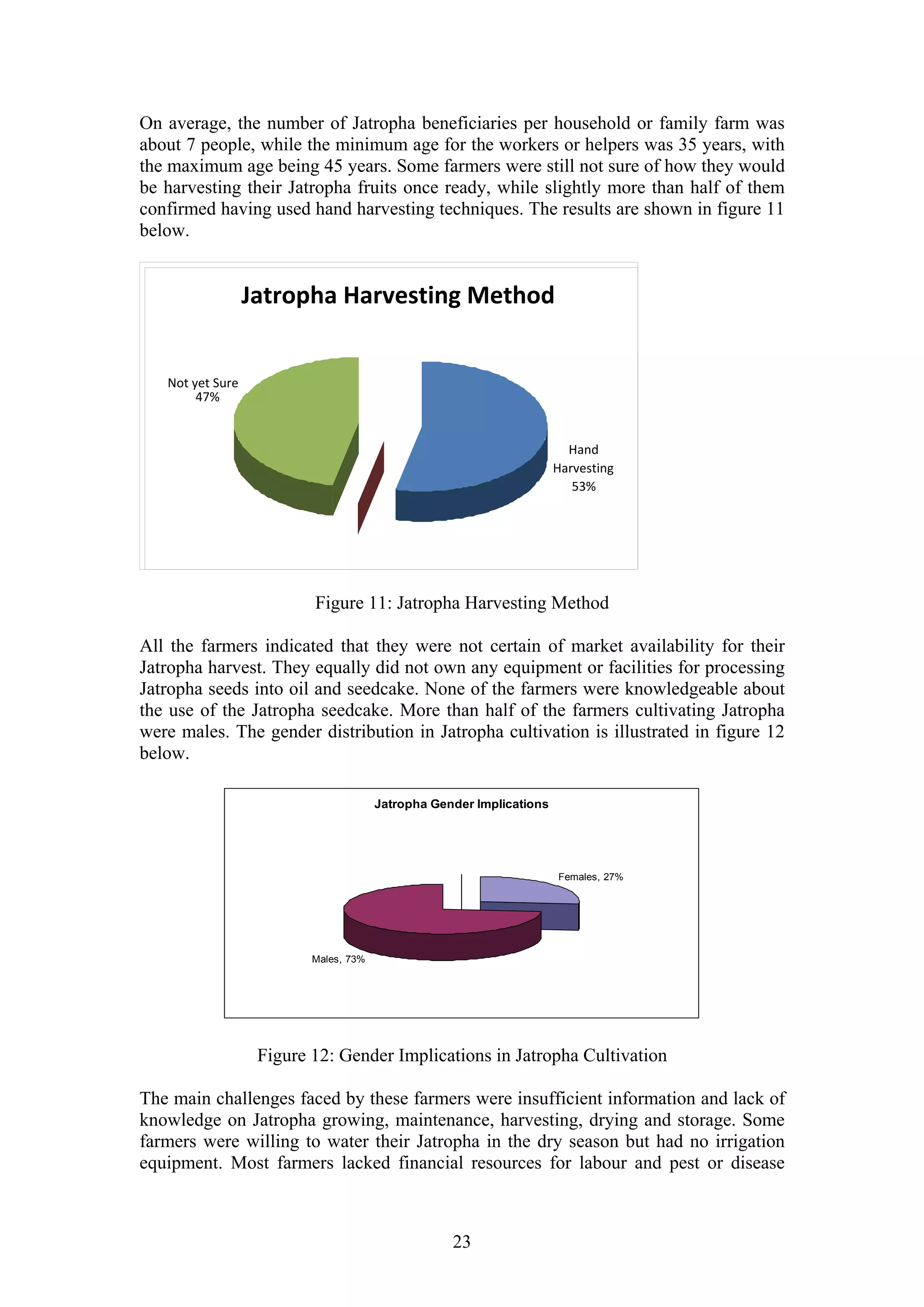
On average, the number of Jatropha beneficiaries per household or family farm was
about 7 people, while the minimum age for the workers or helpers was 35 years, with
the maximum age being 45 years. Some farmers were still not sure of how they would
be harvesting their Jatropha fruits once ready, while slightly more than half of them
confirmed having used hand harvesting techniques. The results are shown in figure 11
below.


                  Jatropha Harvesting Method


   Not yet Sure
        47%


                                                                        Hand
                                                                      Harvesting
                                                                         53%


                          Figure 11: Jatropha Harvesting Method

All the farmers indicated that they were not certain of market availability for their
Jatropha harvest. They equally did not own any equipment or facilities for processing
Jatropha seeds into oil and seedcake. None of the farmers were knowledgeable about
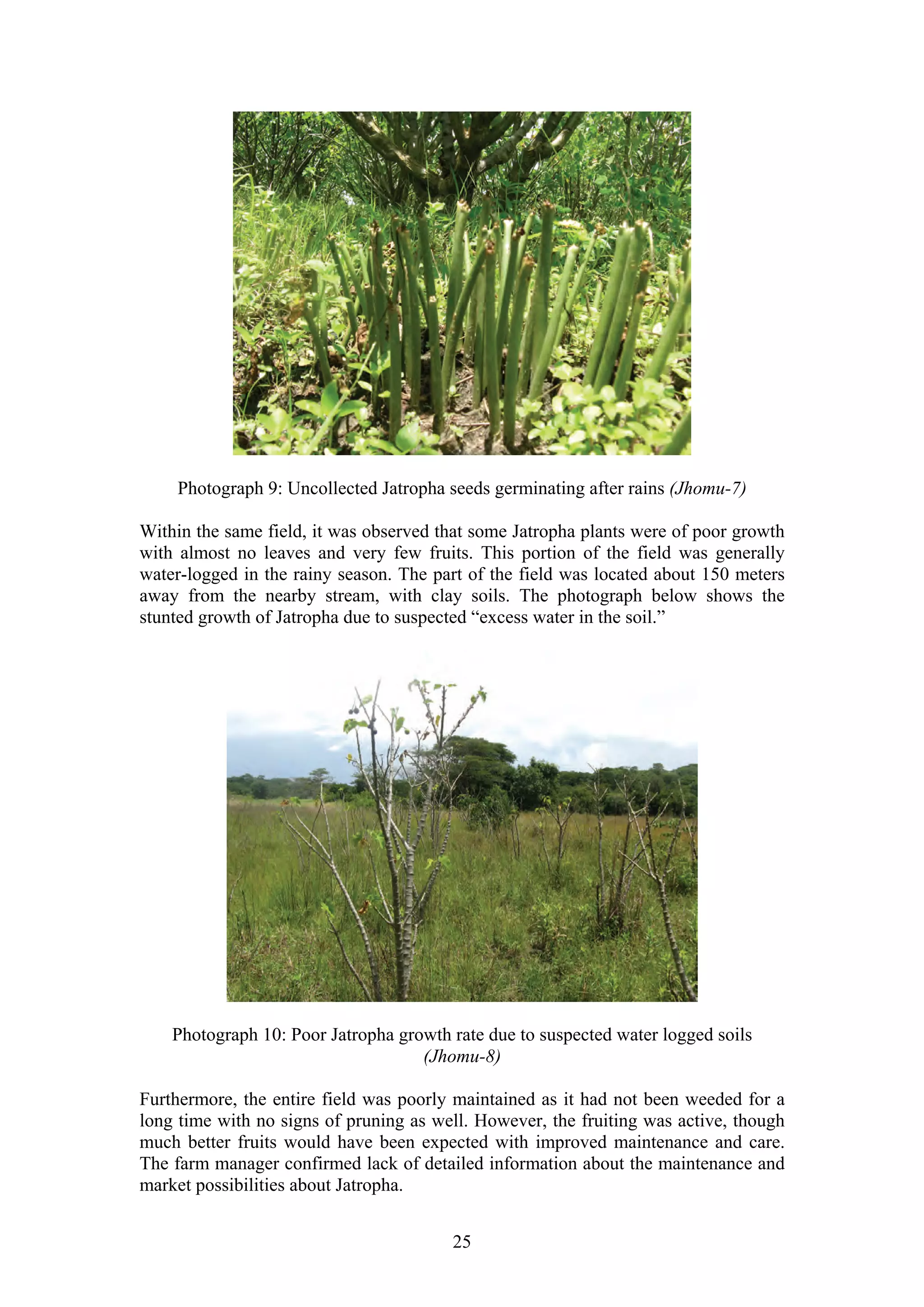
the use of the Jatropha seedcake. More than half of the farmers cultivating Jatropha
were males. The gender distribution in Jatropha cultivation is illustrated in figure 12
below.

                                       Jatropha Gender Implications


                                                                      Females, 27%


                          Males, 73%


                   Figure 12: Gender Implications in Jatropha Cultivation

The main challenges faced by these farmers were insufficient information and lack of
knowledge on Jatropha growing, maintenance, harvesting, drying and storage. Some
farmers were willing to water their Jatropha in the dry season but had no irrigation
equipment. Most farmers lacked financial resources for labour and pest or disease


                                                   23
control. The average budget for each of the farmers was less than fifty dollars per
year.

3.3          Results from Small Scale Famers under OGS in Luanshya

Luanshya is a mining town located on the Copperbelt Province of Zambia, a district
which falls in the higher rainfall belt of the country. The following results were
obtained from the meeting held on February 6th 2009 at the residence of Pastor Musa
of KM 277, Kamirenda in Luanshya. He is the chairman of small scale Jatropha
farmers contracted through OGS arrangement.

There were 208 members under his supervision. The principal agent, Marli
Investments Limited provided the Jatropha seeds to him, who later on co-coordinated
the distribution of the seeds to other farmers. The contractual agreement was 30 years
in which the farmers would be obliged to sell the harvest only to the principal agent.
Approximately 52% of the Jatropha growers were males while 48% constituted the
females.

Farmers were given guidelines on how to grow the Jatropha from the nursery up to the
harvesting time. They had raised their Jatropha nurseries within their back-yard
gardens from about November 2008 and transplanted into the main fields between
January/February 2009, a period of 3 months. Most farmers applied ashes in the holes
where Jatropha was transplanted into, both as a means of preventing pest attacks and
to provide nutrients to the young Jatropha plants. Intercropping, with food crops like
groundnuts, sweet potatoes, maize, beans and soya beans was practiced by most
farmers, while some farmers had specific fields solely for Jatropha.

The majority of the farmers grew Jatropha on one Lima plots in size, with a plant
density of 300 Jatropha plants per Lima. The current price of dried Jatropha seeds by
then was pegged at K3, 150 (US$0.62) per kilograme.

3.4          Results from Shakabunda Farm – Masaiti District

Masaiti district is located in the rural parts of the Copperbelt Province. The late
Zambian President, Levy Patrick Mwanawasa, owns the farm and established the
Jatropha field in 2006 on a trial basis. The area under Jatropha cultivation amounts to
about 5 hectares. The conducted tour on the Jatropha field was lead by the farm
manager on February 24th 2009.

By then (February), most of the ripe Jatropha fruits were ready for harvesting. This
was the second harvest after being transplanted in 2006. The first harvest, which was
in 2007 had been neglected, as some Jatropha seeds had fallen to the ground
uncollected. These seeds ended up germinating around the mature Jatropha trees. This
was evident throughout the field especially where the Jatropha was growing well.
Intercropping was not practiced and there had been no fertilizer added, with all the
water requirements being provided by the rains. The photograph below shows the
germinating Jatropha after being left uncollected for almost a year.


                                          24
Photograph 9: Uncollected Jatropha seeds germinating after rains (Jhomu-7)

Within the same field, it was observed that some Jatropha plants were of poor growth
with almost no leaves and very few fruits. This portion of the field was generally
water-logged in the rainy season. The part of the field was located about 150 meters
away from the nearby stream, with clay soils. The photograph below shows the
stunted growth of Jatropha due to suspected “excess water in the soil.”


    Photograph 10: Poor Jatropha growth rate due to suspected water logged soils
                                    (Jhomu-8)

Furthermore, the entire field was poorly maintained as it had not been weeded for a
long time with no signs of pruning as well. However, the fruiting was active, though
much better fruits would have been expected with improved maintenance and care.
The farm manager confirmed lack of detailed information about the maintenance and
market possibilities about Jatropha.


                                        25
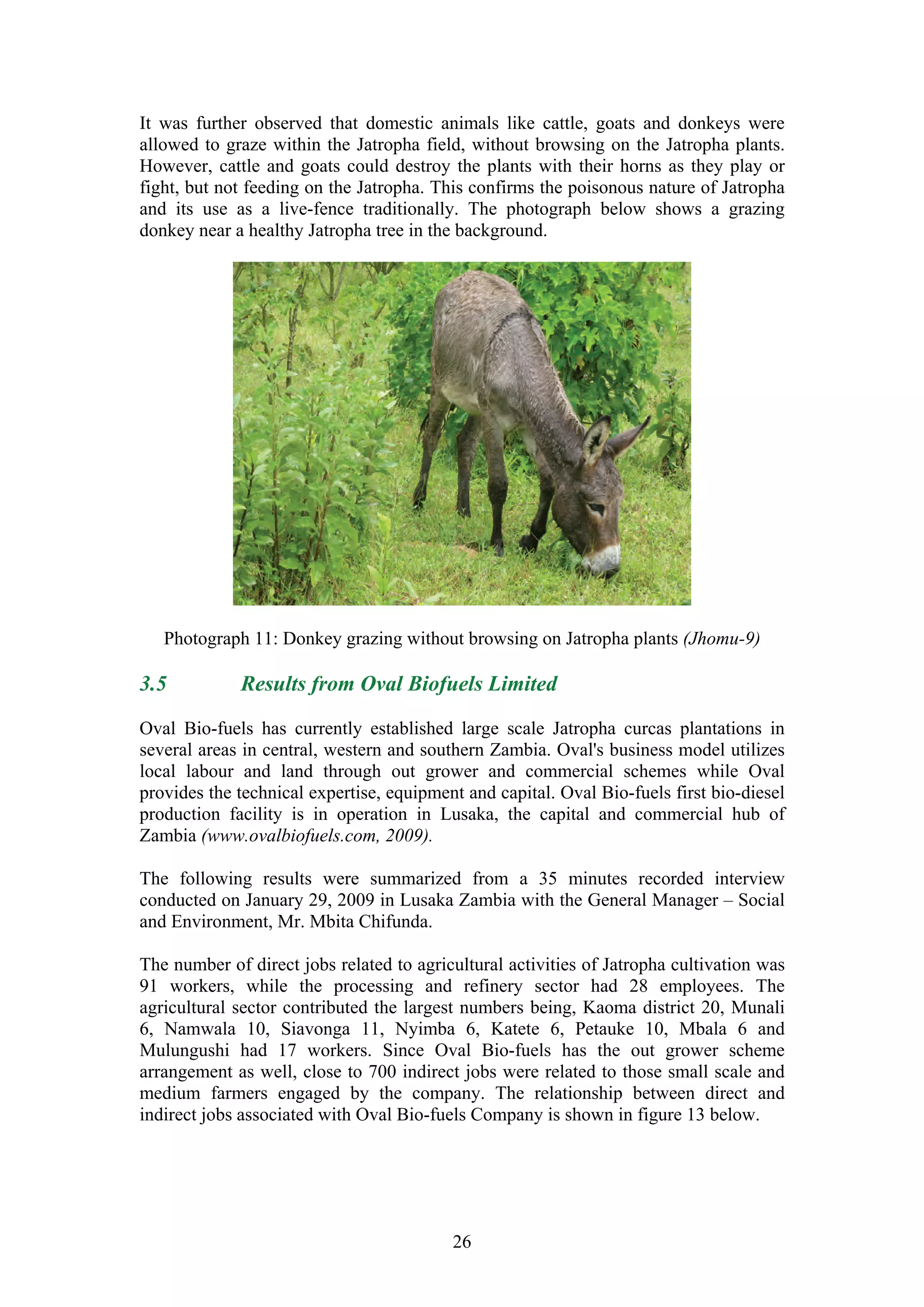
It was further observed that domestic animals like cattle, goats and donkeys were
allowed to graze within the Jatropha field, without browsing on the Jatropha plants.
However, cattle and goats could destroy the plants with their horns as they play or
fight, but not feeding on the Jatropha. This confirms the poisonous nature of Jatropha
and its use as a live-fence traditionally. The photograph below shows a grazing
donkey near a healthy Jatropha tree in the background.


   Photograph 11: Donkey grazing without browsing on Jatropha plants (Jhomu-9)

3.5          Results from Oval Biofuels Limited

Oval Bio-fuels has currently established large scale Jatropha curcas plantations in
several areas in central, western and southern Zambia. Oval's business model utilizes
local labour and land through out grower and commercial schemes while Oval
provides the technical expertise, equipment and capital. Oval Bio-fuels first bio-diesel
production facility is in operation in Lusaka, the capital and commercial hub of
Zambia (www.ovalbiofuels.com, 2009).

The following results were summarized from a 35 minutes recorded interview
conducted on January 29, 2009 in Lusaka Zambia with the General Manager – Social
and Environment, Mr. Mbita Chifunda.

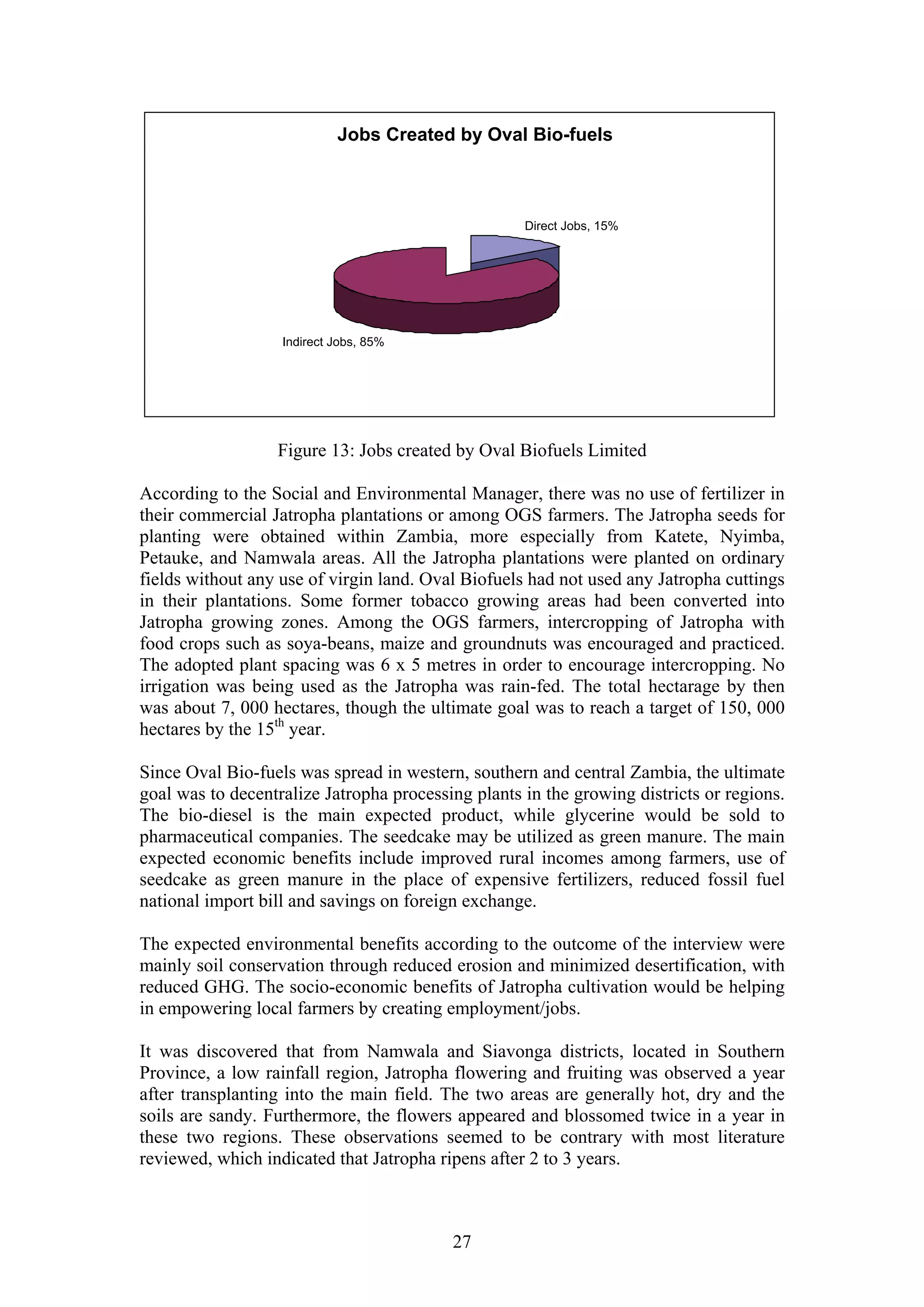
The number of direct jobs related to agricultural activities of Jatropha cultivation was
91 workers, while the processing and refinery sector had 28 employees. The
agricultural sector contributed the largest numbers being, Kaoma district 20, Munali
6, Namwala 10, Siavonga 11, Nyimba 6, Katete 6, Petauke 10, Mbala 6 and
Mulungushi had 17 workers. Since Oval Bio-fuels has the out grower scheme
arrangement as well, close to 700 indirect jobs were related to those small scale and
medium farmers engaged by the company. The relationship between direct and
indirect jobs associated with Oval Bio-fuels Company is shown in figure 13 below.


                                          26
Jobs Created by Oval Bio-fuels


                                                    Direct Jobs, 15%


                   Indirect Jobs, 85%


                  Figure 13: Jobs created by Oval Biofuels Limited

According to the Social and Environmental Manager, there was no use of fertilizer in
their commercial Jatropha plantations or among OGS farmers. The Jatropha seeds for
planting were obtained within Zambia, more especially from Katete, Nyimba,
Petauke, and Namwala areas. All the Jatropha plantations were planted on ordinary
fields without any use of virgin land. Oval Biofuels had not used any Jatropha cuttings
in their plantations. Some former tobacco growing areas had been converted into
Jatropha growing zones. Among the OGS farmers, intercropping of Jatropha with
food crops such as soya-beans, maize and groundnuts was encouraged and practiced.
The adopted plant spacing was 6 x 5 metres in order to encourage intercropping. No
irrigation was being used as the Jatropha was rain-fed. The total hectarage by then
was about 7, 000 hectares, though the ultimate goal was to reach a target of 150, 000
hectares by the 15th year.

Since Oval Bio-fuels was spread in western, southern and central Zambia, the ultimate
goal was to decentralize Jatropha processing plants in the growing districts or regions.
The bio-diesel is the main expected product, while glycerine would be sold to
pharmaceutical companies. The seedcake may be utilized as green manure. The main
expected economic benefits include improved rural incomes among farmers, use of
seedcake as green manure in the place of expensive fertilizers, reduced fossil fuel
national import bill and savings on foreign exchange.

The expected environmental benefits according to the outcome of the interview were
mainly soil conservation through reduced erosion and minimized desertification, with
reduced GHG. The socio-economic benefits of Jatropha cultivation would be helping
in empowering local farmers by creating employment/jobs.

It was discovered that from Namwala and Siavonga districts, located in Southern
Province, a low rainfall region, Jatropha flowering and fruiting was observed a year
after transplanting into the main field. The two areas are generally hot, dry and the
soils are sandy. Furthermore, the flowers appeared and blossomed twice in a year in
these two regions. These observations seemed to be contrary with most literature
reviewed, which indicated that Jatropha ripens after 2 to 3 years.


                                          27
The direct use of bio-diesel in vehicles was confirmed by Oval Biofuels who bought a
fleet of new diesel run vehicles and drove them on B100 bio-diesel. Another case
involving the direct use of bio-diesel was by the director of Zambia Development
Agency, who drove his vehicle to Kafue National Park, more than 200km away from
Lusaka. He reported back to Oval Biofuels that he had made a saving each time he
used bio-diesel compared to fossil diesel.

The key challenges facing the Jatropha industry were:

      •   The risks related to the newness of the Jatropha industry and the high costs of
          initial investments involved.
      •   There was still lack of incentives in terms of duties and taxes on equipment
          and machinery, especially for processing Jatropha into its products.
      •   Difficulties in divorcing the negative history of Paprika & Cashew-nut
          failures. The two cash crops’ failure in Zambia has become a reference point
          for those against Jatropha promotion especially that some players in the bio-
          fuels industry seem to have failed to live to their words.
      •   The use of engines designed for fossil fuel, especially older models
          (manufactured before 1996) may have components made of natural rubber,
          which is attacked or disintegrated as bio-diesel reacts with natural rubber, by
          softening it.

3.6       BAZ Annual General Meeting Proceedings in Lusaka

Bio-fuels Association of Zambia was formed in September 2006 to spearhead and
promote the production and use of renewable energy sources in Zambia. The
headquarters are based in Lusaka.

The January 29th, 2009 annual general meeting brought together most of the key
Jatropha stakeholders in Zambia. The meeting also had representatives from palm oil
growers meant for bio-diesel production and the sugar industry venturing and
investing into bio-ethanol. The meeting was officially opened by the then Deputy
Minister of Energy and Water Development, Mr. Lameck Chibombamilimo.

It was revealed that the Zambian government was supportive and actively interested
in the progressive development of the bio-fuels sector. Zambia imports about 600, 000
metric tonnes per annum of co-mingled petroleum feed stocks, whose cost
implications translated to about 10% of the foreign exchange earnings of the country.
As Zambia is a landlocked country wholly depended on imported petroleum needs,
the bio-fuels sector was a welcome alternative energy source.

Some of the issues the government had addressed were the release of the latest
National Energy Policy of 2008, which addresses policy measures for all sources of
energy including bio-fuels in the country. Furthermore, ERB was given the legal
mandate to regulate and license the production and use of bio-fuels in Zambia. The
blending ratios had not yet been officially released, as they had to be in conformity
with bio-fuel standards and licensing procedures. However, Zambia’s bio-diesel
standards were obtainable at Zambia Bureau of Standards offices.


                                            28
Among the key Jatropha stakeholders that were in attendance, ETC Bio-energy
Company were operating in their third year with commercial Jatropha plantations in
excess of 1, 000 hectares. Marli Investments Limited had planted more than 25, 000
hectares in commercial and OGS arrangements, countrywide. Another company,
Southern Bio-power Limited, operating in Southern and North-Western provinces,
had reported 400 hectares of commercial plantation with about 3, 500 hectares in form
of OGS. In the Northern Province, D1-BP Company had planted 500 hectares in
Kasama and 550 hectares in Rufunsa, with a number of OGS elsewhere. Thomro
Investments Limited had planted more than 70 hectares, while Bruno’s Jatropha
Limited had about 5 million Jatropha plants at nursery stage. Both Jatropha growers
are based in Lusaka.


                                         29
4.0           Discussion
Energy security and its associated risks are important issues to consider since they
affect demand and supply. Fossil fuels are geographically concentrated in the Middle
East, Eastern Europe, Western coast of Africa (Angola, Nigeria) and Venezuela in
South America. These geographical zones are the world’s major suppliers of fossil
fuels. Generally, these zones are vulnerable to terrorism and undemocratic regimes
and political instability. However, renewable energy sources like bio-fuels are much
more equitably distributed, so that bio-energy security is more localized and less
risky. For Zambia, a landlocked country, transport costs from the sources of crude
petroleum to the refinery in Ndola, add another burden to the country’s energy
security. Bio-diesel from Jatropha grown and processed within Zambia will be locally
available and much cheaper than fossil fuel.

In Zambia Jatropha is currently grown by small scale farmers mainly through OGS
arrangement. Whilst this may be the case, some farmers do grow Jatropha
independently, though such farmers are in the minority. They hope to find their own
markets to sell their harvest. Commercial farmers grow Jatropha on larger plantations.
Some intend to grow enough for their own use, while others aim at growing enough
for processing into bio-diesel and its by-products.

4.1          Small Scale Jatropha Farmers

From the results obtained among the small scale Jatropha growers, all of the farmers
rely on rain-fed Jatropha cultivation. Most of the farmers have field sizes within one
Lima, with average crop density of about 300 plants. These are farmers who are
technically and financially weak, growing just what they can manage within their
means. In case of a drought, rain-fed Jatropha cultivation may suffer reduced crop
yields with no hope of irrigation especially among small rural farmers. Jatropha
requires more and adequate water during the flowering and fruiting stages. Such a
scenario would impact negatively on the expected seed yield.

The farmers do not directly apply chemical fertilizers in their fields, though most
farmers in Kalomo (65%) used manure in their fields. However, the farmers in all
three areas under review practiced intercropping with maize. In Zambia, maize
growing is rarely grown without fertilizers, so that ultimately the fertilizer applied to
maize ends up being absorbed by Jatropha plants as well. Therefore, Jatropha
indirectly receives fertilizers due to intercropping with maize. Furthermore, most
small scale growers did not use chemicals for pest or disease control, despite reported
incidences of some pests and diseases in some areas of Kalomo and Kapiri Mposhi.
Diseases and pests may affect crop yield, further eroding the expected income. Should
there arise any need of using fertilizer in Jatropha fields later on, small scale farmers
may be negatively affected.

Concerning crop maintenance, pruning was generally not practiced among most
farmers, though in Kalomo, about 29% had pruned their Jatropha plants. This means
that the farmers may not reap the benefits of pruning which encourages more fresh
shoots. The more the shoots or branches are formed, the more flowers grow and
ultimately the higher the harvest per station or tree. Since most farmers grow Jatropha


                                           30
on one Lima plots, they may not harvest much and maximize land use. Pruning should
therefore be encouraged in order to maximize on the yields and land use for small
scale growers with limited land.

In all the three case study areas, intercropping was practiced with food crops like
maize, groundnuts, soya beans, sweet potatoes and cassava. All these crops are
sensitive to weeds, therefore, during the weeding times, the Jatropha benefits from
this exercise as well. Moreover, this practice reduces on the labour costs and the time
frequency, as the exercise of weeding is done once for both crops. As long as the
spacing is 6 x 5 metres or more, intercropping is possible for the next three to four
years. However, after four years of growing Jatropha, the shade from the expanded
trees may not be suitable and supportive of other crops being grown within the same
field. At this stage, whatever food crop had been grown together with Jatropha would
require a new field. If this is not possible, food security at household level may be
compromised. Therefore, those farmers with limited land may later on be faced with
reduced food crop hectarage. Figure 14 illustrates the relationship between
intercropping and the possible threat to food security.

The number of beneficiaries per household or farm on average for both Kalomo and
Kapiri Mposhi was 7 people. In terms of socio-economic benefits, this could be
indirectly translated into income being realized from Jatropha for all the beneficiaries.
This therefore confirms the fact that Jatropha cultivation or bio-fuels in rural areas do
generate employment opportunities and alternative incomes. The results further
indicated that child labour was not in practice, though at family level, this may be
difficult to define. Traditionally, children are introduced and trained by their parents
to work on the field at an early stage. The aim is to inculcate the spirit of self-reliance
in them. The age group for farm workers or helpers was above 15 years. However, a
15 years old child working on a hired labour basis at a farm would raise concerns
related to child labour.

Male participation dominated the cultivation of Jatropha in all cases considered, by at
least more than half of the number of farmers. Traditionally, farming in Zambia is
male dominated, which could explain the same trends in Jatropha cultivation.
However, in Luanshya, the figures showed a more balanced picture of 52% males
against 48% females. Furthermore, land ownership in Zambia is also tilted towards
males, not as a result of discriminatory laws, but has traditionally and culturally been
so for some years. Women need encouragement and empowerment so that they could
own land for Jatropha cultivation. Moreover they are the majority countrywide, even
when it comes to labour provision on farms and yet the most disadvantage in terms of
land ownership.

Jatropha is labour intensive, especially at harvesting stage, where most farmers
indicated the use of hand harvesting methods, even for some of those who had not yet
harvested. Since Jatropha is a weak plant physically in that the branches break easily,
it should not be allowed to grow tall. During harvesting, it becomes easier to pick ripe
Jatropha fruits within the height of a normal human being, rather than any height
above 2.5 metres. For effective harvesting by hand, pruning should be encouraged so
that Jatropha trees do not grow above 2.5 metres, if possible. Furthermore, pruning
adds more biomass to the soil, if plant residues are left to rot within the Jatropha field,


                                            31
ultimately improving soil nutrients. Pruning also ensures an easier passage between
Jatropha roles during inspection, weeding and harvesting.

The budgetary allocations for disease and pest control showed that the majority of the
farmers spent about less than fifty dollars per annum (<USD 50). This fact was further
confirmed as one of the main challenges the farmers were experiencing, being lack of
financial means. Additionally some of these farmers indicated that they needed
irrigation facilities or equipment, but had no money. These farmers cannot obtain
loans from banks easily, as most of them do not hold title deeds of their pieces of
land, which could be used as security. Moreover, banks may not be supportive for
such ventures as Jatropha growing due to its newness. The chances of expansion are
therefore limited to what each farmer can manage physically and financially. These
farmers are therefore vulnerable to any kind of manipulation by those with money,
unless financially empowered by the government.

The results indicated that most small scale Jatropha farmers were dependant on OGS
arrangement, where they were contracted to sell the Jatropha seeds. The principal
agent or company would finally process or sell to processing companies. These
farmers would be bonded to the principal agent for as long as the contract lasts. If the
conditions in the contract become less supportive and responsive to their needs, then
there will be a challenge of how to negotiate for a review, if at all that could be
possible. However, the presence of readily available market is assured through these
contracts, so that farmers will not have to worry of where to sell their produce.

Interestingly, none of the small scale farmers had planted Jatropha on virgin land. All
of them used already existing fields, where they could have been growing other crops
earlier. This trend has positive environmental gains in terms of GHG balances,
especially the net balances on CO2. Cutting of trees in order to clear land for
agriculture not only threatens bio-diversity, but equally increases GHG. Whilst
Jatropha growing has environmental gains in Zambia due to none use of virgin land,
but on a long term basis, this may not be possible. Where intercropping is practiced,
farmers may need to abandon this practice as Jatropha trees grow bigger in size. The
long term relationship between intercropping and the anticipated threat to food
security at family level is illustrated in figure 14 below.


                                          32
J   FC   J   FC   J       J   J   J   J
       J   FC   J   FC   J       J   J   J   J                 Is there Enough
       J   FC   J   FC   J       J   J   J   J                  Land for Farm
       J   FC   J   FC   J       J   J   J   J                    Expansion?
       J   FC   J   FC   J       J   J   J   J
       J = Jatropha              J   J   J   J
       FC = Food Crop            J = Jatropha


       0-4 years –           Above 4 years –           Displaced Food Crop may
       Intercropping is      Intercropping not         require new fields. Is land
       Beneficial and        Beneficial due to shade   available? Limited Land may
       Possible.             from Jatropha Trees.      threaten Food Security.


      Figure 14: Long Term Implications of Intercropping Jatropha with Food Crops

Intercropping also ensures that the Jatropha field is kept clean from weeds ultimately
preventing pests and fires which are common during the dry season. After harvesting
the food crops, plant residues especially from legumes would be nutritionally
beneficial to the Jatropha. Intercropping therefore has more advantages during the
early years of Jatropha cultivation. It promotes healthy and strong young Jatropha
plants that can resist disease attack and assures a good harvest to farmers.

Another common issue among all farmers was the lack of means to own processing
facilities for converting Jatropha seeds into oil or bio-diesel. Furthermore, all of them
had no knowledge of the use of the seedcake or glycerine, the two main by-products
derived from bio-diesel production. This could mean that these farmers may not enjoy
direct use and benefits of bio-diesel, glycerine or the seedcake. For domestic lighting,
the rural farmers may have to buy the bio-diesel, while the use of the seedcake for
domestic cooking or green manure will also depend on their ability to buy it from
processing companies. Given the weak financial position of most rural small scale
farmers, the use of bio-diesel and the seedcake for their domestic needs may not be
possible. Figure 15 illustrates this point further.

4.2                 Commercial Jatropha Growers

Most of the Jatropha seeds used in Zambia came from sources within the country. The
fear of alien Jatropha species coming into the country may not be very serious, as long
as consistent monitoring and inspections at border crossing points are implemented.
Attempts to sneak in foreign Jatropha seeds into the country have been reported, like
the incidence at Chirundu border post in January 2009, where several kilograms of
Jatropha foreign seeds were destroyed. However, the Zambian seed has not been fully
researched on so as to give a clear picture of the variety, disease tolerant properties,
soil and water requirements, maturing time, approximate yield per Lima/hectare and
the seed oil content. These are areas that need further research.


                                                 33
One of the ecological concerns about Jatropha cultivation is the fear of its
invasiveness. Some sections of society fear that Jatropha is capable of replacing other
local indigenous plant species. They argue that since seeds can grow anywhere where
there is enough moisture, these could be signs of Jatropha being an invasive plant.
There is currently enough evidence to indicate that Jatropha has been in Zambia for
close to 100 years. In Zambia, empirical observations regarding the cultivation of
Jatropha as a species at non-commercial level has so far not shown any problems and
that it has not been reported to exhibit any harmful characteristics to disqualify it as an
energy crop, (Position Paper on Jatropha in Zambia, 2008, p.5). However, there is
need for further research in order to establish facts based on actual experiences.

From the observations made, Jatropha seems to be sensitive to excess water in the
soil, especially if the soil has higher water retention properties like clay. This was
observed in Lusaka at Bruno’s Jatropha residence, just outside, where three Jatropha
plants had poor growth, yellowing and shading of leaves and fewer fruits than plants.
Furthermore, in Masaiti at Shakabunda farm, a similar behavior was noticed. Jatropha
plants on water logged soils had stunted growth. This could indicate the fact that
Jatropha grows better on well drained soils with minimum water requirements.
However, much more specific research is required in order to establish the behavior of
Jatropha in such soils.

The observations made by Oval Biofuels Limited that Jatropha was able to be
harvested after a year, and that double flowering was noted in Namwala and Siavonga
were interesting developments in the Jatropha industry in Zambia. Furthermore, these
two areas are generally hot and dry with low rainfall figures annually. The soils were
reported to be sandy and well-drained. This development could be an indication that
Jatropha cultivation literature is country specific, and may therefore not be
transferable across borders. In addition, this could further be an indication that
Jatropha favours arid sandy soils, with minimum precipitation. However further
research can give concrete and reliable data on such developments.

Small scale farmers and some commercial farmers in Zambia practice mixed
agriculture, where various crops are grown and domestic animals reared. This means
that Jatropha can still be grown successfully on small scale level or commercial farms,
without it being fenced against domestic animals. The fear of domestic animals
accidentally feeding on Jatropha leaves or seeds and cause death may not be
supported since that may not be possible. At Shakabunda farm, cattle, goats and
donkeys were reported and seen grazing grass within the Jatropha field without
browsing on the plants.

From the Oval Biofuels Limited results, Jatropha growing was found to be capable of
generating quite some substantial jobs, especially under agriculture. The total number
of direct jobs was 119, while about 700 jobs were indirectly related. These results
were obtained from one company, still in its early stages of operations. The job
creation potential could have been much more informative if other Jatropha
commercial firms had been considered. This indicates the fact that more rural jobs can
be generated through Jatropha cultivation, since plantations are generally rural based.
Rural development and employment has been lagging behind for many years in
Zambia. The promotion of Jatropha cultivation and processing could improve this
scenario.


                                            34
Most commercial growing and processing companies in Zambia were spread
throughout the country. Oval Biofuels Limited had one bio-diesel refinery based in
Lusaka. This company intends to decentralize their processing facilities in key
Jatropha growing rural districts countrywide. This being the case, means that
infrastructure development in rural areas could be boosted. The government will have
to provide better roads for efficient transport, improved water facilities to support
processing of Jatropha and access to energy to drive processing machines. If other
Jatropha companies could equally decentralize their operations like the proposed Oval
Biofuels approach, then there will be much more rural based developmental activities.
The table below shows some of the weaknesses and strengths of centralized and
decentralized systems of processing Jatropha seeds into bio-diesel.


                                         35
Table 3: Comparisons between Centralized and Decentralized Jatropha Processing
Units

Centralized Jatropha Processing        Decentralized Jatropha Processing Units
Units
Increased Transport costs from         Minimized transport       costs   from    nearby
various      Jatropha    plantations   Jatropha plantations
bringing feed stock
May receive adequate Jatropha seed     May receive inadequate Jatropha seeds as feed
as feed stock from multiple            stock from local farmers in cases of reduced
plantation sources.                    harvests or inadequate supplies.
No risks of poor infrastructure and    Risks of being subjected to poor infrastructure
other services since towns generally   and other services, due to lack of such in rural
are well serviced.                     areas.
Promotes urbanization resulting into   Promotes rural development and thereby
shanties and over-crowding in          spreading national development equitably.
cities.
Nearer to markets where bio-diesel     Far away from main markets but able to serve
consumers are concentrated.            rural and local consumers.
Promotes centralized markets much      Rural farmers may easily benefit or purchase
more suitable for commercial and       the bio-diesel, seedcake and other products
urban consumers.                       within their district.

The direct use of bio-diesel in vehicle engines in Zambia reported by Oval Biofuels
Limited was a positive development. However, vehicle models before 1996 may not
be suitable due to the ability of bio-diesel destroying components made of natural
rubber. With the bio-diesel standards in place, ERB would soon be in a position to
harmonize the blending ratios, licensing and use of bio-diesel in Zambia. However,
there is still need to establish the capacity of Jatropha feedstock available in Zambia.
Sustainable and economically viable production of bio-diesel would only be possible
with a reliable source of Jatropha feedstock. From the BAZ annual general meeting
findings, a rough total hectarage by January 2009 was in the range of 40, 000
hectares. However, this figure was not what could have been available on the ground
as the industry is still expanding and not all Jatropha growers were captured in this
report. Further accurate data would be needed, for a better assessment.


                                          36
4.3          Social Impacts

Perhaps, the most significant factor in ensuring sustainability in the Jatropha industry
lies in developing a correct model of socio economic systems related to rural
employment and economy. Yet another aspect determining sustainability is to ensure
the rights of indigenous people facing displacement from their habitats. It is
imperative to set in place properly designed value sharing models in the initial stage
itself.

The rapid growth of bio-fuel production can have undesirable effects, if not controlled
by deliberate policies. The development of a vertically integrated and large-scale
production system that excludes smallholder farmers may deepen rural inequality
(Baur et. al, 2007). However, a promotion of bio-fuel production can increase both
direct and indirect jobs, as well as induced jobs and move development from urban
areas to rural areas. This will ultimately shift spending from the urban economy to the
rural economy, which is dominated by poorer and much more vulnerable rural people.

4.3.1        Implications of OGS

Most small scale Jatropha farmers are engaged in Jatropha cultivation through OGS
arrangement. The concept of OGS is not new to the Zambian agricultural sector. It has
been there since the 1970s. An OGS is a farming arrangement, agreement or contract
where a farmer grows or produces a commercially viable crop for or on behalf of a
principal agent who buys or processes the produce into its final products. The
principal agent enters into a contract with small scale farmers by supplying farming
inputs and requisites on credit. The small scale farmers pay back through income
deductions from the proceeds of crop sales. The Jatropha farmers engaged in OGS are
supplied with seeds, technical information and sometimes money for hire of labour.
The duration of some contracts were reported to be 30 years, in which the principal
agent would be buying the Jatropha seed from the contracted farmers.

The OGS arrangement ensures that small scale farmers have readily available market
for their produce. Additionally, the farmers can be able to speak with one voice as a
group in times of disagreements. However, the fundamental question concerning this
arrangement is as to whether OGS can reduce poverty among rural farmers?
According to the report by CCJDP (2006), out-grower agriculture is not an escape
route from poverty for the poorest segment of the rural population. The report further
revealed that farmers who are already “better off” tend to improve their livelihoods
while those that are already “worse off” experience even more deterioration due to
OGS. The study focused on cotton and tobacco growing through OGS in Zambia.

Furthermore, the study revealed that there was lack of food security at household and
farm level, lack of implements and lack of advanced farming technologies among
small scale rural farmers. These were the primary causes of livelihoods deterioration.
This poses a great challenge for the Jatropha OGS. Cotton growing and tobacco
growing can be likened to Jatropha in two main ways. Jatropha growing among small
scale farmers is rain fed like cotton and tobacco. Jatropha may not be processed by
small scale farmers just like cotton and tobacco. Therefore, the rural farmers may just
be primary producers of Jatropha seeds which will be processed elsewhere, leaving
them with no direct benefits to the final product and by-products. If poor sections of


                                          37
rural farmers are to benefit from Jatropha OGS, these factors need to be addressed and
carefully considered.

4.3.2        Food Security

Concerns have been raised that energy crop production could contribute to food
insecurity in particular rural areas and nationally because land and water that would
otherwise be used for food production would be diverted into growing energy crops.

According to Wright (2008), Food Security is defined as “assured access for every
person to enough nutritious food to sustain an active and healthy life.” There are three
key levels of food security, being the family level, national level and at the global
community level. The most important of the three levels is the family. As Wright puts
it, “the goal at this level is to meet the nutritional needs of everyone in the family to
an extent that provides freedom from hunger and malnutrition.” For an individual,
there are four legitimate options for attaining food security: You can purchase the
food, raise the food, gather it from natural ecosystems, or have it provided by
someone within or outside the family.

Generally, Zambia has capacity for food production, which can be enhanced through
increased productivity on current farms with little or no land expansion. With
enhanced productivity, the current farmlands are capable of producing enough harvest
for food as well as bio-energy crops without even bringing new lands into production,
(Position Paper on Jatropha Curcas in Zambia, 2008, p.4). The report further states
that the question of whether Jatropha Curcas growing for bio-fuel production is going
to impair food security cannot be answered for lack of facts based on actual
experiences.

Furthermore, according to Müller (2007, p.15), bio-fuels can affect food security both
positively and negatively. At the household level higher prices of food will have a
negative impact on food security for the poor, of which the urban poor will be
affected the most. On the other hand new stimuli on the agricultural sector will offer
new opportunities for rural communities. In addition; Baur et. al (2007) further argues
that rising food prices are a hardship for the urban poor. However, most of the world’s
800 million undernourished people live in rural areas and the central cause for their
hunger is poverty. Countries that develop domestic bio-fuel industries will direct
investments into their rural areas and thus generate employment and income. Seeking
food security through low food prices will in all likelihood hurt the rural poor more
than it helps them.

The suspected threat of Jatropha growing to impair household food security among
rural people comes from the fact that Jatropha is an inedible bio-energy crop.
Opponents to Jatropha growing argue that rural farmers will concentrate and
specialize in Jatropha growing at the expense of food crops like maize, groundnuts,
cassava and vegetables, resulting in lower yields of the main staple food crops.
Furthermore, the land available for growing food crops will be replaced by Jatropha
cultivation, ultimately reducing the total number of hectares for local food crops.

According to Jumbe (2007, p.37), if not properly regulated, the expansion of bio-fuels
production will have serious implications for food security in developing countries. If


                                           38
bio-fuels feedstock production will necessitate the use of arable land currently
allocated to crop production, then this will lead to food insecurity especially for the
developing world. The issue is further supported by Kimble where he states that
“Food insecurity exists when people do not have physical, social, or economic access
to food” (FAO, 2003 as cited in Kimble 2008, p.29).

Most small scale rural farmers in Zambia do not specialize in growing a single crop;
usually they grow more than two crops every rain season. The threat to food security
likely to be posed by Jatropha growing could be minimal. However, it’s expected that
after the third or fourth year of Jatropha cultivation, intercropping may not be feasible,
due to the expected shade resulting from the over-grown Jatropha trees. At this stage
if no further farm expansion is considered, then Jatropha would have replaced land
once used for food crops. This will reduce real hectarage that once supported
cultivation of food crops, ultimately threatening food security at family level.

Therefore, intercropping is a short term measure that temporarily addresses land use
maximization, reduced labour costs and improves food security. For those farmers,
whether small scale or large scale, who would not be able to expand their farmlands
due to limited land, food security threats in the long run would be real. (See figure
14). This calls for proper land use and management practices, since Jatropha
continues growing for many more years, (30 – 50 years).

4.3.3         Poverty Reduction.

According to Jumbe (2007), “perhaps the most controversial aspect of the bio-fuels
industry is the poverty reduction implications of the bio-energy sector in developing
countries. Further on, Jumbe (2007, cited in Lanely 2006, p.32), suggests that given
the numerous ways bio-fuels production and industry could develop, exact impacts
are difficult to predict. The difficulty in establishing the exact positive or negative
poverty implications of the bio-fuels sector is due to the fact that current analyses are
based on predictions rather than on the actual facts since the industry is
underdeveloped.” The actual positive or negative impacts in Zambia are projections
that depend on a variety of parameters and factors that may not follow a linear scale.

The increase in prices for bio-fuels has significant and varied income and poverty
implications for the farming community in developing countries. Modern bio-energy
in its many forms holds promise for new jobs and income creation opportunities for
rural farmers, foresters, and labourers, as well as improved access to quality energy
services (Jumbe, 2007, p.33). In this scenario, the reverse may also be true that if the
prices decrease, then the social impacts will be negative.

On a comparative basis between bio-fuels and fossil fuels studies have shown that
bio-fuels create more jobs than fossil fuels. According to Jumbe (2007, cited in Rutz
and Janssen, 2007, p.33), he suggests that due to longer value chains within national
boundaries, bio-fuel production creates new employment opportunities. A study
commissioned in 2003 by Earth-life Africa showed that an economy creates more jobs
when it invests in the bio-fuels industry than in fossil fuel energy production.

The other expected positive impact that will result from Jatropha growing in Zambia
will be the decentralized processing units that will be scattered around the major


                                           39
growing rural districts. If Oval Bio-fuels will practically decentralize their processing
plants in most of their Jatropha growing districts, then further rural indirect and direct
jobs will be created as a result of decentralized processing of Jatropha seeds into bio-
diesel. The resultant by-products of glycerine and seedcake will further expand and
make the industry more viable and also improve on the Jatropha value chain,
ultimately resulting into a rural based “spill-over positive social impact.” Even among
small scale farmers, the number of Jatropha beneficiaries did indicate a positive
impact at household level. At least 7 people would find work and economic benefits
from Jatropha cultivation at family level.

4.3.4         Labour Requirements

Jatropha labour requirements begin to intensify from land preparation for the main
field, transplanting into the plantation from the nursery, weeding, pruning, harvesting,
sun-drying, fruit decortications and packing of seeds for storage. Depending on the
level of cultivation, the available work force and technology, Jatropha may be labour
intensive.

The African region has a comparative advantage in the production of labour intensive
agricultural commodities including energy crops due to a relative supply of low-cost
labour on fairly vast arable land resources. The high population also assures a ready
market for bio-fuel products within the African Region (Jumbe, 2007, p.37). In
Zambia unemployment figures are very high with rural populations being the hardest
hit. Jatropha cultivation and its final processing into bio-diesel will have readily
available labour needs from among rural dwellers.

On large scale cultivation, Jatropha can be said to be labour intensive. The process of
transplanting from the nursery to the main plantation requires that each Jatropha
seedling is planted per station. The time of pruning requires that all branches are cut-
off by hand pruning equipment, while removal of weeds equally is another labour
demanding exercise. The final harvesting process is also by hand, where each ripened
Jatropha pod is picked. There is currently no machinery available which can plant,
prune or harvest Jatropha in Zambia. Human labour is therefore required from
planting to harvesting stages. This creates an opportunity for more rural people to be
employed on Jatropha farms. However, most Zambian farm labourers are victims of
abuse by farm owners, where conditions may be inhuman, with poor pay and lack of
safety.

For small scale growers, intercropping Jatropha with other edible crops like maize,
groundnuts and beans ensures that labour requirements and costs are minimized.
When weeding food crops, the Jatropha is equally cared for, ultimately reducing the
labour costs and time spent compared to having separate fields. Furthermore, the food
crop residues from beans and groundnuts will enrich the soil and ensure that there are
no fire risks during the dry season. For small scale farmers, it would be more
beneficial if intercropping was encouraged as it minimizes labour needs.

4.3.5         Land Availability and Landlessness

Land competition between food crops & bio-energy crops is a great challenge, which
is country specific in nature. Some countries may have available arable land while


                                           40
others may not. In certain instances, land may be available, and yet lacking in both
irrigation and adequate precipitation.

Globally there is still land and water available to grow a substantial amount of
biomass for bio-energy production. But regionally there are shortages both with
regard to land and water (Müller, 2007, p.14). In Zambia, there is still abundant arable
and irrigatable land for both bio-fuels and food crops. The advantage with Jatropha is
that you're producing a tree shrub that grows for a long time (more than 20 years) and
does its job, producing seeds for oil, while it also sequesters significant amounts of
CO2 from the atmosphere. Sustainable land strategies must be promoted that are
compatible with the climatic, environmental and socio-economic conditions
prevailing in the country.

Zambia has about 42 million hectares of arable land, of which about 15% of it is
under cultivation. This implies that more than 75% of arable land in Zambia is
currently not being utilized and can be made available for agricultural development
activities. Despite such a national arable land use pattern, some parts of Zambia have
areas with serious land deficits. In these areas, the negatively affected groups are
small scale farmers, whose land farms are constantly in use with almost depleted soil
nutrients. Some of these rural farmers have been contracted by commercial Jatropha
firms on a long term basis to produce feed stock for commercial processing into bio-
diesel. Additionally, further expansion of fresh farmland for commercial Jatropha
plantations may worsen the issue of landlessness by displacing rural people who may
have no legal land title deeds.

However, many parts of Zambia have excess land, but such land is not serviced with
infrastructure like roads or railway lines. There are no communication facilities, no
social amenities like hospitals or schools, no nearby markets where farm produce
could be sold, with no electricity and almost unpopulated. It is very difficult to open
up farms in such areas both on commercial or small scale level. This scenario
technically adds pressure on already populated and actively farming areas, ultimately
worsening the issue of landlessness. The government should therefore open up new
farming blocks with communication and social infrastructure in order to attract
agricultural investment, including bio-fuel investments. This will ultimately stimulate
rural development.

4.3.6        Gender Implications

In Zambia, the issues of gender balance are gaining prominence and recognition. The
male folk have currently dominated Jatropha farm ownership and growing, as the
results indicated. The rural districts indicated more domination of males than females,
while the urban districts showed remarkable improvements on female participation in
the Jatropha industry. Though the women are in the minority in terms of owning
Jatropha farms, they however provide more farm human labour statistically.
Furthermore, Zambia’s population is female dominated. Therefore, rural women need
to be more enlightened, encouraged and empowered in order to participate and benefit
from Jatropha growing. According to Byrne (1994), she shares the same view by
stating that “women account for some 60 to 80 percent of subsistence farmers and the
majority of rural women bear major economic responsibility for the support of their
families.”


                                          41
According to Kimble, (2008, p.76) he seems to agree with this view by stating that
“while women in most developing countries are the mainstay of the agricultural
sector, the farm labour force, food systems, and day-to-day family subsistence—they
are the last to benefit. Throughout sub-Saharan Africa, women are responsible for
between 70 and 80% of household food production. Women are also responsible for
gathering wood for home cooking and heating, and carrying water for household
needs and farm irrigation. This consumes their days and leaves little time for studying
or income earning.” Women need education and empowerment through NGOs like
those specifically addressing capacity building issues related to rural women.

4.3.7          Domestic Use of Jatropha Seedcake

The use of Jatropha oil for cooking or the seedcake for heating and cooking do have
gender implications to the rural populations. Women and girls traditionally collect
fire-wood for domestic energy needs; therefore the promotion of Jatropha would
minimize or eliminate this trend. From this survey conducted involving about 235
farmers in Zambia, it was discovered that none of them had the means, knowledge or
capacity to process Jatropha into bio-diesel and ultimately into the resultant seedcake.
The socio-economic and environmental benefits of the Jatropha seedcake could not
therefore be directly linked to small scale farmers. Either these farmers will have to
buy the seedcake or purchase and own Jatropha processing equipment. Figure 15
below illustrates the relationship between small scale farmers and the stage of the
seedcake in the process chain.


                                                              Commercial or
                                                              Rural Farmers
                                                             (Green Manure)


                              Jatropha Seed
         Jatropha              Processing                                     Urban/Rural
        Seeds sold              Company               Jatropha                 Domestic
         by Rural                                     Seedcake                Consumers
         Farmers                                      sold to….


                                                               Bio-gas
                                                              Producing
                                                              Companies


Figure 15: How Rural Farmers may not directly benefit from Jatropha Seedcake

Unless the farmers were empowered to individually or jointly own processing
machinery, this benefit would forever remain a pipe dream. Rural farmers would have
to buy the seedcake from the Jatropha processing companies, for them to use it for
their domestic heating, cooking, and lighting or even as manure in their fields. Should
the price be more expensive for the farmers, then it will be beyond their reach. This
uncertainty in Zambia will only become clear as the Jatropha industry establishes
itself.


                                              42
The use of Jatropha seedcake in order to replace charcoal among the urban households
is a better ecological option in Zambia. Charcoal is the most important household fuel
in urban Zambia. It meets the energy needs of about 70 to 80 per cent of urban
households. However, charcoal burning and use has serious environmental impacts
like increase of deforestation, desertification, CO2 and other atmospheric pollutants. If
well planned, promoted and encouraged, the use of Jatropha seedcake would be a
welcome environmental friendly and sustainable source of energy than charcoal.
Moreover, indoor air pollution would be drastically minimized through the use of
Jatropha oil or seedcake for lighting, heating and cooking as it burns more cleanly
than most domestic fuels.

4.3.8        Human Health versus Processing Technology

The use of chemicals in commercial Jatropha processing poses health challenges to
both humans and the environment. Methanol for example is frequently used during
the transesterification process. It has effects on the nervous system, kidneys, skin,
eyes, and circulatory system. Industrial health regulations should be assessed for their
ability to deal adequately with the safety and use of such chemicals. The small scale
decentralized sector could provide specific and difficult challenges in this regard.
While regulations should be there to protect workers, care should be taken not to
discourage small scale entrepreneurship. However, the mechanical expellers pose less
health hazards, though they do not fully process and purify the bio-diesel. Each
technology has its own weaknesses and strengths which are worthy considering at
planning stage.


                                           43
4.4           Environmental Impacts

Environmental Sustainability of Jatropha feedstock production should address issues
related to land use, water needs, impacts on soil, GHG balance, and bio-diversity
threat or loss. Environmental benefits need to be considered in this new means of
evaluation, including increased productivity from intercropping, reduced soil erosion,
minimizing desertification, and availability of the seedcake which is a good quality
organic fertilizer. However, there is great concern from all stakeholders that large
Jatropha projects have a great potential of causing negative impacts on land, water,
soil and GHG balances. The anticipated commercialization of Jatropha may put
pressure on use of best lands for better yields and clearing indigenous forests of virgin
land for more crop-land. Similarly, pressure for irrigation is likely to be intensified
with its accompanying impacts of indiscriminate extraction of ground water in
ecologically fragile zones.

4.4.1         Land use Patterns versus Marginal Soils

One of the most critical parameters in Jatropha cultivation in Zambia is perhaps land
resource management and usage patterns. In addition, the most favourable Jatropha
ecological zones have also not been established. Plantations have been set up
throughout the country, covering all the three main ecological zones, that is, low
rainfall areas that are generally hot and dry, medium rainfall areas, and high rainfall
areas. Probably later on, there might be a realization that one of these regions could be
more favourable than the rest in terms of Jatropha cultivation for commercial
purposes. So far, Jatropha has proved that it can be grown in all these three ecological
zones in Zambia.

Although Jatropha is reported to grow on marginal soils it, however produces better
yields on good soils and with good rainfall. On marginal soils where soil erosion
should be controlled or minimized, planting Jatropha would be ideal. But if Jatropha
is being planted as a cash crop to produce seeds for oil, marginal soils may be too
poor to assure a good harvest and ultimately a viable bio-diesel production rate. For
commercial purposes, Jatropha should be supplied with enough water and nutrients.
Findings by Kimble (2008, p.67) indicated that though Jatropha can exist with little
water, production yields have been shown to be higher with water and fertilizer.
Additionally, despite its abundance, none of the Jatropha species have been properly
domesticated and, as a result, its productivity is highly variable.

The issue of Jatropha crop yields versus economics is worth considering, especially
growing Jatropha for commercial purposes. As Benge (2006, p.10), states that
“Jatropha is being heralded as a miracle bio-energy crop for bio-diesel production.
Furthermore, its capacity and ability to increase incomes of small farmers on marginal
lands; is equally yet to be confirmed. When you plant crops on marginal soils, you can
expect to get marginal yields. Plants utilize nutrients from the soil, to maintain yields;
these nutrients need to be replaced. Manure or chemical fertilizers are often used to
replace lost soil nutrients. In addition, marginal farmers most often have access to
only a minimal amount of land for food crop production; therefore, what will they
have to eat until a sound market for Jatropha oil is developed?” Marginal soils may
not be economically viable for growing Jatropha in the long run. Jatropha grows for


                                           44
30 – 50 years, unless nutrients are supplied from elsewhere, it may reduce in yields
with diminished soil nutrients.

Observations made by Oval Biofuels that Jatropha grows faster and even registers
double harvest in a year in drier and sandy regions of Siavonga and Namwala adds
another area of further research. The actual soil type, soil nutrients and ecological
zones suitable for Jatropha growing need to be fully established in Zambia. However,
this has not stopped or discouraged the fast growing industry from expanding.

4.4.2        Jatropha Impacts on the Soil

Worldwide, an estimated 3.7 million acres (1.5 million hectares) of agricultural land is
lost yearly to salinization and waterlogging. As the loss of topsoil continues, however,
the decrease in productivity and increase in vulnerability to drought also continues
(Wright, 2008). In Zambia, there have been fears that Jatropha cultivation could be
detrimental to the soil. Unsubstantiated reports have been circulated around in both
electronic and print media that Jatropha destroys the soil. However, such reports have
not been backed up with researched scientific proof.

According to the University of Zambia, School of Agriculture report, conducted by
Dr. Munyinda et. al. (2009), Calcium, Magnesium and Potassium increases with
Jatropha cultivation. Since Jatropha has a deep reaching tap root, it is able to “pump”
minerals from the depth of the soil to the surface. This leads to a rehabilitation of
degraded land or fields. The report further revealed that there was a slight increase in
soil pH with Jatropha production. The above data was based on a research conducted
on a 17 years Jatropha plantation, based in Ichimpe in Kitwe. The figure below shows
results of soil acidity variations between the natural vegetation and Jatropha
plantations. For organic matter, Nitrogen, Calcium and Magnesium graphical results,
see figures 17 – 20 in appendix (iii).

                                   6


                                   5
               Soil Acidity (pH)


                                   4


                                   3


                                   2


                                   1


                                   0
                                         17          0         17            0     2              3        0

                                       Jatropha    Natural   Jatropha    Natural       Jatropha          Natural
                                                    veg                   veg                             veg

                                           ICHIMPE                  NISIR                 Prof Sinkala

                                                     Location, Nature and Age of Field


            Figure 16: Slight increase in Soil pH with Jatropha Production

                                                  Source: (Munyinda et. al, 2009)


                                                                        45
From the findings of this report, it was found that organic matter increased with
Jatropha production due to the leaves falling within the plantation, Soil microbial
respiration increased with Jatropha cultivation as the microbes acted on the increased
organic matter, nitrogen and phosphorus in the soil decreased with Jatropha
production, potassium and magnesium increased with Jatropha production and there
was slight increase in pH with Jatropha cultivation.

4.4.3        Water Requirements and Processing Technology

Bio-fuels will use water at both ends of the process chain. Water will be used in the
cultivation process, whether rain fed farming or irrigation farming is practiced and
bio-fuel processing plants can be large users of water. The process of
transesterification in the Jatropha industry uses water and generates waste water at the
end of the process. According to Wright (2008), he states that “a large share of the
environmental problems we face today stem from direct or indirect impacts on the
water cycle. These impacts can be classified into four categories: (1) changes to the
Earth’s surface, (2) changes to the Earth’s climate, (3) atmospheric pollution, and (4)
withdrawals for human use. Worldwide, the largest use of water is for irrigation
(70%); second is for industry (20%); and third is for direct human use (10%).”

Furthermore, according to Abdrabbo’s findings (2008), Jatropha requires the highest
percentage of water consumption during the harvesting phase. This is due to an
increase in the rate of growing of the Jatropha fruits that need a lot of water compared
with earlier stages. This scenario possesses a challenge for commercial Jatropha
projects which may put pressure on large scale irrigation in order to yield multiple
harvests.

A study conducted in Zimbabwe relating water to Jatropha crop yield, by Tigere et. al
(2005) revealed that a direct relationship exists. “The relationship between water
application rate and the seed yield and the extracted oil of Jatropha were similar. As
the water application rate decreased, the yield of Jatropha seed and extracted oil
decreased as well.” This therefore means that Jatropha water requirements for
commercial purposes need further research and careful consideration.

In Zambia, the water consumption in Jatropha plantations is currently from rain, with
very little from irrigation. Out of more than 200 small scale Jatropha farmers
interviewed, none of them used any form of irrigation, but all entirely depended on
rain for their water requirements. The implications of relying entirely on rain fed
water requirements for Jatropha cultivation and how this ultimately affects seed yield
and oil quality, are not fully known. During times of drought, the Jatropha plants may
risk being less productive, ultimately reducing seed yield and probably the oil content
as well. It is only those farmers who would have potential and the ability to own or
purchase irrigation equipment who would benefit in drought-hit times.

The processing technology of Jatropha based bio-diesel generates minimal or no solid
waste, since the seedcake is a useful by-product. However, the transesterification
process produces wastewater. The wastewater and the LCA of the entire process
should be analyzed so that negative environmental impacts are minimized. The use of
methanol and sodium/potassium hydroxides has ecological implications, both from


                                          46
sources of these chemicals and their use, chemical effects on people and the local
environment.

4.4.4        Bio-diesel Emissions

Minimizing greenhouse gases (in particular CO2) in the transport sector and the
manufacturing industries are some of the most important drivers to promote bio-fuels.
According to Demirbas (2007), a study was conducted to look at the importance of
bio-diesel as transportation fuel. The report findings indicated that emissions of all
pollutants except NOx appear to decrease when bio-diesel is used. Bio-diesel further
provides significant reductions in particulates and CO than petroleum diesel fuel. In
addition, the bio-degradability of several bio-diesels in the aquatic environment shows
that all bio-diesel fuels are readily bio-degradable. After 28 days all bio-diesel fuels
were bio-degraded by about 90%, while diesel fuel was bio-degraded by only 18%.

The use of bio-diesel in engines reduces end-of-pipe particulate matter (PM),
hydrocarbons (HC), and CO emissions. “About 11 percent of the weight of B100 is
oxygen. The presence of oxygen in bio-diesel improves combustion and therefore
reduces hydrocarbon, carbon monoxide, and particulate emissions; but oxygenated
fuels      also      tend      to      increase     nitrogen      oxide   emissions
(http://www.eia.doe.gov/oiaf/analysispaper/biodiesel/). On the overall, bio-diesel
burns more cleanly than fossil diesel. Using bio-diesel means producing fewer
emissions of CO, PM, and toxic chemicals that cause smog, aggravate respiratory and
heart disease, and contribute to thousands of premature deaths each year.

Furthermore, use of bio-diesel in engines reduces or completely eradicates such
emissions as sulphur dioxide responsible for Eutrophication, methane responsible for
Global Warming, HF and HCl both responsible for acidification. However, bio-diesel
emissions differ according to fuel blending ratios used in the engine. The best results
are obtained from pure bio-diesel (B100). For further details of bio-diesel emissions,
see table 7 in appendix (v).

4.4.5        Climate Change

Future fossil fuel use will bring on more intense climate changes, and long before we
burn all the available oil, gas, and coal, we will have been forced to turn to other
energy sources (Wright, 2008). However, bio-fuels constitute converted carbon that
originates from atmospheric CO2, which is converted via photosynthesis into plant
material (biomass). Bio-diesel contains oxygen within its chemical structure and this
makes it a cleaner burning fuel for internal combustion engines compared to mineral
diesel. Wright (2008), further states that “the development of fossil fuel energy and its
worldwide implications pose many threats to the long term sustainability of human
civilization.” Compared to fossil diesel, bio-diesel is a better fuel to minimize Climate
Change. Furthermore, bio-diesel is a renewable and sustainable source of energy.

GHG balance in bio-diesel is related to the technology pathways adopted for each
case study. According to the work of Gheewala (2006, p.4-6), he states that the GHG
emissions and net energy value of JME showed a net energy gain because of resultant
co-products with high energy value, while GHG emissions from the production of
bio-diesel were less than fossil diesel. The total Global Warming potential from bio-


                                           47
diesel production and use was just 23% of fossil diesel. This is because the CO2
emissions from combustion of bio-diesel in the engine during the use phase are
considered GHG-neutral as they are of biomass origin and thus absorbed from the
atmosphere by the Jatropha plants during growth. The author further stated that
“Energy efficiency of bio-diesel conversion should be given the first priority for the
process improvement as it is the main contributor to both energy use as well as GHG
emissions. Almost 60% of energy consumption in the transesterification step was
from steam.”

In Zambia, GHG in terms of CO2 indicated an environmental gain due to the fact that
no virgin land clearing for Jatropha cultivation was reported among small scale
farmers. However, large scale Jatropha farmers will most likely clear large areas of
virgin forests in the near future as the industry expands.

The use of bio-diesel obviously provides for a much more attractive carbon balance in
the biosphere. Bio-diesel does not depend on some concealed source for its
hydrocarbon energy content, as is the case with fossil diesel, but essentially extracts
CO2 from the atmosphere. Therefore, renewable energy sources derived from the Sun
can provide a sustainable, inexhaustible supply of energy that is virtually free from
harmful environmental impacts. For further details on the JME system boundary and
an LCA comparison of GHG emissions of bio-diesel and fossil diesel, see appendices
(vii) and (viii).

4.4.6        Desertification and Soil Erosion

Desertification does not mean advancing deserts rather; the term refers to the
formation and expansion of degraded areas of soil and vegetation cover in arid, semi-
arid, and seasonally dry areas (Wright, 2008). Desertification is therefore the
reduction of land to an infertile state. It is simply the consequence of progressively
losing of the organic component of the soil.

According to Sustainable Bio-energy Development report by Kimble (2008), “land
degradation and desertification influence agricultural production, food security, and
energy security on a continent that remains a net food and energy importer.
Responding to these threats and maintaining economic growth requires a
strengthening of policies and institutions in ways that improve and protect agricultural
capacity, and the adoption of coherent strategies to broaden energy access and address
climate change, land use, and food security.”

In Zambia, desertification is mainly caused by charcoal burning and unsustainable
farming practices like Chitemene system. Jatropha cultivation can be useful in
reforesting areas that have been badly deforested. Jatropha is a tree-shrub which will
grow and produce seeds for decades. The tree roots will hold the soil together
preventing soil erosion, while the Jatropha plantation will act as a wind break,
improve water-soil retention and recharge of ground-water, enhance evapo-
transpiration and improve local rainfall. This view is further supported by Wright
(2008), where he states that, “Forest ecosystems are extremely efficient systems both
for holding and recycling nutrients and for absorbing and holding water, because they
maintain and protect a very porous, humus-rich topsoil.” Cultivation of Jatropha in
Zambia, especially in areas that are prone to desertification and soil erosion should be


                                          48
promoted. It is a much better and sustainable method of minimizing soil erosion and
the process of desertification.

Oval Biofuels Limited in Zambia is already promoting the cultivation of Jatropha in
formerly tobacco growing districts. These areas were left bare and deforested due to
tobacco growing.

4.4.7        Fertilizer Use and Eutrophication

In Zambia, Jatropha growing was found not to be directly using chemical fertilizer
among small scale growers. From the total number of 235 farmers interviewed in four
different provinces, none of them directly used any chemical fertilizers, whether basal
or top dressing. Chemical fertilizers eventually degrade soils and leach out into
surface water bodies, resulting into Eutrophication. Jatropha growing in Zambia could
not therefore be associated with Eutrophication or soil degradation resulting from use
of chemical fertilizers. Additionally, due to low disease prevalence and pests, in
Jatropha cultivation, the use of pesticides and fungicides was very minimal.

However, the practicing of intercropping among small scale farmers could be an
indirect way of using fertilizer on Jatropha fields. For those crops where fertilizer is
applied, Jatropha plants equally benefit as the chemical fertilizer dissociates and
dissolves in the soil. A small percentage of farmers use manure in their Jatropha
fields, a practice that should be encouraged as it conserves the soil. In addition, small
scale farmers risk facing a serious disease and pest out-break due to their none use of
chemicals to control or treat diseases.

4.4.8        Use of Seedcake as Manure

The key to sustainability in agriculture is soil conservation. The soil does represent
one of the most vital and irreplaceable components of ecosystem capital. The goals of
sustainable agriculture are to ensure that there is a productive topsoil for enough
harvest. Furthermore, sustainable agriculture aims to reduce or minimize the use of
chemical fertilizers and pesticides and keep farms economically viable.

According to Benge (2006, p.9), “Jatropha seedcake contains curcin, a highly toxic
protein similar to ricin in castor, making it unsuitable for animal feed. Being rich in
nitrogen, the seed cake is an excellent source of plant nutrients.” In Zambia, fertilizer
is very expensive for most small and medium scale farmers. However, the research
revealed that for small scale farmers it was not possible to have direct access and use
of the seedcake. They were capable of growing the Jatropha but not processing seeds
into finished products. The use of the seedcake as green manure would only be
possibly available among large scale growers who may own equipment and facilities
to process Jatropha into its finished products.

As Tigere et. al (2005) stated that Jatropha seedcake has better nitrogen content,
phosphorus and organic matter compared to cattle and chicken manure. It is a better
green manure option than the use of chemical fertilizers. The details of the nutrient
content of Jatropha seedcake compared with chicken and cattle manure are shown in
table 5 of appendix (ii).


                                           49
4.4.9         Jatropha Species Variety versus Oil Yield

In Zambia there is currently no scientific knowledge of the actual seed variety that is
in use. Though it is reported and widely quoted as Jatropha Curcas, there is no
scientific or factual data to confirm this widely accepted belief. The other issue related
to the current Jatropha species is the actual oil yield that can be obtained per unit mass
or weight of seed. Not much data is available for a specific Zambian case study. It is
also assumed that the data obtainable from other tropical African or Asian countries
could be transferrable and applicable to Zambia.

According to Munyinda et. al (2009), he seems to agree with this view that Jatropha
has been grown in Zambia for more than 100 years. None of the current species
grown in the country have been properly domesticated and as a result their
productivity in terms of seed and oil yield are very variable. The long-term impact of
Jatropha production on soil quality is not known. In order to answer these questions,
the School of Agricultural Sciences is currently carrying out the following research:
• Mutagenesis with Gamma radiation together with crossing to create variation for
    selection of plants with desirable traits.
• Micro-propagation of mutants developed.
• Selection of lines and mutant derived lines with high seed and oil yield for bio-
    diesel production as well as selection of plants with tolerance to pests and
    diseases.

It is hoped and highly expected that such data will add value to the Zambian Jatropha
industry that is still underdeveloped. These are some of the key areas where R & D
will play a key role in providing reliable information about Jatropha in Zambia.

4.4.10        Threat to Bio-diversity

Wright, (2008, cited in Holmes, III, 1998) states that “bio-diversity is the variety of
life on planet Earth. The range of bio-diversity includes the genetic diversity within
species, as well as the diversity of habitats, ecosystems and biomes. Destroying
species is like tearing pages out of an unread book, written in a language humans
hardly know how to read, about the place where they live.” Since ecosystem capital is
of infinite value to human enterprises, the pathway to a sustainable future depends on
protecting and conserving the wild species that make ecosystems work.

According to Baur et. al (2007), large scale bio-fuel production might threaten bio-
diversity. If bio-fuel production took place at the expense of forests it could actually
reduce valuable ecological services and also become a net contributor to GHG
emissions. Avoided deforestation can be a more effective way to reduce greenhouse
gas emissions than conversion of forests to bio-fuel plantations.

Müller (2007) seems to agree with this view by stating that “another big global issue
will be the impact that feed stock production will have on bio-diversity. It is very
likely that valuable ecosystems like native rainforests and wetlands will be cleared to
make expansion of the agricultural sector possible, which will result in large losses of
natural bio-diversity. The bio-diversity issue underlines the general trade-offs between
different efforts to reduce greenhouse gas emissions where bio-fuels substitute for
petroleum and the adverse impacts of land expansion.”


                                           50
Bio-diversity could be threatened by the way in which the bio-fuels sector is
strategically planned and implemented. Under agriculture, the use of mono-cropping
should be discouraged or minimized the use of pesticides, fungicides and herbicides
should be minimized and drastically reduced if possible, and the releasing of GM
crops into the environment should be checked and monitored. All these agricultural
practices impact negatively on the environment. Expansion of Jatropha cultivation
using such practices will equally expand the problem and spread the negative impacts.

4.4.11       Potential Conservation Benefits

According to Benge (2006), Jatropha’s most widespread use until recently was as a
live fence. In addition to protecting crops from livestock, this use reduces wind
erosion and pressure on timber resources and increases moisture retention. He further
states that the key conservation benefits to be derived from cultivation of Jatropha
relate to improved soil management. Jatropha does mine soil nutrients from sub-soils
to top soil.

Since Jatropha is reported to grow well on marginal soils, it could be grown on some
mine dumps in Zambia. These are areas that are left open for very long times,
releasing dust into the air during wind dry seasons. If Jatropha was to be cultivated on
such bare heaps of waste mine rock, it would reclaim the soil, and prevent wind
erosion as well. As Jatropha grows for the next quarter of century or more years, the
land would become productive as a source of renewable energy. Zambia’s mining
towns where mine waste rock or mine dumps are a common feature could benefit
from such a venture.


                                          51
4.5          Economic Impacts

One of the main arguments cited in favours of expanding the bio-fuels sector is its
potential to reduced reliance on imported fossil oil, thereby contributing to energy
security or security of supply.

Bio-fuels hold enormous potential for farmers because they create new markets for
agricultural products and stimulate rural development due to the fact that bio-fuels are
generated from crops. Currently in Zambia, many of these farmers are too small to
compete on the global market, especially with the playing field tilted against them
through trade distorting agricultural subsidies from America and Europe. They are
mostly subsistence farmers who, in a good year, produce enough to feed their
families, and in a bad year, grow even poorer or starve. At national level, producing
more bio-fuels will generate new industries, new technologies, new jobs and new
markets.

According to Baur et. al (2007), he seems to support this view by further stating that
the production of bio-diesel from Jatropha curcas widens the range of income
generating options for rural areas in the tropics. Incorporation in smallholder farming
systems is possible. There is still a shortage of analyses of the external costs and
benefits of Jatropha production at country levels. Possible efficiency gains in
production and marketing are yet to be researched and realized. Jatropha may not be
competitive with other sources of biomass for large scale bio-diesel production for the
world market. But it is very likely to be a cost effective substitute for fossil fuel in
petroleum importing countries in general and in remote rural areas in particular.

Economic benefits of bio-diesel from Jatropha include reducing GHG emissions and
other harmful air pollutants. These have a negative effect on humans, causing various
diseases like respiratory infections. Treatment for such diseases is a huge cost to
individuals and the nation as a whole. Furthermore, Zambia’s reliance on crude oil
imports costs the nation a lot of money. The foreign exchange savings realized from
bio-diesel which will be produced locally, could be diverted to other needy areas like
health and education. Additionally, Jatropha cultivation would promote agriculture,
one way of diversifying Zambia’s economy which is more inclined on mineral
resource extraction.

Jatropha oil cake is rich in nitrogen, phosphorous and potassium and can be used as
organic manure. The Jatropha oil can be used for soap and cosmetics production in
rural areas and all parts of the plant have traditional medicinal uses (both human and
veterinary purposes) that are being scientifically investigated (Abdrabbo, 2008). Some
of the indirect benefits are from the increased demand for employment in
infrastructure, logistics and transportation of products and provision of services.

4.5.1        Saved Costs from Irrigation and Fertilizer

In Zambia, Jatropha growing is mainly rain-fed especially among small scale growers
with very few commercial farmers who intend to use irrigation methods. Furthermore,
small scale farmers use very minimal or no chemical fertilizers at all. However, some
commercial farmers sparingly use some fertilizers in their Jatropha fields. On the
overall, Jatropha can still grow well from rain with little or no chemical fertilizers at


                                           52
all. This ultimately translates to an economic benefit for rural small scale farmers,
who cannot afford the cost of irrigation equipment or fertilizers. Therefore, Jatropha
cultivation should be promoted and encouraged as it saves on the cost of the use of
chemicals and fertilizer by farmers. Moreover, the seedcake can be ploughed back as
green manure within the same field or farm. This is an added economic advantage to
the farmers.

4.5.2        Plant Density versus Crop Yield

The total amount of hectarage each farmer cultivates is equivalent to the Jatropha seed
to be harvested. Not only does the harvest depend on hectarage, but equally on the
plant density. Plant density is the number of Jatropha plants per unit area of land. The
plant and row spacing plays a key role while intercropping is another factor. The
higher the plant density, the closer Jatropha plants will be and the lesser the harvest.
The lower the plant density, the further away Jatropha plants will be and the higher
the harvest. There is therefore need for optimum spacing that is economically viable,
where farmers will harvest without degrading the land or under utilizing it. Therefore,
land use and plant density in Jatropha cultivation do have economic implications.

Most small scale growers planted Jatropha on one (01) Lima plots. The Jatropha plant
density on a Lima is about 300 plants. Taking an assumed average of 3kg of harvested
Jatropha seeds per tree, this translates to 900kg/Lima. At the current (2009) price of
K3, 150 ($0.62 USD) per kilogram of Jatropha seeds, such a harvest would cost K2,
835, 000 ($558 USD). On average, each farmer would expect about $500 per annum
from a Lima of Jatropha field. Since each farmer has an average of 7 beneficiaries per
household, this figure if equally shared among the beneficiaries would translate to
about $71 per person per year. Input and labour costs have not been considered.
Growing Jatropha on one Lima plots for small scale growers may not be economically
beneficial. Small scale farmers should be encouraged and/or empowered to further
expand their one (01) Lima Jatropha plots, in order to reap economic benefits.

4.5.3        Direct and Indirect Jobs

According to Rajagopal (2007, p.54), “bio-fuels are more labour intensive than other
energy technologies per unit of energy-delivered basis. Therefore, bio-fuels should
result in a net creation of new jobs related to energy production with the bulk of the
increase occurring in the agricultural and processing phase.” This view is further
supported by a National Bio-fuels Study document entitled, “An Investigation into the
Feasibility of Establishing a Bio-fuels Industry in the Republic of South Africa,”
(2006, p.11), where it states that “the agricultural component of bio-fuel production
obviously gives it a higher job creation potential than crude oil production – in the
order of 50 times.” For Zambia, a crude oil importer, jobs per unit of bio-fuels would
be much higher than those of refining imported crude oil and even higher than if final
products, namely petrol and diesel were imported.

The largest numbers of jobs in the Jatropha industry were related to the agricultural
stages (land preparation, nursery growing, transplanting, Jatropha management,
harvesting and storage). Since agriculture is rural based, the Jatropha economic
impacts will be more pronounced and noticed among the rural based Zambians.
However, not all Jatropha growing companies in Zambia gave their full reports.


                                          53
Assuming that most of them had a similar approach as Oval Bio-fuels, then the
economic benefits in terms of employment creation would be probably positive. The
economic benefits of Jatropha based bio-diesel begin at family level, rising through
the local districts up to national level.

4.5.4        Economic Value of Glycerol and Seedcake

For Jatropha growing to be economically viable, the two main by-products of
glycerine and the seedcake should be considered and promoted. While bio-diesel is
the main product, glycerine if well marketed among pharmaceutical companies could
generate income. It is a good raw material for soap manufacturing and also for making
various cosmetics. The seedcake can be sold as green manure to the farming
community, it can also be briquetted and used as a charcoal substitute for domestic
energy or even used as raw material for bio-gas production. Bio-diesel production
from Jatropha generates minimum or no solid waste at all as both by-products have
economic and commercial value. Generation of solid waste is usually a cost in terms
of treatment or disposal, which does not apply to Jatropha based bio-diesel.

In Zambia, the economic value of glycerine and the seedcake from Jatropha
processing may not be directly linked to rural small scale farmers, unless they
individually or jointly own processing equipment. However, amongst large scale
growers, this is beneficial and possible.

4.5.5        Market Development

According to Baur et. al (2007), farmers will not invest if they do not have a
minimum guaranteed market. Industry will not invest if there is no reliable and secure
feedstock supply. Instead of aiming at the export market, development of an internal
market first should be a priority. This would save on foreign exchange and transport
costs and could possibly be done through targeted subsidies, temporary tax
exemptions, or with making bio-fuel blending mandatory.

In Zambia the market potential for Jatropha farmers and the entire industry is
enormous. The main users of bio-diesel are the public and private transporting sectors,
manufacturing sector and the mining industry. Currently, there is no established
market structure which deals in bio-fuels or specifically bio-diesel. However, with
government support and the active involvement of the private sector, the market will
soon be operational.

4.5.6        Price of Bio-diesel

The profitability of the bio-diesel is dependent on a variety of factors. Some are
internal while others are external. The internal factors among others include
legislation and licensing, farming practices, bio-diesel production costs and
management, government policies and the already existing oil industry. These are
characteristically internal in relation to the local economy. External factors which
influence the price of bio-diesel include factors, such as climatic changes, exchange
rate and oil price movements. The volatility in external factors can be severely
disruptive in planning for the future or estimating expected outcomes.


                                          54
The price of bio-diesel in Zambia will be affected by such issues as the blending
points and costs. The blending costs and the other internal factors could cause a rise in
the final price, while competition from international bio-diesel suppliers could be
another factor. If such a scenario arose, the bio-diesel industry could then face a
challenge which needs government intervention, either directly or through incentives
or taxes.

4.5.7        Security of Supply

Zambia’s fossil fuel energy needs are completely dependent on imported crude oil.
This scenario has for years made supply of fossil fuel being susceptible to price
instabilities. Any political instability from the country where the feedstock comes
from has had impacts on the supply. The cost of transporting the feedstock or finished
products is usually time consuming adding further risks on supply. However, bio-
diesels’ security of supply is better because the feedstock or finished product is not
imported. One of the advantages attributed to the bio-fuels sector is enhanced security
of supply. Jatropha based bio-diesel would be grown, processed and marketed within
the country, with minimum external interferences. Bio-diesel prices therefore will not
be dictated so much by external factors as compared to fossil fuels. Therefore, bio-
diesel from Jatropha can assist in advancing energy security in Zambia by
diversifying the country’s energy mix, reducing demand for petroleum imports, and
decreasing the impact of fossil fuel price uncertainties.


                                           55
4.6          Policy and Investment

According to the Bio-fuels in the European Union, by Schuppers (2006), legislation is
a key element in promoting bio-fuels. Legislation promoting bio-fuels could be based
on tax incentives, mandates to use bio-fuels or via emission standards. This view has
been supported in the work of Jumbe (2007, p.43-44), where he states that currently,
there is a new scramble for Africa by large-scale investors from the developed world.
However, for the African continent to maximize the benefits of the emerging industry,
African governments must develop policies and strategies to: (i) promote production
of feed stocks without necessarily compromising food security; (ii) attract both
foreign and domestic investors in feedstock production as well as refinery processes
with conducive internal policy regimes such as tax holidays, rebates, etc within the
WTO regulatory framework; and (iii) actively participate in the international arena in
terms of bio-fuels development.

Wright (2008), further states that “If public policy decisions were made on the basis
of the true value of the goods and services provided by the ecosystems, then the
efforts to conserve natural ecosystems would be intensified. This is seldom the case,
however; local decisions heavily favour exploitation and the conversion of
ecosystems, often because unwise subsidies and corrupt practices encourage these
processes, as well as the desire for short term profits.” In Zambia, policies are needed
to ensure that local farmers, communities and businesses receive the benefits of
energy services from Jatropha based bio-diesel development, as well as associated
income and job opportunities. It is important to engage small scale farmers and
producers in the policy formulation discussions. Furthermore, there is need to
deliberately address the issues affecting small scale farmers who happen to be the
main growers through OGS.

Various scholars, researchers and bio-energy experts have emphasized the importance
of clear and consistency policies in the bio-fuel or bio-energy sector. According to
Kimble (2008), bio-energy development will compete with food production unless
policies are well designed. To avoid competition among alternative uses of valuable
cropland, the state must carefully regulate production and land use. Another famous
author in agricultural matters, Müller (2007), argues that “if policies that integrate
bio-energy farming with food farming will be implemented, there is a potential to
decrease local food shortages and increase the incomes of the world’s poorest. As
long as these policies are not yet in place, each bio-energy project will be judged on a
case-by-case basis, taking into account the pertinent economic, ecological and social
criteria.

An American scholar and author, Wright (2008), addresses the issue of corruption and
politics in developing countries. He observed that, “Often, the developing countries
are exploited by multinational extractive corporations that leave the country much
poorer in natural resources when they are finished and that frequently take advantage
of corrupt politicians to gain access to the resources. Sometimes the developing
countries are willing to sacrifice some ecosystems (for example, mangrove swamps)
to satisfy the high global demand for a product like shrimp.” Long term impacts on
the environment and people should be considered when political decisions are made.
Whilst investment is needed, it should not be at the expense of people’s health and the
well being of the environment.


                                          56
One of the major challenges for Jatropha projects in Zambia is related to financing
options available. Currently, there is widespread reluctance on the part of financial
institutions of all hues and shapes to approve farming projects related to crops and it is
necessary to sensitize local, regional and international financial institutions on the
economic importance of Jatropha. Jatropha start up has a 2-3 year gestation period
before the first significant harvest making it a risky investment. Small scale and
medium farmers are the main victims in this area. They lack finances and do not
usually have any valuable assets to act as security in order for banks to lend them
money.

Due to the newness of the Jatropha industry in Zambia, it is not yet very clear as to
how the current policies shall be implemented and what their impact will be on all
stakeholders. The issues of pricing and government incentives need policy guidance.
Equally, R & D plays a key role in the whole process, as the industry expands and
progresses. Policies are tested when conflict of interest among stakeholders arises,
when difficulty times come and when internal or external challenges surface. Will
these policies support the local industry? Will these policies support the vulnerable
and weak? All these questions will be answered as the Jatropha industry grows and
becomes established.


                                           57
4.7           Uncertainties in the Jatropha Industry and the role of R&D

In Zambia, the Jatropha industry has uncertainties and risks even though it is
expanding at a fast rate. Jumbe (2007, p.22), in his research paper observed that
“despite the clear potential of bio-fuels to stimulating economic development in
Africa, there are a number of uncertainties in relation to its promotion as an
alternative to fossil fuels and their effect on agricultural commodity markets. These
uncertainties include the nature of agricultural and bio-fuels policies and strategies
that will be implemented to nurture bio-fuels production from domestic agricultural
crops.”

In Zambia, most small scale farmers expressed lack of adequate knowledge of
Jatropha care and maintenance. It was also discovered that there were no deliberate
government agricultural extension services provided to rural farmers. This could have
been the reason why some farmers may not have been caring enough for their
Jatropha fields. There seemed to have been a missing link between the private sector
and the MACO. This leaves the rural farmers in a vulnerable position, where they are
less informed, have no financial support or ability and probably with limited land. The
end result will be reduced Jatropha yields and ultimately an unstable feedstock.

Bio-fuels research is in an embryonic state in Zambia. Bio-energy crops and plants
have been identified as potential sources of energy, but greater understanding is also
required of their energy properties and the most efficient energy conversion options.
Research and development in the bio-fuels sector needs to expand to tap traditional
knowledge, identify optimal growing conditions, assess environmental impacts, and
determine production costs. Such R&D will play a key role in providing reliable
information on feedstocks by ensuring greater productivity. Government and private
partnership is urgently needed in this area. The Jatropha industry is growing and
expanding exponentially, while its R&D is still lagging behind.

4.8           Key Issues in the Jatropha Industry in Zambia

The Jatropha cultivation in Zambia is either at small scale level or commercial level.
At commercial level, large plantations have been planted, while most small scale
growers were under OGS arrangement. Some of the key findings of this report were
the field sizes among small scale growers, the use of fertilizers and chemicals, water
requirements of Jatropha, pruning of Jatropha, intercropping and job opportunities.

Most small scale farmers have less than one hectare plots (usually 1-2 Lima plots).
Though these Jatropha plots are equivalent to their physical and financial abilities, the
ultimate financial proceeds may not be profitable for these farmers. Jatropha field
expansion and good crop management in order to increase yields, which will
ultimately result into improved financial benefits for rural farmers, should be
promoted.

The minimum or no use of fertilizers in Jatropha cultivation was generally observed
among small and large scale growers. Though this is an added advantage in terms of
avoided costs of fertilizer, it could turn out to be costly for small scale rural farmers,
should there be need later on to use fertilizer in Jatropha fields. Furthermore, despite
some reported incidences of diseases and pests, very few farmers used any chemicals


                                           58
for controlling these pests or diseases. This trend could prove costly later on; as
diseases and pests could reduce yields, or even wipe out the entire crop.

Jatropha crop management in terms of pruning was found to be least practiced among
most small scale growers. This means that the expected harvest per tree is drastically
reduced. In addition, most farmers had less than a hectare, where pruning was not
practiced. The reduced final harvest will negatively impact on the farmers, leaving
them still struggling within poverty chains. Jatropha pruning should be encouraged for
better harvesting and improved yields.

Jatropha cultivation in Zambia was found to be rain-fed at both commercial and small
scale level. The minimum water needs means that costs that should have been
incurred for irrigation investments are avoided, resulting into reduced production
costs. However, during prolonged droughts, especially at flowering and fruiting stage,
lack of water for Jatropha could result into a loss through reduced yields. For those
farmers who may not manage to invest in irrigation equipment, they are at a risk of a
reduced harvest during drought stricken seasons.

Most small scale farmers practiced intercropping of Jatropha with food crops. This is
beneficial for them during the gestation phase of Jatropha cultivation. Intercropping
further reduces labour costs and improves crop field management. However,
intercropping may not be feasible during later years of Jatropha cultivation, as the
trees grow and expand. Moreover, Jatropha may not be suitably intercropped with
certain crops that will compete for plant nutrients within the same field.

The Jatropha industry in Zambia at both small scale and commercial level has
potential to create more jobs. The industry is able to create employment and provide
an alternative source of rural income and stimulate rural based development.
However, most rural areas lack infrastructure development which can attract
investments in these areas. Without government initiatives and support, this may not
be realized and may prove costly.


                                         59
5.0          Conclusion
One of the advantages of promoting Jatropha based bio-diesel production in Zambia is
its potential to reduce reliance on imported fossil oil, which is more susceptible to
external interruptions. Bio-diesel from Jatropha is locally grown and processed,
thereby improving on security of supply, with a potential to stimulate rural
development since plantations are rural based. The Jatropha industry in Zambia has
potential to create more jobs than the fossil fuel sector. Furthermore, Jatropha
cultivation would promote agriculture, one way of diversifying Zambia’s economy
which for a long time has been more inclined towards the mining sector. Glycerine
and the seedcake have both environmental and economic value within the country.

The use of B100 bio-diesel in internal combustion engines would reduce most of the
end-of-pipe emissions while completely eradicating sulphur dioxide. Therefore, the
promotion and use of bio-diesel from Jatropha could provide a sustainable,
inexhaustible supply of energy that is virtually free from harmful environmental
impacts. Jatropha cultivation has soil conservation benefits and could minimize
desertification.

Social impacts resulting from the Jatropha industry cannot be traced easily. Such
issues like poverty reduction, threat to food security and the implications of the OGS
arrangement in the Jatropha industry require a multi-faceted approach. The constantly
asked question of whether Jatropha cultivation for bio-diesel production is going to
threaten food security or not, posses great challenges for the entire industry. The
actual positive or negative impacts are projections that depend on a variety of
parameters and factors that may not follow a linear scale. However, intercropping
may not be feasible after some years, as shade intolerant crops may no longer be
grown in such fields. In areas where farm expansion is not possible due to limited
land, food security may be threatened.

There is a clear distinction between large scale and small scale Jatropha production
systems. Intercropping practices among small scale growers looks promising to
overcome the initial unproductive years, and to more easily integrate Jatropha in
traditional production systems. In times of serious drought, small scale farmers would
be more vulnerable than commercial farmers, while any use of fertilizer would
equally disadvantage the rural farmers.

The way forward for Jatropha based bio-diesel production in Zambia is to ensure that
policies are adequate, broad based and pro-poor in order to protect and promote a
sustainable and reliable feed stock. If the potential for Jatropha to stimulate rural
development is to be realized then small scale rural farmers should not be neglected.
Research and development should go side by side with the growth of the industry so
that locally based information is used for making decisions related to the growth and
expansion of the industry.


                                         60
6.0           References
Bell, J., 2008. Doing Your Research Project. Fourth Edition, Open University Press,
England.

Boyle, G., 2004. Renewable Energy - Power for a Sustainable Future. Oxford
University Press, New York.

Catholic Centre for Justice, Development and Peace., 2006. Growing poverty: The
Impact of Out-Grower Schemes on Poverty in Zambia. Zambia Episcopal Conference,
Lusaka.

Chizyuka, C.H., 2007. PaViDIA Field Manual; Volume 3 - Sustainable Agriculture
Practices. Ministry of Agriculture and Co-operatives / Japan International
Cooperation Agency, Lusaka.

Energy Regulations Board., 2006. Energy Sector Report; Republic of Zambia

Farmers Publication., 2007. The Farmers Gazette. September issue. Lusaka, Zambia

Henning, R.; 1998. The Jatropha Manual A Guide to the integrated exploitation of the
Jatropha plant in Zambia. GTZ-ASIP-Support-Project Southern Province, Choma.

Jumbe, C. Msiska, F., 2007. Report on International and Regional Policies and
Biofuels Sector Development in Sub-Saharan Africa. COMPETE - Competence
Platform on Energy Crop and Agro-forestry Systems for Arid and Semiarid
Ecosystems–Africa, Bunda College, Malawi.

Sinkala, T. Chitembo, A., 2007. An analysis of the Global Jatropha Industry and a
Case Study of the local Value Chain in Zambia. International Labour Organization,
Swedish International Development Agency and Business Development Services
(BDS) Zambia.

Siyamuyoba, P., 2007. Jatropha, Production, Agronomical conditions and Practices.
Power-Point Paper Presentation. Department of Agriculture, Zambia

Stiller, Y., 2008. Corporate Responsibility & Sustainability Reporting – Lecture
Notes. The Royal Institute of Technology (KTH), Stockholm.

Welford, R., 1998. Corporate Environmental Management Systems and Strategies.
Second Edition.

Wright, R.T., 2008. Environmental Science Towards a Sustainable Future. Tenth
Edition. Pearson International Edition. New Jersey.


                                        61
6.1          Internet References

Abdrabbo, A. Atta, N. M.M. Kheira, A., 2008. Response of Jatropha curcas L. to
water deficit: Yield, water use efficiency and oilseed characteristics. Biomass & Bio-
energy xxx, Elsevier [Online] available at
www.sciencedirect.com/science?_ob=Article [Accessed on 2008-11-14]

Advanced Bio-fuel Solutions [Online] available at
www.advancedbiofuel.net/Introduction.htm [Accessed 2009-01-09]

Baur, H. Meadu, V. van Noordwijk, M. Swallow, B., 2007. Bio-fuel from Jatropha
curcas: opportunities, challenges and development perspectives. World Agroforestry
Centre [Online] available at www.worldbankagroforestry.org_PO07207.pdf,
[Accessed on 2008-12-18].

Benge, M., 2006. Assessment of the potential of Jatropha curcas, (biodiesel tree,) for
energy production and other uses in developing countries. USAID. [Online] available
at:www.echotech.org/mambo/index.php?option=com_docman&task=doc_view&gid
[Accessed on 2009-04-28].

Byrne, B. 1994. Gender Profile of Zambia. Institute of Development Studies
University of Sussex, [Online] available at :www.bridge.ids.ac.uk/reports/re29c.pdf
[Accessed on 2009-04-05].

CJP., 2008. Centre for Jatropha Promotion & Biodiesel. [Online] available at
www.jatrophaworld.org, [Accessed on 2008-11-14]

Demirbas. A., 2007. Importance of bio-diesel as transportation fuel. Sila Science, P.
K. 216, TR-61035 Trabzon, Turkey Received 1 February 2007; accepted 1 A [Online]
available at www.elsevier.com/locate/enpol Energy Policy 35 (2007) 4661–4670)
[Accessed on 2008-12-28].

Energy Information Administration. Official Energy Statistics from the U.S.
Government. [Online] available at (http://www.eia.doe.gov). [Accessed 2009-05-07].

Fact Bio Diesel Limited [Online] available at
http://www.factbiodiesel.com/process_large.jpg) [Accessed 2009-04-29]

FAO., 2008. Breeding and cultivation of sweet sorghum [Online] available at
http://www.fao.org/docrep/t4470e/t4470e05.htm [Accessed 2008-12-25]

Gheewala, S.H. Prueksakorn, K., 2006. Energy and Greenhouse Gas Implications of
Bio-diesel Production from Jatropha curcas L. The Joint Graduate School of Energy
and Environment, King Mongkut’s University of Technology Thonburi, Bangkok,
Thailand [Online] available at http://www.jgsee.kmutt.ac.th/see1/cd/file/E-053.pdf
[Accessed 2009-05-06]

Jatropha Tech [Online] available at (http://www.jatrophatech.com/index.htm).
[Accessed 2009-05-03]


                                          62
July 2008. Final Draft Position Paper on Jatropha Curcas in Zambia. [E-mail]
(Personal communication, 6 February 2009).

Kimble, M. Pasdeloup, M.V. Spencer, C., 2008. Sustainable Bio-energy Development
in UEMOA Member Countries. [Online] available at (http://www.globalproblems-
globalsolutionsfiles.org/gpgs_files/pdf/UNF_Bioenergy/UNF_Bioenergy_full_report.
pdf) [Accessed on 2008-12-28]

Kumar, A. Sharma, S., 2008. A review (Jatropha curcas L.): industrial crops and
products. (2008), www.elsevier.com/locate/indcrop, [Online] available at –
www.sciencedirect.com) [Accessed on 2008-11-28]

Map of Zambia [Online] available at (http://www.geology.com/world/zambia-
map.gif) [Accessed 2009-04-26]

Müller, A. Schmidhuber, J. Hoogeveen, J. Steduto, P., 2007. Some insights in the
effect of growing bio-energy demand on global food security and natural resources,
[Online] available at www.globalbioenergy.org/uploads/media/0701_FAO_Mueller)
[Accessed on 2009-01-10]

Munyinda, K. Yerokun, O. Mataa, M. Mutambo, M. Mooba, C. Effect of Jatropha on
Soil Quality and Crop Improvement of Jatropha. School of Agricultural Sciences,
Crop Science Department, University of Zambia. (Accepted for publication January
2009).

National Bio-fuels Study., 2006. An Investigation into the Feasibility of Establishing
a Bio-fuels Industry in the Republic of South Africa. Final Report. [Online] available
at http://www.africanbiofuels.co.za/Biofuels_Feasibility_SA.pdf [Accessed on 2009-
04-06]

Openshaw, K., 2000. A review of Jatropha curcas: an oil plant of unfilled promise.
[Online] available at www.elsevier.com/locate/biombioe, Biomass and Bio-energy 19
(2000) [Accessed on 2008-10-28]

Oval Biofuels Limited [Online] available at www.ovalbiofuels.com [Accessed on
2009-04-06]

Rajagopal, D. Zilberman, D., 2007. Review of Environmental, Economic and Policy
Aspects of Bio-fuels. Policy Research Working Paper – 4341. Sustainable Rural and
Urban Development. University of California. [Online] available at
http://are.berkeley.edu/~dwrh/CERES_Web/Docs/wps4341.pdf [Accessed on 2009-
04-06]

Renewable Energy UK [Online] available at www.reuk.co.uk/Pressing-Jatropha.html
[Accessed on 2009-05-05]

Schuppers, J., 2006. Biofuels in the European Union. – A Vision for 2030 and Beyond.
Final draft report of the Biofuels Research Advisory Council [Online] available at
http://ec.europa.eu/research/energy/pdf/draft_vision_report_en.pdf [Accessed on
2009-04-11].


                                         63
Sun Ecofuels Private Limited. [Online] available at http://www.sunecofuels.com
[Accessed on 2009-04-06]

Tigere, T.A. Gatsi, T.C. Mudita, I.I. Chikuvire, T.J. Thamangani, S. Mavunganidze,
Z., 2006. Potential of Jatropha Curcas in Improving Smallholder Farmers’
Livelihoods in Zimbabwe: An Exploratory Study of Makosa Ward, Mutoko District .
[Online] Available at http://www.jsd-africa.com/Jsda/Fall2006/PDF [Accessed on
2009-01-10]


                                        64
Appendix I: Characteristics of Bio-fuel Policies
Table 4: Policy goals and characteristic for bio-fuels

  Policy goal                           Policy characteristics
Public         Consumers must see the new products as equivalent to as or better
acceptance and than the alternative—and local producers must share in the
support        benefits through policies that protect access to land and ensure
               inputs be available and affordable.
Predictability Consistency & longevity – Investors, producers, and consumers
               must have confidence that there will be a market—and a return on
               investment.
Pilot projects These should demonstrate how best to produce and process bio-
               fuel and illustrate the economic opportunities for small producers
               and processors. These programs must build human capacity at the
               community level to raise agriculture production and productivity
               and develop business planning skills.
Commitment     Public officials at all levels should show commitment to
               implement the policies.
Sustained      Producer incentives, risk reduction arrangements, and smart
product demand subsidies may all play a role in bio-fuel development, but
               sustaining long-term production and use will be dependent on
               predictable demand and supply.
Financial      Local banks and micro-credit institutions must be partners in
accessibility  financing production from the start.
Policy         For bio-fuels to become a significant part of modern energy supply
coherence      in Zambia, national and regional policies must reinforce each
               other. Common regional policies on feed-in tariffs, diesel and
               gasoline blending rates, and new standards will be essential to
               create predictable markets and expand employment.
Private and    The private sector needs to provide credit - and possibly equity
public         capital - to these activities. The public sector must provide policy
investment     support, information, training, financial risk mitigation, and
               support applied research.
Transparent    Clear regulations and limited administrative procedures are vital to
governance     contain costs.

              Adapted from: (http://www.globalproblems-globalsolutions
      files.org/gpgs_files/pdf/UNF_Bioenergy/UNF_Bioenergy_full_report.pdf)


                                           65
Appendix II: Comparison of Nutrient Content of Jatropha
Seedcake with Chicken and Cattle Manure
Table 5: Nutrient Content of Jatropha Seedcake, Chicken Manure and Cattle Manure

Nutrient            Jatropha press-cake Chicken manure Cattle manure

Total Nitrogen      3.93%                2.50%                1.15%
Potassium (K2O)     1.73%                2.00%                1.01%
Phosphorus (P2O5)   2.93%                2.60%                0.65%
Organic matter      87.84%               45.00%               47.50%

                         Source: (Tigere et. al, 2005, p.5)


                                        66
Appendix III: Effects of Jatropha Cultivation on the Soil
                              2.5


                               2
       Organic Matter (%)

                              1.5


                               1


                              0.5


                               0
                                          17          0          17           0       2              3         0

                                        Jatropha Natural Jatropha Natural                 Jatropha          Natural
                                                  veg              veg                                       veg

                                            ICHIMPE                   NISIR                  Prof Sinkala

                                                 Location, Nature and Age of Field (yrs)


                   Figure 17: Organic matter increased with Jatropha production

                                                    Source: (Munyinda et. al 2009)

                               0.35

                                0.3

                               0.25
               Nitrogen (%)


                                0.2

                               0.15

                                0.1

                               0.05

                                    0
                                            17            0      17           0       2              3        0

                                         Jatropha    Natural   Jatropha     Natural       Jatropha          Natural
                                                      veg                    veg                             veg

                                               ICHIMPE                NISIR                  Prof Sinkala

                                                      Location, Nature and Age of Field


                               Figure 18: Nitrogen decreased with Jatropha production

                                                    Source: (Munyinda et. al 2009)


                                                                       67
200
                   180
                   160

Magnesium (mg/L)   140
                   120
                   100
                    80
                    60
                    40
                    20
                     0
                            17          0            17            0      2          3            0
                         Jatropha Natural Jatropha Natural                Jatropha              Natural
                                   veg              veg                                          veg

                              ICHIMPE                     NISIR                 Prof Sinkala

                                       Location, Nature and Age of Field


                   Figure 19: Magnesium increased with Jatropha production

                                   Source: (Munyinda et. al 2009)


                   600.00


                   500.00
Calcium (Mg/L)


                   400.00


                   300.00


                   200.00


                   100.00


                     0.00
                              17            0         17           0      2              3         0

                            Jatropha   Natural      Jatropha    Natural       Jatropha          Natural
                                        veg                      veg                             veg

                                 ICHIMPE                   NISIR                 Prof Sinkala
                                                Location, Nature and Age of Field


                    Figure 20: Calcium increased with Jatropha production

                                   Source: (Munyinda et. al 2009)


                                                           68
Appendix IV: Characteristics of Bio-diesel
Table 6: Characteristics of Bio-diesel

Bio-diesel runs in any conventional, unmodified diesel engine.
Bio-diesel can be used alone or mixed in any amount with petroleum diesel fuel. This is
called blending. Worldwide trend is to start with 2-5% blending and increase it to 20% and
thereafter 100% in a phased manner.
Bio-diesel reduces CO2 emissions because it is a renewable fuel. CO2 contributes to about
50% of the GHG.
Bio-diesel is safe to handle because it is bio-degradable and non-toxic.
Bio-diesel has a high flash point, or ignition temperature, of about 149˚C compared to
petroleum diesel fuel, which has a flash point of 52˚C. This means it is relatively safer to
transport.
Pure bio-diesel is bio-degradable, non-toxic and essentially free of sulphur and aromatics.
Bio-diesel has almost no sulphur (0.05%), no aromatics, and has about 10 % built-in oxygen
which helps in better and complete combustion compared to petroleum diesel.
Its higher Cetane number (> 51 as against 48 in diesel) improves the ignition quality even
when blended in the petroleum diesel.
Bio-diesel is a much better lubricant than conventional diesel fuel and extends engine life
(German truck won an entry in the Guinness Book of Records by travelling more than 1.25
million km (780,000 miles) on biodiesel with its original engine).
Bio-diesel cuts down on targeted emissions. Bio-diesel used in 20% blend with petroleum
diesel and a catalytic converter will cut air pollution. PM is reduced by 31%, CO by 21% and
total HC by 47%. It will also reduce sulphur emissions and aromatics. Using 100% bio-diesel
further reduces emissions and carcinogenic compounds (but NOX about 2% higher).
It can be stored just like the petroleum diesel fuel and hence does not require separate
infrastructure.
Bio-diesel is a substitute for petro-diesel made from renewal sources of energy

         Adapted from: (http://www.jatrophacurcasindia.com/biodiesel.htm)


                                            69
Appendix V: B100 and B20 Bio-diesel Emissions
Table 7: Bio-diesel Reduces Harmful Emissions.

Bio-diesel grade                       B100                      B20
                                  (100% Bio-diesel) (20% Bio-diesel + 80%
                                                    Diesel)
Regulated emissions
Total unburnt hydrocarbons             -93%                     -30%
Carbon monoxide                        -50%                     -20%
Particulate matter                     -30%                     -22%
NOx                                    +13%                     +2%
Un Regulated emissions                   -                        -
Sulphates                              -100%                    -20%
Polycyclic aromatic                    -80%                     -13%
hydrocarbons
Nitrated PAHs                          -90%                     -50%
Ozone potential of Speciated HC        -50%                     -10%
Life cycle emissions
Carbon dioxide (LCA)                   -80%                       -
Sulphur dioxide (LCA)                  -100%                      -

    Source: (http://www.sunecofuels.com/Bio_diesel_Benefits_of_Bio_diesel.htm)


                                       70
Appendix VI: Questionnaire for Small-Scale Farmers
Questionnaire for Small-Scale Farmers

Instructions:

(a) You may indicate your gender

(b) Mark your answer in the boxes provided or write your
answer in the space provided

Gender:         F         M

1. Where are you getting your seeds or seedlings from?

Locally         From shops                   From contractor
                Others

2. How many Limas/hectares of Jatropha have you planted?

3. On what type of soil have you planted your Jatropha?

Virgin land                         Normal field                Old
field

4. How many Jatropha plants do you have per Lima/hectare?

Above 1, 500 plants 1, 000 plants                     Less than 1,
000 plants

5. How many times per year do you weed your Jatropha field?

3-times         2-times             Once              Not all

6. How much fertilizer do you apply per Lima/hectare?

Above 250kg                         50 – 100kg
          Manure          Not all

7. How many times in a year do you irrigate your Jatropha
field?

1 – 5           1 – 2               Once              Not all

8. What type of chemicals do you apply in your Jatropha field?

Pesticides                          Fungicides
          Herbicides                 Nothing

9. How much money do you spend for buying chemicals?

10. How often do you prune your Jatropha plants?


                                        71
Twice a year                     Once a year                    Not
at all

11. How much do you spend for labour costs?

Above $100                       $50 – $100
          Less than $50

12. Are you practicing intercropping in your Jatropha field?

Yes                  No

13. How do you harvest your Jatropha?

By Hand              By Machinery

14. What is the age group (years) of your Jatropha workers or
helpers?

15-25        25-35               35-45    Above 45

15. How many people are or will benefit from Jatropha at your
farm?

16. Do you have readily available market to sell your Jatropha
seeds?

Yes                  Sometimes            No

17. Do you process or crush the seeds into bio-diesel or other
by-products?

Yes                  Some                            No

18. What do you use the Jatropha seed-cake for, after
extracting bio-diesel?

Heating & cooking    Manure               I do not know

19. What problems are you experiencing or facing in Jatropha
growing?

ALL THE INFORMATION SHALL BE USED FOR RESEARCH PURPOSES ONLY.


        Thank you very much for your time and co-operation.


                                 72
Appendix VII LCA of Jatropha Methyl Ester Production


     Figure 21: The System Boundary of Jatropha Methyl Ester Production

                       Source: (Gheewala, 2006, p.2)


                                    73
Appendix VIII Comparative LCA of GHG emissons of Bio-
diesel and Diesel


Figure 22: Comparison of Life Cycle GHG Emissions of Bio-diesel and Fossil Diesel

                         Source: (Gheewala, 2006, p.5)


                                       74
Appendix IX: Questionnaire for Commercial Jatropha
Growers
1. How many direct jobs within your firm have been created or
generated as a result of the Jatropha
industry?.....................................................
..............................................

2. Do you have an idea of the approximate number of indirect
jobs created as a result of the Jatropha
industry?.....................................................
...............................................

3. Which type of fertilizer consumes the largest part of your
budget?........................

4. What is the main source of your Jatropha seeds or
cuttings?.....................................

5. How many hectares of Jatropha have been planted on virgin
land?...........................

6. Approximately how many Jatropha plants could be in a
hectare?..............................

7. Are you practicing intercropping in your Jatropha
fields?...............................................

8. How much water are you irrigating per hectare of
Jatropha?......................................

9. Do you have enough Jatropha feed-stock to satisfy your
market demands?.......

10. What is the production capacity of your Jatropha seed
processing plant?...........

11. What do you do with the glycerol after extracting bio-
diesel?.....................................

12. What use do you have for the Jatropha seed cake which
remains after extracting bio-
diesel?.......................................................
..............................................................
....

13. What are the main economic benefits of Jatropha growing
and processing in
Zambia?.......................................................
..............................................................
...............................


                              75
14. What are the key environmental benefits of the Jatropha
industry in Zambia?

15. What social benefits or impacts can be associated with
Jatropha industry in Zambia?

16. What main challenges are you facing in the Jatropha
industry?


                              76
TRITA-IM 2009:09
ISSN 1402-7615


Industrial Ecology,
Royal Institute of Technology
www.ima.kth.se

Jatropha: Zambia’s First Bio-diesel Feedstock

  • 1.
    Jatropha – Zambia’s firstBio-diesel Feedstock Jhonnah Mundike Master of Science Thesis Stockholm 2009
  • 3.
    Jhonnah Mundike Jatropha –Zambia’s first Bio-diesel Feedstock Supervisor & Examiner: Nils Brandt Master of Science Thesis STOCKHOLM 2009 PRESENTED AT INDUSTRIAL ECOLOGY ROYAL INSTITUTE OF TECHNOLOGY
  • 4.
    TRITA-IM 2009:09 ISSN 1402-7615 IndustrialEcology, Royal Institute of Technology www.ima.kth.se
  • 5.
    Master of ScienceThesis Jatropha – Zambia’s first Bio-diesel Feedstock Prepared By Jhonnah Mundike jhonnah@kth.se baushi_tinta_boy@yahoo.co.uk Supervisor Nils Brandt nilsb@kth.se Department of Industrial Ecology School of Industrial Engineering and Management 28th May 2009. i
  • 6.
    Summary The purpose ofthis study was to highlight and bring out the main environmental, economic and social impacts of the fast developing Jatropha industry in Zambia. The study addressed key issues related with the Jatropha cultivation, processing and use of bio-diesel and its by-products. Each of the stages of Jatropha cultivation, conversion technology and the ultimate use of bio-diesel, glycerine and seedcake were related to the environmental, economic and social impacts. Jatropha based bio-diesel production in Zambia has potential to stimulate rural development, promote agriculture and also helps to diversify Zambia’s economy. The Jatropha industry has potential to create more jobs than the fossil fuel sector. Locally produced bio-diesel would reduce reliance on imported fossil oil, which is more susceptible to external interruptions, ultimately improving on security of supply. Glycerine and the seedcake have both commercial and economic value within or outside the country. The environmental impacts among others include reduced end-of- pipe emissions, soil conservation benefits and ability to minimize desertification. Key social impacts resulting from the Jatropha industry cannot be traced easily as actual experiences are yet to be seen and assessed. The issues of threat to food security and poverty reduction among the poor rural farmers require more time and a multi-disciplinary approach. The actual positive or negative impacts are projections that depend on a variety of parameters and factors that may not follow a linear scale. The use of fertilizer may disadvantage rural farmers, while use of irrigation would equally impact negatively on them. Intercropping is beneficial to small scale farmers in the initial years, but may not be feasible later on. Pro-poor policies and promoting a reliable Jatropha feedstock are some of the ways that will ensure a vibrant and competitive Jatropha industry in Zambia. Research and development should be promoted, well co-ordinated and encouraged so that up to date information is made available for informed decisions as the industry expands. ii
  • 7.
    Table of Contents Summary........................................................................................................................ii Table of Contents ......................................................................................................... iii Acknowledgements ........................................................................................................ v List of Acronyms .......................................................................................................... vi List of Equations ..........................................................................................................vii List of Figures ..............................................................................................................vii List of Photographs .................................................................................................... viii List of Tables ............................................................................................................. viii 1.0 Introduction ........................................................................................................ 1 1.1 Uses of Jatropha ............................................................................................. 1 1.2 Aim: ............................................................................................................... 2 1.2.1 Specific Objectives ................................................................................. 2 1.2.2 Research Methodology........................................................................... 3 1.2.3 System Boundary.................................................................................... 3 1.2.4 Limitations of the Study ......................................................................... 4 1.3 Brief Overview of Agriculture in Zambia ..................................................... 4 1.4 Bio-fuels Potential in Zambia ........................................................................ 5 1.4.1 Local Bio-fuel Industry .......................................................................... 6 1.5 Principles of Sustainability ............................................................................ 6 1.6 Bio-fuel Policies............................................................................................. 7 2.0 Jatropha - Historical Background ...................................................................... 8 2.1 General Description of Jatropha Plant ........................................................... 8 2.1.1 Generative Propagation (Jatropha Seeds) ............................................ 9 2.1.2 Vegetative Propagation (Jatropha Cuttings) ......................................... 9 3.0 Questionnaire and Interview Results ............................................................... 18 3.1 Results from 20 Kalomo Small Scale Jatropha Farmers ............................. 18 3.2 Results from 15 Kapiri Mposhi Small Scale Jatropha Farmers ................... 21 3.3 Results from Small Scale Famers under OGS in Luanshya ........................ 24 3.4 Results from Shakabunda Farm – Masaiti District ...................................... 24 3.5 Results from Oval Biofuels Limited ............................................................ 26 3.6 BAZ Annual General Meeting Proceedings in Lusaka................................ 28 4.0 Discussion ........................................................................................................ 30 4.1 Small Scale Jatropha Farmers ...................................................................... 30 4.2 Commercial Jatropha Growers .................................................................... 33 4.3 Social Impacts .............................................................................................. 37 4.3.1 Implications of OGS ............................................................................. 37 4.3.2 Food Security ....................................................................................... 38 4.3.3 Poverty Reduction. ............................................................................... 39 4.3.4 Labour Requirements ........................................................................... 40 4.3.5 Land Availability and Landlessness..................................................... 40 4.3.6 Gender Implications............................................................................. 41 4.3.7 Domestic Use of Jatropha Seedcake .................................................... 42 4.3.8 Human Health versus Processing Technology .................................... 43 4.4 Environmental Impacts ................................................................................ 44 4.4.1 Land use Patterns versus Marginal Soils ............................................ 44 4.4.2 Jatropha Impacts on the Soil ............................................................... 45 4.4.3 Water Requirements and Processing Technology ............................... 46 4.4.4 Bio-diesel Emissions ............................................................................ 47 4.4.5 Climate Change ................................................................................... 47 iii
  • 8.
    4.4.6 Desertification and Soil Erosion.......................................................... 48 4.4.7 Fertilizer Use and Eutrophication ....................................................... 49 4.4.8 Use of Seedcake as Manure ................................................................. 49 4.4.9 Jatropha Species Variety versus Oil Yield ........................................... 50 4.4.10 Threat to Bio-diversity ......................................................................... 50 4.4.11 Potential Conservation Benefits .......................................................... 51 4.5 Economic Impacts ........................................................................................ 52 4.5.1 Saved Costs from Irrigation and Fertilizer.......................................... 52 4.5.2 Plant Density versus Crop Yield .......................................................... 53 4.5.3 Direct and Indirect Jobs ...................................................................... 53 4.5.4 Economic Value of Glycerol and Seedcake ......................................... 54 4.5.5 Market Development ............................................................................ 54 4.5.6 Price of Bio-diesel................................................................................ 54 4.5.7 Security of Supply ................................................................................ 55 4.6 Policy and Investment .................................................................................. 56 4.7 Uncertainties in the Jatropha Industry and the role of R&D ....................... 58 4.8 Key Issues in the Jatropha Industry in Zambia ............................................ 58 5.0 Conclusion ....................................................................................................... 60 6.0 References ........................................................................................................ 61 6.1 Internet References ...................................................................................... 62 Appendix I: Characteristics of Bio-fuel Policies ......................................................... 65 Appendix II: Comparison of Nutrient Content of Jatropha Seedcake with Chicken and Cattle Manure............................................................................................................... 66 Appendix III: Effects of Jatropha Cultivation on the Soil ........................................... 67 Appendix IV: Characteristics of Bio-diesel ................................................................. 69 Appendix V: B100 and B20 Bio-diesel Emissions ...................................................... 70 Appendix VI: Questionnaire for Small-Scale Farmers ................................................ 71 Appendix VII LCA of Jatropha Methyl Ester Production ........................................... 73 Appendix VIII Comparative LCA of GHG emissons of Bio-diesel and Diesel .......... 74 Appendix IX: Questionnaire for Commercial Jatropha Growers ................................ 75 iv
  • 9.
    Acknowledgements Thanks be toGod for the life and good health I have enjoyed while in Sweden. From August 20, 2007 up to June 1, 2009, God has blessed me with good health, which enabled me fulfil all academic assignments in a good state of mind both physically and spiritually. This I do not take for granted! In the absence of life and good health, nothing is possible! This study would not have been complete without the professional, technical and personal inputs of many people. Some of whom are chronicled here below. I am most grateful to my supervisor, Nils Brandt of the Department of Industrial Ecology who provided the technical, professional and personal advice and guidance, from the initial stages up to the last days of this thesis report. Thank you for those e- mails and meetings in your office. I am equally grateful to Carin Orve of the Department of Industrial Ecology for all the logistics that contributed to the final outcome of this report. Special and big thank you to the Swedish Institute (SI), for the scholarship which financially empowered me during the two years of my stay in Sweden. Another person worthy mentioning is my dear wife, Jocelyn who was co-ordinating the distribution of questionnaires back home in Zambia, to various respondents. The responses from the questionnaires added sustainability values to the entire report. I am also highly indebted to the various small-scale Jatropha farmers who spared their valuable time to respond to my questionnaires. Special thanx to Mrs. M. Munsanje the Marketing Officer at the MACO in Kapiri Mposhi for linking me up with the Jatropha farmers. My course-mates all made the two year programme – Master of Science, Sustainable Technology (ST-07), a live and practical one, as we spent time together. For those memorable times during lectures, group assignments, seminars, presentations, study tours, discussions and examinations, it was a time well-spent! “Tack så mycket,” to all of you. v
  • 10.
    List of Acronyms BAZ Biofuels Association of Zambia B100 Pure unblended bio-diesel or 100% bio-diesel B20 Blended bio-diesel (20% bio-diesel + 80% fossil diesel) Btu/lb British Thermal Units per Pound CCJPDP Catholic Centre for Justice, Development and Peace CJP Centre for Jatropha Promotion & bio-diesel CO Carbon monoxide gas CO2 Carbon dioxide gas CHP Combined Heat and Power ERB Energy Regulations Board FAO Food and Agriculture Organisation GDP Gross Domestic Product GHG Greenhouse Gases GM Genetically modified (either crop or organism). GTZ German Technical Development Cooperation HC Hydrocarbons HCl Hydrogen Chloride gas HF Hydrogen Fluoride gas JME Jatropha Methyl Ester K2O Potassium Oxide KTH Kungliga Tekniska Hogskolan (The Royal Institute of Technology) Lima Piece of cultivated land measuring (50 x 100) metres. MACO Ministry of Agriculture and Co-operatives MAFF Ministry of Agriculture Food & Fisheries MEWD Ministry of Energy and Water Development METNR Ministry of Environment, Tourism & Natural Resources NGOs None Governmental Organizations NOX Nitrogen Oxides OGS Out-Grower Scheme PM Particulate Matter P2O5 Phosphorus Pentoxide vi
  • 11.
    List of Equations Equation1: Transesterification Process…………………………………………….16 List of Figures Figure 1: Geographical Position of Zambia…………………………………….....5 Figure 2: Making of Bio-diesel from Jatropha Seeds……………………………16 Figure 3: Sizes of Jatropha Fields Planted – Kalomo……………………………18 Figure 4: Use of Manure or Fertilizer in Jatropha Field – Kalomo……………...19 Figure 5: Use of Chemicals for Pest or Disease Control – Kalomo………….......19 Figure 6: Pruning of Jatropha Plants – Kalomo……………………………….....20 Figure 7: Intercropping Jatropha with Food Crops – Kalomo……………….......20 Figure 8: Gender Implications in Jatropha Cultivation – Kalomo……………….21 Figure 9: Sizes of Jatropha Fields Planted – Kapiri Mposhi……………………..22 Figure 10: Intercropping Jatropha with Food Crops – Kapiri Mposhi…………….22 Figure 11: Jatropha Harvesting Method – Kapiri Mposhi………………………...23 Figure 12: Gender Implications in Jatropha Cultivation – Kapiri Mposhi………..23 Figure 13: Jobs created by Oval Biofuels Limited………………………………...27 Figure 14: Long Term Implications of Intercropping Jatropha with Food Crops…33 Figure 15: How Rural Farmers may not directly Benefit from Jatropha Seedcake……………………………………………………………….42 Figure 16: Slight increase in Soil pH with Jatropha Production…………………..45 Figure 17: Organic Matter Increased with Jatropha Production…………………..67 Figure 18: Nitrogen Decreased with Jatropha Production………………………...67 Figure 19: Magnesium Increased with Jatropha Production………………………68 Figure 20: Calcium Increased with Jatropha Production……………………….....68 Figure 21: The System Boundary of Jatropha Methyl Ester Production………….73 Figure 22: Comparison of Life Cycle GHG Emissions of Bio-diesel and Fossil Diesel…………………………………………………………………..74 vii
  • 12.
    List of Photographs Photograph1: Jatropha Seeds and Nursery Seedlings…………………...9 Photograph 2: Jatropha Cuttings placed in the Soil…………………….10 Photograph 3: Jatropha Seedling ready for Transplanting……………...11 Photograph 4: Jatropha Plantation………………………………………12 Photograph 5: Ripe Jatropha Fruits……………………………………..13 Photograph 6: Jatropha harvesting by hands in Masaiti District..............13 Photograph 7: Open Jatropha Fruit with Ripe Seeds…………………...14 Photograph 8: Mechanical Press……………………………………......15 Photograph 9: Uncollected Jatropha Seeds Germinating after Rains…...25 Photograph 10: Poor Jatropha Growth rate due to suspected Water logged Soils..................................................................................25 Photograph 11: Donkey Grazing without Browsing on Jatropha Plants…26 List of Tables Table 1: Uses of Jatropha………………………………………………………....2 Table 2: Physical and Chemical Properties of Bio-diesel……………………….17 Table 3: Comparisons between Centralized and Decentralized Jatropha Processing Units……………………………………………………….36 Table 4: Policy Goals and Characteristics for Bio-fuels………………………...65 Table 5: Comparison of Nutrient Content of Jatropha Seedcake with Chicken and Cattle Manure.........................................................................................66 Table 6: Bio-diesel Reduces Harmful Emissions……………………………….69 Table 7: Characteristics of Bio-diesel…………………………………………...70 viii
  • 13.
    1.0 Introduction Jatropha has been grown traditionally in Zambia as hedge or live-fencing against domestic animals. It has also been grown for medicinal purposes but with very limited use of the oil for cosmetics especially as a hair and body lotion. From the late 1980s, Jatropha was grown for mainly soap making at small scale level and domestic lighting in rural and peri-urban areas. However, of late, Jatropha has been promoted as a bio- energy plant capable of producing bio-diesel. Apart from bio-diesel, the resultant Jatropha seedcake and glycerine are said to be of commercial value. According to Boyle, (2004), energy crops have attracted increased attention in recent years, for several different reasons: (a) the need for alternatives to fossil fuels, to reduce net CO2 emissions (b) the search for indigenous alternatives to imported oil (c) the problem of surplus agricultural land. The relative importance of these has been a major factor in determining the preferred crops in different countries or regions. Jumbe (2007, p.9) seems to support this view by stating that “many countries in Africa have abundant land for growing energy crops for bio-fuels production without disturbing the traditional farming systems and the ecosystem. This potential can only be harnessed to benefit the rural masses and facilitate rural economic development if the regional economic communities in Africa develop a comprehensive regional strategy, and provide resources and incentives for the development of a vibrant bio- fuels industry.” Bio-energy comes from any fuel that is derived from biomass. In other words, it is the utilization of solar energy that has been bound up in biomass during the process of photosynthesis. It is a renewable form of energy. There are four main sources of biomass: forestry and agricultural residues, municipal solid waste, industrial waste, and specifically grown bio-energy crops. The common examples of bio-fuels include bio-gas produced from biomass by anaerobic digestion, bio-ethanol derived from fermentation of mainly sugar and starch crops, bio-diesel produced through transesterification of plant oil, and second-generation bio-fuels produced from cellulosic biomass (FAO, 2008). Even though Zambia is endowed with renewable energy resources which can sustainably supplement fossil fuels, they have for a long time remained unexploited. Jatropha was identified as one of the alternative renewable energy sources among other bio-energy crops. In 2007, Zambia adopted the current National Energy Policy, whose main goal was to create conditions that will ensure the availability of adequate supply of energy from various sources. Furthermore, the policy aims at identifying energy sources which are dependable, at the lowest economic, environmental and social costs. Being a landlocked country, transporting either crude oil or refined petroleum products into the country has proved costly for the country. Jatropha based bio-diesel could be one of the possible renewable energy source. 1.1 Uses of Jatropha Jatropha is a multi-purpose plant. In Zambia, its use as a live-hedge or fence was to protect mainly vegetable gardens from domestic animals since it cannot be browsed. 1
  • 14.
    As a medicine,it has found its use in treating poisonous snake bites by applying stem sap on the wound. The fruit has been traditionally used for extracting oil, which was used as a hair and body lotion. Later on, from about 1986, Jatropha oil was used for soap making on a small scale level and domestic lighting. The current commercial realization of the potential of bio-diesel content of Jatropha oil has led to it being considered as an economically viable bio-energy crop in Zambia. Table 1: Uses of Jatropha Jatropha part Use(s) Roots Traditional medicines Stem/Branches Liquid sap for treating snake bites and skin rushes Leaves Soil enrichment after falling on the ground Flowers Very attractive to Honey bees Seeds Crushed into Jatropha oil and seedcake Jatropha oil Processed into bio-diesel and glycerol/glycerine Bio-diesel Directly used in diesel engines or blended with fossil-diesel Used in generator sets and in CHP plants Used for domestic lighting and cooking Glycerol Used for manufacturing skin friendly soaps Used for producing cosmetics in the pharmaceutical industry Seedcake Very good substrate for bio-gas production Used as green manure due to high nitrogen content Compressed into Jatropha briquettes for domestic heating & cooking Used as animal feed after detoxification 1.2 Aim: The main goal of the study was to assess the impacts of the Jatropha Industry in Zambia and how the local policies relate to the concept of Sustainability. The approach to this concept was according to Brundtland Commission, linking up the interconnection between economic, environmental and human social issues. 1.2.1 Specific Objectives In order to fulfil the above stated aim, the following were the specific objectives of the study: • To investigate the environmental and social impacts of Jatropha from the soil to the oil in Zambia. • To assess the economic potential of Jatropha as a bio-energy crop in Zambia. • To investigate the policy and regulatory roles of MEWD, METNR, MAFF & ERB in order to promote sustainability in the Jatropha industry in Zambia. 2
  • 15.
    1.2.2 Research Methodology The data collection and sources of information were grouped into two main categories, being (i) desk-top study and (ii) interviews through questionnaires and personal contacts. 1.2.2.1 Desk-top Study The methodology was based on a desktop review of literature, and internet documents on the Jatropha industry in Zambia. However, the literature review was not just limited to Zambia, other parts of the world like Asia and some African countries were included. 1.2.2.2 Questionnaires and Interviews Primary data was obtained from designed questionnaires. Two sets of questionnaires were designed in order to obtain information from two main sources, being small scale farmers and commercial Jatropha growers. The questionnaires were designed in a simple but well structured format in order to collect information related to environmental, social and economic impacts of Jatropha from the soil to oil stages. The details of the questionnaires were included in the appendices (vi) and (ix) of this report. One workshop held in Kapiri Mposhi District of the Central Province in July 2008 provided valuable information on the challenges small scale farmers face. Interviews were also conducted as way of adding value to the process of data collection. The annual general meeting of BAZ held on January 29th 2009 in Lusaka was another source of information include in this report. Several large scale Jatropha growers and stakeholders provided information through recorded interviews. 1.2.3 System Boundary The case study was confined within Zambia. Due to time and resource constraints, small scale farmers from Kalomo, Kapiri Mposhi, Masaiti, and Luanshya were interviewed through personal contact and questionnaires. These areas represent the southern, central and northern parts of the country. In terms of ecological zones, the southern part is a low rainfall region; the central is medium, while the northern part lies within the high rainfall belt. The scope of the Jatropha study was from the “soil to oil,” that is cultivation of Jatropha to extraction of bio-diesel. The Jatropha phases or processes involved were not very detailed, but adequate enough to give a clear overview. Since the Jatropha industry in Zambia is still in its early stages, the processing technologies may not be fully representative. The study focused and emphasized on the economic importance, social and environmental impacts of the Jatropha industry. However, various Jatropha case studies from other countries were included in this report in order to learn from them and their experiences. The whole report was not case specific, but took a broader overview of the Jatropha industry in the country. 3
  • 16.
    1.2.4 Limitations of the Study Several limitations of the study are worthy noting down. The key ones were time, geographical distance, the newness of the Jatropha industry and some unfavorable responses from targeted individuals and institutions. Though the time allocated for the study was from January to June 2009, time seemed to be too short. Enough time was spent on literature review, while two months were dedicated to data collection through interviews and questionnaires. The process of data collection could not be speeded up as the respondents were at liberty to dictate the pace, while the researcher had to race against time. According to Bell (2008, p.35), she seems to agree with this matter as she states that “there is never enough time to do all the work that seems to be essential in order to do a thorough job, but if you have a handover date, then somehow the work has to be completed in the specified time.” The geographical distance between Sweden, where the student researcher was based, and Zambia, where the data was being collected from, posed a challenge. It was only possible to travel once for such an important exercise, with no time for follow-ups. However, everything possible was done within the limited time and resources to collect as much information as possible. The newness of the Jatropha industry meant that some data or information was assumed to be applicable to Zambia, even when it came from other countries. Moreover, there was very limited written data, authentic enough to be relied upon, so that certain details were not cross-checked as they would still need further research. The newness of the Jatropha industry leaves many unanswered questions whose answers may partly come through research. One of the main challenges was on the poor or slow responses. Due to poor responses, especially from government institutions, it was not possible to fully pursue one of the aims which needed to address the policy implementations and their impacts on the Jatropha industry. Though there was enough literature review conducted on policies in the bio-fuels sector, in Africa and in particular Zambia, no data was made available through interviews or questionnaires. Therefore, policy implementation and their related impacts on the Jatropha industry in Zambia could not be adequately addressed in this report. 1.3 Brief Overview of Agriculture in Zambia Zambia has a land area of 752, 618 km with abundant agricultural resources. The geographical location is between the latitudes 8 – 18˚S and longitudes 22 – 34˚E. It is a landlocked country, with no direct access to the sea. It is a geographically disadvantaged country for exports and imports. Transport is therefore the major cost for both imported and exported goods and services, with significant impacts on the socio-economic sectors countrywide. Despite being landlocked, Zambia has a great potential in agriculture, both rain-fed and irrigation. Unfortunately, presently most of the agricultural resources are under-utilized with only 16% of the estimated 9 million hectares of arable land being cultivated. Zambia 4
  • 17.
    has an estimated25% of the Southern African region’s surface water resources. However, only 5% of the irrigation potential of 423, 000 hectares is being utilized. These under-utilized land and water resources need to be fully exploited in order to achieve sustained growth in the agricultural sector (Chizyuka, 2007). Zambia’s agricultural potential can support food crops and bio-energy crops, if well planned and managed. “The Government is 110 per cent fully supportive of Jatropha cultivation in the country hence we have nothing against bio-fuel production,” Mr. Ben Kapita, Minister of Agriculture, (The Farmers Gazette, September 2007). Figure 1: Geographical position of Zambia Source: (http://www.geology.com/world/zambia-map.gif) 1.4 Bio-fuels Potential in Zambia The main raw materials of bio-fuels in Zambia are from energy crops like sugar cane, sweet sorghum, cassava, palm-oil and Jatropha. Bio-ethanol is derived from sugar cane, sweet sorghum and cassava, while bio-diesel is derived from palm-oil and Jatropha. All these bio-energy crops can be grown in Zambia. While Zambia is endowed with renewable energy resources that can sustainably supplement fossil fuels, these resources have remained unexploited. Recent developments primarily relating to peak oil and the resultant increase in the price of petroleum and also due to environmental concerns, Jatropha is now at the top of the bio-fuels prospects for Zambia (Sinkala, 2007). According to the Position Paper on Jatropha Curcas in Zambia, (2008, p.4), “in 2007, the Zambian Government adopted the National Energy Policy whose objective was to create conditions that will ensure the availability of adequate supply of energy from various 5
  • 18.
    sources, which aredependable, at the lowest economic, financial, social and environmental cost consistent with national development goals.” The policy adequately addresses issues to deal with the bio-fuels industry. According to the Sustainable Bio-energy Development report by (Kimble, 2008, p.2), “Energy is essential to development. Countries with access to abundant and affordable modern energy have significantly larger (GDP), higher per capita income levels, longer life expectancies, increased literacy rates, and greater educational attainment”. Zambia could benefit from the development of the bio-fuels sector, more especially the emerging Jatropha industry. 1.4.1 Local Bio-fuel Industry There is currently no Jatropha industry as such although a plant is now being commercialized as a bio-fuel feedstock. Due to the time lag between the time Jatropha is planted and the time it produces the oil bearing fruit, up to three years, the local bio- fuel industry has not yet moved into production, but this is just a question of time, especially in the view of the fact that the Government of the Republic of Zambia has now put its weight behind the growing of Jatropha (Sinkala, 2007). The Zambian bio- fuel industry is in its infancy, with Jatropha being at the top of the list of renewable sources of energy. Jatropha curcas is an under-developed crop that has never been grown commercially on a large scale. The Jatropha industry is therefore a sunshine industry with a lot of potential socially, environmentally and economically. 1.5 Principles of Sustainability According to the famous Brundtland definition of sustainable development, it is “development that meets the needs of the present without compromising the ability of future generations to meet their own needs.” Understanding and adopting sustainable business practices requires a new awareness of the world. It requires a deeper understanding of how the Earth’s ecosystems operate, and how anthropogenic processes affect nature's delicate balance. The concept of sustainable development stresses the interdependence between economic growth and environmental quality, but it also goes further in demonstrating that the future is uncertain unless we can deal with issues of equality and inequality throughout the whole world. This adds to the social dimension of sustainable development. Energy is central to achieving the inter-related economic, social and environment al aims of sustainable human development. But if we are to realize this important goal, the kinds of energy we produce and the ways we use them will have to change (Wright, 2008). Energy is the engine or main driving force to any kind of development. The Jatropha industry as a bio-energy sector will therefore play a key role in Zambia’s development, with economic, social and environmental implications. The social dimension of sustainability concerns an organization’s impact on the social systems within which it operates (Stiller, 2008). Social sustainability is related to how we make choices that affect other humans in our "global community" - the Earth. Social sustainability is also related to more basic needs of happiness, safety, freedom, dignity and affection. The environmental dimension of sustainability concerns an organization’s impact on living and non-living natural systems, including ecosystems, 6
  • 19.
    land, air andwater. Natural resources are no longer abundant. We are depleting them at a more rapid rate than they can be replaced in nature. The economic dimension of sustainability concerns an organization’s impact on the economic circumstances of its stakeholders and the economic systems (Stiller, 2008). We must accept that sustainability is not something that will be achieved overnight, but in the longer term, individual businesses need to look towards new types of activity, development and growth. This in turn requires them to look at their ethics, their objectives and their own forms of organization, corporate culture and communication. Sustainability makes perfect business sense and it will continue to be a defining characteristic of successful businesses of the future (Welford, 1998). Jatropha cultivation and its use need comprehensive sustainability criteria just as other food crops. A careful and detailed assessment of economic, ecological and social dimensions at the planning and pre-project stages of Jatropha growing is needed to ensure sustainability. The other area of concern is the role and impact of large corporations that are rushing to developing countries to invest in the Jatropha industry. It is hoped that there will be benefits towards improving rural economies. This is only possible with well established pro-poor local policies that are in line with principles of sustainability. 1.6 Bio-fuel Policies Experience to date underscores that policies play a critical role in success or failure when expanding bio-energy use (Kimble, 2008). Furthermore, policies should stand the test of time by possessing durable characteristics. Bio-fuel policies should address critical issues such as feedstock production methods, transformation technologies, bio-fuel quality standards and testing, pricing mechanism, incentives for bio-fuel usage and favourable tax regimes. For more details, see table 4 in appendix (i). The first priority of a bio-fuel policy should be to ensure that the industry develops sustainably. The problems of the petrol-based economy should not be replaced by another socially or ecologically undesirable industry. Bio-fuel policies must protect natural resources and ensure free trade of bio-fuels. Bio-fuel production should be coupled with social and environmental certification and a credible system to ensure compliance (Baur et. al, 2007). According to the Position Paper on Jatropha Curcas in Zambia, (2008, p.4), for the purpose of energy security and global climate change, Zambia has developed a framework within which the bio-fuels industry can operate, grow, and contribute positively to the Zambian economy. Jatropha curcas followed by Palm became the highest ranking for the production of bio-diesel. In general, bio-fuel policies should address issues of energy production, distribution and consumption. Since Zambia imports all her fossil fuel needs, Jatropha bio-diesel needs and other potential sources of bio-fuels need a well structured policy framework. However, bio-diesel from Jatropha cuts across various government ministries. During the cultivation up to harvesting, the MAFF is in charge. At this stage sustainable agricultural policies are needed to address land use, water use, and issues of food security at family and national level. During the processing of Jatropha into bio-diesel, and its ultimate use, the MEWD and ERB play a prominent role. The METNR addresses issues on environmental sustainability from the soil to the oil stage 7
  • 20.
    of Jatropha, includingthe by-product and waste use or disposal. All these government ministries and agencies need well coordinated policies. The other areas that bio-fuel policies should address are incentives to investments, efficiency and emission standards, bio-energy related research and development, general international trade agreements and marketing, energy diversity and risk factors, environmental friendly technologies to increase energy supplies and encourage cleaner, more efficient energy use, air pollution, greenhouse effect (mainly reducing CO2 emissions), global warming and climate change (Demirbas, 2007). 2.0 Jatropha - Historical Background Jatropha is native to Central America and has become naturalized in many tropical and subtropical areas, including India, Africa, and North America. Originating in the Caribbean, Jatropha was spread as a valuable hedge plant to Africa and Asia by Portuguese traders. Since then, Jatropha has historically been planted as a live hedge/fence by peasant farmers around homes, gardens and fields as it is not browsed by domestic animals. Jatropha curcas belongs to the family name Euphorbiaceae. It is known by a variety of names including Barbados nut, Black vomit nut, Physic nut and Purge nut. In Zambia, some local names include Umutondo mono and maboono. There are 170 known species of genus Jatropha (Sinkala, 2007). It is believed the plant was introduced into Zambia about 1850, at about the same as such other crops as maize. Although Jatropha has been used for various traditional purposes including medicinal, live hedges and cosmetic since its introduction into Zambia, it has not been commercialized in the country for anything despite efforts by various organizations including GTZ and the National Institute for Scientific and Industrial Research. 2.1 General Description of Jatropha Plant Jatropha develops into a small tree or shrub with very soft wood that can grow near to 8 metres and be productive for 30 years or more. It has thin, often greenish bark which exudes copious amounts of watery sap when cut. It has leaves which are dark green; alternate, simple, ovate to slightly lobed with 3-5 indentations. The leaves are up to 15cm wide with petioles 10cm long. The flowers are yellow to green in colour, born in axils of the leaves and being small is mostly hidden by foliage (Sinkala, 2007). Jatropha sheds its leaves during the dry season. It can withstand only a very light frost that causes it to lose all of its leaves, and the seed yield will probably sharply decline. Benge (2006, p.4),states that the current distribution shows that introduction has been most successful in drier regions of the tropics with an average annual rainfall between 300 and 1000mm, and seems to thrive well mainly at lower altitudes Jatropha is warm loving and is not expected to perform well in areas with low temperatures or even frost. The Zambian environment generally satisfies the requirements, making it possible to grow Jatropha any where in the country. 8
  • 21.
    2.1.1 Generative Propagation (Jatropha Seeds) Jatropha seedlings can both be raised from seeds and cuttings. Seeds are planted at the beginning of the rainy season. The nursery bed is usually prepared by burning the area with any vegetative matter available. This method kills any soil pests and diseases. The resultant ash acts a source of nutrients for the young Jatropha seedlings. During the dry season, it is advisable to soak the seeds in water overnight before planting. This act increases the germination rate. The seeds are spaced at about 4 centimetres apart with a soil depth of 1 centimetre to ensure good root development and easy transplanting. To get a dense hedge to protect gardens against browsing animals, a seed should be planted every 5 cm. The germination should be controlled and missing plants replaced by new seeds. To achieve a dense hedge it is also possible to plant the seeds alternately in two rows, 20 cm apart. The seeds themselves should be 10 to 15 cm apart. Since the young Jatropha plants have not yet developed their repellent smell, they might be eaten by roaming animals, so they should be protected during the first year with some tree branches. After three rainy seasons the plants are big and dense enough to protect the crops (Henning, 1998). Photograph 1: Jatropha seeds and nursery seedlings (Jhomu-1) 2.1.2 Vegetative Propagation (Jatropha Cuttings) Jatropha is very easily propagated from cuttings, which are placed about 20 cm into the soil. The cuttings should be older than 1 year, already lignified and about 60 to 120 cm long. The best planting time is 1 to 2 months before the beginning of the rainy season, in Zambia in September/October. For live fencing the cuttings can be planted like a fence of dead wood, one cutting beside the other. The cuttings should be 20 cm in the soil, on the top they are fixed with horizontal branches. The protection function is thus achieved immediately and within a few weeks the cuttings start to grow. If well maintained, this kind of live fence can even keep chicken out of gardens. Cuttings can easily be kept in a shaded place for a few weeks, without drying. A cover of wax on the leaves and on the bark reduces the evaporation. The cuttings will start to rot before they dry out (Henning, 1998). 9
  • 22.
    Photograph 2: Jatrophacuttings placed in the soil (Jhomu-2) According to Benge (2006, p.4), Jatropha grows readily from seeds or cuttings; however, trees propagated by cuttings show a lower longevity and possess a lower drought and disease resistance than those propagated by seeds. The reason for such a difference may be due to better root development from plants propagated by seeds. The root systems from Jatropha cuttings are lateral while the root systems from seeds propagation tend to develop a tap-root system. Furthermore, the use of cuttings from older material may reduce productivity and longevity compared to use of cuttings from younger Jatropha plants. 2.1.2.1 Establishment of a Plantation In Zambia, land preparation by small scale farmers is usually by hand or ox-drawn ploughs, while large scale farmers may use mechanized equipment. The land should not have trees or shrubs nearby, since Jatropha is not a competitive plant and will not produce well when in the vicinity of other trees. The mature Jatropha seedlings are planted by hand in each hole at the start of the rainy season. 10
  • 23.
    Photograph 3: Jatrophaseedling ready for transplanting (Jhomu-3) To start a Jatropha plantation the plants should be 2.5 m apart with a distance of 3 m between the rows. If the plants are too close together, it becomes difficult to harvest the mature seeds (Henning, 1998). However, plant and row spacing have varied from 2 x 2, 4 x 6, even to as wide as 6 x 8. In India for example, the recommended optimum spacing is 2m apart with a distance of 2m between rows. The spacing requirement will vary over different agro climatic regions and soil types. The per plant seed yield increase significantly with increase in spacing but per unit area it decrease with increased spacing. 2.1.2.2 Plant Density and Yields The acceptable plant density is expressed as number of trees of Jatropha per hectare. The number of Jatropha trees per hectare of planting will range from 1600 to 2200; wider spacing is reported to give a larger yield of fruit, 794 kilograms per hectare and 318 grams per shrub (Abdrabbo, 2008). The expected production yield according to various literatures is between 3 to 5 metric tonnes of dry seed per hectare, when the plantation is in full production. 11
  • 24.
    Photograph 4: JatrophaPlantation (Jhomu-4) 2.1.2.3 Pruning According to jatrophatech website, pruning is done during the first year when the branches reach a height of 40 - 60 centimeters and latter during the second and third years to ensure the Jatropha tree grows into a shape aiding the Jatropha harvesting (http://www.jatrophatech.com/index.htm). 2.1.2.4 Harvesting Jatropha harvesting is labour intensive. In areas of long rainy seasons, harvesting has to be done manually because fruits are continuously ripening. The economic feasibility of Jatropha oil production depends very much on the manual work needed to harvest the fruits containing the seeds. However, if uniform ripening could be possible, mechanical harvesting like coffee could be an option. 12
  • 25.
    Photograph 5: RipeJatropha Fruits (Jhomu-5) 2.1.2.5 Seed Yield The fruits are small capsule-like and round and are about 2.5 – 4 cm in diameter. They are green and fleshy when immature, becoming yellow and drying to dark brown when ripe, and splitting to release 2 or 3 black seeds each about 2cm long and 1cm thick. The flesh of the opened seed is white and oily in texture. In some parts of Zambia, yields do vary from 300 g to 9 kg per tree per year. On a hectare basis, this is between 2 and 5 tons per hectare. The thousand seed weight is put at between 700 – 760 gm and approximately 1370 seeds make a kilogram (Henning, 1998). Photograph 6: Jatropha harvesting by hands in Masaiti District (Jhomu-6) 13
  • 26.
    The seeds becomemature when the capsule changes from green to yellow, after two to four months from fertilization. The blackish, thin shelled seeds’ contains 25 – 30% oil in the seeds (Siyamuyoba, 2007). The seeds contain, average, 35 to 37% oil, and there are reports of up to about 55% oil content. The main chemical toxins of the plant are Curcin (a phytotoxin found mainly in the seeds and also in the fruit sap) and Purgative oil (the seed yields 40% oil, known as hell oil, pinheon oil, oleum infernale or oleum ricin majoris, which contains small amounts of an irritant curcanoleic acid, which is related to ricinoleic acid and crotonoleic acid, the principle active ingredients of castor oil and croton oil respectively). The plant may also contain hydrocyanic acid, a dermatitis producing resin, an alkaloid, and a glycoside which produce cardiovascular and respiratory depression (Sinkala, 2007). Photograph 7: Open Jatropha fruit with ripe seeds. Source: (http://www.jatrophaworld.org/index.html) Jatropha curcas is a multipurpose plant with many attributes and considerable potential. It is a tropical plant that can be grown in low to high rainfall areas and can be used to reclaim land, as a hedge and/or as a commercial crop. Thus, growing it could provide employment, improve the environment and enhance the quality of rural life (Openshaw, 2000). 2.1.2.6 Jatropha Oil Extraction The ripe fruits are plucked from the trees and the seeds are sun dried. They are decorticated manually or by decorticator. To prepare the seeds for oil extraction, they should be solar heated for several hours or roasted for about 10 minutes. The seeds should not be overheated. The process breaks down the cells containing the oil and eases the oil flow. The heat also liquefies the oil, which improves the extraction process. Oil can be extracted from the seeds by heat, solvents or by pressure. Extraction by heat is not used commercially for vegetable oils. The oil from Jatropha seeds can be extracted by three different methods. These are mechanical extraction using a screw press, solvent extraction and an intermittent extraction technique using a soxhlet extraction. This method uses chemical solvents like methanol or ethanol and sodium hydroxide to extract the bio-diesel from other Jatropha oil constituents. The next stage is the purification of the extracted oil (CPJ, 2008). Mechanical presses range from simple manually operated presses to sophisticated computer controlled machines. The basic principle is the same – to squeeze the Jatropha oil out of the seeds, so that it can be further processed into bio-diesel. After 14
  • 27.
    mechanical pressing ofthe Jatropha seeds, two immediate products are obtained, being the oil and the seedcake. The figure below shows a hand operated mechanical press. Photograph 8: Mechanical Press Source: (http://www.reuk.co.uk/Pressing-Jatropha.html) The process of sedimentation is used to purify extracted Jatropha oil. This is the easiest way to get clear oil. The other method is boiling with water. The purification process can be accelerated tremendously by boiling the oil with about 20 % of water. The boiling should continue until the water has completely evaporated (no bubbles of water vapour anymore). After a few hours the oil then becomes clear. The third method is filtration. Filtration of raw oil is a very slow process and has no advantage in respect of sedimentation. It is not recommended (CPJ, 2008). The process of converting vegetable oil into bio-diesel fuel is called transesterification. It is a chemical process of taking a triglyceride molecule or a complex fatty acid, neutralizing the free fatty acids, removing the glycerine, and then creating an alcohol ester. This is achieved by mixing methanol with sodium hydroxide resulting into sodium methoxide. Then this mixture is reacted with the Jatropha oil in a catalyzed reactor. Gravitational settling separates bio-diesel on top with the denser glycerine below. The final product bio-diesel fuel can be used directly in a diesel engine or blended with diesel from fossil sources. This process may use such alcohols 15
  • 28.
    as ethanol orbutanol; however methanol seems to be readily available, cheaper and also improves the efficiency of the process. The reaction is as follows: Triglyceride + Monohydric alcohol → Glycerine + mono-alkyl ester (biodiesel). Equation 1: Transesterification Process Source: (http://www.sunecofuels.com/image/chemical_formula_big.jpg) Jatropha oil can be converted into bio-diesel through batch or continuous processes. An example of a Jatropha bio-diesel production is shown as a simplified process flow chart below. Figure 2: Making of Bio-diesel from Jatropha seeds. Source: (http://factbiodiesel.com/process_large.jpg) The two by-products of Jatropha bio-diesel are the seedcake and glycerine, both of which have a huge market potential. Jatropha seedcake is rich in nitrogen and forms an excellent source of plant nutrients. According to Benge (2006, p.8), he states that 16
  • 29.
    Glycerine, a by-productof the trans-esterification process can be used to either produce soap or make ethanol through fermentation. It can also be processed into cosmetics for personal care, in the pharmaceutical industry. The table below shows the physical and chemical properties of bio-diesel. Detailed characteristics of bio-diesel can be obtained from table 6 in appendix (iv). Table 2: Physical and Chemical Properties of Bio-diesel Properties Values Specific gravity 0.87 to 0.89 Kinematic viscosity@ 40°C 3.7 to 5.8 Cetane number 46 to 70 Higher heating value (Btu/lb) 16,928 - 17,996 Lower heating value (Btu/lb) 15,700 - 16,735 Sulphur wt % 0.00 – 0.0024 Cloud point °C -11 to 16 Pour point °C -15 to 13 Iodine number 60 – 135 Source: (http://www.jatrophaworld.org/makingbiodiesel_38.html) 17
  • 30.
    3.0 Questionnaire and Interview Results The results were obtained from questionnaires administered among small scale farmers in Kalomo and Kapiri Mposhi. The other results were obtained from recorded interviews from Luanshya, Masaiti and in Lusaka. 3.1 Results from 20 Kalomo Small Scale Jatropha Farmers Kalomo is a farming town located in the Southern Province of Zambia, a district which falls in the low region in terms of rainfall patterns countrywide. All the interviewed farmers indicated that they obtained their seeds from the principal agent. Most farmers planted a Lima each (1 Lima = 50m x 100m), while the rest had planted more than two Lima. The graphical results are shown below, in figure 3. Jatropha Field Planted 14 12 Number of Farmers 10 Interviewed 8 6 4 2 0 1 2 Size of Lima Figure 3: Sizes of Jatropha Fields Planted The farmers all planted their Jatropha in already existing or cleared fields. There was none who planted on virgin land or freshly cleared fields. Since most farmers adopted the measurement of a Lima, they all had a plant density of less than 1, 000 plants per Lima. The weeding of Jatropha was practiced in the rainy season, manually with hand hoes. Most of the farmers practiced a weeding system of at least once per rainy season, though very few adopted a weeding system of more than once per year (rainy season). More than half of the farmers used either cow or goat manure in their Jatropha fields, while the rest neither used manure nor chemical fertilizer in their fields. The graphical representation of the use of manure or fertilizer in Jatropha fields is shown in figure 4 below. 18
  • 31.
    Use of Manureor Fertilizer Neither using Manure nor Fertilizer, 35% Use of Manure only, 65% Figure 4: Use of Manure or Fertilizer in Jatropha Field None of the interviewed farmers in Kalomo area used irrigation in their Jatropha fields. They all relied on rain-fed water requirements for their Jatropha plants. Despite, some reported incidences of pests and diseases (termites and red spider mites); more than half of the farmers had not used any pesticides or fungicides for pest or disease control. The results are shown in figure 5 below. Use of Chemicals for Pest or Disease Control Using Chemicals, 30% Not Using Chemicals, 70% Figure 5: Use of Chemicals for Pest or Disease Control Concerning Jatropha crop management, less than half of the farmers pruned their Jatropha plants once per annum, in order to encourage more side shoots, while more than half did not prune their Jatropha plants at all. The results are shown in figure 6 below. 19
  • 32.
    Pruning of JatrophaPlants Pruned their Jatropha, 30% Did not Prune their Jatropha, 70% Figure 6: Pruning of Jatropha Plants On intercropping of Jatropha with food crops, more than fifty per cent of the farmers confirmed that they grew food crops within their Jatropha fields. The food crops grown within the Jatropha fields were maize, groundnuts, beans and sweet potatoes. The details are shown in figure 7 below. Intercropping Jatropha with Food Crops Not Intercropping, 40% Practiced Intercropping, 60% Figure 7: Intercropping Jatropha with Food Crops All the farmers used hand harvesting method for their ripe Jatropha fruits. The minimum age limit for Jatropha workers or helpers in case of a family farm was 15 years old, while the oldest age was 45 years. On average, the number of beneficiaries per farm/household from the expected Jatropha proceeds was 8 persons. This figure in some cases represented family members only while in certain cases it represented both hired workers and family members. More than 95% confirmed that there would be a definite market where their Jatropha seeds shall be sold. However, most farmers expressed lack of financial means for their input requirements. The main inputs included labour costs and pesticide or fungicide costs. There were more males involved in Jatropha growing than females. Out of the twenty farmers interviewed, the gender distribution in terms of Jatropha farm ownership is shown in the figure below. 20
  • 33.
    Jatropha Gender Implications Females, 25% Males, 75% Figure 8: Gender Implications in Jatropha Cultivation None of the interviewed farmers had any equipment or facilities for processing Jatropha seeds into its semi-finished or final products. They all expressed ignorance on the use of the seedcake resulting from the extraction of bio-diesel. The main challenges faced by these farmers were: • Lack of financial resources needed during the gestation period, a time before the first proceeds from Jatropha are realized. • Lack of knowledge among the farmers on the growing, maintenance, harvesting times, drying and storage of Jatropha seeds. • Lack of agricultural extension services from either the government or private sector. 3.2 Results from 15 Kapiri Mposhi Small Scale Jatropha Farmers Kapiri Mposhi is located in the Central Province of Zambia, a district which falls in the medium region in terms of rainfall patterns of the country. A total of 15 small scale Jatropha farmers were interviewed through questionnaires. Most of the farmers obtained their seeds locally, while very few obtained the seeds from other sources. More than half of the farmers planted on one Lima field plots, while a few planted on less than a Lima and one farmer had a hectare of Jatropha. The graphical details of the field sizes are shown in figure 9 below. 21
  • 34.
    Size of JatrophaField Planted 1 Hectare 6% Less than 1 Lima 19% 1 Lima 75% Figure 9: Sizes of Jatropha Fields Planted Concerning land use patterns, none of the farmers planted their Jatropha on virgin land. They all planted on old fields where other crops had been grown before. Most of them generally had a plant density of less than 1, 000 plants per Lima, while they weeded their plants at least once per rainy season. The farmers neither directly applied manure nor used any fertilizers in their Jatropha fields. Further more, all the fifteen farmers relied on rains for their Jatropha water needs and were not using any chemicals for pest or weed control. In terms of crop management, none of the farmers had pruned their Jatropha plants. On average, most farmers intercropped their Jatropha with food crops such as maize, beans, groundnuts, cassava and sweet potatoes. The results are shown in figure 10 below. Intercropping Jatropha with Food Crops Not Intercropping, 45% Intercropping, 55% Figure 10: Intercropping Jatropha with Food Crops 22
  • 35.
    On average, thenumber of Jatropha beneficiaries per household or family farm was about 7 people, while the minimum age for the workers or helpers was 35 years, with the maximum age being 45 years. Some farmers were still not sure of how they would be harvesting their Jatropha fruits once ready, while slightly more than half of them confirmed having used hand harvesting techniques. The results are shown in figure 11 below. Jatropha Harvesting Method Not yet Sure 47% Hand Harvesting 53% Figure 11: Jatropha Harvesting Method All the farmers indicated that they were not certain of market availability for their Jatropha harvest. They equally did not own any equipment or facilities for processing Jatropha seeds into oil and seedcake. None of the farmers were knowledgeable about the use of the Jatropha seedcake. More than half of the farmers cultivating Jatropha were males. The gender distribution in Jatropha cultivation is illustrated in figure 12 below. Jatropha Gender Implications Females, 27% Males, 73% Figure 12: Gender Implications in Jatropha Cultivation The main challenges faced by these farmers were insufficient information and lack of knowledge on Jatropha growing, maintenance, harvesting, drying and storage. Some farmers were willing to water their Jatropha in the dry season but had no irrigation equipment. Most farmers lacked financial resources for labour and pest or disease 23
  • 36.
    control. The averagebudget for each of the farmers was less than fifty dollars per year. 3.3 Results from Small Scale Famers under OGS in Luanshya Luanshya is a mining town located on the Copperbelt Province of Zambia, a district which falls in the higher rainfall belt of the country. The following results were obtained from the meeting held on February 6th 2009 at the residence of Pastor Musa of KM 277, Kamirenda in Luanshya. He is the chairman of small scale Jatropha farmers contracted through OGS arrangement. There were 208 members under his supervision. The principal agent, Marli Investments Limited provided the Jatropha seeds to him, who later on co-coordinated the distribution of the seeds to other farmers. The contractual agreement was 30 years in which the farmers would be obliged to sell the harvest only to the principal agent. Approximately 52% of the Jatropha growers were males while 48% constituted the females. Farmers were given guidelines on how to grow the Jatropha from the nursery up to the harvesting time. They had raised their Jatropha nurseries within their back-yard gardens from about November 2008 and transplanted into the main fields between January/February 2009, a period of 3 months. Most farmers applied ashes in the holes where Jatropha was transplanted into, both as a means of preventing pest attacks and to provide nutrients to the young Jatropha plants. Intercropping, with food crops like groundnuts, sweet potatoes, maize, beans and soya beans was practiced by most farmers, while some farmers had specific fields solely for Jatropha. The majority of the farmers grew Jatropha on one Lima plots in size, with a plant density of 300 Jatropha plants per Lima. The current price of dried Jatropha seeds by then was pegged at K3, 150 (US$0.62) per kilograme. 3.4 Results from Shakabunda Farm – Masaiti District Masaiti district is located in the rural parts of the Copperbelt Province. The late Zambian President, Levy Patrick Mwanawasa, owns the farm and established the Jatropha field in 2006 on a trial basis. The area under Jatropha cultivation amounts to about 5 hectares. The conducted tour on the Jatropha field was lead by the farm manager on February 24th 2009. By then (February), most of the ripe Jatropha fruits were ready for harvesting. This was the second harvest after being transplanted in 2006. The first harvest, which was in 2007 had been neglected, as some Jatropha seeds had fallen to the ground uncollected. These seeds ended up germinating around the mature Jatropha trees. This was evident throughout the field especially where the Jatropha was growing well. Intercropping was not practiced and there had been no fertilizer added, with all the water requirements being provided by the rains. The photograph below shows the germinating Jatropha after being left uncollected for almost a year. 24
  • 37.
    Photograph 9: UncollectedJatropha seeds germinating after rains (Jhomu-7) Within the same field, it was observed that some Jatropha plants were of poor growth with almost no leaves and very few fruits. This portion of the field was generally water-logged in the rainy season. The part of the field was located about 150 meters away from the nearby stream, with clay soils. The photograph below shows the stunted growth of Jatropha due to suspected “excess water in the soil.” Photograph 10: Poor Jatropha growth rate due to suspected water logged soils (Jhomu-8) Furthermore, the entire field was poorly maintained as it had not been weeded for a long time with no signs of pruning as well. However, the fruiting was active, though much better fruits would have been expected with improved maintenance and care. The farm manager confirmed lack of detailed information about the maintenance and market possibilities about Jatropha. 25
  • 38.
    It was furtherobserved that domestic animals like cattle, goats and donkeys were allowed to graze within the Jatropha field, without browsing on the Jatropha plants. However, cattle and goats could destroy the plants with their horns as they play or fight, but not feeding on the Jatropha. This confirms the poisonous nature of Jatropha and its use as a live-fence traditionally. The photograph below shows a grazing donkey near a healthy Jatropha tree in the background. Photograph 11: Donkey grazing without browsing on Jatropha plants (Jhomu-9) 3.5 Results from Oval Biofuels Limited Oval Bio-fuels has currently established large scale Jatropha curcas plantations in several areas in central, western and southern Zambia. Oval's business model utilizes local labour and land through out grower and commercial schemes while Oval provides the technical expertise, equipment and capital. Oval Bio-fuels first bio-diesel production facility is in operation in Lusaka, the capital and commercial hub of Zambia (www.ovalbiofuels.com, 2009). The following results were summarized from a 35 minutes recorded interview conducted on January 29, 2009 in Lusaka Zambia with the General Manager – Social and Environment, Mr. Mbita Chifunda. The number of direct jobs related to agricultural activities of Jatropha cultivation was 91 workers, while the processing and refinery sector had 28 employees. The agricultural sector contributed the largest numbers being, Kaoma district 20, Munali 6, Namwala 10, Siavonga 11, Nyimba 6, Katete 6, Petauke 10, Mbala 6 and Mulungushi had 17 workers. Since Oval Bio-fuels has the out grower scheme arrangement as well, close to 700 indirect jobs were related to those small scale and medium farmers engaged by the company. The relationship between direct and indirect jobs associated with Oval Bio-fuels Company is shown in figure 13 below. 26
  • 39.
    Jobs Created byOval Bio-fuels Direct Jobs, 15% Indirect Jobs, 85% Figure 13: Jobs created by Oval Biofuels Limited According to the Social and Environmental Manager, there was no use of fertilizer in their commercial Jatropha plantations or among OGS farmers. The Jatropha seeds for planting were obtained within Zambia, more especially from Katete, Nyimba, Petauke, and Namwala areas. All the Jatropha plantations were planted on ordinary fields without any use of virgin land. Oval Biofuels had not used any Jatropha cuttings in their plantations. Some former tobacco growing areas had been converted into Jatropha growing zones. Among the OGS farmers, intercropping of Jatropha with food crops such as soya-beans, maize and groundnuts was encouraged and practiced. The adopted plant spacing was 6 x 5 metres in order to encourage intercropping. No irrigation was being used as the Jatropha was rain-fed. The total hectarage by then was about 7, 000 hectares, though the ultimate goal was to reach a target of 150, 000 hectares by the 15th year. Since Oval Bio-fuels was spread in western, southern and central Zambia, the ultimate goal was to decentralize Jatropha processing plants in the growing districts or regions. The bio-diesel is the main expected product, while glycerine would be sold to pharmaceutical companies. The seedcake may be utilized as green manure. The main expected economic benefits include improved rural incomes among farmers, use of seedcake as green manure in the place of expensive fertilizers, reduced fossil fuel national import bill and savings on foreign exchange. The expected environmental benefits according to the outcome of the interview were mainly soil conservation through reduced erosion and minimized desertification, with reduced GHG. The socio-economic benefits of Jatropha cultivation would be helping in empowering local farmers by creating employment/jobs. It was discovered that from Namwala and Siavonga districts, located in Southern Province, a low rainfall region, Jatropha flowering and fruiting was observed a year after transplanting into the main field. The two areas are generally hot, dry and the soils are sandy. Furthermore, the flowers appeared and blossomed twice in a year in these two regions. These observations seemed to be contrary with most literature reviewed, which indicated that Jatropha ripens after 2 to 3 years. 27
  • 40.
    The direct useof bio-diesel in vehicles was confirmed by Oval Biofuels who bought a fleet of new diesel run vehicles and drove them on B100 bio-diesel. Another case involving the direct use of bio-diesel was by the director of Zambia Development Agency, who drove his vehicle to Kafue National Park, more than 200km away from Lusaka. He reported back to Oval Biofuels that he had made a saving each time he used bio-diesel compared to fossil diesel. The key challenges facing the Jatropha industry were: • The risks related to the newness of the Jatropha industry and the high costs of initial investments involved. • There was still lack of incentives in terms of duties and taxes on equipment and machinery, especially for processing Jatropha into its products. • Difficulties in divorcing the negative history of Paprika & Cashew-nut failures. The two cash crops’ failure in Zambia has become a reference point for those against Jatropha promotion especially that some players in the bio- fuels industry seem to have failed to live to their words. • The use of engines designed for fossil fuel, especially older models (manufactured before 1996) may have components made of natural rubber, which is attacked or disintegrated as bio-diesel reacts with natural rubber, by softening it. 3.6 BAZ Annual General Meeting Proceedings in Lusaka Bio-fuels Association of Zambia was formed in September 2006 to spearhead and promote the production and use of renewable energy sources in Zambia. The headquarters are based in Lusaka. The January 29th, 2009 annual general meeting brought together most of the key Jatropha stakeholders in Zambia. The meeting also had representatives from palm oil growers meant for bio-diesel production and the sugar industry venturing and investing into bio-ethanol. The meeting was officially opened by the then Deputy Minister of Energy and Water Development, Mr. Lameck Chibombamilimo. It was revealed that the Zambian government was supportive and actively interested in the progressive development of the bio-fuels sector. Zambia imports about 600, 000 metric tonnes per annum of co-mingled petroleum feed stocks, whose cost implications translated to about 10% of the foreign exchange earnings of the country. As Zambia is a landlocked country wholly depended on imported petroleum needs, the bio-fuels sector was a welcome alternative energy source. Some of the issues the government had addressed were the release of the latest National Energy Policy of 2008, which addresses policy measures for all sources of energy including bio-fuels in the country. Furthermore, ERB was given the legal mandate to regulate and license the production and use of bio-fuels in Zambia. The blending ratios had not yet been officially released, as they had to be in conformity with bio-fuel standards and licensing procedures. However, Zambia’s bio-diesel standards were obtainable at Zambia Bureau of Standards offices. 28
  • 41.
    Among the keyJatropha stakeholders that were in attendance, ETC Bio-energy Company were operating in their third year with commercial Jatropha plantations in excess of 1, 000 hectares. Marli Investments Limited had planted more than 25, 000 hectares in commercial and OGS arrangements, countrywide. Another company, Southern Bio-power Limited, operating in Southern and North-Western provinces, had reported 400 hectares of commercial plantation with about 3, 500 hectares in form of OGS. In the Northern Province, D1-BP Company had planted 500 hectares in Kasama and 550 hectares in Rufunsa, with a number of OGS elsewhere. Thomro Investments Limited had planted more than 70 hectares, while Bruno’s Jatropha Limited had about 5 million Jatropha plants at nursery stage. Both Jatropha growers are based in Lusaka. 29
  • 42.
    4.0 Discussion Energy security and its associated risks are important issues to consider since they affect demand and supply. Fossil fuels are geographically concentrated in the Middle East, Eastern Europe, Western coast of Africa (Angola, Nigeria) and Venezuela in South America. These geographical zones are the world’s major suppliers of fossil fuels. Generally, these zones are vulnerable to terrorism and undemocratic regimes and political instability. However, renewable energy sources like bio-fuels are much more equitably distributed, so that bio-energy security is more localized and less risky. For Zambia, a landlocked country, transport costs from the sources of crude petroleum to the refinery in Ndola, add another burden to the country’s energy security. Bio-diesel from Jatropha grown and processed within Zambia will be locally available and much cheaper than fossil fuel. In Zambia Jatropha is currently grown by small scale farmers mainly through OGS arrangement. Whilst this may be the case, some farmers do grow Jatropha independently, though such farmers are in the minority. They hope to find their own markets to sell their harvest. Commercial farmers grow Jatropha on larger plantations. Some intend to grow enough for their own use, while others aim at growing enough for processing into bio-diesel and its by-products. 4.1 Small Scale Jatropha Farmers From the results obtained among the small scale Jatropha growers, all of the farmers rely on rain-fed Jatropha cultivation. Most of the farmers have field sizes within one Lima, with average crop density of about 300 plants. These are farmers who are technically and financially weak, growing just what they can manage within their means. In case of a drought, rain-fed Jatropha cultivation may suffer reduced crop yields with no hope of irrigation especially among small rural farmers. Jatropha requires more and adequate water during the flowering and fruiting stages. Such a scenario would impact negatively on the expected seed yield. The farmers do not directly apply chemical fertilizers in their fields, though most farmers in Kalomo (65%) used manure in their fields. However, the farmers in all three areas under review practiced intercropping with maize. In Zambia, maize growing is rarely grown without fertilizers, so that ultimately the fertilizer applied to maize ends up being absorbed by Jatropha plants as well. Therefore, Jatropha indirectly receives fertilizers due to intercropping with maize. Furthermore, most small scale growers did not use chemicals for pest or disease control, despite reported incidences of some pests and diseases in some areas of Kalomo and Kapiri Mposhi. Diseases and pests may affect crop yield, further eroding the expected income. Should there arise any need of using fertilizer in Jatropha fields later on, small scale farmers may be negatively affected. Concerning crop maintenance, pruning was generally not practiced among most farmers, though in Kalomo, about 29% had pruned their Jatropha plants. This means that the farmers may not reap the benefits of pruning which encourages more fresh shoots. The more the shoots or branches are formed, the more flowers grow and ultimately the higher the harvest per station or tree. Since most farmers grow Jatropha 30
  • 43.
    on one Limaplots, they may not harvest much and maximize land use. Pruning should therefore be encouraged in order to maximize on the yields and land use for small scale growers with limited land. In all the three case study areas, intercropping was practiced with food crops like maize, groundnuts, soya beans, sweet potatoes and cassava. All these crops are sensitive to weeds, therefore, during the weeding times, the Jatropha benefits from this exercise as well. Moreover, this practice reduces on the labour costs and the time frequency, as the exercise of weeding is done once for both crops. As long as the spacing is 6 x 5 metres or more, intercropping is possible for the next three to four years. However, after four years of growing Jatropha, the shade from the expanded trees may not be suitable and supportive of other crops being grown within the same field. At this stage, whatever food crop had been grown together with Jatropha would require a new field. If this is not possible, food security at household level may be compromised. Therefore, those farmers with limited land may later on be faced with reduced food crop hectarage. Figure 14 illustrates the relationship between intercropping and the possible threat to food security. The number of beneficiaries per household or farm on average for both Kalomo and Kapiri Mposhi was 7 people. In terms of socio-economic benefits, this could be indirectly translated into income being realized from Jatropha for all the beneficiaries. This therefore confirms the fact that Jatropha cultivation or bio-fuels in rural areas do generate employment opportunities and alternative incomes. The results further indicated that child labour was not in practice, though at family level, this may be difficult to define. Traditionally, children are introduced and trained by their parents to work on the field at an early stage. The aim is to inculcate the spirit of self-reliance in them. The age group for farm workers or helpers was above 15 years. However, a 15 years old child working on a hired labour basis at a farm would raise concerns related to child labour. Male participation dominated the cultivation of Jatropha in all cases considered, by at least more than half of the number of farmers. Traditionally, farming in Zambia is male dominated, which could explain the same trends in Jatropha cultivation. However, in Luanshya, the figures showed a more balanced picture of 52% males against 48% females. Furthermore, land ownership in Zambia is also tilted towards males, not as a result of discriminatory laws, but has traditionally and culturally been so for some years. Women need encouragement and empowerment so that they could own land for Jatropha cultivation. Moreover they are the majority countrywide, even when it comes to labour provision on farms and yet the most disadvantage in terms of land ownership. Jatropha is labour intensive, especially at harvesting stage, where most farmers indicated the use of hand harvesting methods, even for some of those who had not yet harvested. Since Jatropha is a weak plant physically in that the branches break easily, it should not be allowed to grow tall. During harvesting, it becomes easier to pick ripe Jatropha fruits within the height of a normal human being, rather than any height above 2.5 metres. For effective harvesting by hand, pruning should be encouraged so that Jatropha trees do not grow above 2.5 metres, if possible. Furthermore, pruning adds more biomass to the soil, if plant residues are left to rot within the Jatropha field, 31
  • 44.
    ultimately improving soilnutrients. Pruning also ensures an easier passage between Jatropha roles during inspection, weeding and harvesting. The budgetary allocations for disease and pest control showed that the majority of the farmers spent about less than fifty dollars per annum (<USD 50). This fact was further confirmed as one of the main challenges the farmers were experiencing, being lack of financial means. Additionally some of these farmers indicated that they needed irrigation facilities or equipment, but had no money. These farmers cannot obtain loans from banks easily, as most of them do not hold title deeds of their pieces of land, which could be used as security. Moreover, banks may not be supportive for such ventures as Jatropha growing due to its newness. The chances of expansion are therefore limited to what each farmer can manage physically and financially. These farmers are therefore vulnerable to any kind of manipulation by those with money, unless financially empowered by the government. The results indicated that most small scale Jatropha farmers were dependant on OGS arrangement, where they were contracted to sell the Jatropha seeds. The principal agent or company would finally process or sell to processing companies. These farmers would be bonded to the principal agent for as long as the contract lasts. If the conditions in the contract become less supportive and responsive to their needs, then there will be a challenge of how to negotiate for a review, if at all that could be possible. However, the presence of readily available market is assured through these contracts, so that farmers will not have to worry of where to sell their produce. Interestingly, none of the small scale farmers had planted Jatropha on virgin land. All of them used already existing fields, where they could have been growing other crops earlier. This trend has positive environmental gains in terms of GHG balances, especially the net balances on CO2. Cutting of trees in order to clear land for agriculture not only threatens bio-diversity, but equally increases GHG. Whilst Jatropha growing has environmental gains in Zambia due to none use of virgin land, but on a long term basis, this may not be possible. Where intercropping is practiced, farmers may need to abandon this practice as Jatropha trees grow bigger in size. The long term relationship between intercropping and the anticipated threat to food security at family level is illustrated in figure 14 below. 32
  • 45.
    J FC J FC J J J J J J FC J FC J J J J J Is there Enough J FC J FC J J J J J Land for Farm J FC J FC J J J J J Expansion? J FC J FC J J J J J J = Jatropha J J J J FC = Food Crop J = Jatropha 0-4 years – Above 4 years – Displaced Food Crop may Intercropping is Intercropping not require new fields. Is land Beneficial and Beneficial due to shade available? Limited Land may Possible. from Jatropha Trees. threaten Food Security. Figure 14: Long Term Implications of Intercropping Jatropha with Food Crops Intercropping also ensures that the Jatropha field is kept clean from weeds ultimately preventing pests and fires which are common during the dry season. After harvesting the food crops, plant residues especially from legumes would be nutritionally beneficial to the Jatropha. Intercropping therefore has more advantages during the early years of Jatropha cultivation. It promotes healthy and strong young Jatropha plants that can resist disease attack and assures a good harvest to farmers. Another common issue among all farmers was the lack of means to own processing facilities for converting Jatropha seeds into oil or bio-diesel. Furthermore, all of them had no knowledge of the use of the seedcake or glycerine, the two main by-products derived from bio-diesel production. This could mean that these farmers may not enjoy direct use and benefits of bio-diesel, glycerine or the seedcake. For domestic lighting, the rural farmers may have to buy the bio-diesel, while the use of the seedcake for domestic cooking or green manure will also depend on their ability to buy it from processing companies. Given the weak financial position of most rural small scale farmers, the use of bio-diesel and the seedcake for their domestic needs may not be possible. Figure 15 illustrates this point further. 4.2 Commercial Jatropha Growers Most of the Jatropha seeds used in Zambia came from sources within the country. The fear of alien Jatropha species coming into the country may not be very serious, as long as consistent monitoring and inspections at border crossing points are implemented. Attempts to sneak in foreign Jatropha seeds into the country have been reported, like the incidence at Chirundu border post in January 2009, where several kilograms of Jatropha foreign seeds were destroyed. However, the Zambian seed has not been fully researched on so as to give a clear picture of the variety, disease tolerant properties, soil and water requirements, maturing time, approximate yield per Lima/hectare and the seed oil content. These are areas that need further research. 33
  • 46.
    One of theecological concerns about Jatropha cultivation is the fear of its invasiveness. Some sections of society fear that Jatropha is capable of replacing other local indigenous plant species. They argue that since seeds can grow anywhere where there is enough moisture, these could be signs of Jatropha being an invasive plant. There is currently enough evidence to indicate that Jatropha has been in Zambia for close to 100 years. In Zambia, empirical observations regarding the cultivation of Jatropha as a species at non-commercial level has so far not shown any problems and that it has not been reported to exhibit any harmful characteristics to disqualify it as an energy crop, (Position Paper on Jatropha in Zambia, 2008, p.5). However, there is need for further research in order to establish facts based on actual experiences. From the observations made, Jatropha seems to be sensitive to excess water in the soil, especially if the soil has higher water retention properties like clay. This was observed in Lusaka at Bruno’s Jatropha residence, just outside, where three Jatropha plants had poor growth, yellowing and shading of leaves and fewer fruits than plants. Furthermore, in Masaiti at Shakabunda farm, a similar behavior was noticed. Jatropha plants on water logged soils had stunted growth. This could indicate the fact that Jatropha grows better on well drained soils with minimum water requirements. However, much more specific research is required in order to establish the behavior of Jatropha in such soils. The observations made by Oval Biofuels Limited that Jatropha was able to be harvested after a year, and that double flowering was noted in Namwala and Siavonga were interesting developments in the Jatropha industry in Zambia. Furthermore, these two areas are generally hot and dry with low rainfall figures annually. The soils were reported to be sandy and well-drained. This development could be an indication that Jatropha cultivation literature is country specific, and may therefore not be transferable across borders. In addition, this could further be an indication that Jatropha favours arid sandy soils, with minimum precipitation. However further research can give concrete and reliable data on such developments. Small scale farmers and some commercial farmers in Zambia practice mixed agriculture, where various crops are grown and domestic animals reared. This means that Jatropha can still be grown successfully on small scale level or commercial farms, without it being fenced against domestic animals. The fear of domestic animals accidentally feeding on Jatropha leaves or seeds and cause death may not be supported since that may not be possible. At Shakabunda farm, cattle, goats and donkeys were reported and seen grazing grass within the Jatropha field without browsing on the plants. From the Oval Biofuels Limited results, Jatropha growing was found to be capable of generating quite some substantial jobs, especially under agriculture. The total number of direct jobs was 119, while about 700 jobs were indirectly related. These results were obtained from one company, still in its early stages of operations. The job creation potential could have been much more informative if other Jatropha commercial firms had been considered. This indicates the fact that more rural jobs can be generated through Jatropha cultivation, since plantations are generally rural based. Rural development and employment has been lagging behind for many years in Zambia. The promotion of Jatropha cultivation and processing could improve this scenario. 34
  • 47.
    Most commercial growingand processing companies in Zambia were spread throughout the country. Oval Biofuels Limited had one bio-diesel refinery based in Lusaka. This company intends to decentralize their processing facilities in key Jatropha growing rural districts countrywide. This being the case, means that infrastructure development in rural areas could be boosted. The government will have to provide better roads for efficient transport, improved water facilities to support processing of Jatropha and access to energy to drive processing machines. If other Jatropha companies could equally decentralize their operations like the proposed Oval Biofuels approach, then there will be much more rural based developmental activities. The table below shows some of the weaknesses and strengths of centralized and decentralized systems of processing Jatropha seeds into bio-diesel. 35
  • 48.
    Table 3: Comparisonsbetween Centralized and Decentralized Jatropha Processing Units Centralized Jatropha Processing Decentralized Jatropha Processing Units Units Increased Transport costs from Minimized transport costs from nearby various Jatropha plantations Jatropha plantations bringing feed stock May receive adequate Jatropha seed May receive inadequate Jatropha seeds as feed as feed stock from multiple stock from local farmers in cases of reduced plantation sources. harvests or inadequate supplies. No risks of poor infrastructure and Risks of being subjected to poor infrastructure other services since towns generally and other services, due to lack of such in rural are well serviced. areas. Promotes urbanization resulting into Promotes rural development and thereby shanties and over-crowding in spreading national development equitably. cities. Nearer to markets where bio-diesel Far away from main markets but able to serve consumers are concentrated. rural and local consumers. Promotes centralized markets much Rural farmers may easily benefit or purchase more suitable for commercial and the bio-diesel, seedcake and other products urban consumers. within their district. The direct use of bio-diesel in vehicle engines in Zambia reported by Oval Biofuels Limited was a positive development. However, vehicle models before 1996 may not be suitable due to the ability of bio-diesel destroying components made of natural rubber. With the bio-diesel standards in place, ERB would soon be in a position to harmonize the blending ratios, licensing and use of bio-diesel in Zambia. However, there is still need to establish the capacity of Jatropha feedstock available in Zambia. Sustainable and economically viable production of bio-diesel would only be possible with a reliable source of Jatropha feedstock. From the BAZ annual general meeting findings, a rough total hectarage by January 2009 was in the range of 40, 000 hectares. However, this figure was not what could have been available on the ground as the industry is still expanding and not all Jatropha growers were captured in this report. Further accurate data would be needed, for a better assessment. 36
  • 49.
    4.3 Social Impacts Perhaps, the most significant factor in ensuring sustainability in the Jatropha industry lies in developing a correct model of socio economic systems related to rural employment and economy. Yet another aspect determining sustainability is to ensure the rights of indigenous people facing displacement from their habitats. It is imperative to set in place properly designed value sharing models in the initial stage itself. The rapid growth of bio-fuel production can have undesirable effects, if not controlled by deliberate policies. The development of a vertically integrated and large-scale production system that excludes smallholder farmers may deepen rural inequality (Baur et. al, 2007). However, a promotion of bio-fuel production can increase both direct and indirect jobs, as well as induced jobs and move development from urban areas to rural areas. This will ultimately shift spending from the urban economy to the rural economy, which is dominated by poorer and much more vulnerable rural people. 4.3.1 Implications of OGS Most small scale Jatropha farmers are engaged in Jatropha cultivation through OGS arrangement. The concept of OGS is not new to the Zambian agricultural sector. It has been there since the 1970s. An OGS is a farming arrangement, agreement or contract where a farmer grows or produces a commercially viable crop for or on behalf of a principal agent who buys or processes the produce into its final products. The principal agent enters into a contract with small scale farmers by supplying farming inputs and requisites on credit. The small scale farmers pay back through income deductions from the proceeds of crop sales. The Jatropha farmers engaged in OGS are supplied with seeds, technical information and sometimes money for hire of labour. The duration of some contracts were reported to be 30 years, in which the principal agent would be buying the Jatropha seed from the contracted farmers. The OGS arrangement ensures that small scale farmers have readily available market for their produce. Additionally, the farmers can be able to speak with one voice as a group in times of disagreements. However, the fundamental question concerning this arrangement is as to whether OGS can reduce poverty among rural farmers? According to the report by CCJDP (2006), out-grower agriculture is not an escape route from poverty for the poorest segment of the rural population. The report further revealed that farmers who are already “better off” tend to improve their livelihoods while those that are already “worse off” experience even more deterioration due to OGS. The study focused on cotton and tobacco growing through OGS in Zambia. Furthermore, the study revealed that there was lack of food security at household and farm level, lack of implements and lack of advanced farming technologies among small scale rural farmers. These were the primary causes of livelihoods deterioration. This poses a great challenge for the Jatropha OGS. Cotton growing and tobacco growing can be likened to Jatropha in two main ways. Jatropha growing among small scale farmers is rain fed like cotton and tobacco. Jatropha may not be processed by small scale farmers just like cotton and tobacco. Therefore, the rural farmers may just be primary producers of Jatropha seeds which will be processed elsewhere, leaving them with no direct benefits to the final product and by-products. If poor sections of 37
  • 50.
    rural farmers areto benefit from Jatropha OGS, these factors need to be addressed and carefully considered. 4.3.2 Food Security Concerns have been raised that energy crop production could contribute to food insecurity in particular rural areas and nationally because land and water that would otherwise be used for food production would be diverted into growing energy crops. According to Wright (2008), Food Security is defined as “assured access for every person to enough nutritious food to sustain an active and healthy life.” There are three key levels of food security, being the family level, national level and at the global community level. The most important of the three levels is the family. As Wright puts it, “the goal at this level is to meet the nutritional needs of everyone in the family to an extent that provides freedom from hunger and malnutrition.” For an individual, there are four legitimate options for attaining food security: You can purchase the food, raise the food, gather it from natural ecosystems, or have it provided by someone within or outside the family. Generally, Zambia has capacity for food production, which can be enhanced through increased productivity on current farms with little or no land expansion. With enhanced productivity, the current farmlands are capable of producing enough harvest for food as well as bio-energy crops without even bringing new lands into production, (Position Paper on Jatropha Curcas in Zambia, 2008, p.4). The report further states that the question of whether Jatropha Curcas growing for bio-fuel production is going to impair food security cannot be answered for lack of facts based on actual experiences. Furthermore, according to Müller (2007, p.15), bio-fuels can affect food security both positively and negatively. At the household level higher prices of food will have a negative impact on food security for the poor, of which the urban poor will be affected the most. On the other hand new stimuli on the agricultural sector will offer new opportunities for rural communities. In addition; Baur et. al (2007) further argues that rising food prices are a hardship for the urban poor. However, most of the world’s 800 million undernourished people live in rural areas and the central cause for their hunger is poverty. Countries that develop domestic bio-fuel industries will direct investments into their rural areas and thus generate employment and income. Seeking food security through low food prices will in all likelihood hurt the rural poor more than it helps them. The suspected threat of Jatropha growing to impair household food security among rural people comes from the fact that Jatropha is an inedible bio-energy crop. Opponents to Jatropha growing argue that rural farmers will concentrate and specialize in Jatropha growing at the expense of food crops like maize, groundnuts, cassava and vegetables, resulting in lower yields of the main staple food crops. Furthermore, the land available for growing food crops will be replaced by Jatropha cultivation, ultimately reducing the total number of hectares for local food crops. According to Jumbe (2007, p.37), if not properly regulated, the expansion of bio-fuels production will have serious implications for food security in developing countries. If 38
  • 51.
    bio-fuels feedstock productionwill necessitate the use of arable land currently allocated to crop production, then this will lead to food insecurity especially for the developing world. The issue is further supported by Kimble where he states that “Food insecurity exists when people do not have physical, social, or economic access to food” (FAO, 2003 as cited in Kimble 2008, p.29). Most small scale rural farmers in Zambia do not specialize in growing a single crop; usually they grow more than two crops every rain season. The threat to food security likely to be posed by Jatropha growing could be minimal. However, it’s expected that after the third or fourth year of Jatropha cultivation, intercropping may not be feasible, due to the expected shade resulting from the over-grown Jatropha trees. At this stage if no further farm expansion is considered, then Jatropha would have replaced land once used for food crops. This will reduce real hectarage that once supported cultivation of food crops, ultimately threatening food security at family level. Therefore, intercropping is a short term measure that temporarily addresses land use maximization, reduced labour costs and improves food security. For those farmers, whether small scale or large scale, who would not be able to expand their farmlands due to limited land, food security threats in the long run would be real. (See figure 14). This calls for proper land use and management practices, since Jatropha continues growing for many more years, (30 – 50 years). 4.3.3 Poverty Reduction. According to Jumbe (2007), “perhaps the most controversial aspect of the bio-fuels industry is the poverty reduction implications of the bio-energy sector in developing countries. Further on, Jumbe (2007, cited in Lanely 2006, p.32), suggests that given the numerous ways bio-fuels production and industry could develop, exact impacts are difficult to predict. The difficulty in establishing the exact positive or negative poverty implications of the bio-fuels sector is due to the fact that current analyses are based on predictions rather than on the actual facts since the industry is underdeveloped.” The actual positive or negative impacts in Zambia are projections that depend on a variety of parameters and factors that may not follow a linear scale. The increase in prices for bio-fuels has significant and varied income and poverty implications for the farming community in developing countries. Modern bio-energy in its many forms holds promise for new jobs and income creation opportunities for rural farmers, foresters, and labourers, as well as improved access to quality energy services (Jumbe, 2007, p.33). In this scenario, the reverse may also be true that if the prices decrease, then the social impacts will be negative. On a comparative basis between bio-fuels and fossil fuels studies have shown that bio-fuels create more jobs than fossil fuels. According to Jumbe (2007, cited in Rutz and Janssen, 2007, p.33), he suggests that due to longer value chains within national boundaries, bio-fuel production creates new employment opportunities. A study commissioned in 2003 by Earth-life Africa showed that an economy creates more jobs when it invests in the bio-fuels industry than in fossil fuel energy production. The other expected positive impact that will result from Jatropha growing in Zambia will be the decentralized processing units that will be scattered around the major 39
  • 52.
    growing rural districts.If Oval Bio-fuels will practically decentralize their processing plants in most of their Jatropha growing districts, then further rural indirect and direct jobs will be created as a result of decentralized processing of Jatropha seeds into bio- diesel. The resultant by-products of glycerine and seedcake will further expand and make the industry more viable and also improve on the Jatropha value chain, ultimately resulting into a rural based “spill-over positive social impact.” Even among small scale farmers, the number of Jatropha beneficiaries did indicate a positive impact at household level. At least 7 people would find work and economic benefits from Jatropha cultivation at family level. 4.3.4 Labour Requirements Jatropha labour requirements begin to intensify from land preparation for the main field, transplanting into the plantation from the nursery, weeding, pruning, harvesting, sun-drying, fruit decortications and packing of seeds for storage. Depending on the level of cultivation, the available work force and technology, Jatropha may be labour intensive. The African region has a comparative advantage in the production of labour intensive agricultural commodities including energy crops due to a relative supply of low-cost labour on fairly vast arable land resources. The high population also assures a ready market for bio-fuel products within the African Region (Jumbe, 2007, p.37). In Zambia unemployment figures are very high with rural populations being the hardest hit. Jatropha cultivation and its final processing into bio-diesel will have readily available labour needs from among rural dwellers. On large scale cultivation, Jatropha can be said to be labour intensive. The process of transplanting from the nursery to the main plantation requires that each Jatropha seedling is planted per station. The time of pruning requires that all branches are cut- off by hand pruning equipment, while removal of weeds equally is another labour demanding exercise. The final harvesting process is also by hand, where each ripened Jatropha pod is picked. There is currently no machinery available which can plant, prune or harvest Jatropha in Zambia. Human labour is therefore required from planting to harvesting stages. This creates an opportunity for more rural people to be employed on Jatropha farms. However, most Zambian farm labourers are victims of abuse by farm owners, where conditions may be inhuman, with poor pay and lack of safety. For small scale growers, intercropping Jatropha with other edible crops like maize, groundnuts and beans ensures that labour requirements and costs are minimized. When weeding food crops, the Jatropha is equally cared for, ultimately reducing the labour costs and time spent compared to having separate fields. Furthermore, the food crop residues from beans and groundnuts will enrich the soil and ensure that there are no fire risks during the dry season. For small scale farmers, it would be more beneficial if intercropping was encouraged as it minimizes labour needs. 4.3.5 Land Availability and Landlessness Land competition between food crops & bio-energy crops is a great challenge, which is country specific in nature. Some countries may have available arable land while 40
  • 53.
    others may not.In certain instances, land may be available, and yet lacking in both irrigation and adequate precipitation. Globally there is still land and water available to grow a substantial amount of biomass for bio-energy production. But regionally there are shortages both with regard to land and water (Müller, 2007, p.14). In Zambia, there is still abundant arable and irrigatable land for both bio-fuels and food crops. The advantage with Jatropha is that you're producing a tree shrub that grows for a long time (more than 20 years) and does its job, producing seeds for oil, while it also sequesters significant amounts of CO2 from the atmosphere. Sustainable land strategies must be promoted that are compatible with the climatic, environmental and socio-economic conditions prevailing in the country. Zambia has about 42 million hectares of arable land, of which about 15% of it is under cultivation. This implies that more than 75% of arable land in Zambia is currently not being utilized and can be made available for agricultural development activities. Despite such a national arable land use pattern, some parts of Zambia have areas with serious land deficits. In these areas, the negatively affected groups are small scale farmers, whose land farms are constantly in use with almost depleted soil nutrients. Some of these rural farmers have been contracted by commercial Jatropha firms on a long term basis to produce feed stock for commercial processing into bio- diesel. Additionally, further expansion of fresh farmland for commercial Jatropha plantations may worsen the issue of landlessness by displacing rural people who may have no legal land title deeds. However, many parts of Zambia have excess land, but such land is not serviced with infrastructure like roads or railway lines. There are no communication facilities, no social amenities like hospitals or schools, no nearby markets where farm produce could be sold, with no electricity and almost unpopulated. It is very difficult to open up farms in such areas both on commercial or small scale level. This scenario technically adds pressure on already populated and actively farming areas, ultimately worsening the issue of landlessness. The government should therefore open up new farming blocks with communication and social infrastructure in order to attract agricultural investment, including bio-fuel investments. This will ultimately stimulate rural development. 4.3.6 Gender Implications In Zambia, the issues of gender balance are gaining prominence and recognition. The male folk have currently dominated Jatropha farm ownership and growing, as the results indicated. The rural districts indicated more domination of males than females, while the urban districts showed remarkable improvements on female participation in the Jatropha industry. Though the women are in the minority in terms of owning Jatropha farms, they however provide more farm human labour statistically. Furthermore, Zambia’s population is female dominated. Therefore, rural women need to be more enlightened, encouraged and empowered in order to participate and benefit from Jatropha growing. According to Byrne (1994), she shares the same view by stating that “women account for some 60 to 80 percent of subsistence farmers and the majority of rural women bear major economic responsibility for the support of their families.” 41
  • 54.
    According to Kimble,(2008, p.76) he seems to agree with this view by stating that “while women in most developing countries are the mainstay of the agricultural sector, the farm labour force, food systems, and day-to-day family subsistence—they are the last to benefit. Throughout sub-Saharan Africa, women are responsible for between 70 and 80% of household food production. Women are also responsible for gathering wood for home cooking and heating, and carrying water for household needs and farm irrigation. This consumes their days and leaves little time for studying or income earning.” Women need education and empowerment through NGOs like those specifically addressing capacity building issues related to rural women. 4.3.7 Domestic Use of Jatropha Seedcake The use of Jatropha oil for cooking or the seedcake for heating and cooking do have gender implications to the rural populations. Women and girls traditionally collect fire-wood for domestic energy needs; therefore the promotion of Jatropha would minimize or eliminate this trend. From this survey conducted involving about 235 farmers in Zambia, it was discovered that none of them had the means, knowledge or capacity to process Jatropha into bio-diesel and ultimately into the resultant seedcake. The socio-economic and environmental benefits of the Jatropha seedcake could not therefore be directly linked to small scale farmers. Either these farmers will have to buy the seedcake or purchase and own Jatropha processing equipment. Figure 15 below illustrates the relationship between small scale farmers and the stage of the seedcake in the process chain. Commercial or Rural Farmers (Green Manure) Jatropha Seed Jatropha Processing Urban/Rural Seeds sold Company Jatropha Domestic by Rural Seedcake Consumers Farmers sold to…. Bio-gas Producing Companies Figure 15: How Rural Farmers may not directly benefit from Jatropha Seedcake Unless the farmers were empowered to individually or jointly own processing machinery, this benefit would forever remain a pipe dream. Rural farmers would have to buy the seedcake from the Jatropha processing companies, for them to use it for their domestic heating, cooking, and lighting or even as manure in their fields. Should the price be more expensive for the farmers, then it will be beyond their reach. This uncertainty in Zambia will only become clear as the Jatropha industry establishes itself. 42
  • 55.
    The use ofJatropha seedcake in order to replace charcoal among the urban households is a better ecological option in Zambia. Charcoal is the most important household fuel in urban Zambia. It meets the energy needs of about 70 to 80 per cent of urban households. However, charcoal burning and use has serious environmental impacts like increase of deforestation, desertification, CO2 and other atmospheric pollutants. If well planned, promoted and encouraged, the use of Jatropha seedcake would be a welcome environmental friendly and sustainable source of energy than charcoal. Moreover, indoor air pollution would be drastically minimized through the use of Jatropha oil or seedcake for lighting, heating and cooking as it burns more cleanly than most domestic fuels. 4.3.8 Human Health versus Processing Technology The use of chemicals in commercial Jatropha processing poses health challenges to both humans and the environment. Methanol for example is frequently used during the transesterification process. It has effects on the nervous system, kidneys, skin, eyes, and circulatory system. Industrial health regulations should be assessed for their ability to deal adequately with the safety and use of such chemicals. The small scale decentralized sector could provide specific and difficult challenges in this regard. While regulations should be there to protect workers, care should be taken not to discourage small scale entrepreneurship. However, the mechanical expellers pose less health hazards, though they do not fully process and purify the bio-diesel. Each technology has its own weaknesses and strengths which are worthy considering at planning stage. 43
  • 56.
    4.4 Environmental Impacts Environmental Sustainability of Jatropha feedstock production should address issues related to land use, water needs, impacts on soil, GHG balance, and bio-diversity threat or loss. Environmental benefits need to be considered in this new means of evaluation, including increased productivity from intercropping, reduced soil erosion, minimizing desertification, and availability of the seedcake which is a good quality organic fertilizer. However, there is great concern from all stakeholders that large Jatropha projects have a great potential of causing negative impacts on land, water, soil and GHG balances. The anticipated commercialization of Jatropha may put pressure on use of best lands for better yields and clearing indigenous forests of virgin land for more crop-land. Similarly, pressure for irrigation is likely to be intensified with its accompanying impacts of indiscriminate extraction of ground water in ecologically fragile zones. 4.4.1 Land use Patterns versus Marginal Soils One of the most critical parameters in Jatropha cultivation in Zambia is perhaps land resource management and usage patterns. In addition, the most favourable Jatropha ecological zones have also not been established. Plantations have been set up throughout the country, covering all the three main ecological zones, that is, low rainfall areas that are generally hot and dry, medium rainfall areas, and high rainfall areas. Probably later on, there might be a realization that one of these regions could be more favourable than the rest in terms of Jatropha cultivation for commercial purposes. So far, Jatropha has proved that it can be grown in all these three ecological zones in Zambia. Although Jatropha is reported to grow on marginal soils it, however produces better yields on good soils and with good rainfall. On marginal soils where soil erosion should be controlled or minimized, planting Jatropha would be ideal. But if Jatropha is being planted as a cash crop to produce seeds for oil, marginal soils may be too poor to assure a good harvest and ultimately a viable bio-diesel production rate. For commercial purposes, Jatropha should be supplied with enough water and nutrients. Findings by Kimble (2008, p.67) indicated that though Jatropha can exist with little water, production yields have been shown to be higher with water and fertilizer. Additionally, despite its abundance, none of the Jatropha species have been properly domesticated and, as a result, its productivity is highly variable. The issue of Jatropha crop yields versus economics is worth considering, especially growing Jatropha for commercial purposes. As Benge (2006, p.10), states that “Jatropha is being heralded as a miracle bio-energy crop for bio-diesel production. Furthermore, its capacity and ability to increase incomes of small farmers on marginal lands; is equally yet to be confirmed. When you plant crops on marginal soils, you can expect to get marginal yields. Plants utilize nutrients from the soil, to maintain yields; these nutrients need to be replaced. Manure or chemical fertilizers are often used to replace lost soil nutrients. In addition, marginal farmers most often have access to only a minimal amount of land for food crop production; therefore, what will they have to eat until a sound market for Jatropha oil is developed?” Marginal soils may not be economically viable for growing Jatropha in the long run. Jatropha grows for 44
  • 57.
    30 – 50years, unless nutrients are supplied from elsewhere, it may reduce in yields with diminished soil nutrients. Observations made by Oval Biofuels that Jatropha grows faster and even registers double harvest in a year in drier and sandy regions of Siavonga and Namwala adds another area of further research. The actual soil type, soil nutrients and ecological zones suitable for Jatropha growing need to be fully established in Zambia. However, this has not stopped or discouraged the fast growing industry from expanding. 4.4.2 Jatropha Impacts on the Soil Worldwide, an estimated 3.7 million acres (1.5 million hectares) of agricultural land is lost yearly to salinization and waterlogging. As the loss of topsoil continues, however, the decrease in productivity and increase in vulnerability to drought also continues (Wright, 2008). In Zambia, there have been fears that Jatropha cultivation could be detrimental to the soil. Unsubstantiated reports have been circulated around in both electronic and print media that Jatropha destroys the soil. However, such reports have not been backed up with researched scientific proof. According to the University of Zambia, School of Agriculture report, conducted by Dr. Munyinda et. al. (2009), Calcium, Magnesium and Potassium increases with Jatropha cultivation. Since Jatropha has a deep reaching tap root, it is able to “pump” minerals from the depth of the soil to the surface. This leads to a rehabilitation of degraded land or fields. The report further revealed that there was a slight increase in soil pH with Jatropha production. The above data was based on a research conducted on a 17 years Jatropha plantation, based in Ichimpe in Kitwe. The figure below shows results of soil acidity variations between the natural vegetation and Jatropha plantations. For organic matter, Nitrogen, Calcium and Magnesium graphical results, see figures 17 – 20 in appendix (iii). 6 5 Soil Acidity (pH) 4 3 2 1 0 17 0 17 0 2 3 0 Jatropha Natural Jatropha Natural Jatropha Natural veg veg veg ICHIMPE NISIR Prof Sinkala Location, Nature and Age of Field Figure 16: Slight increase in Soil pH with Jatropha Production Source: (Munyinda et. al, 2009) 45
  • 58.
    From the findingsof this report, it was found that organic matter increased with Jatropha production due to the leaves falling within the plantation, Soil microbial respiration increased with Jatropha cultivation as the microbes acted on the increased organic matter, nitrogen and phosphorus in the soil decreased with Jatropha production, potassium and magnesium increased with Jatropha production and there was slight increase in pH with Jatropha cultivation. 4.4.3 Water Requirements and Processing Technology Bio-fuels will use water at both ends of the process chain. Water will be used in the cultivation process, whether rain fed farming or irrigation farming is practiced and bio-fuel processing plants can be large users of water. The process of transesterification in the Jatropha industry uses water and generates waste water at the end of the process. According to Wright (2008), he states that “a large share of the environmental problems we face today stem from direct or indirect impacts on the water cycle. These impacts can be classified into four categories: (1) changes to the Earth’s surface, (2) changes to the Earth’s climate, (3) atmospheric pollution, and (4) withdrawals for human use. Worldwide, the largest use of water is for irrigation (70%); second is for industry (20%); and third is for direct human use (10%).” Furthermore, according to Abdrabbo’s findings (2008), Jatropha requires the highest percentage of water consumption during the harvesting phase. This is due to an increase in the rate of growing of the Jatropha fruits that need a lot of water compared with earlier stages. This scenario possesses a challenge for commercial Jatropha projects which may put pressure on large scale irrigation in order to yield multiple harvests. A study conducted in Zimbabwe relating water to Jatropha crop yield, by Tigere et. al (2005) revealed that a direct relationship exists. “The relationship between water application rate and the seed yield and the extracted oil of Jatropha were similar. As the water application rate decreased, the yield of Jatropha seed and extracted oil decreased as well.” This therefore means that Jatropha water requirements for commercial purposes need further research and careful consideration. In Zambia, the water consumption in Jatropha plantations is currently from rain, with very little from irrigation. Out of more than 200 small scale Jatropha farmers interviewed, none of them used any form of irrigation, but all entirely depended on rain for their water requirements. The implications of relying entirely on rain fed water requirements for Jatropha cultivation and how this ultimately affects seed yield and oil quality, are not fully known. During times of drought, the Jatropha plants may risk being less productive, ultimately reducing seed yield and probably the oil content as well. It is only those farmers who would have potential and the ability to own or purchase irrigation equipment who would benefit in drought-hit times. The processing technology of Jatropha based bio-diesel generates minimal or no solid waste, since the seedcake is a useful by-product. However, the transesterification process produces wastewater. The wastewater and the LCA of the entire process should be analyzed so that negative environmental impacts are minimized. The use of methanol and sodium/potassium hydroxides has ecological implications, both from 46
  • 59.
    sources of thesechemicals and their use, chemical effects on people and the local environment. 4.4.4 Bio-diesel Emissions Minimizing greenhouse gases (in particular CO2) in the transport sector and the manufacturing industries are some of the most important drivers to promote bio-fuels. According to Demirbas (2007), a study was conducted to look at the importance of bio-diesel as transportation fuel. The report findings indicated that emissions of all pollutants except NOx appear to decrease when bio-diesel is used. Bio-diesel further provides significant reductions in particulates and CO than petroleum diesel fuel. In addition, the bio-degradability of several bio-diesels in the aquatic environment shows that all bio-diesel fuels are readily bio-degradable. After 28 days all bio-diesel fuels were bio-degraded by about 90%, while diesel fuel was bio-degraded by only 18%. The use of bio-diesel in engines reduces end-of-pipe particulate matter (PM), hydrocarbons (HC), and CO emissions. “About 11 percent of the weight of B100 is oxygen. The presence of oxygen in bio-diesel improves combustion and therefore reduces hydrocarbon, carbon monoxide, and particulate emissions; but oxygenated fuels also tend to increase nitrogen oxide emissions (http://www.eia.doe.gov/oiaf/analysispaper/biodiesel/). On the overall, bio-diesel burns more cleanly than fossil diesel. Using bio-diesel means producing fewer emissions of CO, PM, and toxic chemicals that cause smog, aggravate respiratory and heart disease, and contribute to thousands of premature deaths each year. Furthermore, use of bio-diesel in engines reduces or completely eradicates such emissions as sulphur dioxide responsible for Eutrophication, methane responsible for Global Warming, HF and HCl both responsible for acidification. However, bio-diesel emissions differ according to fuel blending ratios used in the engine. The best results are obtained from pure bio-diesel (B100). For further details of bio-diesel emissions, see table 7 in appendix (v). 4.4.5 Climate Change Future fossil fuel use will bring on more intense climate changes, and long before we burn all the available oil, gas, and coal, we will have been forced to turn to other energy sources (Wright, 2008). However, bio-fuels constitute converted carbon that originates from atmospheric CO2, which is converted via photosynthesis into plant material (biomass). Bio-diesel contains oxygen within its chemical structure and this makes it a cleaner burning fuel for internal combustion engines compared to mineral diesel. Wright (2008), further states that “the development of fossil fuel energy and its worldwide implications pose many threats to the long term sustainability of human civilization.” Compared to fossil diesel, bio-diesel is a better fuel to minimize Climate Change. Furthermore, bio-diesel is a renewable and sustainable source of energy. GHG balance in bio-diesel is related to the technology pathways adopted for each case study. According to the work of Gheewala (2006, p.4-6), he states that the GHG emissions and net energy value of JME showed a net energy gain because of resultant co-products with high energy value, while GHG emissions from the production of bio-diesel were less than fossil diesel. The total Global Warming potential from bio- 47
  • 60.
    diesel production anduse was just 23% of fossil diesel. This is because the CO2 emissions from combustion of bio-diesel in the engine during the use phase are considered GHG-neutral as they are of biomass origin and thus absorbed from the atmosphere by the Jatropha plants during growth. The author further stated that “Energy efficiency of bio-diesel conversion should be given the first priority for the process improvement as it is the main contributor to both energy use as well as GHG emissions. Almost 60% of energy consumption in the transesterification step was from steam.” In Zambia, GHG in terms of CO2 indicated an environmental gain due to the fact that no virgin land clearing for Jatropha cultivation was reported among small scale farmers. However, large scale Jatropha farmers will most likely clear large areas of virgin forests in the near future as the industry expands. The use of bio-diesel obviously provides for a much more attractive carbon balance in the biosphere. Bio-diesel does not depend on some concealed source for its hydrocarbon energy content, as is the case with fossil diesel, but essentially extracts CO2 from the atmosphere. Therefore, renewable energy sources derived from the Sun can provide a sustainable, inexhaustible supply of energy that is virtually free from harmful environmental impacts. For further details on the JME system boundary and an LCA comparison of GHG emissions of bio-diesel and fossil diesel, see appendices (vii) and (viii). 4.4.6 Desertification and Soil Erosion Desertification does not mean advancing deserts rather; the term refers to the formation and expansion of degraded areas of soil and vegetation cover in arid, semi- arid, and seasonally dry areas (Wright, 2008). Desertification is therefore the reduction of land to an infertile state. It is simply the consequence of progressively losing of the organic component of the soil. According to Sustainable Bio-energy Development report by Kimble (2008), “land degradation and desertification influence agricultural production, food security, and energy security on a continent that remains a net food and energy importer. Responding to these threats and maintaining economic growth requires a strengthening of policies and institutions in ways that improve and protect agricultural capacity, and the adoption of coherent strategies to broaden energy access and address climate change, land use, and food security.” In Zambia, desertification is mainly caused by charcoal burning and unsustainable farming practices like Chitemene system. Jatropha cultivation can be useful in reforesting areas that have been badly deforested. Jatropha is a tree-shrub which will grow and produce seeds for decades. The tree roots will hold the soil together preventing soil erosion, while the Jatropha plantation will act as a wind break, improve water-soil retention and recharge of ground-water, enhance evapo- transpiration and improve local rainfall. This view is further supported by Wright (2008), where he states that, “Forest ecosystems are extremely efficient systems both for holding and recycling nutrients and for absorbing and holding water, because they maintain and protect a very porous, humus-rich topsoil.” Cultivation of Jatropha in Zambia, especially in areas that are prone to desertification and soil erosion should be 48
  • 61.
    promoted. It isa much better and sustainable method of minimizing soil erosion and the process of desertification. Oval Biofuels Limited in Zambia is already promoting the cultivation of Jatropha in formerly tobacco growing districts. These areas were left bare and deforested due to tobacco growing. 4.4.7 Fertilizer Use and Eutrophication In Zambia, Jatropha growing was found not to be directly using chemical fertilizer among small scale growers. From the total number of 235 farmers interviewed in four different provinces, none of them directly used any chemical fertilizers, whether basal or top dressing. Chemical fertilizers eventually degrade soils and leach out into surface water bodies, resulting into Eutrophication. Jatropha growing in Zambia could not therefore be associated with Eutrophication or soil degradation resulting from use of chemical fertilizers. Additionally, due to low disease prevalence and pests, in Jatropha cultivation, the use of pesticides and fungicides was very minimal. However, the practicing of intercropping among small scale farmers could be an indirect way of using fertilizer on Jatropha fields. For those crops where fertilizer is applied, Jatropha plants equally benefit as the chemical fertilizer dissociates and dissolves in the soil. A small percentage of farmers use manure in their Jatropha fields, a practice that should be encouraged as it conserves the soil. In addition, small scale farmers risk facing a serious disease and pest out-break due to their none use of chemicals to control or treat diseases. 4.4.8 Use of Seedcake as Manure The key to sustainability in agriculture is soil conservation. The soil does represent one of the most vital and irreplaceable components of ecosystem capital. The goals of sustainable agriculture are to ensure that there is a productive topsoil for enough harvest. Furthermore, sustainable agriculture aims to reduce or minimize the use of chemical fertilizers and pesticides and keep farms economically viable. According to Benge (2006, p.9), “Jatropha seedcake contains curcin, a highly toxic protein similar to ricin in castor, making it unsuitable for animal feed. Being rich in nitrogen, the seed cake is an excellent source of plant nutrients.” In Zambia, fertilizer is very expensive for most small and medium scale farmers. However, the research revealed that for small scale farmers it was not possible to have direct access and use of the seedcake. They were capable of growing the Jatropha but not processing seeds into finished products. The use of the seedcake as green manure would only be possibly available among large scale growers who may own equipment and facilities to process Jatropha into its finished products. As Tigere et. al (2005) stated that Jatropha seedcake has better nitrogen content, phosphorus and organic matter compared to cattle and chicken manure. It is a better green manure option than the use of chemical fertilizers. The details of the nutrient content of Jatropha seedcake compared with chicken and cattle manure are shown in table 5 of appendix (ii). 49
  • 62.
    4.4.9 Jatropha Species Variety versus Oil Yield In Zambia there is currently no scientific knowledge of the actual seed variety that is in use. Though it is reported and widely quoted as Jatropha Curcas, there is no scientific or factual data to confirm this widely accepted belief. The other issue related to the current Jatropha species is the actual oil yield that can be obtained per unit mass or weight of seed. Not much data is available for a specific Zambian case study. It is also assumed that the data obtainable from other tropical African or Asian countries could be transferrable and applicable to Zambia. According to Munyinda et. al (2009), he seems to agree with this view that Jatropha has been grown in Zambia for more than 100 years. None of the current species grown in the country have been properly domesticated and as a result their productivity in terms of seed and oil yield are very variable. The long-term impact of Jatropha production on soil quality is not known. In order to answer these questions, the School of Agricultural Sciences is currently carrying out the following research: • Mutagenesis with Gamma radiation together with crossing to create variation for selection of plants with desirable traits. • Micro-propagation of mutants developed. • Selection of lines and mutant derived lines with high seed and oil yield for bio- diesel production as well as selection of plants with tolerance to pests and diseases. It is hoped and highly expected that such data will add value to the Zambian Jatropha industry that is still underdeveloped. These are some of the key areas where R & D will play a key role in providing reliable information about Jatropha in Zambia. 4.4.10 Threat to Bio-diversity Wright, (2008, cited in Holmes, III, 1998) states that “bio-diversity is the variety of life on planet Earth. The range of bio-diversity includes the genetic diversity within species, as well as the diversity of habitats, ecosystems and biomes. Destroying species is like tearing pages out of an unread book, written in a language humans hardly know how to read, about the place where they live.” Since ecosystem capital is of infinite value to human enterprises, the pathway to a sustainable future depends on protecting and conserving the wild species that make ecosystems work. According to Baur et. al (2007), large scale bio-fuel production might threaten bio- diversity. If bio-fuel production took place at the expense of forests it could actually reduce valuable ecological services and also become a net contributor to GHG emissions. Avoided deforestation can be a more effective way to reduce greenhouse gas emissions than conversion of forests to bio-fuel plantations. Müller (2007) seems to agree with this view by stating that “another big global issue will be the impact that feed stock production will have on bio-diversity. It is very likely that valuable ecosystems like native rainforests and wetlands will be cleared to make expansion of the agricultural sector possible, which will result in large losses of natural bio-diversity. The bio-diversity issue underlines the general trade-offs between different efforts to reduce greenhouse gas emissions where bio-fuels substitute for petroleum and the adverse impacts of land expansion.” 50
  • 63.
    Bio-diversity could bethreatened by the way in which the bio-fuels sector is strategically planned and implemented. Under agriculture, the use of mono-cropping should be discouraged or minimized the use of pesticides, fungicides and herbicides should be minimized and drastically reduced if possible, and the releasing of GM crops into the environment should be checked and monitored. All these agricultural practices impact negatively on the environment. Expansion of Jatropha cultivation using such practices will equally expand the problem and spread the negative impacts. 4.4.11 Potential Conservation Benefits According to Benge (2006), Jatropha’s most widespread use until recently was as a live fence. In addition to protecting crops from livestock, this use reduces wind erosion and pressure on timber resources and increases moisture retention. He further states that the key conservation benefits to be derived from cultivation of Jatropha relate to improved soil management. Jatropha does mine soil nutrients from sub-soils to top soil. Since Jatropha is reported to grow well on marginal soils, it could be grown on some mine dumps in Zambia. These are areas that are left open for very long times, releasing dust into the air during wind dry seasons. If Jatropha was to be cultivated on such bare heaps of waste mine rock, it would reclaim the soil, and prevent wind erosion as well. As Jatropha grows for the next quarter of century or more years, the land would become productive as a source of renewable energy. Zambia’s mining towns where mine waste rock or mine dumps are a common feature could benefit from such a venture. 51
  • 64.
    4.5 Economic Impacts One of the main arguments cited in favours of expanding the bio-fuels sector is its potential to reduced reliance on imported fossil oil, thereby contributing to energy security or security of supply. Bio-fuels hold enormous potential for farmers because they create new markets for agricultural products and stimulate rural development due to the fact that bio-fuels are generated from crops. Currently in Zambia, many of these farmers are too small to compete on the global market, especially with the playing field tilted against them through trade distorting agricultural subsidies from America and Europe. They are mostly subsistence farmers who, in a good year, produce enough to feed their families, and in a bad year, grow even poorer or starve. At national level, producing more bio-fuels will generate new industries, new technologies, new jobs and new markets. According to Baur et. al (2007), he seems to support this view by further stating that the production of bio-diesel from Jatropha curcas widens the range of income generating options for rural areas in the tropics. Incorporation in smallholder farming systems is possible. There is still a shortage of analyses of the external costs and benefits of Jatropha production at country levels. Possible efficiency gains in production and marketing are yet to be researched and realized. Jatropha may not be competitive with other sources of biomass for large scale bio-diesel production for the world market. But it is very likely to be a cost effective substitute for fossil fuel in petroleum importing countries in general and in remote rural areas in particular. Economic benefits of bio-diesel from Jatropha include reducing GHG emissions and other harmful air pollutants. These have a negative effect on humans, causing various diseases like respiratory infections. Treatment for such diseases is a huge cost to individuals and the nation as a whole. Furthermore, Zambia’s reliance on crude oil imports costs the nation a lot of money. The foreign exchange savings realized from bio-diesel which will be produced locally, could be diverted to other needy areas like health and education. Additionally, Jatropha cultivation would promote agriculture, one way of diversifying Zambia’s economy which is more inclined on mineral resource extraction. Jatropha oil cake is rich in nitrogen, phosphorous and potassium and can be used as organic manure. The Jatropha oil can be used for soap and cosmetics production in rural areas and all parts of the plant have traditional medicinal uses (both human and veterinary purposes) that are being scientifically investigated (Abdrabbo, 2008). Some of the indirect benefits are from the increased demand for employment in infrastructure, logistics and transportation of products and provision of services. 4.5.1 Saved Costs from Irrigation and Fertilizer In Zambia, Jatropha growing is mainly rain-fed especially among small scale growers with very few commercial farmers who intend to use irrigation methods. Furthermore, small scale farmers use very minimal or no chemical fertilizers at all. However, some commercial farmers sparingly use some fertilizers in their Jatropha fields. On the overall, Jatropha can still grow well from rain with little or no chemical fertilizers at 52
  • 65.
    all. This ultimatelytranslates to an economic benefit for rural small scale farmers, who cannot afford the cost of irrigation equipment or fertilizers. Therefore, Jatropha cultivation should be promoted and encouraged as it saves on the cost of the use of chemicals and fertilizer by farmers. Moreover, the seedcake can be ploughed back as green manure within the same field or farm. This is an added economic advantage to the farmers. 4.5.2 Plant Density versus Crop Yield The total amount of hectarage each farmer cultivates is equivalent to the Jatropha seed to be harvested. Not only does the harvest depend on hectarage, but equally on the plant density. Plant density is the number of Jatropha plants per unit area of land. The plant and row spacing plays a key role while intercropping is another factor. The higher the plant density, the closer Jatropha plants will be and the lesser the harvest. The lower the plant density, the further away Jatropha plants will be and the higher the harvest. There is therefore need for optimum spacing that is economically viable, where farmers will harvest without degrading the land or under utilizing it. Therefore, land use and plant density in Jatropha cultivation do have economic implications. Most small scale growers planted Jatropha on one (01) Lima plots. The Jatropha plant density on a Lima is about 300 plants. Taking an assumed average of 3kg of harvested Jatropha seeds per tree, this translates to 900kg/Lima. At the current (2009) price of K3, 150 ($0.62 USD) per kilogram of Jatropha seeds, such a harvest would cost K2, 835, 000 ($558 USD). On average, each farmer would expect about $500 per annum from a Lima of Jatropha field. Since each farmer has an average of 7 beneficiaries per household, this figure if equally shared among the beneficiaries would translate to about $71 per person per year. Input and labour costs have not been considered. Growing Jatropha on one Lima plots for small scale growers may not be economically beneficial. Small scale farmers should be encouraged and/or empowered to further expand their one (01) Lima Jatropha plots, in order to reap economic benefits. 4.5.3 Direct and Indirect Jobs According to Rajagopal (2007, p.54), “bio-fuels are more labour intensive than other energy technologies per unit of energy-delivered basis. Therefore, bio-fuels should result in a net creation of new jobs related to energy production with the bulk of the increase occurring in the agricultural and processing phase.” This view is further supported by a National Bio-fuels Study document entitled, “An Investigation into the Feasibility of Establishing a Bio-fuels Industry in the Republic of South Africa,” (2006, p.11), where it states that “the agricultural component of bio-fuel production obviously gives it a higher job creation potential than crude oil production – in the order of 50 times.” For Zambia, a crude oil importer, jobs per unit of bio-fuels would be much higher than those of refining imported crude oil and even higher than if final products, namely petrol and diesel were imported. The largest numbers of jobs in the Jatropha industry were related to the agricultural stages (land preparation, nursery growing, transplanting, Jatropha management, harvesting and storage). Since agriculture is rural based, the Jatropha economic impacts will be more pronounced and noticed among the rural based Zambians. However, not all Jatropha growing companies in Zambia gave their full reports. 53
  • 66.
    Assuming that mostof them had a similar approach as Oval Bio-fuels, then the economic benefits in terms of employment creation would be probably positive. The economic benefits of Jatropha based bio-diesel begin at family level, rising through the local districts up to national level. 4.5.4 Economic Value of Glycerol and Seedcake For Jatropha growing to be economically viable, the two main by-products of glycerine and the seedcake should be considered and promoted. While bio-diesel is the main product, glycerine if well marketed among pharmaceutical companies could generate income. It is a good raw material for soap manufacturing and also for making various cosmetics. The seedcake can be sold as green manure to the farming community, it can also be briquetted and used as a charcoal substitute for domestic energy or even used as raw material for bio-gas production. Bio-diesel production from Jatropha generates minimum or no solid waste at all as both by-products have economic and commercial value. Generation of solid waste is usually a cost in terms of treatment or disposal, which does not apply to Jatropha based bio-diesel. In Zambia, the economic value of glycerine and the seedcake from Jatropha processing may not be directly linked to rural small scale farmers, unless they individually or jointly own processing equipment. However, amongst large scale growers, this is beneficial and possible. 4.5.5 Market Development According to Baur et. al (2007), farmers will not invest if they do not have a minimum guaranteed market. Industry will not invest if there is no reliable and secure feedstock supply. Instead of aiming at the export market, development of an internal market first should be a priority. This would save on foreign exchange and transport costs and could possibly be done through targeted subsidies, temporary tax exemptions, or with making bio-fuel blending mandatory. In Zambia the market potential for Jatropha farmers and the entire industry is enormous. The main users of bio-diesel are the public and private transporting sectors, manufacturing sector and the mining industry. Currently, there is no established market structure which deals in bio-fuels or specifically bio-diesel. However, with government support and the active involvement of the private sector, the market will soon be operational. 4.5.6 Price of Bio-diesel The profitability of the bio-diesel is dependent on a variety of factors. Some are internal while others are external. The internal factors among others include legislation and licensing, farming practices, bio-diesel production costs and management, government policies and the already existing oil industry. These are characteristically internal in relation to the local economy. External factors which influence the price of bio-diesel include factors, such as climatic changes, exchange rate and oil price movements. The volatility in external factors can be severely disruptive in planning for the future or estimating expected outcomes. 54
  • 67.
    The price ofbio-diesel in Zambia will be affected by such issues as the blending points and costs. The blending costs and the other internal factors could cause a rise in the final price, while competition from international bio-diesel suppliers could be another factor. If such a scenario arose, the bio-diesel industry could then face a challenge which needs government intervention, either directly or through incentives or taxes. 4.5.7 Security of Supply Zambia’s fossil fuel energy needs are completely dependent on imported crude oil. This scenario has for years made supply of fossil fuel being susceptible to price instabilities. Any political instability from the country where the feedstock comes from has had impacts on the supply. The cost of transporting the feedstock or finished products is usually time consuming adding further risks on supply. However, bio- diesels’ security of supply is better because the feedstock or finished product is not imported. One of the advantages attributed to the bio-fuels sector is enhanced security of supply. Jatropha based bio-diesel would be grown, processed and marketed within the country, with minimum external interferences. Bio-diesel prices therefore will not be dictated so much by external factors as compared to fossil fuels. Therefore, bio- diesel from Jatropha can assist in advancing energy security in Zambia by diversifying the country’s energy mix, reducing demand for petroleum imports, and decreasing the impact of fossil fuel price uncertainties. 55
  • 68.
    4.6 Policy and Investment According to the Bio-fuels in the European Union, by Schuppers (2006), legislation is a key element in promoting bio-fuels. Legislation promoting bio-fuels could be based on tax incentives, mandates to use bio-fuels or via emission standards. This view has been supported in the work of Jumbe (2007, p.43-44), where he states that currently, there is a new scramble for Africa by large-scale investors from the developed world. However, for the African continent to maximize the benefits of the emerging industry, African governments must develop policies and strategies to: (i) promote production of feed stocks without necessarily compromising food security; (ii) attract both foreign and domestic investors in feedstock production as well as refinery processes with conducive internal policy regimes such as tax holidays, rebates, etc within the WTO regulatory framework; and (iii) actively participate in the international arena in terms of bio-fuels development. Wright (2008), further states that “If public policy decisions were made on the basis of the true value of the goods and services provided by the ecosystems, then the efforts to conserve natural ecosystems would be intensified. This is seldom the case, however; local decisions heavily favour exploitation and the conversion of ecosystems, often because unwise subsidies and corrupt practices encourage these processes, as well as the desire for short term profits.” In Zambia, policies are needed to ensure that local farmers, communities and businesses receive the benefits of energy services from Jatropha based bio-diesel development, as well as associated income and job opportunities. It is important to engage small scale farmers and producers in the policy formulation discussions. Furthermore, there is need to deliberately address the issues affecting small scale farmers who happen to be the main growers through OGS. Various scholars, researchers and bio-energy experts have emphasized the importance of clear and consistency policies in the bio-fuel or bio-energy sector. According to Kimble (2008), bio-energy development will compete with food production unless policies are well designed. To avoid competition among alternative uses of valuable cropland, the state must carefully regulate production and land use. Another famous author in agricultural matters, Müller (2007), argues that “if policies that integrate bio-energy farming with food farming will be implemented, there is a potential to decrease local food shortages and increase the incomes of the world’s poorest. As long as these policies are not yet in place, each bio-energy project will be judged on a case-by-case basis, taking into account the pertinent economic, ecological and social criteria. An American scholar and author, Wright (2008), addresses the issue of corruption and politics in developing countries. He observed that, “Often, the developing countries are exploited by multinational extractive corporations that leave the country much poorer in natural resources when they are finished and that frequently take advantage of corrupt politicians to gain access to the resources. Sometimes the developing countries are willing to sacrifice some ecosystems (for example, mangrove swamps) to satisfy the high global demand for a product like shrimp.” Long term impacts on the environment and people should be considered when political decisions are made. Whilst investment is needed, it should not be at the expense of people’s health and the well being of the environment. 56
  • 69.
    One of themajor challenges for Jatropha projects in Zambia is related to financing options available. Currently, there is widespread reluctance on the part of financial institutions of all hues and shapes to approve farming projects related to crops and it is necessary to sensitize local, regional and international financial institutions on the economic importance of Jatropha. Jatropha start up has a 2-3 year gestation period before the first significant harvest making it a risky investment. Small scale and medium farmers are the main victims in this area. They lack finances and do not usually have any valuable assets to act as security in order for banks to lend them money. Due to the newness of the Jatropha industry in Zambia, it is not yet very clear as to how the current policies shall be implemented and what their impact will be on all stakeholders. The issues of pricing and government incentives need policy guidance. Equally, R & D plays a key role in the whole process, as the industry expands and progresses. Policies are tested when conflict of interest among stakeholders arises, when difficulty times come and when internal or external challenges surface. Will these policies support the local industry? Will these policies support the vulnerable and weak? All these questions will be answered as the Jatropha industry grows and becomes established. 57
  • 70.
    4.7 Uncertainties in the Jatropha Industry and the role of R&D In Zambia, the Jatropha industry has uncertainties and risks even though it is expanding at a fast rate. Jumbe (2007, p.22), in his research paper observed that “despite the clear potential of bio-fuels to stimulating economic development in Africa, there are a number of uncertainties in relation to its promotion as an alternative to fossil fuels and their effect on agricultural commodity markets. These uncertainties include the nature of agricultural and bio-fuels policies and strategies that will be implemented to nurture bio-fuels production from domestic agricultural crops.” In Zambia, most small scale farmers expressed lack of adequate knowledge of Jatropha care and maintenance. It was also discovered that there were no deliberate government agricultural extension services provided to rural farmers. This could have been the reason why some farmers may not have been caring enough for their Jatropha fields. There seemed to have been a missing link between the private sector and the MACO. This leaves the rural farmers in a vulnerable position, where they are less informed, have no financial support or ability and probably with limited land. The end result will be reduced Jatropha yields and ultimately an unstable feedstock. Bio-fuels research is in an embryonic state in Zambia. Bio-energy crops and plants have been identified as potential sources of energy, but greater understanding is also required of their energy properties and the most efficient energy conversion options. Research and development in the bio-fuels sector needs to expand to tap traditional knowledge, identify optimal growing conditions, assess environmental impacts, and determine production costs. Such R&D will play a key role in providing reliable information on feedstocks by ensuring greater productivity. Government and private partnership is urgently needed in this area. The Jatropha industry is growing and expanding exponentially, while its R&D is still lagging behind. 4.8 Key Issues in the Jatropha Industry in Zambia The Jatropha cultivation in Zambia is either at small scale level or commercial level. At commercial level, large plantations have been planted, while most small scale growers were under OGS arrangement. Some of the key findings of this report were the field sizes among small scale growers, the use of fertilizers and chemicals, water requirements of Jatropha, pruning of Jatropha, intercropping and job opportunities. Most small scale farmers have less than one hectare plots (usually 1-2 Lima plots). Though these Jatropha plots are equivalent to their physical and financial abilities, the ultimate financial proceeds may not be profitable for these farmers. Jatropha field expansion and good crop management in order to increase yields, which will ultimately result into improved financial benefits for rural farmers, should be promoted. The minimum or no use of fertilizers in Jatropha cultivation was generally observed among small and large scale growers. Though this is an added advantage in terms of avoided costs of fertilizer, it could turn out to be costly for small scale rural farmers, should there be need later on to use fertilizer in Jatropha fields. Furthermore, despite some reported incidences of diseases and pests, very few farmers used any chemicals 58
  • 71.
    for controlling thesepests or diseases. This trend could prove costly later on; as diseases and pests could reduce yields, or even wipe out the entire crop. Jatropha crop management in terms of pruning was found to be least practiced among most small scale growers. This means that the expected harvest per tree is drastically reduced. In addition, most farmers had less than a hectare, where pruning was not practiced. The reduced final harvest will negatively impact on the farmers, leaving them still struggling within poverty chains. Jatropha pruning should be encouraged for better harvesting and improved yields. Jatropha cultivation in Zambia was found to be rain-fed at both commercial and small scale level. The minimum water needs means that costs that should have been incurred for irrigation investments are avoided, resulting into reduced production costs. However, during prolonged droughts, especially at flowering and fruiting stage, lack of water for Jatropha could result into a loss through reduced yields. For those farmers who may not manage to invest in irrigation equipment, they are at a risk of a reduced harvest during drought stricken seasons. Most small scale farmers practiced intercropping of Jatropha with food crops. This is beneficial for them during the gestation phase of Jatropha cultivation. Intercropping further reduces labour costs and improves crop field management. However, intercropping may not be feasible during later years of Jatropha cultivation, as the trees grow and expand. Moreover, Jatropha may not be suitably intercropped with certain crops that will compete for plant nutrients within the same field. The Jatropha industry in Zambia at both small scale and commercial level has potential to create more jobs. The industry is able to create employment and provide an alternative source of rural income and stimulate rural based development. However, most rural areas lack infrastructure development which can attract investments in these areas. Without government initiatives and support, this may not be realized and may prove costly. 59
  • 72.
    5.0 Conclusion One of the advantages of promoting Jatropha based bio-diesel production in Zambia is its potential to reduce reliance on imported fossil oil, which is more susceptible to external interruptions. Bio-diesel from Jatropha is locally grown and processed, thereby improving on security of supply, with a potential to stimulate rural development since plantations are rural based. The Jatropha industry in Zambia has potential to create more jobs than the fossil fuel sector. Furthermore, Jatropha cultivation would promote agriculture, one way of diversifying Zambia’s economy which for a long time has been more inclined towards the mining sector. Glycerine and the seedcake have both environmental and economic value within the country. The use of B100 bio-diesel in internal combustion engines would reduce most of the end-of-pipe emissions while completely eradicating sulphur dioxide. Therefore, the promotion and use of bio-diesel from Jatropha could provide a sustainable, inexhaustible supply of energy that is virtually free from harmful environmental impacts. Jatropha cultivation has soil conservation benefits and could minimize desertification. Social impacts resulting from the Jatropha industry cannot be traced easily. Such issues like poverty reduction, threat to food security and the implications of the OGS arrangement in the Jatropha industry require a multi-faceted approach. The constantly asked question of whether Jatropha cultivation for bio-diesel production is going to threaten food security or not, posses great challenges for the entire industry. The actual positive or negative impacts are projections that depend on a variety of parameters and factors that may not follow a linear scale. However, intercropping may not be feasible after some years, as shade intolerant crops may no longer be grown in such fields. In areas where farm expansion is not possible due to limited land, food security may be threatened. There is a clear distinction between large scale and small scale Jatropha production systems. Intercropping practices among small scale growers looks promising to overcome the initial unproductive years, and to more easily integrate Jatropha in traditional production systems. In times of serious drought, small scale farmers would be more vulnerable than commercial farmers, while any use of fertilizer would equally disadvantage the rural farmers. The way forward for Jatropha based bio-diesel production in Zambia is to ensure that policies are adequate, broad based and pro-poor in order to protect and promote a sustainable and reliable feed stock. If the potential for Jatropha to stimulate rural development is to be realized then small scale rural farmers should not be neglected. Research and development should go side by side with the growth of the industry so that locally based information is used for making decisions related to the growth and expansion of the industry. 60
  • 73.
    6.0 References Bell, J., 2008. Doing Your Research Project. Fourth Edition, Open University Press, England. Boyle, G., 2004. Renewable Energy - Power for a Sustainable Future. Oxford University Press, New York. Catholic Centre for Justice, Development and Peace., 2006. Growing poverty: The Impact of Out-Grower Schemes on Poverty in Zambia. Zambia Episcopal Conference, Lusaka. Chizyuka, C.H., 2007. PaViDIA Field Manual; Volume 3 - Sustainable Agriculture Practices. Ministry of Agriculture and Co-operatives / Japan International Cooperation Agency, Lusaka. Energy Regulations Board., 2006. Energy Sector Report; Republic of Zambia Farmers Publication., 2007. The Farmers Gazette. September issue. Lusaka, Zambia Henning, R.; 1998. The Jatropha Manual A Guide to the integrated exploitation of the Jatropha plant in Zambia. GTZ-ASIP-Support-Project Southern Province, Choma. Jumbe, C. Msiska, F., 2007. Report on International and Regional Policies and Biofuels Sector Development in Sub-Saharan Africa. COMPETE - Competence Platform on Energy Crop and Agro-forestry Systems for Arid and Semiarid Ecosystems–Africa, Bunda College, Malawi. Sinkala, T. Chitembo, A., 2007. An analysis of the Global Jatropha Industry and a Case Study of the local Value Chain in Zambia. International Labour Organization, Swedish International Development Agency and Business Development Services (BDS) Zambia. Siyamuyoba, P., 2007. Jatropha, Production, Agronomical conditions and Practices. Power-Point Paper Presentation. Department of Agriculture, Zambia Stiller, Y., 2008. Corporate Responsibility & Sustainability Reporting – Lecture Notes. The Royal Institute of Technology (KTH), Stockholm. Welford, R., 1998. Corporate Environmental Management Systems and Strategies. Second Edition. Wright, R.T., 2008. Environmental Science Towards a Sustainable Future. Tenth Edition. Pearson International Edition. New Jersey. 61
  • 74.
    6.1 Internet References Abdrabbo, A. Atta, N. M.M. Kheira, A., 2008. Response of Jatropha curcas L. to water deficit: Yield, water use efficiency and oilseed characteristics. Biomass & Bio- energy xxx, Elsevier [Online] available at www.sciencedirect.com/science?_ob=Article [Accessed on 2008-11-14] Advanced Bio-fuel Solutions [Online] available at www.advancedbiofuel.net/Introduction.htm [Accessed 2009-01-09] Baur, H. Meadu, V. van Noordwijk, M. Swallow, B., 2007. Bio-fuel from Jatropha curcas: opportunities, challenges and development perspectives. World Agroforestry Centre [Online] available at www.worldbankagroforestry.org_PO07207.pdf, [Accessed on 2008-12-18]. Benge, M., 2006. Assessment of the potential of Jatropha curcas, (biodiesel tree,) for energy production and other uses in developing countries. USAID. [Online] available at:www.echotech.org/mambo/index.php?option=com_docman&task=doc_view&gid [Accessed on 2009-04-28]. Byrne, B. 1994. Gender Profile of Zambia. Institute of Development Studies University of Sussex, [Online] available at :www.bridge.ids.ac.uk/reports/re29c.pdf [Accessed on 2009-04-05]. CJP., 2008. Centre for Jatropha Promotion & Biodiesel. [Online] available at www.jatrophaworld.org, [Accessed on 2008-11-14] Demirbas. A., 2007. Importance of bio-diesel as transportation fuel. Sila Science, P. K. 216, TR-61035 Trabzon, Turkey Received 1 February 2007; accepted 1 A [Online] available at www.elsevier.com/locate/enpol Energy Policy 35 (2007) 4661–4670) [Accessed on 2008-12-28]. Energy Information Administration. Official Energy Statistics from the U.S. Government. [Online] available at (http://www.eia.doe.gov). [Accessed 2009-05-07]. Fact Bio Diesel Limited [Online] available at http://www.factbiodiesel.com/process_large.jpg) [Accessed 2009-04-29] FAO., 2008. Breeding and cultivation of sweet sorghum [Online] available at http://www.fao.org/docrep/t4470e/t4470e05.htm [Accessed 2008-12-25] Gheewala, S.H. Prueksakorn, K., 2006. Energy and Greenhouse Gas Implications of Bio-diesel Production from Jatropha curcas L. The Joint Graduate School of Energy and Environment, King Mongkut’s University of Technology Thonburi, Bangkok, Thailand [Online] available at http://www.jgsee.kmutt.ac.th/see1/cd/file/E-053.pdf [Accessed 2009-05-06] Jatropha Tech [Online] available at (http://www.jatrophatech.com/index.htm). [Accessed 2009-05-03] 62
  • 75.
    July 2008. FinalDraft Position Paper on Jatropha Curcas in Zambia. [E-mail] (Personal communication, 6 February 2009). Kimble, M. Pasdeloup, M.V. Spencer, C., 2008. Sustainable Bio-energy Development in UEMOA Member Countries. [Online] available at (http://www.globalproblems- globalsolutionsfiles.org/gpgs_files/pdf/UNF_Bioenergy/UNF_Bioenergy_full_report. pdf) [Accessed on 2008-12-28] Kumar, A. Sharma, S., 2008. A review (Jatropha curcas L.): industrial crops and products. (2008), www.elsevier.com/locate/indcrop, [Online] available at – www.sciencedirect.com) [Accessed on 2008-11-28] Map of Zambia [Online] available at (http://www.geology.com/world/zambia- map.gif) [Accessed 2009-04-26] Müller, A. Schmidhuber, J. Hoogeveen, J. Steduto, P., 2007. Some insights in the effect of growing bio-energy demand on global food security and natural resources, [Online] available at www.globalbioenergy.org/uploads/media/0701_FAO_Mueller) [Accessed on 2009-01-10] Munyinda, K. Yerokun, O. Mataa, M. Mutambo, M. Mooba, C. Effect of Jatropha on Soil Quality and Crop Improvement of Jatropha. School of Agricultural Sciences, Crop Science Department, University of Zambia. (Accepted for publication January 2009). National Bio-fuels Study., 2006. An Investigation into the Feasibility of Establishing a Bio-fuels Industry in the Republic of South Africa. Final Report. [Online] available at http://www.africanbiofuels.co.za/Biofuels_Feasibility_SA.pdf [Accessed on 2009- 04-06] Openshaw, K., 2000. A review of Jatropha curcas: an oil plant of unfilled promise. [Online] available at www.elsevier.com/locate/biombioe, Biomass and Bio-energy 19 (2000) [Accessed on 2008-10-28] Oval Biofuels Limited [Online] available at www.ovalbiofuels.com [Accessed on 2009-04-06] Rajagopal, D. Zilberman, D., 2007. Review of Environmental, Economic and Policy Aspects of Bio-fuels. Policy Research Working Paper – 4341. Sustainable Rural and Urban Development. University of California. [Online] available at http://are.berkeley.edu/~dwrh/CERES_Web/Docs/wps4341.pdf [Accessed on 2009- 04-06] Renewable Energy UK [Online] available at www.reuk.co.uk/Pressing-Jatropha.html [Accessed on 2009-05-05] Schuppers, J., 2006. Biofuels in the European Union. – A Vision for 2030 and Beyond. Final draft report of the Biofuels Research Advisory Council [Online] available at http://ec.europa.eu/research/energy/pdf/draft_vision_report_en.pdf [Accessed on 2009-04-11]. 63
  • 76.
    Sun Ecofuels PrivateLimited. [Online] available at http://www.sunecofuels.com [Accessed on 2009-04-06] Tigere, T.A. Gatsi, T.C. Mudita, I.I. Chikuvire, T.J. Thamangani, S. Mavunganidze, Z., 2006. Potential of Jatropha Curcas in Improving Smallholder Farmers’ Livelihoods in Zimbabwe: An Exploratory Study of Makosa Ward, Mutoko District . [Online] Available at http://www.jsd-africa.com/Jsda/Fall2006/PDF [Accessed on 2009-01-10] 64
  • 77.
    Appendix I: Characteristicsof Bio-fuel Policies Table 4: Policy goals and characteristic for bio-fuels Policy goal Policy characteristics Public Consumers must see the new products as equivalent to as or better acceptance and than the alternative—and local producers must share in the support benefits through policies that protect access to land and ensure inputs be available and affordable. Predictability Consistency & longevity – Investors, producers, and consumers must have confidence that there will be a market—and a return on investment. Pilot projects These should demonstrate how best to produce and process bio- fuel and illustrate the economic opportunities for small producers and processors. These programs must build human capacity at the community level to raise agriculture production and productivity and develop business planning skills. Commitment Public officials at all levels should show commitment to implement the policies. Sustained Producer incentives, risk reduction arrangements, and smart product demand subsidies may all play a role in bio-fuel development, but sustaining long-term production and use will be dependent on predictable demand and supply. Financial Local banks and micro-credit institutions must be partners in accessibility financing production from the start. Policy For bio-fuels to become a significant part of modern energy supply coherence in Zambia, national and regional policies must reinforce each other. Common regional policies on feed-in tariffs, diesel and gasoline blending rates, and new standards will be essential to create predictable markets and expand employment. Private and The private sector needs to provide credit - and possibly equity public capital - to these activities. The public sector must provide policy investment support, information, training, financial risk mitigation, and support applied research. Transparent Clear regulations and limited administrative procedures are vital to governance contain costs. Adapted from: (http://www.globalproblems-globalsolutions files.org/gpgs_files/pdf/UNF_Bioenergy/UNF_Bioenergy_full_report.pdf) 65
  • 78.
    Appendix II: Comparisonof Nutrient Content of Jatropha Seedcake with Chicken and Cattle Manure Table 5: Nutrient Content of Jatropha Seedcake, Chicken Manure and Cattle Manure Nutrient Jatropha press-cake Chicken manure Cattle manure Total Nitrogen 3.93% 2.50% 1.15% Potassium (K2O) 1.73% 2.00% 1.01% Phosphorus (P2O5) 2.93% 2.60% 0.65% Organic matter 87.84% 45.00% 47.50% Source: (Tigere et. al, 2005, p.5) 66
  • 79.
    Appendix III: Effectsof Jatropha Cultivation on the Soil 2.5 2 Organic Matter (%) 1.5 1 0.5 0 17 0 17 0 2 3 0 Jatropha Natural Jatropha Natural Jatropha Natural veg veg veg ICHIMPE NISIR Prof Sinkala Location, Nature and Age of Field (yrs) Figure 17: Organic matter increased with Jatropha production Source: (Munyinda et. al 2009) 0.35 0.3 0.25 Nitrogen (%) 0.2 0.15 0.1 0.05 0 17 0 17 0 2 3 0 Jatropha Natural Jatropha Natural Jatropha Natural veg veg veg ICHIMPE NISIR Prof Sinkala Location, Nature and Age of Field Figure 18: Nitrogen decreased with Jatropha production Source: (Munyinda et. al 2009) 67
  • 80.
    200 180 160 Magnesium (mg/L) 140 120 100 80 60 40 20 0 17 0 17 0 2 3 0 Jatropha Natural Jatropha Natural Jatropha Natural veg veg veg ICHIMPE NISIR Prof Sinkala Location, Nature and Age of Field Figure 19: Magnesium increased with Jatropha production Source: (Munyinda et. al 2009) 600.00 500.00 Calcium (Mg/L) 400.00 300.00 200.00 100.00 0.00 17 0 17 0 2 3 0 Jatropha Natural Jatropha Natural Jatropha Natural veg veg veg ICHIMPE NISIR Prof Sinkala Location, Nature and Age of Field Figure 20: Calcium increased with Jatropha production Source: (Munyinda et. al 2009) 68
  • 81.
    Appendix IV: Characteristicsof Bio-diesel Table 6: Characteristics of Bio-diesel Bio-diesel runs in any conventional, unmodified diesel engine. Bio-diesel can be used alone or mixed in any amount with petroleum diesel fuel. This is called blending. Worldwide trend is to start with 2-5% blending and increase it to 20% and thereafter 100% in a phased manner. Bio-diesel reduces CO2 emissions because it is a renewable fuel. CO2 contributes to about 50% of the GHG. Bio-diesel is safe to handle because it is bio-degradable and non-toxic. Bio-diesel has a high flash point, or ignition temperature, of about 149˚C compared to petroleum diesel fuel, which has a flash point of 52˚C. This means it is relatively safer to transport. Pure bio-diesel is bio-degradable, non-toxic and essentially free of sulphur and aromatics. Bio-diesel has almost no sulphur (0.05%), no aromatics, and has about 10 % built-in oxygen which helps in better and complete combustion compared to petroleum diesel. Its higher Cetane number (> 51 as against 48 in diesel) improves the ignition quality even when blended in the petroleum diesel. Bio-diesel is a much better lubricant than conventional diesel fuel and extends engine life (German truck won an entry in the Guinness Book of Records by travelling more than 1.25 million km (780,000 miles) on biodiesel with its original engine). Bio-diesel cuts down on targeted emissions. Bio-diesel used in 20% blend with petroleum diesel and a catalytic converter will cut air pollution. PM is reduced by 31%, CO by 21% and total HC by 47%. It will also reduce sulphur emissions and aromatics. Using 100% bio-diesel further reduces emissions and carcinogenic compounds (but NOX about 2% higher). It can be stored just like the petroleum diesel fuel and hence does not require separate infrastructure. Bio-diesel is a substitute for petro-diesel made from renewal sources of energy Adapted from: (http://www.jatrophacurcasindia.com/biodiesel.htm) 69
  • 82.
    Appendix V: B100and B20 Bio-diesel Emissions Table 7: Bio-diesel Reduces Harmful Emissions. Bio-diesel grade B100 B20 (100% Bio-diesel) (20% Bio-diesel + 80% Diesel) Regulated emissions Total unburnt hydrocarbons -93% -30% Carbon monoxide -50% -20% Particulate matter -30% -22% NOx +13% +2% Un Regulated emissions - - Sulphates -100% -20% Polycyclic aromatic -80% -13% hydrocarbons Nitrated PAHs -90% -50% Ozone potential of Speciated HC -50% -10% Life cycle emissions Carbon dioxide (LCA) -80% - Sulphur dioxide (LCA) -100% - Source: (http://www.sunecofuels.com/Bio_diesel_Benefits_of_Bio_diesel.htm) 70
  • 83.
    Appendix VI: Questionnairefor Small-Scale Farmers Questionnaire for Small-Scale Farmers Instructions: (a) You may indicate your gender (b) Mark your answer in the boxes provided or write your answer in the space provided Gender: F M 1. Where are you getting your seeds or seedlings from? Locally From shops From contractor Others 2. How many Limas/hectares of Jatropha have you planted? 3. On what type of soil have you planted your Jatropha? Virgin land Normal field Old field 4. How many Jatropha plants do you have per Lima/hectare? Above 1, 500 plants 1, 000 plants Less than 1, 000 plants 5. How many times per year do you weed your Jatropha field? 3-times 2-times Once Not all 6. How much fertilizer do you apply per Lima/hectare? Above 250kg 50 – 100kg Manure Not all 7. How many times in a year do you irrigate your Jatropha field? 1 – 5 1 – 2 Once Not all 8. What type of chemicals do you apply in your Jatropha field? Pesticides Fungicides Herbicides Nothing 9. How much money do you spend for buying chemicals? 10. How often do you prune your Jatropha plants? 71
  • 84.
    Twice a year Once a year Not at all 11. How much do you spend for labour costs? Above $100 $50 – $100 Less than $50 12. Are you practicing intercropping in your Jatropha field? Yes No 13. How do you harvest your Jatropha? By Hand By Machinery 14. What is the age group (years) of your Jatropha workers or helpers? 15-25 25-35 35-45 Above 45 15. How many people are or will benefit from Jatropha at your farm? 16. Do you have readily available market to sell your Jatropha seeds? Yes Sometimes No 17. Do you process or crush the seeds into bio-diesel or other by-products? Yes Some No 18. What do you use the Jatropha seed-cake for, after extracting bio-diesel? Heating & cooking Manure I do not know 19. What problems are you experiencing or facing in Jatropha growing? ALL THE INFORMATION SHALL BE USED FOR RESEARCH PURPOSES ONLY. Thank you very much for your time and co-operation. 72
  • 85.
    Appendix VII LCAof Jatropha Methyl Ester Production Figure 21: The System Boundary of Jatropha Methyl Ester Production Source: (Gheewala, 2006, p.2) 73
  • 86.
    Appendix VIII ComparativeLCA of GHG emissons of Bio- diesel and Diesel Figure 22: Comparison of Life Cycle GHG Emissions of Bio-diesel and Fossil Diesel Source: (Gheewala, 2006, p.5) 74
  • 87.
    Appendix IX: Questionnairefor Commercial Jatropha Growers 1. How many direct jobs within your firm have been created or generated as a result of the Jatropha industry?..................................................... .............................................. 2. Do you have an idea of the approximate number of indirect jobs created as a result of the Jatropha industry?..................................................... ............................................... 3. Which type of fertilizer consumes the largest part of your budget?........................ 4. What is the main source of your Jatropha seeds or cuttings?..................................... 5. How many hectares of Jatropha have been planted on virgin land?........................... 6. Approximately how many Jatropha plants could be in a hectare?.............................. 7. Are you practicing intercropping in your Jatropha fields?............................................... 8. How much water are you irrigating per hectare of Jatropha?...................................... 9. Do you have enough Jatropha feed-stock to satisfy your market demands?....... 10. What is the production capacity of your Jatropha seed processing plant?........... 11. What do you do with the glycerol after extracting bio- diesel?..................................... 12. What use do you have for the Jatropha seed cake which remains after extracting bio- diesel?....................................................... .............................................................. .... 13. What are the main economic benefits of Jatropha growing and processing in Zambia?....................................................... .............................................................. ............................... 75
  • 88.
    14. What arethe key environmental benefits of the Jatropha industry in Zambia? 15. What social benefits or impacts can be associated with Jatropha industry in Zambia? 16. What main challenges are you facing in the Jatropha industry? 76
  • 90.
    TRITA-IM 2009:09 ISSN 1402-7615 IndustrialEcology, Royal Institute of Technology www.ima.kth.se