Overview


                                                                                               Understand Classes and Objects.
  Introduction to Object Oriented
              Design                                                                       


                                                                                               Understand some of the key
                                                                                               concepts/ features in the Object Oriented
                                                                                               paradigm.


                                                                                               Benefits of Object Oriented Design
                                                                                               paradigm.
                                                                                     1                                                                      2


OOP: model, map, reuse, extend                                                                       Examples of Objects
                                                ¡


                                                     Model the real world
                                                     problem to user’s
                                                     perceive;
                                                ¡


                                                     Use similar metaphor
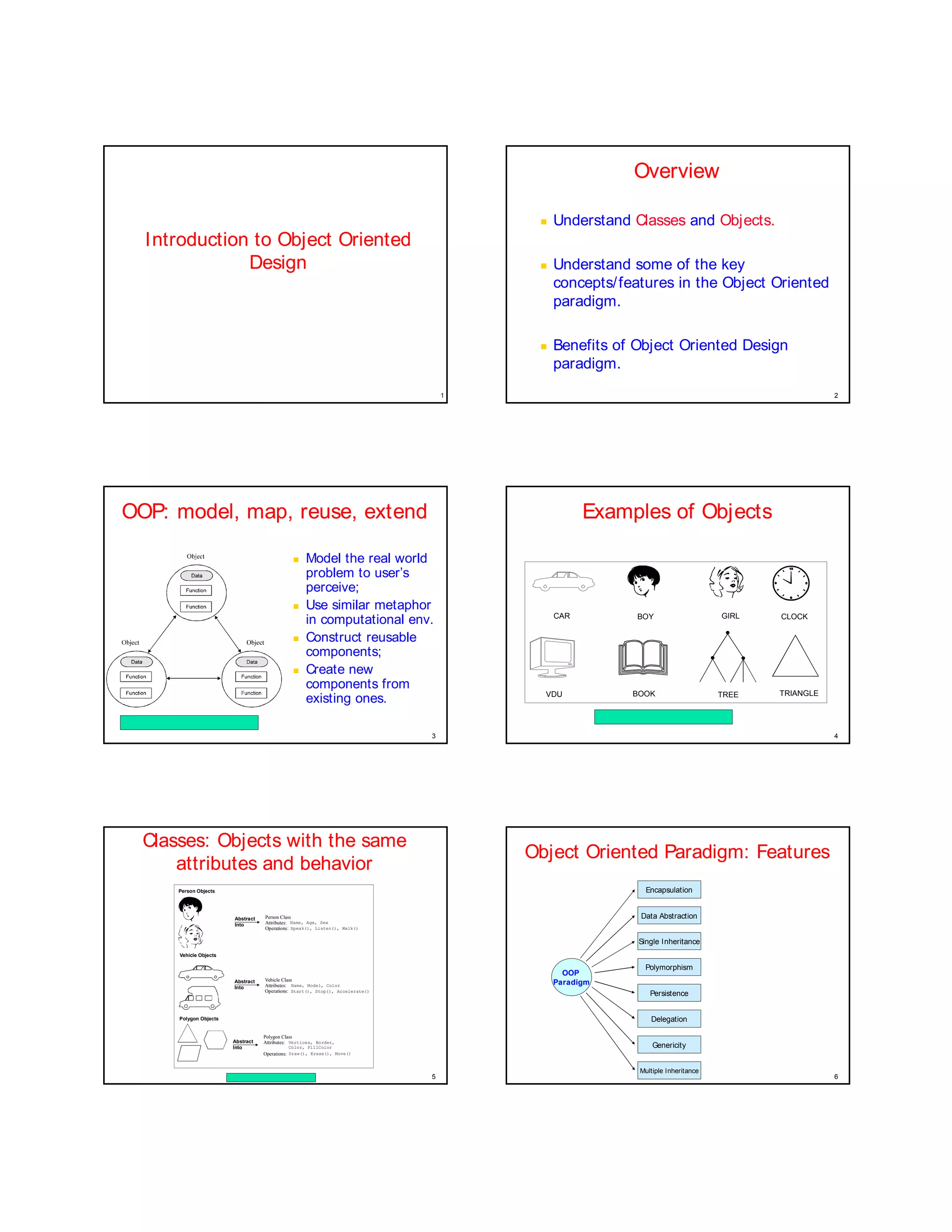
                                                                                               CAR                BOY                     GIRL   CLOCK
                                                     in computational env.
                                                ¡


                                                     Construct reusable
                                                     components;
                                                ¡


                                                     Create new
                                                     components from
                                                                                              VDU                BOOK                     TREE   TRIANGLE
                                                     existing ones.
                                                                                                          Figure 1.9: Examples of objects

                                                                                 3                                                                          4


  Classes: Objects with the same
                                                                                         Object Oriented Paradigm: Features
      attributes and behavior
      Person Objects                                                                                                 Encapsulation


                         Abstract    Person Class                                                                  Data Abstraction
                         Into        Attributes: Name, Age, Sex
                                     Operations: Speak(), Listen(), Walk()

                                                                                                                   Single Inheritance
      Vehicle Objects

                                                                                                                    Polymorphism
                                                                                                 OOP
                                     Vehicle Class
                         Abstract
                                     Attributes: Name, Model, Color                            Paradigm
                         Into
                                     Operations: Start(), Stop(), Accelerate()
                                                                                                                      Persistence


      Polygon Objects                                                                                                 Delegation

                                    Polygon Class
                        Abstract    Attributes: Vertices, Border,
                        Into                  Color, FillColor                                                         Genericity
                                    Operations: Draw(), Erase(), Move()


                                                                                                                   Multiple Inheritance
                        Figure 1.12: Objects and classes                         5                                                                          6
Java’s OO Features                                                                                 Encapsulation
                             Encapsulation                                                                      Encapsulation
                                                                                                                                    ¡


                                                                                                                                        It associates the code
                            Data Abstraction                                                                Data Abstraction            and the data it
                                                                                                                                        manipulates into a
                           Single Inheritance                                                               Single Inheritance
                                                                                                                                        single unit; and
        OOP
                             Polymorphism
                                                                                  OOP
                                                                                                                Polymorphism            keeps them safe from
                                                              Java
      Paradigm                                                                  Paradigm                                                external interference
                               Persistence                                                                       Persistence
                                                                                                                                        and misuse.
                               Delegation                                                                        Delegation


                               Genericity                                                                        Genericity                     Data

                                                                                                                                              Functions
                           Multiple Inheritance                                                             Multiple Inheritance
                                                                            7                                                                                    8


                 Data Abstraction                                                            Abstract Data Type (ADT)
                   Encapsulation
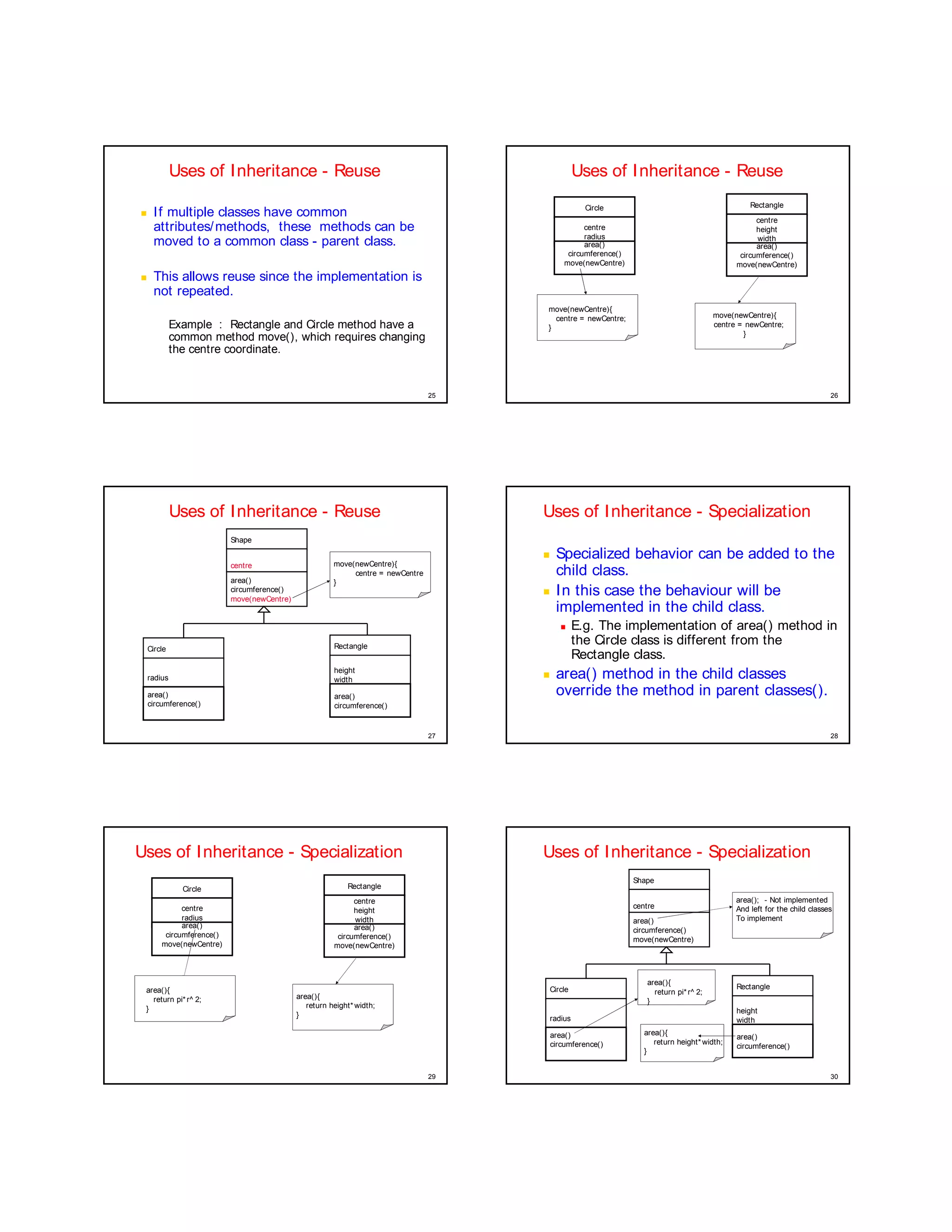
                                                  The technique of
                                                                                            A structure that contains both data
                                              ¢


                                                                                       £


                  Data Abstraction                creating new data types
                                                  that are well suited to an                and the actions to be performed on
                                                  application.
                 Single Inheritance
                                                                                            that data.
                                              ¢


                                                  It allows the creation of
                   Polymorphism
  OOP                                             user defined data types,
Paradigm                                          having the properties of
                    Persistence
                                                  built data types and a set
                                                                                       £


                                                                                            Class is an implementation of an
                                                  of permitted operators.                   Abstract Data Type.
                    Delegation
                                              ¢


                                                  In Java, partial support.
                     Genericity               ¢


                                                  In C+ + , fully supported
                                                  (e.g., operator
                 Multiple Inheritance             overloading).             9                                                                                    10


                 Class- Example                                                                                            Class

class Account {                                                                    ¤


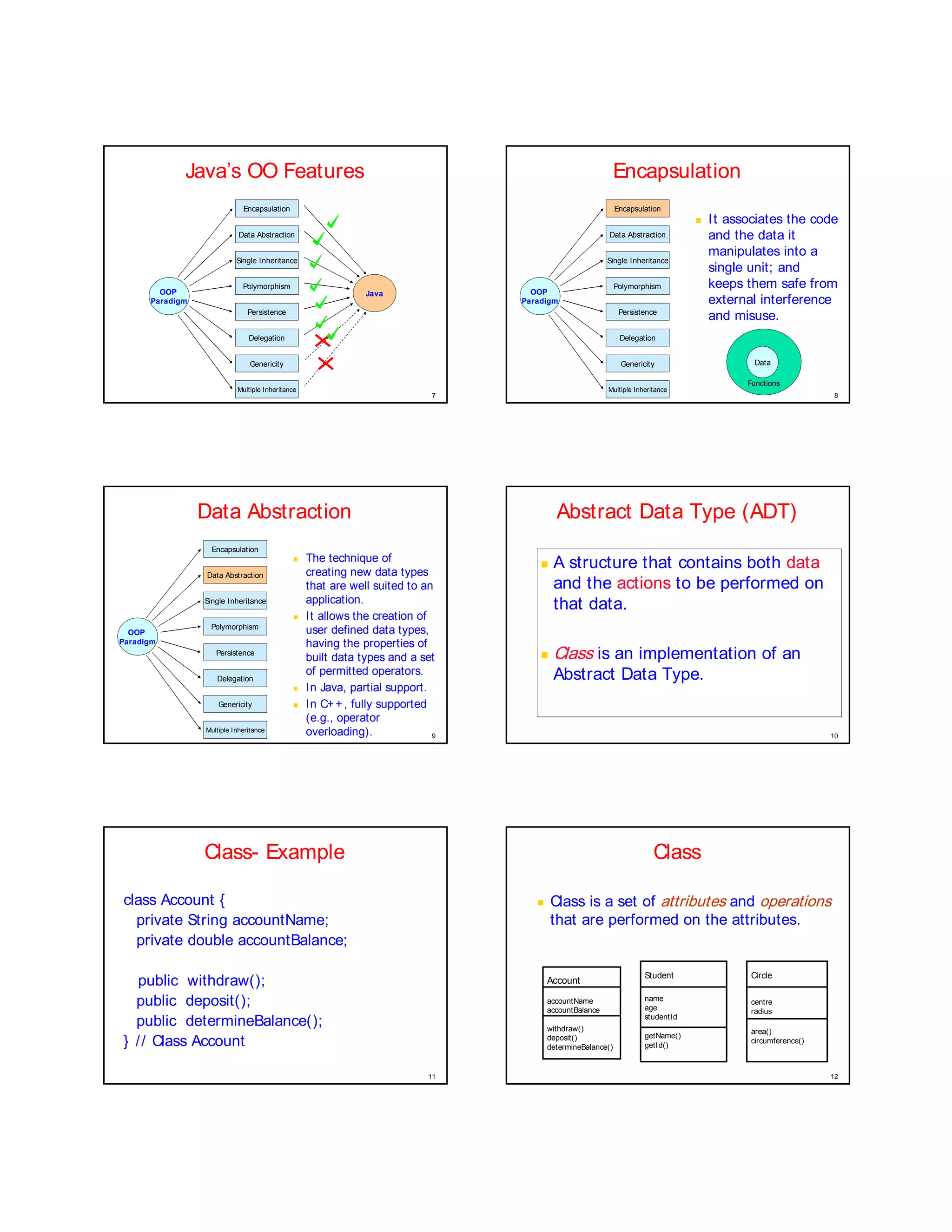
                                                                                           Class is a set of attributes and operations
  private String accountName;                                                              that are performed on the attributes.
  private double accountBalance;

                                                                                                                        Student                Circle
   public withdraw();                                                                      Account

  public deposit();                                                                        accountName
                                                                                           accountBalance
                                                                                                                        name
                                                                                                                        age
                                                                                                                                               centre
                                                                                                                                               radius
                                                                                                                        studentId
  public determineBalance();                                                               withdraw()                                          area()
                                                                                           deposit()                    getName()
} / / Class Account                                                                        determineBalance()           getId()
                                                                                                                                               circumference()


                                                                           11                                                                                    12
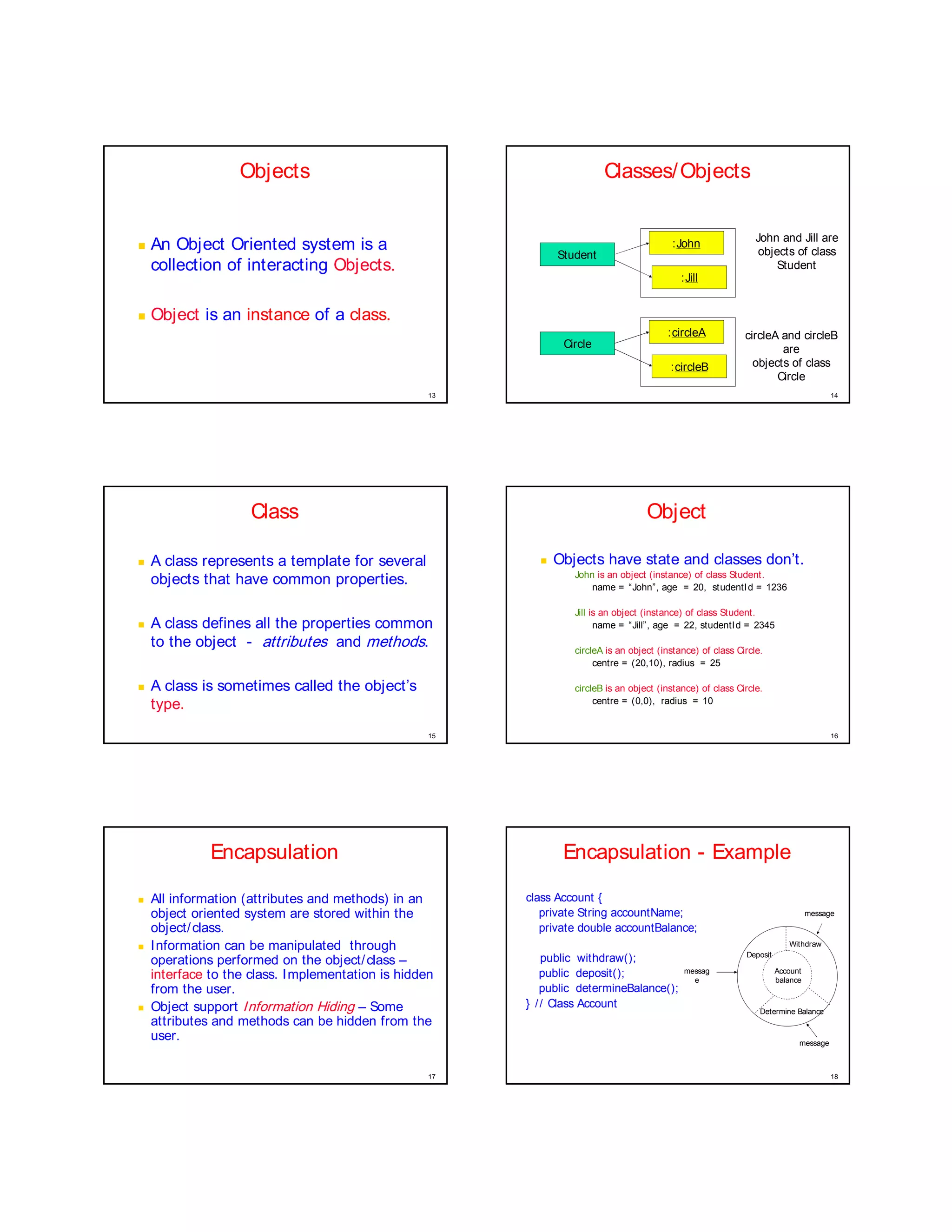
Objects                                              Classes/ Objects


                                                                                                               John and Jill are
£


    An Object Oriented system is a                                                       :John
                                                                                                               objects of class
                                                              Student
    collection of interacting Objects.                                                                             Student
                                                                                            :Jill

£


    Object is an instance of a class.
                                                                                        :circleA            circleA and circleB
                                                               Circle                                               are
                                                                                         :circleB             objects of class
                                                                                                                   Circle
                                                   13                                                                                 14


                    Class                                                          Object
¤


    A class represents a template for several             ¤


                                                              Objects have state and classes don’t.
                                                                 John is an object (instance) of class Student.
    objects that have common properties.                             name = “John”, age = 20, studentI d = 1236

                                                                 Jill is an object (instance) of class Student.
¤


    A class defines all the properties common                          name = “Jill”, age = 22, studentId = 2345
    to the object - attributes and methods.                      circleA is an object (instance) of class Circle.
                                                                      centre = (20,10), radius = 25
¤


    A class is sometimes called the object’s                     circleB is an object (instance) of class Circle.
                                                                      centre = (0,0), radius = 10
    type.
                                                   15                                                                                 16


              Encapsulation                                    Encapsulation - Example
¥


    All information (attributes and methods) in an      class Account {
    object oriented system are stored within the           private String accountName;                                          message

    object/ class.                                         private double accountBalance;
¥


    Information can be manipulated through                                                                               Withdraw
                                                                                                            Deposit
    operations performed on the object/ class –             public withdraw();
                                                           public deposit();                messag                    Account
    interface to the class. Implementation is hidden                                          e                       balance
    from the user.                                         public determineBalance();
¥


    Object support Information Hiding – Some            } / / Class Account
                                                                                                                Determine Balance
    attributes and methods can be hidden from the
    user.                                                                                                                   message


                                                   17                                                                                 18
Data Abstraction                                       Abstraction - Example
¤


        The technique of creating new data types         class Account {
        that are well suited to an application.             private String accountName;
                                                                                                                    Creates a data
                                                            private double accountBalance;
                                                                                                                    type Account
                                                            public withdraw();
¤


        I t allows the creation of user defined data         public deposit();                                     Account acctX;
        types, having the properties of built in             public determineBalance();
                                                         } // Class Account
        data types and more.


                                                    19                                                                                  20


                      Inheritance                                     Inheritance - Example
    ¤


        New data types (classes) can be defined
                                                             ¥


                                                                 Example
                                                                 ¦


                                                                      Define Person to be a class
        as extensions to previously defined types.                     §


                                                                           A Person has attributes, such as age, height, gender
                                                                           Assign values to attributes when describing object
        Parent Class (Super Class) – Child Class
                                                                       §


    ¤


        (Sub Class)                                              ¦


                                                                      Define student to be a subclass of Person
                                     Parent
                                                                       §


                                                                           A student has all attributes of Person, plus attributes of
    ¤


        Subclass inherits                                                  his/her own ( student no, course_enrolled)
                                                                           A student has all attributes of Person, plus attributes of
        properties from the
                                                                       §


                                            Inherited                      his/her own (student no, course_enrolled)
                                            capability                     A student inherits all attributes of Person
        parent class.
                                                                       §


                                                                 ¦


                                                                      Define lecturer to be a subclass of Person
                                                                       §


                                                                           Lecturer has all attributes of Person, plus attributes of
                                        Child                              his/her own ( staff_id, subjectI D1, subjectID2)


                                                    21                                                                                  22


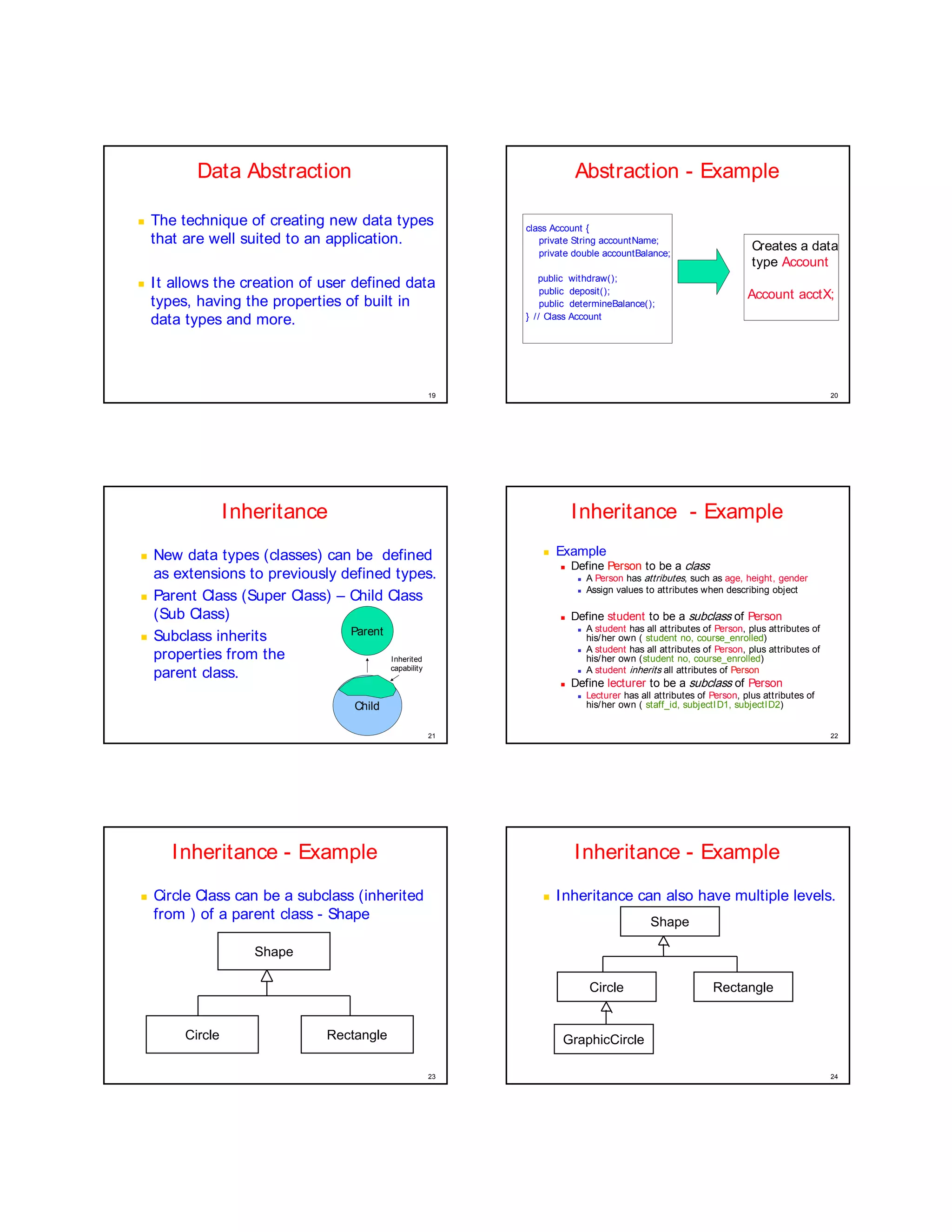
           Inheritance - Example                                      Inheritance - Example
    ¤


        Circle Class can be a subclass (inherited            ¤


                                                                 I nheritance can also have multiple levels.
        from ) of a parent class - Shape                                                   Shape

                         Shape

                                                                           Circle                         Rectangle


             Circle                 Rectangle                        GraphicCircle

                                                    23                                                                                  24
Uses of I nheritance - Reuse                                                            Uses of I nheritance - Reuse
                                                                                                        Circle                                          Rectangle
¥


      If multiple classes have common                                                                                                                     centre
      attributes/ methods, these methods can be                                                          centre                                           height
                                                                                                         radius                                           width
      moved to a common class - parent class.                                                            area()                                           area()
                                                                                                    circumference()                                  circumference()
                                                                                                   move(newCentre)                                  move(newCentre)
¥


      This allows reuse since the implementation is
      not repeated.
                                                                                            move(newCentre){
                                                                                              centre = newCentre;                             move(newCentre){
             Example : Rectangle and Circle method have a                                   }                                                 centre = newCentre;
                                                                                                                                                      }
             common method move(), which requires changing
             the centre coordinate.


                                                                                   25                                                                                            26


             Uses of I nheritance - Reuse                                               Uses of I nheritance - Specialization
                            Shape
                                                                                        ¤


                                                                                             Specialized behavior can be added to the
                            centre                       move(newCentre){
                                                              centre = newCentre             child class.
                            area()                       }
                            circumference()
                            move(newCentre)
                                                                                        ¤


                                                                                             I n this case the behaviour will be
                                                                                             implemented in the child class.
                                                                                               ¨


                                                                                                     E.g. The implementation of area() method in
                                                         Rectangle
                                                                                                     the Circle class is different from the
    Circle
                                                                                                     Rectangle class.
                                                         height
    radius                                               width
                                                                                        ¤


                                                                                             area() method in the child classes
    area()                                               area()                              override the method in parent classes().
    circumference()                                      circumference()


                                                                                   27                                                                                            28


Uses of I nheritance - Specialization                                                   Uses of I nheritance - Specialization
                                                                                                                      Shape
               Circle                                        Rectangle
                                                               centre                                                                               area(); - Not implemented
               centre                                                                                                 centre                        And left for the child classes
                                                               height
               radius                                          width                                                  area()                        To implement
               area()                                          area()                                                 circumference()
          circumference()                                 circumference()                                             move(newCentre)
         move(newCentre)                                 move(newCentre)


                                                                                                                         area(){
    area(){                                                                                 Circle                                                  Rectangle
                                                                                                                           return pi* r^ 2;
      return pi* r^ 2;                        area(){
                                                                                                                         }
    }                                            return height* width;
                                                                                                                                                    height
                                              }                                             radius                                                  width
                                                                                            area()                       area(){
                                                                                                                                                    area()
                                                                                            circumference()                 return height* width;
                                                                                                                                                    circumference()
                                                                                                                         }


                                                                                   29                                                                                            30
Uses of I nheritance – Common Interface                                            Uses of I nheritance - Extension
  ¥


       All the operations that are supported for                            ¤


                                                                                  Extend functionality of a class.
       Rectangle and Circle are the same.
  ¥


       Some methods have common implementation
                                                                            ¤


                                                                                  Child class adds new operations to the
       and others don’t.                                                          parent class but does not change the
         ¦


               move() operation is common to classes and can be
               implemented in parent.                                             inherited behavior.
         ¦


               circumference(), area() operations are significantly
               different and have to be implemented in the
               respective classes.                                                  ¨


                                                                                        E.g. Rectangle class might have a special
  ¥


       The Shape class provides a common interface                                      operation that may not be meaningful to the
       where all 3 operations move(), circumference()                                   Circle class - rotate90degrees()
       and area().

                                                                    31                                                                         32


        Uses of I nheritance - Extension                                 Uses of I nheritance – Multiple I nheritance
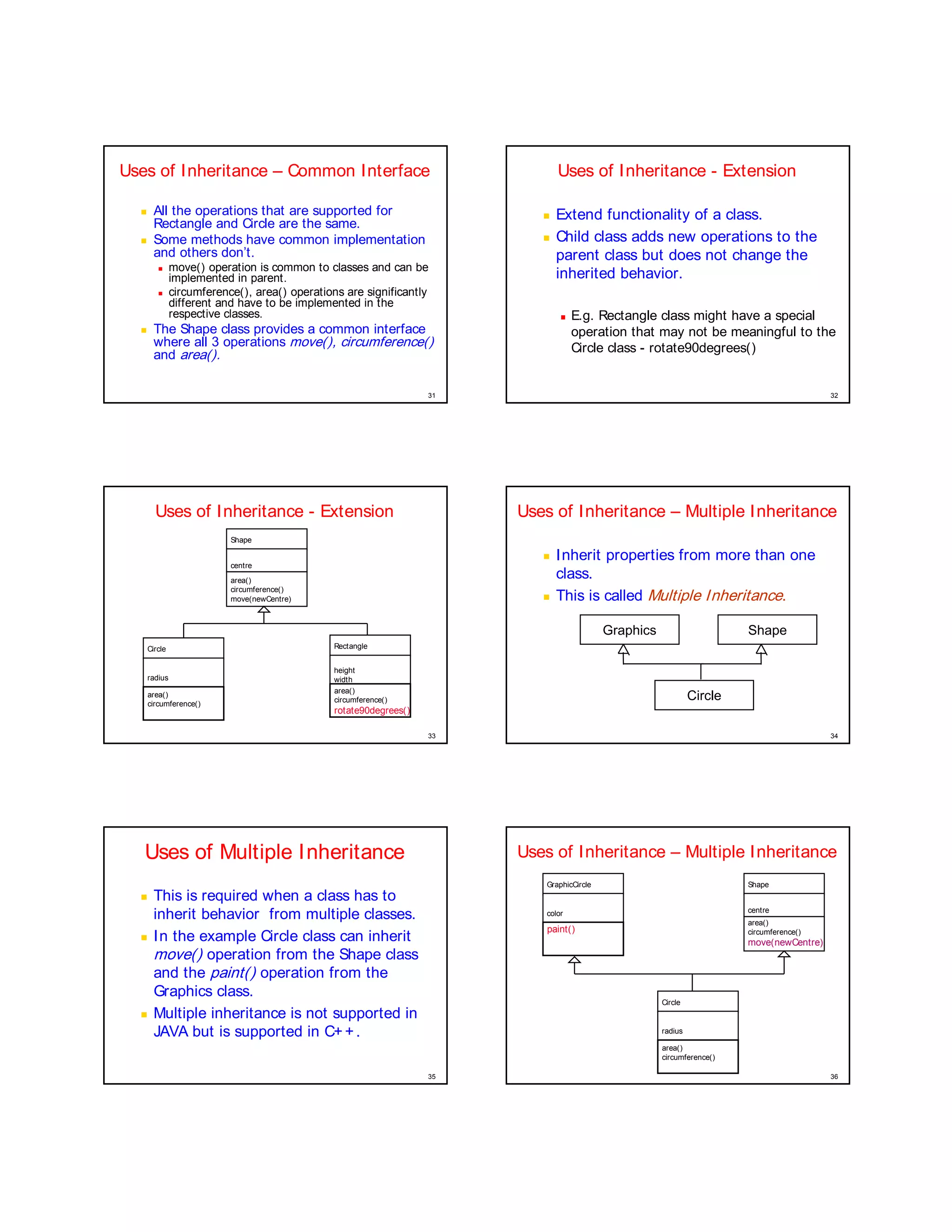
                           Shape
                                                                            ¤


                                                                                  I nherit properties from more than one
                           centre
                           area()
                                                                                  class.
                           circumference()
                           move(newCentre)
                                                                            ¤


                                                                                  This is called Multiple Inheritance.

                                                                                                Graphics                     Shape
      Circle                                    Rectangle


                                                height
      radius                                    width
                                                area()
      area()
      circumference()
                                                circumference()                                                     Circle
                                                rotate90degrees()

                                                                    33                                                                         34


      Uses of Multiple Inheritance                                       Uses of I nheritance – Multiple I nheritance
                                                                                GraphicCircle                                Shape
  ¤


       This is required when a class has to
                                                                                                                             centre
       inherit behavior from multiple classes.                                  color
                                                                                                                             area()
                                                                                paint()                                      circumference()
  ¤


       I n the example Circle class can inherit                                                                              move(newCentre)
       move() operation from the Shape class
       and the paint() operation from the
       Graphics class.
                                                                                                           Circle
  ¤


       Multiple inheritance is not supported in
       JAVA but is supported in C+ + .                                                                     radius

                                                                                                           area()
                                                                                                           circumference()

                                                                    35                                                                         36
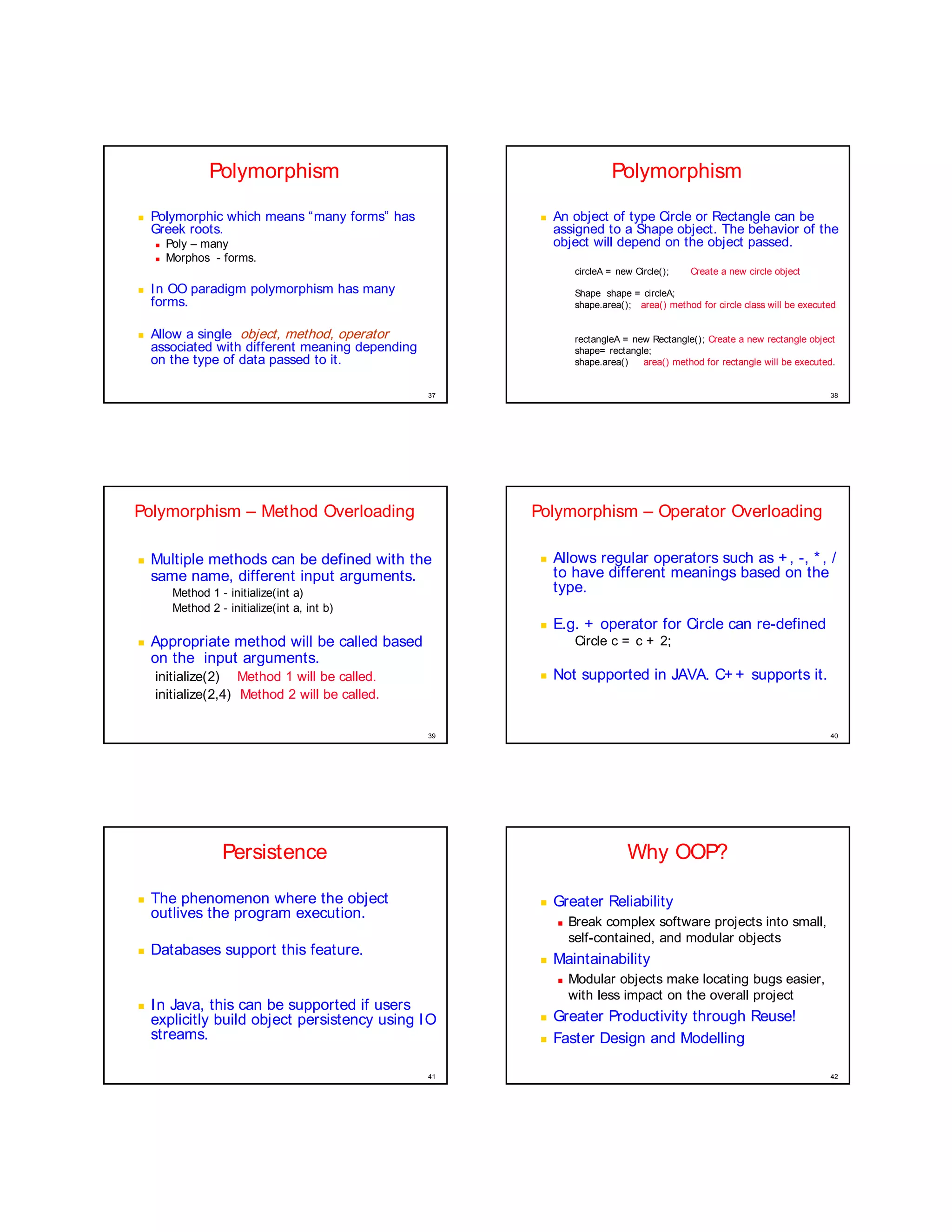
Polymorphism                                            Polymorphism
¥


    Polymorphic which means “many forms” has            ¥


                                                            An object of type Circle or Rectangle can be
    Greek roots.                                            assigned to a Shape object. The behavior of the
    ¦


        Poly – many                                         object will depend on the object passed.
    ¦


        Morphos - forms.
                                                                 circleA = new Circle();    Create a new circle object
¥


    In OO paradigm polymorphism has many                         Shape shape = circleA;
    forms.                                                       shape.area(); area() method for circle class will be executed

¥


    Allow a single object, method, operator                      rectangleA = new Rectangle(); Create a new rectangle object
    associated with different meaning depending                  shape= rectangle;
    on the type of data passed to it.                            shape.area()   area() method for rectangle will be executed.


                                                  37                                                                        38


Polymorphism – Method Overloading                      Polymorphism – Operator Overloading

¤


    Multiple methods can be defined with the            ¤


                                                            Allows regular operators such as + , -, * , /
    same name, different input arguments.                   to have different meanings based on the
         Method 1 - initialize(int a)                       type.
         Method 2 - initialize(int a, int b)
                                                        ¤


                                                            E.g. + operator for Circle can re-defined
¤


    Appropriate method will be called based                      Circle c = c + 2;
    on the input arguments.
    initialize(2) Method 1 will be called.
                                                        ¤


                                                            Not supported in JAVA. C+ + supports it.
    initialize(2,4) Method 2 will be called.

                                                  39                                                                        40


                   Persistence                                               Why OOP?
¤


    The phenomenon where the object                     ¤


                                                            Greater Reliability
    outlives the program execution.                         ¨


                                                                Break complex software projects into small,
                                                                self-contained, and modular objects
¤


    Databases support this feature.                     ¤


                                                            Maintainability
                                                            ¨


                                                                Modular objects make locating bugs easier,
                                                                with less impact on the overall project
¤


    I n Java, this can be supported if users
    explicitly build object persistency using I O
                                                        ¤


                                                            Greater Productivity through Reuse!
    streams.                                            ¤


                                                            Faster Design and Modelling

                                                  41                                                                        42
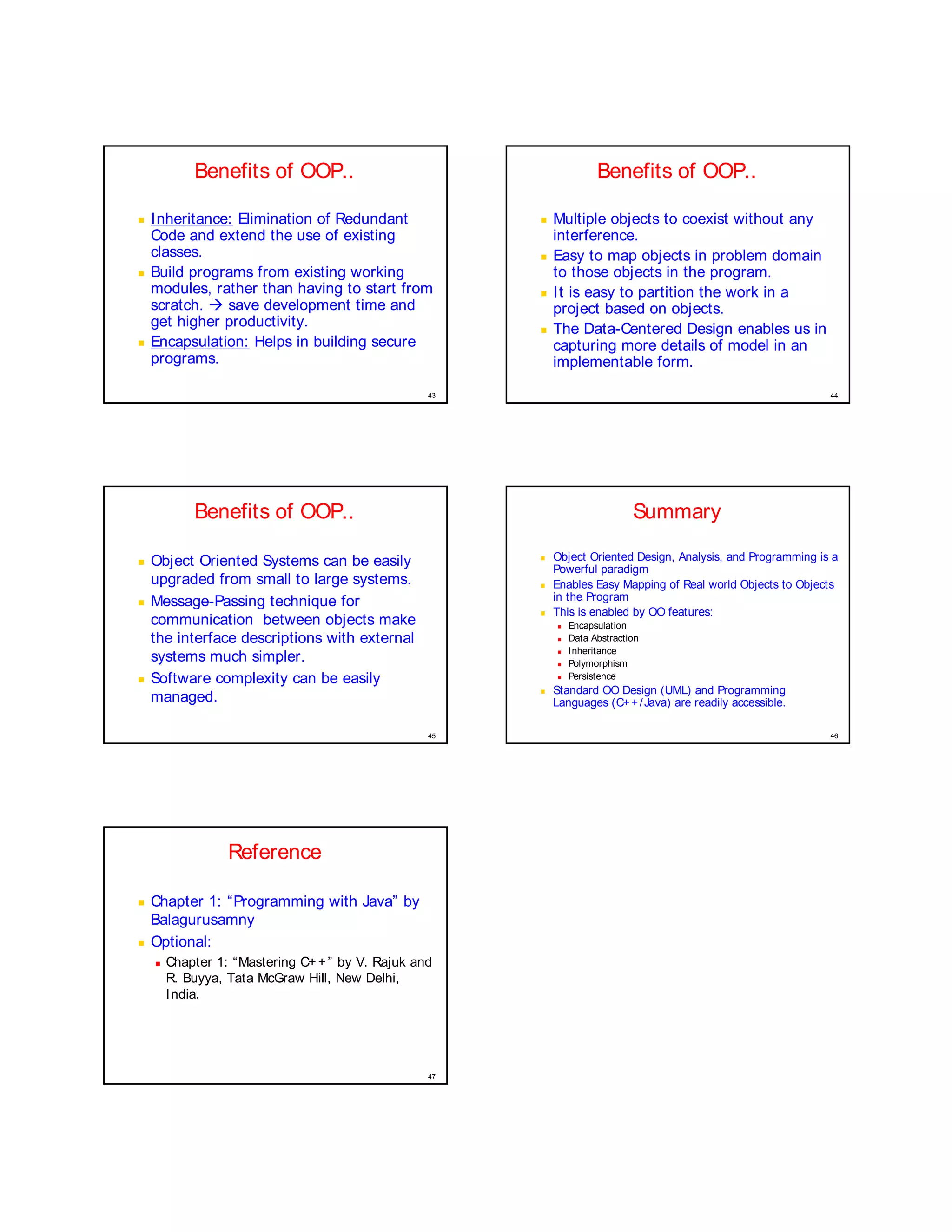
Benefits of OOP..                                             Benefits of OOP..
¤


    I nheritance: Elimination of Redundant                  ¤


                                                                Multiple objects to coexist without any
    Code and extend the use of existing                         interference.
    classes.                                                ¤


                                                                Easy to map objects in problem domain
¤


    Build programs from existing working                        to those objects in the program.
    modules, rather than having to start from               ¤


                                                                I t is easy to partition the work in a
    scratch. Æ save development time and                        project based on objects.
    get higher productivity.                                ¤


                                                                The Data-Centered Design enables us in
¤


    Encapsulation: Helps in building secure                     capturing more details of model in an
    programs.                                                   implementable form.

                                                   43                                                               44


            Benefits of OOP..                                                     Summary
¤


    Object Oriented Systems can be easily
                                                        ©


                                                                Object Oriented Design, Analysis, and Programming is a
                                                                Powerful paradigm
    upgraded from small to large systems.               ©


                                                                Enables Easy Mapping of Real world Objects to Objects
¤


    Message-Passing technique for                               in the Program
                                                        ©


                                                                This is enabled by OO features:
    communication between objects make                          


                                                                    Encapsulation
    the interface descriptions with external                    


                                                                    Data Abstraction
                                                                    Inheritance
    systems much simpler.


                                                                    Polymorphism
¤


    Software complexity can be easily                           


                                                                    Persistence
                                                        ©


                                                                Standard OO Design (UML) and Programming
    managed.                                                    Languages (C+ + / Java) are readily accessible.

                                                   45                                                               46


                  Reference
¤


    Chapter 1: “Programming with Java” by
    Balagurusamny
¤


    Optional:
    ¨


        Chapter 1: “Mastering C+ + ” by V. Rajuk and
        R. Buyya, Tata McGraw Hill, New Delhi,
        India.


                                                   47

Oop

  • 1.
    Overview   Understand Classes and Objects. Introduction to Object Oriented Design   Understand some of the key concepts/ features in the Object Oriented paradigm.   Benefits of Object Oriented Design paradigm. 1 2 OOP: model, map, reuse, extend Examples of Objects ¡ Model the real world problem to user’s perceive; ¡ Use similar metaphor CAR BOY GIRL CLOCK in computational env. ¡ Construct reusable components; ¡ Create new components from VDU BOOK TREE TRIANGLE existing ones. Figure 1.9: Examples of objects 3 4 Classes: Objects with the same Object Oriented Paradigm: Features attributes and behavior Person Objects Encapsulation Abstract Person Class Data Abstraction Into Attributes: Name, Age, Sex Operations: Speak(), Listen(), Walk() Single Inheritance Vehicle Objects Polymorphism OOP Vehicle Class Abstract Attributes: Name, Model, Color Paradigm Into Operations: Start(), Stop(), Accelerate() Persistence Polygon Objects Delegation Polygon Class Abstract Attributes: Vertices, Border, Into Color, FillColor Genericity Operations: Draw(), Erase(), Move() Multiple Inheritance Figure 1.12: Objects and classes 5 6
  • 2.
    Java’s OO Features Encapsulation Encapsulation Encapsulation ¡ It associates the code Data Abstraction Data Abstraction and the data it manipulates into a Single Inheritance Single Inheritance single unit; and OOP Polymorphism OOP Polymorphism keeps them safe from Java Paradigm Paradigm external interference Persistence Persistence and misuse. Delegation Delegation Genericity Genericity Data Functions Multiple Inheritance Multiple Inheritance 7 8 Data Abstraction Abstract Data Type (ADT) Encapsulation The technique of A structure that contains both data ¢ £ Data Abstraction creating new data types that are well suited to an and the actions to be performed on application. Single Inheritance that data. ¢ It allows the creation of Polymorphism OOP user defined data types, Paradigm having the properties of Persistence built data types and a set £ Class is an implementation of an of permitted operators. Abstract Data Type. Delegation ¢ In Java, partial support. Genericity ¢ In C+ + , fully supported (e.g., operator Multiple Inheritance overloading). 9 10 Class- Example Class class Account { ¤ Class is a set of attributes and operations private String accountName; that are performed on the attributes. private double accountBalance; Student Circle public withdraw(); Account public deposit(); accountName accountBalance name age centre radius studentId public determineBalance(); withdraw() area() deposit() getName() } / / Class Account determineBalance() getId() circumference() 11 12
  • 3.
    Objects Classes/ Objects John and Jill are £ An Object Oriented system is a :John objects of class Student collection of interacting Objects. Student :Jill £ Object is an instance of a class. :circleA circleA and circleB Circle are :circleB objects of class Circle 13 14 Class Object ¤ A class represents a template for several ¤ Objects have state and classes don’t. John is an object (instance) of class Student. objects that have common properties. name = “John”, age = 20, studentI d = 1236 Jill is an object (instance) of class Student. ¤ A class defines all the properties common name = “Jill”, age = 22, studentId = 2345 to the object - attributes and methods. circleA is an object (instance) of class Circle. centre = (20,10), radius = 25 ¤ A class is sometimes called the object’s circleB is an object (instance) of class Circle. centre = (0,0), radius = 10 type. 15 16 Encapsulation Encapsulation - Example ¥ All information (attributes and methods) in an class Account { object oriented system are stored within the private String accountName; message object/ class. private double accountBalance; ¥ Information can be manipulated through Withdraw Deposit operations performed on the object/ class – public withdraw(); public deposit(); messag Account interface to the class. Implementation is hidden e balance from the user. public determineBalance(); ¥ Object support Information Hiding – Some } / / Class Account Determine Balance attributes and methods can be hidden from the user. message 17 18
  • 4.
    Data Abstraction Abstraction - Example ¤ The technique of creating new data types class Account { that are well suited to an application. private String accountName; Creates a data private double accountBalance; type Account public withdraw(); ¤ I t allows the creation of user defined data public deposit(); Account acctX; types, having the properties of built in public determineBalance(); } // Class Account data types and more. 19 20 Inheritance Inheritance - Example ¤ New data types (classes) can be defined ¥ Example ¦ Define Person to be a class as extensions to previously defined types. § A Person has attributes, such as age, height, gender Assign values to attributes when describing object Parent Class (Super Class) – Child Class § ¤ (Sub Class) ¦ Define student to be a subclass of Person Parent § A student has all attributes of Person, plus attributes of ¤ Subclass inherits his/her own ( student no, course_enrolled) A student has all attributes of Person, plus attributes of properties from the § Inherited his/her own (student no, course_enrolled) capability A student inherits all attributes of Person parent class. § ¦ Define lecturer to be a subclass of Person § Lecturer has all attributes of Person, plus attributes of Child his/her own ( staff_id, subjectI D1, subjectID2) 21 22 Inheritance - Example Inheritance - Example ¤ Circle Class can be a subclass (inherited ¤ I nheritance can also have multiple levels. from ) of a parent class - Shape Shape Shape Circle Rectangle Circle Rectangle GraphicCircle 23 24
  • 5.
    Uses of Inheritance - Reuse Uses of I nheritance - Reuse Circle Rectangle ¥ If multiple classes have common centre attributes/ methods, these methods can be centre height radius width moved to a common class - parent class. area() area() circumference() circumference() move(newCentre) move(newCentre) ¥ This allows reuse since the implementation is not repeated. move(newCentre){ centre = newCentre; move(newCentre){ Example : Rectangle and Circle method have a } centre = newCentre; } common method move(), which requires changing the centre coordinate. 25 26 Uses of I nheritance - Reuse Uses of I nheritance - Specialization Shape ¤ Specialized behavior can be added to the centre move(newCentre){ centre = newCentre child class. area() } circumference() move(newCentre) ¤ I n this case the behaviour will be implemented in the child class. ¨ E.g. The implementation of area() method in Rectangle the Circle class is different from the Circle Rectangle class. height radius width ¤ area() method in the child classes area() area() override the method in parent classes(). circumference() circumference() 27 28 Uses of I nheritance - Specialization Uses of I nheritance - Specialization Shape Circle Rectangle centre area(); - Not implemented centre centre And left for the child classes height radius width area() To implement area() area() circumference() circumference() circumference() move(newCentre) move(newCentre) move(newCentre) area(){ area(){ Circle Rectangle return pi* r^ 2; return pi* r^ 2; area(){ } } return height* width; height } radius width area() area(){ area() circumference() return height* width; circumference() } 29 30
  • 6.
    Uses of Inheritance – Common Interface Uses of I nheritance - Extension ¥ All the operations that are supported for ¤ Extend functionality of a class. Rectangle and Circle are the same. ¥ Some methods have common implementation ¤ Child class adds new operations to the and others don’t. parent class but does not change the ¦ move() operation is common to classes and can be implemented in parent. inherited behavior. ¦ circumference(), area() operations are significantly different and have to be implemented in the respective classes. ¨ E.g. Rectangle class might have a special ¥ The Shape class provides a common interface operation that may not be meaningful to the where all 3 operations move(), circumference() Circle class - rotate90degrees() and area(). 31 32 Uses of I nheritance - Extension Uses of I nheritance – Multiple I nheritance Shape ¤ I nherit properties from more than one centre area() class. circumference() move(newCentre) ¤ This is called Multiple Inheritance. Graphics Shape Circle Rectangle height radius width area() area() circumference() circumference() Circle rotate90degrees() 33 34 Uses of Multiple Inheritance Uses of I nheritance – Multiple I nheritance GraphicCircle Shape ¤ This is required when a class has to centre inherit behavior from multiple classes. color area() paint() circumference() ¤ I n the example Circle class can inherit move(newCentre) move() operation from the Shape class and the paint() operation from the Graphics class. Circle ¤ Multiple inheritance is not supported in JAVA but is supported in C+ + . radius area() circumference() 35 36
  • 7.
    Polymorphism Polymorphism ¥ Polymorphic which means “many forms” has ¥ An object of type Circle or Rectangle can be Greek roots. assigned to a Shape object. The behavior of the ¦ Poly – many object will depend on the object passed. ¦ Morphos - forms. circleA = new Circle(); Create a new circle object ¥ In OO paradigm polymorphism has many Shape shape = circleA; forms. shape.area(); area() method for circle class will be executed ¥ Allow a single object, method, operator rectangleA = new Rectangle(); Create a new rectangle object associated with different meaning depending shape= rectangle; on the type of data passed to it. shape.area() area() method for rectangle will be executed. 37 38 Polymorphism – Method Overloading Polymorphism – Operator Overloading ¤ Multiple methods can be defined with the ¤ Allows regular operators such as + , -, * , / same name, different input arguments. to have different meanings based on the Method 1 - initialize(int a) type. Method 2 - initialize(int a, int b) ¤ E.g. + operator for Circle can re-defined ¤ Appropriate method will be called based Circle c = c + 2; on the input arguments. initialize(2) Method 1 will be called. ¤ Not supported in JAVA. C+ + supports it. initialize(2,4) Method 2 will be called. 39 40 Persistence Why OOP? ¤ The phenomenon where the object ¤ Greater Reliability outlives the program execution. ¨ Break complex software projects into small, self-contained, and modular objects ¤ Databases support this feature. ¤ Maintainability ¨ Modular objects make locating bugs easier, with less impact on the overall project ¤ I n Java, this can be supported if users explicitly build object persistency using I O ¤ Greater Productivity through Reuse! streams. ¤ Faster Design and Modelling 41 42
  • 8.
    Benefits of OOP.. Benefits of OOP.. ¤ I nheritance: Elimination of Redundant ¤ Multiple objects to coexist without any Code and extend the use of existing interference. classes. ¤ Easy to map objects in problem domain ¤ Build programs from existing working to those objects in the program. modules, rather than having to start from ¤ I t is easy to partition the work in a scratch. Æ save development time and project based on objects. get higher productivity. ¤ The Data-Centered Design enables us in ¤ Encapsulation: Helps in building secure capturing more details of model in an programs. implementable form. 43 44 Benefits of OOP.. Summary ¤ Object Oriented Systems can be easily © Object Oriented Design, Analysis, and Programming is a Powerful paradigm upgraded from small to large systems. © Enables Easy Mapping of Real world Objects to Objects ¤ Message-Passing technique for in the Program © This is enabled by OO features: communication between objects make Encapsulation the interface descriptions with external Data Abstraction Inheritance systems much simpler. Polymorphism ¤ Software complexity can be easily Persistence © Standard OO Design (UML) and Programming managed. Languages (C+ + / Java) are readily accessible. 45 46 Reference ¤ Chapter 1: “Programming with Java” by Balagurusamny ¤ Optional: ¨ Chapter 1: “Mastering C+ + ” by V. Rajuk and R. Buyya, Tata McGraw Hill, New Delhi, India. 47