OBJECT ORIENTED
DATABASE AND OBJECT
RELATIONAL MODEL
Represented by : -
213051 : umm e Ammara
213010 : ariba arif
213190 : mehmood Nadeem khan
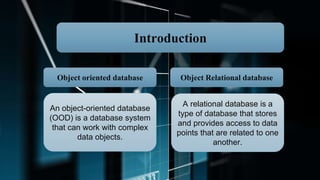
Introduction
Object oriented database Object Relational database
An object-oriented database
(OOD) is a database system
that can work with complex
data objects.
A relational database is a
type of database that stores
and provides access to data
points that are related to one
another.
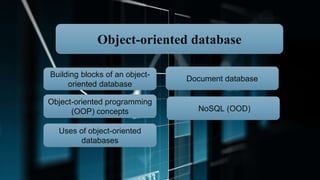
Object-oriented database
Building blocks of an object-
oriented database
Object-oriented programming
(OOP) concepts
Uses of object-oriented
databases
Document database
NoSQL (OOD)
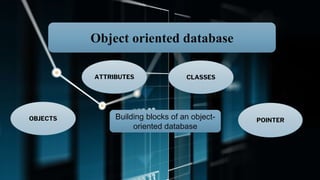
Object oriented database
Building blocks of an object-
oriented database
ATTRIBUTES CLASSES
OBJECTS POINTER
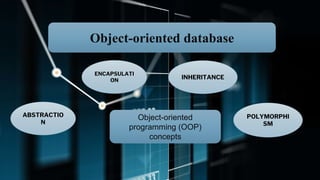
Object-oriented database
Object-oriented
programming (OOP)
concepts
ENCAPSULATI
ON
INHERITANCE
ABSTRACTIO
N
POLYMORPHI
SM
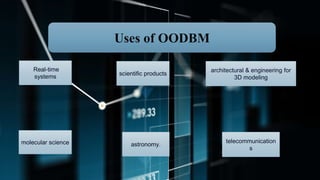
Uses of OODBM
Real-time
systems
architectural & engineering for
3D modeling
telecommunication
s
molecular science astronomy.
scientific products
Document database and NoSQL
DOCUMENT
DATABASE
It is a type of
nonrelational database
that is designed to store
and query data as
JSON-like documents
NO SQL
NoSQL databases are non-tabular
databases and store data
differently than relational tables.
NoSQL databases come in a
variety of types based on their
data model.
Key-value
databases
Wide-column
stores
Graph database
TYPES of NoSQL
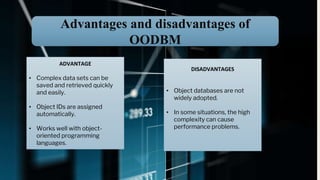
Advantages and disadvantages of
OODBM
DISADVANTAGES
• Object databases are not
widely adopted.
• In some situations, the high
complexity can cause
performance problems.
ADVANTAGE
• Complex data sets can be
saved and retrieved quickly
and easily.
• Object IDs are assigned
automatically.
• Works well with object-
oriented programming
languages.
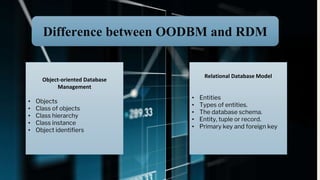
Difference between OODBM and RDM
Relational Database Model
• Entities
• Types of entities.
• The database schema.
• Entity, tuple or record.
• Primary key and foreign key
Object-oriented Database
Management
• Objects
• Class of objects
• Class hierarchy
• Class instance
• Object identifiers
Why did we need ORDBM method
Both are very useful data models
But they both were lacking in some
characteristics
Start working on a model which will be
the combination of both OODBM and
RDM
Then in 1990 ORDM was created
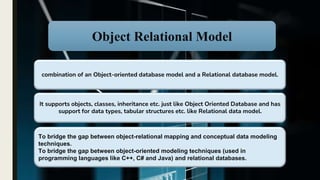
Object Relational Model
combination of an Object-oriented database model and a Relational database model.
It supports objects, classes, inheritance etc. just like Object Oriented Database and has
support for data types, tabular structures etc. like Relational data model.
To bridge the gap between object-relational mapping and conceptual data modeling
techniques.
To bridge the gap between object-oriented modeling techniques (used in
programming languages like C++, C# and Java) and relational databases.
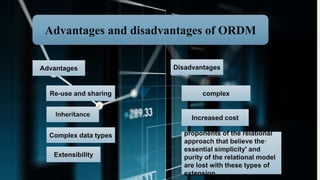
Advantages and disadvantages of ORDM
Advantages
Inheritance
Complex data types
Extensibility
Disadvantages
Re-use and sharing complex
Increased cost
proponents of the relational
approach that believe the·
essential simplicity' and
purity of the relational model
are lost with these types of
extension.
Conclusion
In conclusion, it is important to weigh the benefits and drawbacks of relational and object-
oriented databases before choosing which is most appropriate for a given project.
While object-oriented databases enable developers to express more complex objects and data
interactions, relational databases are highly organized and offer strong searching capabilities.
The application's requirements should ultimately guide the choice; however, other factors like
as cost, scalability, and ease of development will also be taken into consideration.

OODBMSvsORDBMSppt.pptx

  • 1.
    OBJECT ORIENTED DATABASE ANDOBJECT RELATIONAL MODEL Represented by : - 213051 : umm e Ammara 213010 : ariba arif 213190 : mehmood Nadeem khan
  • 2.
    Introduction Object oriented databaseObject Relational database An object-oriented database (OOD) is a database system that can work with complex data objects. A relational database is a type of database that stores and provides access to data points that are related to one another.
  • 3.
    Object-oriented database Building blocksof an object- oriented database Object-oriented programming (OOP) concepts Uses of object-oriented databases Document database NoSQL (OOD)
  • 4.
    Object oriented database Buildingblocks of an object- oriented database ATTRIBUTES CLASSES OBJECTS POINTER
  • 5.
  • 6.
    Uses of OODBM Real-time systems architectural& engineering for 3D modeling telecommunication s molecular science astronomy. scientific products
  • 7.
    Document database andNoSQL DOCUMENT DATABASE It is a type of nonrelational database that is designed to store and query data as JSON-like documents NO SQL NoSQL databases are non-tabular databases and store data differently than relational tables. NoSQL databases come in a variety of types based on their data model. Key-value databases Wide-column stores Graph database TYPES of NoSQL
  • 8.
    Advantages and disadvantagesof OODBM DISADVANTAGES • Object databases are not widely adopted. • In some situations, the high complexity can cause performance problems. ADVANTAGE • Complex data sets can be saved and retrieved quickly and easily. • Object IDs are assigned automatically. • Works well with object- oriented programming languages.
  • 9.
    Difference between OODBMand RDM Relational Database Model • Entities • Types of entities. • The database schema. • Entity, tuple or record. • Primary key and foreign key Object-oriented Database Management • Objects • Class of objects • Class hierarchy • Class instance • Object identifiers
  • 10.
    Why did weneed ORDBM method Both are very useful data models But they both were lacking in some characteristics Start working on a model which will be the combination of both OODBM and RDM Then in 1990 ORDM was created
  • 11.
    Object Relational Model combinationof an Object-oriented database model and a Relational database model. It supports objects, classes, inheritance etc. just like Object Oriented Database and has support for data types, tabular structures etc. like Relational data model. To bridge the gap between object-relational mapping and conceptual data modeling techniques. To bridge the gap between object-oriented modeling techniques (used in programming languages like C++, C# and Java) and relational databases.
  • 12.
    Advantages and disadvantagesof ORDM Advantages Inheritance Complex data types Extensibility Disadvantages Re-use and sharing complex Increased cost proponents of the relational approach that believe the· essential simplicity' and purity of the relational model are lost with these types of extension.
  • 13.
    Conclusion In conclusion, itis important to weigh the benefits and drawbacks of relational and object- oriented databases before choosing which is most appropriate for a given project. While object-oriented databases enable developers to express more complex objects and data interactions, relational databases are highly organized and offer strong searching capabilities. The application's requirements should ultimately guide the choice; however, other factors like as cost, scalability, and ease of development will also be taken into consideration.