Object Oriented Database
Group 4
Mathieu Metz
Palani Kumaresan
Napa Gavinlertvatana
Kristine Pei Keow Lee
Prabhu Ramachandran
Outline
 Object definitions
 Object Structures
 Object-oriented concepts
 OODBS
 OQL with an example
 SQL3 with examples
Definition of an object
Objects – User defined complex data types
An object has structure or state (variables) and methods
(behavior/operations)
An object is described by four characteristics
Identifier: a system-wide unique id for an object
Name: an object may also have a unique name in DB (optional)
Lifetime: determines if the object is persistent or transient
Structure: Construction of objects using type constructors
Object Structure
 The state (current value) of a complex object may be
constructed from other objects (or other values) by
using certain type constructors

Can be represented by (i,c,v)
 i is an unique id
 c is a type constructor
 v is the object state
 Constructors
 Basic types: atom, tuple and set
 Collection type: list, bag and array
Object-Oriented Concepts
 Abstract Data Types
 Class definition, provides extension to complex
attribute types
 Encapsulation
 Implementation of operations and object structure
hidden
 Inheritance
 Sharing of data within hierarchy scope, supports
code reusability
 Polymorphism
• Operator overloading
What is Object Oriented
Database? (OODB)
 A database system that incorporates all
the important object-oriented concepts
 Some additional features
 Unique Object identifiers
 Persistent object handling
Advantages of OODBS
 Designer can specify the structure of
objects and their behavior (methods)
 Better interaction with object-oriented
languages such as Java and C++
 Definition of complex and user-defined
types
 Encapsulation of operations and user-
defined methods
Object Query Language
(OQL)
 Declarative query language
 Not computationally complete
 Syntax based on SQL (select, from,
where)
 Additional flexibility (queries with user
defined operators and types)
Example of OQL query
The following is a sample query
“what are the names of the black product?”
Select distinct p.name
From products p
Where p.color = “black”
⇒ Valid in both SQL and OQL, but results are
different.
Result of the query (SQL)
Product no Name Color
P1 Ford Mustang Black
P2 Toyota Celica Green
P3 Mercedes SLK Black
- The statement queries a relational
database.
=> Returns a table with rows.
Name
Ford Mustang
Mercedes SLK
Result
Original table
Result of the query (OQL)
Product no Name Color
P1 Ford Mustang Black
P2 Toyota Celica Green
P3 Mercedes SLK Black
- The statement
queries a object-
oriented database
=> Returns a
collection of objects.
String
Ford Mustang
Result
Original table
String
Mercedes SLK
Comparison
 Queries look very similar in SQL and OQL,
sometimes they are the same
 In fact, the results they give are very
different
Query returns:
OQL SQL
Object
Collection of objects
Tuple
Table
SQL3 “Object-oriented SQL”
 Foundation for several OO database
management systems – ORACLE8, DB2, etc
 New features – “relational” & “Object oriented”
 Relational Features – new data types, new
predicates, enhanced semantics, additional
security and an active database
 Object Oriented Features – support for
functions and procedures
User defined Data Types
Creating a “row type”
Example:
create row type AddressType(
street char(50),
city char(20));
create row type StarType(
name char(30),
address AddressType);
Creating Data Types (contd.)
Creating “Table”
create table Address of type
AddressType;
create table MovieStar of type StarType;
Instances of Row types are tuples in tables
Sample Query
Find the names and street addresses of those
MovieStars who stay in the city “Columbus”:
select MovieStar.name,
MovieStar.address.street
from MovieStar
where MovieStar.address.city = “Columbus”;
Complex Data and Queries
A Water Resource Management example
 A database of state wide water projects
 Includes a library of picture slides
 Indexing according to predefined concepts
– prohibitively expensive
 Type of queries
 Geographic locations
 Reservoir levels during droughts
 Recent flood conditions, etc
Complex Data and Queries
(contd.)
 Addressing these queries
 Linking this database to landmarks on a
topographic map
 Examining the captions for each slide
 Implementing image-understanding
programs
 Inspecting images and ascertaining
attributes
 These type of queries necessitate
dedicated “methods”
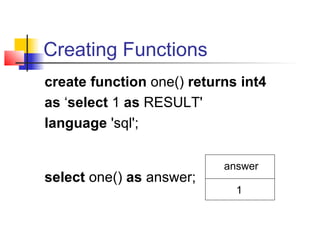
Creating Functions
create function one() returns int4
as ‘select 1 as RESULT'
language 'sql';
select one() as answer;
answer
1
Creating “tables” with
“methods”
Implementation
create table slides (
id int,
date date,
caption document,
picture CD_image,
method containsName
(name varchar)
returns boolean
as external name ‘matching’
language ‘C’
);
Creating Tables (Contd.)
create table landmarks(
name varchar (30),
location point);
Implementation (contd.)
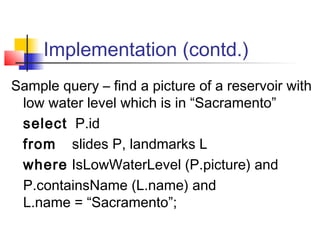
Sample query – find a picture of a reservoir with
low water level which is in “Sacramento”
select P.id
from slides P, landmarks L
where IsLowWaterLevel (P.picture) and
P.containsName (L.name) and
L.name = “Sacramento”;

OODB

  • 1.
    Object Oriented Database Group4 Mathieu Metz Palani Kumaresan Napa Gavinlertvatana Kristine Pei Keow Lee Prabhu Ramachandran
  • 2.
    Outline  Object definitions Object Structures  Object-oriented concepts  OODBS  OQL with an example  SQL3 with examples
  • 3.
    Definition of anobject Objects – User defined complex data types An object has structure or state (variables) and methods (behavior/operations) An object is described by four characteristics Identifier: a system-wide unique id for an object Name: an object may also have a unique name in DB (optional) Lifetime: determines if the object is persistent or transient Structure: Construction of objects using type constructors
  • 4.
    Object Structure  Thestate (current value) of a complex object may be constructed from other objects (or other values) by using certain type constructors  Can be represented by (i,c,v)  i is an unique id  c is a type constructor  v is the object state  Constructors  Basic types: atom, tuple and set  Collection type: list, bag and array
  • 5.
    Object-Oriented Concepts  AbstractData Types  Class definition, provides extension to complex attribute types  Encapsulation  Implementation of operations and object structure hidden  Inheritance  Sharing of data within hierarchy scope, supports code reusability  Polymorphism • Operator overloading
  • 6.
    What is ObjectOriented Database? (OODB)  A database system that incorporates all the important object-oriented concepts  Some additional features  Unique Object identifiers  Persistent object handling
  • 7.
    Advantages of OODBS Designer can specify the structure of objects and their behavior (methods)  Better interaction with object-oriented languages such as Java and C++  Definition of complex and user-defined types  Encapsulation of operations and user- defined methods
  • 8.
    Object Query Language (OQL) Declarative query language  Not computationally complete  Syntax based on SQL (select, from, where)  Additional flexibility (queries with user defined operators and types)
  • 9.
    Example of OQLquery The following is a sample query “what are the names of the black product?” Select distinct p.name From products p Where p.color = “black” ⇒ Valid in both SQL and OQL, but results are different.
  • 10.
    Result of thequery (SQL) Product no Name Color P1 Ford Mustang Black P2 Toyota Celica Green P3 Mercedes SLK Black - The statement queries a relational database. => Returns a table with rows. Name Ford Mustang Mercedes SLK Result Original table
  • 11.
    Result of thequery (OQL) Product no Name Color P1 Ford Mustang Black P2 Toyota Celica Green P3 Mercedes SLK Black - The statement queries a object- oriented database => Returns a collection of objects. String Ford Mustang Result Original table String Mercedes SLK
  • 12.
    Comparison  Queries lookvery similar in SQL and OQL, sometimes they are the same  In fact, the results they give are very different Query returns: OQL SQL Object Collection of objects Tuple Table
  • 13.
    SQL3 “Object-oriented SQL” Foundation for several OO database management systems – ORACLE8, DB2, etc  New features – “relational” & “Object oriented”  Relational Features – new data types, new predicates, enhanced semantics, additional security and an active database  Object Oriented Features – support for functions and procedures
  • 14.
    User defined DataTypes Creating a “row type” Example: create row type AddressType( street char(50), city char(20)); create row type StarType( name char(30), address AddressType);
  • 15.
    Creating Data Types(contd.) Creating “Table” create table Address of type AddressType; create table MovieStar of type StarType; Instances of Row types are tuples in tables
  • 16.
    Sample Query Find thenames and street addresses of those MovieStars who stay in the city “Columbus”: select MovieStar.name, MovieStar.address.street from MovieStar where MovieStar.address.city = “Columbus”;
  • 17.
    Complex Data andQueries A Water Resource Management example  A database of state wide water projects  Includes a library of picture slides  Indexing according to predefined concepts – prohibitively expensive  Type of queries  Geographic locations  Reservoir levels during droughts  Recent flood conditions, etc
  • 18.
    Complex Data andQueries (contd.)  Addressing these queries  Linking this database to landmarks on a topographic map  Examining the captions for each slide  Implementing image-understanding programs  Inspecting images and ascertaining attributes  These type of queries necessitate dedicated “methods”
  • 19.
    Creating Functions create functionone() returns int4 as ‘select 1 as RESULT' language 'sql'; select one() as answer; answer 1
  • 20.
    Creating “tables” with “methods” Implementation createtable slides ( id int, date date, caption document, picture CD_image, method containsName (name varchar) returns boolean as external name ‘matching’ language ‘C’ );
  • 21.
    Creating Tables (Contd.) createtable landmarks( name varchar (30), location point);
  • 22.
    Implementation (contd.) Sample query– find a picture of a reservoir with low water level which is in “Sacramento” select P.id from slides P, landmarks L where IsLowWaterLevel (P.picture) and P.containsName (L.name) and L.name = “Sacramento”;

Editor's Notes

  • #9 1) In SQL, this statement will query a relational database, i.e., a set of table-like structures (see Section 2.2, Second generation database technology), and return a table, the rows of which are rows of the table called products in which the column called colour has the value "black". If the relational database contains the products table in Figure 6.2 (a), the result of the query will be the Figure 6.2 (b) table.   2) In OQL this statement will query an object database and return a collection-object which contains objects contained in the collection object called products for which the value of the colour attribute is the literal "black". Given the object database in Figure 6.1, this OQL statement will return the object represented in Figure 6.3. 1) That which is interpreted as a table name in SQL, is interpreted as a collection-object name in OQL; 2) That which is interpreted as the name of a column of a table in SQL is interpreted as an object characteristic name (an attribute, relationship, or operation name) in OQL.