Open Data in Agrifood:
A Tutorial
Christopher Brewster
TNO, The Netherlands
HAICTA Conference, Chania Sept 2017
1
OUTLINE
‣ A Digital world
‣ Origins of Open Data and the OD movements
‣ Initiatives for Open Data in agrifood
‣ Types and Sources of Open Data in agrifood.
‣ Uses of Open Data and Examples
‣ Issues and challenges
2
A Digital World
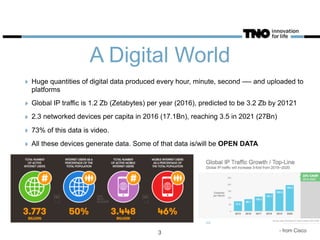
‣ Huge quantities of digital data produced every hour, minute, second —- and uploaded to
platforms
‣ Global IP traffic is 1.2 Zb (Zetabytes) per year (2016), predicted to be 3.2 Zb by 20121
‣ 2.3 networked devices per capita in 2016 (17.1Bn), reaching 3.5 in 2021 (27Bn)
‣ 73% of this data is video.
‣ All these devices generate data. Some of that data is/will be OPEN DATA
- from Cisco3
Closed Data
‣ Most data is closed, even most government data.
‣ Businesses afraid of competition, loss of value, loss of control (what
happens in the future?).
‣ Government afraid of use/abuse by third parties. Also a matter of culture.
‣ For example, GPS data - originally for US military only (1974-85), eventually
made available to all (airlines 1983, everyone 1998) - slow change of culture.
4
Why is data closed?
‣ “Closed” means inaccessible
‣ Forgotten, lost, impractical formats (e.g. binary or
proprietary)
‣ Seen as too sensitive, given only on a “need to know” basis
‣ Seen as too strategic, maybe of competitive advantage
‣ Seen as too costly - to adapt, reformat, provide an API,
follow a data standard
‣ Culture/time and place: data coming off farm machinery
(dairy robots vs. tractors + field machinery)
5
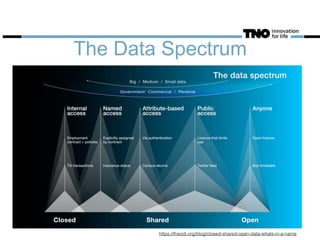
The Data Spectrum
https://theodi.org/blog/closed-shared-open-data-whats-in-a-name
Origins of Open Data
Open Data
‣ “Open data and content can be freely used, modified,
and shared by anyone for any purpose” — The Open
Definition
‣ Open data also needs a License specifying that is open
data, who to credit, and what happens when remixed.
‣ Typically (traditionally) collected and made available by
government agencies (e.g. statistics office)
‣ Classic example is UK school league tables (1994), or
meteorological data (even older).
8
Why is data important?
‣ Data is key to decision making. Governments collect all
kinds of data, corporations collect all kinds of data.
‣ Historically censuses and offices of statistics
‣ Now every website, every app, every digital interaction
‣ Used to make decisions from school building to
advertisement delivery
‣ Open data is a public good!
‣ Open data is infrastructure!
9
Open Data as a public good
‣ A “public good” is non-excludable (everyone can use it)
and non-rivalrous (use by one does not reduce use by
another) cf. https://en.wikipedia.org/wiki/Public_good
‣ Like clean air or public parks
‣ Public goods cost money - usual paid for by government,
collaborations, cross-subsidy, volunteering/crowd
sourcing, social norms etc.
‣ However we usually pay for infrastructure ….
https://theodi.org/blog/why-is-open-data-a-public-good
10
Open Data as Infrastructure
‣ Data is like a road system. You choose to build them.
‣ A “data infrastructure” provides a foundation for social and business
activity.
‣ Some data sets are “trunk roads” - important, frequently used, some
data sets are “side roads” less important — but they all must be
interconnected …
‣ Core data sets are references by other data sets e.g. address,
postcodes, etc. Importance of identifiers!
‣ Important entities = companies, schools, hospitals, stations and
buss stops, and (perhaps) land parcels
‣ Most common example is post codes (open data in most countries)
https://theodi.org/blog/what-national-information-infrastructure11
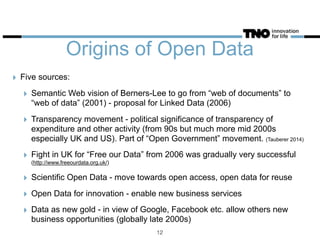
Origins of Open Data
‣ Five sources:
‣ Semantic Web vision of Berners-Lee to go from “web of documents” to
“web of data” (2001) - proposal for Linked Data (2006)
‣ Transparency movement - political significance of transparency of
expenditure and other activity (from 90s but much more mid 2000s
especially UK and US). Part of “Open Government” movement. (Tauberer 2014)
‣ Fight in UK for “Free our Data” from 2006 was gradually very successful
(http://www.freeourdata.org.uk/)
‣ Scientific Open Data - move towards open access, open data for reuse
‣ Open Data for innovation - enable new business services
‣ Data as new gold - in view of Google, Facebook etc. allow others new
business opportunities (globally late 2000s)
12
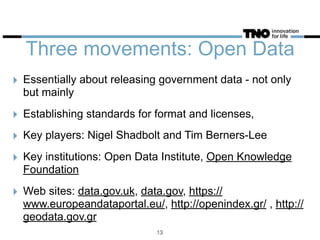
Three movements: Open Data
‣ Essentially about releasing government data - not only
but mainly
‣ Establishing standards for format and licenses,
‣ Key players: Nigel Shadbolt and Tim Berners-Lee
‣ Key institutions: Open Data Institute, Open Knowledge
Foundation
‣ Web sites: data.gov.uk, data.gov, https://
www.europeandataportal.eu/, http://openindex.gr/ , http://
geodata.gov.gr
13
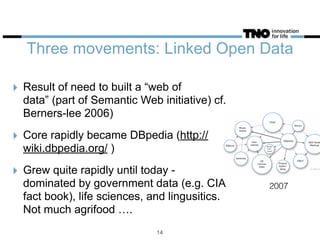
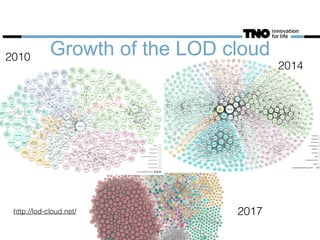
Three movements: Linked Open Data
‣ Result of need to built a “web of
data” (part of Semantic Web initiative) cf.
Berners-lee 2006)
‣ Core rapidly became DBpedia (http://
wiki.dbpedia.org/ )
‣ Grew quite rapidly until today -
dominated by government data (e.g. CIA
fact book), life sciences, and lingusitics.
Not much agrifood ….
2007
14
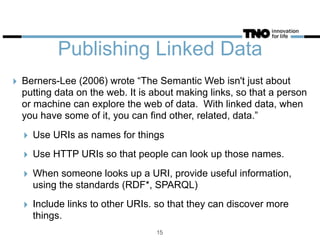
Publishing Linked Data
‣ Berners-Lee (2006) wrote “The Semantic Web isn't just about
putting data on the web. It is about making links, so that a person
or machine can explore the web of data. With linked data, when
you have some of it, you can find other, related, data.”
‣ Use URIs as names for things
‣ Use HTTP URIs so that people can look up those names.
‣ When someone looks up a URI, provide useful information,
using the standards (RDF*, SPARQL)
‣ Include links to other URIs. so that they can discover more
things.
15
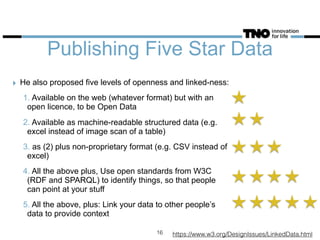
Publishing Five Star Data
‣ He also proposed five levels of openness and linked-ness:
1. Available on the web (whatever format) but with an
open licence, to be Open Data
2. Available as machine-readable structured data (e.g.
excel instead of image scan of a table)
3. as (2) plus non-proprietary format (e.g. CSV instead of
excel)
4. All the above plus, Use open standards from W3C
(RDF and SPARQL) to identify things, so that people
can point at your stuff
5. All the above, plus: Link your data to other people’s
data to provide context
https://www.w3.org/DesignIssues/LinkedData.html16
Growth of the LOD cloud2010
2014
2017http://lod-cloud.net/
17
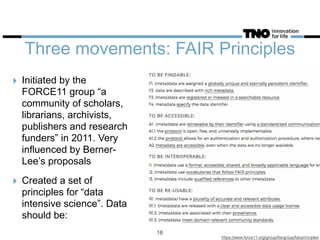
Three movements: FAIR Principles
‣ Initiated by the
FORCE11 group “a
community of scholars,
librarians, archivists,
publishers and research
funders” in 2011. Very
influenced by Berner-
Lee’s proposals
‣ Created a set of
principles for “data
intensive science”. Data
should be:
https://www.force11.org/group/fairgroup/fairprinciples
18
FAIR principles
‣ Resulted in a key paper: Wilkinson et al 2016 “The FAIR
Guiding Principles for scientific data management and
stewardship”
‣ Major impact for Life Sciences, and therefore agricultural
sciences.
‣ FAIR principles adopted by EC in general, e.g. for H2020
projects.
‣ Primary focus is research data but not only …
19
Open Data in Agrifood
20
Open Data in Agrifood
‣ This has “happened” in last 10-15 years
‣ Motivation:
‣ Growing awareness of government data sets, and potential
applications
‣ growing availability of public earth observation data from
satellites (especially ESA and EC’s Copernicus Programme
1998-2020, but mostly 2014-2020)
‣ Desire to “help” farmers with digital technologies and data
‣ Sudden fashion for precision agriculture/smart farming (since
2010 mostly)
21
Important Initiatives: Open Data Institute
‣ ODI create in UK in 2012 by Tim Berners-Lee and Nigel
Shadbolt
‣ Mission to educate, train and encourage adoption of
Open Data
‣ Major effort in agriculture - collation of open data sets,
hackathons, support for UK start-ups
‣ It has produced various reports, and worked closely with
GODAN
‣ https://theodi.org/
22
Important Initiative: GODAN
‣ “Global Open Data for Agriculture and Nutrition”
‣ Followed a G8 commitment in 2012, announced in 2013,
funded by US, UK and NL governments + support from FAO,
GFAR, CGIAR etc.
‣ Major emphasis on developing countries, helping to open up
data, and enable new applications and services.
‣ Several research reports: http://www.godan.info/resources/
research
‣ Several “success stories”: http://www.godan.info/resources/
success-stories
23
Movement: Agrifood hackathons
‣ With growth of Open Data, so growth of hackathons focussed on agrifood
open data
‣ (Past) examples:
‣ Hackathon on "The power of Linked Data in Agriculture and Food
Safety” (2015)
‣ Climate change, Agriculture and Food Security Hackathon (2014)
Lima, Peru
‣ FarmHack NL (repeated hackathons) http://www.farmhack.nl/en/
‣ Hack4Farming hackathon for the future of agricultural development in
India (2016)
‣ Hackathon for Open Agricultural Data, China (2014)
24
Types and Sources of
Agrifood Open Data
25
Government Statistics
‣ Governments collect a lot of data about food and agriculture, mostly economic and
social
‣ For example:
‣ information about the structure of farms, orchards & vineyards, including parcel data
‣ agricultural production
‣ economic accounts for agriculture
‣ agriculture and environment
‣ agricultural prices
‣ animal populations
‣ milk production, animal slaughter
‣ etc.
26
Government data (non statistical)
‣ Plenty of other government data, not really statistics:
‣ Meterological data <— probably the most important
‣ Crop disease outbreaks
‣ Food recalls
‣ Health and safety inspections
‣ Maximum residue levels (for pesticides)
27
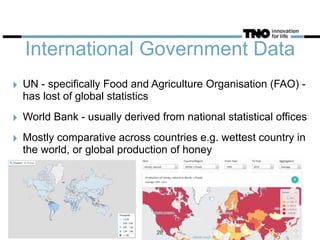
International Government Data
‣ UN - specifically Food and Agriculture Organisation (FAO) -
has lost of global statistics
‣ World Bank - usually derived from national statistical offices
‣ Mostly comparative across countries e.g. wettest country in
the world, or global production of honey
28
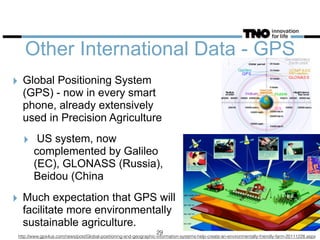
Other International Data - GPS
‣ Global Positioning System
(GPS) - now in every smart
phone, already extensively
used in Precision Agriculture
‣ US system, now
complemented by Galileo
(EC), GLONASS (Russia),
Beidou (China
‣ Much expectation that GPS will
facilitate more environmentally
sustainable agriculture.
http://www.gps4us.com/news/post/Global-positioning-and-geographic-information-systems-help-create-an-environmentally-friendly-farm-20111228.aspx
29
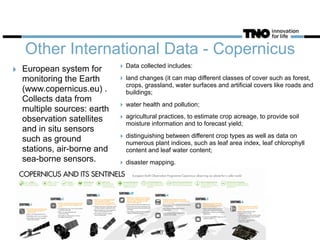
Other International Data - Copernicus
‣ European system for
monitoring the Earth
(www.copernicus.eu) .
Collects data from
multiple sources: earth
observation satellites
and in situ sensors
such as ground
stations, air-borne and
sea-borne sensors.
‣ Data collected includes:
‣ land changes (it can map different classes of cover such as forest,
crops, grassland, water surfaces and artificial covers like roads and
buildings;
‣ water health and pollution;
‣ agricultural practices, to estimate crop acreage, to provide soil
moisture information and to forecast yield;
‣ distinguishing between different crop types as well as data on
numerous plant indices, such as leaf area index, leaf chlorophyll
content and leaf water content;
‣ disaster mapping.
30
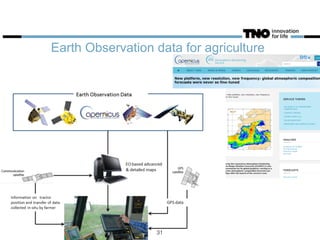
Earth Observation data for agriculture
31
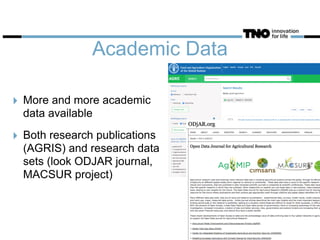
Academic Data
‣ More and more academic
data available
‣ Both research publications
(AGRIS) and research data
sets (look ODJAR journal,
MACSUR project)
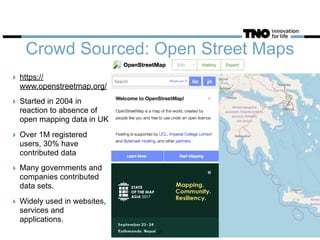
Crowd Sourced: Open Street Maps
‣ https://
www.openstreetmap.org/
‣ Started in 2004 in
reaction to absence of
open mapping data in UK
‣ Over 1M registered
users, 30% have
contributed data
‣ Many governments and
companies contributed
data sets.
‣ Widely used in websites,
services and
applications.
33
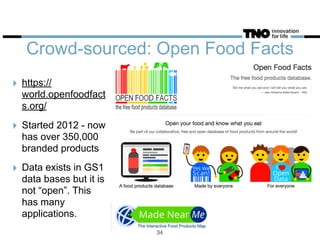
Crowd-sourced: Open Food Facts
‣ https://
world.openfoodfact
s.org/
‣ Started 2012 - now
has over 350,000
branded products
‣ Data exists in GS1
data bases but it is
not “open”. This
has many
applications.
34
Data Sources
‣ There is a profusion of data sources around the world
‣ Most national governments now have a (sort of) open
data portal
‣ Several international ones too (EC, UN, World Bank)
‣ Data comes in many different formats
‣ Some example sources:
35
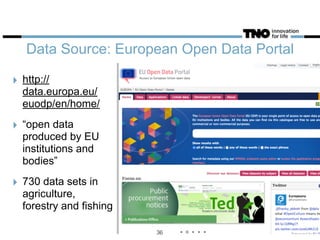
Data Source: European Open Data Portal
‣ http://
data.europa.eu/
euodp/en/home/
‣ “open data
produced by EU
institutions and
bodies”
‣ 730 data sets in
agriculture,
forestry and fishing
36
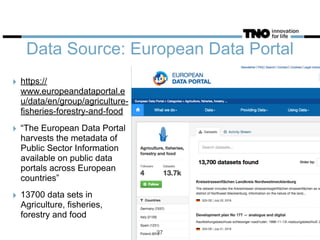
Data Source: European Data Portal
‣ https://
www.europeandataportal.e
u/data/en/group/agriculture-
fisheries-forestry-and-food
‣ “The European Data Portal
harvests the metadata of
Public Sector Information
available on public data
portals across European
countries”
‣ 13700 data sets in
Agriculture, fisheries,
forestry and food
37
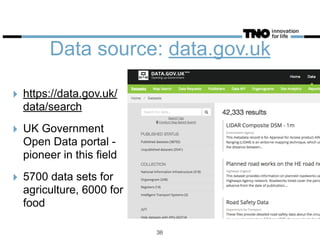
Data source: data.gov.uk
‣ https://data.gov.uk/
data/search
‣ UK Government
Open Data portal -
pioneer in this field
‣ 5700 data sets for
agriculture, 6000 for
food
38
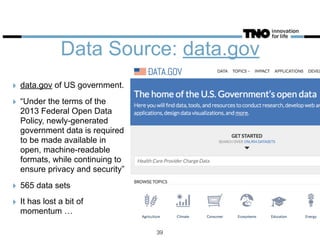
Data Source: data.gov
‣ data.gov of US government.
‣ “Under the terms of the
2013 Federal Open Data
Policy, newly-generated
government data is required
to be made available in
open, machine-readable
formats, while continuing to
ensure privacy and security”
‣ 565 data sets
‣ It has lost a bit of
momentum …
39
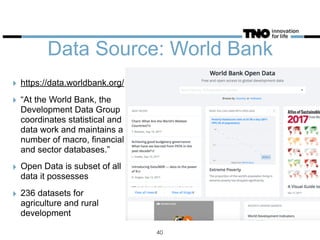
Data Source: World Bank
‣ https://data.worldbank.org/
‣ “At the World Bank, the
Development Data Group
coordinates statistical and
data work and maintains a
number of macro, financial
and sector databases.”
‣ Open Data is subset of all
data it possesses
‣ 236 datasets for
agriculture and rural
development
40
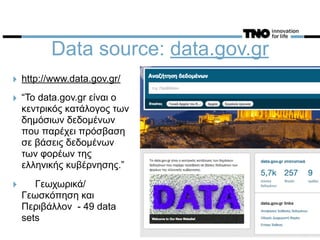
Data source: data.gov.gr
‣ http://www.data.gov.gr/
‣ “Το data.gov.gr είναι ο
κεντρικός κατάλογος των
δηµόσιων δεδοµένων
που παρέχει πρόσβαση
σε βάσεις δεδοµένων
των φορέων της
ελληνικής κυβέρνησης.”
‣ Γεωχωρικά/
Γεωσκόπηση και
Περιβάλλον - 49 data
sets
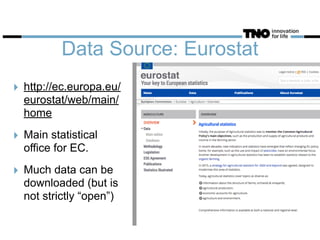
Data Source: Eurostat
‣ http://ec.europa.eu/
eurostat/web/main/
home
‣ Main statistical
office for EC.
‣ Much data can be
downloaded (but is
not strictly “open”)
Data Formats
‣ CSV - single common denominator
‣ EXCEL - most statistical data in this format
‣ XML - much better, but can be confusing
‣ JSON - favourite format for developers, not so frequently
offered
‣ RDF - essential for Linked Data
‣ ARCGIS - (not a format, a tool) some open data in this
form
43
Insufficient use of standards
‣ Many different kinds of standards across three
communities (research, precision farming, supply chain)
‣ Great failure to align and make interoperable.
‣ Most data is not compliant with a standard, especially not
a semantic standard.
‣ Failure to agree on unique identifiers
‣ People revert to lowest common denominator (csv files).
‣ Creates barriers to wider uptake of data in general.
The Uses of Open
Data in Agrifood
45
Benefits of Open Data
‣ Early accurate detection and prediction of problems (pest
outbreaks, water shortages, floods)
‣ Planning what to grow, what treatments to apply, when to
plant or harvest
‣ Risk management (insurance, hedging), and damage
control (from drought and pests)
‣ Managing agricultural subsidies
‣ Informing consumers and supply chain participants
Allemang and Teagarden 201646
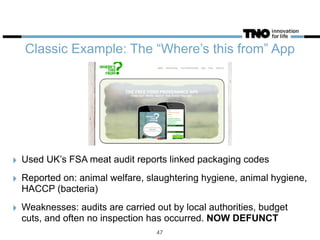
Classic Example: The “Where’s this from” App
‣ Used UK’s FSA meat audit reports linked packaging codes
‣ Reported on: animal welfare, slaughtering hygiene, animal hygiene,
HACCP (bacteria)
‣ Weaknesses: audits are carried out by local authorities, budget
cuts, and often no inspection has occurred. NOW DEFUNCT
47
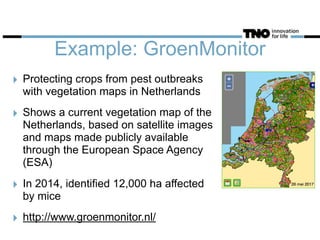
Example: GroenMonitor
‣ Protecting crops from pest outbreaks
with vegetation maps in Netherlands
‣ Shows a current vegetation map of the
Netherlands, based on satellite images
and maps made publicly available
through the European Space Agency
(ESA)
‣ In 2014, identified 12,000 ha affected
by mice
‣ http://www.groenmonitor.nl/
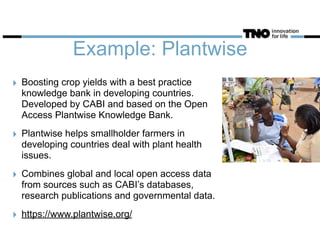
Example: Plantwise
‣ Boosting crop yields with a best practice
knowledge bank in developing countries.
Developed by CABI and based on the Open
Access Plantwise Knowledge Bank.
‣ Plantwise helps smallholder farmers in
developing countries deal with plant health
issues.
‣ Combines global and local open access data
from sources such as CABI’s databases,
research publications and governmental data.
‣ https://www.plantwise.org/
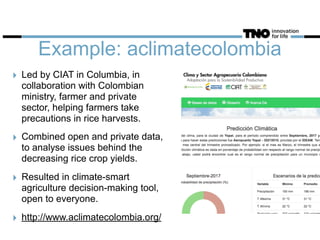
Example: aclimatecolombia
‣ Led by CIAT in Columbia, in
collaboration with Colombian
ministry, farmer and private
sector, helping farmers take
precautions in rice harvests.
‣ Combined open and private data,
to analyse issues behind the
decreasing rice crop yields.
‣ Resulted in climate-smart
agriculture decision-making tool,
open to everyone.
‣ http://www.aclimatecolombia.org/
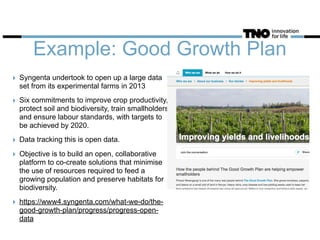
Example: Good Growth Plan
‣ Syngenta undertook to open up a large data
set from its experimental farms in 2013
‣ Six commitments to improve crop productivity,
protect soil and biodiversity, train smallholders
and ensure labour standards, with targets to
be achieved by 2020.
‣ Data tracking this is open data.
‣ Objective is to build an open, collaborative
platform to co-create solutions that minimise
the use of resources required to feed a
growing population and preserve habitats for
biodiversity.
‣ https://www4.syngenta.com/what-we-do/the-
good-growth-plan/progress/progress-open-
data
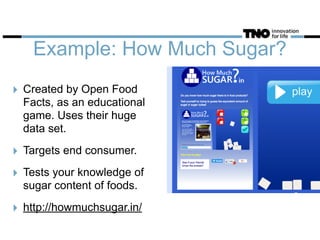
Example: How Much Sugar?
‣ Created by Open Food
Facts, as an educational
game. Uses their huge
data set.
‣ Targets end consumer.
‣ Tests your knowledge of
sugar content of foods.
‣ http://howmuchsugar.in/
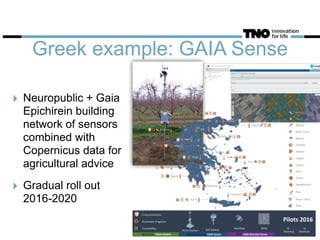
Greek example: GAIA Sense
‣ Neuropublic + Gaia
Epichirein building
network of sensors
combined with
Copernicus data for
agricultural advice
‣ Gradual roll out
2016-2020
Issues and Challenges:
Data and Control
Big Data
‣ Recent growth of interest in Big Data in farming
‣ Poster child is “Climate Corp” bought by Monsanto.
This uses “open” meteorological data as a basis.
‣ Many other actors seeing agriculture as “big data”
domain.
‣ BUT - big data approaches need access to a lot of data,
and if farmers provide data will they benefit?
‣ The political problem here is the danger of crowding out
small farmers
Precision Agriculture
‣ Precision agriculture depends on combining open data
(GPS, Meteo, remote sensing) with local/private data (on
field sensors.
‣ It has both a “big data” aspect and a “micro data” aspect.
‣ Depends on farmers making data available, but also
ongoing availability of open data (GPS, satellite
observation, crop models etc.)
‣ The major push we are seeing for PA must (?) also
mean that agrifood open data is supported even more.
Privacy
‣ According to one big agricultural machinery
manufacturer “GDPR has destroyed our business model”
‣ GDPR = General Data Protection Regulation of the EC
(http://www.eugdpr.org/)
‣ Farm data is also private data in some regards.
‣ Eating/food purchasing data may considered private too.
‣ Lots of scope for complex demarcations between private
vs. open data
Thank You
QUESTIONS
58
Resources
‣ All references and copies of slides available from:
‣ www.cbrewster.com/haicta2017
59

Open Data in Agrifood: A Tutorial

  • 1.
    Open Data inAgrifood: A Tutorial Christopher Brewster TNO, The Netherlands HAICTA Conference, Chania Sept 2017 1
  • 2.
    OUTLINE ‣ A Digitalworld ‣ Origins of Open Data and the OD movements ‣ Initiatives for Open Data in agrifood ‣ Types and Sources of Open Data in agrifood. ‣ Uses of Open Data and Examples ‣ Issues and challenges 2
  • 3.
    A Digital World ‣Huge quantities of digital data produced every hour, minute, second —- and uploaded to platforms ‣ Global IP traffic is 1.2 Zb (Zetabytes) per year (2016), predicted to be 3.2 Zb by 20121 ‣ 2.3 networked devices per capita in 2016 (17.1Bn), reaching 3.5 in 2021 (27Bn) ‣ 73% of this data is video. ‣ All these devices generate data. Some of that data is/will be OPEN DATA - from Cisco3
  • 4.
    Closed Data ‣ Mostdata is closed, even most government data. ‣ Businesses afraid of competition, loss of value, loss of control (what happens in the future?). ‣ Government afraid of use/abuse by third parties. Also a matter of culture. ‣ For example, GPS data - originally for US military only (1974-85), eventually made available to all (airlines 1983, everyone 1998) - slow change of culture. 4
  • 5.
    Why is dataclosed? ‣ “Closed” means inaccessible ‣ Forgotten, lost, impractical formats (e.g. binary or proprietary) ‣ Seen as too sensitive, given only on a “need to know” basis ‣ Seen as too strategic, maybe of competitive advantage ‣ Seen as too costly - to adapt, reformat, provide an API, follow a data standard ‣ Culture/time and place: data coming off farm machinery (dairy robots vs. tractors + field machinery) 5
  • 6.
  • 7.
  • 8.
    Open Data ‣ “Opendata and content can be freely used, modified, and shared by anyone for any purpose” — The Open Definition ‣ Open data also needs a License specifying that is open data, who to credit, and what happens when remixed. ‣ Typically (traditionally) collected and made available by government agencies (e.g. statistics office) ‣ Classic example is UK school league tables (1994), or meteorological data (even older). 8
  • 9.
    Why is dataimportant? ‣ Data is key to decision making. Governments collect all kinds of data, corporations collect all kinds of data. ‣ Historically censuses and offices of statistics ‣ Now every website, every app, every digital interaction ‣ Used to make decisions from school building to advertisement delivery ‣ Open data is a public good! ‣ Open data is infrastructure! 9
  • 10.
    Open Data asa public good ‣ A “public good” is non-excludable (everyone can use it) and non-rivalrous (use by one does not reduce use by another) cf. https://en.wikipedia.org/wiki/Public_good ‣ Like clean air or public parks ‣ Public goods cost money - usual paid for by government, collaborations, cross-subsidy, volunteering/crowd sourcing, social norms etc. ‣ However we usually pay for infrastructure …. https://theodi.org/blog/why-is-open-data-a-public-good 10
  • 11.
    Open Data asInfrastructure ‣ Data is like a road system. You choose to build them. ‣ A “data infrastructure” provides a foundation for social and business activity. ‣ Some data sets are “trunk roads” - important, frequently used, some data sets are “side roads” less important — but they all must be interconnected … ‣ Core data sets are references by other data sets e.g. address, postcodes, etc. Importance of identifiers! ‣ Important entities = companies, schools, hospitals, stations and buss stops, and (perhaps) land parcels ‣ Most common example is post codes (open data in most countries) https://theodi.org/blog/what-national-information-infrastructure11
  • 12.
    Origins of OpenData ‣ Five sources: ‣ Semantic Web vision of Berners-Lee to go from “web of documents” to “web of data” (2001) - proposal for Linked Data (2006) ‣ Transparency movement - political significance of transparency of expenditure and other activity (from 90s but much more mid 2000s especially UK and US). Part of “Open Government” movement. (Tauberer 2014) ‣ Fight in UK for “Free our Data” from 2006 was gradually very successful (http://www.freeourdata.org.uk/) ‣ Scientific Open Data - move towards open access, open data for reuse ‣ Open Data for innovation - enable new business services ‣ Data as new gold - in view of Google, Facebook etc. allow others new business opportunities (globally late 2000s) 12
  • 13.
    Three movements: OpenData ‣ Essentially about releasing government data - not only but mainly ‣ Establishing standards for format and licenses, ‣ Key players: Nigel Shadbolt and Tim Berners-Lee ‣ Key institutions: Open Data Institute, Open Knowledge Foundation ‣ Web sites: data.gov.uk, data.gov, https:// www.europeandataportal.eu/, http://openindex.gr/ , http:// geodata.gov.gr 13
  • 14.
    Three movements: LinkedOpen Data ‣ Result of need to built a “web of data” (part of Semantic Web initiative) cf. Berners-lee 2006) ‣ Core rapidly became DBpedia (http:// wiki.dbpedia.org/ ) ‣ Grew quite rapidly until today - dominated by government data (e.g. CIA fact book), life sciences, and lingusitics. Not much agrifood …. 2007 14
  • 15.
    Publishing Linked Data ‣Berners-Lee (2006) wrote “The Semantic Web isn't just about putting data on the web. It is about making links, so that a person or machine can explore the web of data. With linked data, when you have some of it, you can find other, related, data.” ‣ Use URIs as names for things ‣ Use HTTP URIs so that people can look up those names. ‣ When someone looks up a URI, provide useful information, using the standards (RDF*, SPARQL) ‣ Include links to other URIs. so that they can discover more things. 15
  • 16.
    Publishing Five StarData ‣ He also proposed five levels of openness and linked-ness: 1. Available on the web (whatever format) but with an open licence, to be Open Data 2. Available as machine-readable structured data (e.g. excel instead of image scan of a table) 3. as (2) plus non-proprietary format (e.g. CSV instead of excel) 4. All the above plus, Use open standards from W3C (RDF and SPARQL) to identify things, so that people can point at your stuff 5. All the above, plus: Link your data to other people’s data to provide context https://www.w3.org/DesignIssues/LinkedData.html16
  • 17.
    Growth of theLOD cloud2010 2014 2017http://lod-cloud.net/ 17
  • 18.
    Three movements: FAIRPrinciples ‣ Initiated by the FORCE11 group “a community of scholars, librarians, archivists, publishers and research funders” in 2011. Very influenced by Berner- Lee’s proposals ‣ Created a set of principles for “data intensive science”. Data should be: https://www.force11.org/group/fairgroup/fairprinciples 18
  • 19.
    FAIR principles ‣ Resultedin a key paper: Wilkinson et al 2016 “The FAIR Guiding Principles for scientific data management and stewardship” ‣ Major impact for Life Sciences, and therefore agricultural sciences. ‣ FAIR principles adopted by EC in general, e.g. for H2020 projects. ‣ Primary focus is research data but not only … 19
  • 20.
    Open Data inAgrifood 20
  • 21.
    Open Data inAgrifood ‣ This has “happened” in last 10-15 years ‣ Motivation: ‣ Growing awareness of government data sets, and potential applications ‣ growing availability of public earth observation data from satellites (especially ESA and EC’s Copernicus Programme 1998-2020, but mostly 2014-2020) ‣ Desire to “help” farmers with digital technologies and data ‣ Sudden fashion for precision agriculture/smart farming (since 2010 mostly) 21
  • 22.
    Important Initiatives: OpenData Institute ‣ ODI create in UK in 2012 by Tim Berners-Lee and Nigel Shadbolt ‣ Mission to educate, train and encourage adoption of Open Data ‣ Major effort in agriculture - collation of open data sets, hackathons, support for UK start-ups ‣ It has produced various reports, and worked closely with GODAN ‣ https://theodi.org/ 22
  • 23.
    Important Initiative: GODAN ‣“Global Open Data for Agriculture and Nutrition” ‣ Followed a G8 commitment in 2012, announced in 2013, funded by US, UK and NL governments + support from FAO, GFAR, CGIAR etc. ‣ Major emphasis on developing countries, helping to open up data, and enable new applications and services. ‣ Several research reports: http://www.godan.info/resources/ research ‣ Several “success stories”: http://www.godan.info/resources/ success-stories 23
  • 24.
    Movement: Agrifood hackathons ‣With growth of Open Data, so growth of hackathons focussed on agrifood open data ‣ (Past) examples: ‣ Hackathon on "The power of Linked Data in Agriculture and Food Safety” (2015) ‣ Climate change, Agriculture and Food Security Hackathon (2014) Lima, Peru ‣ FarmHack NL (repeated hackathons) http://www.farmhack.nl/en/ ‣ Hack4Farming hackathon for the future of agricultural development in India (2016) ‣ Hackathon for Open Agricultural Data, China (2014) 24
  • 25.
    Types and Sourcesof Agrifood Open Data 25
  • 26.
    Government Statistics ‣ Governmentscollect a lot of data about food and agriculture, mostly economic and social ‣ For example: ‣ information about the structure of farms, orchards & vineyards, including parcel data ‣ agricultural production ‣ economic accounts for agriculture ‣ agriculture and environment ‣ agricultural prices ‣ animal populations ‣ milk production, animal slaughter ‣ etc. 26
  • 27.
    Government data (nonstatistical) ‣ Plenty of other government data, not really statistics: ‣ Meterological data <— probably the most important ‣ Crop disease outbreaks ‣ Food recalls ‣ Health and safety inspections ‣ Maximum residue levels (for pesticides) 27
  • 28.
    International Government Data ‣UN - specifically Food and Agriculture Organisation (FAO) - has lost of global statistics ‣ World Bank - usually derived from national statistical offices ‣ Mostly comparative across countries e.g. wettest country in the world, or global production of honey 28
  • 29.
    Other International Data- GPS ‣ Global Positioning System (GPS) - now in every smart phone, already extensively used in Precision Agriculture ‣ US system, now complemented by Galileo (EC), GLONASS (Russia), Beidou (China ‣ Much expectation that GPS will facilitate more environmentally sustainable agriculture. http://www.gps4us.com/news/post/Global-positioning-and-geographic-information-systems-help-create-an-environmentally-friendly-farm-20111228.aspx 29
  • 30.
    Other International Data- Copernicus ‣ European system for monitoring the Earth (www.copernicus.eu) . Collects data from multiple sources: earth observation satellites and in situ sensors such as ground stations, air-borne and sea-borne sensors. ‣ Data collected includes: ‣ land changes (it can map different classes of cover such as forest, crops, grassland, water surfaces and artificial covers like roads and buildings; ‣ water health and pollution; ‣ agricultural practices, to estimate crop acreage, to provide soil moisture information and to forecast yield; ‣ distinguishing between different crop types as well as data on numerous plant indices, such as leaf area index, leaf chlorophyll content and leaf water content; ‣ disaster mapping. 30
  • 31.
    Earth Observation datafor agriculture 31
  • 32.
    Academic Data ‣ Moreand more academic data available ‣ Both research publications (AGRIS) and research data sets (look ODJAR journal, MACSUR project)
  • 33.
    Crowd Sourced: OpenStreet Maps ‣ https:// www.openstreetmap.org/ ‣ Started in 2004 in reaction to absence of open mapping data in UK ‣ Over 1M registered users, 30% have contributed data ‣ Many governments and companies contributed data sets. ‣ Widely used in websites, services and applications. 33
  • 34.
    Crowd-sourced: Open FoodFacts ‣ https:// world.openfoodfact s.org/ ‣ Started 2012 - now has over 350,000 branded products ‣ Data exists in GS1 data bases but it is not “open”. This has many applications. 34
  • 35.
    Data Sources ‣ Thereis a profusion of data sources around the world ‣ Most national governments now have a (sort of) open data portal ‣ Several international ones too (EC, UN, World Bank) ‣ Data comes in many different formats ‣ Some example sources: 35
  • 36.
    Data Source: EuropeanOpen Data Portal ‣ http:// data.europa.eu/ euodp/en/home/ ‣ “open data produced by EU institutions and bodies” ‣ 730 data sets in agriculture, forestry and fishing 36
  • 37.
    Data Source: EuropeanData Portal ‣ https:// www.europeandataportal.e u/data/en/group/agriculture- fisheries-forestry-and-food ‣ “The European Data Portal harvests the metadata of Public Sector Information available on public data portals across European countries” ‣ 13700 data sets in Agriculture, fisheries, forestry and food 37
  • 38.
    Data source: data.gov.uk ‣https://data.gov.uk/ data/search ‣ UK Government Open Data portal - pioneer in this field ‣ 5700 data sets for agriculture, 6000 for food 38
  • 39.
    Data Source: data.gov ‣data.gov of US government. ‣ “Under the terms of the 2013 Federal Open Data Policy, newly-generated government data is required to be made available in open, machine-readable formats, while continuing to ensure privacy and security” ‣ 565 data sets ‣ It has lost a bit of momentum … 39
  • 40.
    Data Source: WorldBank ‣ https://data.worldbank.org/ ‣ “At the World Bank, the Development Data Group coordinates statistical and data work and maintains a number of macro, financial and sector databases.” ‣ Open Data is subset of all data it possesses ‣ 236 datasets for agriculture and rural development 40
  • 41.
    Data source: data.gov.gr ‣http://www.data.gov.gr/ ‣ “Το data.gov.gr είναι ο κεντρικός κατάλογος των δηµόσιων δεδοµένων που παρέχει πρόσβαση σε βάσεις δεδοµένων των φορέων της ελληνικής κυβέρνησης.” ‣ Γεωχωρικά/ Γεωσκόπηση και Περιβάλλον - 49 data sets
  • 42.
    Data Source: Eurostat ‣http://ec.europa.eu/ eurostat/web/main/ home ‣ Main statistical office for EC. ‣ Much data can be downloaded (but is not strictly “open”)
  • 43.
    Data Formats ‣ CSV- single common denominator ‣ EXCEL - most statistical data in this format ‣ XML - much better, but can be confusing ‣ JSON - favourite format for developers, not so frequently offered ‣ RDF - essential for Linked Data ‣ ARCGIS - (not a format, a tool) some open data in this form 43
  • 44.
    Insufficient use ofstandards ‣ Many different kinds of standards across three communities (research, precision farming, supply chain) ‣ Great failure to align and make interoperable. ‣ Most data is not compliant with a standard, especially not a semantic standard. ‣ Failure to agree on unique identifiers ‣ People revert to lowest common denominator (csv files). ‣ Creates barriers to wider uptake of data in general.
  • 45.
    The Uses ofOpen Data in Agrifood 45
  • 46.
    Benefits of OpenData ‣ Early accurate detection and prediction of problems (pest outbreaks, water shortages, floods) ‣ Planning what to grow, what treatments to apply, when to plant or harvest ‣ Risk management (insurance, hedging), and damage control (from drought and pests) ‣ Managing agricultural subsidies ‣ Informing consumers and supply chain participants Allemang and Teagarden 201646
  • 47.
    Classic Example: The“Where’s this from” App ‣ Used UK’s FSA meat audit reports linked packaging codes ‣ Reported on: animal welfare, slaughtering hygiene, animal hygiene, HACCP (bacteria) ‣ Weaknesses: audits are carried out by local authorities, budget cuts, and often no inspection has occurred. NOW DEFUNCT 47
  • 48.
    Example: GroenMonitor ‣ Protectingcrops from pest outbreaks with vegetation maps in Netherlands ‣ Shows a current vegetation map of the Netherlands, based on satellite images and maps made publicly available through the European Space Agency (ESA) ‣ In 2014, identified 12,000 ha affected by mice ‣ http://www.groenmonitor.nl/
  • 49.
    Example: Plantwise ‣ Boostingcrop yields with a best practice knowledge bank in developing countries. Developed by CABI and based on the Open Access Plantwise Knowledge Bank. ‣ Plantwise helps smallholder farmers in developing countries deal with plant health issues. ‣ Combines global and local open access data from sources such as CABI’s databases, research publications and governmental data. ‣ https://www.plantwise.org/
  • 50.
    Example: aclimatecolombia ‣ Ledby CIAT in Columbia, in collaboration with Colombian ministry, farmer and private sector, helping farmers take precautions in rice harvests. ‣ Combined open and private data, to analyse issues behind the decreasing rice crop yields. ‣ Resulted in climate-smart agriculture decision-making tool, open to everyone. ‣ http://www.aclimatecolombia.org/
  • 51.
    Example: Good GrowthPlan ‣ Syngenta undertook to open up a large data set from its experimental farms in 2013 ‣ Six commitments to improve crop productivity, protect soil and biodiversity, train smallholders and ensure labour standards, with targets to be achieved by 2020. ‣ Data tracking this is open data. ‣ Objective is to build an open, collaborative platform to co-create solutions that minimise the use of resources required to feed a growing population and preserve habitats for biodiversity. ‣ https://www4.syngenta.com/what-we-do/the- good-growth-plan/progress/progress-open- data
  • 52.
    Example: How MuchSugar? ‣ Created by Open Food Facts, as an educational game. Uses their huge data set. ‣ Targets end consumer. ‣ Tests your knowledge of sugar content of foods. ‣ http://howmuchsugar.in/
  • 53.
    Greek example: GAIASense ‣ Neuropublic + Gaia Epichirein building network of sensors combined with Copernicus data for agricultural advice ‣ Gradual roll out 2016-2020
  • 54.
  • 55.
    Big Data ‣ Recentgrowth of interest in Big Data in farming ‣ Poster child is “Climate Corp” bought by Monsanto. This uses “open” meteorological data as a basis. ‣ Many other actors seeing agriculture as “big data” domain. ‣ BUT - big data approaches need access to a lot of data, and if farmers provide data will they benefit? ‣ The political problem here is the danger of crowding out small farmers
  • 56.
    Precision Agriculture ‣ Precisionagriculture depends on combining open data (GPS, Meteo, remote sensing) with local/private data (on field sensors. ‣ It has both a “big data” aspect and a “micro data” aspect. ‣ Depends on farmers making data available, but also ongoing availability of open data (GPS, satellite observation, crop models etc.) ‣ The major push we are seeing for PA must (?) also mean that agrifood open data is supported even more.
  • 57.
    Privacy ‣ According toone big agricultural machinery manufacturer “GDPR has destroyed our business model” ‣ GDPR = General Data Protection Regulation of the EC (http://www.eugdpr.org/) ‣ Farm data is also private data in some regards. ‣ Eating/food purchasing data may considered private too. ‣ Lots of scope for complex demarcations between private vs. open data
  • 58.
  • 59.
    Resources ‣ All referencesand copies of slides available from: ‣ www.cbrewster.com/haicta2017 59