Onion
Architecture
Overview
Shcherbyna A.
Introduction
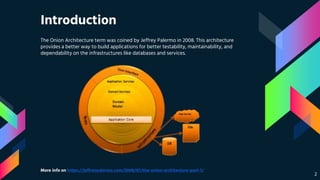
The Onion Architecture term was coined by Jeffrey Palermo in 2008. This architecture
provides a better way to build applications for better testability, maintainability, and
dependability on the infrastructures like databases and services.
More info on https://jeffreypalermo.com/2008/07/the-onion-architecture-part-1/
2
Key tenets of Onion Architecture
› The application is built around an independent object
model
› Inner layers define interfaces. Outer layers implement
interfaces
› Direction of coupling is toward the center
› All application core code can be compiled and run
separate from infrastructure
3
Advantages of Onion Architecture
› It provides better maintainability as all the codes depend on
layers or the center.
› It provides better testability as the unit test can be created for
separate layers without an effect of other modules of the
application.
› It develops a loosely coupled application as the outer layer of the
application always communicates with inner layer via interfaces.
› Any concrete implantation would be provided to the application
at run time
› Domain entities are core and center part. It can have access to
both database and UI layers.
› The internal layers never depend on external layer. The code that
may have changed should be part of an external layer.
4
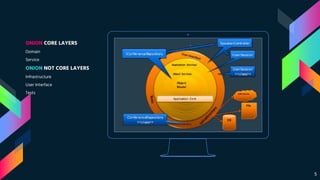
ONION CORE LAYERS
Domain
Service
ONION NOT CORE LAYERS
Infrastructure
User Interface
Tests
5
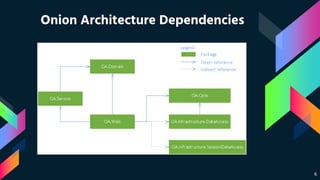
Onion Architecture Dependencies
6
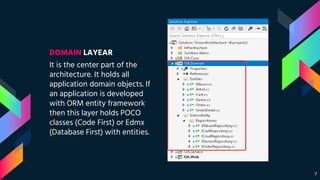
Place DOMAIN LAYER SCREEN
DOMAIN LAYEAR
It is the center part of the
architecture. It holds all
application domain objects. If
an application is developed
with ORM entity framework
then this layer holds POCO
classes (Code First) or Edmx
(Database First) with entities.
7
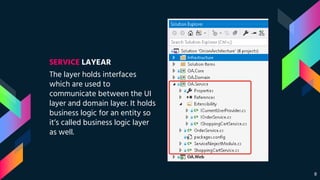
Place Repository LAYER SCREEN
SERVICE LAYEAR
The layer holds interfaces
which are used to
communicate between the UI
layer and domain layer. It holds
business logic for an entity so
it’s called business logic layer
as well.
8
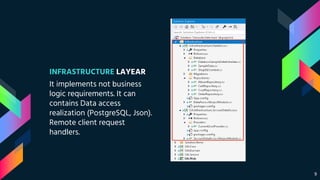
INFRASTRUCTURE LAYEAR
It implements not business
logic requirements. It can
contains Data access
realization (PostgreSQL, Json).
Remote client request
handlers.
9
Place Repository LAYER SCREEN
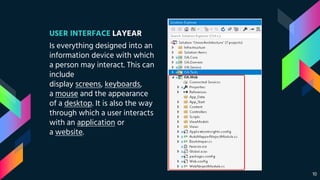
USER INTERFACE LAYEAR
Is everything designed into an
information device with which
a person may interact. This can
include
display screens, keyboards,
a mouse and the appearance
of a desktop. It is also the way
through which a user interacts
with an application or
a website.
10
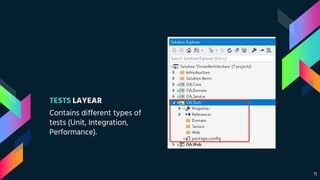
TESTS LAYEAR
Contains different types of
tests (Unit, Integration,
Performance).
11
Onion Architecture
Resources:
› https://blog.thedigitalgroup.com/understanding-onion-architecture
› https://jeffreypalermo.com/2008/07/the-onion-architecture-part-1/
› https://social.technet.microsoft.com/wiki/contents/articles/36655.onion-architecture-in-
asp-net-core-mvc.aspx
You can download application sample:
https://github.com/khdevnet/onion-architecture
12

Onion architecture overview

  • 1.
  • 2.
    Introduction The Onion Architectureterm was coined by Jeffrey Palermo in 2008. This architecture provides a better way to build applications for better testability, maintainability, and dependability on the infrastructures like databases and services. More info on https://jeffreypalermo.com/2008/07/the-onion-architecture-part-1/ 2
  • 3.
    Key tenets ofOnion Architecture › The application is built around an independent object model › Inner layers define interfaces. Outer layers implement interfaces › Direction of coupling is toward the center › All application core code can be compiled and run separate from infrastructure 3
  • 4.
    Advantages of OnionArchitecture › It provides better maintainability as all the codes depend on layers or the center. › It provides better testability as the unit test can be created for separate layers without an effect of other modules of the application. › It develops a loosely coupled application as the outer layer of the application always communicates with inner layer via interfaces. › Any concrete implantation would be provided to the application at run time › Domain entities are core and center part. It can have access to both database and UI layers. › The internal layers never depend on external layer. The code that may have changed should be part of an external layer. 4
  • 5.
    ONION CORE LAYERS Domain Service ONIONNOT CORE LAYERS Infrastructure User Interface Tests 5
  • 6.
  • 7.
    Place DOMAIN LAYERSCREEN DOMAIN LAYEAR It is the center part of the architecture. It holds all application domain objects. If an application is developed with ORM entity framework then this layer holds POCO classes (Code First) or Edmx (Database First) with entities. 7
  • 8.
    Place Repository LAYERSCREEN SERVICE LAYEAR The layer holds interfaces which are used to communicate between the UI layer and domain layer. It holds business logic for an entity so it’s called business logic layer as well. 8
  • 9.
    INFRASTRUCTURE LAYEAR It implementsnot business logic requirements. It can contains Data access realization (PostgreSQL, Json). Remote client request handlers. 9
  • 10.
    Place Repository LAYERSCREEN USER INTERFACE LAYEAR Is everything designed into an information device with which a person may interact. This can include display screens, keyboards, a mouse and the appearance of a desktop. It is also the way through which a user interacts with an application or a website. 10
  • 11.
    TESTS LAYEAR Contains differenttypes of tests (Unit, Integration, Performance). 11
  • 12.
    Onion Architecture Resources: › https://blog.thedigitalgroup.com/understanding-onion-architecture ›https://jeffreypalermo.com/2008/07/the-onion-architecture-part-1/ › https://social.technet.microsoft.com/wiki/contents/articles/36655.onion-architecture-in- asp-net-core-mvc.aspx You can download application sample: https://github.com/khdevnet/onion-architecture 12