Profounding OJT:
Efficiency towards Career Opportunities
By:
JENNY L. LLANO
Asst. Professorial Lecturer II
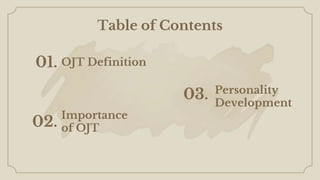
OJT Definition
01.
Importance
of OJT
02.
Personality
Development
03.
Table of Contents
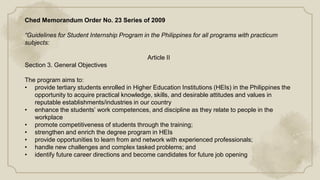
Ched Memorandum Order No. 23 Series of 2009
“Guidelines for Student Internship Program in the Philippines for all programs with practicum
subjects:
Article II
Section 3. General Objectives
The program aims to:
• provide tertiary students enrolled in Higher Education Institutions (HEIs) in the Philippines the
opportunity to acquire practical knowledge, skills, and desirable attitudes and values in
reputable establishments/industries in our country
• enhance the students’ work competences, and discipline as they relate to people in the
workplace
• promote competitiveness of students through the training;
• strengthen and enrich the degree program in HEIs
• provide opportunities to learn from and network with experienced professionals;
• handle new challenges and complex tasked problems; and
• identify future career directions and become candidates for future job opening
1. A great opportunity to learn and tell employers about
it:
An on the job training equips you with these professional skills and also is an amazing
addition to your resume.
2. An insight into what a particular career entails and assess if that
matches with your preference:
With a knowledge of the exact operations of an organization, you can assess your
interests and figure out what you’d like to do as a career. It goes a great way in
providing you clarity on your career goals. This can help you escape those jobs that are
not attractive to you and filter out based on your interests.
Importance of OJT
3. Learn Exactly How it Applies Practically:
Well, whatever best practices you may read in books, an internship offers the
real insights of the industry and how work is done.
Silently observing the operations or shadowing existing employees offer
immense self-growth through observation.
4. Some Worthy Connections for Your Future:
Your internship or on the job training is the best way for some networking
before you step foot in the job world. Those smiles during breaks and short
dialogues will help you build connections.
• Training helps the student to improve performance at work place.
• It adds more diversified experience and abilities while enriching
the self- acquired proficiencies of the students.
• Training helps to minimize the margin of errors at workplace and
most importantly cuts short on the period of time consumed in
completing the work. On the Job Training (O.J.T.) means a
training that occurs in a work place.
Personality
Development
03
Qualities of a good
intern
Appearance
Proper grooming and a professional appearance are important
to gain respect in the workplace. The way you look and carry yourself
creates an impression on the people you work alongside.
Strong interpersonal skills
Interpersonal skills are the behaviors and tactics a person
uses to interact with others effectively. In the business world,
the term refers to an employee's ability to work well with
others. Interpersonal skills range from communication and
listening to attitude and deportment.
Shyness
How to overcome?
1. Adopt a curios mind set
2. Elaborate your response
3. Have a story to share
4. Be present and listen intently
Effective communication
Successful communication helps us
better understand people and
situations. It helps us overcome
diversities, build trust and respect, and
create conditions for sharing creative
ideas and solving problems.
5 skills that are absolutely necessary for successful
communication in the workplace or private life
1. Listening
2. Straight talking
3. Non-verbal communication
4. Stress management
5. Emotion control
Ability to multi-task/Time Management Skills
Managing your time and ability to balance multiple tasks can help you
improve your career. Prioritizing and organizing your day can help you meet
deadlines, remain focused and be proactive. You should be able to multitask
to maintain productivity, which can lead to reaching important goals and
advancing your career.
Multitasking skills
Multitasking consists of many skills that you should develop to be a more productive
professional. Here are the most common skills required for multitasking:
 Organization
 Prioritization
 Scheduling
 Delegation
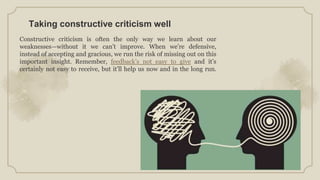
Taking constructive criticism well
Constructive criticism is often the only way we learn about our
weaknesses—without it we can’t improve. When we’re defensive,
instead of accepting and gracious, we run the risk of missing out on this
important insight. Remember, feedback’s not easy to give and it’s
certainly not easy to receive, but it’ll help us now and in the long run.
1. Stop Your First Reaction
2. Listen for Understanding
3. Say Thank You
4. Ask Questions to Deconstruct the Feedback
5. Request Time to Follow Up
Tips on how to handle constructive criticisms
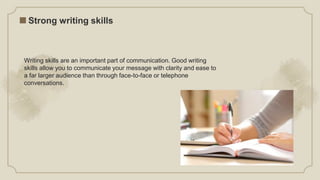
Writing skills are an important part of communication. Good writing
skills allow you to communicate your message with clarity and ease to
a far larger audience than through face-to-face or telephone
conversations.
Strong writing skills
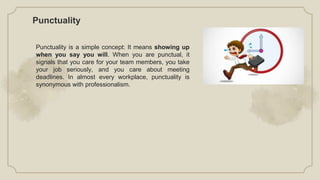
Punctuality
Punctuality is a simple concept: It means showing up
when you say you will. When you are punctual, it
signals that you care for your team members, you take
your job seriously, and you care about meeting
deadlines. In almost every workplace, punctuality is
synonymous with professionalism.
1. Shows your strong character
2. Give you chance to know more people in the workplace
3. Shows that you respect others
4. Gives time to plan your day
5. All set for a meeting
6. Easier to proceed the day
7. Reduces stress
How important is punctuality?
8. No deduction in salary
9. Proves you as reliable:
10. Helps during emergency requirement
11. Boost your self confidence
12. Increase in your output
13. Benefits recommendation
14. Inspire others
15. Makes you a brand
End of slide.
Thank you 

ojt discussion profounding OJT.pptx

  • 1.
    Profounding OJT: Efficiency towardsCareer Opportunities By: JENNY L. LLANO Asst. Professorial Lecturer II
  • 2.
  • 3.
    Ched Memorandum OrderNo. 23 Series of 2009 “Guidelines for Student Internship Program in the Philippines for all programs with practicum subjects: Article II Section 3. General Objectives The program aims to: • provide tertiary students enrolled in Higher Education Institutions (HEIs) in the Philippines the opportunity to acquire practical knowledge, skills, and desirable attitudes and values in reputable establishments/industries in our country • enhance the students’ work competences, and discipline as they relate to people in the workplace • promote competitiveness of students through the training; • strengthen and enrich the degree program in HEIs • provide opportunities to learn from and network with experienced professionals; • handle new challenges and complex tasked problems; and • identify future career directions and become candidates for future job opening
  • 4.
    1. A greatopportunity to learn and tell employers about it: An on the job training equips you with these professional skills and also is an amazing addition to your resume. 2. An insight into what a particular career entails and assess if that matches with your preference: With a knowledge of the exact operations of an organization, you can assess your interests and figure out what you’d like to do as a career. It goes a great way in providing you clarity on your career goals. This can help you escape those jobs that are not attractive to you and filter out based on your interests. Importance of OJT
  • 5.
    3. Learn ExactlyHow it Applies Practically: Well, whatever best practices you may read in books, an internship offers the real insights of the industry and how work is done. Silently observing the operations or shadowing existing employees offer immense self-growth through observation. 4. Some Worthy Connections for Your Future: Your internship or on the job training is the best way for some networking before you step foot in the job world. Those smiles during breaks and short dialogues will help you build connections.
  • 6.
    • Training helpsthe student to improve performance at work place. • It adds more diversified experience and abilities while enriching the self- acquired proficiencies of the students. • Training helps to minimize the margin of errors at workplace and most importantly cuts short on the period of time consumed in completing the work. On the Job Training (O.J.T.) means a training that occurs in a work place.
  • 7.
  • 8.
    Qualities of agood intern
  • 9.
    Appearance Proper grooming anda professional appearance are important to gain respect in the workplace. The way you look and carry yourself creates an impression on the people you work alongside.
  • 10.
    Strong interpersonal skills Interpersonalskills are the behaviors and tactics a person uses to interact with others effectively. In the business world, the term refers to an employee's ability to work well with others. Interpersonal skills range from communication and listening to attitude and deportment.
  • 11.
    Shyness How to overcome? 1.Adopt a curios mind set 2. Elaborate your response 3. Have a story to share 4. Be present and listen intently
  • 12.
    Effective communication Successful communicationhelps us better understand people and situations. It helps us overcome diversities, build trust and respect, and create conditions for sharing creative ideas and solving problems.
  • 13.
    5 skills thatare absolutely necessary for successful communication in the workplace or private life 1. Listening 2. Straight talking 3. Non-verbal communication 4. Stress management 5. Emotion control
  • 14.
    Ability to multi-task/TimeManagement Skills Managing your time and ability to balance multiple tasks can help you improve your career. Prioritizing and organizing your day can help you meet deadlines, remain focused and be proactive. You should be able to multitask to maintain productivity, which can lead to reaching important goals and advancing your career.
  • 15.
    Multitasking skills Multitasking consistsof many skills that you should develop to be a more productive professional. Here are the most common skills required for multitasking:  Organization  Prioritization  Scheduling  Delegation
  • 16.
    Taking constructive criticismwell Constructive criticism is often the only way we learn about our weaknesses—without it we can’t improve. When we’re defensive, instead of accepting and gracious, we run the risk of missing out on this important insight. Remember, feedback’s not easy to give and it’s certainly not easy to receive, but it’ll help us now and in the long run.
  • 17.
    1. Stop YourFirst Reaction 2. Listen for Understanding 3. Say Thank You 4. Ask Questions to Deconstruct the Feedback 5. Request Time to Follow Up Tips on how to handle constructive criticisms
  • 18.
    Writing skills arean important part of communication. Good writing skills allow you to communicate your message with clarity and ease to a far larger audience than through face-to-face or telephone conversations. Strong writing skills
  • 19.
    Punctuality Punctuality is asimple concept: It means showing up when you say you will. When you are punctual, it signals that you care for your team members, you take your job seriously, and you care about meeting deadlines. In almost every workplace, punctuality is synonymous with professionalism.
  • 20.
    1. Shows yourstrong character 2. Give you chance to know more people in the workplace 3. Shows that you respect others 4. Gives time to plan your day 5. All set for a meeting 6. Easier to proceed the day 7. Reduces stress How important is punctuality?
  • 21.
    8. No deductionin salary 9. Proves you as reliable: 10. Helps during emergency requirement 11. Boost your self confidence 12. Increase in your output 13. Benefits recommendation 14. Inspire others 15. Makes you a brand
  • 22.