




World of Work Report 2012
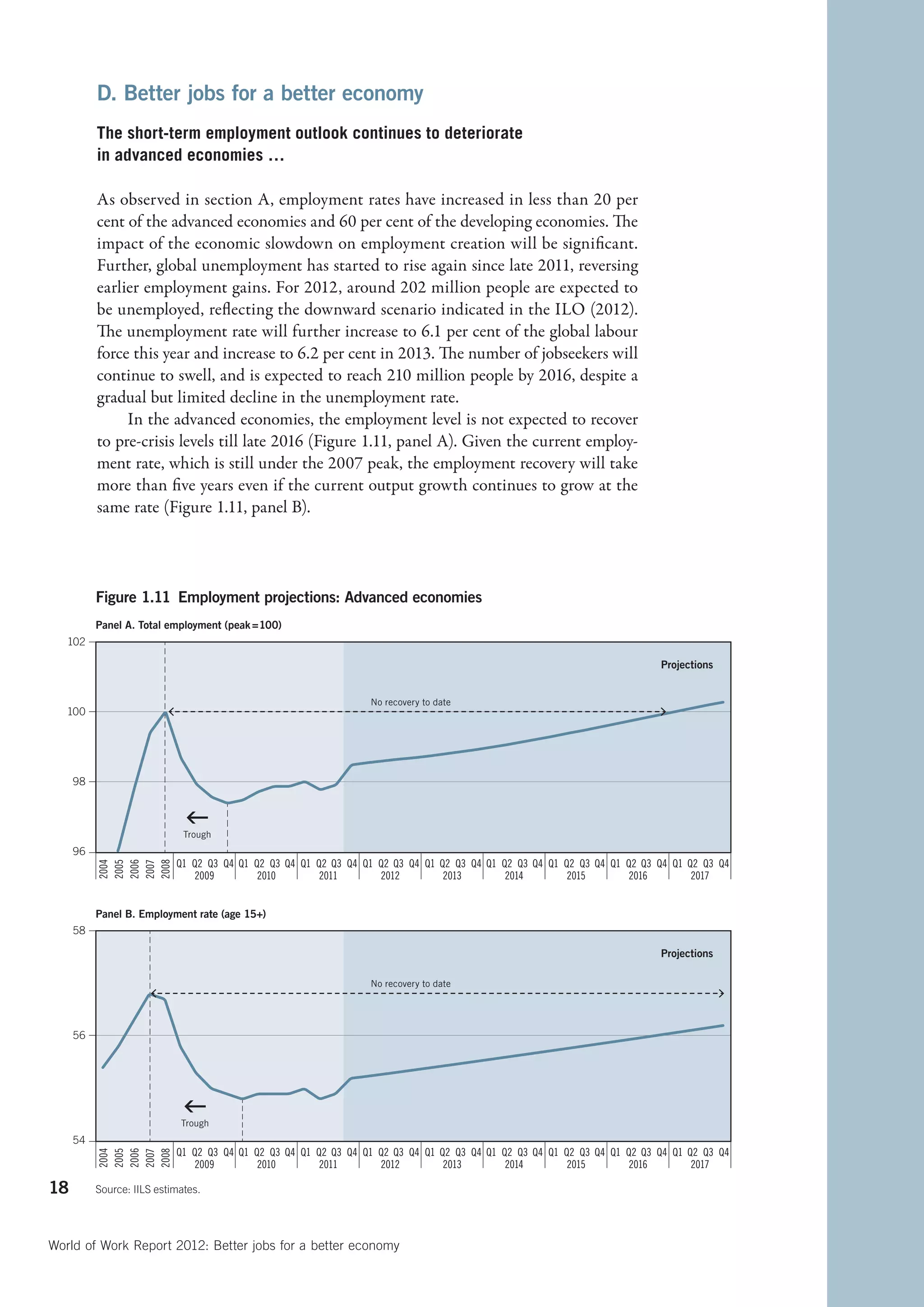
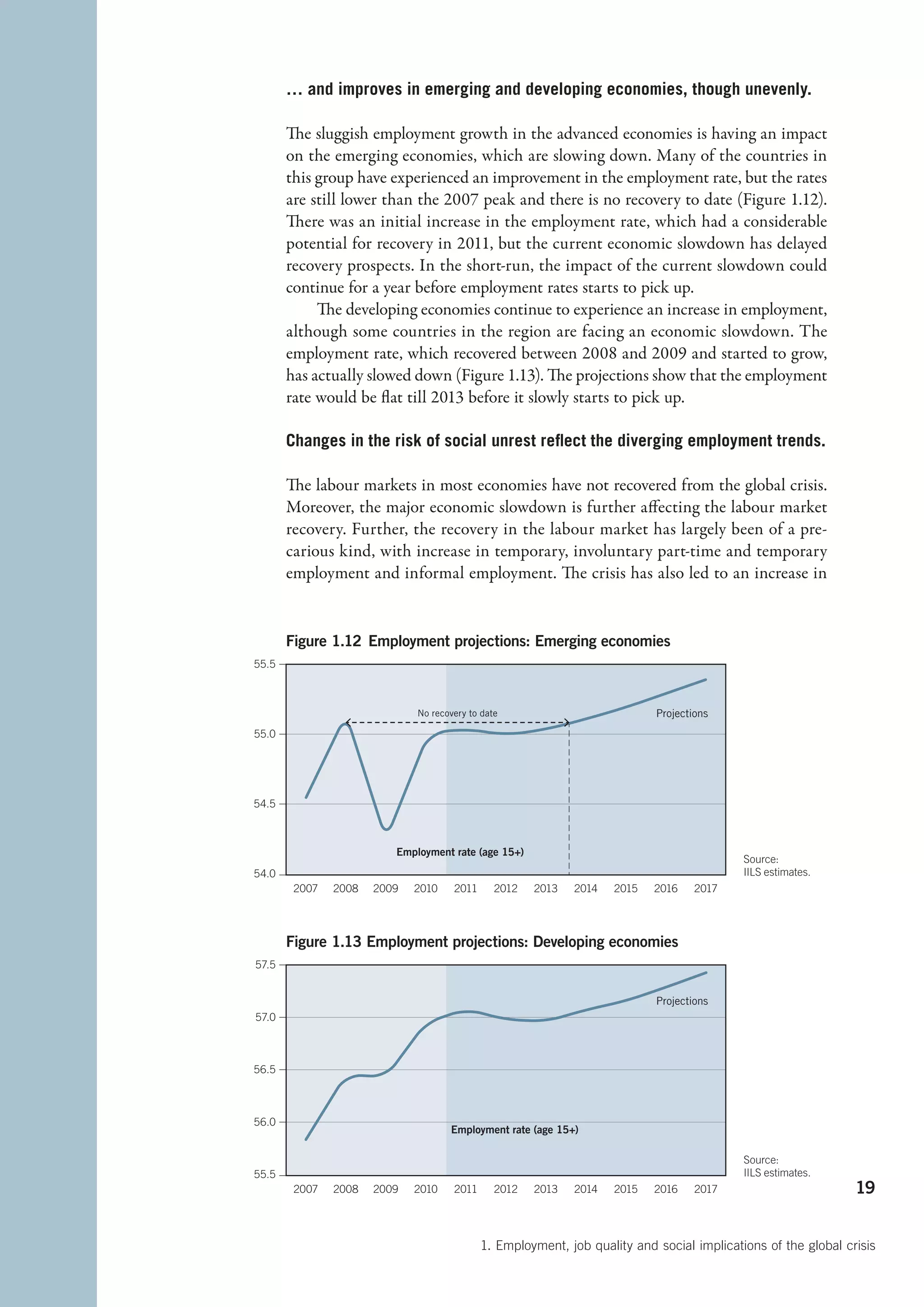
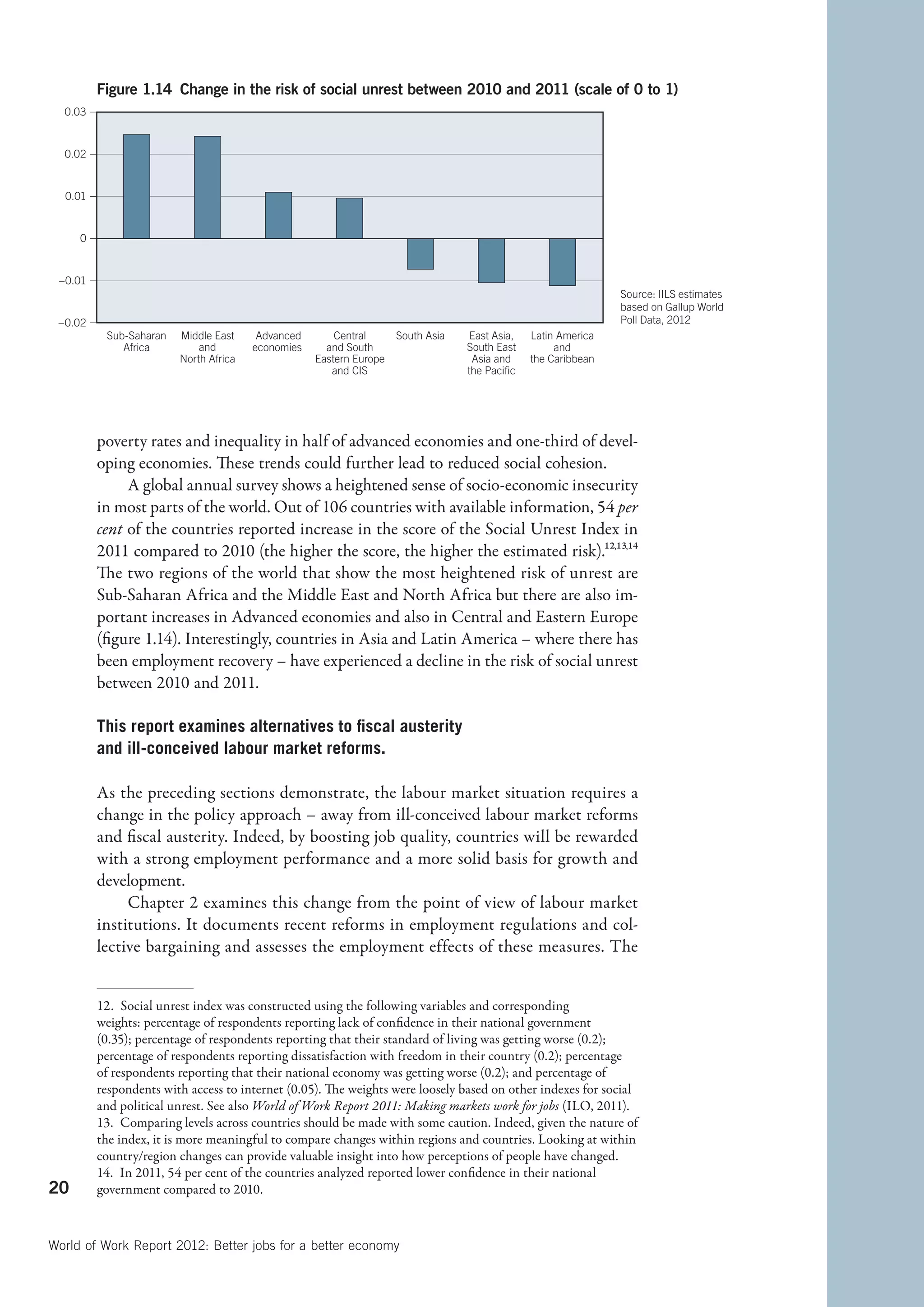
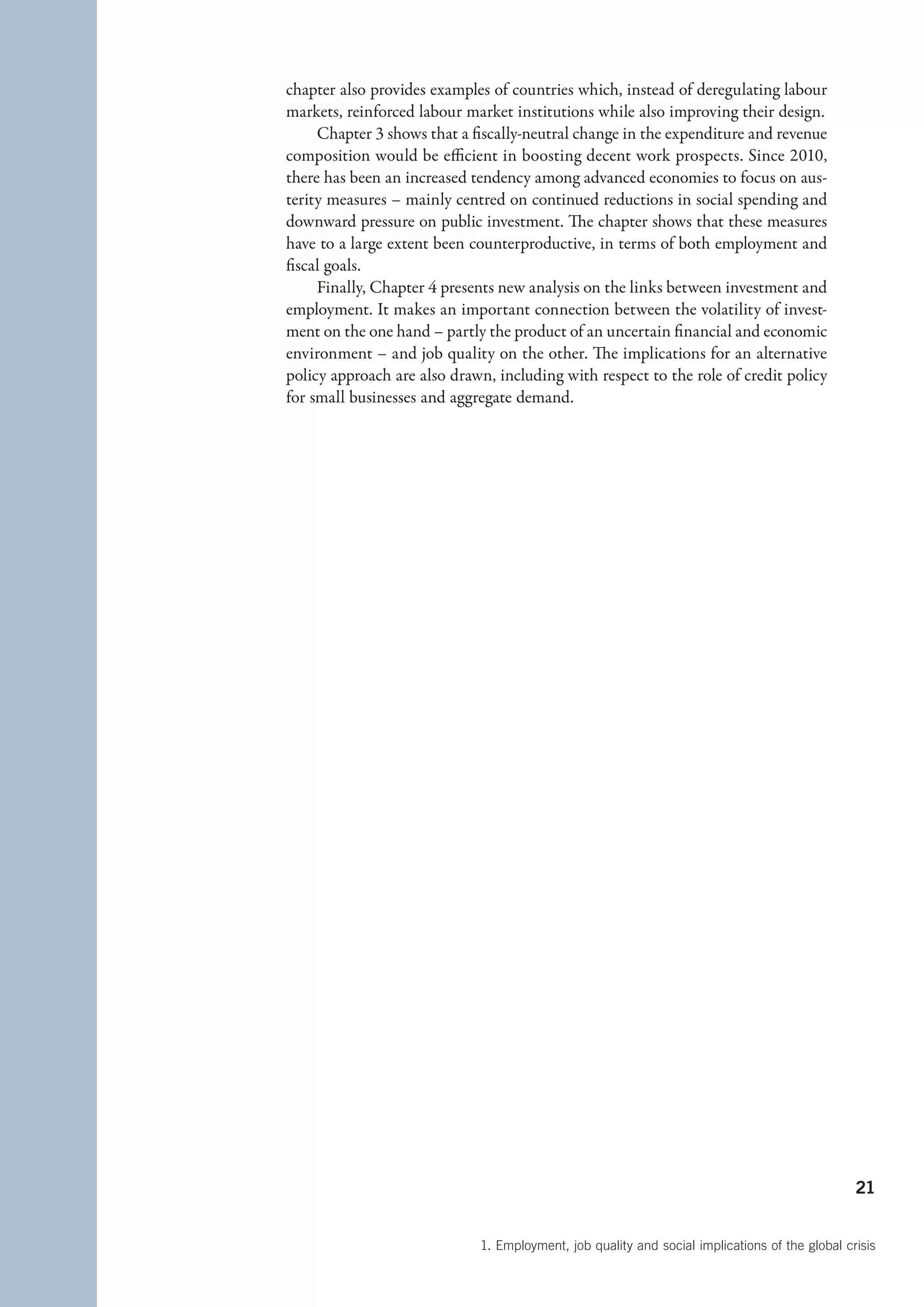
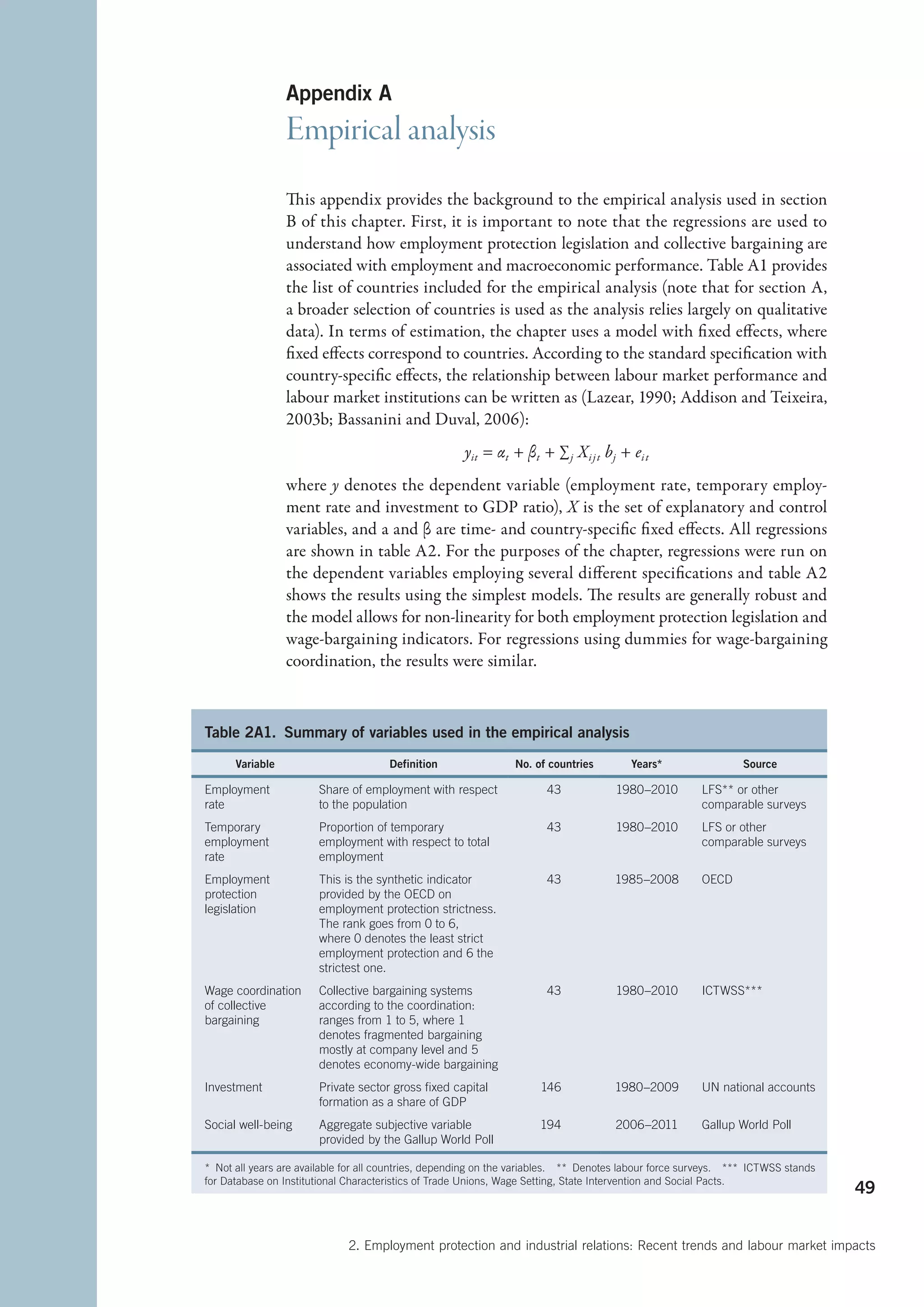
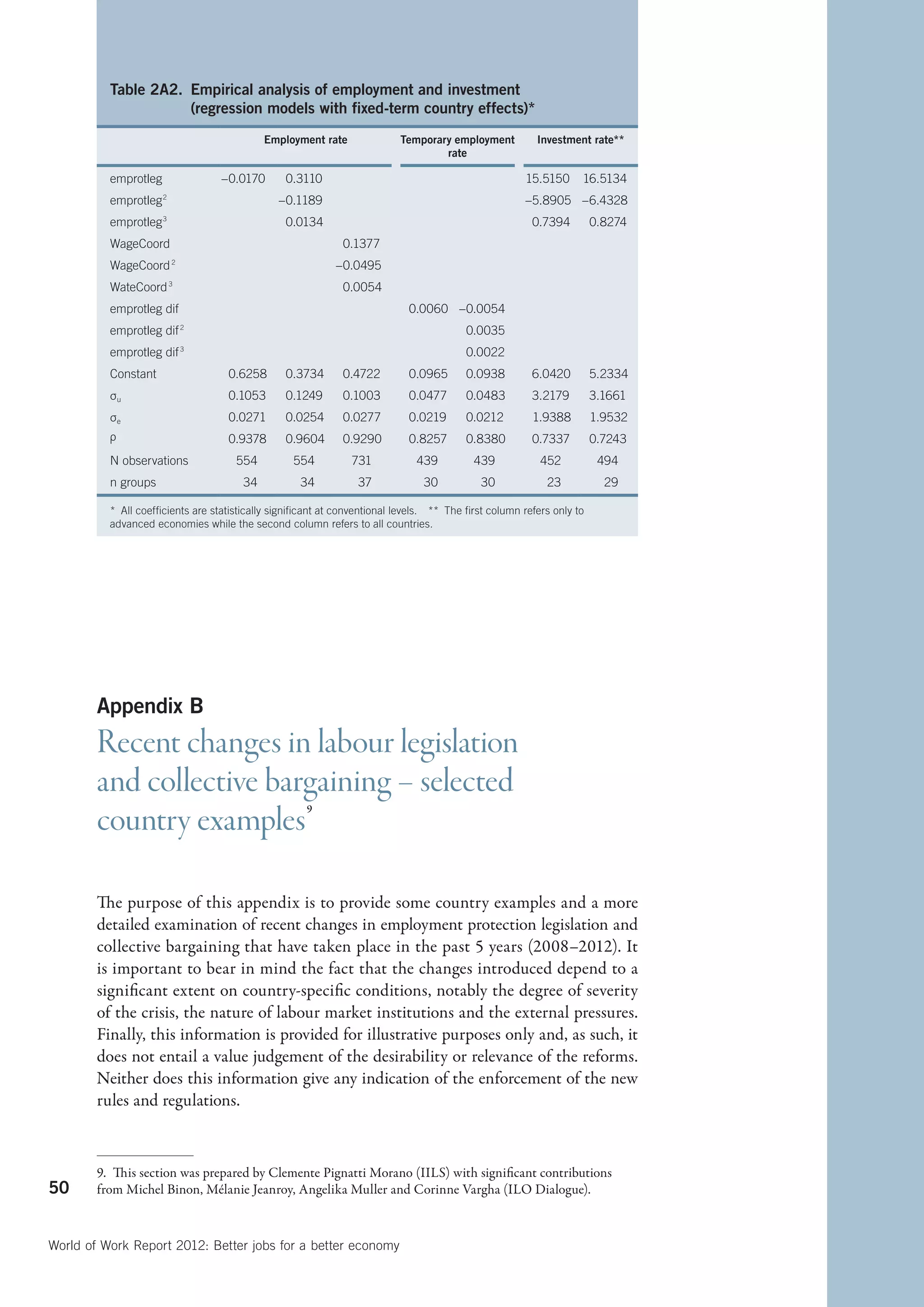
Better jobs for a better economy


  INTERNATIONAL LABOUR ORGANIZATION
  INTERNATIONAL INSTITUTE FOR LABOUR STUDIES
Published by the International Institute for Labour Studies
The International Institute for Labour Studies (IILS) was established in 1960 as an autonomous facility
of the International Labour Organization (ILO) to further policy research, public debate and the sharing
of knowledge on emerging labour and social issues of concern to the ILO and its constituents – labour,
business and government.


Copyright © International Labour Organization (International Institute for Labour Studies)
2012.
Short excerpts from this publication may be reproduced without authorization, on condition that the
source is indicated. For rights of reproduction or translation, application should be made to the Director,
International Institute for Labour Studies, P.O. Box 6, CH-1211 Geneva 22, Switzerland.


ISBN  978-92-9251-009-1 (print)
ISBN  978-92-9251-010-7 (web pdf)
ISSN  2049-9272 (print)
ISSN  2049-9280 (web)


First published 2012 by
International Labour Office
CH-1211 Geneva 22, Switzerland
www.ilo.org
Co-published in South Asia by
Academic Foundation,
4772/23 Bharat Road, (23 Ansari Road), Darya Ganj,
New Delhi – 110002, India
www.academicfoundation.com


World of work report 2010 : Better jobs for a better economy/International Labour Office.
– Geneva: ILO, 2012
International Labour Office
employment / unemployment / crisis / social unrest / debt / austerity / employment protection /
developed countries / developing countries


                                                                      ILO Cataloguing in Publication Data


The responsibility for opinions expressed in signed articles, studies and other contributions of this volume
rests solely with their authors, and their publication does not constitute an endorsement by the Inter-
national Institute for Labour Studies of the opinions expressed.
Copies can be ordered from: ILO Publications, International Labour Office, CH-1211 Geneva 22,
Switzerland. For on-line orders, see www.ilo.org/publns


Graphic design in Switzerland                                                                         ALI
Photocomposed in Switzerland                                                                          WEI
Printed in Switzerland                                                                                ATA
The International Institute for Labour Studies was established
by the International Labour Organization in 1960 as an autonomous centre
for advanced studies in the social and labour field.


    Who are the authors of World of Work Report 2012?
     
    The report has been prepared by staff of the International Institute for
    Labour Studies, with inputs from other ILO colleagues, and is published
    under the responsibility of the Institute’s Director. Chapter authors are:
    c	 Editorial: Raymond Torres
    c	 Uma Rani, Federico Curci and Pelin Sekerler Richiardi (Chapter 1)
    c	 Sandrine Cazes (Employment Sector), Sameer Khatiwada and
       Miguel Angel Malo (Universidad de Salamanca) (Chapter 2)
    c	 Verónica Escudero and Elva López Mourelo (Chapter 3)
    c	 Marva Corley-Coulibaly and Daniel Samaan (Chapter 4)

    Raymond Torres edited and coordinated the Report. Steven Tobin pro-
    vided contributions to Chapters 2 and 3. Matthieu Charpe and Stefan
    Kühn developed simulations of different policy options, based on the
    Global Economic Linkages (GEL) model.


    We are grateful to the ILO Director-General for his stimulating guidance.

    Excellent feedback on earlier versions of the report was provided by the
    Institute’s Expert Group, which includes: Werner Eichhorst, Richard
    Freeman, Maria Jepsen, Johannes Jütting, Frédéric Lerais, Isabel Ortiz,
    Marcio Pochmann, Alakh Sharma, Nikolai Staehler, Dannielle Venn and
    Robert P. Vos.

    Our thanks to ILO colleagues in the Social Dialogue Sector who provided
    very helpful comments especially Michel Binon, Susan Hayter, Mélanie
    Jeanroy, Angelika Muller and Corinne Vargha. In addition, we are
    grateful to the Trends Unit of the ILO Employment Sector for providing
    the global unemployment projections.


                                                                                 v


Editorial


How to move out
of the austerity trap?
Raymond Torres
Director
International Institute for Labour Studies


The employment situation is deteriorating in Europe
and is no longer improving in many other countries …

Over the past year, labour markets have been affected by the slowdown in global
growth. This is all the more problematic because labour markets had not fully
recovered from the global crisis that erupted in 2008: there is still a deficit of
around 50 million jobs in comparison to the pre-crisis situation (Chapter 1). It is
unlikely that the world economy will grow at a sufficient pace over the next couple
of years to both close the existing jobs deficit and provide employment for the over
80 million people expected to enter the labour market during this period.
      The trends are especially worrying in Europe, where the unemployment rate
has increased in nearly two-thirds of these countries since 2010; but labour market
recovery has also stalled in other advanced economies, such as Japan and the
United States. Elsewhere, employment gains have weakened in terms of the needs
of a growing, better educated working-age population, as in China. And jobs def-
icits remain acute in much of the Arab region and Africa.

… as a result, the global jobs crisis has entered a new,
more structural phase.

This is not a normal employment slowdown. Four years into the global crisis,
labour market imbalances are becoming more structural, and therefore more diffi-
cult to eradicate. Certain groups, such as the long-term unemployed, are at risk of
exclusion from the labour market. This means that they would be unable to obtain
new employment even if there were a strong recovery.
     In addition, for a growing proportion of workers who do have a job, employ-
ment has become more unstable or precarious. In advanced economies, involuntary
part-time employment and temporary employment have increased in two-thirds
and more than half of these economies, respectively. The share of informal employ-
ment remains high, standing at more than 40 per cent in two-thirds of emerging         vii
and developing countries for which data are available. Women and youth are dis-
        proportionately affected by unemployment and job precariousness. In particular,
        youth unemployment rates have increased in about 80 per cent of advanced econ-
        omies and in two-thirds of developing economies.
              Job instability is, above all, a human tragedy for workers and their families;
        but it also entails a waste of productive capacity, as skills tend to be lost as a result
        of excessive rotation between jobs and long periods of unemployment or inactivity.
        More job instability therefore means weaker productivity gains in the future and
        less room for prospering and moving up the career ladder.
              The jobs deficit is going hand-in-hand with a prolonged investment def-
        icit – another sign that the crisis has entered a new phase. The amount of unin-
        vested cash in the accounts of large firms has reached unprecedented levels
        (Chapter 4) while, in the case of advanced economies, small firms continue to have
        difficulty accessing credit that would allow them to invest and create jobs. Impor-
        tantly, the Report finds that investment has become more volatile, and that this
        has exacerbated job precariousness in advanced economies as well as in emerging
        and developing ones.
              Finally, society is becoming increasingly anxious about the lack of decent jobs.
        In 57 out of 106 countries, the Social Unrest Index, developed for the purposes of
        this Report, increased in 2011 compared to 2010. Europe, the Middle East, North
        Africa and sub-Saharan Africa show the most heightened risk of social unrest. On
        average, Latin America – where there has been a degree of employment recovery
        and, in a few cases, improvements in job quality – has experienced a decline in the
        risk of social unrest.

        The worsening situation reflects the austerity trap
        in advanced economies, primarily in Europe …

        Since 2010, and despite the job-friendly statements in successive G20 meetings
        and other global forums, the policy strategy has shifted its focus away from job
        creation and improvement and concentrated instead on cutting fiscal deficits at
        all costs. In European countries, cutting fiscal deficits has been deemed essential
        for calming financial markets. But even in countries which have not suffered from
        the effects of the crisis this remedy is being applied for pre-emptive reasons – fiscal
        deficits are being reduced to avert any negative reactions from financial markets.
        This approach was intended to pave the way for greater investment and growth,
        along with lower fiscal deficits.
             In addition, as part of the policy shift, the majority of advanced economies
        have relaxed employment regulations and weakened labour market institutions
        (Chapter 2), and more deregulation measures have been announced. These steps
        are being taken in the hope that financial markets will react positively, thereby
        boosting confidence, growth and job creation.
             However, these expectations have not been met. In countries that have
        pursued austerity and deregulation to the greatest extent, principally those in
        Southern Europe, economic and employment growth have continued to deterio-
        rate. The measures also failed to stabilize fiscal positions in many instances. The
        fundamental reason for these failures is that these policies – implemented in a con-
        text of limited demand prospects and with the added complication of a banking
        system in the throes of its “deleveraging” process – are unable to stimulate pri-
        vate investment. The austerity trap has sprung. Austerity has, in fact, resulted in
viii    weaker economic growth, increased volatility and a worsening of banks’ balance


World of Work Report 2012: Better jobs for a better economy
sheets leading to a further contraction of credit, lower investment and, conse-
quently, more job losses. Ironically, this has adversely affected government budgets,
thus increasing the demands for further austerity. It is a fact that there has been
little improvement in fiscal deficits in countries actively pursuing austerity policies
(Chapter 3).
      With regard to deregulation policies, the Report finds that they will fail to
boost growth and employment in the short term – the key time horizon in a crisis
situation. Indeed, the employment effects of labour market reforms depend heavily
on the business cycle. In the face of a recession, less stringent regulation may lead
to more redundancies without supporting job creation. Likewise, the weakening
of collective bargaining is likely to provoke a downward spiral of wages, thereby
delaying recovery further.
      In general, the Report confirms findings from earlier studies that show there
is no clear link between labour market reforms and employment levels. Interest-
ingly, within the range in which the majority of countries lie, adequate employ-
ment regulations tend to be positively associated with employment. Beyond that,
badly designed regulations may adversely affect labour market performance. In
these cases, there are grounds for considering reforms as part of social dialogue and
in conjunction with social protection measures. This policy has been successfully
pursued in the recent past in countries such as Austria and Brazil.

… but spreading to other countries.

Many emerging and developing countries pursued a strategy of boosting domestic
demand in order to compensate for weaker prospects for exporting to advanced
economies. There are signs that in some of these countries, such as India, Latin
America, South Africa and, more recently, China, wages have grown to catch up
with productivity. Public investment and social protection have also been rein-
forced and regional integration has proved helpful.
     Nevertheless, even in these countries, labour markets and real investment
are not immune to the global economic weakening. Volatile capital flows has
also aggravated the instability of the real economy and the possibility for creating
better jobs.
     It is therefore crucial to pursue further the present approach of boosting
domestic demand, complementing it with better enforcement of core labour stand-
ards and measures to avoid destabilizing capital flows.

An alternative approach exists …

It is possible to move away from the austerity trap. Last year’s World of Work Report
offered a three-pronged approach, which remains valid today. First, labour market
institutions should be strengthened so that wages grow in line with productivity,
starting in surplus economies. In the current situation, consideration could be
given to a careful and coordinated increase in the minimum wage. Further efforts
                                                                        ­
to implement core labour standards would also be helpful, especially in emerging
and developing countries where gaps exist. Ratifying ILO core Conventions in all
G20 countries would give a positive signal in this respect.
      Second, it is critical to restore credit conditions and create a more favourable
business environment for small enterprises. The issue is particularly pressing in the
Euro-zone countries, where the policy of the Central Bank to provide liquidity to
banks has failed to boost credit to the real economy. There may also be a case for              ix


                                                                                          Editorial
higher taxation of firms that do not reinvest profits, and/or lower taxation of firms
        that emphasize investment and job creation.
             Third, it is possible to promote employment while meeting fiscal goals. The
        Report shows that a fiscally neutral change in the composition of expenditures
        and revenues would create between 1.8 and 2.1 million jobs within 1 to 2 years.
        In the case of emerging and developing countries, efforts should be centred on
        public investment and social protection to reduce poverty and income inequality
        and to stimulate aggregate demand. For advanced economies, the focus should be
        on ensuring that unemployed people, especially youth, receive adequate support
        to find new jobs.
             More fundamentally, it is high time for a move towards a growth- and job-
        orientated strategy. This would help to coordinate policies and avert further conta-
        gion caused by fiscal austerity. In Europe, the strategy could include a coordinated
        approach to solving the debt crisis, for which innovative funding mechanisms and
        improved utilization of European Structural Funds – properly reformed in order
        to better tackle present job deficits — would be instrumental.

        … which requires embracing the perception that job-friendly policies
        have a positive effect on the economy and that the voice of finance
        should not drive policy-making.

        The current policy approach reflects the premise that growth follows austerity and
        that, in turn, jobs follow growth. According to this view, the main thrust of efforts
        to date has therefore focused on cutting deficits and restoring global growth to
        positive territory with the view that, soon thereafter, job creation would follow. As
        a consequence, more direct efforts to stimulate job creation and boost the incomes
        of those most vulnerable to the crisis have been of secondary importance.
             Since there are now indications that these premises have proved counterpro-
        ductive, it is vital to demonstrate that an alternative, job-centred approach out-
        lined above exists. It is also imperative to nurture this alternative approach with
        concrete examples of policies that work, in which ILO has played a key role via
        the adoption of the Global Jobs Pact and could play a greater role as a forum for
        policy analysis.
             Another factor at work has been the imbalance between the voice of the real
        economy and that of the financial sector. Both are important, but both need to
        be heard. To remedy this, consideration could first be given to the creation of
        national employment and social observatories. This step could help to identify an
        upper bound to the level of unemployment beyond which new measures will be
        needed – in much the same way as for inflation or fiscal targets. The task could
        be facilitated by the establishment of independent and authoritative observatories
        to monitor and forecast trends in the labour market, which could be charged with
        providing independent evaluations of the employment impact of policy proposals.
        Their remit would be to forewarn governments against the adoption or continua-
        tion of policies that are unlikely to achieve the unemployment goals.
             Second, there is a strong case for establishing consultative national forums,
        where economic and social policies are discussed by government and the social
        partners. Although outcomes will not be binding, such consultations can provide
        important feedback to governments on the current state of the labour market and
        outlook for unemployment. The forum could also play a central role in collabo-
        rating and consulting with the national observatory or agency created to monitor
x       and assess labour market developments and policy impacts.


World of Work Report 2012: Better jobs for a better economy
Finally, national efforts to shift to policies that will ensure higher levels of
employment will be greatly facilitated by reforms in the governance of the global
economy. The key objective of this reform is to provide a high and stable level
of effective demand in the global economy. This will entail: (i) ensuring effective
global coordination of economic policies to eliminate “beggar-my-neighbour”
policies that lead to global imbalances and restrict potential global growth;
(ii) removing the constant threat to global economic stability from volatile and
unregulated cross-border financial flows; and (iii) developing coordinated macro-
economic policies for dealing with future global economic crises.
      In short, this Report calls for countries to put in place the necessary condi-
tions for a dramatic shift in the current policy approach. It highlights the need
for an approach that recognizes the importance of placing jobs at the top of the
policy agenda and the need for coherence among macroeconomic, employment
and social policies. This requires a significant change in domestic and global gov-
ernance, which is a complex task. Though the task is demanding, even progressive
steps in this direction will be rewarded with better job prospects and a more effi-
cient economy.


                                                                                               xi


                                                                                         Editorial
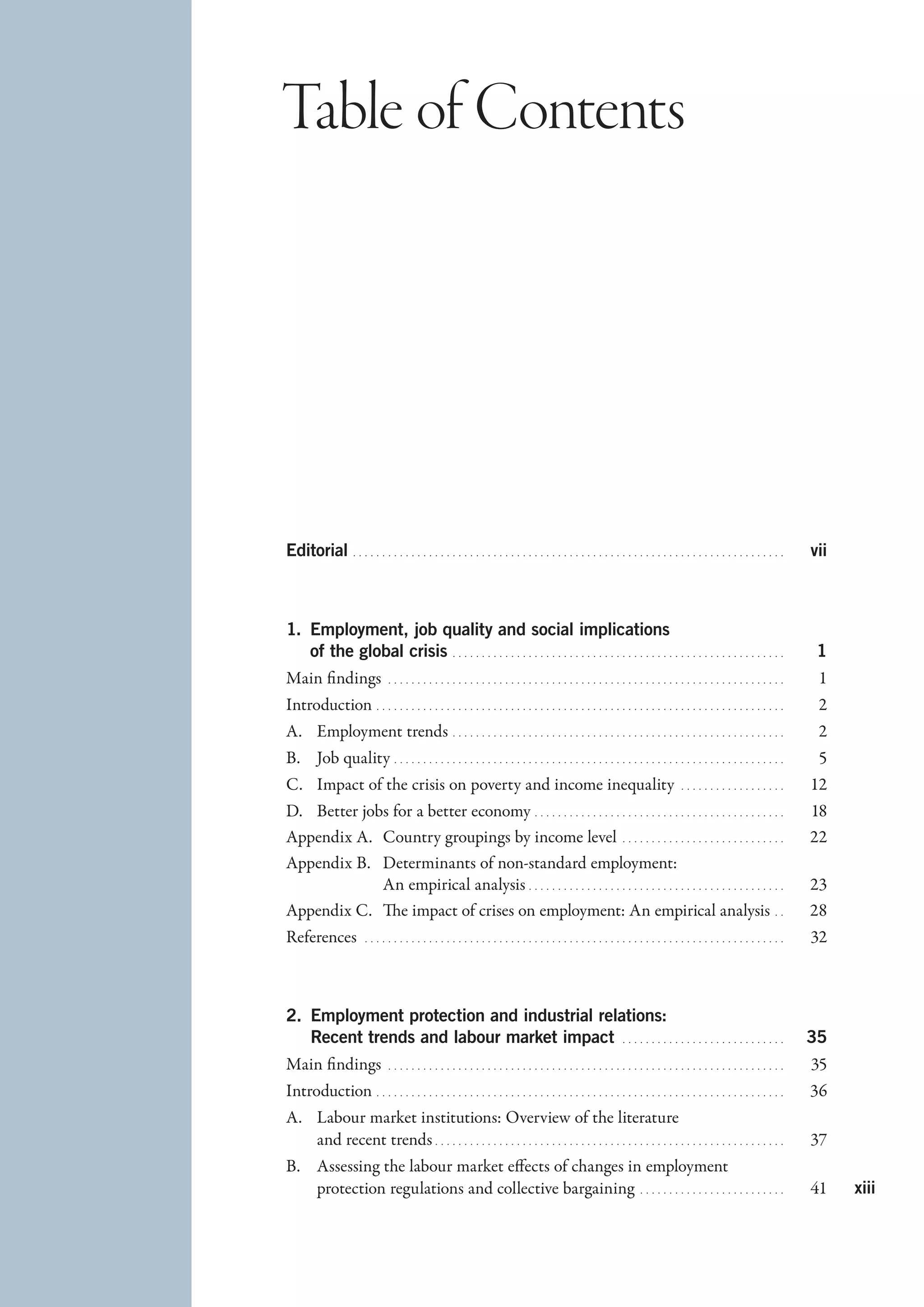
Table of Contents


Editorial   . . . . . . . . . . . . . . . . . . . . . . . . . . . . . . . . . . . . . . . . . . . . . . . . . . . . . . . . . . . . . . . . . . . . . . . . . . 	vii


1.  mployment, job quality and social implications
   E
   of the global crisis   . . . . . . . . . . . . . . . . . . . . . . . . . . . . . . . . . . . . . . . . . . . . . . . . . . . . . . . . . 	1
Main findings   . . . . . . . . . . . . . . . . . . . . . . . . . . . . . . . . . . . . . . . . . . . . . . . . . . . . . . . . . . . . . . . . . . . . . 	1
Introduction   . . . . . . . . . . . . . . . . . . . . . . . . . . . . . . . . . . . . . . . . . . . . . . . . . . . . . . . . . . . . . . . . . . . . . . 	2
A.	 Employment trends   . . . . . . . . . . . . . . . . . . . . . . . . . . . . . . . . . . . . . . . . . . . . . . . . . . . . . . . . . 	2
B.	 Job quality   . . . . . . . . . . . . . . . . . . . . . . . . . . . . . . . . . . . . . . . . . . . . . . . . . . . . . . . . . . . . . . . . . . . 	5
C.	 Impact of the crisis on poverty and income inequality   . . . . . . . . . . . . . . . . . . . 	12
D.	 Better jobs for a better economy   . . . . . . . . . . . . . . . . . . . . . . . . . . . . . . . . . . . . . . . . . . . 	18
Appendix A.	 Country groupings by income level   . . . . . . . . . . . . . . . . . . . . . . . . . . . . . 	22
Appendix B.	 Determinants of non-standard employment:
              An empirical analysis   . . . . . . . . . . . . . . . . . . . . . . . . . . . . . . . . . . . . . . . . . . . . 	23
Appendix C.	 The impact of crises on employment: An empirical analysis   . . 	28
References   . . . . . . . . . . . . . . . . . . . . . . . . . . . . . . . . . . . . . . . . . . . . . . . . . . . . . . . . . . . . . . . . . . . . . . . . . 	32


2.  mployment protection and industrial relations:
   E
   Recent trends and labour market impact  . . . . . . . . . . . . . . . . . . . . . . . . . . . . . 	35
Main findings   . . . . . . . . . . . . . . . . . . . . . . . . . . . . . . . . . . . . . . . . . . . . . . . . . . . . . . . . . . . . . . . . . . . . . 	35
Introduction   . . . . . . . . . . . . . . . . . . . . . . . . . . . . . . . . . . . . . . . . . . . . . . . . . . . . . . . . . . . . . . . . . . . . . . 	36
A.	 Labour market institutions: Overview of the literature
    and recent trends   . . . . . . . . . . . . . . . . . . . . . . . . . . . . . . . . . . . . . . . . . . . . . . . . . . . . . . . . . . . . 	37
B.	 Assessing the labour market effects of changes in employment
    protection regulations and collective bargaining  . . . . . . . . . . . . . . . . . . . . . . . . . 	41                                                            xiii
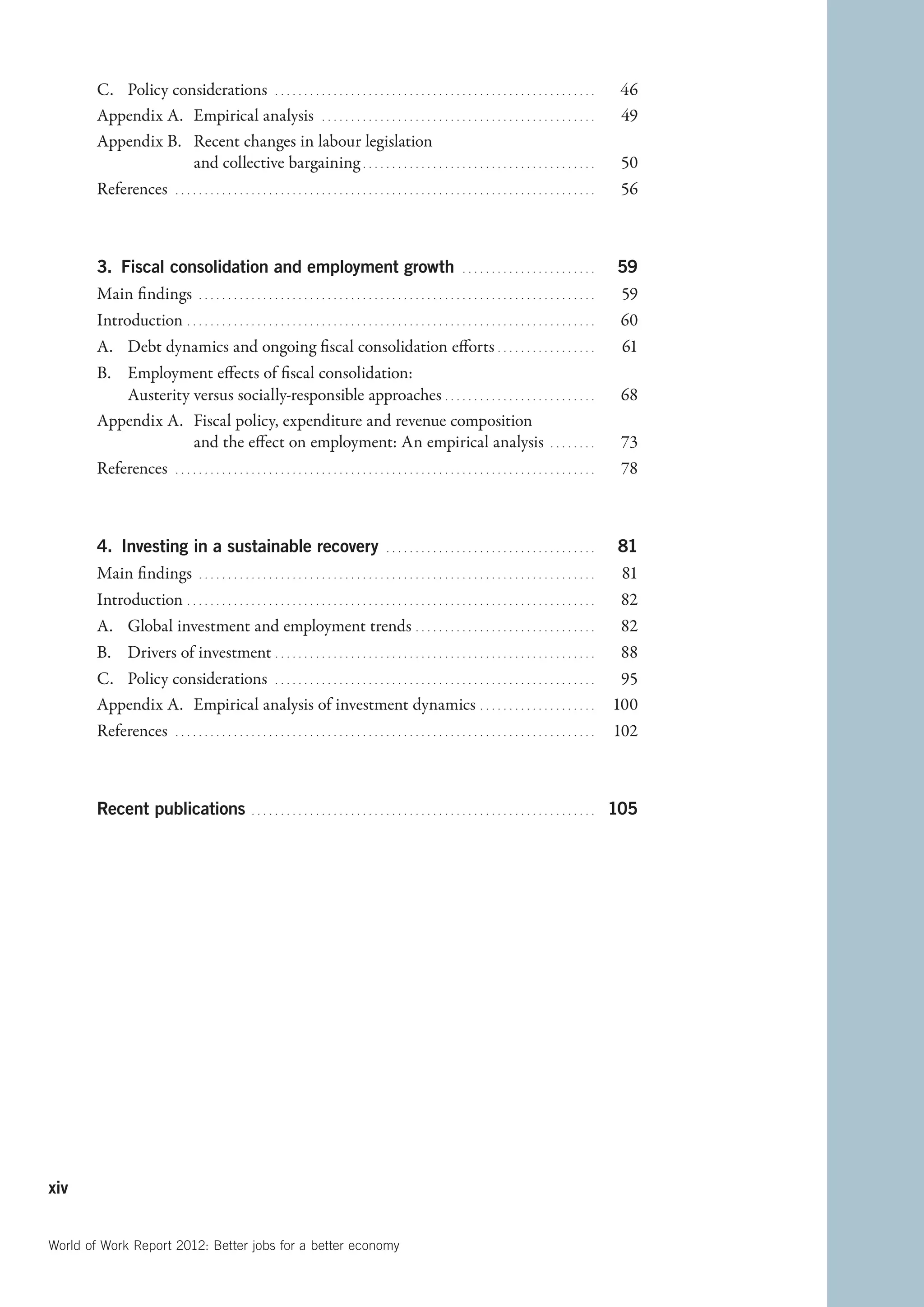
C.	 Policy considerations   . . . . . . . . . . . . . . . . . . . . . . . . . . . . . . . . . . . . . . . . . . . . . . . . . . . . . . . . 	46
        Appendix A.	 Empirical analysis   . . . . . . . . . . . . . . . . . . . . . . . . . . . . . . . . . . . . . . . . . . . . . . . . 	49
        Appendix B.	 Recent changes in labour legislation
                            and collective bargaining   . . . . . . . . . . . . . . . . . . . . . . . . . . . . . . . . . . . . . . . . 	50
        References   . . . . . . . . . . . . . . . . . . . . . . . . . . . . . . . . . . . . . . . . . . . . . . . . . . . . . . . . . . . . . . . . . . . . . . . . . 	56


        3.  iscal consolidation and employment growth  . . . . . . . . . . . . . . . . . . . . . . . . 	59
            F
        Main findings   . . . . . . . . . . . . . . . . . . . . . . . . . . . . . . . . . . . . . . . . . . . . . . . . . . . . . . . . . . . . . . . . . . . . . 	59
        Introduction   . . . . . . . . . . . . . . . . . . . . . . . . . . . . . . . . . . . . . . . . . . . . . . . . . . . . . . . . . . . . . . . . . . . . . . 	60
        A.	 Debt dynamics and ongoing fiscal consolidation efforts   . . . . . . . . . . . . . . . . . 	61
        B.	 Employment effects of fiscal consolidation:
             Austerity versus socially-responsible approaches   . . . . . . . . . . . . . . . . . . . . . . . . . . 	68
        Appendix A.	 Fiscal policy, expenditure and revenue composition
                            and the effect on employment: An empirical analysis   . . . . . . . . . 	73
        References   . . . . . . . . . . . . . . . . . . . . . . . . . . . . . . . . . . . . . . . . . . . . . . . . . . . . . . . . . . . . . . . . . . . . . . . . . 	78


        4.  Investing in a sustainable recovery  . . . . . . . . . . . . . . . . . . . . . . . . . . . . . . . . . . . . . 	81
        Main findings   . . . . . . . . . . . . . . . . . . . . . . . . . . . . . . . . . . . . . . . . . . . . . . . . . . . . . . . . . . . . . . . . . . . . . 	81
        Introduction   . . . . . . . . . . . . . . . . . . . . . . . . . . . . . . . . . . . . . . . . . . . . . . . . . . . . . . . . . . . . . . . . . . . . . . 	82
        A.	 Global investment and employment trends   . . . . . . . . . . . . . . . . . . . . . . . . . . . . . . . 	82
        B.	 Drivers of investment   . . . . . . . . . . . . . . . . . . . . . . . . . . . . . . . . . . . . . . . . . . . . . . . . . . . . . . . 	88
        C.	 Policy considerations   . . . . . . . . . . . . . . . . . . . . . . . . . . . . . . . . . . . . . . . . . . . . . . . . . . . . . . . . 	95
        Appendix A.	 Empirical analysis of investment dynamics   . . . . . . . . . . . . . . . . . . . . 	100
        References   . . . . . . . . . . . . . . . . . . . . . . . . . . . . . . . . . . . . . . . . . . . . . . . . . . . . . . . . . . . . . . . . . . . . . . . . . 	102


        Recent publications  . . . . . . . . . . . . . . . . . . . . . . . . . . . . . . . . . . . . . . . . . . . . . . . . . . . . . . . . . . . . 	105


xiv


World of Work Report 2012: Better jobs for a better economy
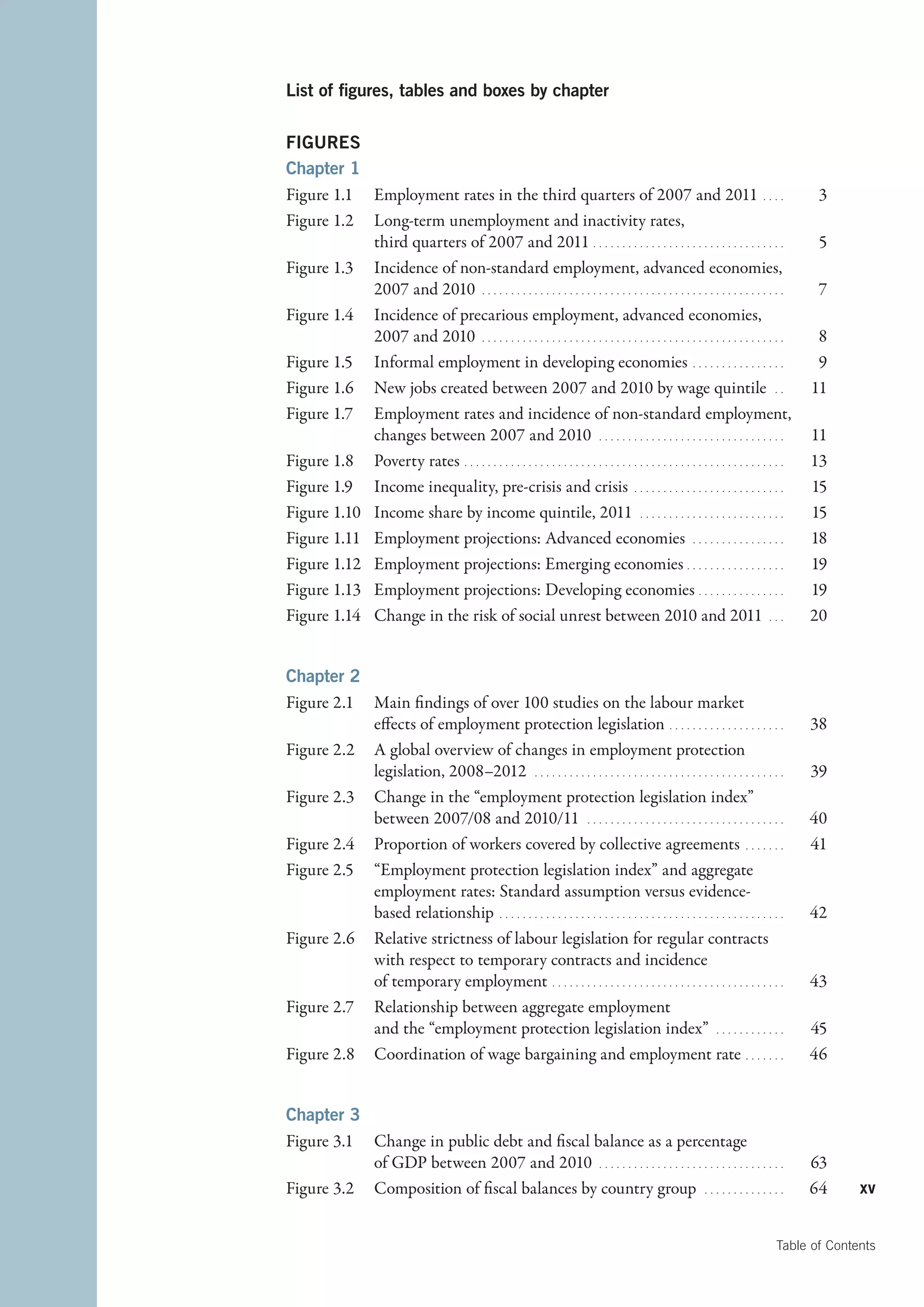
List of figures, tables and boxes by chapter

FIGURES
Chapter 1
Figure 1.1	 Employment rates in the third quarters of 2007 and 2011   . . . . 	3
Figure 1.2	 Long-term unemployment and inactivity rates,
             third quarters of 2007 and 2011   . . . . . . . . . . . . . . . . . . . . . . . . . . . . . . . . . 	5
Figure 1.3	 Incidence of non-standard employment, advanced economies,
             2007 and 2010   . . . . . . . . . . . . . . . . . . . . . . . . . . . . . . . . . . . . . . . . . . . . . . . . . . . . . 	7
Figure 1.4	 Incidence of precarious employment, advanced economies,
             2007 and 2010   . . . . . . . . . . . . . . . . . . . . . . . . . . . . . . . . . . . . . . . . . . . . . . . . . . . . . 	8
Figure 1.5	 Informal employment in developing economies   . . . . . . . . . . . . . . . . 	9
Figure 1.6	 New jobs created between 2007 and 2010 by wage quintile   . . . 	11
Figure 1.7	 Employment rates and incidence of non-standard employment,
             changes between 2007 and 2010   . . . . . . . . . . . . . . . . . . . . . . . . . . . . . . . . . 	11
Figure 1.8	 Poverty rates   . . . . . . . . . . . . . . . . . . . . . . . . . . . . . . . . . . . . . . . . . . . . . . . . . . . . . . . 	13
Figure 1.9	 Income inequality, pre-crisis and crisis   . . . . . . . . . . . . . . . . . . . . . . . . . . . 	15
Figure 1.10	 Income share by income quintile, 2011   . . . . . . . . . . . . . . . . . . . . . . . . . . 	15
Figure 1.11	 Employment projections: Advanced economies   . . . . . . . . . . . . . . . . . 	18
Figure 1.12	 Employment projections: Emerging economies   . . . . . . . . . . . . . . . . . 	19
Figure 1.13	 Employment projections: Developing economies   . . . . . . . . . . . . . . . 	19
Figure 1.14	 Change in the risk of social unrest between 2010 and 2011   . . . . 	20


Chapter 2
Figure 2.1	 Main findings of over 100 studies on the labour market
            effects of employment protection legislation   . . . . . . . . . . . . . . . . . . . . 	38
Figure 2.2	 A global overview of changes in employment protection
            legislation, 2008–2012   . . . . . . . . . . . . . . . . . . . . . . . . . . . . . . . . . . . . . . . . . . . . 	39
Figure 2.3	 Change in the “employment protection legislation index”
            between 2007/08 and 2010/11   . . . . . . . . . . . . . . . . . . . . . . . . . . . . . . . . . . . 	40
Figure 2.4	 Proportion of workers covered by collective agreements  . . . . . . . 	41
Figure 2.5	 “Employment protection legislation index” and aggregate
            employment rates: Standard assumption versus evidence-
            based relationship  . . . . . . . . . . . . . . . . . . . . . . . . . . . . . . . . . . . . . . . . . . . . . . . . . 	42
Figure 2.6	 Relative strictness of labour legislation for regular contracts
            with respect to temporary contracts and incidence
            of temporary employment   . . . . . . . . . . . . . . . . . . . . . . . . . . . . . . . . . . . . . . . . 	43
Figure 2.7	 Relationship between aggregate employment
            and the “employment protection legislation index”   . . . . . . . . . . . . . 	45
Figure 2.8	 Coordination of wage bargaining and employment rate   . . . . . . . 	46


Chapter 3
Figure 3.1	 Change in public debt and fiscal balance as a percentage
            of GDP between 2007 and 2010   . . . . . . . . . . . . . . . . . . . . . . . . . . . . . . . . . 	63
Figure 3.2	 Composition of fiscal balances by country group   . . . . . . . . . . . . . . . 	64                                                 xv


                                                                                                                               Table of Contents
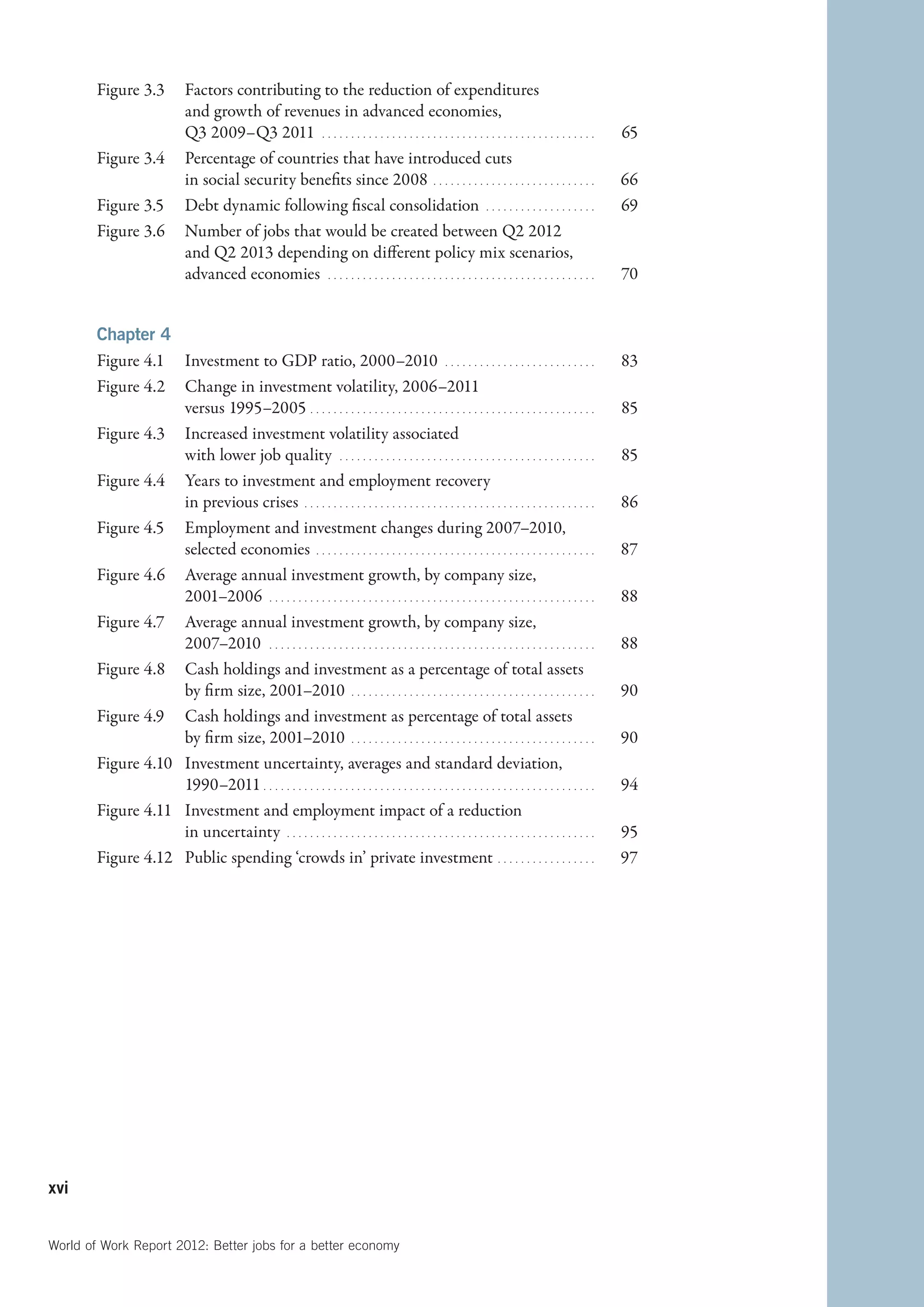
Figure 3.3	 Factors contributing to the reduction of expenditures
                    and growth of revenues in advanced economies,
                    Q3 2009–Q3 2011   . . . . . . . . . . . . . . . . . . . . . . . . . . . . . . . . . . . . . . . . . . . . . . . . 	65
        Figure 3.4	 Percentage of countries that have introduced cuts
                    in social security benefits since 2008   . . . . . . . . . . . . . . . . . . . . . . . . . . . . 	66
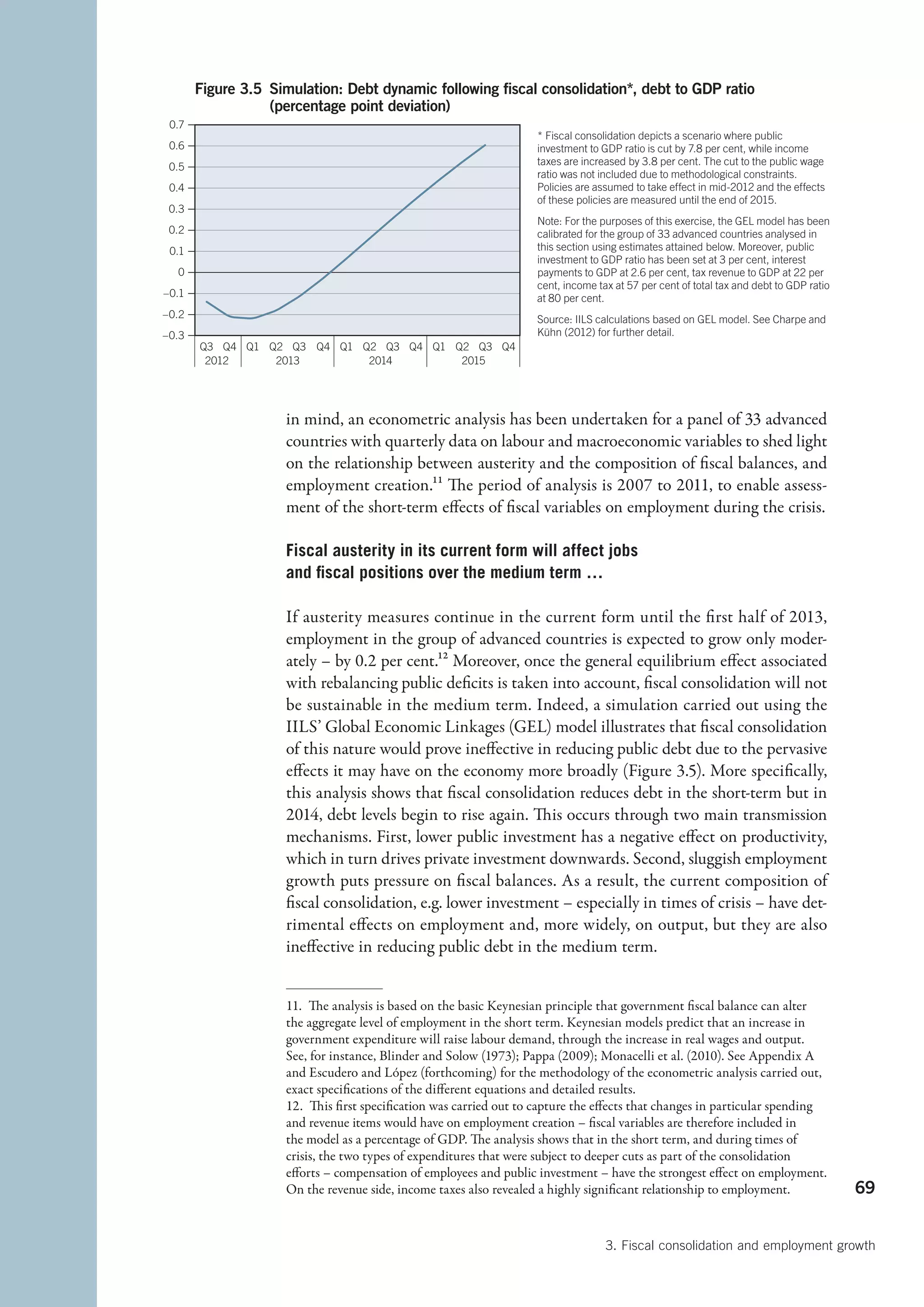
        Figure 3.5	 Debt dynamic following fiscal consolidation   . . . . . . . . . . . . . . . . . . . . 	69
        Figure 3.6	 Number of jobs that would be created between Q2 2012
                    and Q2 2013 depending on different policy mix scenarios,
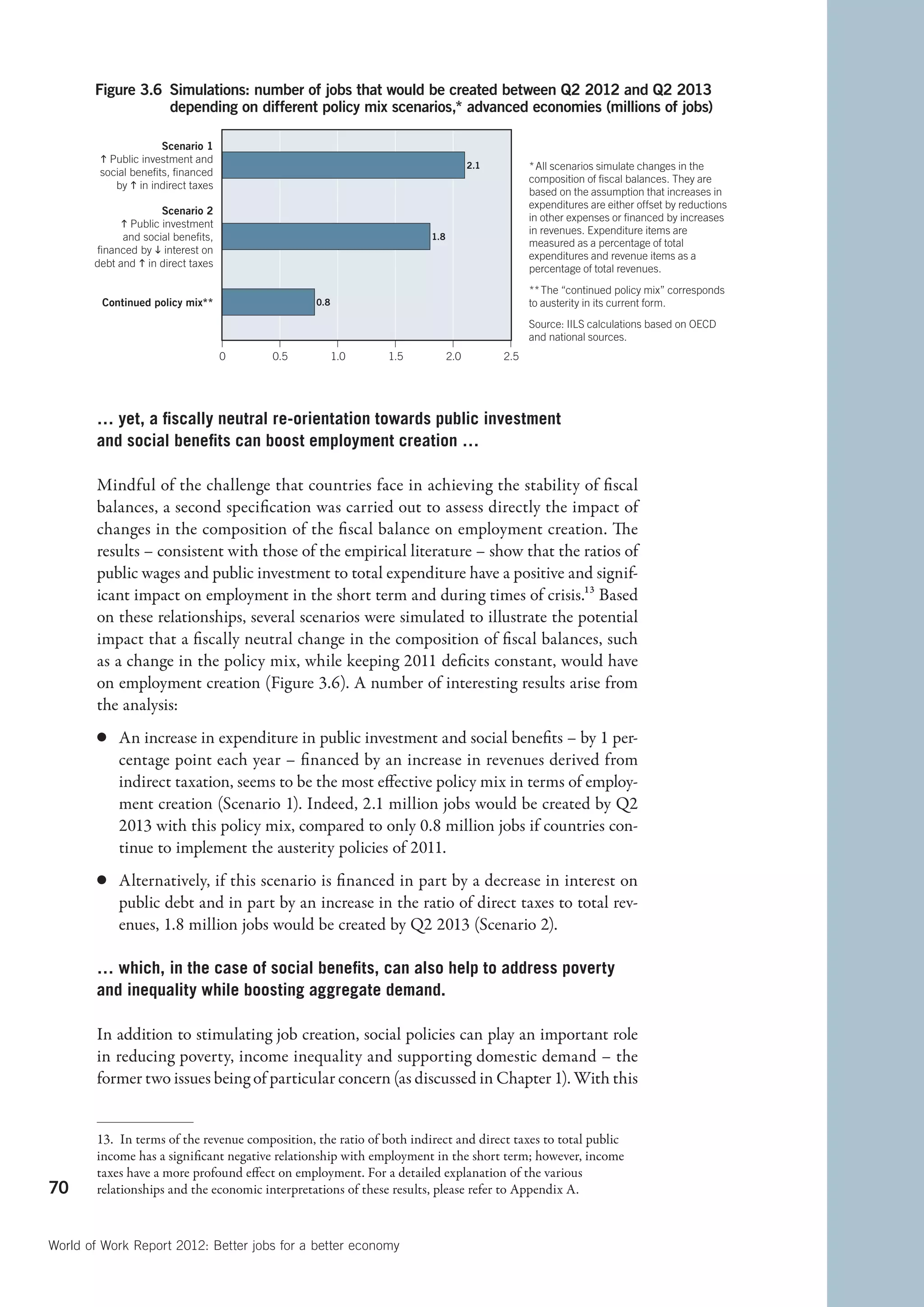
                    advanced economies   . . . . . . . . . . . . . . . . . . . . . . . . . . . . . . . . . . . . . . . . . . . . . . . 	70


        Chapter 4
        Figure 4.1	 Investment to GDP ratio, 2000–2010   . . . . . . . . . . . . . . . . . . . . . . . . . . . 	83
        Figure 4.2	 Change in investment volatility, 2006–2011
                     versus 1995–2005   . . . . . . . . . . . . . . . . . . . . . . . . . . . . . . . . . . . . . . . . . . . . . . . . . 	85
        Figure 4.3	 Increased investment volatility associated
                     with lower job quality   . . . . . . . . . . . . . . . . . . . . . . . . . . . . . . . . . . . . . . . . . . . . . 	85
        Figure 4.4	 Years to investment and employment recovery
                     in previous crises   . . . . . . . . . . . . . . . . . . . . . . . . . . . . . . . . . . . . . . . . . . . . . . . . . . . 	86
        Figure 4.5	 Employment and investment changes during 2007–2010,
                     selected economies   . . . . . . . . . . . . . . . . . . . . . . . . . . . . . . . . . . . . . . . . . . . . . . . . . 	87
        Figure 4.6	 Average annual investment growth, by company size,
                     2001–2006   . . . . . . . . . . . . . . . . . . . . . . . . . . . . . . . . . . . . . . . . . . . . . . . . . . . . . . . . . 	88
        Figure 4.7	 Average annual investment growth, by company size,
                     2007–2010   . . . . . . . . . . . . . . . . . . . . . . . . . . . . . . . . . . . . . . . . . . . . . . . . . . . . . . . . . 	88
        Figure 4.8	 Cash holdings and investment as a percentage of total assets
                     by firm size, 2001–2010   . . . . . . . . . . . . . . . . . . . . . . . . . . . . . . . . . . . . . . . . . . . 	90
        Figure 4.9	 Cash holdings and investment as percentage of total assets
                     by firm size, 2001–2010   . . . . . . . . . . . . . . . . . . . . . . . . . . . . . . . . . . . . . . . . . . . 	90
        Figure 4.10	 Investment uncertainty, averages and standard deviation,
                     1990–2011   . . . . . . . . . . . . . . . . . . . . . . . . . . . . . . . . . . . . . . . . . . . . . . . . . . . . . . . . . 	94
        Figure 4.11	 Investment and employment impact of a reduction
                     in uncertainty   . . . . . . . . . . . . . . . . . . . . . . . . . . . . . . . . . . . . . . . . . . . . . . . . . . . . . . 	95
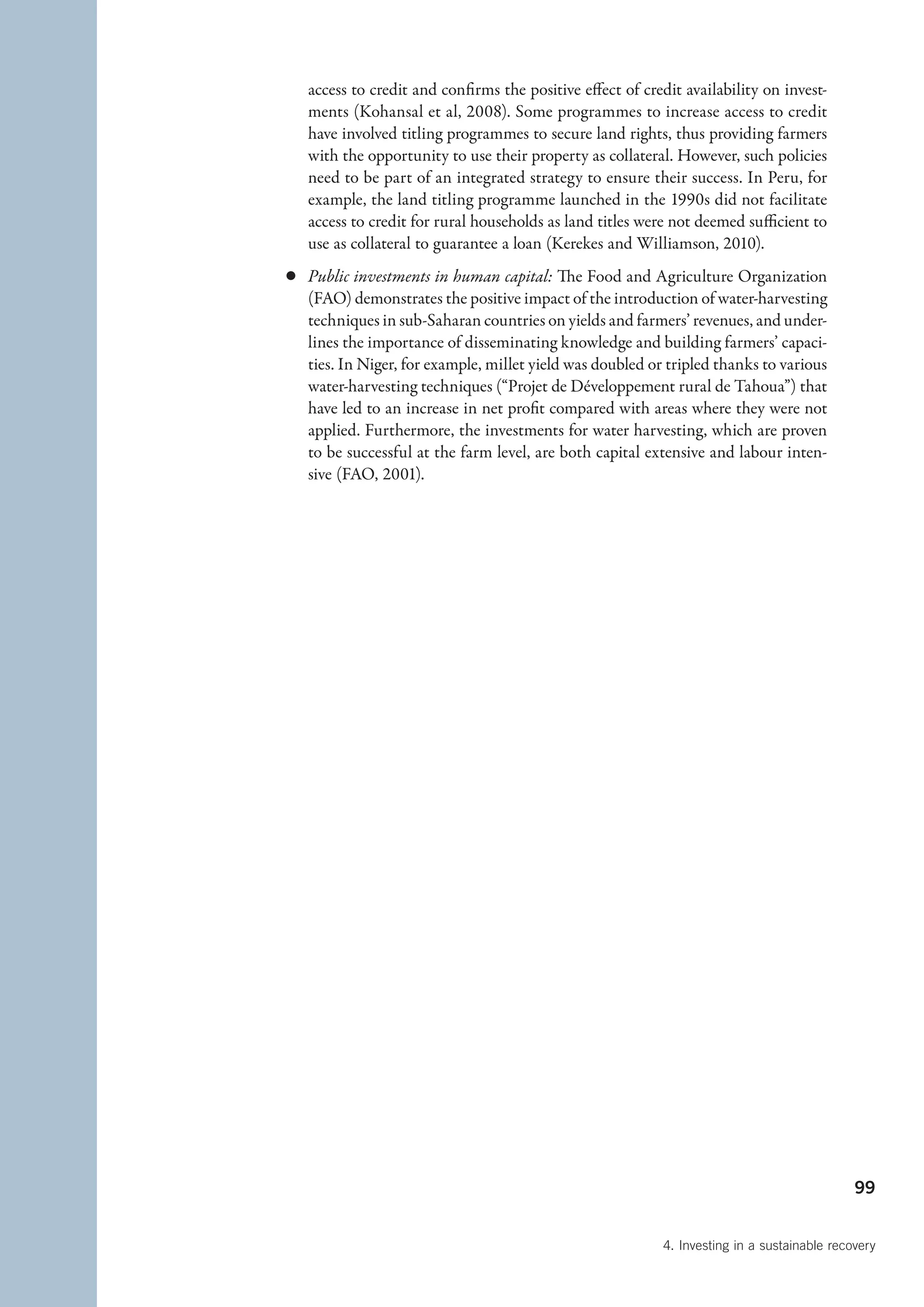
        Figure 4.12	 Public spending ‘crowds in’ private investment   . . . . . . . . . . . . . . . . . 	97


xvi


World of Work Report 2012: Better jobs for a better economy
TABLES
Chapter 1
Table 1B.1	 Definitions and sources of variables used
            in the regression analysis   . . . . . . . . . . . . . . . . . . . . . . . . . . . . . . . . . . . . . . . . . . . 	24
Table 1B.2	 Summary of the estimation of the determinants
            of non-standard employment   . . . . . . . . . . . . . . . . . . . . . . . . . . . . . . . . . . . . . . 	25
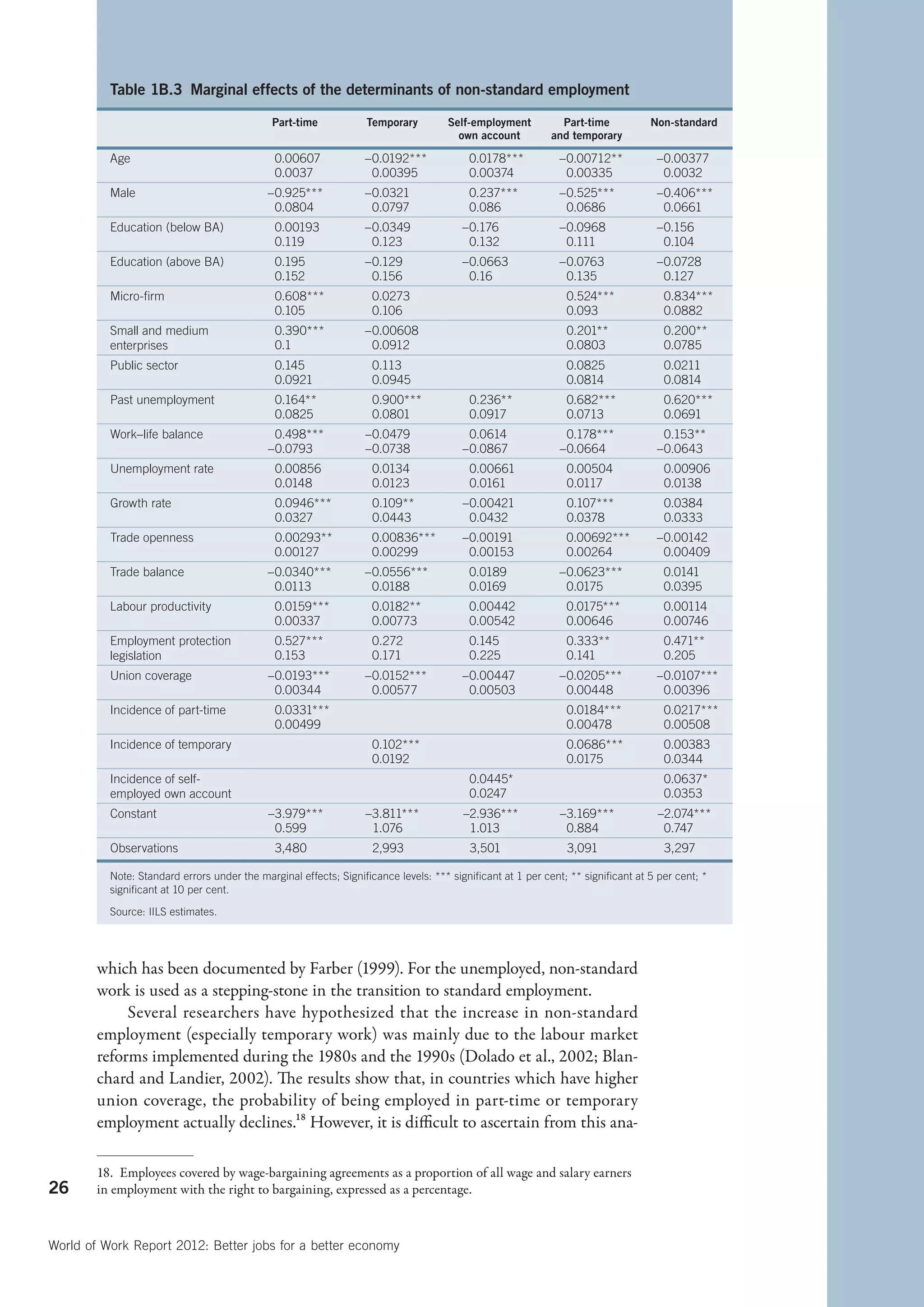
Table 1B.3	 Marginal effects of the determinants
            of non-standard employment   . . . . . . . . . . . . . . . . . . . . . . . . . . . . . . . . . . . . . . 	26
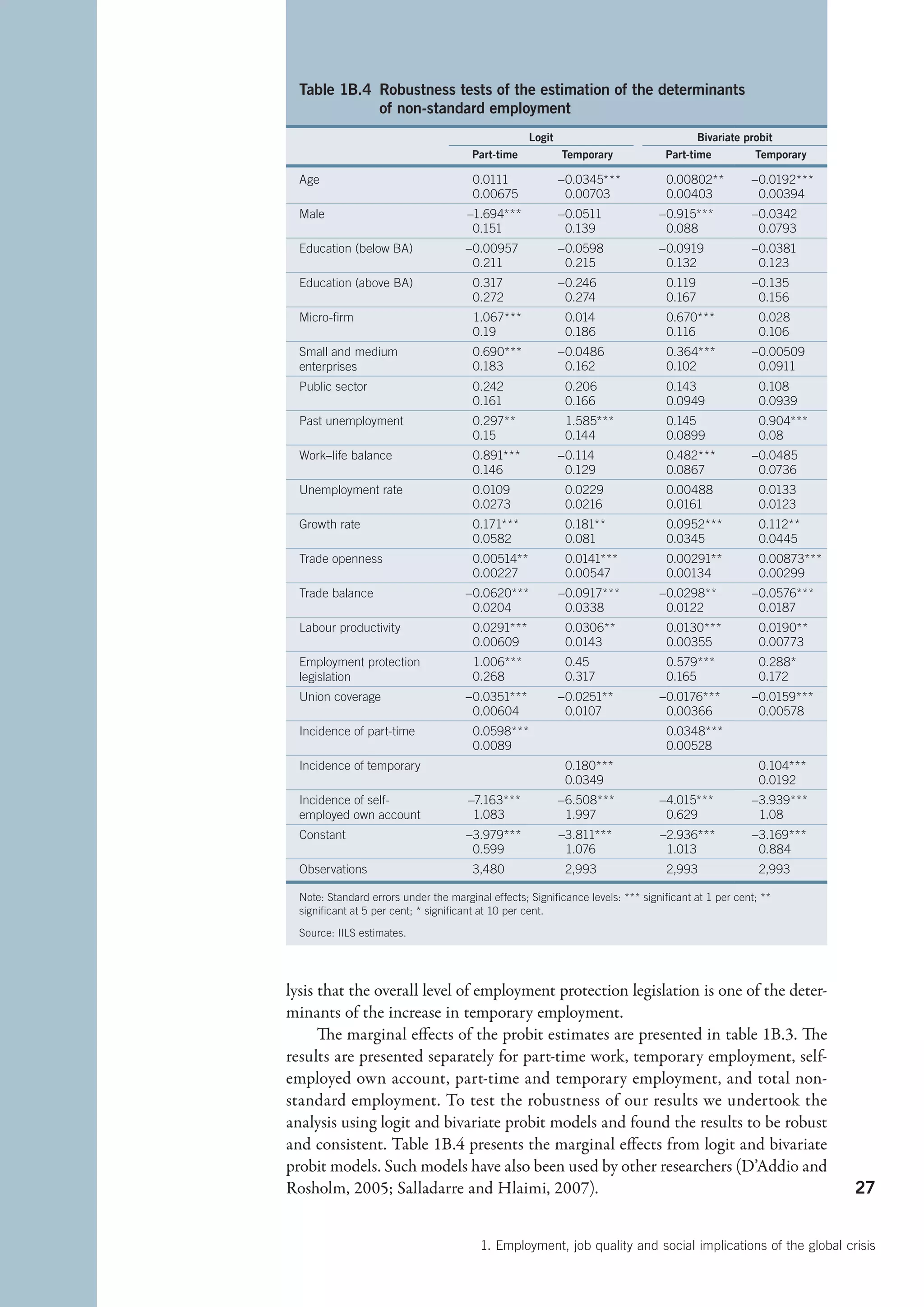
Table 1B.4	 Robustness tests of the estimation of the determinants
            of non-standard employment   . . . . . . . . . . . . . . . . . . . . . . . . . . . . . . . . . . . . . . 	27
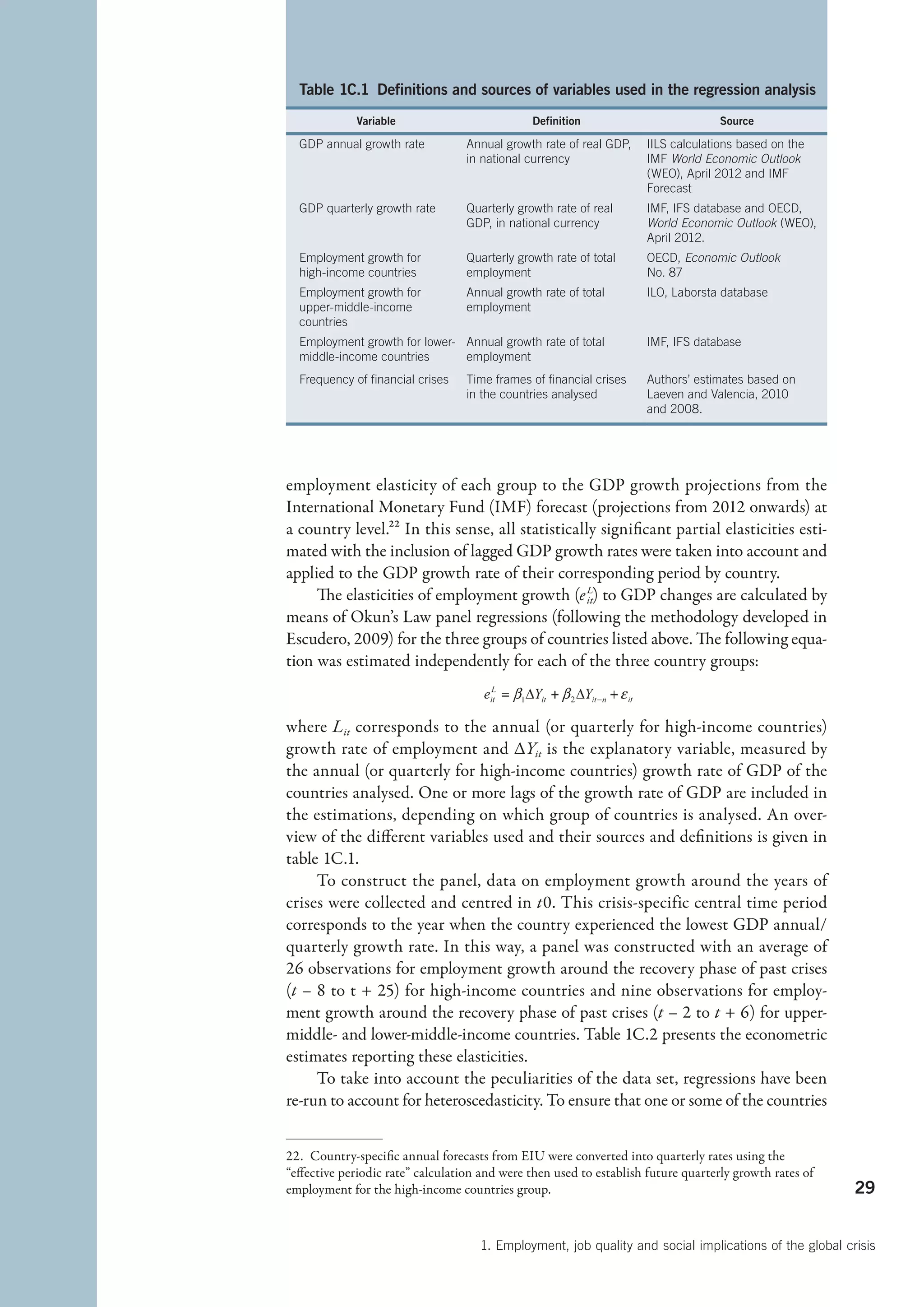
Table 1C.1	 Definitions and sources of variables used
            in the regression analysis   . . . . . . . . . . . . . . . . . . . . . . . . . . . . . . . . . . . . . . . . . . . 	29
Table 1C.2	 Regression results   . . . . . . . . . . . . . . . . . . . . . . . . . . . . . . . . . . . . . . . . . . . . . . . . . . . 	30
Table 1C.3	 Alternative estimators   . . . . . . . . . . . . . . . . . . . . . . . . . . . . . . . . . . . . . . . . . . . . . . 	31

Chapter 2
Table 2A.1	 Summary of variables used in the empirical analysis   . . . . . . . . . . . . 	49
Table 2A.2	 Empirical analysis of employment and investment   . . . . . . . . . . . . . . 	50

Chapter 3
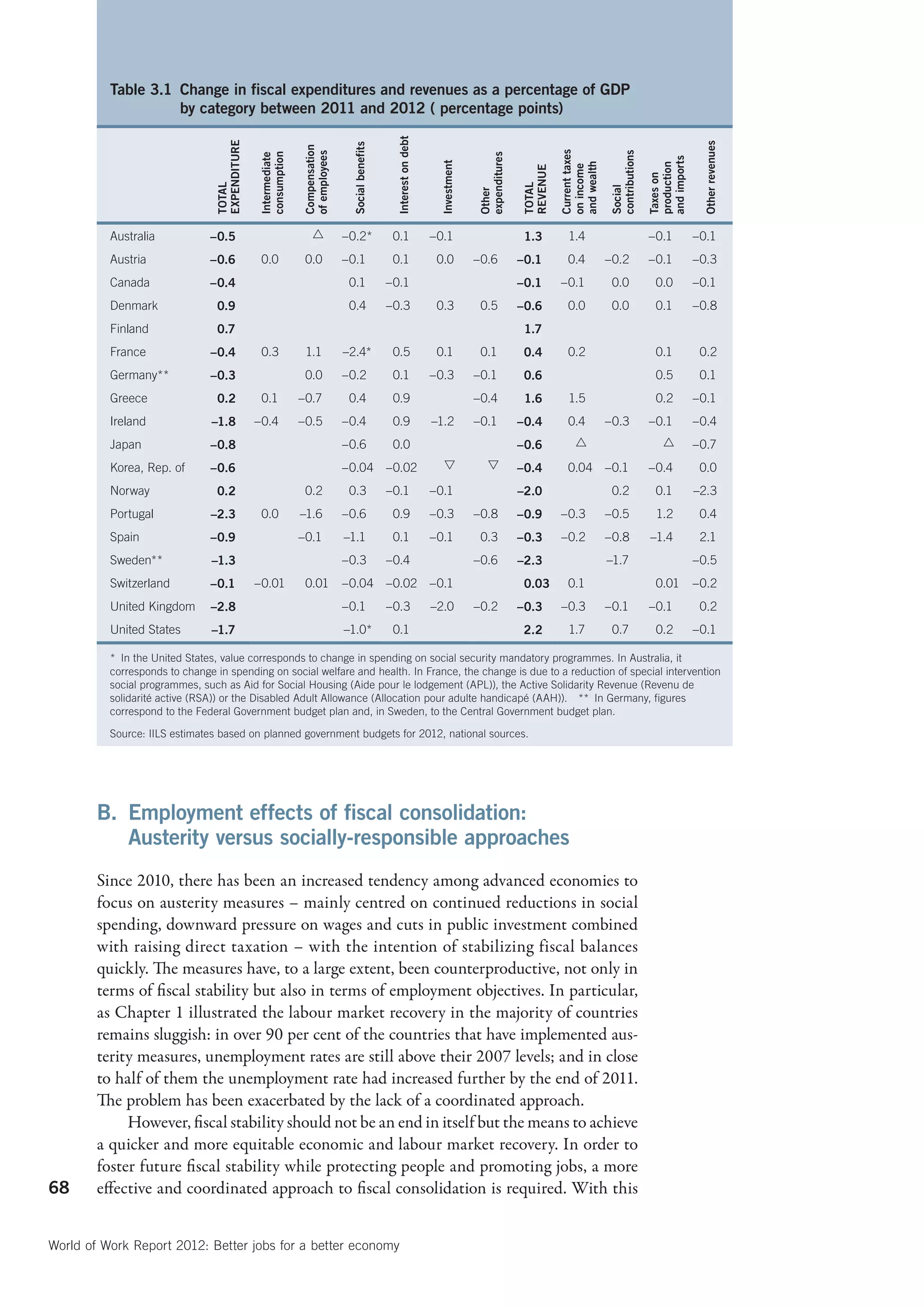
Table 3.1	 Change in fiscal expenditures and revenues as a percentage
            of GDP by category between 2011 and 2012   . . . . . . . . . . . . . . . . . . . . 	68
Table 3A.1	 Definitions and sources of variables used
            in the regression analysis   . . . . . . . . . . . . . . . . . . . . . . . . . . . . . . . . . . . . . . . . . . . 	75
Table 3A.2	 Regression results   . . . . . . . . . . . . . . . . . . . . . . . . . . . . . . . . . . . . . . . . . . . . . . . . . . . 	77

Chapter 4
Table 4.1	 Investment to GDP ratios, 1970–2010   . . . . . . . . . . . . . . . . . . . . . . . . . . . 	84


BOXES
Chapter 2
Box 2.1	 Employment protection legislation and labour market duality
         during the crisis: Issues and considerations   . . . . . . . . . . . . . . . . . . . . . . . . . 	43

Chapter 3
Box 3.1	 Public sector wages and social security policies
         as fiscal consolidation measures   . . . . . . . . . . . . . . . . . . . . . . . . . . . . . . . . . . . . . . 	66

Chapter         4
Box 4.1	        A tale of two crises   . . . . . . . . . . . . . . . . . . . . . . . . . . . . . . . . . . . . . . . . . . . . . . . . . . . . 	87
Box 4.2	        Growth and distribution   . . . . . . . . . . . . . . . . . . . . . . . . . . . . . . . . . . . . . . . . . . . . . 	92
Box 4.3	        Uncertainty measures and the VIX   . . . . . . . . . . . . . . . . . . . . . . . . . . . . . . . . . 	94


                                                                                                                                                     xvii


                                                                                                                                    Table of Contents
Employment,
job quality and
social implications
of the global crisis *

Main findings

c	 Global employment has not yet recovered from the global crisis that erupted in
   2008. The global employment rate, at 60.3 per cent in 2011, is 0.9 percentage
   points lower than before the crisis. This means that around 50 million jobs are
   missing relative to the pre-crisis situation.
c	 There are marked cross-country differences in recent employment trends.
   Employment rates have recovered much faster in emerging and developing
   economies, especially the latter where as a group they have surpassed the pre-
   crisis levels. By contrast, employment rates remain subdued in many advanced
   economies and in Northern Africa.
c	 Despite the cross-country differences, there are general issues which have to be
   addressed in order to ensure a sustainable job recovery in all countries. First, in the
   majority of countries, some groups, such as youth and the long-term unemployed,
   face considerable difficulties in obtaining employment. Youth unemployment
   rates have increased in about 80 per cent of advanced economies and in two-
   thirds of the developing economies. On average, more than 36 per cent of job-
   seekers in advanced economies have been without work for more than one year.
c	 Second, in many countries where employment growth has resumed, jobs tend to
   be provided on a short-term basis. Involuntary part-time work and temporary
   employment are on the increase in the majority of countries where employ-
   ment growth has resumed. Involuntary part-time employment and temporary
   employment have increased in, respectively, two-thirds of advanced economies
   and more than half of these economies. The share of informal employment
   remains high, standing at more than 40 per cent in two-thirds of emerging
   and developing countries for which data are available. There are, however,

*  Thanks to the Trends Unit of the Employment Sector for providing the global unemployment
projections and Sameer Khatiwada (Institute) for the social unrest graph.                     1
some exceptions to these general patterns; in particular, Austria, Belgium,
           Brazil, Chile, Germany, Indonesia, Peru, Poland, Thailand and Uruguay have
           increased their employment rates without compromising on job quality.
        c	 Third, the crisis has led to an increase in poverty rates in half of advanced
           economies and one-third of developing economies. Similarly, inequality has
           increased in approximately one-half of advanced economies and one-quarter of
           emerging and developing economies. Inequalities have also widened in terms
           of access to education, food, land and credit.
        c	 Fourth, in 57 out of 106 countries, the Social Unrest Index increased in 2011
           compared to 2010. Sub-Saharan Africa and the Middle East and North Africa
           show the most heightened risk of social unrest. In several countries in Asia and
           Latin America – where there has been employment recovery and, in some cases,
           improved job quality – have experienced a decline in the risk of social unrest
           between 2010 and 2011.
        c	 Projections indicate that, on present trends, employment in advanced economies
           will not reach pre-crisis levels until late 2016. The current economic slowdown
           has also affected employment prospects in emerging and developing economies.


        Introduction

        Four years on from the onset of the global crisis, the employment rate for the global
        labour market is still below the pre-crisis peak (ILO, 2012). Recent trends suggest
        that the labour market recovery has been weak in many of the advanced econ-
        omies. Employment growth in developing economies has shown a corresponding
        decline as economic growth has slowed down. The decline in demand from the
        Eurozone area has potential consequences that may spill over into other regions
        through trade and financial linkages, if there is no boost in internal demand in
        developing economies (UNDESA, 2012).
             Beyond these general trends, this chapter provides an in-depth examination of
        the profound impact, which the prolonged period of economic turbulence has had
        on labour markets. The chapter examines its impact on employment, long-term
        unemployment and labour market inactivity (section A), as well as job quality (sec-
        tion B) and poverty and income inequality trends (section C). Finally, the chapter
        presents employment projections and introduces the rest of the report (section D).


        A.  Employment trends

        In the past year, the employment recovery has been slower in advanced economies
        (0.1 per cent) than in developing economies (2.2 per cent). The recovery is mar-
        ginal in advanced economies compared to the crisis period (2007–10) during
        which it declined by 1.7 per cent. Developing economies, in contrast, experienced
        a slowdown in their employment growth by more than one percentage point com-
        pared to the crisis period (3.8 per cent).

        Labour markets have not recovered from the global crisis …

        Despite an improvement in the past year, labour markets have not recovered from
2       the global crisis and there is an overall decline in employment growth in advanced


World of Work Report 2012: Better jobs for a better economy
Figure 1.1 Employment rates in the third quarters of 2007 and 2011 (percentages)
     Panel A. Advanced economies
90
                   2007 Q3                                     2011 Q3                                                                                                  Countries where employment rates decreased                                                                                                                                                                                                                       Countries where
                                                                                                                                                                                                                                                                                                                                                                                                                                        employment rates
75                                                                                                                                                                                                                                                                                                                                                                                                                                          increased


60


45


30


15


 0
     Croatia


                                                                                                                                                    Czech Republic


                                                                                                                                                                                                                                                                                                                                                                                  Sweden


                                                                                                                                                                                                                                                                                                                                                                                                                                                Israel
               Greece
                              Italy
                                                 Hungary
                                                            Spain
                                                                    Belgium


                                                                                           Ireland
                                                                                Slovakia


                                                                                                     France
                                                                                                               Portugal
                                                                                                                          Slovenia


                                                                                                                                                                     Estonia
                                                                                                                                                                               Taiwan, China
                                                                                                                                                                                                    Japan
                                                                                                                                                                                                                     United Kingdom
                                                                                                                                                                                                                                      United States
                                                                                                                                                                                                                                                      Cyprus
                                                                                                                                                                                                                                                                  Barbados


                                                                                                                                                                                                                                                                                               Denmark
                                                                                                                                                                                                                                                                                                           World
                                                                                                                                                                                                                                                                                                                   Finland
                                                                                                                                                                                                                                                                                                                              Netherlands
                                                                                                                                                                                                                                                                                                                                            Australia
                                                                                                                                                                                                                                                                                                                                                          Canada
                                                                                                                                                                                                                                                                                                                                                                    New Zealand


                                                                                                                                                                                                                                                                                                                                                                                                       Norway
                                                                                                                                                                                                                                                                                                                                                                                                                    Iceland
                                                                                                                                                                                                                                                                                                                                                                                                                               Malta
                                                                                                                                                                                                                                                                                                                                                                                                                                       Poland


                                                                                                                                                                                                                                                                                                                                                                                                                                                         Luxembourg
                                                                                                                                                                                                                                                                                                                                                                                                                                                                      Germany
                                                                                                                                                                                                                                                                                                                                                                                                                                                                                Austria
                                                                                                                                                                                                                                                                              Korea, Rep. of
     Panel B. Emerging and developing economies
90
                        Countries where employment rates decreased                                                                                                                                                                                     Countries where                                                                          2007 Q3                                       2011 Q3
                                                                                                                                                                                                                                                      employment rates
75                                                                                                                                                                                                                                                        increased


60


45


30


15


 0
                                                                                                     Ecuador


                                                                                                                                                                                                                                      Turkey


                                                                                                                                                                                                                                                                              Brazil


                                                                                                                                                                                                                                                                                                                                                                    Peru
                                                                                                                                                                     Ukraine
                                                                                                                                                                               West Bank and Gaza


                                                                                                                                                                                                                     Morocco


                                                                                                                                                                                                                                                      Sri Lanka
                                                                                                                                                                                                                                                                  Argentina


                                                                                                                                                                                                                                                                                               Mauritius
                                                                                                                                                                                                                                                                                                           Chile


                                                                                                                                                                                                                                                                                                                              Paraguay


                                                                                                                                                                                                                                                                                                                                                          Uruguay


                                                                                                                                                                                                                                                                                                                                                                                  Russian Federation
     Jordan
               South Africa


                                                 Bulgaria
                                                            India
                                                                    Lithuania
                                                                                Romania
                                                                                           Latvia


                                                                                                               Mexico


                                                                                                                                                     World


                                                                                                                                                                                                    Macedonia, FYR


                                                                                                                                                                                                                                                                                                                   Colombia


                                                                                                                                                                                                                                                                                                                                            Philippines


                                                                                                                                                                                                                                                                                                                                                                                                       Kazakhstan
                                                                                                                                                                                                                                                                                                                                                                                                                    Thailand
                                                                                                                          Venezuela, Bol. Rep. of
                              Moldova, Rep. of


     Note: For Argentina, Israel and Sri Lanka the data refers to Q2 and for Morocco and Uruguay the data refers to Q1.
     World refers to global employment rates estimated for the baseline scenario from ILO, 2012.
     Source: IILS estimates based on Eurostat, OECD employment database and national sources.


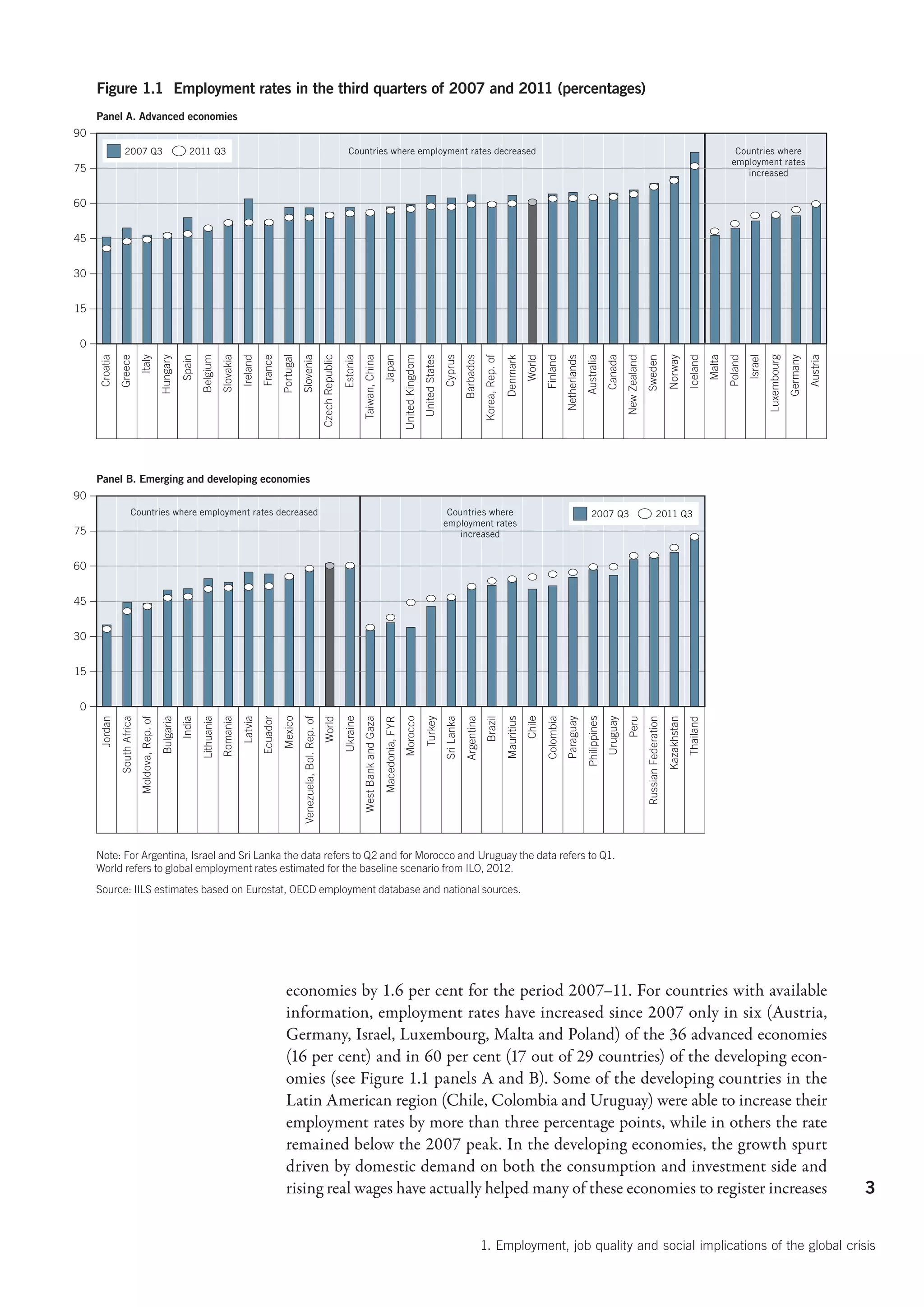
                                                                                                                 economies by 1.6 per cent for the period 2007–11. For countries with available
                                                                                                                 information, employment rates have increased since 2007 only in six (Austria,
                                                                                                                 Germany, Israel, Luxembourg, Malta and Poland) of the 36 advanced economies
                                                                                                                 (16 per cent) and in 60 per cent (17 out of 29 countries) of the developing econ-
                                                                                                                 omies (see Figure 1.1 panels A and B). Some of the developing countries in the
                                                                                                                 Latin American region (Chile, Colombia and Uruguay) were able to increase their
                                                                                                                 employment rates by more than three percentage points, while in others the rate
                                                                                                                 remained below the 2007 peak. In the developing economies, the growth spurt
                                                                                                                 driven by domestic demand on both the consumption and investment side and
                                                                                                                 rising real wages have actually helped many of these economies to register increases                                                                                                                                                                                                                                                                                     3


                                                                                                                                                                                                                                                                              1. Employment, job quality and social implications of the global crisis
in employment. Among the advanced economies, Germany was able to increase
        employment, largely due to the Kurzarbeit  1 scheme.

        … there is a widespread deterioration in youth unemployment …

        In addition to unsatisfactory employment outcomes, in the majority of advanced
        economies labour markets have deteriorated since 2007 in terms of unemployment
        and inactivity. Unemployment has been particularly widespread among vulnerable
        groups, especially youth (aged 15-24). Youth unemployment rates have increased
        in about 80 per cent of the advanced and two-thirds of the developing economies
        with available information. In addition, in half of the advanced economies youth
        unemployment is higher than 15 per cent. Although there was a temporary respite
        in the unemployment rate among adults in 2011, the situation did not improve for
        the unemployed youth (ILO, 2012). In the Middle East and North African region,
        youth unemployment was four times greater than adult unemployment (ILO, 2012),
        and the rates were as high as 25 per cent. Although some countries that improved
        their employment situation, mainly Austria and Germany, were also able to reduce
        their youth unemployment rates, in some others it escalated to 45 per cent in coun-
        tries such as Spain and Greece. In particular, the youth unemployment rate in Spain
        has increased by 28 percentage points (from 18 to 45.8 per cent) since 2007.
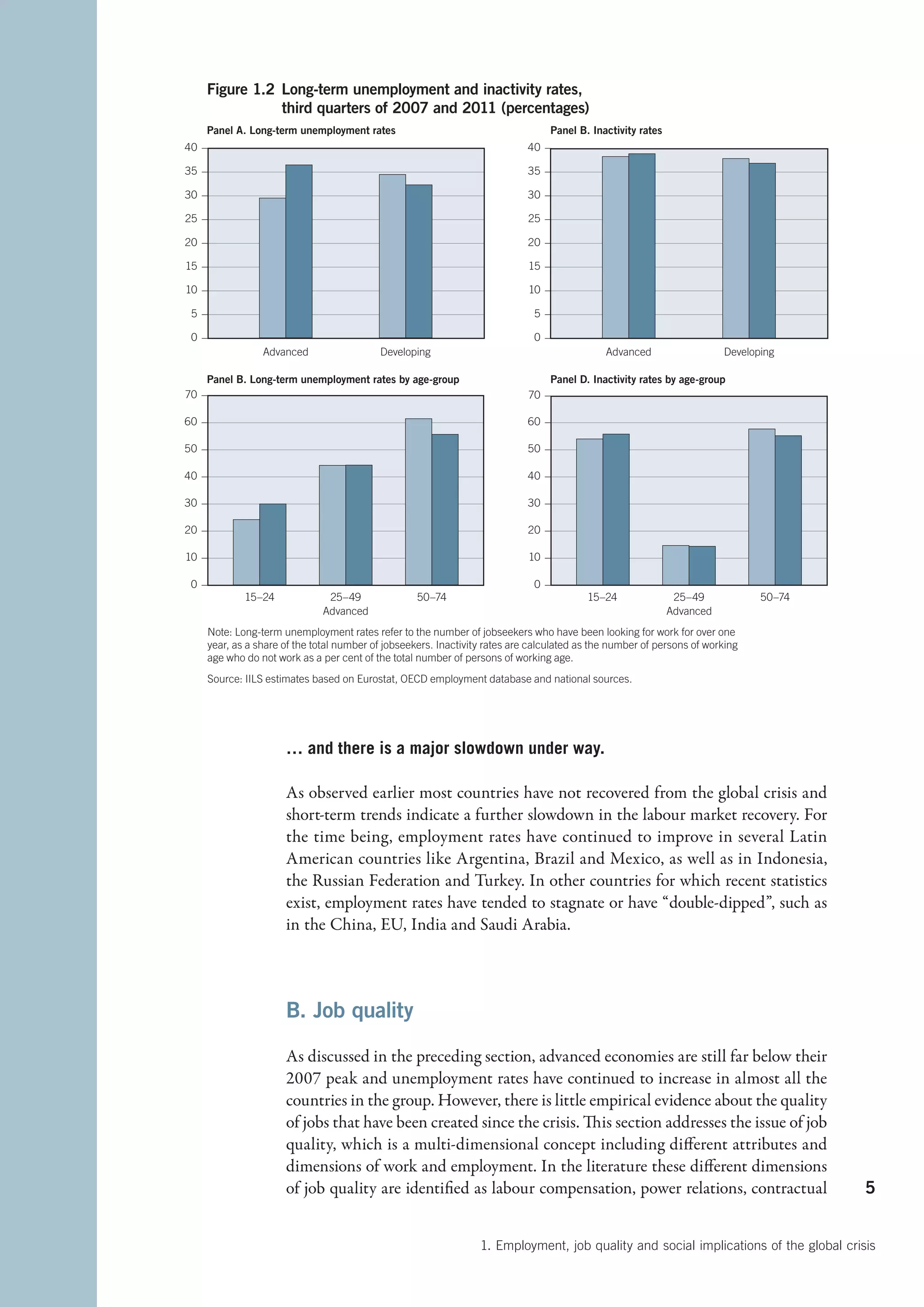
              Across age groups, the long-term unemployment rate has increased by more
        than five percentage points among adults in advanced economies. The long-term un-
        employment rate has seen its greatest increase among youth since 2007 (Figure 1.2
        panel C) and inactivity rates have also increased among youth (Figure 1.2 panel D).
        This has huge economic costs in terms of loss of skills and motivation, and could
        lead to human capital depreciation. There may also be accompanying social impli-
        cations in terms of increased social strife, riots, illness, and so forth.

        … long-term unemployment continues to increase in advanced economies …

        Globally, long-term unemployment rates have increased much more in advanced
        economies compared to developing economies (Figure 1.2 panel A). In half of the
        advanced economies, more than 40 per cent of the unemployed are long-term,
        that is unemployed for more than 12 months. The long-term unemployment rate
        has increased most significantly in Denmark, Ireland, Spain, the United Kingdom
        and the United States since 2007. The presence of a large proportion of long-
        term unemployed could result in huge economic and social costs. In some of the
        countries where the long-term unemployment rate declined, such as the Czech
        Republic, Finland, Greece, Netherlands, Portugal and Slovenia, inactivity rates
        actually increased. This could imply that many of the long-term unemployed are
        already exiting the labour market. Countries such as Australia and Germany had
        a comparatively small increase in long-term unemployment.
             In comparison, in the majority of the developing economies with available
        information there is a decline in both long-term unemployment rates and inac-
        tivity rates (see Figure 1.2 panels A and B). This could be seen as a result of labour
        moving into informal employment to secure access to an income, given the absence
        of unemployment benefits in these economies.


        1.  Kurzarbeit refers to “short-work” or “reduced working hours” in Germany wherein companies
        enter into an agreement to avoid lay-offs of their employees to reduce the working hours of all or most
4       of their employees, with the government taking up the responsibility of some employees’ lost income.


World of Work Report 2012: Better jobs for a better economy
Figure 1.2 Long-term unemployment and inactivity rates,
                third quarters of 2007 and 2011 (percentages)
     Panel A. Long-term unemployment rates                                        Panel B. Inactivity rates
40                                                                          40

35                                                                          35

30                                                                          30

25                                                                          25

20                                                                          20

15                                                                           15

10                                                                           10

 5                                                                            5

 0                                                                            0
                 Advanced                  Developing                                         Advanced                   Developing

     Panel B. Long-term unemployment rates by age-group                           Panel D. Inactivity rates by age-group
70                                                                          70

60                                                                          60

50                                                                          50

40                                                                          40

30                                                                          30

20                                                                          20

10                                                                           10

 0                                                                            0
             15–24             25–49                50–74                                 15–24                25–49            50–74
                              Advanced                                                                        Advanced
     Note: Long-term unemployment rates refer to the number of jobseekers who have been looking for work for over one
     year, as a share of the total number of jobseekers. Inactivity rates are calculated as the number of persons of working
     age who do not work as a per cent of the total number of persons of working age.
     Source: IILS estimates based on Eurostat, OECD employment database and national sources.


                      … and there is a major slowdown under way.

                      As observed earlier most countries have not recovered from the global crisis and
                      short-term trends indicate a further slowdown in the labour market recovery. For
                      the time being, employment rates have continued to improve in several Latin
                      American countries like Argentina, Brazil and Mexico, as well as in Indonesia,
                      the Russian Federation and Turkey. In other countries for which recent statistics
                      exist, employment rates have tended to stagnate or have “double-dipped”, such as
                      in the China, EU, India and Saudi Arabia.


                      B. Job quality

                      As discussed in the preceding section, advanced economies are still far below their
                      2007 peak and unemployment rates have continued to increase in almost all the
                      countries in the group. However, there is little empirical evidence about the quality
                      of jobs that have been created since the crisis. This section addresses the issue of job
                      quality, which is a multi-dimensional concept including different attributes and
                      dimensions of work and employment. In the literature these different dimensions
                      of job quality are identified as labour compensation, power relations, contractual                                5


                                                                  1. Employment, job quality and social implications of the global crisis
status and stability of employment, working time, etc. (see Muñoz de Bustillo and
        de Pedraza (2010) for details of the different perspectives).2 All these aspects of
        employment quality have a potential impact on the well-being of the workers and
        their career development. The issue of job quality is addressed below by taking into
        account only three dimensions: first, the contractual status and stability of employ-
        ment; second, the willingness to continue in a particular employment status; and
        third, labour compensation – that is, wages. All three dimensions combined actu-
        ally reflect the quality of employment.
              The first dimension of job quality considers the contractual status and sta-
        bility of employment, that is standard and non-standard jobs in advanced econ-
        omies or formal and informal employment in developing economies. Non-standard
        jobs comprise part-time or temporary employment or self-employed own account.
        Informal employment comprises workers in small enterprises of fewer than five
        workers, self-employed own-account workers, unpaid family helpers and workers
        with no proper contract in the formal sector. This indicator determines the quality
        of jobs created, whether they are standard or non-standard, formal or informal.
              The second dimension examines the willingness of part-time or temporary
        workers to remain in their job, and this analysis is largely confined to advanced
        economies. Eurostat data provides information to differentiate between volun-
        tary and involuntary part-time or temporary work. Involuntary work is defined
        as those workers who are engaged in these forms of employment because they
        cannot find either full-time or permanent jobs. As the workers are in these forms
        of employment not out of their choice but due to compulsion, so they are referred
        as “precarious workers”.3 The third dimension examines the wages of the workers
        in assessing job quality for a sample of advanced and developing economies.

        Non-standard employment has tended to increase or has remained high …

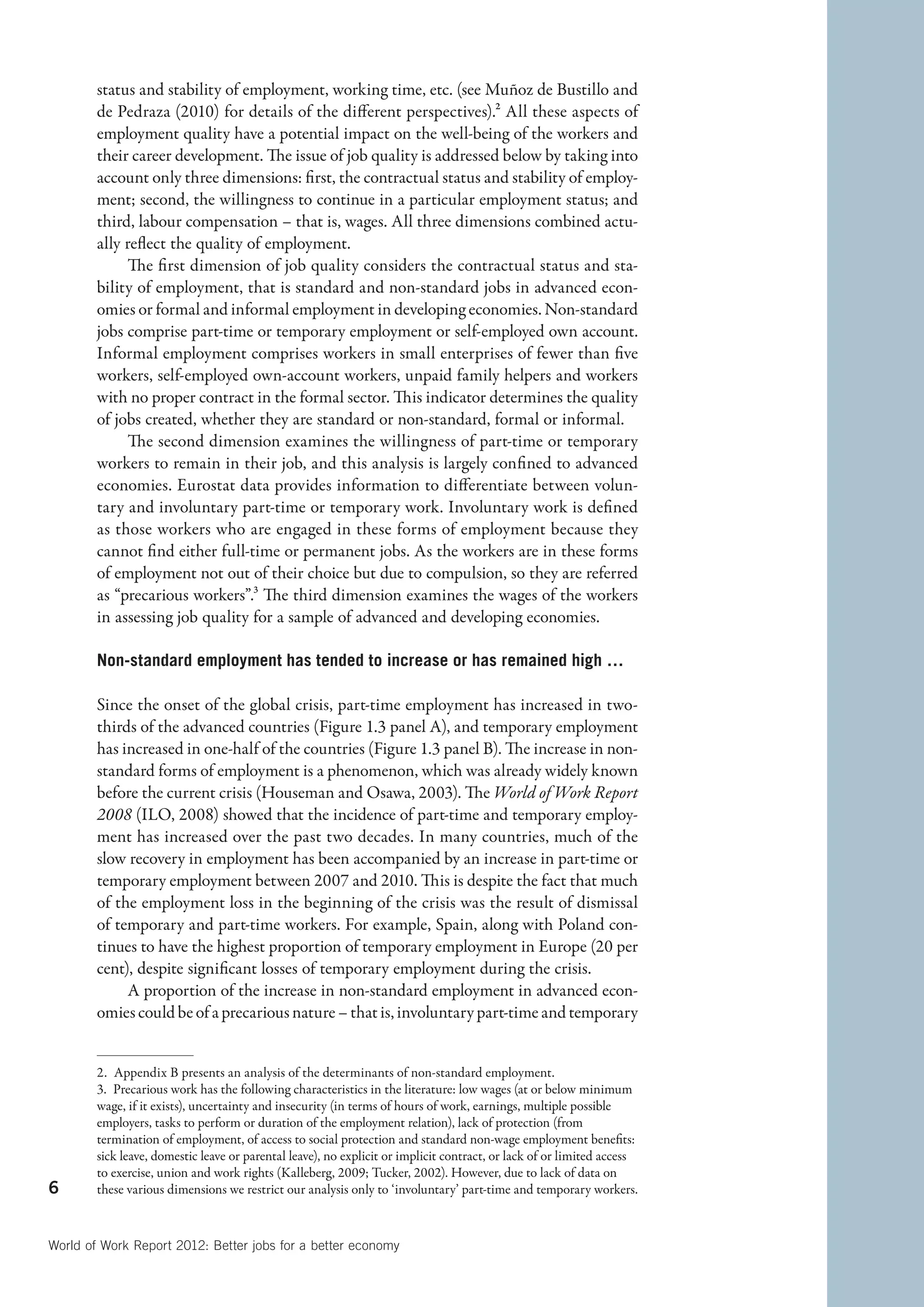
        Since the onset of the global crisis, part-time employment has increased in two-
        thirds of the advanced countries (Figure 1.3 panel A), and temporary employment
        has increased in one-half of the countries (Figure 1.3 panel B). The increase in non-
        standard forms of employment is a phenomenon, which was already widely known
        before the current crisis (Houseman and Osawa, 2003). The World of Work Report
        2008 (ILO, 2008) showed that the incidence of part-time and temporary employ-
        ment has increased over the past two decades. In many countries, much of the
        slow recovery in employment has been accompanied by an increase in part-time or
        temporary employment between 2007 and 2010. This is despite the fact that much
        of the employment loss in the beginning of the crisis was the result of dismissal
        of temporary and part-time workers. For example, Spain, along with Poland con-
        tinues to have the highest proportion of temporary employment in Europe (20 per
        cent), despite significant losses of temporary employment during the crisis.
             A proportion of the increase in non-standard employment in advanced econ-
        omies could be of a precarious nature – that is, involuntary part-time and temporary


        2.  Appendix B presents an analysis of the determinants of non-standard employment.
        3.  Precarious work has the following characteristics in the literature: low wages (at or below minimum
        wage, if it exists), uncertainty and insecurity (in terms of hours of work, earnings, multiple possible
        employers, tasks to perform or duration of the employment relation), lack of protection (from
        termination of employment, of access to social protection and standard non-wage employment benefits:
        sick leave, domestic leave or parental leave), no explicit or implicit contract, or lack of or limited access
        to exercise, union and work rights (Kalleberg, 2009; Tucker, 2002). However, due to lack of data on
6       these various dimensions we restrict our analysis only to ‘involuntary’ part-time and temporary workers.


World of Work Report 2012: Better jobs for a better economy
Figure 1.3 Incidence of non-standard employment, advanced economies, 2007 and 2010
     Panel A. Part-time employment (percentage of total employment)
50
                    2007                          2010                                                                                                                                     Countries where part-time employment increased

40
              Countries where
           part-time employment
                 decreased
30


20


10


 0
                                        Israel
     Lithuania
                 Poland
                             Portugal


                                                  Norway


                                                                         Bulgaria


                                                                                                         Czech Republic


                                                                                                                                                                                                                                                                                                                     Mexico


                                                                                                                                                                                                                                                                                                                                         Japan
                                                                                                                                                                                                                                                                                                                                                  Ireland
                                                                                                                                                                                                                                                                                                                                                                Belgium
                                                                                                                                                                                                                                                                                                                                                                          Australia
                                                                                                                                                                                                                                                                                                                                                                                      Austria
                                                                                                                                                                                                                                                                                                                                                                                                 Germany


                                                                                                                                                                                                                                                                                                                                                                                                                         Sweden
                                                                                                                                                                                                                                                                                                                                                                                                                                  Denmark
                                                           New Zealand


                                                                                    Slovakia
                                                                                               Hungary


                                                                                                                          Greece
                                                                                                                                   Cyprus
                                                                                                                                              Latvia


                                                                                                                                                                              Estonia
                                                                                                                                                                                        Romania
                                                                                                                                                                                                  United States
                                                                                                                                                                                                                  Slovenia
                                                                                                                                                                                                                             Malta
                                                                                                                                                                                                                                     Spain
                                                                                                                                                                                                                                                      Finland
                                                                                                                                                                                                                                                                Italy
                                                                                                                                                                                                                                                                             France
                                                                                                                                                                                                                                                                                              Luxembourg
                                                                                                                                                                                                                                                                                                           Iceland


                                                                                                                                                                                                                                                                                                                               Canada


                                                                                                                                                                                                                                                                                                                                                                                                           Switzerland


                                                                                                                                                                                                                                                                                                                                                                                                                                            United Kingdom
                                                                                                                                                                                                                                                                                                                                                                                                                                                             Netherlands
                                                                                                                                                            Korea, Rep. of


     Panel B. Temporary employment (percentage of total employment)
30
                    2007                          2010


                              Countries where temporary employment decreased                                                                                                                                                   Countries where temporary employment increased

20


10


 0
     Romania


                                                                                                                          Sweden
                 Lithuania
                             Bulgaria
                                        Belgium
                                                  Norway
                                                            Denmark
                                                                         Italy
                                                                                    Japan
                                                                                               France
                                                                                                          Finland


                                                                                                                                   Slovenia
                                                                                                                                              Netherlands


                                                                                                                                                                              Spain
                                                                                                                                                                                        Poland
                                                                                                                                                                                                  Estonia


                                                                                                                                                                                                                                                       Latvia
                                                                                                                                                                                                                                                                Luxembourg
                                                                                                                                                                                                                                                                             Czech Republic
                                                                                                                                                                                                                                                                                              Ireland
                                                                                                                                                                                                                                                                                                           Greece
                                                                                                                                                                                                                                                                                                                     Austria
                                                                                                                                                                                                                                                                                                                               Hungary
                                                                                                                                                                                                                                                                                                                                         Cyprus


                                                                                                                                                                                                                                                                                                                                                                          Germany
                                                                                                                                                                                                                                                                                                                                                                                      Portugal
                                                                                                                                                                                                                  Slovakia
                                                                                                                                                                                                                             Malta
                                                                                                                                                                                                                                     United Kingdom


                                                                                                                                                                                                                                                                                                                                                  Switzerland
                                                                                                                                                                                                                                                                                                                                                                Canada
                                                                                                                                                             Korea, Rep. of


     Note: Grey bar denotes countries where employment rates increased.
     Source: IILS estimates based on Eurostat, OECD employment database and national sources.


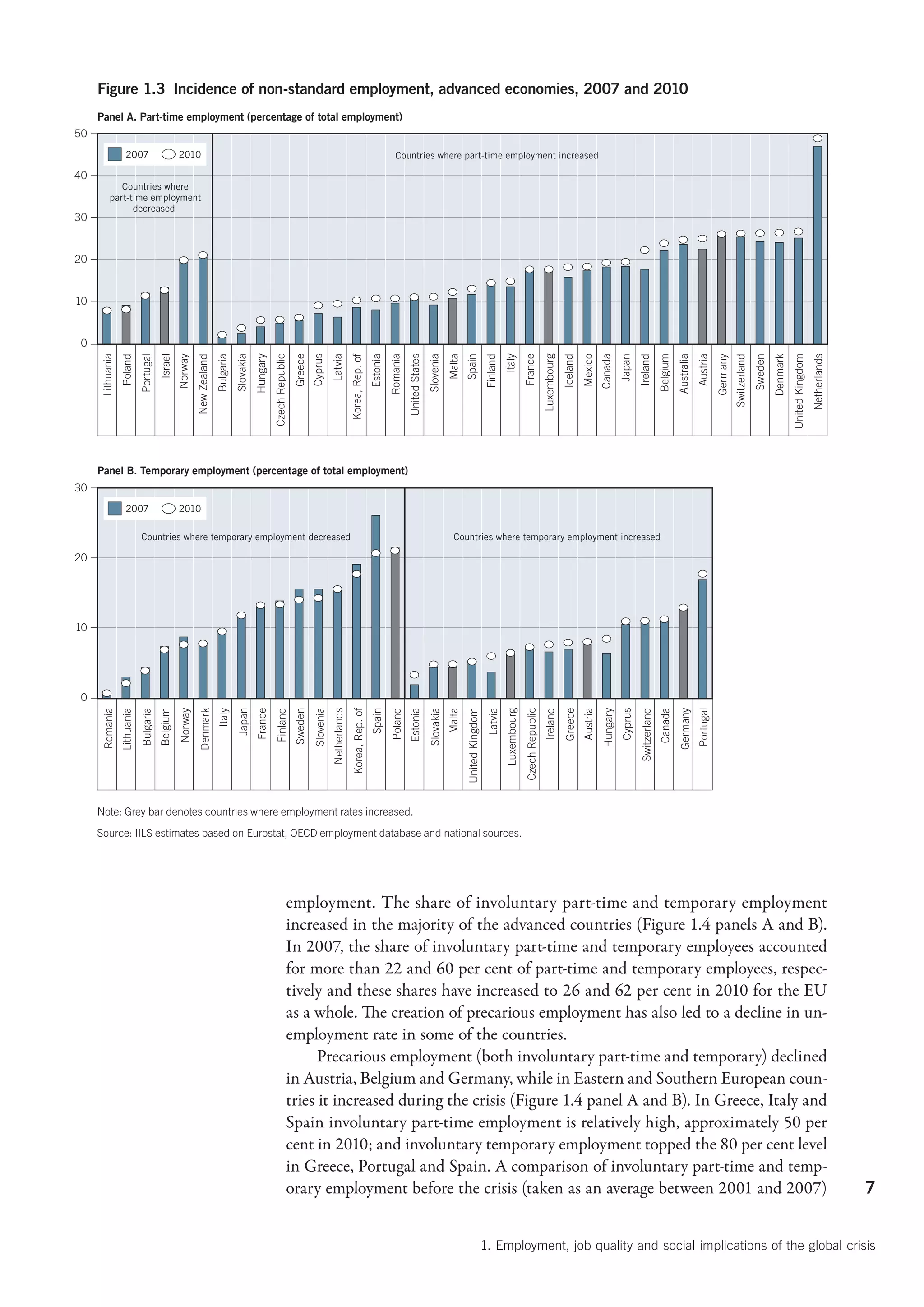
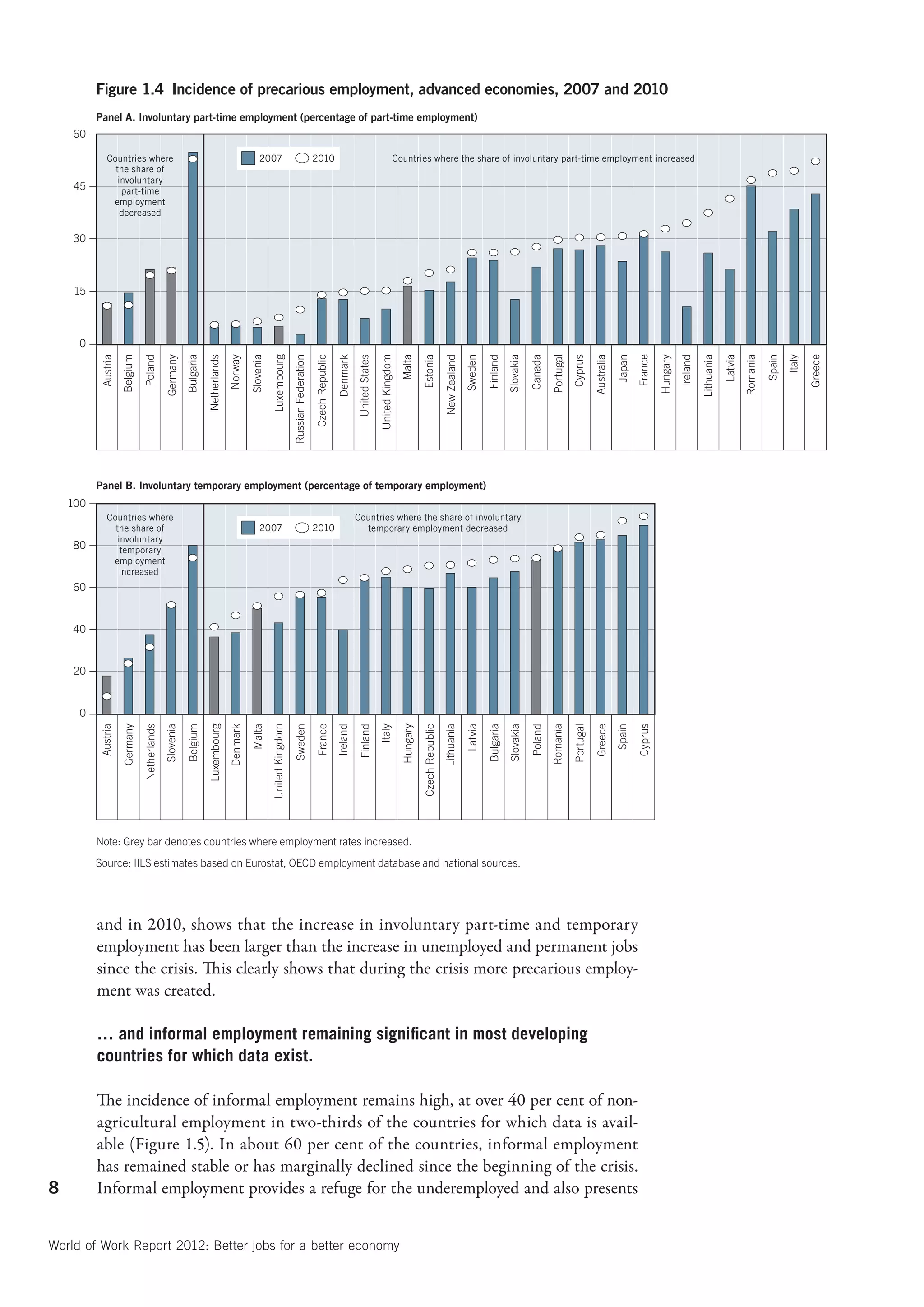
                                                                                                                      employment. The share of involuntary part-time and temporary employment
                                                                                                                      increased in the majority of the advanced countries (Figure 1.4 panels A and B).
                                                                                                                      In 2007, the share of involuntary part-time and temporary employees accounted
                                                                                                                      for more than 22 and 60 per cent of part-time and temporary employees, respec-
                                                                                                                      tively and these shares have increased to 26 and 62 per cent in 2010 for the EU
                                                                                                                      as a whole. The creation of precarious employment has also led to a decline in un-
                                                                                                                      employment rate in some of the countries.
                                                                                                                            Precarious employment (both involuntary part-time and temporary) declined
                                                                                                                      in Austria, Belgium and Germany, while in Eastern and Southern European coun-
                                                                                                                      tries it increased during the crisis (Figure 1.4 panel A and B). In Greece, Italy and
                                                                                                                      Spain involuntary part-time employment is relatively high, approximately 50 per
                                                                                                                      cent in 2010; and involuntary temporary employment topped the 80 per cent level
                                                                                                                      in Greece, Portugal and Spain. A comparison of involuntary part-time and temp-
                                                                                                                      orary employment before the crisis (taken as an average between 2001 and 2007)                                                                                                                                                                                                                                                                       7


                                                                                                                                                                                                                                                      1. Employment, job quality and social implications of the global crisis
Figure 1.4 Incidence of precarious employment, advanced economies, 2007 and 2010
          Panel A. Involuntary part-time employment (percentage of part-time employment)
    60

              Countries where                                                                   2007                                        2010                                                    Countries where the share of involuntary part-time employment increased
                the share of
                 involuntary
    45            part-time
               employment
                  decreased

    30


     15


      0


                                                                                                                                                                                                                                                                                                    Cyprus

                                                                                                                                                                                                                                                                                                               Australia

                                                                                                                                                                                                                                                                                                                           Japan
           Austria
                     Belgium


                                             Germany
                                                        Bulgaria


                                                                                 Norway


                                                                                                                                            Czech Republic

                                                                                                                                                             Denmark
                                                                                                                                                                       United States


                                                                                                                                                                                                                                                 Sweden


                                                                                                                                                                                                                                                                                                                                   France


                                                                                                                                                                                                                                                                                                                                                      Ireland
                               Poland


                                                                   Netherlands


                                                                                           Slovenia

                                                                                                      Luxembourg
                                                                                                                       Russian Federation


                                                                                                                                                                                       United Kingdom
                                                                                                                                                                                                        Malta

                                                                                                                                                                                                                  Estonia

                                                                                                                                                                                                                                   New Zealand


                                                                                                                                                                                                                                                          Finland
                                                                                                                                                                                                                                                                     Slovakia

                                                                                                                                                                                                                                                                                Canada

                                                                                                                                                                                                                                                                                         Portugal


                                                                                                                                                                                                                                                                                                                                            Hungary


                                                                                                                                                                                                                                                                                                                                                                Lithuania

                                                                                                                                                                                                                                                                                                                                                                            Latvia
                                                                                                                                                                                                                                                                                                                                                                                     Romania

                                                                                                                                                                                                                                                                                                                                                                                               Spain
                                                                                                                                                                                                                                                                                                                                                                                                       Italy

                                                                                                                                                                                                                                                                                                                                                                                                               Greece
          Panel B. Involuntary temporary employment (percentage of temporary employment)
    100
              Countries where                                                                                                                                          Countries where the share of involuntary
                the share of                                                                    2007                                        2010                         temporary employment decreased
                 involuntary
    80            temporary
               employment
                  increased
    60


    40


    20


      0
          Austria

                     Germany


                                                        Belgium
                               Netherlands
                                             Slovenia


                                                                   Luxembourg
                                                                                 Denmark


                                                                                                      United Kingdom

                                                                                                                       Sweden
                                                                                           Malta


                                                                                                                                            France
                                                                                                                                                             Ireland

                                                                                                                                                                       Finland
                                                                                                                                                                                       Italy

                                                                                                                                                                                                        Hungary

                                                                                                                                                                                                                  Czech Republic
                                                                                                                                                                                                                                   Lithuania

                                                                                                                                                                                                                                                 Latvia

                                                                                                                                                                                                                                                          Bulgaria
                                                                                                                                                                                                                                                                     Slovakia

                                                                                                                                                                                                                                                                                Poland
                                                                                                                                                                                                                                                                                         Romania

                                                                                                                                                                                                                                                                                                    Portugal

                                                                                                                                                                                                                                                                                                               Greece
                                                                                                                                                                                                                                                                                                                           Spain

                                                                                                                                                                                                                                                                                                                                   Cyprus


          Note: Grey bar denotes countries where employment rates increased.
          Source: IILS estimates based on Eurostat, OECD employment database and national sources.


          and in 2010, shows that the increase in involuntary part-time and temporary
          employment has been larger than the increase in unemployed and permanent jobs
          since the crisis. This clearly shows that during the crisis more precarious employ-
          ment was created.

          … and informal employment remaining significant in most developing
          countries for which data exist.

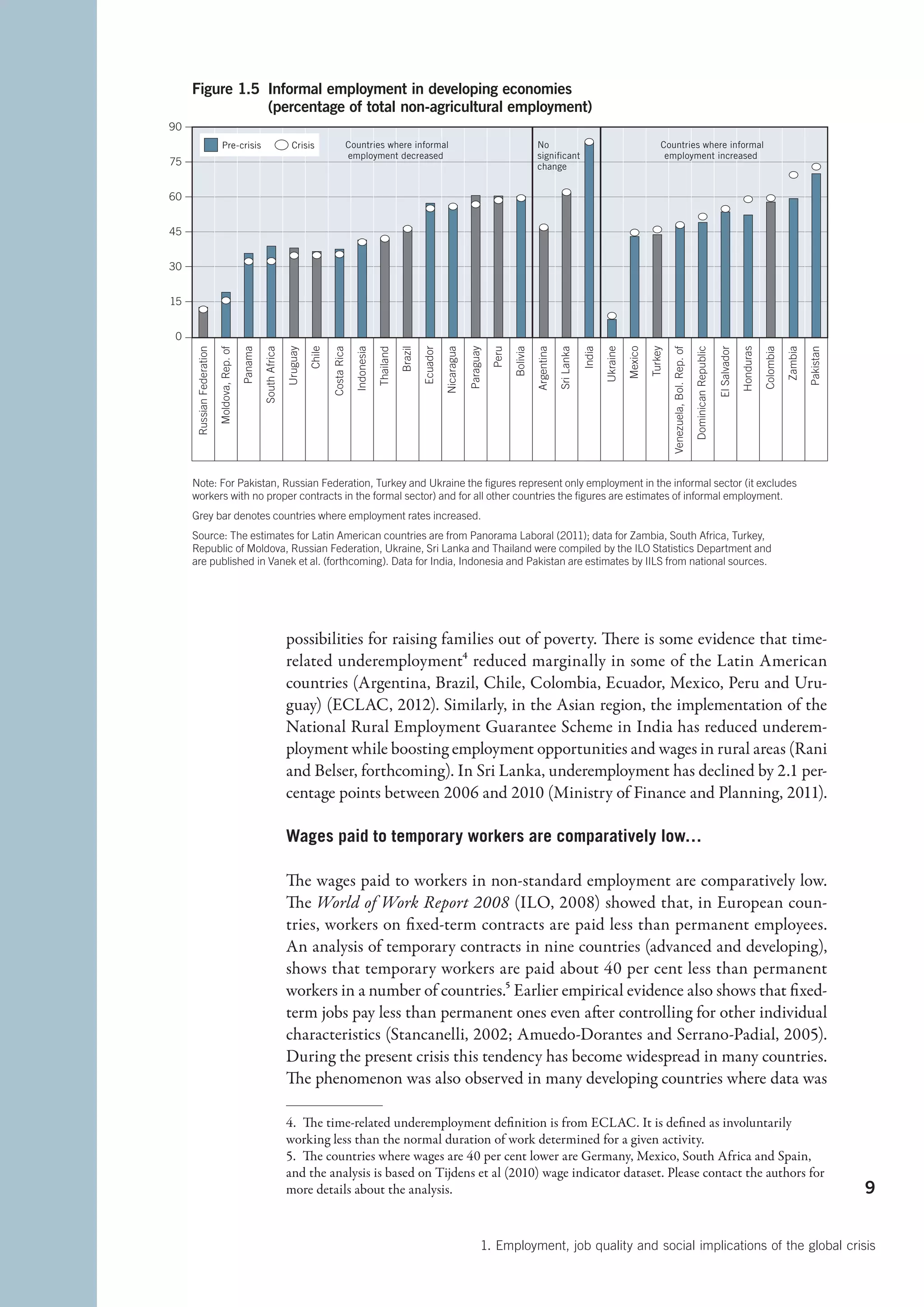
          The incidence of informal employment remains high, at over 40 per cent of non-
          agricultural employment in two-thirds of the countries for which data is avail-
          able (Figure 1.5). In about 60 per cent of the countries, informal employment
          has remained stable or has marginally declined since the beginning of the crisis.
8         Informal employment provides a refuge for the underemployed and also presents


World of Work Report 2012: Better jobs for a better economy
Figure 1.5 Informal employment in developing economies
                (percentage of total non-agricultural employment)
90
                             Pre-crisis                                Crisis                       Countries where informal                                                            No                                                      Countries where informal
                                                                                                    employment decreased                                                                significant                                               employment increased
75                                                                                                                                                                                      change


60


45


30


15


 0
                                                                     Uruguay
     Russian Federation


                                             Panama

                                                      South Africa


                                                                               Chile

                                                                                       Costa Rica

                                                                                                      Indonesia


                                                                                                                             Brazil

                                                                                                                                      Ecuador
                                                                                                                  Thailand


                                                                                                                                                Nicaragua

                                                                                                                                                            Paraguay

                                                                                                                                                                       Peru

                                                                                                                                                                              Bolivia

                                                                                                                                                                                        Argentina

                                                                                                                                                                                                    Sri Lanka

                                                                                                                                                                                                                India

                                                                                                                                                                                                                        Ukraine

                                                                                                                                                                                                                                  Mexico

                                                                                                                                                                                                                                           Turkey


                                                                                                                                                                                                                                                                              Dominican Republic

                                                                                                                                                                                                                                                                                                   El Salvador

                                                                                                                                                                                                                                                                                                                 Honduras

                                                                                                                                                                                                                                                                                                                            Colombia

                                                                                                                                                                                                                                                                                                                                       Zambia

                                                                                                                                                                                                                                                                                                                                                Pakistan
                          Moldova, Rep. of


                                                                                                                                                                                                                                                    Venezuela, Bol. Rep. of
     Note: For Pakistan, Russian Federation, Turkey and Ukraine the figures represent only employment in the informal sector (it excludes
     workers with no proper contracts in the formal sector) and for all other countries the figures are estimates of informal employment.
     Grey bar denotes countries where employment rates increased.
     Source: The estimates for Latin American countries are from Panorama Laboral (2011); data for Zambia, South Africa, Turkey,
     Republic of Moldova, Russian Federation, Ukraine, Sri Lanka and Thailand were compiled by the ILO Statistics Department and
     are published in Vanek et al. (forthcoming). Data for India, Indonesia and Pakistan are estimates by IILS from national sources.


                                                                     possibilities for raising families out of poverty. There is some evidence that time-
                                                                     related underemployment4 reduced marginally in some of the Latin American
                                                                     countries (Argentina, Brazil, Chile, Colombia, Ecuador, Mexico, Peru and Uru-
                                                                     guay) (ECLAC, 2012). Similarly, in the Asian region, the implementation of the
                                                                     National Rural Employment Guarantee Scheme in India has reduced underem-
                                                                     ployment while boosting employment opportunities and wages in rural areas (Rani
                                                                     and Belser, forthcoming). In Sri Lanka, underemployment has declined by 2.1 per-
                                                                     centage points between 2006 and 2010 (Ministry of Finance and Planning, 2011).

                                                                     Wages paid to temporary workers are comparatively low…

                                                                     The wages paid to workers in non-standard employment are comparatively low.
                                                                     The World of Work Report 2008 (ILO, 2008) showed that, in European coun-
                                                                     tries, workers on fixed-term contracts are paid less than permanent employees.
                                                                     An analysis of temporary contracts in nine countries (advanced and developing),
                                                                     shows that temporary workers are paid about 40 per cent less than permanent
                                                                     workers in a number of countries.5 Earlier empirical evidence also shows that fixed-
                                                                     term jobs pay less than permanent ones even after controlling for other individual
                                                                     characteristics (Stancanelli, 2002; Amuedo-Dorantes and Serrano-Padial, 2005).
                                                                     During the present crisis this tendency has become widespread in many countries.
                                                                     The phenomenon was also observed in many developing countries where data was

                                                                     4.  The time-related underemployment definition is from ECLAC. It is defined as involuntarily
                                                                     working less than the normal duration of work determined for a given activity.
                                                                     5.  The countries where wages are 40 per cent lower are Germany, Mexico, South Africa and Spain,
                                                                     and the analysis is based on Tijdens et al (2010) wage indicator dataset. Please contact the authors for
                                                                     more details about the analysis.                                                                                                                                                                                                                                                      9


                                                                                                                                                                   1. Employment, job quality and social implications of the global crisis
available, where informal jobs were paid at less than 40 per cent of the rate for
        formal jobs, and the wage gaps were widening further (ILO, 2008).

        … and new jobs created tend to entail relatively low wages.

        An examination of the nature of jobs created between 2007 and 2010 in the 20
        countries for which data exist shows, first, that the majority of new jobs are remu-
        nerated at a rate below average wages. This is particularly the case in Argentina,
        Mexico, Netherlands, South Africa and Spain. Second, the analysis shows that
        new low-paid jobs are less stable than is the case with new highly-paid jobs. Again
        there are cross-country differences, such as in Sweden and Netherlands most of
        the new jobs are in lower quintiles and these are concentrated in agriculture, con-
        struction, wholesale and retail trade, accommodation and food, while the jobs in
        the upper quintiles are concentrated in information, real estate and financial sec-
        tors. In comparison, in the Russian Federation the new jobs are equally distributed
        across the quintiles and jobs in manufacturing and construction sectors are preva-
        lent in all quintiles. The new jobs in lower quintiles are predominantly in accom-
        modation and food, and in the upper quintiles they are concentrated in mining,
        finance, real estate, information and communication and professional and scien-
        tific sectors.
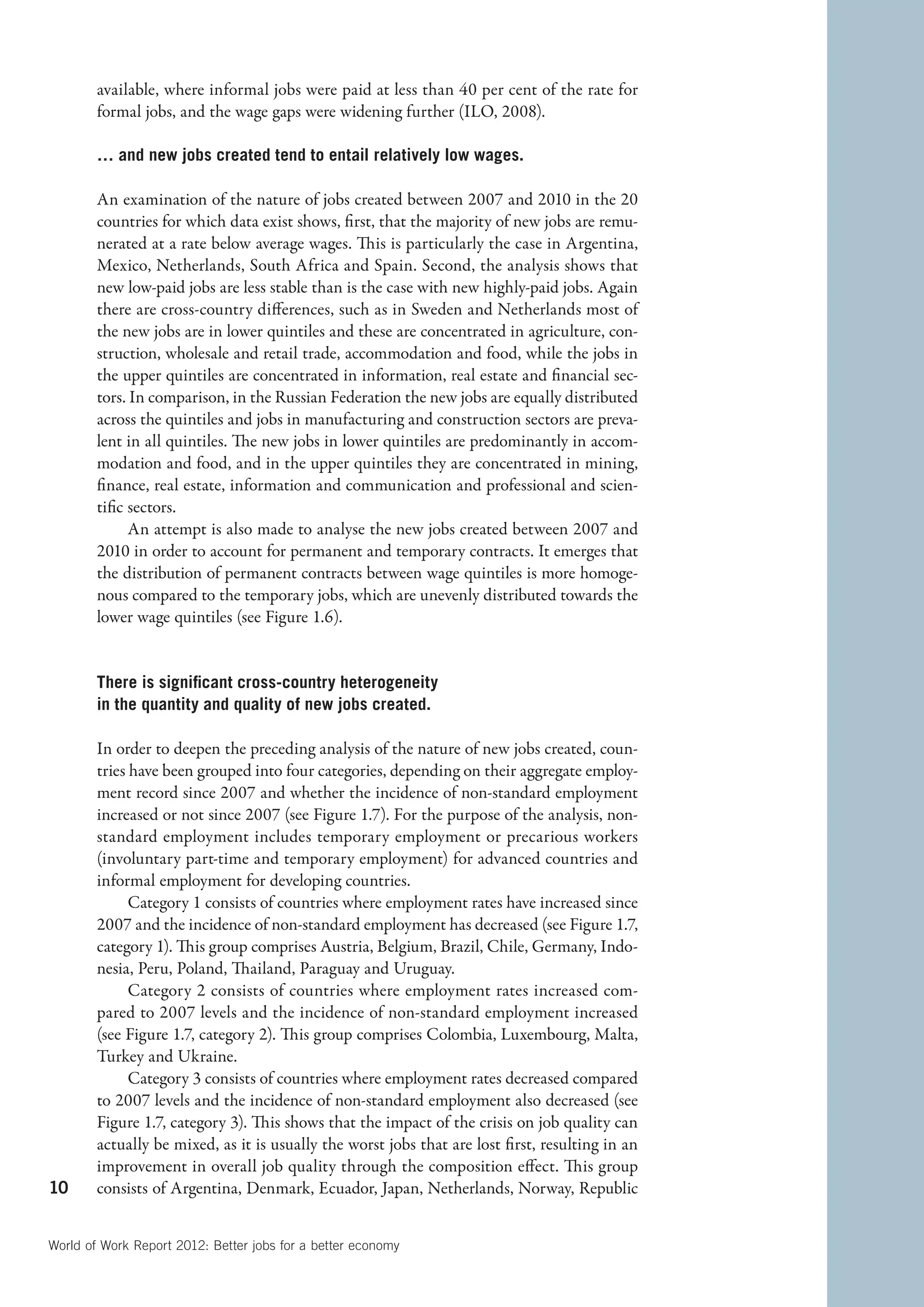
              An attempt is also made to analyse the new jobs created between 2007 and
        2010 in order to account for permanent and temporary contracts. It emerges that
        the distribution of permanent contracts between wage quintiles is more homoge-
        nous compared to the temporary jobs, which are unevenly distributed towards the
        lower wage quintiles (see Figure 1.6).


        There is significant cross-country heterogeneity
        in the quantity and quality of new jobs created.

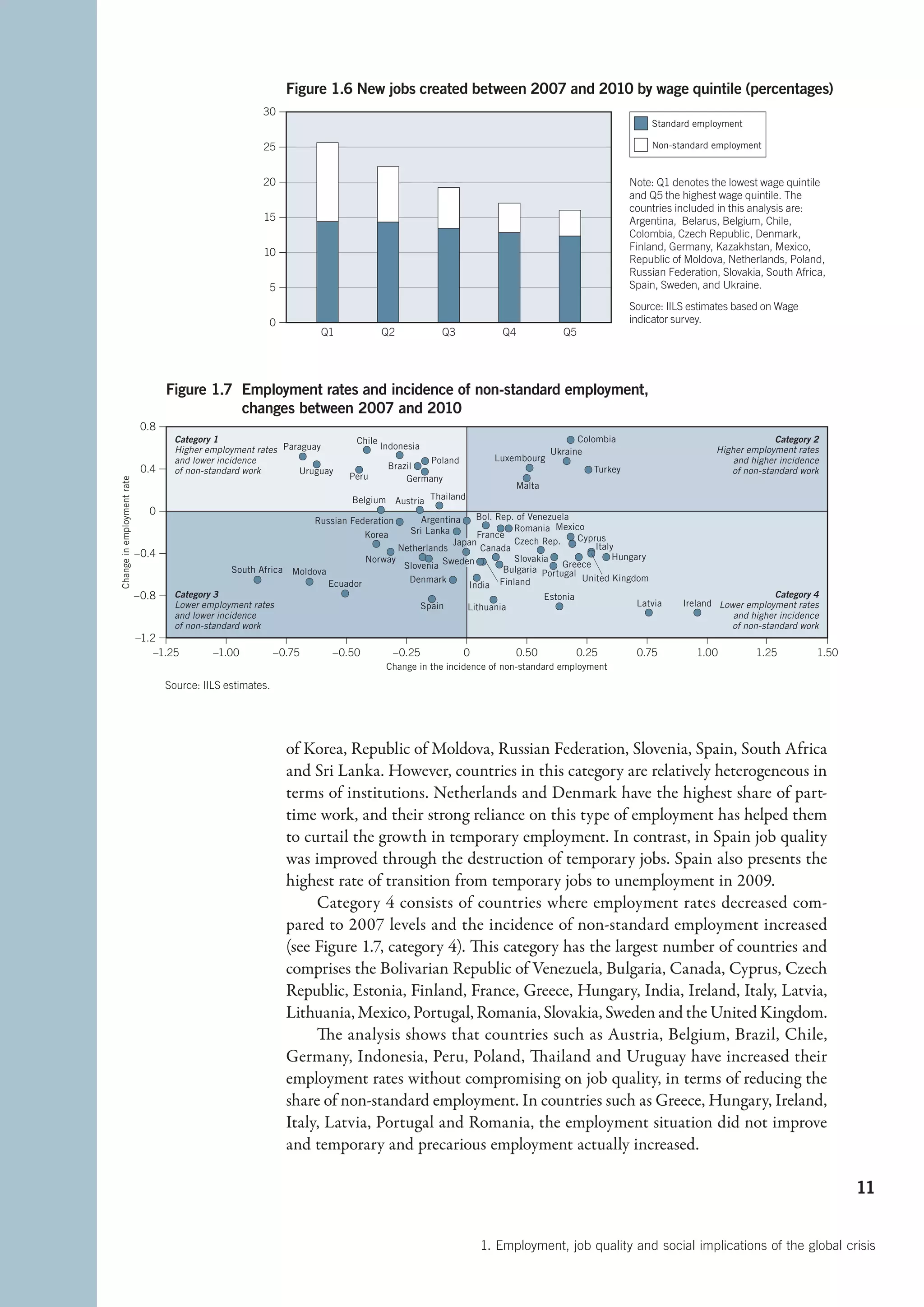
        In order to deepen the preceding analysis of the nature of new jobs created, coun-
        tries have been grouped into four categories, depending on their aggregate employ-
        ment record since 2007 and whether the incidence of non-standard employment
        increased or not since 2007 (see Figure 1.7). For the purpose of the analysis, non-
        standard employment includes temporary employment or precarious workers
        (involuntary part-time and temporary employment) for advanced countries and
        informal employment for developing countries.
              Category 1 consists of countries where employment rates have increased since
        2007 and the incidence of non-standard employment has decreased (see Figure 1.7,
        category 1). This group comprises Austria, Belgium, Brazil, Chile, Germany, Indo-
        nesia, Peru, Poland, Thailand, Paraguay and Uruguay.
              Category 2 consists of countries where employment rates increased com-
        pared to 2007 levels and the incidence of non-standard employment increased
        (see Figure 1.7, category 2). This group comprises Colombia, Luxembourg, Malta,
        Turkey and Ukraine.
              Category 3 consists of countries where employment rates decreased compared
        to 2007 levels and the incidence of non-standard employment also decreased (see
        Figure 1.7, category 3). This shows that the impact of the crisis on job quality can
        actually be mixed, as it is usually the worst jobs that are lost first, resulting in an
        improvement in overall job quality through the composition effect. This group
10      consists of Argentina, Denmark, Ecuador, Japan, Netherlands, Norway, Republic


World of Work Report 2012: Better jobs for a better economy
Figure 1.6 New jobs created between 2007 and 2010 by wage quintile (percentages)
                                                        30
                                                                                                                                                          Standard employment

                                                        25                                                                                                Non-standard employment


                                                        20                                                                                            Note: Q1 denotes the lowest wage quintile
                                                                                                                                                      and Q5 the highest wage quintile. The
                                                                                                                                                      countries included in this analysis are:
                                                        15                                                                                            Argentina, Belarus, Belgium, Chile,
                                                                                                                                                      Colombia, Czech Republic, Denmark,
                                                                                                                                                      Finland, Germany, Kazakhstan, Mexico,
                                                        10
                                                                                                                                                      Republic of Moldova, Netherlands, Poland,
                                                                                                                                                      Russian Federation, Slovakia, South Africa,
                                                          5                                                                                           Spain, Sweden, and Ukraine.
                                                                                                                                                      Source: IILS estimates based on Wage
                                                          0                                                                                           indicator survey.
                                                                      Q1               Q2             Q3            Q4              Q5


                                   Figure 1.7 Employment rates and incidence of non-standard employment,
                                              changes between 2007 and 2010
                             0.8
                                     Category 1                                Chile                                                J Colombia                                         Category 2
                                     Higher employment rates Paraguay          J Indonesia
                                                                                    J                                            Ukraine                                 Higher employment rates
                                     and lower incidence        J                            Poland              Luxembourg                                                  and higher incidence
                             0.4                                   J         J     Brazil JJ                              J
                                                                                                                                    J
                                                                                                                                           J Turkey
                                     of non-standard work       Uruguay                    J                                                                                of non-standard work
                                                                            Peru            Germany                       J
Change in employment rate


                                                                                                                       Malta
                                                                               Belgium Austria Thailand
                                                                                                    J
                              0                                                     J         J
                                                                                      Argentina J Bol. Rep. of Venezuela
                                                                     Russian Federation J
                                                                                   Sri Lanka J
                                                                                                    J JJ Romania Mexico
                                                                          Korea                    France
                                                                           J                 Japan         Czech Rep. J Cyprus
                                                                                                                        J
                                                                                 Netherlands        Canada       J            Italy
                            –0.4                                               J
                                                                          Norway
                                                                                                J
                                                                                     J Sweden J J Slovakia J J J J Hungary
                                                                                       J
                                                                                  Slovenia         J J             J Greece
                                                 South Africa Moldova                                    Bulgaria Portugal
                                                      J                            Denmark J      J                        United Kingdom
                                                                J Ecuador                        India Finland
                            –0.8     Category 3                            J                                                    Estonia                                               Category 4
                                     Lower employment rates
                                                                                                  J             J                                      Latvia    Ireland Lower employment rates
                                                                                                 Spain     Lithuania              J
                                     and lower incidence                                                                                                 J          J       and higher incidence
                                     of non-standard work                                                                                                                   of non-standard work
                            –1.2
                                –1.25        –1.00           –0.75       –0.50           –0.25             0             0.50             0.25         0.75         1.00          1.25          1.50
                                                                                        Change in the incidence of non-standard employment

                                   Source: IILS estimates.


                                                               of Korea, Republic of Moldova, Russian Federation, Slovenia, Spain, South Africa
                                                               and Sri Lanka. However, countries in this category are relatively heterogeneous in
                                                               terms of institutions. Netherlands and Denmark have the highest share of part-
                                                               time work, and their strong reliance on this type of employment has helped them
                                                               to curtail the growth in temporary employment. In contrast, in Spain job quality
                                                               was improved through the destruction of temporary jobs. Spain also presents the
                                                               highest rate of transition from temporary jobs to unemployment in 2009.
                                                                    Category 4 consists of countries where employment rates decreased com-
                                                               pared to 2007 levels and the incidence of non-standard employment increased
                                                               (see Figure 1.7, category 4). This category has the largest number of countries and
                                                               comprises the Bolivarian Republic of Venezuela, Bulgaria, Canada, Cyprus, Czech
                                                               Republic, Estonia, Finland, France, Greece, Hungary, India, Ireland, Italy, Latvia,
                                                               Lithuania, Mexico, Portugal, Romania, Slovakia, Sweden and the United Kingdom.
                                                                    The analysis shows that countries such as Austria, Belgium, Brazil, Chile,
                                                               Germany, Indonesia, Peru, Poland, Thailand and Uruguay have increased their
                                                               employment rates without compromising on job quality, in terms of reducing the
                                                               share of non-standard employment. In countries such as Greece, Hungary, Ireland,
                                                               Italy, Latvia, Portugal and Romania, the employment situation did not improve
                                                               and temporary and precarious employment actually increased.

                                                                                                                                                                                                       11


                                                                                                               1. Employment, job quality and social implications of the global crisis
C. Impact of the crisis on poverty and income inequality

        The social impact of the current global crisis has been manifold, as rising un-
        employment and falling incomes further deepen poverty and worsen inequality in
        certain countries. In many of the developing countries, the informal sector labour
        force has expanded with the entry of the unemployed from the formal sector,
        resulting in sharp declines in the earnings of workers. The situation is similar in
        the advanced economies, where the rise in temporary employment and precarious
        workers also leads to a decline in incomes. This section analyses the impact of the
        crisis on poverty and income inequality.

        Poverty rates have increased since the start of the crisis in advanced
        economies, and have tended to decrease in developing countries …

        In the past decade, global poverty rates, measured as the share of the population
        living below $1.25 per day, declined by 17 percentage points from 42 per cent
        in 1990 to 25 per cent in 2005 (World Bank, 2011).6 However, increasing food
        and fuel prices and the 2008 global crisis reversed these positive trends in sev-
        eral regions of the world. The poverty threshold, which is the minimum level of
        income deemed adequate to sustain a basic standard of living, is defined differ-
        ently for advanced and developing economies. In advanced economies, the poverty
        threshold is a relative measure and is calculated as the percentage of the population
        living on an income below 60 per cent of the median income. In developing econ-
        omies, it is an absolute measure calculated as the percentage of the population
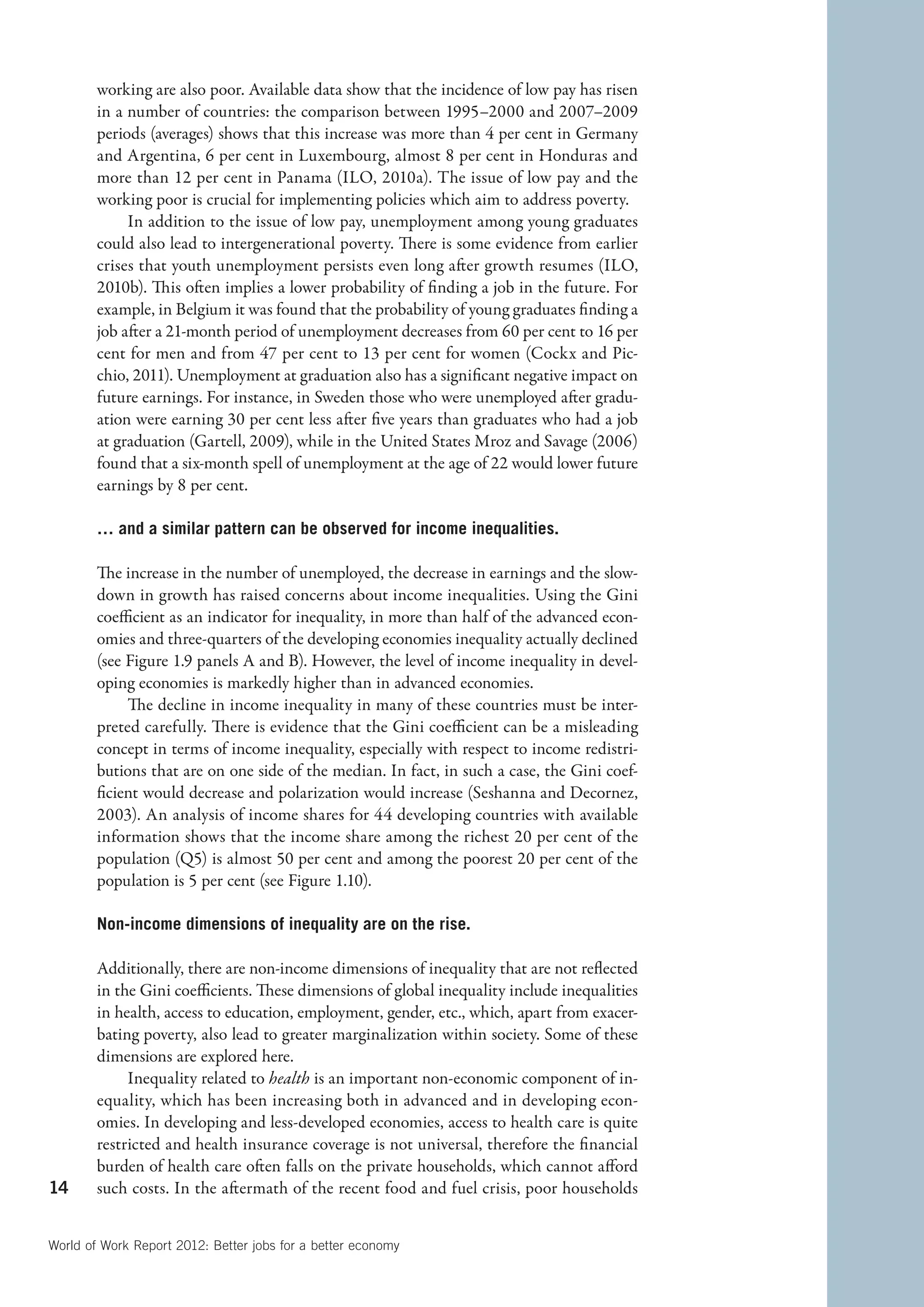
        living on incomes below the national poverty rates.
              In about three-quarters of the developing economies there was a decline
        in national poverty rates between pre-crisis and crisis periods, which was most
        marked in the Latin American region followed by the Asian countries and Uganda
        and Rwanda in the African region (Figure 1.8 panel A). In advanced economies,
        poverty rates declined or remained the same in half of the countries between 2007
        and 2010 (see Figure 1.8 panel B). As the poverty line used in Europe is a rela-
        tive one, the decrease in poverty rates might stem from a disproportional decline
        in overall income instead of an improvement in poverty. Poverty rates have also
        declined in some of the East European countries that joined the EU recently. In
        these countries, the poverty rates were relatively high and joining the EU seems to
        have had a positive impact on their poverty level.
              However, if poverty thresholds are calculated using an absolute measure then
        the situation might be different. For example, in Latvia relative poverty rates do
        not show any significant change in poverty between 2007 and 2010. Though, if
        an absolute poverty line, such as a minimum subsistence basket, is used then the
        poverty rate increases by 16 percentage points between 2008 and 2009 (Kūla et
        al., 2011). The situation in Greece and Portugal7 seems to be similar wherein GDP
        per capita decreased in these countries while relative poverty rates did not change


        6.  This indicator is one of the two indicators used in developing countries to measure poverty (the
        other one is the share of population living below $2 a day) and indicates extreme poverty, according to
        the World Bank. These estimates are provided to present an overall picture of global poverty. However,
        as each country’s national poverty rate is more relevant (since this takes into account economic and
        social conditions specific to that country), this is the rate considered for developing countries. In the
        case of advanced countries, 60 per cent of the median income is used as the poverty rate.
        7.  Using an absolute measure it was found that poverty rates increased by two percentage points
12      between pre-crisis and crisis periods (Callan et al., 2011).


World of Work Report 2012: Better jobs for a better economy
Figure 1.8 Poverty rates (percentages)
     Panel A. Emerging and developing economies
70
                                                                                                                                  Countries where poverty rates decreased


                                                                                                                                                                                                                                                                                                                                                                                                          Countries with no
                                                                                                                                                                                                                                                                                                                                                                                                         significant change
                               Pre-crisis                                  Crisis                                                                                                                                                                                                                                                                                                                                                                Countries where poverty
60
                                                                                                                                                                                                                                                                                                                                                                                                                                                    rates increased

50

40

30

20

10

 0
                                                                                                                        Uruguay
                                                                                                                                  Brazil
      Belarus
                      Montenegro
                                   Thailand
                                              Kazakhstan
                                                           Sri Lanka
                                                                       Albania
                                                                                 Indonesia
                                                                                              Viet Nam
                                                                                                           Azerbaijan


                                                                                                                                           Uganda
                                                                                                                                                         Nepal
                                                                                                                                                                   Lao PDR


                                                                                                                                                                                                       India
                                                                                                                                                                                                                  Fiji
                                                                                                                                                                                                                           Bangladesh
                                                                                                                                                                                                                                        Kyrgyz Republic
                                                                                                                                                                                                                                                          Panama
                                                                                                                                                                                                                                                                     Dominican Republic
                                                                                                                                                                                                                                                                                          Peru
                                                                                                                                                                                                                                                                                                 Paraguay


                                                                                                                                                                                                                                                                                                                                     Ecuador


                                                                                                                                                                                                                                                                                                                                                                        Rwanda


                                                                                                                                                                                                                                                                                                                                                                                                                                            Chile


                                                                                                                                                                                                                                                                                                                                                                                                                                                                        Costa Rica


                                                                                                                                                                                                                                                                                                                                                                                                                                                                                                                                                      Cote d'Ivoire
                                                                                                                                                                                                                                                                                                            Mongolia


                                                                                                                                                                                                                                                                                                                                               Colombia
                                                                                                                                                                                                                                                                                                                       Afghanistan


                                                                                                                                                                                                                                                                                                                                                          Mauritania


                                                                                                                                                                                                                                                                                                                                                                                 Tajikistan
                                                                                                                                                                                                                                                                                                                                                                                              Honduras
                                                                                                                                                                                                                                                                                                                                                                                                         Malaysia
                                                                                                                                                                                                                                                                                                                                                                                                                     Philippines
                                                                                                                                                                                                                                                                                                                                                                                                                                   Jordan


                                                                                                                                                                                                                                                                                                                                                                                                                                                        Turkey


                                                                                                                                                                                                                                                                                                                                                                                                                                                                                     Egypt, Arab Rep. of


                                                                                                                                                                                                                                                                                                                                                                                                                                                                                                                              Armenia
                                                                                                                                                                                                                                                                                                                                                                                                                                                                                                                                        El Salvador


                                                                                                                                                                                                                                                                                                                                                                                                                                                                                                                                                                      Mozambique
                                                                                                                                                                             Venezuela, Bol. Rep. of


                                                                                                                                                                                                                                                                                                                                                                                                                                                                                                           Moldova, Rep. of
     Panel B. Advanced economies
30
                                   Countries where poverty                                                                                                   Countries with no                                                                                                               Countries where poverty
                                                                                                                                                                                                                                                                                                                                                                                                         2007                           2010
                                      rates decreased                                                                                                        significant change                                                                                                                  rates increased
25


20


15


10


 5


 0
     Czech Republic


                                                                                                                          Israel
                      Iceland
                      Norway
                                              Belgium
                                                           Ireland
                                                                       United Kingdom
                                                                                  Italy
                                                                                             New Zealand
                                                                                                           Bulgaria
                                                                                                                        Romania


                                                                                                                                           Netherlands
                                                                                                                                                         Austria
                                                                                                                                                                   Hungary
                                                                                                                                                                    Finland
                                                                                                                                                                                                       Portugal
                                                                                                                                                                                                                  Greece


                                                                                                                                                                                                                                   Latvia


                                                                                                                                                                                                                                                                                           Sweden
                                                                                                                                                                                                                                                                                          Denmark


                                                                                                                                                                                                                                                                                                                                                                        Cyprus


                                                                                                                                                                                                                                                                                                                                                                                              Canada
                                                                                                                                                                                                                                                          Slovakia
                                                                                                                                                                                                                                                                     Slovenia


                                                                                                                                                                                                                                                                                                            France
                                                                                                                                                                                                                                                                                                                       Luxembourg
                                                                                                                                                                                                                                                                                                                            Malta
                                                                                                                                                                                                                                                                                                                                               Germany
                                                                                                                                                                                                                                                                                                                                                          Switzerland


                                                                                                                                                                                                                                                                                                                                                                        Poland


                                                                                                                                                                                                                                                                                                                                                                                                         Lithuania
                                                                                                                                                                                                                                                                                                                                                                                                                     Spain
                                                                                                                                                                                                                                                                                                                                                                                                                     Japan
                                                                                                                                                                                                                                                                                                                                                                                                                                            Australia
                                                                                                                                                                                                                                                                                                                                                                                                                                                        United States
                                                                                                                                                                                                                           Korea, Rep. of


     Note: For emerging and developing economies, the poverty rate is measured as the percentage of the population living below
     the national poverty rate. For advanced economies it is measured as the percentage of the population living below 60 per cent
     of the median income. For Australia, Canada, Israel, Japan, Republic of Korea, New Zealand, Switzerland and the United States
     the data refer to mid-2000s and latest year.
     Source: IILS estimates based on World Bank, Eurostat and OECD databases.


                                                                                                                                           during this crisis. This is surprising given that both these countries observed a
                                                                                                                                           decline in minimum wages by 20 and 25 per cent respectively, which should have
                                                                                                                                           led to a decline in purchasing power and also increase in poverty.
                                                                                                                                                One of the obstacles to reducing poverty is its intergenerational transmission
                                                                                                                                           from parents to children, which increases the long-term probability that the poor
                                                                                                                                           will remain in poverty. One of the reasons why certain groups are trapped in pov-
                                                                                                                                           erty is due to low pay.8 “Historically poverty was associated with joblessness” (Luci-
                                                                                                                                           fora and Salverda, 2009); however, today an increasing number of those who are

                                                                                                                                           8.  Low pay is defined by the ILO as “the proportion of workers whose hourly wages [are] less than
                                                                                                                                           two-thirds of the median wage across all jobs” (ILO, 2010a).                                                                                                                                                                                                                                                                                                                                                                            13


                                                                                                                                                                                                                                                                                                      1. Employment, job quality and social implications of the global crisis
working are also poor. Available data show that the incidence of low pay has risen
        in a number of countries: the comparison between 1995–2000 and 2007–2009
        periods (averages) shows that this increase was more than 4 per cent in Germany
        and Argentina, 6 per cent in Luxembourg, almost 8 per cent in Honduras and
        more than 12 per cent in Panama (ILO, 2010a). The issue of low pay and the
        working poor is crucial for implementing policies which aim to address poverty.
             In addition to the issue of low pay, unemployment among young graduates
        could also lead to intergenerational poverty. There is some evidence from earlier
        crises that youth unemployment persists even long after growth resumes (ILO,
        2010b). This often implies a lower probability of finding a job in the future. For
        example, in Belgium it was found that the probability of young graduates finding a
        job after a 21-month period of unemployment decreases from 60 per cent to 16 per
        cent for men and from 47 per cent to 13 per cent for women (Cockx and Pic-
        chio, 2011). Unemployment at graduation also has a significant negative impact on
        future earnings. For instance, in Sweden those who were unemployed after gradu-
        ation were earning 30 per cent less after five years than graduates who had a job
        at graduation (Gartell, 2009), while in the United States Mroz and Savage (2006)
        found that a six-month spell of unemployment at the age of 22 would lower future
        earnings by 8 per cent.

        … and a similar pattern can be observed for income inequalities.

        The increase in the number of unemployed, the decrease in earnings and the slow-
        down in growth has raised concerns about income inequalities. Using the Gini
        coefficient as an indicator for inequality, in more than half of the advanced econ-
        omies and three-quarters of the developing economies inequality actually declined
        (see Figure 1.9 panels A and B). However, the level of income inequality in devel-
        oping economies is markedly higher than in advanced economies.
             The decline in income inequality in many of these countries must be inter-
        preted carefully. There is evidence that the Gini coefficient can be a misleading
        concept in terms of income inequality, especially with respect to income redistri-
        butions that are on one side of the median. In fact, in such a case, the Gini coef-
        ficient would decrease and polarization would increase (Seshanna and Decornez,
        2003). An analysis of income shares for 44 developing countries with available
        information shows that the income share among the richest 20 per cent of the
        population (Q5) is almost 50 per cent and among the poorest 20 per cent of the
        population is 5 per cent (see Figure 1.10).

        Non-income dimensions of inequality are on the rise.

        Additionally, there are non-income dimensions of inequality that are not reflected
        in the Gini coefficients. These dimensions of global inequality include inequalities
        in health, access to education, employment, gender, etc., which, apart from exacer-
        bating poverty, also lead to greater marginalization within society. Some of these
        dimensions are explored here.
             Inequality related to health is an important non-economic component of in-
        equality, which has been increasing both in advanced and in developing econ-
        omies. In developing and less-developed economies, access to health care is quite
        restricted and health insurance coverage is not universal, therefore the financial
        burden of health care often falls on the private households, which cannot afford
14      such costs. In the aftermath of the recent food and fuel crisis, poor households


World of Work Report 2012: Better jobs for a better economy
0
                                                                                                                10
                                                                                                                                        20
                                                                                                                                              30
                                                                                                                                                   40
                                                                                                                                                        50
                                                                                                                                                                                                                                                                                                                                                                                         0
                                                                                                                                                                                                                                                                                                                                                                                             10
                                                                                                                                                                                                                                                                                                                                                                                                  20
                                                                                                                                                                                                                                                                                                                                                                                                       30
                                                                                                                                                                                                                                                                                                                                                                                                            40
                                                                                                                                                                                                                                                                                                                                                                                                                 50
                                                                                                                                                                                                                                                                                                                                                                                                                        60
                                                                                                                                                                                                                                                                                                                                                                                                                                                                    70
                                                                                                                                                                                                                                                                                                                                                                                                                                                                                                                                         0
                                                                                                                                                                                                                                                                                                                                                                                                                                                                                                                                             10
                                                                                                                                                                                                                                                                                                                                                                                                                                                                                                                                                  20
                                                                                                                                                                                                                                                                                                                                                                                                                                                                                                                                                       30
                                                                                                                                                                                                                                                                                                                                                                                                                                                                                                                                                            40
                                                                                                                                                                                                                                                                                                                                                                                                                                                                                                                                                                                                        50
                                                                                                                                                                                                                                                                                                                                                                       Montenegro                                                                                                                                            Norway
                                                                                                                                                                                                                                                                                                                                                               Bosnia-Herzegovina
                                                                                                                                                                                                                                                                                                                                                                           Lao PDR                                                                                                                                          Hungary
                                                                                                                                                                                                                                                                                                                                                                Russian Federation                                                                                                                                    Czech Republic


                                                                          Q1
                                                                                                                                                                                                                                                                                                                                                                                                                                                                                                                                                                 2007
                                                                                                                                                                                                                                                                                                                                                                      Burkina Faso                                                                                                                                           Finland
                                                                                                                                                                                                                                                                                                                                                                               Latvia


                                                                                                                                                                                                                                                                                                                                                                                                                          2002–06
                                                                                                                                                                                                                                                                                                                                                                           Mongolia                                                                                                                                      Netherlands
                                                                                                                                                                                                                                                                                                                                                                  Macedonia, FYR                                                                                                                                             Iceland
                                                                                                                                                                                                                                                                                                                                                                                                                                                                                                                                                                 2010


                                                                                                                                                                                                                                                                                                                                                                            Uganda


                                                                          Q2
                                                                                                                                                                                                                                                                                                                                                                                                                                                                                                                              Austria
                                                                                                                                                                                                                                                                                                                                                                           Lithuania
                                                                                                                                                                                                                                                                                                                                                                             Belarus                                                                                                                                          Croatia


                                                                                                                                                                                                                                                                                                                                                                                                                          2007–11
                                                                                                                                                                                                                                                                                                                                                                              Nigeria
                                                                                                                                                                                                                                                                                                                                                                                                                                                                                                                                                                                                             Panel A. Advanced economies


                                                                                                                                                                                                                                                                                                                                                                                                                                                                                                                              Cyprus
                                                                                                                                                                                                                                                                                                                                                                             Ukraine
                                                                                                                                                                                                                                                                                                                                                               Central African Rep.                                                                                                                                           Ireland


                                                                          Q3
                                                                                                                                                                                                                                                                                                                                                                        Kazakhstan                                                                                                                                          Germany
                                                                                                                                                                                                                                                                                                                                                                Egypt, Arab Rep. of
                                                                                                                                                                                                                                                                                                                                                                                                                                                                                                                        New Zealand
                                                                                                                                                                                                                                                                                                                                                                            Pakistan
                                                                                                                                                                                                                                                                                                                                                                          Sri Lanka                                                                                                                                           Poland


                                                                                                                                                                                                                                                                                                                                                                                                                                                                         Panel B. Emerging and developing economies
                                                                                                                                                                                                                                                                                                                                                                           Romania                                                                                                                                               Italy


                                                                          Q4
                                                                                                                                                                                                                                                                                                                                                                          Tajikistan
                                                                                                                                                                                                                                                                                                                                                                            Armenia                                                                                                                                          Estonia


                                                                                                                                                                                                                               Source: IILS estimates based on World Bank Database.
                                                                                                                                                                                                                                                                                                                                                                              Serbia                                                                                                                                          Greece
                                                                                                                                                                                                                                                                                                                                                                           Malaysia
                                                                                                                                                                                                                                                                                                                                                                                                                                                                                                                             Bulgaria
                                                                                                                                                                                                                                                                                                                                                                                 Mali


                                                                          Q5
                                                                                                                                                                                                                                                                                                                                                                                                                                                                                                                                                                 Countries where inequality decreased


                                                                                                                                                                                                                                                                                                                                                                           Viet Nam                                                                                                                                         Romania
                                                                                                                                                                                                                                                                                                                                                                               Nepal                                                                                                                                        Portugal
                                                                                                                                                                                                                                                                                                                                                                            Bulgaria


                                                                                                                                                                                                                                                                                      Note: The data for Canada, Croatia, Cyprus and Ireland relate to 2009.
                                                                                                                                                                                                                                                                                                                                                                                                                                                                                                                             Slovenia
                                                                                                                                                                                                                                                                                                                                                                                                                                                                                                                                                                                                                                           Figure 1.9 Income inequality, pre-crisis and crisis


                                                                                                                                                                                                                                                                                                                                                                               Niger
                                                                                                                                                                                                                                                                                                                                                                   Rep. of Moldova                                                                                                                                           Sweden
                                                                                                                                                                                                                                                                                                                                                                          Argentina                                                                                                                                          Slovakia
                                                                                                                                                                                                                                                                                                                                                                            Uruguay
                                                                                                                                                                                                                                                                                                                                                                      Mozambique                                                                                                                                             Belgium
                                                                                                                                                                                                                                                                                                                                                                       Bangladesh                                                                                                                                           Denmark
                                                                                                                                                                                                                                                                                                                                                               Dominican Republic
                                                                                                                                                                                                                                                                                                                                                                                                                             Countries where inequality decreased
                                                                                                                                                                                                                                                                                                                                                                   Kyrgyz Republic                                                                                                                                       Luxembourg
                                                                                                                                                                                                                                                                                                                                                                              Jordan                                                                                                                                           Malta


                                                                                                                                                             Figure 1.10 Income share by income quintile, 2011 (percentages)
                                                                                                                                                                                                                                                                                                                                                                             Bhutan                                                                                                                                           France


                                                                                                              quintile of population.
                                                                                                                                                                                                                                                                                                                                                                                Peru
                                                                                                                                                                                                                                                                                                                                                                                                                                                                                                                      United Kingdom


                                                                               on World Bank Database.
                                                                                                                                                                                                                                                                                                                                                                              Turkey


                                                                                                              and Q5 the richest income
                                                                                                                                                                                                                                                                                                                                                                              Guinea                                                                                                                                           Spain


                                                                                                              income quintile of population


                                                                               Source: IILS estimates based
                                                                                                              Note: Q1 denotes the poorest
                                                                                                                                                                                                                                                                                                                                                                            Rwanda
                                                                                                                                                                                                                                                                                                                                                                             Georgia                                                                                                                                           Latvia
                                                                                                                                                                                                                                                                                                                                                                                                                                                                                                                                                                 Countries where inequality increased


                                                                                                                                                                                                                                                                                                                                                                          Paraguay                                                                                                                                           Canada
                                                                                                                                                                                                                                                                                                                                                                            Ecuador                                                                                                                                         Lithuania
                                                                                                                                                                                                                                                                                                                                                                         Mauritania
                                                                                                                                                                                                                                                                                                                                                                            Panama                                                                                                                                      United States
                                                                                                                                                                                                                                                                                                                                                                           Thailand
                                                                                                                                                                                                                                                                                                                                                                               Brazil
                                                                                                                                                                                                                                                                                                                                                                              Bolivia
                                                                                                                                                                                                                                                                                                                                                                         Cambodia
                                                                                                                                                                                                                                                                                                                                                                       Cote d'Ivoire
                                                                                                                                                                                                                                                                                                                                                                                  Fiji
                                                                                                                                                                                                                                                                                                                                                                        Philippines
                                                                                                                                                                                                                                                                                                                                                                          Colombia
                                                                                                                                                                                                                                                                                                                                                                       Madagascar
                                                                                                                                                                                                                                                                                                                                                                       South Africa
                                                                                                                                                                                                                                                                                                                                                                             Albania
                                                                                                                                                                                                                                                                                                                                                                        El Salvador
                                                                                                                                                                                                                                                                                                                                                                             Mexico
                                                                                                                                                                                                                                                                                                                                                                                                                        where


                                                                                                                                                                                                                                                                                                                                                                         Costa Rica
                                                                                                                                                                                                                                                                                                                                                                                                                      Countries


                                                                                                                                                                                                                                                                                                                                                                                                                      increased
                                                                                                                                                                                                                                                                                                                                                                                                                      inequality


                                                                                                                                                                                                                                                                                                                                                                                Chile
                                                                                                                                                                                                                                                                                                                                                                          Honduras


1. Employment, job quality and social implications of the global crisis
                                                                          15
in Bangladesh and Jamaica “reported finding it harder to manage the costs of
        accessing health services”, which led to “self-diagnosis and resort to folk remedies”
        (Institute of Development Studies (IDS), 2009). In Pakistan, it was reported that
        among households in the poorest quintile “the number of households unable to
        afford healthcare increased from 6 per cent to 30 per cent” (Sanogo, 2009). The
        crisis has also led to a slowdown in foreign aid for health programmes in many
        countries. For example development assistance for health stagnated or decreased
        (France, Luxembourg, Netherlands, Ireland, Italy, Portugal among others) and in
        many of them there were marginal increases with some exceptions such as Norway
        and United Kingdom between 2008 and 2009 (Institute for Health Metrics and
        Evaluation, 2010, 2011). Some of the sub-Saharan countries, such as Botswana,
        South Africa and Tanzania, have also announced cuts in government budgets for
        HIV/AIDS, and the impact on vulnerable groups could be phenomenal.
              In Europe, the situation was exacerbated in some countries, such as Greece,
        after the crisis. Many Greeks lost their access to health care through employment,
        which pushed many from private sector health care into state health institutions.9
        At the same time, austerity measures led to 40 per cent cuts in public hospital
        budgets, which in turn created problems of understaffing and shortages of med-
        ical supplies. This led to a rise in the number of those who reported unmet med-
        ical needs and “bad health” between 2007 and 2009. There was increase in the
        use of street clinics run by NGOs from 3-4 per cent to 30 per cent worsening the
        situation for the vulnerable groups (Kentikelenis et al., 2011). The United States
        provides another example of rising problems related to health care after the crisis:
        many households “are close to financial ruin owing to health costs incurred after
        the loss of employer-provided health insurance” (UNDESA, 2010).
              Inequality in access to education perpetuates income inequality and further
        “limits the impact of economic growth on poverty reduction” (Ahmad, 2003).
        This could also have implications for other outcomes, such as employment, wages,
        health (UNDESA, 2005). Access to education helps in acquiring skills, which
        enhance the capacity to take advantage of job opportunities, and improve per-
        sonal bargaining power in the labour market (Ahmad, 2003). However, access to
        education is quite unequal in different countries throughout the world. In some
        African countries (Benin, Burkina Faso and Senegal), the percentage of those
        aged 25 and older without any education stands at more than 60 per cent, with
        lack of education much higher among poor households. The situation worsens in
        times of crisis when the financial burden on poor households increases, leading
        to a rise in drop-out rates among children (UNESCO, 2011). A number of coun-
        tries (Bangladesh, Kenya and Zambia) have observed significant school drop-
        outs after the crisis, due to unaffordable school costs, children entering the
        labour market to augment household income, and lack of adequate food (IDS,
        2009). The World Bank and IMF estimate that “350,000 more students will fail
        to complete primary school” in 2015 due to the recent crisis (World Bank and
        IMF, 2010).
              Inequality in access to food is the most alarming of all inequalities. In 2009, the
        number of undernourished reached a peak of 1.023 billion (FAO, 2011). In times
        of economic crisis, inequalities become even more glaring as the poor, whose share
        of food expenditure is more than 60 per cent of their total income, cannot afford
        to purchase food at the increased prices and tend to reduce both their consump-
        tion and the variety of food they consume. In some countries, such as Bangladesh,

16      9.  See http://www.guardian.co.uk/world/2011/oct/10/greece-economic-crisis-health


World of Work Report 2012: Better jobs for a better economy
Kenya and Jamaica, people reported a reduction in the consumption of vegetables,
cheese, milk and meat and there was a tendency to buy cheaper and lower quality
products (IDS, 2009).
      Related to the issue of access to food is the issue of access to land, which is
quite skewed in developing economies. For example, the Gini coefficient for land
was 0.80 in Brazil, Chile, Colombia, Uruguay and the Bolivarian Republic of Ven-
ezuela in the 2000s (Torche and Spilerman, 2008).10 Land has become increas-
ingly concentrated in the hands of a few landowners and landlessness has been
increasing over the past decades in a number of countries (Bangladesh, Cam-
bodia, the Philippines and Thailand). Moreover, the cultivated land per capita has
declined in a number of countries: for example, in Eastern and Southern Africa
the average cultivated area today accounts to less than 0.3 hectares per capita
(International Fund for Agricultural Development (IFAD), 2010). The landless
and those who have very small parcels of land are usually net food buyers who are
more vulnerable to shocks, and were most severely affected during the recent food
crisis (IFAD, 2010).
      Huge inequalities exist in access to credit and, historically, those with better
credit worthiness have been able to access credit much more easily than others.
According to IFAD, “basic formal financial services reach only ten per cent of
rural communities”.11 Availability of credit has become highly restricted in the
developing world after the crisis. In Africa, real growth of credit to the private
sector declined substantially between 2007 and 2009 (Brixiová and Ndikumana,
2010). Moreover, defaults in payments to microcredit institutions are on the rise
in many regions (such as Central Asia) reducing micro-entrepreneurs’ profits and
increasing the difficulty of accessing liquidity (International Finance Corporation
(IFC), 2009).
      Access to credit for small and medium-sized enterprises (SMEs) has decreased
considerably in several European countries. For example, in Estonia and Latvia
firms in 2009 were “15 per cent more likely to be credit constrained than in
2005”, largely due to credit rationing (McCann, 2011). Greece also observed a
decline in credit growth to the private sector in 2010, which turned negative at the
beginning of 2011 (OECD, 2011). SMEs in Europe reported 6 percentage points
increase in rejection of their bank loan application (18 per cent) while “bank loan
application success (72 per cent) and rejection rates (5 per cent) remained stable
for large firms” (European Central Bank (ECB), 2010). In 2011, the situation of
large firms compared to SMEs remained more favourable, with 50 per cent of
the large firms reporting that there were no obstacles to receiving financing. The
number of SMEs reporting that there were no obstacles to receiving financing in
2011 was only 8 per cent in Greece, 15 per cent in Portugal, 16 per cent in Spain
and 18 per cent in Ireland, while it was 64 per cent in Finland, 58 per cent in
Germany and 56 per cent in Austria (ECB, 2011). In 2011, “The highest net per-
centages of SMEs reporting deterioration in the availability of bank loans were …
in Greece, Ireland and Portugal (42 per cent, 35 per cent and 31 per cent respec-
tively)” (ECB, 2011).


10.  The Gini coefficient for land does not include the landless.
11.  See http://www.ifad.org/ruralfinance                                                               17


                                     1. Employment, job quality and social implications of the global crisis
D. Better jobs for a better economy
          The short-term employment outlook continues to deteriorate
          in advanced economies …

          As observed in section A, employment rates have increased in less than 20 per
          cent of the advanced economies and 60 per cent of the developing economies. The
          impact of the economic slowdown on employment creation will be significant.
          Further, global unemployment has started to rise again since late 2011, reversing
          earlier employment gains. For 2012, around 202 million people are expected to
          be unemployed, reflecting the downward scenario indicated in the ILO (2012).
          The unemployment rate will further increase to 6.1 per cent of the global labour
          force this year and increase to 6.2 per cent in 2013. The number of jobseekers will
          continue to swell, and is expected to reach 210 million people by 2016, despite a
          gradual but limited decline in the unemployment rate.
               In the advanced economies, the employment level is not expected to recover
          to pre-crisis levels till late 2016 (Figure 1.11, panel A). Given the current employ-
          ment rate, which is still under the 2007 peak, the employment recovery will take
          more than five years even if the current output growth continues to grow at the
          same rate (Figure 1.11, panel B).


          Figure 1.11 Employment projections: Advanced economies
          Panel A. Total employment (peak =100)
   102

                                                                                                                        Projections


                                                                No recovery to date
   100


     98


                             
                             Trough
     96
                           Q1 Q2 Q3 Q4 Q1 Q2 Q3 Q4 Q1 Q2 Q3 Q4 Q1 Q2 Q3 Q4 Q1 Q2 Q3 Q4 Q1 Q2 Q3 Q4 Q1 Q2 Q3 Q4 Q1 Q2 Q3 Q4 Q1 Q2 Q3 Q4
          2004

          2006

          2008
          2005

          2007


                              2009         2010        2011       2012         2013        2014        2015       2016         2017


          Panel B. Employment rate (age 15+)
     58

                                                                                                                        Projections

                                                                No recovery to date


     56


                            
                            Trough
     54
                           Q1 Q2 Q3 Q4 Q1 Q2 Q3 Q4 Q1 Q2 Q3 Q4 Q1 Q2 Q3 Q4 Q1 Q2 Q3 Q4 Q1 Q2 Q3 Q4 Q1 Q2 Q3 Q4 Q1 Q2 Q3 Q4 Q1 Q2 Q3 Q4
          2004

          2006

          2008
          2005

          2007


                              2009         2010        2011       2012         2013        2014        2015       2016         2017

18        Source: IILS estimates.


World of Work Report 2012: Better jobs for a better economy
… and improves in emerging and developing economies, though unevenly.

       The sluggish employment growth in the advanced economies is having an impact
       on the emerging economies, which are slowing down. Many of the countries in
       this group have experienced an improvement in the employment rate, but the rates
       are still lower than the 2007 peak and there is no recovery to date (Figure 1.12).
       There was an initial increase in the employment rate, which had a considerable
       potential for recovery in 2011, but the current economic slowdown has delayed
       recovery prospects. In the short-run, the impact of the current slowdown could
       continue for a year before employment rates starts to pick up.
            The developing economies continue to experience an increase in employment,
       although some countries in the region are facing an economic slowdown. The
       employment rate, which recovered between 2008 and 2009 and started to grow,
       has actually slowed down (Figure 1.13). The projections show that the employment
       rate would be flat till 2013 before it slowly starts to pick up.

       Changes in the risk of social unrest reflect the diverging employment trends.

       The labour markets in most economies have not recovered from the global crisis.
       Moreover, the major economic slowdown is further affecting the labour market
       recovery. Further, the recovery in the labour market has largely been of a pre-
       carious kind, with increase in temporary, involuntary part-time and temporary
       employment and informal employment. The crisis has also led to an increase in


       Figure 1.12 Employment projections: Emerging economies
55.5


                             No recovery to date                           Projections
55.0


54.5


                         Employment rate (age 15+)
                                                                                           Source:
54.0                                                                                       IILS estimates.
        2007   2008   2009   2010    2011      2012   2013   2014   2015   2016    2017


       Figure 1.13 Employment projections: Developing economies
57.5


                                                                           Projections
57.0


56.5


56.0
                                    Employment rate (age 15+)

                                                                                           Source:
55.5                                                                                       IILS estimates.
        2007   2008   2009   2010    2011      2012   2013   2014   2015   2016    2017                        19


                                            1. Employment, job quality and social implications of the global crisis
Figure 1.14 Change in the risk of social unrest between 2010 and 2011 (scale of 0 to 1)
  0.03


  0.02


  0.01


     0


 –0.01
                                                                                                               Source: IILS estimates
                                                                                                               based on Gallup World
 –0.02                                                                                                         Poll Data, 2012
          Sub-Saharan   Middle East     Advanced       Central      South Asia    East Asia,   Latin America
             Africa         and        economies     and South                   South East         and
                        North Africa               Eastern Europe                 Asia and     the Caribbean
                                                      and CIS                    the Pacific


         poverty rates and inequality in half of advanced economies and one-third of devel-
         oping economies. These trends could further lead to reduced social cohesion.
              A global annual survey shows a heightened sense of socio-economic insecurity
         in most parts of the world. Out of 106 countries with available information, 54 per
         cent of the countries reported increase in the score of the Social Unrest Index in
         2011 compared to 2010 (the higher the score, the higher the estimated risk).12,13,14
         The two regions of the world that show the most heightened risk of unrest are
         Sub-Saharan Africa and the Middle East and North Africa but there are also im-
         portant increases in Advanced economies and also in Central and Eastern Europe
         (figure 1.14). Interestingly, countries in Asia and Latin America – where there has
         been employment recovery – have experienced a decline in the risk of social unrest
         between 2010 and 2011.

         This report examines alternatives to fiscal austerity
         and ill-conceived labour market reforms.

         As the preceding sections demonstrate, the labour market situation requires a
         change in the policy approach – away from ill-conceived labour market reforms
         and fiscal austerity. Indeed, by boosting job quality, countries will be rewarded
         with a strong employment performance and a more solid basis for growth and
         development.
              Chapter 2 examines this change from the point of view of labour market
         institutions. It documents recent reforms in employment regulations and col-
         lective bargaining and assesses the employment effects of these measures. The


         12.  Social unrest index was constructed using the following variables and corresponding
         weights: percentage of respondents reporting lack of confidence in their national government
         (0.35); percentage of respondents reporting that their standard of living was getting worse (0.2);
         percentage of respondents reporting dissatisfaction with freedom in their country (0.2); percentage
         of respondents reporting that their national economy was getting worse (0.2); and percentage of
         respondents with access to internet (0.05). The weights were loosely based on other indexes for social
         and political unrest. See also World of Work Report 2011: Making markets work for jobs (ILO, 2011).
         13.  Comparing levels across countries should be made with some caution. Indeed, given the nature of
         the index, it is more meaningful to compare changes within regions and countries. Looking at within
         country/region changes can provide valuable insight into how perceptions of people have changed.
         14.  In 2011, 54 per cent of the countries analyzed reported lower confidence in their national
20       government compared to 2010.


World of Work Report 2012: Better jobs for a better economy
chapter also provides examples of countries which, instead of deregulating labour
markets, reinforced labour market institutions while also improving their design.
     Chapter 3 shows that a fiscally-neutral change in the expenditure and revenue
composition would be efficient in boosting decent work prospects. Since 2010,
there has been an increased tendency among advanced economies to focus on aus-
terity measures – mainly centred on continued reductions in social spending and
downward pressure on public investment. The chapter shows that these measures
have to a large extent been counterproductive, in terms of both employment and
fiscal goals.
     Finally, Chapter 4 presents new analysis on the links between investment and
employment. It makes an important connection between the volatility of invest-
ment on the one hand – partly the product of an uncertain financial and economic
environment – and job quality on the other. The implications for an alternative
policy approach are also drawn, including with respect to the role of credit policy
for small businesses and aggregate demand.


                                                                                                21


                             1. Employment, job quality and social implications of the global crisis
Appendix A
        Country groupings by income level
         Country                            Income-level group 
                                                              1
                                                                              Country                             Income-level group 
                                                                                                                                    1


         Afghanistan (AFG)                  Low income                        Kyrgyzstan (KGZ)                   Low income
         Albania (ALB)                      Upper-middle income               Latvia (LVA)                       Upper-middle income
         Algeria (DZA)                      Upper-middle income               Lithuania (LTU)                    Upper-middle income
         Argentina (ARG)                    Upper-middle income               Luxembourg (LUX)                   High income
         Armenia (ARM)                      Lower-middle income               Macao SAR (MAC)                    High income
         Australia (AUS)                    High income                       Macedonia, FYR (MKD)               Upper-middle income
         Austria (AUT)                      High income                       Malaysia (MYS)                     Upper-middle income
         Azerbaijan (AZE)                   Upper-middle income               Malta (MLT)                        High income
         Bahamas (BHS)                      High income                       Mauritius (MUS)                    Upper-middle income
         Barbados (BRB)                     High income                       Mexico (MEX)                       Upper-middle income
         Belarus (BLR)                      Upper-middle income               Rep. of Moldova (MDA)              Lower-middle income
         Belgium (BEL)                      High income                       Mongolia (MNG)                     Lower-middle income
         Bolivia (BOL)                      Lower-middle income               Montenegro (MNE)                   Upper-middle income
         Brazil (BRA)                       Upper-middle income               Morocco (MAR)                      Lower-middle income
         Bulgaria (BGR)                     Upper-middle income               Netherlands (NLD)                  High income
         Cambodia (KHM)                     Low income
                                                                              New Zealand (NZL)                  High income
         Canada (CAN)                       High income
                                                                              Niger (NER)                        Low income
         Chile (CHL)                        Upper-middle income
                                                                              Norway (NOR)                       High income
         China (CHN)                        Upper-middle income
                                                                              Pakistan (PAK)                     Lower-middle income
         Colombia (COL)                     Upper-middle income
                                                                              Panama (PAN)                       Upper-middle income
         Costa Rica (CRC)                   Upper-middle income
                                                                              Paraguay (PRY)                     Lower-middle income
         Croatia (HRV)                      High income
                                                                              Peru (PER)                         Upper-middle income
         Cyprus (CYP)                       High income
                                                                              Philippines (PHL)                  Lower-middle income
         Czech Republic (CZE)               High income
                                                                              Poland (POL)                       High income
         Denmark (DNK)                      High income
                                                                              Portugal (PRT)                     High income
         Dominica (DMA)                     Upper-middle income
                                                                              Romania (ROU)                      Upper-middle income
         Dominican Republic (DOM)           Upper-middle income
                                                                              Russian Federation (RUS)           Upper-middle income
         Ecuador (ECU)                      Upper-middle income
                                                                              Serbia (SCG)                       Upper-middle income
         Egypt, Arab Rep. of (EGY)          Lower-middle income
         El Salvador (SLV)                  Lower-middle income               Singapore (SGP)                    High income
         Estonia (EST)                      High income                       Slovakia (SVK)                     High income
         Finland (FIN)                      High income                       Slovenia (SVN)                     High income
         France (FRA)                       High income                       South Africa (ZAF)                 Upper-middle income
         Georgia (GEO)                      Lower-middle income               Spain (ESP)                        High income
         Germany (DEU)                      High income                       Sri Lanka (LKA)                    Lower-middle income
         Greece (GRC)                       High income                       Sweden (SWE)                       High income
         Guatemala (GTM)                    Lower-middle income               Switzerland (CHE)                  High income
         Honduras (HND)                     Lower-middle income               Taiwan, China (TWN)                High income
         Hong Kong SAR (HKG)                High income                       Tajikistan (TJK)                   Low income
         Hungary (HUN)                      High income                       Thailand (THA)                     Upper-middle income
         Iceland (IS)                       High income                       Trinidad and Tobago (TTO)          High income
         India (IND)                        Lower-middle income               Tunisia (TUN)                      Upper-middle income
         Indonesia (IDN)                    Lower-middle income               Turkey (TUR)                       Upper-middle income
         Iran (IRN)                         Upper-middle income               Ukraine (UKR)                      Lower-middle income
         Ireland (IRL)                      High income                       United Kingdom (GBR)               High income
         Israel (ISR)                       High income                       United States (USA)                High income
         Italy (ITA)                        High income                       Uruguay (URY)                      Upper-middle income
         Jamaica (JAM)                      Upper-middle income               Uzbekistan (UZB)                   Lower-middle income
         Japan (JPN)                        High income                       Bolivarian Republic of             Upper-middle income
         Kazakhstan (KAZ)                   Upper-middle income               Venezuela (VEN)
         Korea, Republic of (KOR)           High income                       Viet Nam (VNM)                     Lower-middle income
         1
          Income groups are based on gross national income (GNI) per capita according to the World Bank country classification, available
         at: http://data.worldbank.org/about/country-classifications/country-and-lending-groups. High-income countries are countries
         with a GNI per capita of US$12,276 or more; upper-middle income countries are countries with a GNI per capita of US$3,976
         to US$12,275; lower-middle income countries are countries with a GNI per capita of US$1,006 to US$3,975; and low-income
         countries are countries with a GNI per capita of US$1,005 or less.

         The advanced economies are categorized as high-income countries, emerging economies are categorized as upper-middle income
22       economies and developing economies are categorized as lower-middle income economies.


World of Work Report 2012: Better jobs for a better economy
Appendix B
Determinants of non-standard employment:
An empirical analysis
Section B of this chapter discusses about the non-standard employment. The fac-
tors that could explain the rise in non-standard employment in advanced econ-
omies is analysed in this appendix. The determinants of non-standard forms of
employment are classified in terms of micro- and macroeconomic factors in the
literature. The microeconomic factors refer to the individual characteristics of the
worker: that is, sex, age, nationality, education and family, work–life balance, past
unemployment experiences, working conditions and labour demand character-
istics, such as establishment size, sector and demand uncertainty. A number of
empirical studies actually use these different microeconomic variables to explain
the rise in non-standard work (Farber, 1999; Booth et al., 2000; Gagliarducci,
2005; Salladarre and Hlaimi, 2007). The macroeconomic factors considered in
the literature to explain the rise in non-standard work largely concern the role of
labour market reforms (Dolado et al., 2002; Blanchard and Landier, 2002; Kahn,
2010). D’Addio and Rosholm (2005) also consider the role of growth rate and un-
employment rate, as well as including the microeconomic and labour market insti-
tution variables in their analysis.
      The empirical analysis is undertaken to explain the rise in non-standard
forms of employment for each of the categories – namely, part-time employment,
temporary employment and self-employed own-account workers. Both the micro-
and macroeconomic variables are considered to explain the rise in non-standard
employment, which is similar to the methods employed by D’Addio and Rosholm,
200515. The analysis is undertaken for the year 2010 for 20 advanced economies
(Belgium, Bulgaria, Czech Republic, Denmark, Estonia, Finland, France, Ger-
many, Hungary, Israel, Netherlands, Norway, Poland, Portugal, Russian Feder-
ation, Slovenia, Spain, Sweden, Switzerland and the United Kingdom). The data
used for this analysis is from the European Social Survey (ESS).16 The variables
included in the analysis are listed and described in table 1B.1.
      The dependent variable in the model is a binary variable: whether a worker
is “part-time”, “temporary” or “self-employed own-account” and takes the value 1,
otherwise 0. The vector of independent variable, xt, includes the variables listed
in table 1B.1. The conditional probability of yt, given the vector of regressor xt, is
given by:


where φ is the cumulative density function of the standard normal distribution
and θ = (β’, σ  )’ is the parameter to estimate, which includes β and σ– that is, the
              2


15.  We did not conduct a cluster analysis of the different employment contracts, as was done by
D’Addio and Rosholm, 2005, and we have included both micro- and macroeconomic variables in our
analysis.
16.  The data refers to ESS Round 5: European Social Survey Round 5 Data (2010). Data file
edition 1.0. The Norwegian Social Science Data Services, Norway is the distributor of ESS data
and the data archive.                                                                                23


                                  1. Employment, job quality and social implications of the global crisis
Table 1B.1  Definitions and sources of variables used in the regression analysis
          Variable                       Definition                                                                         Source

          Microeconomic variables
          Part-time worker               Worker with less than 30 hours of work per week in main job (overtime              ESS 2010
                                         excluded)
          Temporary worker               Worker with limited duration employment contract                                   ESS 2010
          Self-employment                Self-employed worker with no employees                                             ESS 2010
          own account
          Age                                                                                                               ESS 2010
          Gender                                                                                                            ESS 2010
          Education (below BA)           Worker with highest level of education below International Standard                ESS 2010
                                         Classification of Education (ISCED) 5A medium, bachelor/equivalent from
                                         lower tier tertiary
          Education (above BA)           Worker with masters or doctoral degrees, ISCED 5A medium or long                   ESS 2010
          Micro-firm                     Firm with fewer than ten employees                                                 ESS 2010
          Small and medium enterprises Small and medium-sized enterprises with ten and 100 employees                        ESS 2010
          Public sector                  Workers employed by central or local government, other public sectors (such        ESS 2010
                                         as education and health) or a state-owned enterprise
          Past unemployment              Workers who have experienced any period of unemployment and work-seeking ESS 2010
                                         within the past 5 years
          Work–life balance              Workers with a satisfaction level of between 6 and 10 (on a scale of 1 to 10) in   ESS 2010
                                         terms of the balance between time spent on their job and time spent on other
                                         aspects of life

          Macroeconomic variables
          Unemployment rate              People who are currently not working but are willing and able to work for          IMF, World Economic
                                         pay, currently available to work, and have actively searched for work, as          Outlook 2011
                                         a percentage of labour force
          Growth rate                    Growth rate of gross domestic product (GDP) at constant price, in per cent         IMF, World Economic
                                                                                                                            Outlook 2011
          Trade openness                 Ratio between trade (sum of export and imports) and GDP                            OECD
          Trade balance                  Ratio between trade balance (difference between exports and imports) and GDP OECD
          Labour productivity            Real GDP per employed person                                                       OECD
          Employment protection          Summary indicator of the stringency of employment protection legislation,          OECD
          legislation                    2008 values
          Union coverage                 Employees covered by wage-bargaining agreements as a proportion of all wage ICTWSS database
                                         and salary earners in employment with the right to bargaining, expressed as
                                         a percentage, adjusted for the possibility that some sectors or occupations are
                                         excluded from the right to bargain, 2008 values
          Incidence of part-time         Proportion of part-time workers to total employment                                Eurostat
          Incidence of temporary         Proportion of temporary employees to total employment                              Eurostat
          Incidence of self-employed     Proportion of self-employed own–account workers to total employment                Eurostat
          own account


        coefficient attached to every independent variable and its variance. The conditional
        probability can be written compactly as: 17


        The regression is estimated using a probit model, which is specified as follows:


        Where NS is the non-standard employment variable considered (either the fact of
        being a part-time, temporary or self-employed own-account worker), MICRO is

        17.  Taking the log form, the Probit model to estimate using maximum likelihood has the following
24      specification:


World of Work Report 2012: Better jobs for a better economy
Table 1B.2  Summary of the estimation of the determinants of non-standard employment
                                                                              Part-time    Temporary      Self-employment own account

Microeconomic factors            Age                                            NS             –                        +
                                 Male                                            –            NS                        +
                                 Education                                      NS            NS                        NS
                                 Size of the firm                                –            NS                        NI
                                 Past unemployment                              +             +                         +
Micro-labour supply              Work–life balance                               +            NS                        NS
Macroeconomic factors            Unemployment rate                              NS            NS                        NS
                                 Growth rate                                    +             +                         NS
Macro-labour demand              Trade openness                                  +             +                        NS
                                 Trade balance                                   –             –                        NS
                                 Labour productivity                             +             +                        NS
Labour market institutions       Employment protection legislation               +            NS                        NS
                                 Union coverage                                  –             –                        NS

Note: Estimated using probit model using the methodology, the variables and the list of countries detailed earlier. +: positive
marginal effect of the variable; –: negative marginal effect of the variable; NS: statistically non-significant; NI: variable not included
in the estimation. Reference categories are female, graduate and above and larger firms.

Source: IILS estimates.


                  the kth variable for the set of microeconomic characteristics, MACRO is the lth
                  variable for the set of macroeconomic characteristics, LD is the mth variable for
                  labour demand factors and LMI is the nth variable for labour market institutions.
                  The subscript i refer to the different individuals and εi is the error term.
                       In particular, the three different non-standard employment statuses are
                  regressed on a set of variables: microeconomic (age, sex, education, size of the
                  firm and public sector), macroeconomic (unemployment rate and growth rate),
                  labour demand (trade openness, trade balance and labour productivity) and labour
                  market institutions (employment protection legislation, union coverage and inci-
                  dence of the non-standard form of work). The variables referring to the size of the
                  firm and working in the public sector are not taken into account when the self-
                  employed own-account category is considered as a dependent variable. The analysis
                  is undertaken for the age groups 15–64 years.
                       The results show that labour-supply factors, such as work–life balance, influ-
                  ence the increase in part-time work but do not affect temporary and self-employ-
                  ment (see table 1B.2). Labour demand and macroeconomic factors seem to be
                  important determinants for the increase in part-time and temporary work, but
                  do not influence self-employment. The greater flexibility required by firms to
                  face a more globalized market with higher demand uncertainty seems to con-
                  tribute to the increase in non-standard forms of employment. Trade openness
                  (defined as the sum of the exports and imports over GDP) leads to an increase
                  in part-time and temporary work, while countries with a positive trade balances
                  could have lower levels of part-time and temporary work. It is also likely that
                  part-time and temporary works are pro-cyclical, increasing when the economy
                  expands and declining during downturns and recessions. It is probable that
                  countries with higher productivity will have a higher share of part-time or temp-
                  orary work.
                       Microeconomic factors could also influence the growth in non-standard
                  work. There is a higher probability for youth to be hired as temporary workers
                  and for old male workers to be self-employed. Women have a higher probability
                  of being employed part-time and in small enterprises. There is a higher probability
                  that those who are unemployed will be part of non-standard work; a circumstance                                            25


                                                              1. Employment, job quality and social implications of the global crisis
Table 1B.3  Marginal effects of the determinants of non-standard employment

                                              Part-time            Temporary         Self-employment          Part-time           Non-standard
                                                                                       own account          and temporary

          Age                                 0.00607             –0.0192***              0.0178***           –0.00712**           –0.00377
                                              0.0037               0.00395                0.00374              0.00335              0.0032
          Male                               –0.925***            –0.0321                 0.237***            –0.525***            –0.406***
                                              0.0804               0.0797                 0.086                0.0686               0.0661
          Education (below BA)                0.00193             –0.0349               –0.176                –0.0968              –0.156
                                              0.119                0.123                 0.132                 0.111                0.104
          Education (above BA)                0.195               –0.129                –0.0663               –0.0763              –0.0728
                                              0.152                0.156                 0.16                  0.135                0.127
          Micro-firm                          0.608***              0.0273                                     0.524***              0.834***
                                              0.105                 0.106                                      0.093                 0.0882
          Small and medium                    0.390***            –0.00608                                     0.201**               0.200**
          enterprises                         0.1                  0.0912                                      0.0803                0.0785
          Public sector                       0.145                 0.113                                      0.0825                0.0211
                                              0.0921                0.0945                                     0.0814                0.0814
          Past unemployment                   0.164**               0.900***              0.236**              0.682***              0.620***
                                              0.0825                0.0801                0.0917               0.0713                0.0691
          Work–life balance                   0.498***            –0.0479                0.0614                0.178***             0.153**
                                             –0.0793              –0.0738               –0.0867               –0.0664              –0.0643
          Unemployment rate                   0.00856               0.0134                0.00661              0.00504               0.00906
                                              0.0148                0.0123                0.0161               0.0117                0.0138
          Growth rate                         0.0946***             0.109**             –0.00421               0.107***              0.0384
                                              0.0327                0.0443               0.0432                0.0378                0.0333
          Trade openness                      0.00293**             0.00836***          –0.00191               0.00692***          –0.00142
                                              0.00127               0.00299              0.00153               0.00264              0.00409
          Trade balance                      –0.0340***           –0.0556***              0.0189              –0.0623***             0.0141
                                              0.0113               0.0188                 0.0169               0.0175                0.0395
          Labour productivity                 0.0159***             0.0182**              0.00442              0.0175***             0.00114
                                              0.00337               0.00773               0.00542              0.00646               0.00746
          Employment protection               0.527***              0.272                 0.145                0.333**               0.471**
          legislation                         0.153                 0.171                 0.225                0.141                 0.205
          Union coverage                     –0.0193***           –0.0152***            –0.00447              –0.0205***           –0.0107***
                                              0.00344              0.00577               0.00503               0.00448              0.00396
          Incidence of part-time              0.0331***                                                        0.0184***             0.0217***
                                              0.00499                                                          0.00478               0.00508
          Incidence of temporary                                    0.102***                                   0.0686***             0.00383
                                                                    0.0192                                     0.0175                0.0344
          Incidence of self-                                                              0.0445*                                    0.0637*
          employed own account                                                            0.0247                                     0.0353
          Constant                           –3.979***            –3.811***             –2.936***             –3.169***            –2.074***
                                              0.599                1.076                 1.013                 0.884                0.747
          Observations                        3,480                 2,993                 3,501                3,091                 3,297

          Note: Standard errors under the marginal effects; Significance levels: *** significant at 1 per cent; ** significant at 5 per cent; *
          significant at 10 per cent.

          Source: IILS estimates.


        which has been documented by Farber (1999). For the unemployed, non-standard
        work is used as a stepping-stone in the transition to standard employment.
             Several researchers have hypothesized that the increase in non-standard
        employment (especially temporary work) was mainly due to the labour market
        reforms implemented during the 1980s and the 1990s (Dolado et al., 2002; Blan-
        chard and Landier, 2002). The results show that, in countries which have higher
        union coverage, the probability of being employed in part-time or temporary
        employment actually declines.18 However, it is difficult to ascertain from this ana-

        18.  Employees covered by wage-bargaining agreements as a proportion of all wage and salary earners
26      in employment with the right to bargaining, expressed as a percentage.


World of Work Report 2012: Better jobs for a better economy
Table 1B.4  obustness tests of the estimation of the determinants
             R
             of non-standard employment
                                                    Logit                                 Bivariate probit
                                        Part-time           Temporary             Part-time           Temporary

  Age                                   0.0111              –0.0345***            0.00802**          –0.0192***
                                        0.00675              0.00703              0.00403             0.00394
  Male                                 –1.694***            –0.0511              –0.915***           –0.0342
                                        0.151                0.139                0.088               0.0793
  Education (below BA)                –0.00957              –0.0598              –0.0919             –0.0381
                                       0.211                 0.215                0.132               0.123
  Education (above BA)                  0.317               –0.246                0.119              –0.135
                                        0.272                0.274                0.167               0.156
  Micro-firm                            1.067***             0.014                0.670***             0.028
                                        0.19                 0.186                0.116                0.106
  Small and medium                      0.690***            –0.0486               0.364***           –0.00509
  enterprises                           0.183                0.162                0.102               0.0911
  Public sector                         0.242                0.206                0.143                0.108
                                        0.161                0.166                0.0949               0.0939
  Past unemployment                     0.297**              1.585***             0.145                0.904***
                                        0.15                 0.144                0.0899               0.08
  Work–life balance                     0.891***            –0.114                0.482***           –0.0485
                                        0.146                0.129                0.0867              0.0736
  Unemployment rate                     0.0109               0.0229               0.00488              0.0133
                                        0.0273               0.0216               0.0161               0.0123
  Growth rate                           0.171***             0.181**              0.0952***            0.112**
                                        0.0582               0.081                0.0345               0.0445
  Trade openness                        0.00514**            0.0141***            0.00291**            0.00873***
                                        0.00227              0.00547              0.00134              0.00299
  Trade balance                       –0.0620***            –0.0917***           –0.0298**           –0.0576***
                                       0.0204                0.0338               0.0122              0.0187
  Labour productivity                   0.0291***            0.0306**             0.0130***            0.0190**
                                        0.00609              0.0143               0.00355              0.00773
  Employment protection                 1.006***             0.45                 0.579***             0.288*
  legislation                           0.268                0.317                0.165                0.172
  Union coverage                      –0.0351***            –0.0251**            –0.0176***          –0.0159***
                                       0.00604               0.0107               0.00366             0.00578
  Incidence of part-time                0.0598***                                 0.0348***              
                                        0.0089                                    0.00528                
  Incidence of temporary                                     0.180***                                  0.104***
                                                             0.0349                                    0.0192
  Incidence of self-                   –7.163***            –6.508***            –4.015***           –3.939***
  employed own account                  1.083                1.997                0.629               1.08
  Constant                            –3.979***             –3.811***            –2.936***           –3.169***
                                       0.599                 1.076                1.013               0.884
  Observations                          3,480                2,993                2,993                2,993

  Note: Standard errors under the marginal effects; Significance levels: *** significant at 1 per cent; **
  significant at 5 per cent; * significant at 10 per cent.

  Source: IILS estimates.


lysis that the overall level of employment protection legislation is one of the deter-
minants of the increase in temporary employment.
      The marginal effects of the probit estimates are presented in table 1B.3. The
results are presented separately for part-time work, temporary employment, self-
employed own account, part-time and temporary employment, and total non-
standard employment. To test the robustness of our results we undertook the
analysis using logit and bivariate probit models and found the results to be robust
and consistent. Table 1B.4 presents the marginal effects from logit and bivariate
probit models. Such models have also been used by other researchers (D’Addio and
Rosholm, 2005; Salladarre and Hlaimi, 2007).                                                                        27


                                         1. Employment, job quality and social implications of the global crisis
Appendix C
        The impact of crises on employment:
        An empirical analysis
        Section D of this chapter provided employment projections from 2012 to 2017,
        which are based upon the following countries that experienced a crisis, that is
        economic recession in the past and for which there is sufficient historical time
        series data:
        c	 High-income countries: Econometric analysis for this group is based on 22 coun-
           tries, 26 crises19 and 737 observations. For projections the countries in this group
           include: Australia, Austria, Belgium, Canada, Cyprus, Croatia, Czech Republic,
           Denmark, Estonia, Finland, France, Germany, Greece, Hungary, Iceland, Ire-
           land, Israel, Italy, Japan, Republic of Korea, Luxembourg, Netherlands, New Zea-
           land, Norway, Portugal, Poland, Singapore, Slovakia, Slovenia, Spain, Sweden,
           Switzerland, Trinidad and Tobago, the United Kingdom and the United States.
        c	 Upper-middle-income countries: Based on 26 countries and 33 crises20, 211 obser-
           vations were taken into account in the econometric analysis. The countries
           included for projections are Argentina, Brazil, Bulgaria, Chile, Colombia,
           Ecuador, Jamaica, Kazakhstan, Latvia, Lithuania, Macedonia, Malaysia, Mau-
           ritius, Mexico, Peru, Romania, Russian Federation, Serbia, South Africa, Thai-
           land, Turkey and Bolivarian Republic of Venezuela.
        c	 Lower-middle-income countries: Based on 17 countries and 21 crises21, 115 obser-
           vations were taken into account in the econometric analysis. The countries
           included for projections are Arab Rep. of Egypt, Indonesia, Republic of Mol-
           dova, Morocco, Philippines, Sri Lanka and Ukraine.

        These projections draw on output–employment elasticities, which have been esti-
        mated using econometric analysis based on employment impact of the recovery
        phase during past crises. The projections are constructed by applying the


        19.  The following crises were taken into account in the analysis of this group: Australia, 1989–92;
        Canada, 1983–85; Czech Republic, 1996–2000; Denmark, 1987–92; Estonia, 1998; Finland,
        1991–95; France, 1994–95; Germany, late 1970s; Hungary, 1991–95; Iceland, 1975; Iceland, 1989;
        Israel, 1977; Israel, 1985; Italy, 1981; Italy, 1990–95; Japan, 1997–2001; Republic of Korea, 1997–
        98; New Zealand, 1987–90; Norway, 1991–93; Portugal, 1983; Slovakia, 1998–2000; Spain, 1977–
        81; Sweden, 1991; United Kingdom, 1974–76; United Kingdom, 1980s–1990s; and the United
        States, 1988. The crises of all groups have been identified on the basis of Laeven and Valencia, 2010
        and 2008.
        20.  The following crises were taken into account in the analysis of this group: Algeria, 1990–94;
        Argentina, 1989–91; Argentina, 1995; Argentina, 2001–03; Belarus, 1995; Brazil, 1994–98;
        Bulgaria, 1996–97; Chile, 1981–85; Colombia, 1982; Colombia, 1998–2000; Costa Rica, 1987–91;
        Costa Rica, 1994–95; Dominican Republic, 2003–04; Jamaica, 1996–98; Kazakhstan, 1999; Latvia,
        1995–96; Lithuania, 1995–96; Macedonia, 1993–95; Malaysia, 1997–99; Mauritius, 1996; Mexico,
        1994–96; Panama, 1988–89; Poland, 1992–94; Romania, 1990–92; Russian Federation, 1998;
        Serbia, 2000; Suriname, 1990; Turkey, 1982–84; Turkey, 2000; Uruguay, 1981–85; Uruguay,
        2002–05; Bolivarian Republic of Venezuela, 1994–98 and 2002.
        21.  The following crises were taken into account in the analysis of this group: Albania, 1994; Arab
        Rep. of Egypt, 1990; Armenia, 1994; Bolivia, 1986; Bolivia, 1994; China, 1998; Ecuador, 1982–86;
        El Salvador, 1989–90; Georgia, 1999; Honduras, 1990; India, 1993; Indonesia, 1997–2001; Republic
        of Moldova, 1999; Nicaragua, 1990–93; Nicaragua, 2000–01; Paraguay, 2002; Philippines, 1983–
28      86; Philippines, 1997–2000; Sri Lanka, 1989–91; Thailand, 1983; Thailand, 1997–2000.


World of Work Report 2012: Better jobs for a better economy
Table 1C.1  Definitions and sources of variables used in the regression analysis
             Variable                          Definition                          Source

  GDP annual growth rate          Annual growth rate of real GDP,    IILS calculations based on the
                                  in national currency               IMF World Economic Outlook
                                                                     (WEO), April 2012 and IMF
                                                                     Forecast
  GDP quarterly growth rate       Quarterly growth rate of real      IMF, IFS database and OECD,
                                  GDP, in national currency          World Economic Outlook (WEO),
                                                                     April 2012.
  Employment growth for           Quarterly growth rate of total     OECD, Economic Outlook
  high-income countries           employment                         No. 87
  Employment growth for           Annual growth rate of total        ILO, Laborsta database
  upper-middle-income             employment
  countries
  Employment growth for lower- Annual growth rate of total           IMF, IFS database
  middle-income countries      employment
  Frequency of financial crises   Time frames of financial crises    Authors’ estimates based on
                                  in the countries analysed          Laeven and Valencia, 2010
                                                                     and 2008.


employment elasticity of each group to the GDP growth projections from the
International Monetary Fund (IMF) forecast (projections from 2012 onwards) at
a country level.22 In this sense, all statistically significant partial elasticities esti-
mated with the inclusion of lagged GDP growth rates were taken into account and
applied to the GDP growth rate of their corresponding period by country.
     The elasticities of employment growth (e it) to GDP changes are calculated by
                                                  L

means of Okun’s Law panel regressions (following the methodology developed in
Escudero, 2009) for the three groups of countries listed above. The following equa-
tion was estimated independently for each of the three country groups:


where Lit corresponds to the annual (or quarterly for high-income countries)
growth rate of employment and ∆Yit is the explanatory variable, measured by
the annual (or quarterly for high-income countries) growth rate of GDP of the
countries analysed. One or more lags of the growth rate of GDP are included in
the estimations, depending on which group of countries is analysed. An over-
view of the different variables used and their sources and definitions is given in
table 1C.1.
     To construct the panel, data on employment growth around the years of
crises were collected and centred in t0. This crisis-specific central time period
corresponds to the year when the country experienced the lowest GDP annual/
quarterly growth rate. In this way, a panel was constructed with an average of
26 observations for employment growth around the recovery phase of past crises
(t – 8 to t + 25) for high-income countries and nine observations for employ-
ment growth around the recovery phase of past crises (t – 2 to t + 6) for upper-
middle- and lower-middle-income countries. Table 1C.2 presents the econometric
estimates reporting these elasticities.
     To take into account the peculiarities of the data set, regressions have been
re-run to account for heteroscedasticity. To ensure that one or some of the countries


22.  Country-specific annual forecasts from EIU were converted into quarterly rates using the
“effective periodic rate” calculation and were then used to establish future quarterly growth rates of
employment for the high-income countries group.                                                          29


                                     1. Employment, job quality and social implications of the global crisis
Table 1C.2  Regression results   
                                        1,2


                                                    High income            Upper middle income         Lower middle income

          GDP (annual growth rate)                     0.0238                      0.2785                      0.0481
                                                      (3.39)**                    (5.69)**                    (0.61)
          Lag 1 of GDP                                 0.0311                                                  0.2624
                                                      (4.16)**                                                (3.45)**
          Lag 2 of GDP                                 0.0347
                                                      (4.52)**
          Lag 3 of GDP                                 0.0289
                                                      (3.75)**
          Lag 4 of GDP                                 0.0124
                                                      (1.68)*
          Lag 5 of GDP                                 0.0126
                                                      (1.88)*
          Constant                                     0.0123                      0.4126                      0.3731
                                                      (0.37)                      (1.51)                      (0.81)
          Fixed effects                                 Yes                         Yes                         Yes
          Observations                                  737                         211                        115
          Number of crisis episodes                     26                          33                          21
          1
            Estimated based on ordinary least squares. All regressions are controlled for country-fixed effects. Absolute
          value of t-statistics in parentheses. Significance levels: *significant at 5 per cent; **significant at 1 per cent.
          2
              For details of the countries included in each group see Appendix A.


        did not influence the results, reduced regressions were also estimated by excluding
        the countries analysed one at a time. Moreover, table 1C.3 presents GLS estimates
        and controls for autocorrelated error terms. As can be seen in all panels of table
        1C.3, all coefficients remain highly significant, and the absolute sizes of the esti-
        mated effects change relatively little between different estimation methods.


30


World of Work Report 2012: Better jobs for a better economy
Table 1C.3  Alternative estimators 
                                  1,2


Panel A. High-income countries
                                     Baseline equation                   GLS                      GLS                         GLS
                                    (heteroscedasticity)                                   (heteroscedasticity)      (autocorrelated errors)

GDP (annual growth rate)                   0.0238                     0.0291                     0.0658                      0.0571
                                          (3.39)**                   (4.05)**                   (6.31)**                    (6.17)**
Lag 1 of GDP                               0.0311                     0.0397                     0.0839                      0.0840
                                          (4.16)**                   (5.27)**                   (8.29)**                    (8.28)**
Lag 2 of GDP                               0.0347                     0.0455                     0.0724                       0.0756
                                          (4.52)**                   (5.98)**                   (7.21)**                     (7.26)**
Lag 3 of GDP                               0.0289                     0.0399                     0.0669                      0.0673
                                          (3.75)**                   (5.28)**                   (6.72)**                    (6.48)**
Lag 4 of GDP                               0.0124                     0.0207                     0.0407                      0.0427
                                          (1.68)*                    (2.82)**                   (4.09)**                    (4.19)**
Lag 5 of GDP                               0.0126                     0.0167                     0.0223                      0.0235
                                          (1.88)*                    (2.42)*                    (2.21)**                    (2.56)**
Constant                                   0.0123                    –0.0233                   –0.1517                      –0.1529
                                          (0.37)                    (–0.69)                   (–6.96)                      (–4.99)
Observations                                737                        737                        737                         737
Number of crisis episodes                    26                          26                        26                           26

Panel B. Upper-middle-income countries
                                     Baseline equation                   GLS                      GLS                         GLS
                                    (heteroscedasticity)                                   (heteroscedasticity)      (autocorrelated errors)

GDP (annual growth rate)                   0.2785                     0.3140                     0.3063                      0.3025
                                          (5.69)**                   (6.70)**                   (9.21)**                    (8.95)**
Constant                                   0.4126                     0.3165                     0.4423                      0.4303
                                          (1.51)                     (1.11)                     (2.24)*                     (1.98)*
Observations                                211                        211                        211                         211
Number of crisis episodes                    33                          33                        33                           33

Panel C. Lower-middle-income countries
                                     Baseline equation                   GLS
                                    (heteroscedasticity)

GDP (annual growth rate)                   0.0481                     0.0138
                                          (0.61)                     (0.18)
Lag 1 of GDP                               0.2624                     0.2536
                                          (3.45)**                   (3.20)**
Constant                                   0.3731                     0.2829
                                          (0.81)                     (0.60)
Observations                                115                        115
Number of crisis episodes                    21                          21

Note: All regressions are controlled for country-fixed effects. Absolute value of t-statistics (z-statistics in the tests for autocorrelation)
      1

is provided in parentheses. Significance levels: *significant at 5 per cent; **significant at 1 per cent.  2  For detail of the countries
included in each group see Appendix A.

Source: IILS estimates.


                                                                                                                                                 31


                                                               1. Employment, job quality and social implications of the global crisis
References
        Ahmad, A. 2003. Inequality in the access to education and poverty in Bangladesh
             (Department of Economics, Lund University). Available at: http://www.nek.lu.se/
             publications/workpap/Papers/WP03_5.pdf [14 Apr. 2012].
        Amuedo-Dorantes, C.; Serrano-Padial, R. 2005. “Fixed-term employment and its
             poverty implications: Evidence from Spain”, in Focus, Vol. 23, No. 3, pp. 42-51.
        Blanchard, O.; Landier, A. 2002. “The perverse effects of partial labour market reform:
             Fixed-term contracts in France”, in Economic Journal, Vol. 112, No. 480, pp. F214–
             F244. Available at: http://ideas.repec.org/a/ecj/econjl/v112y2002i480pf214-f244.
             html [14 Apr. 2012]..
        Booth, A.L.; Francesconi, M.; Frank, J. 2000. “Temporary jobs: Stepping stones or
             dead ends?”, IZA Discussion Paper No. 205, Oct. (Bonn, Institute for the Study
             of Labor (IZA)). Available at: http://ideas.repec.org/p/iza/izadps/dp205.html
             [14 Apr. 2012].
        Brixiová, Z.; Ndikumana, L. 2010. “Supporting Africa’s Post-crisis growth: The role
             of macroeconomic policies”, Working Paper Research No. 117 (Tunis, African
             Development Bank). Available at: http://www.afdb.org/fileadmin/uploads/afdb/
             Documents/Project-related-Procurement/WORKING%20117%20word%20
             document_ASS_.pdf [14 Apr. 2012].
        Callan, T.; Leventi C.; Levy H., Matsaganis M.; Paulus A.; Sutherland H. 2011. The
             Distributional Effects of Austerity Measures: a Comparison of Six EU Countries.
             European Commission; Employment, Social Affairs and Inclusion; Social
             Situation Observatory. Available at: http://www.socialsituation.eu/research-notes/
             SSO2011%20RN2%20Austerity%20measures_final.pdf [5 March 2012].
        Cockx, B; Picchio, M. 2011. “Scarring effects of remaining unemployed for long-term
             unemployed school-leavers”, IZA Discussion Paper No. 5937 (Bonn, Institute for
             the Study of Labor (IZA)).
        D’Addio, A.C.; Rosholm, M. 2005. “Temporary employment in Europe: Characteristics,
             determinants and outcomes”, in Brussels Economic Review, Vol. 48, No. 1–2,
             pp. 13–42.
        Dolado, J.J.; Garcia-Serrano, C.; Jimeno, J.F. 2002. “Drawing lessons from the boom
             of temporary jobs in Spain”, in Economic Journal, Vol. 112, No. 721, pp.270-295.
             Available at: http://ideas.repec.org/a/ecj/econjl/v112y2002i721pf270-f295.html
             [14 Apr. 2012].
        Economic Commission for Latin America and the Caribbean (ECLAC). 2012.
             Preliminary overview of the economies of Latin America and the Caribbean
             (Santiago, Chile, United Nations).
        Escudero, V. 2009. “Effects of the Crisis on the Financial Sector: Trends and Policy
             Issue”, Discussion Paper No. 197 (Geneva, International Institute for Labour
             Studies, ILO).
        European Central Bank (ECB). 2010. Survey on the access to finance of small and
             medium-sized enterprises in the euro area: Second half of 2009. Available at: http://
             www.ecb.int/pub/pdf/other/accesstofinancesmallmediumsizedenterprises201002en.
             pdf [14 Apr. 2012].
        —. 2011. Survey on the access to finance of SMEs in the euro area: April
             to September 2011. Available at: http://www.ecb.int/pub/pdf/other/
             accesstofinancesmallmediumsizedenterprises201112en.pdf [14 Apr. 2012].
        Food and Agricultural Organisation (FAO). 2011. The State of Food and Agriculture.
             Rome: FAO. http://www.fao.org/docrep/013/i2050e/i2050e.pdf [14 Apr. 2012].
        Farber, H.S. 1999. “Alternative and art-time employment arrangements as a response to
             job loss”, in Journal of Labor Economics, Vol. 17, No. 4, pp. 142–169.
        Gagliarducci, S. 2005. “The dynamics of repeated temporary jobs”, in Labour Economics,
             Vol. 12, No. 4, pp. 429–448.
        Gartell, M. 2009. “Unemployment and subsequent earnings for Swedish college graduates:
             A study of scarring effects”, Finland, Institute for Futures Studies, Working Paper
             No. 2. Available at: http://www.ifau.se/upload/pdf/se/2009/wp09-10.pdf
        Houseman, S.; Osawa, M. 2003. Nonstandard work in developed economies: Causes and
32           consequences (Michigan, W.E. John Institute for Employment Research).


World of Work Report 2012: Better jobs for a better economy
International Fund for Agricultural Development (IFAD). 2010. Rural Poverty Report 2011
      (Rome). Available at: http://www.ifad.org/rpr2011/report/e/rpr2011.pdf [15 Apr. 2012].
International Labour Office (ILO). 2008. World of Work Report: Income inequalities in
      the age of financial globalization (Geneva)
—. 2010a. Global Wage Report: Wage policies in time of crisis (Geneva).
—. 2010b. World of Work Report 2010: From one crisis to the next? (Geneva).
—. 2011. World of Work Report 2011: Making markets work for jobs (Geneva).
—. 2012. Global Employment Trends: Preventing a deeper jobs crisis (Geneva).
—. 2012b. Men and Women in Informal Economy: A statistical picture (Geneva).
Institute for Health Metrics and Evaluation (IHME). 2010. Financial Global Health,
      Development Assistance and Country Spending in Economic Uncertainty (Seattle,
      WA). Available at: http://www.healthmetricsandevaluation.org/sites/default/files/
      policy_report/2010/Report_Overview_%20FGH_2010_051111.pdf [20 Apr. 2012].
—. 2011. Financing Global Health, Continued Growth as MDG Deadline Approaches
      (Seattle, WA). Available at: http://www.healthmetricsandevaluation.org/sites/
      default/files/policy_report/2011/FGH_2011_overview_IHME.pdf [20 Apr. 2012].
Institute of Development Studies (IDS). 2009. Accounts of crisis: Poor people’s experiences
      of the food, fuel and financial crises in five countries. Available at: http://www.ids.
      ac.uk/files/dmfile/AccountsofCrisisFINAL.pdf [15 Apr. 2012].
Kahn, L.M. 2010. “Employment protection reforms, employment and the incidence of
      temporary jobs in Europe: 1996–2001”, in Labour Economics, Vol. 17, No. 1, pp. 1–15.
Kalleberg, A.L. 2009. “Precarious work, insecure workers: Employment relations in
      transition”, in American Sociological Review, Vol. 74, No. 1, pp. 1–22.
Kentikelenis, A.; Karanikolos, M; Papanicolas, I.; Basu, S.; McKee, M.; Stuckler, D.
      2011. “Health effects of financial crisis: Omens of a Greek tragedy”, in The Lancet,
      Vol. 378, No. 9801, pp. 1457–1458.
Kūla, E.; Lāce, T.; Vaskis, E.; Veretjanovs, V. 2011. Poverty situation and changes in social
      assistance system in Latvia due to crisis, Improving the efficiency of social protection,
      Portugal: Peer Review in Social Protection, European Commission. Available at:
      http://www.peer-review-social-inclusion.eu/peer-reviews/2011/improving-the-
      efficiency-of-social-protection [15 Apr. 2012].
Laeven, L.; Valencia, F. 2008. “Systemic banking crises: A new database”. Working Paper
      No. 224 (Washington, DC, IMF).
——. 2010. “Resolution of banking crises: The good, the bad, and the ugly”. Working
      Paper No. 164 (Washington, DC, IMF).
Lucifora, C.; Salverda, W. 2009. “Low pay”, in The Oxford handbook of economic
      inequality, W. Salverda, B. Nolan and T. Smeeding (eds) (Oxford, Oxford
      University Press), pp. 257–283.
McCann, F. 2011. “Access to credit amongst SMEs: Pre and post-crisis evidence from
      Eastern Europe”, in Economic Letters, Issue 3. Available at: http://ideas.repec.org/a/
      cbi/ecolet/y2011v2011i3.html [15 Apr. 2012].
Ministry of Finance and Planning. 2011. “Sri Lanka Labour Force Survey: Annual
      report 2010” (Colombo, Department of Census and Statistics).
Mroz, T.A.; Savage, T.H. 2006. “The long-term effects of youth unemployment”, in
      Journal of Human Resources, Vol. 41, No. 2, pp. 259–293.
Muñoz de Bustillo, R.; Pedraza, P. de 2010. “Determinants of job insecurity in five European
      countries”, in Economic Journal of Industrial Relations, Vol 16, No. 1, pp. 5-20.
Panorama Laboral. 2011. América Latina y el Caribe. (Lima, OIT).
(OECD). 2011. OECD Economic Survey, Greece. (Paris).
Rani, U.; Belser, P. (Forthcoming). “The effectiveness of minimum wages in developing
      countries: The case of India”, in International Journal of Labour Research.
Salladarre, F.; Hlaimi, B. 2007. “Analysis of the determinants of temporary employment
      in 19 European countries”, Working Paper, HAL. Available at: http://ideas.repec.
      org/p/hal/wpaper/hal-00174817.html [15 Apr. 2012].
Sanogo, I. 2009. “The global food price crisis and household hunger a review of recent
      food security assessments”, in Humanitarian Exchange Magazine, Vol. 42. Available
      at: http://www.odihpn.org/humanitarian-exchange-magazine/issue-42/the-global-
      food-price-crisis-and-household-hunger-a-review-of-recent-food-security-assessments
      [15 Apr. 2012].                                                                                33


                                  1. Employment, job quality and social implications of the global crisis
Seshanna, S.; Decornez, S. 2003. “Income polarization and inequality across countries:
             An empirical study”, in Journal of Policy Modeling, Vol. 25, No. 4, pp. 335-358.
        Stancanelli, E.G.F. 2002. “Do temporary jobs pay? Wages and career perspectives of
             temporary workers”, in Labour, Vol. 16, No.4, pp. 667–705.
        Tijdens, K.; van Zijl, S.; Hughie-Williams, M.; van Klaveren, M.; Steinmetz, S. 2010.
             “Codebook and explanatory note on the wageindicator dataset”. Working Paper
             10-102 (Amsterdam, Amsterdam Institute for Advanced labour studies).
        Torche, F.; Spilerman, S. 2008. “Household wealth in Latin America”, in Personal wealth
             from a global perspective, J.B. Davies (ed.) (Oxford, Oxford University Press for
             UNU-WIDER).
        Tucker, D. 2002. “‘Precarious’ non-standard employment: A review of literature”
             (Wellington, Department of Labour, Government of New Zealand).
        United Nations Department of Economic and Social Affairs (UNDESA). 2005.
             Report on the World Social Situation: The inequality predicament (New York,
             United Nations). Available at: http://www.sustainable-design.ie/sustain/un2005_
             ReportWorldSocialSystem.pdf [15 Apr. 2012].
        —. 2010. Report on the World Social Situation: Rethinking poverty (New York, United
             Nations).
        —. 2012. World Economic Situation and Prospects 2012: Global Economic Outlook (New
             York, United Nations).
        United Nations Educational, Scientific and Cultural Organization (UNESCO).
             2011. The hidden crisis: Armed conflict and education, EFA Global Monitoring
             Report (Paris, UNESCO Publishing). Available at: http://unesdoc.unesco.org/
             images/0019/001907/190743e.pdf [15 Apr. 2012].
        Vanek, J.; Chen, M.; Hussmanns, R.; Heintz, J.; Carre, F. (Forthcoming). Men and
             Women in Informal Economy: A statistical picture (Geneva, ILO)
        World Bank. 2011. World Development Indicators (Washington, DC).
        World Bank; International Monetary Fund (IMF). 2010. Global Monitoring Report: The
             MDGs after the crisis (Washington, DC). Available at: http://www-wds.worldbank.
             org/external/default/WDSContentServer/IW3P/IB/2010/05/11/000333037_2010
             0511001700/Rendered/INDEX/544380PUB0EPI01BOX0349416B01PUBLIC1.
             txt. [15 Apr. 2012].


34


World of Work Report 2012: Better jobs for a better economy
Employment
protection and
industrial relations:
Recent trends and
labour market impacts *
Main findings

c	 Countries faced with the twin challenges of low employment growth
   (Chapter 1) and limited fiscal space (Chapter 3), have turned increasingly
   towards labour market reform as a tool for reassuring financial markets and in
   the hope of boosting economic growth. Indeed, the most recent evidence gath-
   ered in this chapter indicates that, in the post-crisis period, reforms that pro-
   mote lighter employment protection regulations and decentralized collective
   bargaining have gathered momentum:
   C	 Between 2008 and March 2012, 40  countries out of 131 have altered
      their employment protection regulations for permanent employees, mainly
      by modifying the regulation of severance payments and notice periods.
      Overall, 60 per cent of these reforms have relaxed employment protec-
      tion regulations for permanent employees. This trend is particularly visible
      among advanced economies, where 76 per cent of the reforms have relaxed
      employment protection regulations for permanent employees.
   C	 During the same period, 25 countries out of 131 have modified their legis-
      lation on collective dismissals for economic reasons – in 60 per cent of
      the cases (15 countries) facilitating the process or reducing the require-
      ments for collective dismissals. In particular, in Central and South-Eastern
      Europe, 83 per cent of the reforms have relaxed the regulation of collective
      dismissals.
   C	 In 26 out of the 40 countries for which information is available, the propor-
      tion of workers covered by a collective agreement declined between 2000
      and 2009. In some cases, the trend decline has accelerated since the start of
      the global crisis.

*  Outstanding research assistance by Clemente Pignatti Morano is gratefully acknowledged.
Valuable comments were provided by Corinne Vargha, Susan Hayter, and Mélanie Jeanroy (Social
Dialogue Sector, ILO) and Danielle Venn (OECD).                                                35
c	 Empirical evidence gathered for the purposes of this chapter confirms the find-
           ings from earlier studies, that there is no clear link between employment pro-
           tection legislation and employment levels. First, from low levels of employment
           protection regulation to an average level of regulation, employment levels tend
           to be positively associated with more stringent regulations. Beyond that, badly
           designed regulations may adversely affect employment. In these cases, there
           are grounds for considering a reform of regulations along with better protec-
           tion via the welfare system (see Chapter 3). Second, the highest employment
           rates are found in either decentralized (but coordinated by social partners) sys-
           tems of collective bargaining or centralized and coordinated bargaining sys-
           tems. The recent trend towards decentralized collective bargaining, sometimes
           carried out without sufficient social dialogue or coordination, may therefore
           affect employment performance. Third, the employment effects of labour
           market reforms depend heavily on the business cycle. In the face of a recession,
           lighter regulations may aggravate the employment situation in the short term.
           Finally, country circumstances play a crucial role, notably as regards the extent
           to which regulations are applied effectively and in a predictable manner.
        c	 In short, while there are grounds for modifying inadequate provisions, some of
           the recent labour market reforms may reduce job stability and exacerbate ine-
           qualities while failing to boost employment levels. And, in countries in recession,
           the weakening of regulations and institutions may leave the labour market with
           no protection floor or a very low one – thereby hampering overall job recovery
           prospects. The policy debate should therefore focus on the efficient design of
           regulations and institutions, rather than on “less regulation versus more regula-
           tion”. This chapter provides recent examples of such efficient regulation.


        Introduction

        As Chapter 1 documented, job creation remains tepid at best and job quality has
        deteriorated. Labour market reforms are therefore seen by some as a way to spur
        job creation and growth. This is particularly the case in the European economies
        which continue to languish in the aftermath of the global crisis. Others, how-
        ever, warn that labour market reforms need to be carefully designed, otherwise
        they risk creating worse labour market and macroeconomic outcomes in the short
        term while exacerbating structural problems, such as labour market duality, in
        the medium to long term. In view of the variety of opinions on these issues, the
        purpose of this chapter is (i) to document recent labour market reforms, notably
        in the areas of employment protection regulations and collective bargaining, and
        examine in which direction they have moved since the start of the global crisis
        and (ii) to assess the effects of these reforms in terms of employment levels and
        investment.
             Section A provides a brief overview of the literature on employment protec-
        tion regulations and collective bargaining and describes recent changes in these
        policies and institutions covering over 130 countries. Section B assesses the labour
        market impacts of the changes in regulations and institutions documented in sec-
        tion A. Section C draws policy lessons from the findings and provides examples
        of “efficient regulation”, i.e. collectively negotiated levels of protection that will
        ensure job quality and satisfaction without preventing economic efficiency and
36      employment growth.


World of Work Report 2012: Better jobs for a better economy
A.  abour market institutions:
   L
   Overview of the literature and recent trends
Employment protection can be achieved through either legislation or collective bar-
gaining. In particular, legislation is designed to give employees protection against
unfair dismissal as well as against fluctuations in earned income, which nor-
mally occur at the time of individual or collective job loss. Collective bargaining
involves a process of negotiation between employers and/or their organizations
and workers’ organizations over employment relations and wages and working
conditions. Depending on the structure and coverage of collective bargaining, it
can also be a means of regulating the labour market. Moreover, these measures
combined with effective labour policies (such as unemployment insurance, min-
imum wage legislation and training provisions and so forth) ensure labour market
security – a more comprehensive understanding of protection that goes beyond
one job or employer. Together, these labour policies and institutions facilitate tran-
sition from unemployment into employment, while providing protection to those
who are already in employment. This chapter will examine only issues related to
employment protection legislation and collective bargaining institutions.

A review of over 100 studies shows that reforms of employment regulations
and collective bargaining have had diverse labour market impacts.

The empirical evidence on the effects of employment protection legislation can be
divided into the following three categories: (i) cross-country studies using aggregate
data; (ii) cross-country studies using disaggregate data; and (iii) within-country
studies using disaggregate data (Figure 2.1). Most commonly found empirical evi-
dence is of the first type but in recent years there has been a notable shift towards
using disaggregated data and increasing reliance on within-country evidence. Irre-
spective of the methodology used, there is a general consensus that the stringency
of labour legislation affects labour market outcomes but that the magnitude and
direction of the impact on employment and unemployment are rather mixed.1
     With respect to collective bargaining, there has been a trend towards deregu-
lation and decentralization. This is despite the empirical evidence in Europe (and
elsewhere) that illustrates that bargaining facilitates the adaptability of enter-
prises to macroeconomic shocks while saving jobs. Moreover, the discussion on
the design of collective bargaining has moved away from the virtues of centrali-
zation and coordinated structures to the virtues of firm-level bargaining. Impor-
tantly, the period of decentralization and deregulation is also associated with a
general increase in wage inequality.
     Given their importance to labour market outcomes, it is not surprising that
many changes to employment regulations and collective bargaining have been
implemented since the start of the global crisis. However, in order to under-
stand these changes, it is important to bear in mind that the responses of indi-
vidual countries were very much a consequence of the initial conditions faced by
those countries – with respect to both their institutional circumstances and the

1.  This is partly due to the fact that internationally comparable measures of employment protection
legislation have numerous problems: for example, they are de jure indicators, based on the provision
of legislation in place, such as labour codes, employment protection Acts and other types of laws.
Yet, there are several important indications that asymmetries across countries (and over time) in the
degree of enforcement of labour legislation maybe more marked than differences in regulations per se.
For more detail, see Bertola et al., 2000.                                                              37


           2. Employment protection and industrial relations: Recent trends and labour market impacts
Figure 2.1 Main findings of over 100 studies on the labour market effects
                  of employment protection legislation

               Cross-country studies                   Cross-country studies                Within-country studies
               using aggregate data                   using disaggregate data           using mostly disaggregate data

         ● Mixed and rather small effects        ● Mixed effects on aggregate levels   ● Mixed and rather small effects
           on aggregate levels of                  of employment/unemployment            on aggregate levels of
           employment/unemployment               ● Reduced employee turnover             employment/unemployment
         ● Negative effects on vulnerable          (job creation/destruction)          ● Reduced employee turnover
           groups, especially youth              ● Negative effects on productivity      (job creation/destruction)
         ● Hump-shaped relationship              ● Weak/negative connection            ● Negative effects on productivity
           between EPL and growth                  between EPL and perceived           ● Increased worker absenteeism
                                                   job security


       Note: The summary is based on over 100 studies conducted since 1990.
       Source: Cazes et al. (forthcoming).


        magnitude of the impact of the crisis. For example, in countries where collective
        bargaining was relatively strong (measured by coverage rate and union density),
        the response to the crisis included extensive consultations with social partners. In
        addition, given that the severity of the crisis varied between countries, so too did
        the nature and depth of country responses. Furthermore, the debt overhang exac-
        erbated the response in many troubled economies.

        Since the start of the global crisis many changes have been towards lighter
        employment regulations …

        Against the backdrop of weak job creation, poor growth prospects and constrained
        fiscal space, there has been an increasing trend towards making modifications to
        employment protection legislation as part of broader labour market reforms. In
        fact, approximately 40 countries out of 131 (equal to 31 per cent) have changed
        their employment protection legislation for permanent employees (Figure 2.2).2
        This trend is particularly prominent in the EU-27, where changes in employ-
        ment protection for permanent workers occurred in 19 out of 27 countries (see
        Appendix B for some country examples).
              Furthermore, the changes to legislation for permanent employees have
        focused primarily (in 60 per cent of the cases of countries that made changes to
        their legislation) on lowering overall protection. This is particularly the case in
        advanced economies, where 76 per cent (13 countries) of the interventions have
        reduced employment protection for permanent employees (Figure 2.2, panel A).
        These reforms have generally taken the form of increasing probationary periods,
        expanding the grounds for justified dismissal, reducing severance payments and
        notice periods and weakening the remedies in the case of unfair dismissals. Besides
        the advanced economies, 60  per cent of the  countries in Central and South-
        Eastern Europe that adopted any change in their legislation (6 out of 10 coun-
        tries) reduced protection for permanent workers. The story is similar for countries
        in sub-Saharan Africa. Countries in Latin America and the Caribbean and the
        Middle East and North Africa also reduced protection – half of all the countries
        that put in place any change to their labour legislation.


        2.  Change in employment protection legislation refers to either negative change (reduction in
        protection), positive change (strengthening of protection) or a neutral situation (where changes were
        made but these did not affect the overall character of the legislation either way). This characterization
38      is used by the ILO to construct its databases on employment protection legislation (EPLex).


World of Work Report 2012: Better jobs for a better economy
Figure 2.2 A global overview of changes in employment protection legislation, 2008–2012*
     Panel A. Out of all the countries with changes in employment protection legislation
     for permanent contracts, the percentage of those that reduced protection
90

             76
75

                                 60                  60
60
                                                                           50                   50

45


30


15

                                                                                                                     0
 0
         Advanced              Central          Sub-Saharan        Latin America          Middle East            East Asia,
        economies            and South             Africa               and                   and               South East
                           Eastern Europe                          the Caribbean          North Africa           Asia and
                              and CIS                                                                           the Pacific

     Panel B. Summary of all changes

                    Region                              Permanent contracts                              Temporary contracts           Collective dismissals

                                           Countries        Percentage           Percentage          Percentage      Percentage     Percentage      Percentage
                                         with available     of countries         of countries        of countries    of countries   of countries    of countries
                                          information         with any          with negative          with any     with negative     with any     with negative
                                                               change            changes out            change       changes out       change       changes out
                                                                                 of the ones                         of the ones                    of the ones
                                                                                that changed                        that changed                   that changed
                                                                                  legislation                         legislation                    legislation

        Advanced economies                      35               49                  76                   26              44            29              50
        Central and South                       20               50                  60                  40              100            30              83
        Eastern Europe and CIS
        East Asia, South East                   10               30                   0                    0             N/A              0           N/A
        Asia and the Pacific
        South Asia                               7               14                   0                    0             N/A              0           N/A
        Latin America                           19               11                  50                    0             N/A              0           N/A
        and the Caribbean
        Middle East                              9               22                  50                   11                  0         33                0
        and North Africa
        Sub-Saharan Africa                      31               16                  60                   13              75             19             83
        Total                                 131                31                  60                   18              65             19             60

     Note: Changes in employment protection legislation refer to all changes – whether resulting from legislation, case law
     or collective bargaining. “Countries with negative changes” refers to reductions in the stringency of employment
     regulations for permanent and temporary employment (e.g. notice periods, severance payments, valid grounds
     for dismissal, probationary periods, maximum length of fixed-term contracts) as well as for collective dismissals
     (e.g. definition of collective dismissal, consultation with workers’ representatives and public administration).
     * Cut-off date is March 2012.
     Source: IILS based on EIRO, ILO EPLex database and national sources.


                                                     Meanwhile, 23 countries out of 131 (18 per cent) have modified their legis-
                                               lation for fixed-term contracts (also known as temporary contracts) – out of these,
                                               15 countries (65 per cent) reduced employment protection for fixed-term employees
                                               by increasing the maximum length of fixed-term contracts, increasing the number
                                               of reasons for their conclusion and reducing the level of protection ascribed to
                                               them (Figure 2.2, panel B). In particular, in Central and South-Eastern Europe,
                                               all the interventions on fixed-term employment have reduced employment protec-
                                               tion. Meanwhile, in the case of advanced economies, less than half of all countries
                                               with any legislative change reduced protection for temporary workers.
                                                     Furthermore, 25 countries out of 131 (19 per cent) have made changes to the
                                               legislation governing collective dismissals for economic reasons. In 60 per cent of                                 39


                                                            2. Employment protection and industrial relations: Recent trends and labour market impacts
Figure 2.3 Change in the “employment protection legislation index” between 2007/08 and 2010/11
  0.30

  0.15

     0

 –0.15

 –0.30

 –0.45

 –0.60

 –0.75


                                                                                                                                                                                                                                                                                                                              Sweden


                                                                                                                                                                                                                                                                                                                                                     Turkey
         Romania
                   Portugal
                              Greece
                                       Belgium
                                                 New Zealand
                                                               Spain
                                                                       Estonia
                                                                                 Australia


                                                                                                                     Serbia


                                                                                                                                                     Austria
                                                                                                                                                               Czech Republic


                                                                                                                                                                                                                                           Luxembourg
                                                                                                                                                                                                                                                        Mexico


                                                                                                                                                                                                                                                                                                                                                              United Kingdom


                                                                                                                                                                                                                                                                                                                                                                                                                                                         Brazil
                                                                                             Canada (Federal only)


                                                                                                                                                                                France
                                                                                                                                                                                         Georgia
                                                                                                                                                                                                   Germany
                                                                                                                                                                                                             Hungary
                                                                                                                                                                                                                       Indonesia
                                                                                                                                                                                                                                   Italy


                                                                                                                                                                                                                                                                 Netherlands
                                                                                                                                                                                                                                                                               Russian Federation
                                                                                                                                                                                                                                                                                                    Slovenia
                                                                                                                                                                                                                                                                                                               South Africa


                                                                                                                                                                                                                                                                                                                                       Switzerland


                                                                                                                                                                                                                                                                                                                                                                               United States
                                                                                                                                                                                                                                                                                                                                                                                               Bulgaria
                                                                                                                                                                                                                                                                                                                                                                                                          China
                                                                                                                                                                                                                                                                                                                                                                                                                  Chile
                                                                                                                                                                                                                                                                                                                                                                                                                          Denmark


                                                                                                                                                                                                                                                                                                                                                                                                                                                                  Japan
                                                                                                                              Moldova, Republic of


                                                                                                                                                                                                                                                                                                                                                                                                                                    Korea, Republic of
         Notes: An increase in the value of the “index” denotes that legislation is more stringent and a reduction in the value of
         the “index” indicates less stringent legislation.
         Source: ILO estimates based on OECD methodology (www.oecd.org/employment/protection) and ILO EPLex database.


         these cases (15 countries), the new legislation facilitates the use of collective dis-
         missals, for example, by reducing the administrative procedures to be followed or
         increasing the numerical benchmark above which a dismissal is considered col-
         lective. In Central and South-Eastern Europe and sub-Saharan Africa the changes
         in the legislation of collective dismissals have relaxed the regulation in 83 per cent
         of the cases.
               In order to quantify these changes, employment protection legislation indi-
         cators based on the OECD methodology3 were updated for the year 2010/11 for
         43 countries. Changes which took place between the pre-crisis (2007/08) and post-
         crisis (2010/11) period could be identified, not only for the overall “indicator”
         (Figure 2.3), but also for each of the three components capturing respectively:
         (i) the legislation for individual permanent contracts; (ii) the legislation for temp-
         orary contracts; and (iii) the legislation applying to collective dismissals. The ana-
         lysis confirms the shift towards less protection among the 43 countries and that it
         was particularly pronounced in Southern and Eastern Europe. In contrast, the ana-
         lysis also shows some countries reinforced their employment protection (mostly key
         emerging economies, but also Denmark, Japan and the Republic of Korea).

         … as well as decentralization and deregulation of collective bargaining.

         Leading up to the global crisis, industrial relations were already under strain, but
         the process of decentralization and deregulation has been hastened by the crisis. In
         some instances, collective bargaining has been regarded as an impediment to the
         correct functioning of the economy and social partnership viewed as an obstacle to
         implementing austerity and anti-crisis measures. These reforms have promoted the
         decentralization and/or the deregulation of collective bargaining – for example, by
         introducing opt-out clauses to sectoral agreements or giving greater legal validity
         to firm-level bargaining (see Appendix B for some country examples). This trend

40       3.  See www.oecd.org/employment/protection for more information.


World of Work Report 2012: Better jobs for a better economy
Figure 2.4 Proportion of workers covered by collective agreements
                 (change between 2000/01 and 2008/09 in percentage points)
12


 8


 4


 0


–4


–8


–12
                                                                                                                      Czech Republic
      Ireland
                Cyprus
                         Slovakia
                                    Australia
                                                Bulgaria
                                                           Estonia
                                                                     Slovenia
                                                                                Hungary
                                                                                          Spain
                                                                                                  Indonesia
                                                                                                              Malta


                                                                                                                                       Poland
                                                                                                                                                Germany
                                                                                                                                                          Netherlands
                                                                                                                                                                        South Africa
                                                                                                                                                                                       Denmark
                                                                                                                                                                                                 Japan
                                                                                                                                                                                                         Mexico
                                                                                                                                                                                                                  New Zealand
                                                                                                                                                                                                                                Sweden
                                                                                                                                                                                                                                         United Kingdom
                                                                                                                                                                                                                                                          Luxembourg
                                                                                                                                                                                                                                                                       United States


                                                                                                                                                                                                                                                                                                            Canada
                                                                                                                                                                                                                                                                                                                     Belgium
                                                                                                                                                                                                                                                                                                                               Brazil
                                                                                                                                                                                                                                                                                                                                        Greece
                                                                                                                                                                                                                                                                                                                                                 Finland
                                                                                                                                                                                                                                                                                                                                                           France
                                                                                                                                                                                                                                                                                                                                                                    Italy
                                                                                                                                                                                                                                                                                                                                                                            Switzerland
                                                                                                                                                                                                                                                                                                                                                                                          Austria
                                                                                                                                                                                                                                                                                                                                                                                                    Iceland
                                                                                                                                                                                                                                                                                                                                                                                                              Lithuania
                                                                                                                                                                                                                                                                                                                                                                                                                          Portugal
                                                                                                                                                                                                                                                                                                                                                                                                                                     China
                                                                                                                                                                                                                                                                                                                                                                                                                                             Latvia
                                                                                                                                                                                                                                                                                       Korea, Republic of
      Note: The 2000/01 data for Bulgaria, Brazil, Cyprus, Indonesia, Latvia, Lithuania, Malta, Mexico, Portugal, Republic of Korea and
      South Africa refers to either 2002 or 2003. Similarly, the 2008/09 data for Australia, Denmark, Estonia, Finland and New Zealand
      refers to 2007 data. Definition of coverage: employees covered by wage-bargaining agreements as a proportion of all wage and salary
      earners with the right to bargain. The figures are adjusted for the possibility that some sectors or occupations are excluded from the
      right to bargain (removing such groups from the employment count before dividing the number of covered employees by the total
      number of dependent workers in employment, see Traxler 1994). Cross-country comparisons of the data should be made with some
      caution, especially as regards emerging and developing countries given the size of the informal sector in many of these countries.
      Source: ICTWSS database.


                                                                                                     is particularly evident in those countries where the presence of established col-
                                                                                                     lective bargaining institutions has provided room for deregulation. In particular,
                                                                                                     in 60 per cent of countries in Central and South-Eastern Europe that introduced
                                                                                                     changes to their industrial relations, there has been a move towards deregulation
                                                                                                     and decentralization of collective bargaining (for example, Hungary, Lithuania
                                                                                                     and Romania). In many cases, reforms have reduced workers’ representation rights
                                                                                                     by generally increasing the requirements for creating a trade union or limiting the
                                                                                                     ability to call a strike.
                                                                                                          Meanwhile, 26 out of the 40 countries where the data on bargaining cov-
                                                                                                     erage is available have shown a decline in the coverage rate between 2000/01 and
                                                                                                     2008/09 (Figure 2.4). Some of the decline is attributable to the broader trend that
                                                                                                     was already taking place before the crisis, while in many others the decline was
                                                                                                     accelerated by the financial and economic crisis.


                                                                                                     B.  ssessing the labour market effects of changes
                                                                                                        A
                                                                                                        in employment protection regulations and
                                                                                                        collective bargaining
                                                                                                     Empirically, less protection has generally not meant higher employment …

                                                                                                     Previous studies that found a rather ambiguous impact of employment protection
                                                                                                     legislation on aggregate employment rate may be due to the fact that most research has
                                                                                                     taken a cross-country approach and concentrated on the link between labour legis-
                                                                                                     lation and aggregate stock data, such as the effects on employment or unemployment
                                                                                                     levels. Another possible explanation may be provided by the lack of a satisfactory                                                                                                                                                                                                                                                               41


                                                                                                                                                2. Employment protection and industrial relations: Recent trends and labour market impacts
Figure 2.5 “Employment protection legislation index” and aggregate employment rates:
                                        Standard assumption versus evidence-based relationship
                       65


                                                                                                            Relationship that
                       60                                                                                   fits the evidence
 Employment rate (%)


                                                                                 Standard assumption
                       55


                       50
                                                                                                                                Notes: Simulations are based on
                                     Shaded area includes 23 countries
                                        out of the 34 in the sample
                                                                                                                                fixed-effects estimations of the
                                                                                                                                employment rate using actual
                       45                                                                                                       data for 34 countries.
                                                                                                                                Source: IILS estimates
                       40                                                                                                       (see Appendix A for details).
                            0.2 0.4 0.6 0.8 1.0 1.2 1.4 1.6 1.8 2.0 2.2 2.4 2.6 2.8 3.0 3.2 3.4 3.6 3.8 4.0
                                                  Strictness of “employment protection legislation index”


                             indicator for employment protection legislation, particularly for temporary employ-
                             ment (fixed-term contracts).4 However, empirical work exploring the effect of labour
                             legislation based on disaggregated information (by gender or age as well as within-
                             country studies) finds some impact of legislation on particular groups.5 Indeed, the
                             simulations conducted for this chapter suggest that there is a non-linear relationship
                             between employment protection legislation and employment rate.
                                   Allowing for a linear relationship between “employment protection legis-
                             lation index” and employment rate – as most previous studies have done – sug-
                             gests that going from the lowest value for the index (the United States) to the
                             highest value (Portugal), the employment rate decreases from 62 per cent to 55 per
                             cent (Figure 2.5). In other words, less protection means more jobs. However, this
                             relationship or assumption is misleading. In fact, when simulations allow for a
                             non-linear relationship between “employment protection legislation index” and
                             employment, the negative impact of employment protection legislation on employ-
                             ment begins only around 2.1 (on the OECD range). Below 2.1, as the value of the
                             index increases, employment rate also increases – in particular, it increases from
                             43 per cent to 63 per cent between the “employment protection legislation index”
                             scores of 0.2 and 2.1 (Figure 2.5). This simple exercise shows that the impact of
                             labour legislation on aggregate employment rate is far from being a linear nega-
                             tive relationship. In fact, at very low levels of employment protection, increases in
                             protection are associated with higher employment rates. This is mainly due to the
                             fact that at low levels of stringency, adjustment occurs through quantity of labour
                             rather than prices – this effect is positive but decreasing until the “employment
                             protection legislation index” value of around 2.6
                                   In recent years, several authors have stressed the role of relative strictness of
                             employment protection legislation between regular and temporary contracts to
                             better understand the impact on labour market duality (see Boeri and Garibaldi,
                             2007). According to this reasoning, the key determinant of labour market duality
                             is the gap between the stringency of labour legislation for regular and for temporary


                             4.  For more details, see Cazes et al. (forthcoming).
                             5.  Bassanini and Duval (2006) find no impact of employment protection legislation on male
                             employment but a negative impact on female employment. Meanwhile, they identify a positive
                             relationship between employment protection legislation and the employment of older workers (male
                             and female) but a negative or zero impact for younger workers. For a review of these effects, see Cazes
                             and Tonin, 2010.
42                           6.  For a more theoretical analysis, see Cazes and Nesporova (2007).


World of Work Report 2012: Better jobs for a better economy
Box 2.1 
                                         Employment protection legislation and labour market duality
                                         during the crisis: Issues and considerations
                                 Within the flexibility debate, the question of the structure of employment protection legis-
                                 lation and its possible impact on labour market duality (defined as the share of temporary
                                 employment out of total employment) has increasingly been attracting interest, in particular
                                 in Southern European countries, such as Italy, Portugal and Spain. Although the crisis of
                                 2008–09 brought the duality in OECD labour markets into sharp focus, it is by no means
                                 a new phenomenon. As discussed by Boeri and Garibaldi (2007) and Eichhorst and Marx
                                 (2010), there has been growing duality in European labour markets over some decades as
                                 a consequence of partial (or two-tier) labour market reforms. Indeed, the share of temp-
                                 orary employees increased on average in the European Union (EU) from 9.0 per cent in
                                 1987 to 15.1 per cent in 2006, before the crisis hit these workers, with a resultant fall in
                                 the share (to 13.6 per cent in 2009). Given the different treatment meted out to different
                                 groups of workers, the effects of those partial reforms in employment protection legis-
                                 lation have been disproportionately felt by new entrants (young, women and immigrants)
                                 as well as low-skilled and less experienced workers (Khan, 2007; Dolado et al. 2007).
                                 Determining whether this duality intensified or not during the jobs crisis of 2008 is not a
                                 straightforward matter. First, the relationship between employment protection legislation
                                 and duality in the labour markets would need to be further investigated, both theoreti-
                                 cally  and empirically, given the various effects (direct, substitution) that the structure of
                                      1

                                 labour legislation may ultimately have on labour market segmentation. Second, in times
                                 of crisis, the (few) firms which hire may tend to use mostly fixed-term contracts due to
                                 high degrees of uncertainty in demand patterns. At the same time, the (many) firms
                                 which reduce their labour force may disproportionately affect non-standard forms of
                                 employment, in particular fixed-terms contracts.2 This contractual duality has created an
                                 objective increase in instability (as measured by shorter tenure) among youth (see Cazes
                                 and Tonin, 2010), which may have contributed to an overall feeling of insecurity and dis-
                                 satisfaction within this group.
                                 1
                                     There are fewer studies that model reforms in the context of dualism between permanent and temporary
                                 contracts, one exception being Boeri (2010), which is based on a Mortensen-Pissarides type model.
                                 2
                                     For more detail see Cazes and Tonin (forthcoming).

                                 Source: Cazes et al. (forthcoming).


                             Figure 2.6 Relative strictness of labour legislation for regular contracts with respect
                                        to temporary contracts and incidence of temporary employment:
                                        Standard assumption versus evidence-based relationship
                        18
                                                                                                               Relationship that
                                                                                                               fits the evidence
                        16
                                                                              The range
Temporary employment/


                                                                       between –1.5 and +1.5
 total employment (%)


                        14                                              includes 25 countries
                                                                     out of the 34 in the sample

                        12
                                                                                                                        Standard
                                                                                                                      assumption         Notes: Simulations are based on
                        10
                                                                                                                                         fixed-effects estimations of the
                                                                                                                                         temporary employment rate
                        8                                                                                                                using data for 30 countries.
                                                                                                                                         Source: IILS estimates
                        6                                                                                                                (see Appendix A for details).
                        –3.5    –3.0   –2.5   –2.0    –1.5    –1.0     –0.5      0      0.5        1.0   1.5    2.0     2.5        3.0
                                                  Difference in “employment protection legislation index”
                                                        between permanent and temporary contracts


                             workers. Indeed, simulations presented in Figure 2.6 show that, when considering
                             a linear relationship, which is the classic assumption in the literature, as the gap
                             in stringency increases, the share of temporary employment in total employment
                             also rises (see also box 2.1). However, when considering a non-linear relationship,
                             this positive association holds only for the extremes – that is, when the difference
                             in stringency is very high. For the intermediate gaps (say, between –1.5 and 1.5),                                                   43


                                         2. Employment protection and industrial relations: Recent trends and labour market impacts
the employment rate has a variability of around 1 percentage point and more than
        80 per cent of the observations fall within this range. This shows that the assump-
        tion that decreasing the stringency of employment protection legislation will lead
        to a reduction in labour market duality is simply not correct. Therefore, when the
        gap is at an intermediate level, implementing stricter or less strict legislation will
        not be adequate to address labour market duality.

        … and some recent changes in employment regulations may
        be counterproductive in terms of employment levels ...

        To assess the recent changes in employment protection legislation on labour market
        outcomes, a cross-country analysis was conducted for a range of OECD countries,
        comparing pre-crisis (2007) and post-crisis (2010) situations (see Appendix A for
        more details and methodological considerations). More specifically, the change7
        that occurred in various labour market outcomes between 2007 and 2010 is
        regressed on the change in GDP that occurred in the same period and on the
        level of employment protection as measured by the OECD indicator for 2008.8 In
        particular, aggregate unemployment rates (both for the whole workforce and for
        youth), employment to population ratio, and the share of permanent employment
        among employees are used as dependent variables to test how employment protec-
        tion legislation is related to the labour market response to the crisis. For instance,
        whether, for a given drop in GDP, unemployment responded more or less strongly
        in countries that entered the crisis with a higher level of “employment protection
        legislation index”. Since the structure of labour legislation may be expected to play
        an important role in determining labour market outcomes, the impact of both
        the overall “employment protection legislation index” and the three sub-indices on
        regular and temporary contracts and on collective dismissal is also considered in
        the analysis. As a robustness check, some specifications also include control vari-
        ables, such as the trade union density in 2007 and the degree of coordination of
        wage bargaining in 2007.
              Figure 2.7 shows the relationship between “employment protection legis-
        lation index” and the absolute change in the dependent variable after netting out
        the effect of GDP changes (significant at the 5 per cent level). The figure shows
        that there is some evidence to suggest a positive impact of the overall index on
        the employment rate. However, the relationship is not significant (p-value: 11 per
        cent) when controlling variables, such as trade union density or coordination, are
        introduced. This is not surprising, given the lack of robustness of such cross-coun-
        tries studies. Nevertheless, it is an interesting finding given the evidence presented
        above, which challenges the existence of a systematic negative effect of employ-
        ment protection legislation on employment.
              With regard to employment structure, there seems to be no significant rela-
        tionship between the change in the share of permanent employment among
        employees and employment protection legislation, as indicated by the small and
        non-significant value of the coefficient. This is not surprising, given the complex


        7.  The importance of considering changes instead of levels is that any time-invariant differences
        across countries are cancelled out.
        8.  The reason for using the “OECD indicator” for 2008 rather than the updated “indicator” is due to
        the fact that indicators of labour market outcomes (such as employment/unemployment rates) are not
        yet available for 2011, while most of the legislative reforms took place in 2010–2011, some of them
        being announced but not actually implemented. Therefore, the effects of employment protection
44      legislation cannot be expected to be detected in 2010 figures.


World of Work Report 2012: Better jobs for a better economy
Figure 2.7 Relationship between aggregate employment and
                                               the “employment protection legislation index”
                               4                                                                   J
                                                                                              Germany                   J
                                                                         Japan                                       Luxembourg
                                                                          J Chile       Austria         Greece
                                                                             J                             J
                               2                                          Netherlands J   J
                                              United Kingdom                                                J France


to poulation ratio, 2007–10
                                                     J                    Hungary J        Italy J Belgium
                                                                                                 J                          J Turkey


   Change in employment
                                                                                       J                                                     Note: The y-axis shows the
                                                                   Switzerland Finland            J J Slovenia Mexico
                                                                                                                   J
                                                                                              Norway
                               0                                        J J             J Czech Rep.                                         residual of a regression on
                                           Canada J                      Denmark                        J Portugal                           GDP change and the x-axis
                                                            J                             J Poland
                                                         Australia   Israel J Sweden                                                         shows the change in
                                                                                 J
                              –2
                                                     J                     Iceland J      J Estonia                                          employment to population
                                                 New Zealand       Slovak Republic J
                                                                                   J Republic of Korea                                       ratio between 2007 and
                                              J                                                                                              2010. For a list of country
                                         United States
                                                               J                                                                             codes, please see
                              –4                          Ireland                                                                            Appendix A of chapter 1.
                                                                                                             Spain
                                                                                                                 J
                                                                                                                                             Source: ILO estimates (see
                              –6                                                                                                             Appendix A for details).
                                   0.5            1.0              1.5           2.0         2.5           3.0              3.5        4.0
                                                               “Employment protection legislation index” in 2008


                                    relationship between legislation and labour market duality, as discussed above. It
                                    confirms that some cautious recommendations should be made in the debate on
                                    the role played by employment protection on increasing labour market duality. As
                                    mentioned above, assessing causality between employment protection legislation
                                    and dual labour markets is a not straightforward exercise.

                                    … and private-sector investment.

                                    It is difficult to tease out the relationship between employment protection and
                                    GDP growth and therefore it is not surprising that most studies find no, or an
                                    insignificant, relationship between the two variables. In this chapter, a novel
                                    approach is employed by looking at the link between “employment protection
                                    legislation index” and private business investment (namely, private sector gross
                                    fixed capital formation as a percentage of GDP). The impact on investment stems
                                    from the fact that decisions regarding allocation of capital, besides labour, are also
                                    dependent on labour market regulation (see Chapter 4 for a discussion of invest-
                                    ment trends and drivers).
                                          From a theoretical standpoint, the impact of labour legislation on invest-
                                    ment could be either positive or negative. On the one hand, strictness of legis-
                                    lation might discourage businesses from expanding production, resulting in lower
                                    aggregate investment. Similarly, in industries where labour and capital are com-
                                    plementary factors of production, the impact of legislation on employment and
                                    investment would be in the same direction (either positive or negative depending
                                    on the employment intensity). On the other hand, a relatively strict labour legis-
                                    lation might discourage the use of labour and encourage firms to adopt capital-
                                    intensive technologies, therefore increasing aggregate investment.
                                          Indeed, there is a hump-shaped relationship between private sector invest-
                                    ment and strictness of employment protection legislation. There is a positive rela-
                                    tionship between the two variables until the “employment protection legislation
                                    index” score of 2.7, which is slightly above the average level of strictness among
                                    the OECD countries. Beyond 2.7, the relationship between the two is negative.
                                    This is consistent with the relationship between labour legislation and employ-
                                    ment rate considered earlier (see Figure 2.5). Meanwhile, in the case of developing
                                    and emerging countries, there are not enough data points to carry out simulations
                                    but simple correlations show that there is a positive relationship between employ-
                                    ment protection legislation and private sector investment.                                                                       45


                                                    2. Employment protection and industrial relations: Recent trends and labour market impacts
Figure 2.8 Coordination of wage bargaining and employment rate
     61

     60

     59

     58

     57

     56

                                                                                      Note: Simulations are based on fixed-effects
     55                                                                               estimations using data for 34 countries.

     54                                                                               Source IILS estimates (see Appendix A for details).
                 1             2              3             4             5
                                      Wage coordination
           (1 denotes completely fragmented while 5 denotes completely centralized)


          The empirical linkages between collective bargaining
          and employment levels are also complex.

          The premise that higher levels of coverage and a more centralized level of bar-
          gaining have a negative impact on aggregate employment is not straightforward.
          In fact, simulations following the same guidelines as before show that the level
          of coordination over wage-setting is non-linear (Figure 2.8). The lowest employ-
          ment rate is associated with a coordination value of 1, which stands for not only
          full decentralization but also fragmentation (that is, disorganized decentral-
          ization, meaning that negotiations over wages are not only at firm level but also
          without any coordination). For coordination values of 2 to 5, there is a U-shaped
          relationship between employment and bargaining. In other words, the highest
          employment rates occur in a fully decentralized but organized bargaining system
          (score of 2) and in a totally centralized bargaining system (score of 5). Meanwhile,
          within the intermediate level of coordination, there are relatively lower levels of
          employment. To sum up, disorganized decentralization has a negative impact on
          employment and is associated with even worse results than intermediate levels of
          coordination.


          C.  Policy considerations

          As shown in the preceding section, poorly designed reforms of employment regu-
          lations and collective bargaining can have adverse consequences on employment
          and investment, which can be difficult to rectify. This, combined with lacklustre
          reform of the financial system (where the global crisis originated), may also fuel
          perceptions that the policy response is unfair.
               Instead, in the past few years, the countries that have achieved the best labour
          market and macroeconomic results have been those that opted for a coherent
          approach which reinforces labour market institutions and incorporate the need
          to adjust to macroeconomic shocks. This requires both proper design of the regu-
          lations and a comprehensive approach which considers the broader set of labour
          market institutions and social protection, with a view to enhancing overall employ-
46        ment security.


World of Work Report 2012: Better jobs for a better economy
c	In Australia, the global crisis interrupted a long period of sustained economic
  growth. In a deteriorating macroeconomic context, the social partners and the
  national Government decided to structurally reform the system of industrial
  relations with the approval of the Fair Work Act in 2009. The overall objective
  of the reform was to achieve an industrial relations framework that is “fair to
  the employees and flexible for business”. Under the new legislation, employers
  are legally required to conclude firm-level agreements if the majority of workers
  ask them to do so. Moreover, if the national industrial relations institution
  believes that bargaining at the firm level is not adequately developed, then
  those firms are required to participate in multi-employer bargaining. Further-
  more, if one employee in the company belongs to a trade union, the union has
  the right to be involved in the negotiations. While it is difficult to judge the
  efficacy of the Fair Work Act, Australia is widely regarded as a success story in
  terms of its economic and labour market recovery following the global crisis.
c	 Even through the global crisis, Austria has done remarkably well in terms of
   macroeconomic and employment performance, while maintaining the balance
   between employment security and ability to respond to shocks. For example, in
   2008, the Government increased severance payments and tightened the regula-
   tion on gender-related discrimination. Moreover, in 2003, Austria’s severance
   payment system underwent a number of modifications; primarily the introduc-
   tion of a new system of individual savings accounts, under which the employer
   is required to contribute 1.54 per cent of each employee’s salary every month
   to a corresponding severance fund. Payment begins on the employee’s second
   month of work and is untaxed. These measures have allowed workers to accu-
   mulate severance pay uninterrupted by job changes, thus helping to encourage
   job mobility. In addition, the contributions are intended to act as a supplemen-
   tary pillar to the pension system.
c	 During the decade preceding the global crisis, Denmark represented an example
   of successful reconciliation between employment security and flexibility. How-
   ever, this model has come under severe strain in recent years, mainly as a result
   of the global crisis. In order to respond to the crisis, the Government and
   the social partners decided to reinforce employment protection. For example,
   s
   ­ everance pay was included for the first time in a national agreement in the
   s
   ­ ectors covered by LO (Danish Confederations of Trade Unions) and the Con-
   federation of Danish Employers (LO). The 2010 national collective agreement
   in the manufacturing industry extended the right to severance payments to
   hourly employees with a minimum of 3 years of service. The joint actions
   undertaken by the Government and the social partners avoided the disman-
   tling of the Danish system of employment protection and prevented workers
   from having to bear the consequences of the recession disproportionately.
c	 In 2009, the Government of Jordan decided to implement a series of meas-
   ures aimed at avoiding the worsening of the economic situation and deterio-
   ration of employment security. Consultations with the social partners in the
   newly instituted tripartite forum “Economic and Social Council” favoured
   the implementation of such an approach and all the three pillars of employ-
   ment protection legislation (permanent employment, temporary employment
   and collective dismissal) have been reformed. First, in cases of unjustified and
   unfair individual dismissal of permanent employees, labour courts may now
   impose either the reinstatement of the employee or the payment of financial
   compensation linked to seniority. Second, in order to narrow the gap between                47


         2. Employment protection and industrial relations: Recent trends and labour market impacts
permanent and temporary workers, the right to severance payments has been
           extended to fixed-term employees. As a consequence, Jordan has emerged from
           the crisis in a stronger position than its neighbours in the region.
        c	 In Latin America, several countries have moved towards a more inclusive labour
           market. For example, in Argentina, labour market institutions and collective
           bargaining continued to work together in response to the global crisis. All the
           main anti-crisis measures have been approved after extensive consultations with
           the social partners and have aimed at increasing the coverage of employment
           protection legislation and social security. Employment has recovered and the
           incidence of informality has declined. Similarly, in Brazil, the crisis interrupted
           a strong period of economic growth as GDP declined in 2009 for the first time
           in almost 20 years. A consultative council in 2008 presented a series of recom-
           mendations, including increasing employment protection and raising public
           investment, that were later included in the anti-crisis measures approved by the
           Government. Furthermore, in 2009 a tripartite council approved the extension
           of unemployment benefits and adopted a programme which allowed employers
           to temporarily lay off workers, provided that vocational training was offered
           during the period. Unemployment has now returned to pre-crisis levels.
        c	 South Africa provides an important example of a country that brought together
           social partners to design and implement policy responses to the global crisis.
           Following the long-standing national tradition of tripartite policy-making, the
           Government and the social partners decided to develop a coordinated response
           to the crisis. The consultation process began in October 2008 and resulted
           in the “Framework for South Africa’s response to the international economic
           crisis” in February 2009. This national framework agreement identified six
           priorities for developing the response to the crisis: investment in public infra-
           structure, macroeconomic policy, industrial and trade policy, employment and
           social measures, global coordination and social partnership.
        c	 In 2009, Viet Nam introduced a scheme to help workers who were laid off
           during the global crisis – by providing loans for job training and self-employ-
           ment. Furthermore, the Government reinforced workers’ rights of association
           and strengthened employment protection in cases of unfair dismissal. Viet
           Nam provides an example of a country that managed to respond to the macro-
           economic shock of the global crisis while strengthening and augmenting the
           institutions for employment protection and industrial relations.


48


World of Work Report 2012: Better jobs for a better economy
Appendix A
                 Empirical analysis
                 This appendix provides the background to the empirical analysis used in section
                 B of this chapter. First, it is important to note that the regressions are used to
                 understand how employment protection legislation and collective bargaining are
                 associated with employment and macroeconomic performance. Table A1 provides
                 the list of countries included for the empirical analysis (note that for section A,
                 a broader selection of countries is used as the analysis relies largely on qualitative
                 data). In terms of estimation, the chapter uses a model with fixed effects, where
                 fixed effects correspond to countries. According to the standard specification with
                 country-specific effects, the relationship between labour market performance and
                 labour market institutions can be written as (Lazear, 1990; Addison and Teixeira,
                 2003b; Bassanini and Duval, 2006):
                                                        yit = αt + βt + ∑ j Xi j t bj + ei t
                 where y denotes the dependent variable (employment rate, temporary employ-
                 ment rate and investment to GDP ratio), X is the set of explanatory and control
                 variables, and a and β are time- and country-specific fixed effects. All regressions
                 are shown in table A2. For the purposes of the chapter, regressions were run on
                 the dependent variables employing several different specifications and table A2
                 shows the results using the simplest models. The results are generally robust and
                 the model allows for non-linearity for both employment protection legislation and
                 wage-bargaining indicators. For regressions using dummies for wage-bargaining
                 coordination, the results were similar.


Table 2A1.  Summary of variables used in the empirical analysis
      Variable                         Definition                  No. of countries         Years*                  Source

Employment              Share of employment with respect                  43            1980–2010          LFS** or other
rate                    to the population                                                                  comparable surveys
Temporary               Proportion of temporary                           43            1980–2010          LFS or other
employment              employment with respect to total                                                   comparable surveys
rate                    employment
Employment              This is the synthetic indicator                   43            1985–2008          OECD
protection              provided by the OECD on
legislation             employment protection strictness.
                        The rank goes from 0 to 6,
                        where 0 denotes the least strict
                        employment protection and 6 the
                        strictest one.
Wage coordination       Collective bargaining systems                     43            1980–2010          ICTWSS***
of collective           according to the coordination:
bargaining              ranges from 1 to 5, where 1
                        denotes fragmented bargaining
                        mostly at company level and 5
                        denotes economy-wide bargaining
Investment              Private sector gross fixed capital              146             1980–2009          UN national accounts
                        formation as a share of GDP
Social well-being       Aggregate subjective variable                   194             2006–2011          Gallup World Poll
                        provided by the Gallup World Poll

*  Not all years are available for all countries, depending on the variables.  **  Denotes labour force surveys.  ***  ICTWSS stands
for Database on Institutional Characteristics of Trade Unions, Wage Setting, State Intervention and Social Pacts.
                                                                                                                                       49


                               2. Employment protection and industrial relations: Recent trends and labour market impacts
Table 2A2.  mpirical analysis of employment and investment
                     E
                     (regression models with fixed-term country effects)*
                                             Employment rate                 Temporary employment            Investment rate**
                                                                                     rate

          emprotleg                –0.0170        0.3110                                                  15.5150      16.5134
          emprotleg 2                            –0.1189                                                  –5.8905 –6.4328
          emprotleg 3                             0.0134                                                    0.7394         0.8274
          WageCoord                                             0.1377
          WageCoord 2                                         –0.0495
          WateCoord 3                                           0.0054
          emprotleg dif                                                        0.0060 –0.0054
          emprotleg dif 2                                                                   0.0035
          emprotleg dif   3
                                                                                            0.0022
          Constant                   0.6258       0.3734        0.4722         0.0965       0.0938         6.0420          5.2334
          σu                         0.1053       0.1249        0.1003         0.0477       0.0483         3.2179          3.1661
          σe                         0.0271       0.0254        0.0277         0.0219       0.0212          1.9388         1.9532
          ρ                          0.9378       0.9604        0.9290         0.8257       0.8380         0.7337          0.7243
          N observations               554          554           731            439          439            452            494
          n groups                      34            34           37             30            30             23            29

          *  All coefficients are statistically significant at conventional levels.  **  The first column refers only to
          advanced economies while the second column refers to all countries.


        Appendix B
        Recent changes in labour legislation
        and collective bargaining – selected
        country examples 9

        The purpose of this appendix is to provide some country examples and a more
        detailed examination of recent changes in employment protection legislation and
        collective bargaining that have taken place in the past 5 years (2008–2012). It
        is important to bear in mind the fact that the changes introduced depend to a
        significant extent on country-specific conditions, notably the degree of severity
        of the crisis, the nature of labour market institutions and the external pressures.
        Finally, this information is provided for illustrative purposes only and, as such, it
        does not entail a value judgement of the desirability or relevance of the reforms.
        Neither does this information give any indication of the enforcement of the new
        rules and regulations.


        9.  This section was prepared by Clemente Pignatti Morano (IILS) with significant contributions
50      from Michel Binon, Mélanie Jeanroy, Angelika Muller and Corinne Vargha (ILO Dialogue).


World of Work Report 2012: Better jobs for a better economy
1.  High-income countries 
                         10


Social dialogue and collective bargaining

Out of the 43 high-income countries with available information, 20 have reformed
regulations relating to industrial relations and 11 regulations relating to workers’
representation. In the majority of cases, reforms have gone in the direction of
decentralization of collective bargaining. For example:
c	 Greece: Law 3899 (2010) allows for companies of any size that experience
   adverse financial and economic conditions to conclude collective agreements
   containing less favourable conditions than those agreed in the relevant sectoral
   agreements.
c	 Hungary: In 2011, a reform of the labour code compromised the role of social
   dialogue at the national level by rendering the tripartite council “National
   Interest Reconciliation Council” a purely consultative rather than decision-
   making institution. The reform also limited the possible motivations for strikes
   and protests and raised the level of essential public services that should be guar-
   anteed during a strike.
c	 Italy: Law 138 (2011) allows for company-level agreements to deviate from sec-
   toral agreements.
c	 Slovakia: In December 2010, Parliament modified measures regulating the exten-
   sion of collective agreements to non-signatory parties and requiring the consent
   of the employer as a preliminary condition. In July 2011, Parliament approved an
   amendment to the Labour Code regarding the formation of trade unions (which
   must now represent at least 30 per cent of the workforce in the firm).
c	 Spain: The new legislation introduced in February 2012 established that, in
   cases of contradictory measures between bargaining levels, firm-level agree-
   ments take precedence over sectoral or regional agreements.

In two high-income countries, labour market reforms aimed to reinforce indus-
trial relations:
c	 Australia: The Fair Work Act 2009 reinforced the role of trade unions at the
   company level and the coordinating function of industry-wide agreements.
   Employers are now legally required to conclude company-level agreements if
   required by the majority of workers. Moreover, if the national industrial rela-
   tions institution believes that bargaining at the firm level is not adequately
   developed, then those firms are required to participate in multi-employer bar-
   gaining. Furthermore, if one employee in the company belongs to a trade union,
   the union has the right to be involved in the negotiations.
c	 Republic of Korea: Following the amendments to the Trade Union and Labour
   Relations Adjustment Act in 2010, more than one union may be established in
   each firm. However, firms are required to engage in collective bargaining with
   only one union being selected as the bargaining representative organization in
   the company.

10.  For operational and analytical purposes, economies are divided among income groups according
to 2010 gross national income (GNI) per capita, calculated using the World Bank Atlas method.
The groups are: low income, US$1,005 or less; middle income, US$1,006–12,275; and high income,
US$12,276 or more.                                                                                  51


           2. Employment protection and industrial relations: Recent trends and labour market impacts
Employment protection legislation

        Out of the 43  countries with available information, 19  modified legislation
        regarding employment protection for permanent contracts, 12 regarding fixed-
        term contracts and 11 countries regarding collective dismissals for economic rea-
        sons. For example:
        c	 Estonia: Severance payments in cases of individual dismissals for economic rea-
           sons have been reduced from 2–4 months to 1 month, the grounds for justi-
           fied dismissal have been broadened and in cases of unjustified dismissal there
           is no longer the possibility of reinstatement. In addition, the authorization by
           the labour inspectorate of collective dismissals for economic reasons has been
           abolished. Finally, the principle of priority for rehiring in cases of collectively
           dismissed workers has been removed.
        c	 Greece: Law 3863 (2010) reduced the length of notice period for individual
           dismissals from 5 to 3 months, reduced severance payments for white-collar
           workers and allowed employers to pay individuals in instalments. The new
           legislation also changed the definition of collective dismissals from four to six
           employees for companies with fewer than 20 employees and from 2 to 5 per
           cent of the workforce in companies with more than 150 employees. Finally, the
           time limit after which a fixed-term employment contract is automatically con-
           sidered to be of indefinite duration has been raised from 2 to 3 years.
        c	 Hungary: New legislation allows for the regularization (rather than the revo-
           cation) of an individual dismissal made by an unauthorized person. In add-
           ition, compensation in case of unfair dismissals is reduced from no limit to a
           maximum of 12 months’ salary.
        c	 New Zealand: The new justification test for individual dismissal provides for
           the administration and the judicial authorities to have less control. Addition-
           ally, in cases of unlawful dismissal reinstatement is no longer considered as the
           first solution.
        c	 Portugal: For contracts from 1 November 2011, redundancy pay in the case
           of collective and individual dismissals for economic reason and for individual
           dismissals based on a worker’s unsuitability has been reduced to 20 days’ wages
           (from 30 days prior to the reform). In addition, the time limit for consultations
           in cases of collective dismissals has been reduced.
        c	 Slovakia: The period of application for rehiring in cases of collectively dis-
           missed workers has been shortened.
        c	 Spain: The 2010 and 2012 labour market reforms modified the legislation of
           both individual and collective dismissals. For individual dismissals, notice
           periods in cases of dismissals for objective causes have been reduced from 30
           to 15 days. In cases of unfair individual dismissals, the employee is no longer
           entitled to their salary that accrues during the tribunal proceedings if the dis-
           missal is contested. Moreover, the employee is now only entitled to 33 days’
           salary per year of service (compared to 45 previously). Finally, consultations
           between the employer and workers’ representatives in cases of collective dis-
           missals have been reduced to a maximum of 30 days in companies with more
           than 50 employees and 15 days in smaller companies.

        Some countries have reinforced the protection of workers in the event of indi-
52      vidual and collective dismissals. For example:


World of Work Report 2012: Better jobs for a better economy
c	 Australia: Employers are now required to consider alternatives to collective dis-
   missal for economic reasons and a redundancy payment scheme has been intro-
   duced in cases of individual and collective dismissals.
c	 Belgium: The obligation to notify the labour administration in cases of col-
   lective dismissal has been reinforced.
c	 France: New legislation regarding collective dismissals (for economic reasons)
   has been introduced, which requires the employer to pay the commensurate
   salary when workers are asked to move abroad for the same job.
c	 Hungary: There is now a notice period for the dismissal of temporary agency
   workers. In addition, in case of dismissals of permanent employees due to a
   “transfer of business”, the employee is now entitled to a severance payment.


2.  Middle-income economies

Social dialogue and collective bargaining

Among the 67 countries in this group, industrial relations have been reformed
in 20 countries, while regulations regarding workers’ representation have been
amended in 26 countries. Some of the changes have resulted in greater decentral-
ization of industrial relations. For example:
c	 Lithuania: A reform of labour code in 2009 had temporarily introduced (until
   the end of 2010) the possibility for collective agreements between employers’
   representatives and employees’ representatives to set less favourable conditions
   (for example, in terms of severance pay and notice period) than those foreseen
   in the labour code.
c	 Romania: The Law on Social Dialogue 62 of 2011 abolished collective bar-
   gaining at the national level and eliminated the automatic extension of col-
   lective agreements to non-signatory parties. The new legislation has also
   increased the minimum number of workers necessary for the formation of a
   trade union, raised the threshold of trade unions’ representation for the conclu-
   sion of collective agreements and relaxed the conditions for dismissal of trade
   unions’ representatives.

In contrast to this trend, in many middle-income economies – especially outside
the European Union – labour market reforms have been aimed at reinforcing
industrial relations. For example:
c	 Democratic Republic of the Congo, Djibouti, Gabon, Jordan, Lao People’s Demo-
   cratic Republic and the Syrian Arab Republic: Tripartite national councils were
   instituted (or reinforced) to promote social dialogue on the main economic and
   social issues.
c	 El Salvador and Republic of Moldova: New guarantees on freedom of associ-
   ation for trade unions have been introduced.
c	 Senegal: In Senegal, Decree 1413 of 2009 provides practical guidance for
   employees participating in collective bargaining at the enterprise level.
                                                                                               53


         2. Employment protection and industrial relations: Recent trends and labour market impacts
Employment protection legislation

        Out of the 67 middle-income economies with available information, employment
        protection legislation for permanent employment has been modified in 15 coun-
        tries, legislation of temporary employment in eight countries and the regulation of
        collective dismissals for economic reasons in eight countries. For example:
        c	 Armenia: Fixed-term contracts can now be renewed an unlimited number of
           times and with no restrictions on their maximum duration.
        c	 Belarus: The obligation to notify third parties in cases of individual dismissals
           of permanent employees for economic reasons has been suppressed.
        c	 Former Yugoslav Republic of Macedonia: The principle of priority for rehiring
           collectively dismissed workers has been removed.
        c	 Gabon: Restrictions on renewing fixed-term contracts of short duration have
           been removed.
        c	 Latvia: Notice periods in cases of collective dismissals have been reduced from
           60 to 45 days and the labour administration may extend this limit only up to
           60 days (rather than 75 as was previously the case).
        c	 Mauritius: The requirement to obtain permission from the labour administra-
           tion in cases of collective dismissal has been removed.
        c	 Romania: The maximum length of fixed-term contracts has been extended and
           a collective agreement to allow the use of these contracts for the development
           of a project, programme or works is no longer needed. Moreover, public sector
           employees and workers on fixed-term contracts have been excluded from the
           protection provided in the case of collective dismissals. For workers on per-
           manent contracts, the priority for rehiring after a collective dismissal has been
           reduced from 9 months to 45 days.

        Meanwhile, some middle-income economies have reinforced employment protec-
        tion. For example:
        c	 Jordan: In the past few years, Jordan has reinforced its employment protection
           legislation. First, in cases of unjustified and unfair individual dismissal of per-
           manent employees, labour courts may now impose either the reinstatement of
           the employee or the payment of financial compensation. Second, the right to
           severance payments has been extended to workers on fixed-term arrangements.
        c	 Lithuania: The new legislation impedes the dismissal of workers on permanent
           contracts who intend to have a child.


54


World of Work Report 2012: Better jobs for a better economy
3.  Low-income economies
Social dialogue and collective bargaining

Changes in industrial relations in low-income countries have occurred in six out of
the 20 countries with available information. Reforms have mainly focused on the
creation of new institutions or the clarification of existing provisions. The regula-
tion of workers’ representation has been changed in only two countries out of 20.
Some examples are as follows:
c	 Burkina Faso: Decree No. 806 of 2010 regulates the procedures to be followed
   in case of signature of a collective agreement, while Decree 841 of 2009 modi-
   fies the regulations covering the nomination of representatives for the Chamber
   of Trades.
c	 Mozambique: Decree No. 50 of 2009 approved the regulation of the national
   industrial tribunal.
c	 Tajikistan: The Government Decree No. 173 of 2008 adopts the statute of the
   “Tripartite commission on regulation of social and working relations”.


Employment protection legislation

Six countries out of 20 have modified employment protection legislation of per-
manent contracts; three  countries the requirements for fixed-term contracts;
and six countries the procedures and the requirements for collective dismissals.
Overall, the main changes have aimed to relax the regulations over individual and
collective dismissals. For example:
c	 The Central African Republic: The obligation to obtain the authorization from
   the Labour inspection in cases of collective dismissals has been removed.
c	 Kyrgyzstan: The obligation to notify the public authority in cases of individual
   dismissals for economic reasons has been suppressed.
c	 Malawi: Severance payments in cases of collective dismissals have been reduced
   from 30 to 25 weeks’ pay for employees with 10 years of service, and from 80
   to 65 weeks’ pay for employees with 20 years of service.
c	 Rwanda: The obligation to consult workers’ representatives in cases of indi-
   vidual and collective dismissals for economic reasons has been eliminated.
c	 Zimbabwe: Severance payments in cases of individual dismissals have been
   reduced from 4–6 to 2–4 months’ pay.

One low-income country reinforced regulations over individual and collective dis-
missals, namely:
c	 The Democratic Republic of the Congo: A Ministerial Order now obliges
   employers to report any dismissal to the regional office of the labour inspectorate
   and the regional office of the national employment agency within 48 hours.


                                                                                               55


         2. Employment protection and industrial relations: Recent trends and labour market impacts
References
        Addison, J.T.; Teixeira, P. 2003a. “What have we learned about the employment effects
             of severance pay? Further iterations of Lazear et al.”, IZA Discussion Paper
             No. 943.
        Addison, J.T.; Teixeira, P. 2003b. “The economics of employment protection”, in Journal
             of Labor Research, Vol. 24, No. 1, pp. 85–129.
        Aleksynska, M.; Schindler, M. 2011. “Labor market regulations in low-, middle- and
             high-income countries: A new panel database”, IMF Working Paper 11/154.
        Amuedo-Dorantes, C.; Malo, M.A. 2008. “How are fixed-term contracts used by firms?
             An analysis using gross job and worker flows”, in Research in Labor Economics,
             Vol. 28, pp. 277–304.
        Bassanini, A.; Duval, R. 2006. “The determinants of unemployment across
             OECD countries”, in OECD Economic Studies, Vol. 42, No. 1, pp. 7–86.
        Bertola, G., Boeri, T. and Cazes, S. 2000. “Employment Protection in Industrialized
             Countries: The Case for New Indicators”, in International Labour Review, Vol. 139,
             No. 1, pp. 57-72.
        Blanchard, O.; Galí, J. 2010. “Labor markets and monetary policy: A new Keynesian
             model with unemployment”, in American Economic Journal: Macroeconomics,
             Vol. 2, No. 2, pp. 1–30.
        Boeri, T.; Garibaldi, P. 2007. “Two tier reforms of employment protection: A
             honeymoon effect?”, in Economic Journal, Vol. 117, Issue 521, pp. 357–385.
        Calmors, L.; Driffill, J. 1988. “Centralization and wage bargaining”, in Economic Policy,
             Vol. 3, No. 1, pp. 13–61.
        Cazes, S.; Nesporova, A. 2007. “Labour markets in Central and South-Eastern Europe:
             From transition to stabilization”, in S. Cazes and A. Nesporova (eds): Flexicurity:
             A relevant approach in Central and Eastern Europe (Geneva, International Labour
             Organization).
        Cazes, S.; Tonin, M. 2010. “Employment protection legislation and job stability: A
             European cross country analysis,” in International Labour Review, Vol. 149, No. 3,
             pp. 261–285.
        Cazes, S.; Khatiwada, S.; Malo, M.A. Forthcoming. “Employment protection legislation
             and collective bargaining in the post-crisis period: An empirical assessment”, ILO
             Working Paper, 2012.
        Cazes, S. and Tonin, M. Forthcoming. “Labour Market Duality in Times of Crisis: An
             European Perspective,” ILO Working Paper, 2012
        Dolado, J., M. Jansen, and J.F. Jimeno (2007): “A Positive Analysis of Targeted
             Employment Protection Legislation”, B.E. Journal of Macroeconomics 7, article 14.
        Eichhorst, W. and Marx, P. 2010. “Whatever Works: Dualisation and the Service
             Economy in Bismarckian Welfare States”, IZA Discussion Paper No. 5035.
        Eichhorst, W.; Escudero, V.; Marx, P.; Tobin, S. 2010. “The impact of the crisis on
             employment and the role of labour market institutions”, International Institute
             for Labour Studies Discussion Paper No. 202 (Geneva, International Labour
             Organization).
        Glassner, V.; Keune, M. 2010. “Negotiating the crisis? Collective bargaining in Europe
             during the economic downturn”, DIALOGUE Working Paper 10 (Geneva,
             International Labour Organization).
        Hayter, S.; Weiberg, B. 2011. “Mind the gap: Collective bargaining and wage inequality”,
             Chapter 6 in S. Hayter (ed.): The role of collective bargaining in the global economy:
             Negotiating for Social Justice, pp. 136–186.
        Hayter, Susan. Forthcoming. “Promoting balanced recovery: The role of collective
             bargaining”, DIALOGUE in Brief No. 4, ILO, Geneva, 2012.
        Kahn, L.M. 1998. “Against the wind: bargaining recentralisation and wage inequality in
             Norway 1987-1991”, in Economica, Vol. 65, No. 260, pp. 507-534.
        Lazear, E. 1990. “Job security provisions and employment”, in Quarterly Journal of
             Economics, Vol. 105, pp. 699–726.
        Muller, A. 2011. “Employment protection legislation tested by the economic crisis: A
             global review of the regulation of collective dismissals for economic reasons”, ILO
56           DIALOGUE in Brief No. 3 (Geneva).


World of Work Report 2012: Better jobs for a better economy
Organisation for Economic Co-operation and Development (OECD). 2004. OECD
     Employment Outlook 2004 (Paris).
Pissarides, C. 2010. “Why do firms offer ‘employment protection’?”, in Economica,
     Vol. 77, No. 308, pp. 613–636.
Skedinger, P. 2010. Employment protection legislation: Evolution, effects, winners and
     losers (Cheltenham, Edward Elgar).
Traxler, F. 1994. “Collective bargaining: Levels and coverage”, in OECD Employment
     Outlook 1994, pp. 167–194.
Venn, D. 2009. “Legislation, collective bargaining and enforcement: Updating the
     OECD employment protection indicators”, Working Paper 89 (Directorate for
     Employment, Labour and Social Affairs, OECD, Paris).


                                                                                                57


          2. Employment protection and industrial relations: Recent trends and labour market impacts
Fiscal consolidation
and employment
growth*


Main findings
c	 In the wake of the global crisis prompted by the demise of the financial systems
   of advanced economies, many countries used fiscal policy as an anti-cyclical
   device. Although this step helped to attenuate the crisis, it also led to higher
   fiscal deficits and increased public debt. Between 2007 and 2009, public debt
   as a percentage of GDP increased in over 91 per cent of the 168 countries ana-
   lysed in this chapter and has increased further in 2010 in over 71 per cent of
   these countries. On average, in advanced economies, public debt as a percentage
   of GDP increased during this period by almost 24 percentage points, reaching
   95 per cent in 2010. Similarly, in the group of emerging economies, debt ratios
   increased during the period in 71 per cent of the countries analysed, but only
   moderately (by 7.7 percentage points on average), reaching 35.5 per cent of GDP
   in 2010. On the contrary, in the developing countries analysed, public debt
   ratios fell by 5.5 percentage points, on average, to 52 per cent of GDP in 2010.
c	 In the face of these trends, since public deficits reached their peak in 2009,
   almost 93 per cent of the advanced countries have adopted fiscal consolida-
   tion measures. Much of the effort has been focused on spending cuts rather
   than raising revenues. Fiscal spending as a percentage of GDP decreased by
   1.4 percentage points between the third quarters of 2009 and 2011, while the
   share of revenues in GDP increased by 1.2 percentage points during the same
   period. The reduction in government wage bills accounted for 36 per cent of
   the decline in government expenditure, cuts in government investment con-
   tributed to almost 30 per cent of the expenditure reductions and cuts in social
   spending to over 22 per cent. The increase in taxes on income and wealth con-
   tributed to almost 77 per cent of the increase in government revenues and the


*  The authors would like to thank Steven Tobin for valuable contributions and comments in final
and preliminary versions of the chapter. The contribution of Clemente Pignatti with Box 3.1 is
also gratefully acknowledged.                                                                      59
increase in indirect taxes to almost 42 per cent of the increase. In contrast,
           social contributions declined. Budget plans in advanced economies for 2012
           will see continued fiscal consolidation along similar lines, especially in certain
           European countries.
        c	 In examining the range of policies measures introduced, a slightly different pic-
           ture emerges among emerging and developing countries. In fact, only 28 per
           cent of the selected group of emerging and developing countries put in place
           policies aimed directly to reduced social security benefits during the crisis com-
           pared to 65 per cent in the case of advanced economies. The range of policies
           introduced varied considerably. In some countries, governments introduced
           pension reforms that either reduced pension entitlements (e.g. Hungary and
           Ireland) or increased retirement age (e.g. Canada, Belgium, France, Greece and
           Spain). Other changes include reductions in unemployment benefits (Czech
           Republic, Netherlands and the Ukraine) and reductions in entitlements for
           sick leave (Estonia). In contrast, a number of developing economies tried to
           extend either the coverage (Chile, India and Uganda) or the benefits (Argen-
           tina, Armenia and Cape Verde) of pension schemes.
        c	 Evidence presented in this chapter shows that the pace and content of fiscal
           consolidation measures are important if countries are to foster fiscal stability
           while simultaneously boosting employment growth. In fact, the current path
           of consolidation will lead to weak employment growth and a worsening of the
           fiscal position in the medium-term. This is mainly because lower public invest-
           ment has a negative effect on the economy and jobs which cannot be com-
           pensated by higher private investment. In contrast, a fiscally neutral change
           in the composition of expenditures and revenues would create between 1.8
           and 2.1 million jobs in the following year alone, depending on the policy mix
           selected. In the case of emerging and developing countries, efforts should be
           placed on public investment and social protection to reduce poverty, income
           inequality and stimulate aggregate demand. For advanced economies, the focus
           should be on ensuring that unemployed persons, especially youth, receive ad-
           equate support to find new jobs.
        c	 Finally, the significant variability in the pace and intensity of fiscal consolida-
           tion across regions and countries, highlights the absence of policy coordination.
           Many countries are focusing on cutting their own fiscal deficits quickly, in the
           expectation that other countries will take the lead in boosting global growth.
           Such an approach may appear to be effective in the near-term but could prove
           counterproductive. Indeed, inward-looking policies in the context of a global
           crisis may adversely affect other countries and the global recovery more broadly.


        Introduction

        In response to the financial and economic crisis that erupted in 2007/08, govern-
        ments mobilized sizable fiscal support to safeguard the financial sector and put
        forth stimulus measures in an effort to stimulate aggregate demand. The increase
        in government spending at the time was seen as a necessary to support the economy
        until private sector demand would recover. Yet, the boost to growth was short-
        lived as private sector business activity and investment in the real economy con-
60      tinued to falter (see also Chapter 4). Government revenues have since dramatically


World of Work Report 2012: Better jobs for a better economy
deteriorated principally through shortfalls in tax revenues.1 As a result, public debt
ratios in the majority of countries analysed have increased significantly and are set
to continue their upward trend over the coming years.2 Going forward, the key
question is how to stimulate economic activity against the backdrop of pressures
on governments to reign in expenses and weak private sector demand.
     With this in mind, this chapter will assess the magnitude and nature of the
fiscal consolidation challenge. In particular, while fiscal unbalances need to be
addressed, the challenge is to do so without damaging further recovery prospects
while safeguarding public finances. In this regard, emphasis will be placed on
the important employment and social implications of poorly-designed fiscal cuts.
In particular, section A examines briefly the evolution of fiscal balances and the
recent build-up of public debt and looks at the recent government efforts to con-
solidate public finances. This section also examines the manner in which govern-
ments intend to raise revenue and how they will attempt to reduce expenditures
during 2012. Finally, section B assesses the employment and fiscal implications
of a change in the composition of austerity, highlighting how the two goals can
be achieved simultaneously and in fact, if properly designed, can be mutually
reinforcing.


A.  Debt dynamics and ongoing fiscal consolidation efforts

Public debt has increased in the majority of countries analysed since
the start of the global crisis, especially in advanced economies …

Since the onset of the crisis in 2007, public debt 3 has increased rapidly in advanced
economies,4,5 driven by a deep recession and a double dip in terms of falling GDP
in a number of countries. Indeed, between 2007 and 2009 (when deficits reached
their peak) fiscal deficits worsened in over 93 per cent of the countries analysed,
increasing by 7.8 percentage points to reach an average deficit of 8.5 per cent
of GDP in 2009. Meanwhile, public debt as a percentage of GDP increased in
over 91 per cent of the countries analysed in this group and increased further
in 2010 in over 71 per cent of the countries analysed (Figure 3.1). On average,
between 2007 and 2010 the debt ratio increased by almost 24 percentage points,
reaching 95 per cent of GDP in 2010. According to estimates, debt ratios will


1.  See Chapter 3 of the World of Work Report 2010: From one crisis to the next (IILS, 2010) for an
analysis of the different channels through which the crisis affected fiscal balances during the crisis.
2.  See Cecchetti et al. (2010), Escudero and López (forthcoming) and IMF (2012).
3.  Public debt in this chapter is measured as the ratio of general government gross debt to GDP.
Gross debt consists of “all liabilities that require payment or payments of interest and/or principal by
the debtor to the creditor at a date or dates in the future. This includes debt liabilities in the form of
SDRs, currency and deposits, debt securities, loans, insurance, pensions and standardized guarantee
schemes, and other accounts payable” (IMF, 2011b). This definition of debt is consistent with the
definition given in the Government Finance Statistics Manual (GFSM) and the System of National
Accounts 2008 (SNA, 2008).
4.  The sample analysed comprises 168 countries, of which 45 are advanced economies, 49 are
emerging economies and 74 are developing countries. See Appendix A of Chapter 1 for the list of
countries analysed and their income groups.
5.  “Advanced economies” refers to high-income countries, that is, countries with a gross national
income (GNI) per capita of US$12,276 or more. “Emerging economies” refers to upper-middle
income countries (GNI between US$3,976 and US$12,275) and “developing economies” to low-
and lower-middle income countries (GNI of US$3,975 or less).                                                 61


                                                               3. Fiscal consolidation and employment growth
increase further in 2011, despite a contraction of fiscal deficits. There is, however,
        considerable heterogeneity in terms of the worsening of debt levels in advanced
        economies:
        c	 Ireland and Iceland, for example, show the steepest increases  –  at 70 and
           63.3 percentage points, respectively – albeit from relatively low initial levels
           of public debt to GDP. Interestingly, other countries, where debt levels had
           remained relatively low before the crisis, saw significant increases in public debt
           levels, notably Spain, the United Kingdom and the United States.
        c	 Greece, Japan and, to a lesser extent, Italy, which already had public debt ratios
           of over 100 per cent in 2007, have also seen sharp increases – of 37.3, 32.3 and
           15.4 percentage points, respectively.
        c	 In contrast, oil-producing Arab countries, such as Kuwait, Oman and Saudi
           Arabia, saw their already low ratios of debt decrease further.

        The situation and overall trend in the emerging and developing economies stand in
        stark contrast to those of advanced economies. These countries had accumulated
        fiscal space during the years preceding the crisis, which allowed them to respond
        to the crisis with limited effects on fiscal balances and debt accumulation. In
        emerging economies, for example, fiscal balances deteriorated by 4.7 percentage
        points on average, passing from a surplus of 1 per cent of GDP in 2007 to a 3.7 per
        cent deficit in 2009. This weakening of fiscal positions, combined with low rates of
        economic growth and higher inflation rates, pushed debt ratios upwards, but only
        moderately (i.e. by 7.7 percentage points on average during the crisis). In devel-
        oping countries, the increase in fiscal deficits – of 4 percentage points – did not
        translate into an increase in public debt, mainly due to strong economic growth.6
        In fact, between 2007 and 2010, public debt ratios in this group of countries fell by
        5.5 percentage points, on average, to reach 52 per cent of GDP in 2010. Moreover,
        estimates for 2011 show that fiscal deficits and debt ratios declined in both groups
        of countries. Some variation exists, however, among countries:
        c	 In emerging economies, 71.4 per cent showed an increase in the ratio of public
           debt to GDP; however, the magnitude of the changes varied greatly. The highest
           increases in debt levels among emerging economies between 2007 and 2010
           were observed in Latvia (32 percentage points from one of the lowest ratios of
           debt in the group – 7.8 per cent) and Jamaica (29 percentage points from one
           of the highest ratios of debt in the group – 114.2 per cent). In contrast, the
           Seychelles attained a reduction in debt ratio of almost 50 per cent – to 83 per
           cent in 2010. Likewise, Argentina and Gabon saw their levels of debt declining
           by 18 percentage points each, and Ecuador by 12 percentage points.
        c	 In the case of developing countries, there was even more heterogeneity. The
           overall decrease in the debt ratio was the result of declines in 58 per cent of
           the countries analysed. This was particularly true among African countries
           (i.e. Burundi, the Democratic Republic of Congo, Guinea-Bissau and Togo),
           although Iraq and Liberia also had declining debt ratios. Meanwhile, almost
           42 per cent of the countries analysed experienced an increase in public debt
           ratios, among these Armenia, Georgia and Ukraine.


        6.  Between 2007 and 2010, public gross debt in the group increased by 13.6 per cent, while GDP
62      grew by almost 24 per cent.


World of Work Report 2012: Better jobs for a better economy
Figure 3.1 Change in public debt* and fiscal balance as a percentage of GDP between 2007 and 2010
      Panel A. Advanced economies
250
                                                                                                                             2007       2010

200


150


100


 50


  0
                       Japan


                        Israel


                      Cyprus


                   Denmark

                      Croatia

                    Sweden
            Czech Republic

          Republic of Korea


      United Arab Emirates

               Luxembourg
                      Kuwait


                     Estonia
                       Oman
            United Kingdom
                      Austria
                        Malta
                Netherlands

                        Spain
                     Norway
                      Poland
                Switzerland
                     Finland
              The Bahamas

            Slovak Republic

       Trinidad and Tobago


                    Slovenia

                    Bahrain
               New Zealand
                        Qatar

                   Australia


               Saudi Arabia
          Equatorial Guinea
                     Greece
                          Italy
                  Barbados
                    Belgium
                  Singapore
                      Ireland
              United States
                    Portugal
                     Iceland
                   Germany
                     Canada
                      France
                   Hungary


      Panel B. Emerging and developing economies
180

160                                                                                                                                       2007      2010

140

120

100

 80

 60

 40

 20

  0
                                   Brazil


                               Uruguay
                              Dominica
                   St. Kitts and Nevis
                               Jamaica
                               Lebanon
                               Grenada
                            Seychelles
                Antigua and Barbuda

      St. Vincent and the Grenadines
                                 Jordan
                               St. Lucia
                               Maldives
                                Albania


                               Malaysia
                              Mauritius
                             Argentina
                                  Serbia
                          Montenegro
                               Thailand
                                Mexico
                                 Turkey
                                 Tunisia
                                  Latvia

                               Panama


                               Romania
                            Costa Rica
                 Dominican Republic
                                Belarus
                                 Gabon

                                    Peru

                               Ecuador
             Bosnia and Herzegovina

                              Lithuania
                             Venezuela
                              Colombia
                          South Africa
                                  China


      Former Yug. Rep. of Macedonia

                              Suriname

                               Namibia
                               Bulgaria
                             Botswana
                  Russian Federation
                                     Iran
                            Azerbaijan
                           Kazakhstan
                                 Algeria
                                   Chile


      * General government gross debt.
      Note: The sample analysed comprises 168 countries, of which 45 are advanced economies, 49 are emerging economies and 74 are developing countries.
      See Appendix A of Chapter 1 for the list of countries analysed, their income groups and country codes.
      Source: IILS calculations based on IMF (2011b).


                                              … and it is important to adopt a medium-term fiscal consolidation strategy.

                                              Public deficits have increased in 82 per cent of the countries analysed during the
                                              crisis, that is, in 96 per cent of the advanced economies, in 86 per cent of the
                                              emerging economies and in 72 per cent of the developing economies.
                                                   In advanced economies, the increase in fiscal expenditure was the main
                                              destabilizing factor  –  4.6  percentage points between 2007 and 2010 (Figure
                                              3.2). Yet, fiscal revenues also deteriorated, falling by 1.9 percentage points during
                                              this period. In emerging economies, the increase in public expenditure was even                              63


                                                                                                               3. Fiscal consolidation and employment growth
Figure 3.2 Composition of fiscal balances by country group (percentages of GDP)
     45
                                             Expenditure          Revenues     Net borrowing/lending
     30


     15


      0                                    1.0                                                         Note: The sample analysed comprises 168
               –0.7                                        –2.6              –2.7                      countries, of which 45 are advanced economies,
                           –7.1                                                            –5.9
                                                                                                       49 are emerging economies and 74 are
   –15                                                                                                 developing countries.
                                                                                                       Country group averages correspond to weighted
   –30                                                                                                 averages based on 2010 purchasing
                                                                                                       power parity (PPP) GDP weights.

   –45                                                                                                 Source: IILS calculations based on IMF (2011b).
               2007      2010             2007        2010                   2007        2010
                  Advanced                    Emerging                          Developing


          higher – 3 percentage points – relative to the average deterioration of fiscal pos-
          itions – 3.6 percentage points. In comparison, the increase in fiscal deficit in devel-
          oping countries was clearly a response to the 3.3 percentage point decrease in fiscal
          revenues.
               These findings are all the more worrying in advanced economies since fiscal
          balances continue to bear the weight of the sluggish labour market recovery (see
          Chapter 1). In addition, the crisis-related increase in deficits comes at a time
          when many advanced economies are facing significant pressures to improve their
          budget balances in order to stabilize unfunded liabilities arising from their aging
          populations.
               Bringing fiscal balances back onto a sustainable track, so that governments
          can start to put in place the necessary structural reforms, is of the utmost im-
          portance. Indeed, a number of countries have begun to implement measures to
          consolidate their public finances. The challenge, however, is to find a mix of meas-
          ures that will allow for medium-term deficit reduction without endangering the
          incipient economic and labour market recovery. The remainder of this section
          examines the manner in which countries are attempting to reduce expenses and
          increase revenues to achieve fiscal stability.

          A majority of countries have responded by reducing social expenditures
          and limiting public investment ...

          It is important to bear in mind that the worsening of fiscal positions has less to
          do with the specific social and labour market measures put in place to address
          the impacts of the crisis and more to do with the bailouts of the financial system,
          general spending increases and losses in tax revenues. Indeed, direct fiscal support
          to safeguard the financial sector has been substantial – accounting for more than
          7 per cent of GDP in advanced G20 countries (and as much as 12 per cent in the
          United Kingdom). 7 Similarly, other measures such as the purchase of toxic assets,
          loan guarantees or direct acquisition of banks, as was the case in Ireland, had im-
          portant effects on government deficits and their ability to acquire new financing,
          notably at reasonable rates. Moreover, there is considerable uncertainty regarding
          contingent liabilities that will affect fiscal balances in the future.
                Yet with public deficits reaching their peak in 2009, almost 93 per cent of
          the countries have adopted fiscal consolidation measures – either by reducing

64        7.  As detailed in the World of Work Report 2010 (IILS, 2010).


World of Work Report 2012: Better jobs for a better economy
Figure 3.3 Factors contributing to the reduction of expenditures and growth of revenues
           in advanced economies, Q3 2009–Q3 2011 (percentages)
Panel A. Contribution to the reduction of fiscal expenditure                       Panel B. Contribution to the increase in fiscal revenues

         TOTAL                    –1.4 percentage points
 EXPENDITURE                                                                           TOTAL
                                                                                                                   1.2 percentage points
                                                                                    REVENUE
   Intermediate 11.0
   consumption
                                                                                 Current taxes
  Compensation                                                                     on income                          76.6
                                36.3
   of employees
                                                                                   and wealth
       Subsidies                                4.0                                      Social
                                                                                 contributions,                                    –24.9
            Social
          benefits                                     22.4                          receivable
          Interest                                                                       Taxes
                                                           –9.1                  on production                                             41.5
          on debt
      Gross fixed                                                                   and imports
                                                                  29.2
capital formation
                                                                                         Other
            Other                                                                                                                                 6.8
                                                                         6.1          revenues
     expenditure

Note: The sample analysed comprises 28 advanced economies. This sample is smaller than the previous ones due to the lack of up-to-date
quarterly information on National Accounts for a number of countries.
Country group averages correspond to weighted averages based on 2010 PPP GDP weights.
Source: IILS calculations based on Eurostat and OECD National Accounts databases, national sources and IMF (2011b).


                                       expenditures, increasing revenues, or both – with important implications for
                                       employment and social conditions. In fact, since 2009 efforts to consolidate have
                                       focused on the expenditure side – fiscal spending as a percentage of GDP decreased
                                       by 1.4 percentage points between the third quarters of 2009 and 2011 – with im-
                                       portant cuts to wages, investment and social spending. In particular, between the
                                       third quarters of 2009 and 2011 compensation of employees contributed over
                                       36 per cent of the decline in government expenditure (Figure 3.3, panel A).
                                            The same situation arose with respect to social spending,8 which accounted
                                       for 22.4 per cent of the decrease in government expenditure. Importantly, in a
                                       number of countries the fall in public expenditure on compensation of employees
                                       and social spending was the result of specific measures put in place by govern-
                                       ments to lessen the burden of public sector wages and social security spending on
                                       public finances (Box 3.1). Paradoxically, in some of the countries where spending
                                       on social benefits as a percentage of GDP decreased, such as Hungary, Italy, Lux-
                                       embourg, Poland, Portugal, Slovakia and Spain, the number of unemployed indi-
                                       viduals continued to rise (by 1.4 million in the third quarter of 2011) compared
                                       to the same quarter in 2009.
                                            Another important factor in the reduction of government expenditure was
                                       productive investment, which not only decreased as a percentage of GDP but fell
                                       in value by 6 per cent during the same period, contributing 29.2 per cent of the
                                       decrease in total expenditure.9
                                            On the income side, the share of revenues in GDP increased by 1.2 percentage
                                       points in the two years to Q3 2011. This increase was mainly due to an increase
                                       in tax revenues despite a reduction in social contributions received (Figure 3.3,
                                       panel B). More specifically, the increase in taxes on income and wealth contrib-
                                       uted almost 77 per cent of the increase in government revenues and the increase in
                                       taxes on production and imports accounted for almost 42 per cent of the increase.


                                       8.  Social spending includes social benefits and social transfers in kind made through market
                                       producers, as defined by the System of National Accounts 2008 (SNA, 2008).
                                       9.  See Chapter 4 for a more detailed analysis on the evolution and drivers of total investment during
                                       the crisis.                                                                                                      65


                                                                                                         3. Fiscal consolidation and employment growth
Box 3.1 
               Public sector wages and social security policies
               as fiscal consolidation measures
       Policies directed at public sector wages: In the face of the deepening crisis and the need for fiscal con-
       solidation, public sector wage cuts and wage freezes were at the top of the political agenda for a number
       of governments.
       Between 2008 and 2011, the governments of 27 of the 45 countries with available information imple-
       mented policies designed to cut or freeze public sector wages. This tendency is more pronounced among
       advanced economies (22 of the 35 countries analysed); although five of the ten emerging and developing
       countries analysed show a similar trend. Governments in the European Union have been the most likely
       to introduce either wage cuts or wage freezes in civil servants’ wages during the crisis, with 80 per cent
       of the countries analysed adopting such measures.
       The sharpest cuts in public sector wages have been registered in economies that are suffering the most
       from the sovereign debt crisis (e.g. Greece, Ireland and Portugal) as well as in countries that have expe-
       rienced substantial contractions in GDP (for example, Estonia, Latvia, Lithuania and Romania). On the
       contrary, countries benefitting from a sustained economic expansion (such as Argentina, Hong Kong and
       Singapore) have raised public sector wages.
       Social security policies: Similarly, since 2008, 31 of the 71 countries with available information have
       introduced cuts in social security benefits, including pensions. As with wage policies, the trend is more
       marked for advanced economies, with 65 per cent of the countries having put in place at least one policy
       aimed at reducing social security benefits during the crisis, compared to 28 per cent in emerging and
       developing countries. The European Union still presents the strongest trend, with 80 per cent of the EU
       members having introduced this type of measure.
       Cuts in social security benefits took different forms. In some countries, national governments introduced
       pension reforms that either reduced pension entitlements (for example, Hungary, Ireland, Latvia, Lithu-
       ania, Macedonia and Moldova) or increased retirement age (such as Albania, Belgium, Bulgaria, Estonia,
       France, Greece, Hungary, Italy, Netherlands, Romania and Spain). Other changes include reductions
       in unemployment benefits (Czech Republic, Hungary, Ireland, Latvia, Netherlands, Romania, Serbia,
       Switzerland and Ukraine) and reductions in entitlements for sick leave (Estonia). Meanwhile, a number
       of developing economies tried to extend either the coverage (Chile, India and Uganda) or the benefits
       (Argentina, Armenia and Cape Verde) of pension schemes.

        Figure 3.4 Percentage of countries that have introduced cuts
                   in social security benefits since 2008

                                                  Yes        No

        Emerging and
          developing
           countries

           Advanced
            countries


               EU 27
                                                                                          Source: IILS calculations
                                                                                          based on national sources.
                        0   10   20    30    40         50   60   70   80      90   100


             Likewise, emerging European Union countries10 and Turkey have also
        adopted fiscal consolidation measures since 2009. Between the third quarters of
        2009 and 2011, total spending as a percentage of GDP in these countries fell by
        2.5 percentage points, driven mainly by a 1.3 percentage point decrease in social
        benefits and a 1.1 percentage point fall in compensation of employees. On the
        income side, this group of countries experienced a 1.8 percentage point increase in
        total revenues as a percentage of GDP; the main factor behind this rise being the
        1 percentage point increase in the indirect taxes ratio.

66      10.  This analysis includes Bulgaria, Latvia, Lithuania and Romania.


World of Work Report 2012: Better jobs for a better economy
... and the prospects are for further austerity in most advanced economies …

In 2012, fiscal policies in the majority of advanced economies will continue to
be characterized by austerity. A comparative analysis of the different measures
planned in the 2012 government budgets shows that countries will continue
their consolidation efforts in 2012 and will do so mainly through expendi-
ture cuts relative to GDP (Table 3.1). Among the select group of countries
analysed, the United Kingdom, Portugal and Ireland show the largest cuts in
public spending – by 2.8, 2.3 and 1.8 percentages points, respectively. In the
United Kingdom and Ireland, productive investment is bearing the brunt of
cuts – falling by 2 and 1.2 percentage points, respectively, whereas in Portugal,
compensation of public sector employees (reduction of 1.6 percentage points) is
the focus of planned cutbacks.
     In France, Spain, the United States and Japan, the focus of government
expenditure reductions are the result of cuts in social benefits. Only Denmark
and Finland have plans to increase total expenditures in 2012. Greece also shows
an increase in total expenditure, but it is a result of an increase in interest pay-
ments on public debt. Meanwhile, Germany is consolidating, but at a slow pace.
     On the income side, seven of the 18 countries analysed are planning an
increase in revenues in 2012 and in all of these countries – with the exception of
Portugal – the increase will come from increased taxation, especially from per-
sonal income taxes and corporate taxes. For example, in the United States and
Australia current taxes on income and wealth will rise by 1.7 and 1.4 percentage
points, respectively. In Portugal, on the other hand, it is the rise in indirect tax-
ation that will drive the increase in public revenues.

… with little coordination across countries.

There is considerable variation in the intensity with which countries plan to imple-
ment this consolidation process (Escudero and López, forthcoming). In some
countries, for example Australia and France, the expectation is that the planned
austerity measures will ensure debt stabilization over a very short period, i.e. less
than 2 years. In Portugal the plan is to attain debt stabilization over the next
3 years. Meanwhile, in one-quarter of the countries analysed, despite the wide-
spread adoption of austerity measures, primary fiscal balances that allow for public
debt stability will not be attained in the medium term – for example, Greece will
only attain a debt-stabilizing primary balance in ten years and Japan in 12 years.
There are also countries that have chosen a path of austerity despite having suffi-
cient fiscal space. Indeed, Norway is planning to have a primary surplus of almost
13 per cent, although a 1 per cent surplus would be adequate. The same principle
applies in Sweden and Switzerland. Together, these countries saved or cut over
US$1 trillion that could have been allocated to foster further aggregate demand.
     It is critical to bring public finances under control. And the pace of consolida-
tion must take into account country-specific circumstances and outlook. However,
the significant variability in the intensity of consolidation highlights the absence
of policy coordination between countries. Countries are attempting to cut their
own fiscal deficits quickly in the expectation that other countries will take the
lead in boosting global growth. However, such inward-looking policies must be
carefully considered in the face of a global crisis as they may adversely affect other
countries and the global recovery more broadly. The remainder of this chapter will
consider this, and other policy issues, in greater detail.                                 67


                                                  3. Fiscal consolidation and employment growth
Table 3.1  hange in fiscal expenditures and revenues as a percentage of GDP
                    C
                    by category between 2011 and 2012 ( percentage points)


                                                                                                Interest on debt
                                EXPENDITURE


                                                                                                                                                                                                         Other revenues
                                                                             Social benefits
                                                             Compensation


                                                                                                                                                          Current taxes


                                                                                                                                                                          contributions
                                                             of employees
                                              consumption


                                                                                                                                 expenditures
                                              Intermediate


                                                                                                                                                                                          and imports
                                                                                                                    Investment


                                                                                                                                                          and wealth


                                                                                                                                                                                          production
                                                                                                                                                          on income
                                                                                                                                                REVENUE


                                                                                                                                                                                          Taxes on
                                TOTAL


                                                                                                                                                TOTAL


                                                                                                                                                                          Social
                                                                                                                                 Other
          Australia            –0.5                                        –0.2*               0.1                –0.1                          1.3        1.4                           –0.1          –0.1
          Austria              –0.6            0.0            0.0           –0.1                0.1                 0.0          –0.6           –0.1        0.4           –0.2            –0.1          –0.3
          Canada               –0.4                                          0.1               –0.1                                             –0.1      –0.1             0.0              0.0         –0.1
          Denmark               0.9                                          0.4               –0.3                 0.3           0.5           –0.6        0.0            0.0              0.1         –0.8
          Finland               0.7                                                                                                              1.7
          France               –0.4            0.3            1.1           –2.4*               0.5                 0.1           0.1            0.4        0.2                             0.1          0.2
          Germany**            –0.3                           0.0           –0.2                0.1                –0.3          –0.1            0.6                                        0.5          0.1
          Greece                0.2            0.1           –0.7            0.4                0.9                              –0.4            1.6        1.5                             0.2         –0.1
          Ireland              –1.8           –0.4           –0.5           –0.4                0.9                –1.2          –0.1           –0.4        0.4           –0.3            –0.1          –0.4
          Japan                –0.8                                         –0.6                0.0                                             –0.6                                                  –0.7
          Korea, Rep. of       –0.6                                         –0.04              –0.02                                          –0.4        0.04 –0.1                     –0.4           0.0
          Norway                0.2                           0.2            0.3               –0.1                –0.1                         –2.0                       0.2              0.1         –2.3
          Portugal             –2.3            0.0           –1.6           –0.6                0.9                –0.3          –0.8           –0.9      –0.3            –0.5              1.2          0.4
          Spain                –0.9                          –0.1           –1.1                0.1                –0.1           0.3           –0.3      –0.2            –0.8            –1.4           2.1
          Sweden**             –1.3                                         –0.3               –0.4                              –0.6           –2.3                      –1.7                          –0.5
          Switzerland          –0.1           –0.01           0.01          –0.04              –0.02               –0.1                          0.03       0.1                             0.01        –0.2
          United Kingdom       –2.8                                         –0.1               –0.3                –2.0          –0.2           –0.3      –0.3            –0.1            –0.1           0.2
          United States        –1.7                                         –1.0*               0.1                                              2.2        1.7            0.7              0.2         –0.1

          *  In the United States, value corresponds to change in spending on social security mandatory programmes. In Australia, it
          corresponds to change in spending on social welfare and health. In France, the change is due to a reduction of special intervention
          social programmes, such as Aid for Social Housing (Aide pour le lodgement (APL)), the Active Solidarity Revenue (Revenu de
          solidarité active (RSA)) or the Disabled Adult Allowance (Allocation pour adulte handicapé (AAH)).  **  In Germany, figures
          correspond to the Federal Government budget plan and, in Sweden, to the Central Government budget plan.

          Source: IILS estimates based on planned government budgets for 2012, national sources.


        B.  mployment effects of fiscal consolidation:
           E
           Austerity versus socially-responsible approaches
        Since 2010, there has been an increased tendency among advanced economies to
        focus on austerity measures – mainly centred on continued reductions in social
        spending, downward pressure on wages and cuts in public investment combined
        with raising direct taxation – with the intention of stabilizing fiscal balances
        quickly. The measures have, to a large extent, been counterproductive, not only in
        terms of fiscal stability but also in terms of employment objectives. In particular,
        as Chapter 1 illustrated the labour market recovery in the majority of countries
        remains sluggish: in over 90 per cent of the countries that have implemented aus-
        terity measures, unemployment rates are still above their 2007 levels; and in close
        to half of them the unemployment rate had increased further by the end of 2011.
        The problem has been exacerbated by the lack of a coordinated approach.
             However, fiscal stability should not be an end in itself but the means to achieve
        a quicker and more equitable economic and labour market recovery. In order to
        foster future fiscal stability while protecting people and promoting jobs, a more
68      effective and coordinated approach to fiscal consolidation is required. With this


World of Work Report 2012: Better jobs for a better economy
Figure 3.5 Simulation: Debt dynamic following fiscal consolidation*, debt to GDP ratio
                  (percentage point deviation)
 0.7
                                                                    * Fiscal consolidation depicts a scenario where public
 0.6                                                                investment to GDP ratio is cut by 7.8 per cent, while income
 0.5                                                                taxes are increased by 3.8 per cent. The cut to the public wage
                                                                    ratio was not included due to methodological constraints.
 0.4                                                                Policies are assumed to take effect in mid-2012 and the effects
                                                                    of these policies are measured until the end of 2015.
 0.3
                                                                    Note: For the purposes of this exercise, the GEL model has been
 0.2                                                                calibrated for the group of 33 advanced countries analysed in
 0.1                                                                this section using estimates attained below. Moreover, public
                                                                    investment to GDP ratio has been set at 3 per cent, interest
  0                                                                 payments to GDP at 2.6 per cent, tax revenue to GDP at 22 per
                                                                    cent, income tax at 57 per cent of total tax and debt to GDP ratio
–0.1                                                                at 80 per cent.
–0.2                                                                Source: IILS calculations based on GEL model. See Charpe and
–0.3                                                                Kühn (2012) for further detail.
       Q3 Q4 Q1 Q2 Q3 Q4 Q1 Q2 Q3 Q4 Q1 Q2 Q3 Q4
        2012     2013        2014        2015


                    in mind, an econometric analysis has been undertaken for a panel of 33 advanced
                    countries with quarterly data on labour and macroeconomic variables to shed light
                    on the relationship between austerity and the composition of fiscal balances, and
                    employment creation.11 The period of analysis is 2007 to 2011, to enable assess-
                    ment of the short-term effects of fiscal variables on employment during the crisis.

                    Fiscal austerity in its current form will affect jobs
                    and fiscal positions over the medium term …

                    If austerity measures continue in the current form until the first half of 2013,
                    employment in the group of advanced countries is expected to grow only moder-
                    ately – by 0.2 per cent.12 Moreover, once the general equilibrium effect associated
                    with rebalancing public deficits is taken into account, fiscal consolidation will not
                    be sustainable in the medium term. Indeed, a simulation carried out using the
                    IILS’ Global Economic Linkages (GEL) model illustrates that fiscal consolidation
                    of this nature would prove ineffective in reducing public debt due to the pervasive
                    effects it may have on the economy more broadly (Figure 3.5). More specifically,
                    this analysis shows that fiscal consolidation reduces debt in the short-term but in
                    2014, debt levels begin to rise again. This occurs through two main transmission
                    mechanisms. First, lower public investment has a negative effect on productivity,
                    which in turn drives private investment downwards. Second, sluggish employment
                    growth puts pressure on fiscal balances. As a result, the current composition of
                    fiscal consolidation, e.g. lower investment – especially in times of crisis – have det-
                    rimental effects on employment and, more widely, on output, but they are also
                    ineffective in reducing public debt in the medium term.


                    11.  The analysis is based on the basic Keynesian principle that government fiscal balance can alter
                    the aggregate level of employment in the short term. Keynesian models predict that an increase in
                    government expenditure will raise labour demand, through the increase in real wages and output.
                    See, for instance, Blinder and Solow (1973); Pappa (2009); Monacelli et al. (2010). See Appendix A
                    and Escudero and López (forthcoming) for the methodology of the econometric analysis carried out,
                    exact specifications of the different equations and detailed results.
                    12.  This first specification was carried out to capture the effects that changes in particular spending
                    and revenue items would have on employment creation – fiscal variables are therefore included in
                    the model as a percentage of GDP. The analysis shows that in the short term, and during times of
                    crisis, the two types of expenditures that were subject to deeper cuts as part of the consolidation
                    efforts – compensation of employees and public investment – have the strongest effect on employment.
                    On the revenue side, income taxes also revealed a highly significant relationship to employment.                     69


                                                                                   3. Fiscal consolidation and employment growth
Figure 3.6 Simulations: number of jobs that would be created between Q2 2012 and Q2 2013
                  depending on different policy mix scenarios,* advanced economies (millions of jobs)

                     Scenario 1
         Public investment and
                                                                                    2.1         * All scenarios simulate changes in the
        social benefits, financed
                                                                                                composition of fiscal balances. They are
           by  in indirect taxes
                                                                                                based on the assumption that increases in
                                                                                                expenditures are either offset by reductions
                     Scenario 2
                                                                                                in other expenses or financed by increases
             Public investment
                                                                                                in revenues. Expenditure items are
             and social benefits,                                        1.8
                                                                                                measured as a percentage of total
       financed by  interest on
                                                                                                expenditures and revenue items as a
       debt and  in direct taxes
                                                                                                percentage of total revenues.
                                                                                                ** The “continued policy mix” corresponds
         Continued policy mix**                   0.8                                           to austerity in its current form.
                                                                                                Source: IILS calculations based on OECD
                                                                                                and national sources.
                                    0    0.5            1.0    1.5            2.0         2.5


        … yet, a fiscally neutral re-orientation towards public investment
        and social benefits can boost employment creation …

        Mindful of the challenge that countries face in achieving the stability of fiscal
        balances, a second specification was carried out to assess directly the impact of
        changes in the composition of the fiscal balance on employment creation. The
        results – consistent with those of the empirical literature – show that the ratios of
        public wages and public investment to total expenditure have a positive and signif-
        icant impact on employment in the short term and during times of crisis.13 Based
        on these relationships, several scenarios were simulated to illustrate the potential
        impact that a fiscally neutral change in the composition of fiscal balances, such
        as a change in the policy mix, while keeping 2011 deficits constant, would have
        on employment creation (Figure 3.6). A number of interesting results arise from
        the analysis:
        c	 An increase in expenditure in public investment and social benefits – by 1 per-
           centage point each year – financed by an increase in revenues derived from
           indirect taxation, seems to be the most effective policy mix in terms of employ-
           ment creation (Scenario 1). Indeed, 2.1 million jobs would be created by Q2
           2013 with this policy mix, compared to only 0.8 million jobs if countries con-
           tinue to implement the austerity policies of 2011.
        c	 Alternatively, if this scenario is financed in part by a decrease in interest on
           public debt and in part by an increase in the ratio of direct taxes to total rev-
           enues, 1.8 million jobs would be created by Q2 2013 (Scenario 2).

        … which, in the case of social benefits, can also help to address poverty
        and inequality while boosting aggregate demand.

        In addition to stimulating job creation, social policies can play an important role
        in reducing poverty, income inequality and supporting domestic demand – the
        former two issues being of particular concern (as discussed in Chapter 1). With this


        13.  In terms of the revenue composition, the ratio of both indirect and direct taxes to total public
        income has a significant negative relationship with employment in the short term; however, income
        taxes have a more profound effect on employment. For a detailed explanation of the various
70      relationships and the economic interpretations of these results, please refer to Appendix A.


World of Work Report 2012: Better jobs for a better economy
in mind, emerging and developing economies can leverage existing fiscal space to
improve and enhance social protection. Some progress is being made. For instance,
China has embarked on a vast programme to extend social protection, including
old age pension and universal health insurance for rural areas. India is planning
to launch its universal health coverage based on the existing Rashtriya Swasthya
Bima Yojna (RSBY) for the poor. Further efforts of this nature can also support
the recovery process and boost domestic demand, notably in surplus countries.
For example in China, an increase of 1 percentage point of GDP in public social
expenditures (education, health, and pensions) would translate into an increase of
household consumption by 1.25 percentage points of GDP.14
     Moreover, in the context of a fiscally-neutral shift in austerity, programmes
can be effective in reducing poverty and income inequality, without eroding public
finances. For example, in Uruguay, the government introduced in 2007 the Plan
for Social Equity to reduce poverty and inequality. The reforms were designed to
be revenue neutral and contributed to the decline in the national poverty rate from
18 per cent in 2007 to 8 per cent in 2010. In addition, income inequality as meas-
ured by the Gini index also fell over the same period from 47.6 to 45.3. Similarly,
the comprehensive Poverty Eradication Action Plan of 1997-2008 in Uganda con-
tributed significantly to reverse the upward trend in poverty (poverty rates fell by
6 percentage points between 2005 and 2009).
     In advanced economies, efforts are needed to ensure that the unemployed
workers continue to receive adequate income support while being encouraged to
transition to areas where new jobs are being created. This means placing emphasis
on skills training and upgrading through active labour market programmes – with
a focus on youth for whom skills erosion is a particular challenge. In a number of
countries, e.g. Austria, Belgium and the Netherlands, new training programmes
have tried to favour the school-to work-transition and to ensure youths remain
attached to the labour market. Here, the successful delivery of these programmes
will hinge on an effective employment service. Indeed, training provisions and
active labour market programmes more generally have a greater likelihood of suc-
cess if delivered through an efficient employment services.

A sustainable and global recovery will only be possible through
improved coordination.

Choosing the correct combination of expenditure and revenue when imple-
menting austerity measures and consolidating public finances at the right pace,
crucial though they are, will not be enough to achieve a sustainable recovery,
notably for jobs and incomes. International policy coordination is also needed.
There is a growing risk that so many countries moving in the same direction will
trigger a wage or tax competition that will lead to a combined race-to-the-bottom
strategy. Yet, historical evidence from the Great Depression of the 1930s and the
deep recessions of the 1970s and 1980s,15 and more recent empirical evidence16 has
suggested that the gains for coordinated policy efforts are substantial:


14.  Barnett and Brooks (2010).
15.  Oudiz et al. (1984).
16.  A number of theoretical and empirical analyses, based on a variety of approaches, have argued
about the significant gains from coordination. See, for example: Canzoneri et al. (2005), Cooley and
Quadrini (2002), Kollmann (2002), Pappa (2002), Sutherland (2002) and Tchakarov (2002).                71


                                                           3. Fiscal consolidation and employment growth
c	 Coordinated responses boost aggregate demand: Advantageous coordination in
           the fiscal sphere has the potential to allow all countries to reach a higher level
           of economic growth.17 One of the channels through which this occurs is that
           a fiscal stimulus in a country increases its aggregate demand, which results in
           an increase in aggregate demand of partner countries through increased trade
           (with the effects being more significant when countries have stronger links in
           commodity and financial markets).18 In 2011, with almost 64 per cent of all
           EU 27 exports remaining within the EU 27, it is clear that there are consid-
           erable potential gains to be made from policy coordination.19 Additionally,
           expansionary fiscal policies may raise output while pushing inflation down-
           wards due to a domestic exchange rate appreciation.20
        c	 Uncoordinated response leads to more uncertainty and volatility: As the current
           economic crisis has proved, lack of political will to coordinate policy responses
           creates an environment of uncertainty that has detrimental consequences for
           economic and employment growth. The current uncertainty, for example, has
           had an especially adverse effect on banks and bank lending, with particularly
           adverse consequences for small and medium-sized enterprises. Moreover, as
           Chapter 4 shows, uncertainty and volatility give firms an incentive to delay
           investment and employment decisions.
        c	 Other gains from policy coordination: Closer policy coordination has more
           benefits than purely macroeconomic ones. For example, in general, countries
           have imperfect knowledge of the actions taken in other countries. Thus, there
           are informational gains to be made from closer harmonization of macroeco-
           nomic policies. Moreover, there is an important potential for strengthening
           political ties that comes from closer policy coordination. A virtuous cycle of
           closer policy coordination can be established; one that enhances macroeco-
           nomic and social gains, which in turn further reinforces the harmonization of
           policies, and so on.


        17.  Oudiz et al. (1984).
        18.  As early as the 1980s, Oudiz et al. (1984) had found that the direct demand effects on German
        output of a fiscal stimulus in the United States was 0.02 per cent, which could be tripled or
        quadrupled if US imports from the rest of Europe were taken into account
        19.  ITC (International Trade Centre), Trade Map database.
        20.  Naturally, the degree of international asset substitutability and the extent of wage indexation in
72      each economy play an important role in the size of the effects.


World of Work Report 2012: Better jobs for a better economy
Appendix A
Fiscal policy, expenditure and revenue
composition and the effect on employment:
An empirical analysis

Section C provided additional insights for policy-making through several simula-
tions that illustrated the effects that different fiscal policies (in terms of continued
fiscal consolidation, but mainly regarding changes in the composition of fiscal bal-
ances) could have on employment. This appendix explains how the model was con-
structed and provides the quantitative basis for simulating the policy scenarios
presented in section C. The analysis draws on a cross-sectional time-series econo-
metric model based on a panel of 32 countries21 with quarterly data during the
period 2007 to 2011. The results of the exercise (estimated coefficients and levels
of significance of variables) are presented in table 3A.2. For a more detailed explan-
ation of the economic interpretations of these results, please refer to ­ scudero and
                                                                           E
López (forthcoming) and the body of section C.
      The analysis is based on the fundamental Keynesian principle that govern-
ment fiscal balance can alter the aggregate level of employment in the short term.22
With the aim of assessing the impact of fiscal balance variables on employment, a
semi-simultaneous equation model was estimated. The model includes two equa-
tions with real GDP and employment as dependent variables.
      Based on the economic theory that describes the relationship between eco-
nomic growth and fiscal policy,23 the following model was estimated:

                                                                                               (1)
                                                                                            
Where:
GDP, represents real gross domestic product; privategkf, private investment; trade,
terms of trade; labour, labour force; primary, primary enrolment rate; secondary,
secondary enrolment rate; and FISCAL, a vector of independent fiscal variables.
    The second equation of our model is a standard labour demand equation
where employment is derived from output level, labour costs and capital input:24

                                                                                     (2)
Where:
employment represents the total employed population; wages, compensation
of employees of the overall economy; gkf, gross capital formation of the overall
economy; and GDP, real gross domestic product.
    With the aim of shedding light on the potential effect that fiscal variables have
on employment, the GDP parameter of equation (2) is substituted by equation (1).


21.  The 32 economies included in this analysis are: Austria, Belgium, Bulgaria, Canada, Cyprus,
Czech Republic, Denmark, Estonia, Finland, France, Germany, Greece, Hungary, Iceland, Ireland,
Italy, Japan, Latvia, Lithuania, Luxembourg, Malta, Netherlands, Norway, Poland, Portugal,
Romania, Slovak Republic, Slovenia, Spain, Sweden, the United Kingdom and the United States.
22.  See Blinder and Solow (1973); Pappa (2009); and Monacelli et al. (2010).
23.  See Gupta et al. (2005).
24.  See, for example, Layard and Nickell (1986).                                                    73


                                                          3. Fiscal consolidation and employment growth
This results in a new equation (3), which allows for an estimation of the relation-
        ships between fiscal balance composition variables and employment:25

                                                                                     (3)
        Based on this employment definition, two different specifications were established
        for assessing, first, the effects of changes in particular expenditure and revenue
        items on employment creation and, second, the impact of changes in expenditure
        and revenue composition on employment creation.


        Model A. mpact of particular fiscal balance
                 I
                 components on employment

        The first specification (4) was carried out to capture the effects of changes in par-
        ticular spending and revenue items on employment creation. Fiscal variables are
        therefore included in the model as a percentage of GDP, with no additional fiscal
        balance. Model A is formulated as follows:


                                                                                                    (4)
                                                                                                 
        Where:
        pubwages_ gdp represents public expenditure on wages and salaries; interest_
        gdp, interest payments on public debt; benefits_gdp, public expenditure on social
        benefits; publicgkf _gdp, public investment; indtaxes_gdp, indirect taxes received;
        and incometaxes_gdp, income taxes received.


        Model B. mpact of changes in expenditure
                 I
                 and revenue composition on employment

        Mindful of the challenge that countries face in achieving the stability of fiscal bal-
        ances without damaging an incipient economic recovery and hurting the labour
        market further, a second specification (5) of the employment model was carried
        out. In this second model, fiscal variables are measured in relation to total expen-
        ditures or total revenues, in order to assess directly the impact of changes in the
        composition of expenditure and revenue on employment creation. Model B is for-
        mulated as follows:


                                                                                                         (5)
                                                                                                      

        Where:
        pubwages_exp represents public expenditure on wages and salaries (as a percentage
        of total expenditure); interest_exp, interest payments on public debt (as a percentage


        25.  This extended employment equation does not include some of the variables included in the
        economic growth model described in equation (1). The variables terms of trade, primary and
        secondary enrollment rates and labour force were excluded from equation (3) because the level of
74      significance of these variables was not sufficiently high to be meaningful for the model.


World of Work Report 2012: Better jobs for a better economy
Table 3A.1  Definitions and sources of variables used in the regression analysis
  Variable                                      Definition                             Source

  Employment            Employed persons aged 15-64                            OECD. Stat; Eurostat
                                                                               and National sources
  Real GDP              Gross domestic product in real terms                   OECD. Stat; Eurostat
                                                                               and National sources
  Private investment    Gross capital formation of private sector              OECD. Stat; Eurostat
                                                                               and National sources
  Public wages          Compensation of employees of General Government        OECD. Stat; Eurostat
  and salaries                                                                 and National sources
  Interest payments     Interest payments on public debt                       OECD. Stat; Eurostat
                                                                               and National sources
  Social benefits       Social benefits other than social transfers in kind    OECD. Stat; Eurostat
                                                                               and National sources
  Social transfers      Expenditure on products supplied to households         OECD. Stat; Eurostat
  in kind               via market producers                                   and National sources
  Public investment     Gross capital formation of General Government          OECD. Stat; Eurostat
                                                                               and National sources
  Indirect taxes        Taxes on production and imports                        OECD. Stat; Eurostat
                                                                               and National sources
  Income taxes          Current taxes on income, wealth etc.                   OECD. Stat; Eurostat
                                                                               and National sources
  Social contributions Social contributions receivable                         OECD. Stat; Eurostat
                       by General Government                                   and National sources


of total expenditure); benefits_exp, public expenditure on social benefits (as a per-
centage of total expenditure); publicgkf _exp, public investment (as a percentage of
total expenditure); indtaxes_rev, indirect taxes received (as a percentage of total
revenues); incometaxes_rev, income taxes received (as a percentage of total reve-
nues); and contribut_rev, social contributions (as a percentage of total revenues).


Estimation of the models

Both models were estimated first using time fixed effects following the results in
favour of this estimator by the Hausman test. Both models were estimated with
controls for unobservable time-specific effects in order to remove time-related
shocks from the errors and prevent “contemporaneous correlation”, which is the
most likely form of cross-individual correlation.
      Fixed individual effects were also used when estimating the models, given
that unobserved country-specific effects is a common problem encountered when
working with panel data. Excluding unobserved country-specific effects could lead
to serious biases in the coefficient estimated, particularly when these effects are
correlated with the other covariates.26
      Models were also controlled for multicollinearity, following the VIF regress
command, and for heteroskedasticity using the robust option available. However,
both models failed to pass the latter with this first fixed effects estimator.
      It is important to note that fixed effects estimators are based on the assump-
tion of strict exogeneity, which is a very strong assumption, and frequently unre-
alistic, especially when dealing with fiscal policy variables (a common issue with
fiscal policy specifications is the likely presence of endogeneity or reverse causality)

26.  Gupta et al. (2005).                                                                               75


                                                               3. Fiscal consolidation and employment growth
and when using dynamic specifications (that is, the presence of intertemporal endo-
        geneity). Under these circumstances, it has been widely demonstrated that coeffi-
        cients estimated through fixed effects might be inconsistent and downward biased.
             To address the abovementioned specification problem, a final robustness test
        was carried out, by running both models through a generalized method of moments
        (GMM) estimator, using as instruments the lagged values of the dependent var-
        iable. Model A has been estimated by differenced-GMM (Arellano and Bond,
        1991), and model B has been estimated by System-GMM (Blundell and Bond,
        1997). GMM estimators have the potential to address both endogeneity and serial
        correlation problems arising from the dynamic specification of the model. Both
        models showed robust results in the tests for the validity of instruments (Hansen
        test) and the presence of serial correlation (Arellano and Bond test for serial cor-
        relation in the errors).
             Finally, in model B, the two-step option of the system GMM was used given
        the presence of heteroskedasticity and the serial correlation arising from the
        dynamic form of the models. Indeed, this option uses a consistent estimate of the
        weighting matrix (taking the residuals from the one-step estimate) in the absence
        of homoscedasticity, which is asymptotically more efficient. It has been demon-
        strated that this specification has the downside of making standard errors severely
        downward biased; which is why the Windmeijer finite-sample correction to the
        two-step covariance matrix was used to solve this problem.27


        Results of the models

        Results from the baseline regressions are consistent with the empirical literature28
        and are highly significant. These results are detailed in table 3A.2.
              Model A: The analysis shows that, in the short term and during times of
        crisis, public spending on compensation of employees and public investment have
        a strong effect on employment – a 1 per cent decrease (increase) in each of these
        expenditures (as a percentage of GDP) would lead, respectively, to a 0.08 and
        0.05 per cent decrease (increase) in employment. On the revenue side, income
        taxes also revealed a positive and highly significant relationship with employment.
              Model B: The findings of the analysis show that the ratios of public invest-
        ment and public wages to total expenditure have a positive and significant impact
        on employment in the short term and during times of crisis. A 1 percentage point
        increase in each of these two ratios would raise employment by 0.43 and 0.3 per
        cent, respectively.29 An increase in the debt burden, on the other hand, tends to
        be harmful for employment (since an increase in the ratio of interest payments to
        total expenditures by 1 percentage point reduces employment by 0.22 per cent).


        27.  Windmeijer (2005).
        28.  The effect of expansionary fiscal policy on growth and employment in the short term remains a
        subject of intense debate. However, a significant number of studies (mainly carried out in a sample
        of advanced economies) have drawn the conclusion that positive changes in government spending
        stimulate economy and employment growth. See Ardagna (2001); Baxter and King (1993); Fatás
        and Mihov (2001); Dalsgaard et al. (2001); Hemming et al. (2002); and Ludvigson (1996) for
        examples of these analyses. Gupta et al. (2005), in particular, show that budget composition plays a
        role in explaining the effect of fiscal policy on growth – which occurs mainly through private sector
        responses to fiscal policy.
        29.  These figures correspond to the value of their effect (public investment and public wages) given
        their coefficients (6.3 per cent and 5.2 per cent, respectively) multiplied by the part of the change in
76      employment each variable explains (6.8 per cent and 5.6 per cent, respectively).


World of Work Report 2012: Better jobs for a better economy
Table 3A.2  Regression results
                                                                                      Ln of employment

                                                                               Model A                Model B

 Lag of ln of Real GDP                                                      0.093                   0.296
                                                                           (6.08)***               (2.02)**
 Ln of private investment                                                   0.072                   0.288
                                                                           (4.13)***               (1.85)*
 Ln of public wages and salaries (% of GDP)                                 0.081
                                                                           (3.20)***
  Ln of interest payments (% of GDP)                                      –0.042
                                                                         (–8.94)***
  Ln of social benefits (% of GDP)                                          0.109
                                                                           (4.23)***
  Ln of public investment (% of GDP)                                        0.045
                                                                           (8.09)***
  Ln of indirect taxes (% of GDP)                                          –0.034
                                                                          (–1.87)*
  Ln of income taxes (% of GDP)                                             0.057
                                                                           (2.21)**
  Ln of social contributions (% of GDP)                                   –0.011
                                                                          (3.35)***
  Public wages and salaries (% of total expenditure)                                                0.052
                                                                                                   (2.88)***
  Interest payments (% of total expenditure)                                                      –0.045
                                                                                                 (–1.83)*
  Social benefits (% of total expenditure)                                                          0.036
                                                                                                   (2.04)**
  Social transfers in kind (%of total expenditure)                                                  0.137
                                                                                                   (2.41)**
  Public investment (% of total expenditure)                                                        0.063
                                                                                                   (3.14)***
  Indirect taxes (% of total revenues)                                                            –0.032
                                                                                                 (–1.85)*
  Income taxes (% of total revenues)                                                              –0.068
                                                                                                 (–3.15)***
  Social contributions (% of total revenues)                                                      –0.054
                                                                                                 (–3.04)***
  Constant                                                                                          3.27
                                                                                                   (2.67)***

 Notes: Absolute value of z-statistics in parentheses. Significance levels: * at 10 per cent;  ** at 5 per cent;
 *** at 1 per cent.

 All variables were tested for non-stationarity through the augmented Dickey-Fuller test and the Phillips-Perron
 test. In all cases the tests rejected the null hypotheses of non-stationarity at 1 and 5 per cent levels.

 Both models were tested for first and second order serial correlation in the errors. Models showed, as
 expected, first order but not second order correlation. Finally, all instruments were found to be valid
 according to the Hansen test.


In terms of the revenue composition, the ratio of taxes – both indirect and direct
taxes – to total public income has a negative and significant relationship with
employment in the short term. However, a 1 percentage point increase in the ratio
of income taxes (i.e. direct taxes) to total revenues has a more marked effect on
employment (-0.49 per cent) than the indirect tax ratio (–0.11 per cent).


                                                                                                                   77


                                                                     3. Fiscal consolidation and employment growth
References
        Ardagna, S. 2001. “Fiscal policy composition, public debt, and economic activity”, in
             Public Choice, Vol. 109, pp. 301–325.
        Arellano, M.; Bond, S. 1991. “Some tests of specification for panel data: Monte Carlo
             evidence and an application to employment equations”, in Review of Economic
             Studies, Vol. 58, No. 2, Apr., pp. 277–297.
        Baum, F.C.; Schaffer, M.E.; Stillman, S. 2003. Instrumental variables and GMM:
             Estimation and testing, Working Paper No. 454, Feb. (Boston, MA, Boston
             College).
        Barnett, S., Brooks, R. 2010, “China: Does Government Health and Education
             Spending Boost Consumption?”, IMF Working Paper No. 10/16.
        Baxter, M.; King, R.G. 1993. “Fiscal policy in general equilibrium”, in American
             Economic Review, Vol. 83, June, pp. 315–334.
        Blinder, A.S; Solow, R.M. 1973. “Does fiscal policy matter?”, in Journal of Public
             Economics, Vol. 2, pp. 319–337.
        Blundell, R. and Bond, S. 1997. “Initial conditions and moment restrictions in dynamic
             panel data models”, in Journal of Econometrics, Vol. 87, pp. 115–143.
        Canzoneri, M.; Cumby, R.E.; Diba, B.T. 2005.“The need for international policy
             coordination: What’s old, what’s new, what’s yet to come?”, in Journal of
             International Economics, Vol. 66, Issue 2, pp. 363–384.
        Cecchetti G.S.; Mohanty M.S.; Zampolli F. 2010.The future of public debt: Prospects and
             implication, Working Papers No. 300 (Basel, Bank of International Settlements).
        Charpe; M.; Kühn, S. (2012) “ILO friendly policies and crisis recovery: An ILO
             modelling assessment”, mimeo, (Geneva, International Institute for Labour
             Studies, ILO) .
        Cooley, F.; Quadrini, V. 2002. “Common currencies vs. monetary independence”,
             Working Paper (New York University).
        Dalsgaard, T.; André, C.; Richardson, P. 2001. Standard shocks in the OECD interlink
             model, Economics Department Working Paper No. 306, Sep., ECO/WKP(2001)32
             (OECD, Paris).
        Escudero, V.; López Mourelo, E. Forthcoming. “Public debt, fiscal consolidation and
             the effect on employment”, Discussion Paper No. 213 (forthcoming), (International
             Institute for Labour Studies, ILO).
        European Commission (EC); International Monetary Fund (IMF); Organisation for
             Economic Co-operation and Development (OECD); United Nations (UN); World
             Bank (WB). 2009. System of National Accounts 2008.
        Fatás, A.; Mihov, I. 2001. “The effects of fiscal policy on consumption and employment:
             Theory and evidence”, CEPR Discussion Paper No. 2760, Apr.
        Frieden, J. 2009. “Avoiding the worst: International economic cooperation and domestic
             politics”, VoxEU, 2 Feb. Available at: http://voxeu.org/index.php?q=node/2956
             [7 Apr. 2012].
        Gupta, S.; Clements, B.; Baldacci, E.; Mulas-Granados, C. 2005. “Fiscal policy, expenditure
             composition and growth in low-income countries”, in Journal of International Money
             and Finance, No. 24 (Washington, DC, International Monetary Fund), pp. 441–463.
        Hemming, R.; Kell, M.; Mahfouz, S. 2002. “The effectiveness of fiscal policy in
             stimulating economic activity: A review of the literature”, IMF Working Paper,
             WP/02/208, Dec. 2002 (Washington, DC).
        International Institute for Labour Studies. 2010. World of Work Report 2010: From one
             crisis to the next (Geneva, International Labour Organization).
        International Monetary Fund (IMF). 2001. Government Finance Statistics Manual 2001
             (Washington, DC).
        —. 2011a. World Economic Outlook: Slowing growth, rising risks, Sep. (Washington, DC).
        —. 2011b. Public Sector Debt Statistics: Guide for compilers and users (Washington, DC).
        —. 2012. World Economic Outlook Update: Global recovery stalls, downside risks intensify,
             Jan. (Washington, DC).
        Keho, Y. 2010. “Budget deficits and economic growth: Causality evidence and policy
             implications for WAEMU countries”, in European Journal of Economics, Finance
78           and Administrative Sciences, Issue 18, pp. 99–104.


World of Work Report 2012: Better jobs for a better economy
Kneller, R.; Bleaney, M.F.; Gemmell, N. 1999. “Fiscal policy and growth: Evidence from
     OECD countries”, in Journal of Public Economics, Vol. 74, Issue 2, pp. 171–190.
Kollmann, R. 2002. “Monetary policy rules in an interdependent world”, Working
     Paper (University of Bonn).
Layard, R.; Nickell, S. 1986.“Unemployment in Britain”, in Economica, Vol. 53, No. 210,
     pp. S121–S169.
Lequiller, F.; Blades, D. 2006. Understanding national accounts (Paris, Organisation for
     Economic Co-operation and Development).
Ludvigson, S. 1996. “The macroeconomic effects of government debt in a stochastic
     growth model”, Journal of Monetary Economics, Vol. 38, Mar., pp. 25–45.
Martner, R.; Tromben, V. 2004. “La sostenibilidad de la deuda pública”, in Revista de la
     CEPAL, No. 84, Dec.
Monacelli, T.; Perotti, R.; Trigari, A. 2010. “Unemployment fiscal multipliers”, in Journal
     of Monetary Economics, Vol. 57, No. 5, pp. 531–553.
Oudiz, G.; Sachs, J.; Blanchard, O.; Marris, S. N.; Woo, W.T. 1984. “Macroeconomic
     policy coordination among the industrial economies”, in Brookings Papers
     on Economic Activity, Vol. 1984, No. 1, pp. 1–75 (The Brookings Institution,
     Washington, DC).
Pappa, E. 2002. “Do the ECB and the Fed really need to cooperate? Optimal monetary
     policy in a two-country world”, Working Paper (London School of Economics).
—. 2009. “The effects of fiscal shocks on employment and the real wage”, in International
     Economic Review, Vol. 50, No. 1, pp. 217–244.
Pauvanic, I. 2005. “Public debt sustainability in the northern countries of Latin
     America”, in Revista de la Cepal, No. 87, Dec.
Presbitero, A.F. 2006. The debt-growth nexus in poor countries: A reassessment,
     Proceedings of the German Development Economics Conference, Berlin 2006,
     Verein für Socialpolitik, Research Committee Development Economics, No. 22.
     Available at: http://www.econstor.eu/handle/10419/19848 [7 Apr. 2012].
Roodman, D. 2006. How to do xtabond2: An introduction to “Difference” and “System”
     GMM in Stata, Working Paper, No. 103, Dec. (Washington, DC, Center for
     Global Development).
Soto, M. 2010. System GMM estimation with small sample (Barcelona, Instituto de
     Análisis Económico).
Sutherland, A. 2002.“International monetary policy coordination and financial market
     integration”, Working Paper No. 174, European Central Bank.
Tchakarov, I. 2002. “The gains from international monetary cooperation revisited”,
     Working Paper (University of California, Davis).
Windmeijer, F. 2005. “A finite sample correction for the variance of linear two-step
     GMM estimators”, in Journal of Econometrics, Vol. 126(1), pp. 25–51.


                                                                                               79


                                                      3. Fiscal consolidation and employment growth
Investing
in a sustainable
recovery *


Main findings

c	 World investment as a share of GDP fell to its lowest level on record during
   the global crisis and, at 19.8 per cent of GDP in 2010, remains 3.1 percentage
   points lower than the historical average. These developments mask a pro-
   nounced downward trend in advanced economies and an increase in the share
   of investment in GDP in emerging and developing countries. However, the
   chapter finds that a common trend in all regions is that investment in small
   firms has been impacted disproportionately by the global crisis. This is crucial
   since small firms are key engines of job creation.
c	 Those countries that experienced fewer investment losses during the global
   crisis also tended to have the fewest employment losses. And stagnant invest-
   ment seems to act as a constraint on job recovery. Further analysis in this
   chapter shows that a direct increase of real investment to pre-crisis levels would
   have a significant impact on employment and reduce unemployment levels by
   almost 9 per cent.
c	 Importantly, investment has become more volatile, consequently affecting the
   predictability of the production and employment horizon. Global investment vol-
   atility increased by roughly 170 per cent between the pre- and post-crisis periods,
   with volatility of investment increasing more markedly in advanced economies.
   More volatile investment not only robs the economy of the stimulus necessary to
   increase job creation, but limits the overall quality of the jobs created. Increased
   investment volatility has gone hand-in-hand with the trend rise in the incidence
   of temporary and part-time employment (described in Chapter 1).
c	 It is therefore crucial to address both investment levels and volatility. This
   requires, first, improving demand prospects so as to encourage firms to invest
   their cash assets – which, according to the chapter, have reached unprecedented

*  Excellent research assistance was provided by Florian Hartmann and Laurie Barnier.     81
levels especially in advanced economies and Asia. Second, it is urgent to improve
            access to finance among small firms. Targeted tax deductions for investment by
            these firms may help as well. Third, the chapter shows that well-designed public
            investment could play a crucial role in improving the overall investment cli-
            mate while “crowding in” private investment.


        Introduction

        As Chapter 1 has shown, given the current economic growth environment, the
        prospects for an employment recovery are muted. The purpose of this chapter is to
        (i) assess the extent to which higher investment would help to promote recovery pro-
        spects, and (ii) examine policies and factors that would trigger higher investment.
              It is a fact that global investment activity has weakened since the start of the
        global crisis. This was, of course, to be expected, as investment is typically more
        volatile than other demand components. However, the issue arises of whether the
        slowdown in investment has undermined productive capacity to the point that it
        represents a constraint on a sustainable growth and employment recovery.
              Given the current economic context, private investment may be more influ-
        enced by policies that improve overall security for firms and households (economic,
        political and social) and reduce uncertainty than by more accommodative policies
        that influence the cost of capital. In this regard, maintaining aggregate demand via
        wage policies as well as by more direct public investment initiatives, and improved
        access to finance for small firms can have immediate short-term impacts on invest-
        ment and employment while also improving long-term growth prospects.
              In section A, the chapter reviews pre- and post-crisis trends in investment and
        critically analyses the extent to which lack of investment acts as a constraint on
        increased, and better, job prospects. Section B examines the traditional drivers of
        investment, such as the cost of capital, but also introduces other factors that could
        be more important to the current economic climate, such as the degree of uncer-
        tainty facing enterprises and income distribution. Finally, section C discusses the
        policy implications of the findings and highlights good practices based on country
        experiences of addressing investment challenges.


        A.  Global investment and employment trends

        This section discusses pre- and post-crisis trends in investment in advanced and
        developing countries.1 It also looks at the crucial link between investment and
        employment and the extent to which investment has been a driver of employment
        in previous crisis periods.

        Globally, investment has still not returned to pre-crisis levels …

        Worldwide investment, measured as the ratio of gross fixed capital formation
        (GFCF) to GDP, declined considerably in the wake of the global crisis and in 2010
        was still about 3 percentage points below its pre-crisis level (Figure 4.1). Although

82      1.  See Appendix A of Chapter 1 for a list of countries by income groupings.


World of Work Report 2012: Better jobs for a better economy
Figure 4.1 Investment to GDP ratio, 2000–2010
31
                                                         Emerging and developing economies
27

25

23

21                                                                                            Note: The chart presents
                                               Advanced economies                             gross fixed capital formation
                                                                               World          as a percentage of GDP,
19
                                                                                              both at current prices.
17                                                                                            Source: IILS estimates based
                                                                                              on World Development
15                                                                                            Indicators, 2012.
     2000   2001   2002   2003   2004   2005      2006     2007     2008      2009     2010


     a slight rebound in investment has recently been observable, the global annual
     average growth rate between 2009 and 2010 was only 4 per cent. If growth con-
     tinues to follow this trend, pre-crisis levels will not be reached until 2014 on a
     global scale and until 2016 in advanced economies.
          The global trends are principally driven by the advanced economies, which
     represent over 50 per cent of worldwide investment. Advanced countries suffered
     sharp declines in capital formation during the crisis, while emerging and devel-
     oping economies suffered a much milder downturn and have already returned to
     pre-crisis levels of investment.

     … and investment volatility has increased …

     The severity of the downturn in investment activity since the start of the global
     crisis can be further revealed by comparing post-crisis figures with pre-crisis his-
     torical trends. Table 4.1 summarizes short- and long-term investment trends across
     regions and in selected economies. The first column presents the historical average
     of investment to GDP ratios from 1970 to 2010; while column 2 presents histor-
     ical averages for the pre-crisis period, 1970–2006. Column 7 is the standard devia-
     tion of the time series from 1970 to 2006, which gives an indication of how much
     investment shares vary around their averages during normal times (i.e. the vola-
     tility of investment); while column 8 indicates in percentage terms how far below
     (or above) the historical average the investment share is in 2010.
           In 2009, world investment as a share of GDP fell to its lowest level at 19 per
     cent. This trend was heavily influenced by developments in advanced economies
     where investment as a share GDP was also at a low point of 17.2 per cent. Although
     the investment share increased in 2010, in advanced economies it was still more
     than 20 per cent below its long-term average investment share (column 8). This is
     all the more striking since the volatility of the investment share during the entire
     pre-crisis period was only 7.6 per cent.
           In emerging and developing countries, the investment share in 2010 was
     above its long-term average. In emerging economies it was 12.4 per cent above its
     long-term average, while in developing regions it was as much as 25 per cent higher
     in East Asia and the Pacific, but only 2.9 per cent higher in Latin America and the
     Caribbean. In East Asia, most of the increase in investment can be attributed to
     China, where the investment ratio in 2010 was 32.5 per cent above its long-term
     average, indicative of the country’s mobilization of resources for investment since
     the financial crisis.                                                                                            83


                                                                              4. Investing in a sustainable recovery
Table 4.1  Investment to GDP ratios, 1970-2010
                                                           (1)          (2)          (3)       (4)        15)        (6)        (7)         (8)

          Region/country                               Historical    Pre-crisis    2007       2008       2009      2010      Volatility Current
                                                       weighted      historical                                                (%)      deviation
                                                        average      weighted                                                             (%)
                                                                      average


          World                                          22.9          23.1         22.5      22.0       19.0       19.8        5.9      –14.4
          Advanced economies                             22.3          22.7         21.3      20.5       17.2       17.9        7.6      –21.0
          Emerging economies                             26.5          26.2        28.4       29.7       28.0       29.5        5.8       12.4
          Developing regions
            East Asia and the Pacific                    33.8          33.2        36.5       38.5       40.7       41.5       11.8        24.9
            Latin America and the Caribbean              21.2          21.1         22.3      23.5       20.1       21.7       10.2         2.9
            Middle East and North Africa                 26.4          26.3        28.3        n/a        n/a       n/a        10.6        n/a
            Sub-Saharan Africa                           20.6          20.4         21.1      22.0       20.8       23.7       17.2        15.8
          China                                           37.0         36.1         41.7      44.0       48.2       47.8       13.0       32.5
          Japan                                          29.0          29.7         23.7      23.6       20.2       20.2       14.4      –31.9
          European Union                                 21.7          21.9         21.6      21.0       17.9       18.5        9.9      –15.8
          United States                                  19.0          19.3         19.1       17.4      13.9       15.1        7.3      –22.0

          Note: The historical period covers 1970 to 2010; the pre-crisis historical average is the period 1970 until 2006. Volatility is defined
          as the standard deviation of the time series from 1970 to 2006. Current deviation is defined as the deviation of the investment
          share in 2010 to the pre-crisis average, with the sign indicating whether the deviation is positive or negative.

          Source: IILS estimates based on IMF World Economic Outlook (WEO) database and World Development Indicators.


             Additionally, the long-term volatility of the investment share is considerably
        higher in developing regions than in the emerging or advanced economies. For
        example, in East Asia and the Pacific and Sub-Saharan Africa volatility is par-
        ticularly high, at 11.8 and 17.2 per cent respectively. This high historical invest-
        ment volatility in developing economies is due to a number of factors, including
        increased trade and capital market opening, frequency and depth of economic
        recessions since the 1970s, and increased “financialization” (UNDESA, 2008).
             Since the global crisis, the volatility of investment has increased more in
        advanced and emerging economies than in developing economies. Global invest-
        ment volatility increased by roughly 170 per cent between the pre- and post-crisis
        period, with volatility of investment increasing by 193 per cent in advanced econ-
        omies and by 10 per cent in emerging economies (Figure 4.2). In developing econ-
        omies, investment volatility decreased by 32 per cent. The weaker growth prospects
        in advanced economies, along with heightened perceptions of risk and uncertainty,
        mar the stable economic environment that firms and entrepreneurs need in order
        to make investment decisions, particularly those decisions regarding productive
        investment. Indeed, perceptions of risk tend to have a more profound negative
        impact on corporate investment and employment during economic recessions than
        during economic expansions (Bhagat and Obreja, 2011).

        … thereby affecting job quality.

        The combination of increased macroeconomic uncertainty and lower (in the case
        of advanced economies) and more volatile investment not only robs the economy
        of the stimulus necessary to increase job creation, but limits the overall quality of
84      the jobs created – particularly as there is an increasing demand on the part of firms


World of Work Report 2012: Better jobs for a better economy
Figure 4.2 Change in investment volatility, 2006–2011 versus 1995–2005
            250


           200


            150


            100


                        50


                         0


            –50
                                   World Advanced Emerging Developing                             Spain    United   South    Germany   Japan   Brazil   France   China     India
                                         economies economies economies                                     States   Africa

                              Note: The change in volatility is measured as the percentage change in standard deviations between the two periods.
                              Source: IILS estimates based on World Development Indicators, 2012.


                              Figure 4.3 Increased investment volatility associated with lower job quality
                        9
                                                                        Estonia*                                         Ireland
                                                                               J                                             J
                        8                                                      J       J Russian Federation*
                                                                       Luxembourg

                        7
                                                                                                                                            Note: Volatility is measured as
                        6                                                                                                                   standard deviations from Q1 2006–
Investment volatility


                                                                                            Czech Republic                                  Q3 2011. An asterisk (*) indicates
                                                        Slovenia            Slovak Republic J
                        5                                                 J                                                                 the share of involuntary part-time
                                                             J                         J Denmark
                                                        Norway* J J Greece                                                                  employment in total part time
                        4                              Finland J
                                                                      New Zealand*                                                          employment in 2006–2010; all other
                                                  Germany Sweden        J            United Kingdom
                                                        J      J Portugal J  Canada*                                                        indicators refer to the share of
                        3             Netherlands J                                        J
                                                                     J
                                                           Australia J         JJ United States                                             involuntary temporary employment
                                               Belgium               Italy Spain
                        2                                Poland J                   Hungary                                                 in total temporary employment during
                                       Austria    J
                                                                    J
                                                                      J        JJ                                                           the same period.
                                                                             Japan*
                                         J                      France
                        1
                                                                                                                                            Source: IILS estimates based
                        0                                                                                                                   on OECD.Stat.
                             –15        –10        –5              0               5         10           15        20           25    30
                                                 Change in the share of involuntary temporary or part-time workers


                                                   for more flexible hiring and firing practices as a buffer against large and unexpected
                                                   swings in the overall level of economic activity (see Chapter 2 and UNDESA,
                                                   2008). This deteriorating labour market trend is reflected in the increasing share
                                                   of temporary and part-time employment, which has been closely correlated with
                                                   increased investment volatility since the crisis (Figure 4.3).

                                                   In previous crises, investment recovery tended to lead employment recovery …

                                                   In previous crises, investment and employment followed strikingly similar pat-
                                                   terns, with employment growth lagging slightly behind the recovery in investment.
                                                   During the United States’ Great Depression from 1929 to 1940, it took invest-
                                                   ment 12 years to return to pre-crisis levels, and employment 14 years (Figure 4.4,
                                                   panel A). Since Japan’s asset bubble crash (from 1990), two decades have passed
                                                   and investment and employment have still not returned to their pre-crisis levels
                                                   (Figure 4.4, panel B).
                                                        It is worth noting that in both the United States’ Great Depression and
                                                   Japan’s asset bubble crash, an initial turning point in investment and employment
                                                   was reached at the 5- or 6-year period; however, the duration of the recovery was
                                                   impacted by the magnitude of the stimulus programme and the time it took before                                                 85


                                                                                                                                               4. Investing in a sustainable recovery
Figure 4.4 Years to investment and employment recovery in previous crises
                                    Panel A. Great Depression in the United States (1929)                                                                              Panel B. Asset bubble burst in Japan (1990)
                               0                                                                 0                                                                0                                                                 0

                              –2                    Investment/GDP                                                                                               –2
                                                                                                 –2
                                                                                                                                                                                                                                    –2
 Investment share deviation


                                                                                                                                    Investment share deviation
                                                                                                       Employment rate deviation


                                                                                                                                                                                                                                         Employment rate deviation
                              –4
                                                                                                                                                                 –4
                                                                                                 –4
                              –6
                                                                                                                                                                 –6                                               Employment rate   –4
                              –8
                                                                                                 –6
                                                           Employment rate                                                                                       –8
                              –10
                                                                                                                                                                                                                                    –6
                                                                                                 –8                                                                                                               Investment/GDP
                              –12                                                                                                                                –10


                              –14                                                                –10                                                             –12                                                                –8
                                    1    3      5      7       9     11      13   15   17   19                                                                         1    3      5     7     9     11      13   15     17    19
                                                            Years to recovery                                                                                                                Years to recovery


                                    Panel C. Global crisis, OECD economies (2007)
                               0                                                                 0


                               –1
                                                                                                 –1
 Investment share deviation


                                                                                                       Employment rate deviation


                              –2
                                                                                                 –2
                              –3

                                              Investment/GDP
                                                                                                 –3
                              –4
                                                                                                                                   Source: IILS estimates based on NBER Macro History Database, World
                                              Employment rate
                                                                                                                                   Bank World Development Indicators, UNSD National Accounts Official
                              –5                                                                 –4                                Country Data and OECD.Stat Database.
                                    1    3      5      7       9     11      13   15   17   19
                                                            Years to recovery


                                    austerity measures were implemented (Box 4.1). Currently, in this second phase
                                    of the global crisis, the decline in investment rates in OECD economies, though
                                    severe, is certainly less than at the same 5-year juncture in the Great Depression.
                                    But, it is somewhat similar to that of Japan’s asset bubble crash, which should serve
                                    as a reminder that even though investment is on the mend, premature austerity
                                    could thwart the recovery and lead to a slow downward spiral (Figure 4.4, panel C).

                                    … which is consistent with investment–employment patterns
                                    during the current crisis

                                    Figure 4.5 compares the loss in investment with that of employment in selected
                                    economies during the period 2007–2010. In general, the figure shows that the
                                    countries with smaller declines in investment as a share of GDP have the best out-
                                    comes in terms of employment.
                                         In the Eastern European economies, where there have been considerable invest-
                                    ment declines, these declines have been accompanied by increases in unemployment.
                                    In contrast, Brazil, China and the Philippines all performed relatively well during
                                    the global crisis in terms of employment and also managed to improve their invest-
                                    ment to GDP ratio. Between 2007 and 2010, Brazil’s investment to GDP ratio
                                    increased by 0.9 percentage points, China’s by 6.4 percentage points and the Philip-
                                    pines by 3.6 percentage points; while the unemployment rate fell by 2.6 percentage
                                    points in Brazil and remained virtually flat in China and the Philippines. In all
86                                  cases, public infrastructure investment has been an important component of total


World of Work Report 2012: Better jobs for a better economy
Box 4.1  A tale of two crises
         During the Great Depression, unemployment increased from 4 per cent in 1929 to its peak of 25 per cent
         in 1933. A Keynesian-style economic stimulus, in the form of the “New Deal”, led to an initial increase
         in demand for investment and employment between 1932 and 1937. The programmes implemented,
         which included public works for the unemployed, subsidies for farmers, numerous business regulations
         and increased government spending and entitlements under the Social Security Act, pushed govern-
         ment spending from about 12 per cent of GDP in the 1920s to 20 per cent in the 1930s. In an effort to
         balance the budget during the nascent recovery contractionary policies were implemented, which were
         accompanied by steep declines in both employment and investment (DeLong, 2008). It was not until the
         economic expansion associated with the Second World War that growth finally recovered and investment
         and employment achieved pre-crisis levels.
         In Japan, after the burst of the asset bubble in 1990, the economy fell into a long and still ongoing “growth
         recession”, during which growth was not strong enough to increase the use of idle resources, such as
         labour and capital. A series of small stimulus packages in the 1990s, which included public investment
         in roads and bridges, helped to stem the deceleration in private investment and also employment losses
         (Krugman, 2008) (Figure 4.4, panel B). However, the introduction of tax increases in 1997 to address
         the growing deficit killed off the recovery before it had gained an adequate foothold.
         Although, the government implemented a major public works programme in 1998, amounting to 6.7 tril-
         lion yen (US$58.2 billion) the impact was short-lived. It was not until 2003 that investment and employ-
         ment stabilized (owing to a rebound in exports to the United States, China and other emerging economies).
         The global economic crisis halted this improvement in activity, and investment and employment are again
         on a downward slide. In essence, the investment share and the employment rate have still not recovered
         to 1990 pre-crisis levels and changing demographics and lower productivity have made policy responses
         particularly difficult.


      Figure 4.5 Employment and investment changes during 2007–2010, in per cent, selected economies
 15

 10

 5
                                                                                                        Note: The Figure shows the
                                                                                                        per cent change in
 0
                                                                                                        investment as a share of GDP
                                                                                                        and the unemployment rate
 –5                                                                                                     over the period 2007 and
                                                                                                        2010. Figures above the axis
–10                                                                                                     represent gains in investment
                                                                                                        and employment, while those
                                                                                                        below represent losses.
–15                                                                  Unemployment    Investment/GDP
                                                                                                        Source: IILS estimates based
–20                                                                                                     on IMF WEO database
                          Latvia
                        Estonia
                        Iceland


                        Greece
           Russian Federation


              United Kingdom


                           Brazil
                       Ecuador
                      Lithuania
                         Ireland
                       Bulgaria
                       Ukraine
      Boliv. Rep. of Venezuela
                           Spain


                      Viet Nam
                 United States
                         Poland
                          Japan

                         France
                  South Africa
                      Germany
                             Italy
                        Mexico
                        Canada
                         Turkey
                      Thailand
             Republic of Korea
                     Argentina
                Taiwan, China


                            Peru
                  Saudi Arabia
                         Tunisia
                      Morocco
                     Singapore

                    Philippines
                            Chile
                           China
                     Indonesia
                         Algeria
       Hong Kong, SAR China


                     investment. For example, Brazil allocated (and spent) R$657.4 billion (US$396 bil-
                     lion) between 2007 and 2010 to public infrastructure development, and in China
                     and the Philippines one of the driving forces for growth prior to the crisis was public
                     investment (Brooks and Go, 2011; Chuan, 2007; Son and San Andres, 2009).
                          Policy simulations further suggest that increasing investment to pre-crisis
                     levels in high-income economies would lead to substantial job gains (Appendix A).
                     In the previous section, it was shown that the average increase of real investment
                     that high-income countries would need in order to return to pre-crisis investment
                     levels is 20 per cent. Taking the example of the United States (where an exogenous                       87


                                                                                        4. Investing in a sustainable recovery
increase of real investment by about 17.8 per cent is needed to achieve pre-crisis
          levels), the effect on unemployment is computed. The simulation shows that a
          direct increase of real investment would have a significant impact on employment
          and reduce current unemployment levels by 8.9 per cent.


          B.  Drivers of investment

          Investment in small firms has been particularly hard hit by the crisis.

          Investment in listed small and medium-sized firms grew at a higher average annual
          rate than investment in large companies during the pre-crisis period.2 Between
          2001 and 2006, small firms’ investment grew at least twice as much annually
          as larger firms’ investment in the United States, the Eurozone and Asia, while
          medium-sized enterprises’ investment growth was about 40 per cent greater than
          investment in large firms in the United States and the Eurozone (Figure 4.6). The
          strong investment growth in small firms is a complement to their job-creating
          ability – since in many economies small and medium-sized enterprises (SMEs) rep-
          resent the bulk of employment. For example, in the United States, about two-thirds


          Figure 4.6 Average annual investment growth, by company size, 2001–2006
     35
                                                                                Small

     30                                                                         Medium

                                                                                Large
     25

     20

     15

     10

      5

      0                                                                     Source: IILS estimates based on FactSet Research Systems.
             United States   Euro area        Asia      Latin America


          Figure 4.7 Average annual investment growth, by company size, 2007–2010
     30
                                                                                Small

                                                                                Medium
     20
                                                                                Large


     10


      0


   –10


   –20                                                                      Source: IILS estimates based on FactSet Research Systems.
             United States   Euro area        Asia      Latin America


          2.  Small firms are categorized as the lowest tertile of firms by number of employees (in the sample),
          large firms the upper tertile and medium sized firms the remainder. The calculations are regionally
88        based, thus absolute firm size differs by region.


World of Work Report 2012: Better jobs for a better economy
of the jobs created are among enterprises with fewer than 5,000 employees (US
Census Bureau, 2012).
     However, since the onset of the global crisis (2007–2010) smaller firms have
been much harder hit in terms of investment declines than larger firms (Figure 4.7)
In particular, smaller firms in Europe faced declines in investment growth of
about 16 per cent on average per year compared to an increase of 0.3 per cent for
large firms between 2007 and 2010. In the United States, smaller firms suffered
investment declines of almost 6 per cent annually, while investment in large firms
declined by 3.2 per cent during the same period.
     SMEs were also more adversely impacted in Asia and Latin America in terms
of investment during the crisis. Growth decelerated by close to 20 per cent in
small firms in Asia and Latin America, almost treble that of larger firms – from
a 22.0 per cent annual average increase pre-crisis, to 3.4 per cent after the crisis in
Asia. In Latin American, growth slowed from 22.5 per cent to 2.8 per cent. Larger
firms were considerably more resilient during the crisis, with growth slowing by
about 7 per cent in both Asia and Latin America.

Firms’ cash holdings have reached their highest value on record.

Firms’ reluctance to take on additional investment risk is evidenced by their siz-
able liquid asset holdings, which have reached unprecedented global levels. In gen-
eral, studies have found that finance-constrained firms tend to hold excess cash to
ensure their long-term survival in adverse economic periods and during periods of
uncertainty in terms of access to external financing (Baum et al., 2004). The result
of such behaviour is that firms forgo investments that could conceivably yield a
higher return.
      The situation is particularly acute for smaller firms, which are younger, riskier
and tend to face more restricted access to external financing than larger firms
((Bigelli and Sànchez-Vidal (2011) and Han and Qiu, 2007)). In general, larger
firms tend to hold more liquid assets as a share of total assets than medium-sized
firms in the United States and Asia (Figure 4.8). Cash holdings increased mark-
edly in Asia following the global crisis, accompanied by a considerable fall-off in
investment across firms of all sizes. In the United States, the share of cash holdings
in total assets in medium-sized firms increased from around 5.2 per cent to around
6.2 per cent after the crisis; while in larger firms it rose from about 4.2 per cent in
2006 to 5.3 per cent in 2010. Additionally, there is an inverse relationship between
investment and cash holdings, with the increase in cash holdings impacting invest-
ment more severely in the case of smaller firms than in larger firms. This lends sup-
port to the argument that smaller firms finance more of their investment out of
cash holdings, and less from external financing (Beck et al., 2008). Nevertheless,
large firms, which tend to have better access to external finance, have also increased
their cash holdings considerably.
      In European and Latin American firms cash holdings as a share of total assets
are roughly equivalent across firm size (Figure 4.9). In Europe, in particular, cash
holdings of larger firms have increased at a faster pace since 2008 than medium-
sized firms, although investment in large firms (as a share of total assets) still
remains higher.
      In Latin America, where cash holdings are particularly low, investment pat-
terns are much more erratic and suggest greater use of external financing for
investment. Nevertheless, medium-sized firms have considerably less investment
as a share of total assets than large firms.                                                  89


                                                            4. Investing in a sustainable recovery
Figure 4.8 Cash holdings and investment as a percentage of total assets by firm size, 2001–2010
                               United States (medium)                                                                           United States (large)
                        0.07                                                                                             0.07
                                 Cash holdings
                        0.06                                                                                             0.06
                                                                                                                                                                      Cash holdings
                        0.05                                                                                             0.05
Ratio to total assets


                                                                                                 Ratio to total assets
                        0.04     Investment                                                                              0.04

                        0.03                                                                                             0.03

                        0.02                                                                                             0.02
                                                                                                                                                                        Investment
                        0.01                                                                                             0.01

                          0                                                                                                0
                               2001 2002 2003 2004 2005 2006 2007 2008 2009 2010                                                2001 2002 2003 2004 2005 2006 2007 2008 2009 2010

                               Asia (medium)                                                                                    Asia (large)
                        0.12                                                                                             0.12

                                 Cash holdings
                        0.10                                                                                             0.10

                                                                                                                                                                      Cash holdings
Ratio to total assets


                                                                                                 Ratio to total assets
                        0.08                                                                                             0.08

                        0.06                                                                                             0.06
                                 Investment
                                                                                                                                                                        Investment
                        0.04                                                                                             0.04

                        0.02                                                                                             0.02

                          0                                                                                                0
                               2001 2002 2003 2004 2005 2006 2007 2008 2009 2010                                                2001 2002 2003 2004 2005 2006 2007 2008 2009 2010

                               Source: IILS estimates based on FactSet Research Systems.


                               Figure 4.9 Cash holdings and investment as a percentage of total assets by firm size, 2001–2010
                               Euro area (medium)                                                                               Euro area (large)
                        0.05                                                                                             0.05

                                                                                                                                                                      Cash holdings
                        0.04                                                                                             0.04
                                 Cash holdings
Ratio to total assets


                                                                                                 Ratio to total assets


                        0.03                                                                                             0.03
                                                                                                                                                                        Investment

                        0.02                                                                                             0.02

                                                                                    Investment
                        0.01                                                                                             0.01


                          0                                                                                                0
                               2001 2002 2003 2004 2005 2006 2007 2008 2009 2010                                                2001 2002 2003 2004 2005 2006 2007 2008 2009 2010

                               Latin America (medium)                                                                           Latin America (large)
                        0.14                                                                                             0.14

                        0.12                                                                                             0.12

                        0.10                                                                                             0.10
Ratio to total assets


                                                                                                 Ratio to total assets


                        0.08                                                                                             0.08
                                                                                                                                  Investment
                        0.06                                                                                             0.06
                                 Investment
                        0.04                                                                                             0.04

                        0.02                                                                                             0.02
                                 Cash holdings
                                                                                                                                  Cash holdings
                          0                                                                                                0
                               2001 2002 2003 2004 2005 2006 2007 2008 2009 2010                                                2001 2002 2003 2004 2005 2006 2007 2008 2009 2010

    90                         Source: IILS estimates based on FactSet Research Systems.


    World of Work Report 2012: Better jobs for a better economy
In general, lower cost of capital boosts investment …

In theory, investment is characterized as a present sacrifice of resources for future
benefits: investment today cannot be paid out as dividends by firms or consumed
by households. Hence, on an economy-wide scale, investment is the counterpart to
macroeconomic saving, with interest rates acting as a possible equalizer between
the two variables. For the household, high interest rates create an incentive to
increase savings, while low interest rates have the opposite effect.
     For the firm, the market interest rate represents a cost of capital. In this
respect, the market interest rate can be used to discount the value of future income
streams and to determine if an investment project has a positive net present value
(NPV). Firms undertake those projects that have a positive NPV. Increasing the
interest rate leads to a decline in NPV, and thus to fewer investment projects being
undertaken. Lower interest rates provoke the opposite effect since they raise NPV.
Therefore, the interest rate is the classical instrument which policy-makers use in
an attempt to stimulate private investment.
     However, the mechanism by which investment can be stimulated through
interest rate cuts is complex. Costs of capital are determined through long-term
real interest rates. Central banks can only influence nominal short-term interest
rates. Although large central banks like the United States Federal Reserve System
and the European Central Bank have succeeded in lowering short-term interest
rates through expansive monetary policies, the term structure of the interest rates
can only be marginally controlled and reacts to other factors, such as expected
inflation rates or risk considerations of market participants.
     Additionally, other factors such as tax rates and tax policies, in the form of
depreciation rates, marginal personal income tax rates or marginal corporate tax
rates, and tax credits also impact on the cost of capital.

… but reducing capital cost is not sufficient to solve the current crisis.

In the current economic environment, the classical drivers of investment seem in-
adequate to explain the massive drop in investment that has occurred, particularly
in advanced economies. Nominal interest rates have fallen to historical lows in a
number of countries, such as the United Kingdom and the United States, and, as
the World of Work Report 2011 has shown, the tax burden on investors and capital
owners has been declining in most countries over the past decades.
     Thus, since the drop in investment during the crisis has not been caused by an
increase in the cost of capital, the extent to which a decrease in the same factors
can reverse low investment activity is questionable. Additionally, since short-term
nominal interest rates are already close to zero, the possibilities for conventional
monetary policy are exhausted. Indeed, studies such as McCulley and Pozsar
(2012) suggest that much of the developed world is in a “liquidity trap”, a situation
which typically arises after the burst of a debt-fuelled asset-price bubble. Although
the presence of a liquidity trap is still somewhat controversial, many other promi-
nent economists agree with this view.3
     In such a situation, tax and interest rate policies have a limited potential and
can only play a complementary role in a policy approach that supports a recovery
of investment. Other factors, such as income distribution and uncertainty, may
have a more prominent role.

3.  See, for example, Evans (2010); Krugman (2011) and Delong (2012).                                 91


                                                                    4. Investing in a sustainable recovery
Box 4.2  Growth and distribution
       In underemployed economies – when capital and labour are not fully utilized – an increase
       of the wage share can have ambiguous effects on economic activity. Depending on how
       saving and investment decisions react in response to a (policy-induced) change of the
       wage share, aggregate demand on the goods market can either increase or decline. At
       the same time, any changes in aggregate demand feed back into an economy’s income
       distribution and affect the wage share, depending on labour’s bargaining power and the
       distribution of productivity gains. After these adjustment processes to the goods market
       and income distribution have taken place, the economy arrives at a new equilibrium for
       output and the wage share.
       If (equilibrium) output has expanded in response to an initial reduction of the wage share,
       the economy is referred to as “profit-led”, while in the case of a contraction of output
       the economy is referred to as “wage-led” (see Bhaduri and Marglin (1990)). Belser and
       Lee (2011) emphasize that wage-led growth hinges critically on the question of whether
       investment is wage-led. Investment, being part of aggregate demand, is wage-led if an
       increase of the wage share results in an expansion of investment. The authors men-
       tion two important channels that explain how investment could be wage-led. First, if
       demand is strongly wage-led via the standard accelerator effect in the investment func-
       tion. Second, if productivity is wage-led and investment reacts to productivity growth,
       then investment increases in response to wage increases.
       Different constellations of aggregate demand, capacity utilization and the distributive
       schedule result in different responses of the economy to a policy-induced change in
       income distribution. Economies tend to be wage-led if capacity utilization is low and
       cyclical movements of the wage share result in a non-linear distribution schedule (see
       Nikiforos and Foley (2011)).


        A shifting income distribution can lead to investment constrained growth.

        An important consideration in better understanding why investment has not yet
        recovered lies in the possible mismatch between saving and investment decisions.
        Household saving is not automatically channelled into productive investment by
        firms. Investment decisions are made by firms (or entrepreneurs) and saving deci-
        sions are made by a large number of heterogeneous households. These decisions
        made by different actors in the economy are influenced by the income distribu-
        tion (Kalecki, 1971).
             Growing income inequalities can lead to an inveterate excess of planned sav-
        ings over investment, creating the need to constantly find sources of additional
        aggregate demand.4 If the willingness of governments and households to save is
        higher than the willingness of firms and entrepreneurs to invest, economies can
        be caught in a situation of “investment constrained growth”. Higher saving and
        higher income growth can only be achieved if investment increases at the same
        time, otherwise the mismatch between desired higher saving and constrained
        investment is inevitably resolved through a contraction of output. Therefore, pri-
        vate households and governments cannot attempt to increase saving at the same
        time, especially not in all countries simultaneously.
             The conjunction between income distribution and economic growth has long
        been recognized by the economics literature in the Keynesian tradition. The func-
        tional income distribution (that is, the distribution of income between labour and
        capital) can become a key determinant of investment, employment and overall


        4.  Creating additional domestic investment demand is one option to close this gap. Other
        possibilities are net exports or additional debt-financed consumption of low-income households. The
92      latter has been identified as one of the sources of the sub-prime mortgage crisis.


World of Work Report 2012: Better jobs for a better economy
aggregate performance. In fact, increasing wages can lead to an expansion of
output and eventually to an increase in the growth of capital through increased
investment. However, as the World of Work Report 2011 demonstrated, profit
shares have been increasing while their counterpart, the wage share, has declined
over the past decades in most countries, thus shifting the distribution of income
from labour to capital. The impact of the wage share on economic growth has
mainly been discussed in the context of so-called wage-led and profit-led econ-
omies (Box 4.2).

Global economic uncertainty can inhibit investment and employment …

Another essential factor that can impede investment activity is economic and
political uncertainty, which can have important implications for employment.5
For instance, Baker et al. (2012) show that for the United States an increase in
the level of policy uncertainty foreshadows a drop in private investment of about
16 per cent within one quarter and leads to reductions of aggregate employment
of 2.3 million jobs within two years.
      A high level of uncertainty gives firms an incentive to delay investment and
employment decisions. If many firms postpone making investments or hiring
employees, the economy as a whole contracts, generating a recession or trapping
the economy in a recessive state. On the contrary, once uncertainty is reduced,
firms start hiring and investing again to address pent-up demand. The mechanisms
through which uncertainty depresses economic activity can be manifold (see Leahy
and Whited (1996)). Gilchrist and Williams (2005), Fernandez-Villaverde et al.
(2011) and Pastor and Veronesi (2011) find that uncertainty pushes up the cost
of finance; Panousi and Papanikolaou (forthcoming) identify an increasing man-
agerial risk-aversion, and DeMarzo and Uuliy (2006) and Narita (2011) find an
intensification of agency problems that reduces the value of both new and existing
employment and business and financial relationships.
      As previous chapters have shown, investors face high degrees of uncertainty
in a number of areas, including job growth, labour regulations and fiscal austerity.
As the previous section illustrated, investment rates have continued to struggle,
despite significant interest rate cuts and other efforts to revive private investment.
Indeed, the degree of uncertainty has increased considerably over the past decades,
and particularly during the crisis. One general measure of uncertainty is the Vola-
tility Index (VIX), produced by the Chicago Board Options Exchange (CBOE)
(Box 4.3).
      Figure 4.10 illustrates the average VIX over a 21-year period from 1990 to
2011. In general, not only did the average value of the index increase during the
two decades, but the variability increased as well. Between 1990 and 2000, the
average value of the index was 18.9, indicating that investors were anticipating that
asset prices would fluctuate by about 19 per cent annually. This investor sentiment
varied on average by 5 percentage points over the same time period. From 2001 to
2011 the average index increased to 22.3, with a variability of 9.2 percentage points.
Much of the increase in the average is owing to the core crisis period (2008–2010),
during which perceived uncertainty increased to an average index value of 29.0,
with the variability of the index increasing to a high of 11.6 percentage points.


5.  See, for example, Bloom (2009), who shows how uncertainty shocks drive the dynamics of
investment and hiring behaviour.                                                                      93


                                                                    4. Investing in a sustainable recovery
Box 4.3  Uncertainty measures and the VIX
       The Volatility Index (VIX) of the Chicago Board Options Exchange (CBOE) is a measure of
       the near-term implied volatility of Standard and Poor’s 500 index options. In other words,
       this index – quoted in percentage points – calculates and provides on a daily basis a
       general indication of the expected level of volatility as perceived by market participants
       (or “implied volatility”). The index describes the expected annualized deviation of asset
       prices in per cent. For example, a VIX of 15 means that investors expect asset prices in
       the next 30 days to fluctuate by about 15 per cent on an annualized basis. The VIX is today
       considered to be the most important barometer of investor sentiment and market volatility
       in the world. Financial market participants also refer to VIX as the “fear index”. The index
       spiked considerably during the global economic crisis, reaching a peak of 60 per cent.
       Identifying and measuring specific sources of uncertainty can be very difficult. Using
       implied volatility from options prices, the VIX has the advantage of being an operational,
       quantifiable measure of ex ante uncertainty as perceived by financial market investors.
       A disadvantage of the VIX is that it not only captures anticipated uncertainty in the real
       economy (for example, pure business risk) but also anticipated fluctuations in financial
       markets that could be caused by bubbles or fads. Furthermore, financial market investors
       may have a different perception of uncertainty than entrepreneurs. Other measures of
       economic uncertainty and economic policy uncertainty have been suggested by Baker
       et al. (2012), who focus on policy-related uncertainty, or by Bachmann et al. (2011) who
       construct several measures of uncertainty based on business survey data from Germany
       and the United States.


       Figure 4.10 Investment uncertainty, averages and standard deviation, 1990–2011

          Pre-2000
       (1990–2000)                                               Variability

                                                                 Average

          Post-2000
          (2001–11)                                                                 Note: Investment uncertainty is expressed as
                                                                                    implied volatility. Average uncertainty is measured
                                                                                    as the mean of the daily volatility index (VIX) of the
              Crisis                                                                Chicago Board Options Exchange. The variability of
          (2007–11)                                                                 uncertainty, i.e. how strongly investors’ sentiment
                                                                                    has been changing during the period under
                                                                                    consideration, has been measured as the standard
         Core crisis                                                                deviation of quarterly data.
         (2008–10)                                                                  Source: IILS estimates based on Chicago Board
                                                                                    Options Exchange.
                       0    5        10        15       20        25           30


        … while decreasing uncertainty boosts investment and reduces unemployment.

        In order to assess the impact of uncertainty on investment and employment, an
        econometric model in the form of a vector autoregression (VAR) model, quanti-
        fies how employment and investment react to changes in the level of uncertainty
        (see Appendix A).
              In a first policy experiment, it is shown how real investment growth and un-
        employment would respond to exogenously decreasing uncertainty to a pre-crisis
        (2002–2007) VIX level of 19. Such a rollback would entail a reduction of uncer-
        tainty by 37 per cent from current levels, which would boost real investment by
        approximately 23 per cent within two to three quarters. Current unemployment
        levels would react with a short time lag and fall by approximately 9.5 per cent
        within two to six quarters after the initial reduction in uncertainty. Based on un-
        employment numbers of advanced countries in the fourth quarter of 2011, a reduc-
94      tion in global uncertainty would translate into a reduction in unemployment in


World of Work Report 2012: Better jobs for a better economy
Figure 4.11 Investment and employment impact of a reduction in uncertainty
 30

 20
                                                              Note: The figure shows the cumulative reaction of
 10                                                           investment and unemployment to a reduction in
                                                              uncertainty. The simulation is based on a system
                                                              of dynamic equations, which is estimated through
  0
                                                              a second-order vector autoregression (see
                                                              Appendix A). The estimated system is
–10                                                           subsequently subjected to an exogenous shock
                                                              that reduces uncertainty by 37 per cent (to return
–20                                                           to pre-crisis levels). Cumulative impulse response
                                                              functions are calculated and show the overall
                                                              growth of real investment and unemployment six
–30                                                           quarters after the shock.

–40                                                           Source: IILS estimates.
          Uncertainty     Real investment   Unemployment


      advanced countries by 3.7 million people within 18 months.6 The jobs gap (about
      49.5 million people globally, see Chapter 1) could therefore be closed by about
      7.5 per cent (Figure 4.11). Concrete steps that policy-makers can take in order to
      reduce uncertainty are discussed in section C.


      C.  Policy considerations

      As shown in sections A and B, there is currently a high degree of uncertainty
      driving private sector investment decisions and, consequently, many firms (partic-
      ularly in developed economies) prefer to hold cash in an attempt to build up their
      balance sheets. In circumstances where there is a high degree of uncertainty about
      future growth in product demand (and labour costs), the cost of overcoming the
      preference for liquidity may be rather excessive
           In a situation where investment fails to respond to monetary stimuli, other
      measures such as improving access to loans for finance-constrained firms, pro-
      viding incentives for business investment and supporting policies to increase pri-
      vate domestic consumption have been shown to encourage private investment.
      Additionally, direct government investment, particularly in the form of infrastruc-
      ture development, has been shown to have a particularly strong and long-lasting
      impact on private investment. Thus, the productivity and employment impacts of
      such options would justify the additional fiscal spending.

      Encouraging job-rich investment requires, first, better financing
      conditions for SMEs…

      From the investors’ perspective, economic uncertainty stems mainly from the
      financing conditions of investment. The opportunities for debt financing of
      investment have deteriorated during the crisis, especially for SMEs, and section
      A has demonstrated that SMEs’ investment activities have suffered disproportion-
      ally in comparison to larger firms, which tend to have better access to external

      6.  Approximately 39 million people were unemployed in advanced economies during the fourth
      quarter of 2011. The following 27 advanced countries constitute the group: Australia, Austria,
      Belgium, Canada, Czech Republic, Denmark, Finland, France, Germany, Hungary, Ireland, Italy,
      Japan, Luxembourg, Netherlands, New Zealand, Norway, Poland, Portugal, Republic of Korea,
      Slovak Republic, Slovenia, Spain, Sweden, Switzerland, the United Kingdom and the United States.             95


                                                                            4. Investing in a sustainable recovery
financing. Therefore, providing SMEs with sufficient financing options is crucial
        to improving investment. Many central banks have already injected considerable
        liquidity into private banks over recent years, but this liquidity is building up in
        terms of excess reserves as opposed to loans to the private sector. In general, banks
        have increased their financing of government debt, but obtaining credit for SMEs
        is still difficult in countries that have been hit hard by the crisis. Direct financing
        of businesses through public banks or partnerships can be considered as an option
        in a situation of credit rationing by private business banks.7

        … second, tackling excessive income inequalities especially
        in surplus economies…

        Uncertainty about future employment and labour income substitutes can depress
        consumer confidence and lead to increased precautionary saving by households,
        which inevitably leads to higher business uncertainty with regard to firms’ invest-
        ments. Some deficit-reduction policies can be counterintuitive in this respect.
        As a large number of countries dealing with high levels of government debt (see
        Chapter 3) and negative external balances try to reduce internal and external def-
        icits simultaneously within a very short period of time – through policies such as
        across-the-board wage cuts – this decreases the future income security of house-
        holds and future government consumption, which will inevitably lead to higher
        uncertainty among firms. Thus, the challenge for governments is to implement
        a more careful approach that provides a more visible path to recovery and also
        encourages investment. This will also help to reduce the risk of social unrest, which
        has increased in many countries over recent years (see Chapter 1). Uncertainty
        about the social cohesion feeds back into economic uncertainty. Policy-makers can
        reduce the risk of social unrest by implementing policies that promote employ-
        ment creation and address rising inequality.

        … and well-designed public investment which helps to “crowd in”
        p
        ­ rivate investment and support more and better jobs…

        The importance of public investment for stimulating growth during previous
        crises, such as the Great Depression in the United States and Japan’s asset bubble
        crash, has been discussed in section A of this chapter. In both cases, a recovery
        was jumpstarted through large fiscal stimuli, but thwarted prematurely owing to
        concern over the growing deficit situation. Although the debt situation in Europe
        has left a number of economies with limited options for financing additional fiscal
        spending, the low cost of public borrowing has also created more space in some
        economies for additional deficit-financed spending.
             The “J-curve” approach to fiscal spending has been used to suggest that those
        economies with access to low financing costs in capital markets have room to
        either maintain or enhance deficit-financed fiscal stimuli.8 The term “J” refers to
        the shape of the fiscal balance curve, which under deficit-financed spending would
        initially worsen before improving strongly thereafter. In this approach, after 2 or
        3 years of a widening deficit, government revenues would increase owing to the

        7.  Successful examples of such government initiatives exist in the Industrial and Commercial
        Finance Corporation (ICFC), which was set up in 1945 by the Bank of England to plug a financial
        gap that the banks were unable to fill, as well as the loan programme launched by the European
        Investment Bank (EIB) for financing investments in SMEs.
96      8.  See UNDESA (2012).


World of Work Report 2012: Better jobs for a better economy
Figure 4.12 Public spending ‘crowds in’ private investment
0.6


0.5

                                                                                       Note: This figure displays the reaction of
0.4                                                                                    private investment under two scenarios. In a
                                                                              Public   first scenario, public intervention takes the
                                                                         investment    form of an increase in public investment to
0.3                                                                                    GDP ratio by 1 percentage point. In a
                                                                                       second scenario, public intervention takes
                                                                  Investment subsidy   the form of an increase in investment
0.2
                                                                                       subsidy by 2 per cent of private investment
                                                                                       to GDP ratio. The policies are assumed to
0.1                                                                                    take effect in mid-2012 and the effects are
                                                                                       measured until the end of 2015.

 0                                                                                     Source: IILS GEL model.
       Q3    Q4   Q1    Q2    Q3   Q4   Q1   Q2    Q3   Q4   Q1    Q2    Q3       Q4
         2012             2013                 2014                  2015


                       growth in employment and GDP. Once the recovery has gained an adequate foot-
                       hold, austerity measures could then be implemented to more gradually reduce the
                       public debt to GDP ratio.
                            Infrastructure spending has the greatest impact on stimulating private invest-
                       ment, since its effectiveness is independent of business cycle conditions. Simula-
                       tions with the IILS Global Economic Linkages (GEL) model show the impact of
                       public investment (in the form of infrastructure investment) on private investment
                       in Figure 4.12. The existence of a large stock of public capital provides a positive
                       external influence on firms’ production, as public investment acts as a free input
                       for firms, which is productivity enhancing. A 1 percentage point increase in the
                       public investment to GDP ratio leads to a 0.5 percentage point increase in private
                       investment by the third quarter of 2012, and peaks at a one for one gain by the
                       second quarter of 2013. Thereafter, private investment spending decelerates until
                       the end of 2015.
                            Similarly, an investment subsidy can also stimulate private investment by low-
                       ering the cost of capital accumulation. The benefit of such a subsidy is that it dir-
                       ectly affects investment decisions. Following a 2 per cent increase in the subsidy,
                       private investment increases by 0.5 percentage points at peak.
                            The benefits of public investment, however are that projects in this domain
                       can also be labour-intensive and have long term benefits, such as broadband tele-
                       communication networks, which can help to alleviate infrastructure bottlenecks.
                       Additionally, in developing economies where the rural economy represents a large
                       share of the economy, agriculture investment has been shown to have an effect on
                       improving productivity, wages and employment.

                       … as illustrated by public investment in ICT infrastructure …

                       Improving telecommunications networks plays a crucial role in infrastructure
                       development and overall economic growth. Consequently, a number of devel-
                       oped economies included initiatives to improve telecommunications infrastruc-
                       ture in their initial stimulus packages in 2008/09. In Australia, for example, this
                       represented 10 per cent of the total economic cost of the packages (Qiang, 2010).
                       Although this type of telecommunications investment (which is geared towards
                       building faster fixed lines and wireless next-generation networks) is an important
                       part of long-term development and growth strategies in both developed and devel-
                       oping economies, and in the short term has the capacity to create quality jobs, as                             97


                                                                                          4. Investing in a sustainable recovery
well as increase productivity and investment in other sectors of the economy. The
        strategy is also cost effective as much of the investment can ultimately be financed
        by the private sector (ibid.).
             Estimates from the United States show that a US$5 billion public investment
        stimulus in broadband infrastructure would lead to 100,000 direct jobs and 2.5
        million indirect jobs, owing to the network effects (Communication Workers of
        America, 2008).
             In terms of financing, broadband infrastructure investment comes close
        to being self-financed in the sense that governments may provide initial seed
        money or a line of credit to private operators. In Australia and the Republic of
        Korea, for example, the government financed 11 per cent and 4 per cent of the
        total investment cost respectively, with the private sector contributing the rest
        (Qiang, 2010). In addition, for developing economies it also represents a major
        source of foreign direct investment (FDI), with developing and emerging econ-
        omies attracting US$108 billion of FDI for broadband investment from around
        the world (UNCTAD, 2008).

        … and in agriculture and rural areas.

        Public investment in agriculture has been shown to have an effect on improving
        productivity, wages and employment. It is also labour intensive and can have
        spillover impacts on non-rural sectors of the economy by raising aggregate
        demand and increasing consumption of durable goods, which stimulates invest-
        ment demand.
             In rural India, for example, where per capita incomes have grown by 12 per
        cent in recent years, owing to improved agricultural incomes demand for durable
        goods has nearly doubled – from 2.6 per cent in 2005 to 4.8 per cent in 2010
        (Fontanella-Khan and Lamont, 2012). Similarly, a study by Citigroup (2011) in
        the Indian province of Uttar Pradesh shows that sales of durable goods by major
        producers have increased more than 50 per cent since 2006, and tractor sales by
        as much as 30 per cent.
             The following experiences provide examples of public investment policy meas-
        ures that can lead to increased productivity and wages and which have contributed
        to growth in the agricultural sector:
        c	 Public investments in infrastructure: Investments in infrastructure (irrigation,
           roads, harbours) contribute to increasing productivity and/or access to mar-
           kets for producers and to reducing production prices. From 2000, Madagascar
           launched a new agricultural policy with the aim of increasing the domestic
           supply of local agriculture and regulating urban supply thanks to imports. The
           policy to increase local production consisted of providing support to local pro-
           ducers by the development of transport and irrigation infrastructures, improved
           governance of decision-makers and reinforced coordination between private
           stakeholders and the state (Gérard et al., 2011). Positive results were observed
           as early as 2002, with a strong increase in paddy production of 83 per cent
           between 2002 and 2010.
        c	 Improving access to credit: Impact analysis of credit schemes to smallholder
           farmers in developing countries generally shows that the availability of credit
           to poor farmers increases investment and helps to improve productivity. For
           example, a study conducted in the province of Razavi Kharasan in Iran involving
98         177 farmers compares the level of investments of farmers depending on their


World of Work Report 2012: Better jobs for a better economy
access to credit and confirms the positive effect of credit availability on invest-
   ments (Kohansal et al, 2008). Some programmes to increase access to credit
   have involved titling programmes to secure land rights, thus providing farmers
   with the opportunity to use their property as collateral. However, such policies
   need to be part of an integrated strategy to ensure their success. In Peru, for
   example, the land titling programme launched in the 1990s did not facilitate
   access to credit for rural households as land titles were not deemed sufficient to
   use as collateral to guarantee a loan (Kerekes and Williamson, 2010).
c	 Public investments in human capital: The Food and Agriculture Organization
   (FAO) demonstrates the positive impact of the introduction of water-harvesting
   techniques in sub-Saharan countries on yields and farmers’ revenues, and under-
   lines the importance of disseminating knowledge and building farmers’ capaci-
   ties. In Niger, for example, millet yield was doubled or tripled thanks to various
   water-harvesting techniques (“Projet de Développement rural de Tahoua”) that
   have led to an increase in net profit compared with areas where they were not
   applied. Furthermore, the investments for water harvesting, which are proven
   to be successful at the farm level, are both capital extensive and labour inten-
   sive (FAO, 2001).


                                                                                             99


                                                           4. Investing in a sustainable recovery
Appendix A
        Empirical analysis of investment dynamics

        The economic simulations in sections A and B of this chapter are based on a four-
        dimensional vector autrogressive (VAR) model. The economic dynamic is cap-
        tured by the following equation system:
                                        xt = c + A1 xt–1 + A2 xt–2 + εt
        The column vector xt contains the log differences of the column vector Vt with
        VtT = (∑t It Yt Ut ), whereby ∑ denotes uncertainty, I, real investment, Y, real GDP
        and U symbolizes the unemployment level. The small letter t is a time index
        denoting the end of a time period and ∆t equals one-quarter of a year. T denotes
        the transpose of a matrix or a vector. Log differences are denoted by small letters
                                 =
        so that, for example, σt – ln∑t – ln∑t–1 and xtT = (σt it yt ut ). εt is a four-dimensional
        white noise process with E(εt) = 0, E(εt εtT ) = Ω and E(εt εsT ) = 0 for s ≠ t. The vari-
        ance–covariance matrix Ω is assumed to be non-singular.
             Data have been available for all variables since Q1 1990. ∑ is implied stock
        market volatility as measured by the Chicago Board Options Exchange Market
        Volatility Index, VIX (see Box 4.3). The daily observations of the VIX have been
        transformed into monthly averages in order to be matched with quarterly data on
        investment, GDP and unemployment. This smoothing of the original VIX series
        leads to a reduction of the original sample volatility by about 7 per cent.
             The vector of constants, c, and the two coefficient matrices, A1 and A2, are
        estimated by multivariate least squares estimation, yielding:
                                             ˆ
                                             B = X ZT (Z ZT )–1
        with B = (c A1 A2), (4 × 9); X = (x1, …, x86), (4 × 86); ZtT = (1 xtT xt–1), (1 × 9); and
                                                                               T

        Z = (Z1, …, Z86), (9 × 86), . Numbers in brackets denote the dimensions of the re-
        spective matrices.
            The following table comprises the entries of matrix B : ˆ

          –0.0182 –0.0869 –0.1499 –0.8043 –0.0393 –0.1947                 0.3324   1.3004   0.197
          –0.0342 –0.122     –0.0158      3.015     0.3306 –0.1634        0.025    0.0183 –0.1537
           0.0094 –0.0248      0.0039     0.4795    0.0593 –0.0056        0.009    0.1191 –0.0246
           0.049     0.0786 –0.0195 –1.1771 –0.5961           0.0852 –0.1134 –0.1942        0.1701

        All z satisfying the condition, det (I4 – Â1 z – Â2  z 2 ) = 0, lie outside the unit circle
        and the estimated system is therefore stable. I4 denotes the identity matrix in this
        context. Satisfaction of the stability condition implies that the estimated VAR
        process is covariance stationary.
             The impact of an exogenous shock to the system can be analysed with the
        help of impulse response functions (IRF). These IRF show the impact of an innov-
        ation of each of the four variables on itself and on each of the other three variables.
        Since innovations of the VAR are generally not contemporaneously independent
        of one another orthogonal innovations are constructed which are uncorrelated and
        have unit variance. The following chart depicts the IRF of such innovations for a
        period of twenty quarters. The ordering corresponds to the ordering chosen for the
100     elements of vector xt , thus i  j shows the response of the i-th variable in xt due to


World of Work Report 2012: Better jobs for a better economy
a unit impulse to structural shock j. As can be seen from the charts, most of the
effects die out within about five quarters.
     For the policy simulations, the cumulative responses of the system have been
computed for innovations of uncertainty and real investment. For example, an
exogenous increase of real investment by 17.8 per cent leads to a response of un-
employment levels over the next four years to a decline of 8.9 per cent (section A).


                                                                                          101


                                                          4. Investing in a sustainable recovery
References
        Bachmann, R.; Elstner, S.; Sims, E. 2011. Uncertainty and economic activity, mimeo
             (University of Michigan).
        Baker, S.; Bloom, N.; Davis, S. 2012. Measuring economic policy uncertainty, mimeo
             (University of Stanford).
        Baum, C.; Caglayan, M.; Ozkan, N.; Talavera, O. 2004. “The impact of macroeconomic
             uncertainty on cash holdings for non-financial firms”, Working Paper No. 04/19,
             June (University of Leicester, Department of Economics).
        Beck, T.; Demirguc-Kunt, A; Maksimovic, V. 2008. “Financing patterns around the world:
             Are small firms different?”, in Journal of Financial Economics, vol. 89, No. 3, Sep.
        Belser, P.; Lee, S. 2011. “Wages and economic crisis: Towards a new perspective on
             wages, productivity and economic growth”, in The global crisis, causes, responses and
             challenges (Geneva, International Labour Organization), pp. 151–165.
        Bhaduri, M.; Marglin, S. 1990. “Unemployment and the real wage: The economic basis
             for contesting political ideologies”, in Cambridge Journal of Economics, No. 14,
             pp. 375–393.
        Bhagat, S.; Obreja, J. 2011. “Employment corporate investment and cash flow uncertainty”,
             29 Oct. 2011 (Department of Finance, University of Colorado at Boulder).
        Bigelli, M.; Sànchez-Vidal, J. 2011. “Cash holdings in private firms”, in Journal of
             Banking and Finance, vol. 36, pp. 26-35.
        Bloom, N. 2009, “The impact of uncertainty shocks”, in Econometrica, vol. 77,
             pp. 623–685.
        Brooks, D.; Go, E. 2011. “Infrastructure’s role in sustaining Asia’s growth”, Economics
             Working Paper Series, No. 294, Dec. (Asian Development Bank).
        Chuan, L. 2007. “Infrastructure development in China”, in N. Kumar (ed.): Economic
             Research Project Report 2007, No. 2 International infrastructure development in East
             Asia: Towards balanced regional development and integration. Available at: http://
             www.eria.org/research/no2.html [13 Apr. 2012].
        Citigroup Global Markets. 2011. India equity strategy, Heartland hues: Up and down
             in UP, 6 Sep.
        Cochrane, J. 2012. “Stimulus and etiquette”, in The Grumpy Economist. Available at: http://
             johnhcochrane.blogspot.com/2012/01/stimulus-and-etiquette.html [13 Apr. 2012].
        Communications Workers of America. 2008. “Proposals to stimulate broadband
             investment”, letter to the House Speaker and Senate Majority Leader, 9 Dec. 2008.
        Delong, B. 2008. Lessons from the Great Depression blogging. Available at: http://delong.
             typepad.com/sdj/2008/11/lessons-from-th.html [13 Apr. 2012].
        —. 2012. The limits of monetary policy in a liquidity trap. Available at: http://
             seekingalpha.com/article/426621-the-limits-of-monetary-policy-in-a-liquidity-trap
             [13 Apr. 2012].
        DeMarzo, P.; Uuliy, S. 2006, “Optimal security design and dynamic capital structure in
             a continuous time agency model”, in Journal of Finance, vol. 61, pp. 2681–2724.
        Evans, C.L. 2010. “A perspective on the future of U.S. monetary policy”, speech at a
             conference sponsored by the Bank of France, The Future of Monetary Policy, Rome,
             Italy, 1 Oct.
        Fernandez-Villaverde, J.; Guerron-Quintana, P.; Kuester , K.; Rubio-Ramirez, J. 2011.
             Fiscal volatility shocks and economic activity, mimeo (University of Pennsylvania).
        Food and Agriculture Organization (FAO). 2001. Water harvesting in western and
             central Africa (Accra, Ghana, Regional Office for Africa).
        Fontanella-Khan, J.; Lamont, J. 2012. “Rural India enjoys consumption boom”, in
             Financial Times, 29 Feb.
        Gabas, J.J. 2011. “Les investissements agricoles en Afrique”, in Afrique Contemporaine,
             No. 237, pp. 47–55.
        Gérard, F. (CIRAD); Alpha, A. (GRET); Beaujeu, R. (IRAM); Levard, L. (GRET);
             Maitre d’Hotel, E. (CIRAD); Rouille d’Orfeuil, H. (CIRAD); Bricas, N.
             (CIRAD); Daviron, B. (CIRAD); Galtier, F. (CIRAD); Boussard, J.M.
             (Académie d’Agriculture). 2011. Managing food price volatility for food security and
             development, GREMA. Available at: http://www.csa-be.org/IMG/pdf_Managing_
102          Food_Price_Volatility_for_Food_Security_and_development.pdf [13 Apr. 2012].


World of Work Report 2012: Better jobs for a better economy
Gilchrist, S.; Williams, J. 2005. “Investment, capacity and uncertainty: A putty-clay
     approach”, in Review of Economic Dynamics, vol. 8, pp. 1 –27.
Han, S.; Qiu, J. 2007. “Corporate precautionary cash holdings”, in Journal of Corporate
     Finance, 13, pp. 43–57. Available at: http://www.business.mcmaster.ca/finance/
     jiaping/paper/cashholdings.pdf [13 Apr. 2012].
International Labour Office (ILO). 2011. World of Work Report 2011: Making markets
     work for jobs (Geneva, International Institute for Labour Studies).
International Monetary Fund (IMF). 2011. World Economic Outlook database, Sep.
     (Washington, DC).
Kalecki, M. 1971. Selected essays on the dynamics of the capitalist economy (Cambridge,
     Cambridge University Press).
Kerekes, C.B.; Williamson, C.R. 2010. “Propertyless in Peru, even with a Government
     land title”, in American Journal of Economics and Sociology, vol. 63, No. 3, July.
Keynes, J.M. 1936. The general theory of employment, interest and money (London,
     Macmillan).
—. 1937. “The general theory of employment”, in Quarterly Journal of Economics, vol. 51,
     pp. 209–223.
Kohansal, M.R.; Ghorbani M.; Mansoori, H. 2008. “Effect of Credit Accessibility
     of Farmers on Agricultural Investment and Investigation of Policy options in
     Khorasan-Razavi Province” in Journal of Applied Sciences, vol. 8, pp. 4455-4459.
Krugman, P. 2008. The return of Depression economics and the crisis of 2008 (London,
     Penguin Books).
—. 2011. “Even more on 1921”, New York Times. Available at: http://krugman.blogs.
     nytimes.com/2011/04/02/even-more-on-1921/ [13 Apr. 2012].
Leahy, J.; Whited, T. 1996. “The effect of uncertainty on investment: Some stylized
     facts”, in Journal of Money, Credit and Banking, vol. 28, pp. 64–83.
McCulley, P.; Pozsar, Z. 2012. Does central bank independence frustrate the optimal
     fiscal–monetary policy mix in a liquidity trap?, Global Society of Fellows Working
     Paper, 26 Mar. Available at: http://www.interdependence.org/wp-content/
     uploads/2012/03/Paul-McCulley-Fellows-Paper.pdf [13 Apr. 2012].
Narita, F. 2011. Hidden actions, risk-taking, and uncertainty shocks, mimeo (University of
     Minnesota).
Nikiforos, M.; Foley, D. 2011. “Distribution and capacity utilization: Conceptual issues
     and empirical evidence”, in Metroeconomica, vol. 63, 1, pp. 200–229.
Panousi, V.; Papanikolaou, D. Forthcoming. “Investment, idiosyncratic risk and
     ownership”, in Journal of Finance.
Pastor, L.; Veronesi, P. Forthcoming. “Uncertainty about government policy and stock
     prices”, in Journal of Finance.
Qiang, C.Z. 2010. “Broadband infrastructure investment in stimulus packages:
     Relevance for developing countries”, in Info, vol. 12, Issue 2, pp. 41–56.
Son, H.; San Andres, E. 2009. How has Asia fared in the financial crisis? A tale of three
     countries: Republic of Korea, Philippines and Thailand, Asian Development Bank
     Economic Working Paper Series No. 174, Oct.
Slichter, S. 1938. “The downturn of 1937”, in The Review of Economic Statistics 20, Aug.
     (Harvard University’s Kennedy School of Government), pp. 97–108.
United Nations Conference on Trade and Development (UNCTAD). 2008. World
     Investment Report (Geneva).
—. 2010. Trade and Development Report 2010 (Geneva).
United Nations Department for Economic and Social Affairs (UNDESA). 2012. World
     economic situation and prospects (New York).
—. 2008. World Economic and Social Survey 2008: Overcoming economic insecurity (New
     York).
United States Census Bureau. 2012. Statistics of U.S. Businesses (SUSB). Available at:
     http://www.census.gov/econ/susb/ [14 Apr. 2012].
Weir, S. 1999. The effects of education on farmer productivity in rural Ethiopia, Mar.
     (Oxford, Centre for the Study of African Economies).
World Bank (WB). 2012. Global economic prospects: Uncertainties and vulnerabilities
     (Washington, DC).
                                                                                              103


                                                              4. Investing in a sustainable recovery
Recent publications


Recently published

World of Work Report 2011: Making markets work for jobs
International Institute for Labour Studies
World of Work Report 2010: From one crisis to the next?
International Institute for Labour Studies
Building a sustainable job-rich recovery
International Institute for Labour Studies (Joint EC-ILO synthesis report)
Towards a greener economy: the social dimensions recovery
International Institute for Labour Studies (Joint EC-ILO synthesis report)
The Global Crisis: Causes, responses and challenges
Edited by R. Torres, International Labour Office, 2011


Studies on Growth with Equity

Synthesis Report – Making recovery sustainable: Lessons from country innovations
International Institute for Labour Studies, 2011
Brazil – An innovative income-led strategy
by J. Berg, B.J. Ha, N. Prasad and S. Tobin (with contributions from D. Prates,
University of Campinas), International Institute for Labour Studies, 2011
Germany – A job-centred approach
by V. Escudero, B.J. Ha, S. Khatiwada and S. Tobin, International Institute
for Labour Studies, 2011
Indonesia – Reinforcing domestic demand in times of crisis
by B.J. Ha, S. Khatiwada, N. Prasad and S. Tobin, International Institute
for Labour Studies, 2011                                                           105
Spain – Quality jobs for a new economy
        by V. Escudero and S. Khatiwada, International Institute for Labour Studies, 2011
        Tunisia – A new social contract for fair and equitable growth
        by M. Corley-Coulibaly, S. Khatiwada, N. Prasad and P. Sekerler Richiardi,
        International Institute for Labour Studies, 2011


        Recent IILS Discussion papers

        Bridging the gap between labour rights and human rights: The role of ILO law
        in regional human rights courts, No. 211 (2012)
        by Franz Christian Ebert and Martin Oelz
        Labour market policies in Spain under the current recession, No. 210 (2011)
        by M.Á. Malo
        Determinants of unemployment flows Labour market institutions and
        macroeconomic policies, No. 209 (2011)
        by E. Ernst
        Assessing policy effectiveness during the crisis: The case of Indonesia, No. 208 (2011)
        by D. Hartono.
        Safeguarding jobs in times of crisis, No. 207 (2011)
        by M. Dietz, M. Stops and U. Walwei
        Did the financial sector profit at the expense of the rest of the economy?
        Evidence from the United States, No. 206 (2010)
        by S. Khatiwada
        Labour provisions in trade arrangements: current trends and perspectives,
        No. 205 (2010)
        by F. C. Ebert and A. Posthuma
        Labour Standards and Development Finance Institutions: A Review of Current
        Policies and Activities, No. 204 (2010)
        by F. C. Ebert and A. Posthuma
        Employment prospects: A global model of recovery and rebalancing, No. 203 (2010)
        by R. von Arnim
        The Impact of the Crisis on Employment and the Role of Labour Market
        Institutions, No. 202 (2010)
        by W. Eichhorst, V. Escudero, P, Marx, and S. Tobin


        International Labour Review
        No. 1–2/2012 (Vol. 151)
        Mapping anti-discrimination law onto inequality at work: Expanding the meaning
        of equality in international labour law
        by C. Sheppard
        Employment and real macroeconomic stability: The regressive role of financial flows
        in Latin America
106     by R. French-Davis


World of Work Report 2012: Better jobs for a better economy
Wage differentials and disability across Europe: Discrimination
and/or lower productivity?
by M. Á. Malo and R. Pagan
Job quality in Quebec and the United Kingdom: Trends by sex
and family status, 1998–2008
by L. Cloutier-Villeneuve
Part-time work and gender: Worker versus job explanations
By R. Kjeldstad and E. H. Nymoen

No. 3–4/2011 (Vol. 150)
Posting of workers, EU enlargement and the globalization of trade in services
by S. Lalanne
Job attitudes, behaviours and well-being among different types of temporary
workers in Europe and Israel
by E.J. Gracia, J. Ramos, J. M. Peiró, A. Caballer and B. Sora
Primary school student employment and academic achievement in Chile,
Colombia, Ecuador and Peru
by D. Post
Trade union influence in Spanish manufacturing firms
by C. García-olaverri and E.Huerta

Special feature: Decent Work in Global Production Networks
Decent work in global production networks: Framing the policy debate
by S. Barrientos, F. Mayer, J. Pickles, and A. Posthuma
Economic and social upgrading in global production networks:
A new paradigm for a changing world
by S. Barrientos, G. Gereffi, and A. Rossi
Economic and social upgrading in global production networks:
Problems of theory and measurement
by W. Milberg and D. Winkler

No. 1–2/2011 (Vol. 150)
Trade liberalization, employment and inequality in India and South Africa
by D. Kucera and L. Roncolato
The administration and financing of paid sick leave
by A. Schliwen, A. Earle, J. Hayes and S. J. Heymann
Public pensions’ sustainability and population ageing: Is immigration the solution?
by F. Serrano, B. Eguía and J. Ferreiro
Labour administration in sub-Saharan Africa: Functions and challenges
in the light of ILO Convention No. 150
by P. Auvergnon, S. Laviolette and M. Oumarou

Special feature: Labour and industrial relations in China
Labour market transition, income inequality and economic growth in China
by M. Lu and H. Gao                                                                    107


                                                                          Recent publications
Employment relations “with Chinese characteristics”:
        The role of trade unions in China
        by Y. Zhu, M. Warner and T. Feng
        Industrial relations in China: A review based on a six-party model
        by Z. Ma
        Failures of enterprise-level unionization in China:
        Implications for coalmine safety and beyond
        by C. Liu
        Social security for China’s migrant workers
        by Z. Wang
        From job search to hiring and promotion: The labour market experiences
        of ethnic minorities in Beijing
        by R. Hasmath


108


World of Work Report 2012: Better jobs for a better economy
OIT :  world of work report 2012

OIT : world of work report 2012

  • 2.
    World of WorkReport 2012
  • 4.
    World of WorkReport 2012 Better jobs for a better economy INTERNATIONAL LABOUR ORGANIZATION INTERNATIONAL INSTITUTE FOR LABOUR STUDIES
  • 5.
    Published by theInternational Institute for Labour Studies The International Institute for Labour Studies (IILS) was established in 1960 as an autonomous facility of the International Labour Organization (ILO) to further policy research, public debate and the sharing of knowledge on emerging labour and social issues of concern to the ILO and its constituents – labour, business and government. Copyright © International Labour Organization (International Institute for Labour Studies) 2012. Short excerpts from this publication may be reproduced without authorization, on condition that the source is indicated. For rights of reproduction or translation, application should be made to the Director, International Institute for Labour Studies, P.O. Box 6, CH-1211 Geneva 22, Switzerland. ISBN  978-92-9251-009-1 (print) ISBN  978-92-9251-010-7 (web pdf) ISSN  2049-9272 (print) ISSN  2049-9280 (web) First published 2012 by International Labour Office CH-1211 Geneva 22, Switzerland www.ilo.org Co-published in South Asia by Academic Foundation, 4772/23 Bharat Road, (23 Ansari Road), Darya Ganj, New Delhi – 110002, India www.academicfoundation.com World of work report 2010 : Better jobs for a better economy/International Labour Office. – Geneva: ILO, 2012 International Labour Office employment / unemployment / crisis / social unrest / debt / austerity / employment protection / developed countries / developing countries ILO Cataloguing in Publication Data The responsibility for opinions expressed in signed articles, studies and other contributions of this volume rests solely with their authors, and their publication does not constitute an endorsement by the Inter- national Institute for Labour Studies of the opinions expressed. Copies can be ordered from: ILO Publications, International Labour Office, CH-1211 Geneva 22, Switzerland. For on-line orders, see www.ilo.org/publns Graphic design in Switzerland ALI Photocomposed in Switzerland WEI Printed in Switzerland ATA
  • 6.
    The International Institutefor Labour Studies was established by the International Labour Organization in 1960 as an autonomous centre for advanced studies in the social and labour field. Who are the authors of World of Work Report 2012?   The report has been prepared by staff of the International Institute for Labour Studies, with inputs from other ILO colleagues, and is published under the responsibility of the Institute’s Director. Chapter authors are: c Editorial: Raymond Torres c Uma Rani, Federico Curci and Pelin Sekerler Richiardi (Chapter 1) c Sandrine Cazes (Employment Sector), Sameer Khatiwada and Miguel Angel Malo (Universidad de Salamanca) (Chapter 2) c Verónica Escudero and Elva López Mourelo (Chapter 3) c Marva Corley-Coulibaly and Daniel Samaan (Chapter 4) Raymond Torres edited and coordinated the Report. Steven Tobin pro- vided contributions to Chapters 2 and 3. Matthieu Charpe and Stefan Kühn developed simulations of different policy options, based on the Global Economic Linkages (GEL) model. We are grateful to the ILO Director-General for his stimulating guidance. Excellent feedback on earlier versions of the report was provided by the Institute’s Expert Group, which includes: Werner Eichhorst, Richard Freeman, Maria Jepsen, Johannes Jütting, Frédéric Lerais, Isabel Ortiz, Marcio Pochmann, Alakh Sharma, Nikolai Staehler, Dannielle Venn and Robert P. Vos. Our thanks to ILO colleagues in the Social Dialogue Sector who provided very helpful comments especially Michel Binon, Susan Hayter, Mélanie Jeanroy, Angelika Muller and Corinne Vargha. In addition, we are grateful to the Trends Unit of the ILO Employment Sector for providing the global unemployment projections. v 
  • 8.
    Editorial How to moveout of the austerity trap? Raymond Torres Director International Institute for Labour Studies The employment situation is deteriorating in Europe and is no longer improving in many other countries … Over the past year, labour markets have been affected by the slowdown in global growth. This is all the more problematic because labour markets had not fully recovered from the global crisis that erupted in 2008: there is still a deficit of around 50 million jobs in comparison to the pre-crisis situation (Chapter 1). It is unlikely that the world economy will grow at a sufficient pace over the next couple of years to both close the existing jobs deficit and provide employment for the over 80 million people expected to enter the labour market during this period. The trends are especially worrying in Europe, where the unemployment rate has increased in nearly two-thirds of these countries since 2010; but labour market recovery has also stalled in other advanced economies, such as Japan and the United States. Elsewhere, employment gains have weakened in terms of the needs of a growing, better educated working-age population, as in China. And jobs def- icits remain acute in much of the Arab region and Africa. … as a result, the global jobs crisis has entered a new, more structural phase. This is not a normal employment slowdown. Four years into the global crisis, labour market imbalances are becoming more structural, and therefore more diffi- cult to eradicate. Certain groups, such as the long-term unemployed, are at risk of exclusion from the labour market. This means that they would be unable to obtain new employment even if there were a strong recovery. In addition, for a growing proportion of workers who do have a job, employ- ment has become more unstable or precarious. In advanced economies, involuntary part-time employment and temporary employment have increased in two-thirds and more than half of these economies, respectively. The share of informal employ- ment remains high, standing at more than 40 per cent in two-thirds of emerging vii
  • 9.
    and developing countriesfor which data are available. Women and youth are dis- proportionately affected by unemployment and job precariousness. In particular, youth unemployment rates have increased in about 80 per cent of advanced econ- omies and in two-thirds of developing economies. Job instability is, above all, a human tragedy for workers and their families; but it also entails a waste of productive capacity, as skills tend to be lost as a result of excessive rotation between jobs and long periods of unemployment or inactivity. More job instability therefore means weaker productivity gains in the future and less room for prospering and moving up the career ladder. The jobs deficit is going hand-in-hand with a prolonged investment def- icit – another sign that the crisis has entered a new phase. The amount of unin- vested cash in the accounts of large firms has reached unprecedented levels (Chapter 4) while, in the case of advanced economies, small firms continue to have difficulty accessing credit that would allow them to invest and create jobs. Impor- tantly, the Report finds that investment has become more volatile, and that this has exacerbated job precariousness in advanced economies as well as in emerging and developing ones. Finally, society is becoming increasingly anxious about the lack of decent jobs. In 57 out of 106 countries, the Social Unrest Index, developed for the purposes of this Report, increased in 2011 compared to 2010. Europe, the Middle East, North Africa and sub-Saharan Africa show the most heightened risk of social unrest. On average, Latin America – where there has been a degree of employment recovery and, in a few cases, improvements in job quality – has experienced a decline in the risk of social unrest. The worsening situation reflects the austerity trap in advanced economies, primarily in Europe … Since 2010, and despite the job-friendly statements in successive G20 meetings and other global forums, the policy strategy has shifted its focus away from job creation and improvement and concentrated instead on cutting fiscal deficits at all costs. In European countries, cutting fiscal deficits has been deemed essential for calming financial markets. But even in countries which have not suffered from the effects of the crisis this remedy is being applied for pre-emptive reasons – fiscal deficits are being reduced to avert any negative reactions from financial markets. This approach was intended to pave the way for greater investment and growth, along with lower fiscal deficits. In addition, as part of the policy shift, the majority of advanced economies have relaxed employment regulations and weakened labour market institutions (Chapter 2), and more deregulation measures have been announced. These steps are being taken in the hope that financial markets will react positively, thereby boosting confidence, growth and job creation. However, these expectations have not been met. In countries that have pursued austerity and deregulation to the greatest extent, principally those in Southern Europe, economic and employment growth have continued to deterio- rate. The measures also failed to stabilize fiscal positions in many instances. The fundamental reason for these failures is that these policies – implemented in a con- text of limited demand prospects and with the added complication of a banking system in the throes of its “deleveraging” process – are unable to stimulate pri- vate investment. The austerity trap has sprung. Austerity has, in fact, resulted in viii weaker economic growth, increased volatility and a worsening of banks’ balance World of Work Report 2012: Better jobs for a better economy
  • 10.
    sheets leading toa further contraction of credit, lower investment and, conse- quently, more job losses. Ironically, this has adversely affected government budgets, thus increasing the demands for further austerity. It is a fact that there has been little improvement in fiscal deficits in countries actively pursuing austerity policies (Chapter 3). With regard to deregulation policies, the Report finds that they will fail to boost growth and employment in the short term – the key time horizon in a crisis situation. Indeed, the employment effects of labour market reforms depend heavily on the business cycle. In the face of a recession, less stringent regulation may lead to more redundancies without supporting job creation. Likewise, the weakening of collective bargaining is likely to provoke a downward spiral of wages, thereby delaying recovery further. In general, the Report confirms findings from earlier studies that show there is no clear link between labour market reforms and employment levels. Interest- ingly, within the range in which the majority of countries lie, adequate employ- ment regulations tend to be positively associated with employment. Beyond that, badly designed regulations may adversely affect labour market performance. In these cases, there are grounds for considering reforms as part of social dialogue and in conjunction with social protection measures. This policy has been successfully pursued in the recent past in countries such as Austria and Brazil. … but spreading to other countries. Many emerging and developing countries pursued a strategy of boosting domestic demand in order to compensate for weaker prospects for exporting to advanced economies. There are signs that in some of these countries, such as India, Latin America, South Africa and, more recently, China, wages have grown to catch up with productivity. Public investment and social protection have also been rein- forced and regional integration has proved helpful. Nevertheless, even in these countries, labour markets and real investment are not immune to the global economic weakening. Volatile capital flows has also aggravated the instability of the real economy and the possibility for creating better jobs. It is therefore crucial to pursue further the present approach of boosting domestic demand, complementing it with better enforcement of core labour stand- ards and measures to avoid destabilizing capital flows. An alternative approach exists … It is possible to move away from the austerity trap. Last year’s World of Work Report offered a three-pronged approach, which remains valid today. First, labour market institutions should be strengthened so that wages grow in line with productivity, starting in surplus economies. In the current situation, consideration could be given to a careful and coordinated increase in the minimum wage. Further efforts ­ to implement core labour standards would also be helpful, especially in emerging and developing countries where gaps exist. Ratifying ILO core Conventions in all G20 countries would give a positive signal in this respect. Second, it is critical to restore credit conditions and create a more favourable business environment for small enterprises. The issue is particularly pressing in the Euro-zone countries, where the policy of the Central Bank to provide liquidity to banks has failed to boost credit to the real economy. There may also be a case for ix Editorial
  • 11.
    higher taxation offirms that do not reinvest profits, and/or lower taxation of firms that emphasize investment and job creation. Third, it is possible to promote employment while meeting fiscal goals. The Report shows that a fiscally neutral change in the composition of expenditures and revenues would create between 1.8 and 2.1 million jobs within 1 to 2 years. In the case of emerging and developing countries, efforts should be centred on public investment and social protection to reduce poverty and income inequality and to stimulate aggregate demand. For advanced economies, the focus should be on ensuring that unemployed people, especially youth, receive adequate support to find new jobs. More fundamentally, it is high time for a move towards a growth- and job- orientated strategy. This would help to coordinate policies and avert further conta- gion caused by fiscal austerity. In Europe, the strategy could include a coordinated approach to solving the debt crisis, for which innovative funding mechanisms and improved utilization of European Structural Funds – properly reformed in order to better tackle present job deficits — would be instrumental. … which requires embracing the perception that job-friendly policies have a positive effect on the economy and that the voice of finance should not drive policy-making. The current policy approach reflects the premise that growth follows austerity and that, in turn, jobs follow growth. According to this view, the main thrust of efforts to date has therefore focused on cutting deficits and restoring global growth to positive territory with the view that, soon thereafter, job creation would follow. As a consequence, more direct efforts to stimulate job creation and boost the incomes of those most vulnerable to the crisis have been of secondary importance. Since there are now indications that these premises have proved counterpro- ductive, it is vital to demonstrate that an alternative, job-centred approach out- lined above exists. It is also imperative to nurture this alternative approach with concrete examples of policies that work, in which ILO has played a key role via the adoption of the Global Jobs Pact and could play a greater role as a forum for policy analysis. Another factor at work has been the imbalance between the voice of the real economy and that of the financial sector. Both are important, but both need to be heard. To remedy this, consideration could first be given to the creation of national employment and social observatories. This step could help to identify an upper bound to the level of unemployment beyond which new measures will be needed – in much the same way as for inflation or fiscal targets. The task could be facilitated by the establishment of independent and authoritative observatories to monitor and forecast trends in the labour market, which could be charged with providing independent evaluations of the employment impact of policy proposals. Their remit would be to forewarn governments against the adoption or continua- tion of policies that are unlikely to achieve the unemployment goals. Second, there is a strong case for establishing consultative national forums, where economic and social policies are discussed by government and the social partners. Although outcomes will not be binding, such consultations can provide important feedback to governments on the current state of the labour market and outlook for unemployment. The forum could also play a central role in collabo- rating and consulting with the national observatory or agency created to monitor x and assess labour market developments and policy impacts. World of Work Report 2012: Better jobs for a better economy
  • 12.
    Finally, national effortsto shift to policies that will ensure higher levels of employment will be greatly facilitated by reforms in the governance of the global economy. The key objective of this reform is to provide a high and stable level of effective demand in the global economy. This will entail: (i) ensuring effective global coordination of economic policies to eliminate “beggar-my-neighbour” policies that lead to global imbalances and restrict potential global growth; (ii) removing the constant threat to global economic stability from volatile and unregulated cross-border financial flows; and (iii) developing coordinated macro- economic policies for dealing with future global economic crises. In short, this Report calls for countries to put in place the necessary condi- tions for a dramatic shift in the current policy approach. It highlights the need for an approach that recognizes the importance of placing jobs at the top of the policy agenda and the need for coherence among macroeconomic, employment and social policies. This requires a significant change in domestic and global gov- ernance, which is a complex task. Though the task is demanding, even progressive steps in this direction will be rewarded with better job prospects and a more effi- cient economy. xi Editorial
  • 14.
    Table of Contents Editorial  . . . . . . . . . . . . . . . . . . . . . . . . . . . . . . . . . . . . . . . . . . . . . . . . . . . . . . . . . . . . . . . . . . . . . . . . . . vii 1.  mployment, job quality and social implications E of the global crisis  . . . . . . . . . . . . . . . . . . . . . . . . . . . . . . . . . . . . . . . . . . . . . . . . . . . . . . . . . 1 Main findings  . . . . . . . . . . . . . . . . . . . . . . . . . . . . . . . . . . . . . . . . . . . . . . . . . . . . . . . . . . . . . . . . . . . . . 1 Introduction  . . . . . . . . . . . . . . . . . . . . . . . . . . . . . . . . . . . . . . . . . . . . . . . . . . . . . . . . . . . . . . . . . . . . . . 2 A. Employment trends  . . . . . . . . . . . . . . . . . . . . . . . . . . . . . . . . . . . . . . . . . . . . . . . . . . . . . . . . . 2 B. Job quality  . . . . . . . . . . . . . . . . . . . . . . . . . . . . . . . . . . . . . . . . . . . . . . . . . . . . . . . . . . . . . . . . . . . 5 C. Impact of the crisis on poverty and income inequality  . . . . . . . . . . . . . . . . . . . 12 D. Better jobs for a better economy  . . . . . . . . . . . . . . . . . . . . . . . . . . . . . . . . . . . . . . . . . . . 18 Appendix A. Country groupings by income level  . . . . . . . . . . . . . . . . . . . . . . . . . . . . . 22 Appendix B. Determinants of non-standard employment: An empirical analysis  . . . . . . . . . . . . . . . . . . . . . . . . . . . . . . . . . . . . . . . . . . . . 23 Appendix C. The impact of crises on employment: An empirical analysis  . . 28 References  . . . . . . . . . . . . . . . . . . . . . . . . . . . . . . . . . . . . . . . . . . . . . . . . . . . . . . . . . . . . . . . . . . . . . . . . . 32 2.  mployment protection and industrial relations: E Recent trends and labour market impact  . . . . . . . . . . . . . . . . . . . . . . . . . . . . . 35 Main findings  . . . . . . . . . . . . . . . . . . . . . . . . . . . . . . . . . . . . . . . . . . . . . . . . . . . . . . . . . . . . . . . . . . . . . 35 Introduction  . . . . . . . . . . . . . . . . . . . . . . . . . . . . . . . . . . . . . . . . . . . . . . . . . . . . . . . . . . . . . . . . . . . . . . 36 A. Labour market institutions: Overview of the literature and recent trends  . . . . . . . . . . . . . . . . . . . . . . . . . . . . . . . . . . . . . . . . . . . . . . . . . . . . . . . . . . . . 37 B. Assessing the labour market effects of changes in employment protection regulations and collective bargaining  . . . . . . . . . . . . . . . . . . . . . . . . . 41 xiii
  • 15.
    C. Policy considerations  . . . . . . . . . . . . . . . . . . . . . . . . . . . . . . . . . . . . . . . . . . . . . . . . . . . . . . . . 46 Appendix A. Empirical analysis  . . . . . . . . . . . . . . . . . . . . . . . . . . . . . . . . . . . . . . . . . . . . . . . . 49 Appendix B. Recent changes in labour legislation and collective bargaining  . . . . . . . . . . . . . . . . . . . . . . . . . . . . . . . . . . . . . . . . 50 References  . . . . . . . . . . . . . . . . . . . . . . . . . . . . . . . . . . . . . . . . . . . . . . . . . . . . . . . . . . . . . . . . . . . . . . . . . 56 3.  iscal consolidation and employment growth  . . . . . . . . . . . . . . . . . . . . . . . . 59 F Main findings  . . . . . . . . . . . . . . . . . . . . . . . . . . . . . . . . . . . . . . . . . . . . . . . . . . . . . . . . . . . . . . . . . . . . . 59 Introduction  . . . . . . . . . . . . . . . . . . . . . . . . . . . . . . . . . . . . . . . . . . . . . . . . . . . . . . . . . . . . . . . . . . . . . . 60 A. Debt dynamics and ongoing fiscal consolidation efforts  . . . . . . . . . . . . . . . . . 61 B. Employment effects of fiscal consolidation: Austerity versus socially-responsible approaches  . . . . . . . . . . . . . . . . . . . . . . . . . . 68 Appendix A. Fiscal policy, expenditure and revenue composition and the effect on employment: An empirical analysis  . . . . . . . . . 73 References  . . . . . . . . . . . . . . . . . . . . . . . . . . . . . . . . . . . . . . . . . . . . . . . . . . . . . . . . . . . . . . . . . . . . . . . . . 78 4.  Investing in a sustainable recovery  . . . . . . . . . . . . . . . . . . . . . . . . . . . . . . . . . . . . . 81 Main findings  . . . . . . . . . . . . . . . . . . . . . . . . . . . . . . . . . . . . . . . . . . . . . . . . . . . . . . . . . . . . . . . . . . . . . 81 Introduction  . . . . . . . . . . . . . . . . . . . . . . . . . . . . . . . . . . . . . . . . . . . . . . . . . . . . . . . . . . . . . . . . . . . . . . 82 A. Global investment and employment trends  . . . . . . . . . . . . . . . . . . . . . . . . . . . . . . . 82 B. Drivers of investment  . . . . . . . . . . . . . . . . . . . . . . . . . . . . . . . . . . . . . . . . . . . . . . . . . . . . . . . 88 C. Policy considerations  . . . . . . . . . . . . . . . . . . . . . . . . . . . . . . . . . . . . . . . . . . . . . . . . . . . . . . . . 95 Appendix A. Empirical analysis of investment dynamics  . . . . . . . . . . . . . . . . . . . . 100 References  . . . . . . . . . . . . . . . . . . . . . . . . . . . . . . . . . . . . . . . . . . . . . . . . . . . . . . . . . . . . . . . . . . . . . . . . . 102 Recent publications  . . . . . . . . . . . . . . . . . . . . . . . . . . . . . . . . . . . . . . . . . . . . . . . . . . . . . . . . . . . . 105 xiv World of Work Report 2012: Better jobs for a better economy
  • 16.
    List of figures,tables and boxes by chapter FIGURES Chapter 1 Figure 1.1 Employment rates in the third quarters of 2007 and 2011  . . . . 3 Figure 1.2 Long-term unemployment and inactivity rates, third quarters of 2007 and 2011  . . . . . . . . . . . . . . . . . . . . . . . . . . . . . . . . . 5 Figure 1.3 Incidence of non-standard employment, advanced economies, 2007 and 2010  . . . . . . . . . . . . . . . . . . . . . . . . . . . . . . . . . . . . . . . . . . . . . . . . . . . . . 7 Figure 1.4 Incidence of precarious employment, advanced economies, 2007 and 2010  . . . . . . . . . . . . . . . . . . . . . . . . . . . . . . . . . . . . . . . . . . . . . . . . . . . . . 8 Figure 1.5 Informal employment in developing economies  . . . . . . . . . . . . . . . . 9 Figure 1.6 New jobs created between 2007 and 2010 by wage quintile  . . . 11 Figure 1.7 Employment rates and incidence of non-standard employment, changes between 2007 and 2010  . . . . . . . . . . . . . . . . . . . . . . . . . . . . . . . . . 11 Figure 1.8 Poverty rates  . . . . . . . . . . . . . . . . . . . . . . . . . . . . . . . . . . . . . . . . . . . . . . . . . . . . . . . 13 Figure 1.9 Income inequality, pre-crisis and crisis  . . . . . . . . . . . . . . . . . . . . . . . . . . . 15 Figure 1.10 Income share by income quintile, 2011  . . . . . . . . . . . . . . . . . . . . . . . . . . 15 Figure 1.11 Employment projections: Advanced economies  . . . . . . . . . . . . . . . . . 18 Figure 1.12 Employment projections: Emerging economies  . . . . . . . . . . . . . . . . . 19 Figure 1.13 Employment projections: Developing economies  . . . . . . . . . . . . . . . 19 Figure 1.14 Change in the risk of social unrest between 2010 and 2011  . . . . 20 Chapter 2 Figure 2.1 Main findings of over 100 studies on the labour market effects of employment protection legislation  . . . . . . . . . . . . . . . . . . . . 38 Figure 2.2 A global overview of changes in employment protection legislation, 2008–2012  . . . . . . . . . . . . . . . . . . . . . . . . . . . . . . . . . . . . . . . . . . . . 39 Figure 2.3 Change in the “employment protection legislation index” between 2007/08 and 2010/11  . . . . . . . . . . . . . . . . . . . . . . . . . . . . . . . . . . . 40 Figure 2.4 Proportion of workers covered by collective agreements  . . . . . . . 41 Figure 2.5 “Employment protection legislation index” and aggregate employment rates: Standard assumption versus evidence- based relationship  . . . . . . . . . . . . . . . . . . . . . . . . . . . . . . . . . . . . . . . . . . . . . . . . . 42 Figure 2.6 Relative strictness of labour legislation for regular contracts with respect to temporary contracts and incidence of temporary employment  . . . . . . . . . . . . . . . . . . . . . . . . . . . . . . . . . . . . . . . . 43 Figure 2.7 Relationship between aggregate employment and the “employment protection legislation index”  . . . . . . . . . . . . . 45 Figure 2.8 Coordination of wage bargaining and employment rate  . . . . . . . 46 Chapter 3 Figure 3.1 Change in public debt and fiscal balance as a percentage of GDP between 2007 and 2010  . . . . . . . . . . . . . . . . . . . . . . . . . . . . . . . . . 63 Figure 3.2 Composition of fiscal balances by country group  . . . . . . . . . . . . . . . 64 xv Table of Contents
  • 17.
    Figure 3.3 Factorscontributing to the reduction of expenditures and growth of revenues in advanced economies, Q3 2009–Q3 2011  . . . . . . . . . . . . . . . . . . . . . . . . . . . . . . . . . . . . . . . . . . . . . . . . 65 Figure 3.4 Percentage of countries that have introduced cuts in social security benefits since 2008  . . . . . . . . . . . . . . . . . . . . . . . . . . . . 66 Figure 3.5 Debt dynamic following fiscal consolidation  . . . . . . . . . . . . . . . . . . . . 69 Figure 3.6 Number of jobs that would be created between Q2 2012 and Q2 2013 depending on different policy mix scenarios, advanced economies  . . . . . . . . . . . . . . . . . . . . . . . . . . . . . . . . . . . . . . . . . . . . . . . 70 Chapter 4 Figure 4.1 Investment to GDP ratio, 2000–2010  . . . . . . . . . . . . . . . . . . . . . . . . . . . 83 Figure 4.2 Change in investment volatility, 2006–2011 versus 1995–2005  . . . . . . . . . . . . . . . . . . . . . . . . . . . . . . . . . . . . . . . . . . . . . . . . . 85 Figure 4.3 Increased investment volatility associated with lower job quality  . . . . . . . . . . . . . . . . . . . . . . . . . . . . . . . . . . . . . . . . . . . . . 85 Figure 4.4 Years to investment and employment recovery in previous crises  . . . . . . . . . . . . . . . . . . . . . . . . . . . . . . . . . . . . . . . . . . . . . . . . . . . 86 Figure 4.5 Employment and investment changes during 2007–2010, selected economies  . . . . . . . . . . . . . . . . . . . . . . . . . . . . . . . . . . . . . . . . . . . . . . . . . 87 Figure 4.6 Average annual investment growth, by company size, 2001–2006  . . . . . . . . . . . . . . . . . . . . . . . . . . . . . . . . . . . . . . . . . . . . . . . . . . . . . . . . . 88 Figure 4.7 Average annual investment growth, by company size, 2007–2010  . . . . . . . . . . . . . . . . . . . . . . . . . . . . . . . . . . . . . . . . . . . . . . . . . . . . . . . . . 88 Figure 4.8 Cash holdings and investment as a percentage of total assets by firm size, 2001–2010  . . . . . . . . . . . . . . . . . . . . . . . . . . . . . . . . . . . . . . . . . . . 90 Figure 4.9 Cash holdings and investment as percentage of total assets by firm size, 2001–2010  . . . . . . . . . . . . . . . . . . . . . . . . . . . . . . . . . . . . . . . . . . . 90 Figure 4.10 Investment uncertainty, averages and standard deviation, 1990–2011  . . . . . . . . . . . . . . . . . . . . . . . . . . . . . . . . . . . . . . . . . . . . . . . . . . . . . . . . . 94 Figure 4.11 Investment and employment impact of a reduction in uncertainty  . . . . . . . . . . . . . . . . . . . . . . . . . . . . . . . . . . . . . . . . . . . . . . . . . . . . . . 95 Figure 4.12 Public spending ‘crowds in’ private investment  . . . . . . . . . . . . . . . . . 97 xvi World of Work Report 2012: Better jobs for a better economy
  • 18.
    TABLES Chapter 1 Table 1B.1 Definitions and sources of variables used in the regression analysis  . . . . . . . . . . . . . . . . . . . . . . . . . . . . . . . . . . . . . . . . . . . 24 Table 1B.2 Summary of the estimation of the determinants of non-standard employment  . . . . . . . . . . . . . . . . . . . . . . . . . . . . . . . . . . . . . . 25 Table 1B.3 Marginal effects of the determinants of non-standard employment  . . . . . . . . . . . . . . . . . . . . . . . . . . . . . . . . . . . . . . 26 Table 1B.4 Robustness tests of the estimation of the determinants of non-standard employment  . . . . . . . . . . . . . . . . . . . . . . . . . . . . . . . . . . . . . . 27 Table 1C.1 Definitions and sources of variables used in the regression analysis  . . . . . . . . . . . . . . . . . . . . . . . . . . . . . . . . . . . . . . . . . . . 29 Table 1C.2 Regression results  . . . . . . . . . . . . . . . . . . . . . . . . . . . . . . . . . . . . . . . . . . . . . . . . . . . 30 Table 1C.3 Alternative estimators  . . . . . . . . . . . . . . . . . . . . . . . . . . . . . . . . . . . . . . . . . . . . . . 31 Chapter 2 Table 2A.1 Summary of variables used in the empirical analysis  . . . . . . . . . . . . 49 Table 2A.2 Empirical analysis of employment and investment  . . . . . . . . . . . . . . 50 Chapter 3 Table 3.1 Change in fiscal expenditures and revenues as a percentage of GDP by category between 2011 and 2012  . . . . . . . . . . . . . . . . . . . . 68 Table 3A.1 Definitions and sources of variables used in the regression analysis  . . . . . . . . . . . . . . . . . . . . . . . . . . . . . . . . . . . . . . . . . . . 75 Table 3A.2 Regression results  . . . . . . . . . . . . . . . . . . . . . . . . . . . . . . . . . . . . . . . . . . . . . . . . . . . 77 Chapter 4 Table 4.1 Investment to GDP ratios, 1970–2010  . . . . . . . . . . . . . . . . . . . . . . . . . . . 84 BOXES Chapter 2 Box 2.1 Employment protection legislation and labour market duality during the crisis: Issues and considerations  . . . . . . . . . . . . . . . . . . . . . . . . . 43 Chapter 3 Box 3.1 Public sector wages and social security policies as fiscal consolidation measures  . . . . . . . . . . . . . . . . . . . . . . . . . . . . . . . . . . . . . . 66 Chapter 4 Box 4.1 A tale of two crises  . . . . . . . . . . . . . . . . . . . . . . . . . . . . . . . . . . . . . . . . . . . . . . . . . . . . 87 Box 4.2 Growth and distribution  . . . . . . . . . . . . . . . . . . . . . . . . . . . . . . . . . . . . . . . . . . . . . 92 Box 4.3 Uncertainty measures and the VIX  . . . . . . . . . . . . . . . . . . . . . . . . . . . . . . . . . 94 xvii Table of Contents
  • 20.
    Employment, job quality and socialimplications of the global crisis * Main findings c Global employment has not yet recovered from the global crisis that erupted in 2008. The global employment rate, at 60.3 per cent in 2011, is 0.9 percentage points lower than before the crisis. This means that around 50 million jobs are missing relative to the pre-crisis situation. c There are marked cross-country differences in recent employment trends. Employment rates have recovered much faster in emerging and developing economies, especially the latter where as a group they have surpassed the pre- crisis levels. By contrast, employment rates remain subdued in many advanced economies and in Northern Africa. c Despite the cross-country differences, there are general issues which have to be addressed in order to ensure a sustainable job recovery in all countries. First, in the majority of countries, some groups, such as youth and the long-term unemployed, face considerable difficulties in obtaining employment. Youth unemployment rates have increased in about 80 per cent of advanced economies and in two- thirds of the developing economies. On average, more than 36 per cent of job- seekers in advanced economies have been without work for more than one year. c Second, in many countries where employment growth has resumed, jobs tend to be provided on a short-term basis. Involuntary part-time work and temporary employment are on the increase in the majority of countries where employ- ment growth has resumed. Involuntary part-time employment and temporary employment have increased in, respectively, two-thirds of advanced economies and more than half of these economies. The share of informal employment remains high, standing at more than 40 per cent in two-thirds of emerging and developing countries for which data are available. There are, however, *  Thanks to the Trends Unit of the Employment Sector for providing the global unemployment projections and Sameer Khatiwada (Institute) for the social unrest graph. 1
  • 21.
    some exceptions tothese general patterns; in particular, Austria, Belgium, Brazil, Chile, Germany, Indonesia, Peru, Poland, Thailand and Uruguay have increased their employment rates without compromising on job quality. c Third, the crisis has led to an increase in poverty rates in half of advanced economies and one-third of developing economies. Similarly, inequality has increased in approximately one-half of advanced economies and one-quarter of emerging and developing economies. Inequalities have also widened in terms of access to education, food, land and credit. c Fourth, in 57 out of 106 countries, the Social Unrest Index increased in 2011 compared to 2010. Sub-Saharan Africa and the Middle East and North Africa show the most heightened risk of social unrest. In several countries in Asia and Latin America – where there has been employment recovery and, in some cases, improved job quality – have experienced a decline in the risk of social unrest between 2010 and 2011. c Projections indicate that, on present trends, employment in advanced economies will not reach pre-crisis levels until late 2016. The current economic slowdown has also affected employment prospects in emerging and developing economies. Introduction Four years on from the onset of the global crisis, the employment rate for the global labour market is still below the pre-crisis peak (ILO, 2012). Recent trends suggest that the labour market recovery has been weak in many of the advanced econ- omies. Employment growth in developing economies has shown a corresponding decline as economic growth has slowed down. The decline in demand from the Eurozone area has potential consequences that may spill over into other regions through trade and financial linkages, if there is no boost in internal demand in developing economies (UNDESA, 2012). Beyond these general trends, this chapter provides an in-depth examination of the profound impact, which the prolonged period of economic turbulence has had on labour markets. The chapter examines its impact on employment, long-term unemployment and labour market inactivity (section A), as well as job quality (sec- tion B) and poverty and income inequality trends (section C). Finally, the chapter presents employment projections and introduces the rest of the report (section D). A.  Employment trends In the past year, the employment recovery has been slower in advanced economies (0.1 per cent) than in developing economies (2.2 per cent). The recovery is mar- ginal in advanced economies compared to the crisis period (2007–10) during which it declined by 1.7 per cent. Developing economies, in contrast, experienced a slowdown in their employment growth by more than one percentage point com- pared to the crisis period (3.8 per cent). Labour markets have not recovered from the global crisis … Despite an improvement in the past year, labour markets have not recovered from 2 the global crisis and there is an overall decline in employment growth in advanced World of Work Report 2012: Better jobs for a better economy
  • 22.
    Figure 1.1 Employmentrates in the third quarters of 2007 and 2011 (percentages) Panel A. Advanced economies 90 2007 Q3 2011 Q3 Countries where employment rates decreased Countries where employment rates 75 increased 60 45 30 15 0 Croatia Czech Republic Sweden Israel Greece Italy Hungary Spain Belgium Ireland Slovakia France Portugal Slovenia Estonia Taiwan, China Japan United Kingdom United States Cyprus Barbados Denmark World Finland Netherlands Australia Canada New Zealand Norway Iceland Malta Poland Luxembourg Germany Austria Korea, Rep. of Panel B. Emerging and developing economies 90 Countries where employment rates decreased Countries where 2007 Q3 2011 Q3 employment rates 75 increased 60 45 30 15 0 Ecuador Turkey Brazil Peru Ukraine West Bank and Gaza Morocco Sri Lanka Argentina Mauritius Chile Paraguay Uruguay Russian Federation Jordan South Africa Bulgaria India Lithuania Romania Latvia Mexico World Macedonia, FYR Colombia Philippines Kazakhstan Thailand Venezuela, Bol. Rep. of Moldova, Rep. of Note: For Argentina, Israel and Sri Lanka the data refers to Q2 and for Morocco and Uruguay the data refers to Q1. World refers to global employment rates estimated for the baseline scenario from ILO, 2012. Source: IILS estimates based on Eurostat, OECD employment database and national sources. economies by 1.6 per cent for the period 2007–11. For countries with available information, employment rates have increased since 2007 only in six (Austria, Germany, Israel, Luxembourg, Malta and Poland) of the 36 advanced economies (16 per cent) and in 60 per cent (17 out of 29 countries) of the developing econ- omies (see Figure 1.1 panels A and B). Some of the developing countries in the Latin American region (Chile, Colombia and Uruguay) were able to increase their employment rates by more than three percentage points, while in others the rate remained below the 2007 peak. In the developing economies, the growth spurt driven by domestic demand on both the consumption and investment side and rising real wages have actually helped many of these economies to register increases 3 1. Employment, job quality and social implications of the global crisis
  • 23.
    in employment. Amongthe advanced economies, Germany was able to increase employment, largely due to the Kurzarbeit  1 scheme. … there is a widespread deterioration in youth unemployment … In addition to unsatisfactory employment outcomes, in the majority of advanced economies labour markets have deteriorated since 2007 in terms of unemployment and inactivity. Unemployment has been particularly widespread among vulnerable groups, especially youth (aged 15-24). Youth unemployment rates have increased in about 80 per cent of the advanced and two-thirds of the developing economies with available information. In addition, in half of the advanced economies youth unemployment is higher than 15 per cent. Although there was a temporary respite in the unemployment rate among adults in 2011, the situation did not improve for the unemployed youth (ILO, 2012). In the Middle East and North African region, youth unemployment was four times greater than adult unemployment (ILO, 2012), and the rates were as high as 25 per cent. Although some countries that improved their employment situation, mainly Austria and Germany, were also able to reduce their youth unemployment rates, in some others it escalated to 45 per cent in coun- tries such as Spain and Greece. In particular, the youth unemployment rate in Spain has increased by 28 percentage points (from 18 to 45.8 per cent) since 2007. Across age groups, the long-term unemployment rate has increased by more than five percentage points among adults in advanced economies. The long-term un- employment rate has seen its greatest increase among youth since 2007 (Figure 1.2 panel C) and inactivity rates have also increased among youth (Figure 1.2 panel D). This has huge economic costs in terms of loss of skills and motivation, and could lead to human capital depreciation. There may also be accompanying social impli- cations in terms of increased social strife, riots, illness, and so forth. … long-term unemployment continues to increase in advanced economies … Globally, long-term unemployment rates have increased much more in advanced economies compared to developing economies (Figure 1.2 panel A). In half of the advanced economies, more than 40 per cent of the unemployed are long-term, that is unemployed for more than 12 months. The long-term unemployment rate has increased most significantly in Denmark, Ireland, Spain, the United Kingdom and the United States since 2007. The presence of a large proportion of long- term unemployed could result in huge economic and social costs. In some of the countries where the long-term unemployment rate declined, such as the Czech Republic, Finland, Greece, Netherlands, Portugal and Slovenia, inactivity rates actually increased. This could imply that many of the long-term unemployed are already exiting the labour market. Countries such as Australia and Germany had a comparatively small increase in long-term unemployment. In comparison, in the majority of the developing economies with available information there is a decline in both long-term unemployment rates and inac- tivity rates (see Figure 1.2 panels A and B). This could be seen as a result of labour moving into informal employment to secure access to an income, given the absence of unemployment benefits in these economies. 1.  Kurzarbeit refers to “short-work” or “reduced working hours” in Germany wherein companies enter into an agreement to avoid lay-offs of their employees to reduce the working hours of all or most 4 of their employees, with the government taking up the responsibility of some employees’ lost income. World of Work Report 2012: Better jobs for a better economy
  • 24.
    Figure 1.2 Long-termunemployment and inactivity rates, third quarters of 2007 and 2011 (percentages) Panel A. Long-term unemployment rates Panel B. Inactivity rates 40 40 35 35 30 30 25 25 20 20 15 15 10 10 5 5 0 0 Advanced Developing Advanced Developing Panel B. Long-term unemployment rates by age-group Panel D. Inactivity rates by age-group 70 70 60 60 50 50 40 40 30 30 20 20 10 10 0 0 15–24 25–49 50–74 15–24 25–49 50–74 Advanced Advanced Note: Long-term unemployment rates refer to the number of jobseekers who have been looking for work for over one year, as a share of the total number of jobseekers. Inactivity rates are calculated as the number of persons of working age who do not work as a per cent of the total number of persons of working age. Source: IILS estimates based on Eurostat, OECD employment database and national sources. … and there is a major slowdown under way. As observed earlier most countries have not recovered from the global crisis and short-term trends indicate a further slowdown in the labour market recovery. For the time being, employment rates have continued to improve in several Latin American countries like Argentina, Brazil and Mexico, as well as in Indonesia, the Russian Federation and Turkey. In other countries for which recent statistics exist, employment rates have tended to stagnate or have “double-dipped”, such as in the China, EU, India and Saudi Arabia. B. Job quality As discussed in the preceding section, advanced economies are still far below their 2007 peak and unemployment rates have continued to increase in almost all the countries in the group. However, there is little empirical evidence about the quality of jobs that have been created since the crisis. This section addresses the issue of job quality, which is a multi-dimensional concept including different attributes and dimensions of work and employment. In the literature these different dimensions of job quality are identified as labour compensation, power relations, contractual 5 1. Employment, job quality and social implications of the global crisis
  • 25.
    status and stabilityof employment, working time, etc. (see Muñoz de Bustillo and de Pedraza (2010) for details of the different perspectives).2 All these aspects of employment quality have a potential impact on the well-being of the workers and their career development. The issue of job quality is addressed below by taking into account only three dimensions: first, the contractual status and stability of employ- ment; second, the willingness to continue in a particular employment status; and third, labour compensation – that is, wages. All three dimensions combined actu- ally reflect the quality of employment. The first dimension of job quality considers the contractual status and sta- bility of employment, that is standard and non-standard jobs in advanced econ- omies or formal and informal employment in developing economies. Non-standard jobs comprise part-time or temporary employment or self-employed own account. Informal employment comprises workers in small enterprises of fewer than five workers, self-employed own-account workers, unpaid family helpers and workers with no proper contract in the formal sector. This indicator determines the quality of jobs created, whether they are standard or non-standard, formal or informal. The second dimension examines the willingness of part-time or temporary workers to remain in their job, and this analysis is largely confined to advanced economies. Eurostat data provides information to differentiate between volun- tary and involuntary part-time or temporary work. Involuntary work is defined as those workers who are engaged in these forms of employment because they cannot find either full-time or permanent jobs. As the workers are in these forms of employment not out of their choice but due to compulsion, so they are referred as “precarious workers”.3 The third dimension examines the wages of the workers in assessing job quality for a sample of advanced and developing economies. Non-standard employment has tended to increase or has remained high … Since the onset of the global crisis, part-time employment has increased in two- thirds of the advanced countries (Figure 1.3 panel A), and temporary employment has increased in one-half of the countries (Figure 1.3 panel B). The increase in non- standard forms of employment is a phenomenon, which was already widely known before the current crisis (Houseman and Osawa, 2003). The World of Work Report 2008 (ILO, 2008) showed that the incidence of part-time and temporary employ- ment has increased over the past two decades. In many countries, much of the slow recovery in employment has been accompanied by an increase in part-time or temporary employment between 2007 and 2010. This is despite the fact that much of the employment loss in the beginning of the crisis was the result of dismissal of temporary and part-time workers. For example, Spain, along with Poland con- tinues to have the highest proportion of temporary employment in Europe (20 per cent), despite significant losses of temporary employment during the crisis. A proportion of the increase in non-standard employment in advanced econ- omies could be of a precarious nature – that is, involuntary part-time and temporary 2.  Appendix B presents an analysis of the determinants of non-standard employment. 3.  Precarious work has the following characteristics in the literature: low wages (at or below minimum wage, if it exists), uncertainty and insecurity (in terms of hours of work, earnings, multiple possible employers, tasks to perform or duration of the employment relation), lack of protection (from termination of employment, of access to social protection and standard non-wage employment benefits: sick leave, domestic leave or parental leave), no explicit or implicit contract, or lack of or limited access to exercise, union and work rights (Kalleberg, 2009; Tucker, 2002). However, due to lack of data on 6 these various dimensions we restrict our analysis only to ‘involuntary’ part-time and temporary workers. World of Work Report 2012: Better jobs for a better economy
  • 26.
    Figure 1.3 Incidenceof non-standard employment, advanced economies, 2007 and 2010 Panel A. Part-time employment (percentage of total employment) 50 2007 2010 Countries where part-time employment increased 40 Countries where part-time employment decreased 30 20 10 0 Israel Lithuania Poland Portugal Norway Bulgaria Czech Republic Mexico Japan Ireland Belgium Australia Austria Germany Sweden Denmark New Zealand Slovakia Hungary Greece Cyprus Latvia Estonia Romania United States Slovenia Malta Spain Finland Italy France Luxembourg Iceland Canada Switzerland United Kingdom Netherlands Korea, Rep. of Panel B. Temporary employment (percentage of total employment) 30 2007 2010 Countries where temporary employment decreased Countries where temporary employment increased 20 10 0 Romania Sweden Lithuania Bulgaria Belgium Norway Denmark Italy Japan France Finland Slovenia Netherlands Spain Poland Estonia Latvia Luxembourg Czech Republic Ireland Greece Austria Hungary Cyprus Germany Portugal Slovakia Malta United Kingdom Switzerland Canada Korea, Rep. of Note: Grey bar denotes countries where employment rates increased. Source: IILS estimates based on Eurostat, OECD employment database and national sources. employment. The share of involuntary part-time and temporary employment increased in the majority of the advanced countries (Figure 1.4 panels A and B). In 2007, the share of involuntary part-time and temporary employees accounted for more than 22 and 60 per cent of part-time and temporary employees, respec- tively and these shares have increased to 26 and 62 per cent in 2010 for the EU as a whole. The creation of precarious employment has also led to a decline in un- employment rate in some of the countries. Precarious employment (both involuntary part-time and temporary) declined in Austria, Belgium and Germany, while in Eastern and Southern European coun- tries it increased during the crisis (Figure 1.4 panel A and B). In Greece, Italy and Spain involuntary part-time employment is relatively high, approximately 50 per cent in 2010; and involuntary temporary employment topped the 80 per cent level in Greece, Portugal and Spain. A comparison of involuntary part-time and temp- orary employment before the crisis (taken as an average between 2001 and 2007) 7 1. Employment, job quality and social implications of the global crisis
  • 27.
    Figure 1.4 Incidenceof precarious employment, advanced economies, 2007 and 2010 Panel A. Involuntary part-time employment (percentage of part-time employment) 60 Countries where 2007 2010 Countries where the share of involuntary part-time employment increased the share of involuntary 45 part-time employment decreased 30 15 0 Cyprus Australia Japan Austria Belgium Germany Bulgaria Norway Czech Republic Denmark United States Sweden France Ireland Poland Netherlands Slovenia Luxembourg Russian Federation United Kingdom Malta Estonia New Zealand Finland Slovakia Canada Portugal Hungary Lithuania Latvia Romania Spain Italy Greece Panel B. Involuntary temporary employment (percentage of temporary employment) 100 Countries where Countries where the share of involuntary the share of 2007 2010 temporary employment decreased involuntary 80 temporary employment increased 60 40 20 0 Austria Germany Belgium Netherlands Slovenia Luxembourg Denmark United Kingdom Sweden Malta France Ireland Finland Italy Hungary Czech Republic Lithuania Latvia Bulgaria Slovakia Poland Romania Portugal Greece Spain Cyprus Note: Grey bar denotes countries where employment rates increased. Source: IILS estimates based on Eurostat, OECD employment database and national sources. and in 2010, shows that the increase in involuntary part-time and temporary employment has been larger than the increase in unemployed and permanent jobs since the crisis. This clearly shows that during the crisis more precarious employ- ment was created. … and informal employment remaining significant in most developing countries for which data exist. The incidence of informal employment remains high, at over 40 per cent of non- agricultural employment in two-thirds of the countries for which data is avail- able (Figure 1.5). In about 60 per cent of the countries, informal employment has remained stable or has marginally declined since the beginning of the crisis. 8 Informal employment provides a refuge for the underemployed and also presents World of Work Report 2012: Better jobs for a better economy
  • 28.
    Figure 1.5 Informalemployment in developing economies (percentage of total non-agricultural employment) 90 Pre-crisis Crisis Countries where informal No Countries where informal employment decreased significant employment increased 75 change 60 45 30 15 0 Uruguay Russian Federation Panama South Africa Chile Costa Rica Indonesia Brazil Ecuador Thailand Nicaragua Paraguay Peru Bolivia Argentina Sri Lanka India Ukraine Mexico Turkey Dominican Republic El Salvador Honduras Colombia Zambia Pakistan Moldova, Rep. of Venezuela, Bol. Rep. of Note: For Pakistan, Russian Federation, Turkey and Ukraine the figures represent only employment in the informal sector (it excludes workers with no proper contracts in the formal sector) and for all other countries the figures are estimates of informal employment. Grey bar denotes countries where employment rates increased. Source: The estimates for Latin American countries are from Panorama Laboral (2011); data for Zambia, South Africa, Turkey, Republic of Moldova, Russian Federation, Ukraine, Sri Lanka and Thailand were compiled by the ILO Statistics Department and are published in Vanek et al. (forthcoming). Data for India, Indonesia and Pakistan are estimates by IILS from national sources. possibilities for raising families out of poverty. There is some evidence that time- related underemployment4 reduced marginally in some of the Latin American countries (Argentina, Brazil, Chile, Colombia, Ecuador, Mexico, Peru and Uru- guay) (ECLAC, 2012). Similarly, in the Asian region, the implementation of the National Rural Employment Guarantee Scheme in India has reduced underem- ployment while boosting employment opportunities and wages in rural areas (Rani and Belser, forthcoming). In Sri Lanka, underemployment has declined by 2.1 per- centage points between 2006 and 2010 (Ministry of Finance and Planning, 2011). Wages paid to temporary workers are comparatively low… The wages paid to workers in non-standard employment are comparatively low. The World of Work Report 2008 (ILO, 2008) showed that, in European coun- tries, workers on fixed-term contracts are paid less than permanent employees. An analysis of temporary contracts in nine countries (advanced and developing), shows that temporary workers are paid about 40 per cent less than permanent workers in a number of countries.5 Earlier empirical evidence also shows that fixed- term jobs pay less than permanent ones even after controlling for other individual characteristics (Stancanelli, 2002; Amuedo-Dorantes and Serrano-Padial, 2005). During the present crisis this tendency has become widespread in many countries. The phenomenon was also observed in many developing countries where data was 4.  The time-related underemployment definition is from ECLAC. It is defined as involuntarily working less than the normal duration of work determined for a given activity. 5.  The countries where wages are 40 per cent lower are Germany, Mexico, South Africa and Spain, and the analysis is based on Tijdens et al (2010) wage indicator dataset. Please contact the authors for more details about the analysis. 9 1. Employment, job quality and social implications of the global crisis
  • 29.
    available, where informaljobs were paid at less than 40 per cent of the rate for formal jobs, and the wage gaps were widening further (ILO, 2008). … and new jobs created tend to entail relatively low wages. An examination of the nature of jobs created between 2007 and 2010 in the 20 countries for which data exist shows, first, that the majority of new jobs are remu- nerated at a rate below average wages. This is particularly the case in Argentina, Mexico, Netherlands, South Africa and Spain. Second, the analysis shows that new low-paid jobs are less stable than is the case with new highly-paid jobs. Again there are cross-country differences, such as in Sweden and Netherlands most of the new jobs are in lower quintiles and these are concentrated in agriculture, con- struction, wholesale and retail trade, accommodation and food, while the jobs in the upper quintiles are concentrated in information, real estate and financial sec- tors. In comparison, in the Russian Federation the new jobs are equally distributed across the quintiles and jobs in manufacturing and construction sectors are preva- lent in all quintiles. The new jobs in lower quintiles are predominantly in accom- modation and food, and in the upper quintiles they are concentrated in mining, finance, real estate, information and communication and professional and scien- tific sectors. An attempt is also made to analyse the new jobs created between 2007 and 2010 in order to account for permanent and temporary contracts. It emerges that the distribution of permanent contracts between wage quintiles is more homoge- nous compared to the temporary jobs, which are unevenly distributed towards the lower wage quintiles (see Figure 1.6). There is significant cross-country heterogeneity in the quantity and quality of new jobs created. In order to deepen the preceding analysis of the nature of new jobs created, coun- tries have been grouped into four categories, depending on their aggregate employ- ment record since 2007 and whether the incidence of non-standard employment increased or not since 2007 (see Figure 1.7). For the purpose of the analysis, non- standard employment includes temporary employment or precarious workers (involuntary part-time and temporary employment) for advanced countries and informal employment for developing countries. Category 1 consists of countries where employment rates have increased since 2007 and the incidence of non-standard employment has decreased (see Figure 1.7, category 1). This group comprises Austria, Belgium, Brazil, Chile, Germany, Indo- nesia, Peru, Poland, Thailand, Paraguay and Uruguay. Category 2 consists of countries where employment rates increased com- pared to 2007 levels and the incidence of non-standard employment increased (see Figure 1.7, category 2). This group comprises Colombia, Luxembourg, Malta, Turkey and Ukraine. Category 3 consists of countries where employment rates decreased compared to 2007 levels and the incidence of non-standard employment also decreased (see Figure 1.7, category 3). This shows that the impact of the crisis on job quality can actually be mixed, as it is usually the worst jobs that are lost first, resulting in an improvement in overall job quality through the composition effect. This group 10 consists of Argentina, Denmark, Ecuador, Japan, Netherlands, Norway, Republic World of Work Report 2012: Better jobs for a better economy
  • 30.
    Figure 1.6 Newjobs created between 2007 and 2010 by wage quintile (percentages) 30 Standard employment 25 Non-standard employment 20 Note: Q1 denotes the lowest wage quintile and Q5 the highest wage quintile. The countries included in this analysis are: 15 Argentina, Belarus, Belgium, Chile, Colombia, Czech Republic, Denmark, Finland, Germany, Kazakhstan, Mexico, 10 Republic of Moldova, Netherlands, Poland, Russian Federation, Slovakia, South Africa, 5 Spain, Sweden, and Ukraine. Source: IILS estimates based on Wage 0 indicator survey. Q1 Q2 Q3 Q4 Q5 Figure 1.7 Employment rates and incidence of non-standard employment, changes between 2007 and 2010 0.8 Category 1 Chile J Colombia Category 2 Higher employment rates Paraguay J Indonesia J Ukraine Higher employment rates and lower incidence J Poland Luxembourg and higher incidence 0.4 J J Brazil JJ J J J Turkey of non-standard work Uruguay J of non-standard work Peru Germany J Change in employment rate Malta Belgium Austria Thailand J 0 J J Argentina J Bol. Rep. of Venezuela Russian Federation J Sri Lanka J J JJ Romania Mexico Korea France J Japan Czech Rep. J Cyprus J Netherlands Canada J Italy –0.4 J Norway J J Sweden J J Slovakia J J J J Hungary J Slovenia J J J Greece South Africa Moldova Bulgaria Portugal J Denmark J J United Kingdom J Ecuador India Finland –0.8 Category 3 J Estonia Category 4 Lower employment rates J J Latvia Ireland Lower employment rates Spain Lithuania J and lower incidence J J and higher incidence of non-standard work of non-standard work –1.2 –1.25 –1.00 –0.75 –0.50 –0.25 0 0.50 0.25 0.75 1.00 1.25 1.50 Change in the incidence of non-standard employment Source: IILS estimates. of Korea, Republic of Moldova, Russian Federation, Slovenia, Spain, South Africa and Sri Lanka. However, countries in this category are relatively heterogeneous in terms of institutions. Netherlands and Denmark have the highest share of part- time work, and their strong reliance on this type of employment has helped them to curtail the growth in temporary employment. In contrast, in Spain job quality was improved through the destruction of temporary jobs. Spain also presents the highest rate of transition from temporary jobs to unemployment in 2009. Category 4 consists of countries where employment rates decreased com- pared to 2007 levels and the incidence of non-standard employment increased (see Figure 1.7, category 4). This category has the largest number of countries and comprises the Bolivarian Republic of Venezuela, Bulgaria, Canada, Cyprus, Czech Republic, Estonia, Finland, France, Greece, Hungary, India, Ireland, Italy, Latvia, Lithuania, Mexico, Portugal, Romania, Slovakia, Sweden and the United Kingdom. The analysis shows that countries such as Austria, Belgium, Brazil, Chile, Germany, Indonesia, Peru, Poland, Thailand and Uruguay have increased their employment rates without compromising on job quality, in terms of reducing the share of non-standard employment. In countries such as Greece, Hungary, Ireland, Italy, Latvia, Portugal and Romania, the employment situation did not improve and temporary and precarious employment actually increased. 11 1. Employment, job quality and social implications of the global crisis
  • 31.
    C. Impact ofthe crisis on poverty and income inequality The social impact of the current global crisis has been manifold, as rising un- employment and falling incomes further deepen poverty and worsen inequality in certain countries. In many of the developing countries, the informal sector labour force has expanded with the entry of the unemployed from the formal sector, resulting in sharp declines in the earnings of workers. The situation is similar in the advanced economies, where the rise in temporary employment and precarious workers also leads to a decline in incomes. This section analyses the impact of the crisis on poverty and income inequality. Poverty rates have increased since the start of the crisis in advanced economies, and have tended to decrease in developing countries … In the past decade, global poverty rates, measured as the share of the population living below $1.25 per day, declined by 17 percentage points from 42 per cent in 1990 to 25 per cent in 2005 (World Bank, 2011).6 However, increasing food and fuel prices and the 2008 global crisis reversed these positive trends in sev- eral regions of the world. The poverty threshold, which is the minimum level of income deemed adequate to sustain a basic standard of living, is defined differ- ently for advanced and developing economies. In advanced economies, the poverty threshold is a relative measure and is calculated as the percentage of the population living on an income below 60 per cent of the median income. In developing econ- omies, it is an absolute measure calculated as the percentage of the population living on incomes below the national poverty rates. In about three-quarters of the developing economies there was a decline in national poverty rates between pre-crisis and crisis periods, which was most marked in the Latin American region followed by the Asian countries and Uganda and Rwanda in the African region (Figure 1.8 panel A). In advanced economies, poverty rates declined or remained the same in half of the countries between 2007 and 2010 (see Figure 1.8 panel B). As the poverty line used in Europe is a rela- tive one, the decrease in poverty rates might stem from a disproportional decline in overall income instead of an improvement in poverty. Poverty rates have also declined in some of the East European countries that joined the EU recently. In these countries, the poverty rates were relatively high and joining the EU seems to have had a positive impact on their poverty level. However, if poverty thresholds are calculated using an absolute measure then the situation might be different. For example, in Latvia relative poverty rates do not show any significant change in poverty between 2007 and 2010. Though, if an absolute poverty line, such as a minimum subsistence basket, is used then the poverty rate increases by 16 percentage points between 2008 and 2009 (Kūla et al., 2011). The situation in Greece and Portugal7 seems to be similar wherein GDP per capita decreased in these countries while relative poverty rates did not change 6.  This indicator is one of the two indicators used in developing countries to measure poverty (the other one is the share of population living below $2 a day) and indicates extreme poverty, according to the World Bank. These estimates are provided to present an overall picture of global poverty. However, as each country’s national poverty rate is more relevant (since this takes into account economic and social conditions specific to that country), this is the rate considered for developing countries. In the case of advanced countries, 60 per cent of the median income is used as the poverty rate. 7.  Using an absolute measure it was found that poverty rates increased by two percentage points 12 between pre-crisis and crisis periods (Callan et al., 2011). World of Work Report 2012: Better jobs for a better economy
  • 32.
    Figure 1.8 Povertyrates (percentages) Panel A. Emerging and developing economies 70 Countries where poverty rates decreased Countries with no significant change Pre-crisis Crisis Countries where poverty 60 rates increased 50 40 30 20 10 0 Uruguay Brazil Belarus Montenegro Thailand Kazakhstan Sri Lanka Albania Indonesia Viet Nam Azerbaijan Uganda Nepal Lao PDR India Fiji Bangladesh Kyrgyz Republic Panama Dominican Republic Peru Paraguay Ecuador Rwanda Chile Costa Rica Cote d'Ivoire Mongolia Colombia Afghanistan Mauritania Tajikistan Honduras Malaysia Philippines Jordan Turkey Egypt, Arab Rep. of Armenia El Salvador Mozambique Venezuela, Bol. Rep. of Moldova, Rep. of Panel B. Advanced economies 30 Countries where poverty Countries with no Countries where poverty 2007 2010 rates decreased significant change rates increased 25 20 15 10 5 0 Czech Republic Israel Iceland Norway Belgium Ireland United Kingdom Italy New Zealand Bulgaria Romania Netherlands Austria Hungary Finland Portugal Greece Latvia Sweden Denmark Cyprus Canada Slovakia Slovenia France Luxembourg Malta Germany Switzerland Poland Lithuania Spain Japan Australia United States Korea, Rep. of Note: For emerging and developing economies, the poverty rate is measured as the percentage of the population living below the national poverty rate. For advanced economies it is measured as the percentage of the population living below 60 per cent of the median income. For Australia, Canada, Israel, Japan, Republic of Korea, New Zealand, Switzerland and the United States the data refer to mid-2000s and latest year. Source: IILS estimates based on World Bank, Eurostat and OECD databases. during this crisis. This is surprising given that both these countries observed a decline in minimum wages by 20 and 25 per cent respectively, which should have led to a decline in purchasing power and also increase in poverty. One of the obstacles to reducing poverty is its intergenerational transmission from parents to children, which increases the long-term probability that the poor will remain in poverty. One of the reasons why certain groups are trapped in pov- erty is due to low pay.8 “Historically poverty was associated with joblessness” (Luci- fora and Salverda, 2009); however, today an increasing number of those who are 8.  Low pay is defined by the ILO as “the proportion of workers whose hourly wages [are] less than two-thirds of the median wage across all jobs” (ILO, 2010a). 13 1. Employment, job quality and social implications of the global crisis
  • 33.
    working are alsopoor. Available data show that the incidence of low pay has risen in a number of countries: the comparison between 1995–2000 and 2007–2009 periods (averages) shows that this increase was more than 4 per cent in Germany and Argentina, 6 per cent in Luxembourg, almost 8 per cent in Honduras and more than 12 per cent in Panama (ILO, 2010a). The issue of low pay and the working poor is crucial for implementing policies which aim to address poverty. In addition to the issue of low pay, unemployment among young graduates could also lead to intergenerational poverty. There is some evidence from earlier crises that youth unemployment persists even long after growth resumes (ILO, 2010b). This often implies a lower probability of finding a job in the future. For example, in Belgium it was found that the probability of young graduates finding a job after a 21-month period of unemployment decreases from 60 per cent to 16 per cent for men and from 47 per cent to 13 per cent for women (Cockx and Pic- chio, 2011). Unemployment at graduation also has a significant negative impact on future earnings. For instance, in Sweden those who were unemployed after gradu- ation were earning 30 per cent less after five years than graduates who had a job at graduation (Gartell, 2009), while in the United States Mroz and Savage (2006) found that a six-month spell of unemployment at the age of 22 would lower future earnings by 8 per cent. … and a similar pattern can be observed for income inequalities. The increase in the number of unemployed, the decrease in earnings and the slow- down in growth has raised concerns about income inequalities. Using the Gini coefficient as an indicator for inequality, in more than half of the advanced econ- omies and three-quarters of the developing economies inequality actually declined (see Figure 1.9 panels A and B). However, the level of income inequality in devel- oping economies is markedly higher than in advanced economies. The decline in income inequality in many of these countries must be inter- preted carefully. There is evidence that the Gini coefficient can be a misleading concept in terms of income inequality, especially with respect to income redistri- butions that are on one side of the median. In fact, in such a case, the Gini coef- ficient would decrease and polarization would increase (Seshanna and Decornez, 2003). An analysis of income shares for 44 developing countries with available information shows that the income share among the richest 20 per cent of the population (Q5) is almost 50 per cent and among the poorest 20 per cent of the population is 5 per cent (see Figure 1.10). Non-income dimensions of inequality are on the rise. Additionally, there are non-income dimensions of inequality that are not reflected in the Gini coefficients. These dimensions of global inequality include inequalities in health, access to education, employment, gender, etc., which, apart from exacer- bating poverty, also lead to greater marginalization within society. Some of these dimensions are explored here. Inequality related to health is an important non-economic component of in- equality, which has been increasing both in advanced and in developing econ- omies. In developing and less-developed economies, access to health care is quite restricted and health insurance coverage is not universal, therefore the financial burden of health care often falls on the private households, which cannot afford 14 such costs. In the aftermath of the recent food and fuel crisis, poor households World of Work Report 2012: Better jobs for a better economy
  • 34.
    0 10 20 30 40 50 0 10 20 30 40 50 60 70 0 10 20 30 40 50 Montenegro Norway Bosnia-Herzegovina Lao PDR Hungary Russian Federation Czech Republic Q1 2007 Burkina Faso Finland Latvia 2002–06 Mongolia Netherlands Macedonia, FYR Iceland 2010 Uganda Q2 Austria Lithuania Belarus Croatia 2007–11 Nigeria Panel A. Advanced economies Cyprus Ukraine Central African Rep. Ireland Q3 Kazakhstan Germany Egypt, Arab Rep. of New Zealand Pakistan Sri Lanka Poland Panel B. Emerging and developing economies Romania Italy Q4 Tajikistan Armenia Estonia Source: IILS estimates based on World Bank Database. Serbia Greece Malaysia Bulgaria Mali Q5 Countries where inequality decreased Viet Nam Romania Nepal Portugal Bulgaria Note: The data for Canada, Croatia, Cyprus and Ireland relate to 2009. Slovenia Figure 1.9 Income inequality, pre-crisis and crisis Niger Rep. of Moldova Sweden Argentina Slovakia Uruguay Mozambique Belgium Bangladesh Denmark Dominican Republic Countries where inequality decreased Kyrgyz Republic Luxembourg Jordan Malta Figure 1.10 Income share by income quintile, 2011 (percentages) Bhutan France quintile of population. Peru United Kingdom on World Bank Database. Turkey and Q5 the richest income Guinea Spain income quintile of population Source: IILS estimates based Note: Q1 denotes the poorest Rwanda Georgia Latvia Countries where inequality increased Paraguay Canada Ecuador Lithuania Mauritania Panama United States Thailand Brazil Bolivia Cambodia Cote d'Ivoire Fiji Philippines Colombia Madagascar South Africa Albania El Salvador Mexico where Costa Rica Countries increased inequality Chile Honduras 1. Employment, job quality and social implications of the global crisis 15
  • 35.
    in Bangladesh andJamaica “reported finding it harder to manage the costs of accessing health services”, which led to “self-diagnosis and resort to folk remedies” (Institute of Development Studies (IDS), 2009). In Pakistan, it was reported that among households in the poorest quintile “the number of households unable to afford healthcare increased from 6 per cent to 30 per cent” (Sanogo, 2009). The crisis has also led to a slowdown in foreign aid for health programmes in many countries. For example development assistance for health stagnated or decreased (France, Luxembourg, Netherlands, Ireland, Italy, Portugal among others) and in many of them there were marginal increases with some exceptions such as Norway and United Kingdom between 2008 and 2009 (Institute for Health Metrics and Evaluation, 2010, 2011). Some of the sub-Saharan countries, such as Botswana, South Africa and Tanzania, have also announced cuts in government budgets for HIV/AIDS, and the impact on vulnerable groups could be phenomenal. In Europe, the situation was exacerbated in some countries, such as Greece, after the crisis. Many Greeks lost their access to health care through employment, which pushed many from private sector health care into state health institutions.9 At the same time, austerity measures led to 40 per cent cuts in public hospital budgets, which in turn created problems of understaffing and shortages of med- ical supplies. This led to a rise in the number of those who reported unmet med- ical needs and “bad health” between 2007 and 2009. There was increase in the use of street clinics run by NGOs from 3-4 per cent to 30 per cent worsening the situation for the vulnerable groups (Kentikelenis et al., 2011). The United States provides another example of rising problems related to health care after the crisis: many households “are close to financial ruin owing to health costs incurred after the loss of employer-provided health insurance” (UNDESA, 2010). Inequality in access to education perpetuates income inequality and further “limits the impact of economic growth on poverty reduction” (Ahmad, 2003). This could also have implications for other outcomes, such as employment, wages, health (UNDESA, 2005). Access to education helps in acquiring skills, which enhance the capacity to take advantage of job opportunities, and improve per- sonal bargaining power in the labour market (Ahmad, 2003). However, access to education is quite unequal in different countries throughout the world. In some African countries (Benin, Burkina Faso and Senegal), the percentage of those aged 25 and older without any education stands at more than 60 per cent, with lack of education much higher among poor households. The situation worsens in times of crisis when the financial burden on poor households increases, leading to a rise in drop-out rates among children (UNESCO, 2011). A number of coun- tries (Bangladesh, Kenya and Zambia) have observed significant school drop- outs after the crisis, due to unaffordable school costs, children entering the labour market to augment household income, and lack of adequate food (IDS, 2009). The World Bank and IMF estimate that “350,000 more students will fail to complete primary school” in 2015 due to the recent crisis (World Bank and IMF, 2010). Inequality in access to food is the most alarming of all inequalities. In 2009, the number of undernourished reached a peak of 1.023 billion (FAO, 2011). In times of economic crisis, inequalities become even more glaring as the poor, whose share of food expenditure is more than 60 per cent of their total income, cannot afford to purchase food at the increased prices and tend to reduce both their consump- tion and the variety of food they consume. In some countries, such as Bangladesh, 16 9.  See http://www.guardian.co.uk/world/2011/oct/10/greece-economic-crisis-health World of Work Report 2012: Better jobs for a better economy
  • 36.
    Kenya and Jamaica,people reported a reduction in the consumption of vegetables, cheese, milk and meat and there was a tendency to buy cheaper and lower quality products (IDS, 2009). Related to the issue of access to food is the issue of access to land, which is quite skewed in developing economies. For example, the Gini coefficient for land was 0.80 in Brazil, Chile, Colombia, Uruguay and the Bolivarian Republic of Ven- ezuela in the 2000s (Torche and Spilerman, 2008).10 Land has become increas- ingly concentrated in the hands of a few landowners and landlessness has been increasing over the past decades in a number of countries (Bangladesh, Cam- bodia, the Philippines and Thailand). Moreover, the cultivated land per capita has declined in a number of countries: for example, in Eastern and Southern Africa the average cultivated area today accounts to less than 0.3 hectares per capita (International Fund for Agricultural Development (IFAD), 2010). The landless and those who have very small parcels of land are usually net food buyers who are more vulnerable to shocks, and were most severely affected during the recent food crisis (IFAD, 2010). Huge inequalities exist in access to credit and, historically, those with better credit worthiness have been able to access credit much more easily than others. According to IFAD, “basic formal financial services reach only ten per cent of rural communities”.11 Availability of credit has become highly restricted in the developing world after the crisis. In Africa, real growth of credit to the private sector declined substantially between 2007 and 2009 (Brixiová and Ndikumana, 2010). Moreover, defaults in payments to microcredit institutions are on the rise in many regions (such as Central Asia) reducing micro-entrepreneurs’ profits and increasing the difficulty of accessing liquidity (International Finance Corporation (IFC), 2009). Access to credit for small and medium-sized enterprises (SMEs) has decreased considerably in several European countries. For example, in Estonia and Latvia firms in 2009 were “15 per cent more likely to be credit constrained than in 2005”, largely due to credit rationing (McCann, 2011). Greece also observed a decline in credit growth to the private sector in 2010, which turned negative at the beginning of 2011 (OECD, 2011). SMEs in Europe reported 6 percentage points increase in rejection of their bank loan application (18 per cent) while “bank loan application success (72 per cent) and rejection rates (5 per cent) remained stable for large firms” (European Central Bank (ECB), 2010). In 2011, the situation of large firms compared to SMEs remained more favourable, with 50 per cent of the large firms reporting that there were no obstacles to receiving financing. The number of SMEs reporting that there were no obstacles to receiving financing in 2011 was only 8 per cent in Greece, 15 per cent in Portugal, 16 per cent in Spain and 18 per cent in Ireland, while it was 64 per cent in Finland, 58 per cent in Germany and 56 per cent in Austria (ECB, 2011). In 2011, “The highest net per- centages of SMEs reporting deterioration in the availability of bank loans were … in Greece, Ireland and Portugal (42 per cent, 35 per cent and 31 per cent respec- tively)” (ECB, 2011). 10.  The Gini coefficient for land does not include the landless. 11.  See http://www.ifad.org/ruralfinance 17 1. Employment, job quality and social implications of the global crisis
  • 37.
    D. Better jobsfor a better economy The short-term employment outlook continues to deteriorate in advanced economies … As observed in section A, employment rates have increased in less than 20 per cent of the advanced economies and 60 per cent of the developing economies. The impact of the economic slowdown on employment creation will be significant. Further, global unemployment has started to rise again since late 2011, reversing earlier employment gains. For 2012, around 202 million people are expected to be unemployed, reflecting the downward scenario indicated in the ILO (2012). The unemployment rate will further increase to 6.1 per cent of the global labour force this year and increase to 6.2 per cent in 2013. The number of jobseekers will continue to swell, and is expected to reach 210 million people by 2016, despite a gradual but limited decline in the unemployment rate. In the advanced economies, the employment level is not expected to recover to pre-crisis levels till late 2016 (Figure 1.11, panel A). Given the current employ- ment rate, which is still under the 2007 peak, the employment recovery will take more than five years even if the current output growth continues to grow at the same rate (Figure 1.11, panel B). Figure 1.11 Employment projections: Advanced economies Panel A. Total employment (peak =100) 102 Projections No recovery to date 100 98  Trough 96 Q1 Q2 Q3 Q4 Q1 Q2 Q3 Q4 Q1 Q2 Q3 Q4 Q1 Q2 Q3 Q4 Q1 Q2 Q3 Q4 Q1 Q2 Q3 Q4 Q1 Q2 Q3 Q4 Q1 Q2 Q3 Q4 Q1 Q2 Q3 Q4 2004 2006 2008 2005 2007 2009 2010 2011 2012 2013 2014 2015 2016 2017 Panel B. Employment rate (age 15+) 58 Projections No recovery to date 56  Trough 54 Q1 Q2 Q3 Q4 Q1 Q2 Q3 Q4 Q1 Q2 Q3 Q4 Q1 Q2 Q3 Q4 Q1 Q2 Q3 Q4 Q1 Q2 Q3 Q4 Q1 Q2 Q3 Q4 Q1 Q2 Q3 Q4 Q1 Q2 Q3 Q4 2004 2006 2008 2005 2007 2009 2010 2011 2012 2013 2014 2015 2016 2017 18 Source: IILS estimates. World of Work Report 2012: Better jobs for a better economy
  • 38.
    … and improvesin emerging and developing economies, though unevenly. The sluggish employment growth in the advanced economies is having an impact on the emerging economies, which are slowing down. Many of the countries in this group have experienced an improvement in the employment rate, but the rates are still lower than the 2007 peak and there is no recovery to date (Figure 1.12). There was an initial increase in the employment rate, which had a considerable potential for recovery in 2011, but the current economic slowdown has delayed recovery prospects. In the short-run, the impact of the current slowdown could continue for a year before employment rates starts to pick up. The developing economies continue to experience an increase in employment, although some countries in the region are facing an economic slowdown. The employment rate, which recovered between 2008 and 2009 and started to grow, has actually slowed down (Figure 1.13). The projections show that the employment rate would be flat till 2013 before it slowly starts to pick up. Changes in the risk of social unrest reflect the diverging employment trends. The labour markets in most economies have not recovered from the global crisis. Moreover, the major economic slowdown is further affecting the labour market recovery. Further, the recovery in the labour market has largely been of a pre- carious kind, with increase in temporary, involuntary part-time and temporary employment and informal employment. The crisis has also led to an increase in Figure 1.12 Employment projections: Emerging economies 55.5 No recovery to date Projections 55.0 54.5 Employment rate (age 15+) Source: 54.0 IILS estimates. 2007 2008 2009 2010 2011 2012 2013 2014 2015 2016 2017 Figure 1.13 Employment projections: Developing economies 57.5 Projections 57.0 56.5 56.0 Employment rate (age 15+) Source: 55.5 IILS estimates. 2007 2008 2009 2010 2011 2012 2013 2014 2015 2016 2017 19 1. Employment, job quality and social implications of the global crisis
  • 39.
    Figure 1.14 Changein the risk of social unrest between 2010 and 2011 (scale of 0 to 1) 0.03 0.02 0.01 0 –0.01 Source: IILS estimates based on Gallup World –0.02 Poll Data, 2012 Sub-Saharan Middle East Advanced Central South Asia East Asia, Latin America Africa and economies and South South East and North Africa Eastern Europe Asia and the Caribbean and CIS the Pacific poverty rates and inequality in half of advanced economies and one-third of devel- oping economies. These trends could further lead to reduced social cohesion. A global annual survey shows a heightened sense of socio-economic insecurity in most parts of the world. Out of 106 countries with available information, 54 per cent of the countries reported increase in the score of the Social Unrest Index in 2011 compared to 2010 (the higher the score, the higher the estimated risk).12,13,14 The two regions of the world that show the most heightened risk of unrest are Sub-Saharan Africa and the Middle East and North Africa but there are also im- portant increases in Advanced economies and also in Central and Eastern Europe (figure 1.14). Interestingly, countries in Asia and Latin America – where there has been employment recovery – have experienced a decline in the risk of social unrest between 2010 and 2011. This report examines alternatives to fiscal austerity and ill-conceived labour market reforms. As the preceding sections demonstrate, the labour market situation requires a change in the policy approach – away from ill-conceived labour market reforms and fiscal austerity. Indeed, by boosting job quality, countries will be rewarded with a strong employment performance and a more solid basis for growth and development. Chapter 2 examines this change from the point of view of labour market institutions. It documents recent reforms in employment regulations and col- lective bargaining and assesses the employment effects of these measures. The 12.  Social unrest index was constructed using the following variables and corresponding weights: percentage of respondents reporting lack of confidence in their national government (0.35); percentage of respondents reporting that their standard of living was getting worse (0.2); percentage of respondents reporting dissatisfaction with freedom in their country (0.2); percentage of respondents reporting that their national economy was getting worse (0.2); and percentage of respondents with access to internet (0.05). The weights were loosely based on other indexes for social and political unrest. See also World of Work Report 2011: Making markets work for jobs (ILO, 2011). 13.  Comparing levels across countries should be made with some caution. Indeed, given the nature of the index, it is more meaningful to compare changes within regions and countries. Looking at within country/region changes can provide valuable insight into how perceptions of people have changed. 14.  In 2011, 54 per cent of the countries analyzed reported lower confidence in their national 20 government compared to 2010. World of Work Report 2012: Better jobs for a better economy
  • 40.
    chapter also providesexamples of countries which, instead of deregulating labour markets, reinforced labour market institutions while also improving their design. Chapter 3 shows that a fiscally-neutral change in the expenditure and revenue composition would be efficient in boosting decent work prospects. Since 2010, there has been an increased tendency among advanced economies to focus on aus- terity measures – mainly centred on continued reductions in social spending and downward pressure on public investment. The chapter shows that these measures have to a large extent been counterproductive, in terms of both employment and fiscal goals. Finally, Chapter 4 presents new analysis on the links between investment and employment. It makes an important connection between the volatility of invest- ment on the one hand – partly the product of an uncertain financial and economic environment – and job quality on the other. The implications for an alternative policy approach are also drawn, including with respect to the role of credit policy for small businesses and aggregate demand. 21 1. Employment, job quality and social implications of the global crisis
  • 41.
    Appendix A Country groupings by income level Country Income-level group  1 Country Income-level group  1 Afghanistan (AFG) Low income Kyrgyzstan (KGZ) Low income Albania (ALB) Upper-middle income Latvia (LVA) Upper-middle income Algeria (DZA) Upper-middle income Lithuania (LTU) Upper-middle income Argentina (ARG) Upper-middle income Luxembourg (LUX) High income Armenia (ARM) Lower-middle income Macao SAR (MAC) High income Australia (AUS) High income Macedonia, FYR (MKD) Upper-middle income Austria (AUT) High income Malaysia (MYS) Upper-middle income Azerbaijan (AZE) Upper-middle income Malta (MLT) High income Bahamas (BHS) High income Mauritius (MUS) Upper-middle income Barbados (BRB) High income Mexico (MEX) Upper-middle income Belarus (BLR) Upper-middle income Rep. of Moldova (MDA) Lower-middle income Belgium (BEL) High income Mongolia (MNG) Lower-middle income Bolivia (BOL) Lower-middle income Montenegro (MNE) Upper-middle income Brazil (BRA) Upper-middle income Morocco (MAR) Lower-middle income Bulgaria (BGR) Upper-middle income Netherlands (NLD) High income Cambodia (KHM) Low income New Zealand (NZL) High income Canada (CAN) High income Niger (NER) Low income Chile (CHL) Upper-middle income Norway (NOR) High income China (CHN) Upper-middle income Pakistan (PAK) Lower-middle income Colombia (COL) Upper-middle income Panama (PAN) Upper-middle income Costa Rica (CRC) Upper-middle income Paraguay (PRY) Lower-middle income Croatia (HRV) High income Peru (PER) Upper-middle income Cyprus (CYP) High income Philippines (PHL) Lower-middle income Czech Republic (CZE) High income Poland (POL) High income Denmark (DNK) High income Portugal (PRT) High income Dominica (DMA) Upper-middle income Romania (ROU) Upper-middle income Dominican Republic (DOM) Upper-middle income Russian Federation (RUS) Upper-middle income Ecuador (ECU) Upper-middle income Serbia (SCG) Upper-middle income Egypt, Arab Rep. of (EGY) Lower-middle income El Salvador (SLV) Lower-middle income Singapore (SGP) High income Estonia (EST) High income Slovakia (SVK) High income Finland (FIN) High income Slovenia (SVN) High income France (FRA) High income South Africa (ZAF) Upper-middle income Georgia (GEO) Lower-middle income Spain (ESP) High income Germany (DEU) High income Sri Lanka (LKA) Lower-middle income Greece (GRC) High income Sweden (SWE) High income Guatemala (GTM) Lower-middle income Switzerland (CHE) High income Honduras (HND) Lower-middle income Taiwan, China (TWN) High income Hong Kong SAR (HKG) High income Tajikistan (TJK) Low income Hungary (HUN) High income Thailand (THA) Upper-middle income Iceland (IS) High income Trinidad and Tobago (TTO) High income India (IND) Lower-middle income Tunisia (TUN) Upper-middle income Indonesia (IDN) Lower-middle income Turkey (TUR) Upper-middle income Iran (IRN) Upper-middle income Ukraine (UKR) Lower-middle income Ireland (IRL) High income United Kingdom (GBR) High income Israel (ISR) High income United States (USA) High income Italy (ITA) High income Uruguay (URY) Upper-middle income Jamaica (JAM) Upper-middle income Uzbekistan (UZB) Lower-middle income Japan (JPN) High income Bolivarian Republic of Upper-middle income Kazakhstan (KAZ) Upper-middle income Venezuela (VEN) Korea, Republic of (KOR) High income Viet Nam (VNM) Lower-middle income 1 Income groups are based on gross national income (GNI) per capita according to the World Bank country classification, available at: http://data.worldbank.org/about/country-classifications/country-and-lending-groups. High-income countries are countries with a GNI per capita of US$12,276 or more; upper-middle income countries are countries with a GNI per capita of US$3,976 to US$12,275; lower-middle income countries are countries with a GNI per capita of US$1,006 to US$3,975; and low-income countries are countries with a GNI per capita of US$1,005 or less. The advanced economies are categorized as high-income countries, emerging economies are categorized as upper-middle income 22 economies and developing economies are categorized as lower-middle income economies. World of Work Report 2012: Better jobs for a better economy
  • 42.
    Appendix B Determinants ofnon-standard employment: An empirical analysis Section B of this chapter discusses about the non-standard employment. The fac- tors that could explain the rise in non-standard employment in advanced econ- omies is analysed in this appendix. The determinants of non-standard forms of employment are classified in terms of micro- and macroeconomic factors in the literature. The microeconomic factors refer to the individual characteristics of the worker: that is, sex, age, nationality, education and family, work–life balance, past unemployment experiences, working conditions and labour demand character- istics, such as establishment size, sector and demand uncertainty. A number of empirical studies actually use these different microeconomic variables to explain the rise in non-standard work (Farber, 1999; Booth et al., 2000; Gagliarducci, 2005; Salladarre and Hlaimi, 2007). The macroeconomic factors considered in the literature to explain the rise in non-standard work largely concern the role of labour market reforms (Dolado et al., 2002; Blanchard and Landier, 2002; Kahn, 2010). D’Addio and Rosholm (2005) also consider the role of growth rate and un- employment rate, as well as including the microeconomic and labour market insti- tution variables in their analysis. The empirical analysis is undertaken to explain the rise in non-standard forms of employment for each of the categories – namely, part-time employment, temporary employment and self-employed own-account workers. Both the micro- and macroeconomic variables are considered to explain the rise in non-standard employment, which is similar to the methods employed by D’Addio and Rosholm, 200515. The analysis is undertaken for the year 2010 for 20 advanced economies (Belgium, Bulgaria, Czech Republic, Denmark, Estonia, Finland, France, Ger- many, Hungary, Israel, Netherlands, Norway, Poland, Portugal, Russian Feder- ation, Slovenia, Spain, Sweden, Switzerland and the United Kingdom). The data used for this analysis is from the European Social Survey (ESS).16 The variables included in the analysis are listed and described in table 1B.1. The dependent variable in the model is a binary variable: whether a worker is “part-time”, “temporary” or “self-employed own-account” and takes the value 1, otherwise 0. The vector of independent variable, xt, includes the variables listed in table 1B.1. The conditional probability of yt, given the vector of regressor xt, is given by: where φ is the cumulative density function of the standard normal distribution and θ = (β’, σ  )’ is the parameter to estimate, which includes β and σ– that is, the 2 15.  We did not conduct a cluster analysis of the different employment contracts, as was done by D’Addio and Rosholm, 2005, and we have included both micro- and macroeconomic variables in our analysis. 16.  The data refers to ESS Round 5: European Social Survey Round 5 Data (2010). Data file edition 1.0. The Norwegian Social Science Data Services, Norway is the distributor of ESS data and the data archive. 23 1. Employment, job quality and social implications of the global crisis
  • 43.
    Table 1B.1  Definitionsand sources of variables used in the regression analysis Variable Definition Source Microeconomic variables Part-time worker Worker with less than 30 hours of work per week in main job (overtime ESS 2010 excluded) Temporary worker Worker with limited duration employment contract ESS 2010 Self-employment Self-employed worker with no employees ESS 2010 own account Age ESS 2010 Gender ESS 2010 Education (below BA) Worker with highest level of education below International Standard ESS 2010 Classification of Education (ISCED) 5A medium, bachelor/equivalent from lower tier tertiary Education (above BA) Worker with masters or doctoral degrees, ISCED 5A medium or long ESS 2010 Micro-firm Firm with fewer than ten employees ESS 2010 Small and medium enterprises Small and medium-sized enterprises with ten and 100 employees ESS 2010 Public sector Workers employed by central or local government, other public sectors (such ESS 2010 as education and health) or a state-owned enterprise Past unemployment Workers who have experienced any period of unemployment and work-seeking ESS 2010 within the past 5 years Work–life balance Workers with a satisfaction level of between 6 and 10 (on a scale of 1 to 10) in ESS 2010 terms of the balance between time spent on their job and time spent on other aspects of life Macroeconomic variables Unemployment rate People who are currently not working but are willing and able to work for IMF, World Economic pay, currently available to work, and have actively searched for work, as Outlook 2011 a percentage of labour force Growth rate Growth rate of gross domestic product (GDP) at constant price, in per cent IMF, World Economic Outlook 2011 Trade openness Ratio between trade (sum of export and imports) and GDP OECD Trade balance Ratio between trade balance (difference between exports and imports) and GDP OECD Labour productivity Real GDP per employed person OECD Employment protection Summary indicator of the stringency of employment protection legislation, OECD legislation 2008 values Union coverage Employees covered by wage-bargaining agreements as a proportion of all wage ICTWSS database and salary earners in employment with the right to bargaining, expressed as a percentage, adjusted for the possibility that some sectors or occupations are excluded from the right to bargain, 2008 values Incidence of part-time Proportion of part-time workers to total employment Eurostat Incidence of temporary Proportion of temporary employees to total employment Eurostat Incidence of self-employed Proportion of self-employed own–account workers to total employment Eurostat own account coefficient attached to every independent variable and its variance. The conditional probability can be written compactly as: 17 The regression is estimated using a probit model, which is specified as follows: Where NS is the non-standard employment variable considered (either the fact of being a part-time, temporary or self-employed own-account worker), MICRO is 17.  Taking the log form, the Probit model to estimate using maximum likelihood has the following 24 specification: World of Work Report 2012: Better jobs for a better economy
  • 44.
    Table 1B.2  Summaryof the estimation of the determinants of non-standard employment Part-time Temporary Self-employment own account Microeconomic factors Age NS – + Male – NS + Education NS NS NS Size of the firm – NS NI Past unemployment + + + Micro-labour supply Work–life balance + NS NS Macroeconomic factors Unemployment rate NS NS NS Growth rate + + NS Macro-labour demand Trade openness + + NS Trade balance – – NS Labour productivity + + NS Labour market institutions Employment protection legislation + NS NS Union coverage – – NS Note: Estimated using probit model using the methodology, the variables and the list of countries detailed earlier. +: positive marginal effect of the variable; –: negative marginal effect of the variable; NS: statistically non-significant; NI: variable not included in the estimation. Reference categories are female, graduate and above and larger firms. Source: IILS estimates. the kth variable for the set of microeconomic characteristics, MACRO is the lth variable for the set of macroeconomic characteristics, LD is the mth variable for labour demand factors and LMI is the nth variable for labour market institutions. The subscript i refer to the different individuals and εi is the error term. In particular, the three different non-standard employment statuses are regressed on a set of variables: microeconomic (age, sex, education, size of the firm and public sector), macroeconomic (unemployment rate and growth rate), labour demand (trade openness, trade balance and labour productivity) and labour market institutions (employment protection legislation, union coverage and inci- dence of the non-standard form of work). The variables referring to the size of the firm and working in the public sector are not taken into account when the self- employed own-account category is considered as a dependent variable. The analysis is undertaken for the age groups 15–64 years. The results show that labour-supply factors, such as work–life balance, influ- ence the increase in part-time work but do not affect temporary and self-employ- ment (see table 1B.2). Labour demand and macroeconomic factors seem to be important determinants for the increase in part-time and temporary work, but do not influence self-employment. The greater flexibility required by firms to face a more globalized market with higher demand uncertainty seems to con- tribute to the increase in non-standard forms of employment. Trade openness (defined as the sum of the exports and imports over GDP) leads to an increase in part-time and temporary work, while countries with a positive trade balances could have lower levels of part-time and temporary work. It is also likely that part-time and temporary works are pro-cyclical, increasing when the economy expands and declining during downturns and recessions. It is probable that countries with higher productivity will have a higher share of part-time or temp- orary work. Microeconomic factors could also influence the growth in non-standard work. There is a higher probability for youth to be hired as temporary workers and for old male workers to be self-employed. Women have a higher probability of being employed part-time and in small enterprises. There is a higher probability that those who are unemployed will be part of non-standard work; a circumstance 25 1. Employment, job quality and social implications of the global crisis
  • 45.
    Table 1B.3  Marginaleffects of the determinants of non-standard employment   Part-time Temporary Self-employment Part-time Non-standard own account and temporary Age 0.00607 –0.0192*** 0.0178*** –0.00712** –0.00377 0.0037 0.00395 0.00374 0.00335 0.0032 Male –0.925*** –0.0321 0.237*** –0.525*** –0.406*** 0.0804 0.0797 0.086 0.0686 0.0661 Education (below BA) 0.00193 –0.0349 –0.176 –0.0968 –0.156 0.119 0.123 0.132 0.111 0.104 Education (above BA) 0.195 –0.129 –0.0663 –0.0763 –0.0728 0.152 0.156 0.16 0.135 0.127 Micro-firm 0.608*** 0.0273   0.524*** 0.834*** 0.105 0.106   0.093 0.0882 Small and medium 0.390*** –0.00608   0.201** 0.200** enterprises 0.1 0.0912   0.0803 0.0785 Public sector 0.145 0.113   0.0825 0.0211 0.0921 0.0945   0.0814 0.0814 Past unemployment 0.164** 0.900*** 0.236** 0.682*** 0.620*** 0.0825 0.0801 0.0917 0.0713 0.0691 Work–life balance 0.498*** –0.0479 0.0614 0.178*** 0.153** –0.0793 –0.0738 –0.0867 –0.0664 –0.0643 Unemployment rate 0.00856 0.0134 0.00661 0.00504 0.00906 0.0148 0.0123 0.0161 0.0117 0.0138 Growth rate 0.0946*** 0.109** –0.00421 0.107*** 0.0384 0.0327 0.0443 0.0432 0.0378 0.0333 Trade openness 0.00293** 0.00836*** –0.00191 0.00692*** –0.00142 0.00127 0.00299 0.00153 0.00264 0.00409 Trade balance –0.0340*** –0.0556*** 0.0189 –0.0623*** 0.0141 0.0113 0.0188 0.0169 0.0175 0.0395 Labour productivity 0.0159*** 0.0182** 0.00442 0.0175*** 0.00114 0.00337 0.00773 0.00542 0.00646 0.00746 Employment protection 0.527*** 0.272 0.145 0.333** 0.471** legislation 0.153 0.171 0.225 0.141 0.205 Union coverage –0.0193*** –0.0152*** –0.00447 –0.0205*** –0.0107*** 0.00344 0.00577 0.00503 0.00448 0.00396 Incidence of part-time 0.0331***     0.0184*** 0.0217*** 0.00499     0.00478 0.00508 Incidence of temporary   0.102***   0.0686*** 0.00383   0.0192   0.0175 0.0344 Incidence of self-     0.0445*   0.0637* employed own account     0.0247   0.0353 Constant –3.979*** –3.811*** –2.936*** –3.169*** –2.074*** 0.599 1.076 1.013 0.884 0.747 Observations 3,480 2,993 3,501 3,091 3,297 Note: Standard errors under the marginal effects; Significance levels: *** significant at 1 per cent; ** significant at 5 per cent; * significant at 10 per cent. Source: IILS estimates. which has been documented by Farber (1999). For the unemployed, non-standard work is used as a stepping-stone in the transition to standard employment. Several researchers have hypothesized that the increase in non-standard employment (especially temporary work) was mainly due to the labour market reforms implemented during the 1980s and the 1990s (Dolado et al., 2002; Blan- chard and Landier, 2002). The results show that, in countries which have higher union coverage, the probability of being employed in part-time or temporary employment actually declines.18 However, it is difficult to ascertain from this ana- 18.  Employees covered by wage-bargaining agreements as a proportion of all wage and salary earners 26 in employment with the right to bargaining, expressed as a percentage. World of Work Report 2012: Better jobs for a better economy
  • 46.
    Table 1B.4  obustnesstests of the estimation of the determinants R of non-standard employment Logit Bivariate probit Part-time Temporary Part-time Temporary Age 0.0111 –0.0345*** 0.00802** –0.0192*** 0.00675 0.00703 0.00403 0.00394 Male –1.694*** –0.0511 –0.915*** –0.0342 0.151 0.139 0.088 0.0793 Education (below BA) –0.00957 –0.0598 –0.0919 –0.0381 0.211 0.215 0.132 0.123 Education (above BA) 0.317 –0.246 0.119 –0.135 0.272 0.274 0.167 0.156 Micro-firm 1.067*** 0.014 0.670*** 0.028 0.19 0.186 0.116 0.106 Small and medium 0.690*** –0.0486 0.364*** –0.00509 enterprises 0.183 0.162 0.102 0.0911 Public sector 0.242 0.206 0.143 0.108 0.161 0.166 0.0949 0.0939 Past unemployment 0.297** 1.585*** 0.145 0.904*** 0.15 0.144 0.0899 0.08 Work–life balance 0.891*** –0.114 0.482*** –0.0485 0.146 0.129 0.0867 0.0736 Unemployment rate 0.0109 0.0229 0.00488 0.0133 0.0273 0.0216 0.0161 0.0123 Growth rate 0.171*** 0.181** 0.0952*** 0.112** 0.0582 0.081 0.0345 0.0445 Trade openness 0.00514** 0.0141*** 0.00291** 0.00873*** 0.00227 0.00547 0.00134 0.00299 Trade balance –0.0620*** –0.0917*** –0.0298** –0.0576*** 0.0204 0.0338 0.0122 0.0187 Labour productivity 0.0291*** 0.0306** 0.0130*** 0.0190** 0.00609 0.0143 0.00355 0.00773 Employment protection 1.006*** 0.45 0.579*** 0.288* legislation 0.268 0.317 0.165 0.172 Union coverage –0.0351*** –0.0251** –0.0176*** –0.0159*** 0.00604 0.0107 0.00366 0.00578 Incidence of part-time 0.0598***   0.0348***   0.0089   0.00528   Incidence of temporary   0.180***   0.104***   0.0349   0.0192 Incidence of self- –7.163*** –6.508*** –4.015*** –3.939*** employed own account 1.083 1.997 0.629 1.08 Constant –3.979*** –3.811*** –2.936*** –3.169*** 0.599 1.076 1.013 0.884 Observations 3,480 2,993 2,993 2,993 Note: Standard errors under the marginal effects; Significance levels: *** significant at 1 per cent; ** significant at 5 per cent; * significant at 10 per cent. Source: IILS estimates. lysis that the overall level of employment protection legislation is one of the deter- minants of the increase in temporary employment. The marginal effects of the probit estimates are presented in table 1B.3. The results are presented separately for part-time work, temporary employment, self- employed own account, part-time and temporary employment, and total non- standard employment. To test the robustness of our results we undertook the analysis using logit and bivariate probit models and found the results to be robust and consistent. Table 1B.4 presents the marginal effects from logit and bivariate probit models. Such models have also been used by other researchers (D’Addio and Rosholm, 2005; Salladarre and Hlaimi, 2007). 27 1. Employment, job quality and social implications of the global crisis
  • 47.
    Appendix C The impact of crises on employment: An empirical analysis Section D of this chapter provided employment projections from 2012 to 2017, which are based upon the following countries that experienced a crisis, that is economic recession in the past and for which there is sufficient historical time series data: c High-income countries: Econometric analysis for this group is based on 22 coun- tries, 26 crises19 and 737 observations. For projections the countries in this group include: Australia, Austria, Belgium, Canada, Cyprus, Croatia, Czech Republic, Denmark, Estonia, Finland, France, Germany, Greece, Hungary, Iceland, Ire- land, Israel, Italy, Japan, Republic of Korea, Luxembourg, Netherlands, New Zea- land, Norway, Portugal, Poland, Singapore, Slovakia, Slovenia, Spain, Sweden, Switzerland, Trinidad and Tobago, the United Kingdom and the United States. c Upper-middle-income countries: Based on 26 countries and 33 crises20, 211 obser- vations were taken into account in the econometric analysis. The countries included for projections are Argentina, Brazil, Bulgaria, Chile, Colombia, Ecuador, Jamaica, Kazakhstan, Latvia, Lithuania, Macedonia, Malaysia, Mau- ritius, Mexico, Peru, Romania, Russian Federation, Serbia, South Africa, Thai- land, Turkey and Bolivarian Republic of Venezuela. c Lower-middle-income countries: Based on 17 countries and 21 crises21, 115 obser- vations were taken into account in the econometric analysis. The countries included for projections are Arab Rep. of Egypt, Indonesia, Republic of Mol- dova, Morocco, Philippines, Sri Lanka and Ukraine. These projections draw on output–employment elasticities, which have been esti- mated using econometric analysis based on employment impact of the recovery phase during past crises. The projections are constructed by applying the 19.  The following crises were taken into account in the analysis of this group: Australia, 1989–92; Canada, 1983–85; Czech Republic, 1996–2000; Denmark, 1987–92; Estonia, 1998; Finland, 1991–95; France, 1994–95; Germany, late 1970s; Hungary, 1991–95; Iceland, 1975; Iceland, 1989; Israel, 1977; Israel, 1985; Italy, 1981; Italy, 1990–95; Japan, 1997–2001; Republic of Korea, 1997– 98; New Zealand, 1987–90; Norway, 1991–93; Portugal, 1983; Slovakia, 1998–2000; Spain, 1977– 81; Sweden, 1991; United Kingdom, 1974–76; United Kingdom, 1980s–1990s; and the United States, 1988. The crises of all groups have been identified on the basis of Laeven and Valencia, 2010 and 2008. 20.  The following crises were taken into account in the analysis of this group: Algeria, 1990–94; Argentina, 1989–91; Argentina, 1995; Argentina, 2001–03; Belarus, 1995; Brazil, 1994–98; Bulgaria, 1996–97; Chile, 1981–85; Colombia, 1982; Colombia, 1998–2000; Costa Rica, 1987–91; Costa Rica, 1994–95; Dominican Republic, 2003–04; Jamaica, 1996–98; Kazakhstan, 1999; Latvia, 1995–96; Lithuania, 1995–96; Macedonia, 1993–95; Malaysia, 1997–99; Mauritius, 1996; Mexico, 1994–96; Panama, 1988–89; Poland, 1992–94; Romania, 1990–92; Russian Federation, 1998; Serbia, 2000; Suriname, 1990; Turkey, 1982–84; Turkey, 2000; Uruguay, 1981–85; Uruguay, 2002–05; Bolivarian Republic of Venezuela, 1994–98 and 2002. 21.  The following crises were taken into account in the analysis of this group: Albania, 1994; Arab Rep. of Egypt, 1990; Armenia, 1994; Bolivia, 1986; Bolivia, 1994; China, 1998; Ecuador, 1982–86; El Salvador, 1989–90; Georgia, 1999; Honduras, 1990; India, 1993; Indonesia, 1997–2001; Republic of Moldova, 1999; Nicaragua, 1990–93; Nicaragua, 2000–01; Paraguay, 2002; Philippines, 1983– 28 86; Philippines, 1997–2000; Sri Lanka, 1989–91; Thailand, 1983; Thailand, 1997–2000. World of Work Report 2012: Better jobs for a better economy
  • 48.
    Table 1C.1  Definitionsand sources of variables used in the regression analysis Variable Definition Source GDP annual growth rate Annual growth rate of real GDP, IILS calculations based on the in national currency IMF World Economic Outlook (WEO), April 2012 and IMF Forecast GDP quarterly growth rate Quarterly growth rate of real IMF, IFS database and OECD, GDP, in national currency World Economic Outlook (WEO), April 2012. Employment growth for Quarterly growth rate of total OECD, Economic Outlook high-income countries employment No. 87 Employment growth for Annual growth rate of total ILO, Laborsta database upper-middle-income employment countries Employment growth for lower- Annual growth rate of total IMF, IFS database middle-income countries employment Frequency of financial crises Time frames of financial crises Authors’ estimates based on in the countries analysed Laeven and Valencia, 2010 and 2008. employment elasticity of each group to the GDP growth projections from the International Monetary Fund (IMF) forecast (projections from 2012 onwards) at a country level.22 In this sense, all statistically significant partial elasticities esti- mated with the inclusion of lagged GDP growth rates were taken into account and applied to the GDP growth rate of their corresponding period by country. The elasticities of employment growth (e it) to GDP changes are calculated by L means of Okun’s Law panel regressions (following the methodology developed in Escudero, 2009) for the three groups of countries listed above. The following equa- tion was estimated independently for each of the three country groups: where Lit corresponds to the annual (or quarterly for high-income countries) growth rate of employment and ∆Yit is the explanatory variable, measured by the annual (or quarterly for high-income countries) growth rate of GDP of the countries analysed. One or more lags of the growth rate of GDP are included in the estimations, depending on which group of countries is analysed. An over- view of the different variables used and their sources and definitions is given in table 1C.1. To construct the panel, data on employment growth around the years of crises were collected and centred in t0. This crisis-specific central time period corresponds to the year when the country experienced the lowest GDP annual/ quarterly growth rate. In this way, a panel was constructed with an average of 26 observations for employment growth around the recovery phase of past crises (t – 8 to t + 25) for high-income countries and nine observations for employ- ment growth around the recovery phase of past crises (t – 2 to t + 6) for upper- middle- and lower-middle-income countries. Table 1C.2 presents the econometric estimates reporting these elasticities. To take into account the peculiarities of the data set, regressions have been re-run to account for heteroscedasticity. To ensure that one or some of the countries 22.  Country-specific annual forecasts from EIU were converted into quarterly rates using the “effective periodic rate” calculation and were then used to establish future quarterly growth rates of employment for the high-income countries group. 29 1. Employment, job quality and social implications of the global crisis
  • 49.
    Table 1C.2  Regressionresults    1,2 High income Upper middle income Lower middle income GDP (annual growth rate) 0.0238 0.2785 0.0481 (3.39)** (5.69)** (0.61) Lag 1 of GDP 0.0311 0.2624 (4.16)** (3.45)** Lag 2 of GDP 0.0347 (4.52)** Lag 3 of GDP 0.0289 (3.75)** Lag 4 of GDP 0.0124 (1.68)* Lag 5 of GDP 0.0126 (1.88)* Constant 0.0123 0.4126 0.3731   (0.37) (1.51) (0.81) Fixed effects Yes Yes Yes Observations 737 211 115 Number of crisis episodes 26 33 21 1 Estimated based on ordinary least squares. All regressions are controlled for country-fixed effects. Absolute value of t-statistics in parentheses. Significance levels: *significant at 5 per cent; **significant at 1 per cent. 2 For details of the countries included in each group see Appendix A. did not influence the results, reduced regressions were also estimated by excluding the countries analysed one at a time. Moreover, table 1C.3 presents GLS estimates and controls for autocorrelated error terms. As can be seen in all panels of table 1C.3, all coefficients remain highly significant, and the absolute sizes of the esti- mated effects change relatively little between different estimation methods. 30 World of Work Report 2012: Better jobs for a better economy
  • 50.
    Table 1C.3  Alternativeestimators  1,2 Panel A. High-income countries Baseline equation  GLS GLS GLS (heteroscedasticity) (heteroscedasticity) (autocorrelated errors) GDP (annual growth rate) 0.0238 0.0291 0.0658 0.0571 (3.39)** (4.05)** (6.31)** (6.17)** Lag 1 of GDP 0.0311 0.0397 0.0839 0.0840 (4.16)** (5.27)** (8.29)** (8.28)** Lag 2 of GDP 0.0347 0.0455 0.0724 0.0756 (4.52)** (5.98)** (7.21)** (7.26)** Lag 3 of GDP 0.0289 0.0399 0.0669 0.0673 (3.75)** (5.28)** (6.72)** (6.48)** Lag 4 of GDP 0.0124 0.0207 0.0407 0.0427 (1.68)* (2.82)** (4.09)** (4.19)** Lag 5 of GDP 0.0126 0.0167 0.0223 0.0235 (1.88)* (2.42)* (2.21)** (2.56)** Constant 0.0123 –0.0233 –0.1517 –0.1529 (0.37) (–0.69) (–6.96) (–4.99) Observations 737 737 737 737 Number of crisis episodes 26 26 26 26 Panel B. Upper-middle-income countries Baseline equation  GLS GLS GLS (heteroscedasticity) (heteroscedasticity) (autocorrelated errors) GDP (annual growth rate) 0.2785 0.3140 0.3063 0.3025 (5.69)** (6.70)** (9.21)** (8.95)** Constant 0.4126 0.3165 0.4423 0.4303 (1.51) (1.11) (2.24)* (1.98)* Observations 211 211 211 211 Number of crisis episodes 33 33 33 33 Panel C. Lower-middle-income countries Baseline equation  GLS (heteroscedasticity) GDP (annual growth rate) 0.0481 0.0138 (0.61) (0.18) Lag 1 of GDP 0.2624 0.2536 (3.45)** (3.20)** Constant 0.3731 0.2829 (0.81) (0.60) Observations 115 115 Number of crisis episodes 21 21 Note: All regressions are controlled for country-fixed effects. Absolute value of t-statistics (z-statistics in the tests for autocorrelation) 1 is provided in parentheses. Significance levels: *significant at 5 per cent; **significant at 1 per cent.  2  For detail of the countries included in each group see Appendix A. Source: IILS estimates. 31 1. Employment, job quality and social implications of the global crisis
  • 51.
    References Ahmad, A. 2003. Inequality in the access to education and poverty in Bangladesh (Department of Economics, Lund University). Available at: http://www.nek.lu.se/ publications/workpap/Papers/WP03_5.pdf [14 Apr. 2012]. Amuedo-Dorantes, C.; Serrano-Padial, R. 2005. “Fixed-term employment and its poverty implications: Evidence from Spain”, in Focus, Vol. 23, No. 3, pp. 42-51. Blanchard, O.; Landier, A. 2002. “The perverse effects of partial labour market reform: Fixed-term contracts in France”, in Economic Journal, Vol. 112, No. 480, pp. F214– F244. Available at: http://ideas.repec.org/a/ecj/econjl/v112y2002i480pf214-f244. html [14 Apr. 2012].. Booth, A.L.; Francesconi, M.; Frank, J. 2000. “Temporary jobs: Stepping stones or dead ends?”, IZA Discussion Paper No. 205, Oct. (Bonn, Institute for the Study of Labor (IZA)). Available at: http://ideas.repec.org/p/iza/izadps/dp205.html [14 Apr. 2012]. Brixiová, Z.; Ndikumana, L. 2010. “Supporting Africa’s Post-crisis growth: The role of macroeconomic policies”, Working Paper Research No. 117 (Tunis, African Development Bank). Available at: http://www.afdb.org/fileadmin/uploads/afdb/ Documents/Project-related-Procurement/WORKING%20117%20word%20 document_ASS_.pdf [14 Apr. 2012]. Callan, T.; Leventi C.; Levy H., Matsaganis M.; Paulus A.; Sutherland H. 2011. The Distributional Effects of Austerity Measures: a Comparison of Six EU Countries. European Commission; Employment, Social Affairs and Inclusion; Social Situation Observatory. Available at: http://www.socialsituation.eu/research-notes/ SSO2011%20RN2%20Austerity%20measures_final.pdf [5 March 2012]. Cockx, B; Picchio, M. 2011. “Scarring effects of remaining unemployed for long-term unemployed school-leavers”, IZA Discussion Paper No. 5937 (Bonn, Institute for the Study of Labor (IZA)). D’Addio, A.C.; Rosholm, M. 2005. “Temporary employment in Europe: Characteristics, determinants and outcomes”, in Brussels Economic Review, Vol. 48, No. 1–2, pp. 13–42. Dolado, J.J.; Garcia-Serrano, C.; Jimeno, J.F. 2002. “Drawing lessons from the boom of temporary jobs in Spain”, in Economic Journal, Vol. 112, No. 721, pp.270-295. Available at: http://ideas.repec.org/a/ecj/econjl/v112y2002i721pf270-f295.html [14 Apr. 2012]. Economic Commission for Latin America and the Caribbean (ECLAC). 2012. Preliminary overview of the economies of Latin America and the Caribbean (Santiago, Chile, United Nations). Escudero, V. 2009. “Effects of the Crisis on the Financial Sector: Trends and Policy Issue”, Discussion Paper No. 197 (Geneva, International Institute for Labour Studies, ILO). European Central Bank (ECB). 2010. Survey on the access to finance of small and medium-sized enterprises in the euro area: Second half of 2009. Available at: http:// www.ecb.int/pub/pdf/other/accesstofinancesmallmediumsizedenterprises201002en. pdf [14 Apr. 2012]. —. 2011. Survey on the access to finance of SMEs in the euro area: April to September 2011. Available at: http://www.ecb.int/pub/pdf/other/ accesstofinancesmallmediumsizedenterprises201112en.pdf [14 Apr. 2012]. Food and Agricultural Organisation (FAO). 2011. The State of Food and Agriculture. Rome: FAO. http://www.fao.org/docrep/013/i2050e/i2050e.pdf [14 Apr. 2012]. Farber, H.S. 1999. “Alternative and art-time employment arrangements as a response to job loss”, in Journal of Labor Economics, Vol. 17, No. 4, pp. 142–169. Gagliarducci, S. 2005. “The dynamics of repeated temporary jobs”, in Labour Economics, Vol. 12, No. 4, pp. 429–448. Gartell, M. 2009. “Unemployment and subsequent earnings for Swedish college graduates: A study of scarring effects”, Finland, Institute for Futures Studies, Working Paper No. 2. Available at: http://www.ifau.se/upload/pdf/se/2009/wp09-10.pdf Houseman, S.; Osawa, M. 2003. Nonstandard work in developed economies: Causes and 32 consequences (Michigan, W.E. John Institute for Employment Research). World of Work Report 2012: Better jobs for a better economy
  • 52.
    International Fund forAgricultural Development (IFAD). 2010. Rural Poverty Report 2011 (Rome). Available at: http://www.ifad.org/rpr2011/report/e/rpr2011.pdf [15 Apr. 2012]. International Labour Office (ILO). 2008. World of Work Report: Income inequalities in the age of financial globalization (Geneva) —. 2010a. Global Wage Report: Wage policies in time of crisis (Geneva). —. 2010b. World of Work Report 2010: From one crisis to the next? (Geneva). —. 2011. World of Work Report 2011: Making markets work for jobs (Geneva). —. 2012. Global Employment Trends: Preventing a deeper jobs crisis (Geneva). —. 2012b. Men and Women in Informal Economy: A statistical picture (Geneva). Institute for Health Metrics and Evaluation (IHME). 2010. Financial Global Health, Development Assistance and Country Spending in Economic Uncertainty (Seattle, WA). Available at: http://www.healthmetricsandevaluation.org/sites/default/files/ policy_report/2010/Report_Overview_%20FGH_2010_051111.pdf [20 Apr. 2012]. —. 2011. Financing Global Health, Continued Growth as MDG Deadline Approaches (Seattle, WA). Available at: http://www.healthmetricsandevaluation.org/sites/ default/files/policy_report/2011/FGH_2011_overview_IHME.pdf [20 Apr. 2012]. Institute of Development Studies (IDS). 2009. Accounts of crisis: Poor people’s experiences of the food, fuel and financial crises in five countries. Available at: http://www.ids. ac.uk/files/dmfile/AccountsofCrisisFINAL.pdf [15 Apr. 2012]. Kahn, L.M. 2010. “Employment protection reforms, employment and the incidence of temporary jobs in Europe: 1996–2001”, in Labour Economics, Vol. 17, No. 1, pp. 1–15. Kalleberg, A.L. 2009. “Precarious work, insecure workers: Employment relations in transition”, in American Sociological Review, Vol. 74, No. 1, pp. 1–22. Kentikelenis, A.; Karanikolos, M; Papanicolas, I.; Basu, S.; McKee, M.; Stuckler, D. 2011. “Health effects of financial crisis: Omens of a Greek tragedy”, in The Lancet, Vol. 378, No. 9801, pp. 1457–1458. Kūla, E.; Lāce, T.; Vaskis, E.; Veretjanovs, V. 2011. Poverty situation and changes in social assistance system in Latvia due to crisis, Improving the efficiency of social protection, Portugal: Peer Review in Social Protection, European Commission. Available at: http://www.peer-review-social-inclusion.eu/peer-reviews/2011/improving-the- efficiency-of-social-protection [15 Apr. 2012]. Laeven, L.; Valencia, F. 2008. “Systemic banking crises: A new database”. Working Paper No. 224 (Washington, DC, IMF). ——. 2010. “Resolution of banking crises: The good, the bad, and the ugly”. Working Paper No. 164 (Washington, DC, IMF). Lucifora, C.; Salverda, W. 2009. “Low pay”, in The Oxford handbook of economic inequality, W. Salverda, B. Nolan and T. Smeeding (eds) (Oxford, Oxford University Press), pp. 257–283. McCann, F. 2011. “Access to credit amongst SMEs: Pre and post-crisis evidence from Eastern Europe”, in Economic Letters, Issue 3. Available at: http://ideas.repec.org/a/ cbi/ecolet/y2011v2011i3.html [15 Apr. 2012]. Ministry of Finance and Planning. 2011. “Sri Lanka Labour Force Survey: Annual report 2010” (Colombo, Department of Census and Statistics). Mroz, T.A.; Savage, T.H. 2006. “The long-term effects of youth unemployment”, in Journal of Human Resources, Vol. 41, No. 2, pp. 259–293. Muñoz de Bustillo, R.; Pedraza, P. de 2010. “Determinants of job insecurity in five European countries”, in Economic Journal of Industrial Relations, Vol 16, No. 1, pp. 5-20. Panorama Laboral. 2011. América Latina y el Caribe. (Lima, OIT). (OECD). 2011. OECD Economic Survey, Greece. (Paris). Rani, U.; Belser, P. (Forthcoming). “The effectiveness of minimum wages in developing countries: The case of India”, in International Journal of Labour Research. Salladarre, F.; Hlaimi, B. 2007. “Analysis of the determinants of temporary employment in 19 European countries”, Working Paper, HAL. Available at: http://ideas.repec. org/p/hal/wpaper/hal-00174817.html [15 Apr. 2012]. Sanogo, I. 2009. “The global food price crisis and household hunger a review of recent food security assessments”, in Humanitarian Exchange Magazine, Vol. 42. Available at: http://www.odihpn.org/humanitarian-exchange-magazine/issue-42/the-global- food-price-crisis-and-household-hunger-a-review-of-recent-food-security-assessments [15 Apr. 2012]. 33 1. Employment, job quality and social implications of the global crisis
  • 53.
    Seshanna, S.; Decornez,S. 2003. “Income polarization and inequality across countries: An empirical study”, in Journal of Policy Modeling, Vol. 25, No. 4, pp. 335-358. Stancanelli, E.G.F. 2002. “Do temporary jobs pay? Wages and career perspectives of temporary workers”, in Labour, Vol. 16, No.4, pp. 667–705. Tijdens, K.; van Zijl, S.; Hughie-Williams, M.; van Klaveren, M.; Steinmetz, S. 2010. “Codebook and explanatory note on the wageindicator dataset”. Working Paper 10-102 (Amsterdam, Amsterdam Institute for Advanced labour studies). Torche, F.; Spilerman, S. 2008. “Household wealth in Latin America”, in Personal wealth from a global perspective, J.B. Davies (ed.) (Oxford, Oxford University Press for UNU-WIDER). Tucker, D. 2002. “‘Precarious’ non-standard employment: A review of literature” (Wellington, Department of Labour, Government of New Zealand). United Nations Department of Economic and Social Affairs (UNDESA). 2005. Report on the World Social Situation: The inequality predicament (New York, United Nations). Available at: http://www.sustainable-design.ie/sustain/un2005_ ReportWorldSocialSystem.pdf [15 Apr. 2012]. —. 2010. Report on the World Social Situation: Rethinking poverty (New York, United Nations). —. 2012. World Economic Situation and Prospects 2012: Global Economic Outlook (New York, United Nations). United Nations Educational, Scientific and Cultural Organization (UNESCO). 2011. The hidden crisis: Armed conflict and education, EFA Global Monitoring Report (Paris, UNESCO Publishing). Available at: http://unesdoc.unesco.org/ images/0019/001907/190743e.pdf [15 Apr. 2012]. Vanek, J.; Chen, M.; Hussmanns, R.; Heintz, J.; Carre, F. (Forthcoming). Men and Women in Informal Economy: A statistical picture (Geneva, ILO) World Bank. 2011. World Development Indicators (Washington, DC). World Bank; International Monetary Fund (IMF). 2010. Global Monitoring Report: The MDGs after the crisis (Washington, DC). Available at: http://www-wds.worldbank. org/external/default/WDSContentServer/IW3P/IB/2010/05/11/000333037_2010 0511001700/Rendered/INDEX/544380PUB0EPI01BOX0349416B01PUBLIC1. txt. [15 Apr. 2012]. 34 World of Work Report 2012: Better jobs for a better economy
  • 54.
    Employment protection and industrial relations: Recenttrends and labour market impacts * Main findings c Countries faced with the twin challenges of low employment growth (Chapter 1) and limited fiscal space (Chapter 3), have turned increasingly towards labour market reform as a tool for reassuring financial markets and in the hope of boosting economic growth. Indeed, the most recent evidence gath- ered in this chapter indicates that, in the post-crisis period, reforms that pro- mote lighter employment protection regulations and decentralized collective bargaining have gathered momentum: C Between 2008 and March 2012, 40  countries out of 131 have altered their employment protection regulations for permanent employees, mainly by modifying the regulation of severance payments and notice periods. Overall, 60 per cent of these reforms have relaxed employment protec- tion regulations for permanent employees. This trend is particularly visible among advanced economies, where 76 per cent of the reforms have relaxed employment protection regulations for permanent employees. C During the same period, 25 countries out of 131 have modified their legis- lation on collective dismissals for economic reasons – in 60 per cent of the cases (15 countries) facilitating the process or reducing the require- ments for collective dismissals. In particular, in Central and South-Eastern Europe, 83 per cent of the reforms have relaxed the regulation of collective dismissals. C In 26 out of the 40 countries for which information is available, the propor- tion of workers covered by a collective agreement declined between 2000 and 2009. In some cases, the trend decline has accelerated since the start of the global crisis. *  Outstanding research assistance by Clemente Pignatti Morano is gratefully acknowledged. Valuable comments were provided by Corinne Vargha, Susan Hayter, and Mélanie Jeanroy (Social Dialogue Sector, ILO) and Danielle Venn (OECD). 35
  • 55.
    c Empirical evidencegathered for the purposes of this chapter confirms the find- ings from earlier studies, that there is no clear link between employment pro- tection legislation and employment levels. First, from low levels of employment protection regulation to an average level of regulation, employment levels tend to be positively associated with more stringent regulations. Beyond that, badly designed regulations may adversely affect employment. In these cases, there are grounds for considering a reform of regulations along with better protec- tion via the welfare system (see Chapter 3). Second, the highest employment rates are found in either decentralized (but coordinated by social partners) sys- tems of collective bargaining or centralized and coordinated bargaining sys- tems. The recent trend towards decentralized collective bargaining, sometimes carried out without sufficient social dialogue or coordination, may therefore affect employment performance. Third, the employment effects of labour market reforms depend heavily on the business cycle. In the face of a recession, lighter regulations may aggravate the employment situation in the short term. Finally, country circumstances play a crucial role, notably as regards the extent to which regulations are applied effectively and in a predictable manner. c In short, while there are grounds for modifying inadequate provisions, some of the recent labour market reforms may reduce job stability and exacerbate ine- qualities while failing to boost employment levels. And, in countries in recession, the weakening of regulations and institutions may leave the labour market with no protection floor or a very low one – thereby hampering overall job recovery prospects. The policy debate should therefore focus on the efficient design of regulations and institutions, rather than on “less regulation versus more regula- tion”. This chapter provides recent examples of such efficient regulation. Introduction As Chapter 1 documented, job creation remains tepid at best and job quality has deteriorated. Labour market reforms are therefore seen by some as a way to spur job creation and growth. This is particularly the case in the European economies which continue to languish in the aftermath of the global crisis. Others, how- ever, warn that labour market reforms need to be carefully designed, otherwise they risk creating worse labour market and macroeconomic outcomes in the short term while exacerbating structural problems, such as labour market duality, in the medium to long term. In view of the variety of opinions on these issues, the purpose of this chapter is (i) to document recent labour market reforms, notably in the areas of employment protection regulations and collective bargaining, and examine in which direction they have moved since the start of the global crisis and (ii) to assess the effects of these reforms in terms of employment levels and investment. Section A provides a brief overview of the literature on employment protec- tion regulations and collective bargaining and describes recent changes in these policies and institutions covering over 130 countries. Section B assesses the labour market impacts of the changes in regulations and institutions documented in sec- tion A. Section C draws policy lessons from the findings and provides examples of “efficient regulation”, i.e. collectively negotiated levels of protection that will ensure job quality and satisfaction without preventing economic efficiency and 36 employment growth. World of Work Report 2012: Better jobs for a better economy
  • 56.
    A.  abour marketinstitutions: L Overview of the literature and recent trends Employment protection can be achieved through either legislation or collective bar- gaining. In particular, legislation is designed to give employees protection against unfair dismissal as well as against fluctuations in earned income, which nor- mally occur at the time of individual or collective job loss. Collective bargaining involves a process of negotiation between employers and/or their organizations and workers’ organizations over employment relations and wages and working conditions. Depending on the structure and coverage of collective bargaining, it can also be a means of regulating the labour market. Moreover, these measures combined with effective labour policies (such as unemployment insurance, min- imum wage legislation and training provisions and so forth) ensure labour market security – a more comprehensive understanding of protection that goes beyond one job or employer. Together, these labour policies and institutions facilitate tran- sition from unemployment into employment, while providing protection to those who are already in employment. This chapter will examine only issues related to employment protection legislation and collective bargaining institutions. A review of over 100 studies shows that reforms of employment regulations and collective bargaining have had diverse labour market impacts. The empirical evidence on the effects of employment protection legislation can be divided into the following three categories: (i) cross-country studies using aggregate data; (ii) cross-country studies using disaggregate data; and (iii) within-country studies using disaggregate data (Figure 2.1). Most commonly found empirical evi- dence is of the first type but in recent years there has been a notable shift towards using disaggregated data and increasing reliance on within-country evidence. Irre- spective of the methodology used, there is a general consensus that the stringency of labour legislation affects labour market outcomes but that the magnitude and direction of the impact on employment and unemployment are rather mixed.1 With respect to collective bargaining, there has been a trend towards deregu- lation and decentralization. This is despite the empirical evidence in Europe (and elsewhere) that illustrates that bargaining facilitates the adaptability of enter- prises to macroeconomic shocks while saving jobs. Moreover, the discussion on the design of collective bargaining has moved away from the virtues of centrali- zation and coordinated structures to the virtues of firm-level bargaining. Impor- tantly, the period of decentralization and deregulation is also associated with a general increase in wage inequality. Given their importance to labour market outcomes, it is not surprising that many changes to employment regulations and collective bargaining have been implemented since the start of the global crisis. However, in order to under- stand these changes, it is important to bear in mind that the responses of indi- vidual countries were very much a consequence of the initial conditions faced by those countries – with respect to both their institutional circumstances and the 1.  This is partly due to the fact that internationally comparable measures of employment protection legislation have numerous problems: for example, they are de jure indicators, based on the provision of legislation in place, such as labour codes, employment protection Acts and other types of laws. Yet, there are several important indications that asymmetries across countries (and over time) in the degree of enforcement of labour legislation maybe more marked than differences in regulations per se. For more detail, see Bertola et al., 2000. 37 2. Employment protection and industrial relations: Recent trends and labour market impacts
  • 57.
    Figure 2.1 Mainfindings of over 100 studies on the labour market effects of employment protection legislation Cross-country studies Cross-country studies Within-country studies using aggregate data using disaggregate data using mostly disaggregate data ● Mixed and rather small effects ● Mixed effects on aggregate levels ● Mixed and rather small effects on aggregate levels of of employment/unemployment on aggregate levels of employment/unemployment ● Reduced employee turnover employment/unemployment ● Negative effects on vulnerable (job creation/destruction) ● Reduced employee turnover groups, especially youth ● Negative effects on productivity (job creation/destruction) ● Hump-shaped relationship ● Weak/negative connection ● Negative effects on productivity between EPL and growth between EPL and perceived ● Increased worker absenteeism job security Note: The summary is based on over 100 studies conducted since 1990. Source: Cazes et al. (forthcoming). magnitude of the impact of the crisis. For example, in countries where collective bargaining was relatively strong (measured by coverage rate and union density), the response to the crisis included extensive consultations with social partners. In addition, given that the severity of the crisis varied between countries, so too did the nature and depth of country responses. Furthermore, the debt overhang exac- erbated the response in many troubled economies. Since the start of the global crisis many changes have been towards lighter employment regulations … Against the backdrop of weak job creation, poor growth prospects and constrained fiscal space, there has been an increasing trend towards making modifications to employment protection legislation as part of broader labour market reforms. In fact, approximately 40 countries out of 131 (equal to 31 per cent) have changed their employment protection legislation for permanent employees (Figure 2.2).2 This trend is particularly prominent in the EU-27, where changes in employ- ment protection for permanent workers occurred in 19 out of 27 countries (see Appendix B for some country examples). Furthermore, the changes to legislation for permanent employees have focused primarily (in 60 per cent of the cases of countries that made changes to their legislation) on lowering overall protection. This is particularly the case in advanced economies, where 76 per cent (13 countries) of the interventions have reduced employment protection for permanent employees (Figure 2.2, panel A). These reforms have generally taken the form of increasing probationary periods, expanding the grounds for justified dismissal, reducing severance payments and notice periods and weakening the remedies in the case of unfair dismissals. Besides the advanced economies, 60  per cent of the  countries in Central and South- Eastern Europe that adopted any change in their legislation (6 out of 10 coun- tries) reduced protection for permanent workers. The story is similar for countries in sub-Saharan Africa. Countries in Latin America and the Caribbean and the Middle East and North Africa also reduced protection – half of all the countries that put in place any change to their labour legislation. 2.  Change in employment protection legislation refers to either negative change (reduction in protection), positive change (strengthening of protection) or a neutral situation (where changes were made but these did not affect the overall character of the legislation either way). This characterization 38 is used by the ILO to construct its databases on employment protection legislation (EPLex). World of Work Report 2012: Better jobs for a better economy
  • 58.
    Figure 2.2 Aglobal overview of changes in employment protection legislation, 2008–2012* Panel A. Out of all the countries with changes in employment protection legislation for permanent contracts, the percentage of those that reduced protection 90 76 75 60 60 60 50 50 45 30 15 0 0 Advanced Central Sub-Saharan Latin America Middle East East Asia, economies and South Africa and and South East Eastern Europe the Caribbean North Africa Asia and and CIS the Pacific Panel B. Summary of all changes Region  Permanent contracts Temporary contracts Collective dismissals Countries Percentage Percentage Percentage Percentage Percentage Percentage with available of countries of countries of countries of countries of countries of countries information with any with negative with any with negative with any with negative change changes out change changes out change changes out of the ones of the ones of the ones that changed that changed that changed legislation legislation legislation Advanced economies 35 49 76 26 44 29 50 Central and South 20 50 60 40 100 30 83 Eastern Europe and CIS East Asia, South East 10 30 0 0 N/A 0 N/A Asia and the Pacific South Asia 7 14 0 0 N/A 0 N/A Latin America 19 11 50 0 N/A 0 N/A and the Caribbean Middle East 9 22 50 11 0 33 0 and North Africa Sub-Saharan Africa 31 16 60 13 75 19 83 Total 131 31 60 18 65 19 60 Note: Changes in employment protection legislation refer to all changes – whether resulting from legislation, case law or collective bargaining. “Countries with negative changes” refers to reductions in the stringency of employment regulations for permanent and temporary employment (e.g. notice periods, severance payments, valid grounds for dismissal, probationary periods, maximum length of fixed-term contracts) as well as for collective dismissals (e.g. definition of collective dismissal, consultation with workers’ representatives and public administration). * Cut-off date is March 2012. Source: IILS based on EIRO, ILO EPLex database and national sources. Meanwhile, 23 countries out of 131 (18 per cent) have modified their legis- lation for fixed-term contracts (also known as temporary contracts) – out of these, 15 countries (65 per cent) reduced employment protection for fixed-term employees by increasing the maximum length of fixed-term contracts, increasing the number of reasons for their conclusion and reducing the level of protection ascribed to them (Figure 2.2, panel B). In particular, in Central and South-Eastern Europe, all the interventions on fixed-term employment have reduced employment protec- tion. Meanwhile, in the case of advanced economies, less than half of all countries with any legislative change reduced protection for temporary workers. Furthermore, 25 countries out of 131 (19 per cent) have made changes to the legislation governing collective dismissals for economic reasons. In 60 per cent of 39 2. Employment protection and industrial relations: Recent trends and labour market impacts
  • 59.
    Figure 2.3 Changein the “employment protection legislation index” between 2007/08 and 2010/11 0.30 0.15 0 –0.15 –0.30 –0.45 –0.60 –0.75 Sweden Turkey Romania Portugal Greece Belgium New Zealand Spain Estonia Australia Serbia Austria Czech Republic Luxembourg Mexico United Kingdom Brazil Canada (Federal only) France Georgia Germany Hungary Indonesia Italy Netherlands Russian Federation Slovenia South Africa Switzerland United States Bulgaria China Chile Denmark Japan Moldova, Republic of Korea, Republic of Notes: An increase in the value of the “index” denotes that legislation is more stringent and a reduction in the value of the “index” indicates less stringent legislation. Source: ILO estimates based on OECD methodology (www.oecd.org/employment/protection) and ILO EPLex database. these cases (15 countries), the new legislation facilitates the use of collective dis- missals, for example, by reducing the administrative procedures to be followed or increasing the numerical benchmark above which a dismissal is considered col- lective. In Central and South-Eastern Europe and sub-Saharan Africa the changes in the legislation of collective dismissals have relaxed the regulation in 83 per cent of the cases. In order to quantify these changes, employment protection legislation indi- cators based on the OECD methodology3 were updated for the year 2010/11 for 43 countries. Changes which took place between the pre-crisis (2007/08) and post- crisis (2010/11) period could be identified, not only for the overall “indicator” (Figure 2.3), but also for each of the three components capturing respectively: (i) the legislation for individual permanent contracts; (ii) the legislation for temp- orary contracts; and (iii) the legislation applying to collective dismissals. The ana- lysis confirms the shift towards less protection among the 43 countries and that it was particularly pronounced in Southern and Eastern Europe. In contrast, the ana- lysis also shows some countries reinforced their employment protection (mostly key emerging economies, but also Denmark, Japan and the Republic of Korea). … as well as decentralization and deregulation of collective bargaining. Leading up to the global crisis, industrial relations were already under strain, but the process of decentralization and deregulation has been hastened by the crisis. In some instances, collective bargaining has been regarded as an impediment to the correct functioning of the economy and social partnership viewed as an obstacle to implementing austerity and anti-crisis measures. These reforms have promoted the decentralization and/or the deregulation of collective bargaining – for example, by introducing opt-out clauses to sectoral agreements or giving greater legal validity to firm-level bargaining (see Appendix B for some country examples). This trend 40 3.  See www.oecd.org/employment/protection for more information. World of Work Report 2012: Better jobs for a better economy
  • 60.
    Figure 2.4 Proportionof workers covered by collective agreements (change between 2000/01 and 2008/09 in percentage points) 12 8 4 0 –4 –8 –12 Czech Republic Ireland Cyprus Slovakia Australia Bulgaria Estonia Slovenia Hungary Spain Indonesia Malta Poland Germany Netherlands South Africa Denmark Japan Mexico New Zealand Sweden United Kingdom Luxembourg United States Canada Belgium Brazil Greece Finland France Italy Switzerland Austria Iceland Lithuania Portugal China Latvia Korea, Republic of Note: The 2000/01 data for Bulgaria, Brazil, Cyprus, Indonesia, Latvia, Lithuania, Malta, Mexico, Portugal, Republic of Korea and South Africa refers to either 2002 or 2003. Similarly, the 2008/09 data for Australia, Denmark, Estonia, Finland and New Zealand refers to 2007 data. Definition of coverage: employees covered by wage-bargaining agreements as a proportion of all wage and salary earners with the right to bargain. The figures are adjusted for the possibility that some sectors or occupations are excluded from the right to bargain (removing such groups from the employment count before dividing the number of covered employees by the total number of dependent workers in employment, see Traxler 1994). Cross-country comparisons of the data should be made with some caution, especially as regards emerging and developing countries given the size of the informal sector in many of these countries. Source: ICTWSS database. is particularly evident in those countries where the presence of established col- lective bargaining institutions has provided room for deregulation. In particular, in 60 per cent of countries in Central and South-Eastern Europe that introduced changes to their industrial relations, there has been a move towards deregulation and decentralization of collective bargaining (for example, Hungary, Lithuania and Romania). In many cases, reforms have reduced workers’ representation rights by generally increasing the requirements for creating a trade union or limiting the ability to call a strike. Meanwhile, 26 out of the 40 countries where the data on bargaining cov- erage is available have shown a decline in the coverage rate between 2000/01 and 2008/09 (Figure 2.4). Some of the decline is attributable to the broader trend that was already taking place before the crisis, while in many others the decline was accelerated by the financial and economic crisis. B.  ssessing the labour market effects of changes A in employment protection regulations and collective bargaining Empirically, less protection has generally not meant higher employment … Previous studies that found a rather ambiguous impact of employment protection legislation on aggregate employment rate may be due to the fact that most research has taken a cross-country approach and concentrated on the link between labour legis- lation and aggregate stock data, such as the effects on employment or unemployment levels. Another possible explanation may be provided by the lack of a satisfactory 41 2. Employment protection and industrial relations: Recent trends and labour market impacts
  • 61.
    Figure 2.5 “Employmentprotection legislation index” and aggregate employment rates: Standard assumption versus evidence-based relationship 65 Relationship that 60 fits the evidence Employment rate (%) Standard assumption 55 50 Notes: Simulations are based on Shaded area includes 23 countries out of the 34 in the sample fixed-effects estimations of the employment rate using actual 45 data for 34 countries. Source: IILS estimates 40 (see Appendix A for details). 0.2 0.4 0.6 0.8 1.0 1.2 1.4 1.6 1.8 2.0 2.2 2.4 2.6 2.8 3.0 3.2 3.4 3.6 3.8 4.0 Strictness of “employment protection legislation index” indicator for employment protection legislation, particularly for temporary employ- ment (fixed-term contracts).4 However, empirical work exploring the effect of labour legislation based on disaggregated information (by gender or age as well as within- country studies) finds some impact of legislation on particular groups.5 Indeed, the simulations conducted for this chapter suggest that there is a non-linear relationship between employment protection legislation and employment rate. Allowing for a linear relationship between “employment protection legis- lation index” and employment rate – as most previous studies have done – sug- gests that going from the lowest value for the index (the United States) to the highest value (Portugal), the employment rate decreases from 62 per cent to 55 per cent (Figure 2.5). In other words, less protection means more jobs. However, this relationship or assumption is misleading. In fact, when simulations allow for a non-linear relationship between “employment protection legislation index” and employment, the negative impact of employment protection legislation on employ- ment begins only around 2.1 (on the OECD range). Below 2.1, as the value of the index increases, employment rate also increases – in particular, it increases from 43 per cent to 63 per cent between the “employment protection legislation index” scores of 0.2 and 2.1 (Figure 2.5). This simple exercise shows that the impact of labour legislation on aggregate employment rate is far from being a linear nega- tive relationship. In fact, at very low levels of employment protection, increases in protection are associated with higher employment rates. This is mainly due to the fact that at low levels of stringency, adjustment occurs through quantity of labour rather than prices – this effect is positive but decreasing until the “employment protection legislation index” value of around 2.6 In recent years, several authors have stressed the role of relative strictness of employment protection legislation between regular and temporary contracts to better understand the impact on labour market duality (see Boeri and Garibaldi, 2007). According to this reasoning, the key determinant of labour market duality is the gap between the stringency of labour legislation for regular and for temporary 4.  For more details, see Cazes et al. (forthcoming). 5.  Bassanini and Duval (2006) find no impact of employment protection legislation on male employment but a negative impact on female employment. Meanwhile, they identify a positive relationship between employment protection legislation and the employment of older workers (male and female) but a negative or zero impact for younger workers. For a review of these effects, see Cazes and Tonin, 2010. 42 6.  For a more theoretical analysis, see Cazes and Nesporova (2007). World of Work Report 2012: Better jobs for a better economy
  • 62.
    Box 2.1  Employment protection legislation and labour market duality during the crisis: Issues and considerations Within the flexibility debate, the question of the structure of employment protection legis- lation and its possible impact on labour market duality (defined as the share of temporary employment out of total employment) has increasingly been attracting interest, in particular in Southern European countries, such as Italy, Portugal and Spain. Although the crisis of 2008–09 brought the duality in OECD labour markets into sharp focus, it is by no means a new phenomenon. As discussed by Boeri and Garibaldi (2007) and Eichhorst and Marx (2010), there has been growing duality in European labour markets over some decades as a consequence of partial (or two-tier) labour market reforms. Indeed, the share of temp- orary employees increased on average in the European Union (EU) from 9.0 per cent in 1987 to 15.1 per cent in 2006, before the crisis hit these workers, with a resultant fall in the share (to 13.6 per cent in 2009). Given the different treatment meted out to different groups of workers, the effects of those partial reforms in employment protection legis- lation have been disproportionately felt by new entrants (young, women and immigrants) as well as low-skilled and less experienced workers (Khan, 2007; Dolado et al. 2007). Determining whether this duality intensified or not during the jobs crisis of 2008 is not a straightforward matter. First, the relationship between employment protection legislation and duality in the labour markets would need to be further investigated, both theoreti- cally  and empirically, given the various effects (direct, substitution) that the structure of 1 labour legislation may ultimately have on labour market segmentation. Second, in times of crisis, the (few) firms which hire may tend to use mostly fixed-term contracts due to high degrees of uncertainty in demand patterns. At the same time, the (many) firms which reduce their labour force may disproportionately affect non-standard forms of employment, in particular fixed-terms contracts.2 This contractual duality has created an objective increase in instability (as measured by shorter tenure) among youth (see Cazes and Tonin, 2010), which may have contributed to an overall feeling of insecurity and dis- satisfaction within this group. 1   There are fewer studies that model reforms in the context of dualism between permanent and temporary contracts, one exception being Boeri (2010), which is based on a Mortensen-Pissarides type model. 2   For more detail see Cazes and Tonin (forthcoming). Source: Cazes et al. (forthcoming). Figure 2.6 Relative strictness of labour legislation for regular contracts with respect to temporary contracts and incidence of temporary employment: Standard assumption versus evidence-based relationship 18 Relationship that fits the evidence 16 The range Temporary employment/ between –1.5 and +1.5 total employment (%) 14 includes 25 countries out of the 34 in the sample 12 Standard assumption Notes: Simulations are based on 10 fixed-effects estimations of the temporary employment rate 8 using data for 30 countries. Source: IILS estimates 6 (see Appendix A for details). –3.5 –3.0 –2.5 –2.0 –1.5 –1.0 –0.5 0 0.5 1.0 1.5 2.0 2.5 3.0 Difference in “employment protection legislation index” between permanent and temporary contracts workers. Indeed, simulations presented in Figure 2.6 show that, when considering a linear relationship, which is the classic assumption in the literature, as the gap in stringency increases, the share of temporary employment in total employment also rises (see also box 2.1). However, when considering a non-linear relationship, this positive association holds only for the extremes – that is, when the difference in stringency is very high. For the intermediate gaps (say, between –1.5 and 1.5), 43 2. Employment protection and industrial relations: Recent trends and labour market impacts
  • 63.
    the employment ratehas a variability of around 1 percentage point and more than 80 per cent of the observations fall within this range. This shows that the assump- tion that decreasing the stringency of employment protection legislation will lead to a reduction in labour market duality is simply not correct. Therefore, when the gap is at an intermediate level, implementing stricter or less strict legislation will not be adequate to address labour market duality. … and some recent changes in employment regulations may be counterproductive in terms of employment levels ... To assess the recent changes in employment protection legislation on labour market outcomes, a cross-country analysis was conducted for a range of OECD countries, comparing pre-crisis (2007) and post-crisis (2010) situations (see Appendix A for more details and methodological considerations). More specifically, the change7 that occurred in various labour market outcomes between 2007 and 2010 is regressed on the change in GDP that occurred in the same period and on the level of employment protection as measured by the OECD indicator for 2008.8 In particular, aggregate unemployment rates (both for the whole workforce and for youth), employment to population ratio, and the share of permanent employment among employees are used as dependent variables to test how employment protec- tion legislation is related to the labour market response to the crisis. For instance, whether, for a given drop in GDP, unemployment responded more or less strongly in countries that entered the crisis with a higher level of “employment protection legislation index”. Since the structure of labour legislation may be expected to play an important role in determining labour market outcomes, the impact of both the overall “employment protection legislation index” and the three sub-indices on regular and temporary contracts and on collective dismissal is also considered in the analysis. As a robustness check, some specifications also include control vari- ables, such as the trade union density in 2007 and the degree of coordination of wage bargaining in 2007. Figure 2.7 shows the relationship between “employment protection legis- lation index” and the absolute change in the dependent variable after netting out the effect of GDP changes (significant at the 5 per cent level). The figure shows that there is some evidence to suggest a positive impact of the overall index on the employment rate. However, the relationship is not significant (p-value: 11 per cent) when controlling variables, such as trade union density or coordination, are introduced. This is not surprising, given the lack of robustness of such cross-coun- tries studies. Nevertheless, it is an interesting finding given the evidence presented above, which challenges the existence of a systematic negative effect of employ- ment protection legislation on employment. With regard to employment structure, there seems to be no significant rela- tionship between the change in the share of permanent employment among employees and employment protection legislation, as indicated by the small and non-significant value of the coefficient. This is not surprising, given the complex 7.  The importance of considering changes instead of levels is that any time-invariant differences across countries are cancelled out. 8.  The reason for using the “OECD indicator” for 2008 rather than the updated “indicator” is due to the fact that indicators of labour market outcomes (such as employment/unemployment rates) are not yet available for 2011, while most of the legislative reforms took place in 2010–2011, some of them being announced but not actually implemented. Therefore, the effects of employment protection 44 legislation cannot be expected to be detected in 2010 figures. World of Work Report 2012: Better jobs for a better economy
  • 64.
    Figure 2.7 Relationshipbetween aggregate employment and the “employment protection legislation index” 4 J Germany J Japan Luxembourg J Chile Austria Greece J J 2 Netherlands J J United Kingdom J France to poulation ratio, 2007–10 J Hungary J Italy J Belgium J J Turkey Change in employment J Note: The y-axis shows the Switzerland Finland J J Slovenia Mexico J Norway 0 J J J Czech Rep. residual of a regression on Canada J Denmark J Portugal GDP change and the x-axis J J Poland Australia Israel J Sweden shows the change in J –2 J Iceland J J Estonia employment to population New Zealand Slovak Republic J J Republic of Korea ratio between 2007 and J 2010. For a list of country United States J codes, please see –4 Ireland Appendix A of chapter 1. Spain J Source: ILO estimates (see –6 Appendix A for details). 0.5 1.0 1.5 2.0 2.5 3.0 3.5 4.0 “Employment protection legislation index” in 2008 relationship between legislation and labour market duality, as discussed above. It confirms that some cautious recommendations should be made in the debate on the role played by employment protection on increasing labour market duality. As mentioned above, assessing causality between employment protection legislation and dual labour markets is a not straightforward exercise. … and private-sector investment. It is difficult to tease out the relationship between employment protection and GDP growth and therefore it is not surprising that most studies find no, or an insignificant, relationship between the two variables. In this chapter, a novel approach is employed by looking at the link between “employment protection legislation index” and private business investment (namely, private sector gross fixed capital formation as a percentage of GDP). The impact on investment stems from the fact that decisions regarding allocation of capital, besides labour, are also dependent on labour market regulation (see Chapter 4 for a discussion of invest- ment trends and drivers). From a theoretical standpoint, the impact of labour legislation on invest- ment could be either positive or negative. On the one hand, strictness of legis- lation might discourage businesses from expanding production, resulting in lower aggregate investment. Similarly, in industries where labour and capital are com- plementary factors of production, the impact of legislation on employment and investment would be in the same direction (either positive or negative depending on the employment intensity). On the other hand, a relatively strict labour legis- lation might discourage the use of labour and encourage firms to adopt capital- intensive technologies, therefore increasing aggregate investment. Indeed, there is a hump-shaped relationship between private sector invest- ment and strictness of employment protection legislation. There is a positive rela- tionship between the two variables until the “employment protection legislation index” score of 2.7, which is slightly above the average level of strictness among the OECD countries. Beyond 2.7, the relationship between the two is negative. This is consistent with the relationship between labour legislation and employ- ment rate considered earlier (see Figure 2.5). Meanwhile, in the case of developing and emerging countries, there are not enough data points to carry out simulations but simple correlations show that there is a positive relationship between employ- ment protection legislation and private sector investment. 45 2. Employment protection and industrial relations: Recent trends and labour market impacts
  • 65.
    Figure 2.8 Coordinationof wage bargaining and employment rate 61 60 59 58 57 56 Note: Simulations are based on fixed-effects 55 estimations using data for 34 countries. 54 Source IILS estimates (see Appendix A for details). 1 2 3 4 5 Wage coordination (1 denotes completely fragmented while 5 denotes completely centralized) The empirical linkages between collective bargaining and employment levels are also complex. The premise that higher levels of coverage and a more centralized level of bar- gaining have a negative impact on aggregate employment is not straightforward. In fact, simulations following the same guidelines as before show that the level of coordination over wage-setting is non-linear (Figure 2.8). The lowest employ- ment rate is associated with a coordination value of 1, which stands for not only full decentralization but also fragmentation (that is, disorganized decentral- ization, meaning that negotiations over wages are not only at firm level but also without any coordination). For coordination values of 2 to 5, there is a U-shaped relationship between employment and bargaining. In other words, the highest employment rates occur in a fully decentralized but organized bargaining system (score of 2) and in a totally centralized bargaining system (score of 5). Meanwhile, within the intermediate level of coordination, there are relatively lower levels of employment. To sum up, disorganized decentralization has a negative impact on employment and is associated with even worse results than intermediate levels of coordination. C.  Policy considerations As shown in the preceding section, poorly designed reforms of employment regu- lations and collective bargaining can have adverse consequences on employment and investment, which can be difficult to rectify. This, combined with lacklustre reform of the financial system (where the global crisis originated), may also fuel perceptions that the policy response is unfair. Instead, in the past few years, the countries that have achieved the best labour market and macroeconomic results have been those that opted for a coherent approach which reinforces labour market institutions and incorporate the need to adjust to macroeconomic shocks. This requires both proper design of the regu- lations and a comprehensive approach which considers the broader set of labour market institutions and social protection, with a view to enhancing overall employ- 46 ment security. World of Work Report 2012: Better jobs for a better economy
  • 66.
    c In Australia, theglobal crisis interrupted a long period of sustained economic growth. In a deteriorating macroeconomic context, the social partners and the national Government decided to structurally reform the system of industrial relations with the approval of the Fair Work Act in 2009. The overall objective of the reform was to achieve an industrial relations framework that is “fair to the employees and flexible for business”. Under the new legislation, employers are legally required to conclude firm-level agreements if the majority of workers ask them to do so. Moreover, if the national industrial relations institution believes that bargaining at the firm level is not adequately developed, then those firms are required to participate in multi-employer bargaining. Further- more, if one employee in the company belongs to a trade union, the union has the right to be involved in the negotiations. While it is difficult to judge the efficacy of the Fair Work Act, Australia is widely regarded as a success story in terms of its economic and labour market recovery following the global crisis. c Even through the global crisis, Austria has done remarkably well in terms of macroeconomic and employment performance, while maintaining the balance between employment security and ability to respond to shocks. For example, in 2008, the Government increased severance payments and tightened the regula- tion on gender-related discrimination. Moreover, in 2003, Austria’s severance payment system underwent a number of modifications; primarily the introduc- tion of a new system of individual savings accounts, under which the employer is required to contribute 1.54 per cent of each employee’s salary every month to a corresponding severance fund. Payment begins on the employee’s second month of work and is untaxed. These measures have allowed workers to accu- mulate severance pay uninterrupted by job changes, thus helping to encourage job mobility. In addition, the contributions are intended to act as a supplemen- tary pillar to the pension system. c During the decade preceding the global crisis, Denmark represented an example of successful reconciliation between employment security and flexibility. How- ever, this model has come under severe strain in recent years, mainly as a result of the global crisis. In order to respond to the crisis, the Government and the social partners decided to reinforce employment protection. For example, s ­ everance pay was included for the first time in a national agreement in the s ­ ectors covered by LO (Danish Confederations of Trade Unions) and the Con- federation of Danish Employers (LO). The 2010 national collective agreement in the manufacturing industry extended the right to severance payments to hourly employees with a minimum of 3 years of service. The joint actions undertaken by the Government and the social partners avoided the disman- tling of the Danish system of employment protection and prevented workers from having to bear the consequences of the recession disproportionately. c In 2009, the Government of Jordan decided to implement a series of meas- ures aimed at avoiding the worsening of the economic situation and deterio- ration of employment security. Consultations with the social partners in the newly instituted tripartite forum “Economic and Social Council” favoured the implementation of such an approach and all the three pillars of employ- ment protection legislation (permanent employment, temporary employment and collective dismissal) have been reformed. First, in cases of unjustified and unfair individual dismissal of permanent employees, labour courts may now impose either the reinstatement of the employee or the payment of financial compensation linked to seniority. Second, in order to narrow the gap between 47 2. Employment protection and industrial relations: Recent trends and labour market impacts
  • 67.
    permanent and temporaryworkers, the right to severance payments has been extended to fixed-term employees. As a consequence, Jordan has emerged from the crisis in a stronger position than its neighbours in the region. c In Latin America, several countries have moved towards a more inclusive labour market. For example, in Argentina, labour market institutions and collective bargaining continued to work together in response to the global crisis. All the main anti-crisis measures have been approved after extensive consultations with the social partners and have aimed at increasing the coverage of employment protection legislation and social security. Employment has recovered and the incidence of informality has declined. Similarly, in Brazil, the crisis interrupted a strong period of economic growth as GDP declined in 2009 for the first time in almost 20 years. A consultative council in 2008 presented a series of recom- mendations, including increasing employment protection and raising public investment, that were later included in the anti-crisis measures approved by the Government. Furthermore, in 2009 a tripartite council approved the extension of unemployment benefits and adopted a programme which allowed employers to temporarily lay off workers, provided that vocational training was offered during the period. Unemployment has now returned to pre-crisis levels. c South Africa provides an important example of a country that brought together social partners to design and implement policy responses to the global crisis. Following the long-standing national tradition of tripartite policy-making, the Government and the social partners decided to develop a coordinated response to the crisis. The consultation process began in October 2008 and resulted in the “Framework for South Africa’s response to the international economic crisis” in February 2009. This national framework agreement identified six priorities for developing the response to the crisis: investment in public infra- structure, macroeconomic policy, industrial and trade policy, employment and social measures, global coordination and social partnership. c In 2009, Viet Nam introduced a scheme to help workers who were laid off during the global crisis – by providing loans for job training and self-employ- ment. Furthermore, the Government reinforced workers’ rights of association and strengthened employment protection in cases of unfair dismissal. Viet Nam provides an example of a country that managed to respond to the macro- economic shock of the global crisis while strengthening and augmenting the institutions for employment protection and industrial relations. 48 World of Work Report 2012: Better jobs for a better economy
  • 68.
    Appendix A Empirical analysis This appendix provides the background to the empirical analysis used in section B of this chapter. First, it is important to note that the regressions are used to understand how employment protection legislation and collective bargaining are associated with employment and macroeconomic performance. Table A1 provides the list of countries included for the empirical analysis (note that for section A, a broader selection of countries is used as the analysis relies largely on qualitative data). In terms of estimation, the chapter uses a model with fixed effects, where fixed effects correspond to countries. According to the standard specification with country-specific effects, the relationship between labour market performance and labour market institutions can be written as (Lazear, 1990; Addison and Teixeira, 2003b; Bassanini and Duval, 2006): yit = αt + βt + ∑ j Xi j t bj + ei t where y denotes the dependent variable (employment rate, temporary employ- ment rate and investment to GDP ratio), X is the set of explanatory and control variables, and a and β are time- and country-specific fixed effects. All regressions are shown in table A2. For the purposes of the chapter, regressions were run on the dependent variables employing several different specifications and table A2 shows the results using the simplest models. The results are generally robust and the model allows for non-linearity for both employment protection legislation and wage-bargaining indicators. For regressions using dummies for wage-bargaining coordination, the results were similar. Table 2A1.  Summary of variables used in the empirical analysis Variable Definition No. of countries Years* Source Employment Share of employment with respect 43 1980–2010 LFS** or other rate to the population comparable surveys Temporary Proportion of temporary 43 1980–2010 LFS or other employment employment with respect to total comparable surveys rate employment Employment This is the synthetic indicator 43 1985–2008 OECD protection provided by the OECD on legislation employment protection strictness. The rank goes from 0 to 6, where 0 denotes the least strict employment protection and 6 the strictest one. Wage coordination Collective bargaining systems 43 1980–2010 ICTWSS*** of collective according to the coordination: bargaining ranges from 1 to 5, where 1 denotes fragmented bargaining mostly at company level and 5 denotes economy-wide bargaining Investment Private sector gross fixed capital 146 1980–2009 UN national accounts formation as a share of GDP Social well-being Aggregate subjective variable 194 2006–2011 Gallup World Poll provided by the Gallup World Poll *  Not all years are available for all countries, depending on the variables.  **  Denotes labour force surveys.  ***  ICTWSS stands for Database on Institutional Characteristics of Trade Unions, Wage Setting, State Intervention and Social Pacts. 49 2. Employment protection and industrial relations: Recent trends and labour market impacts
  • 69.
    Table 2A2.  mpiricalanalysis of employment and investment E (regression models with fixed-term country effects)* Employment rate Temporary employment Investment rate** rate emprotleg –0.0170 0.3110 15.5150 16.5134 emprotleg 2 –0.1189 –5.8905 –6.4328 emprotleg 3 0.0134 0.7394 0.8274 WageCoord 0.1377 WageCoord 2 –0.0495 WateCoord 3 0.0054 emprotleg dif 0.0060 –0.0054 emprotleg dif 2 0.0035 emprotleg dif  3 0.0022 Constant 0.6258 0.3734 0.4722 0.0965 0.0938 6.0420 5.2334 σu 0.1053 0.1249 0.1003 0.0477 0.0483 3.2179 3.1661 σe 0.0271 0.0254 0.0277 0.0219 0.0212 1.9388 1.9532 ρ 0.9378 0.9604 0.9290 0.8257 0.8380 0.7337 0.7243 N observations 554 554 731 439 439 452 494 n groups 34 34 37 30 30 23 29 *  All coefficients are statistically significant at conventional levels.  **  The first column refers only to advanced economies while the second column refers to all countries. Appendix B Recent changes in labour legislation and collective bargaining – selected country examples 9 The purpose of this appendix is to provide some country examples and a more detailed examination of recent changes in employment protection legislation and collective bargaining that have taken place in the past 5 years (2008–2012). It is important to bear in mind the fact that the changes introduced depend to a significant extent on country-specific conditions, notably the degree of severity of the crisis, the nature of labour market institutions and the external pressures. Finally, this information is provided for illustrative purposes only and, as such, it does not entail a value judgement of the desirability or relevance of the reforms. Neither does this information give any indication of the enforcement of the new rules and regulations. 9.  This section was prepared by Clemente Pignatti Morano (IILS) with significant contributions 50 from Michel Binon, Mélanie Jeanroy, Angelika Muller and Corinne Vargha (ILO Dialogue). World of Work Report 2012: Better jobs for a better economy
  • 70.
    1.  High-income countries  10 Social dialogue and collective bargaining Out of the 43 high-income countries with available information, 20 have reformed regulations relating to industrial relations and 11 regulations relating to workers’ representation. In the majority of cases, reforms have gone in the direction of decentralization of collective bargaining. For example: c Greece: Law 3899 (2010) allows for companies of any size that experience adverse financial and economic conditions to conclude collective agreements containing less favourable conditions than those agreed in the relevant sectoral agreements. c Hungary: In 2011, a reform of the labour code compromised the role of social dialogue at the national level by rendering the tripartite council “National Interest Reconciliation Council” a purely consultative rather than decision- making institution. The reform also limited the possible motivations for strikes and protests and raised the level of essential public services that should be guar- anteed during a strike. c Italy: Law 138 (2011) allows for company-level agreements to deviate from sec- toral agreements. c Slovakia: In December 2010, Parliament modified measures regulating the exten- sion of collective agreements to non-signatory parties and requiring the consent of the employer as a preliminary condition. In July 2011, Parliament approved an amendment to the Labour Code regarding the formation of trade unions (which must now represent at least 30 per cent of the workforce in the firm). c Spain: The new legislation introduced in February 2012 established that, in cases of contradictory measures between bargaining levels, firm-level agree- ments take precedence over sectoral or regional agreements. In two high-income countries, labour market reforms aimed to reinforce indus- trial relations: c Australia: The Fair Work Act 2009 reinforced the role of trade unions at the company level and the coordinating function of industry-wide agreements. Employers are now legally required to conclude company-level agreements if required by the majority of workers. Moreover, if the national industrial rela- tions institution believes that bargaining at the firm level is not adequately developed, then those firms are required to participate in multi-employer bar- gaining. Furthermore, if one employee in the company belongs to a trade union, the union has the right to be involved in the negotiations. c Republic of Korea: Following the amendments to the Trade Union and Labour Relations Adjustment Act in 2010, more than one union may be established in each firm. However, firms are required to engage in collective bargaining with only one union being selected as the bargaining representative organization in the company. 10.  For operational and analytical purposes, economies are divided among income groups according to 2010 gross national income (GNI) per capita, calculated using the World Bank Atlas method. The groups are: low income, US$1,005 or less; middle income, US$1,006–12,275; and high income, US$12,276 or more. 51 2. Employment protection and industrial relations: Recent trends and labour market impacts
  • 71.
    Employment protection legislation Out of the 43  countries with available information, 19  modified legislation regarding employment protection for permanent contracts, 12 regarding fixed- term contracts and 11 countries regarding collective dismissals for economic rea- sons. For example: c Estonia: Severance payments in cases of individual dismissals for economic rea- sons have been reduced from 2–4 months to 1 month, the grounds for justi- fied dismissal have been broadened and in cases of unjustified dismissal there is no longer the possibility of reinstatement. In addition, the authorization by the labour inspectorate of collective dismissals for economic reasons has been abolished. Finally, the principle of priority for rehiring in cases of collectively dismissed workers has been removed. c Greece: Law 3863 (2010) reduced the length of notice period for individual dismissals from 5 to 3 months, reduced severance payments for white-collar workers and allowed employers to pay individuals in instalments. The new legislation also changed the definition of collective dismissals from four to six employees for companies with fewer than 20 employees and from 2 to 5 per cent of the workforce in companies with more than 150 employees. Finally, the time limit after which a fixed-term employment contract is automatically con- sidered to be of indefinite duration has been raised from 2 to 3 years. c Hungary: New legislation allows for the regularization (rather than the revo- cation) of an individual dismissal made by an unauthorized person. In add- ition, compensation in case of unfair dismissals is reduced from no limit to a maximum of 12 months’ salary. c New Zealand: The new justification test for individual dismissal provides for the administration and the judicial authorities to have less control. Addition- ally, in cases of unlawful dismissal reinstatement is no longer considered as the first solution. c Portugal: For contracts from 1 November 2011, redundancy pay in the case of collective and individual dismissals for economic reason and for individual dismissals based on a worker’s unsuitability has been reduced to 20 days’ wages (from 30 days prior to the reform). In addition, the time limit for consultations in cases of collective dismissals has been reduced. c Slovakia: The period of application for rehiring in cases of collectively dis- missed workers has been shortened. c Spain: The 2010 and 2012 labour market reforms modified the legislation of both individual and collective dismissals. For individual dismissals, notice periods in cases of dismissals for objective causes have been reduced from 30 to 15 days. In cases of unfair individual dismissals, the employee is no longer entitled to their salary that accrues during the tribunal proceedings if the dis- missal is contested. Moreover, the employee is now only entitled to 33 days’ salary per year of service (compared to 45 previously). Finally, consultations between the employer and workers’ representatives in cases of collective dis- missals have been reduced to a maximum of 30 days in companies with more than 50 employees and 15 days in smaller companies. Some countries have reinforced the protection of workers in the event of indi- 52 vidual and collective dismissals. For example: World of Work Report 2012: Better jobs for a better economy
  • 72.
    c Australia: Employersare now required to consider alternatives to collective dis- missal for economic reasons and a redundancy payment scheme has been intro- duced in cases of individual and collective dismissals. c Belgium: The obligation to notify the labour administration in cases of col- lective dismissal has been reinforced. c France: New legislation regarding collective dismissals (for economic reasons) has been introduced, which requires the employer to pay the commensurate salary when workers are asked to move abroad for the same job. c Hungary: There is now a notice period for the dismissal of temporary agency workers. In addition, in case of dismissals of permanent employees due to a “transfer of business”, the employee is now entitled to a severance payment. 2.  Middle-income economies Social dialogue and collective bargaining Among the 67 countries in this group, industrial relations have been reformed in 20 countries, while regulations regarding workers’ representation have been amended in 26 countries. Some of the changes have resulted in greater decentral- ization of industrial relations. For example: c Lithuania: A reform of labour code in 2009 had temporarily introduced (until the end of 2010) the possibility for collective agreements between employers’ representatives and employees’ representatives to set less favourable conditions (for example, in terms of severance pay and notice period) than those foreseen in the labour code. c Romania: The Law on Social Dialogue 62 of 2011 abolished collective bar- gaining at the national level and eliminated the automatic extension of col- lective agreements to non-signatory parties. The new legislation has also increased the minimum number of workers necessary for the formation of a trade union, raised the threshold of trade unions’ representation for the conclu- sion of collective agreements and relaxed the conditions for dismissal of trade unions’ representatives. In contrast to this trend, in many middle-income economies – especially outside the European Union – labour market reforms have been aimed at reinforcing industrial relations. For example: c Democratic Republic of the Congo, Djibouti, Gabon, Jordan, Lao People’s Demo- cratic Republic and the Syrian Arab Republic: Tripartite national councils were instituted (or reinforced) to promote social dialogue on the main economic and social issues. c El Salvador and Republic of Moldova: New guarantees on freedom of associ- ation for trade unions have been introduced. c Senegal: In Senegal, Decree 1413 of 2009 provides practical guidance for employees participating in collective bargaining at the enterprise level. 53 2. Employment protection and industrial relations: Recent trends and labour market impacts
  • 73.
    Employment protection legislation Out of the 67 middle-income economies with available information, employment protection legislation for permanent employment has been modified in 15 coun- tries, legislation of temporary employment in eight countries and the regulation of collective dismissals for economic reasons in eight countries. For example: c Armenia: Fixed-term contracts can now be renewed an unlimited number of times and with no restrictions on their maximum duration. c Belarus: The obligation to notify third parties in cases of individual dismissals of permanent employees for economic reasons has been suppressed. c Former Yugoslav Republic of Macedonia: The principle of priority for rehiring collectively dismissed workers has been removed. c Gabon: Restrictions on renewing fixed-term contracts of short duration have been removed. c Latvia: Notice periods in cases of collective dismissals have been reduced from 60 to 45 days and the labour administration may extend this limit only up to 60 days (rather than 75 as was previously the case). c Mauritius: The requirement to obtain permission from the labour administra- tion in cases of collective dismissal has been removed. c Romania: The maximum length of fixed-term contracts has been extended and a collective agreement to allow the use of these contracts for the development of a project, programme or works is no longer needed. Moreover, public sector employees and workers on fixed-term contracts have been excluded from the protection provided in the case of collective dismissals. For workers on per- manent contracts, the priority for rehiring after a collective dismissal has been reduced from 9 months to 45 days. Meanwhile, some middle-income economies have reinforced employment protec- tion. For example: c Jordan: In the past few years, Jordan has reinforced its employment protection legislation. First, in cases of unjustified and unfair individual dismissal of per- manent employees, labour courts may now impose either the reinstatement of the employee or the payment of financial compensation. Second, the right to severance payments has been extended to workers on fixed-term arrangements. c Lithuania: The new legislation impedes the dismissal of workers on permanent contracts who intend to have a child. 54 World of Work Report 2012: Better jobs for a better economy
  • 74.
    3.  Low-income economies Socialdialogue and collective bargaining Changes in industrial relations in low-income countries have occurred in six out of the 20 countries with available information. Reforms have mainly focused on the creation of new institutions or the clarification of existing provisions. The regula- tion of workers’ representation has been changed in only two countries out of 20. Some examples are as follows: c Burkina Faso: Decree No. 806 of 2010 regulates the procedures to be followed in case of signature of a collective agreement, while Decree 841 of 2009 modi- fies the regulations covering the nomination of representatives for the Chamber of Trades. c Mozambique: Decree No. 50 of 2009 approved the regulation of the national industrial tribunal. c Tajikistan: The Government Decree No. 173 of 2008 adopts the statute of the “Tripartite commission on regulation of social and working relations”. Employment protection legislation Six countries out of 20 have modified employment protection legislation of per- manent contracts; three  countries the requirements for fixed-term contracts; and six countries the procedures and the requirements for collective dismissals. Overall, the main changes have aimed to relax the regulations over individual and collective dismissals. For example: c The Central African Republic: The obligation to obtain the authorization from the Labour inspection in cases of collective dismissals has been removed. c Kyrgyzstan: The obligation to notify the public authority in cases of individual dismissals for economic reasons has been suppressed. c Malawi: Severance payments in cases of collective dismissals have been reduced from 30 to 25 weeks’ pay for employees with 10 years of service, and from 80 to 65 weeks’ pay for employees with 20 years of service. c Rwanda: The obligation to consult workers’ representatives in cases of indi- vidual and collective dismissals for economic reasons has been eliminated. c Zimbabwe: Severance payments in cases of individual dismissals have been reduced from 4–6 to 2–4 months’ pay. One low-income country reinforced regulations over individual and collective dis- missals, namely: c The Democratic Republic of the Congo: A Ministerial Order now obliges employers to report any dismissal to the regional office of the labour inspectorate and the regional office of the national employment agency within 48 hours. 55 2. Employment protection and industrial relations: Recent trends and labour market impacts
  • 75.
    References Addison, J.T.; Teixeira, P. 2003a. “What have we learned about the employment effects of severance pay? Further iterations of Lazear et al.”, IZA Discussion Paper No. 943. Addison, J.T.; Teixeira, P. 2003b. “The economics of employment protection”, in Journal of Labor Research, Vol. 24, No. 1, pp. 85–129. Aleksynska, M.; Schindler, M. 2011. “Labor market regulations in low-, middle- and high-income countries: A new panel database”, IMF Working Paper 11/154. Amuedo-Dorantes, C.; Malo, M.A. 2008. “How are fixed-term contracts used by firms? An analysis using gross job and worker flows”, in Research in Labor Economics, Vol. 28, pp. 277–304. Bassanini, A.; Duval, R. 2006. “The determinants of unemployment across OECD countries”, in OECD Economic Studies, Vol. 42, No. 1, pp. 7–86. Bertola, G., Boeri, T. and Cazes, S. 2000. “Employment Protection in Industrialized Countries: The Case for New Indicators”, in International Labour Review, Vol. 139, No. 1, pp. 57-72. Blanchard, O.; Galí, J. 2010. “Labor markets and monetary policy: A new Keynesian model with unemployment”, in American Economic Journal: Macroeconomics, Vol. 2, No. 2, pp. 1–30. Boeri, T.; Garibaldi, P. 2007. “Two tier reforms of employment protection: A honeymoon effect?”, in Economic Journal, Vol. 117, Issue 521, pp. 357–385. Calmors, L.; Driffill, J. 1988. “Centralization and wage bargaining”, in Economic Policy, Vol. 3, No. 1, pp. 13–61. Cazes, S.; Nesporova, A. 2007. “Labour markets in Central and South-Eastern Europe: From transition to stabilization”, in S. Cazes and A. Nesporova (eds): Flexicurity: A relevant approach in Central and Eastern Europe (Geneva, International Labour Organization). Cazes, S.; Tonin, M. 2010. “Employment protection legislation and job stability: A European cross country analysis,” in International Labour Review, Vol. 149, No. 3, pp. 261–285. Cazes, S.; Khatiwada, S.; Malo, M.A. Forthcoming. “Employment protection legislation and collective bargaining in the post-crisis period: An empirical assessment”, ILO Working Paper, 2012. Cazes, S. and Tonin, M. Forthcoming. “Labour Market Duality in Times of Crisis: An European Perspective,” ILO Working Paper, 2012 Dolado, J., M. Jansen, and J.F. Jimeno (2007): “A Positive Analysis of Targeted Employment Protection Legislation”, B.E. Journal of Macroeconomics 7, article 14. Eichhorst, W. and Marx, P. 2010. “Whatever Works: Dualisation and the Service Economy in Bismarckian Welfare States”, IZA Discussion Paper No. 5035. Eichhorst, W.; Escudero, V.; Marx, P.; Tobin, S. 2010. “The impact of the crisis on employment and the role of labour market institutions”, International Institute for Labour Studies Discussion Paper No. 202 (Geneva, International Labour Organization). Glassner, V.; Keune, M. 2010. “Negotiating the crisis? Collective bargaining in Europe during the economic downturn”, DIALOGUE Working Paper 10 (Geneva, International Labour Organization). Hayter, S.; Weiberg, B. 2011. “Mind the gap: Collective bargaining and wage inequality”, Chapter 6 in S. Hayter (ed.): The role of collective bargaining in the global economy: Negotiating for Social Justice, pp. 136–186. Hayter, Susan. Forthcoming. “Promoting balanced recovery: The role of collective bargaining”, DIALOGUE in Brief No. 4, ILO, Geneva, 2012. Kahn, L.M. 1998. “Against the wind: bargaining recentralisation and wage inequality in Norway 1987-1991”, in Economica, Vol. 65, No. 260, pp. 507-534. Lazear, E. 1990. “Job security provisions and employment”, in Quarterly Journal of Economics, Vol. 105, pp. 699–726. Muller, A. 2011. “Employment protection legislation tested by the economic crisis: A global review of the regulation of collective dismissals for economic reasons”, ILO 56 DIALOGUE in Brief No. 3 (Geneva). World of Work Report 2012: Better jobs for a better economy
  • 76.
    Organisation for EconomicCo-operation and Development (OECD). 2004. OECD Employment Outlook 2004 (Paris). Pissarides, C. 2010. “Why do firms offer ‘employment protection’?”, in Economica, Vol. 77, No. 308, pp. 613–636. Skedinger, P. 2010. Employment protection legislation: Evolution, effects, winners and losers (Cheltenham, Edward Elgar). Traxler, F. 1994. “Collective bargaining: Levels and coverage”, in OECD Employment Outlook 1994, pp. 167–194. Venn, D. 2009. “Legislation, collective bargaining and enforcement: Updating the OECD employment protection indicators”, Working Paper 89 (Directorate for Employment, Labour and Social Affairs, OECD, Paris). 57 2. Employment protection and industrial relations: Recent trends and labour market impacts
  • 78.
    Fiscal consolidation and employment growth* Mainfindings c In the wake of the global crisis prompted by the demise of the financial systems of advanced economies, many countries used fiscal policy as an anti-cyclical device. Although this step helped to attenuate the crisis, it also led to higher fiscal deficits and increased public debt. Between 2007 and 2009, public debt as a percentage of GDP increased in over 91 per cent of the 168 countries ana- lysed in this chapter and has increased further in 2010 in over 71 per cent of these countries. On average, in advanced economies, public debt as a percentage of GDP increased during this period by almost 24 percentage points, reaching 95 per cent in 2010. Similarly, in the group of emerging economies, debt ratios increased during the period in 71 per cent of the countries analysed, but only moderately (by 7.7 percentage points on average), reaching 35.5 per cent of GDP in 2010. On the contrary, in the developing countries analysed, public debt ratios fell by 5.5 percentage points, on average, to 52 per cent of GDP in 2010. c In the face of these trends, since public deficits reached their peak in 2009, almost 93 per cent of the advanced countries have adopted fiscal consolida- tion measures. Much of the effort has been focused on spending cuts rather than raising revenues. Fiscal spending as a percentage of GDP decreased by 1.4 percentage points between the third quarters of 2009 and 2011, while the share of revenues in GDP increased by 1.2 percentage points during the same period. The reduction in government wage bills accounted for 36 per cent of the decline in government expenditure, cuts in government investment con- tributed to almost 30 per cent of the expenditure reductions and cuts in social spending to over 22 per cent. The increase in taxes on income and wealth con- tributed to almost 77 per cent of the increase in government revenues and the *  The authors would like to thank Steven Tobin for valuable contributions and comments in final and preliminary versions of the chapter. The contribution of Clemente Pignatti with Box 3.1 is also gratefully acknowledged. 59
  • 79.
    increase in indirecttaxes to almost 42 per cent of the increase. In contrast, social contributions declined. Budget plans in advanced economies for 2012 will see continued fiscal consolidation along similar lines, especially in certain European countries. c In examining the range of policies measures introduced, a slightly different pic- ture emerges among emerging and developing countries. In fact, only 28 per cent of the selected group of emerging and developing countries put in place policies aimed directly to reduced social security benefits during the crisis com- pared to 65 per cent in the case of advanced economies. The range of policies introduced varied considerably. In some countries, governments introduced pension reforms that either reduced pension entitlements (e.g. Hungary and Ireland) or increased retirement age (e.g. Canada, Belgium, France, Greece and Spain). Other changes include reductions in unemployment benefits (Czech Republic, Netherlands and the Ukraine) and reductions in entitlements for sick leave (Estonia). In contrast, a number of developing economies tried to extend either the coverage (Chile, India and Uganda) or the benefits (Argen- tina, Armenia and Cape Verde) of pension schemes. c Evidence presented in this chapter shows that the pace and content of fiscal consolidation measures are important if countries are to foster fiscal stability while simultaneously boosting employment growth. In fact, the current path of consolidation will lead to weak employment growth and a worsening of the fiscal position in the medium-term. This is mainly because lower public invest- ment has a negative effect on the economy and jobs which cannot be com- pensated by higher private investment. In contrast, a fiscally neutral change in the composition of expenditures and revenues would create between 1.8 and 2.1 million jobs in the following year alone, depending on the policy mix selected. In the case of emerging and developing countries, efforts should be placed on public investment and social protection to reduce poverty, income inequality and stimulate aggregate demand. For advanced economies, the focus should be on ensuring that unemployed persons, especially youth, receive ad- equate support to find new jobs. c Finally, the significant variability in the pace and intensity of fiscal consolida- tion across regions and countries, highlights the absence of policy coordination. Many countries are focusing on cutting their own fiscal deficits quickly, in the expectation that other countries will take the lead in boosting global growth. Such an approach may appear to be effective in the near-term but could prove counterproductive. Indeed, inward-looking policies in the context of a global crisis may adversely affect other countries and the global recovery more broadly. Introduction In response to the financial and economic crisis that erupted in 2007/08, govern- ments mobilized sizable fiscal support to safeguard the financial sector and put forth stimulus measures in an effort to stimulate aggregate demand. The increase in government spending at the time was seen as a necessary to support the economy until private sector demand would recover. Yet, the boost to growth was short- lived as private sector business activity and investment in the real economy con- 60 tinued to falter (see also Chapter 4). Government revenues have since dramatically World of Work Report 2012: Better jobs for a better economy
  • 80.
    deteriorated principally throughshortfalls in tax revenues.1 As a result, public debt ratios in the majority of countries analysed have increased significantly and are set to continue their upward trend over the coming years.2 Going forward, the key question is how to stimulate economic activity against the backdrop of pressures on governments to reign in expenses and weak private sector demand. With this in mind, this chapter will assess the magnitude and nature of the fiscal consolidation challenge. In particular, while fiscal unbalances need to be addressed, the challenge is to do so without damaging further recovery prospects while safeguarding public finances. In this regard, emphasis will be placed on the important employment and social implications of poorly-designed fiscal cuts. In particular, section A examines briefly the evolution of fiscal balances and the recent build-up of public debt and looks at the recent government efforts to con- solidate public finances. This section also examines the manner in which govern- ments intend to raise revenue and how they will attempt to reduce expenditures during 2012. Finally, section B assesses the employment and fiscal implications of a change in the composition of austerity, highlighting how the two goals can be achieved simultaneously and in fact, if properly designed, can be mutually reinforcing. A.  Debt dynamics and ongoing fiscal consolidation efforts Public debt has increased in the majority of countries analysed since the start of the global crisis, especially in advanced economies … Since the onset of the crisis in 2007, public debt 3 has increased rapidly in advanced economies,4,5 driven by a deep recession and a double dip in terms of falling GDP in a number of countries. Indeed, between 2007 and 2009 (when deficits reached their peak) fiscal deficits worsened in over 93 per cent of the countries analysed, increasing by 7.8 percentage points to reach an average deficit of 8.5 per cent of GDP in 2009. Meanwhile, public debt as a percentage of GDP increased in over 91 per cent of the countries analysed in this group and increased further in 2010 in over 71 per cent of the countries analysed (Figure 3.1). On average, between 2007 and 2010 the debt ratio increased by almost 24 percentage points, reaching 95 per cent of GDP in 2010. According to estimates, debt ratios will 1.  See Chapter 3 of the World of Work Report 2010: From one crisis to the next (IILS, 2010) for an analysis of the different channels through which the crisis affected fiscal balances during the crisis. 2.  See Cecchetti et al. (2010), Escudero and López (forthcoming) and IMF (2012). 3.  Public debt in this chapter is measured as the ratio of general government gross debt to GDP. Gross debt consists of “all liabilities that require payment or payments of interest and/or principal by the debtor to the creditor at a date or dates in the future. This includes debt liabilities in the form of SDRs, currency and deposits, debt securities, loans, insurance, pensions and standardized guarantee schemes, and other accounts payable” (IMF, 2011b). This definition of debt is consistent with the definition given in the Government Finance Statistics Manual (GFSM) and the System of National Accounts 2008 (SNA, 2008). 4.  The sample analysed comprises 168 countries, of which 45 are advanced economies, 49 are emerging economies and 74 are developing countries. See Appendix A of Chapter 1 for the list of countries analysed and their income groups. 5.  “Advanced economies” refers to high-income countries, that is, countries with a gross national income (GNI) per capita of US$12,276 or more. “Emerging economies” refers to upper-middle income countries (GNI between US$3,976 and US$12,275) and “developing economies” to low- and lower-middle income countries (GNI of US$3,975 or less). 61 3. Fiscal consolidation and employment growth
  • 81.
    increase further in2011, despite a contraction of fiscal deficits. There is, however, considerable heterogeneity in terms of the worsening of debt levels in advanced economies: c Ireland and Iceland, for example, show the steepest increases  –  at 70 and 63.3 percentage points, respectively – albeit from relatively low initial levels of public debt to GDP. Interestingly, other countries, where debt levels had remained relatively low before the crisis, saw significant increases in public debt levels, notably Spain, the United Kingdom and the United States. c Greece, Japan and, to a lesser extent, Italy, which already had public debt ratios of over 100 per cent in 2007, have also seen sharp increases – of 37.3, 32.3 and 15.4 percentage points, respectively. c In contrast, oil-producing Arab countries, such as Kuwait, Oman and Saudi Arabia, saw their already low ratios of debt decrease further. The situation and overall trend in the emerging and developing economies stand in stark contrast to those of advanced economies. These countries had accumulated fiscal space during the years preceding the crisis, which allowed them to respond to the crisis with limited effects on fiscal balances and debt accumulation. In emerging economies, for example, fiscal balances deteriorated by 4.7 percentage points on average, passing from a surplus of 1 per cent of GDP in 2007 to a 3.7 per cent deficit in 2009. This weakening of fiscal positions, combined with low rates of economic growth and higher inflation rates, pushed debt ratios upwards, but only moderately (i.e. by 7.7 percentage points on average during the crisis). In devel- oping countries, the increase in fiscal deficits – of 4 percentage points – did not translate into an increase in public debt, mainly due to strong economic growth.6 In fact, between 2007 and 2010, public debt ratios in this group of countries fell by 5.5 percentage points, on average, to reach 52 per cent of GDP in 2010. Moreover, estimates for 2011 show that fiscal deficits and debt ratios declined in both groups of countries. Some variation exists, however, among countries: c In emerging economies, 71.4 per cent showed an increase in the ratio of public debt to GDP; however, the magnitude of the changes varied greatly. The highest increases in debt levels among emerging economies between 2007 and 2010 were observed in Latvia (32 percentage points from one of the lowest ratios of debt in the group – 7.8 per cent) and Jamaica (29 percentage points from one of the highest ratios of debt in the group – 114.2 per cent). In contrast, the Seychelles attained a reduction in debt ratio of almost 50 per cent – to 83 per cent in 2010. Likewise, Argentina and Gabon saw their levels of debt declining by 18 percentage points each, and Ecuador by 12 percentage points. c In the case of developing countries, there was even more heterogeneity. The overall decrease in the debt ratio was the result of declines in 58 per cent of the countries analysed. This was particularly true among African countries (i.e. Burundi, the Democratic Republic of Congo, Guinea-Bissau and Togo), although Iraq and Liberia also had declining debt ratios. Meanwhile, almost 42 per cent of the countries analysed experienced an increase in public debt ratios, among these Armenia, Georgia and Ukraine. 6.  Between 2007 and 2010, public gross debt in the group increased by 13.6 per cent, while GDP 62 grew by almost 24 per cent. World of Work Report 2012: Better jobs for a better economy
  • 82.
    Figure 3.1 Changein public debt* and fiscal balance as a percentage of GDP between 2007 and 2010 Panel A. Advanced economies 250 2007 2010 200 150 100 50 0 Japan Israel Cyprus Denmark Croatia Sweden Czech Republic Republic of Korea United Arab Emirates Luxembourg Kuwait Estonia Oman United Kingdom Austria Malta Netherlands Spain Norway Poland Switzerland Finland The Bahamas Slovak Republic Trinidad and Tobago Slovenia Bahrain New Zealand Qatar Australia Saudi Arabia Equatorial Guinea Greece Italy Barbados Belgium Singapore Ireland United States Portugal Iceland Germany Canada France Hungary Panel B. Emerging and developing economies 180 160 2007 2010 140 120 100 80 60 40 20 0 Brazil Uruguay Dominica St. Kitts and Nevis Jamaica Lebanon Grenada Seychelles Antigua and Barbuda St. Vincent and the Grenadines Jordan St. Lucia Maldives Albania Malaysia Mauritius Argentina Serbia Montenegro Thailand Mexico Turkey Tunisia Latvia Panama Romania Costa Rica Dominican Republic Belarus Gabon Peru Ecuador Bosnia and Herzegovina Lithuania Venezuela Colombia South Africa China Former Yug. Rep. of Macedonia Suriname Namibia Bulgaria Botswana Russian Federation Iran Azerbaijan Kazakhstan Algeria Chile * General government gross debt. Note: The sample analysed comprises 168 countries, of which 45 are advanced economies, 49 are emerging economies and 74 are developing countries. See Appendix A of Chapter 1 for the list of countries analysed, their income groups and country codes. Source: IILS calculations based on IMF (2011b). … and it is important to adopt a medium-term fiscal consolidation strategy. Public deficits have increased in 82 per cent of the countries analysed during the crisis, that is, in 96 per cent of the advanced economies, in 86 per cent of the emerging economies and in 72 per cent of the developing economies. In advanced economies, the increase in fiscal expenditure was the main destabilizing factor  –  4.6  percentage points between 2007 and 2010 (Figure 3.2). Yet, fiscal revenues also deteriorated, falling by 1.9 percentage points during this period. In emerging economies, the increase in public expenditure was even 63 3. Fiscal consolidation and employment growth
  • 83.
    Figure 3.2 Compositionof fiscal balances by country group (percentages of GDP) 45 Expenditure Revenues Net borrowing/lending 30 15 0 1.0 Note: The sample analysed comprises 168 –0.7 –2.6 –2.7 countries, of which 45 are advanced economies, –7.1 –5.9 49 are emerging economies and 74 are –15 developing countries. Country group averages correspond to weighted –30 averages based on 2010 purchasing power parity (PPP) GDP weights. –45 Source: IILS calculations based on IMF (2011b). 2007 2010 2007 2010 2007 2010 Advanced Emerging Developing higher – 3 percentage points – relative to the average deterioration of fiscal pos- itions – 3.6 percentage points. In comparison, the increase in fiscal deficit in devel- oping countries was clearly a response to the 3.3 percentage point decrease in fiscal revenues. These findings are all the more worrying in advanced economies since fiscal balances continue to bear the weight of the sluggish labour market recovery (see Chapter 1). In addition, the crisis-related increase in deficits comes at a time when many advanced economies are facing significant pressures to improve their budget balances in order to stabilize unfunded liabilities arising from their aging populations. Bringing fiscal balances back onto a sustainable track, so that governments can start to put in place the necessary structural reforms, is of the utmost im- portance. Indeed, a number of countries have begun to implement measures to consolidate their public finances. The challenge, however, is to find a mix of meas- ures that will allow for medium-term deficit reduction without endangering the incipient economic and labour market recovery. The remainder of this section examines the manner in which countries are attempting to reduce expenses and increase revenues to achieve fiscal stability. A majority of countries have responded by reducing social expenditures and limiting public investment ... It is important to bear in mind that the worsening of fiscal positions has less to do with the specific social and labour market measures put in place to address the impacts of the crisis and more to do with the bailouts of the financial system, general spending increases and losses in tax revenues. Indeed, direct fiscal support to safeguard the financial sector has been substantial – accounting for more than 7 per cent of GDP in advanced G20 countries (and as much as 12 per cent in the United Kingdom). 7 Similarly, other measures such as the purchase of toxic assets, loan guarantees or direct acquisition of banks, as was the case in Ireland, had im- portant effects on government deficits and their ability to acquire new financing, notably at reasonable rates. Moreover, there is considerable uncertainty regarding contingent liabilities that will affect fiscal balances in the future. Yet with public deficits reaching their peak in 2009, almost 93 per cent of the countries have adopted fiscal consolidation measures – either by reducing 64 7.  As detailed in the World of Work Report 2010 (IILS, 2010). World of Work Report 2012: Better jobs for a better economy
  • 84.
    Figure 3.3 Factorscontributing to the reduction of expenditures and growth of revenues in advanced economies, Q3 2009–Q3 2011 (percentages) Panel A. Contribution to the reduction of fiscal expenditure Panel B. Contribution to the increase in fiscal revenues TOTAL –1.4 percentage points EXPENDITURE TOTAL 1.2 percentage points REVENUE Intermediate 11.0 consumption Current taxes Compensation on income 76.6 36.3 of employees and wealth Subsidies 4.0 Social contributions, –24.9 Social benefits 22.4 receivable Interest Taxes –9.1 on production 41.5 on debt Gross fixed and imports 29.2 capital formation Other Other 6.8 6.1 revenues expenditure Note: The sample analysed comprises 28 advanced economies. This sample is smaller than the previous ones due to the lack of up-to-date quarterly information on National Accounts for a number of countries. Country group averages correspond to weighted averages based on 2010 PPP GDP weights. Source: IILS calculations based on Eurostat and OECD National Accounts databases, national sources and IMF (2011b). expenditures, increasing revenues, or both – with important implications for employment and social conditions. In fact, since 2009 efforts to consolidate have focused on the expenditure side – fiscal spending as a percentage of GDP decreased by 1.4 percentage points between the third quarters of 2009 and 2011 – with im- portant cuts to wages, investment and social spending. In particular, between the third quarters of 2009 and 2011 compensation of employees contributed over 36 per cent of the decline in government expenditure (Figure 3.3, panel A). The same situation arose with respect to social spending,8 which accounted for 22.4 per cent of the decrease in government expenditure. Importantly, in a number of countries the fall in public expenditure on compensation of employees and social spending was the result of specific measures put in place by govern- ments to lessen the burden of public sector wages and social security spending on public finances (Box 3.1). Paradoxically, in some of the countries where spending on social benefits as a percentage of GDP decreased, such as Hungary, Italy, Lux- embourg, Poland, Portugal, Slovakia and Spain, the number of unemployed indi- viduals continued to rise (by 1.4 million in the third quarter of 2011) compared to the same quarter in 2009. Another important factor in the reduction of government expenditure was productive investment, which not only decreased as a percentage of GDP but fell in value by 6 per cent during the same period, contributing 29.2 per cent of the decrease in total expenditure.9 On the income side, the share of revenues in GDP increased by 1.2 percentage points in the two years to Q3 2011. This increase was mainly due to an increase in tax revenues despite a reduction in social contributions received (Figure 3.3, panel B). More specifically, the increase in taxes on income and wealth contrib- uted almost 77 per cent of the increase in government revenues and the increase in taxes on production and imports accounted for almost 42 per cent of the increase. 8.  Social spending includes social benefits and social transfers in kind made through market producers, as defined by the System of National Accounts 2008 (SNA, 2008). 9.  See Chapter 4 for a more detailed analysis on the evolution and drivers of total investment during the crisis. 65 3. Fiscal consolidation and employment growth
  • 85.
    Box 3.1  Public sector wages and social security policies as fiscal consolidation measures Policies directed at public sector wages: In the face of the deepening crisis and the need for fiscal con- solidation, public sector wage cuts and wage freezes were at the top of the political agenda for a number of governments. Between 2008 and 2011, the governments of 27 of the 45 countries with available information imple- mented policies designed to cut or freeze public sector wages. This tendency is more pronounced among advanced economies (22 of the 35 countries analysed); although five of the ten emerging and developing countries analysed show a similar trend. Governments in the European Union have been the most likely to introduce either wage cuts or wage freezes in civil servants’ wages during the crisis, with 80 per cent of the countries analysed adopting such measures. The sharpest cuts in public sector wages have been registered in economies that are suffering the most from the sovereign debt crisis (e.g. Greece, Ireland and Portugal) as well as in countries that have expe- rienced substantial contractions in GDP (for example, Estonia, Latvia, Lithuania and Romania). On the contrary, countries benefitting from a sustained economic expansion (such as Argentina, Hong Kong and Singapore) have raised public sector wages. Social security policies: Similarly, since 2008, 31 of the 71 countries with available information have introduced cuts in social security benefits, including pensions. As with wage policies, the trend is more marked for advanced economies, with 65 per cent of the countries having put in place at least one policy aimed at reducing social security benefits during the crisis, compared to 28 per cent in emerging and developing countries. The European Union still presents the strongest trend, with 80 per cent of the EU members having introduced this type of measure. Cuts in social security benefits took different forms. In some countries, national governments introduced pension reforms that either reduced pension entitlements (for example, Hungary, Ireland, Latvia, Lithu- ania, Macedonia and Moldova) or increased retirement age (such as Albania, Belgium, Bulgaria, Estonia, France, Greece, Hungary, Italy, Netherlands, Romania and Spain). Other changes include reductions in unemployment benefits (Czech Republic, Hungary, Ireland, Latvia, Netherlands, Romania, Serbia, Switzerland and Ukraine) and reductions in entitlements for sick leave (Estonia). Meanwhile, a number of developing economies tried to extend either the coverage (Chile, India and Uganda) or the benefits (Argentina, Armenia and Cape Verde) of pension schemes. Figure 3.4 Percentage of countries that have introduced cuts in social security benefits since 2008 Yes No Emerging and developing countries Advanced countries EU 27 Source: IILS calculations based on national sources. 0 10 20 30 40 50 60 70 80 90 100 Likewise, emerging European Union countries10 and Turkey have also adopted fiscal consolidation measures since 2009. Between the third quarters of 2009 and 2011, total spending as a percentage of GDP in these countries fell by 2.5 percentage points, driven mainly by a 1.3 percentage point decrease in social benefits and a 1.1 percentage point fall in compensation of employees. On the income side, this group of countries experienced a 1.8 percentage point increase in total revenues as a percentage of GDP; the main factor behind this rise being the 1 percentage point increase in the indirect taxes ratio. 66 10.  This analysis includes Bulgaria, Latvia, Lithuania and Romania. World of Work Report 2012: Better jobs for a better economy
  • 86.
    ... and theprospects are for further austerity in most advanced economies … In 2012, fiscal policies in the majority of advanced economies will continue to be characterized by austerity. A comparative analysis of the different measures planned in the 2012 government budgets shows that countries will continue their consolidation efforts in 2012 and will do so mainly through expendi- ture cuts relative to GDP (Table 3.1). Among the select group of countries analysed, the United Kingdom, Portugal and Ireland show the largest cuts in public spending – by 2.8, 2.3 and 1.8 percentages points, respectively. In the United Kingdom and Ireland, productive investment is bearing the brunt of cuts – falling by 2 and 1.2 percentage points, respectively, whereas in Portugal, compensation of public sector employees (reduction of 1.6 percentage points) is the focus of planned cutbacks. In France, Spain, the United States and Japan, the focus of government expenditure reductions are the result of cuts in social benefits. Only Denmark and Finland have plans to increase total expenditures in 2012. Greece also shows an increase in total expenditure, but it is a result of an increase in interest pay- ments on public debt. Meanwhile, Germany is consolidating, but at a slow pace. On the income side, seven of the 18 countries analysed are planning an increase in revenues in 2012 and in all of these countries – with the exception of Portugal – the increase will come from increased taxation, especially from per- sonal income taxes and corporate taxes. For example, in the United States and Australia current taxes on income and wealth will rise by 1.7 and 1.4 percentage points, respectively. In Portugal, on the other hand, it is the rise in indirect tax- ation that will drive the increase in public revenues. … with little coordination across countries. There is considerable variation in the intensity with which countries plan to imple- ment this consolidation process (Escudero and López, forthcoming). In some countries, for example Australia and France, the expectation is that the planned austerity measures will ensure debt stabilization over a very short period, i.e. less than 2 years. In Portugal the plan is to attain debt stabilization over the next 3 years. Meanwhile, in one-quarter of the countries analysed, despite the wide- spread adoption of austerity measures, primary fiscal balances that allow for public debt stability will not be attained in the medium term – for example, Greece will only attain a debt-stabilizing primary balance in ten years and Japan in 12 years. There are also countries that have chosen a path of austerity despite having suffi- cient fiscal space. Indeed, Norway is planning to have a primary surplus of almost 13 per cent, although a 1 per cent surplus would be adequate. The same principle applies in Sweden and Switzerland. Together, these countries saved or cut over US$1 trillion that could have been allocated to foster further aggregate demand. It is critical to bring public finances under control. And the pace of consolida- tion must take into account country-specific circumstances and outlook. However, the significant variability in the intensity of consolidation highlights the absence of policy coordination between countries. Countries are attempting to cut their own fiscal deficits quickly in the expectation that other countries will take the lead in boosting global growth. However, such inward-looking policies must be carefully considered in the face of a global crisis as they may adversely affect other countries and the global recovery more broadly. The remainder of this chapter will consider this, and other policy issues, in greater detail. 67 3. Fiscal consolidation and employment growth
  • 87.
    Table 3.1  hangein fiscal expenditures and revenues as a percentage of GDP C by category between 2011 and 2012 ( percentage points) Interest on debt EXPENDITURE Other revenues Social benefits Compensation Current taxes contributions of employees consumption expenditures Intermediate and imports Investment and wealth production on income REVENUE Taxes on TOTAL TOTAL Social Other Australia –0.5  –0.2* 0.1 –0.1 1.3 1.4 –0.1 –0.1 Austria –0.6 0.0 0.0 –0.1 0.1 0.0 –0.6 –0.1 0.4 –0.2 –0.1 –0.3 Canada –0.4 0.1 –0.1 –0.1 –0.1 0.0 0.0 –0.1 Denmark 0.9 0.4 –0.3 0.3 0.5 –0.6 0.0 0.0 0.1 –0.8 Finland 0.7 1.7 France –0.4 0.3 1.1 –2.4* 0.5 0.1 0.1 0.4 0.2 0.1 0.2 Germany** –0.3 0.0 –0.2 0.1 –0.3 –0.1 0.6 0.5 0.1 Greece 0.2 0.1 –0.7 0.4 0.9 –0.4 1.6 1.5 0.2 –0.1 Ireland –1.8 –0.4 –0.5 –0.4 0.9 –1.2 –0.1 –0.4 0.4 –0.3 –0.1 –0.4 Japan –0.8 –0.6 0.0 –0.6   –0.7 Korea, Rep. of –0.6 –0.04 –0.02   –0.4 0.04 –0.1 –0.4 0.0 Norway 0.2 0.2 0.3 –0.1 –0.1 –2.0 0.2 0.1 –2.3 Portugal –2.3 0.0 –1.6 –0.6 0.9 –0.3 –0.8 –0.9 –0.3 –0.5 1.2 0.4 Spain –0.9 –0.1 –1.1 0.1 –0.1 0.3 –0.3 –0.2 –0.8 –1.4 2.1 Sweden** –1.3 –0.3 –0.4 –0.6 –2.3 –1.7 –0.5 Switzerland –0.1 –0.01 0.01 –0.04 –0.02 –0.1 0.03 0.1 0.01 –0.2 United Kingdom –2.8 –0.1 –0.3 –2.0 –0.2 –0.3 –0.3 –0.1 –0.1 0.2 United States –1.7 –1.0* 0.1 2.2 1.7 0.7 0.2 –0.1 *  In the United States, value corresponds to change in spending on social security mandatory programmes. In Australia, it corresponds to change in spending on social welfare and health. In France, the change is due to a reduction of special intervention social programmes, such as Aid for Social Housing (Aide pour le lodgement (APL)), the Active Solidarity Revenue (Revenu de solidarité active (RSA)) or the Disabled Adult Allowance (Allocation pour adulte handicapé (AAH)).  **  In Germany, figures correspond to the Federal Government budget plan and, in Sweden, to the Central Government budget plan. Source: IILS estimates based on planned government budgets for 2012, national sources. B.  mployment effects of fiscal consolidation: E Austerity versus socially-responsible approaches Since 2010, there has been an increased tendency among advanced economies to focus on austerity measures – mainly centred on continued reductions in social spending, downward pressure on wages and cuts in public investment combined with raising direct taxation – with the intention of stabilizing fiscal balances quickly. The measures have, to a large extent, been counterproductive, not only in terms of fiscal stability but also in terms of employment objectives. In particular, as Chapter 1 illustrated the labour market recovery in the majority of countries remains sluggish: in over 90 per cent of the countries that have implemented aus- terity measures, unemployment rates are still above their 2007 levels; and in close to half of them the unemployment rate had increased further by the end of 2011. The problem has been exacerbated by the lack of a coordinated approach. However, fiscal stability should not be an end in itself but the means to achieve a quicker and more equitable economic and labour market recovery. In order to foster future fiscal stability while protecting people and promoting jobs, a more 68 effective and coordinated approach to fiscal consolidation is required. With this World of Work Report 2012: Better jobs for a better economy
  • 88.
    Figure 3.5 Simulation:Debt dynamic following fiscal consolidation*, debt to GDP ratio (percentage point deviation) 0.7 * Fiscal consolidation depicts a scenario where public 0.6 investment to GDP ratio is cut by 7.8 per cent, while income 0.5 taxes are increased by 3.8 per cent. The cut to the public wage ratio was not included due to methodological constraints. 0.4 Policies are assumed to take effect in mid-2012 and the effects of these policies are measured until the end of 2015. 0.3 Note: For the purposes of this exercise, the GEL model has been 0.2 calibrated for the group of 33 advanced countries analysed in 0.1 this section using estimates attained below. Moreover, public investment to GDP ratio has been set at 3 per cent, interest 0 payments to GDP at 2.6 per cent, tax revenue to GDP at 22 per cent, income tax at 57 per cent of total tax and debt to GDP ratio –0.1 at 80 per cent. –0.2 Source: IILS calculations based on GEL model. See Charpe and –0.3 Kühn (2012) for further detail. Q3 Q4 Q1 Q2 Q3 Q4 Q1 Q2 Q3 Q4 Q1 Q2 Q3 Q4 2012 2013 2014 2015 in mind, an econometric analysis has been undertaken for a panel of 33 advanced countries with quarterly data on labour and macroeconomic variables to shed light on the relationship between austerity and the composition of fiscal balances, and employment creation.11 The period of analysis is 2007 to 2011, to enable assess- ment of the short-term effects of fiscal variables on employment during the crisis. Fiscal austerity in its current form will affect jobs and fiscal positions over the medium term … If austerity measures continue in the current form until the first half of 2013, employment in the group of advanced countries is expected to grow only moder- ately – by 0.2 per cent.12 Moreover, once the general equilibrium effect associated with rebalancing public deficits is taken into account, fiscal consolidation will not be sustainable in the medium term. Indeed, a simulation carried out using the IILS’ Global Economic Linkages (GEL) model illustrates that fiscal consolidation of this nature would prove ineffective in reducing public debt due to the pervasive effects it may have on the economy more broadly (Figure 3.5). More specifically, this analysis shows that fiscal consolidation reduces debt in the short-term but in 2014, debt levels begin to rise again. This occurs through two main transmission mechanisms. First, lower public investment has a negative effect on productivity, which in turn drives private investment downwards. Second, sluggish employment growth puts pressure on fiscal balances. As a result, the current composition of fiscal consolidation, e.g. lower investment – especially in times of crisis – have det- rimental effects on employment and, more widely, on output, but they are also ineffective in reducing public debt in the medium term. 11.  The analysis is based on the basic Keynesian principle that government fiscal balance can alter the aggregate level of employment in the short term. Keynesian models predict that an increase in government expenditure will raise labour demand, through the increase in real wages and output. See, for instance, Blinder and Solow (1973); Pappa (2009); Monacelli et al. (2010). See Appendix A and Escudero and López (forthcoming) for the methodology of the econometric analysis carried out, exact specifications of the different equations and detailed results. 12.  This first specification was carried out to capture the effects that changes in particular spending and revenue items would have on employment creation – fiscal variables are therefore included in the model as a percentage of GDP. The analysis shows that in the short term, and during times of crisis, the two types of expenditures that were subject to deeper cuts as part of the consolidation efforts – compensation of employees and public investment – have the strongest effect on employment. On the revenue side, income taxes also revealed a highly significant relationship to employment. 69 3. Fiscal consolidation and employment growth
  • 89.
    Figure 3.6 Simulations:number of jobs that would be created between Q2 2012 and Q2 2013 depending on different policy mix scenarios,* advanced economies (millions of jobs) Scenario 1  Public investment and 2.1 * All scenarios simulate changes in the social benefits, financed composition of fiscal balances. They are by  in indirect taxes based on the assumption that increases in expenditures are either offset by reductions Scenario 2 in other expenses or financed by increases  Public investment in revenues. Expenditure items are and social benefits, 1.8 measured as a percentage of total financed by  interest on expenditures and revenue items as a debt and  in direct taxes percentage of total revenues. ** The “continued policy mix” corresponds Continued policy mix** 0.8 to austerity in its current form. Source: IILS calculations based on OECD and national sources. 0 0.5 1.0 1.5 2.0 2.5 … yet, a fiscally neutral re-orientation towards public investment and social benefits can boost employment creation … Mindful of the challenge that countries face in achieving the stability of fiscal balances, a second specification was carried out to assess directly the impact of changes in the composition of the fiscal balance on employment creation. The results – consistent with those of the empirical literature – show that the ratios of public wages and public investment to total expenditure have a positive and signif- icant impact on employment in the short term and during times of crisis.13 Based on these relationships, several scenarios were simulated to illustrate the potential impact that a fiscally neutral change in the composition of fiscal balances, such as a change in the policy mix, while keeping 2011 deficits constant, would have on employment creation (Figure 3.6). A number of interesting results arise from the analysis: c An increase in expenditure in public investment and social benefits – by 1 per- centage point each year – financed by an increase in revenues derived from indirect taxation, seems to be the most effective policy mix in terms of employ- ment creation (Scenario 1). Indeed, 2.1 million jobs would be created by Q2 2013 with this policy mix, compared to only 0.8 million jobs if countries con- tinue to implement the austerity policies of 2011. c Alternatively, if this scenario is financed in part by a decrease in interest on public debt and in part by an increase in the ratio of direct taxes to total rev- enues, 1.8 million jobs would be created by Q2 2013 (Scenario 2). … which, in the case of social benefits, can also help to address poverty and inequality while boosting aggregate demand. In addition to stimulating job creation, social policies can play an important role in reducing poverty, income inequality and supporting domestic demand – the former two issues being of particular concern (as discussed in Chapter 1). With this 13.  In terms of the revenue composition, the ratio of both indirect and direct taxes to total public income has a significant negative relationship with employment in the short term; however, income taxes have a more profound effect on employment. For a detailed explanation of the various 70 relationships and the economic interpretations of these results, please refer to Appendix A. World of Work Report 2012: Better jobs for a better economy
  • 90.
    in mind, emergingand developing economies can leverage existing fiscal space to improve and enhance social protection. Some progress is being made. For instance, China has embarked on a vast programme to extend social protection, including old age pension and universal health insurance for rural areas. India is planning to launch its universal health coverage based on the existing Rashtriya Swasthya Bima Yojna (RSBY) for the poor. Further efforts of this nature can also support the recovery process and boost domestic demand, notably in surplus countries. For example in China, an increase of 1 percentage point of GDP in public social expenditures (education, health, and pensions) would translate into an increase of household consumption by 1.25 percentage points of GDP.14 Moreover, in the context of a fiscally-neutral shift in austerity, programmes can be effective in reducing poverty and income inequality, without eroding public finances. For example, in Uruguay, the government introduced in 2007 the Plan for Social Equity to reduce poverty and inequality. The reforms were designed to be revenue neutral and contributed to the decline in the national poverty rate from 18 per cent in 2007 to 8 per cent in 2010. In addition, income inequality as meas- ured by the Gini index also fell over the same period from 47.6 to 45.3. Similarly, the comprehensive Poverty Eradication Action Plan of 1997-2008 in Uganda con- tributed significantly to reverse the upward trend in poverty (poverty rates fell by 6 percentage points between 2005 and 2009). In advanced economies, efforts are needed to ensure that the unemployed workers continue to receive adequate income support while being encouraged to transition to areas where new jobs are being created. This means placing emphasis on skills training and upgrading through active labour market programmes – with a focus on youth for whom skills erosion is a particular challenge. In a number of countries, e.g. Austria, Belgium and the Netherlands, new training programmes have tried to favour the school-to work-transition and to ensure youths remain attached to the labour market. Here, the successful delivery of these programmes will hinge on an effective employment service. Indeed, training provisions and active labour market programmes more generally have a greater likelihood of suc- cess if delivered through an efficient employment services. A sustainable and global recovery will only be possible through improved coordination. Choosing the correct combination of expenditure and revenue when imple- menting austerity measures and consolidating public finances at the right pace, crucial though they are, will not be enough to achieve a sustainable recovery, notably for jobs and incomes. International policy coordination is also needed. There is a growing risk that so many countries moving in the same direction will trigger a wage or tax competition that will lead to a combined race-to-the-bottom strategy. Yet, historical evidence from the Great Depression of the 1930s and the deep recessions of the 1970s and 1980s,15 and more recent empirical evidence16 has suggested that the gains for coordinated policy efforts are substantial: 14.  Barnett and Brooks (2010). 15.  Oudiz et al. (1984). 16.  A number of theoretical and empirical analyses, based on a variety of approaches, have argued about the significant gains from coordination. See, for example: Canzoneri et al. (2005), Cooley and Quadrini (2002), Kollmann (2002), Pappa (2002), Sutherland (2002) and Tchakarov (2002). 71 3. Fiscal consolidation and employment growth
  • 91.
    c Coordinated responsesboost aggregate demand: Advantageous coordination in the fiscal sphere has the potential to allow all countries to reach a higher level of economic growth.17 One of the channels through which this occurs is that a fiscal stimulus in a country increases its aggregate demand, which results in an increase in aggregate demand of partner countries through increased trade (with the effects being more significant when countries have stronger links in commodity and financial markets).18 In 2011, with almost 64 per cent of all EU 27 exports remaining within the EU 27, it is clear that there are consid- erable potential gains to be made from policy coordination.19 Additionally, expansionary fiscal policies may raise output while pushing inflation down- wards due to a domestic exchange rate appreciation.20 c Uncoordinated response leads to more uncertainty and volatility: As the current economic crisis has proved, lack of political will to coordinate policy responses creates an environment of uncertainty that has detrimental consequences for economic and employment growth. The current uncertainty, for example, has had an especially adverse effect on banks and bank lending, with particularly adverse consequences for small and medium-sized enterprises. Moreover, as Chapter 4 shows, uncertainty and volatility give firms an incentive to delay investment and employment decisions. c Other gains from policy coordination: Closer policy coordination has more benefits than purely macroeconomic ones. For example, in general, countries have imperfect knowledge of the actions taken in other countries. Thus, there are informational gains to be made from closer harmonization of macroeco- nomic policies. Moreover, there is an important potential for strengthening political ties that comes from closer policy coordination. A virtuous cycle of closer policy coordination can be established; one that enhances macroeco- nomic and social gains, which in turn further reinforces the harmonization of policies, and so on. 17.  Oudiz et al. (1984). 18.  As early as the 1980s, Oudiz et al. (1984) had found that the direct demand effects on German output of a fiscal stimulus in the United States was 0.02 per cent, which could be tripled or quadrupled if US imports from the rest of Europe were taken into account 19.  ITC (International Trade Centre), Trade Map database. 20.  Naturally, the degree of international asset substitutability and the extent of wage indexation in 72 each economy play an important role in the size of the effects. World of Work Report 2012: Better jobs for a better economy
  • 92.
    Appendix A Fiscal policy,expenditure and revenue composition and the effect on employment: An empirical analysis Section C provided additional insights for policy-making through several simula- tions that illustrated the effects that different fiscal policies (in terms of continued fiscal consolidation, but mainly regarding changes in the composition of fiscal bal- ances) could have on employment. This appendix explains how the model was con- structed and provides the quantitative basis for simulating the policy scenarios presented in section C. The analysis draws on a cross-sectional time-series econo- metric model based on a panel of 32 countries21 with quarterly data during the period 2007 to 2011. The results of the exercise (estimated coefficients and levels of significance of variables) are presented in table 3A.2. For a more detailed explan- ation of the economic interpretations of these results, please refer to ­ scudero and E López (forthcoming) and the body of section C. The analysis is based on the fundamental Keynesian principle that govern- ment fiscal balance can alter the aggregate level of employment in the short term.22 With the aim of assessing the impact of fiscal balance variables on employment, a semi-simultaneous equation model was estimated. The model includes two equa- tions with real GDP and employment as dependent variables. Based on the economic theory that describes the relationship between eco- nomic growth and fiscal policy,23 the following model was estimated: (1)   Where: GDP, represents real gross domestic product; privategkf, private investment; trade, terms of trade; labour, labour force; primary, primary enrolment rate; secondary, secondary enrolment rate; and FISCAL, a vector of independent fiscal variables. The second equation of our model is a standard labour demand equation where employment is derived from output level, labour costs and capital input:24   (2) Where: employment represents the total employed population; wages, compensation of employees of the overall economy; gkf, gross capital formation of the overall economy; and GDP, real gross domestic product. With the aim of shedding light on the potential effect that fiscal variables have on employment, the GDP parameter of equation (2) is substituted by equation (1). 21.  The 32 economies included in this analysis are: Austria, Belgium, Bulgaria, Canada, Cyprus, Czech Republic, Denmark, Estonia, Finland, France, Germany, Greece, Hungary, Iceland, Ireland, Italy, Japan, Latvia, Lithuania, Luxembourg, Malta, Netherlands, Norway, Poland, Portugal, Romania, Slovak Republic, Slovenia, Spain, Sweden, the United Kingdom and the United States. 22.  See Blinder and Solow (1973); Pappa (2009); and Monacelli et al. (2010). 23.  See Gupta et al. (2005). 24.  See, for example, Layard and Nickell (1986). 73 3. Fiscal consolidation and employment growth
  • 93.
    This results ina new equation (3), which allows for an estimation of the relation- ships between fiscal balance composition variables and employment:25   (3) Based on this employment definition, two different specifications were established for assessing, first, the effects of changes in particular expenditure and revenue items on employment creation and, second, the impact of changes in expenditure and revenue composition on employment creation. Model A. mpact of particular fiscal balance I components on employment The first specification (4) was carried out to capture the effects of changes in par- ticular spending and revenue items on employment creation. Fiscal variables are therefore included in the model as a percentage of GDP, with no additional fiscal balance. Model A is formulated as follows: (4)   Where: pubwages_ gdp represents public expenditure on wages and salaries; interest_ gdp, interest payments on public debt; benefits_gdp, public expenditure on social benefits; publicgkf _gdp, public investment; indtaxes_gdp, indirect taxes received; and incometaxes_gdp, income taxes received. Model B. mpact of changes in expenditure I and revenue composition on employment Mindful of the challenge that countries face in achieving the stability of fiscal bal- ances without damaging an incipient economic recovery and hurting the labour market further, a second specification (5) of the employment model was carried out. In this second model, fiscal variables are measured in relation to total expen- ditures or total revenues, in order to assess directly the impact of changes in the composition of expenditure and revenue on employment creation. Model B is for- mulated as follows: (5)   Where: pubwages_exp represents public expenditure on wages and salaries (as a percentage of total expenditure); interest_exp, interest payments on public debt (as a percentage 25.  This extended employment equation does not include some of the variables included in the economic growth model described in equation (1). The variables terms of trade, primary and secondary enrollment rates and labour force were excluded from equation (3) because the level of 74 significance of these variables was not sufficiently high to be meaningful for the model. World of Work Report 2012: Better jobs for a better economy
  • 94.
    Table 3A.1  Definitionsand sources of variables used in the regression analysis Variable Definition Source Employment Employed persons aged 15-64 OECD. Stat; Eurostat and National sources Real GDP Gross domestic product in real terms OECD. Stat; Eurostat and National sources Private investment Gross capital formation of private sector OECD. Stat; Eurostat and National sources Public wages Compensation of employees of General Government OECD. Stat; Eurostat and salaries and National sources Interest payments Interest payments on public debt OECD. Stat; Eurostat and National sources Social benefits Social benefits other than social transfers in kind OECD. Stat; Eurostat and National sources Social transfers Expenditure on products supplied to households OECD. Stat; Eurostat in kind via market producers and National sources Public investment Gross capital formation of General Government OECD. Stat; Eurostat and National sources Indirect taxes Taxes on production and imports OECD. Stat; Eurostat and National sources Income taxes Current taxes on income, wealth etc. OECD. Stat; Eurostat and National sources Social contributions Social contributions receivable OECD. Stat; Eurostat by General Government and National sources of total expenditure); benefits_exp, public expenditure on social benefits (as a per- centage of total expenditure); publicgkf _exp, public investment (as a percentage of total expenditure); indtaxes_rev, indirect taxes received (as a percentage of total revenues); incometaxes_rev, income taxes received (as a percentage of total reve- nues); and contribut_rev, social contributions (as a percentage of total revenues). Estimation of the models Both models were estimated first using time fixed effects following the results in favour of this estimator by the Hausman test. Both models were estimated with controls for unobservable time-specific effects in order to remove time-related shocks from the errors and prevent “contemporaneous correlation”, which is the most likely form of cross-individual correlation. Fixed individual effects were also used when estimating the models, given that unobserved country-specific effects is a common problem encountered when working with panel data. Excluding unobserved country-specific effects could lead to serious biases in the coefficient estimated, particularly when these effects are correlated with the other covariates.26 Models were also controlled for multicollinearity, following the VIF regress command, and for heteroskedasticity using the robust option available. However, both models failed to pass the latter with this first fixed effects estimator. It is important to note that fixed effects estimators are based on the assump- tion of strict exogeneity, which is a very strong assumption, and frequently unre- alistic, especially when dealing with fiscal policy variables (a common issue with fiscal policy specifications is the likely presence of endogeneity or reverse causality) 26.  Gupta et al. (2005). 75 3. Fiscal consolidation and employment growth
  • 95.
    and when usingdynamic specifications (that is, the presence of intertemporal endo- geneity). Under these circumstances, it has been widely demonstrated that coeffi- cients estimated through fixed effects might be inconsistent and downward biased. To address the abovementioned specification problem, a final robustness test was carried out, by running both models through a generalized method of moments (GMM) estimator, using as instruments the lagged values of the dependent var- iable. Model A has been estimated by differenced-GMM (Arellano and Bond, 1991), and model B has been estimated by System-GMM (Blundell and Bond, 1997). GMM estimators have the potential to address both endogeneity and serial correlation problems arising from the dynamic specification of the model. Both models showed robust results in the tests for the validity of instruments (Hansen test) and the presence of serial correlation (Arellano and Bond test for serial cor- relation in the errors). Finally, in model B, the two-step option of the system GMM was used given the presence of heteroskedasticity and the serial correlation arising from the dynamic form of the models. Indeed, this option uses a consistent estimate of the weighting matrix (taking the residuals from the one-step estimate) in the absence of homoscedasticity, which is asymptotically more efficient. It has been demon- strated that this specification has the downside of making standard errors severely downward biased; which is why the Windmeijer finite-sample correction to the two-step covariance matrix was used to solve this problem.27 Results of the models Results from the baseline regressions are consistent with the empirical literature28 and are highly significant. These results are detailed in table 3A.2. Model A: The analysis shows that, in the short term and during times of crisis, public spending on compensation of employees and public investment have a strong effect on employment – a 1 per cent decrease (increase) in each of these expenditures (as a percentage of GDP) would lead, respectively, to a 0.08 and 0.05 per cent decrease (increase) in employment. On the revenue side, income taxes also revealed a positive and highly significant relationship with employment. Model B: The findings of the analysis show that the ratios of public invest- ment and public wages to total expenditure have a positive and significant impact on employment in the short term and during times of crisis. A 1 percentage point increase in each of these two ratios would raise employment by 0.43 and 0.3 per cent, respectively.29 An increase in the debt burden, on the other hand, tends to be harmful for employment (since an increase in the ratio of interest payments to total expenditures by 1 percentage point reduces employment by 0.22 per cent). 27.  Windmeijer (2005). 28.  The effect of expansionary fiscal policy on growth and employment in the short term remains a subject of intense debate. However, a significant number of studies (mainly carried out in a sample of advanced economies) have drawn the conclusion that positive changes in government spending stimulate economy and employment growth. See Ardagna (2001); Baxter and King (1993); Fatás and Mihov (2001); Dalsgaard et al. (2001); Hemming et al. (2002); and Ludvigson (1996) for examples of these analyses. Gupta et al. (2005), in particular, show that budget composition plays a role in explaining the effect of fiscal policy on growth – which occurs mainly through private sector responses to fiscal policy. 29.  These figures correspond to the value of their effect (public investment and public wages) given their coefficients (6.3 per cent and 5.2 per cent, respectively) multiplied by the part of the change in 76 employment each variable explains (6.8 per cent and 5.6 per cent, respectively). World of Work Report 2012: Better jobs for a better economy
  • 96.
    Table 3A.2  Regressionresults Ln of employment Model A Model B Lag of ln of Real GDP 0.093 0.296 (6.08)*** (2.02)** Ln of private investment 0.072 0.288 (4.13)*** (1.85)* Ln of public wages and salaries (% of GDP) 0.081 (3.20)*** Ln of interest payments (% of GDP) –0.042 (–8.94)*** Ln of social benefits (% of GDP) 0.109 (4.23)*** Ln of public investment (% of GDP) 0.045 (8.09)*** Ln of indirect taxes (% of GDP) –0.034 (–1.87)* Ln of income taxes (% of GDP) 0.057 (2.21)** Ln of social contributions (% of GDP) –0.011 (3.35)*** Public wages and salaries (% of total expenditure) 0.052 (2.88)*** Interest payments (% of total expenditure) –0.045 (–1.83)* Social benefits (% of total expenditure) 0.036 (2.04)** Social transfers in kind (%of total expenditure) 0.137 (2.41)** Public investment (% of total expenditure) 0.063 (3.14)*** Indirect taxes (% of total revenues) –0.032 (–1.85)* Income taxes (% of total revenues) –0.068 (–3.15)*** Social contributions (% of total revenues) –0.054 (–3.04)*** Constant 3.27 (2.67)*** Notes: Absolute value of z-statistics in parentheses. Significance levels: * at 10 per cent;  ** at 5 per cent; *** at 1 per cent. All variables were tested for non-stationarity through the augmented Dickey-Fuller test and the Phillips-Perron test. In all cases the tests rejected the null hypotheses of non-stationarity at 1 and 5 per cent levels. Both models were tested for first and second order serial correlation in the errors. Models showed, as expected, first order but not second order correlation. Finally, all instruments were found to be valid according to the Hansen test. In terms of the revenue composition, the ratio of taxes – both indirect and direct taxes – to total public income has a negative and significant relationship with employment in the short term. However, a 1 percentage point increase in the ratio of income taxes (i.e. direct taxes) to total revenues has a more marked effect on employment (-0.49 per cent) than the indirect tax ratio (–0.11 per cent). 77 3. Fiscal consolidation and employment growth
  • 97.
    References Ardagna, S. 2001. “Fiscal policy composition, public debt, and economic activity”, in Public Choice, Vol. 109, pp. 301–325. Arellano, M.; Bond, S. 1991. “Some tests of specification for panel data: Monte Carlo evidence and an application to employment equations”, in Review of Economic Studies, Vol. 58, No. 2, Apr., pp. 277–297. Baum, F.C.; Schaffer, M.E.; Stillman, S. 2003. Instrumental variables and GMM: Estimation and testing, Working Paper No. 454, Feb. (Boston, MA, Boston College). Barnett, S., Brooks, R. 2010, “China: Does Government Health and Education Spending Boost Consumption?”, IMF Working Paper No. 10/16. Baxter, M.; King, R.G. 1993. “Fiscal policy in general equilibrium”, in American Economic Review, Vol. 83, June, pp. 315–334. Blinder, A.S; Solow, R.M. 1973. “Does fiscal policy matter?”, in Journal of Public Economics, Vol. 2, pp. 319–337. Blundell, R. and Bond, S. 1997. “Initial conditions and moment restrictions in dynamic panel data models”, in Journal of Econometrics, Vol. 87, pp. 115–143. Canzoneri, M.; Cumby, R.E.; Diba, B.T. 2005.“The need for international policy coordination: What’s old, what’s new, what’s yet to come?”, in Journal of International Economics, Vol. 66, Issue 2, pp. 363–384. Cecchetti G.S.; Mohanty M.S.; Zampolli F. 2010.The future of public debt: Prospects and implication, Working Papers No. 300 (Basel, Bank of International Settlements). Charpe; M.; Kühn, S. (2012) “ILO friendly policies and crisis recovery: An ILO modelling assessment”, mimeo, (Geneva, International Institute for Labour Studies, ILO) . Cooley, F.; Quadrini, V. 2002. “Common currencies vs. monetary independence”, Working Paper (New York University). Dalsgaard, T.; André, C.; Richardson, P. 2001. Standard shocks in the OECD interlink model, Economics Department Working Paper No. 306, Sep., ECO/WKP(2001)32 (OECD, Paris). Escudero, V.; López Mourelo, E. Forthcoming. “Public debt, fiscal consolidation and the effect on employment”, Discussion Paper No. 213 (forthcoming), (International Institute for Labour Studies, ILO). European Commission (EC); International Monetary Fund (IMF); Organisation for Economic Co-operation and Development (OECD); United Nations (UN); World Bank (WB). 2009. System of National Accounts 2008. Fatás, A.; Mihov, I. 2001. “The effects of fiscal policy on consumption and employment: Theory and evidence”, CEPR Discussion Paper No. 2760, Apr. Frieden, J. 2009. “Avoiding the worst: International economic cooperation and domestic politics”, VoxEU, 2 Feb. Available at: http://voxeu.org/index.php?q=node/2956 [7 Apr. 2012]. Gupta, S.; Clements, B.; Baldacci, E.; Mulas-Granados, C. 2005. “Fiscal policy, expenditure composition and growth in low-income countries”, in Journal of International Money and Finance, No. 24 (Washington, DC, International Monetary Fund), pp. 441–463. Hemming, R.; Kell, M.; Mahfouz, S. 2002. “The effectiveness of fiscal policy in stimulating economic activity: A review of the literature”, IMF Working Paper, WP/02/208, Dec. 2002 (Washington, DC). International Institute for Labour Studies. 2010. World of Work Report 2010: From one crisis to the next (Geneva, International Labour Organization). International Monetary Fund (IMF). 2001. Government Finance Statistics Manual 2001 (Washington, DC). —. 2011a. World Economic Outlook: Slowing growth, rising risks, Sep. (Washington, DC). —. 2011b. Public Sector Debt Statistics: Guide for compilers and users (Washington, DC). —. 2012. World Economic Outlook Update: Global recovery stalls, downside risks intensify, Jan. (Washington, DC). Keho, Y. 2010. “Budget deficits and economic growth: Causality evidence and policy implications for WAEMU countries”, in European Journal of Economics, Finance 78 and Administrative Sciences, Issue 18, pp. 99–104. World of Work Report 2012: Better jobs for a better economy
  • 98.
    Kneller, R.; Bleaney,M.F.; Gemmell, N. 1999. “Fiscal policy and growth: Evidence from OECD countries”, in Journal of Public Economics, Vol. 74, Issue 2, pp. 171–190. Kollmann, R. 2002. “Monetary policy rules in an interdependent world”, Working Paper (University of Bonn). Layard, R.; Nickell, S. 1986.“Unemployment in Britain”, in Economica, Vol. 53, No. 210, pp. S121–S169. Lequiller, F.; Blades, D. 2006. Understanding national accounts (Paris, Organisation for Economic Co-operation and Development). Ludvigson, S. 1996. “The macroeconomic effects of government debt in a stochastic growth model”, Journal of Monetary Economics, Vol. 38, Mar., pp. 25–45. Martner, R.; Tromben, V. 2004. “La sostenibilidad de la deuda pública”, in Revista de la CEPAL, No. 84, Dec. Monacelli, T.; Perotti, R.; Trigari, A. 2010. “Unemployment fiscal multipliers”, in Journal of Monetary Economics, Vol. 57, No. 5, pp. 531–553. Oudiz, G.; Sachs, J.; Blanchard, O.; Marris, S. N.; Woo, W.T. 1984. “Macroeconomic policy coordination among the industrial economies”, in Brookings Papers on Economic Activity, Vol. 1984, No. 1, pp. 1–75 (The Brookings Institution, Washington, DC). Pappa, E. 2002. “Do the ECB and the Fed really need to cooperate? Optimal monetary policy in a two-country world”, Working Paper (London School of Economics). —. 2009. “The effects of fiscal shocks on employment and the real wage”, in International Economic Review, Vol. 50, No. 1, pp. 217–244. Pauvanic, I. 2005. “Public debt sustainability in the northern countries of Latin America”, in Revista de la Cepal, No. 87, Dec. Presbitero, A.F. 2006. The debt-growth nexus in poor countries: A reassessment, Proceedings of the German Development Economics Conference, Berlin 2006, Verein für Socialpolitik, Research Committee Development Economics, No. 22. Available at: http://www.econstor.eu/handle/10419/19848 [7 Apr. 2012]. Roodman, D. 2006. How to do xtabond2: An introduction to “Difference” and “System” GMM in Stata, Working Paper, No. 103, Dec. (Washington, DC, Center for Global Development). Soto, M. 2010. System GMM estimation with small sample (Barcelona, Instituto de Análisis Económico). Sutherland, A. 2002.“International monetary policy coordination and financial market integration”, Working Paper No. 174, European Central Bank. Tchakarov, I. 2002. “The gains from international monetary cooperation revisited”, Working Paper (University of California, Davis). Windmeijer, F. 2005. “A finite sample correction for the variance of linear two-step GMM estimators”, in Journal of Econometrics, Vol. 126(1), pp. 25–51. 79 3. Fiscal consolidation and employment growth
  • 100.
    Investing in a sustainable recovery * Mainfindings c World investment as a share of GDP fell to its lowest level on record during the global crisis and, at 19.8 per cent of GDP in 2010, remains 3.1 percentage points lower than the historical average. These developments mask a pro- nounced downward trend in advanced economies and an increase in the share of investment in GDP in emerging and developing countries. However, the chapter finds that a common trend in all regions is that investment in small firms has been impacted disproportionately by the global crisis. This is crucial since small firms are key engines of job creation. c Those countries that experienced fewer investment losses during the global crisis also tended to have the fewest employment losses. And stagnant invest- ment seems to act as a constraint on job recovery. Further analysis in this chapter shows that a direct increase of real investment to pre-crisis levels would have a significant impact on employment and reduce unemployment levels by almost 9 per cent. c Importantly, investment has become more volatile, consequently affecting the predictability of the production and employment horizon. Global investment vol- atility increased by roughly 170 per cent between the pre- and post-crisis periods, with volatility of investment increasing more markedly in advanced economies. More volatile investment not only robs the economy of the stimulus necessary to increase job creation, but limits the overall quality of the jobs created. Increased investment volatility has gone hand-in-hand with the trend rise in the incidence of temporary and part-time employment (described in Chapter 1). c It is therefore crucial to address both investment levels and volatility. This requires, first, improving demand prospects so as to encourage firms to invest their cash assets – which, according to the chapter, have reached unprecedented *  Excellent research assistance was provided by Florian Hartmann and Laurie Barnier. 81
  • 101.
    levels especially inadvanced economies and Asia. Second, it is urgent to improve access to finance among small firms. Targeted tax deductions for investment by these firms may help as well. Third, the chapter shows that well-designed public investment could play a crucial role in improving the overall investment cli- mate while “crowding in” private investment. Introduction As Chapter 1 has shown, given the current economic growth environment, the prospects for an employment recovery are muted. The purpose of this chapter is to (i) assess the extent to which higher investment would help to promote recovery pro- spects, and (ii) examine policies and factors that would trigger higher investment. It is a fact that global investment activity has weakened since the start of the global crisis. This was, of course, to be expected, as investment is typically more volatile than other demand components. However, the issue arises of whether the slowdown in investment has undermined productive capacity to the point that it represents a constraint on a sustainable growth and employment recovery. Given the current economic context, private investment may be more influ- enced by policies that improve overall security for firms and households (economic, political and social) and reduce uncertainty than by more accommodative policies that influence the cost of capital. In this regard, maintaining aggregate demand via wage policies as well as by more direct public investment initiatives, and improved access to finance for small firms can have immediate short-term impacts on invest- ment and employment while also improving long-term growth prospects. In section A, the chapter reviews pre- and post-crisis trends in investment and critically analyses the extent to which lack of investment acts as a constraint on increased, and better, job prospects. Section B examines the traditional drivers of investment, such as the cost of capital, but also introduces other factors that could be more important to the current economic climate, such as the degree of uncer- tainty facing enterprises and income distribution. Finally, section C discusses the policy implications of the findings and highlights good practices based on country experiences of addressing investment challenges. A.  Global investment and employment trends This section discusses pre- and post-crisis trends in investment in advanced and developing countries.1 It also looks at the crucial link between investment and employment and the extent to which investment has been a driver of employment in previous crisis periods. Globally, investment has still not returned to pre-crisis levels … Worldwide investment, measured as the ratio of gross fixed capital formation (GFCF) to GDP, declined considerably in the wake of the global crisis and in 2010 was still about 3 percentage points below its pre-crisis level (Figure 4.1). Although 82 1.  See Appendix A of Chapter 1 for a list of countries by income groupings. World of Work Report 2012: Better jobs for a better economy
  • 102.
    Figure 4.1 Investmentto GDP ratio, 2000–2010 31 Emerging and developing economies 27 25 23 21 Note: The chart presents Advanced economies gross fixed capital formation World as a percentage of GDP, 19 both at current prices. 17 Source: IILS estimates based on World Development 15 Indicators, 2012. 2000 2001 2002 2003 2004 2005 2006 2007 2008 2009 2010 a slight rebound in investment has recently been observable, the global annual average growth rate between 2009 and 2010 was only 4 per cent. If growth con- tinues to follow this trend, pre-crisis levels will not be reached until 2014 on a global scale and until 2016 in advanced economies. The global trends are principally driven by the advanced economies, which represent over 50 per cent of worldwide investment. Advanced countries suffered sharp declines in capital formation during the crisis, while emerging and devel- oping economies suffered a much milder downturn and have already returned to pre-crisis levels of investment. … and investment volatility has increased … The severity of the downturn in investment activity since the start of the global crisis can be further revealed by comparing post-crisis figures with pre-crisis his- torical trends. Table 4.1 summarizes short- and long-term investment trends across regions and in selected economies. The first column presents the historical average of investment to GDP ratios from 1970 to 2010; while column 2 presents histor- ical averages for the pre-crisis period, 1970–2006. Column 7 is the standard devia- tion of the time series from 1970 to 2006, which gives an indication of how much investment shares vary around their averages during normal times (i.e. the vola- tility of investment); while column 8 indicates in percentage terms how far below (or above) the historical average the investment share is in 2010. In 2009, world investment as a share of GDP fell to its lowest level at 19 per cent. This trend was heavily influenced by developments in advanced economies where investment as a share GDP was also at a low point of 17.2 per cent. Although the investment share increased in 2010, in advanced economies it was still more than 20 per cent below its long-term average investment share (column 8). This is all the more striking since the volatility of the investment share during the entire pre-crisis period was only 7.6 per cent. In emerging and developing countries, the investment share in 2010 was above its long-term average. In emerging economies it was 12.4 per cent above its long-term average, while in developing regions it was as much as 25 per cent higher in East Asia and the Pacific, but only 2.9 per cent higher in Latin America and the Caribbean. In East Asia, most of the increase in investment can be attributed to China, where the investment ratio in 2010 was 32.5 per cent above its long-term average, indicative of the country’s mobilization of resources for investment since the financial crisis. 83 4. Investing in a sustainable recovery
  • 103.
    Table 4.1  Investmentto GDP ratios, 1970-2010 (1) (2) (3) (4) 15) (6) (7) (8) Region/country Historical Pre-crisis 2007 2008 2009 2010 Volatility Current weighted historical (%) deviation average weighted (%) average World 22.9 23.1 22.5 22.0 19.0 19.8 5.9 –14.4 Advanced economies 22.3 22.7 21.3 20.5 17.2 17.9 7.6 –21.0 Emerging economies 26.5 26.2 28.4 29.7 28.0 29.5 5.8 12.4 Developing regions East Asia and the Pacific 33.8 33.2 36.5 38.5 40.7 41.5 11.8 24.9 Latin America and the Caribbean 21.2 21.1 22.3 23.5 20.1 21.7 10.2 2.9 Middle East and North Africa 26.4 26.3 28.3 n/a n/a n/a 10.6 n/a Sub-Saharan Africa 20.6 20.4 21.1 22.0 20.8 23.7 17.2 15.8 China 37.0 36.1 41.7 44.0 48.2 47.8 13.0 32.5 Japan 29.0 29.7 23.7 23.6 20.2 20.2 14.4 –31.9 European Union 21.7 21.9 21.6 21.0 17.9 18.5 9.9 –15.8 United States 19.0 19.3 19.1 17.4 13.9 15.1 7.3 –22.0 Note: The historical period covers 1970 to 2010; the pre-crisis historical average is the period 1970 until 2006. Volatility is defined as the standard deviation of the time series from 1970 to 2006. Current deviation is defined as the deviation of the investment share in 2010 to the pre-crisis average, with the sign indicating whether the deviation is positive or negative. Source: IILS estimates based on IMF World Economic Outlook (WEO) database and World Development Indicators. Additionally, the long-term volatility of the investment share is considerably higher in developing regions than in the emerging or advanced economies. For example, in East Asia and the Pacific and Sub-Saharan Africa volatility is par- ticularly high, at 11.8 and 17.2 per cent respectively. This high historical invest- ment volatility in developing economies is due to a number of factors, including increased trade and capital market opening, frequency and depth of economic recessions since the 1970s, and increased “financialization” (UNDESA, 2008). Since the global crisis, the volatility of investment has increased more in advanced and emerging economies than in developing economies. Global invest- ment volatility increased by roughly 170 per cent between the pre- and post-crisis period, with volatility of investment increasing by 193 per cent in advanced econ- omies and by 10 per cent in emerging economies (Figure 4.2). In developing econ- omies, investment volatility decreased by 32 per cent. The weaker growth prospects in advanced economies, along with heightened perceptions of risk and uncertainty, mar the stable economic environment that firms and entrepreneurs need in order to make investment decisions, particularly those decisions regarding productive investment. Indeed, perceptions of risk tend to have a more profound negative impact on corporate investment and employment during economic recessions than during economic expansions (Bhagat and Obreja, 2011). … thereby affecting job quality. The combination of increased macroeconomic uncertainty and lower (in the case of advanced economies) and more volatile investment not only robs the economy of the stimulus necessary to increase job creation, but limits the overall quality of 84 the jobs created – particularly as there is an increasing demand on the part of firms World of Work Report 2012: Better jobs for a better economy
  • 104.
    Figure 4.2 Changein investment volatility, 2006–2011 versus 1995–2005 250 200 150 100 50 0 –50 World Advanced Emerging Developing Spain United South Germany Japan Brazil France China India economies economies economies States Africa Note: The change in volatility is measured as the percentage change in standard deviations between the two periods. Source: IILS estimates based on World Development Indicators, 2012. Figure 4.3 Increased investment volatility associated with lower job quality 9 Estonia* Ireland J J 8 J J Russian Federation* Luxembourg 7 Note: Volatility is measured as 6 standard deviations from Q1 2006– Investment volatility Czech Republic Q3 2011. An asterisk (*) indicates Slovenia Slovak Republic J 5 J the share of involuntary part-time J J Denmark Norway* J J Greece employment in total part time 4 Finland J New Zealand* employment in 2006–2010; all other Germany Sweden J United Kingdom J J Portugal J Canada* indicators refer to the share of 3 Netherlands J J J Australia J JJ United States involuntary temporary employment Belgium Italy Spain 2 Poland J Hungary in total temporary employment during Austria J J J JJ the same period. Japan* J France 1 Source: IILS estimates based 0 on OECD.Stat. –15 –10 –5 0 5 10 15 20 25 30 Change in the share of involuntary temporary or part-time workers for more flexible hiring and firing practices as a buffer against large and unexpected swings in the overall level of economic activity (see Chapter 2 and UNDESA, 2008). This deteriorating labour market trend is reflected in the increasing share of temporary and part-time employment, which has been closely correlated with increased investment volatility since the crisis (Figure 4.3). In previous crises, investment recovery tended to lead employment recovery … In previous crises, investment and employment followed strikingly similar pat- terns, with employment growth lagging slightly behind the recovery in investment. During the United States’ Great Depression from 1929 to 1940, it took invest- ment 12 years to return to pre-crisis levels, and employment 14 years (Figure 4.4, panel A). Since Japan’s asset bubble crash (from 1990), two decades have passed and investment and employment have still not returned to their pre-crisis levels (Figure 4.4, panel B). It is worth noting that in both the United States’ Great Depression and Japan’s asset bubble crash, an initial turning point in investment and employment was reached at the 5- or 6-year period; however, the duration of the recovery was impacted by the magnitude of the stimulus programme and the time it took before 85 4. Investing in a sustainable recovery
  • 105.
    Figure 4.4 Yearsto investment and employment recovery in previous crises Panel A. Great Depression in the United States (1929) Panel B. Asset bubble burst in Japan (1990) 0 0 0 0 –2 Investment/GDP –2 –2 –2 Investment share deviation Investment share deviation Employment rate deviation Employment rate deviation –4 –4 –4 –6 –6 Employment rate –4 –8 –6 Employment rate –8 –10 –6 –8 Investment/GDP –12 –10 –14 –10 –12 –8 1 3 5 7 9 11 13 15 17 19 1 3 5 7 9 11 13 15 17 19 Years to recovery Years to recovery Panel C. Global crisis, OECD economies (2007) 0 0 –1 –1 Investment share deviation Employment rate deviation –2 –2 –3 Investment/GDP –3 –4 Source: IILS estimates based on NBER Macro History Database, World Employment rate Bank World Development Indicators, UNSD National Accounts Official –5 –4 Country Data and OECD.Stat Database. 1 3 5 7 9 11 13 15 17 19 Years to recovery austerity measures were implemented (Box 4.1). Currently, in this second phase of the global crisis, the decline in investment rates in OECD economies, though severe, is certainly less than at the same 5-year juncture in the Great Depression. But, it is somewhat similar to that of Japan’s asset bubble crash, which should serve as a reminder that even though investment is on the mend, premature austerity could thwart the recovery and lead to a slow downward spiral (Figure 4.4, panel C). … which is consistent with investment–employment patterns during the current crisis Figure 4.5 compares the loss in investment with that of employment in selected economies during the period 2007–2010. In general, the figure shows that the countries with smaller declines in investment as a share of GDP have the best out- comes in terms of employment. In the Eastern European economies, where there have been considerable invest- ment declines, these declines have been accompanied by increases in unemployment. In contrast, Brazil, China and the Philippines all performed relatively well during the global crisis in terms of employment and also managed to improve their invest- ment to GDP ratio. Between 2007 and 2010, Brazil’s investment to GDP ratio increased by 0.9 percentage points, China’s by 6.4 percentage points and the Philip- pines by 3.6 percentage points; while the unemployment rate fell by 2.6 percentage points in Brazil and remained virtually flat in China and the Philippines. In all 86 cases, public infrastructure investment has been an important component of total World of Work Report 2012: Better jobs for a better economy
  • 106.
    Box 4.1  Atale of two crises During the Great Depression, unemployment increased from 4 per cent in 1929 to its peak of 25 per cent in 1933. A Keynesian-style economic stimulus, in the form of the “New Deal”, led to an initial increase in demand for investment and employment between 1932 and 1937. The programmes implemented, which included public works for the unemployed, subsidies for farmers, numerous business regulations and increased government spending and entitlements under the Social Security Act, pushed govern- ment spending from about 12 per cent of GDP in the 1920s to 20 per cent in the 1930s. In an effort to balance the budget during the nascent recovery contractionary policies were implemented, which were accompanied by steep declines in both employment and investment (DeLong, 2008). It was not until the economic expansion associated with the Second World War that growth finally recovered and investment and employment achieved pre-crisis levels. In Japan, after the burst of the asset bubble in 1990, the economy fell into a long and still ongoing “growth recession”, during which growth was not strong enough to increase the use of idle resources, such as labour and capital. A series of small stimulus packages in the 1990s, which included public investment in roads and bridges, helped to stem the deceleration in private investment and also employment losses (Krugman, 2008) (Figure 4.4, panel B). However, the introduction of tax increases in 1997 to address the growing deficit killed off the recovery before it had gained an adequate foothold. Although, the government implemented a major public works programme in 1998, amounting to 6.7 tril- lion yen (US$58.2 billion) the impact was short-lived. It was not until 2003 that investment and employ- ment stabilized (owing to a rebound in exports to the United States, China and other emerging economies). The global economic crisis halted this improvement in activity, and investment and employment are again on a downward slide. In essence, the investment share and the employment rate have still not recovered to 1990 pre-crisis levels and changing demographics and lower productivity have made policy responses particularly difficult. Figure 4.5 Employment and investment changes during 2007–2010, in per cent, selected economies 15 10 5 Note: The Figure shows the per cent change in 0 investment as a share of GDP and the unemployment rate –5 over the period 2007 and 2010. Figures above the axis –10 represent gains in investment and employment, while those below represent losses. –15 Unemployment Investment/GDP Source: IILS estimates based –20 on IMF WEO database Latvia Estonia Iceland Greece Russian Federation United Kingdom Brazil Ecuador Lithuania Ireland Bulgaria Ukraine Boliv. Rep. of Venezuela Spain Viet Nam United States Poland Japan France South Africa Germany Italy Mexico Canada Turkey Thailand Republic of Korea Argentina Taiwan, China Peru Saudi Arabia Tunisia Morocco Singapore Philippines Chile China Indonesia Algeria Hong Kong, SAR China investment. For example, Brazil allocated (and spent) R$657.4 billion (US$396 bil- lion) between 2007 and 2010 to public infrastructure development, and in China and the Philippines one of the driving forces for growth prior to the crisis was public investment (Brooks and Go, 2011; Chuan, 2007; Son and San Andres, 2009). Policy simulations further suggest that increasing investment to pre-crisis levels in high-income economies would lead to substantial job gains (Appendix A). In the previous section, it was shown that the average increase of real investment that high-income countries would need in order to return to pre-crisis investment levels is 20 per cent. Taking the example of the United States (where an exogenous 87 4. Investing in a sustainable recovery
  • 107.
    increase of realinvestment by about 17.8 per cent is needed to achieve pre-crisis levels), the effect on unemployment is computed. The simulation shows that a direct increase of real investment would have a significant impact on employment and reduce current unemployment levels by 8.9 per cent. B.  Drivers of investment Investment in small firms has been particularly hard hit by the crisis. Investment in listed small and medium-sized firms grew at a higher average annual rate than investment in large companies during the pre-crisis period.2 Between 2001 and 2006, small firms’ investment grew at least twice as much annually as larger firms’ investment in the United States, the Eurozone and Asia, while medium-sized enterprises’ investment growth was about 40 per cent greater than investment in large firms in the United States and the Eurozone (Figure 4.6). The strong investment growth in small firms is a complement to their job-creating ability – since in many economies small and medium-sized enterprises (SMEs) rep- resent the bulk of employment. For example, in the United States, about two-thirds Figure 4.6 Average annual investment growth, by company size, 2001–2006 35 Small 30 Medium Large 25 20 15 10 5 0 Source: IILS estimates based on FactSet Research Systems. United States Euro area Asia Latin America Figure 4.7 Average annual investment growth, by company size, 2007–2010 30 Small Medium 20 Large 10 0 –10 –20 Source: IILS estimates based on FactSet Research Systems. United States Euro area Asia Latin America 2.  Small firms are categorized as the lowest tertile of firms by number of employees (in the sample), large firms the upper tertile and medium sized firms the remainder. The calculations are regionally 88 based, thus absolute firm size differs by region. World of Work Report 2012: Better jobs for a better economy
  • 108.
    of the jobscreated are among enterprises with fewer than 5,000 employees (US Census Bureau, 2012). However, since the onset of the global crisis (2007–2010) smaller firms have been much harder hit in terms of investment declines than larger firms (Figure 4.7) In particular, smaller firms in Europe faced declines in investment growth of about 16 per cent on average per year compared to an increase of 0.3 per cent for large firms between 2007 and 2010. In the United States, smaller firms suffered investment declines of almost 6 per cent annually, while investment in large firms declined by 3.2 per cent during the same period. SMEs were also more adversely impacted in Asia and Latin America in terms of investment during the crisis. Growth decelerated by close to 20 per cent in small firms in Asia and Latin America, almost treble that of larger firms – from a 22.0 per cent annual average increase pre-crisis, to 3.4 per cent after the crisis in Asia. In Latin American, growth slowed from 22.5 per cent to 2.8 per cent. Larger firms were considerably more resilient during the crisis, with growth slowing by about 7 per cent in both Asia and Latin America. Firms’ cash holdings have reached their highest value on record. Firms’ reluctance to take on additional investment risk is evidenced by their siz- able liquid asset holdings, which have reached unprecedented global levels. In gen- eral, studies have found that finance-constrained firms tend to hold excess cash to ensure their long-term survival in adverse economic periods and during periods of uncertainty in terms of access to external financing (Baum et al., 2004). The result of such behaviour is that firms forgo investments that could conceivably yield a higher return. The situation is particularly acute for smaller firms, which are younger, riskier and tend to face more restricted access to external financing than larger firms ((Bigelli and Sànchez-Vidal (2011) and Han and Qiu, 2007)). In general, larger firms tend to hold more liquid assets as a share of total assets than medium-sized firms in the United States and Asia (Figure 4.8). Cash holdings increased mark- edly in Asia following the global crisis, accompanied by a considerable fall-off in investment across firms of all sizes. In the United States, the share of cash holdings in total assets in medium-sized firms increased from around 5.2 per cent to around 6.2 per cent after the crisis; while in larger firms it rose from about 4.2 per cent in 2006 to 5.3 per cent in 2010. Additionally, there is an inverse relationship between investment and cash holdings, with the increase in cash holdings impacting invest- ment more severely in the case of smaller firms than in larger firms. This lends sup- port to the argument that smaller firms finance more of their investment out of cash holdings, and less from external financing (Beck et al., 2008). Nevertheless, large firms, which tend to have better access to external finance, have also increased their cash holdings considerably. In European and Latin American firms cash holdings as a share of total assets are roughly equivalent across firm size (Figure 4.9). In Europe, in particular, cash holdings of larger firms have increased at a faster pace since 2008 than medium- sized firms, although investment in large firms (as a share of total assets) still remains higher. In Latin America, where cash holdings are particularly low, investment pat- terns are much more erratic and suggest greater use of external financing for investment. Nevertheless, medium-sized firms have considerably less investment as a share of total assets than large firms. 89 4. Investing in a sustainable recovery
  • 109.
    Figure 4.8 Cashholdings and investment as a percentage of total assets by firm size, 2001–2010 United States (medium) United States (large) 0.07 0.07 Cash holdings 0.06 0.06 Cash holdings 0.05 0.05 Ratio to total assets Ratio to total assets 0.04 Investment 0.04 0.03 0.03 0.02 0.02 Investment 0.01 0.01 0 0 2001 2002 2003 2004 2005 2006 2007 2008 2009 2010 2001 2002 2003 2004 2005 2006 2007 2008 2009 2010 Asia (medium) Asia (large) 0.12 0.12 Cash holdings 0.10 0.10 Cash holdings Ratio to total assets Ratio to total assets 0.08 0.08 0.06 0.06 Investment Investment 0.04 0.04 0.02 0.02 0 0 2001 2002 2003 2004 2005 2006 2007 2008 2009 2010 2001 2002 2003 2004 2005 2006 2007 2008 2009 2010 Source: IILS estimates based on FactSet Research Systems. Figure 4.9 Cash holdings and investment as a percentage of total assets by firm size, 2001–2010 Euro area (medium) Euro area (large) 0.05 0.05 Cash holdings 0.04 0.04 Cash holdings Ratio to total assets Ratio to total assets 0.03 0.03 Investment 0.02 0.02 Investment 0.01 0.01 0 0 2001 2002 2003 2004 2005 2006 2007 2008 2009 2010 2001 2002 2003 2004 2005 2006 2007 2008 2009 2010 Latin America (medium) Latin America (large) 0.14 0.14 0.12 0.12 0.10 0.10 Ratio to total assets Ratio to total assets 0.08 0.08 Investment 0.06 0.06 Investment 0.04 0.04 0.02 0.02 Cash holdings Cash holdings 0 0 2001 2002 2003 2004 2005 2006 2007 2008 2009 2010 2001 2002 2003 2004 2005 2006 2007 2008 2009 2010 90 Source: IILS estimates based on FactSet Research Systems. World of Work Report 2012: Better jobs for a better economy
  • 110.
    In general, lowercost of capital boosts investment … In theory, investment is characterized as a present sacrifice of resources for future benefits: investment today cannot be paid out as dividends by firms or consumed by households. Hence, on an economy-wide scale, investment is the counterpart to macroeconomic saving, with interest rates acting as a possible equalizer between the two variables. For the household, high interest rates create an incentive to increase savings, while low interest rates have the opposite effect. For the firm, the market interest rate represents a cost of capital. In this respect, the market interest rate can be used to discount the value of future income streams and to determine if an investment project has a positive net present value (NPV). Firms undertake those projects that have a positive NPV. Increasing the interest rate leads to a decline in NPV, and thus to fewer investment projects being undertaken. Lower interest rates provoke the opposite effect since they raise NPV. Therefore, the interest rate is the classical instrument which policy-makers use in an attempt to stimulate private investment. However, the mechanism by which investment can be stimulated through interest rate cuts is complex. Costs of capital are determined through long-term real interest rates. Central banks can only influence nominal short-term interest rates. Although large central banks like the United States Federal Reserve System and the European Central Bank have succeeded in lowering short-term interest rates through expansive monetary policies, the term structure of the interest rates can only be marginally controlled and reacts to other factors, such as expected inflation rates or risk considerations of market participants. Additionally, other factors such as tax rates and tax policies, in the form of depreciation rates, marginal personal income tax rates or marginal corporate tax rates, and tax credits also impact on the cost of capital. … but reducing capital cost is not sufficient to solve the current crisis. In the current economic environment, the classical drivers of investment seem in- adequate to explain the massive drop in investment that has occurred, particularly in advanced economies. Nominal interest rates have fallen to historical lows in a number of countries, such as the United Kingdom and the United States, and, as the World of Work Report 2011 has shown, the tax burden on investors and capital owners has been declining in most countries over the past decades. Thus, since the drop in investment during the crisis has not been caused by an increase in the cost of capital, the extent to which a decrease in the same factors can reverse low investment activity is questionable. Additionally, since short-term nominal interest rates are already close to zero, the possibilities for conventional monetary policy are exhausted. Indeed, studies such as McCulley and Pozsar (2012) suggest that much of the developed world is in a “liquidity trap”, a situation which typically arises after the burst of a debt-fuelled asset-price bubble. Although the presence of a liquidity trap is still somewhat controversial, many other promi- nent economists agree with this view.3 In such a situation, tax and interest rate policies have a limited potential and can only play a complementary role in a policy approach that supports a recovery of investment. Other factors, such as income distribution and uncertainty, may have a more prominent role. 3.  See, for example, Evans (2010); Krugman (2011) and Delong (2012). 91 4. Investing in a sustainable recovery
  • 111.
    Box 4.2  Growthand distribution In underemployed economies – when capital and labour are not fully utilized – an increase of the wage share can have ambiguous effects on economic activity. Depending on how saving and investment decisions react in response to a (policy-induced) change of the wage share, aggregate demand on the goods market can either increase or decline. At the same time, any changes in aggregate demand feed back into an economy’s income distribution and affect the wage share, depending on labour’s bargaining power and the distribution of productivity gains. After these adjustment processes to the goods market and income distribution have taken place, the economy arrives at a new equilibrium for output and the wage share. If (equilibrium) output has expanded in response to an initial reduction of the wage share, the economy is referred to as “profit-led”, while in the case of a contraction of output the economy is referred to as “wage-led” (see Bhaduri and Marglin (1990)). Belser and Lee (2011) emphasize that wage-led growth hinges critically on the question of whether investment is wage-led. Investment, being part of aggregate demand, is wage-led if an increase of the wage share results in an expansion of investment. The authors men- tion two important channels that explain how investment could be wage-led. First, if demand is strongly wage-led via the standard accelerator effect in the investment func- tion. Second, if productivity is wage-led and investment reacts to productivity growth, then investment increases in response to wage increases. Different constellations of aggregate demand, capacity utilization and the distributive schedule result in different responses of the economy to a policy-induced change in income distribution. Economies tend to be wage-led if capacity utilization is low and cyclical movements of the wage share result in a non-linear distribution schedule (see Nikiforos and Foley (2011)). A shifting income distribution can lead to investment constrained growth. An important consideration in better understanding why investment has not yet recovered lies in the possible mismatch between saving and investment decisions. Household saving is not automatically channelled into productive investment by firms. Investment decisions are made by firms (or entrepreneurs) and saving deci- sions are made by a large number of heterogeneous households. These decisions made by different actors in the economy are influenced by the income distribu- tion (Kalecki, 1971). Growing income inequalities can lead to an inveterate excess of planned sav- ings over investment, creating the need to constantly find sources of additional aggregate demand.4 If the willingness of governments and households to save is higher than the willingness of firms and entrepreneurs to invest, economies can be caught in a situation of “investment constrained growth”. Higher saving and higher income growth can only be achieved if investment increases at the same time, otherwise the mismatch between desired higher saving and constrained investment is inevitably resolved through a contraction of output. Therefore, pri- vate households and governments cannot attempt to increase saving at the same time, especially not in all countries simultaneously. The conjunction between income distribution and economic growth has long been recognized by the economics literature in the Keynesian tradition. The func- tional income distribution (that is, the distribution of income between labour and capital) can become a key determinant of investment, employment and overall 4.  Creating additional domestic investment demand is one option to close this gap. Other possibilities are net exports or additional debt-financed consumption of low-income households. The 92 latter has been identified as one of the sources of the sub-prime mortgage crisis. World of Work Report 2012: Better jobs for a better economy
  • 112.
    aggregate performance. Infact, increasing wages can lead to an expansion of output and eventually to an increase in the growth of capital through increased investment. However, as the World of Work Report 2011 demonstrated, profit shares have been increasing while their counterpart, the wage share, has declined over the past decades in most countries, thus shifting the distribution of income from labour to capital. The impact of the wage share on economic growth has mainly been discussed in the context of so-called wage-led and profit-led econ- omies (Box 4.2). Global economic uncertainty can inhibit investment and employment … Another essential factor that can impede investment activity is economic and political uncertainty, which can have important implications for employment.5 For instance, Baker et al. (2012) show that for the United States an increase in the level of policy uncertainty foreshadows a drop in private investment of about 16 per cent within one quarter and leads to reductions of aggregate employment of 2.3 million jobs within two years. A high level of uncertainty gives firms an incentive to delay investment and employment decisions. If many firms postpone making investments or hiring employees, the economy as a whole contracts, generating a recession or trapping the economy in a recessive state. On the contrary, once uncertainty is reduced, firms start hiring and investing again to address pent-up demand. The mechanisms through which uncertainty depresses economic activity can be manifold (see Leahy and Whited (1996)). Gilchrist and Williams (2005), Fernandez-Villaverde et al. (2011) and Pastor and Veronesi (2011) find that uncertainty pushes up the cost of finance; Panousi and Papanikolaou (forthcoming) identify an increasing man- agerial risk-aversion, and DeMarzo and Uuliy (2006) and Narita (2011) find an intensification of agency problems that reduces the value of both new and existing employment and business and financial relationships. As previous chapters have shown, investors face high degrees of uncertainty in a number of areas, including job growth, labour regulations and fiscal austerity. As the previous section illustrated, investment rates have continued to struggle, despite significant interest rate cuts and other efforts to revive private investment. Indeed, the degree of uncertainty has increased considerably over the past decades, and particularly during the crisis. One general measure of uncertainty is the Vola- tility Index (VIX), produced by the Chicago Board Options Exchange (CBOE) (Box 4.3). Figure 4.10 illustrates the average VIX over a 21-year period from 1990 to 2011. In general, not only did the average value of the index increase during the two decades, but the variability increased as well. Between 1990 and 2000, the average value of the index was 18.9, indicating that investors were anticipating that asset prices would fluctuate by about 19 per cent annually. This investor sentiment varied on average by 5 percentage points over the same time period. From 2001 to 2011 the average index increased to 22.3, with a variability of 9.2 percentage points. Much of the increase in the average is owing to the core crisis period (2008–2010), during which perceived uncertainty increased to an average index value of 29.0, with the variability of the index increasing to a high of 11.6 percentage points. 5.  See, for example, Bloom (2009), who shows how uncertainty shocks drive the dynamics of investment and hiring behaviour. 93 4. Investing in a sustainable recovery
  • 113.
    Box 4.3  Uncertaintymeasures and the VIX The Volatility Index (VIX) of the Chicago Board Options Exchange (CBOE) is a measure of the near-term implied volatility of Standard and Poor’s 500 index options. In other words, this index – quoted in percentage points – calculates and provides on a daily basis a general indication of the expected level of volatility as perceived by market participants (or “implied volatility”). The index describes the expected annualized deviation of asset prices in per cent. For example, a VIX of 15 means that investors expect asset prices in the next 30 days to fluctuate by about 15 per cent on an annualized basis. The VIX is today considered to be the most important barometer of investor sentiment and market volatility in the world. Financial market participants also refer to VIX as the “fear index”. The index spiked considerably during the global economic crisis, reaching a peak of 60 per cent. Identifying and measuring specific sources of uncertainty can be very difficult. Using implied volatility from options prices, the VIX has the advantage of being an operational, quantifiable measure of ex ante uncertainty as perceived by financial market investors. A disadvantage of the VIX is that it not only captures anticipated uncertainty in the real economy (for example, pure business risk) but also anticipated fluctuations in financial markets that could be caused by bubbles or fads. Furthermore, financial market investors may have a different perception of uncertainty than entrepreneurs. Other measures of economic uncertainty and economic policy uncertainty have been suggested by Baker et al. (2012), who focus on policy-related uncertainty, or by Bachmann et al. (2011) who construct several measures of uncertainty based on business survey data from Germany and the United States. Figure 4.10 Investment uncertainty, averages and standard deviation, 1990–2011 Pre-2000 (1990–2000) Variability Average Post-2000 (2001–11) Note: Investment uncertainty is expressed as implied volatility. Average uncertainty is measured as the mean of the daily volatility index (VIX) of the Crisis Chicago Board Options Exchange. The variability of (2007–11) uncertainty, i.e. how strongly investors’ sentiment has been changing during the period under consideration, has been measured as the standard Core crisis deviation of quarterly data. (2008–10) Source: IILS estimates based on Chicago Board Options Exchange. 0 5 10 15 20 25 30 … while decreasing uncertainty boosts investment and reduces unemployment. In order to assess the impact of uncertainty on investment and employment, an econometric model in the form of a vector autoregression (VAR) model, quanti- fies how employment and investment react to changes in the level of uncertainty (see Appendix A). In a first policy experiment, it is shown how real investment growth and un- employment would respond to exogenously decreasing uncertainty to a pre-crisis (2002–2007) VIX level of 19. Such a rollback would entail a reduction of uncer- tainty by 37 per cent from current levels, which would boost real investment by approximately 23 per cent within two to three quarters. Current unemployment levels would react with a short time lag and fall by approximately 9.5 per cent within two to six quarters after the initial reduction in uncertainty. Based on un- employment numbers of advanced countries in the fourth quarter of 2011, a reduc- 94 tion in global uncertainty would translate into a reduction in unemployment in World of Work Report 2012: Better jobs for a better economy
  • 114.
    Figure 4.11 Investmentand employment impact of a reduction in uncertainty 30 20 Note: The figure shows the cumulative reaction of 10 investment and unemployment to a reduction in uncertainty. The simulation is based on a system of dynamic equations, which is estimated through 0 a second-order vector autoregression (see Appendix A). The estimated system is –10 subsequently subjected to an exogenous shock that reduces uncertainty by 37 per cent (to return –20 to pre-crisis levels). Cumulative impulse response functions are calculated and show the overall growth of real investment and unemployment six –30 quarters after the shock. –40 Source: IILS estimates. Uncertainty Real investment Unemployment advanced countries by 3.7 million people within 18 months.6 The jobs gap (about 49.5 million people globally, see Chapter 1) could therefore be closed by about 7.5 per cent (Figure 4.11). Concrete steps that policy-makers can take in order to reduce uncertainty are discussed in section C. C.  Policy considerations As shown in sections A and B, there is currently a high degree of uncertainty driving private sector investment decisions and, consequently, many firms (partic- ularly in developed economies) prefer to hold cash in an attempt to build up their balance sheets. In circumstances where there is a high degree of uncertainty about future growth in product demand (and labour costs), the cost of overcoming the preference for liquidity may be rather excessive In a situation where investment fails to respond to monetary stimuli, other measures such as improving access to loans for finance-constrained firms, pro- viding incentives for business investment and supporting policies to increase pri- vate domestic consumption have been shown to encourage private investment. Additionally, direct government investment, particularly in the form of infrastruc- ture development, has been shown to have a particularly strong and long-lasting impact on private investment. Thus, the productivity and employment impacts of such options would justify the additional fiscal spending. Encouraging job-rich investment requires, first, better financing conditions for SMEs… From the investors’ perspective, economic uncertainty stems mainly from the financing conditions of investment. The opportunities for debt financing of investment have deteriorated during the crisis, especially for SMEs, and section A has demonstrated that SMEs’ investment activities have suffered disproportion- ally in comparison to larger firms, which tend to have better access to external 6.  Approximately 39 million people were unemployed in advanced economies during the fourth quarter of 2011. The following 27 advanced countries constitute the group: Australia, Austria, Belgium, Canada, Czech Republic, Denmark, Finland, France, Germany, Hungary, Ireland, Italy, Japan, Luxembourg, Netherlands, New Zealand, Norway, Poland, Portugal, Republic of Korea, Slovak Republic, Slovenia, Spain, Sweden, Switzerland, the United Kingdom and the United States. 95 4. Investing in a sustainable recovery
  • 115.
    financing. Therefore, providingSMEs with sufficient financing options is crucial to improving investment. Many central banks have already injected considerable liquidity into private banks over recent years, but this liquidity is building up in terms of excess reserves as opposed to loans to the private sector. In general, banks have increased their financing of government debt, but obtaining credit for SMEs is still difficult in countries that have been hit hard by the crisis. Direct financing of businesses through public banks or partnerships can be considered as an option in a situation of credit rationing by private business banks.7 … second, tackling excessive income inequalities especially in surplus economies… Uncertainty about future employment and labour income substitutes can depress consumer confidence and lead to increased precautionary saving by households, which inevitably leads to higher business uncertainty with regard to firms’ invest- ments. Some deficit-reduction policies can be counterintuitive in this respect. As a large number of countries dealing with high levels of government debt (see Chapter 3) and negative external balances try to reduce internal and external def- icits simultaneously within a very short period of time – through policies such as across-the-board wage cuts – this decreases the future income security of house- holds and future government consumption, which will inevitably lead to higher uncertainty among firms. Thus, the challenge for governments is to implement a more careful approach that provides a more visible path to recovery and also encourages investment. This will also help to reduce the risk of social unrest, which has increased in many countries over recent years (see Chapter 1). Uncertainty about the social cohesion feeds back into economic uncertainty. Policy-makers can reduce the risk of social unrest by implementing policies that promote employ- ment creation and address rising inequality. … and well-designed public investment which helps to “crowd in” p ­ rivate investment and support more and better jobs… The importance of public investment for stimulating growth during previous crises, such as the Great Depression in the United States and Japan’s asset bubble crash, has been discussed in section A of this chapter. In both cases, a recovery was jumpstarted through large fiscal stimuli, but thwarted prematurely owing to concern over the growing deficit situation. Although the debt situation in Europe has left a number of economies with limited options for financing additional fiscal spending, the low cost of public borrowing has also created more space in some economies for additional deficit-financed spending. The “J-curve” approach to fiscal spending has been used to suggest that those economies with access to low financing costs in capital markets have room to either maintain or enhance deficit-financed fiscal stimuli.8 The term “J” refers to the shape of the fiscal balance curve, which under deficit-financed spending would initially worsen before improving strongly thereafter. In this approach, after 2 or 3 years of a widening deficit, government revenues would increase owing to the 7.  Successful examples of such government initiatives exist in the Industrial and Commercial Finance Corporation (ICFC), which was set up in 1945 by the Bank of England to plug a financial gap that the banks were unable to fill, as well as the loan programme launched by the European Investment Bank (EIB) for financing investments in SMEs. 96 8.  See UNDESA (2012). World of Work Report 2012: Better jobs for a better economy
  • 116.
    Figure 4.12 Publicspending ‘crowds in’ private investment 0.6 0.5 Note: This figure displays the reaction of 0.4 private investment under two scenarios. In a Public first scenario, public intervention takes the investment form of an increase in public investment to 0.3 GDP ratio by 1 percentage point. In a second scenario, public intervention takes Investment subsidy the form of an increase in investment 0.2 subsidy by 2 per cent of private investment to GDP ratio. The policies are assumed to 0.1 take effect in mid-2012 and the effects are measured until the end of 2015. 0 Source: IILS GEL model. Q3 Q4 Q1 Q2 Q3 Q4 Q1 Q2 Q3 Q4 Q1 Q2 Q3 Q4 2012 2013 2014 2015 growth in employment and GDP. Once the recovery has gained an adequate foot- hold, austerity measures could then be implemented to more gradually reduce the public debt to GDP ratio. Infrastructure spending has the greatest impact on stimulating private invest- ment, since its effectiveness is independent of business cycle conditions. Simula- tions with the IILS Global Economic Linkages (GEL) model show the impact of public investment (in the form of infrastructure investment) on private investment in Figure 4.12. The existence of a large stock of public capital provides a positive external influence on firms’ production, as public investment acts as a free input for firms, which is productivity enhancing. A 1 percentage point increase in the public investment to GDP ratio leads to a 0.5 percentage point increase in private investment by the third quarter of 2012, and peaks at a one for one gain by the second quarter of 2013. Thereafter, private investment spending decelerates until the end of 2015. Similarly, an investment subsidy can also stimulate private investment by low- ering the cost of capital accumulation. The benefit of such a subsidy is that it dir- ectly affects investment decisions. Following a 2 per cent increase in the subsidy, private investment increases by 0.5 percentage points at peak. The benefits of public investment, however are that projects in this domain can also be labour-intensive and have long term benefits, such as broadband tele- communication networks, which can help to alleviate infrastructure bottlenecks. Additionally, in developing economies where the rural economy represents a large share of the economy, agriculture investment has been shown to have an effect on improving productivity, wages and employment. … as illustrated by public investment in ICT infrastructure … Improving telecommunications networks plays a crucial role in infrastructure development and overall economic growth. Consequently, a number of devel- oped economies included initiatives to improve telecommunications infrastruc- ture in their initial stimulus packages in 2008/09. In Australia, for example, this represented 10 per cent of the total economic cost of the packages (Qiang, 2010). Although this type of telecommunications investment (which is geared towards building faster fixed lines and wireless next-generation networks) is an important part of long-term development and growth strategies in both developed and devel- oping economies, and in the short term has the capacity to create quality jobs, as 97 4. Investing in a sustainable recovery
  • 117.
    well as increaseproductivity and investment in other sectors of the economy. The strategy is also cost effective as much of the investment can ultimately be financed by the private sector (ibid.). Estimates from the United States show that a US$5 billion public investment stimulus in broadband infrastructure would lead to 100,000 direct jobs and 2.5 million indirect jobs, owing to the network effects (Communication Workers of America, 2008). In terms of financing, broadband infrastructure investment comes close to being self-financed in the sense that governments may provide initial seed money or a line of credit to private operators. In Australia and the Republic of Korea, for example, the government financed 11 per cent and 4 per cent of the total investment cost respectively, with the private sector contributing the rest (Qiang, 2010). In addition, for developing economies it also represents a major source of foreign direct investment (FDI), with developing and emerging econ- omies attracting US$108 billion of FDI for broadband investment from around the world (UNCTAD, 2008). … and in agriculture and rural areas. Public investment in agriculture has been shown to have an effect on improving productivity, wages and employment. It is also labour intensive and can have spillover impacts on non-rural sectors of the economy by raising aggregate demand and increasing consumption of durable goods, which stimulates invest- ment demand. In rural India, for example, where per capita incomes have grown by 12 per cent in recent years, owing to improved agricultural incomes demand for durable goods has nearly doubled – from 2.6 per cent in 2005 to 4.8 per cent in 2010 (Fontanella-Khan and Lamont, 2012). Similarly, a study by Citigroup (2011) in the Indian province of Uttar Pradesh shows that sales of durable goods by major producers have increased more than 50 per cent since 2006, and tractor sales by as much as 30 per cent. The following experiences provide examples of public investment policy meas- ures that can lead to increased productivity and wages and which have contributed to growth in the agricultural sector: c Public investments in infrastructure: Investments in infrastructure (irrigation, roads, harbours) contribute to increasing productivity and/or access to mar- kets for producers and to reducing production prices. From 2000, Madagascar launched a new agricultural policy with the aim of increasing the domestic supply of local agriculture and regulating urban supply thanks to imports. The policy to increase local production consisted of providing support to local pro- ducers by the development of transport and irrigation infrastructures, improved governance of decision-makers and reinforced coordination between private stakeholders and the state (Gérard et al., 2011). Positive results were observed as early as 2002, with a strong increase in paddy production of 83 per cent between 2002 and 2010. c Improving access to credit: Impact analysis of credit schemes to smallholder farmers in developing countries generally shows that the availability of credit to poor farmers increases investment and helps to improve productivity. For example, a study conducted in the province of Razavi Kharasan in Iran involving 98 177 farmers compares the level of investments of farmers depending on their World of Work Report 2012: Better jobs for a better economy
  • 118.
    access to creditand confirms the positive effect of credit availability on invest- ments (Kohansal et al, 2008). Some programmes to increase access to credit have involved titling programmes to secure land rights, thus providing farmers with the opportunity to use their property as collateral. However, such policies need to be part of an integrated strategy to ensure their success. In Peru, for example, the land titling programme launched in the 1990s did not facilitate access to credit for rural households as land titles were not deemed sufficient to use as collateral to guarantee a loan (Kerekes and Williamson, 2010). c Public investments in human capital: The Food and Agriculture Organization (FAO) demonstrates the positive impact of the introduction of water-harvesting techniques in sub-Saharan countries on yields and farmers’ revenues, and under- lines the importance of disseminating knowledge and building farmers’ capaci- ties. In Niger, for example, millet yield was doubled or tripled thanks to various water-harvesting techniques (“Projet de Développement rural de Tahoua”) that have led to an increase in net profit compared with areas where they were not applied. Furthermore, the investments for water harvesting, which are proven to be successful at the farm level, are both capital extensive and labour inten- sive (FAO, 2001). 99 4. Investing in a sustainable recovery
  • 119.
    Appendix A Empirical analysis of investment dynamics The economic simulations in sections A and B of this chapter are based on a four- dimensional vector autrogressive (VAR) model. The economic dynamic is cap- tured by the following equation system: xt = c + A1 xt–1 + A2 xt–2 + εt The column vector xt contains the log differences of the column vector Vt with VtT = (∑t It Yt Ut ), whereby ∑ denotes uncertainty, I, real investment, Y, real GDP and U symbolizes the unemployment level. The small letter t is a time index denoting the end of a time period and ∆t equals one-quarter of a year. T denotes the transpose of a matrix or a vector. Log differences are denoted by small letters = so that, for example, σt – ln∑t – ln∑t–1 and xtT = (σt it yt ut ). εt is a four-dimensional white noise process with E(εt) = 0, E(εt εtT ) = Ω and E(εt εsT ) = 0 for s ≠ t. The vari- ance–covariance matrix Ω is assumed to be non-singular. Data have been available for all variables since Q1 1990. ∑ is implied stock market volatility as measured by the Chicago Board Options Exchange Market Volatility Index, VIX (see Box 4.3). The daily observations of the VIX have been transformed into monthly averages in order to be matched with quarterly data on investment, GDP and unemployment. This smoothing of the original VIX series leads to a reduction of the original sample volatility by about 7 per cent. The vector of constants, c, and the two coefficient matrices, A1 and A2, are estimated by multivariate least squares estimation, yielding: ˆ B = X ZT (Z ZT )–1 with B = (c A1 A2), (4 × 9); X = (x1, …, x86), (4 × 86); ZtT = (1 xtT xt–1), (1 × 9); and T Z = (Z1, …, Z86), (9 × 86), . Numbers in brackets denote the dimensions of the re- spective matrices. The following table comprises the entries of matrix B : ˆ –0.0182 –0.0869 –0.1499 –0.8043 –0.0393 –0.1947 0.3324 1.3004 0.197 –0.0342 –0.122 –0.0158 3.015 0.3306 –0.1634 0.025 0.0183 –0.1537 0.0094 –0.0248 0.0039 0.4795 0.0593 –0.0056 0.009 0.1191 –0.0246 0.049 0.0786 –0.0195 –1.1771 –0.5961 0.0852 –0.1134 –0.1942 0.1701 All z satisfying the condition, det (I4 – Â1 z – Â2  z 2 ) = 0, lie outside the unit circle and the estimated system is therefore stable. I4 denotes the identity matrix in this context. Satisfaction of the stability condition implies that the estimated VAR process is covariance stationary. The impact of an exogenous shock to the system can be analysed with the help of impulse response functions (IRF). These IRF show the impact of an innov- ation of each of the four variables on itself and on each of the other three variables. Since innovations of the VAR are generally not contemporaneously independent of one another orthogonal innovations are constructed which are uncorrelated and have unit variance. The following chart depicts the IRF of such innovations for a period of twenty quarters. The ordering corresponds to the ordering chosen for the 100 elements of vector xt , thus i  j shows the response of the i-th variable in xt due to World of Work Report 2012: Better jobs for a better economy
  • 120.
    a unit impulseto structural shock j. As can be seen from the charts, most of the effects die out within about five quarters. For the policy simulations, the cumulative responses of the system have been computed for innovations of uncertainty and real investment. For example, an exogenous increase of real investment by 17.8 per cent leads to a response of un- employment levels over the next four years to a decline of 8.9 per cent (section A). 101 4. Investing in a sustainable recovery
  • 121.
    References Bachmann, R.; Elstner, S.; Sims, E. 2011. Uncertainty and economic activity, mimeo (University of Michigan). Baker, S.; Bloom, N.; Davis, S. 2012. Measuring economic policy uncertainty, mimeo (University of Stanford). Baum, C.; Caglayan, M.; Ozkan, N.; Talavera, O. 2004. “The impact of macroeconomic uncertainty on cash holdings for non-financial firms”, Working Paper No. 04/19, June (University of Leicester, Department of Economics). Beck, T.; Demirguc-Kunt, A; Maksimovic, V. 2008. “Financing patterns around the world: Are small firms different?”, in Journal of Financial Economics, vol. 89, No. 3, Sep. Belser, P.; Lee, S. 2011. “Wages and economic crisis: Towards a new perspective on wages, productivity and economic growth”, in The global crisis, causes, responses and challenges (Geneva, International Labour Organization), pp. 151–165. Bhaduri, M.; Marglin, S. 1990. “Unemployment and the real wage: The economic basis for contesting political ideologies”, in Cambridge Journal of Economics, No. 14, pp. 375–393. Bhagat, S.; Obreja, J. 2011. “Employment corporate investment and cash flow uncertainty”, 29 Oct. 2011 (Department of Finance, University of Colorado at Boulder). Bigelli, M.; Sànchez-Vidal, J. 2011. “Cash holdings in private firms”, in Journal of Banking and Finance, vol. 36, pp. 26-35. Bloom, N. 2009, “The impact of uncertainty shocks”, in Econometrica, vol. 77, pp. 623–685. Brooks, D.; Go, E. 2011. “Infrastructure’s role in sustaining Asia’s growth”, Economics Working Paper Series, No. 294, Dec. (Asian Development Bank). Chuan, L. 2007. “Infrastructure development in China”, in N. Kumar (ed.): Economic Research Project Report 2007, No. 2 International infrastructure development in East Asia: Towards balanced regional development and integration. Available at: http:// www.eria.org/research/no2.html [13 Apr. 2012]. Citigroup Global Markets. 2011. India equity strategy, Heartland hues: Up and down in UP, 6 Sep. Cochrane, J. 2012. “Stimulus and etiquette”, in The Grumpy Economist. Available at: http:// johnhcochrane.blogspot.com/2012/01/stimulus-and-etiquette.html [13 Apr. 2012]. Communications Workers of America. 2008. “Proposals to stimulate broadband investment”, letter to the House Speaker and Senate Majority Leader, 9 Dec. 2008. Delong, B. 2008. Lessons from the Great Depression blogging. Available at: http://delong. typepad.com/sdj/2008/11/lessons-from-th.html [13 Apr. 2012]. —. 2012. The limits of monetary policy in a liquidity trap. Available at: http:// seekingalpha.com/article/426621-the-limits-of-monetary-policy-in-a-liquidity-trap [13 Apr. 2012]. DeMarzo, P.; Uuliy, S. 2006, “Optimal security design and dynamic capital structure in a continuous time agency model”, in Journal of Finance, vol. 61, pp. 2681–2724. Evans, C.L. 2010. “A perspective on the future of U.S. monetary policy”, speech at a conference sponsored by the Bank of France, The Future of Monetary Policy, Rome, Italy, 1 Oct. Fernandez-Villaverde, J.; Guerron-Quintana, P.; Kuester , K.; Rubio-Ramirez, J. 2011. Fiscal volatility shocks and economic activity, mimeo (University of Pennsylvania). Food and Agriculture Organization (FAO). 2001. Water harvesting in western and central Africa (Accra, Ghana, Regional Office for Africa). Fontanella-Khan, J.; Lamont, J. 2012. “Rural India enjoys consumption boom”, in Financial Times, 29 Feb. Gabas, J.J. 2011. “Les investissements agricoles en Afrique”, in Afrique Contemporaine, No. 237, pp. 47–55. Gérard, F. (CIRAD); Alpha, A. (GRET); Beaujeu, R. (IRAM); Levard, L. (GRET); Maitre d’Hotel, E. (CIRAD); Rouille d’Orfeuil, H. (CIRAD); Bricas, N. (CIRAD); Daviron, B. (CIRAD); Galtier, F. (CIRAD); Boussard, J.M. (Académie d’Agriculture). 2011. Managing food price volatility for food security and development, GREMA. Available at: http://www.csa-be.org/IMG/pdf_Managing_ 102 Food_Price_Volatility_for_Food_Security_and_development.pdf [13 Apr. 2012]. World of Work Report 2012: Better jobs for a better economy
  • 122.
    Gilchrist, S.; Williams,J. 2005. “Investment, capacity and uncertainty: A putty-clay approach”, in Review of Economic Dynamics, vol. 8, pp. 1 –27. Han, S.; Qiu, J. 2007. “Corporate precautionary cash holdings”, in Journal of Corporate Finance, 13, pp. 43–57. Available at: http://www.business.mcmaster.ca/finance/ jiaping/paper/cashholdings.pdf [13 Apr. 2012]. International Labour Office (ILO). 2011. World of Work Report 2011: Making markets work for jobs (Geneva, International Institute for Labour Studies). International Monetary Fund (IMF). 2011. World Economic Outlook database, Sep. (Washington, DC). Kalecki, M. 1971. Selected essays on the dynamics of the capitalist economy (Cambridge, Cambridge University Press). Kerekes, C.B.; Williamson, C.R. 2010. “Propertyless in Peru, even with a Government land title”, in American Journal of Economics and Sociology, vol. 63, No. 3, July. Keynes, J.M. 1936. The general theory of employment, interest and money (London, Macmillan). —. 1937. “The general theory of employment”, in Quarterly Journal of Economics, vol. 51, pp. 209–223. Kohansal, M.R.; Ghorbani M.; Mansoori, H. 2008. “Effect of Credit Accessibility of Farmers on Agricultural Investment and Investigation of Policy options in Khorasan-Razavi Province” in Journal of Applied Sciences, vol. 8, pp. 4455-4459. Krugman, P. 2008. The return of Depression economics and the crisis of 2008 (London, Penguin Books). —. 2011. “Even more on 1921”, New York Times. Available at: http://krugman.blogs. nytimes.com/2011/04/02/even-more-on-1921/ [13 Apr. 2012]. Leahy, J.; Whited, T. 1996. “The effect of uncertainty on investment: Some stylized facts”, in Journal of Money, Credit and Banking, vol. 28, pp. 64–83. McCulley, P.; Pozsar, Z. 2012. Does central bank independence frustrate the optimal fiscal–monetary policy mix in a liquidity trap?, Global Society of Fellows Working Paper, 26 Mar. Available at: http://www.interdependence.org/wp-content/ uploads/2012/03/Paul-McCulley-Fellows-Paper.pdf [13 Apr. 2012]. Narita, F. 2011. Hidden actions, risk-taking, and uncertainty shocks, mimeo (University of Minnesota). Nikiforos, M.; Foley, D. 2011. “Distribution and capacity utilization: Conceptual issues and empirical evidence”, in Metroeconomica, vol. 63, 1, pp. 200–229. Panousi, V.; Papanikolaou, D. Forthcoming. “Investment, idiosyncratic risk and ownership”, in Journal of Finance. Pastor, L.; Veronesi, P. Forthcoming. “Uncertainty about government policy and stock prices”, in Journal of Finance. Qiang, C.Z. 2010. “Broadband infrastructure investment in stimulus packages: Relevance for developing countries”, in Info, vol. 12, Issue 2, pp. 41–56. Son, H.; San Andres, E. 2009. How has Asia fared in the financial crisis? A tale of three countries: Republic of Korea, Philippines and Thailand, Asian Development Bank Economic Working Paper Series No. 174, Oct. Slichter, S. 1938. “The downturn of 1937”, in The Review of Economic Statistics 20, Aug. (Harvard University’s Kennedy School of Government), pp. 97–108. United Nations Conference on Trade and Development (UNCTAD). 2008. World Investment Report (Geneva). —. 2010. Trade and Development Report 2010 (Geneva). United Nations Department for Economic and Social Affairs (UNDESA). 2012. World economic situation and prospects (New York). —. 2008. World Economic and Social Survey 2008: Overcoming economic insecurity (New York). United States Census Bureau. 2012. Statistics of U.S. Businesses (SUSB). Available at: http://www.census.gov/econ/susb/ [14 Apr. 2012]. Weir, S. 1999. The effects of education on farmer productivity in rural Ethiopia, Mar. (Oxford, Centre for the Study of African Economies). World Bank (WB). 2012. Global economic prospects: Uncertainties and vulnerabilities (Washington, DC). 103 4. Investing in a sustainable recovery
  • 124.
    Recent publications Recently published Worldof Work Report 2011: Making markets work for jobs International Institute for Labour Studies World of Work Report 2010: From one crisis to the next? International Institute for Labour Studies Building a sustainable job-rich recovery International Institute for Labour Studies (Joint EC-ILO synthesis report) Towards a greener economy: the social dimensions recovery International Institute for Labour Studies (Joint EC-ILO synthesis report) The Global Crisis: Causes, responses and challenges Edited by R. Torres, International Labour Office, 2011 Studies on Growth with Equity Synthesis Report – Making recovery sustainable: Lessons from country innovations International Institute for Labour Studies, 2011 Brazil – An innovative income-led strategy by J. Berg, B.J. Ha, N. Prasad and S. Tobin (with contributions from D. Prates, University of Campinas), International Institute for Labour Studies, 2011 Germany – A job-centred approach by V. Escudero, B.J. Ha, S. Khatiwada and S. Tobin, International Institute for Labour Studies, 2011 Indonesia – Reinforcing domestic demand in times of crisis by B.J. Ha, S. Khatiwada, N. Prasad and S. Tobin, International Institute for Labour Studies, 2011 105
  • 125.
    Spain – Qualityjobs for a new economy by V. Escudero and S. Khatiwada, International Institute for Labour Studies, 2011 Tunisia – A new social contract for fair and equitable growth by M. Corley-Coulibaly, S. Khatiwada, N. Prasad and P. Sekerler Richiardi, International Institute for Labour Studies, 2011 Recent IILS Discussion papers Bridging the gap between labour rights and human rights: The role of ILO law in regional human rights courts, No. 211 (2012) by Franz Christian Ebert and Martin Oelz Labour market policies in Spain under the current recession, No. 210 (2011) by M.Á. Malo Determinants of unemployment flows Labour market institutions and macroeconomic policies, No. 209 (2011) by E. Ernst Assessing policy effectiveness during the crisis: The case of Indonesia, No. 208 (2011) by D. Hartono. Safeguarding jobs in times of crisis, No. 207 (2011) by M. Dietz, M. Stops and U. Walwei Did the financial sector profit at the expense of the rest of the economy? Evidence from the United States, No. 206 (2010) by S. Khatiwada Labour provisions in trade arrangements: current trends and perspectives, No. 205 (2010) by F. C. Ebert and A. Posthuma Labour Standards and Development Finance Institutions: A Review of Current Policies and Activities, No. 204 (2010) by F. C. Ebert and A. Posthuma Employment prospects: A global model of recovery and rebalancing, No. 203 (2010) by R. von Arnim The Impact of the Crisis on Employment and the Role of Labour Market Institutions, No. 202 (2010) by W. Eichhorst, V. Escudero, P, Marx, and S. Tobin International Labour Review No. 1–2/2012 (Vol. 151) Mapping anti-discrimination law onto inequality at work: Expanding the meaning of equality in international labour law by C. Sheppard Employment and real macroeconomic stability: The regressive role of financial flows in Latin America 106 by R. French-Davis World of Work Report 2012: Better jobs for a better economy
  • 126.
    Wage differentials anddisability across Europe: Discrimination and/or lower productivity? by M. Á. Malo and R. Pagan Job quality in Quebec and the United Kingdom: Trends by sex and family status, 1998–2008 by L. Cloutier-Villeneuve Part-time work and gender: Worker versus job explanations By R. Kjeldstad and E. H. Nymoen No. 3–4/2011 (Vol. 150) Posting of workers, EU enlargement and the globalization of trade in services by S. Lalanne Job attitudes, behaviours and well-being among different types of temporary workers in Europe and Israel by E.J. Gracia, J. Ramos, J. M. Peiró, A. Caballer and B. Sora Primary school student employment and academic achievement in Chile, Colombia, Ecuador and Peru by D. Post Trade union influence in Spanish manufacturing firms by C. García-olaverri and E.Huerta Special feature: Decent Work in Global Production Networks Decent work in global production networks: Framing the policy debate by S. Barrientos, F. Mayer, J. Pickles, and A. Posthuma Economic and social upgrading in global production networks: A new paradigm for a changing world by S. Barrientos, G. Gereffi, and A. Rossi Economic and social upgrading in global production networks: Problems of theory and measurement by W. Milberg and D. Winkler No. 1–2/2011 (Vol. 150) Trade liberalization, employment and inequality in India and South Africa by D. Kucera and L. Roncolato The administration and financing of paid sick leave by A. Schliwen, A. Earle, J. Hayes and S. J. Heymann Public pensions’ sustainability and population ageing: Is immigration the solution? by F. Serrano, B. Eguía and J. Ferreiro Labour administration in sub-Saharan Africa: Functions and challenges in the light of ILO Convention No. 150 by P. Auvergnon, S. Laviolette and M. Oumarou Special feature: Labour and industrial relations in China Labour market transition, income inequality and economic growth in China by M. Lu and H. Gao 107 Recent publications
  • 127.
    Employment relations “withChinese characteristics”: The role of trade unions in China by Y. Zhu, M. Warner and T. Feng Industrial relations in China: A review based on a six-party model by Z. Ma Failures of enterprise-level unionization in China: Implications for coalmine safety and beyond by C. Liu Social security for China’s migrant workers by Z. Wang From job search to hiring and promotion: The labour market experiences of ethnic minorities in Beijing by R. Hasmath 108 World of Work Report 2012: Better jobs for a better economy