




Bringing Offshore Testing Onshore Making the world a smaller place Kevin Harvey
Meet the Offshore Test Team How is this possible?
Objectives Break down social and technical barriers Increase overall productivity Improve quality Reduce overall costs to the project
Misconceptions and fears Inefficiency – language and cultural differences Onshore staff morale issues (will I lose my job?) Inflexibility – fear of knowledge transfer and lose of transparency Reduction in overall standards Greater management headache
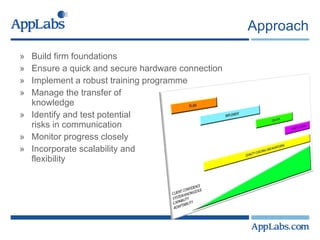
Approach Build firm foundations Ensure a quick and secure hardware connection Implement a robust training programme Manage the transfer of  knowledge Identify and test potential  risks in communication Monitor progress closely Incorporate scalability and  flexibility
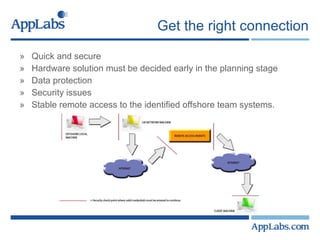
Get the right connection Quick and secure Hardware solution must be decided early in the planning stage Data protection  Security issues Stable remote access to the identified offshore team systems.
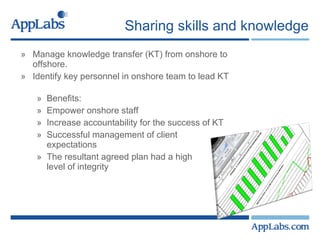
Sharing skills and knowledge Manage knowledge transfer (KT) from onshore to  offshore. Identify key personnel in onshore team to lead KT   Benefits: Empower onshore staff Increase accountability for the success of KT  Successful management of client  expectations  The resultant agreed plan had a high  level of integrity
Training Implement a robust training programme  Training partnerships  Daily meetings  "What did you teach/learn today?"  Benefits Ability to quickly identify any problems  Ensure that the training programme remained on schedule.
What could go wrong? Identify key risk areas in communication Are the test scripts written well?  Is the connection quick enough and easy to use?  Are the offshore team able to communicate issues effectively? Benefits Ability to baseline the daily totals for the team Early resolution of any communication issues Proven viability of connection
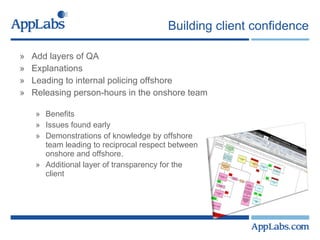
Building client confidence Add layers of QA Explanations Leading to internal policing offshore Releasing person-hours in the onshore team Benefits Issues found early  Demonstrations of knowledge by offshore  team leading to reciprocal respect between  onshore and offshore.  Additional layer of transparency for the  client
Scalability and flexibility Training methods Remote access New training modules can be rolled out quickly and effectively, with few communication errors.
Results Within 2 months – a working offshore team Within 3 months – expansion of offshore team by 150% Within 5 months – successfully integrated onshore and offshore team Average working day of +5 hours greatly increasing efficiency With no significant increase in overheads And a very happy client
Conclusions Build a foundation for success including a Robust hardware connection  strong scalable training programme range of communication pathways  managed and monitored by a stringent QA process   Highly rewarding
 

Offshore Test Management

  • 1.
  • 2.
    Bringing Offshore TestingOnshore Making the world a smaller place Kevin Harvey
  • 3.
    Meet the OffshoreTest Team How is this possible?
  • 4.
    Objectives Break downsocial and technical barriers Increase overall productivity Improve quality Reduce overall costs to the project
  • 5.
    Misconceptions and fearsInefficiency – language and cultural differences Onshore staff morale issues (will I lose my job?) Inflexibility – fear of knowledge transfer and lose of transparency Reduction in overall standards Greater management headache
  • 6.
    Approach Build firmfoundations Ensure a quick and secure hardware connection Implement a robust training programme Manage the transfer of knowledge Identify and test potential risks in communication Monitor progress closely Incorporate scalability and flexibility
  • 7.
    Get the rightconnection Quick and secure Hardware solution must be decided early in the planning stage Data protection Security issues Stable remote access to the identified offshore team systems.
  • 8.
    Sharing skills andknowledge Manage knowledge transfer (KT) from onshore to offshore. Identify key personnel in onshore team to lead KT Benefits: Empower onshore staff Increase accountability for the success of KT Successful management of client expectations The resultant agreed plan had a high level of integrity
  • 9.
    Training Implement arobust training programme Training partnerships Daily meetings "What did you teach/learn today?" Benefits Ability to quickly identify any problems Ensure that the training programme remained on schedule.
  • 10.
    What could gowrong? Identify key risk areas in communication Are the test scripts written well? Is the connection quick enough and easy to use? Are the offshore team able to communicate issues effectively? Benefits Ability to baseline the daily totals for the team Early resolution of any communication issues Proven viability of connection
  • 11.
    Building client confidenceAdd layers of QA Explanations Leading to internal policing offshore Releasing person-hours in the onshore team Benefits Issues found early Demonstrations of knowledge by offshore team leading to reciprocal respect between onshore and offshore. Additional layer of transparency for the client
  • 12.
    Scalability and flexibilityTraining methods Remote access New training modules can be rolled out quickly and effectively, with few communication errors.
  • 13.
    Results Within 2months – a working offshore team Within 3 months – expansion of offshore team by 150% Within 5 months – successfully integrated onshore and offshore team Average working day of +5 hours greatly increasing efficiency With no significant increase in overheads And a very happy client
  • 14.
    Conclusions Build afoundation for success including a Robust hardware connection strong scalable training programme range of communication pathways managed and monitored by a stringent QA process Highly rewarding
  • 15.