ODOO FUNCTIONAL TRAINING
CAPSULE
Prepared by:Sarath Kumar J
Functional Consultant
Mail:kjsarath91@gmail.com
Linkedin: https://in.linkedin.com/pub/sarath-kumar-
j/71/b24/837
Skype :kjsarath
Odoo
lOdoo is a suite of open-source business apps
written in Python and released under the AGPL
license.
lIt is used by 2 million users worldwide
lVersion 8 of the software introduced apps
including website builder, e-commerce, point of
sale and business intelligence
lThe software conforms to standard expectations
of ERP systems, while providing additional
modules beyond the coverage of traditional ERP
systems.
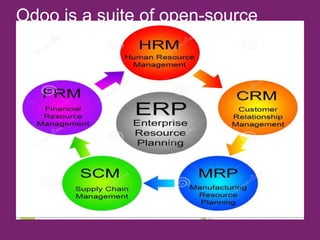
Odoo is a suite of open-source
business apps
The official Odoo apps are
organized in 6 groups:
lFront-end apps: website builder, blog, e-
commerce
lSales management apps: CRM, point of sales,
quotation builder
lBusiness operations apps: project management,
inventory, manufacturing, accounting and
purchase
lMarketing apps: mass mailing, lead automation,
events, survey, forum, live chat
lHuman Resources apps: employee directory,
enterprise social network, leaves management,
timesheet, fleet management
lProductivity apps: business intelligence, instant
messaging, notes
lCustoms Modules : Thousands of custom modules
that is avliable to suite your business
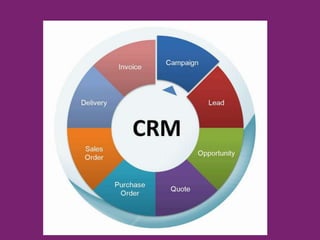
CRM
lIntelligently and efficiently manage leads
lManages key task such as communication,
identification, prioritization, assignment, resolution
and notification
lCRM ensures that all cases are successfully
tracked by users, customers and suppliers
lAuto tomatically send reminders, escalate the
request, trigger specific methods and many other
actions based on your own enterprise rules
lPowerfull Reporting will drive the business
lPlanned Revenue by Stage and User (graph)
lOpportunities by Stage (graph)
Sales Management
lDrive your sales operations from quotes to
invoices with all the information you need, easily
accessible.
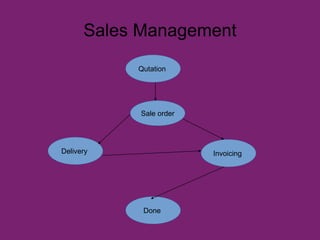
lIt handles the full sales workflow:
l* **Quotation** -> **Sales order** -> **Invoice**
lYou can choose flexible invoicing methods:
l* *On Demand*: Invoices are created manually from
Sales Orders when needed
l* *On Delivery Order*: Invoices are generated from
picking (delivery)
l* *Before Delivery*: A Draft invoice is created and
must be paid before delivery
Qutation
Sale order
InvoicingDelivery
Done
Sales Management
Purchase
Purchase Mangement
lAutomate procurement propositions, launch
request for quotations, track purchase orders,
manage suppliers' information, control products
reception and check suppliers' invoices.
lManage goods requirement by Purchase Orders
easily
lPurchase management enables you to track your
suppliers' price quotations .
lConvert them into orders
lOdoo can handle partial deliveries
lIt issue reminders automatically for stock
replinesment .
lReplenishment management rules enable the
system to generate draft purchase orders
automatically
lDashboard / Reports for Purchase Management
will include:
l* Request for Quotations
l* Purchase Orders Waiting Approval
l* Monthly Purchases by Category
l* Receptions Analysis
l* Purchase Analysis
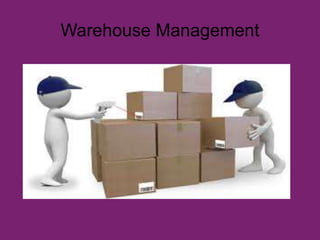
Warehouse Management
lManage multi-warehouses, multi- and structured
stock locations
lThe warehouse and inventory management is
based on a hierarchical location structure, from
warehouses to storage bins.
lhe double entry inventory system allows you to
manage customers, suppliers as well as
manufacturing inventories.
lOpenERP has the capacity to manage lots and
serial numbers ensuring compliance with the
traceability requirements imposed by the majority
of industries.
lKey Features
l* Moves history and planning,
l* Minimum stock rules
l* Support for barcodes
l* Rapid detection of mistakes through double entry
system
l* Traceability (Serial Numbers, Packages, ...)
lDashboard / Reports for Warehouse Management
will include:
l* Incoming Products (Graph)
l* Outgoing Products (Graph
l* Procurement in Exception
l* Inventory Analysis
l* Last Product Inventories
l* Moves Analysis
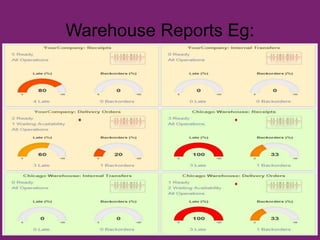
Warehouse Reports Eg:
MRP
lThe manufacturing module allows you to cover
planning, ordering, stocks and the manufacturing
or assembly of products from raw materials and
components.
l It handles the consumption and production of
products according to a bill of materials and the
necessary operations on machinery, tools or
human resources according to routings
lIt supports complete integration and planification
of stockable goods, consumables or services.
lServices are completely integrated with the rest of
the software.
lKey Features
l* Make to Stock/Make to Order
l* Multi-level bill of materials, no limit
l* Multi-level routing, no limit
l* Routing and work center integrated with analytic
accounting
l* Periodical scheduler computation
l* Allows to browse bills of materials in a complete
structure that includes child and phantom bills of
materials
lDashboard / Reports for MRP will include:
l** Procurements in Exception (Graph)
l* Stock Value Variation (Graph)
l* Work Order Analysis
Accounting
Accounting and Financial
Management.
lKey Features
l * General Accounting
l * Cost/Analytic accounting
l * Third party accounting
l * Taxes management
l * Budgets
l * Customer and Supplier Invoices
l * Bank statements
l * Reconciliation process by partner
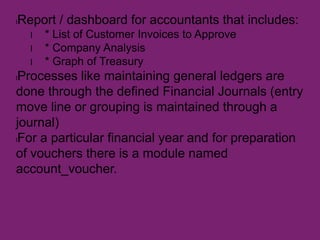
lReport / dashboard for accountants that includes:
l * List of Customer Invoices to Approve
l * Company Analysis
l * Graph of Treasury
lProcesses like maintaining general ledgers are
done through the defined Financial Journals (entry
move line or grouping is maintained through a
journal)
lFor a particular financial year and for preparation
of vouchers there is a module named
account_voucher.
Conslusion
lOpen ERP has become established as the main
free market-changing alternative for enterprise
management systems in amongst software from
giants such as SAP, Oracle and Microsoft, and
from the small software developers in their own
niches
lLarger companies often prefer a more classic
implementation path. Even though Open ERP's
simplicity makes this task easier than with other
systems, you can't hide the fact that a project
implementation is complex and introduces big
changes to a company.
lSo you can turn towards some of the different actors in
this free software ecosystem to help you out the
community of users and developers,
Feedbackes please
@kjsarath91@gmail.com
Thank you
Have great day ,

Odoo Training

  • 1.
    ODOO FUNCTIONAL TRAINING CAPSULE Preparedby:Sarath Kumar J Functional Consultant Mail:kjsarath91@gmail.com Linkedin: https://in.linkedin.com/pub/sarath-kumar- j/71/b24/837 Skype :kjsarath
  • 2.
    Odoo lOdoo is asuite of open-source business apps written in Python and released under the AGPL license. lIt is used by 2 million users worldwide lVersion 8 of the software introduced apps including website builder, e-commerce, point of sale and business intelligence lThe software conforms to standard expectations of ERP systems, while providing additional modules beyond the coverage of traditional ERP systems.
  • 3.
    Odoo is asuite of open-source business apps
  • 4.
    The official Odooapps are organized in 6 groups: lFront-end apps: website builder, blog, e- commerce lSales management apps: CRM, point of sales, quotation builder lBusiness operations apps: project management, inventory, manufacturing, accounting and purchase lMarketing apps: mass mailing, lead automation, events, survey, forum, live chat
  • 5.
    lHuman Resources apps:employee directory, enterprise social network, leaves management, timesheet, fleet management lProductivity apps: business intelligence, instant messaging, notes lCustoms Modules : Thousands of custom modules that is avliable to suite your business
  • 7.
    CRM lIntelligently and efficientlymanage leads lManages key task such as communication, identification, prioritization, assignment, resolution and notification lCRM ensures that all cases are successfully tracked by users, customers and suppliers lAuto tomatically send reminders, escalate the request, trigger specific methods and many other actions based on your own enterprise rules lPowerfull Reporting will drive the business lPlanned Revenue by Stage and User (graph) lOpportunities by Stage (graph)
  • 9.
    Sales Management lDrive yoursales operations from quotes to invoices with all the information you need, easily accessible. lIt handles the full sales workflow: l* **Quotation** -> **Sales order** -> **Invoice** lYou can choose flexible invoicing methods: l* *On Demand*: Invoices are created manually from Sales Orders when needed l* *On Delivery Order*: Invoices are generated from picking (delivery) l* *Before Delivery*: A Draft invoice is created and must be paid before delivery
  • 10.
  • 11.
  • 12.
    Purchase Mangement lAutomate procurementpropositions, launch request for quotations, track purchase orders, manage suppliers' information, control products reception and check suppliers' invoices. lManage goods requirement by Purchase Orders easily lPurchase management enables you to track your suppliers' price quotations . lConvert them into orders
  • 13.
    lOdoo can handlepartial deliveries lIt issue reminders automatically for stock replinesment . lReplenishment management rules enable the system to generate draft purchase orders automatically lDashboard / Reports for Purchase Management will include: l* Request for Quotations l* Purchase Orders Waiting Approval l* Monthly Purchases by Category l* Receptions Analysis l* Purchase Analysis
  • 14.
  • 15.
    Warehouse Management lManage multi-warehouses,multi- and structured stock locations lThe warehouse and inventory management is based on a hierarchical location structure, from warehouses to storage bins. lhe double entry inventory system allows you to manage customers, suppliers as well as manufacturing inventories. lOpenERP has the capacity to manage lots and serial numbers ensuring compliance with the traceability requirements imposed by the majority of industries.
  • 16.
    lKey Features l* Moveshistory and planning, l* Minimum stock rules l* Support for barcodes l* Rapid detection of mistakes through double entry system l* Traceability (Serial Numbers, Packages, ...) lDashboard / Reports for Warehouse Management will include: l* Incoming Products (Graph) l* Outgoing Products (Graph l* Procurement in Exception l* Inventory Analysis l* Last Product Inventories l* Moves Analysis
  • 17.
  • 18.
    MRP lThe manufacturing moduleallows you to cover planning, ordering, stocks and the manufacturing or assembly of products from raw materials and components. l It handles the consumption and production of products according to a bill of materials and the necessary operations on machinery, tools or human resources according to routings lIt supports complete integration and planification of stockable goods, consumables or services. lServices are completely integrated with the rest of the software.
  • 19.
    lKey Features l* Maketo Stock/Make to Order l* Multi-level bill of materials, no limit l* Multi-level routing, no limit l* Routing and work center integrated with analytic accounting l* Periodical scheduler computation l* Allows to browse bills of materials in a complete structure that includes child and phantom bills of materials lDashboard / Reports for MRP will include: l** Procurements in Exception (Graph) l* Stock Value Variation (Graph) l* Work Order Analysis
  • 20.
  • 21.
    Accounting and Financial Management. lKeyFeatures l * General Accounting l * Cost/Analytic accounting l * Third party accounting l * Taxes management l * Budgets l * Customer and Supplier Invoices l * Bank statements l * Reconciliation process by partner
  • 22.
    lReport / dashboardfor accountants that includes: l * List of Customer Invoices to Approve l * Company Analysis l * Graph of Treasury lProcesses like maintaining general ledgers are done through the defined Financial Journals (entry move line or grouping is maintained through a journal) lFor a particular financial year and for preparation of vouchers there is a module named account_voucher.
  • 23.
    Conslusion lOpen ERP hasbecome established as the main free market-changing alternative for enterprise management systems in amongst software from giants such as SAP, Oracle and Microsoft, and from the small software developers in their own niches lLarger companies often prefer a more classic implementation path. Even though Open ERP's simplicity makes this task easier than with other systems, you can't hide the fact that a project implementation is complex and introduces big changes to a company.
  • 24.
    lSo you canturn towards some of the different actors in this free software ecosystem to help you out the community of users and developers,
  • 25.