Project Approach to Delivery 
Delivering curriculum 
by innovative and creative projects 
They should be: 
• industry-relevant to key sector requirements 
• suit a broad range of learning styles and abilities 
• meet the needs the modern world of work
What is it? 
Project Approach to Delivery 
• Project Based Learning is a teaching method in which students 
gain knowledge and skills by investigating and responding to 
a complex question, problem, or challenge 
• A learner centred method of delivering teaching that engages 
students in learning essential knowledge and skills. 
• An opportunity for students to broaden learning and 
employability skills through wider exploration and 
consideration of a real-world project using carefully designed 
tasks
Project Approach to Delivery 
Why use it? 
• develop independent and responsible students 
• provides students with genuine evidence for employment 
• develops personal skills and attributes 
• enhances a student’s social skills, by interaction with the 
social environment
Project Approach components 
• A Problem 
• A Goal 
• Relevant and Realistic Activities 
• Learner control 
• Evaluation
• Teacher 
Project Approach roles 
– Facilitator 
– Client 
– Sounding board 
– Mentor 
• Student 
– Set goals 
– Query and research 
– Project Management
Project Approach advantages 
Opportunity to: 
• learn skills relevant for employment 
• use practical as well as academic skills 
• control the project completion promoting a sense of 
achievement 
• seek interest in different sectors and subjects 
• add variety to a program of study 
• advertise the work of the individual
• Three Types of Project Approach 
Project Approach to 
development 
– Holistic delivery of complete units within a qualification 
– Cross sector delivery for achievement of common modules 
– Employer led – vocational project, cross sector mapped to 
certain but not all qualification learning outcomes.
Project Approach examples 
• Cambridge Technicals in IT Project Approach 
• UTC delivery of Computing and Creative 
Media 
• Silverstone, F1, JCB, IBM
Project Approach 
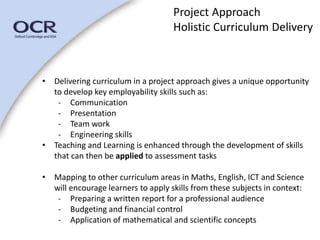
Holistic Curriculum Delivery 
• Delivering curriculum in a project approach gives a unique opportunity 
to develop key employability skills such as: 
- Communication 
- Presentation 
- Team work 
- Engineering skills 
• Teaching and Learning is enhanced through the development of skills 
that can then be applied to assessment tasks 
• Mapping to other curriculum areas in Maths, English, ICT and Science 
will encourage learners to apply skills from these subjects in context: 
- Preparing a written report for a professional audience 
- Budgeting and financial control 
- Application of mathematical and scientific concepts
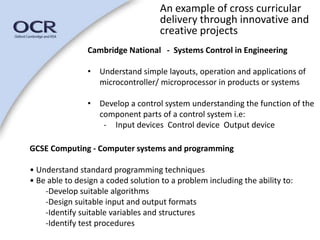
An example of cross curricular 
delivery through innovative and 
creative projects 
Cambridge National - Systems Control in Engineering 
• Understand simple layouts, operation and applications of 
microcontroller/ microprocessor in products or systems 
• Develop a control system understanding the function of the 
component parts of a control system i.e: 
- Input devices Control device Output device 
GCSE Computing - Computer systems and programming 
• Understand standard programming techniques 
• Be able to design a coded solution to a problem including the ability to: 
-Develop suitable algorithms 
-Design suitable input and output formats 
-Identify suitable variables and structures 
-Identify test procedures
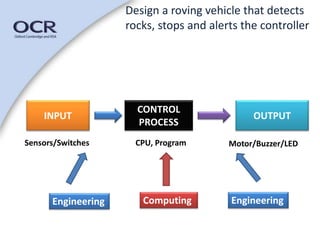
Design a roving vehicle that detects 
rocks, stops and alerts the controller 
INPUT 
CONTROL 
PROCESS 
OUTPUT 
Sensors/Switches CPU, Program Motor/Buzzer/LED 
Engineering Computing Engineering
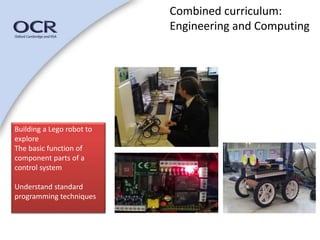
Building a Lego robot to 
explore 
The basic function of 
component parts of a 
control system 
Understand standard 
programming techniques 
Combined curriculum: 
Engineering and Computing
The future 
• New suite of Cambridge Technical qualifications 
• Comprehensive resource development through 
2014/15 for Cambridge Technicals including 
Project Approach 
• Employer / school engagement programmes 
An opportunity to get involved by: 
• Being part of the project approach programme 
• Developing own resources that could link to Cambridge Qualifications 
• Being an employer - school educator
Workshop Group Application 
• Ideas 
• Requirements 
• Groups 
• Timings

5th Annual Conf. | Developing projects that deliver the learning that employers value

  • 1.
    Project Approach toDelivery Delivering curriculum by innovative and creative projects They should be: • industry-relevant to key sector requirements • suit a broad range of learning styles and abilities • meet the needs the modern world of work
  • 2.
    What is it? Project Approach to Delivery • Project Based Learning is a teaching method in which students gain knowledge and skills by investigating and responding to a complex question, problem, or challenge • A learner centred method of delivering teaching that engages students in learning essential knowledge and skills. • An opportunity for students to broaden learning and employability skills through wider exploration and consideration of a real-world project using carefully designed tasks
  • 3.
    Project Approach toDelivery Why use it? • develop independent and responsible students • provides students with genuine evidence for employment • develops personal skills and attributes • enhances a student’s social skills, by interaction with the social environment
  • 4.
    Project Approach components • A Problem • A Goal • Relevant and Realistic Activities • Learner control • Evaluation
  • 5.
    • Teacher ProjectApproach roles – Facilitator – Client – Sounding board – Mentor • Student – Set goals – Query and research – Project Management
  • 6.
    Project Approach advantages Opportunity to: • learn skills relevant for employment • use practical as well as academic skills • control the project completion promoting a sense of achievement • seek interest in different sectors and subjects • add variety to a program of study • advertise the work of the individual
  • 7.
    • Three Typesof Project Approach Project Approach to development – Holistic delivery of complete units within a qualification – Cross sector delivery for achievement of common modules – Employer led – vocational project, cross sector mapped to certain but not all qualification learning outcomes.
  • 8.
    Project Approach examples • Cambridge Technicals in IT Project Approach • UTC delivery of Computing and Creative Media • Silverstone, F1, JCB, IBM
  • 9.
    Project Approach HolisticCurriculum Delivery • Delivering curriculum in a project approach gives a unique opportunity to develop key employability skills such as: - Communication - Presentation - Team work - Engineering skills • Teaching and Learning is enhanced through the development of skills that can then be applied to assessment tasks • Mapping to other curriculum areas in Maths, English, ICT and Science will encourage learners to apply skills from these subjects in context: - Preparing a written report for a professional audience - Budgeting and financial control - Application of mathematical and scientific concepts
  • 10.
    An example ofcross curricular delivery through innovative and creative projects Cambridge National - Systems Control in Engineering • Understand simple layouts, operation and applications of microcontroller/ microprocessor in products or systems • Develop a control system understanding the function of the component parts of a control system i.e: - Input devices Control device Output device GCSE Computing - Computer systems and programming • Understand standard programming techniques • Be able to design a coded solution to a problem including the ability to: -Develop suitable algorithms -Design suitable input and output formats -Identify suitable variables and structures -Identify test procedures
  • 11.
    Design a rovingvehicle that detects rocks, stops and alerts the controller INPUT CONTROL PROCESS OUTPUT Sensors/Switches CPU, Program Motor/Buzzer/LED Engineering Computing Engineering
  • 12.
    Building a Legorobot to explore The basic function of component parts of a control system Understand standard programming techniques Combined curriculum: Engineering and Computing
  • 13.
    The future •New suite of Cambridge Technical qualifications • Comprehensive resource development through 2014/15 for Cambridge Technicals including Project Approach • Employer / school engagement programmes An opportunity to get involved by: • Being part of the project approach programme • Developing own resources that could link to Cambridge Qualifications • Being an employer - school educator
  • 14.
    Workshop Group Application • Ideas • Requirements • Groups • Timings

Editor's Notes

  • #5 At its core, the project is focused on teaching students important knowledge and skills, derived from standards and key concepts at the heart of academic subjects. Students build competencies valuable for today’s world, such as problem solving, critical thinking, collaboration, communication, and creativity/innovation, which are explicitly taught and assessed. Students are engaged in an extended, rigorous process of asking questions, using resources, and developing answers