Get to know the Dewey Decimal Classification system A brief PowerPoint slide show to help you understand how the Dewey Decimal Classification system works in your library
Get to know the DDC Have you ever gone  to the library  and wondered  how to find the  books you want?
Did you know that your library has a  great way of organizing its books  so that you can find them easily? Get to know the DDC
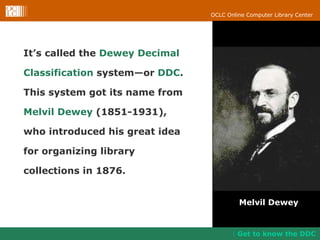
It’s called the  Dewey Decimal Classification  system—or  DDC . This system got its name from  Melvil Dewey  (1851-1931), who introduced his great idea for organizing library collections in 1876.  Melvil Dewey Get to know the DDC
With its structure and flexibility, the DDC has served libraries for over  130 years  so far and has spread to  more than 200,000 libraries  in  135 countries  around the world. Get to know the DDC
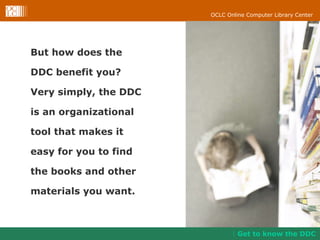
But how does the  DDC benefit you?  Very simply, the DDC  is an organizational  tool that makes it  easy for you to find  the books and other  materials you want. Get to know the DDC
So what does the DDC do? It helps solve a big problem:  helping you find the right information by giving you  a specific number that belongs  to the item you want.   Get to know the DDC
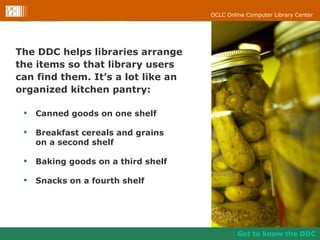
The DDC helps libraries arrange  the items so that library users  can find them. It’s a lot like an  organized kitchen pantry: Get to know the DDC Canned goods on one shelf Breakfast cereals and grains  on a second shelf  Baking goods on a third shelf Snacks on a fourth shelf
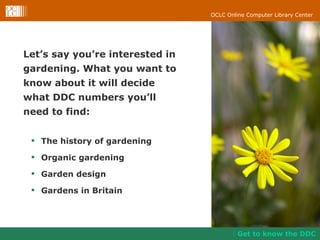
Let’s say you’re interested in  gardening. What you want to  know about it will decide  what DDC numbers you’ll  need to find: Get to know the DDC The history of gardening  Organic gardening Garden design Gardens in Britain
Each of these topics  is about gardening,  but a book about  each of these topics  will have its very own  DDC number. The history of gardening  (630.9)  Organic gardening  (635.0484) Garden design  (712) Gardens in Britain  (712.0941) Get to know the DDC
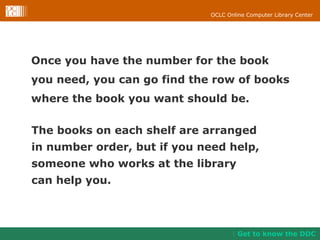
Once you have the number for the book  you need, you can go find the row of books  where the book you want should be. Get to know the DDC The books on each shelf are arranged  in number order, but if you need help,  someone who works at the library  can help you.
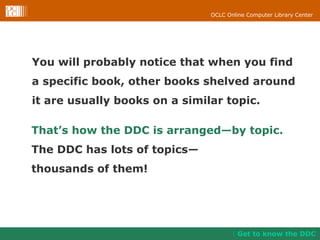
You will probably notice that when you find a specific book, other books shelved around it are usually books on a similar topic.  Get to know the DDC That’s how the DDC is arranged—by topic.   The DDC has lots of topics— thousands of them!
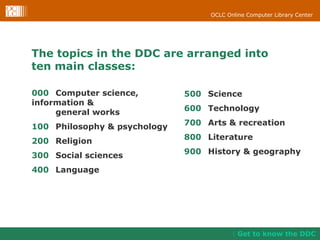
The topics in the DDC are arranged into  ten main classes: 500 Science 600 Technology 700 Arts & recreation 800 Literature 900 History & geography 000 Computer science,  information &  general works  100   Philosophy & psychology  200   Religion 300   Social sciences  400   Language   Get to know the DDC
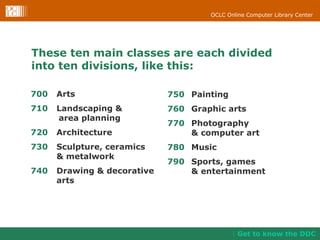
These ten main classes are each divided  into ten divisions, like this: 700  Arts 710 Landscaping &  area planning 720  Architecture 730 Sculpture, ceramics  & metalwork 740 Drawing & decorative   arts 750 Painting 760 Graphic arts 770 Photography  & computer art 780 Music 790 Sports, games  & entertainment Get to know the DDC
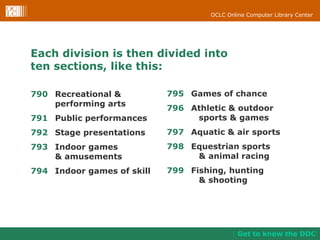
Each division is then divided into  ten sections, like this: 790 Recreational &  performing arts 791 Public performances 792   Stage presentations 793 Indoor games  & amusements 794 Indoor games of skill 795   Games of chance 796   Athletic & outdoor sports & games 797   Aquatic & air sports 798 Equestrian sports  & animal racing 799 Fishing, hunting  & shooting Get to know the DDC
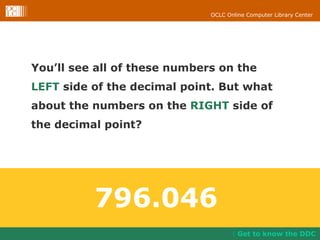
You’ll see all of these numbers on the LEFT  side of the decimal point. But what about the numbers on the  RIGHT  side of the decimal point? 796.046 Get to know the DDC
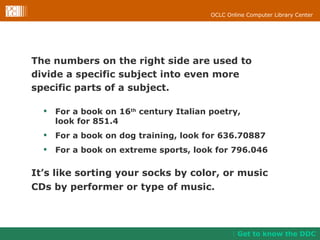
The numbers on the right side are used to divide a specific subject into even more  specific parts of a subject.  For a book on 16 th  century Italian poetry,  look for 851.4 For a book on dog training, look for 636.70887 For a book on extreme sports, look for 796.046 It’s like sorting your socks by color, or music CDs by performer or type of music. Get to know the DDC
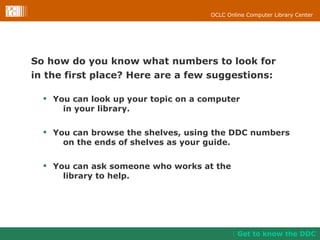
So how do you know what numbers to look for  in the first place? Here are a few suggestions: You can look up your topic on a computer  in your library.  You can browse the shelves, using the DDC numbers on the ends of shelves as your guide.  You can ask someone who works at the library to help. Get to know the DDC
Once you get to know  the DDC, you’ll have a much better idea about  where you’ll find the books  and other items you need  in your library—and in  other libraries  that use the DDC. Get to know the DDC
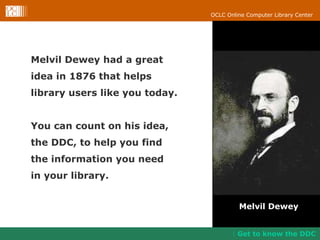
Melvil Dewey had a great idea in 1876 that helps  library users like you today. You can count on his idea,  the DDC, to help you find  the information you need  in your library.  Melvil Dewey Get to know the DDC

OCLC Dewey Tutorial

  • 1.
    Get to knowthe Dewey Decimal Classification system A brief PowerPoint slide show to help you understand how the Dewey Decimal Classification system works in your library
  • 2.
    Get to knowthe DDC Have you ever gone to the library and wondered how to find the books you want?
  • 3.
    Did you knowthat your library has a great way of organizing its books so that you can find them easily? Get to know the DDC
  • 4.
    It’s called the Dewey Decimal Classification system—or DDC . This system got its name from Melvil Dewey (1851-1931), who introduced his great idea for organizing library collections in 1876. Melvil Dewey Get to know the DDC
  • 5.
    With its structureand flexibility, the DDC has served libraries for over 130 years so far and has spread to more than 200,000 libraries in 135 countries around the world. Get to know the DDC
  • 6.
    But how doesthe DDC benefit you? Very simply, the DDC is an organizational tool that makes it easy for you to find the books and other materials you want. Get to know the DDC
  • 7.
    So what doesthe DDC do? It helps solve a big problem: helping you find the right information by giving you a specific number that belongs to the item you want. Get to know the DDC
  • 8.
    The DDC helpslibraries arrange the items so that library users can find them. It’s a lot like an organized kitchen pantry: Get to know the DDC Canned goods on one shelf Breakfast cereals and grains on a second shelf Baking goods on a third shelf Snacks on a fourth shelf
  • 9.
    Let’s say you’reinterested in gardening. What you want to know about it will decide what DDC numbers you’ll need to find: Get to know the DDC The history of gardening Organic gardening Garden design Gardens in Britain
  • 10.
    Each of thesetopics is about gardening, but a book about each of these topics will have its very own DDC number. The history of gardening (630.9) Organic gardening (635.0484) Garden design (712) Gardens in Britain (712.0941) Get to know the DDC
  • 11.
    Once you havethe number for the book you need, you can go find the row of books where the book you want should be. Get to know the DDC The books on each shelf are arranged in number order, but if you need help, someone who works at the library can help you.
  • 12.
    You will probablynotice that when you find a specific book, other books shelved around it are usually books on a similar topic. Get to know the DDC That’s how the DDC is arranged—by topic. The DDC has lots of topics— thousands of them!
  • 13.
    The topics inthe DDC are arranged into ten main classes: 500 Science 600 Technology 700 Arts & recreation 800 Literature 900 History & geography 000 Computer science, information & general works 100 Philosophy & psychology 200 Religion 300 Social sciences 400 Language Get to know the DDC
  • 14.
    These ten mainclasses are each divided into ten divisions, like this: 700 Arts 710 Landscaping & area planning 720 Architecture 730 Sculpture, ceramics & metalwork 740 Drawing & decorative arts 750 Painting 760 Graphic arts 770 Photography & computer art 780 Music 790 Sports, games & entertainment Get to know the DDC
  • 15.
    Each division isthen divided into ten sections, like this: 790 Recreational & performing arts 791 Public performances 792 Stage presentations 793 Indoor games & amusements 794 Indoor games of skill 795 Games of chance 796 Athletic & outdoor sports & games 797 Aquatic & air sports 798 Equestrian sports & animal racing 799 Fishing, hunting & shooting Get to know the DDC
  • 16.
    You’ll see allof these numbers on the LEFT side of the decimal point. But what about the numbers on the RIGHT side of the decimal point? 796.046 Get to know the DDC
  • 17.
    The numbers onthe right side are used to divide a specific subject into even more specific parts of a subject. For a book on 16 th century Italian poetry, look for 851.4 For a book on dog training, look for 636.70887 For a book on extreme sports, look for 796.046 It’s like sorting your socks by color, or music CDs by performer or type of music. Get to know the DDC
  • 18.
    So how doyou know what numbers to look for in the first place? Here are a few suggestions: You can look up your topic on a computer in your library. You can browse the shelves, using the DDC numbers on the ends of shelves as your guide. You can ask someone who works at the library to help. Get to know the DDC
  • 19.
    Once you getto know the DDC, you’ll have a much better idea about where you’ll find the books and other items you need in your library—and in other libraries that use the DDC. Get to know the DDC
  • 20.
    Melvil Dewey hada great idea in 1876 that helps library users like you today. You can count on his idea, the DDC, to help you find the information you need in your library. Melvil Dewey Get to know the DDC