A. Reconstruction and Rehabilitation

Reconstruction and
development of railed ,
roads and air transport
A. Reconstruction and Rehabilitation
(Papua New Guinea)
Mr. EJ Ward

 Australian charter for
post-war New Guinea
The program for rehabilitation
and development would have
regard to “the moral and material
welfare of the native inhabitants
and the strategic importance of the
area to Australia.”
A. Reconstruction and Rehabilitation
(Papua New Guinea)
1942

Papua-New Guinea
Provisional
Administration.

 Administration in New Guinea
and Papua had been amalgamated
Australian New Guinea
Administrative Unit (ANGAU).

ANGAU continued to
controlled until 1946
A. Reconstruction and Rehabilitation
(Papua New Guinea)
December 1946

Trusteeship over the Territory of
New Guinea to Australia

Single
administration
A. Reconstruction and Rehabilitation
(Papua New Guinea)
 Australian government grants increased markedly from 1946 to
support development and public service expansion.
 …prepared plans for massive increases in assistance in education and
health to prepare the people of Papua New Guinea for selfdetermination.
 Political development, based on Western-style democracy was
encouraged, initially through the development of local government
councils. They were intended to overcome the problem posed by
absence of suitable indigenous authorities and to “serve as institutions
suited to the needs of Papuan society in a period of change
 By 1969 there were some 142 councils in existence, representing
almost 2 million people.
A. Reconstruction and Rehabilitation
(Papua New Guinea)
1950's
the light aircraft fields of the country were improved as the basis
of inland transport, while flying boat services existed in the island's
regions.
air control centre at Madang became one of the busiest in the
world handling air freighter flights to the newly opened Highland
centres such as Goroka, Kundiawa, Banz and Mount Hagen
Coastal shipping remained the basis of coastal and inter-island
transport.
A. Reconstruction and Rehabilitation
(Papua New Guinea)
1950's
railways which provided transport in coconut plantations
provided the main focus for rail operations in the post-War era.
Choisel Plantation tramways on Soraken, Lindenhafen,
Tinputz, Boau and Kunua plantations

longest serving plantation railways were on Soraken and
Kunua plantations in north- west Bougainville .(1951)
B. Issues and Problem
• Bougainville Civil War
B. Issues and Problem
• Bougainville Civil War

was an armed conflict fought between Papua New Guinea
and the Bougainville Revolutionary Army (BRA)

been described as the largest conflict in Oceania since the
end of World War II, with approximately 15,000 to 20,000
Bougainvilleans killed.
B. Issues and Problem
• Bougainville Civil War
discovery of vast copper ore deposits in Bougainville's Crown
Prince Range in 1969

Australian company Conzinc Rio Tinto.
Began production 1972 under the management of
Bougainville Copper Ltd,
Panguna open cut mine was the largest in the world.
B. Issues and Problem
• Bougainville Civil War
set up the Bougainville Interim
Government (BIG)
The Bougainville
Revolutionary Army (BRA)
raskol (criminal) gangs that
were affiliated with the BRA
B. Issues and Problem
• Nuclear testing in
Oceania

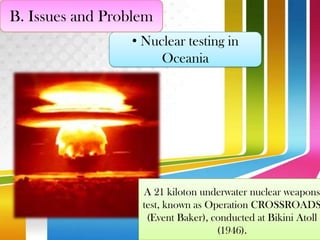
A 21 kiloton underwater nuclear weapons
test, known as Operation CROSSROADS
(Event Baker), conducted at Bikini Atoll
(1946).
B. Issues and Problem
• Nuclear testing in
Oceania

•From 1946 to 1958, the Marshall Islands
served as the Pacific Proving Grounds for
the United States
•. "Mike“ (first hydrogen bomb), was
tested at the Enewetak atoll in the
Marshall Islands
(November 1 (local date) in 1952, US

•1954 fallout from the American Castle
Bravo hydrogen bomb test in the Marshal
Islands
THANK YOU!!!!!!! 

Oceania post war.ppt

  • 3.
    A. Reconstruction andRehabilitation Reconstruction and development of railed , roads and air transport
  • 4.
    A. Reconstruction andRehabilitation (Papua New Guinea) Mr. EJ Ward  Australian charter for post-war New Guinea The program for rehabilitation and development would have regard to “the moral and material welfare of the native inhabitants and the strategic importance of the area to Australia.”
  • 5.
    A. Reconstruction andRehabilitation (Papua New Guinea) 1942 Papua-New Guinea Provisional Administration.  Administration in New Guinea and Papua had been amalgamated Australian New Guinea Administrative Unit (ANGAU). ANGAU continued to controlled until 1946
  • 6.
    A. Reconstruction andRehabilitation (Papua New Guinea) December 1946 Trusteeship over the Territory of New Guinea to Australia Single administration
  • 7.
    A. Reconstruction andRehabilitation (Papua New Guinea)  Australian government grants increased markedly from 1946 to support development and public service expansion.  …prepared plans for massive increases in assistance in education and health to prepare the people of Papua New Guinea for selfdetermination.  Political development, based on Western-style democracy was encouraged, initially through the development of local government councils. They were intended to overcome the problem posed by absence of suitable indigenous authorities and to “serve as institutions suited to the needs of Papuan society in a period of change  By 1969 there were some 142 councils in existence, representing almost 2 million people.
  • 8.
    A. Reconstruction andRehabilitation (Papua New Guinea) 1950's the light aircraft fields of the country were improved as the basis of inland transport, while flying boat services existed in the island's regions. air control centre at Madang became one of the busiest in the world handling air freighter flights to the newly opened Highland centres such as Goroka, Kundiawa, Banz and Mount Hagen Coastal shipping remained the basis of coastal and inter-island transport.
  • 9.
    A. Reconstruction andRehabilitation (Papua New Guinea) 1950's railways which provided transport in coconut plantations provided the main focus for rail operations in the post-War era. Choisel Plantation tramways on Soraken, Lindenhafen, Tinputz, Boau and Kunua plantations longest serving plantation railways were on Soraken and Kunua plantations in north- west Bougainville .(1951)
  • 10.
    B. Issues andProblem • Bougainville Civil War
  • 11.
    B. Issues andProblem • Bougainville Civil War was an armed conflict fought between Papua New Guinea and the Bougainville Revolutionary Army (BRA) been described as the largest conflict in Oceania since the end of World War II, with approximately 15,000 to 20,000 Bougainvilleans killed.
  • 12.
    B. Issues andProblem • Bougainville Civil War discovery of vast copper ore deposits in Bougainville's Crown Prince Range in 1969 Australian company Conzinc Rio Tinto. Began production 1972 under the management of Bougainville Copper Ltd, Panguna open cut mine was the largest in the world.
  • 13.
    B. Issues andProblem • Bougainville Civil War set up the Bougainville Interim Government (BIG) The Bougainville Revolutionary Army (BRA) raskol (criminal) gangs that were affiliated with the BRA
  • 14.
    B. Issues andProblem • Nuclear testing in Oceania A 21 kiloton underwater nuclear weapons test, known as Operation CROSSROADS (Event Baker), conducted at Bikini Atoll (1946).
  • 15.
    B. Issues andProblem • Nuclear testing in Oceania •From 1946 to 1958, the Marshall Islands served as the Pacific Proving Grounds for the United States •. "Mike“ (first hydrogen bomb), was tested at the Enewetak atoll in the Marshall Islands (November 1 (local date) in 1952, US •1954 fallout from the American Castle Bravo hydrogen bomb test in the Marshal Islands
  • 16.