Observer Design for Boost-Type
Photovoltaic MPPT System
Literature Survey
 “Proportional Integral Observer(PIO) Design for Linear Control Systems”, Xiaonan Dong
1. Designing P and PIO observers
2. Calculating Observer Gains.
 “Accurate State Estimation in DC-DC converters using a Proportional-Integral Observer”, S.M.Mahdi
Alavi ,Mehrdad Saif , Bahram Shafai
1. Application of observer to boost converter
 “Comparative study of different MPPT techniques for a stand-alone PV system”, Ameni Kchaou, Aziz
Naamane, Yassine Koubaa, Nacer K M'Sirdi
1. Perturb and Observe (P&O) MPPT Technique
2. Incremental Conductance (INC) MPPT Technique
 “State Space modelling of Current Mode control and its application to input impedance shaping of
Power Electronic Constant-Power Loads”, Sean C. Smithson
1. State space modelling of boost converter
2
Introduction
 In state feedback control systems, all state variables are needed for feed-back to
make the system stable. However, state variables might not be available for the
reason of inaccessibility of some variables, or the limitation on the number of
sensors. Therefore, observers are designed to estimate the unmeasured state
variables for feedback purpose.
 Observers play a crucial role in control because some control methods require the
accurate estimation of system states to realize the close loop control tasks.
 Meanwhile high quality performance could be achieved through the estimation of
unknown inputs affecting the system such as disturbances or model uncertainties.
 Difference between Luenberger Observer or Proportional Observer and PI-Observer
3
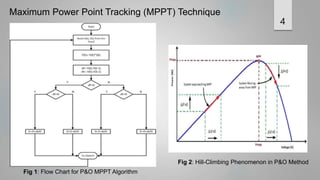
Maximum Power Point Tracking (MPPT) Technique
4
Fig 1: Flow Chart for P&O MPPT Algorithm
Fig 2: Hill-Climbing Phenomenon in P&O Method
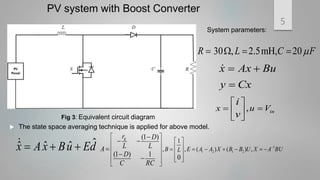
PV system with Boost Converter
5
Fig 3: Equivalent circuit diagram
System parameters:
30 , 2.5mH, 20
R L C F

   
 The state space averaging technique is applied for above model.
ˆ
ˆ ˆ ˆ
x Ax Bu Ed
   1
1 2 1 2
1
, , ( ) ( ) ,
(1 )
(1 ) 1 0
k
B E A A X B B U X A BU
L
r D
L L
A
D
C RC

 
 
 
 
        
 
 
 
 
 
 

 



, in
x u V
i
v
 
 
 
 
x Ax Bu
y Cx
 

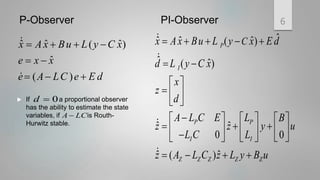
P-Observer 6
ˆ ˆ ˆ
( )
ˆ
( )
x A x Bu L y C x
e x x
e A LC e E d
   
 
  
PI-Observer
ˆ
ˆ ˆ ˆ
( )
ˆ ˆ
( )
ˆ ˆ
0 0
ˆ ˆ
( )
P
I
P P
I I
Z Z Z Z Z
C
x Ax Bu L y x E d
d L y C x
x
z
d
A L C E L B
z z y u
L C L
z A L C z L y B u
    
 
 
  
 

     
  
     
  
   
   
 If a proportional observer
has the ability to estimate the state
variables, if is Routh-
Hurwitz stable.
0
d 
A LC

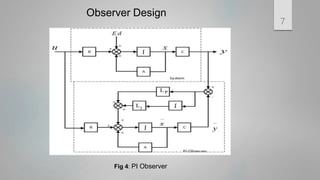
Observer Design
7
Fig 4: PI Observer
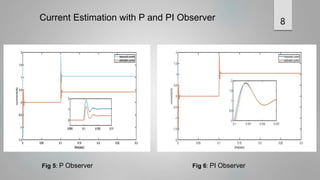
Current Estimation with P and PI Observer 8
Fig 5: P Observer Fig 6: PI Observer
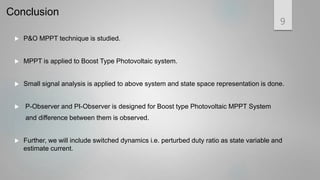
Conclusion
 P&O MPPT technique is studied.
 MPPT is applied to Boost Type Photovoltaic system.
 Small signal analysis is applied to above system and state space representation is done.
 P-Observer and PI-Observer is designed for Boost type Photovoltaic MPPT System
and difference between them is observed.
 Further, we will include switched dynamics i.e. perturbed duty ratio as state variable and
estimate current.
9
References
[1] Y. C. Kuo, T. J. Liang, and J. F. Chen, “Novel maximum-power-point-tracking controller for photo voltaic energy
conversion system, ” IEEE Transactions on Industrial Electronics, vol. 48, no. 3, pp. 594-601, 2001.
.
[2] W. Li, and X. He, “Review of non-isolated high-step-up dc/dc converters in photovoltaic grid-
connected applications," IEEE Transactions on Industrial Electronics, vol. 58, no. 4, pp. 1239-1250, 2011.
[3] D. G. Luenberger, “An Introduction to Observers," IEEE Transactions on Automatic
Control, vol.16, no. 6, pp. 596-602, 1971.
[4] T. Floquet, and J. P. Barbot, “State and unknown input estimation for linear discrete-time systems,“ Automatica,
vol.42, no.11, pp.1883-1889, 2006.
[5] S. M. M, Alavi, M. Saif, and B. Shafai ,”Accurate state estimation in dc-dc converters using a Proportional-Integral
Observer(PIO)”, IEEE International Symposium on Industrial Electronics, pp. 1304-1309, 2014
10

Observer Design for Boost-Type Photovoltaic MPPT System

  • 1.
    Observer Design forBoost-Type Photovoltaic MPPT System
  • 2.
    Literature Survey  “ProportionalIntegral Observer(PIO) Design for Linear Control Systems”, Xiaonan Dong 1. Designing P and PIO observers 2. Calculating Observer Gains.  “Accurate State Estimation in DC-DC converters using a Proportional-Integral Observer”, S.M.Mahdi Alavi ,Mehrdad Saif , Bahram Shafai 1. Application of observer to boost converter  “Comparative study of different MPPT techniques for a stand-alone PV system”, Ameni Kchaou, Aziz Naamane, Yassine Koubaa, Nacer K M'Sirdi 1. Perturb and Observe (P&O) MPPT Technique 2. Incremental Conductance (INC) MPPT Technique  “State Space modelling of Current Mode control and its application to input impedance shaping of Power Electronic Constant-Power Loads”, Sean C. Smithson 1. State space modelling of boost converter 2
  • 3.
    Introduction  In statefeedback control systems, all state variables are needed for feed-back to make the system stable. However, state variables might not be available for the reason of inaccessibility of some variables, or the limitation on the number of sensors. Therefore, observers are designed to estimate the unmeasured state variables for feedback purpose.  Observers play a crucial role in control because some control methods require the accurate estimation of system states to realize the close loop control tasks.  Meanwhile high quality performance could be achieved through the estimation of unknown inputs affecting the system such as disturbances or model uncertainties.  Difference between Luenberger Observer or Proportional Observer and PI-Observer 3
  • 4.
    Maximum Power PointTracking (MPPT) Technique 4 Fig 1: Flow Chart for P&O MPPT Algorithm Fig 2: Hill-Climbing Phenomenon in P&O Method
  • 5.
    PV system withBoost Converter 5 Fig 3: Equivalent circuit diagram System parameters: 30 , 2.5mH, 20 R L C F       The state space averaging technique is applied for above model. ˆ ˆ ˆ ˆ x Ax Bu Ed    1 1 2 1 2 1 , , ( ) ( ) , (1 ) (1 ) 1 0 k B E A A X B B U X A BU L r D L L A D C RC                                     , in x u V i v         x Ax Bu y Cx   
  • 6.
    P-Observer 6 ˆ ˆˆ ( ) ˆ ( ) x A x Bu L y C x e x x e A LC e E d          PI-Observer ˆ ˆ ˆ ˆ ( ) ˆ ˆ ( ) ˆ ˆ 0 0 ˆ ˆ ( ) P I P P I I Z Z Z Z Z C x Ax Bu L y x E d d L y C x x z d A L C E L B z z y u L C L z A L C z L y B u                                           If a proportional observer has the ability to estimate the state variables, if is Routh- Hurwitz stable. 0 d  A LC 
  • 7.
  • 8.
    Current Estimation withP and PI Observer 8 Fig 5: P Observer Fig 6: PI Observer
  • 9.
    Conclusion  P&O MPPTtechnique is studied.  MPPT is applied to Boost Type Photovoltaic system.  Small signal analysis is applied to above system and state space representation is done.  P-Observer and PI-Observer is designed for Boost type Photovoltaic MPPT System and difference between them is observed.  Further, we will include switched dynamics i.e. perturbed duty ratio as state variable and estimate current. 9
  • 10.
    References [1] Y. C.Kuo, T. J. Liang, and J. F. Chen, “Novel maximum-power-point-tracking controller for photo voltaic energy conversion system, ” IEEE Transactions on Industrial Electronics, vol. 48, no. 3, pp. 594-601, 2001. . [2] W. Li, and X. He, “Review of non-isolated high-step-up dc/dc converters in photovoltaic grid- connected applications," IEEE Transactions on Industrial Electronics, vol. 58, no. 4, pp. 1239-1250, 2011. [3] D. G. Luenberger, “An Introduction to Observers," IEEE Transactions on Automatic Control, vol.16, no. 6, pp. 596-602, 1971. [4] T. Floquet, and J. P. Barbot, “State and unknown input estimation for linear discrete-time systems,“ Automatica, vol.42, no.11, pp.1883-1889, 2006. [5] S. M. M, Alavi, M. Saif, and B. Shafai ,”Accurate state estimation in dc-dc converters using a Proportional-Integral Observer(PIO)”, IEEE International Symposium on Industrial Electronics, pp. 1304-1309, 2014 10