6-1
Observation
6-2
Observation Methods
Structured versus Unstructured Observation
 For structured observation, the researcher
specifies in detail what is to be observed and
how the measurements are to be recorded.
 In unstructured observation, the observer
monitors all aspects of the phenomenon that
seem relevant to the problem.
6-3
Observation Methods
Disguised versus Undisguised Observation
 In disguised observation, the respondents
are unaware that they are being observed. It
may be accomplished by using hidden
cameras, or inconspicuous mechanical
devices. Observers may be disguised as
shoppers or sales clerks.
 In undisguised observation, the
respondents are aware that they are under
observation.
6-4
Observation Methods
 Natural observation involves observing
behavior as it takes places in the
environment. For example, one could
observe the behavior of respondents eating
fast food in Burger King.
6-5
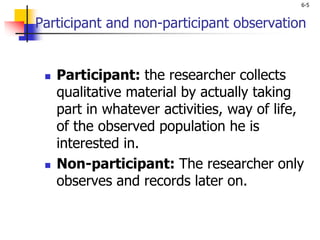
Participant and non-participant observation
 Participant: the researcher collects
qualitative material by actually taking
part in whatever activities, way of life,
of the observed population he is
interested in.
 Non-participant: The researcher only
observes and records later on.
6-6
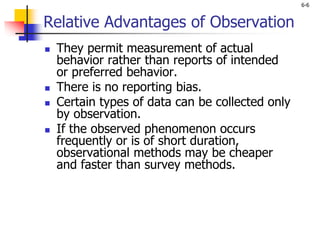
Relative Advantages of Observation
 They permit measurement of actual
behavior rather than reports of intended
or preferred behavior.
 There is no reporting bias.
 Certain types of data can be collected only
by observation.
 If the observed phenomenon occurs
frequently or is of short duration,
observational methods may be cheaper
and faster than survey methods.
6-7
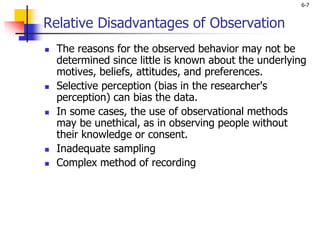
Relative Disadvantages of Observation
 The reasons for the observed behavior may not be
determined since little is known about the underlying
motives, beliefs, attitudes, and preferences.
 Selective perception (bias in the researcher's
perception) can bias the data.
 In some cases, the use of observational methods
may be unethical, as in observing people without
their knowledge or consent.
 Inadequate sampling
 Complex method of recording

Observation method 9.ppt

  • 1.
  • 2.
    6-2 Observation Methods Structured versusUnstructured Observation  For structured observation, the researcher specifies in detail what is to be observed and how the measurements are to be recorded.  In unstructured observation, the observer monitors all aspects of the phenomenon that seem relevant to the problem.
  • 3.
    6-3 Observation Methods Disguised versusUndisguised Observation  In disguised observation, the respondents are unaware that they are being observed. It may be accomplished by using hidden cameras, or inconspicuous mechanical devices. Observers may be disguised as shoppers or sales clerks.  In undisguised observation, the respondents are aware that they are under observation.
  • 4.
    6-4 Observation Methods  Naturalobservation involves observing behavior as it takes places in the environment. For example, one could observe the behavior of respondents eating fast food in Burger King.
  • 5.
    6-5 Participant and non-participantobservation  Participant: the researcher collects qualitative material by actually taking part in whatever activities, way of life, of the observed population he is interested in.  Non-participant: The researcher only observes and records later on.
  • 6.
    6-6 Relative Advantages ofObservation  They permit measurement of actual behavior rather than reports of intended or preferred behavior.  There is no reporting bias.  Certain types of data can be collected only by observation.  If the observed phenomenon occurs frequently or is of short duration, observational methods may be cheaper and faster than survey methods.
  • 7.
    6-7 Relative Disadvantages ofObservation  The reasons for the observed behavior may not be determined since little is known about the underlying motives, beliefs, attitudes, and preferences.  Selective perception (bias in the researcher's perception) can bias the data.  In some cases, the use of observational methods may be unethical, as in observing people without their knowledge or consent.  Inadequate sampling  Complex method of recording