INTERNSHIP PRESENTATION ON,
“CLASSIFYDIFFERENT TYPES OF OBJECTS”
PRESENTED BY
SRUSHTI S HULYALAD(4GM21AI052)
Project Guide: Project Co-Ordinator: Head of Department:
Miss. Snehal V Mrs. Shilpa R N Dr. Asha K
B.E, M.Tech B.E, M.Tech B.E, M.Tech, Ph.D
2.
ABSTRACT
Object classification isthe process of assigning predefined labels or
categories to objects based on their characteristics, features, and
properties. It is a fundamental task in machine learning and computer
vision, enabling machines to understand and interpret visual data. Object
classification has benefited significantly from advancements in deep
learning. Convolutional Neural Networks (CNNs) have proven highly
effective in learning complex patterns from vast amounts of image data,
achieving impressive accuracy in object recognition tasks.
3.
CONTENT
1. Company Details
2.Introduction
3. Objectives
4. Literature Survey
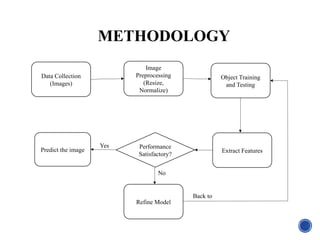
5. Methodology
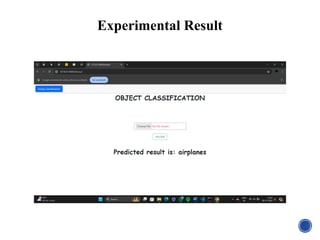
6. Experimental Result
7. Applications
8. Advantages
9. Future Scope
10. Conclusion
4.
COMPANY DETAILS
• KarunaduTechnologies Private Limited is an unlisted private company
incorporated on 19 July, 2018. It is classified as a private limited company and
is located in Bangalore, Karnataka.
• The last reported AGM (Annual General Meeting) of Karunadu Technologies
Private Limited, per our records, was held on 30 September, 2022.
• Karunadu Technologies Private Limited has two directors - Mahesh Deginal
and Bhavaramma S Hatti.
• In Karunadu Technologies Private Limited, I completed my Internship
program for 4 weeks, on the domain Artificial intelligence and Machine
Learning.
5.
INTRODUCTION
Object classification,which is a computer-based technique of artificial
intelligence that enables the identification of objects.
Object detection is primarily based on machine learning, and it requires an
enormous amount of data for training and testing to achieve high accuracy in
recognizing objects.
This technique involves using advanced algorithms and machine learning models
that can process large amounts of data to accurately recognize and classify
objects based on their visual features.
Object classification has a wide range of applications in various industries such
as manufacturing, retail, and security.
6.
OBJECTIVES
Object classification isa critical task in computer vision with several key
objectives that drive its development and application. Here are the
primary objectives:
Accurate Identification
Real-Time Processing
Scalability
7.
LITERATURE SURVEY
Paper TitleAuthor Name Year Description
A Survey on Deep
Learning
Techniques for
Image and Video
Classification
Lei Meng,
Mingjie Wang
2020 Provides an overview of
deep learning methods,
including CNNs and
their applications in
image and video
classification tasks.
Recent Advances
in Object Detection
and Classification:
A Review
Shengjin Wang,
Zhen Liu
2021 Focuses on both
traditional and deep
learning approaches for
object detection and
classification.
ADVANTAGES
Object classification offersnumerous benefits across various fields and
applications. Here are some of the key advantages:
Improved accuracy
Automatic feature learning
Increases the efficiency
14.
FUTURE SCOPE:
Future scopeon object classification will focus on refining and
optimizing existing applications, exploring new techniques.
Advancements in computer vision will lead to increased adoption across
industries, including healthcare, autonomous vehicles, and smart
surveillance.
15.
CONCLUSION
We can easilydetect and identify the various objects present in an image.
Object detection provides a faster and accurate means to predict the
object in an image. It is useful in various applications such as image
retrieval system.