Online Consultation: 
Governments Engaging 
Citizens 
Seminar 
By Steven Clift, Publicus.Net
Online Consultation 
Seminar Outline 
• Introduction 
• Online Consultation 
• Conclusion 
Online Consultation Seminar 
Copyright 2003, Steven Clift,
Introduction
Introduction 
• Moving from one-way old media to two-way 
communication 
• Many-to-many communication is the focus of 
this seminar 
• “The most democratizing aspect of the 
Internet is the ability for people to organize 
and communicate in groups.” 
- Steven Clift from Democracy is Online article in, 
OnTheInternet, April 1998 
Online Consultation Seminar 
Copyright 2003, Steven Clift,
Introduction 
• Taking the E-citizen perspective 
– What do people actually do online? 
– How can that knowledge be used to design 
interactive opportunities? 
• Time online. People spend more time in their 
e-mail box than surfing on the web. 
• E-mail is where the e-citizens roam. The web 
is a tremendous and valuable complement. 
Online Consultation Seminar 
Copyright 2003, Steven Clift,
Introduction 
• Daily Internet Activities – 
PewInternet.Org 
On a typical day, Americans with net 
access: 
– Go online - 53% 
– Send email - 46 
– Use an online search engine 
to find information - 29 
– Get news - 22 
– Surf the Web for fun - 22 
– Look for info on a hobby - 19 
– Check the weather - 17 
– Do any type of research for 
their job - 16 
– Do an Internet search to answer 
a specific question - 14 
– Research a product or service 
before buying it - 14 
– Get financial information - 13 
– Look for info about movies, 
books, or other leisure activities 
- 13 
– Send an instant message - 11 
– Check sports scores - 10 
– Look for political 
news/information - 9 
– Research for school or training - 
9 
– Visit a government Web site - 8 
Online Consultation Seminar 
Copyright 2003, Steven Clift,
Introduction 
• Local online groups, where might e-citizen 
already “be”? 
– Club EGroups 
– Religious Institutions E-News lists 
– Local Business and Trade Groups E-Lists 
– Sports Group E-Lists 
– Media Hosted Web Forums 
– Social Chat Forums (Younger net users) 
– Civic/NGO E-Lists 
– Neighbors, Apartment Complexes 
– EGroups with Personal Friends 
Adapted from PewInternet.Org report on Online Communities 
Online Consultation Seminar 
Copyright 2003, Steven Clift,
Introduction 
• Do most people view the Internet as a way to get 
involved locally? Not yet. We must change that. 
– 67% of American Internet users say the Net helps 
them get involved in things outside their 
community 
– 9% say it helps them get involved in things close 
to home. 
– However, 26% of American Internet users (or 28 
million people) have employed the Internet to 
contact or get information about local groups. 
• From PewInternet.Org’s, Online Communities survey, 
continued … 
Online Consultation Seminar 
Copyright 2003, Steven Clift,
Introduction 
• Of American Internet users, they go online “often” or 
“sometimes”: 
– 41% for information about local stores or merchants. 
– 35% for news about their local community or community events. 
– 30% for information about local government. 
– 24% for information about local schools. 
– 13% to email public officials. (Only half of all net users say their 
town has a Web site, and few net users find it very useful.) 
– 11% of Internet users say they are aware of at least one local 
issue where the net played a role in organizing citizens to 
communicate with public officials. 
– Percentage doubles to 22% for Internet users who are active 
members of online communities. 
– Source: PewInternet.Org Online Communities survey 
Online Consultation Seminar 
Copyright 2003, Steven Clift,
Introduction 
• If “barriers to entry” to publishing information 
or hosting discussions online are low, what 
scarcities remain? 
– User Time 
– User Attention 
– Resources available to produce quality content, 
host consultations and discussions 
• Increasing expectations of users important 
• These factors must always be taken into 
consideration. 
Online Consultation Seminar 
Copyright 2003, Steven Clift,
Introduction 
• Value of online community and consultations 
include: 
– Anywhere 
– Anytime – On your own time 
– Diverse voices 
– Complement not replace existing participation 
• Can overcome the “democratic divide” 
despite digital divide 
• Most current decision-making processes 
have specific place and time restrictions. 
Online Consultation Seminar 
Copyright 2003, Steven Clift,
Online Consultation
Online Consultation 
• Online consultations are (normally) time-limited 
events designed to inform the 
public policy process and inform 
interested citizens and experts 
• Often sponsored by government and 
NGOs, sometimes media – this 
presentation has a government focus 
• Related terms – online events, online 
hearings, e-rulemaking 
Online Consultation Seminar 
Copyright 2003, Steven Clift,
Online Consultation 
• Why do them? 
– Increase the quality, quantity, and diversity of 
information and opinion available to decision-makers 
– Educate citizens on the policy options and complex 
choices 
– Build public and media awareness on priority issues 
– Float ideas and proposals to determine interest, build 
support, lessen opposition 
• Don’t expect them to be easy or less work than 
in-person consultations or public hearings 
Online Consultation Seminar 
Copyright 2003, Steven Clift,
Online Consultation 
Online Consultation Top Ten Tips 
1. Political Support Required. 
2. State Purpose, Share Context. 
3. Build an Audience. 
Online Consultation Seminar 
Copyright 2003, Steven Clift,
Online Consultation 
• 4. Choose Your Model and Elements Carefully. 
Examples 
– Questions and Answers 
– Document/Policy Comments 
– Online Expert Panel 
– Online Conference 
– E-Rulemaking Comments 
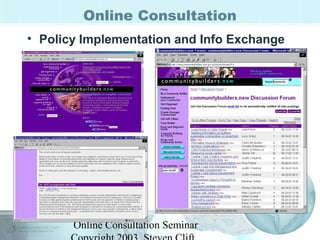
– Policy Implementation Information Exchange 
– Live Chat/Interview Events 
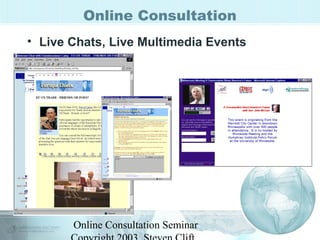
– Live Multimedia Events 
– Consultation Index (Traditional Participation) 
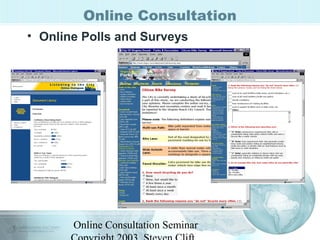
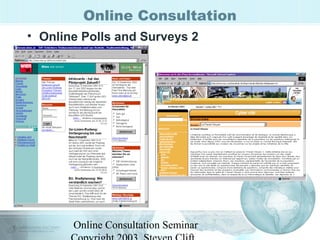
– Other Online Elements: Surveys and Polls, Comment 
Forms, Petitions, Testimony, Focus Groups, Web 
Forums and E-mail Lists 
• Here are select examples … 
Online Consultation Seminar 
Copyright 2003, Steven Clift,
Online Consultation 
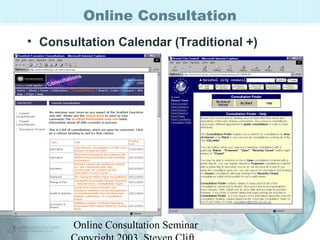
• Consultation Calendar (Traditional +) 
Online Consultation Seminar 
Copyright 2003, Steven Clift,
Online Consultation 
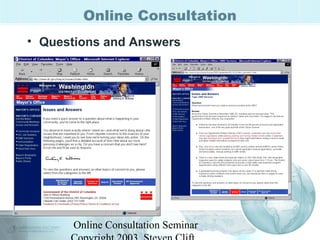
• Questions and Answers 
Online Consultation Seminar 
Copyright 2003, Steven Clift,
Online Consultation 
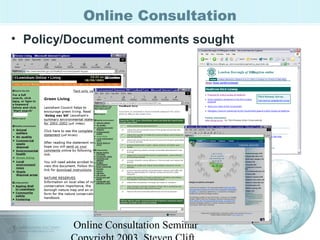
• Policy/Document comments sought 
Online Consultation Seminar 
Copyright 2003, Steven Clift,
Online Consultation 
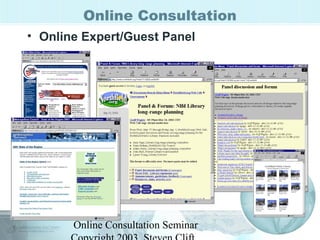
• Online Expert/Guest Panel 
Online Consultation Seminar 
Copyright 2003, Steven Clift,
Online Consultation 
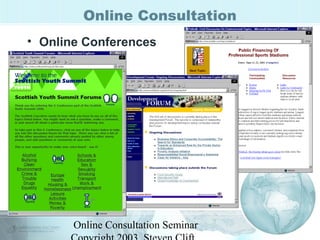
• Online Conferences 
Online Consultation Seminar 
Copyright 2003, Steven Clift,
Online Consultation 
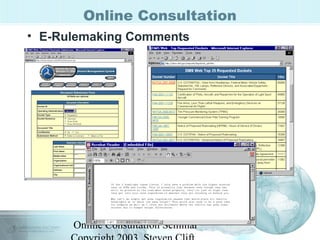
• E-Rulemaking Comments 
Online Consultation Seminar 
Copyright 2003, Steven Clift,
Online Consultation 
• Policy Implementation and Info Exchange 
Online Consultation Seminar 
Copyright 2003, Steven Clift,
Online Consultation 
• Live Chats, Live Multimedia Events 
Online Consultation Seminar 
Copyright 2003, Steven Clift,
Online Consultation 
• Online Polls and Surveys 
Online Consultation Seminar 
Copyright 2003, Steven Clift,
Online Consultation 
• Online Polls and Surveys 2 
Online Consultation Seminar 
Copyright 2003, Steven Clift,
Online Consultation 
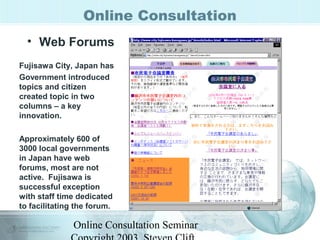
• Web Forums 
Fujisawa City, Japan has 
Government introduced 
topics and citizen 
created topic in two 
columns – a key 
innovation. 
Approximately 600 of 
3000 local governments 
in Japan have web 
forums, most are not 
active. Fujisawa is 
successful exception 
with staff time dedicated 
to facilitating the forum. 
Online Consultation Seminar 
Copyright 2003, Steven Clift,
Online Consultation 
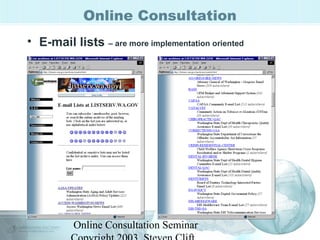
• E-mail lists – are more implementation oriented 
Online Consultation Seminar 
Copyright 2003, Steven Clift,
Online Consultation 
Back to the final 5 of 10 top tips … 
5. Create Structure. 
6. Provide Facilitation and Guidelines. 
7. Disseminate Content and Results. 
Online Consultation Seminar 
Copyright 2003, Steven Clift,
Online Consultation 
8. Access to Decision-Makers and Staff 
Required. 
9. Promote Civic Education. 
10. Not About Technology. 
Full article online at: 
http://www.publicus.net/articles/consult.html 
Online Consultation Seminar 
Copyright 2003, Steven Clift,
Online Consultation 
Addition resources online at bottom of: 
http://www.publicus.net/articles/consult.html 
• Bowling Together: Online Public Engagement in Policy Deliberation 
• OECD Citizens as Partners Guide: Information, Consultation and Public 
Participation in Policy-Making (268 pages) 
• Engaging Citizens in Policy-making: Information, Consultation and Public 
Participation. OECD Public Management Policy Brief No. 10 
• Building Digital Bridges - Creating Inclusive Online Parliamentary 
Consultations 
• Electronic Democracy and Educating Young People 
• New Media and Social Exclusion (report excerpt from Hansard Society) 
• On-line Engagement – New Models and Implications for Government 
Departments and Officials 
• Lessons from the Network Model for Online Engagement of Citizens 
• Electronic Civic Consultation: A guide to the use of the Internet in 
interactive policy making (Key Dutch report from 1997) 
Online Consultation Seminar 
Copyright 2003, Steven Clift,
Conclusion
Conclusion 
• We have a choice – use information and 
communications technologies to improve the 
connection between citizens and their 
governments or not. 
• We have a choice – build online efforts 
among and for citizens that connect them 
with each other in order to raise their voices 
in our communities or not. 
Online Consultation Seminar 
Copyright 2003, Steven Clift,
Conclusion 
• This is an evolution that can be shaped on 
our terms, our democratic terms. 
• Ultimately, our goal is to create systems for 
political participation that fully accommodate 
the will of the people so we can improve the 
outcomes of our public work and society as a 
whole. 
Online Consultation Seminar 
Copyright 2003, Steven Clift,
Further Information 
• Democracies Online Newswire 
http://www.e-democracy.org/do 
Over 2500 people around the world exchanging 
announcements, news, and articles related to e-democracy, 
e-government, and e-politics. 
• E-Democracy Resources Flyer 
http://publicus.net/articles/edemresources.html 
Links to the top e-democracy starting points on a two page 
flyer available in HTML, Word, and PDF. 
• Publicus.Net 
http://www.publicus.net 
More articles and presentations by Steven Clift 
Online Consultation Seminar 
Copyright 2003, Steven Clift,

Online Consultation: Governments Engaging Citizens Seminar - From the Archives

  • 1.
    Online Consultation: GovernmentsEngaging Citizens Seminar By Steven Clift, Publicus.Net
  • 2.
    Online Consultation SeminarOutline • Introduction • Online Consultation • Conclusion Online Consultation Seminar Copyright 2003, Steven Clift,
  • 3.
  • 4.
    Introduction • Movingfrom one-way old media to two-way communication • Many-to-many communication is the focus of this seminar • “The most democratizing aspect of the Internet is the ability for people to organize and communicate in groups.” - Steven Clift from Democracy is Online article in, OnTheInternet, April 1998 Online Consultation Seminar Copyright 2003, Steven Clift,
  • 5.
    Introduction • Takingthe E-citizen perspective – What do people actually do online? – How can that knowledge be used to design interactive opportunities? • Time online. People spend more time in their e-mail box than surfing on the web. • E-mail is where the e-citizens roam. The web is a tremendous and valuable complement. Online Consultation Seminar Copyright 2003, Steven Clift,
  • 6.
    Introduction • DailyInternet Activities – PewInternet.Org On a typical day, Americans with net access: – Go online - 53% – Send email - 46 – Use an online search engine to find information - 29 – Get news - 22 – Surf the Web for fun - 22 – Look for info on a hobby - 19 – Check the weather - 17 – Do any type of research for their job - 16 – Do an Internet search to answer a specific question - 14 – Research a product or service before buying it - 14 – Get financial information - 13 – Look for info about movies, books, or other leisure activities - 13 – Send an instant message - 11 – Check sports scores - 10 – Look for political news/information - 9 – Research for school or training - 9 – Visit a government Web site - 8 Online Consultation Seminar Copyright 2003, Steven Clift,
  • 7.
    Introduction • Localonline groups, where might e-citizen already “be”? – Club EGroups – Religious Institutions E-News lists – Local Business and Trade Groups E-Lists – Sports Group E-Lists – Media Hosted Web Forums – Social Chat Forums (Younger net users) – Civic/NGO E-Lists – Neighbors, Apartment Complexes – EGroups with Personal Friends Adapted from PewInternet.Org report on Online Communities Online Consultation Seminar Copyright 2003, Steven Clift,
  • 8.
    Introduction • Domost people view the Internet as a way to get involved locally? Not yet. We must change that. – 67% of American Internet users say the Net helps them get involved in things outside their community – 9% say it helps them get involved in things close to home. – However, 26% of American Internet users (or 28 million people) have employed the Internet to contact or get information about local groups. • From PewInternet.Org’s, Online Communities survey, continued … Online Consultation Seminar Copyright 2003, Steven Clift,
  • 9.
    Introduction • OfAmerican Internet users, they go online “often” or “sometimes”: – 41% for information about local stores or merchants. – 35% for news about their local community or community events. – 30% for information about local government. – 24% for information about local schools. – 13% to email public officials. (Only half of all net users say their town has a Web site, and few net users find it very useful.) – 11% of Internet users say they are aware of at least one local issue where the net played a role in organizing citizens to communicate with public officials. – Percentage doubles to 22% for Internet users who are active members of online communities. – Source: PewInternet.Org Online Communities survey Online Consultation Seminar Copyright 2003, Steven Clift,
  • 10.
    Introduction • If“barriers to entry” to publishing information or hosting discussions online are low, what scarcities remain? – User Time – User Attention – Resources available to produce quality content, host consultations and discussions • Increasing expectations of users important • These factors must always be taken into consideration. Online Consultation Seminar Copyright 2003, Steven Clift,
  • 11.
    Introduction • Valueof online community and consultations include: – Anywhere – Anytime – On your own time – Diverse voices – Complement not replace existing participation • Can overcome the “democratic divide” despite digital divide • Most current decision-making processes have specific place and time restrictions. Online Consultation Seminar Copyright 2003, Steven Clift,
  • 12.
  • 13.
    Online Consultation •Online consultations are (normally) time-limited events designed to inform the public policy process and inform interested citizens and experts • Often sponsored by government and NGOs, sometimes media – this presentation has a government focus • Related terms – online events, online hearings, e-rulemaking Online Consultation Seminar Copyright 2003, Steven Clift,
  • 14.
    Online Consultation •Why do them? – Increase the quality, quantity, and diversity of information and opinion available to decision-makers – Educate citizens on the policy options and complex choices – Build public and media awareness on priority issues – Float ideas and proposals to determine interest, build support, lessen opposition • Don’t expect them to be easy or less work than in-person consultations or public hearings Online Consultation Seminar Copyright 2003, Steven Clift,
  • 15.
    Online Consultation OnlineConsultation Top Ten Tips 1. Political Support Required. 2. State Purpose, Share Context. 3. Build an Audience. Online Consultation Seminar Copyright 2003, Steven Clift,
  • 16.
    Online Consultation •4. Choose Your Model and Elements Carefully. Examples – Questions and Answers – Document/Policy Comments – Online Expert Panel – Online Conference – E-Rulemaking Comments – Policy Implementation Information Exchange – Live Chat/Interview Events – Live Multimedia Events – Consultation Index (Traditional Participation) – Other Online Elements: Surveys and Polls, Comment Forms, Petitions, Testimony, Focus Groups, Web Forums and E-mail Lists • Here are select examples … Online Consultation Seminar Copyright 2003, Steven Clift,
  • 17.
    Online Consultation •Consultation Calendar (Traditional +) Online Consultation Seminar Copyright 2003, Steven Clift,
  • 18.
    Online Consultation •Questions and Answers Online Consultation Seminar Copyright 2003, Steven Clift,
  • 19.
    Online Consultation •Policy/Document comments sought Online Consultation Seminar Copyright 2003, Steven Clift,
  • 20.
    Online Consultation •Online Expert/Guest Panel Online Consultation Seminar Copyright 2003, Steven Clift,
  • 21.
    Online Consultation •Online Conferences Online Consultation Seminar Copyright 2003, Steven Clift,
  • 22.
    Online Consultation •E-Rulemaking Comments Online Consultation Seminar Copyright 2003, Steven Clift,
  • 23.
    Online Consultation •Policy Implementation and Info Exchange Online Consultation Seminar Copyright 2003, Steven Clift,
  • 24.
    Online Consultation •Live Chats, Live Multimedia Events Online Consultation Seminar Copyright 2003, Steven Clift,
  • 25.
    Online Consultation •Online Polls and Surveys Online Consultation Seminar Copyright 2003, Steven Clift,
  • 26.
    Online Consultation •Online Polls and Surveys 2 Online Consultation Seminar Copyright 2003, Steven Clift,
  • 27.
    Online Consultation •Web Forums Fujisawa City, Japan has Government introduced topics and citizen created topic in two columns – a key innovation. Approximately 600 of 3000 local governments in Japan have web forums, most are not active. Fujisawa is successful exception with staff time dedicated to facilitating the forum. Online Consultation Seminar Copyright 2003, Steven Clift,
  • 28.
    Online Consultation •E-mail lists – are more implementation oriented Online Consultation Seminar Copyright 2003, Steven Clift,
  • 29.
    Online Consultation Backto the final 5 of 10 top tips … 5. Create Structure. 6. Provide Facilitation and Guidelines. 7. Disseminate Content and Results. Online Consultation Seminar Copyright 2003, Steven Clift,
  • 30.
    Online Consultation 8.Access to Decision-Makers and Staff Required. 9. Promote Civic Education. 10. Not About Technology. Full article online at: http://www.publicus.net/articles/consult.html Online Consultation Seminar Copyright 2003, Steven Clift,
  • 31.
    Online Consultation Additionresources online at bottom of: http://www.publicus.net/articles/consult.html • Bowling Together: Online Public Engagement in Policy Deliberation • OECD Citizens as Partners Guide: Information, Consultation and Public Participation in Policy-Making (268 pages) • Engaging Citizens in Policy-making: Information, Consultation and Public Participation. OECD Public Management Policy Brief No. 10 • Building Digital Bridges - Creating Inclusive Online Parliamentary Consultations • Electronic Democracy and Educating Young People • New Media and Social Exclusion (report excerpt from Hansard Society) • On-line Engagement – New Models and Implications for Government Departments and Officials • Lessons from the Network Model for Online Engagement of Citizens • Electronic Civic Consultation: A guide to the use of the Internet in interactive policy making (Key Dutch report from 1997) Online Consultation Seminar Copyright 2003, Steven Clift,
  • 32.
  • 33.
    Conclusion • Wehave a choice – use information and communications technologies to improve the connection between citizens and their governments or not. • We have a choice – build online efforts among and for citizens that connect them with each other in order to raise their voices in our communities or not. Online Consultation Seminar Copyright 2003, Steven Clift,
  • 34.
    Conclusion • Thisis an evolution that can be shaped on our terms, our democratic terms. • Ultimately, our goal is to create systems for political participation that fully accommodate the will of the people so we can improve the outcomes of our public work and society as a whole. Online Consultation Seminar Copyright 2003, Steven Clift,
  • 35.
    Further Information •Democracies Online Newswire http://www.e-democracy.org/do Over 2500 people around the world exchanging announcements, news, and articles related to e-democracy, e-government, and e-politics. • E-Democracy Resources Flyer http://publicus.net/articles/edemresources.html Links to the top e-democracy starting points on a two page flyer available in HTML, Word, and PDF. • Publicus.Net http://www.publicus.net More articles and presentations by Steven Clift Online Consultation Seminar Copyright 2003, Steven Clift,