NEW YORK CITY
EXPERIENCE 2014
Daniel Caldas
Sidney Madge
Kasey Coffey
Jackson Landgreen
Delaney Pratt
Wieden + Kennedy NYC
challenge
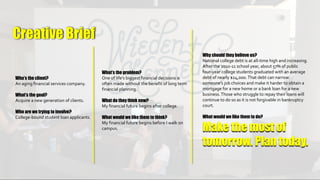
Why should they believe us?
National college debt is at all-time high and increasing.
After the 2010-11 school year, about 57% of public
four-year college students graduated with an average
debt of nearly $24,000. That debt can narrow
someone’s job choices and make it harder to obtain a
mortgage for a new home or a bank loan for a new
business.Those who struggle to repay their loans will
continue to do so as it is not forgivable in bankruptcy
court.
What would we like them to do?
Make the most of
tomorrow. Plan today.
Creative Brief
What’s the problem?
One of life’s biggest financial decisions is
often made without the benefit of long term
financial planning.
What do they think now?
My financial future begins after college.
What would we like them to think?
My financial future begins before I walk on
campus.
Who’s the client?
An aging financial services company.
What’s the goal?
Acquire a new generation of clients.
Who are we trying to involve?
College-bound student loan applicants.
=-
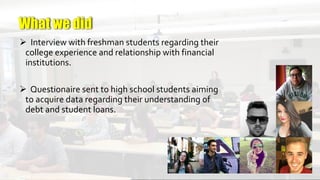
 Interview with freshman students regarding their
college experience and relationship with financial
institutions.
 Questionaire sent to high school students aiming
to acquire data regarding their understanding of
debt and student loans.
What we did
Our findings
First: the truth
The whole point of education
is to get a job.
This was the insight that
triggered our curiosity to
understand the relationship
between the student and
financial agency.
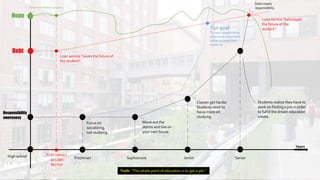
Responsibility
awereness
High school Freshman Sophomore Junior Senior
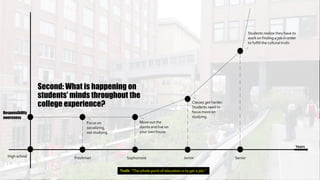
Focus on
socializing,
not studying.
Move out the
dorms and live on
your own house.
Classes get harder.
Students need to
focus more on
studying.
Students realize they have to
work on finding a job in order
to fulfill the cultural truth.
Second: What is happening on
students’ minds throughout the
college experience?
Years
Truth: “The whole point of education is to get a job.”
Debt
Responsibility
awereness
High school Freshman Sophomore Junior Senior
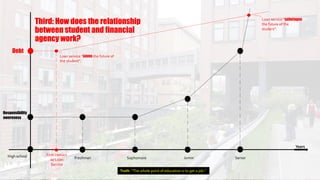
First contact
w/ Loan
Service
Loan service “saves the future of
the student”.
Loan service “sabotages
the future of the
student”.
Third: How does the relationship
between student and financial
agency work?
Years
Truth: “The whole point of education is to get a job.”
Debt
Hope
Responsibility
awereness
High school Freshman Sophomore Junior Senior
First contact
w/ Loan
Service
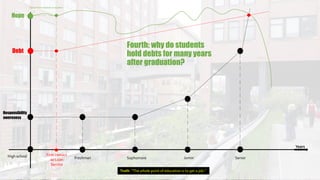
Varies from student to student.
Years
Fourth: why do students
hold debts for many years
after graduation?
Truth: “The whole point of education is to get a job.”
Debt
Hope
Responsibility
awereness
High school Freshman Sophomore Junior Senior
First contact
w/ Loan
Service
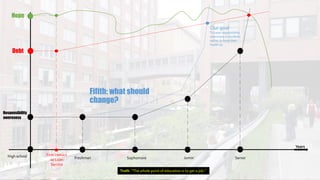
Our goal
To raise responsibility
awereness in students
earlier to keep their
hopes up.
Years
Fifith: what should
change?
Truth: “The whole point of education is to get a job.”
Debt
Hope
Responsibility
awereness
High school Freshman Sophomore Junior Senior
First contact
w/ Loan
Service
Focus on
socializing,
not studying.
Students realize they have to
work on finding a job in order
to fulfill the dream education
create.
Our goal
To raise responsibility
awereness in students
earlier to keep their
hopes up.
Loan service “saves the future of
the student”.
Loan service “sabotages
the future of the
student”.
Debt meets
responsibility.Varies from student to student.
Years
Truth: “The whole point of education is to get a job.”
Classes get harder.
Students need to
focus more on
studying.
Move out the
dorms and live on
your own house.
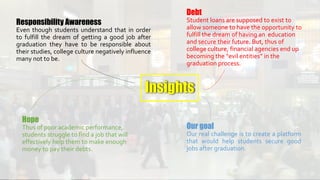
Responsibility Awareness
Even though students understand that in order
to fulfill the dream of getting a good job after
graduation they have to be responsible about
their studies, college culture negatively influence
many not to be.
Debt
Student loans are supposed to exist to
allow someone to have the opportunity to
fulfill the dream of having an education
and secure their future. But, thus of
college culture, financial agencies end up
becoming the “evil entities” in the
graduation process.
Hope
Thus of poor academic performance,
students struggle to find a job that will
effectively help them to make enough
money to pay their debts.
Our goal
Our real challenge is to create a platform
that would help students secure good
jobs after graduation.
Insights
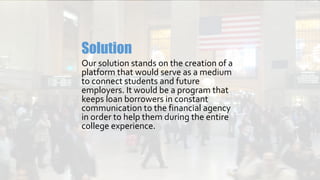
Solution
Our solution stands on the creation of a
platform that would serve as a medium
to connect students and future
employers. It would be a program that
keeps loan borrowers in constant
communication to the financial agency
in order to help them during the entire
college experience.
Solution
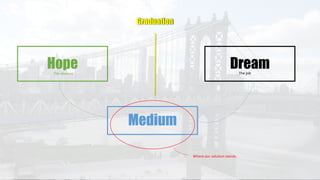
Hope Dream
Medium
The student The job
Where our solution stands.
Graduation
Team
cargocollective.com/danielcaldas
www.delaneyrpratt.com
www.kaseycoffey.com
jacksonlandgreen.wix.com/jacksonlandgreen
www.sydneymadge.com
Thank you for all your
guidance and opportunities.
CAROLYN CHAMBERS
DISTINGUISHED PROFESSOR OF
ADVERTISING, ADVERTISING
AREA DIRECTOR
331 Allen Hall
541-346-1797
debmor@uoregon.edu
MPhil, 2010, University of Ghana;
BA, 2007, University of Cape
Coast, Sociology/Geography
oforipar@uoregon.edu
SENIOR INSTRUCTOR
310 Allen Hall
541-346-3754
dkoranda@uoregon.edu
NEW YORK CITY
EXPERIENCE 2014

NYCE 2014 - W+K Challenge - UofO

  • 1.
    NEW YORK CITY EXPERIENCE2014 Daniel Caldas Sidney Madge Kasey Coffey Jackson Landgreen Delaney Pratt
  • 2.
    Wieden + KennedyNYC challenge
  • 3.
    Why should theybelieve us? National college debt is at all-time high and increasing. After the 2010-11 school year, about 57% of public four-year college students graduated with an average debt of nearly $24,000. That debt can narrow someone’s job choices and make it harder to obtain a mortgage for a new home or a bank loan for a new business.Those who struggle to repay their loans will continue to do so as it is not forgivable in bankruptcy court. What would we like them to do? Make the most of tomorrow. Plan today. Creative Brief What’s the problem? One of life’s biggest financial decisions is often made without the benefit of long term financial planning. What do they think now? My financial future begins after college. What would we like them to think? My financial future begins before I walk on campus. Who’s the client? An aging financial services company. What’s the goal? Acquire a new generation of clients. Who are we trying to involve? College-bound student loan applicants.
  • 4.
    =-  Interview withfreshman students regarding their college experience and relationship with financial institutions.  Questionaire sent to high school students aiming to acquire data regarding their understanding of debt and student loans. What we did
  • 5.
  • 6.
    First: the truth Thewhole point of education is to get a job. This was the insight that triggered our curiosity to understand the relationship between the student and financial agency.
  • 7.
    Responsibility awereness High school FreshmanSophomore Junior Senior Focus on socializing, not studying. Move out the dorms and live on your own house. Classes get harder. Students need to focus more on studying. Students realize they have to work on finding a job in order to fulfill the cultural truth. Second: What is happening on students’ minds throughout the college experience? Years Truth: “The whole point of education is to get a job.”
  • 8.
    Debt Responsibility awereness High school FreshmanSophomore Junior Senior First contact w/ Loan Service Loan service “saves the future of the student”. Loan service “sabotages the future of the student”. Third: How does the relationship between student and financial agency work? Years Truth: “The whole point of education is to get a job.”
  • 9.
    Debt Hope Responsibility awereness High school FreshmanSophomore Junior Senior First contact w/ Loan Service Varies from student to student. Years Fourth: why do students hold debts for many years after graduation? Truth: “The whole point of education is to get a job.”
  • 10.
    Debt Hope Responsibility awereness High school FreshmanSophomore Junior Senior First contact w/ Loan Service Our goal To raise responsibility awereness in students earlier to keep their hopes up. Years Fifith: what should change? Truth: “The whole point of education is to get a job.”
  • 11.
    Debt Hope Responsibility awereness High school FreshmanSophomore Junior Senior First contact w/ Loan Service Focus on socializing, not studying. Students realize they have to work on finding a job in order to fulfill the dream education create. Our goal To raise responsibility awereness in students earlier to keep their hopes up. Loan service “saves the future of the student”. Loan service “sabotages the future of the student”. Debt meets responsibility.Varies from student to student. Years Truth: “The whole point of education is to get a job.” Classes get harder. Students need to focus more on studying. Move out the dorms and live on your own house.
  • 12.
    Responsibility Awareness Even thoughstudents understand that in order to fulfill the dream of getting a good job after graduation they have to be responsible about their studies, college culture negatively influence many not to be. Debt Student loans are supposed to exist to allow someone to have the opportunity to fulfill the dream of having an education and secure their future. But, thus of college culture, financial agencies end up becoming the “evil entities” in the graduation process. Hope Thus of poor academic performance, students struggle to find a job that will effectively help them to make enough money to pay their debts. Our goal Our real challenge is to create a platform that would help students secure good jobs after graduation. Insights
  • 13.
  • 14.
    Our solution standson the creation of a platform that would serve as a medium to connect students and future employers. It would be a program that keeps loan borrowers in constant communication to the financial agency in order to help them during the entire college experience. Solution
  • 15.
    Hope Dream Medium The studentThe job Where our solution stands. Graduation
  • 16.
  • 17.
  • 18.
    Thank you forall your guidance and opportunities. CAROLYN CHAMBERS DISTINGUISHED PROFESSOR OF ADVERTISING, ADVERTISING AREA DIRECTOR 331 Allen Hall 541-346-1797 debmor@uoregon.edu MPhil, 2010, University of Ghana; BA, 2007, University of Cape Coast, Sociology/Geography oforipar@uoregon.edu SENIOR INSTRUCTOR 310 Allen Hall 541-346-3754 dkoranda@uoregon.edu
  • 19.