S
Why do people still make
unhealthy choice even when they
have nutrition facts on fast food
menus?
Presenter :Yuefeng Pan
Mentor: Catherine A. Cole
Tippie Research Fair
Januray, 27th,2015
Study 1
As reported by Dr. Christina A.
Roberto and her colleagues
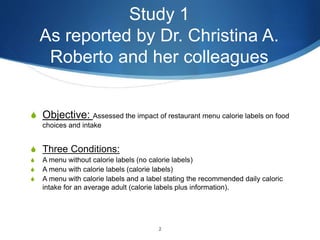
S Objective: Assessed the impact of restaurant menu calorie labels on food
choices and intake
S Three Conditions:
S A menu without calorie labels (no calorie labels)
S A menu with calorie labels (calorie labels)
S A menu with calorie labels and a label stating the recommended daily caloric
intake for an average adult (calorie labels plus information).
2
Study 1
As reported by Dr. Christina A.
Roberto and her colleagues
S Procedure
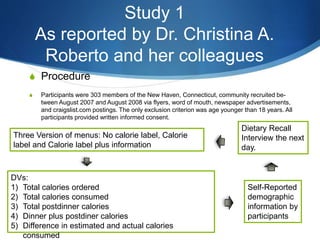
S Participants were 303 members of the New Haven, Connecticut, community recruited be-
tween August 2007 and August 2008 via flyers, word of mouth, newspaper advertisements,
and craigslist.com postings. The only exclusion criterion was age younger than 18 years. All
participants provided written informed consent.
3
Three Version of menus: No calorie label, Calorie
label and Calorie label plus information
DVs:
1) Total calories ordered
2) Total calories consumed
3) Total postdinner calories
4) Dinner plus postdiner calories
5) Difference in estimated and actual calories
consumed
Dietary Recall
Interview the next
day.
Self-Reported
demographic
information by
participants
Study 1
As reported by Dr. Christina A.
Roberto and her colleagues
4
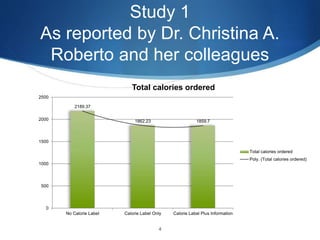
2189.37
1862.23 1859.7
0
500
1000
1500
2000
2500
No Calorie Label Calorie Label Only Calorie Label Plus Information
Total calories ordered
Poly. (Total calories ordered)
Results
S Conclusion: Calorie labels on restaurant menus impacted food
choices and intake; adding a recommended daily caloric
requirement label increased this effect, suggesting menu label
legislation should require such a label
S In Study 2: We want to incorporate nutrition knowledge—our
hypothesis is that whether the effect observed in study 1 will be
stronger for high knowledge consumers).
5
Study 2
S Hypothesis: High knowledge people will not be as
influenced by calorie information on menus as low
knowledge people.
6
Study 2
S DV:
1. Total Calories Ordered
2. Perceived Healthiness
3. Error between perceived calorie consumption and actual calorie consumption
S IVs:
1. Different version of menus
2. Different nutrition knowledge level
Study 2 Method
S Amazon Mechanical Turks
S 277 total – 42 pretest= 235 valid
S Number of eliminated:
S (1)Who have not finished the survey: 18 subjects
S (2)Who finished the survey within 3min(mean=382.91s,
SD=182.71s): 14 subjects
S (3)Who doesn’t meet the screening criteria 58 subjects
Final subjects: 145
8
Independent Variable
S 1. Two versions of menu
Menu with Calorie info
Menu without Calorie info
S 2. Nutrition Knowledge(Nutrition Grade)
High knowledge
Low knowledge
Independent Variable 1
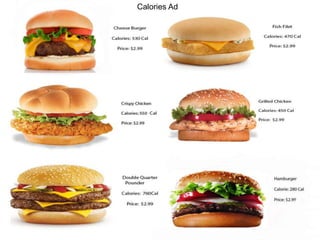
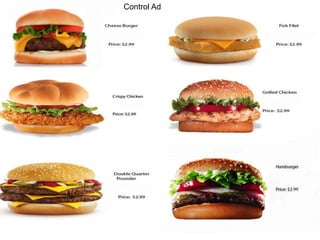
S Different Version of Fast Food Menu:
S V1: Menu with Calorie Information
S V2: Menu without Calorie Information
10
Nostalgic Ad
11
Calories Ad
Control Ad
Control Ad
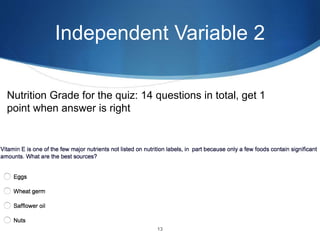
Independent Variable 2
13
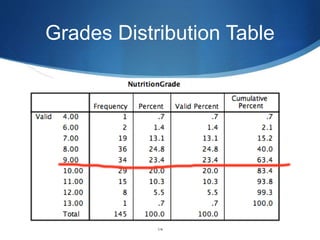
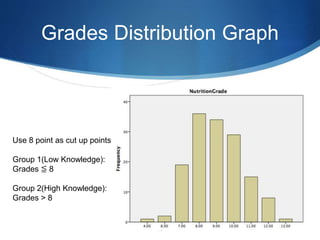
Nutrition Grade for the quiz: 14 questions in total, get 1
point when answer is right
Grades Distribution Table
14
Grades Distribution Graph
15
Use 8 point as cut up points:
Group 1(Low Knowledge):
Grades ≦ 8
Group 2(High Knowledge):
Grades > 8
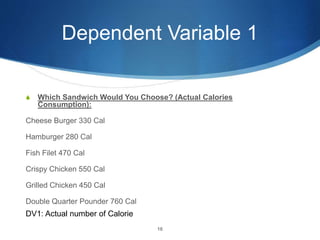
Dependent Variable 1
S Which Sandwich Would You Choose? (Actual Calories
Consumption):
Cheese Burger 330 Cal
Hamburger 280 Cal
Fish Filet 470 Cal
Crispy Chicken 550 Cal
Grilled Chicken 450 Cal
Double Quarter Pounder 760 Cal
16
DV1: Actual number of Calorie
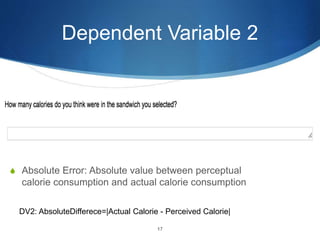
Dependent Variable 2
S Absolute Error: Absolute value between perceptual
calorie consumption and actual calorie consumption
17
DV2: AbsoluteDifferece=|Actual Calorie - Perceived Calorie|
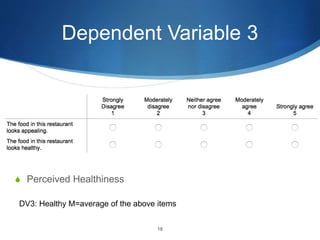
Dependent Variable 3
S Perceived Healthiness
18
DV3: Healthy M=average of the above items
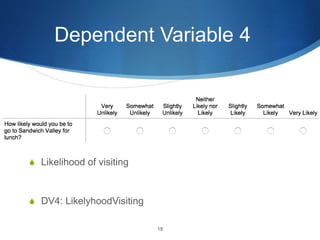
Dependent Variable 4
19
S Likelihood of visiting
S DV4: LikelyhoodVisiting
Next page is…
S When 0-8 belongs to low knowledge group 1
S When 9-13 belongs to high knowledge group 2
20
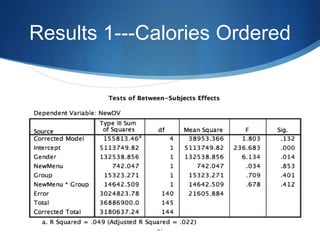
Results 1---Calories Ordered
21
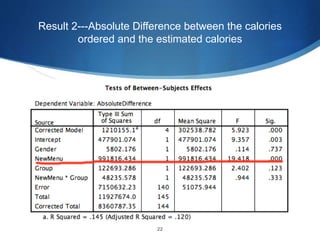
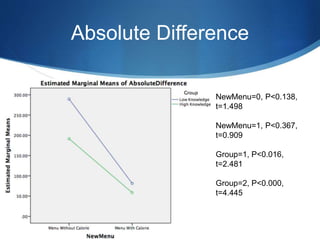
Result 2---Absolute Difference between the calories
ordered and the estimated calories
22
Absolute Difference
23
NewMenu=0, P<0.138,
t=1.498
NewMenu=1, P<0.367,
t=0.909
Group=1, P<0.016,
t=2.481
Group=2, P<0.000,
t=4.445
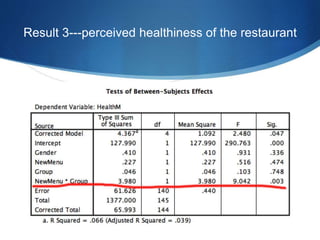
Result 3---perceived healthiness of the restaurant
24
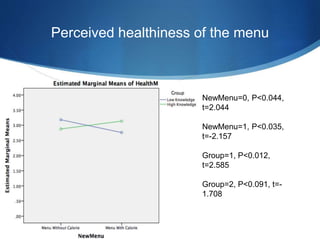
Perceived healthiness of the menu
25
NewMenu=0, P<0.044,
t=2.044
NewMenu=1, P<0.035,
t=-2.157
Group=1, P<0.012,
t=2.585
Group=2, P<0.091, t=-
1.708
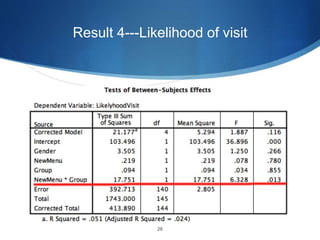
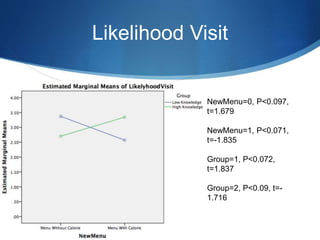
Result 4---Likelihood of visit
26
Likelihood Visit
27
NewMenu=0, P<0.097,
t=1.679
NewMenu=1, P<0.071,
t=-1.835
Group=1, P<0.072,
t=1.837
Group=2, P<0.09, t=-
1.716
Conclusion
28
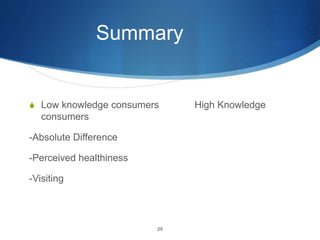
Summary
S Low knowledge consumers High Knowledge
consumers
-Absolute Difference
-Perceived healthiness
-Visiting
29
Limitations
S We didn’t track their actual behavior
S We tried to eliminate the people who didn’t pay attention,
but there’s no guarantee Mturks
30
Next page is…
S When 0-9 belongs to low knowledge group 1
S When 10-13 belongs to high knowledge group 2
31
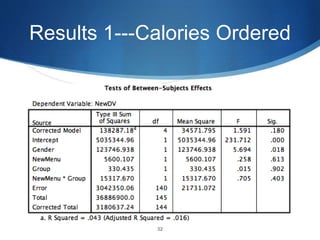
Results 1---Calories Ordered
32
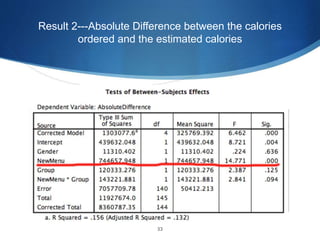
Result 2---Absolute Difference between the calories
ordered and the estimated calories
33
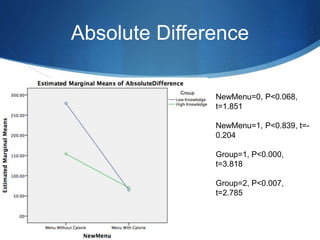
Absolute Difference
34
NewMenu=0, P<0.068,
t=1.851
NewMenu=1, P<0.839, t=-
0.204
Group=1, P<0.000,
t=3.818
Group=2, P<0.007,
t=2.785
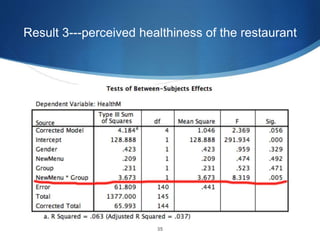
Result 3---perceived healthiness of the restaurant
35
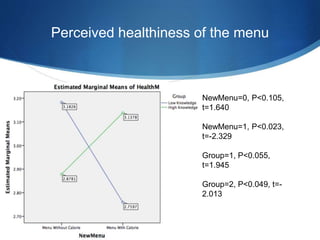
Perceived healthiness of the menu
36
NewMenu=0, P<0.105,
t=1.640
NewMenu=1, P<0.023,
t=-2.329
Group=1, P<0.055,
t=1.945
Group=2, P<0.049, t=-
2.013
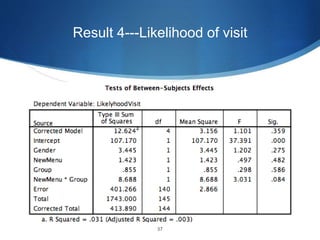
Result 4---Likelihood of visit
37
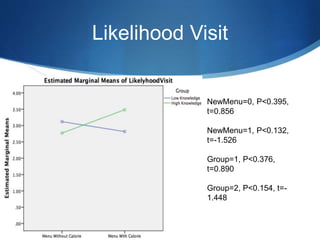
Likelihood Visit
38
NewMenu=0, P<0.395,
t=0.856
NewMenu=1, P<0.132,
t=-1.526
Group=1, P<0.376,
t=0.890
Group=2, P<0.154, t=-
1.448

Nutrition research

  • 1.
    S Why do peoplestill make unhealthy choice even when they have nutrition facts on fast food menus? Presenter :Yuefeng Pan Mentor: Catherine A. Cole Tippie Research Fair Januray, 27th,2015
  • 2.
    Study 1 As reportedby Dr. Christina A. Roberto and her colleagues S Objective: Assessed the impact of restaurant menu calorie labels on food choices and intake S Three Conditions: S A menu without calorie labels (no calorie labels) S A menu with calorie labels (calorie labels) S A menu with calorie labels and a label stating the recommended daily caloric intake for an average adult (calorie labels plus information). 2
  • 3.
    Study 1 As reportedby Dr. Christina A. Roberto and her colleagues S Procedure S Participants were 303 members of the New Haven, Connecticut, community recruited be- tween August 2007 and August 2008 via flyers, word of mouth, newspaper advertisements, and craigslist.com postings. The only exclusion criterion was age younger than 18 years. All participants provided written informed consent. 3 Three Version of menus: No calorie label, Calorie label and Calorie label plus information DVs: 1) Total calories ordered 2) Total calories consumed 3) Total postdinner calories 4) Dinner plus postdiner calories 5) Difference in estimated and actual calories consumed Dietary Recall Interview the next day. Self-Reported demographic information by participants
  • 4.
    Study 1 As reportedby Dr. Christina A. Roberto and her colleagues 4 2189.37 1862.23 1859.7 0 500 1000 1500 2000 2500 No Calorie Label Calorie Label Only Calorie Label Plus Information Total calories ordered Total calories ordered Poly. (Total calories ordered)
  • 5.
    Results S Conclusion: Calorielabels on restaurant menus impacted food choices and intake; adding a recommended daily caloric requirement label increased this effect, suggesting menu label legislation should require such a label S In Study 2: We want to incorporate nutrition knowledge—our hypothesis is that whether the effect observed in study 1 will be stronger for high knowledge consumers). 5
  • 6.
    Study 2 S Hypothesis:High knowledge people will not be as influenced by calorie information on menus as low knowledge people. 6
  • 7.
    Study 2 S DV: 1.Total Calories Ordered 2. Perceived Healthiness 3. Error between perceived calorie consumption and actual calorie consumption S IVs: 1. Different version of menus 2. Different nutrition knowledge level
  • 8.
    Study 2 Method SAmazon Mechanical Turks S 277 total – 42 pretest= 235 valid S Number of eliminated: S (1)Who have not finished the survey: 18 subjects S (2)Who finished the survey within 3min(mean=382.91s, SD=182.71s): 14 subjects S (3)Who doesn’t meet the screening criteria 58 subjects Final subjects: 145 8
  • 9.
    Independent Variable S 1.Two versions of menu Menu with Calorie info Menu without Calorie info S 2. Nutrition Knowledge(Nutrition Grade) High knowledge Low knowledge
  • 10.
    Independent Variable 1 SDifferent Version of Fast Food Menu: S V1: Menu with Calorie Information S V2: Menu without Calorie Information 10
  • 11.
  • 12.
  • 13.
    Independent Variable 2 13 NutritionGrade for the quiz: 14 questions in total, get 1 point when answer is right
  • 14.
  • 15.
    Grades Distribution Graph 15 Use8 point as cut up points: Group 1(Low Knowledge): Grades ≦ 8 Group 2(High Knowledge): Grades > 8
  • 16.
    Dependent Variable 1 SWhich Sandwich Would You Choose? (Actual Calories Consumption): Cheese Burger 330 Cal Hamburger 280 Cal Fish Filet 470 Cal Crispy Chicken 550 Cal Grilled Chicken 450 Cal Double Quarter Pounder 760 Cal 16 DV1: Actual number of Calorie
  • 17.
    Dependent Variable 2 SAbsolute Error: Absolute value between perceptual calorie consumption and actual calorie consumption 17 DV2: AbsoluteDifferece=|Actual Calorie - Perceived Calorie|
  • 18.
    Dependent Variable 3 SPerceived Healthiness 18 DV3: Healthy M=average of the above items
  • 19.
    Dependent Variable 4 19 SLikelihood of visiting S DV4: LikelyhoodVisiting
  • 20.
    Next page is… SWhen 0-8 belongs to low knowledge group 1 S When 9-13 belongs to high knowledge group 2 20
  • 21.
  • 22.
    Result 2---Absolute Differencebetween the calories ordered and the estimated calories 22
  • 23.
    Absolute Difference 23 NewMenu=0, P<0.138, t=1.498 NewMenu=1,P<0.367, t=0.909 Group=1, P<0.016, t=2.481 Group=2, P<0.000, t=4.445
  • 24.
  • 25.
    Perceived healthiness ofthe menu 25 NewMenu=0, P<0.044, t=2.044 NewMenu=1, P<0.035, t=-2.157 Group=1, P<0.012, t=2.585 Group=2, P<0.091, t=- 1.708
  • 26.
  • 27.
    Likelihood Visit 27 NewMenu=0, P<0.097, t=1.679 NewMenu=1,P<0.071, t=-1.835 Group=1, P<0.072, t=1.837 Group=2, P<0.09, t=- 1.716
  • 28.
  • 29.
    Summary S Low knowledgeconsumers High Knowledge consumers -Absolute Difference -Perceived healthiness -Visiting 29
  • 30.
    Limitations S We didn’ttrack their actual behavior S We tried to eliminate the people who didn’t pay attention, but there’s no guarantee Mturks 30
  • 31.
    Next page is… SWhen 0-9 belongs to low knowledge group 1 S When 10-13 belongs to high knowledge group 2 31
  • 32.
  • 33.
    Result 2---Absolute Differencebetween the calories ordered and the estimated calories 33
  • 34.
    Absolute Difference 34 NewMenu=0, P<0.068, t=1.851 NewMenu=1,P<0.839, t=- 0.204 Group=1, P<0.000, t=3.818 Group=2, P<0.007, t=2.785
  • 35.
  • 36.
    Perceived healthiness ofthe menu 36 NewMenu=0, P<0.105, t=1.640 NewMenu=1, P<0.023, t=-2.329 Group=1, P<0.055, t=1.945 Group=2, P<0.049, t=- 2.013
  • 37.
  • 38.
    Likelihood Visit 38 NewMenu=0, P<0.395, t=0.856 NewMenu=1,P<0.132, t=-1.526 Group=1, P<0.376, t=0.890 Group=2, P<0.154, t=- 1.448