NutriBon	
  labels:	
  
Do	
  nutriEon	
  labels	
  affect	
  people’s	
  choices	
  at	
  restaurants?	


In	
  the	
  restaurant	
  industry,	
  calorie	
  labels	
  on	
  restaurant	
  
menus	
  impacted	
  food	
  choices	
  and	
  intake	
  (Brownell	
  and	
  
Roberto,	
  2010).	
  	
  
IntroducBon	
  
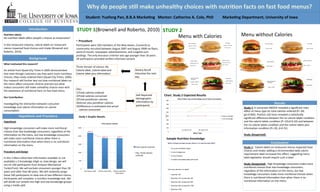
Study	
  1:	
  A	
  univariate	
  ANOVA	
  revealed	
  a	
  significant	
  main	
  
effect	
  of	
  menu	
  type	
  on	
  total	
  calories	
  ordered	
  (P=.04;	
  
g2=0.005).	
  Posthoc	
  LSD	
  tests	
  revealed	
  a	
  staEsEcally	
  
significant	
  difference	
  between	
  the	
  no	
  calorie	
  labels	
  condiEon	
  
and	
  the	
  calorie	
  labels	
  condiEon	
  (P=.03;d=0.32)	
  and	
  between	
  
the	
  no	
  calorie	
  labels	
  condiEon	
  and	
  the	
  calorie	
  labels	
  plus	
  
informaEon	
  condiEon	
  (P=.03,	
  d=0.31).	


Study	
  2(expected):	
  
Background	
  
Hypothesis	


High	
  knowledge	
  consumers	
  will	
  make	
  more	
  nutriEonal	
  
choices	
  than	
  low	
  knowledge	
  consumers,	
  regardless	
  of	
  the	
  
informaEon	
  on	
  the	
  menu,	
  but	
  low	
  knowledge	
  consumers	
  
will	
  make	
  more	
  nutriEonal	
  choices	
  when	
  there	
  is	
  
nutriEonal	
  informaEon	
  than	
  when	
  there	
  is	
  no	
  nutriEonal	
  
informaEon	
  on	
  the	
  menu.	


Procedure	
  and	
  Design	


In	
  this	
  2	
  Menu	
  (NutriEon	
  InformaEon	
  available	
  or	
  not	
  
available)	
  x	
  2	
  Knowledge	
  (High	
  vs.	
  low)	
  design,	
  we	
  will	
  
recruit	
  160	
  parEcipants	
  from	
  Amazon	
  Mechanical	
  
Turk(mTurk).	
  We	
  will	
  exclude	
  consumers	
  younger	
  than	
  18	
  
years	
  and	
  older	
  than	
  80	
  years.	
  We	
  will	
  randomly	
  assign	
  
these	
  160	
  parEcipants	
  to	
  view	
  one	
  of	
  two	
  different	
  menus.	
  
ParEcipants	
  will	
  complete	
  	
  a	
  nutriEon	
  knowledge	
  test.	
  We	
  
will	
  divide	
  our	
  sample	
  into	
  high	
  and	
  low	
  knowledge	
  groups	
  
using	
  a	
  media	
  split.	


Hypothesis	
  and	
  Procedure	
  
Study	
  1:	
  	
  Calorie	
  labels	
  on	
  restaurant	
  menus	
  impacted	
  food	
  
choices	
  and	
  intake;	
  adding	
  a	
  recommended	
  daily	
  caloric	
  
requirement	
  label	
  increased	
  this	
  effect,	
  suggesEng	
  menu	
  
label	
  legislaEon	
  should	
  require	
  such	
  a	
  label	
  
Study	
  2(expected):	
  	
  High	
  knowledge	
  consumers	
  make	
  more	
  
nutriEonal	
  choices	
  than	
  low	
  knowledge	
  consumers,	
  
regardless	
  of	
  the	
  informaEon	
  on	
  the	
  menu,	
  but	
  low	
  
knowledge	
  consumers	
  make	
  more	
  nutriEonal	
  choices	
  when	
  
there	
  is	
  nutriEonal	
  informaEon	
  than	
  when	
  there	
  is	
  no	
  
nutriEonal	
  informaEon	
  on	
  the	
  menu.	


Conclusions	
  
What	
  moBvated	
  this	
  research?	
  	
  
An	
  arEcle	
  from	
  Quad-­‐City	
  Times	
  in	
  2005	
  demonstrated	
  
that	
  even	
  though	
  customers	
  say	
  they	
  want	
  more	
  nutriEous	
  
choices,	
  they	
  rarely	
  ordered	
  them	
  (Quad-­‐City	
  Times,	
  2005).	
  
Our	
  research	
  will	
  further	
  test	
  out	
  how	
  nutriEonal	
  labels	
  on	
  
the	
  menu	
  affect	
  consumer	
  choices	
  and	
  test	
  out	
  what	
  
makes	
  consumers	
  sEll	
  make	
  unhealthy	
  choices	
  even	
  with	
  
the	
  awareness	
  of	
  nutriEonal	
  facts	
  on	
  fast	
  food	
  menu.	


Our	
  ContribuBon:	


InvesEgaEng	
  the	
  interacEon	
  between	
  consumer	
  
knowledge	
  and	
  calorie	
  informaEon	
  on	
  calorie	
  
consumpEon.	
  
Results	
  
Study	
  1	
  Graphic	
  Results.	
  
REPLACE	
  THIS	
  BOX	
  WITH	
  
YOUR	
  ORGANIZATION’S	
  
HIGH	
  RESOLUTION	
  LOGO	
  
STUDY	
  1(Brownell	
  and	
  Roberto,	
  2010).	


STUDY	
  2	
  
Chart.	
  Study	
  2	
  Expected	
  Results	
  
Student:	
  Yuefeng	
  Pan,	
  B.B.A	
  MarkeBng	
  	
  	
  Mentor:	
  Catherine	
  A.	
  Cole,	
  PhD	


  MarkeBng	
  Department,	
  University	
  of	
  Iowa	
  
Why	
  do	
  people	
  sBll	
  make	
  unhealthy	
  choices	
  with	
  nutriBon	
  facts	
  on	
  fast	
  food	
  menus?	


•  Procedure	
  
ParEcipants	
  were	
  303	
  members	
  of	
  the	
  New	
  Haven,	
  ConnecEcut,	
  
community	
  recruited	
  between	
  August	
  2007	
  and	
  August	
  2008	
  via	
  flyers,	
  
word	
  of	
  mouth,	
  newspaper	
  adverEsements,	
  and	
  craigslist.com	
  
posEngs.	
  The	
  only	
  exclusion	
  criterion	
  was	
  age	
  younger	
  than	
  18	
  years.	
  
All	
  parEcipants	
  provided	
  wriuen	
  informed	
  consent.	


Three	
  Version	
  of	
  menus:	
  No	
  
Calorie	
  label,	
  Calorie	
  label	
  and	
  
Calorie	
  label	
  plus	
  informaEon	
  
DVs:	
  
1) Total	
  calories	
  ordered	
  
2) Total	
  calories	
  consumed	
  
3) Total	
  postdinner	
  calories	
  
4) Dinner	
  plus	
  postdiner	
  calories	
  
5) Difference	
  in	
  esEmated	
  and	
  actual	
  
calories	
  consumed	
  
Dietary	
  Recall	
  
Interview	
  the	
  next	
  
day.	
  
Self-­‐Reported	
  
demographic	
  
informaEon	
  by	
  
parEcipants	
  
2189.37	
  
1862.23	
   1859.7	
  
0	
  
500	
  
1000	
  
1500	
  
2000	
  
2500	
  
No	
  Calorie	
  Label	
   Calorie	
  Label	
  Only	
   Calorie	
  Label	
  Plus	
  
InformaEon	
  
Total	
  calories	
  ordered	
  
Total	
  calories	
  ordered	
  
Poly.	
  (Total	
  calories	
  
ordered)	
  
Menu	
  with	
  Calories	
   Menu	
  without	
  Calories	
  
0	
  
100	
  
200	
  
300	
  
400	
  
500	
  
600	
  
700	
  
800	
  
C
a
l
o
r
i
e
s	
  
Menu	
  Type	
  
Effect	
  of	
  Menu	
  Type	
  and	
  Knowledge	
  Level	
  of	
  Calorie	
  ConsumpBon	
  
High	
  Knowledge	
  
Low	
  Knowledge	
  
w/	
  calorie	
  info	
   No	
  calorie	
  info	
  
Sample	
  NutriBon	
  Knowledge	
  
QuesBons	


nutrition poster (3)

  • 1.
    NutriBon  labels:   Do  nutriEon  labels  affect  people’s  choices  at  restaurants?     In  the  restaurant  industry,  calorie  labels  on  restaurant   menus  impacted  food  choices  and  intake  (Brownell  and   Roberto,  2010).     IntroducBon   Study  1:  A  univariate  ANOVA  revealed  a  significant  main   effect  of  menu  type  on  total  calories  ordered  (P=.04;   g2=0.005).  Posthoc  LSD  tests  revealed  a  staEsEcally   significant  difference  between  the  no  calorie  labels  condiEon   and  the  calorie  labels  condiEon  (P=.03;d=0.32)  and  between   the  no  calorie  labels  condiEon  and  the  calorie  labels  plus   informaEon  condiEon  (P=.03,  d=0.31).     Study  2(expected):   Background   Hypothesis     High  knowledge  consumers  will  make  more  nutriEonal   choices  than  low  knowledge  consumers,  regardless  of  the   informaEon  on  the  menu,  but  low  knowledge  consumers   will  make  more  nutriEonal  choices  when  there  is   nutriEonal  informaEon  than  when  there  is  no  nutriEonal   informaEon  on  the  menu.       Procedure  and  Design     In  this  2  Menu  (NutriEon  InformaEon  available  or  not   available)  x  2  Knowledge  (High  vs.  low)  design,  we  will   recruit  160  parEcipants  from  Amazon  Mechanical   Turk(mTurk).  We  will  exclude  consumers  younger  than  18   years  and  older  than  80  years.  We  will  randomly  assign   these  160  parEcipants  to  view  one  of  two  different  menus.   ParEcipants  will  complete    a  nutriEon  knowledge  test.  We   will  divide  our  sample  into  high  and  low  knowledge  groups   using  a  media  split.       Hypothesis  and  Procedure   Study  1:    Calorie  labels  on  restaurant  menus  impacted  food   choices  and  intake;  adding  a  recommended  daily  caloric   requirement  label  increased  this  effect,  suggesEng  menu   label  legislaEon  should  require  such  a  label   Study  2(expected):    High  knowledge  consumers  make  more   nutriEonal  choices  than  low  knowledge  consumers,   regardless  of  the  informaEon  on  the  menu,  but  low   knowledge  consumers  make  more  nutriEonal  choices  when   there  is  nutriEonal  informaEon  than  when  there  is  no   nutriEonal  informaEon  on  the  menu.         Conclusions   What  moBvated  this  research?     An  arEcle  from  Quad-­‐City  Times  in  2005  demonstrated   that  even  though  customers  say  they  want  more  nutriEous   choices,  they  rarely  ordered  them  (Quad-­‐City  Times,  2005).   Our  research  will  further  test  out  how  nutriEonal  labels  on   the  menu  affect  consumer  choices  and  test  out  what   makes  consumers  sEll  make  unhealthy  choices  even  with   the  awareness  of  nutriEonal  facts  on  fast  food  menu.       Our  ContribuBon:     InvesEgaEng  the  interacEon  between  consumer   knowledge  and  calorie  informaEon  on  calorie   consumpEon.   Results   Study  1  Graphic  Results.   REPLACE  THIS  BOX  WITH   YOUR  ORGANIZATION’S   HIGH  RESOLUTION  LOGO   STUDY  1(Brownell  and  Roberto,  2010).       STUDY  2   Chart.  Study  2  Expected  Results   Student:  Yuefeng  Pan,  B.B.A  MarkeBng      Mentor:  Catherine  A.  Cole,  PhD                            MarkeBng  Department,  University  of  Iowa   Why  do  people  sBll  make  unhealthy  choices  with  nutriBon  facts  on  fast  food  menus?         •  Procedure   ParEcipants  were  303  members  of  the  New  Haven,  ConnecEcut,   community  recruited  between  August  2007  and  August  2008  via  flyers,   word  of  mouth,  newspaper  adverEsements,  and  craigslist.com   posEngs.  The  only  exclusion  criterion  was  age  younger  than  18  years.   All  parEcipants  provided  wriuen  informed  consent.       Three  Version  of  menus:  No   Calorie  label,  Calorie  label  and   Calorie  label  plus  informaEon   DVs:   1) Total  calories  ordered   2) Total  calories  consumed   3) Total  postdinner  calories   4) Dinner  plus  postdiner  calories   5) Difference  in  esEmated  and  actual   calories  consumed   Dietary  Recall   Interview  the  next   day.   Self-­‐Reported   demographic   informaEon  by   parEcipants   2189.37   1862.23   1859.7   0   500   1000   1500   2000   2500   No  Calorie  Label   Calorie  Label  Only   Calorie  Label  Plus   InformaEon   Total  calories  ordered   Total  calories  ordered   Poly.  (Total  calories   ordered)   Menu  with  Calories   Menu  without  Calories   0   100   200   300   400   500   600   700   800   C a l o r i e s   Menu  Type   Effect  of  Menu  Type  and  Knowledge  Level  of  Calorie  ConsumpBon   High  Knowledge   Low  Knowledge   w/  calorie  info   No  calorie  info   Sample  NutriBon  Knowledge   QuesBons