Nutritional management of
emergency and elective
surgical patients – are we
doing enough?
Chaitya Desai (CT1)
Daniel Hern (Med student)
Mr Vittal Rao
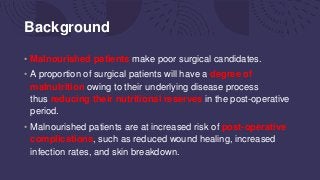
Background
• Malnourished patients make poor surgical candidates.
• A proportion of surgical patients will have a degree of
malnutrition owing to their underlying disease process
thus reducing their nutritional reserves in the post-operative
period.
• Malnourished patients are at increased risk of post-operative
complications, such as reduced wound healing, increased
infection rates, and skin breakdown.
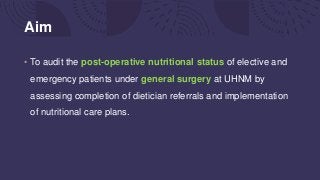
Aim
• To audit the post-operative nutritional status of elective and
emergency patients under general surgery at UHNM by
assessing completion of dietician referrals and implementation
of nutritional care plans.
Methods
• Data collected between 1st September – 1st November 2021
• Total patients = 100
• 50 emergency admissions
• 50 elective admissions
• All patients underwent surgery for GI pathology
• LOS > 5 days
• All emergency patients were deemed to be acutely ill AND no nutritional intake or likelihood of no
intake for more than 5 days – as per the MUST tool
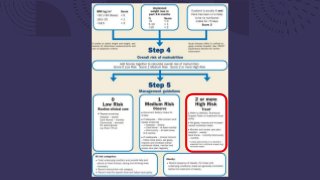
https://www.bapen.org.uk/pdfs/must/must_full.pdf
Emergency admissions – Results
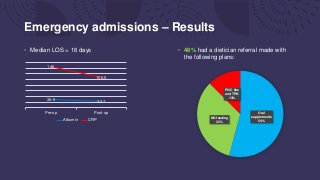
• Median LOS = 16 days
30.5 23.7
146
105.5
Pre-op Post-op
Albumin CRP
Oral
supplements
54%
NG feeding
33%
PICC line
and TPN
13%
• 48% had a dietician referral made with
the following plans:
Emergency admissions – Referral breakdown
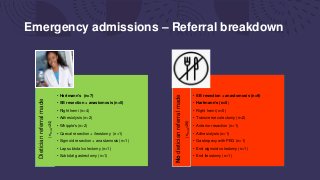
Dietician
referral
made
(n
Total
=24)
• Hartmann's (n=7)
• SB resection + anastomosis (n=5)
• Right hemi (n=4)
• Adhesiolysis (n=2)
• Whipple's (n=2)
• Caecal resection + ileostomy (n=1)
• Sigmoid resection + anastamosis (n=1)
• Lap subtotal colectomy (n=1)
• Subtotal gastrectomy (n=1)
No
dietician
referral
made
(n
Total
=26)
• SB resection + anastomosis (n=9)
• Hartmann's (n=5)
• Right hemi (n=5)
• Transverse colectomy (n=2)
• Anterior resection (n=1)
• Adhesiolysis (n=1)
• Gastropexy with PEG (n=1)
• End sigmoid colostomy (n=1)
• End ileostomy (n=1)
Emergency admissions – Complications
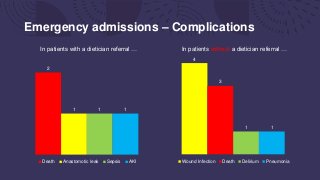
4
3
1 1
Wound Infection Death Delirium Pneumonia
2
1 1 1
Death Anastomotic leak Sepsis AKI
In patients with a dietician referral … In patients without a dietician referral …
Elective admissions – Results
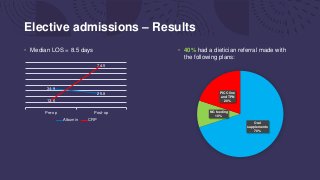
• Median LOS = 8.5 days
34.9
25.8
13.6
74.5
Pre-op Post-op
Albumin CRP
Oral
supplements
70%
NG feeding
10%
PICC line
and TPN
20%
• 40% had a dietician referral made with
the following plans:
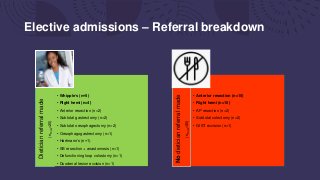
Elective admissions – Referral breakdown
Dietician
referral
made
(n
Total
=20)
• Whipple’s (n=5)
• Right hemi (n=4)
• Anterior resection (n=2)
• Subtotal gastrectomy (n=2)
• Subtotal oesophagectomy (n=2)
• Oesophagogastrectomy (n=1)
• Hartmann’s (n=1)
• SB resection + anastomosis (n=1)
• Defunctioning loop colostomy (n=1)
• Duodenal lesion excision (n=1)
No
dietician
referral
made
(n
Total
=30)
• Anterior resection (n=15)
• Right hemi (n=10)
• AP resection (n=2)
• Subtotal colectomy (n=2)
• GIST excision (n=1)
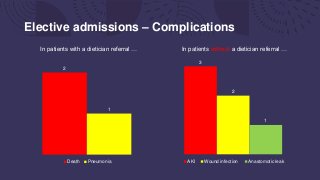
Elective admissions – Complications
3
2
1
AKI Wound infection Anastomotic leak
2
1
Death Pneumonia
In patients with a dietician referral … In patients without a dietician referral …
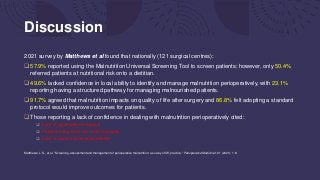
Discussion
2021 survey by Matthews et al found that nationally (121 surgical centres):
 57.9% reported using the Malnutrition Universal Screening Tool to screen patients; however, only 50.4%
referred patients at nutritional risk onto a dietitian.
 49.6% lacked confidence in local ability to identify and manage malnutrition perioperatively, with 23.1%
reporting having a structured pathway for managing malnourished patients.
 91.7% agreed that malnutrition impacts on quality of life after surgery and 86.8% felt adopting a standard
protocol would improve outcomes for patients.
 Those reporting a lack of confidence in dealing with malnutrition perioperatively cited:
 Lack of organisational support
 Patients being seen too close to surgery
 Lack of clarity around responsibility
Matthews, L. S., et al. "Screening, assessment and management of perioperative malnutrition: a survey of UK practice." Perioperative Medicine 10.1 (2021): 1-8.
Key points
In total, 56% high risk patients with no dietician referral in place.
• Ideally, the need for a dietician referral for nutritional support should be discussed as soon as patient is
seen on post-take WR, and re-evaluated post-surgery.
• Ensure our patients are on ENSURE! - simple interventions such as oral supplementation can be
commenced by the surgical team without dietician input – especially when high-risk as per MUST tool.
Suggested interventions:
- Teaching session for doctors and nurses based across the surgical specialties.
- Educational poster distributed across surgical wards.
Re-audit to evaluate improvement.

Nutrition audit a si t

  • 1.
    Nutritional management of emergencyand elective surgical patients – are we doing enough? Chaitya Desai (CT1) Daniel Hern (Med student) Mr Vittal Rao
  • 2.
    Background • Malnourished patientsmake poor surgical candidates. • A proportion of surgical patients will have a degree of malnutrition owing to their underlying disease process thus reducing their nutritional reserves in the post-operative period. • Malnourished patients are at increased risk of post-operative complications, such as reduced wound healing, increased infection rates, and skin breakdown.
  • 3.
    Aim • To auditthe post-operative nutritional status of elective and emergency patients under general surgery at UHNM by assessing completion of dietician referrals and implementation of nutritional care plans.
  • 4.
    Methods • Data collectedbetween 1st September – 1st November 2021 • Total patients = 100 • 50 emergency admissions • 50 elective admissions • All patients underwent surgery for GI pathology • LOS > 5 days • All emergency patients were deemed to be acutely ill AND no nutritional intake or likelihood of no intake for more than 5 days – as per the MUST tool https://www.bapen.org.uk/pdfs/must/must_full.pdf
  • 6.
    Emergency admissions –Results • Median LOS = 16 days 30.5 23.7 146 105.5 Pre-op Post-op Albumin CRP Oral supplements 54% NG feeding 33% PICC line and TPN 13% • 48% had a dietician referral made with the following plans:
  • 7.
    Emergency admissions –Referral breakdown Dietician referral made (n Total =24) • Hartmann's (n=7) • SB resection + anastomosis (n=5) • Right hemi (n=4) • Adhesiolysis (n=2) • Whipple's (n=2) • Caecal resection + ileostomy (n=1) • Sigmoid resection + anastamosis (n=1) • Lap subtotal colectomy (n=1) • Subtotal gastrectomy (n=1) No dietician referral made (n Total =26) • SB resection + anastomosis (n=9) • Hartmann's (n=5) • Right hemi (n=5) • Transverse colectomy (n=2) • Anterior resection (n=1) • Adhesiolysis (n=1) • Gastropexy with PEG (n=1) • End sigmoid colostomy (n=1) • End ileostomy (n=1)
  • 8.
    Emergency admissions –Complications 4 3 1 1 Wound Infection Death Delirium Pneumonia 2 1 1 1 Death Anastomotic leak Sepsis AKI In patients with a dietician referral … In patients without a dietician referral …
  • 9.
    Elective admissions –Results • Median LOS = 8.5 days 34.9 25.8 13.6 74.5 Pre-op Post-op Albumin CRP Oral supplements 70% NG feeding 10% PICC line and TPN 20% • 40% had a dietician referral made with the following plans:
  • 10.
    Elective admissions –Referral breakdown Dietician referral made (n Total =20) • Whipple’s (n=5) • Right hemi (n=4) • Anterior resection (n=2) • Subtotal gastrectomy (n=2) • Subtotal oesophagectomy (n=2) • Oesophagogastrectomy (n=1) • Hartmann’s (n=1) • SB resection + anastomosis (n=1) • Defunctioning loop colostomy (n=1) • Duodenal lesion excision (n=1) No dietician referral made (n Total =30) • Anterior resection (n=15) • Right hemi (n=10) • AP resection (n=2) • Subtotal colectomy (n=2) • GIST excision (n=1)
  • 11.
    Elective admissions –Complications 3 2 1 AKI Wound infection Anastomotic leak 2 1 Death Pneumonia In patients with a dietician referral … In patients without a dietician referral …
  • 12.
    Discussion 2021 survey byMatthews et al found that nationally (121 surgical centres):  57.9% reported using the Malnutrition Universal Screening Tool to screen patients; however, only 50.4% referred patients at nutritional risk onto a dietitian.  49.6% lacked confidence in local ability to identify and manage malnutrition perioperatively, with 23.1% reporting having a structured pathway for managing malnourished patients.  91.7% agreed that malnutrition impacts on quality of life after surgery and 86.8% felt adopting a standard protocol would improve outcomes for patients.  Those reporting a lack of confidence in dealing with malnutrition perioperatively cited:  Lack of organisational support  Patients being seen too close to surgery  Lack of clarity around responsibility Matthews, L. S., et al. "Screening, assessment and management of perioperative malnutrition: a survey of UK practice." Perioperative Medicine 10.1 (2021): 1-8.
  • 13.
    Key points In total,56% high risk patients with no dietician referral in place. • Ideally, the need for a dietician referral for nutritional support should be discussed as soon as patient is seen on post-take WR, and re-evaluated post-surgery. • Ensure our patients are on ENSURE! - simple interventions such as oral supplementation can be commenced by the surgical team without dietician input – especially when high-risk as per MUST tool. Suggested interventions: - Teaching session for doctors and nurses based across the surgical specialties. - Educational poster distributed across surgical wards. Re-audit to evaluate improvement.