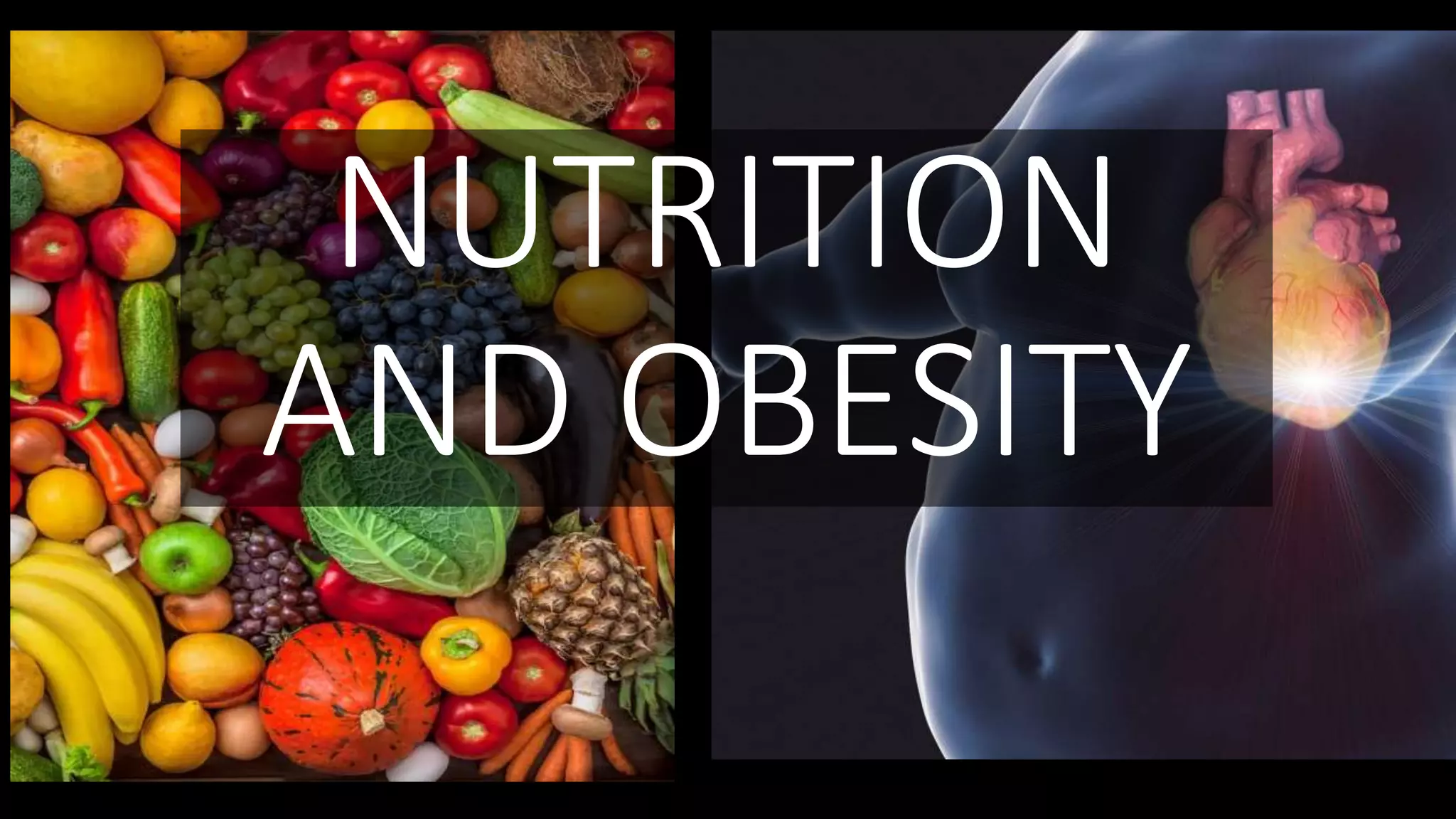
NUTRITION
AND OBESITY
NUTRITION
• The process of taking in food and using it for growth, metabolism, and
repair.
The Ministry of Healing, ch. 23
…foods should be chosen that best supply the elements needed for
building up the body. In this choice, appetite is not a safe guide.
Through wrong habits of eating, the appetite has become perverted.
Often it demands food that impairs health and causes weakness
instead of strength…
The disease and suffering that everywhere prevail are largely due to
popular errors in regard to diet.
• In order to know what are the best foods, we must study God's original
plan for man's diet. He who created man and who understands his needs
appointed Adam his food.
• "Behold," He said, "I have given you every herb yielding seed, . . . and every
tree, in which is the fruit of a tree yielding seed; to you it shall be for food."
Genesis 1:29.
• Upon leaving Eden to gain his livelihood by tilling the earth under the
curse of sin, man received permission to eat also "the herb of the field."
Genesis 3:18.
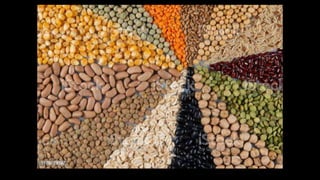
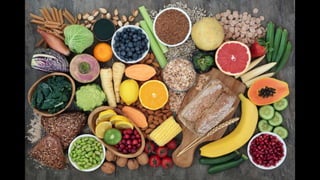
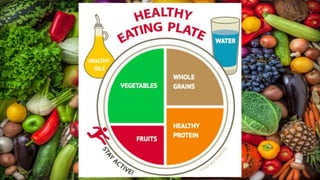
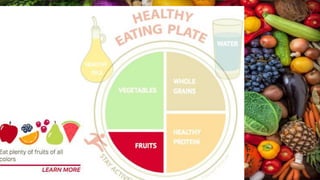
• Grains, fruits, nuts, and vegetables constitute the diet chosen for us
by our Creator. These foods, prepared in as simple and natural a
manner as possible, are the most healthful and nourishing. They
impart a strength, a power of endurance, and a vigor of intellect that
are not afforded by a more complex and stimulating diet.
Forget Fad Diets
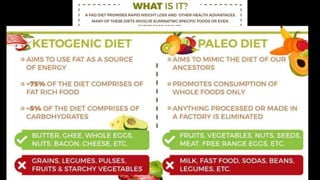
• The old adage is true: If it sounds too good to be true, it probably is.

“Fad diets usually have some sort of gimmick and make promises of
easy, fast weight loss,” said Dr. Walsh. “But most don’t result in long-
term success because they’re not sustainable.” Fad diets tend to
eliminate certain food groups, which can lead to nutritional
deficiencies or leave you feeling deprived.
Fuel Your Body
• The food you eat impacts how well your body functions. In the short
term, proper nutrition gives you energy and improves your mood.
Long-term eating of processed foods can lead to inflammation, which
is associated with diabetes, Alzheimer’s disease and hypertension.
Seek out foods that fight inflammation and prevent disease, such as
leafy greens, berries and fatty fish. “It’s cliché but it’s true—you are
what you eat,” she said.
Eat Real Food
• Reduce the amount of food you eat from a package. Most packaged
foods are highly processed, meaning they contain few nutrients your
body can use. And beware of the food marketer who slaps labels like
“gluten free” or “all natural” on a processed food in order to boost
sales. Additionally, avoid “miracle” supplements that claim to have
harnessed the benefits of a naturally-occurring substance. Once the
substance is refined, it rarely contains the benefits and can
sometimes do more harm than good. So stick with what works–eating
real food. “All the nutrition you need should be coming from the food
you’re eating,” she said.
More Plants, Less Meat
• Most Americans eat a diet high in animal-based proteins and dairy.
This can be part of a healthy diet, but consider including more fruits
and vegetables as well as alternate sources of protein. “I don’t ask my
patients to quit eating meat,” Dr. Walsh said. “Eating beef three times
a week is probably okay, but eating it every day—or for every meal
most days—tells me you probably aren’t getting a lot of the
nutritional benefits of a plant or fish-based protein.”
Eat Consciously (i.e., no mindless munching)
• “Let’s face it, food isn’t just nutrition,” Dr. Walsh said. “It’s also about
emotions.” Whether it’s bonding over birthday cake or connecting
over a shared love of bacon, certain foods are part of our culture and
rituals. Diets that forbid you from enjoying the foods we find delicious
aren’t sustainable. Besides, depriving yourself of a favorite food today
typically results in over-indulging later. “I love McDonald’s French
fries,” she said. “So once a month, I make a conscious decision to hit
the drive-thru. And I savor the indulgence.”
Call in a Professional
• The best diet is one you can stick with. According to Dr. Walsh, this
depends largely on the individual. “Research on nutrition is always
changing, and sometimes what’s best for one person doesn’t work for
another,” she said. “That’s why I often recommend my patients see a
Kaiser Permanente nutritionist, who can look at their individual needs
and give them an honest assessment of their habits.”
Keep It Simple
• “If it’s not simple, you’re not going to stick with it. It has to be
practical for you and your family. You have to choose the foods that
can easily be incorporated into your life.”
Beans: The Underestimated Power Food
• What does Dr. Walsh wish everyone would eat more of? Beans, of
every variety!
• “Beans really are magical. They are a powerhouse of nutrition, with
protein, fiber and many key nutrients. Add a half cup of beans of any
variety to your weekly meal plan, and your health will improve.”
Eat More Beans For…
• Better gut health. “There’s a lot of talk in nutrition about probiotics, but
beans are the original pre-biotic, meaning they foster and promote good gut
bacteria.”
• Weight loss. Beans help you feel fuller, longer.
• Disease prevention. Beans can help stabilize blood sugar and reduce
cholesterol.
• A smaller grocery bill (and better environment). “Beans cost pennies
to serve and are water efficient, frost hardy and have a low carbon
footprint.”
Add These Foods to Fight Inflammation
• Whole grains (brown rice, quinoa,whole wheat)
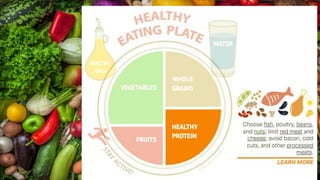
• Protein (legumes, chicken, turkey, white fish, wild salmon)
• Vegetables (leafy dark greens like spinach or kale, broccoli, cabbage,
sweet potatoes, mushrooms)
• Fruits (papaya, blackberries, cranberries, strawberries, raspberries)
• Fats and oils (flaxseed, olive oil)
• Herbs and spices (ginger, garlic, turmeric)
OBESITY
DEFINITION
Overweight and obesity are defined as abnormal or excessive fat
accumulation that may impair health.
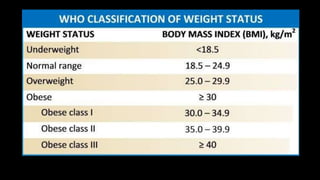
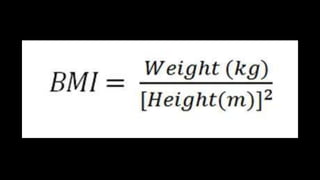
Body mass index (BMI) is a simple index of weight-for-height that is
commonly used to classify overweight and obesity in adults. It is
defined as a person's weight in kilograms divided by the square of his
height in meters (kg/m2).
CONVERSION Table of ft. to meter
What causes obesity and overweight?
• The fundamental cause of obesity and overweight is an energy
imbalance between calories consumed and calories expended.
Globally, there has been:
• an increased intake of energy-dense foods that are high in fat and
sugars; and
• an increase in physical inactivity due to the increasingly sedentary
nature of many forms of work, changing modes of transportation, and
increasing urbanization.
What are common health consequences of
overweight and obesity?
• Raised BMI is a major risk factor for noncommunicable
diseases such as:
• cardiovascular diseases (mainly heart disease and stroke),
which were the leading cause of death in 2012;
• diabetes;
• musculoskeletal disorders (especially osteoarthritis – a highly
disabling degenerative disease of the joints);
• some cancers (including endometrial, breast, ovarian, prostate,
liver, gallbladder, kidney, and colon).
Nutrition and Obesity.pptx

Nutrition and Obesity.pptx

  • 1.
  • 3.
    NUTRITION • The processof taking in food and using it for growth, metabolism, and repair.
  • 4.
    The Ministry ofHealing, ch. 23 …foods should be chosen that best supply the elements needed for building up the body. In this choice, appetite is not a safe guide. Through wrong habits of eating, the appetite has become perverted. Often it demands food that impairs health and causes weakness instead of strength… The disease and suffering that everywhere prevail are largely due to popular errors in regard to diet.
  • 6.
    • In orderto know what are the best foods, we must study God's original plan for man's diet. He who created man and who understands his needs appointed Adam his food. • "Behold," He said, "I have given you every herb yielding seed, . . . and every tree, in which is the fruit of a tree yielding seed; to you it shall be for food." Genesis 1:29. • Upon leaving Eden to gain his livelihood by tilling the earth under the curse of sin, man received permission to eat also "the herb of the field." Genesis 3:18.
  • 8.
    • Grains, fruits,nuts, and vegetables constitute the diet chosen for us by our Creator. These foods, prepared in as simple and natural a manner as possible, are the most healthful and nourishing. They impart a strength, a power of endurance, and a vigor of intellect that are not afforded by a more complex and stimulating diet.
  • 10.
    Forget Fad Diets •The old adage is true: If it sounds too good to be true, it probably is. “Fad diets usually have some sort of gimmick and make promises of easy, fast weight loss,” said Dr. Walsh. “But most don’t result in long- term success because they’re not sustainable.” Fad diets tend to eliminate certain food groups, which can lead to nutritional deficiencies or leave you feeling deprived.
  • 13.
    Fuel Your Body •The food you eat impacts how well your body functions. In the short term, proper nutrition gives you energy and improves your mood. Long-term eating of processed foods can lead to inflammation, which is associated with diabetes, Alzheimer’s disease and hypertension. Seek out foods that fight inflammation and prevent disease, such as leafy greens, berries and fatty fish. “It’s cliché but it’s true—you are what you eat,” she said.
  • 14.
    Eat Real Food •Reduce the amount of food you eat from a package. Most packaged foods are highly processed, meaning they contain few nutrients your body can use. And beware of the food marketer who slaps labels like “gluten free” or “all natural” on a processed food in order to boost sales. Additionally, avoid “miracle” supplements that claim to have harnessed the benefits of a naturally-occurring substance. Once the substance is refined, it rarely contains the benefits and can sometimes do more harm than good. So stick with what works–eating real food. “All the nutrition you need should be coming from the food you’re eating,” she said.
  • 15.
    More Plants, LessMeat • Most Americans eat a diet high in animal-based proteins and dairy. This can be part of a healthy diet, but consider including more fruits and vegetables as well as alternate sources of protein. “I don’t ask my patients to quit eating meat,” Dr. Walsh said. “Eating beef three times a week is probably okay, but eating it every day—or for every meal most days—tells me you probably aren’t getting a lot of the nutritional benefits of a plant or fish-based protein.”
  • 16.
    Eat Consciously (i.e.,no mindless munching) • “Let’s face it, food isn’t just nutrition,” Dr. Walsh said. “It’s also about emotions.” Whether it’s bonding over birthday cake or connecting over a shared love of bacon, certain foods are part of our culture and rituals. Diets that forbid you from enjoying the foods we find delicious aren’t sustainable. Besides, depriving yourself of a favorite food today typically results in over-indulging later. “I love McDonald’s French fries,” she said. “So once a month, I make a conscious decision to hit the drive-thru. And I savor the indulgence.”
  • 17.
    Call in aProfessional • The best diet is one you can stick with. According to Dr. Walsh, this depends largely on the individual. “Research on nutrition is always changing, and sometimes what’s best for one person doesn’t work for another,” she said. “That’s why I often recommend my patients see a Kaiser Permanente nutritionist, who can look at their individual needs and give them an honest assessment of their habits.”
  • 18.
    Keep It Simple •“If it’s not simple, you’re not going to stick with it. It has to be practical for you and your family. You have to choose the foods that can easily be incorporated into your life.”
  • 19.
    Beans: The UnderestimatedPower Food • What does Dr. Walsh wish everyone would eat more of? Beans, of every variety! • “Beans really are magical. They are a powerhouse of nutrition, with protein, fiber and many key nutrients. Add a half cup of beans of any variety to your weekly meal plan, and your health will improve.”
  • 20.
    Eat More BeansFor… • Better gut health. “There’s a lot of talk in nutrition about probiotics, but beans are the original pre-biotic, meaning they foster and promote good gut bacteria.” • Weight loss. Beans help you feel fuller, longer. • Disease prevention. Beans can help stabilize blood sugar and reduce cholesterol. • A smaller grocery bill (and better environment). “Beans cost pennies to serve and are water efficient, frost hardy and have a low carbon footprint.”
  • 21.
    Add These Foodsto Fight Inflammation • Whole grains (brown rice, quinoa,whole wheat) • Protein (legumes, chicken, turkey, white fish, wild salmon) • Vegetables (leafy dark greens like spinach or kale, broccoli, cabbage, sweet potatoes, mushrooms) • Fruits (papaya, blackberries, cranberries, strawberries, raspberries) • Fats and oils (flaxseed, olive oil) • Herbs and spices (ginger, garlic, turmeric)
  • 22.
    OBESITY DEFINITION Overweight and obesityare defined as abnormal or excessive fat accumulation that may impair health. Body mass index (BMI) is a simple index of weight-for-height that is commonly used to classify overweight and obesity in adults. It is defined as a person's weight in kilograms divided by the square of his height in meters (kg/m2).
  • 24.
    CONVERSION Table offt. to meter
  • 26.
    What causes obesityand overweight? • The fundamental cause of obesity and overweight is an energy imbalance between calories consumed and calories expended. Globally, there has been: • an increased intake of energy-dense foods that are high in fat and sugars; and • an increase in physical inactivity due to the increasingly sedentary nature of many forms of work, changing modes of transportation, and increasing urbanization.
  • 27.
    What are commonhealth consequences of overweight and obesity? • Raised BMI is a major risk factor for noncommunicable diseases such as: • cardiovascular diseases (mainly heart disease and stroke), which were the leading cause of death in 2012; • diabetes; • musculoskeletal disorders (especially osteoarthritis – a highly disabling degenerative disease of the joints); • some cancers (including endometrial, breast, ovarian, prostate, liver, gallbladder, kidney, and colon).