Nutrition
What should my diet look like?
Old Food Guide Pyramid


 One Size Fits All : (
MyPyramid.gov
     • Developed by USDA
     • Personal guide to
       healthy eating &
       physical activity
     • Based on age, gender,
       activity level
     • How does this pyramid
       compare to the old
       Food Guide Pyramid?
Anatomy of MyPyramid
Activity:                             Proportionality:
•Importance of daily                  •Different widths of food groups
physical activity                     •Widths suggest how much food
•At least 30 min. / day               should be eaten from each group
•60 min. / day of
moderate to intense
activity more beneficial

                                               Variety:
Moderation:                                    •6 color bands
•Narrowing of each                             representing 5 food
food group                                     groups & oils
•Base represents                               •Food from all groups are
nutrient rich food w/                          needed for healthy
essential vitamins and                         nutrition
minerals & fewer
calories
•Top represents foods
containing more added
                           Personalization & Gradual Improvement:
sugars & solid fats
                           •Small steps everyday for YOU!!!
MyPyramid.gov
      • Orange = Grains
      • Green = Vegetables
      • Red = Fruits
      • Yellow = Healthy
        Fats/Oils
      • Blue = Dairy
      • Purple = Meat &
        Beans
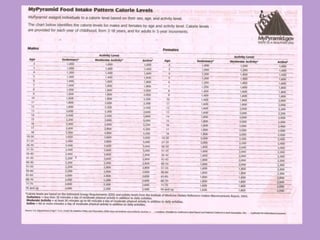
What Are YOUR Caloric Needs?
• Use MyPyramid.gov to discover YOUR needs
  – Individual food plan for caloric needs

  – Tract diet & physical activity for up to 1 year

  – Detailed info on each food group’s serving
    sizes, nutrients, & health benefits

  – Info for special populations (i.e.
    pregnant, overweight, elderly, children)
6 Categories of Nutrients
•   Carbohydrates (CHO)
•   Lipids (Fats)              Macronutrients
•   Proteins
•   Vitamins
•   Minerals      Micronutrients
•   Water
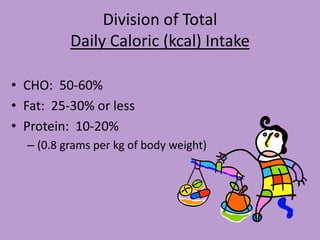
Division of Total
          Daily Caloric (kcal) Intake

• CHO: 50-60%
• Fat: 25-30% or less
• Protein: 10-20%
  – (0.8 grams per kg of body weight)
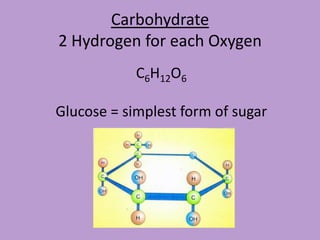
Carbohydrate
2 Hydrogen for each Oxygen
            C6H12O6

Glucose = simplest form of sugar
A Sugar is a Sugar is a….
•Glucose    • Granulated      •Invert sugar
•Dextrose     sugar           •Maple syrup
•Fructose   • Confectioner’   •Molasses
•Lactose      sugar           •Mannitol
•Maltose    • Brown sugar     •Sorbitol
•Sucrose    • Corn syrup      •Sorghum
            • Honey
Categories of Carbohydrates
• Monosaccharides (glucose, fructose, galactose)

• Disaccharides (sucrose, maltose, lactose)

• Polysaccharides (starch, fiber, glycogen)
Monosaccharides = Simple Sugar Units
• Glucose - Blood Sugar
  – Found in fruits & vegetables
  – Used for:
     • Cell energy
     • Stored as glycogen in muscles & liver
     • Converted to fat for energy storage
• Fructose - “Fruit Sugar”
  – Found in fruit, honey, corn syrup
• Galactose
  – Found as part of lactose in milk
Disaccharides = 2 Monosaccharides
Monosaccharides & Disaccharides = Simple Sugars


Sucrose = Glucose + Fructose
                 (brown sugar; 25% of sugar intake)

Lactose = Glucose + Galactose
                 (milk sugar; least sweet)

Maltose = Glucose + Glucose
                (honey)


50% of average American dietary CHO intake = simple sugars
Polysaccharides = 3 or more simple sugars combine

 • Plant Polysaccharides:
    – Starch
       • Peas, seeds, corn, grains, cereals, potatoes, roots
    – Cellulose
       • Fiber (technically not a nutrient – resistant to digestion)
          – Water-insoluble
          – Water-soluble
          – ***Recommended fiber intake = 20-35 g per day
Dietary Fiber
• Water-Soluble Fiber
   – Depress synthesis & absorption of cholesterol in gut
   – Bind existing cholesterol to facilitate excretion in feces
   – Ex: pectin & guar gum in oats, beans, peas, carrots, fruits
• Water-Insoluble Fiber
   – Hold water & give bulk to food residues in small intestine
     increasing stool weight/volume
   – Ex: cellulose, hemicellulose, lignins, pectins in brown rice,
     corn, & wheat bran
• Health Implications of Fiber:
   – Colorectal cancer, diabetes, intestinal disorders (stool issues), cholesterol
     effects
Dietary Fiber
• Average American eats 12 g of fiber / day

• Recommended Intake of Fiber = 20-35 g / day
  – Insoluble to soluble = 3:1


• Guess who has the highest incidence of
  colorectal cancer?
Polysaccharides = 3 or more simple sugars combine


• Animal Polysaccharides:
   – Glycogen
     • Ranges in size from few hundred to thousands of
       glucose molecules liked together like sausage links
     • Storage form of glucose
     • 375-475 g stored in body (liver, muscle, kidney)
     • Can be modified by diet & exercise
     • Most important energy fuel
Functions of CHO
• Important Energy Source

• Protein Sparer

• Metabolic Primer

• Central Nervous System Fuel
Source of CHO
•   Dairy
•   Fruits
•   Cereals
•   Breads
•   Pasta        BUT…
Recommended CHO Intake
• Percent of daily total caloric intake = 50-60%

• So, if I eat 1200 kcal / day, 600 – 700 kcal
  should be from carbohydrates

• 1 gram of CHO = 4 kcal
                              Calorie (kcal) = unit
                                of heat used to
                              express energy value
                                    of food
What are the Fates of Blood Glucose?


                             Blood Glucose


      Muscle Glycogen                            Liver Glycogen


            Adipose Tissue                   Kidney Excretion


                             Used for Energy
Nature of Lipids
• Same structural elements as CHO but linking of
  atoms is different (C, H, & O)
• The H to O2 ratio is typically 18.3:1
  – (CHO is 2:1)
• Found in both plants & animals
• 3 kinds of lipids
  – Simple, Compound, & Derived
• Generally greasy to touch & insoluble in water
Kinds of Lipids – Simple Fats
Simple Fats:
• aka Neutral Fats
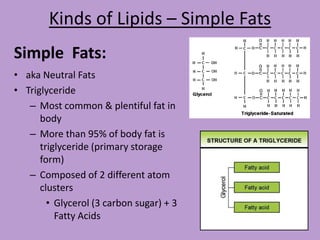
• Triglyceride
   – Most common & plentiful fat in
      body
   – More than 95% of body fat is
      triglyceride (primary storage
      form)
   – Composed of 2 different atom
      clusters
        • Glycerol (3 carbon sugar) + 3
          Fatty Acids
Fatty Acids
• Give each fat unique qualities of flavor & texture
• Differ in:
   – Length of carbon chain
   – Bonding of carbon atoms & arrangement of
     hydrogens along carbon chain
• 3 Kinds of Fatty Acids:
   – Saturated
   – Unsaturated
   – Essential
Saturated Fatty Acid
           • A saturated fatty
             acid contains only
             single bonds
             between C atoms;
             all remaining bonds
             attach to hydrogen
             – The fatty acid
               molecule holds as
               many H+ atoms as
               possible - thus the
               term saturated
Saturated Fatty Acids
• Found primarily in animal products:
   –   Beef
   –   Lamb
   –   Pork
   –   Chicken
   –   Egg yolk
   –   Cream, milk, butter, cheese (Dairy)
   –   Coconut and palm oil
   –   Vegetable shortening
   –   Hydrogenated butter
Unsaturated Fatty Acids

• Contain one or more double bonds along the
  main C chain - the fatty acid is unsaturated with
  respect to H+
• Mono-unsaturated: 1 double bond (olive,
  canola, and peanut oil)
• Poly-unsaturated: 2 or more double bonds
  (safflower, sunflower, soybean, corn oil)
Unsaturated Fatty Acids

                     Each double
                    bond takes the
                       place of
                     2 hydrogen
                        atoms
Saturated vs Unsaturated Fat

                         Regardless of
                        the degree of
                        saturation, all
                          lipids have
                        essentially the
                       same number of
                       calories per unit
                            weight.

                      1 g of fat = 9 kcal
Essential Fatty Acids
• Polyunsaturated fatty acids
  – Linoleic acid = Omega-6 fatty acid
     • Vegetable oil, corn oil, sunflower oil, peanut oil
  – Alpha-linolenic acid = Omega-3 fatty acid
     • Green leafy vegetables, canola oil, soy products, fish
• Must be consumed from food/diet
• Serve as precursors of other fatty acids which
  body can not synthesize
Omega-3 Fatty Acids
Eicosapentaenoic acid (fish oil)
  –Found in oils of shell fish, cold-water
   tuna, herring, sardines, mackerel & sea
   mammals
    •   CHD protective
    •   Prevents blood clot formation on arterial walls
    •   Lowers blood pressure
    •   Increases plasma HDL
    •   Decreases LCL cholesterol

    Eat fish – 10 ounces / week!!!
Hydrogenation
• Oils exist as liquids & contain unsaturated fatty acids
• Hydrogenation changes oils to semi-solid fat
   – Bubbles liquid hydrogen into vegetable oil w/ mineral
     catalyst nickel
• Reduces unsaturated fatty acids’ bonds from double bonds to
  single bonds
   – More hydrogen attach to carbons
• Firmer fat results b/c hydrogen increases lipid’s melting temp.
• Hydrogenated oil behaves like a saturated fat
Trans Fatty Acids
• Hydrogenation of vegetable oils
   – Unsaturated corn, soybean & sunflower oil
• Results when one of the H+ moves from its naturally occurring
  position to the opposite side of the double bond
   – 17-25% in margarine
   – 7% in butter
   – Possible links to heart disease
      • (30,000 deaths / year)
Kinds of Fat - Derived Lipids
• Cholesterol
 – Exists only in animal tissue
 – No FFA but shares similar characteristics
 – Exists as endogenous cholesterol
    • 0.5 - 2.0 g/d production
    • More forms with high saturated diets
 – Functions include: building plasma
   membranes, synthesizing Vit D, adrenal gland
   hormones and sex hormones
   (estrogen, androgen, progesterone), bile; tissue and
   organ formation during fetal development.
Recommended Cholesterol Intake
• 300 mg (1/100 oz) / day or LESS!!!

• 100 kCal per 1000 kCal ingested
   – 1 cup skim milk = 4 mg
   – 1 cup whole milk = 33 mg
   – 3 oz beef = 680 mg
Fat in the Diet
• Average American now consumes 15% of total kCal
  (>50 lbs) of saturated fat per year, most of which is
  animal in origin

• 25-30% of total daily kcal intake should be fat
   – More unsaturated
   – Less saturated
   – Try to avoid trans fat, hydrogenated fats
Fat in the Diet
Roles of Fat
1. Energy source and reserve
         -9 kCal/g
2. Protection and insulation
3. Vitamin carrier
4. Satiety
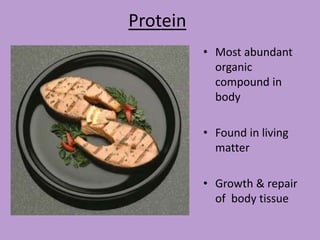
Protein
          • Most abundant
            organic
            compound in
            body

          • Found in living
            matter

          • Growth & repair
            of body tissue
Protein Organization
• Chemical organization similar to fats &
  CHO, except protein also contains nitrogen

• Nitrogen = 16% of protein molecule

• Basic units – “building blocks” – of protein are
  Amino Acids (AA)
Proteins & Amino Acids (AA)
• Amino Radical – NH2
• Organic Acid Radical – COOH
• Side Chain – R
  – Determines differences between amino acids


                           Amine + Acid = Amino Acid

                            23 Different Amino Acids
Essential/Nonessential AA
Essential (cannot be synthesized Nonessential (made in the body)
by the body and be obtained from food)
                                         Alanine
    Histidine
                                         Arginine
    Isoleucine
                                         Asparagine
    Lysine
                                         Cysteine
    Methionine
                                         Glutamic acid
    Phenylalanine
                                         Glutamine
    Threonine
                                         Glycine
    Tryptophan
                                         Proline
    Valine
                                         Serine
                                         Tyrosine
Proteins in Foods
• Proteins can be found in both animals and plants

• Nothing “better” about an amino acid from animal
  compared to same amino acid from plant origin

• Proteins in food classified as complete or incomplete
  depending on amino acid content
Proteins in Foods
• Complete aka High-Quality Protein
  – Contain all essential AA in quality & correct proportion to
    maintain nitrogen balance & promote normal growth
  – Usually animal products (eggs, milk, meat, fish, poultry)


• Incomplete aka Lower-Quality Protein
  – Lacks one or more of the essential AA
  – Usually plant products (nuts, lima beans, lentils)
Complimentary Function of Proteins
• All essential amino acids can be consumed by eating
  variety of vegetable foods

• Example: Grains & legumes
   – Grains lack AA lysine which legumes have
   – Legumes lack AA methionine which grains have
   – Tortillas & beans; rice & beans; rice & lentils; rice & peas;
     peanuts & wheat bread


• B/c large amounts of these foods must be eaten to
  obtain required amount of AA, people eat animal
  products
Protein RDA
    0.8 - 0.9 grams/kg BW
Examples
 –50 kg (110 lb) person = 40 g (1.4 oz)
 –85 kg (187 lb) person = 68 g (2.4 oz)
Your Protein Needs
• Determine ideal body weight
• Determine protein needs:
  – Older Teen – 0.9 g / kg BW
  – Adult – 0.8 g / kg BW
  – Adult Athlete – 1.1 – 1.6 g / kg BW
  – Pregnant – add 10 g
  – Lactating – add 15 g for 1st 6 months & 12 g after
• Body Weight X Need = Protein Requirement
Functions of Proteins
•   Anabolism
•   Structural proteins
•   Enzymes
•   DNA, RNA
•   Blood Plasma
•   Vitamin precursor
•   1g = 5.65 kCal
    – Reduces to 4 kcal
FATE OF AMINO ACIDS

• Gluconeogeneis - 18 AA serve as a
  source for glucose synthesis
• Energy Source - Oxidized for energy
  in Krebs cycle
• Fat Synthesis - All AA provide a
  potential source for fat synthesis
Nonprotein Consumers
Semivegetarian - avoids only certain kinds of
meat, fish, poultry
Lacto-ovo vegetarian - avoids eating any animal
flesh, but uses dairy products and eggs
Lacto-vegetarian - avoids eating animal flesh and
eggs, but uses dairy products
Vegan - avoids all foods of animal origin, even dairy
products and eggs
Macrobiotic Vegetarian - ten dietary stages;
Fruitarian- includes only fruit, nuts, honey and olive
oil
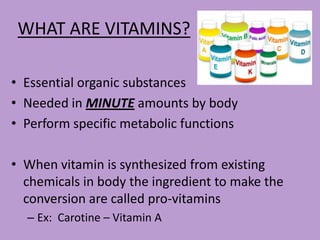
WHAT ARE VITAMINS?

• Essential organic substances
• Needed in MINUTE amounts by body
• Perform specific metabolic functions

• When vitamin is synthesized from existing
  chemicals in body the ingredient to make the
  conversion are called pro-vitamins
  – Ex: Carotine – Vitamin A
Where do Vitamins Come From?
• All vitamins found in green leaves
  & roots of plants (photosynthesis)

• Exception: Vitamin B12 – found
  only in animals

• Man cannot synthesize Vitamin C &
  most of fat soluble vitamins
FUNCTIONS OF VITAMINS
• essential links and regulators in metabolism
• tissue synthesis
2 Types of Vitamins
• Fat-Soluble
  –   A (Retinol)
  –   D (Cholecaciferol)
  –   E (Tocopherol)
  –   K (Menadione)
• Water-Soluble
  –   C (Ascorbic Acid)
  –   Thiamin
  –   Riboflavin
  –   Niacin
  –   B-6 (Pyridoxine)
  –   Pantothenic Acid
  –   Biotin
  –   Folate
  –   B-12
FAT SOLUBLE VITAMINS

A, D, E, K
  –Daily ingestion unnecessary
  –Stored in the liver, fat cells and
   subcutaneously
  –No mechanism to leave the body
  –Can be toxic in excess
VITAMIN A
           RDA = 0.8 - 1.0 mg
• Functions
  – Constituent of visual pigment
  – Antioxidants
  – Maintenance of epithelial tissues
• Food Sources
  – Yellow-orange vegetables
  – Orange fruits
  – Dark-green leafy vegetables
VITAMIN D
          RDA = .005 - .01 mg
• Functions
  – Promote growth & mineralization of bones
  – Increases absorption of calcium
• Food Sources
  – Dairy products
  – Cod-liver oil
  – Eggs
  – (Non-food source) Sunlight!!!
VITAMIN D Deficiency

• Rickets = vitamin D
  deficiency disease of
  children

• Osteomalacia = vitamin D
  deficiency in adults
  (softening of
  bones, making them
  brittle)
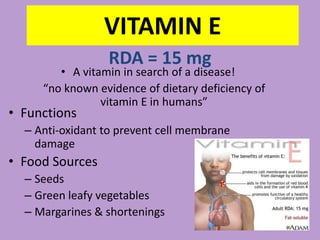
VITAMIN E
                 RDA = 15 mg
        • A vitamin in search of a disease!
     “no known evidence of dietary deficiency of
                vitamin E in humans”
• Functions
  – Anti-oxidant to prevent cell membrane
    damage
• Food Sources
  – Seeds
  – Green leafy vegetables
  – Margarines & shortenings
VITAMIN K
               RDA = .06-.08 mg
• Functions
  – Blood clotting
  – Formation of bone
• Food sources
  – Green vegetables
  – Liver
  – Egg yolks
Water Soluble Vitamins
• Vitamin C & B-complex group
  – Transported throughout water medium of the
    body
  – Not stored in body
  – Voided in urine
  – Must be consumed regularly - daily
B Vitamins
   • B vitamins act primarily as
     coenzymes
   • Work as catalysts
   • Function in energy-producing
     metabolic reactions
   • Includes:
      –   Thiamin 1.1 -1.2 mg/day
      –   Riboflavin 1.1-1.3 mg/day
      –   Niacin 14-16 mg/day
      –   B6 1.3-1.7 mg/day
      –   Folate 0.2 mg/day
      –   B12 0.002 mg/day
VITAMIN C
                 RDA = 75-90 mg

•   Increases absorption of iron
•   Influences serum cholesterol
•   Affects immune system
•   Affects synthesis of collagen
•   Affects drug metabolism
•   Protects DNA in sperm
•   Maintains intercellular matrix of cartilage, bone, &
    dentine
Minerals
• 4% of body mass
  composed of 22
  metallic elements
  called minerals

• Important minerals
  found in
  enzymes, hormones
  , & vitamins

• Classified as major
  or minor
Major and Minor Minerals
• Major Minerals                • Minor Minerals
                                  (intake needed < 100 mg/day)
• (intake needed >100 mg/day)
                                   –   iron
   – sodium
                                   –   zinc
   – potassium                     –   copper
   – calcium                       –   selenium
   – phosphorus                    –   iodine
   – magnesium                     –   fluorine
   – sulfur                        –   chromium
                                   –   molybdenum
   – chlorine
                                   –   manganese
Bioavailability of Minerals
• Extent that mineral is absorbed by body &
  made available for its biologic functions
• Affected by:
  – Vitamin-Mineral Interaction
     • Synergism in consuming some vitamins & minerals
       together
     • Example: calcium & vitamin D
  – Fiber-Mineral Interaction
     • Example: Too much fiber decreases absorption of
       calcium, zinc, magnesium, iron
Where Do Minerals Come From?
• Occur freely in nature
  (rivers, lakes, oceans, topsoil, under earth’s surface)

• Found in root systems of plants and in body structures
  of animals that consume plants and water

• Best sources of minerals are animal products (because
  they are more concentrated in animal tissues than in
  plants)
Functions of
          Minerals
•Provide structure in formation of
bones & teeth

•Maintain normal heart rhythm,
muscle contractility, nerve
conduction, & acid-base balance of
body fluids

•Regulatory role in cellular
metabolism

•Part of enzymes & hormones that
modify & regulate cellular activity

•Involved in catabolism &
anabolism of nutrients
Calcium
• Body’s most abundant mineral
  (1.5 to 2.0% of body mass; 1400 g)

• Ca combines with P to form hydroxyapatite, the
  crystalline structure of bones and teeth

• Ionized, Ca serves these functions:
      • Muscle contraction
      • Transmission nerve impulses
      • Activation of enzymes
      • Blood clotting
      • Fluid movement across membranes
Osteoporosis
• When calcium is deficient, bones
  “give up” their calcium to try &
  restore deficit

• Bones become hollow or porous
  leading to breaks & fractures

• Hormone estrogen linked to
  osteoporosis
   – b/c estrogen enhances Ca
     absorption, a decrease in estrogen
     no longer offers a protective effect
Osteoporosis:
  Bone Disease of Epidemic Proportions
• 1.5 million fractures yearly
• 500,000 spinal fractures
• 230,000 hip fractures


• Each year, 1.3 million osteoporetic women will fracture one or
  more of their bones
• About 1 of 6 older men & 1 of 3 older women will sustain hip
  fractures (death will occur in 20%)
• Often, x-rays don’t detect the disease until bone loss reaches 30 to
  50% of its total mineral content!
Progressive Disease

• 30-50% bone loss by age 70 y

• Shrinkage of spinal vertebrae
Who Gets the Disease?

• By age 50:
   – Men lose about 0.4% bone each year
   – In women, the loss is about 0.8% starting at age 35
     (double the loss 15 years sooner!)

• During menopause, bone loss accelerates to between
  1% to 3% each year. Thus, by age 60, a woman can lose
  about 15% of her bone mass, and by age 70, bone loss
  can be as much as 30%
Where Does The Bone Loss Occur?
• Most occurs in the vertebrae
   – person shrinks in stature by up to 6 inches
     from age 45-50 to age 70


• The “spongy” bone (trabecular bone)
  loses its mineral content, causing the
  bone to crumble. The inside of the
  bone becomes honeycombed (like a
  beehive) and porous
CALCIUM AND EXERCISE HELPS
 •1200-1500 mg Calcium daily
    •Sardines, pink salmon, ricotta
    cheese, dried figs
    •Calcium carbonate & calcium
    citrate can help
    •Meat, salt, coffee, alcohol
    inhibit Ca absorption


• Exercise -weight bearing help
   – weight training important for “bone fitness”
Sodium: How Much is Enough?
• Excessive intake increases fluid volume and peripheral vascular
  resistance
   – sodium-induced hypertension (occurs in 1/3 of individuals
     with hypertension in U.S. and Japan)

• Recommended level = 1100 to 3300 mg/day
   – average in U.S = 3000 to 7000 mg/day
   – amount actually needed = 500 mg/day


• Sodium plentiful in table salt, MSG, soy sauce, condiments,
  canned foods, baking soda, baking powder
Vitamins & Minerals: The Bottom Line

 Vitamins and minerals
  do not appear to have
 any ergogenic value in
   amounts beyond the
 RDA. Amounts greater
than RDA probably does
       not improve
      performance.

Nutrition

  • 1.
    Nutrition What should mydiet look like?
  • 2.
    Old Food GuidePyramid One Size Fits All : (
  • 3.
    MyPyramid.gov • Developed by USDA • Personal guide to healthy eating & physical activity • Based on age, gender, activity level • How does this pyramid compare to the old Food Guide Pyramid?
  • 4.
    Anatomy of MyPyramid Activity: Proportionality: •Importance of daily •Different widths of food groups physical activity •Widths suggest how much food •At least 30 min. / day should be eaten from each group •60 min. / day of moderate to intense activity more beneficial Variety: Moderation: •6 color bands •Narrowing of each representing 5 food food group groups & oils •Base represents •Food from all groups are nutrient rich food w/ needed for healthy essential vitamins and nutrition minerals & fewer calories •Top represents foods containing more added Personalization & Gradual Improvement: sugars & solid fats •Small steps everyday for YOU!!!
  • 5.
    MyPyramid.gov • Orange = Grains • Green = Vegetables • Red = Fruits • Yellow = Healthy Fats/Oils • Blue = Dairy • Purple = Meat & Beans
  • 6.
    What Are YOURCaloric Needs? • Use MyPyramid.gov to discover YOUR needs – Individual food plan for caloric needs – Tract diet & physical activity for up to 1 year – Detailed info on each food group’s serving sizes, nutrients, & health benefits – Info for special populations (i.e. pregnant, overweight, elderly, children)
  • 9.
    6 Categories ofNutrients • Carbohydrates (CHO) • Lipids (Fats) Macronutrients • Proteins • Vitamins • Minerals Micronutrients • Water
  • 10.
    Division of Total Daily Caloric (kcal) Intake • CHO: 50-60% • Fat: 25-30% or less • Protein: 10-20% – (0.8 grams per kg of body weight)
  • 11.
    Carbohydrate 2 Hydrogen foreach Oxygen C6H12O6 Glucose = simplest form of sugar
  • 12.
    A Sugar isa Sugar is a…. •Glucose • Granulated •Invert sugar •Dextrose sugar •Maple syrup •Fructose • Confectioner’ •Molasses •Lactose sugar •Mannitol •Maltose • Brown sugar •Sorbitol •Sucrose • Corn syrup •Sorghum • Honey
  • 13.
    Categories of Carbohydrates •Monosaccharides (glucose, fructose, galactose) • Disaccharides (sucrose, maltose, lactose) • Polysaccharides (starch, fiber, glycogen)
  • 14.
    Monosaccharides = SimpleSugar Units • Glucose - Blood Sugar – Found in fruits & vegetables – Used for: • Cell energy • Stored as glycogen in muscles & liver • Converted to fat for energy storage • Fructose - “Fruit Sugar” – Found in fruit, honey, corn syrup • Galactose – Found as part of lactose in milk
  • 15.
    Disaccharides = 2Monosaccharides Monosaccharides & Disaccharides = Simple Sugars Sucrose = Glucose + Fructose (brown sugar; 25% of sugar intake) Lactose = Glucose + Galactose (milk sugar; least sweet) Maltose = Glucose + Glucose (honey) 50% of average American dietary CHO intake = simple sugars
  • 16.
    Polysaccharides = 3or more simple sugars combine • Plant Polysaccharides: – Starch • Peas, seeds, corn, grains, cereals, potatoes, roots – Cellulose • Fiber (technically not a nutrient – resistant to digestion) – Water-insoluble – Water-soluble – ***Recommended fiber intake = 20-35 g per day
  • 17.
    Dietary Fiber • Water-SolubleFiber – Depress synthesis & absorption of cholesterol in gut – Bind existing cholesterol to facilitate excretion in feces – Ex: pectin & guar gum in oats, beans, peas, carrots, fruits • Water-Insoluble Fiber – Hold water & give bulk to food residues in small intestine increasing stool weight/volume – Ex: cellulose, hemicellulose, lignins, pectins in brown rice, corn, & wheat bran • Health Implications of Fiber: – Colorectal cancer, diabetes, intestinal disorders (stool issues), cholesterol effects
  • 18.
    Dietary Fiber • AverageAmerican eats 12 g of fiber / day • Recommended Intake of Fiber = 20-35 g / day – Insoluble to soluble = 3:1 • Guess who has the highest incidence of colorectal cancer?
  • 19.
    Polysaccharides = 3or more simple sugars combine • Animal Polysaccharides: – Glycogen • Ranges in size from few hundred to thousands of glucose molecules liked together like sausage links • Storage form of glucose • 375-475 g stored in body (liver, muscle, kidney) • Can be modified by diet & exercise • Most important energy fuel
  • 20.
    Functions of CHO •Important Energy Source • Protein Sparer • Metabolic Primer • Central Nervous System Fuel
  • 21.
    Source of CHO • Dairy • Fruits • Cereals • Breads • Pasta BUT…
  • 22.
    Recommended CHO Intake •Percent of daily total caloric intake = 50-60% • So, if I eat 1200 kcal / day, 600 – 700 kcal should be from carbohydrates • 1 gram of CHO = 4 kcal Calorie (kcal) = unit of heat used to express energy value of food
  • 23.
    What are theFates of Blood Glucose? Blood Glucose Muscle Glycogen Liver Glycogen Adipose Tissue Kidney Excretion Used for Energy
  • 24.
    Nature of Lipids •Same structural elements as CHO but linking of atoms is different (C, H, & O) • The H to O2 ratio is typically 18.3:1 – (CHO is 2:1) • Found in both plants & animals • 3 kinds of lipids – Simple, Compound, & Derived • Generally greasy to touch & insoluble in water
  • 25.
    Kinds of Lipids– Simple Fats Simple Fats: • aka Neutral Fats • Triglyceride – Most common & plentiful fat in body – More than 95% of body fat is triglyceride (primary storage form) – Composed of 2 different atom clusters • Glycerol (3 carbon sugar) + 3 Fatty Acids
  • 26.
    Fatty Acids • Giveeach fat unique qualities of flavor & texture • Differ in: – Length of carbon chain – Bonding of carbon atoms & arrangement of hydrogens along carbon chain • 3 Kinds of Fatty Acids: – Saturated – Unsaturated – Essential
  • 27.
    Saturated Fatty Acid • A saturated fatty acid contains only single bonds between C atoms; all remaining bonds attach to hydrogen – The fatty acid molecule holds as many H+ atoms as possible - thus the term saturated
  • 28.
    Saturated Fatty Acids •Found primarily in animal products: – Beef – Lamb – Pork – Chicken – Egg yolk – Cream, milk, butter, cheese (Dairy) – Coconut and palm oil – Vegetable shortening – Hydrogenated butter
  • 29.
    Unsaturated Fatty Acids •Contain one or more double bonds along the main C chain - the fatty acid is unsaturated with respect to H+ • Mono-unsaturated: 1 double bond (olive, canola, and peanut oil) • Poly-unsaturated: 2 or more double bonds (safflower, sunflower, soybean, corn oil)
  • 30.
    Unsaturated Fatty Acids Each double bond takes the place of 2 hydrogen atoms
  • 31.
    Saturated vs UnsaturatedFat Regardless of the degree of saturation, all lipids have essentially the same number of calories per unit weight. 1 g of fat = 9 kcal
  • 32.
    Essential Fatty Acids •Polyunsaturated fatty acids – Linoleic acid = Omega-6 fatty acid • Vegetable oil, corn oil, sunflower oil, peanut oil – Alpha-linolenic acid = Omega-3 fatty acid • Green leafy vegetables, canola oil, soy products, fish • Must be consumed from food/diet • Serve as precursors of other fatty acids which body can not synthesize
  • 33.
    Omega-3 Fatty Acids Eicosapentaenoicacid (fish oil) –Found in oils of shell fish, cold-water tuna, herring, sardines, mackerel & sea mammals • CHD protective • Prevents blood clot formation on arterial walls • Lowers blood pressure • Increases plasma HDL • Decreases LCL cholesterol Eat fish – 10 ounces / week!!!
  • 34.
    Hydrogenation • Oils existas liquids & contain unsaturated fatty acids • Hydrogenation changes oils to semi-solid fat – Bubbles liquid hydrogen into vegetable oil w/ mineral catalyst nickel • Reduces unsaturated fatty acids’ bonds from double bonds to single bonds – More hydrogen attach to carbons • Firmer fat results b/c hydrogen increases lipid’s melting temp. • Hydrogenated oil behaves like a saturated fat
  • 35.
    Trans Fatty Acids •Hydrogenation of vegetable oils – Unsaturated corn, soybean & sunflower oil • Results when one of the H+ moves from its naturally occurring position to the opposite side of the double bond – 17-25% in margarine – 7% in butter – Possible links to heart disease • (30,000 deaths / year)
  • 36.
    Kinds of Fat- Derived Lipids • Cholesterol – Exists only in animal tissue – No FFA but shares similar characteristics – Exists as endogenous cholesterol • 0.5 - 2.0 g/d production • More forms with high saturated diets – Functions include: building plasma membranes, synthesizing Vit D, adrenal gland hormones and sex hormones (estrogen, androgen, progesterone), bile; tissue and organ formation during fetal development.
  • 37.
    Recommended Cholesterol Intake •300 mg (1/100 oz) / day or LESS!!! • 100 kCal per 1000 kCal ingested – 1 cup skim milk = 4 mg – 1 cup whole milk = 33 mg – 3 oz beef = 680 mg
  • 38.
    Fat in theDiet • Average American now consumes 15% of total kCal (>50 lbs) of saturated fat per year, most of which is animal in origin • 25-30% of total daily kcal intake should be fat – More unsaturated – Less saturated – Try to avoid trans fat, hydrogenated fats
  • 39.
  • 40.
    Roles of Fat 1.Energy source and reserve -9 kCal/g 2. Protection and insulation 3. Vitamin carrier 4. Satiety
  • 41.
    Protein • Most abundant organic compound in body • Found in living matter • Growth & repair of body tissue
  • 42.
    Protein Organization • Chemicalorganization similar to fats & CHO, except protein also contains nitrogen • Nitrogen = 16% of protein molecule • Basic units – “building blocks” – of protein are Amino Acids (AA)
  • 43.
    Proteins & AminoAcids (AA) • Amino Radical – NH2 • Organic Acid Radical – COOH • Side Chain – R – Determines differences between amino acids Amine + Acid = Amino Acid 23 Different Amino Acids
  • 44.
    Essential/Nonessential AA Essential (cannotbe synthesized Nonessential (made in the body) by the body and be obtained from food) Alanine Histidine Arginine Isoleucine Asparagine Lysine Cysteine Methionine Glutamic acid Phenylalanine Glutamine Threonine Glycine Tryptophan Proline Valine Serine Tyrosine
  • 45.
    Proteins in Foods •Proteins can be found in both animals and plants • Nothing “better” about an amino acid from animal compared to same amino acid from plant origin • Proteins in food classified as complete or incomplete depending on amino acid content
  • 46.
    Proteins in Foods •Complete aka High-Quality Protein – Contain all essential AA in quality & correct proportion to maintain nitrogen balance & promote normal growth – Usually animal products (eggs, milk, meat, fish, poultry) • Incomplete aka Lower-Quality Protein – Lacks one or more of the essential AA – Usually plant products (nuts, lima beans, lentils)
  • 47.
    Complimentary Function ofProteins • All essential amino acids can be consumed by eating variety of vegetable foods • Example: Grains & legumes – Grains lack AA lysine which legumes have – Legumes lack AA methionine which grains have – Tortillas & beans; rice & beans; rice & lentils; rice & peas; peanuts & wheat bread • B/c large amounts of these foods must be eaten to obtain required amount of AA, people eat animal products
  • 48.
    Protein RDA 0.8 - 0.9 grams/kg BW Examples –50 kg (110 lb) person = 40 g (1.4 oz) –85 kg (187 lb) person = 68 g (2.4 oz)
  • 49.
    Your Protein Needs •Determine ideal body weight • Determine protein needs: – Older Teen – 0.9 g / kg BW – Adult – 0.8 g / kg BW – Adult Athlete – 1.1 – 1.6 g / kg BW – Pregnant – add 10 g – Lactating – add 15 g for 1st 6 months & 12 g after • Body Weight X Need = Protein Requirement
  • 50.
    Functions of Proteins • Anabolism • Structural proteins • Enzymes • DNA, RNA • Blood Plasma • Vitamin precursor • 1g = 5.65 kCal – Reduces to 4 kcal
  • 51.
    FATE OF AMINOACIDS • Gluconeogeneis - 18 AA serve as a source for glucose synthesis • Energy Source - Oxidized for energy in Krebs cycle • Fat Synthesis - All AA provide a potential source for fat synthesis
  • 52.
    Nonprotein Consumers Semivegetarian -avoids only certain kinds of meat, fish, poultry Lacto-ovo vegetarian - avoids eating any animal flesh, but uses dairy products and eggs Lacto-vegetarian - avoids eating animal flesh and eggs, but uses dairy products Vegan - avoids all foods of animal origin, even dairy products and eggs Macrobiotic Vegetarian - ten dietary stages; Fruitarian- includes only fruit, nuts, honey and olive oil
  • 53.
    WHAT ARE VITAMINS? •Essential organic substances • Needed in MINUTE amounts by body • Perform specific metabolic functions • When vitamin is synthesized from existing chemicals in body the ingredient to make the conversion are called pro-vitamins – Ex: Carotine – Vitamin A
  • 54.
    Where do VitaminsCome From? • All vitamins found in green leaves & roots of plants (photosynthesis) • Exception: Vitamin B12 – found only in animals • Man cannot synthesize Vitamin C & most of fat soluble vitamins
  • 55.
    FUNCTIONS OF VITAMINS •essential links and regulators in metabolism • tissue synthesis
  • 56.
    2 Types ofVitamins • Fat-Soluble – A (Retinol) – D (Cholecaciferol) – E (Tocopherol) – K (Menadione) • Water-Soluble – C (Ascorbic Acid) – Thiamin – Riboflavin – Niacin – B-6 (Pyridoxine) – Pantothenic Acid – Biotin – Folate – B-12
  • 57.
    FAT SOLUBLE VITAMINS A,D, E, K –Daily ingestion unnecessary –Stored in the liver, fat cells and subcutaneously –No mechanism to leave the body –Can be toxic in excess
  • 58.
    VITAMIN A RDA = 0.8 - 1.0 mg • Functions – Constituent of visual pigment – Antioxidants – Maintenance of epithelial tissues • Food Sources – Yellow-orange vegetables – Orange fruits – Dark-green leafy vegetables
  • 59.
    VITAMIN D RDA = .005 - .01 mg • Functions – Promote growth & mineralization of bones – Increases absorption of calcium • Food Sources – Dairy products – Cod-liver oil – Eggs – (Non-food source) Sunlight!!!
  • 60.
    VITAMIN D Deficiency •Rickets = vitamin D deficiency disease of children • Osteomalacia = vitamin D deficiency in adults (softening of bones, making them brittle)
  • 61.
    VITAMIN E RDA = 15 mg • A vitamin in search of a disease! “no known evidence of dietary deficiency of vitamin E in humans” • Functions – Anti-oxidant to prevent cell membrane damage • Food Sources – Seeds – Green leafy vegetables – Margarines & shortenings
  • 62.
    VITAMIN K RDA = .06-.08 mg • Functions – Blood clotting – Formation of bone • Food sources – Green vegetables – Liver – Egg yolks
  • 63.
    Water Soluble Vitamins •Vitamin C & B-complex group – Transported throughout water medium of the body – Not stored in body – Voided in urine – Must be consumed regularly - daily
  • 64.
    B Vitamins • B vitamins act primarily as coenzymes • Work as catalysts • Function in energy-producing metabolic reactions • Includes: – Thiamin 1.1 -1.2 mg/day – Riboflavin 1.1-1.3 mg/day – Niacin 14-16 mg/day – B6 1.3-1.7 mg/day – Folate 0.2 mg/day – B12 0.002 mg/day
  • 65.
    VITAMIN C RDA = 75-90 mg • Increases absorption of iron • Influences serum cholesterol • Affects immune system • Affects synthesis of collagen • Affects drug metabolism • Protects DNA in sperm • Maintains intercellular matrix of cartilage, bone, & dentine
  • 66.
    Minerals • 4% ofbody mass composed of 22 metallic elements called minerals • Important minerals found in enzymes, hormones , & vitamins • Classified as major or minor
  • 67.
    Major and MinorMinerals • Major Minerals • Minor Minerals (intake needed < 100 mg/day) • (intake needed >100 mg/day) – iron – sodium – zinc – potassium – copper – calcium – selenium – phosphorus – iodine – magnesium – fluorine – sulfur – chromium – molybdenum – chlorine – manganese
  • 68.
    Bioavailability of Minerals •Extent that mineral is absorbed by body & made available for its biologic functions • Affected by: – Vitamin-Mineral Interaction • Synergism in consuming some vitamins & minerals together • Example: calcium & vitamin D – Fiber-Mineral Interaction • Example: Too much fiber decreases absorption of calcium, zinc, magnesium, iron
  • 69.
    Where Do MineralsCome From? • Occur freely in nature (rivers, lakes, oceans, topsoil, under earth’s surface) • Found in root systems of plants and in body structures of animals that consume plants and water • Best sources of minerals are animal products (because they are more concentrated in animal tissues than in plants)
  • 70.
    Functions of Minerals •Provide structure in formation of bones & teeth •Maintain normal heart rhythm, muscle contractility, nerve conduction, & acid-base balance of body fluids •Regulatory role in cellular metabolism •Part of enzymes & hormones that modify & regulate cellular activity •Involved in catabolism & anabolism of nutrients
  • 71.
    Calcium • Body’s mostabundant mineral (1.5 to 2.0% of body mass; 1400 g) • Ca combines with P to form hydroxyapatite, the crystalline structure of bones and teeth • Ionized, Ca serves these functions: • Muscle contraction • Transmission nerve impulses • Activation of enzymes • Blood clotting • Fluid movement across membranes
  • 72.
    Osteoporosis • When calciumis deficient, bones “give up” their calcium to try & restore deficit • Bones become hollow or porous leading to breaks & fractures • Hormone estrogen linked to osteoporosis – b/c estrogen enhances Ca absorption, a decrease in estrogen no longer offers a protective effect
  • 73.
    Osteoporosis: BoneDisease of Epidemic Proportions • 1.5 million fractures yearly • 500,000 spinal fractures • 230,000 hip fractures • Each year, 1.3 million osteoporetic women will fracture one or more of their bones • About 1 of 6 older men & 1 of 3 older women will sustain hip fractures (death will occur in 20%) • Often, x-rays don’t detect the disease until bone loss reaches 30 to 50% of its total mineral content!
  • 74.
    Progressive Disease • 30-50%bone loss by age 70 y • Shrinkage of spinal vertebrae
  • 75.
    Who Gets theDisease? • By age 50: – Men lose about 0.4% bone each year – In women, the loss is about 0.8% starting at age 35 (double the loss 15 years sooner!) • During menopause, bone loss accelerates to between 1% to 3% each year. Thus, by age 60, a woman can lose about 15% of her bone mass, and by age 70, bone loss can be as much as 30%
  • 76.
    Where Does TheBone Loss Occur? • Most occurs in the vertebrae – person shrinks in stature by up to 6 inches from age 45-50 to age 70 • The “spongy” bone (trabecular bone) loses its mineral content, causing the bone to crumble. The inside of the bone becomes honeycombed (like a beehive) and porous
  • 77.
    CALCIUM AND EXERCISEHELPS •1200-1500 mg Calcium daily •Sardines, pink salmon, ricotta cheese, dried figs •Calcium carbonate & calcium citrate can help •Meat, salt, coffee, alcohol inhibit Ca absorption • Exercise -weight bearing help – weight training important for “bone fitness”
  • 78.
    Sodium: How Muchis Enough? • Excessive intake increases fluid volume and peripheral vascular resistance – sodium-induced hypertension (occurs in 1/3 of individuals with hypertension in U.S. and Japan) • Recommended level = 1100 to 3300 mg/day – average in U.S = 3000 to 7000 mg/day – amount actually needed = 500 mg/day • Sodium plentiful in table salt, MSG, soy sauce, condiments, canned foods, baking soda, baking powder
  • 79.
    Vitamins & Minerals:The Bottom Line Vitamins and minerals do not appear to have any ergogenic value in amounts beyond the RDA. Amounts greater than RDA probably does not improve performance.