ROUTINE CATHETER CARE
An Indwelling catheter is used to provide continuous drainage of urine
from the bladder. The catheter, which is attached to a drainage bag
maybe used for episodic or long term urinary drainage. As the catheter
is in the bladder through the urethra , bacteria may enter the urinary
system therefore care must be taken to ensure that the surrounding
area is clean to decrease the contamination of the catheter by bacterial
flora. Clients maybe embarrassed or frightened by the catheter and
related care and therefore require emotional support.
ASSESSMENT
1. Assess catheter patency and urine color consistency and the
amount while performing the care to determine if catheter and
drainage system are functioning correctly.
2. Determine the condition of the urinary meatus and perineal area to
monitor for redness, swelling, drainage or signs of infection.
Monitor vaginal discharge and diarrhea as microorganisms may
migrate up the catheter and lead to urinary tract infections.
3. Determine the client’s emotional reaction and feelings related to
the catheter. This may prevent untoward reaction to the care and
allow the nurse to help the client deal with some deeper emotional
issues.
DIAGNOSIS
1. Risk for Infection
2. Risk for impaired skin integrity
3. Risk for disturbed body image
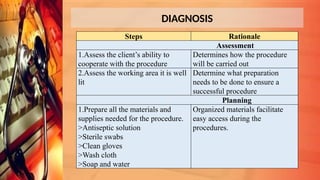
DIAGNOSIS
Steps Rationale
Assessment
1.Assess the client’s ability to
cooperate with the procedure
Determines how the procedure
will be carried out
2.Assess the working area it is well
lit
Determine what preparation
needs to be done to ensure a
successful procedure
Planning
1.Prepare all the materials and
supplies needed for the procedure.
>Antiseptic solution
>Sterile swabs
>Clean gloves
>Wash cloth
>Soap and water
Organized materials facilitate
easy access during the
procedures.
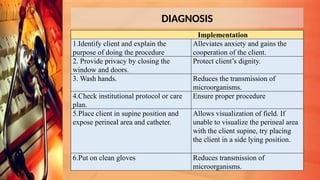
DIAGNOSIS
Implementation
1.Identify client and explain the
purpose of doing the procedure
Alleviates anxiety and gains the
cooperation of the client.
2. Provide privacy by closing the
window and doors.
Protect client’s dignity.
3. Wash hands. Reduces the transmission of
microorganisms.
4.Check institutional protocol or care
plan.
Ensure proper procedure
5.Place client in supine position and
expose perineal area and catheter.
Allows visualization of field. If
unable to visualize the perineal area
with the client supine, try placing
the client in a side lying position.
6.Put on clean gloves Reduces transmission of
microorganisms.
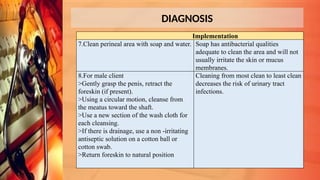
DIAGNOSIS
Implementation
7.Clean perineal area with soap and water. Soap has antibacterial qualities
adequate to clean the area and will not
usually irritate the skin or mucus
membranes.
8.For male client
>Gently grasp the penis, retract the
foreskin (if present).
>Using a circular motion, cleanse from
the meatus toward the shaft.
>Use a new section of the wash cloth for
each cleansing.
>If there is drainage, use a non -irritating
antiseptic solution on a cotton ball or
cotton swab.
>Return foreskin to natural position
Cleaning from most clean to least clean
decreases the risk of urinary tract
infections.
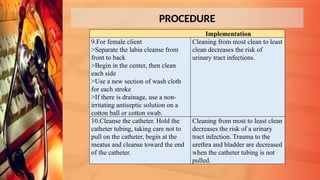
PROCEDURE
Implementation
9.For female client
>Separate the labia cleanse from
front to back
>Begin in the center, then clean
each side
>Use a new section of wash cloth
for each stroke
>If there is drainage, use a non-
irritating antiseptic solution on a
cotton ball or cotton swab.
Cleaning from most clean to least
clean decreases the risk of
urinary tract infections.
10.Cleanse the catheter. Hold the
catheter tubing, taking care not to
pull on the catheter, begin at the
meatus and cleanse toward the end
of the catheter.
Cleaning from most to least clean
decreases the risk of a urinary
tract infection. Trauma to the
urethra and bladder are decreased
when the catheter tubing is not
pulled.
PROCEDURE
Implementation
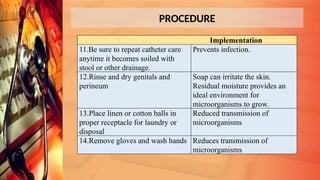
11.Be sure to repeat catheter care
anytime it becomes soiled with
stool or other drainage.
Prevents infection.
12.Rinse and dry genitals and
perineum
Soap can irritate the skin.
Residual moisture provides an
ideal environment for
microorganisms to grow.
13.Place linen or cotton balls in
proper receptacle for laundry or
disposal
Reduced transmission of
microorganisms
14.Remove gloves and wash hands Reduces transmission of
microorganisms
PROCEDURE
Evaluation
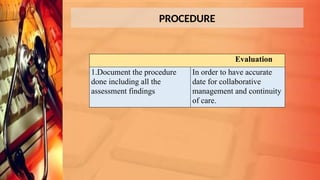
1.Document the procedure
done including all the
assessment findings
In order to have accurate
date for collaborative
management and continuity
of care.
VIDEO LINK
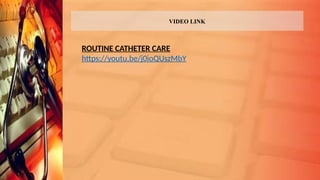
ROUTINE CATHETER CARE
https://youtu.be/j0ioQUszMbY

Nursing procedure - Routine Catheter Care.pptx

  • 1.
  • 2.
    ROUTINE CATHETER CARE AnIndwelling catheter is used to provide continuous drainage of urine from the bladder. The catheter, which is attached to a drainage bag maybe used for episodic or long term urinary drainage. As the catheter is in the bladder through the urethra , bacteria may enter the urinary system therefore care must be taken to ensure that the surrounding area is clean to decrease the contamination of the catheter by bacterial flora. Clients maybe embarrassed or frightened by the catheter and related care and therefore require emotional support.
  • 3.
    ASSESSMENT 1. Assess catheterpatency and urine color consistency and the amount while performing the care to determine if catheter and drainage system are functioning correctly. 2. Determine the condition of the urinary meatus and perineal area to monitor for redness, swelling, drainage or signs of infection. Monitor vaginal discharge and diarrhea as microorganisms may migrate up the catheter and lead to urinary tract infections. 3. Determine the client’s emotional reaction and feelings related to the catheter. This may prevent untoward reaction to the care and allow the nurse to help the client deal with some deeper emotional issues.
  • 4.
    DIAGNOSIS 1. Risk forInfection 2. Risk for impaired skin integrity 3. Risk for disturbed body image
  • 5.
    DIAGNOSIS Steps Rationale Assessment 1.Assess theclient’s ability to cooperate with the procedure Determines how the procedure will be carried out 2.Assess the working area it is well lit Determine what preparation needs to be done to ensure a successful procedure Planning 1.Prepare all the materials and supplies needed for the procedure. >Antiseptic solution >Sterile swabs >Clean gloves >Wash cloth >Soap and water Organized materials facilitate easy access during the procedures.
  • 6.
    DIAGNOSIS Implementation 1.Identify client andexplain the purpose of doing the procedure Alleviates anxiety and gains the cooperation of the client. 2. Provide privacy by closing the window and doors. Protect client’s dignity. 3. Wash hands. Reduces the transmission of microorganisms. 4.Check institutional protocol or care plan. Ensure proper procedure 5.Place client in supine position and expose perineal area and catheter. Allows visualization of field. If unable to visualize the perineal area with the client supine, try placing the client in a side lying position. 6.Put on clean gloves Reduces transmission of microorganisms.
  • 7.
    DIAGNOSIS Implementation 7.Clean perineal areawith soap and water. Soap has antibacterial qualities adequate to clean the area and will not usually irritate the skin or mucus membranes. 8.For male client >Gently grasp the penis, retract the foreskin (if present). >Using a circular motion, cleanse from the meatus toward the shaft. >Use a new section of the wash cloth for each cleansing. >If there is drainage, use a non -irritating antiseptic solution on a cotton ball or cotton swab. >Return foreskin to natural position Cleaning from most clean to least clean decreases the risk of urinary tract infections.
  • 8.
    PROCEDURE Implementation 9.For female client >Separatethe labia cleanse from front to back >Begin in the center, then clean each side >Use a new section of wash cloth for each stroke >If there is drainage, use a non- irritating antiseptic solution on a cotton ball or cotton swab. Cleaning from most clean to least clean decreases the risk of urinary tract infections. 10.Cleanse the catheter. Hold the catheter tubing, taking care not to pull on the catheter, begin at the meatus and cleanse toward the end of the catheter. Cleaning from most to least clean decreases the risk of a urinary tract infection. Trauma to the urethra and bladder are decreased when the catheter tubing is not pulled.
  • 9.
    PROCEDURE Implementation 11.Be sure torepeat catheter care anytime it becomes soiled with stool or other drainage. Prevents infection. 12.Rinse and dry genitals and perineum Soap can irritate the skin. Residual moisture provides an ideal environment for microorganisms to grow. 13.Place linen or cotton balls in proper receptacle for laundry or disposal Reduced transmission of microorganisms 14.Remove gloves and wash hands Reduces transmission of microorganisms
  • 10.
    PROCEDURE Evaluation 1.Document the procedure doneincluding all the assessment findings In order to have accurate date for collaborative management and continuity of care.
  • 11.
    VIDEO LINK ROUTINE CATHETERCARE https://youtu.be/j0ioQUszMbY