Title
A comparison of Gordon's functional health patterns
model and standard nursing care in symptomatic heart
failure patients: A randomized controlled
trial
Outline
• Introduction/background
• Aim/objective
• Methods
• Results and Discussion
• Conclusion and recommendation
• Appraisal (personal reflection about
the article)
• Relevance to the practice
Introduction
 HF is a progressive disease characterized with poor quality
of life, recurrent emergency visits and hospitalizations, as
well as high mortality rates.
 HF is associated with poor quality of life and increased
morbidity and mortality.
 The prevalence of HF in developed countries is
approximately 1–2% in adult populations but it increases
with age and exceeds 10% over 70 years.
 HF patients experience various physical and emotional
symptoms depending on the underlying cause
 It characterized by typical symptoms such as fatigue,
dyspnea, decreased exercise tolerance and edema, which
limit the daily activities of the patients and affect the
 Both clinical situation and different effects of treatment on
daily life significantly decrease life quality of patients.
 Poor quality of life and the severity of symptom level
affects morbidity and mortality
 Class II-IV patients is considered symptomatic.
 Worsening of HF symptoms increased risk of
hospitalization and death .
 The 30 day studies of ARIC show 1 and 5-year mortality
rates after index admission with diagnosis of HF were
10.4%, 22% and 42.3%, respectively
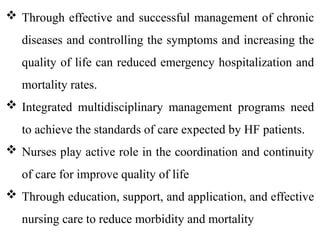
 Through effective and successful management of chronic
diseases and controlling the symptoms and increasing the
quality of life can reduced emergency hospitalization and
mortality rates.
 Integrated multidisciplinary management programs need
to achieve the standards of care expected by HF patients.
 Nurses play active role in the coordination and continuity
of care for improve quality of life
 Through education, support, and application, and effective
nursing care to reduce morbidity and mortality
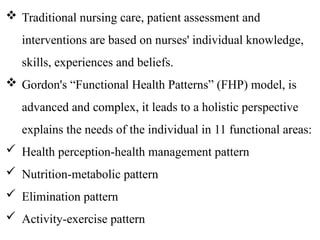
 Traditional nursing care, patient assessment and
interventions are based on nurses' individual knowledge,
skills, experiences and beliefs.
 Gordon's “Functional Health Patterns” (FHP) model, is
advanced and complex, it leads to a holistic perspective
explains the needs of the individual in 11 functional areas:
 Health perception-health management pattern
 Nutrition-metabolic pattern
 Elimination pattern
 Activity-exercise pattern
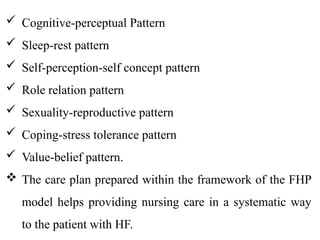
 Cognitive-perceptual Pattern
 Sleep-rest pattern
 Self-perception-self concept pattern
 Role relation pattern
 Sexuality-reproductive pattern
 Coping-stress tolerance pattern
 Value-belief pattern.
 The care plan prepared within the framework of the FHP
model helps providing nursing care in a systematic way
to the patient with HF.
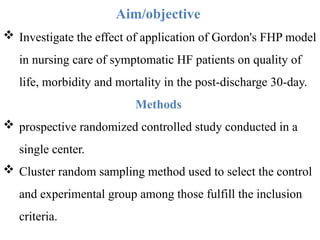
Aim/objective
 Investigate the effect of application of Gordon's FHP model
in nursing care of symptomatic HF patients on quality of
life, morbidity and mortality in the post-discharge 30-day.
Methods
 prospective randomized controlled study conducted in a
single center.
 Cluster random sampling method used to select the control
and experimental group among those fulfill the inclusion
criteria.
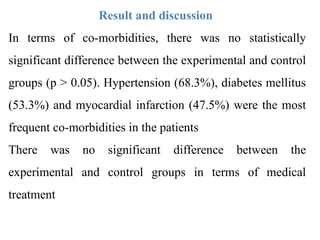
Result and discussion
In terms of co-morbidities, there was no statistically
significant difference between the experimental and control
groups (p > 0.05). Hypertension (68.3%), diabetes mellitus
(53.3%) and myocardial infarction (47.5%) were the most
frequent co-morbidities in the patients
There was no significant difference between the
experimental and control groups in terms of medical
treatment
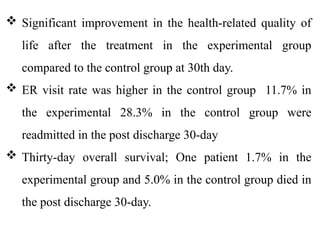
 Significant improvement in the health-related quality of
life after the treatment in the experimental group
compared to the control group at 30th day.
 ER visit rate was higher in the control group 11.7% in
the experimental 28.3% in the control group were
readmitted in the post discharge 30-day
 Thirty-day overall survival; One patient 1.7% in the
experimental group and 5.0% in the control group died in
the post discharge 30-day.
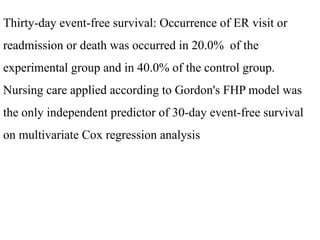
Thirty-day event-free survival: Occurrence of ER visit or
readmission or death was occurred in 20.0% of the
experimental group and in 40.0% of the control group.
Nursing care applied according to Gordon's FHP model was
the only independent predictor of 30-day event-free survival
on multivariate Cox regression analysis
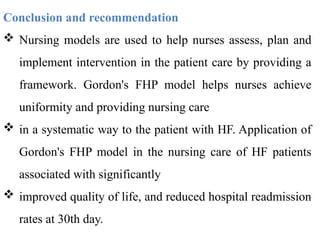
Conclusion and recommendation
 Nursing models are used to help nurses assess, plan and
implement intervention in the patient care by providing a
framework. Gordon's FHP model helps nurses achieve
uniformity and providing nursing care
 in a systematic way to the patient with HF. Application of
Gordon's FHP model in the nursing care of HF patients
associated with significantly
 improved quality of life, and reduced hospital readmission
rates at 30th day.
 Mortality rate was also reduced even though this was not
statistically significant. Also, this was the only
independent predictor of 30-day event-free survival in
multivariate analysis.
Appraisal personal reflection
 This approach is highly effective; therefore, implementing
it in our clinical setting would be both beneficial and
essential for improving patient care outcomes.

Nursing assessment presentation.pptxxxxx

  • 1.
    Title A comparison ofGordon's functional health patterns model and standard nursing care in symptomatic heart failure patients: A randomized controlled trial
  • 2.
    Outline • Introduction/background • Aim/objective •Methods • Results and Discussion • Conclusion and recommendation • Appraisal (personal reflection about the article) • Relevance to the practice
  • 3.
    Introduction  HF isa progressive disease characterized with poor quality of life, recurrent emergency visits and hospitalizations, as well as high mortality rates.  HF is associated with poor quality of life and increased morbidity and mortality.  The prevalence of HF in developed countries is approximately 1–2% in adult populations but it increases with age and exceeds 10% over 70 years.  HF patients experience various physical and emotional symptoms depending on the underlying cause  It characterized by typical symptoms such as fatigue, dyspnea, decreased exercise tolerance and edema, which limit the daily activities of the patients and affect the
  • 4.
     Both clinicalsituation and different effects of treatment on daily life significantly decrease life quality of patients.  Poor quality of life and the severity of symptom level affects morbidity and mortality  Class II-IV patients is considered symptomatic.  Worsening of HF symptoms increased risk of hospitalization and death .  The 30 day studies of ARIC show 1 and 5-year mortality rates after index admission with diagnosis of HF were 10.4%, 22% and 42.3%, respectively
  • 5.
     Through effectiveand successful management of chronic diseases and controlling the symptoms and increasing the quality of life can reduced emergency hospitalization and mortality rates.  Integrated multidisciplinary management programs need to achieve the standards of care expected by HF patients.  Nurses play active role in the coordination and continuity of care for improve quality of life  Through education, support, and application, and effective nursing care to reduce morbidity and mortality
  • 6.
     Traditional nursingcare, patient assessment and interventions are based on nurses' individual knowledge, skills, experiences and beliefs.  Gordon's “Functional Health Patterns” (FHP) model, is advanced and complex, it leads to a holistic perspective explains the needs of the individual in 11 functional areas:  Health perception-health management pattern  Nutrition-metabolic pattern  Elimination pattern  Activity-exercise pattern
  • 7.
     Cognitive-perceptual Pattern Sleep-rest pattern  Self-perception-self concept pattern  Role relation pattern  Sexuality-reproductive pattern  Coping-stress tolerance pattern  Value-belief pattern.  The care plan prepared within the framework of the FHP model helps providing nursing care in a systematic way to the patient with HF.
  • 8.
    Aim/objective  Investigate theeffect of application of Gordon's FHP model in nursing care of symptomatic HF patients on quality of life, morbidity and mortality in the post-discharge 30-day. Methods  prospective randomized controlled study conducted in a single center.  Cluster random sampling method used to select the control and experimental group among those fulfill the inclusion criteria.
  • 9.
    Result and discussion Interms of co-morbidities, there was no statistically significant difference between the experimental and control groups (p > 0.05). Hypertension (68.3%), diabetes mellitus (53.3%) and myocardial infarction (47.5%) were the most frequent co-morbidities in the patients There was no significant difference between the experimental and control groups in terms of medical treatment
  • 10.
     Significant improvementin the health-related quality of life after the treatment in the experimental group compared to the control group at 30th day.  ER visit rate was higher in the control group 11.7% in the experimental 28.3% in the control group were readmitted in the post discharge 30-day  Thirty-day overall survival; One patient 1.7% in the experimental group and 5.0% in the control group died in the post discharge 30-day.
  • 11.
    Thirty-day event-free survival:Occurrence of ER visit or readmission or death was occurred in 20.0% of the experimental group and in 40.0% of the control group. Nursing care applied according to Gordon's FHP model was the only independent predictor of 30-day event-free survival on multivariate Cox regression analysis
  • 12.
    Conclusion and recommendation Nursing models are used to help nurses assess, plan and implement intervention in the patient care by providing a framework. Gordon's FHP model helps nurses achieve uniformity and providing nursing care  in a systematic way to the patient with HF. Application of Gordon's FHP model in the nursing care of HF patients associated with significantly  improved quality of life, and reduced hospital readmission rates at 30th day.
  • 13.
     Mortality ratewas also reduced even though this was not statistically significant. Also, this was the only independent predictor of 30-day event-free survival in multivariate analysis. Appraisal personal reflection  This approach is highly effective; therefore, implementing it in our clinical setting would be both beneficial and essential for improving patient care outcomes.