NURS 320: Module 2: Rural Dwellers This module introduces some common characteristics of
rural dwellers as they relate to healthcare. It is very important to remember that rural dwellers are
not all the same! Yet it is important to appreciate some characteristics that may be more
prevalent in rural areas so care can be adapted to meet unique needs and preferences. Module
Objectives:ñ€¯ 1) Consider approaches nurses should take in adapting care to meet the needs of
unique individuals. 2) Explore the significance of the Symptom- Action - Timeline Process as it
relates to rural dwellers. 4) Choose approaches that would facilitate positive outcomes when
caring for those who delay care. 5) Appraise factors that contribute to the use of complementary
and alternative approaches to care in rural dwellers. Assigned readings: Buehler, J.A., Malone,
M., Mjerus-Wegerhoff, J.M. (2013). Patterns of Responses to Symptoms in Rural Residents: The
Symptom-Action-Timeline Process. In C.A. Winters (Ed.),ñ€¯Rural nursing: Concepts,theory,
and practiceñ€¯(pp. 131 - 139). New York: Springer.ñ€¯ This is chapter nine in the online text
Rural nursing: Concepts, theory and practice.
http://ssuproxy.mnpals.net/login?url=http://search.ebscohost.com/login.aspx?direct=true&db=e6
80sw w&AN=547705&scope=site National Council of State Boards of Nursing (2018). A
nurse's guide to professional boundaries.
https://www.ncsbn.org/ProfessionalBoundaries_Complete.pdf Shreffler-Grant, J.M., Nichols, E.,
Weinert, C., & Ide, B. (2013). Complementary Therapy and Health Literacy in rural
Dwellers.ñ€¯In C.A. Winters (Ed.),ñ€¯Rural nursing: Concepts, theory, and practiceñ€¯(pp.205 -
214). New York: Springer. This is chapter 13 in the online text Rural nursing: Concepts, theory
and practice.
http://ssuproxy.mnpals.net/login?url=http://search.ebscohost.com/login.aspx?direct=true&db=e6
80sw w&AN=547705&scope=site Swan, M. A., & Hobbs, B. B. (2021). Lack of Anonymity and
Secondary Traumatic Stress in Rural Nurses. Online Journal of Rural Nursing & Health Care,
21(1), 183ñ€“201.
https://ssuproxy.mnpals.net/login?url=https://search.ebscohost.com/login.aspx?direct=true&db=c
cm& AN=150428679&scope=site Key Points
ñ€± Since rural dwellers have different definitions of health, it is important that healthcare
professionals respect values and approach care from the clientñ€ℱs unique perspective.
ñ€± It is important to remember that rural dwellers and rural communities areñ€¯notñ€¯all alike.
There is much diversity (client, family, nurse, and healthcare system) in rural areas.
ñ€± It is not uncommon for rural dwellers to delay seeking professional healthcare for a variety
of reasons.
http://ssuproxy.mnpals.net/login?url=http://search.ebscohost.com/login.aspx?direct=true&db=e6
80sww&AN=547705&scope=site
http://ssuproxy.mnpals.net/login?url=http://search.ebscohost.com/login.aspx?direct=true&db=e6
80sww&AN=547705&scope=site
https://www.ncsbn.org/ProfessionalBoundaries_Complete.pdf
http://ssuproxy.mnpals.net/login?url=http://search.ebscohost.com/login.aspx?direct=true&db=e6
80sww&AN=547705&scope=site
http://ssuproxy.mnpals.net/login?url=http://search.ebscohost.com/login.aspx?direct=true&db=e6
80sww&AN=547705&scope=site
https://ssuproxy.mnpals.net/login?url=https://search.ebscohost.com/login.aspx?direct=true&db=c
cm&AN=150428679&scope=site
https://ssuproxy.mnpals.net/login?url=https://search.ebscohost.com/login.aspx?direct=true&db=c
cm&AN=150428679&scope=site
ñ€± It is important that healthcare professionals are sensitive to issues surrounding the healthcare
experience of rural dwellers.
ñ€± The Symptom-Action-Timeline (SATL) process is explored in relationship to rural dwellers.
ñ€± Chronic illness impacts many. It is not uncommon for rural and urban dwellers experience
and manage chronic illness in different ways.
ñ€± Rural dwellers may be drawn to use complementary and alternative therapies for unique
reasons.
ñ€± Caring for individuals the nurse knows on a personal level can be beneficial or detrimental.
Graded Assignment: ñ€¯ You will complete your first synthesis and application assignment.
Synthesis and Application assignments have two separate components. Please see the
information in the Synthesis and Application Assignment folder for a video and more detailed
direction. Refer to the grading rubric (Appendix B in your syllabus or at the end of this
document) for how points can be earned.ñ€¯ Carefully note the criteria for a professional nursing
journal as found in the course syllabus (p. 9).ñ€¯ Part 1: Choose one of the situations below. You
will need to refer back to information from your assigned readings in Module One in addition to
the readings assigned for this module. Respond to the situation you choose in the discussion
forum adhering to the grading rubric in Appendix B. Note thatñ€¯all partsñ€¯of the discussion
question/topic must be addressed to earn full points.ñ€¯ You can earn up to 15 points for your
initial post. Part 2: There is an opportunity to review what your peers have posted and build on
their knowledge and insights by the date included on the course schedule.ñ€¯ñ€¯You will post a
substantive addition to one of your peers' post. Your substantive addition must address the
topic/situationñ€¯other than the topic/ situation addressed in your original synthesisñ€¯and
application post. You can earn up to 10 points for a substantive addition that meets rubric
criteria. As you search for articles the first weeks of this course, two journals that may be
especially helpful are theñ€¯Online Journal of Rural Nursingñ€¯and Health Careñ€¯and
theñ€¯Journal of Rural Health.ñ€¯ Both are readily accessible via the SMSU library.ñ€¯ There
are many other articles and journals that will be helpful as well. Situation One: Please post your
primary post in both the discussion forum and the assignment box. Thanks.
You are the nurse working in a rural hospital. Joe is a 64 year old gentleman, who has been
working as a farmer for the last 40 years. Joe's wife Ann brings him to the emergency
department after he complained of chest pain, became short of breath, and his skin was cool and
clammy. Joe says this has happened before, that he feels fine now and this isn't bad enough to
keep him from getting back home and tending to his cattle. Ann insists that since he is here now
(they live 30 miles from the hospital) he should have this checked out.
1. Explore at least two concepts of Rural Nursing Theory (from those addressed in Chapter 1 in
your text by Winters, i.e. work beliefs and health beliefs; isolation and distance; self-reliance;
lack of anonymity; outsider/insider; and old-timer/newcomer). Discuss how these two concepts
are relevant to this nursing situation.
2. As the nurse, explain how would you approach this situation to achieve the best outcome? (be
sure to consider concepts of Rural Nursing Theory). Note: the implications for nursing practice
section (pages 11-12) of chapter 1 in your Rural Nursing text maybe helpful as you discuss
nursing approaches.
Joe stays in the Emergency Department (at his wife's insistence). As you complete your
assessment, you learn that Joe has a strong family history or coronary artery disease, has
experienced these symptoms before, has not seen a physician for over 20 years, has tried over the
counter remedies, and even asked his neighbor (a retired nurse) for some advice.
3. Consider the Symptom- Action ñ€“Timeline (SATL). How does it relate to Joe's situation?
How can the nurse be the most effective in this type of situation?
Situation 2
You are the nurse working in a primary care clinic in a rural community. One of your neighbors
comes to the clinic but is very hesitant to share her mental health challenges. Please respond to
demonstrate synthesis and application of the assigned readings.
1. Compare and contrast probable lack of anonymity in rural vs. urban settings.
2. What are at least two positive and two negative factors related to knowing those you care for
on a personal level?
3. Consider the Code of Ethics for Nurses, particularly as it relates to professional boundaries. As
the nurse, what could you do to help the person seeking care for sensitive concerns share more
openly?
Appendix B: Synthesis and Application Assignment Remember that integrating your own
thoughts with evidence from the literature is an effective to demonstrate synthesis and critical
analysis. Sometimes a few short direct quotes add value to your work. But remember that long
quotes generally serve to share someone else's thoughts, rather than your analysis. Please refer to
the Synthesis and Application folder for a more detail and guidance.
Primary post
Criterion Excellent Competent Not satisfactory
Complete All questions from one chosen scenario/topic addressed in a clear, focused manner. All
responses demonstrate critical analysis. (3 points)
Not all questions addressed OR responses not clear and focused (2 points)
Not all required questions addressed. (0 points)
Demonstrates Post demonstrates that the assigned content was appropriately reviewed,
Demonstrates limited familiarity and synthesis
Not all questions addressed. Responses do not
synthesis of assigned readings
understood, and synthesized. Minimal direct quotations. (points) (6 points)
of assigned content. (3 points)
demonstrate synthesis of assigned readings (0 points)
Evidence based
At least two professional resources support post. Resources must be integrated, cited, and
referenced per APA style. See criteria for professional references on p. 7 of syllabus. Rare APA
style errors. (3 pts)
Supported by fewer than two professional references. Or provides evidence-based, scholarly
references using incorrect APA format. Or provides non-scholarly references with correct APA
format in-text. (1.5 points)
Provides no
scholarly reference
to support
position/ideas in
postings/discussion
and /or uses no
APA format
(0 points)
Writing quality Punctuation, spelling, spacing, capitalization, and writing mechanics errors are
rare. Writing is clear, succinct, focused, organized, Easy to understand main ideas. (2 points)
Fewer than six total writing mechanics Writing is focused and organized. (1 point)
Six or more writing mechanics errors; run-on sentences. Writing lacks organization or focus (0
points)
Posted Posted in both the discussion forum and the assignment box. (1 point)
Not posted in both the discussion forum and the assignment box (0 points)
Not posted as directed. (0 points)
Substantive addition - addition must address the topic/situationñ€¯other than the topic/ situation
addressed in your original synthesisñ€¯and application post to earn any points.
Criterion Excellent Competent Not satisfactory
Addition relevant and valuable to nursing practice
Substantive addition demonstrates thorough review of post. Adds at least one new perspective
that would be relevant and valuable in nursing practice situations. (3 points)
Addition accurate, but application to nursing practice limited. (1.5 points)
Relevance to nursing practice not included. (0 points)
Demonstrates critical analysis
Offered a critical analysis of an existing posted. Demonstrates that the assigned content was
appropriately reviewed, understood, and synthesized. (3 points)
Addition demonstrates limited synthesis of assigned content related to the situation/topic. Agreed
or disagreed, but did not provide justification. (1.5 points)
Response not applicable to the situation/topic. (0 points)
Supported by evidence
At least one professional resource supports post. Resources must be integrated, cited, and
referenced per APA style. See criteria for professional references on p. 9
Supported by at least one professional resource. Provides evidence-based, scholarly reference
using incorrect APA format Or provides non-scholarly references with fewer
Provides no
scholarly reference
to support
position/ideas in
postings/discussion
and /or uses no
of syllabus. Rare APA style errors. (3 pts)
than four APA format errors. (1.5 points)
APA format (0
points)
writing quality Punctuation, spelling, spacing, capitalization and writing mechanics errors are
rare. Writing is clear, succinct, focused, organized, Easy to understand main ideas. (1 point)
Fewer than 6 total writing mechanics Writing is focused and organized. (0.5 points)
Six or more writing
mechanics errors;
run-on sentences.
Writing lacks
organization or
focus (0 points)
The Impact of Perceived Leader Integrity
on Subordinates in a Work Team
Environment Darin W. White
Emily Lean
ABSTRACT. Over the last decade, the increased use of
work teams within organizations has been one of the most
influential and far-reaching trends to shape the business
world. At the same time, corporations have continued to
struggle with increased unethical employee behavior.
Very little research has been conducted that specifically
examines the developmental aspects of employee ethical
decision-making in a team environment. This study
examines the impact of a team leaderñ€ℱs perceived integrity
on his or her subordinatesñ€ℱ behavior. The results, which
came from a survey of 245 MBA students functioning for
2 years in a work team environment, indicate an inter-
action between leader integrity and team member ethical
intentions.
KEY WORDS: work teams, leader integrity, ethical
decision-making, teammates
Abbreviations: PLIS: Perceived leader integrity scale;
MCSD: MC form C social desirability scale; SDRB:
Social desirability response bias
Introduction
Over the past decade, the ethical practices of cor-
porations have received increased attention.
Through mass media, the public has consistently
learned about the far-reaching effects of corporate
scandal in organizations like Enron, Adelphia Com-
munications, WorldCom, and Tyco International
(cf. Merritt, 2004). Increased public awareness of
corporate fraud has resulted in an outcry for stiffer
penalties and greater responsibility from business
leaders (Carter and Borrus, 2005). Due to consumersñ€ℱ
concerns related to these dishonorable practices, the
study of corrupt behavior in organizations remains an
area of great interest among academic researchers
(Loe et al., 2000). Associated with much of the dif-
ferences in the observed unethical behavior among
corporations is the integrity of the organizationñ€ℱs
leaders, both at the upper management level and at
the lower work team level (Sims and Brinkmann,
2002). It is our contention that, irrespective of the
level at which work is done, the ethical atmosphere
that a leader sets has a major impact on the ethical
behavior of his or her followers. Specifically, the
moral reputation of an organization may be influ-
enced at many levels by its work team leaders. As the
use of teams has grown and become one of the most
influential and far-reaching trends to shape the
business world, the ethical influence of team leaders
has increased respectively.
The term ñ€˜ñ€˜teamñ€ℱñ€ℱ refers to a working unit com-
posed of more than two members, with at least one
being a leader. Team members stress interdepen-
dence and cooperation with each other, pursue
common goals, and take responsibility for the success
or failure of the work (Jessup, 1990; Katzenbach and
Smith, 1993; Lewis, 1993). Teamwork has become
the basic working arrangement of most enterprises
(Drucker, 1998). Approximately 68% of the 1,000
largest U.S. companies have adopted the system of
teamwork design (Lawler et al., 1995). Teamwork
design offers numerous benefits, such as the
improvement of performance, productivity, cost
reduction, and employee satisfaction (Cohen et al.,
1996). One of the essential components of project-
related teamwork is the teamñ€ℱs leadership. The
leadership of a team impacts everything from the
successful accomplishment of team goals to various
behavioral determinants of team members (George
and Bettenhausen, 1990).
Journal of Business Ethics (2008) 81:765ñ€“778 ĂŻÂżÂœ Springer 2007 DOI 10.1007/s10551-007-
9546-6
To be most effective, leaders should be perceived
by followers as displaying a level of integrity consistent
with followersñ€ℱ expectations and implicit leadership
theories (Craig and Gustafson, 1998). According to
Cheng (2000) and Shea (2000), a leaderñ€ℱs fairness in
giving rewards and punishments has a positive impact
on organizational commitment, team effectiveness,
and team and organizational performance. Research
has also shown that an individualñ€ℱs ethical definitions
are learned through socialization and are acquired
from peers and managers (Zey-Ferrell et al., 1979).
Thus, any explanation of unethical behavior must take
into account that individuals do not learn values from
ñ€˜ñ€˜societyñ€ℱñ€ℱ but rather from members of their immediate
social networks such as leaders of their work teams.
Few studies have looked at how members learn values
from their work teams.
Previous approaches to the study of ethical deci-
sion-making processes in organizations tend to address
either the individual role or the situational variables
resulting in unethical behavior. Further, there is little
empirical or theoretical research on developmental
aspects of employee ethical decision-making in a team
environment, and our knowledge of how employee
behavior is influenced by a team leader is limited. The
present study is unique in that it extends the business
ethics literature by examining the important interac-
tion between a team leader and the team members.
Specifically, we evaluate the degree to which a team
leader affects team membersñ€ℱ ethical intentions in an
organizational setting. By seeking to understand the
degree to which employeesñ€ℱ perceptions of their team
leader influence their individual ethical decision-
making, we seek to enrich our knowledge of how
employee ethical behavior is developed.
In the following sections, we discuss some of the
factors that may account for the impact of perceived
leader integrity in a team-management environment
and outline the hypotheses tested in this study.
Literature review and hypothesis
development
Over the last decade, virtually all organizations, from
production to commercial retailing to customer
service firms, have begun utilizing the work team
structure to some degree within their operations.
Due to this, the work team has emerged as a key
business concept, and unified team performance is
now regarded as crucial to corporate success (Wil-
liams, 2002). With this newfound influence on team
performance and unity, one might hope that ethical
behavior within corporations would improve since
increased accountability is inherent in team envi-
ronments. However, based on the constant stream of
corporate scandal stories saturating our media, this
obviously is not the case.
Kohlbergñ€ℱs model suggests that individuals define
what is ethically appropriate based on the expecta-
tions of good behavior by others within their circle
of influence. Other scholars have suggested that the
intentions of individuals who do not believe in
universal moral rules are influenced by referent
others (Peterson, 2004), such as their organizational
team leaders. While researchers have questioned
exactly how much leaders influence the ethical
attitudes of their subordinates (Minkes et al., 1999),
most propose that the authority and power bestowed
on leaders in organizations provide them with the
means of setting the tone and ethical atmosphere of
the organization (Trevino, 1986). Results from
Petersonñ€ℱs (2002) study clearly demonstrated that
deviant workplace behavior could be partially pre-
dicted from the ethical climate of an organization.
Similarly, Schminke et al. (2005) found results
indicating that the correlation between leader moral
development and ethical climate is moderated by the
degree to which the leader uses his or her moral
development as well as by the age of the organiza-
tion. They further found that the leaderñ€ℱs moral
development and the consistency between the lea-
derñ€ℱs moral development and actions interacted to
affect ethical climate. Team leaders influence their
organizational environment through their manage-
ment techniques and their leadership abilities;
organizing assignments, tracking progress, and
rewarding performance are all under the control of
the work team leader (Thamhain, 2004). It is
through this control that team leaders define the
environment through their own actions and, thus,
build either a favorable, highly moral, team-friendly
environment, or one based on selfish, unethical
actions designed to achieve individual goals, even in
the face of conflicting team or organizational goals.
Numerous scholars have contributed to the
development of the ethical leadership literature. Vitell
and Davis (1990) found strong positive correlations
766 D. W. White and E. Lean
between employee perception of the managerñ€ℱs
integrity and employee job satisfaction in a study that
linked perceptions of leader ethics with subordinate
outcomes. In their 2003 paper, VanSandt and Neck
examined the possible causes of ethical gaps between
the workerñ€ℱs sense of right and wrong and the
organizationñ€ℱs ethical code. The findings of Weeks
et al. (2004) suggest that the ethical climate of an
organization has either a direct or indirect effect on
its sales force. Trevino and Brown (2004) recom-
mended that the ethical conduct be managed pro-
actively via explicit ethical leadership and conscious
management of the organizationñ€ℱs ethical culture.
One implication from Forteñ€ℱs (2004) study on moral
reasoning was that managers or executive level
employees should keep in mind that gender and the
industry experience of a new employee might have
an impact on his or her moral reasoning. Sunder-
landñ€ℱs theory of differential association states that
whether or not the learning process results in
unethical behavior is contingent upon the ratio of
contacts with unethical patterns to ethical patterns.
Ferrell and Gresham (1985) proposed referent others
as a determinant of whether an individualñ€ℱs behavior
is ethical. Although both peers and managers fit the
role of referent others, managers have been deemed
more influential due to their greater authority
(Baumhart, 1961; Brenner and Molander, 1977;
Hunt et al., 1984). Similarly, Zey-Ferrell et al.
(1979) found that while an employee may hold a
fairly high standard of ethics individually, he or she
may still adapt his or her moral behavior to imitate
that of the primary group and/or that groupñ€ℱs leader.
In addition, association with co-workers who par-
ticipate in and condone unethical behavior, as well as
the opportunity to be involved in such behavior, are
thought to be major predictors of an individualñ€ℱs
behavior.
A highly cited survey from Harvard Business
Review (Baumhart, 1961), updated by Brenner and
Molander (1977) and Vitell et al. (2000), found that
between the years 1960 and 2000, respondents
became significantly more skeptical regarding the
ethical conduct of their co-workers. Four-fifths of
those surveyed by Brenner and Molander (1977)
agreed that business managers should try to live up to
absolute ethical standards, and most felt that sound
ethics is good business. Approximately one-half of
the respondents, however, reported that supervisors
rarely if ever apply these ethical standards of good
business. Vitell et al. (2000) found that most
employees believe that the ethical behavior of cor-
porate leadership has the most impact on decisions in
ethical situations. Respondents offered explanations
for the decline in ethical standards as being man-
agementñ€ℱs preoccupation with increased profit, lack
of reinforcement of ethical behavior, competition,
and a sense that only ñ€˜ñ€˜resultsñ€ℱñ€ℱ are important.
Several authors have shown a positive relationship
between different dimensions of leadership and cit-
izenship-type behavior. Farh et al. (1990) reported
that, beyond the variance explained by satisfaction,
leader fairness accounted for 9% of variance in
altruism among individuals. Williams et al. (2002)
reported that leader fairness was associated with
subordinate intentions to engage in organizational
citizenship behavior. Different types of leadership
have also been found to be positively related to
citizenship-type behaviors (Pearce and Herbik,
2004). One method of categorizing ethical issues is
to classify them according to those directly affected
by the unethical behavior itself. Soutar et al. (1994)
reported that most unethical behavior in business
environments involve acts that adversely affect one
of three entities: the organization, co-workers, or
the customers. In addition, Vitell et al. (2000) found
that respondents held differing ethical responsibility
levels for these same three entities. Although man-
agers have begun increasing their ethical awareness
and, in turn, making more ethical decisions,
Premeaux (2004) reported that this is mainly due to
managersñ€ℱ risk aversion.
In the current study, we theorize that three
internal entities would be impacted by potential
unethical behavior that occurs within a work team
environment: work team members, the team as a
cohesive unit, and the organization as a whole. Our
reasoning for choosing these three entities is outlined
below.
Teammates
Why unethical activity is common in some com-
panies but not in others has been a highly debated
topic among researchers (Sims and Brinkmann,
2002). The unethical behaviors found in these
organizations could be from many sources: poor
The Impact of Perceived Leader Integrity on Subordinates 767
hiring practices, societal ethical shifts, unclear goals,
etc. Numerous studies (Deluga, 1995; Schnake et al.,
1993; Wayne and Green, 1993) have shown cor-
porate leadership to be strongly associated with
employee behavior at the individual level.
Researchers have speculated that the integrity of
leaders may be the primary driving influence on
subordinatesñ€ℱ behaviors with regard to ethical issues
involving other individuals. Based on this theory,
managers develop into role models and, thus, are
responsible for establishing the norms for how other
individuals, such as teammates, are to be treated
(Paine, 1997; Sims and Brinkmann, 2002).
When team members perceive that their leader
has low integrity the atmosphere within the team
will become one of independent gain as opposed to
unity and progress. In this environment, we propose
that team members will be more willing to engage in
unethical behaviors regardless of the negative out-
comes to their teammates. Similarly, if a team leader
is perceived as having high integrity, his or her
subordinate team members will be less willing to
behave in a manner that would hurt individual team
members. Following this reasoning, we posit:
Hypothesis 1 As perceptions of team leader
integrity increase, team membersñ€ℱ intentions to
engage in unethical activity adversely affecting
other team members will decrease.
The team as a cohesive unit
A work teamñ€ℱs success on a project depends to a
large degree on effective interactions among the
team members responsible for the project. If team
members have positive emotional attachments to the
team and its leaders, it seems likely that they would
engage in behaviors that would be beneficial to the
team (Pearce and Herbik, 2004). Conversely, if the
situational environment is such that the emotional
attachments to the team are negative or very weak
due to poor or unethical leadership practices, it is
more likely that individuals would engage in
behaviors harmful to the team.
As previously mentioned, Williams et al. (2002)
found that leader fairness was associated with subordi-
nate intentions to engage in organizational citizenship
behavior. Team citizenship behavior is defined as
encompassing the following behaviors: altruism, civic
virtue, conscientiousness, courtesy, teamwork, and
team mindedness (Pearce and Herbik, 2004). If the
team leader exhibits unfair and unethical behaviors,
subordinates will, we theorize, be less likely to engage
in team citizenship behaviors such as civic virtue,
courtesy, teamwork, and team mindedness.
Based upon this line of reasoning, we propose that
the leader, through his or her own unethical
behavior and the resulting harmful environment,
will reduce the level of personal attachment between
the individual and the team as a cohesive unit. This
will result in individual team members being more
likely to engage in activities having adverse out-
comes to their team. If however, the manager
engages in behaviors that create positive subordinate
perceptions of his or her integrity, these subordinates
will be less likely to engage in behaviors that would
have a negative impact on the team. Accordingly,
we propose:
Hypothesis 2 As perceptions of team leader
integrity increase, team membersñ€ℱ intentions to
engage in unethical behavior adversely affecting
the team as a whole will decrease.
The organization
Many key functions within organizations exist in
teams of individuals. Both Hunt and Vitell (1986)
and Trevino (1986) speculated that organizational
norms are a determinant of ethical or unethical
behavior. Stated differently, organizational norms
identify what is and what is not appropriate behav-
ior, thus determining the ethical environment of the
organization itself. Theorists assert that leaders have
the ability to establish and communicate these
organizational norms as well as to offer rewards and
impose sanctions in order to ensure compliance with
these norms (Paine, 1997; Sims, 2000; Sims and
Brinkmann, 2002).
The social exchange theory (Settoon et al., 1996;
Wayne et al., 1997) suggests that when team
members perceive that they are being treated ethi-
cally, they will feel an obligation to reciprocate this
positive behavior to the organization. Therefore, if
768 D. W. White and E. Lean
the leader, who is perceived as an agent of the
organization, creates an atmosphere of trust and
loyalty through positive, personal integrity, the team
member will replicate the leaderñ€ℱs behavior by not
acting in ways that would cause harm to or create
negative attention for the organization. Conversely, a
team leader that is perceived as having poor integrity
implicitly communicates that the organization
approves of an unethical environment. In this situa-
tion, it is likely that team members will take no heed
of whether their actions cause adverse affects to the
organization. Therefore, we posit the following:
Hypothesis 3 As perceptions of team leader integrity
increase, team membersñ€ℱ intentions to engage in
unethical behavior adversely affecting the organi-
zation that the team is a part of will decrease.
Research design and methodology
Pretest
A self-report survey was used for the current study.
A pretest was conducted with 41 undergraduate
college students to assure that respondents would
properly interpret the wording in the various sce-
narios and items. Based on their feedback a few slight
revisions were made to the instrument. At this point,
the survey instrument was deemed ready to be
administered to the chosen sample frame.
Sample frame
The questionnaires were administered to MBA
students from two southeastern universities over
several months. The students completed the survey
instrument in class when they were within 2 months
of finishing the MBA program or via e-mail some-
time after they had completed the program. Each
student had been part of a work team that consisted
of the same five to seven individuals for two con-
secutive years. The teams had met twice per week
during the entire program to work together on
projects, cases, and papers. Each team had a leader
who was responsible for scheduling meetings,
developing agendas, and keeping the team on track.
These teams were designed by the MBA director to
closely reflect work teams in real organizations.
During the 8 weeks leading up to the time when
the students completed the survey instrument, the
teams were engaged in an intensive business simu-
lation game. Teams were required to function in an
environment very similar to that of the real business
world with extreme workloads, pressures, and
responsibilities. Course participants were expected
to allocate at least 8 h per week to outside-of-class
activities during which time they would meet with
their MBA work teams to make informed, strategic
business decisions for their companies. The com-
petitive nature of the simulation game, the feedback
that it provided, and the wide open challenge it
presented the students were the primary driving
forces that determined the extent of their efforts.
Thus, extreme pressure existed within each team for
each member to pull his or her own weight. Due to
the required workload, it was virtually impossible for
a team to be successful unless everyone in the group
significantly participated. Team leaders were given
complete control of their groups with both reward
power and the authority to fire poor performing
members. At the end of the 8 weeks, team leaders
were responsible for determining grade assignments
for each member of the team based on individual
and team performance measures. Team members
who received a ñ€˜ñ€˜Cñ€ℱñ€ℱ or lower or were fired had to
repeat the class. Insights into the culture of the class
are perhaps best provided by the following quota-
tions, which have been taken from course evalua-
tions of previous course participants:
This is the real world, fraught with real world work-
loads, satisfactions, and frustrations. A course offering a
lot of fun but little sleep... the most challenging course
Iñ€ℱve taken.
I found the job interviewers were fascinated, by the
way, with the kinds of problems we were asked to
solve ñ€“ especially the organizational problems. What
do you do with the free loader? How do you handle
the good friend who tries hard but really doesnñ€ℱt
perform? The study group is the most real world thing
you will do here.
The scenarios
A total of 12 scenarios were written to be directly
relevant to the MBA work team groups. The ethical
dilemmas involved realistic situations that a MBA
The Impact of Perceived Leader Integrity on Subordinates 769
work team might potentially face while in the pro-
gram. In two of the scenarios, the respondents were
required to project their MBA work team group
into a different environment.
There were four scenarios that involved acts
impacting other team members. These scenarios
described a hypothetical teammate who either
engaged in financial misconduct; went into the team
leaderñ€ℱs office when they were not there, opened a
file marked ñ€˜ñ€˜privateñ€ℱñ€ℱ and read damaging informa-
tion about teammates (Conger et al., 1995); violated
the team charter in a way that impacted other team
members; or pretended to be sick resulting in more
work for other team members (Zey-Ferrell and
Ferrell, 1982).
Four scenarios involved actions negatively
impacting the team as a whole. These four scenarios
described a team member who abruptly resigned
without advance notice (Abratt and Penman, 2002);
a team member who used group equipment without
obtaining approval from the team leader (Zey-Fer-
rell and Ferrell, 1982); a team member who took a
trip and then lied on the reimbursement documen-
tation, thus leaving the team less budget money for
the year (Zey-Ferrell and Ferrell, 1982); and a team
member who decided to lie to an external party, thus
negatively impacting the team.
The remaining four scenarios involved acts
affecting an organization of which the team is a part.
These scenarios described a team member who fre-
quently made derogatory comments about the
organization to friends and acquaintances (Peterson,
2004); a team member who drove away potential
customers from the organization through unsavory
conduct; a team member who falsely reported
information to a regulatory agency, resulting in
potential negative consequences for the organiza-
tion; and a team member who hired an employee
with a reputation of poor integrity, resulting in
negative media coverage for the organization.
The ordering of the 12 scenarios on the survey
instrument was random. Following Petersonñ€ℱs
(2004) example, three questions followed each sce-
nario to access (1) the extent to which society in
general is perceived to agree that the act in question
was morally repugnant; (2) the degree of damage
caused by the act; and (3) the behavioral intentions
of the respondent (ñ€˜ñ€˜I might take the same actionñ€ℱñ€ℱ as
the individual in the scenario). As a result of the
pretest, a few of the scenarios were slightly changed
to ensure respondents would view the acts as
ñ€˜ñ€˜causing damageñ€ℱñ€ℱ and ñ€˜ñ€˜morally wrong.ñ€ℱñ€ℱ Each of
the questions was answered using a Likert scale
(1 = strongly agree and 7 = strongly disagree). For
each participant, three average behavioral intention
scores were calculated relating to intended ethical
behavior in teammate situations, team situations, and
organizational situations. Higher values indicated
lower intentions to engage in unethical behavior.
Additional measures
In addition to the scenarios and various demographic
questions, the survey instrument included two well-
established, highly reliable and valid measurement
scales: Craig and Gustafsonñ€ℱs (1998) 31-item per-
ceived leader integrity scale (PLIS) and Andrews and
Meyerñ€ℱs (2003) MC Form C social desirability scale
(MCSD) originally developed by Crowne and Mar-
lowe (1960). According to Reynolds (1982), the
shortened version of the MCSD is comparable to the
full version with only a slight reduction in internal
consistency. For both scales, a seven point, strongly
agree/strongly disagree, Likert scale was used, and
responses were averaged across all items to create a
mean value for each participant. Higher values indi-
cate higher perceived leader integrity and a higher
social desirability response bias (SDRB). To mini-
mize the effect of common rater bias, we undertook
numerous precautions.
On the survey instrument, we strongly assured
participants of the anonymity of their responses,
promised them that no identifying marks were on
the survey, assured them that there was no right or
wrong answer, and encouraged them to be honest
with their responses. According to Podsakoff et al.
(2003) these procedures can greatly reduce or even
eliminate common rater effects. Second, we in-
cluded the MCSD scale on our survey instrument
and utilized it to control for SDRB. Social desir-
ability response bias is the tendency of respondents
to answer questions in the perceived socially
acceptable way rather than with their true feelings. It
is one of the most prevalent common rater effects
impacting ethics research. To determine if SDRB
was a problem, we utilized a Harmanñ€ℱs one-factor
test as well as a partial correlation procedure
770 D. W. White and E. Lean
described below. Finally, we physically distanced the
MBA work team leaders from the respondents by
asking them to leave the room while the survey was
being completed. According to Scott (1982), this
procedure has been shown to reduce social desir-
ability bias in some situations. Respondents who
completed the survey instrument via e-mail were
assumed to be in a similar condition. Indeed, Booth-
Kewley et al. (1992) found no SDRB difference
between computer-administered and paper and
pencil modes when precautions were taken with the
face-to-face group.
Analysis and results
Demographics and response rate
About 249 MBA students completed the survey over
the course of several months. A final sample of 245
was established after rejecting four unusable, partially
completed responses. Of the respondents, 58.8%
were male and 41.2% were female. The average age
was 24 with a standard deviation of 2.41. Ages
ranged from 21 years to 34 years old. The majority
of the respondents (96%) was from the United States
and was currently employed on a full-time basis
(93%). The primary industries of employment in-
cluded healthcare, manufacturing, services, sales,
transportation, and consumer products.
The total sample frame for the in-class condition
was 174, of which 169 provided us with completed
usable surveys (one was incomplete and four de-
clined to participate). This resulted in a response rate
of 97.1%. Team leaders were asked to leave the class
(before we announced what was going to happen)
and were not included in the sample. This was done
to ensure honest responses and to guard against
potential unwanted leader influence regarding the
leader integrity scale.
The total sample frame for the e-mail condition
was 138, of which 76 provided us with completed
usable surveys (three were incomplete). A total of
three e-mails were sent out to each respondent over
the course of 10 days. This resulted in a response rate
of 55.1%. The excellent response rate was due in
part to a strong relationship with the professor, high
levels of involvement in the simulation course, and a
general interest in the topic.
To test for possible difference between the two
conditions, the 169 questionnaires received from the
in-class respondents were compared to the 76 ques-
tionnaires received from the e-mail respondents. A
total of 11 separate t-tests were conducted to com-
pare the mean values of every scale for the two
conditions. The 11 scales included three average
behavioral intention scores for teammate, team, and
organizational situations, three agreement with
society scores, three degree of damage caused scores,
perceived leader integrity scores, and the social
desirability scores. None of the constructs were dif-
ferent between the two groups at the p < 0.05 level.
Scale reliabilities
The general psychometric characteristics of the
constructs used to evaluate the hypothesized rela-
tionships are described in this section. For the 12
ethical scenario scales, we followed a traditional scale
development procedure. The first step was to
investigate the internal consistency of the construct
items by calculating a Cronbachñ€ℱs alpha. The next
step involved an analysis of the correlation matrix
and the item-to-total correlations. This was done to
identify potential scale contaminants. Items with low
item-to-total correlations (below 0.3) were deleted
from the scales as the low correlations suggested that
the items might not fit the construct or might tap
into another dimension of the construct (Churchill,
1979). The third step involved an analysis of the
factor structure of each scale by carrying out a
principal component analysis. An eigenvalue of one
was used as a criterion for creating the dimensions
(cf. Green, 1978; Hair et al., 1992). Emergence of a
single factor indicates the unidimensionality of a
scale (Churchill, 1979). Items that loaded on more
than one factor were deleted. After all split loading
items were deleted, a final principal components
factor analysis was conducted to assure scale unidi-
mensionality. Items with communality of 0.4 or
greater remained in the factor solution (cf. Green,
1978). The final step was to calculate a concluding
Cronbachñ€ℱs alpha. Ideally, the coefficient alpha for a
purified scale should exceed 0.7 (Nunnally, 1978).
For the ethical scenarios, we utilized the behav-
ioral intention of the respondent question for scaling
purposes. In the literature review section, it was
The Impact of Perceived Leader Integrity on Subordinates 771
predicted that a three-factor solution would result.
We theorized that respondents would view situa-
tions involving teammates, the team, and the orga-
nization differently. Three scenarios, one from each
group, had to be deleted because of cross loadings.
The deleted teammate scenario dealt with a violation
of the team charter in a way that impacted other
team members. The deleted team scenario con-
cerned a team member who decided to lie to an
external party thus negatively impacting the team.
The deleted organization scenario dealt with a team
member who frequently made derogatory comments
about the organization to friends and acquaintances.
The remaining nine scenarios loaded on their pre-
dicted factor. As Table I demonstrates, the coeffi-
cient alpha of two of the scales was above the 0.70
threshold recommended by Nunnally (1978). The
organization ethical scenario scale fell just shy with a
coefficient alpha of 0.65.
Following Parry and Proctor-Thomson (2002), a
principal component analysis was conducted on the
PLIS to verify dimensionality. It found that a four-
factor solution best fit the data. These four factors
accounted for 55.89% of the variance. Similar to
Craig and Gustafson (1998) and Parry and Proctor-
Thomson (2002), the first factor produced an
eigenvalue five times larger than the second eigen-
value, indicating a latent one-factor construct. In
addition, the high Cronbachñ€ℱs alpha (0.97) for the
complete scale supports the finding of a latent one-
factor construct.
As noted by Parry and Proctor-Thomson (2002),
the potential negative effect of heteroscedasticity
caused by highly skewed means is a weakness of the
PLIS scale. However, they recognized that the scale
is useful for measuring ñ€˜ñ€˜a level of global perceived
integrityñ€ℱñ€ℱ but that a ceiling effect on the positive end
of the scale limits its usefulness to other types of
analyses. In line with Parry and Proctor-Thomsonñ€ℱs
suggestion, we utilized the PLIS in the current study
as a global measure of perceived integrity. By con-
verting the data from Likert scale data into nominal
categorical data, we minimized the impact of the
ceiling effect. Individuals who rated their leader
above the PLIS mean of 6.09 were placed into the
high-perceived leader integrity group. Individuals
who rated their leader below the mean but still
within one standard deviation of the mean were
placed into the medium perceived leader integrity
group. Those who rated their leader more than one
standard deviation below the mean were placed into
the low perceived leader integrity group. This
approach is logical given the characteristics of PLIS.
Since the PLIS utilizes items that describe clear,
unambiguous unethical acts, the presence of uneth-
ical behavior is detected when respondents rate their
leader lower than the highest end of the scale.
However, if all unethical behavior is completely
absent, then the leader is said to act ethically and
posses integrity (Parry and Proctor-Thomson, 2002).
Factor analysis was not conducted on the ten-item
social desirability response scale (MCSD) because its
factor structure has been confirmed many times in
the literature. Similar to Andrews and Meyerñ€ℱs
(2003), the scale produced a final Cronbachñ€ℱs alpha
of 0.88.
TABLE I
Summary Statistics, Correlation Coefficients, & Scale Reliabilities
Variable Mean S 1 2 3 4 5
1. MCSD 4.821 1.432 (0.880)
2. PLIS 6.091 1.114 0.146 (0.970)
Dependent Measures
3. Teammates 5.090 1.192 0.389** 0.201* (0.764)
4. Team 5.559 1.279 )0.122* 0.318** 0.073 (0.757)
5. Organization 5.137 1.419 )0.134* 0.194* 0.278** 0.207* (0.653)
Note: Cronbachñ€ℱs alpha coefficients are in parentheses
*p < 0.10; **p < 0.05
772 D. W. White and E. Lean
Preliminary analyses
Before hypothesis testing could begin, two series of
tests were conducted to assure that respondents be-
lieved the situations described in the scenarios would
be viewed as (1) unethical by society in general and
(2) harmful to the affected individual or group.
Three means were calculated for the social consensus
items relating to teammates (2.22), the team (2.41),
and the organization (2.40). All three were below
the neutral value of four, which indicates that
respondents believe the situations would be viewed
as unethical by society in general. In addition, three
means were calculated for the magnitude of conse-
quence items ñ€“ teammates (5.39), the team (4.92),
and the organization (5.16). The mean values were
all above 4 indicating that respondents viewed the
situations as harmful to the affected individual or
group.
Hypotheses testing
The three hypotheses predicted a positive relation-
ship would exist between a team membersñ€ℱ percep-
tion of his leaderñ€ℱs integrity and his own ethical
intentions. To test these hypotheses, it was first nec-
essary to identify those team members who were
characterized as having very high perceptions of the
team leaderñ€ℱs integrity and those team members who
were characterized as having low perceptions of the
team leaderñ€ℱs integrity. As was described above, a
frequency distribution of all respondents was con-
ducted on the mean scores of the PLIS. We then
divided the respondents into one of three groups
based on the PLIS mean and standard deviation: low
perceived team leader integrity (PLIS-LG) ñ€“ more
than one standard deviation below the mean; mod-
erate perceived team leader integrity (PLIS-MG) ñ€“
less than one standard deviation below the mean yet
not above the mean; and high perceived team leader
integrity (PLIS-HG) ñ€“ above the mean. The 128
respondents in the high group had a mean PLIS of
6.98. The 77 respondents in the middle group (PLIS-
MG) had a mean PLIS of 6.41, and the 40 respondents
in the low group (PLISñ€“LG) had a mean PLIS of 5.10.
To test the hypotheses we needed to determine
whether or not each population (PLIS-HG, PLIS-
MG, and PLIS-LG) had a statistically different ethical
intention mean in the three different situations. To
achieve this, we conducted an ANOVA test for each
of the three situational scenarios. An ANOVA test
was used to find out if there was a significant dif-
ference between the three group means. The
ANOVA analysis, however, simply indicated there
was a difference between two or more group means;
it did not indicate which means were significantly
different. Thus, we performed a post hoc pairwise
multiple comparison Scheffeñ€ℱs test to determine
which means differed. Scheffeñ€ℱs test was selected
since we had unequal group sizes.
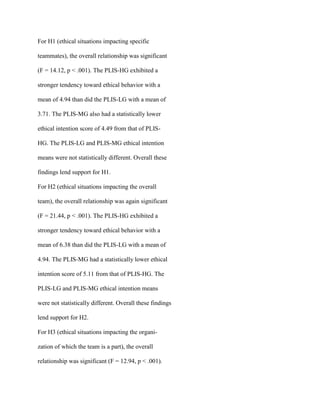
For H1 (ethical situations impacting specific
teammates), the overall relationship was significant
(F = 14.12, p < .001). The PLIS-HG exhibited a
stronger tendency toward ethical behavior with a
mean of 4.94 than did the PLIS-LG with a mean of
3.71. The PLIS-MG also had a statistically lower
ethical intention score of 4.49 from that of PLIS-
HG. The PLIS-LG and PLIS-MG ethical intention
means were not statistically different. Overall these
findings lend support for H1.
For H2 (ethical situations impacting the overall
team), the overall relationship was again significant
(F = 21.44, p < .001). The PLIS-HG exhibited a
stronger tendency toward ethical behavior with a
mean of 6.38 than did the PLIS-LG with a mean of
4.94. The PLIS-MG had a statistically lower ethical
intention score of 5.11 from that of PLIS-HG. The
PLIS-LG and PLIS-MG ethical intention means
were not statistically different. Overall these findings
lend support for H2.
For H3 (ethical situations impacting the organi-
zation of which the team is a part), the overall
relationship was significant (F = 12.94, p < .001).
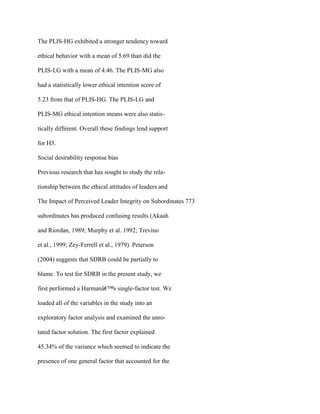
The PLIS-HG exhibited a stronger tendency toward
ethical behavior with a mean of 5.69 than did the
PLIS-LG with a mean of 4.46. The PLIS-MG also
had a statistically lower ethical intention score of
5.23 from that of PLIS-HG. The PLIS-LG and
PLIS-MG ethical intention means were also statis-
tically different. Overall these findings lend support
for H3.
Social desirability response bias
Previous research that has sought to study the rela-
tionship between the ethical attitudes of leaders and
The Impact of Perceived Leader Integrity on Subordinates 773
subordinates has produced confusing results (Akaah
and Riordan, 1989; Murphy et al. 1992; Trevino
et al., 1999; Zey-Ferrell et al., 1979). Peterson
(2004) suggests that SDRB could be partially to
blame. To test for SDRB in the present study, we
first performed a Harmanñ€ℱs single-factor test. We
loaded all of the variables in the study into an
exploratory factor analysis and examined the unro-
tated factor solution. The first factor explained
45.34% of the variance which seemed to indicate the
presence of one general factor that accounted for the
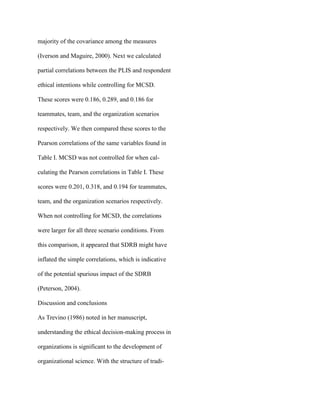
majority of the covariance among the measures
(Iverson and Maguire, 2000). Next we calculated
partial correlations between the PLIS and respondent
ethical intentions while controlling for MCSD.
These scores were 0.186, 0.289, and 0.186 for
teammates, team, and the organization scenarios
respectively. We then compared these scores to the
Pearson correlations of the same variables found in
Table I. MCSD was not controlled for when cal-
culating the Pearson correlations in Table I. These
scores were 0.201, 0.318, and 0.194 for teammates,
team, and the organization scenarios respectively.
When not controlling for MCSD, the correlations
were larger for all three scenario conditions. From
this comparison, it appeared that SDRB might have
inflated the simple correlations, which is indicative
of the potential spurious impact of the SDRB
(Peterson, 2004).
Discussion and conclusions
As Trevino (1986) noted in her manuscript,
understanding the ethical decision-making process in
organizations is significant to the development of
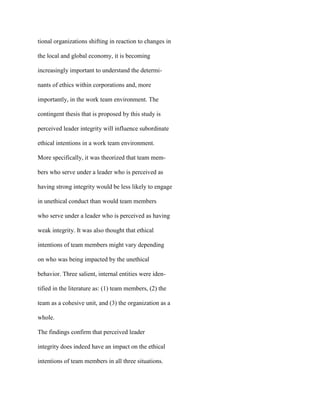
organizational science. With the structure of tradi-
tional organizations shifting in reaction to changes in
the local and global economy, it is becoming
increasingly important to understand the determi-
nants of ethics within corporations and, more
importantly, in the work team environment. The
contingent thesis that is proposed by this study is
perceived leader integrity will influence subordinate
ethical intentions in a work team environment.
More specifically, it was theorized that team mem-
bers who serve under a leader who is perceived as
having strong integrity would be less likely to engage
in unethical conduct than would team members
who serve under a leader who is perceived as having
weak integrity. It was also thought that ethical
intentions of team members might vary depending
on who was being impacted by the unethical
behavior. Three salient, internal entities were iden-
tified in the literature as: (1) team members, (2) the
team as a cohesive unit, and (3) the organization as a
whole.
The findings confirm that perceived leader
integrity does indeed have an impact on the ethical
intentions of team members in all three situations.
The relationship was strongest in ethical situations
impacting the team itself and the organization as a
whole. This is significant in light of current events in
the business world. As corporations are searching for
ways to decrease unethical employee activity, it is
important to note that team members who perceived
their team leader to have high integrity were less
likely to commit unethical acts that impact the team
itself and the organization.
Most of the previous work researching the effects
of leadership on subordinate behavior looked at the
effects of CEO or top management ethical behavior
rather than at the team level, as in the present study.
By increasing the use of work teams, corporations
can create a stronger sense of identity within their
employees and foster an environment where
employees feel they are part of something larger than
themselves. In addition, work teams tend to produce
accountability between team members which may
help to improve ethical conduct. It was found that
respondents who perceived their team leader to have
high integrity reported lower intentions of com-
mitting unethical acts directed at other team mem-
bers. Interestingly, however, the relationship was not
as strong as it was in situations impacting the team
and the organization. Only leaders who were per-
ceived as having extremely high integrity were
found to positively impact the ethical intentions of
team members toward each other. This seems to
lend support to Robinson and Bennettñ€ℱs (1995)
argument that unethical acts that affect co-workers
may be more explicable in terms of individual,
personal factors rather than in terms of situational
factors such as leader influence.
As with all empirical research, there were several
limitations associated with this study. First and fore-
most was that a team leaderñ€ℱs integrity was assessed
strictly through a single participantñ€ℱs perceptions. In
774 D. W. White and E. Lean
order to obtain the most accurate moral reading of a
team leader, it would be preferable to survey an
entire team. However, in such a case, the anonymity
perceived by participants may begin to diminish.
Further, the actual integrity of a team leader may not
be properly assessed by surveys of his or her imme-
diate subordinates. A related issue would be that
leaders are not likely to allow their integrity to be
directly observed or measured. The purpose in our
study, however, was to assess the relationship
between the team memberñ€ℱs ethical intentions and
that memberñ€ℱs perception of his leaderñ€ℱs integrity
as opposed to his leaderñ€ℱs actual integrity. Thus, it is
the team memberñ€ℱs perception of his leader that is
expected to influence his behavioral intentions
(Vidaver-Cohen, 1998). Since all research designs
contain limitations, we must caution against potential
implications of this study until further inquiries can
confirm our results.
No attempt was made to determine the impact
that leaders external to the work team have on group
members. It is likely that other leaders (spiritual,
work, athletic, etc.) have significant impact as well.
In the future, it would be valuable to determine the
degree of influence external leaders have as com-
pared to the internal group leader.
Another potential limitation of our study relates
to the fact that the respondents provided the measure
for both the PLIS and their own ethical intentions.
According to Podsakoff et al. (2003), a common
rater effect bias can be produced when the predictor
and criterion variable measures are provided by the
same individual. This type of self-report bias or
ñ€˜ñ€˜artificial covariance between the predictor and
criterion variableñ€ℱñ€ℱ is a potential weakness of the
current study. In an effort to reduce the possibility of
these types of method biases, we followed proce-
dures recommended by Podsakoff et al. (2003).
They state that by following two procedural reme-
dies, researchers can greatly minimize, if not totally
eliminate, the potential effects of common rater
variance on the findings of their studies. First, we
promised the respondents that their answers would
be completely anonymous multiple times through-
out the survey instrument. Second, we assured
respondents that there were no wrong or right an-
swers and encouraged them to answer the items as
honestly as possible. Finally, we pointed out that no
markings were used to identify the respondents on
the survey instrument. According to Podsakoff et al.
(2003), these procedures ñ€˜ñ€˜should reduce peopleñ€ℱs
evaluation apprehension and make them less likely
to edit their responses.ñ€ℱñ€ℱ In addition, we physically
distanced the respondents from the work team
leaders (Scott, 1982).
The findings that emerged from this study, though
consistent with previous studies regarding the rela-
tionship between the ethical attitudes of leaders and
their subordinates, raise several questions worthy of
additional research. Future research should investigate
how a belief in universal moral rules by team members
impacts the perceived leader integrity/ethical inten-
tions relationship. Individuals join organizations with
an individual level of cognitive moral development as
well as other personal characteristics. A personal
characteristic likely to moderate the influence of sit-
uational variables, such as perceived leader integrity, is
the degree to which an individual believes in universal
moral rules. For example, one team member may
believe that certain behaviors are always unethical
regardless of the situation while another team member
may reject the idea of universal moral rules and believe
that morality depends on situational variables or the
outcome. Assessing a subordinateñ€ℱs level of universal
moral rules may help researchers to understand exactly
how much of an impact the team leader has on the
subordinateñ€ℱs ethical intentions.
As was stated earlier, the PLIS has a tendency to
produce extremely high means due to the fact that it
only uses negative items. This limits the potential
usefulness and the analyses it can provide. In the
future, researchers should seek to deal with the po-
tential effects of heteroscedasticity caused by the
highly skewed means (Parry and Proctor-Thomson,
2002).
An implication of these results, as Craig and
Gustafson (1998) studied, is that researchers do not
yet fully understand how a followerñ€ℱs impressions of
leader integrity develop, how those impressions
change over time, or even which leader behaviors
are most influential in the perception formation
process. Studying each of these issues would greatly
expand the literature with regard to team membersñ€ℱ
ethical intentions as a result of their perceived leader
integrity.
In summary, the present study provides needed
research on the relationship between perceived lea-
der integrity and its effect on employee behavior.
The Impact of Perceived Leader Integrity on Subordinates 775
Rather than focusing on the impact of the ethical
influences of top management and CEOs, as much
of the previous literature has done, the present study
examined how leaders of work teams affect the
ethical intentions of their subordinates. It is hoped
that the findings from this study can add to the
conceptual base needed to develop a research agenda
for future investigations of the integrity of team
leaders and its effect on work team groups.
References
Abratt, R. and N. Penman: 2002, ñ€˜Understanding Factors
Affecting Salespeopleñ€ℱs Perceptions of Ethical Behavior
in South Africañ€ℱ, Journal of Business Ethics 35, 269ñ€“280.
Akaah, I. P. and E. A. Riordan: 1989, ñ€˜Judgments of
Marketing Professionals About Ethical Issues in
Marketing Research: A Replication and Extensionñ€ℱ,
Journal of Marketing Research 26, 112ñ€“120.
Andrews, P. and R. G. Meyer: 2003, ñ€˜Marlowe-Crowne
Social Desirability Scale and Short Form C: Forensic
Normsñ€ℱ, Journal of Clinical Psychology 59, 483ñ€“492.
Booth-Kewley, S., J. E. Edwards and P. Rosenfeld: 1992,
ñ€˜Impression Management, Social Desirability, and
Computer Administration of Attitude Questionnaires:
Does the Computer Make a Difference?ñ€ℱ, Journal of
Applied Psychology 77, 562ñ€“566.
Baumhart, R. C.: 1961, ñ€˜How Ethical are Businessmen?ñ€ℱ,
Harvard Business Review 39(6ñ€“19), 156ñ€“176.
Brenner, S. N. and E. A. Molander: 1977, ñ€˜Is the Ethics of
Business Changing?ñ€ℱ, Harvard Business Review 55, 57ñ€“71.
Carter, A. and A. Borrus: 2005, ñ€˜What if Companies
Fessed Up?ñ€ℱ, Business Week 3917, 59ñ€“60.
Cheng, B. S.: 2000, ñ€˜The Paternalistic Leadership of
Chinese Organization: Concept Reconstruction,
Measurement, and Model Buildingñ€ℱ, Taipai: Nation
Science Specific Research Issue Report.
Churchill, G. A., Jr.: 1979, ñ€˜A Paradigm for Developing
Better Measures of Marketing Constructsñ€ℱ, Journal of
Marketing Research 16, 64ñ€“73.
Cohen, S. G., G. E. Ledford, Jr. and G. M. Spreitzer:
1996, ñ€˜A Predictive Model of Self-Managing Work
Team Effectivenessñ€ℱ, Human Relations 49, 643ñ€“676.
Conger, S., K. D. Loch and L. Helft: 1995, ñ€˜Ethics and
Information Technology Use: A Factor Analysis of
Attitudes to Computer Useñ€ℱ, Information Systems Journal
5, 161ñ€“184.
Craig, S. B. and S. B. Gustafson: 1998, ñ€˜Perceived Leader
Integrity Scale: An Instrument For Assessing Employee
Perceptions of Leader Integrityñ€ℱ, Leadership Quarterly 9,
127ñ€“145.
Crowne, D. P. and D. Marlowe: 1960, ñ€˜A New Scale of
Social Desirability Independent of Psychopathologyñ€ℱ,
Journal of Consulting Psychology 24, 349ñ€“354.
Deluga, R. J.: 1995, ñ€˜The Relationship Between Attri-
butional Charismatic Leadership and Organizational
Citizenship Behaviorñ€ℱ, Journal of Applied Social
Psychology 25, 1652ñ€“1669.
Drucker, P. F: 1998, ñ€˜Knowledge Worker Productivity:
The Biggest Challengeñ€ℱ, California Management Review
41, 79ñ€“94.
Farh, J. L., P. M. Podsakoff and D. W. Organ: 1990,
ñ€˜Accounting for Organizational Citizenship Behavior:
Leader Fairness and Task Scope Versus Satisfactionñ€ℱ,
Journal of Management 16, 705ñ€“721.
Ferrell, O. C. and L. G. Gresham: 1985, ñ€˜A
Contingency Framework for Understanding Ethical
Decision-Making in Marketingñ€ℱ, Journal of Marketing
49, 87ñ€“96.
Forte, A.: 2004, ñ€˜Business Ethics: A Study of the Moral
Reasoning of Select Business Managers and the
Influence of Organizational Ethical Climateñ€ℱ, Journal of
Business Ethics 51, 167ñ€“173.
George, J. M. and K. Bettenhausen: 1990, ñ€˜Under-
standing Prosocial Behavior, Sales Performance, and
Turnover: A Group-Level Analysis in a Service
Contextñ€ℱ, Journal of Applied Psychology 75, 698ñ€“709.
Green, P. E.: 1978, Analyzing Multivariate Data (The
Dryden Press, Hinsdale, IL).
Hair, F. J., R. E. Anderson, R. L. Tatham and W. C.
Black: 1992, Multivariate Data Analysis, 3rd Edition
(McMillian Publishing Co, New York, NY), pp. 263.
Hunt, S. D, L. B. Chonko and J. B. Wilcox: 1984,
ñ€˜Ethical Problems of Marketing Researchersñ€ℱ, Journal of
Marketing Research 21, 309ñ€“24.
Hunt, S. D. and S. Vitell: 1986, ñ€˜A General Theory of
Marketing Ethics,ñ€ℱ Journal of Macromarketing 6(1), 5ñ€“16.
Iverson, R. D. and C. Maguire: 2000, ñ€˜The Relationship
Between Job and Life Satisfaction: Evidence form a
Remote Mining Communityñ€ℱ, Human Relations 53,
807ñ€“839.
Jessup, H. R.: 1990, ñ€˜New Roles in Team Leadershipñ€ℱ,
Training and Development Journal 44, 79ñ€“83.
Katzenbach, J. R. and D. K. Smith: 1993, The Wisdom of
Teams: Creating the High-Performance Organization
(Harper Collins, New York).
Lawler, E. E., III, S. A. Mohrman and G. E. Ledford, Jr.:
1995, Creating High Performance Organizations: Practices
and Results of Employee Involvement and Total Quality
Management in Fortune 1000 Companies (Jossey-Bass,
San Francisco).
Lewis, J. P.: 1993, How to Build and Manage a Winning
Project Team (American Management Association,
New York).
776 D. W. White and E. Lean
Loe, T. W., L. Ferrell and P. Mansfield: 2000, ñ€˜A Review
of Empirical Studies Assessing Ethical Decision Mak-
ing in Businessñ€ℱ, Journal of Business Ethics 25, 185ñ€“204.
Merritt, J.: 2004, ñ€˜Welcome to Ethics 101ñ€ℱ, Business Week
3904, 90.
Minkes, A. L., M. W. Small and S. R. Chatterjee: 1999,
ñ€˜Leadership and Business Ethic: Does It Matter?
Implications for Managementñ€ℱ, Journal of Business Ethics
20, 327ñ€“335.
Murphy, P. R., J. E. Smith and J. M. Daley: 1992,
ñ€˜Executive Attitudes, Organizational Size and Ethical
Issues: Perspectives on a Service Industryñ€ℱ, Journal of
Business Ethics 11, 11ñ€“19.
Nunnally, J. C.: 1978, Psychometric Theory (McGraw-Hill,
New York, NY).
Paine, L. S.: 1997, Cases In Leadership, Ethics, and
Organization Integrity: A Strategic Perspective (Irwin
Press, Chicago, IL).
Parry, K. W. and S. B. Proctor-Thomson: 2002, ñ€˜Per-
ceived Integrity of Transformational Leaders in
Organisational Settingsñ€ℱ, Journal of Business Ethics 35,
75ñ€“96.
Pearce, C. L. and P. A. Herbik: 2004, ñ€˜Citizenship
Behavior at the Team Level of Analysis: The Effects of
Team Leadership, Team Commitment, Perceived
Team Support, and Team Sizeñ€ℱ, Journal of Social
Psychology 144, 293ñ€“310.
Peterson, D. K.: 2002, ñ€˜Deviant Workplace Behavior and
the Organizationñ€ℱs Ethical Climateñ€ℱ, Journal of Business
and Psychology 17, 47ñ€“61.
Peterson, D.: 2004, ñ€˜Perceived Leader Integrity and
Ethical Intentions of Subordinatesñ€ℱ, Leadership and
Organization Development Journal 25, 7ñ€“23.
Podsakoff, P. M., S. B. MacKenzie, N. P. Podsakoff and
J. Y. Lee: 2003, ñ€˜Common Method Biases in Be-
havioral Research: A Critical Review of the Literature
and Recommended Remediesñ€ℱ, Journal of Applied
Psychology 88, 879ñ€“903.
Premeaux, S. R.: 2004, ñ€˜The Current Link Between
Management Behavior and Ethical Philosophyñ€ℱ, Journal
of Business Ethics 51, 269ñ€“278.
Reynolds, W. M.: 1982, ñ€˜Development of Reliable and
Valid Short Forms of the Marlowe-Crowne Social
Desirability Scaleñ€ℱ, Journal of Clinical Psychology 38,
119ñ€“125.
Robinson, S. L. and R. J. Bennett: 1995, ñ€˜A Typology of
Deviant Workplace Behavior: A Multidimensional
Scaling Studyñ€ℱ, Academy of Management Journal 38, 555ñ€“
572.
Schminke, M., M. L. Ambrose and D. O. Neubaum:
2005, ñ€˜The Effect of Leader Moral Development on
Ethical Climate and Employee Attitudesñ€ℱ, Organiza-
tional Behavior and Human Decision Processes 97, 135ñ€“
151.
Schnake, M., M. P. Dumler and D. S. Cochran: 1993,
ñ€˜The Relationship Between ñ€˜ñ€˜Traditionalñ€ℱñ€ℱ Leadership,
ñ€˜ñ€˜Superñ€ℱñ€ℱ Leadership and Organizational Behaviorñ€ℱ,
Group and Organizational Management 18, 352ñ€“365.
Scott, C.: 1982, ñ€˜Contribution to Discussion of the Paper
by Dr Kalton & Dr. Schumanñ€ℱ, Journal of the Royal
Statistical Society 145, 68ñ€“69.
Settoon, R. P., N. Bennett and R. C. Liden: 1996,
ñ€˜Social Exchange in Organizations: Perceived Orga-
nizational Support, Leader-Member Exchange, and
Employee Reciprocityñ€ℱ, Journal of Applied Psychology
81, 219ñ€“227.
Shea, P. W.: 2000, Principle Leadership Style, Up Down
Relationship Quality and Teacher Organizational Behavior
Citizenship Research, National Taipai Teachers College,
Graduate School of Nationalist Education Master
Thesis.
Sims, R. R.: 2000, ñ€˜Changing an Organizationñ€ℱs Culture
Under New Leadershipñ€ℱ, Journal of Business Ethics 25,
65ñ€“78.
Sims, R. R. and J. Brinkmann: 2002, ñ€˜Leaders as Moral
Role Models: The Case of John Gutreund at Saloman
Brothersñ€ℱ, Journal of Business Ethics 35, 327ñ€“339.
Soutar, G., M. M. McNeil and C. Molster: 1994, ñ€˜The
Impact of the Work Environment on Ethical Decision
Making: Some Australian Evidence,ñ€ℱ Journal of Business
Ethics 13, 327ñ€“339.
Thamhain, H. J.: 2004, ñ€˜Team Leadership Effectiveness in
Technology Based Project Environmentsñ€ℱ, Project
Management Journal 35, 35ñ€“46.
Trevino, L. K.: 1986, ñ€˜Ethical Decision Making in
Organizations: A Person-Situation Interactionist
Modelñ€ℱ, Academy of Management Review 11, 601ñ€“617.
Trevino, L. K. and M. E. Brown: 2004, ñ€˜Managing to be
Ethical: Debunking Five Business Ethics Mythsñ€ℱ,
Academy of Management Executive 18, 69ñ€“81.
Trevino, L. K., G. R. Weaver, D. G. Gibson and B. L.
Toffler: 1999, ñ€˜Managing Ethics and Legal
Compliance: What Works and What Hurtsñ€ℱ, California
Management Review 41, 131ñ€“151.
VanSandt, C. V. and C. P. Neck: 2003, ñ€˜Bridging Ethics
and Self Leadership: Overcoming Ethical Discrepan-
cies Between Employee and Organizational Standardsñ€ℱ,
Journal of Business Ethics 43, 363ñ€“387.
Vidaver-Cohen, D.: 1998, ñ€˜Moral Climate in Business
Firms: A Conceptual Framework For Analysis and
Changeñ€ℱ, Journal of Business Ethics 17, 1211ñ€“1126.
Vitell, S. J. and D. L. Davis: 1990, ñ€˜The Relationship
Between Ethics and Job Satisfaction: An Empirical
Investigationñ€ℱ, Journal of Business Ethics 9, 489ñ€“494.
The Impact of Perceived Leader Integrity on Subordinates 777
Vitell, S. J., E. B. Dickerson and T. A. Festervand: 2000,
ñ€˜Ethical Problems, Conflicts and Beliefs of Small
Business Professionalsñ€ℱ, Journal of Business Ethics 28, 15ñ€“
25.
Wayne, S. J. and S. A. Green: 1993, ñ€˜The effects of
Leader-Member Exchange on Employee Citizenship
and Impression Management Behaviorñ€ℱ, Human Rela-
tions 46, 1431ñ€“441.
Wayne, S. J., L. M. Shore and R. C. Liden: 1997,
ñ€˜Perceived Organizational Support and Leader-
Member Exchange: A Social Exchange Perspectiveñ€ℱ,
Academy of Management 40, 82ñ€“111.
Weeks, W. A., T. W. Loe, L. W. Chonko and K.
Wakefield: 2004, ñ€˜The Effect of Perceived Ethical
Climate on the Search for Sales Force Excellenceñ€ℱ,
Journal of Personal Selling and Sales Management 14, 199ñ€“
214.
Williams, J.: 2002, Team Development for High-Tech Project
Managers (Artech House, Norwood, MA).
Williams, S., R. Pitre and M. Zainuba: 2002, ñ€˜Justice and
Organizational Citizenship Behavior Intentions: Fair
Rewards Versus Fair Treatmentñ€ℱ, The Journal of Social
Psychology 142, 33ñ€“44.
Zey-Ferrell, M. and O. C. Ferrell: 1982, ñ€˜Role-Set
Configuration and Opportunity as Predictors of
Unethical Behavior in Organizationsñ€ℱ, Human Relations
35, 587ñ€“605.
Zey-Ferrell, M., K. M. Weaver and O. C. Ferrell: 1979,
ñ€˜Predicting Unethical Behavior Among Marketing
Practitionersñ€ℱ, Human Relations 32, 557ñ€“569.
Darin W. White
McAfee School of Business Administration,
Union University,
1050 Union University Dr, Jackson, TN, 38305,
U.S.A.
E-mail: [email protected]
Emily Lean
Walton College of Business,
University of Arkansas,
Business Building 402, Fayetteville, AR, 72701,
U.S.A.
778 D. W. White and E. Lean
Reproduced with permission of the copyright owner. Further reproduction prohibited without
permission.
<< /ASCII85EncodePages false /AllowTransparency false /AutoPositionEPSFiles true
/AutoRotatePages /None /Binding /Left /CalGrayProfile (None) /CalRGBProfile (sRGB
IEC61966-2.1) /CalCMYKProfile (ISO Coated v2 300% 050ECI051) /sRGBProfile (sRGB
IEC61966-2.1) /CannotEmbedFontPolicy /Error /CompatibilityLevel 1.3 /CompressObjects /Off
/CompressPages true /ConvertImagesToIndexed true /PassThroughJPEGImages true
/CreateJDFFile false /CreateJobTicket false /DefaultRenderingIntent /Perceptual /DetectBlends
true /ColorConversionStrategy /sRGB /DoThumbnails true /EmbedAllFonts true
/EmbedJobOptions true /DSCReportingLevel 0 /SyntheticBoldness 1.00 /EmitDSCWarnings
false /EndPage -1 /ImageMemory 524288 /LockDistillerParams true /MaxSubsetPct 100
/Optimize true /OPM 1 /ParseDSCComments true /ParseDSCCommentsForDocInfo true
/PreserveCopyPage true /PreserveEPSInfo true /PreserveHalftoneInfo false
/PreserveOPIComments false /PreserveOverprintSettings true /StartPage 1 /SubsetFonts false
/TransferFunctionInfo /Apply /UCRandBGInfo /Preserve /UsePrologue false /ColorSettingsFile
() /AlwaysEmbed [ true ] /NeverEmbed [ true ] /AntiAliasColorImages false
/DownsampleColorImages true /ColorImageDownsampleType /Bicubic /ColorImageResolution
150 /ColorImageDepth -1 /ColorImageDownsampleThreshold 1.50000 /EncodeColorImages true
/ColorImageFilter /DCTEncode /AutoFilterColorImages false /ColorImageAutoFilterStrategy
/JPEG /ColorACSImageDict << /QFactor 0.76 /HSamples [2 1 1 2] /VSamples [2 1 1 2] >>
/ColorImageDict << /QFactor 0.76 /HSamples [2 1 1 2] /VSamples [2 1 1 2] >>
/JPEG2000ColorACSImageDict << /TileWidth 256 /TileHeight 256 /Quality 30 >>
/JPEG2000ColorImageDict << /TileWidth 256 /TileHeight 256 /Quality 30 >>
/AntiAliasGrayImages false /DownsampleGrayImages true /GrayImageDownsampleType
/Bicubic /GrayImageResolution 150 /GrayImageDepth -1 /GrayImageDownsampleThreshold
1.50000 /EncodeGrayImages true /GrayImageFilter /DCTEncode /AutoFilterGrayImages true
/GrayImageAutoFilterStrategy /JPEG /GrayACSImageDict << /QFactor 0.76 /HSamples [2 1 1
2] /VSamples [2 1 1 2] >> /GrayImageDict << /QFactor 0.15 /HSamples [1 1 1 1] /VSamples [1
1 1 1] >> /JPEG2000GrayACSImageDict << /TileWidth 256 /TileHeight 256 /Quality 30 >>
/JPEG2000GrayImageDict << /TileWidth 256 /TileHeight 256 /Quality 30 >>
/AntiAliasMonoImages false /DownsampleMonoImages true /MonoImageDownsampleType
/Bicubic /MonoImageResolution 600 /MonoImageDepth -1 /MonoImageDownsampleThreshold
1.50000 /EncodeMonoImages true /MonoImageFilter /CCITTFaxEncode /MonoImageDict <<
/K -1 >> /AllowPSXObjects false /PDFX1aCheck false /PDFX3Check false
/PDFXCompliantPDFOnly false /PDFXNoTrimBoxError true
/PDFXTrimBoxToMediaBoxOffset [ 0.00000 0.00000 0.00000 0.00000 ]
/PDFXSetBleedBoxToMediaBox true /PDFXBleedBoxToTrimBoxOffset [ 0.00000 0.00000
0.00000 0.00000 ] /PDFXOutputIntentProfile (None) /PDFXOutputCondition ()
/PDFXRegistryName (http://www.color.org?) /PDFXTrapped /False /Description << /ENU
<FEFF004a006f0062006f007000740069006f006e007300200066006f007200200041006300720
06f006200610074002000440069007300740069006c006c0065007200200036002e000d0050007
2006f006400750063006500730020005000440046002000660069006c006500730020007700680
0690063006800200061007200650020007500730065006400200066006f0072002000640069006
7006900740061006c0020007000720069006e00740069006e006700200061006e00640020006f0
06e006c0069006e0065002000750073006100670065002e000d002800630029002000320030003
0003400200053007000720069006e00670065007200200061006e006400200049006d007000720
065007300730065006400200047006d00620048> /DEU
<FEFF004a006f0062006f007000740069006f006e007300200066006f007200200041006300720
06f006200610074002000440069007300740069006c006c0065007200200036002e000d0050007
2006f006400750063006500730020005000440046002000660069006c006500730020007700680
0690063006800200061007200650020007500730065006400200066006f00720020006f006e006
c0069006e0065002e000d0028006300290020003200300030003800200053007000720069006e0
06700650072002d005600650072006c0061006700200047006d006200480020000d000d0054006
800650020006c00610074006500730074002000760065007200730069006f006e0020006300610
06e00200062006500200064006f0077006e006c006f006100640065006400200061007400200068
007400740070003a002f002f00700072006f00640075006300740069006f006e002e00730070007
20069006e006700650072002e0063006f006d000d0054006800650072006500200079006f00750
02000630061006e00200061006c0073006f002000660069006e006400200061002000730075006
9007400610062006c006500200045006e0066006f0063007500730020005000440046002000500
072006f00660069006c006500200066006f0072002000500069007400530074006f007000200050
0072006f00660065007300730069006f006e0061006c0020003600200061006e006400200050006
9007400530074006f007000200053006500720076006500720020003300200066006f007200200
070007200650066006c00690067006800740069006e006700200079006f0075007200200050004
40046002000660069006c006500730020006200650066006f007200650020006a006f006200200
07300750062006d0069007300730069006f006e002e> >> >> setdistillerparams <<
/HWResolution [2400 2400] /PageSize [5952.756 8418.897] >> setpagedevice
The Talmudic Concept of "Beyond the Letter of the Law": Relevance to Business Social
Responsibilities Author(s): Moses L. Pava Source: Journal of Business Ethics, Vol. 15, No. 9
(Sep., 1996), pp. 941-950 Published by: Springer Stable URL:
http://www.jstor.org/stable/25072821 . Accessed: 30/08/2011 15:16
Your use of the JSTOR archive indicates your acceptance of the Terms & Conditions of Use,
available at . http://www.jstor.org/page/info/about/policies/terms.jsp
JSTOR is a not-for-profit service that helps scholars, researchers, and students discover, use, and
build upon a wide range of content in a trusted digital archive. We use information technology
and tools to increase productivity and facilitate new forms of scholarship. For more information
about JSTOR, please contact [email protected]
Springer is collaborating with JSTOR to digitize, preserve and extend access to Journal of
Business Ethics.
http://www.jstor.org
http://www.jstor.org/action/showPublisher?publisherCode=springer
http://www.jstor.org/stable/25072821?origin=JSTOR-pdf
http://www.jstor.org/page/info/about/policies/terms.jsp
ABSTRACT. There is growing recognition that good ethics can have a positive economic impact
on the performance of firms. Many statistics support the premise that ethics, values, integrity and
responsibility are required in the modern workplace. For consumer groups and society at large,
research has shown that good ethics is good business. This study defines and traces the
emergence and evolution within the business literature of the concepts of values, business ethics
and corporate social responsibility to illustrate the increased emphasis that has been placed on
these issues over time. Two organizations that have suc- cessfully dealt with these issues were
analyzed to identify the links among values, ethics, and corpo- rate social responsibility as they
are incorporated into the culture and management of a firm. This study identified the presence
and implementation of values,
business ethics, and CSR actions within the two orga- nizations studied.
Introduction
It has been clearly established that ethics is not just a fad.
ñ€Ɠ. . . (W)inning companies first emphasize values ñ€“ the beliefs and attitudes that . . . the
business owner, ha(s) about . . . employees, customers, quality, ethics, integrity, social
responsibility, growth, stability, innovation and flexibility. Managing by values ñ€“ not by
profits ñ€“ is a powerful process that will set . . . (a) business on the path to becoming . . . a
ñ€ƓFortunate 500ñ€ company (Blanchard, 1998).ñ€
Evolution and Implementation: A Study of Values, Business Ethics and Corporate
Brenda E. Joyner Social Responsibility Dinah Payne
Journal of Business Ethics 41: 297ñ€“311, 2002. © 2002 Kluwer Academic Publishers. Printed
in the Netherlands.
Brenda E. Joyner is Associate Professor of Management at Loyola University New Orleans. She
received her Ph.D. from the University of Georgia in 1995. Dr. Joyner teaches classes in
strategic management, entrepreneurship, and strategic quality management. Her research inter-
ests include venture startups, entrepreneurial behaviors, and entrepreneurial ethics. Her business
experience includes eight years with a startup venture in the con- struction industry, two years
with a Fortune 500 man- ufacturing firm, and many years in the financial services industry in
investment and commercial banking. She has published articles in Journal of Developmental
Entrepreneurship, Journal of Business and Economic Perspectives, Frontiers of Entrepreneurship
Research, Global Focus and Quality Progress. She is a 1997 recipient of the Certificate of
Distinction for Excellence in Research in Entrepreneurship and Independent Business, given by
the Academy of Management and the National Federation for Independent Businesses.
Dinah Payne is Professor of Management at the University of New Orleans. A graduate of
Loyola University New Orleans, Dr. Payne earned a Juris Doctor Degree and a Master of
Business Administration Degree. Her teaching and research interests include multiple facets of
international business: law, strategy, organizational behavior, corporate social responsibility and
ethics. Additionally, she has done extensive research in U.S. domestic business law, ethics,
management and engi- neering management. She has had articles published in the Journal of
Business Ethics, the Labor Law Journal, the Journal of Managerial Issues, Management
Accounting, and the Journal of Corporate Accounting and Finance. She is a member of the
American Bar Association, the Louisiana Bar Association, the New Orleans World Trade Center,
the Academy of Legal Studies in Business and the International Academy of Business
Disciplines.
Many statistics support the premise that ñ€Ɠtalk about ethics, values, integrity and responsibility
is not only becoming acceptable in the business community, itñ€ℱs practically required
(Stodder, 1998).ñ€‱ For consumer groups and society at large, research has shown that good
ethics is good business. Stodder (1998) reports that a Walker Information survey (1994) of
consumers produced results indicating that good business is good ethics: forty-seven per cent of
those polled responded that they would be much more likely to buy from a ñ€Ɠgoodñ€‱
company given parity in quality, service and price. Additionally, 70% of the consumers
answered that they would not do business with a firm that was not socially respon- sible,
regardless of price.
In light of the change in the way values and ethics are viewed by organizational stakeholders,
there has been growing recognition that prof- itability measures, in isolation, fail to capture the
essence of an organizationñ€ℱs overall performance, both as a profit-seeking entity and as a
member of society. This paper suggests, as a starting point, general suppositions as to why
businesses are ethical and proceeds with a review of the seman- tics of business ethics and a
foundational presen- tation of the definitions of values, business ethics/morality and corporate
social responsibility (CSR). Further, it traces the emergence and evolution within the business
literature of the concepts of values, business ethics and CSR to illustrate the increased emphasis
which has been placed on these issues over time. Two organiza- tions that have successfully
dealt with these issues are profiled in order to try to discover the link between values, ethics, and
CSR as they are incorporated into the culture and management of a firm. These organizations are
also models to show the positive economic impact that good ethics can create. Thus, we perceive
the eco- nomic and moral value of good business ethics.
Business ethics: the why
A predicate question to the role of ethics in business is the question of why businesses engage in
ethical practices. Some authors, notably Milton Friedman (1962), would strongly deny
that a business has a fiduciary responsibility to any group but the firmñ€ℱs stockholders. To
initiate corporate giving, for example, would be a fiduciary breach of management in
Friedmanñ€ℱs opinion: an agent for a principal is neither legally nor morally permitted to give
away or ñ€Ɠwasteñ€ the principalñ€ℱs capital. The managerñ€ℱs fiduciary duty, one wherein
stockholders should be able to repose trust and confidence in managementñ€ℱs obligation to act
in the shareholdersñ€ℱ own best self-interest, is to husband organizational strength and generate
a growth environment, for the continued maximization of shareholder wealth. Employees are
also an integral part of the firmñ€ℱs environmental ethics. A Walker Information survey (1997)
revealed that 86% of the employees surveyed who felt their firmñ€ℱs ethics were positive, were
strongly committed to their orga- nizations, while only 14% of the respondents who did not
regard the firmñ€ℱs ethics highly, were similarly committed. 42% of all surveyed indi- cated
that a firmñ€ℱs ethical integrity would directly influence their choice of employer (Stodder,
1998).
The view of pursuing shareholder wealth alone, of course, is not the approach most ethicists or,
now, most business people take. The realization has occurred that businesses must participate in
society in an ethically symbiotic way. A fundamental truth is that business cannot exist without
society and that society cannot go forward without business. Thus, business must acknowledge
societyñ€ℱs existence and societyñ€ℱs growing demand for more ethically responsible
business practice.
Businesses will in fact engage in ethical business practices for one of two reasons, one ethical in
nature and one more machiavellian. The ethical motivation guiding business is related to a desire
to do the right thing, without external pressure or governmental constraint. As this empirical
evidence presented here shows, business does choose this approach without being forced into
doing so. These business people recognize their own personal existence in society and thus
acknowledge that their firms must also operate in this sphere in an ethical manner.
The more machiavellian approach that busi- nesses espouse in their use of ethics has its roots
298 Brenda E. Joyner and Dinah Payne
in a desire to convince the stakeholder that the firm is doing the right thing. The firmñ€ℱs end
here is either to avoid legal consequences of its actions or to convince the stakeholders that the
firm does have their best interests at heart and seeks to serve their interests rather than their own.
An example of this is the beer industry: the advertising cam- paigns touting responsible
consumption of beer may in fact be to serve the consumer interest in safety. However, in a more
cynical world, such an advertising campaign could have been designed to make the consumer
feel that the firms cared more for their consumers than for selling their products.
In fact, minimal compliance with legal standards alone can be deadly to the firm. The myriad of
laws affecting corporate existence and behavior is numerous enough to entangle any business to
its demise (see the example of Johns- Manville, the now defunct manufacturer of asbestos).
Public outrage over perceived illegal or immoral acts is as harsh, if not worse: trust is lost and
public image tarnished, good will that is extremely expensive to generate initially and almost
impossible to regain once lost. Thus, ñ€Ɠ(A)lthough legality generally stems from what society
believes is morally right or wrong, an issueñ€ℱs legality does not always reflect the totality of
its perceived morality. This differentiation reflects the classic distinction between the spirit of the
law (morality) and the letter of the law (legality) (Raiborn and Payne, 1990).ñ€‱
Right or wrong: the definitions of ethics
There has been considerable debate regarding what the terms values, business ethics and CSR
represent. In order to be consistent with prior literature in social issues and management research
and to assist the reader, the following definitions were used throughout this research. Values are
defined as the core set of beliefs and principles deemed to be desirable (by groups) of individuals
(Andrews, 1987; Mason, 1992). Values are derived from oneñ€ℱs membership in a culture.
With attitudes, beliefs, and behaviors, values combine to form a continuous spiral of community
culture (Adler, 1999). Each suc-
ceeding generation has impact on the next generationñ€ℱs values, beliefs, attitudes and behav-
iors. Thus, our grandparentsñ€ℱ values are likely to be reflected in ours, as ours are to be
reflected in our childrenñ€ℱs and grandchildrenñ€ℱs. As the movement towards consciously
incorporating ethics into businesses in our society grows, the stronger will be the cultural pull to
be ethical.
Ethics are defined as the conception of what is right and fair conduct or behavior (Carroll, 1991;
Freeman and Gilbert, 1988). ñ€ƓEthics is a system of value principles or practices and a
definition of right and wrong (Raiborn and Payne, 1990).ñ€‱ Velasquez (1999) defined ethics as
being concerned with judgements involved in moral decisions: normative judgements which
state or imply that something is good or bad, or right or wrong. Thus, these statements of ethics
or value judgements attempt to ascribe value to actions, so the actor can determine whether or
not he should engage in the action.
More specifically with regard to business, De George (1999) defined business ethics as the
interaction of ethics and business. Such a defin- ition encompasses a moral evaluation of the
economic system of the free enterprise system in the United States, the businesses which operate
in this system, a moral evaluation of individuals and their actions in conducting business and a
review of business behavior in the international arena. De George provides further illumination:
moral judgements should be uni- versally applicable, they involve serious matters with potential
to cause serious results, and moral judgements invoke praise or blame. Additionally, moral
judgements can only be made by individ- uals for themselves: others, including govern- mental
agencies, cannot force moral judgements on anyone. De George also distinguished between
objective and subjective morality. Objective morality is the broader, societally held moral law.
This is most easily equated with promulgated law. Subjective morality, on the other hand, is
oneñ€ℱs own belief as to the right- ness or wrongness of an action. This is equat- able to the
concept of conscience. In a perfect world, the decision-maker would make decisions that were
deemed both objectively and subjec- tively correct. In the world of business and entre-
Evolution and Implementation 299
preneurship, the decision-maker must sometimes choose between those moralities: strong
minded entrepreneurs choose the subjective right.
A common sense, dictionary-type definition of the word moral or even morality indicates that
morality is the ability to choose between right and wrong. Reasonably, the definitions of ethics
and morality are cross-referenced to each other. The terms moral and ethical have been used
interchangeably in this paper, as they are in much of the social issues literature (Freeman and
Gilbert, 1988). Additionally, the concept of cor- porate social responsibility, defined more
specif- ically below, is often included in the definition of ethics in general (Singer, 1993).
Corporate social responsibility (CSR) is defined as categories or levels of economic, legal,
ethical and discretionary activities of a business entity as adapted to the values and expectations
of society (Andrews, 1987; Carroll, 1979; Sethi, 1975). The term corporate social responsibility
is used more in the management literature than in the business ethics literature. However, while
some authors may not agree (Friedman, 1962), the researchers feel that these concepts, as with
the terms moral and ethical, are similar enough to be interchangeable for the purposes of this
paper.
Archie Carroll (1979) has developed a frame- work for integrating all dimensions of social
responsibility into the firmñ€ℱs corporate culture and decision making processes. The
ñ€ƓOrganiza- tional Social Performance Modelñ€‱ is comprised of three dimensions and can be
visualized as a three dimensional cube, with all sets of dimen- sions intersecting with the others:
the level of responsibility can be measured against the social issue involved, as well as the
firmñ€ℱs social respon- siveness to these issues. Dimension I contains the ñ€ƓSocial
Responsibilityñ€‱ categories. These respon- sibilities, in order of importance to the firm, are
economic, legal, ethical and discretionary. The economic responsibilities of the firm are to
produce goods and services to be sold at a profit. Obedience to societal laws and regulations,
while executing economic responsibilities is the firmñ€ℱs legal responsibilities. The firmñ€ℱs
ethical responsi- bilities are to meet societyñ€ℱs expectations for conscientious and proper
behavior. Carroll rec-
ognized in developing this responsibility that these expectations may not be only a matter of
legal compliance, according to the letter of the law, but may go further in pursuit of the spirit of
the law. Finally, the firmñ€ℱs discretionary responsibilities encompass the duty to carry out acts
of a voluntary nature designed to provide for the betterment of society, such as philanthropic
contributions or provisions of certain employee benefits. Such acts are not required to be under-
taken by the firm, as legal responsibilities are, and the firm would not be considered unethical for
not engaging in these activities, but it is within the firmñ€ℱs discretion to do the acts as a con-
tributing member of society.
The second dimension of Carrollñ€ℱs model is represented by the firmñ€ℱs the ñ€ƓPhilosophy
of Social Responsiveness.ñ€‱ These philosophies direct how an organization will respond to
social issues. There are four types of social responsiveness philosophies. First, the reaction
philosophies require the firm to address social issues as a result of the application of external
forces, such as legal, regulatory or social pressures. Defense philoso- phies address social issues
to escape being forced into it by the external forces. The third philos- ophy of responsiveness is
the accommodation philosophy: these firms address social issues because they exist. This
represents a stride in the direction of doing the right thing because it is the right thing, rather than
from some ulterior motive to further the economic interests of the firm. In this instance, the
demands to recognize and deal with social issues are not likely to be made by external forces, but
the firm takes a voluntary stance in dealing with social issues before being forced into it by
outside forces. The final philosophy goes even further than the accommodation philosophy. The
proaction philosophy is one that attempts to be proactive with society: it attempts to anticipate
important social issues before they are generally recognized as being important and to develop
strategies for addressing these issues.
The third dimension of this model is the dimensions of the social issues themselves. A review of
stakeholders and issues in our society yields a list of issues identified by Carroll: con- sumerism,
environmentalism, discrimination
300 Brenda E. Joyner and Dinah Payne
issues, issues involving product safety and occu- pational safety, and shareholder issues. It can
be anticipated that these issues and stakeholders are not static; social issues are as dynamic as is
society and the list should be considered illustrative only, not complete. In light of the Carroll
model, it is clear that one must consider the existence and importance of the firmñ€ℱs
stakeholders in the ethical decision making process. These stake- holders include, but are not
necessarily limited to: employees, stockholders, customers, suppliers, lenders, communities and
society at large (Vaughn, 1997). This paper attempts to track the use of these dimensions by
entrepreneurs and to determine the extent to which the entrepreneurs and their business have
incorporated these ideas into their corporate cultures.
These concepts of values, ethics/morality and CSR are not mutually exclusive; rather, they are
interrelated and somewhat interdependent. Values influence the extent of a corporationñ€ℱs
perceived social responsibility and are influenced by societal activities and norms or standards.
One component of corporate social responsibility is an organizationñ€ℱs ethical responsibility,
which is also influenced by the values of society (Carroll, 1979). Conversely, ethical or unethical
activities of an organization can influence the values held by members of society. Once again,
the spiral of culture, wherein culture influences values, which influence beliefs, which influence
attitudes, which influence behaviors, which shapes culture, continues to form.
Literature review
Some of the classic texts that form the founda- tions of management research and practice were
researched to identify these themes as they emerged and evolved in the literature to identify
changes in perception of these concepts over time. In addition, other texts published more
recently were reviewed to identify the most recent changes in the understanding of these
concepts.
The evolving concepts
While the management literature has many good books and articles which address values,
business ethics, and CSR, the following works have been chosen because they have endured
through the years and generated much of the original dis- course in the concepts of interest
(Schendel and Hofer, 1979; Summer et al., 1990). They are summarized in Table I.
The role of the organization within the larger society was addressed by Chester Barnard as early
as 1938 in his seminal book, The Functions of the Executive. Barnard decried the lack of
recogni- tion that formal organizations are a most impor- tant characteristic of social life, as they
are the principal structural frameworks of society itself (1938, p. xxix). He concentrated on
aspects of individual action, which are directed by their connection with formal organizations.
Barnard recognized that many unwritten rules guiding an organizationñ€ℱs course of business
grew from actual practice (1938, p. 172). He addressed the need to analyze the economic, legal,
moral, social, and physical elements of the environment when making business decisions (1938,
p. 198), stating that the organization endures depending upon the quality of its leadership, which
is in propor- tion to the breadth of morality on which it stands (1938, p. 282).
Herbert Simonñ€ℱs book, Administrative Behavior (1945), built on the work of Barnard. Like
Barnard, Simon noted the strong influence of the organization on the individual and addressed
aspects of individual action within the context of the organization. While Simon recognized that
organizations must be responsive to community values, far beyond explicit legal considerations,
he saw the primary criteria of ñ€Ɠgoodñ€‱ business as economic behavior accurately calculated
to recognized a gain (1945, p. 62). He noted, however, that an increasing number of businesses
had become affected with a public interest, as executives had become concerned with respon-
sibilities of trusteeship toward the community beyond the legal limits imposed on them (1945, p.
70).
Peter Drucker, in his book The Practice of Management, was among the first authors to
Evolution and Implementation 301
explicitly address the ñ€Ɠsocial responsibilities of businessñ€‱ (1954, p. ix). Whereas Barnard
(1938) and Simon (1945) gave far more attention to the moral/ethical dimensions of individual
behavior in organizations, Drucker concentrated more on CSR. He included public responsibility
as one of the eight key areas in which business objectives should be set. Further, Drucker stated
that objectives in this area must be set according to prevailing political and social conditions as
per- ceived by management (1954, p. 82). Morality had to be a principle of action, exhibited
through tangible behavior, that stressed building on strengths, integrity, and high standards of
justice and conduct (1954, p. 146). Drucker recognized the growing requirement that a manager
assume responsibility for the public good, as he subor- dinated his actions to an ethical standard
of conduct. While he emphatically declared that the organizationñ€ℱs first responsibility to
society involved making a profit, he felt it was also most important that management consider
the impact of every business policy and action upon society.
ñ€ƓIt has to consider whether the action is likely to promote the public good, to advance the
basic beliefs of our society, to contribute to its stability, strength, and harmonyñ€‱ (1954, p.
388). The ultimate responsibility of management was ñ€Ɠto itself, to the enterprise, to our
heritage, to our society, and to our way of lifeñ€‱ (1954, p. 392).
Philip Selznick primarily addressed values, although he did provide some insight into
moral/ethical considerations and corporate social responsibility, in his book Leadership in
Administration: A Sociological Perspective. He noted that sound organizational leadership
required the ñ€Ɠproper ordering of human affairs, including the establishment of social order,
the determination of public interest, and the defense of critical valuesñ€‱ (1957, p. ix). Like
Drucker (1954), Selznick realized that organizations had become increasingly public in nature
and needed to deal with problems that affected the welfare of the entire community. He stated
that goal statements based on making a profit offered little guidance in the formulation of
organizational purpose. A
302 Brenda E. Joyner and Dinah Payne
TABLE I Corporate social responsibility, business ethics, and values: An historical perspective
Authors Corporate social responsibility Ethical/Moral considerations Values/Other
Barnard Analyze economic, legal, Morals are active result of Responsibility: power of (1938)
moral, social and physical accumulated influences on private code of morals to
aspects of environment persons evident in actions control individual conduct
Simon Organizations must be Ethical propositions assert Firm survival involves (1945)
responsible to community ñ€Ɠoughtsñ€‱, rather than facts adapting objectives to values
values of customers
Drucker Management must consider Morality must be principle First responsibility to society
(1954) impact of every business of action exhibited through is to make a profit
policy upon society tangible behavior
Selznick Enduring enterprise will Definition of mission Leadership requires defense (1957)
contribute to maintenance includes wider moral of critical values
of community stability objectives
Andrews Firm should have explicit Defining firm only in financial Ethical behavior is product
(1971- strategy for support of terms leads to subordination of values Revision) community
institutions of ethical concerns
Freeman Business must satisfy Concern for ethics necessary Enterprise strategy: what do (1984)
multiple stakeholders but not sufficient to decide we stand for?
ñ€Ɠwhat we stand forñ€‱
large corporation which shifted from ñ€Ɠa narrow emphasis on profit making to a larger social
responsibilityñ€ was required to build special values into the organization (1957, pp. 26ñ€“27).
For Selznick, the formation of an institution was marked by the making of value commitments
that accounted for its role in the community.
Kenneth R. Andrews, in his 1987 revision of The Concepts of Corporate Strategy, originally
published in 1971, viewed ethical behavior as a product of values and, like the previous authors,
recognized the ever growing importance of values, ethical/moral considerations and CSR. He
stated that defining the corporation as a means to serving only the financial interests of its
shareholders led to a subordination of ethical concern to financial outcome. Andrews suggested
that a company should venture into good works that were strategically related to its present and
prospective economic functions. He also proposed that a firm should have both economic and
non-economic objectives, which coincided with similar views held by Drucker (1954) and
Ansoff (1965). Andrews stated that the strategi- cally directed company ñ€Ɠwill have a strategy
for support of its community institutions as explicit as its economic strategy and as its decisions
about the kind of organization it intends to be and the kind of people it intends to attract to its
mem- bershipñ€‱ (1987, p. 77).
In his book, Strategic Management: A Stakeholder Approach, R. Edward Freeman built on a
promi- nent theme found in the previous books examined here: business organizations operate in
increasingly complex environments and must satisfy multiple constituencies, or
ñ€Ɠstakeholdersñ€‱ (1984, p. 26). Freeman noted that the traditional corporate strategy
attention to stockholder concerns could involve actions which are immoral or unethical, as well
as illegal. He recognized the growing importance of ethics, as evidenced by the development of
codes of ethics in businesses and the increasing number of ethics courses in business schools. He
proposed the concept of stakeholder management as an inte- grating force to address CSR,
ethical/moral considerations, and values.
In the decade since the last of these founda- tional books was published, books and articles
about values, ethics, morality, and corporate social responsibility have flourished. Today the
demands for social responsibility and ethical behavior by corporations and their leaders are
stronger than ever before. Solomon (1997) postulates several reasons for this. First, the enormous
success of American businesses has bred extravagant expectations by the public. Second, the
new nobility, the privileged class, that has emerged because of this enormous success is
corporate business ñ€“ and society has always made demands of its nobility (noblesse oblige).
Finally, Solomon states that ñ€Ɠnow that businesses are often the most powerful institu- tions in
the world, the expanse of social respon- sibility has enlarged to include areas formerly
considered the domain of governments: quality of education and support of the arts, funding and
facilities for basic research, urban planning and development, world hunger and poverty, hard-
core unemployment. The more powerful business becomes in the world, the more responsibility
for the well-being of the world it will be expected to bearñ€ (pp. 204ñ€“206). Clearly the
concept of corporate social responsibility has grown to include a stunning plethora of social
concerns.
But what about our understanding of values and ethics today? How do our leaders encourage and
promote ethical behavior by individuals in an organization? Solomon (1997, p. 140) states that
ñ€Ɠ. . . corporate cultures set up the network of people and positions with whom we feel
comfortable and, given the enormous power of peer pressure in ethics, one should not be sur-
prised that the culture of the corporation ñ€“ rather than ñ€˜individual valuesñ€ℱ ñ€“ is the
primary deter- minant of business ethics. Different businesses provide different cultures, and
different cultures define different values, different ethics, different livesñ€‱. In small firms the
cultures, and therefore the values and ethics of the organization, are strongly shaped by the
founders ( Joyner and Hofer, 1992). As firms grow, there is the danger that impersonality may
set in and ethics may generate into a set of abstract rules that can too easily be compromised (or
reinterpreted) under the pressure of corporate hierarchy (Solomon, 1997, p. 144). However, size
is not always the determining factor. Some individuals may
Evolution and Implementation 303
identify strongly with smaller groups within a larger organization and ethical responses are
reinforced. Even in small organizations, some individuals may feel isolated and resort to uneth-
ical behavior.
The emergence of the concepts discussed here and their evolution over time in the literature of
management shows an increasing emphasis by the academic community on the social issues that
a firm must consider. However, at the same time these issues were being considered by the
academic community, they were also being addressed by the business community. It is the way
in which practitioners have addressed these issues that is the focus of this study.
Methodology
This study seeks to identify the link between values, business ethics, and corporate social
responsibility. The first phase of the study was the empirical identification and description of
these issues within business practice.
Because CSR is a concept made up of various categories, it was necessary to find a framework
for identifying those levels within the practice of CSR. A widely used set of categories of CSR
appears to be that set identified by Carroll (1979) in his ñ€ƓOrganizational Social Performance
Model.ñ€‱ It should be noted that the concept of business ethics falls within the category of
ethical
responsiveness in the Carroll model. See Table II.
Two organizations that have been publicly acknowledged as socially responsible firms by
organizations and communities where they operate were selected as subjects for this study. The
first firm (Firm A) is a large commercial construction company with annual sales of
approximately $150 million. The company has been in business for more than three decades and
is highly regarded, both in the local business community where its headquarters are located, and
also within the national community of builders. The second subject (Firm B) is also a
commercial construction firm with annual sales of approximately $40 million. This company has
been in business for fifteen years and specializes in renovation of large commercial complexes. It
is also well regarded by its peers within the local and national business communities. Both orga-
nizations are still run by their founding entre- preneurs. The founders were willing to discuss
their experiences during the start up and devel- opment of these ventures, and agreed to partic-
ipate fully in whatever manner seemed appropriate for the research.
Data collection
Interviews are an appropriate technique for gath- ering data concerning cultural categories and
304 Brenda E. Joyner and Dinah Payne
TABLE II Organizational social performance model
Dimension I ñ€“ Philosophy Dimension II ñ€“ Social Dimension III ñ€“ Social Issues of Social
Responsiveness Responsibility Categories Involved
Proaction Discretionary responsibilities Consumerism
Accommodation Ethical responsibilities Environment
Defense Legal responsibilities Discrimination
Reaction Economic responsibilities Product safety Occupational safety Shareholders
Adapted from A. B. Carroll (1979), ñ€˜A Three-Dimensional Conceptual Model of Corporate
Performanceñ€ℱ, Academy of Management Review 4, 503.
shared meanings (McCracken, 1988). Semi-struc- tured interview questions were prepared in
advance to probe those areas of interest to the researcher. (See Exhibit 1.) These open-ended
questions allowed elaboration by the subject, but focused the discussion to allow the most
efficient use of time by the interviewer. Both interviews were recorded on tape and then
transcribed for analysis. The two entrepreneurs then reviewed the transcripts and made any
corrections neces- sary. The corrected transcripts were used for the data analysis.
Data analysis
Content analysis was used to search for the three concepts of values, business ethics and CSR
within the transcripts. All data related to corpo- rate social responsibility were then further
analyzed to identify whether or not they could be assigned to any of the four categories of social
responsibility as outlined by Carroll (1979). Data which fell within the business ethics concept
were placed within the ethical responsiveness category of the Carroll model. Once the data were
assigned to categories, the categories were analyzed for possible links to the financial per-
Evolution and Implementation 305
EXHIBIT 1 Interview guide
01. Give me a little background about yourself. How did you end up in this business? 02. How
did you identify the business opportunity and evaluate the potential of the business before you
started
up? 03. Did you have a fully developed concept of the business when you began? If not, how did
it develop? How
has it changed over time? 04. What resources did you need to get started? How did you acquire
them? 05. How did you market your company in the beginning? Has that changed over time?
How important is
marketing in your business? 06. Do you compete mainly on price, quality, differentiated service
or product ñ€“ or in some other way? Who
do you see as your competition? 07. How do you produce your product or service? Has that
changed over time? 08. Has technology played a significant role in the development of your
business? 09. As new ventures grow, their cultures develop. How would you describe the culture
of this company? How
have you influenced the development of culture within your company? 10. With growth comes
the formalization of structure. What kind of structure does this company have and
why did you choose that particular form? 11. With growth, systems and processes must be put in
place. What systems and processes did your company
develop? Which were most important? How did your employees react to them? 12. How have
you managed the transition from startup entrepreneur to manager of such a large business? 13.
Do you foresee selling the company, retiring, or turning it over to other management in the near
future? 14. What do you see as the future of the business? 15. What was the state of the industry
when you entered it? How has that changed over time? 16. How have you developed the people
in your company over time? 17. Were there any people who were especially important in helping
you develop the ideas or experience
necessary to begin the company? 18. How does the decision-making process in your business
work? 19. Do you do research and development for either products or processes for the business?
If so, how do you
do that? 20. Have you ever reached a point where you had to redefine your business concept?
When did that occur
and how did you do that? 21. Are there other tasks associated with startup and development of
your business that you found essential to
the success of the venture that we havenñ€ℱt discussed?
formance of the firms. It should be noted that the design of this study prohibits the ascertain-
ment of causality with respect to financial per- formance and these issues; while some linkages
have been identified, the authors cannot state that the values, ethics and CSR linkages cause
changes in financial performance. The findings are detailed below.
Findings of the study
Economic responsibilities
According to the Carroll model, the economic responsibilities of the firm are to produce goods
and/or provide services and sell them at a profit. The need to make a profit is sometimes thought
of as incompatible with the assumption of responsibility to the larger community. ñ€Ɠñ€˜The
marketplace puts oneñ€ℱs convictions to the test. A business is not a philanthropy, social aid
service or school. And if it tries to be all things to all people, it wonñ€ℱt be able to fulfill its
mission (Vaughn, 1997, p. 14).ñ€ℱñ€‱ However, the two firms in this study had different
thoughts on the subject: they did not perceive that the produc- tion of goods and/or provision of
services at a profit was mutually exclusive with good business ethics.
Firm A: In the Atlanta business community you are expected to be a part of the public service
scene, process. Itñ€ℱs a negative if you donñ€ℱt do it. And when you do it you find yourself
doing it with all kinds of other business leaders. So itñ€ℱs an opportunity, itñ€ℱs a tailor made
opportunity to network with other decision-makers and a lot of the business we get is
relationship driven.
The founder of this firm clearly perceived that his economic responsibility was to make a profit;
he was also farsighted enough to realize that his firmñ€ℱs economic welfare, a duty asserted to
exist by the Carroll model, was dependent on his involvement in the public service sector.
Because of this, he used networking as a means to increase his exposure with the public service
sector. His statement above unites the fulfillment of the firmñ€ℱs economic responsibilities with
its ethical
and discretionary responsibilities to meet or exceed societal standards of what is expected or
considered morally right. This statement also reflects three of the response philosophies
discussed earlier: the defense, accommodation and proaction philosophies. His statement implies
that the defense philosophy is only marginally in place; the entrepreneur would apparently
exceed his ethical and discretionary responsibil- ities even if he did not want to avoid being
forced into it by outside forces. The statement also implies the accommodation philosophy of
addressing social issues because they exist ñ€“ ñ€Ɠbecause the public service sceneñ€‱ exists.
Also, that such participation is ñ€Ɠa tailor made oppor- tunity to network with other decision-
makersñ€‱ implies a proactive approach to social issues: the proaction philosophy. As a whole,
the entrepre- neurñ€ℱs statement seems to recognize the impor- tance of Carrollñ€ℱs
modelñ€ℱs Dimension III, social issues/publics. Acknowledgement of the idea of a
ñ€Ɠrelationship drivenñ€‱ business is a tacit accep- tance of a number of stakeholders affected
by the founderñ€ℱs firmñ€ℱs actions: stockholders, creditors, other business leaders in the
community, the community itself . . .
The founder of Firm B found that doing the socially responsible thing can also result in positive
economic gain.
Firm B: In 1980 we were two years old. The only job I could get in (the city) was renovating
low- income housing. I couldnñ€ℱt get another job. . . . (W)e were getting robbed every night,
we were getting torched every night. I got this idea. We could hire four security guards who
would cost $150,000 for the duration of the project. Their lives would be in jeopardy. Instead I
went to the neighborhood association leader, a marvelous . . . lady who was President of the
neighborhood asso- ciation. I said, ñ€ƓLook, I need your help. I would like to put $10,000 in
escrow with an attorney of your choosing. If the neighborhood would simply call the police if
you see strangers around our project at night. I donñ€ℱt want anyone to jeopar- dize his or her
life, I want you to simply help us to secure the job.ñ€‱ I actually found a dead body on the job
one day. There was shooting around the site. It was a major drug dealing area.
The police got wind of it and they decided that they had been trying to get a neighborhood watch
306 Brenda E. Joyner and Dinah Payne
program for years and they said this is our chance. Theyñ€ℱre getting $10,000 bucks from this
contractor in return for doing what weñ€ℱve been trying to get them to do. So the police made a
commitment to respond to any call from this neighborhood during the project time within three
minutes. The Fire Department heard about it. Some of the guys from the Fire Department lived
in the neighborhood. They promised that on their way back from fires they would go through the
neighborhood. The school principals sent home flyers outlining the chance to earn $10,000 for
the neighborhood if residents would just help this contractor. The ministers from the churches
urged their members every Sunday to remember to watch the (City) apartments. The crime
virtually stopped. The heavy stuff stopped although we still had some minor problems.
The neighborhood was presented a check at the end of the project. They gave me a full
accounting of every nickel of the $10,000 that they spent. They got uniforms for the
neighborhood kids track team and baseball teams and some equipment for the community center.
Weñ€ℱre still members of the Neighborhood Association. The press picked up on it . . . And we
just got tremendous mileage out of the $10,000 instead of $150,000 for watchmen. Remember
thatñ€ℱs what we saved: $140,000.
This is an interesting combination of the two motivations to do the right thing. In this instance,
the business owner had the choice of involving the community or not, of acting in recognition of
the symbiotic relationship between business and the community or not. This entre- preneur
decided to invest in the community, with the result that his return on his investment was both
tangibly (ñ€the press picked it upñ€ ñ€“ equating to free publicity, a marketing method that is
not paid for and frequently results in very positive gains for the business) and intangibly: the
goodwill of the community and the Neighbor- hood Association. This action is again commen-
surate with the Carroll model dictating economic responsibility as the first duty of the firm. By
engaging in ethically laudable behavior, this firm saved a good bit of money ñ€“ the first
obligation of the firm.
The firm accepted the possibility of trouble associated with building in that area and, suc-
cessfully, dealt with them, to the mutual benefit
of both the community and the firm. The stake- holders who benefited here are numerous:
shareholders (who saved thousands of dollars), the neighborhood association, the groups funded
at the discretion of the neighborhood association, the community itself . . .
Legal responsibilities
Obedience to societyñ€ℱs promulgated laws coupled with pursuit of the firmñ€ℱs economic
responsibil- ities is the second most important element of Carrollñ€ℱs dimensions of social
responsibility. It requires at least minimal adherence to the law. The entrepreneurs in this study
exhibited an understanding of the importance of laws and abiding by them, as part of their
strategy to be successful, ethical businesses.
Firm B: This company was the first to test for drugs. When you go on a scaffold you will know
that the person standing next to you, the person who erected the scaffold is not on drugs and we
will have random testing every month, because I want to assure you that your place of work will
be safe.
This statement indicates that the entrepreneur has accepted the societal prohibition against the
use of controlled substances that could endanger safe conditions at the workplace. In so
accepting these laws and regulations (laws against illegal substance abuse and OSHA
regulations), the entrepreneur has not only complied with his basic legal responsibilities, he has
also complied with Carrollñ€ℱs model in obeying such laws and regu- lations to the betterment
of the firmñ€ℱs economic responsibilities: a safe workplace means fewer costly accidents.
The organizational response to the example of the legal issue of drug testing presented here is
once again that of the proaction philosophy. Rather than wait for one of the many stake- holders
that could be affected to be injured, the founder of the firm anticipated the need to address the
social issue of drug abuse in the workplace.
Evolution and Implementation 307
Ethical responsibilities
The founder of Firm A spoke of his role in a community project and the impact it has had on the
organization. In acknowledging his obliga- tions to his society, the founder exhibits commitment
to fulfilling Carrollñ€ℱs ethical respon- sibilities ñ€Ɠto meet societyñ€ℱs expectations for
conscientious and proper behavior, even when these expectations are not reflected in the letter of
laws and regulationsñ€‱ (Dunham and Pierce, 1989).
Firm A: I am the chairman of (a large, highly visible social event). Iñ€ℱm able to do that. Not
only am I spending a lot of my time doing that, a lot of my money doing that. I donñ€ℱt accept
any kind of money, Iñ€ℱm a volunteer so I donñ€ℱt get paid. And I donñ€ℱt take any
reimbursement. And we disqual- ified our company from doing any of the con- struction because
of the conflict of interest. Which means we sit here and watch the team who got picked to do the
stadium build the stadium. Thatñ€ℱs a $150 million job . . . So we sit and watch our competitors
. . . do that.
The firmñ€ℱs ethical responsibilities are to meet societyñ€ℱs expectations for conscientious
and proper behavior. Additionally, the firm should have good faith commitment to the spirit of
the law, not just the letter of the law, as the legal responsibilities category requires. It is
important to note that doing the right thing can be diffi- cult, both personally and in business.
The question this founder asked and answered is whether one should do the ethically right thing
in the face of substantial costs to the firm. This entrepreneur clearly found that his commitment,
his ethical responsibility, to the community was much greater than the fear of the potential for
lost profits. Vaughn (1997, p. 14) warns of the dangers of being ethical at any cost. ñ€Ɠñ€˜They
need to remember that their shareholders are not empowering them to manage charities but are
asking them to manage their corporations.ñ€ℱñ€‱ While this is most definitely true, it should
be noted that doing the right thing has its own reward, satisfaction in knowing that one did the
right thing (according to De George, mentioned previously, moral praise is associated with doing
the right thing). Additionally, doing the right thing may have other rewards, as well, like in the
previous example wherein the dividends of doing the right thing were not anticipated but were a
direct result of doing the right thing. Further, the entrepreneur could experience self-
actualization (Maslow, 1957).
The importance of being ethical in day-to-day dealings with the many stakeholders of the
organization was addressed by the owner of Firm B.
Firm B: To people who do business with us, we should be known as an honorable and fair
company composed of people who keep their word and always fulfill their obligations in a
timely fashion. We are going to pay our bills on time.
If we say itñ€ℱs going to be there on Tuesday. If we say the building will be completed in 16
months, it will be done in at least 16 months. No matter what it costs and we will keep our word.
This statement smacks of integrity ñ€“ a hallmark concept of the ethical responsibilities
Carrollñ€ℱs model asserts are the duties of the firm. This founder is clearly more concerned
about the spirit of the law and doing the right thing even though the expectations are not
reflected in societyñ€ℱs laws and regulations than about the consequences of failing to complete
the ñ€Ɠjobñ€‱ in a timely fashion, a lawsuit for breach of contract.
Both of the statements related here imply a proaction philosophy. In acting to serve the com-
munity through chairing a social benefit and in cultivating the reputation to be an honest and fair
company, these entrepreneurs anticipate the positive role they play in society and rise to play that
role completely. They have clearly made great efforts, and even sacrifices, to understand their
business and community environment and to plan strategies that can help their communi- ties.
Discretionary responsibilities
The founder of Firm B exercised discretionary responsibility in a very different area of the com-
munity.
308 Brenda E. Joyner and Dinah Payne
Firm B: When I first came here I thought that all companies would buy tickets to arts events. I
just thought thatñ€ℱs what you do in a major metropol- itan area . . . (W)e got a bunch of tickets
and all our employees went and we were all proud. We took some clients and some of the
management guys thought it was extreme to spend that much money. I said, ñ€ƓLook letñ€ℱs
think about this. Weñ€ℱre going to get exposure. Weñ€ℱre getting in the right circlesñ€‱.
A lawyerñ€ℱs wife turned out was on the board of (the local ballet) where one of our guys was
selling a tenant fit-up to that law firm. The firm gave us that job basically because . . . (we)
sponsored (a show) for his wifeñ€ℱs favorite ballet company. An architect said to us, ñ€ƓYou
know I wouldnñ€ℱt do this ñ€“ work over a weekend ñ€“ for any other construc- tion company.
But you guys have helped the arts. Iñ€ℱm going to do this for you. Iñ€ℱm going to work this
weekend to get you that documentation you need.ñ€‱
We now give ñ€“ we tithe to the arts. In 1983 we made that commitment. Ten percent of the after
tax profits are given to the arts in communi- ties in which we build.
This statement is an indication that the firm is meeting its discretionary responsibilities. These
duties are to act voluntarily to aid society in some way, even if not acting this way would not be
considered unethical. There is no legal mandate that firmñ€ℱs tithe to the arts; many firms do
not do so and are not necessarily viewed negatively for not doing so. Thus, the firm is engaging
in philanthropic activities they have no legal or even moral obligation to do; however, in
fulfilling the firmñ€ℱs discretionary responsibilities, the firm may certainly act to the benefit of
society.
This entrepreneur also takes a proaction phi- losophy with regard to the arts in his commu- nity,
an important ñ€Ɠsocial issueñ€‱ often undervalued by society as a whole. Knowing this and
anticipating the need in that area, the entre- preneur committed himself and his firm to being of
service to those stakeholders.
This action also highlights the conundrum of an ethical business person engaging in ethical
behavior for both the ethical and more Machiavellian approach discussed in the intro- duction
section of this paper. The founder of Firm B has already indicated in many instances
his commitment to his community and to doing quality jobs, the adherence to ethically sound
business practices. In this instance, however, he found an unexpected payoff for doing the right
thing because it is right. Here, he found that he gained something other than simple satisfaction
that he did the right thing: he was awarded a contract as a tangential outcome of his ethical
behavior and he received the help of a required professional to complete a job in a timely
fashion. The initial motivation of the entrepreneur was to do the right thing because it was right.
His reward was actually greater than that; in doing the right thing, his unexpected dividend was
the securing of a contract and the help he needed.
Conclusions and implications
This research identified the presence and imple- mentation of values, business ethics, and CSR
actions within the two organizations studied. The study found that the link to financial perfor-
mance of the firm can be either direct or indirect. However, it is impossible to state that these
linkages caused the changes in financial performance noted. In one instance, it appeared to be
possible to assign an exact dollar value to the socially responsible action. In other instances, it
was apparent that the contacts made through socially responsible behavior resulted in contracts
awarded at a later date. While it is impossible to generalize the results of this study because of
the small sample, a larger study of the link of CSR to firm financial performance, using the
frame- work tested in this research, could be undertaken in order to further explain the direct and
indirect links to performance.
It also appears that the indirect links identi- fied in the research have associated time lags
between socially responsible behavior by the firm and financial gain. These lags could be traced
in order to find out how the impact of the time lag affects the ability of the firm to connect
specific behaviors to future financial reward. A longitudinal study of a larger sample of firms
using a time frame of from five to ten years could shed much light on the effect of time lag on
the issue.
Evolution and Implementation 309
For many researchers in the areas of ethics and corporate social responsibility, the issue of
finding a financial performance link to ethical behavior is unnecessary and a waste of time.
Surely there are enough compelling reasons besides financial gain to push firms to support and
champion ethical behaviors from their employees and to engage in socially responsible behavior
with respect to the environment and the communi- ties within which they conduct their
businesses. The authors agree with such reasoning. However, the ability to link socially
responsible behavior with positive firm financial performance adds a strong, quantitative
foundation to the push for such actions. By showing ways to link changes in culture that can
generate positive financial performance that shows up as increases in the bottom line, stock
price, or other financial per- formance measures, a stronger case can be made for such changes.
In a perfect world such studies would not be necessary. However, in this less- than-perfect world
that we inhabit, where success for business is measured almost exclusively by financial
performance, the ability to show that ethical and socially responsible behavior can boost
financial results might provide the impetus for real change in many organizations.
References
Adler, Nancy: 1999, International dimensions of Organizational Behavior (Southwestern,
Cincinnati, OH).
Andrews, K. R.: 1987, The Concept of Corporate Strategy (Richard D. Irwin, Inc., New York,
NY).
Ansoff, H. I.: 1965, Corporate Strategy: An Analytic Approach to Business Policy for Growth
and Expansion (McGraw Hill, New York, NY).
Barnard, C. I.: 1938, The Functions of the Executive (Harvard University Press, Cambridge,
MA).
Blanchard, K.: 1998, ñ€˜The New Bottom Lineñ€ℱ, Entrepreneur (February), 127ñ€“131.
Carroll, A. B.: 1979, ñ€˜A Three-Dimensional Conceptual Model of Corporate
Performanceñ€ℱ, Academy of Management Review 4(4), 497ñ€“505.
Carroll, A. B.: 1991, ñ€˜The Pyramid of Corporate Social Responsibility: Toward the Moral
Management of Organizational Stakeholdersñ€ℱ, Business Horizons 34, 4.
De George, Richard T.: 1999, Business Ethics (Simon & Schuster, Upper Saddle River, NJ).
Drucker, P. F.: 1954, The Practice of Management (Harper & Row Publishers, New York, NY).
Dunham, R. B. and J. L. Pierce: 1989, Management (Scott, Foresman and Company, Glenview,
IL).
Freeman, R. E.: 1984, Strategic Management: A Stakeholder Approach (Pitman Publishing Inc.,
Marshfield, MA).
Freeman, R. E. and D. E. Gilbert Jr.: 1988, Corporate Strategy and the Search for Ethics
(Prentice Hall, Englewood Cliffs, NJ).
Friedman, Milton: 1962, Capitalism and Freedom (The University of Chicago Press, Chicago,
IL).
Joyner, Brenda E. and Charles W. Hofer: 1992, ñ€˜The Key Tasks of Successful Venture
Creation and Developmentñ€ℱ, in Douglas Naffziger and Jeffrey Hornsby (eds.), Emerging
Entrepreneurial Strategies in the 1990s, Conference Proceedings of the Seventh Annual National
USASBE Conference, Chicago, IL, Ball State University, pp. 239ñ€“253.
Maslow, A. H.: 1957, Motivation and Personality (Harper & Row, New York, NY).
Mason, D. E.: 1992, Values for Ethical Choices: Rate Yourself ñ€ℱ, Nonprofit World 10(3),
23ñ€“25.
McCracken, Grant: 1988, The Long Interview (Sage Publications, Inc., Newbury Park, CA).
Raiborn, Cecily A. and D. Payne: 1990, ñ€˜Corporate Codes of Conduct: A Collective
Conscience and Continuumñ€ℱ, Journal of Business Ethics 9, 897ñ€“ 889.
Schendel, D. E. and C. W. Hofer (eds.): 1979, Strategic Management: A New View of Business
Policy and Planning (Little, Brown and Co., Boston, MA).
Selznick, P.: 1957, Leadership in Administration (Harper & Row Publishers, New York, NY).
Sethi, S. P.: 1975, ñ€˜Dimensions of Corporate Social Responsibilityñ€ℱ, California
Management Review 17(3), 58ñ€“64.
Simon, H. A.: 1945, Administrative Behavior (Free Press, New York, NY).
Singer, A. W.: 1993, ñ€˜Can a Company Be Too Ethical?ñ€ℱ, Across the Board (April),
17ñ€“22.
Solomon, R. C.: 1997, Itñ€ℱs Good Business (Rowman & Littlefield Publishers, Inc., Lanham,
MD).
Stodder, Gayle Sato: 1998, ñ€˜Goodwill Huntingñ€ℱ, Entrepreneur ( July), 118ñ€“121.
Summer, C. E., R. A. Bettis, I. H. Duhaime, G. H. Grant, D. E. Hambrick, C. C. Snow and C. P.
Zeithaml: 1990, ñ€˜Doctoral Education in the Field of Business Policy and Strategyñ€ℱ, Journal
of Management 16(2), 361ñ€“398.
Vaughn, Susan: 1997, ñ€˜Firms Find Long-Term
310 Brenda E. Joyner and Dinah Payne
Rewards in Doing Goodñ€ℱ, Los Angeles Times (November 3), 13ñ€“14.
Velasquez, Manuel G.: 1999, Business Ethics: Cases and Concepts (Prentice Hall, Englewood
Cliffs, NJ).
Brenda E. Joyner, Ph.D. Loyola University New Orleans,
6363 St. Charles Avenue, Box 15, New Orleans, LA 70118,
U.S.A. E-mail: [email protected]
Evolution and Implementation 311
Dinah Payne, J.D./MBA University of New Orleans, New Orleans, LA 70148,
U.S.A. E-mail: [email protected]

NURS 320- Module 2- Rural Dwellers This module introduces some comm.docx

  • 1.
    NURS 320: Module2: Rural Dwellers This module introduces some common characteristics of rural dwellers as they relate to healthcare. It is very important to remember that rural dwellers are not all the same! Yet it is important to appreciate some characteristics that may be more prevalent in rural areas so care can be adapted to meet unique needs and preferences. Module Objectives:ñ€¯ 1) Consider approaches nurses should take in adapting care to meet the needs of unique individuals. 2) Explore the significance of the Symptom- Action - Timeline Process as it relates to rural dwellers. 4) Choose approaches that would facilitate positive outcomes when caring for those who delay care. 5) Appraise factors that contribute to the use of complementary and alternative approaches to care in rural dwellers. Assigned readings: Buehler, J.A., Malone, M., Mjerus-Wegerhoff, J.M. (2013). Patterns of Responses to Symptoms in Rural Residents: The Symptom-Action-Timeline Process. In C.A. Winters (Ed.),ñ€¯Rural nursing: Concepts,theory, and practiceñ€¯(pp. 131 - 139). New York: Springer.ñ€¯ This is chapter nine in the online text Rural nursing: Concepts, theory and practice. http://ssuproxy.mnpals.net/login?url=http://search.ebscohost.com/login.aspx?direct=true&db=e6 80sw w&AN=547705&scope=site National Council of State Boards of Nursing (2018). A nurse's guide to professional boundaries. https://www.ncsbn.org/ProfessionalBoundaries_Complete.pdf Shreffler-Grant, J.M., Nichols, E., Weinert, C., & Ide, B. (2013). Complementary Therapy and Health Literacy in rural Dwellers.ñ€¯In C.A. Winters (Ed.),ñ€¯Rural nursing: Concepts, theory, and practiceñ€¯(pp.205 - 214). New York: Springer. This is chapter 13 in the online text Rural nursing: Concepts, theory and practice. http://ssuproxy.mnpals.net/login?url=http://search.ebscohost.com/login.aspx?direct=true&db=e6 80sw w&AN=547705&scope=site Swan, M. A., & Hobbs, B. B. (2021). Lack of Anonymity and Secondary Traumatic Stress in Rural Nurses. Online Journal of Rural Nursing & Health Care, 21(1), 183ñ€“201. https://ssuproxy.mnpals.net/login?url=https://search.ebscohost.com/login.aspx?direct=true&db=c cm& AN=150428679&scope=site Key Points ñ€± Since rural dwellers have different definitions of health, it is important that healthcare professionals respect values and approach care from the clientñ€ℱs unique perspective. ñ€± It is important to remember that rural dwellers and rural communities areñ€¯notñ€¯all alike. There is much diversity (client, family, nurse, and healthcare system) in rural areas. ñ€± It is not uncommon for rural dwellers to delay seeking professional healthcare for a variety of reasons. http://ssuproxy.mnpals.net/login?url=http://search.ebscohost.com/login.aspx?direct=true&db=e6 80sww&AN=547705&scope=site http://ssuproxy.mnpals.net/login?url=http://search.ebscohost.com/login.aspx?direct=true&db=e6 80sww&AN=547705&scope=site https://www.ncsbn.org/ProfessionalBoundaries_Complete.pdf http://ssuproxy.mnpals.net/login?url=http://search.ebscohost.com/login.aspx?direct=true&db=e6 80sww&AN=547705&scope=site http://ssuproxy.mnpals.net/login?url=http://search.ebscohost.com/login.aspx?direct=true&db=e6 80sww&AN=547705&scope=site
  • 2.
    https://ssuproxy.mnpals.net/login?url=https://search.ebscohost.com/login.aspx?direct=true&db=c cm&AN=150428679&scope=site https://ssuproxy.mnpals.net/login?url=https://search.ebscohost.com/login.aspx?direct=true&db=c cm&AN=150428679&scope=site ñ€± It isimportant that healthcare professionals are sensitive to issues surrounding the healthcare experience of rural dwellers. ñ€± The Symptom-Action-Timeline (SATL) process is explored in relationship to rural dwellers. ñ€± Chronic illness impacts many. It is not uncommon for rural and urban dwellers experience and manage chronic illness in different ways. ñ€± Rural dwellers may be drawn to use complementary and alternative therapies for unique reasons. ñ€± Caring for individuals the nurse knows on a personal level can be beneficial or detrimental. Graded Assignment: ñ€¯ You will complete your first synthesis and application assignment. Synthesis and Application assignments have two separate components. Please see the information in the Synthesis and Application Assignment folder for a video and more detailed direction. Refer to the grading rubric (Appendix B in your syllabus or at the end of this document) for how points can be earned.ñ€¯ Carefully note the criteria for a professional nursing journal as found in the course syllabus (p. 9).ñ€¯ Part 1: Choose one of the situations below. You will need to refer back to information from your assigned readings in Module One in addition to the readings assigned for this module. Respond to the situation you choose in the discussion forum adhering to the grading rubric in Appendix B. Note thatñ€¯all partsñ€¯of the discussion question/topic must be addressed to earn full points.ñ€¯ You can earn up to 15 points for your initial post. Part 2: There is an opportunity to review what your peers have posted and build on their knowledge and insights by the date included on the course schedule.ñ€¯ñ€¯You will post a substantive addition to one of your peers' post. Your substantive addition must address the topic/situationñ€¯other than the topic/ situation addressed in your original synthesisñ€¯and application post. You can earn up to 10 points for a substantive addition that meets rubric criteria. As you search for articles the first weeks of this course, two journals that may be especially helpful are theñ€¯Online Journal of Rural Nursingñ€¯and Health Careñ€¯and theñ€¯Journal of Rural Health.ñ€¯ Both are readily accessible via the SMSU library.ñ€¯ There are many other articles and journals that will be helpful as well. Situation One: Please post your primary post in both the discussion forum and the assignment box. Thanks. You are the nurse working in a rural hospital. Joe is a 64 year old gentleman, who has been working as a farmer for the last 40 years. Joe's wife Ann brings him to the emergency department after he complained of chest pain, became short of breath, and his skin was cool and clammy. Joe says this has happened before, that he feels fine now and this isn't bad enough to keep him from getting back home and tending to his cattle. Ann insists that since he is here now (they live 30 miles from the hospital) he should have this checked out.
  • 3.
    1. Explore atleast two concepts of Rural Nursing Theory (from those addressed in Chapter 1 in your text by Winters, i.e. work beliefs and health beliefs; isolation and distance; self-reliance; lack of anonymity; outsider/insider; and old-timer/newcomer). Discuss how these two concepts are relevant to this nursing situation. 2. As the nurse, explain how would you approach this situation to achieve the best outcome? (be sure to consider concepts of Rural Nursing Theory). Note: the implications for nursing practice section (pages 11-12) of chapter 1 in your Rural Nursing text maybe helpful as you discuss nursing approaches. Joe stays in the Emergency Department (at his wife's insistence). As you complete your assessment, you learn that Joe has a strong family history or coronary artery disease, has experienced these symptoms before, has not seen a physician for over 20 years, has tried over the counter remedies, and even asked his neighbor (a retired nurse) for some advice. 3. Consider the Symptom- Action ñ€“Timeline (SATL). How does it relate to Joe's situation? How can the nurse be the most effective in this type of situation? Situation 2 You are the nurse working in a primary care clinic in a rural community. One of your neighbors comes to the clinic but is very hesitant to share her mental health challenges. Please respond to demonstrate synthesis and application of the assigned readings. 1. Compare and contrast probable lack of anonymity in rural vs. urban settings. 2. What are at least two positive and two negative factors related to knowing those you care for on a personal level? 3. Consider the Code of Ethics for Nurses, particularly as it relates to professional boundaries. As the nurse, what could you do to help the person seeking care for sensitive concerns share more openly? Appendix B: Synthesis and Application Assignment Remember that integrating your own thoughts with evidence from the literature is an effective to demonstrate synthesis and critical analysis. Sometimes a few short direct quotes add value to your work. But remember that long quotes generally serve to share someone else's thoughts, rather than your analysis. Please refer to the Synthesis and Application folder for a more detail and guidance. Primary post Criterion Excellent Competent Not satisfactory Complete All questions from one chosen scenario/topic addressed in a clear, focused manner. All responses demonstrate critical analysis. (3 points)
  • 4.
    Not all questionsaddressed OR responses not clear and focused (2 points) Not all required questions addressed. (0 points) Demonstrates Post demonstrates that the assigned content was appropriately reviewed, Demonstrates limited familiarity and synthesis Not all questions addressed. Responses do not synthesis of assigned readings understood, and synthesized. Minimal direct quotations. (points) (6 points) of assigned content. (3 points) demonstrate synthesis of assigned readings (0 points) Evidence based At least two professional resources support post. Resources must be integrated, cited, and referenced per APA style. See criteria for professional references on p. 7 of syllabus. Rare APA style errors. (3 pts) Supported by fewer than two professional references. Or provides evidence-based, scholarly references using incorrect APA format. Or provides non-scholarly references with correct APA format in-text. (1.5 points) Provides no scholarly reference to support position/ideas in postings/discussion and /or uses no APA format (0 points) Writing quality Punctuation, spelling, spacing, capitalization, and writing mechanics errors are rare. Writing is clear, succinct, focused, organized, Easy to understand main ideas. (2 points)
  • 5.
    Fewer than sixtotal writing mechanics Writing is focused and organized. (1 point) Six or more writing mechanics errors; run-on sentences. Writing lacks organization or focus (0 points) Posted Posted in both the discussion forum and the assignment box. (1 point) Not posted in both the discussion forum and the assignment box (0 points) Not posted as directed. (0 points) Substantive addition - addition must address the topic/situationñ€¯other than the topic/ situation addressed in your original synthesisñ€¯and application post to earn any points. Criterion Excellent Competent Not satisfactory Addition relevant and valuable to nursing practice Substantive addition demonstrates thorough review of post. Adds at least one new perspective that would be relevant and valuable in nursing practice situations. (3 points) Addition accurate, but application to nursing practice limited. (1.5 points) Relevance to nursing practice not included. (0 points) Demonstrates critical analysis Offered a critical analysis of an existing posted. Demonstrates that the assigned content was appropriately reviewed, understood, and synthesized. (3 points) Addition demonstrates limited synthesis of assigned content related to the situation/topic. Agreed or disagreed, but did not provide justification. (1.5 points) Response not applicable to the situation/topic. (0 points) Supported by evidence At least one professional resource supports post. Resources must be integrated, cited, and referenced per APA style. See criteria for professional references on p. 9 Supported by at least one professional resource. Provides evidence-based, scholarly reference using incorrect APA format Or provides non-scholarly references with fewer Provides no scholarly reference
  • 6.
    to support position/ideas in postings/discussion and/or uses no of syllabus. Rare APA style errors. (3 pts) than four APA format errors. (1.5 points) APA format (0 points) writing quality Punctuation, spelling, spacing, capitalization and writing mechanics errors are rare. Writing is clear, succinct, focused, organized, Easy to understand main ideas. (1 point) Fewer than 6 total writing mechanics Writing is focused and organized. (0.5 points) Six or more writing mechanics errors; run-on sentences. Writing lacks organization or focus (0 points) The Impact of Perceived Leader Integrity on Subordinates in a Work Team Environment Darin W. White Emily Lean ABSTRACT. Over the last decade, the increased use of work teams within organizations has been one of the most influential and far-reaching trends to shape the business
  • 7.
    world. At thesame time, corporations have continued to struggle with increased unethical employee behavior. Very little research has been conducted that specifically examines the developmental aspects of employee ethical decision-making in a team environment. This study examines the impact of a team leaderñ€ℱs perceived integrity on his or her subordinatesñ€ℱ behavior. The results, which came from a survey of 245 MBA students functioning for 2 years in a work team environment, indicate an inter- action between leader integrity and team member ethical intentions. KEY WORDS: work teams, leader integrity, ethical decision-making, teammates Abbreviations: PLIS: Perceived leader integrity scale; MCSD: MC form C social desirability scale; SDRB: Social desirability response bias Introduction Over the past decade, the ethical practices of cor- porations have received increased attention. Through mass media, the public has consistently learned about the far-reaching effects of corporate scandal in organizations like Enron, Adelphia Com- munications, WorldCom, and Tyco International
  • 8.
    (cf. Merritt, 2004).Increased public awareness of corporate fraud has resulted in an outcry for stiffer penalties and greater responsibility from business leaders (Carter and Borrus, 2005). Due to consumersñ€ℱ concerns related to these dishonorable practices, the study of corrupt behavior in organizations remains an area of great interest among academic researchers (Loe et al., 2000). Associated with much of the dif- ferences in the observed unethical behavior among corporations is the integrity of the organizationñ€ℱs leaders, both at the upper management level and at the lower work team level (Sims and Brinkmann, 2002). It is our contention that, irrespective of the level at which work is done, the ethical atmosphere that a leader sets has a major impact on the ethical behavior of his or her followers. Specifically, the moral reputation of an organization may be influ- enced at many levels by its work team leaders. As the use of teams has grown and become one of the most influential and far-reaching trends to shape the business world, the ethical influence of team leaders has increased respectively. The term ñ€˜ñ€˜teamñ€ℱñ€ℱ refers to a working unit com-
  • 9.
    posed of morethan two members, with at least one being a leader. Team members stress interdepen- dence and cooperation with each other, pursue common goals, and take responsibility for the success or failure of the work (Jessup, 1990; Katzenbach and Smith, 1993; Lewis, 1993). Teamwork has become the basic working arrangement of most enterprises (Drucker, 1998). Approximately 68% of the 1,000 largest U.S. companies have adopted the system of teamwork design (Lawler et al., 1995). Teamwork design offers numerous benefits, such as the improvement of performance, productivity, cost reduction, and employee satisfaction (Cohen et al., 1996). One of the essential components of project- related teamwork is the teamñ€ℱs leadership. The leadership of a team impacts everything from the successful accomplishment of team goals to various behavioral determinants of team members (George and Bettenhausen, 1990). Journal of Business Ethics (2008) 81:765ñ€“778 ĂŻÂżÂœ Springer 2007 DOI 10.1007/s10551-007- 9546-6 To be most effective, leaders should be perceived by followers as displaying a level of integrity consistent with followersñ€ℱ expectations and implicit leadership
  • 10.
    theories (Craig andGustafson, 1998). According to Cheng (2000) and Shea (2000), a leaderñ€ℱs fairness in giving rewards and punishments has a positive impact on organizational commitment, team effectiveness, and team and organizational performance. Research has also shown that an individualñ€ℱs ethical definitions are learned through socialization and are acquired from peers and managers (Zey-Ferrell et al., 1979). Thus, any explanation of unethical behavior must take into account that individuals do not learn values from ñ€˜ñ€˜societyñ€ℱñ€ℱ but rather from members of their immediate social networks such as leaders of their work teams. Few studies have looked at how members learn values from their work teams. Previous approaches to the study of ethical deci- sion-making processes in organizations tend to address either the individual role or the situational variables resulting in unethical behavior. Further, there is little empirical or theoretical research on developmental aspects of employee ethical decision-making in a team environment, and our knowledge of how employee behavior is influenced by a team leader is limited. The present study is unique in that it extends the business
  • 11.
    ethics literature byexamining the important interac- tion between a team leader and the team members. Specifically, we evaluate the degree to which a team leader affects team membersñ€ℱ ethical intentions in an organizational setting. By seeking to understand the degree to which employeesñ€ℱ perceptions of their team leader influence their individual ethical decision- making, we seek to enrich our knowledge of how employee ethical behavior is developed. In the following sections, we discuss some of the factors that may account for the impact of perceived leader integrity in a team-management environment and outline the hypotheses tested in this study. Literature review and hypothesis development Over the last decade, virtually all organizations, from production to commercial retailing to customer service firms, have begun utilizing the work team structure to some degree within their operations. Due to this, the work team has emerged as a key business concept, and unified team performance is now regarded as crucial to corporate success (Wil- liams, 2002). With this newfound influence on team
  • 12.
    performance and unity,one might hope that ethical behavior within corporations would improve since increased accountability is inherent in team envi- ronments. However, based on the constant stream of corporate scandal stories saturating our media, this obviously is not the case. Kohlbergñ€ℱs model suggests that individuals define what is ethically appropriate based on the expecta- tions of good behavior by others within their circle of influence. Other scholars have suggested that the intentions of individuals who do not believe in universal moral rules are influenced by referent others (Peterson, 2004), such as their organizational team leaders. While researchers have questioned exactly how much leaders influence the ethical attitudes of their subordinates (Minkes et al., 1999), most propose that the authority and power bestowed on leaders in organizations provide them with the means of setting the tone and ethical atmosphere of the organization (Trevino, 1986). Results from Petersonñ€ℱs (2002) study clearly demonstrated that deviant workplace behavior could be partially pre- dicted from the ethical climate of an organization.
  • 13.
    Similarly, Schminke etal. (2005) found results indicating that the correlation between leader moral development and ethical climate is moderated by the degree to which the leader uses his or her moral development as well as by the age of the organiza- tion. They further found that the leaderñ€ℱs moral development and the consistency between the lea- derñ€ℱs moral development and actions interacted to affect ethical climate. Team leaders influence their organizational environment through their manage- ment techniques and their leadership abilities; organizing assignments, tracking progress, and rewarding performance are all under the control of the work team leader (Thamhain, 2004). It is through this control that team leaders define the environment through their own actions and, thus, build either a favorable, highly moral, team-friendly environment, or one based on selfish, unethical actions designed to achieve individual goals, even in the face of conflicting team or organizational goals. Numerous scholars have contributed to the development of the ethical leadership literature. Vitell and Davis (1990) found strong positive correlations
  • 14.
    766 D. W.White and E. Lean between employee perception of the managerñ€ℱs integrity and employee job satisfaction in a study that linked perceptions of leader ethics with subordinate outcomes. In their 2003 paper, VanSandt and Neck examined the possible causes of ethical gaps between the workerñ€ℱs sense of right and wrong and the organizationñ€ℱs ethical code. The findings of Weeks et al. (2004) suggest that the ethical climate of an organization has either a direct or indirect effect on its sales force. Trevino and Brown (2004) recom- mended that the ethical conduct be managed pro- actively via explicit ethical leadership and conscious management of the organizationñ€ℱs ethical culture. One implication from Forteñ€ℱs (2004) study on moral reasoning was that managers or executive level employees should keep in mind that gender and the industry experience of a new employee might have an impact on his or her moral reasoning. Sunder- landñ€ℱs theory of differential association states that whether or not the learning process results in unethical behavior is contingent upon the ratio of contacts with unethical patterns to ethical patterns.
  • 15.
    Ferrell and Gresham(1985) proposed referent others as a determinant of whether an individualñ€ℱs behavior is ethical. Although both peers and managers fit the role of referent others, managers have been deemed more influential due to their greater authority (Baumhart, 1961; Brenner and Molander, 1977; Hunt et al., 1984). Similarly, Zey-Ferrell et al. (1979) found that while an employee may hold a fairly high standard of ethics individually, he or she may still adapt his or her moral behavior to imitate that of the primary group and/or that groupñ€ℱs leader. In addition, association with co-workers who par- ticipate in and condone unethical behavior, as well as the opportunity to be involved in such behavior, are thought to be major predictors of an individualñ€ℱs behavior. A highly cited survey from Harvard Business Review (Baumhart, 1961), updated by Brenner and Molander (1977) and Vitell et al. (2000), found that between the years 1960 and 2000, respondents became significantly more skeptical regarding the ethical conduct of their co-workers. Four-fifths of those surveyed by Brenner and Molander (1977)
  • 16.
    agreed that businessmanagers should try to live up to absolute ethical standards, and most felt that sound ethics is good business. Approximately one-half of the respondents, however, reported that supervisors rarely if ever apply these ethical standards of good business. Vitell et al. (2000) found that most employees believe that the ethical behavior of cor- porate leadership has the most impact on decisions in ethical situations. Respondents offered explanations for the decline in ethical standards as being man- agementñ€ℱs preoccupation with increased profit, lack of reinforcement of ethical behavior, competition, and a sense that only ñ€˜ñ€˜resultsñ€ℱñ€ℱ are important. Several authors have shown a positive relationship between different dimensions of leadership and cit- izenship-type behavior. Farh et al. (1990) reported that, beyond the variance explained by satisfaction, leader fairness accounted for 9% of variance in altruism among individuals. Williams et al. (2002) reported that leader fairness was associated with subordinate intentions to engage in organizational citizenship behavior. Different types of leadership have also been found to be positively related to
  • 17.
    citizenship-type behaviors (Pearceand Herbik, 2004). One method of categorizing ethical issues is to classify them according to those directly affected by the unethical behavior itself. Soutar et al. (1994) reported that most unethical behavior in business environments involve acts that adversely affect one of three entities: the organization, co-workers, or the customers. In addition, Vitell et al. (2000) found that respondents held differing ethical responsibility levels for these same three entities. Although man- agers have begun increasing their ethical awareness and, in turn, making more ethical decisions, Premeaux (2004) reported that this is mainly due to managersñ€ℱ risk aversion. In the current study, we theorize that three internal entities would be impacted by potential unethical behavior that occurs within a work team environment: work team members, the team as a cohesive unit, and the organization as a whole. Our reasoning for choosing these three entities is outlined below. Teammates Why unethical activity is common in some com-
  • 18.
    panies but notin others has been a highly debated topic among researchers (Sims and Brinkmann, 2002). The unethical behaviors found in these organizations could be from many sources: poor The Impact of Perceived Leader Integrity on Subordinates 767 hiring practices, societal ethical shifts, unclear goals, etc. Numerous studies (Deluga, 1995; Schnake et al., 1993; Wayne and Green, 1993) have shown cor- porate leadership to be strongly associated with employee behavior at the individual level. Researchers have speculated that the integrity of leaders may be the primary driving influence on subordinatesñ€ℱ behaviors with regard to ethical issues involving other individuals. Based on this theory, managers develop into role models and, thus, are responsible for establishing the norms for how other individuals, such as teammates, are to be treated (Paine, 1997; Sims and Brinkmann, 2002). When team members perceive that their leader has low integrity the atmosphere within the team will become one of independent gain as opposed to unity and progress. In this environment, we propose that team members will be more willing to engage in
  • 19.
    unethical behaviors regardlessof the negative out- comes to their teammates. Similarly, if a team leader is perceived as having high integrity, his or her subordinate team members will be less willing to behave in a manner that would hurt individual team members. Following this reasoning, we posit: Hypothesis 1 As perceptions of team leader integrity increase, team membersñ€ℱ intentions to engage in unethical activity adversely affecting other team members will decrease. The team as a cohesive unit A work teamñ€ℱs success on a project depends to a large degree on effective interactions among the team members responsible for the project. If team members have positive emotional attachments to the team and its leaders, it seems likely that they would engage in behaviors that would be beneficial to the team (Pearce and Herbik, 2004). Conversely, if the situational environment is such that the emotional attachments to the team are negative or very weak due to poor or unethical leadership practices, it is more likely that individuals would engage in behaviors harmful to the team.
  • 20.
    As previously mentioned,Williams et al. (2002) found that leader fairness was associated with subordi- nate intentions to engage in organizational citizenship behavior. Team citizenship behavior is defined as encompassing the following behaviors: altruism, civic virtue, conscientiousness, courtesy, teamwork, and team mindedness (Pearce and Herbik, 2004). If the team leader exhibits unfair and unethical behaviors, subordinates will, we theorize, be less likely to engage in team citizenship behaviors such as civic virtue, courtesy, teamwork, and team mindedness. Based upon this line of reasoning, we propose that the leader, through his or her own unethical behavior and the resulting harmful environment, will reduce the level of personal attachment between the individual and the team as a cohesive unit. This will result in individual team members being more likely to engage in activities having adverse out- comes to their team. If however, the manager engages in behaviors that create positive subordinate perceptions of his or her integrity, these subordinates will be less likely to engage in behaviors that would have a negative impact on the team. Accordingly,
  • 21.
    we propose: Hypothesis 2As perceptions of team leader integrity increase, team membersñ€ℱ intentions to engage in unethical behavior adversely affecting the team as a whole will decrease. The organization Many key functions within organizations exist in teams of individuals. Both Hunt and Vitell (1986) and Trevino (1986) speculated that organizational norms are a determinant of ethical or unethical behavior. Stated differently, organizational norms identify what is and what is not appropriate behav- ior, thus determining the ethical environment of the organization itself. Theorists assert that leaders have the ability to establish and communicate these organizational norms as well as to offer rewards and impose sanctions in order to ensure compliance with these norms (Paine, 1997; Sims, 2000; Sims and Brinkmann, 2002). The social exchange theory (Settoon et al., 1996; Wayne et al., 1997) suggests that when team members perceive that they are being treated ethi- cally, they will feel an obligation to reciprocate this
  • 22.
    positive behavior tothe organization. Therefore, if 768 D. W. White and E. Lean the leader, who is perceived as an agent of the organization, creates an atmosphere of trust and loyalty through positive, personal integrity, the team member will replicate the leaderñ€ℱs behavior by not acting in ways that would cause harm to or create negative attention for the organization. Conversely, a team leader that is perceived as having poor integrity implicitly communicates that the organization approves of an unethical environment. In this situa- tion, it is likely that team members will take no heed of whether their actions cause adverse affects to the organization. Therefore, we posit the following: Hypothesis 3 As perceptions of team leader integrity increase, team membersñ€ℱ intentions to engage in unethical behavior adversely affecting the organi- zation that the team is a part of will decrease. Research design and methodology Pretest A self-report survey was used for the current study. A pretest was conducted with 41 undergraduate college students to assure that respondents would
  • 23.
    properly interpret thewording in the various sce- narios and items. Based on their feedback a few slight revisions were made to the instrument. At this point, the survey instrument was deemed ready to be administered to the chosen sample frame. Sample frame The questionnaires were administered to MBA students from two southeastern universities over several months. The students completed the survey instrument in class when they were within 2 months of finishing the MBA program or via e-mail some- time after they had completed the program. Each student had been part of a work team that consisted of the same five to seven individuals for two con- secutive years. The teams had met twice per week during the entire program to work together on projects, cases, and papers. Each team had a leader who was responsible for scheduling meetings, developing agendas, and keeping the team on track. These teams were designed by the MBA director to closely reflect work teams in real organizations. During the 8 weeks leading up to the time when the students completed the survey instrument, the
  • 24.
    teams were engagedin an intensive business simu- lation game. Teams were required to function in an environment very similar to that of the real business world with extreme workloads, pressures, and responsibilities. Course participants were expected to allocate at least 8 h per week to outside-of-class activities during which time they would meet with their MBA work teams to make informed, strategic business decisions for their companies. The com- petitive nature of the simulation game, the feedback that it provided, and the wide open challenge it presented the students were the primary driving forces that determined the extent of their efforts. Thus, extreme pressure existed within each team for each member to pull his or her own weight. Due to the required workload, it was virtually impossible for a team to be successful unless everyone in the group significantly participated. Team leaders were given complete control of their groups with both reward power and the authority to fire poor performing members. At the end of the 8 weeks, team leaders were responsible for determining grade assignments for each member of the team based on individual
  • 25.
    and team performancemeasures. Team members who received a ñ€˜ñ€˜Cñ€ℱñ€ℱ or lower or were fired had to repeat the class. Insights into the culture of the class are perhaps best provided by the following quota- tions, which have been taken from course evalua- tions of previous course participants: This is the real world, fraught with real world work- loads, satisfactions, and frustrations. A course offering a lot of fun but little sleep... the most challenging course Iñ€ℱve taken. I found the job interviewers were fascinated, by the way, with the kinds of problems we were asked to solve ñ€“ especially the organizational problems. What do you do with the free loader? How do you handle the good friend who tries hard but really doesnñ€ℱt perform? The study group is the most real world thing you will do here. The scenarios A total of 12 scenarios were written to be directly relevant to the MBA work team groups. The ethical dilemmas involved realistic situations that a MBA The Impact of Perceived Leader Integrity on Subordinates 769 work team might potentially face while in the pro-
  • 26.
    gram. In twoof the scenarios, the respondents were required to project their MBA work team group into a different environment. There were four scenarios that involved acts impacting other team members. These scenarios described a hypothetical teammate who either engaged in financial misconduct; went into the team leaderñ€ℱs office when they were not there, opened a file marked ñ€˜ñ€˜privateñ€ℱñ€ℱ and read damaging informa- tion about teammates (Conger et al., 1995); violated the team charter in a way that impacted other team members; or pretended to be sick resulting in more work for other team members (Zey-Ferrell and Ferrell, 1982). Four scenarios involved actions negatively impacting the team as a whole. These four scenarios described a team member who abruptly resigned without advance notice (Abratt and Penman, 2002); a team member who used group equipment without obtaining approval from the team leader (Zey-Fer- rell and Ferrell, 1982); a team member who took a trip and then lied on the reimbursement documen- tation, thus leaving the team less budget money for
  • 27.
    the year (Zey-Ferrelland Ferrell, 1982); and a team member who decided to lie to an external party, thus negatively impacting the team. The remaining four scenarios involved acts affecting an organization of which the team is a part. These scenarios described a team member who fre- quently made derogatory comments about the organization to friends and acquaintances (Peterson, 2004); a team member who drove away potential customers from the organization through unsavory conduct; a team member who falsely reported information to a regulatory agency, resulting in potential negative consequences for the organiza- tion; and a team member who hired an employee with a reputation of poor integrity, resulting in negative media coverage for the organization. The ordering of the 12 scenarios on the survey instrument was random. Following Petersonñ€ℱs (2004) example, three questions followed each sce- nario to access (1) the extent to which society in general is perceived to agree that the act in question was morally repugnant; (2) the degree of damage caused by the act; and (3) the behavioral intentions
  • 28.
    of the respondent(ñ€˜ñ€˜I might take the same actionñ€ℱñ€ℱ as the individual in the scenario). As a result of the pretest, a few of the scenarios were slightly changed to ensure respondents would view the acts as ñ€˜ñ€˜causing damageñ€ℱñ€ℱ and ñ€˜ñ€˜morally wrong.ñ€ℱñ€ℱ Each of the questions was answered using a Likert scale (1 = strongly agree and 7 = strongly disagree). For each participant, three average behavioral intention scores were calculated relating to intended ethical behavior in teammate situations, team situations, and organizational situations. Higher values indicated lower intentions to engage in unethical behavior. Additional measures In addition to the scenarios and various demographic questions, the survey instrument included two well- established, highly reliable and valid measurement scales: Craig and Gustafsonñ€ℱs (1998) 31-item per- ceived leader integrity scale (PLIS) and Andrews and Meyerñ€ℱs (2003) MC Form C social desirability scale (MCSD) originally developed by Crowne and Mar- lowe (1960). According to Reynolds (1982), the shortened version of the MCSD is comparable to the full version with only a slight reduction in internal
  • 29.
    consistency. For bothscales, a seven point, strongly agree/strongly disagree, Likert scale was used, and responses were averaged across all items to create a mean value for each participant. Higher values indi- cate higher perceived leader integrity and a higher social desirability response bias (SDRB). To mini- mize the effect of common rater bias, we undertook numerous precautions. On the survey instrument, we strongly assured participants of the anonymity of their responses, promised them that no identifying marks were on the survey, assured them that there was no right or wrong answer, and encouraged them to be honest with their responses. According to Podsakoff et al. (2003) these procedures can greatly reduce or even eliminate common rater effects. Second, we in- cluded the MCSD scale on our survey instrument and utilized it to control for SDRB. Social desir- ability response bias is the tendency of respondents to answer questions in the perceived socially acceptable way rather than with their true feelings. It is one of the most prevalent common rater effects impacting ethics research. To determine if SDRB
  • 30.
    was a problem,we utilized a Harmanñ€ℱs one-factor test as well as a partial correlation procedure 770 D. W. White and E. Lean described below. Finally, we physically distanced the MBA work team leaders from the respondents by asking them to leave the room while the survey was being completed. According to Scott (1982), this procedure has been shown to reduce social desir- ability bias in some situations. Respondents who completed the survey instrument via e-mail were assumed to be in a similar condition. Indeed, Booth- Kewley et al. (1992) found no SDRB difference between computer-administered and paper and pencil modes when precautions were taken with the face-to-face group. Analysis and results Demographics and response rate About 249 MBA students completed the survey over the course of several months. A final sample of 245 was established after rejecting four unusable, partially completed responses. Of the respondents, 58.8% were male and 41.2% were female. The average age was 24 with a standard deviation of 2.41. Ages
  • 31.
    ranged from 21years to 34 years old. The majority of the respondents (96%) was from the United States and was currently employed on a full-time basis (93%). The primary industries of employment in- cluded healthcare, manufacturing, services, sales, transportation, and consumer products. The total sample frame for the in-class condition was 174, of which 169 provided us with completed usable surveys (one was incomplete and four de- clined to participate). This resulted in a response rate of 97.1%. Team leaders were asked to leave the class (before we announced what was going to happen) and were not included in the sample. This was done to ensure honest responses and to guard against potential unwanted leader influence regarding the leader integrity scale. The total sample frame for the e-mail condition was 138, of which 76 provided us with completed usable surveys (three were incomplete). A total of three e-mails were sent out to each respondent over the course of 10 days. This resulted in a response rate of 55.1%. The excellent response rate was due in part to a strong relationship with the professor, high
  • 32.
    levels of involvementin the simulation course, and a general interest in the topic. To test for possible difference between the two conditions, the 169 questionnaires received from the in-class respondents were compared to the 76 ques- tionnaires received from the e-mail respondents. A total of 11 separate t-tests were conducted to com- pare the mean values of every scale for the two conditions. The 11 scales included three average behavioral intention scores for teammate, team, and organizational situations, three agreement with society scores, three degree of damage caused scores, perceived leader integrity scores, and the social desirability scores. None of the constructs were dif- ferent between the two groups at the p < 0.05 level. Scale reliabilities The general psychometric characteristics of the constructs used to evaluate the hypothesized rela- tionships are described in this section. For the 12 ethical scenario scales, we followed a traditional scale development procedure. The first step was to investigate the internal consistency of the construct items by calculating a Cronbachñ€ℱs alpha. The next
  • 33.
    step involved ananalysis of the correlation matrix and the item-to-total correlations. This was done to identify potential scale contaminants. Items with low item-to-total correlations (below 0.3) were deleted from the scales as the low correlations suggested that the items might not fit the construct or might tap into another dimension of the construct (Churchill, 1979). The third step involved an analysis of the factor structure of each scale by carrying out a principal component analysis. An eigenvalue of one was used as a criterion for creating the dimensions (cf. Green, 1978; Hair et al., 1992). Emergence of a single factor indicates the unidimensionality of a scale (Churchill, 1979). Items that loaded on more than one factor were deleted. After all split loading items were deleted, a final principal components factor analysis was conducted to assure scale unidi- mensionality. Items with communality of 0.4 or greater remained in the factor solution (cf. Green, 1978). The final step was to calculate a concluding Cronbachñ€ℱs alpha. Ideally, the coefficient alpha for a purified scale should exceed 0.7 (Nunnally, 1978). For the ethical scenarios, we utilized the behav-
  • 34.
    ioral intention ofthe respondent question for scaling purposes. In the literature review section, it was The Impact of Perceived Leader Integrity on Subordinates 771 predicted that a three-factor solution would result. We theorized that respondents would view situa- tions involving teammates, the team, and the orga- nization differently. Three scenarios, one from each group, had to be deleted because of cross loadings. The deleted teammate scenario dealt with a violation of the team charter in a way that impacted other team members. The deleted team scenario con- cerned a team member who decided to lie to an external party thus negatively impacting the team. The deleted organization scenario dealt with a team member who frequently made derogatory comments about the organization to friends and acquaintances. The remaining nine scenarios loaded on their pre- dicted factor. As Table I demonstrates, the coeffi- cient alpha of two of the scales was above the 0.70 threshold recommended by Nunnally (1978). The organization ethical scenario scale fell just shy with a coefficient alpha of 0.65. Following Parry and Proctor-Thomson (2002), a
  • 35.
    principal component analysiswas conducted on the PLIS to verify dimensionality. It found that a four- factor solution best fit the data. These four factors accounted for 55.89% of the variance. Similar to Craig and Gustafson (1998) and Parry and Proctor- Thomson (2002), the first factor produced an eigenvalue five times larger than the second eigen- value, indicating a latent one-factor construct. In addition, the high Cronbachñ€ℱs alpha (0.97) for the complete scale supports the finding of a latent one- factor construct. As noted by Parry and Proctor-Thomson (2002), the potential negative effect of heteroscedasticity caused by highly skewed means is a weakness of the PLIS scale. However, they recognized that the scale is useful for measuring ñ€˜ñ€˜a level of global perceived integrityñ€ℱñ€ℱ but that a ceiling effect on the positive end of the scale limits its usefulness to other types of analyses. In line with Parry and Proctor-Thomsonñ€ℱs suggestion, we utilized the PLIS in the current study as a global measure of perceived integrity. By con- verting the data from Likert scale data into nominal categorical data, we minimized the impact of the
  • 36.
    ceiling effect. Individualswho rated their leader above the PLIS mean of 6.09 were placed into the high-perceived leader integrity group. Individuals who rated their leader below the mean but still within one standard deviation of the mean were placed into the medium perceived leader integrity group. Those who rated their leader more than one standard deviation below the mean were placed into the low perceived leader integrity group. This approach is logical given the characteristics of PLIS. Since the PLIS utilizes items that describe clear, unambiguous unethical acts, the presence of uneth- ical behavior is detected when respondents rate their leader lower than the highest end of the scale. However, if all unethical behavior is completely absent, then the leader is said to act ethically and posses integrity (Parry and Proctor-Thomson, 2002). Factor analysis was not conducted on the ten-item social desirability response scale (MCSD) because its factor structure has been confirmed many times in the literature. Similar to Andrews and Meyerñ€ℱs (2003), the scale produced a final Cronbachñ€ℱs alpha of 0.88.
  • 37.
    TABLE I Summary Statistics,Correlation Coefficients, & Scale Reliabilities Variable Mean S 1 2 3 4 5 1. MCSD 4.821 1.432 (0.880) 2. PLIS 6.091 1.114 0.146 (0.970) Dependent Measures 3. Teammates 5.090 1.192 0.389** 0.201* (0.764) 4. Team 5.559 1.279 )0.122* 0.318** 0.073 (0.757) 5. Organization 5.137 1.419 )0.134* 0.194* 0.278** 0.207* (0.653) Note: Cronbachñ€ℱs alpha coefficients are in parentheses *p < 0.10; **p < 0.05 772 D. W. White and E. Lean Preliminary analyses Before hypothesis testing could begin, two series of tests were conducted to assure that respondents be- lieved the situations described in the scenarios would be viewed as (1) unethical by society in general and (2) harmful to the affected individual or group. Three means were calculated for the social consensus items relating to teammates (2.22), the team (2.41), and the organization (2.40). All three were below the neutral value of four, which indicates that respondents believe the situations would be viewed
  • 38.
    as unethical bysociety in general. In addition, three means were calculated for the magnitude of conse- quence items ñ€“ teammates (5.39), the team (4.92), and the organization (5.16). The mean values were all above 4 indicating that respondents viewed the situations as harmful to the affected individual or group. Hypotheses testing The three hypotheses predicted a positive relation- ship would exist between a team membersñ€ℱ percep- tion of his leaderñ€ℱs integrity and his own ethical intentions. To test these hypotheses, it was first nec- essary to identify those team members who were characterized as having very high perceptions of the team leaderñ€ℱs integrity and those team members who were characterized as having low perceptions of the team leaderñ€ℱs integrity. As was described above, a frequency distribution of all respondents was con- ducted on the mean scores of the PLIS. We then divided the respondents into one of three groups based on the PLIS mean and standard deviation: low perceived team leader integrity (PLIS-LG) ñ€“ more than one standard deviation below the mean; mod-
  • 39.
    erate perceived teamleader integrity (PLIS-MG) ñ€“ less than one standard deviation below the mean yet not above the mean; and high perceived team leader integrity (PLIS-HG) ñ€“ above the mean. The 128 respondents in the high group had a mean PLIS of 6.98. The 77 respondents in the middle group (PLIS- MG) had a mean PLIS of 6.41, and the 40 respondents in the low group (PLISñ€“LG) had a mean PLIS of 5.10. To test the hypotheses we needed to determine whether or not each population (PLIS-HG, PLIS- MG, and PLIS-LG) had a statistically different ethical intention mean in the three different situations. To achieve this, we conducted an ANOVA test for each of the three situational scenarios. An ANOVA test was used to find out if there was a significant dif- ference between the three group means. The ANOVA analysis, however, simply indicated there was a difference between two or more group means; it did not indicate which means were significantly different. Thus, we performed a post hoc pairwise multiple comparison Scheffeñ€ℱs test to determine which means differed. Scheffeñ€ℱs test was selected since we had unequal group sizes.
  • 40.
    For H1 (ethicalsituations impacting specific teammates), the overall relationship was significant (F = 14.12, p < .001). The PLIS-HG exhibited a stronger tendency toward ethical behavior with a mean of 4.94 than did the PLIS-LG with a mean of 3.71. The PLIS-MG also had a statistically lower ethical intention score of 4.49 from that of PLIS- HG. The PLIS-LG and PLIS-MG ethical intention means were not statistically different. Overall these findings lend support for H1. For H2 (ethical situations impacting the overall team), the overall relationship was again significant (F = 21.44, p < .001). The PLIS-HG exhibited a stronger tendency toward ethical behavior with a mean of 6.38 than did the PLIS-LG with a mean of 4.94. The PLIS-MG had a statistically lower ethical intention score of 5.11 from that of PLIS-HG. The PLIS-LG and PLIS-MG ethical intention means were not statistically different. Overall these findings lend support for H2. For H3 (ethical situations impacting the organi- zation of which the team is a part), the overall relationship was significant (F = 12.94, p < .001).
  • 41.
    The PLIS-HG exhibiteda stronger tendency toward ethical behavior with a mean of 5.69 than did the PLIS-LG with a mean of 4.46. The PLIS-MG also had a statistically lower ethical intention score of 5.23 from that of PLIS-HG. The PLIS-LG and PLIS-MG ethical intention means were also statis- tically different. Overall these findings lend support for H3. Social desirability response bias Previous research that has sought to study the rela- tionship between the ethical attitudes of leaders and The Impact of Perceived Leader Integrity on Subordinates 773 subordinates has produced confusing results (Akaah and Riordan, 1989; Murphy et al. 1992; Trevino et al., 1999; Zey-Ferrell et al., 1979). Peterson (2004) suggests that SDRB could be partially to blame. To test for SDRB in the present study, we first performed a Harmanñ€ℱs single-factor test. We loaded all of the variables in the study into an exploratory factor analysis and examined the unro- tated factor solution. The first factor explained 45.34% of the variance which seemed to indicate the presence of one general factor that accounted for the
  • 42.
    majority of thecovariance among the measures (Iverson and Maguire, 2000). Next we calculated partial correlations between the PLIS and respondent ethical intentions while controlling for MCSD. These scores were 0.186, 0.289, and 0.186 for teammates, team, and the organization scenarios respectively. We then compared these scores to the Pearson correlations of the same variables found in Table I. MCSD was not controlled for when cal- culating the Pearson correlations in Table I. These scores were 0.201, 0.318, and 0.194 for teammates, team, and the organization scenarios respectively. When not controlling for MCSD, the correlations were larger for all three scenario conditions. From this comparison, it appeared that SDRB might have inflated the simple correlations, which is indicative of the potential spurious impact of the SDRB (Peterson, 2004). Discussion and conclusions As Trevino (1986) noted in her manuscript, understanding the ethical decision-making process in organizations is significant to the development of organizational science. With the structure of tradi-
  • 43.
    tional organizations shiftingin reaction to changes in the local and global economy, it is becoming increasingly important to understand the determi- nants of ethics within corporations and, more importantly, in the work team environment. The contingent thesis that is proposed by this study is perceived leader integrity will influence subordinate ethical intentions in a work team environment. More specifically, it was theorized that team mem- bers who serve under a leader who is perceived as having strong integrity would be less likely to engage in unethical conduct than would team members who serve under a leader who is perceived as having weak integrity. It was also thought that ethical intentions of team members might vary depending on who was being impacted by the unethical behavior. Three salient, internal entities were iden- tified in the literature as: (1) team members, (2) the team as a cohesive unit, and (3) the organization as a whole. The findings confirm that perceived leader integrity does indeed have an impact on the ethical intentions of team members in all three situations.
  • 44.
    The relationship wasstrongest in ethical situations impacting the team itself and the organization as a whole. This is significant in light of current events in the business world. As corporations are searching for ways to decrease unethical employee activity, it is important to note that team members who perceived their team leader to have high integrity were less likely to commit unethical acts that impact the team itself and the organization. Most of the previous work researching the effects of leadership on subordinate behavior looked at the effects of CEO or top management ethical behavior rather than at the team level, as in the present study. By increasing the use of work teams, corporations can create a stronger sense of identity within their employees and foster an environment where employees feel they are part of something larger than themselves. In addition, work teams tend to produce accountability between team members which may help to improve ethical conduct. It was found that respondents who perceived their team leader to have high integrity reported lower intentions of com- mitting unethical acts directed at other team mem-
  • 45.
    bers. Interestingly, however,the relationship was not as strong as it was in situations impacting the team and the organization. Only leaders who were per- ceived as having extremely high integrity were found to positively impact the ethical intentions of team members toward each other. This seems to lend support to Robinson and Bennettñ€ℱs (1995) argument that unethical acts that affect co-workers may be more explicable in terms of individual, personal factors rather than in terms of situational factors such as leader influence. As with all empirical research, there were several limitations associated with this study. First and fore- most was that a team leaderñ€ℱs integrity was assessed strictly through a single participantñ€ℱs perceptions. In 774 D. W. White and E. Lean order to obtain the most accurate moral reading of a team leader, it would be preferable to survey an entire team. However, in such a case, the anonymity perceived by participants may begin to diminish. Further, the actual integrity of a team leader may not be properly assessed by surveys of his or her imme- diate subordinates. A related issue would be that
  • 46.
    leaders are notlikely to allow their integrity to be directly observed or measured. The purpose in our study, however, was to assess the relationship between the team memberñ€ℱs ethical intentions and that memberñ€ℱs perception of his leaderñ€ℱs integrity as opposed to his leaderñ€ℱs actual integrity. Thus, it is the team memberñ€ℱs perception of his leader that is expected to influence his behavioral intentions (Vidaver-Cohen, 1998). Since all research designs contain limitations, we must caution against potential implications of this study until further inquiries can confirm our results. No attempt was made to determine the impact that leaders external to the work team have on group members. It is likely that other leaders (spiritual, work, athletic, etc.) have significant impact as well. In the future, it would be valuable to determine the degree of influence external leaders have as com- pared to the internal group leader. Another potential limitation of our study relates to the fact that the respondents provided the measure for both the PLIS and their own ethical intentions. According to Podsakoff et al. (2003), a common
  • 47.
    rater effect biascan be produced when the predictor and criterion variable measures are provided by the same individual. This type of self-report bias or ñ€˜ñ€˜artificial covariance between the predictor and criterion variableñ€ℱñ€ℱ is a potential weakness of the current study. In an effort to reduce the possibility of these types of method biases, we followed proce- dures recommended by Podsakoff et al. (2003). They state that by following two procedural reme- dies, researchers can greatly minimize, if not totally eliminate, the potential effects of common rater variance on the findings of their studies. First, we promised the respondents that their answers would be completely anonymous multiple times through- out the survey instrument. Second, we assured respondents that there were no wrong or right an- swers and encouraged them to answer the items as honestly as possible. Finally, we pointed out that no markings were used to identify the respondents on the survey instrument. According to Podsakoff et al. (2003), these procedures ñ€˜ñ€˜should reduce peopleñ€ℱs evaluation apprehension and make them less likely to edit their responses.ñ€ℱñ€ℱ In addition, we physically
  • 48.
    distanced the respondentsfrom the work team leaders (Scott, 1982). The findings that emerged from this study, though consistent with previous studies regarding the rela- tionship between the ethical attitudes of leaders and their subordinates, raise several questions worthy of additional research. Future research should investigate how a belief in universal moral rules by team members impacts the perceived leader integrity/ethical inten- tions relationship. Individuals join organizations with an individual level of cognitive moral development as well as other personal characteristics. A personal characteristic likely to moderate the influence of sit- uational variables, such as perceived leader integrity, is the degree to which an individual believes in universal moral rules. For example, one team member may believe that certain behaviors are always unethical regardless of the situation while another team member may reject the idea of universal moral rules and believe that morality depends on situational variables or the outcome. Assessing a subordinateñ€ℱs level of universal moral rules may help researchers to understand exactly how much of an impact the team leader has on the
  • 49.
    subordinateñ€ℱs ethical intentions. Aswas stated earlier, the PLIS has a tendency to produce extremely high means due to the fact that it only uses negative items. This limits the potential usefulness and the analyses it can provide. In the future, researchers should seek to deal with the po- tential effects of heteroscedasticity caused by the highly skewed means (Parry and Proctor-Thomson, 2002). An implication of these results, as Craig and Gustafson (1998) studied, is that researchers do not yet fully understand how a followerñ€ℱs impressions of leader integrity develop, how those impressions change over time, or even which leader behaviors are most influential in the perception formation process. Studying each of these issues would greatly expand the literature with regard to team membersñ€ℱ ethical intentions as a result of their perceived leader integrity. In summary, the present study provides needed research on the relationship between perceived lea- der integrity and its effect on employee behavior. The Impact of Perceived Leader Integrity on Subordinates 775
  • 50.
    Rather than focusingon the impact of the ethical influences of top management and CEOs, as much of the previous literature has done, the present study examined how leaders of work teams affect the ethical intentions of their subordinates. It is hoped that the findings from this study can add to the conceptual base needed to develop a research agenda for future investigations of the integrity of team leaders and its effect on work team groups. References Abratt, R. and N. Penman: 2002, ñ€˜Understanding Factors Affecting Salespeopleñ€ℱs Perceptions of Ethical Behavior in South Africañ€ℱ, Journal of Business Ethics 35, 269ñ€“280. Akaah, I. P. and E. A. Riordan: 1989, ñ€˜Judgments of Marketing Professionals About Ethical Issues in Marketing Research: A Replication and Extensionñ€ℱ, Journal of Marketing Research 26, 112ñ€“120. Andrews, P. and R. G. Meyer: 2003, ñ€˜Marlowe-Crowne Social Desirability Scale and Short Form C: Forensic Normsñ€ℱ, Journal of Clinical Psychology 59, 483ñ€“492. Booth-Kewley, S., J. E. Edwards and P. Rosenfeld: 1992, ñ€˜Impression Management, Social Desirability, and Computer Administration of Attitude Questionnaires:
  • 51.
    Does the ComputerMake a Difference?ñ€ℱ, Journal of Applied Psychology 77, 562ñ€“566. Baumhart, R. C.: 1961, ñ€˜How Ethical are Businessmen?ñ€ℱ, Harvard Business Review 39(6ñ€“19), 156ñ€“176. Brenner, S. N. and E. A. Molander: 1977, ñ€˜Is the Ethics of Business Changing?ñ€ℱ, Harvard Business Review 55, 57ñ€“71. Carter, A. and A. Borrus: 2005, ñ€˜What if Companies Fessed Up?ñ€ℱ, Business Week 3917, 59ñ€“60. Cheng, B. S.: 2000, ñ€˜The Paternalistic Leadership of Chinese Organization: Concept Reconstruction, Measurement, and Model Buildingñ€ℱ, Taipai: Nation Science Specific Research Issue Report. Churchill, G. A., Jr.: 1979, ñ€˜A Paradigm for Developing Better Measures of Marketing Constructsñ€ℱ, Journal of Marketing Research 16, 64ñ€“73. Cohen, S. G., G. E. Ledford, Jr. and G. M. Spreitzer: 1996, ñ€˜A Predictive Model of Self-Managing Work Team Effectivenessñ€ℱ, Human Relations 49, 643ñ€“676. Conger, S., K. D. Loch and L. Helft: 1995, ñ€˜Ethics and Information Technology Use: A Factor Analysis of Attitudes to Computer Useñ€ℱ, Information Systems Journal 5, 161ñ€“184. Craig, S. B. and S. B. Gustafson: 1998, ñ€˜Perceived Leader
  • 52.
    Integrity Scale: AnInstrument For Assessing Employee Perceptions of Leader Integrityñ€ℱ, Leadership Quarterly 9, 127ñ€“145. Crowne, D. P. and D. Marlowe: 1960, ñ€˜A New Scale of Social Desirability Independent of Psychopathologyñ€ℱ, Journal of Consulting Psychology 24, 349ñ€“354. Deluga, R. J.: 1995, ñ€˜The Relationship Between Attri- butional Charismatic Leadership and Organizational Citizenship Behaviorñ€ℱ, Journal of Applied Social Psychology 25, 1652ñ€“1669. Drucker, P. F: 1998, ñ€˜Knowledge Worker Productivity: The Biggest Challengeñ€ℱ, California Management Review 41, 79ñ€“94. Farh, J. L., P. M. Podsakoff and D. W. Organ: 1990, ñ€˜Accounting for Organizational Citizenship Behavior: Leader Fairness and Task Scope Versus Satisfactionñ€ℱ, Journal of Management 16, 705ñ€“721. Ferrell, O. C. and L. G. Gresham: 1985, ñ€˜A Contingency Framework for Understanding Ethical Decision-Making in Marketingñ€ℱ, Journal of Marketing 49, 87ñ€“96. Forte, A.: 2004, ñ€˜Business Ethics: A Study of the Moral Reasoning of Select Business Managers and the
  • 53.
    Influence of OrganizationalEthical Climateñ€ℱ, Journal of Business Ethics 51, 167ñ€“173. George, J. M. and K. Bettenhausen: 1990, ñ€˜Under- standing Prosocial Behavior, Sales Performance, and Turnover: A Group-Level Analysis in a Service Contextñ€ℱ, Journal of Applied Psychology 75, 698ñ€“709. Green, P. E.: 1978, Analyzing Multivariate Data (The Dryden Press, Hinsdale, IL). Hair, F. J., R. E. Anderson, R. L. Tatham and W. C. Black: 1992, Multivariate Data Analysis, 3rd Edition (McMillian Publishing Co, New York, NY), pp. 263. Hunt, S. D, L. B. Chonko and J. B. Wilcox: 1984, ñ€˜Ethical Problems of Marketing Researchersñ€ℱ, Journal of Marketing Research 21, 309ñ€“24. Hunt, S. D. and S. Vitell: 1986, ñ€˜A General Theory of Marketing Ethics,ñ€ℱ Journal of Macromarketing 6(1), 5ñ€“16. Iverson, R. D. and C. Maguire: 2000, ñ€˜The Relationship Between Job and Life Satisfaction: Evidence form a Remote Mining Communityñ€ℱ, Human Relations 53, 807ñ€“839. Jessup, H. R.: 1990, ñ€˜New Roles in Team Leadershipñ€ℱ, Training and Development Journal 44, 79ñ€“83. Katzenbach, J. R. and D. K. Smith: 1993, The Wisdom of
  • 54.
    Teams: Creating theHigh-Performance Organization (Harper Collins, New York). Lawler, E. E., III, S. A. Mohrman and G. E. Ledford, Jr.: 1995, Creating High Performance Organizations: Practices and Results of Employee Involvement and Total Quality Management in Fortune 1000 Companies (Jossey-Bass, San Francisco). Lewis, J. P.: 1993, How to Build and Manage a Winning Project Team (American Management Association, New York). 776 D. W. White and E. Lean Loe, T. W., L. Ferrell and P. Mansfield: 2000, ñ€˜A Review of Empirical Studies Assessing Ethical Decision Mak- ing in Businessñ€ℱ, Journal of Business Ethics 25, 185ñ€“204. Merritt, J.: 2004, ñ€˜Welcome to Ethics 101ñ€ℱ, Business Week 3904, 90. Minkes, A. L., M. W. Small and S. R. Chatterjee: 1999, ñ€˜Leadership and Business Ethic: Does It Matter? Implications for Managementñ€ℱ, Journal of Business Ethics 20, 327ñ€“335. Murphy, P. R., J. E. Smith and J. M. Daley: 1992, ñ€˜Executive Attitudes, Organizational Size and Ethical Issues: Perspectives on a Service Industryñ€ℱ, Journal of
  • 55.
    Business Ethics 11,11ñ€“19. Nunnally, J. C.: 1978, Psychometric Theory (McGraw-Hill, New York, NY). Paine, L. S.: 1997, Cases In Leadership, Ethics, and Organization Integrity: A Strategic Perspective (Irwin Press, Chicago, IL). Parry, K. W. and S. B. Proctor-Thomson: 2002, ñ€˜Per- ceived Integrity of Transformational Leaders in Organisational Settingsñ€ℱ, Journal of Business Ethics 35, 75ñ€“96. Pearce, C. L. and P. A. Herbik: 2004, ñ€˜Citizenship Behavior at the Team Level of Analysis: The Effects of Team Leadership, Team Commitment, Perceived Team Support, and Team Sizeñ€ℱ, Journal of Social Psychology 144, 293ñ€“310. Peterson, D. K.: 2002, ñ€˜Deviant Workplace Behavior and the Organizationñ€ℱs Ethical Climateñ€ℱ, Journal of Business and Psychology 17, 47ñ€“61. Peterson, D.: 2004, ñ€˜Perceived Leader Integrity and Ethical Intentions of Subordinatesñ€ℱ, Leadership and Organization Development Journal 25, 7ñ€“23. Podsakoff, P. M., S. B. MacKenzie, N. P. Podsakoff and J. Y. Lee: 2003, ñ€˜Common Method Biases in Be-
  • 56.
    havioral Research: ACritical Review of the Literature and Recommended Remediesñ€ℱ, Journal of Applied Psychology 88, 879ñ€“903. Premeaux, S. R.: 2004, ñ€˜The Current Link Between Management Behavior and Ethical Philosophyñ€ℱ, Journal of Business Ethics 51, 269ñ€“278. Reynolds, W. M.: 1982, ñ€˜Development of Reliable and Valid Short Forms of the Marlowe-Crowne Social Desirability Scaleñ€ℱ, Journal of Clinical Psychology 38, 119ñ€“125. Robinson, S. L. and R. J. Bennett: 1995, ñ€˜A Typology of Deviant Workplace Behavior: A Multidimensional Scaling Studyñ€ℱ, Academy of Management Journal 38, 555ñ€“ 572. Schminke, M., M. L. Ambrose and D. O. Neubaum: 2005, ñ€˜The Effect of Leader Moral Development on Ethical Climate and Employee Attitudesñ€ℱ, Organiza- tional Behavior and Human Decision Processes 97, 135ñ€“ 151. Schnake, M., M. P. Dumler and D. S. Cochran: 1993, ñ€˜The Relationship Between ñ€˜ñ€˜Traditionalñ€ℱñ€ℱ Leadership, ñ€˜ñ€˜Superñ€ℱñ€ℱ Leadership and Organizational Behaviorñ€ℱ, Group and Organizational Management 18, 352ñ€“365.
  • 57.
    Scott, C.: 1982,ñ€˜Contribution to Discussion of the Paper by Dr Kalton & Dr. Schumanñ€ℱ, Journal of the Royal Statistical Society 145, 68ñ€“69. Settoon, R. P., N. Bennett and R. C. Liden: 1996, ñ€˜Social Exchange in Organizations: Perceived Orga- nizational Support, Leader-Member Exchange, and Employee Reciprocityñ€ℱ, Journal of Applied Psychology 81, 219ñ€“227. Shea, P. W.: 2000, Principle Leadership Style, Up Down Relationship Quality and Teacher Organizational Behavior Citizenship Research, National Taipai Teachers College, Graduate School of Nationalist Education Master Thesis. Sims, R. R.: 2000, ñ€˜Changing an Organizationñ€ℱs Culture Under New Leadershipñ€ℱ, Journal of Business Ethics 25, 65ñ€“78. Sims, R. R. and J. Brinkmann: 2002, ñ€˜Leaders as Moral Role Models: The Case of John Gutreund at Saloman Brothersñ€ℱ, Journal of Business Ethics 35, 327ñ€“339. Soutar, G., M. M. McNeil and C. Molster: 1994, ñ€˜The Impact of the Work Environment on Ethical Decision Making: Some Australian Evidence,ñ€ℱ Journal of Business Ethics 13, 327ñ€“339.
  • 58.
    Thamhain, H. J.:2004, ñ€˜Team Leadership Effectiveness in Technology Based Project Environmentsñ€ℱ, Project Management Journal 35, 35ñ€“46. Trevino, L. K.: 1986, ñ€˜Ethical Decision Making in Organizations: A Person-Situation Interactionist Modelñ€ℱ, Academy of Management Review 11, 601ñ€“617. Trevino, L. K. and M. E. Brown: 2004, ñ€˜Managing to be Ethical: Debunking Five Business Ethics Mythsñ€ℱ, Academy of Management Executive 18, 69ñ€“81. Trevino, L. K., G. R. Weaver, D. G. Gibson and B. L. Toffler: 1999, ñ€˜Managing Ethics and Legal Compliance: What Works and What Hurtsñ€ℱ, California Management Review 41, 131ñ€“151. VanSandt, C. V. and C. P. Neck: 2003, ñ€˜Bridging Ethics and Self Leadership: Overcoming Ethical Discrepan- cies Between Employee and Organizational Standardsñ€ℱ, Journal of Business Ethics 43, 363ñ€“387. Vidaver-Cohen, D.: 1998, ñ€˜Moral Climate in Business Firms: A Conceptual Framework For Analysis and Changeñ€ℱ, Journal of Business Ethics 17, 1211ñ€“1126. Vitell, S. J. and D. L. Davis: 1990, ñ€˜The Relationship Between Ethics and Job Satisfaction: An Empirical Investigationñ€ℱ, Journal of Business Ethics 9, 489ñ€“494.
  • 59.
    The Impact ofPerceived Leader Integrity on Subordinates 777 Vitell, S. J., E. B. Dickerson and T. A. Festervand: 2000, ñ€˜Ethical Problems, Conflicts and Beliefs of Small Business Professionalsñ€ℱ, Journal of Business Ethics 28, 15ñ€“ 25. Wayne, S. J. and S. A. Green: 1993, ñ€˜The effects of Leader-Member Exchange on Employee Citizenship and Impression Management Behaviorñ€ℱ, Human Rela- tions 46, 1431ñ€“441. Wayne, S. J., L. M. Shore and R. C. Liden: 1997, ñ€˜Perceived Organizational Support and Leader- Member Exchange: A Social Exchange Perspectiveñ€ℱ, Academy of Management 40, 82ñ€“111. Weeks, W. A., T. W. Loe, L. W. Chonko and K. Wakefield: 2004, ñ€˜The Effect of Perceived Ethical Climate on the Search for Sales Force Excellenceñ€ℱ, Journal of Personal Selling and Sales Management 14, 199ñ€“ 214. Williams, J.: 2002, Team Development for High-Tech Project Managers (Artech House, Norwood, MA). Williams, S., R. Pitre and M. Zainuba: 2002, ñ€˜Justice and Organizational Citizenship Behavior Intentions: Fair Rewards Versus Fair Treatmentñ€ℱ, The Journal of Social
  • 60.
    Psychology 142, 33ñ€“44. Zey-Ferrell,M. and O. C. Ferrell: 1982, ñ€˜Role-Set Configuration and Opportunity as Predictors of Unethical Behavior in Organizationsñ€ℱ, Human Relations 35, 587ñ€“605. Zey-Ferrell, M., K. M. Weaver and O. C. Ferrell: 1979, ñ€˜Predicting Unethical Behavior Among Marketing Practitionersñ€ℱ, Human Relations 32, 557ñ€“569. Darin W. White McAfee School of Business Administration, Union University, 1050 Union University Dr, Jackson, TN, 38305, U.S.A. E-mail: [email protected] Emily Lean Walton College of Business, University of Arkansas, Business Building 402, Fayetteville, AR, 72701, U.S.A. 778 D. W. White and E. Lean Reproduced with permission of the copyright owner. Further reproduction prohibited without permission. << /ASCII85EncodePages false /AllowTransparency false /AutoPositionEPSFiles true /AutoRotatePages /None /Binding /Left /CalGrayProfile (None) /CalRGBProfile (sRGB IEC61966-2.1) /CalCMYKProfile (ISO Coated v2 300% 050ECI051) /sRGBProfile (sRGB
  • 61.
    IEC61966-2.1) /CannotEmbedFontPolicy /Error/CompatibilityLevel 1.3 /CompressObjects /Off /CompressPages true /ConvertImagesToIndexed true /PassThroughJPEGImages true /CreateJDFFile false /CreateJobTicket false /DefaultRenderingIntent /Perceptual /DetectBlends true /ColorConversionStrategy /sRGB /DoThumbnails true /EmbedAllFonts true /EmbedJobOptions true /DSCReportingLevel 0 /SyntheticBoldness 1.00 /EmitDSCWarnings false /EndPage -1 /ImageMemory 524288 /LockDistillerParams true /MaxSubsetPct 100 /Optimize true /OPM 1 /ParseDSCComments true /ParseDSCCommentsForDocInfo true /PreserveCopyPage true /PreserveEPSInfo true /PreserveHalftoneInfo false /PreserveOPIComments false /PreserveOverprintSettings true /StartPage 1 /SubsetFonts false /TransferFunctionInfo /Apply /UCRandBGInfo /Preserve /UsePrologue false /ColorSettingsFile () /AlwaysEmbed [ true ] /NeverEmbed [ true ] /AntiAliasColorImages false /DownsampleColorImages true /ColorImageDownsampleType /Bicubic /ColorImageResolution 150 /ColorImageDepth -1 /ColorImageDownsampleThreshold 1.50000 /EncodeColorImages true /ColorImageFilter /DCTEncode /AutoFilterColorImages false /ColorImageAutoFilterStrategy /JPEG /ColorACSImageDict << /QFactor 0.76 /HSamples [2 1 1 2] /VSamples [2 1 1 2] >> /ColorImageDict << /QFactor 0.76 /HSamples [2 1 1 2] /VSamples [2 1 1 2] >> /JPEG2000ColorACSImageDict << /TileWidth 256 /TileHeight 256 /Quality 30 >> /JPEG2000ColorImageDict << /TileWidth 256 /TileHeight 256 /Quality 30 >> /AntiAliasGrayImages false /DownsampleGrayImages true /GrayImageDownsampleType /Bicubic /GrayImageResolution 150 /GrayImageDepth -1 /GrayImageDownsampleThreshold 1.50000 /EncodeGrayImages true /GrayImageFilter /DCTEncode /AutoFilterGrayImages true /GrayImageAutoFilterStrategy /JPEG /GrayACSImageDict << /QFactor 0.76 /HSamples [2 1 1 2] /VSamples [2 1 1 2] >> /GrayImageDict << /QFactor 0.15 /HSamples [1 1 1 1] /VSamples [1 1 1 1] >> /JPEG2000GrayACSImageDict << /TileWidth 256 /TileHeight 256 /Quality 30 >> /JPEG2000GrayImageDict << /TileWidth 256 /TileHeight 256 /Quality 30 >> /AntiAliasMonoImages false /DownsampleMonoImages true /MonoImageDownsampleType /Bicubic /MonoImageResolution 600 /MonoImageDepth -1 /MonoImageDownsampleThreshold 1.50000 /EncodeMonoImages true /MonoImageFilter /CCITTFaxEncode /MonoImageDict << /K -1 >> /AllowPSXObjects false /PDFX1aCheck false /PDFX3Check false /PDFXCompliantPDFOnly false /PDFXNoTrimBoxError true /PDFXTrimBoxToMediaBoxOffset [ 0.00000 0.00000 0.00000 0.00000 ] /PDFXSetBleedBoxToMediaBox true /PDFXBleedBoxToTrimBoxOffset [ 0.00000 0.00000 0.00000 0.00000 ] /PDFXOutputIntentProfile (None) /PDFXOutputCondition () /PDFXRegistryName (http://www.color.org?) /PDFXTrapped /False /Description << /ENU <FEFF004a006f0062006f007000740069006f006e007300200066006f007200200041006300720 06f006200610074002000440069007300740069006c006c0065007200200036002e000d0050007 2006f006400750063006500730020005000440046002000660069006c006500730020007700680 0690063006800200061007200650020007500730065006400200066006f0072002000640069006 7006900740061006c0020007000720069006e00740069006e006700200061006e00640020006f0 06e006c0069006e0065002000750073006100670065002e000d002800630029002000320030003 0003400200053007000720069006e00670065007200200061006e006400200049006d007000720 065007300730065006400200047006d00620048> /DEU <FEFF004a006f0062006f007000740069006f006e007300200066006f007200200041006300720 06f006200610074002000440069007300740069006c006c0065007200200036002e000d0050007 2006f006400750063006500730020005000440046002000660069006c006500730020007700680 0690063006800200061007200650020007500730065006400200066006f00720020006f006e006
  • 62.
    c0069006e0065002e000d0028006300290020003200300030003800200053007000720069006e0 06700650072002d005600650072006c0061006700200047006d006200480020000d000d0054006 800650020006c00610074006500730074002000760065007200730069006f006e0020006300610 06e00200062006500200064006f0077006e006c006f006100640065006400200061007400200068 007400740070003a002f002f00700072006f00640075006300740069006f006e002e00730070007 20069006e006700650072002e0063006f006d000d0054006800650072006500200079006f00750 02000630061006e00200061006c0073006f002000660069006e006400200061002000730075006 9007400610062006c006500200045006e0066006f0063007500730020005000440046002000500 072006f00660069006c006500200066006f0072002000500069007400530074006f007000200050 0072006f00660065007300730069006f006e0061006c0020003600200061006e006400200050006 9007400530074006f007000200053006500720076006500720020003300200066006f007200200 070007200650066006c00690067006800740069006e006700200079006f0075007200200050004 40046002000660069006c006500730020006200650066006f007200650020006a006f006200200 07300750062006d0069007300730069006f006e002e> >> >>setdistillerparams << /HWResolution [2400 2400] /PageSize [5952.756 8418.897] >> setpagedevice The Talmudic Concept of "Beyond the Letter of the Law": Relevance to Business Social Responsibilities Author(s): Moses L. Pava Source: Journal of Business Ethics, Vol. 15, No. 9 (Sep., 1996), pp. 941-950 Published by: Springer Stable URL: http://www.jstor.org/stable/25072821 . Accessed: 30/08/2011 15:16 Your use of the JSTOR archive indicates your acceptance of the Terms & Conditions of Use, available at . http://www.jstor.org/page/info/about/policies/terms.jsp JSTOR is a not-for-profit service that helps scholars, researchers, and students discover, use, and build upon a wide range of content in a trusted digital archive. We use information technology and tools to increase productivity and facilitate new forms of scholarship. For more information about JSTOR, please contact [email protected] Springer is collaborating with JSTOR to digitize, preserve and extend access to Journal of Business Ethics. http://www.jstor.org http://www.jstor.org/action/showPublisher?publisherCode=springer http://www.jstor.org/stable/25072821?origin=JSTOR-pdf http://www.jstor.org/page/info/about/policies/terms.jsp ABSTRACT. There is growing recognition that good ethics can have a positive economic impact on the performance of firms. Many statistics support the premise that ethics, values, integrity and responsibility are required in the modern workplace. For consumer groups and society at large, research has shown that good ethics is good business. This study defines and traces the emergence and evolution within the business literature of the concepts of values, business ethics and corporate social responsibility to illustrate the increased emphasis that has been placed on these issues over time. Two organizations that have suc- cessfully dealt with these issues were analyzed to identify the links among values, ethics, and corpo- rate social responsibility as they
  • 63.
    are incorporated intothe culture and management of a firm. This study identified the presence and implementation of values, business ethics, and CSR actions within the two orga- nizations studied. Introduction It has been clearly established that ethics is not just a fad. ñ€Ɠ. . . (W)inning companies first emphasize values ñ€“ the beliefs and attitudes that . . . the business owner, ha(s) about . . . employees, customers, quality, ethics, integrity, social responsibility, growth, stability, innovation and flexibility. Managing by values ñ€“ not by profits ñ€“ is a powerful process that will set . . . (a) business on the path to becoming . . . a ñ€ƓFortunate 500ñ€ company (Blanchard, 1998).ñ€ Evolution and Implementation: A Study of Values, Business Ethics and Corporate Brenda E. Joyner Social Responsibility Dinah Payne Journal of Business Ethics 41: 297ñ€“311, 2002. © 2002 Kluwer Academic Publishers. Printed in the Netherlands. Brenda E. Joyner is Associate Professor of Management at Loyola University New Orleans. She received her Ph.D. from the University of Georgia in 1995. Dr. Joyner teaches classes in strategic management, entrepreneurship, and strategic quality management. Her research inter- ests include venture startups, entrepreneurial behaviors, and entrepreneurial ethics. Her business experience includes eight years with a startup venture in the con- struction industry, two years with a Fortune 500 man- ufacturing firm, and many years in the financial services industry in investment and commercial banking. She has published articles in Journal of Developmental Entrepreneurship, Journal of Business and Economic Perspectives, Frontiers of Entrepreneurship Research, Global Focus and Quality Progress. She is a 1997 recipient of the Certificate of Distinction for Excellence in Research in Entrepreneurship and Independent Business, given by the Academy of Management and the National Federation for Independent Businesses. Dinah Payne is Professor of Management at the University of New Orleans. A graduate of Loyola University New Orleans, Dr. Payne earned a Juris Doctor Degree and a Master of Business Administration Degree. Her teaching and research interests include multiple facets of international business: law, strategy, organizational behavior, corporate social responsibility and ethics. Additionally, she has done extensive research in U.S. domestic business law, ethics, management and engi- neering management. She has had articles published in the Journal of Business Ethics, the Labor Law Journal, the Journal of Managerial Issues, Management Accounting, and the Journal of Corporate Accounting and Finance. She is a member of the American Bar Association, the Louisiana Bar Association, the New Orleans World Trade Center, the Academy of Legal Studies in Business and the International Academy of Business Disciplines.
  • 64.
    Many statistics supportthe premise that ñ€Ɠtalk about ethics, values, integrity and responsibility is not only becoming acceptable in the business community, itñ€ℱs practically required (Stodder, 1998).ñ€‱ For consumer groups and society at large, research has shown that good ethics is good business. Stodder (1998) reports that a Walker Information survey (1994) of consumers produced results indicating that good business is good ethics: forty-seven per cent of those polled responded that they would be much more likely to buy from a ñ€Ɠgoodñ€‱ company given parity in quality, service and price. Additionally, 70% of the consumers answered that they would not do business with a firm that was not socially respon- sible, regardless of price. In light of the change in the way values and ethics are viewed by organizational stakeholders, there has been growing recognition that prof- itability measures, in isolation, fail to capture the essence of an organizationñ€ℱs overall performance, both as a profit-seeking entity and as a member of society. This paper suggests, as a starting point, general suppositions as to why businesses are ethical and proceeds with a review of the seman- tics of business ethics and a foundational presen- tation of the definitions of values, business ethics/morality and corporate social responsibility (CSR). Further, it traces the emergence and evolution within the business literature of the concepts of values, business ethics and CSR to illustrate the increased emphasis which has been placed on these issues over time. Two organiza- tions that have successfully dealt with these issues are profiled in order to try to discover the link between values, ethics, and CSR as they are incorporated into the culture and management of a firm. These organizations are also models to show the positive economic impact that good ethics can create. Thus, we perceive the eco- nomic and moral value of good business ethics. Business ethics: the why A predicate question to the role of ethics in business is the question of why businesses engage in ethical practices. Some authors, notably Milton Friedman (1962), would strongly deny that a business has a fiduciary responsibility to any group but the firmñ€ℱs stockholders. To initiate corporate giving, for example, would be a fiduciary breach of management in Friedmanñ€ℱs opinion: an agent for a principal is neither legally nor morally permitted to give away or ñ€Ɠwasteñ€ the principalñ€ℱs capital. The managerñ€ℱs fiduciary duty, one wherein stockholders should be able to repose trust and confidence in managementñ€ℱs obligation to act in the shareholdersñ€ℱ own best self-interest, is to husband organizational strength and generate a growth environment, for the continued maximization of shareholder wealth. Employees are also an integral part of the firmñ€ℱs environmental ethics. A Walker Information survey (1997) revealed that 86% of the employees surveyed who felt their firmñ€ℱs ethics were positive, were strongly committed to their orga- nizations, while only 14% of the respondents who did not regard the firmñ€ℱs ethics highly, were similarly committed. 42% of all surveyed indi- cated that a firmñ€ℱs ethical integrity would directly influence their choice of employer (Stodder, 1998). The view of pursuing shareholder wealth alone, of course, is not the approach most ethicists or, now, most business people take. The realization has occurred that businesses must participate in society in an ethically symbiotic way. A fundamental truth is that business cannot exist without
  • 65.
    society and thatsociety cannot go forward without business. Thus, business must acknowledge societyñ€ℱs existence and societyñ€ℱs growing demand for more ethically responsible business practice. Businesses will in fact engage in ethical business practices for one of two reasons, one ethical in nature and one more machiavellian. The ethical motivation guiding business is related to a desire to do the right thing, without external pressure or governmental constraint. As this empirical evidence presented here shows, business does choose this approach without being forced into doing so. These business people recognize their own personal existence in society and thus acknowledge that their firms must also operate in this sphere in an ethical manner. The more machiavellian approach that busi- nesses espouse in their use of ethics has its roots 298 Brenda E. Joyner and Dinah Payne in a desire to convince the stakeholder that the firm is doing the right thing. The firmñ€ℱs end here is either to avoid legal consequences of its actions or to convince the stakeholders that the firm does have their best interests at heart and seeks to serve their interests rather than their own. An example of this is the beer industry: the advertising cam- paigns touting responsible consumption of beer may in fact be to serve the consumer interest in safety. However, in a more cynical world, such an advertising campaign could have been designed to make the consumer feel that the firms cared more for their consumers than for selling their products. In fact, minimal compliance with legal standards alone can be deadly to the firm. The myriad of laws affecting corporate existence and behavior is numerous enough to entangle any business to its demise (see the example of Johns- Manville, the now defunct manufacturer of asbestos). Public outrage over perceived illegal or immoral acts is as harsh, if not worse: trust is lost and public image tarnished, good will that is extremely expensive to generate initially and almost impossible to regain once lost. Thus, ñ€Ɠ(A)lthough legality generally stems from what society believes is morally right or wrong, an issueñ€ℱs legality does not always reflect the totality of its perceived morality. This differentiation reflects the classic distinction between the spirit of the law (morality) and the letter of the law (legality) (Raiborn and Payne, 1990).ñ€‱ Right or wrong: the definitions of ethics There has been considerable debate regarding what the terms values, business ethics and CSR represent. In order to be consistent with prior literature in social issues and management research and to assist the reader, the following definitions were used throughout this research. Values are defined as the core set of beliefs and principles deemed to be desirable (by groups) of individuals (Andrews, 1987; Mason, 1992). Values are derived from oneñ€ℱs membership in a culture. With attitudes, beliefs, and behaviors, values combine to form a continuous spiral of community culture (Adler, 1999). Each suc- ceeding generation has impact on the next generationñ€ℱs values, beliefs, attitudes and behav- iors. Thus, our grandparentsñ€ℱ values are likely to be reflected in ours, as ours are to be reflected in our childrenñ€ℱs and grandchildrenñ€ℱs. As the movement towards consciously
  • 66.
    incorporating ethics intobusinesses in our society grows, the stronger will be the cultural pull to be ethical. Ethics are defined as the conception of what is right and fair conduct or behavior (Carroll, 1991; Freeman and Gilbert, 1988). ñ€ƓEthics is a system of value principles or practices and a definition of right and wrong (Raiborn and Payne, 1990).ñ€‱ Velasquez (1999) defined ethics as being concerned with judgements involved in moral decisions: normative judgements which state or imply that something is good or bad, or right or wrong. Thus, these statements of ethics or value judgements attempt to ascribe value to actions, so the actor can determine whether or not he should engage in the action. More specifically with regard to business, De George (1999) defined business ethics as the interaction of ethics and business. Such a defin- ition encompasses a moral evaluation of the economic system of the free enterprise system in the United States, the businesses which operate in this system, a moral evaluation of individuals and their actions in conducting business and a review of business behavior in the international arena. De George provides further illumination: moral judgements should be uni- versally applicable, they involve serious matters with potential to cause serious results, and moral judgements invoke praise or blame. Additionally, moral judgements can only be made by individ- uals for themselves: others, including govern- mental agencies, cannot force moral judgements on anyone. De George also distinguished between objective and subjective morality. Objective morality is the broader, societally held moral law. This is most easily equated with promulgated law. Subjective morality, on the other hand, is oneñ€ℱs own belief as to the right- ness or wrongness of an action. This is equat- able to the concept of conscience. In a perfect world, the decision-maker would make decisions that were deemed both objectively and subjec- tively correct. In the world of business and entre- Evolution and Implementation 299 preneurship, the decision-maker must sometimes choose between those moralities: strong minded entrepreneurs choose the subjective right. A common sense, dictionary-type definition of the word moral or even morality indicates that morality is the ability to choose between right and wrong. Reasonably, the definitions of ethics and morality are cross-referenced to each other. The terms moral and ethical have been used interchangeably in this paper, as they are in much of the social issues literature (Freeman and Gilbert, 1988). Additionally, the concept of cor- porate social responsibility, defined more specif- ically below, is often included in the definition of ethics in general (Singer, 1993). Corporate social responsibility (CSR) is defined as categories or levels of economic, legal, ethical and discretionary activities of a business entity as adapted to the values and expectations of society (Andrews, 1987; Carroll, 1979; Sethi, 1975). The term corporate social responsibility is used more in the management literature than in the business ethics literature. However, while some authors may not agree (Friedman, 1962), the researchers feel that these concepts, as with the terms moral and ethical, are similar enough to be interchangeable for the purposes of this paper.
  • 67.
    Archie Carroll (1979)has developed a frame- work for integrating all dimensions of social responsibility into the firmñ€ℱs corporate culture and decision making processes. The ñ€ƓOrganiza- tional Social Performance Modelñ€‱ is comprised of three dimensions and can be visualized as a three dimensional cube, with all sets of dimen- sions intersecting with the others: the level of responsibility can be measured against the social issue involved, as well as the firmñ€ℱs social respon- siveness to these issues. Dimension I contains the ñ€ƓSocial Responsibilityñ€‱ categories. These respon- sibilities, in order of importance to the firm, are economic, legal, ethical and discretionary. The economic responsibilities of the firm are to produce goods and services to be sold at a profit. Obedience to societal laws and regulations, while executing economic responsibilities is the firmñ€ℱs legal responsibilities. The firmñ€ℱs ethical responsi- bilities are to meet societyñ€ℱs expectations for conscientious and proper behavior. Carroll rec- ognized in developing this responsibility that these expectations may not be only a matter of legal compliance, according to the letter of the law, but may go further in pursuit of the spirit of the law. Finally, the firmñ€ℱs discretionary responsibilities encompass the duty to carry out acts of a voluntary nature designed to provide for the betterment of society, such as philanthropic contributions or provisions of certain employee benefits. Such acts are not required to be under- taken by the firm, as legal responsibilities are, and the firm would not be considered unethical for not engaging in these activities, but it is within the firmñ€ℱs discretion to do the acts as a con- tributing member of society. The second dimension of Carrollñ€ℱs model is represented by the firmñ€ℱs the ñ€ƓPhilosophy of Social Responsiveness.ñ€‱ These philosophies direct how an organization will respond to social issues. There are four types of social responsiveness philosophies. First, the reaction philosophies require the firm to address social issues as a result of the application of external forces, such as legal, regulatory or social pressures. Defense philoso- phies address social issues to escape being forced into it by the external forces. The third philos- ophy of responsiveness is the accommodation philosophy: these firms address social issues because they exist. This represents a stride in the direction of doing the right thing because it is the right thing, rather than from some ulterior motive to further the economic interests of the firm. In this instance, the demands to recognize and deal with social issues are not likely to be made by external forces, but the firm takes a voluntary stance in dealing with social issues before being forced into it by outside forces. The final philosophy goes even further than the accommodation philosophy. The proaction philosophy is one that attempts to be proactive with society: it attempts to anticipate important social issues before they are generally recognized as being important and to develop strategies for addressing these issues. The third dimension of this model is the dimensions of the social issues themselves. A review of stakeholders and issues in our society yields a list of issues identified by Carroll: con- sumerism, environmentalism, discrimination 300 Brenda E. Joyner and Dinah Payne issues, issues involving product safety and occu- pational safety, and shareholder issues. It can be anticipated that these issues and stakeholders are not static; social issues are as dynamic as is
  • 68.
    society and thelist should be considered illustrative only, not complete. In light of the Carroll model, it is clear that one must consider the existence and importance of the firmñ€ℱs stakeholders in the ethical decision making process. These stake- holders include, but are not necessarily limited to: employees, stockholders, customers, suppliers, lenders, communities and society at large (Vaughn, 1997). This paper attempts to track the use of these dimensions by entrepreneurs and to determine the extent to which the entrepreneurs and their business have incorporated these ideas into their corporate cultures. These concepts of values, ethics/morality and CSR are not mutually exclusive; rather, they are interrelated and somewhat interdependent. Values influence the extent of a corporationñ€ℱs perceived social responsibility and are influenced by societal activities and norms or standards. One component of corporate social responsibility is an organizationñ€ℱs ethical responsibility, which is also influenced by the values of society (Carroll, 1979). Conversely, ethical or unethical activities of an organization can influence the values held by members of society. Once again, the spiral of culture, wherein culture influences values, which influence beliefs, which influence attitudes, which influence behaviors, which shapes culture, continues to form. Literature review Some of the classic texts that form the founda- tions of management research and practice were researched to identify these themes as they emerged and evolved in the literature to identify changes in perception of these concepts over time. In addition, other texts published more recently were reviewed to identify the most recent changes in the understanding of these concepts. The evolving concepts While the management literature has many good books and articles which address values, business ethics, and CSR, the following works have been chosen because they have endured through the years and generated much of the original dis- course in the concepts of interest (Schendel and Hofer, 1979; Summer et al., 1990). They are summarized in Table I. The role of the organization within the larger society was addressed by Chester Barnard as early as 1938 in his seminal book, The Functions of the Executive. Barnard decried the lack of recogni- tion that formal organizations are a most impor- tant characteristic of social life, as they are the principal structural frameworks of society itself (1938, p. xxix). He concentrated on aspects of individual action, which are directed by their connection with formal organizations. Barnard recognized that many unwritten rules guiding an organizationñ€ℱs course of business grew from actual practice (1938, p. 172). He addressed the need to analyze the economic, legal, moral, social, and physical elements of the environment when making business decisions (1938, p. 198), stating that the organization endures depending upon the quality of its leadership, which is in propor- tion to the breadth of morality on which it stands (1938, p. 282). Herbert Simonñ€ℱs book, Administrative Behavior (1945), built on the work of Barnard. Like Barnard, Simon noted the strong influence of the organization on the individual and addressed aspects of individual action within the context of the organization. While Simon recognized that
  • 69.
    organizations must beresponsive to community values, far beyond explicit legal considerations, he saw the primary criteria of ñ€Ɠgoodñ€‱ business as economic behavior accurately calculated to recognized a gain (1945, p. 62). He noted, however, that an increasing number of businesses had become affected with a public interest, as executives had become concerned with respon- sibilities of trusteeship toward the community beyond the legal limits imposed on them (1945, p. 70). Peter Drucker, in his book The Practice of Management, was among the first authors to Evolution and Implementation 301 explicitly address the ñ€Ɠsocial responsibilities of businessñ€‱ (1954, p. ix). Whereas Barnard (1938) and Simon (1945) gave far more attention to the moral/ethical dimensions of individual behavior in organizations, Drucker concentrated more on CSR. He included public responsibility as one of the eight key areas in which business objectives should be set. Further, Drucker stated that objectives in this area must be set according to prevailing political and social conditions as per- ceived by management (1954, p. 82). Morality had to be a principle of action, exhibited through tangible behavior, that stressed building on strengths, integrity, and high standards of justice and conduct (1954, p. 146). Drucker recognized the growing requirement that a manager assume responsibility for the public good, as he subor- dinated his actions to an ethical standard of conduct. While he emphatically declared that the organizationñ€ℱs first responsibility to society involved making a profit, he felt it was also most important that management consider the impact of every business policy and action upon society. ñ€ƓIt has to consider whether the action is likely to promote the public good, to advance the basic beliefs of our society, to contribute to its stability, strength, and harmonyñ€‱ (1954, p. 388). The ultimate responsibility of management was ñ€Ɠto itself, to the enterprise, to our heritage, to our society, and to our way of lifeñ€‱ (1954, p. 392). Philip Selznick primarily addressed values, although he did provide some insight into moral/ethical considerations and corporate social responsibility, in his book Leadership in Administration: A Sociological Perspective. He noted that sound organizational leadership required the ñ€Ɠproper ordering of human affairs, including the establishment of social order, the determination of public interest, and the defense of critical valuesñ€‱ (1957, p. ix). Like Drucker (1954), Selznick realized that organizations had become increasingly public in nature and needed to deal with problems that affected the welfare of the entire community. He stated that goal statements based on making a profit offered little guidance in the formulation of organizational purpose. A 302 Brenda E. Joyner and Dinah Payne TABLE I Corporate social responsibility, business ethics, and values: An historical perspective Authors Corporate social responsibility Ethical/Moral considerations Values/Other
  • 70.
    Barnard Analyze economic,legal, Morals are active result of Responsibility: power of (1938) moral, social and physical accumulated influences on private code of morals to aspects of environment persons evident in actions control individual conduct Simon Organizations must be Ethical propositions assert Firm survival involves (1945) responsible to community ñ€Ɠoughtsñ€‱, rather than facts adapting objectives to values values of customers Drucker Management must consider Morality must be principle First responsibility to society (1954) impact of every business of action exhibited through is to make a profit policy upon society tangible behavior Selznick Enduring enterprise will Definition of mission Leadership requires defense (1957) contribute to maintenance includes wider moral of critical values of community stability objectives Andrews Firm should have explicit Defining firm only in financial Ethical behavior is product (1971- strategy for support of terms leads to subordination of values Revision) community institutions of ethical concerns Freeman Business must satisfy Concern for ethics necessary Enterprise strategy: what do (1984) multiple stakeholders but not sufficient to decide we stand for? ñ€Ɠwhat we stand forñ€‱ large corporation which shifted from ñ€Ɠa narrow emphasis on profit making to a larger social responsibilityñ€ was required to build special values into the organization (1957, pp. 26ñ€“27). For Selznick, the formation of an institution was marked by the making of value commitments that accounted for its role in the community. Kenneth R. Andrews, in his 1987 revision of The Concepts of Corporate Strategy, originally published in 1971, viewed ethical behavior as a product of values and, like the previous authors, recognized the ever growing importance of values, ethical/moral considerations and CSR. He stated that defining the corporation as a means to serving only the financial interests of its shareholders led to a subordination of ethical concern to financial outcome. Andrews suggested that a company should venture into good works that were strategically related to its present and prospective economic functions. He also proposed that a firm should have both economic and non-economic objectives, which coincided with similar views held by Drucker (1954) and Ansoff (1965). Andrews stated that the strategi- cally directed company ñ€Ɠwill have a strategy for support of its community institutions as explicit as its economic strategy and as its decisions about the kind of organization it intends to be and the kind of people it intends to attract to its mem- bershipñ€‱ (1987, p. 77).
  • 71.
    In his book,Strategic Management: A Stakeholder Approach, R. Edward Freeman built on a promi- nent theme found in the previous books examined here: business organizations operate in increasingly complex environments and must satisfy multiple constituencies, or ñ€Ɠstakeholdersñ€‱ (1984, p. 26). Freeman noted that the traditional corporate strategy attention to stockholder concerns could involve actions which are immoral or unethical, as well as illegal. He recognized the growing importance of ethics, as evidenced by the development of codes of ethics in businesses and the increasing number of ethics courses in business schools. He proposed the concept of stakeholder management as an inte- grating force to address CSR, ethical/moral considerations, and values. In the decade since the last of these founda- tional books was published, books and articles about values, ethics, morality, and corporate social responsibility have flourished. Today the demands for social responsibility and ethical behavior by corporations and their leaders are stronger than ever before. Solomon (1997) postulates several reasons for this. First, the enormous success of American businesses has bred extravagant expectations by the public. Second, the new nobility, the privileged class, that has emerged because of this enormous success is corporate business ñ€“ and society has always made demands of its nobility (noblesse oblige). Finally, Solomon states that ñ€Ɠnow that businesses are often the most powerful institu- tions in the world, the expanse of social respon- sibility has enlarged to include areas formerly considered the domain of governments: quality of education and support of the arts, funding and facilities for basic research, urban planning and development, world hunger and poverty, hard- core unemployment. The more powerful business becomes in the world, the more responsibility for the well-being of the world it will be expected to bearñ€ (pp. 204ñ€“206). Clearly the concept of corporate social responsibility has grown to include a stunning plethora of social concerns. But what about our understanding of values and ethics today? How do our leaders encourage and promote ethical behavior by individuals in an organization? Solomon (1997, p. 140) states that ñ€Ɠ. . . corporate cultures set up the network of people and positions with whom we feel comfortable and, given the enormous power of peer pressure in ethics, one should not be sur- prised that the culture of the corporation ñ€“ rather than ñ€˜individual valuesñ€ℱ ñ€“ is the primary deter- minant of business ethics. Different businesses provide different cultures, and different cultures define different values, different ethics, different livesñ€‱. In small firms the cultures, and therefore the values and ethics of the organization, are strongly shaped by the founders ( Joyner and Hofer, 1992). As firms grow, there is the danger that impersonality may set in and ethics may generate into a set of abstract rules that can too easily be compromised (or reinterpreted) under the pressure of corporate hierarchy (Solomon, 1997, p. 144). However, size is not always the determining factor. Some individuals may Evolution and Implementation 303 identify strongly with smaller groups within a larger organization and ethical responses are reinforced. Even in small organizations, some individuals may feel isolated and resort to uneth- ical behavior.
  • 72.
    The emergence ofthe concepts discussed here and their evolution over time in the literature of management shows an increasing emphasis by the academic community on the social issues that a firm must consider. However, at the same time these issues were being considered by the academic community, they were also being addressed by the business community. It is the way in which practitioners have addressed these issues that is the focus of this study. Methodology This study seeks to identify the link between values, business ethics, and corporate social responsibility. The first phase of the study was the empirical identification and description of these issues within business practice. Because CSR is a concept made up of various categories, it was necessary to find a framework for identifying those levels within the practice of CSR. A widely used set of categories of CSR appears to be that set identified by Carroll (1979) in his ñ€ƓOrganizational Social Performance Model.ñ€‱ It should be noted that the concept of business ethics falls within the category of ethical responsiveness in the Carroll model. See Table II. Two organizations that have been publicly acknowledged as socially responsible firms by organizations and communities where they operate were selected as subjects for this study. The first firm (Firm A) is a large commercial construction company with annual sales of approximately $150 million. The company has been in business for more than three decades and is highly regarded, both in the local business community where its headquarters are located, and also within the national community of builders. The second subject (Firm B) is also a commercial construction firm with annual sales of approximately $40 million. This company has been in business for fifteen years and specializes in renovation of large commercial complexes. It is also well regarded by its peers within the local and national business communities. Both orga- nizations are still run by their founding entre- preneurs. The founders were willing to discuss their experiences during the start up and devel- opment of these ventures, and agreed to partic- ipate fully in whatever manner seemed appropriate for the research. Data collection Interviews are an appropriate technique for gath- ering data concerning cultural categories and 304 Brenda E. Joyner and Dinah Payne TABLE II Organizational social performance model Dimension I ñ€“ Philosophy Dimension II ñ€“ Social Dimension III ñ€“ Social Issues of Social Responsiveness Responsibility Categories Involved Proaction Discretionary responsibilities Consumerism
  • 73.
    Accommodation Ethical responsibilitiesEnvironment Defense Legal responsibilities Discrimination Reaction Economic responsibilities Product safety Occupational safety Shareholders Adapted from A. B. Carroll (1979), ñ€˜A Three-Dimensional Conceptual Model of Corporate Performanceñ€ℱ, Academy of Management Review 4, 503. shared meanings (McCracken, 1988). Semi-struc- tured interview questions were prepared in advance to probe those areas of interest to the researcher. (See Exhibit 1.) These open-ended questions allowed elaboration by the subject, but focused the discussion to allow the most efficient use of time by the interviewer. Both interviews were recorded on tape and then transcribed for analysis. The two entrepreneurs then reviewed the transcripts and made any corrections neces- sary. The corrected transcripts were used for the data analysis. Data analysis Content analysis was used to search for the three concepts of values, business ethics and CSR within the transcripts. All data related to corpo- rate social responsibility were then further analyzed to identify whether or not they could be assigned to any of the four categories of social responsibility as outlined by Carroll (1979). Data which fell within the business ethics concept were placed within the ethical responsiveness category of the Carroll model. Once the data were assigned to categories, the categories were analyzed for possible links to the financial per- Evolution and Implementation 305 EXHIBIT 1 Interview guide 01. Give me a little background about yourself. How did you end up in this business? 02. How did you identify the business opportunity and evaluate the potential of the business before you started up? 03. Did you have a fully developed concept of the business when you began? If not, how did it develop? How has it changed over time? 04. What resources did you need to get started? How did you acquire them? 05. How did you market your company in the beginning? Has that changed over time? How important is marketing in your business? 06. Do you compete mainly on price, quality, differentiated service or product ñ€“ or in some other way? Who do you see as your competition? 07. How do you produce your product or service? Has that changed over time? 08. Has technology played a significant role in the development of your
  • 74.
    business? 09. Asnew ventures grow, their cultures develop. How would you describe the culture of this company? How have you influenced the development of culture within your company? 10. With growth comes the formalization of structure. What kind of structure does this company have and why did you choose that particular form? 11. With growth, systems and processes must be put in place. What systems and processes did your company develop? Which were most important? How did your employees react to them? 12. How have you managed the transition from startup entrepreneur to manager of such a large business? 13. Do you foresee selling the company, retiring, or turning it over to other management in the near future? 14. What do you see as the future of the business? 15. What was the state of the industry when you entered it? How has that changed over time? 16. How have you developed the people in your company over time? 17. Were there any people who were especially important in helping you develop the ideas or experience necessary to begin the company? 18. How does the decision-making process in your business work? 19. Do you do research and development for either products or processes for the business? If so, how do you do that? 20. Have you ever reached a point where you had to redefine your business concept? When did that occur and how did you do that? 21. Are there other tasks associated with startup and development of your business that you found essential to the success of the venture that we havenñ€ℱt discussed? formance of the firms. It should be noted that the design of this study prohibits the ascertain- ment of causality with respect to financial per- formance and these issues; while some linkages have been identified, the authors cannot state that the values, ethics and CSR linkages cause changes in financial performance. The findings are detailed below. Findings of the study Economic responsibilities According to the Carroll model, the economic responsibilities of the firm are to produce goods and/or provide services and sell them at a profit. The need to make a profit is sometimes thought of as incompatible with the assumption of responsibility to the larger community. ñ€Ɠñ€˜The marketplace puts oneñ€ℱs convictions to the test. A business is not a philanthropy, social aid service or school. And if it tries to be all things to all people, it wonñ€ℱt be able to fulfill its mission (Vaughn, 1997, p. 14).ñ€ℱñ€‱ However, the two firms in this study had different thoughts on the subject: they did not perceive that the produc- tion of goods and/or provision of services at a profit was mutually exclusive with good business ethics.
  • 75.
    Firm A: Inthe Atlanta business community you are expected to be a part of the public service scene, process. Itñ€ℱs a negative if you donñ€ℱt do it. And when you do it you find yourself doing it with all kinds of other business leaders. So itñ€ℱs an opportunity, itñ€ℱs a tailor made opportunity to network with other decision-makers and a lot of the business we get is relationship driven. The founder of this firm clearly perceived that his economic responsibility was to make a profit; he was also farsighted enough to realize that his firmñ€ℱs economic welfare, a duty asserted to exist by the Carroll model, was dependent on his involvement in the public service sector. Because of this, he used networking as a means to increase his exposure with the public service sector. His statement above unites the fulfillment of the firmñ€ℱs economic responsibilities with its ethical and discretionary responsibilities to meet or exceed societal standards of what is expected or considered morally right. This statement also reflects three of the response philosophies discussed earlier: the defense, accommodation and proaction philosophies. His statement implies that the defense philosophy is only marginally in place; the entrepreneur would apparently exceed his ethical and discretionary responsibil- ities even if he did not want to avoid being forced into it by outside forces. The statement also implies the accommodation philosophy of addressing social issues because they exist ñ€“ ñ€Ɠbecause the public service sceneñ€‱ exists. Also, that such participation is ñ€Ɠa tailor made oppor- tunity to network with other decision- makersñ€‱ implies a proactive approach to social issues: the proaction philosophy. As a whole, the entrepre- neurñ€ℱs statement seems to recognize the impor- tance of Carrollñ€ℱs modelñ€ℱs Dimension III, social issues/publics. Acknowledgement of the idea of a ñ€Ɠrelationship drivenñ€‱ business is a tacit accep- tance of a number of stakeholders affected by the founderñ€ℱs firmñ€ℱs actions: stockholders, creditors, other business leaders in the community, the community itself . . . The founder of Firm B found that doing the socially responsible thing can also result in positive economic gain. Firm B: In 1980 we were two years old. The only job I could get in (the city) was renovating low- income housing. I couldnñ€ℱt get another job. . . . (W)e were getting robbed every night, we were getting torched every night. I got this idea. We could hire four security guards who would cost $150,000 for the duration of the project. Their lives would be in jeopardy. Instead I went to the neighborhood association leader, a marvelous . . . lady who was President of the neighborhood asso- ciation. I said, ñ€ƓLook, I need your help. I would like to put $10,000 in escrow with an attorney of your choosing. If the neighborhood would simply call the police if you see strangers around our project at night. I donñ€ℱt want anyone to jeopar- dize his or her life, I want you to simply help us to secure the job.ñ€‱ I actually found a dead body on the job one day. There was shooting around the site. It was a major drug dealing area. The police got wind of it and they decided that they had been trying to get a neighborhood watch 306 Brenda E. Joyner and Dinah Payne
  • 76.
    program for yearsand they said this is our chance. Theyñ€ℱre getting $10,000 bucks from this contractor in return for doing what weñ€ℱve been trying to get them to do. So the police made a commitment to respond to any call from this neighborhood during the project time within three minutes. The Fire Department heard about it. Some of the guys from the Fire Department lived in the neighborhood. They promised that on their way back from fires they would go through the neighborhood. The school principals sent home flyers outlining the chance to earn $10,000 for the neighborhood if residents would just help this contractor. The ministers from the churches urged their members every Sunday to remember to watch the (City) apartments. The crime virtually stopped. The heavy stuff stopped although we still had some minor problems. The neighborhood was presented a check at the end of the project. They gave me a full accounting of every nickel of the $10,000 that they spent. They got uniforms for the neighborhood kids track team and baseball teams and some equipment for the community center. Weñ€ℱre still members of the Neighborhood Association. The press picked up on it . . . And we just got tremendous mileage out of the $10,000 instead of $150,000 for watchmen. Remember thatñ€ℱs what we saved: $140,000. This is an interesting combination of the two motivations to do the right thing. In this instance, the business owner had the choice of involving the community or not, of acting in recognition of the symbiotic relationship between business and the community or not. This entre- preneur decided to invest in the community, with the result that his return on his investment was both tangibly (ñ€the press picked it upñ€ ñ€“ equating to free publicity, a marketing method that is not paid for and frequently results in very positive gains for the business) and intangibly: the goodwill of the community and the Neighbor- hood Association. This action is again commen- surate with the Carroll model dictating economic responsibility as the first duty of the firm. By engaging in ethically laudable behavior, this firm saved a good bit of money ñ€“ the first obligation of the firm. The firm accepted the possibility of trouble associated with building in that area and, suc- cessfully, dealt with them, to the mutual benefit of both the community and the firm. The stake- holders who benefited here are numerous: shareholders (who saved thousands of dollars), the neighborhood association, the groups funded at the discretion of the neighborhood association, the community itself . . . Legal responsibilities Obedience to societyñ€ℱs promulgated laws coupled with pursuit of the firmñ€ℱs economic responsibil- ities is the second most important element of Carrollñ€ℱs dimensions of social responsibility. It requires at least minimal adherence to the law. The entrepreneurs in this study exhibited an understanding of the importance of laws and abiding by them, as part of their strategy to be successful, ethical businesses. Firm B: This company was the first to test for drugs. When you go on a scaffold you will know that the person standing next to you, the person who erected the scaffold is not on drugs and we
  • 77.
    will have randomtesting every month, because I want to assure you that your place of work will be safe. This statement indicates that the entrepreneur has accepted the societal prohibition against the use of controlled substances that could endanger safe conditions at the workplace. In so accepting these laws and regulations (laws against illegal substance abuse and OSHA regulations), the entrepreneur has not only complied with his basic legal responsibilities, he has also complied with Carrollñ€ℱs model in obeying such laws and regu- lations to the betterment of the firmñ€ℱs economic responsibilities: a safe workplace means fewer costly accidents. The organizational response to the example of the legal issue of drug testing presented here is once again that of the proaction philosophy. Rather than wait for one of the many stake- holders that could be affected to be injured, the founder of the firm anticipated the need to address the social issue of drug abuse in the workplace. Evolution and Implementation 307 Ethical responsibilities The founder of Firm A spoke of his role in a community project and the impact it has had on the organization. In acknowledging his obliga- tions to his society, the founder exhibits commitment to fulfilling Carrollñ€ℱs ethical respon- sibilities ñ€Ɠto meet societyñ€ℱs expectations for conscientious and proper behavior, even when these expectations are not reflected in the letter of laws and regulationsñ€‱ (Dunham and Pierce, 1989). Firm A: I am the chairman of (a large, highly visible social event). Iñ€ℱm able to do that. Not only am I spending a lot of my time doing that, a lot of my money doing that. I donñ€ℱt accept any kind of money, Iñ€ℱm a volunteer so I donñ€ℱt get paid. And I donñ€ℱt take any reimbursement. And we disqual- ified our company from doing any of the con- struction because of the conflict of interest. Which means we sit here and watch the team who got picked to do the stadium build the stadium. Thatñ€ℱs a $150 million job . . . So we sit and watch our competitors . . . do that. The firmñ€ℱs ethical responsibilities are to meet societyñ€ℱs expectations for conscientious and proper behavior. Additionally, the firm should have good faith commitment to the spirit of the law, not just the letter of the law, as the legal responsibilities category requires. It is important to note that doing the right thing can be diffi- cult, both personally and in business. The question this founder asked and answered is whether one should do the ethically right thing in the face of substantial costs to the firm. This entrepreneur clearly found that his commitment, his ethical responsibility, to the community was much greater than the fear of the potential for lost profits. Vaughn (1997, p. 14) warns of the dangers of being ethical at any cost. ñ€Ɠñ€˜They need to remember that their shareholders are not empowering them to manage charities but are asking them to manage their corporations.ñ€ℱñ€‱ While this is most definitely true, it should be noted that doing the right thing has its own reward, satisfaction in knowing that one did the right thing (according to De George, mentioned previously, moral praise is associated with doing
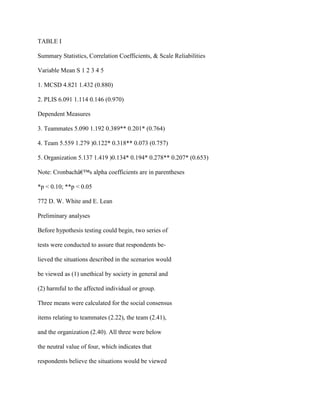
  • 78.
    the right thing).Additionally, doing the right thing may have other rewards, as well, like in the previous example wherein the dividends of doing the right thing were not anticipated but were a direct result of doing the right thing. Further, the entrepreneur could experience self- actualization (Maslow, 1957). The importance of being ethical in day-to-day dealings with the many stakeholders of the organization was addressed by the owner of Firm B. Firm B: To people who do business with us, we should be known as an honorable and fair company composed of people who keep their word and always fulfill their obligations in a timely fashion. We are going to pay our bills on time. If we say itñ€ℱs going to be there on Tuesday. If we say the building will be completed in 16 months, it will be done in at least 16 months. No matter what it costs and we will keep our word. This statement smacks of integrity ñ€“ a hallmark concept of the ethical responsibilities Carrollñ€ℱs model asserts are the duties of the firm. This founder is clearly more concerned about the spirit of the law and doing the right thing even though the expectations are not reflected in societyñ€ℱs laws and regulations than about the consequences of failing to complete the ñ€Ɠjobñ€‱ in a timely fashion, a lawsuit for breach of contract. Both of the statements related here imply a proaction philosophy. In acting to serve the com- munity through chairing a social benefit and in cultivating the reputation to be an honest and fair company, these entrepreneurs anticipate the positive role they play in society and rise to play that role completely. They have clearly made great efforts, and even sacrifices, to understand their business and community environment and to plan strategies that can help their communi- ties. Discretionary responsibilities The founder of Firm B exercised discretionary responsibility in a very different area of the com- munity. 308 Brenda E. Joyner and Dinah Payne Firm B: When I first came here I thought that all companies would buy tickets to arts events. I just thought thatñ€ℱs what you do in a major metropol- itan area . . . (W)e got a bunch of tickets and all our employees went and we were all proud. We took some clients and some of the management guys thought it was extreme to spend that much money. I said, ñ€ƓLook letñ€ℱs think about this. Weñ€ℱre going to get exposure. Weñ€ℱre getting in the right circlesñ€‱. A lawyerñ€ℱs wife turned out was on the board of (the local ballet) where one of our guys was selling a tenant fit-up to that law firm. The firm gave us that job basically because . . . (we) sponsored (a show) for his wifeñ€ℱs favorite ballet company. An architect said to us, ñ€ƓYou know I wouldnñ€ℱt do this ñ€“ work over a weekend ñ€“ for any other construc- tion company. But you guys have helped the arts. Iñ€ℱm going to do this for you. Iñ€ℱm going to work this weekend to get you that documentation you need.ñ€‱
  • 79.
    We now giveñ€“ we tithe to the arts. In 1983 we made that commitment. Ten percent of the after tax profits are given to the arts in communi- ties in which we build. This statement is an indication that the firm is meeting its discretionary responsibilities. These duties are to act voluntarily to aid society in some way, even if not acting this way would not be considered unethical. There is no legal mandate that firmñ€ℱs tithe to the arts; many firms do not do so and are not necessarily viewed negatively for not doing so. Thus, the firm is engaging in philanthropic activities they have no legal or even moral obligation to do; however, in fulfilling the firmñ€ℱs discretionary responsibilities, the firm may certainly act to the benefit of society. This entrepreneur also takes a proaction phi- losophy with regard to the arts in his commu- nity, an important ñ€Ɠsocial issueñ€‱ often undervalued by society as a whole. Knowing this and anticipating the need in that area, the entre- preneur committed himself and his firm to being of service to those stakeholders. This action also highlights the conundrum of an ethical business person engaging in ethical behavior for both the ethical and more Machiavellian approach discussed in the intro- duction section of this paper. The founder of Firm B has already indicated in many instances his commitment to his community and to doing quality jobs, the adherence to ethically sound business practices. In this instance, however, he found an unexpected payoff for doing the right thing because it is right. Here, he found that he gained something other than simple satisfaction that he did the right thing: he was awarded a contract as a tangential outcome of his ethical behavior and he received the help of a required professional to complete a job in a timely fashion. The initial motivation of the entrepreneur was to do the right thing because it was right. His reward was actually greater than that; in doing the right thing, his unexpected dividend was the securing of a contract and the help he needed. Conclusions and implications This research identified the presence and imple- mentation of values, business ethics, and CSR actions within the two organizations studied. The study found that the link to financial perfor- mance of the firm can be either direct or indirect. However, it is impossible to state that these linkages caused the changes in financial performance noted. In one instance, it appeared to be possible to assign an exact dollar value to the socially responsible action. In other instances, it was apparent that the contacts made through socially responsible behavior resulted in contracts awarded at a later date. While it is impossible to generalize the results of this study because of the small sample, a larger study of the link of CSR to firm financial performance, using the frame- work tested in this research, could be undertaken in order to further explain the direct and indirect links to performance. It also appears that the indirect links identi- fied in the research have associated time lags between socially responsible behavior by the firm and financial gain. These lags could be traced in order to find out how the impact of the time lag affects the ability of the firm to connect specific behaviors to future financial reward. A longitudinal study of a larger sample of firms
  • 80.
    using a timeframe of from five to ten years could shed much light on the effect of time lag on the issue. Evolution and Implementation 309 For many researchers in the areas of ethics and corporate social responsibility, the issue of finding a financial performance link to ethical behavior is unnecessary and a waste of time. Surely there are enough compelling reasons besides financial gain to push firms to support and champion ethical behaviors from their employees and to engage in socially responsible behavior with respect to the environment and the communi- ties within which they conduct their businesses. The authors agree with such reasoning. However, the ability to link socially responsible behavior with positive firm financial performance adds a strong, quantitative foundation to the push for such actions. By showing ways to link changes in culture that can generate positive financial performance that shows up as increases in the bottom line, stock price, or other financial per- formance measures, a stronger case can be made for such changes. In a perfect world such studies would not be necessary. However, in this less- than-perfect world that we inhabit, where success for business is measured almost exclusively by financial performance, the ability to show that ethical and socially responsible behavior can boost financial results might provide the impetus for real change in many organizations. References Adler, Nancy: 1999, International dimensions of Organizational Behavior (Southwestern, Cincinnati, OH). Andrews, K. R.: 1987, The Concept of Corporate Strategy (Richard D. Irwin, Inc., New York, NY). Ansoff, H. I.: 1965, Corporate Strategy: An Analytic Approach to Business Policy for Growth and Expansion (McGraw Hill, New York, NY). Barnard, C. I.: 1938, The Functions of the Executive (Harvard University Press, Cambridge, MA). Blanchard, K.: 1998, ñ€˜The New Bottom Lineñ€ℱ, Entrepreneur (February), 127ñ€“131. Carroll, A. B.: 1979, ñ€˜A Three-Dimensional Conceptual Model of Corporate Performanceñ€ℱ, Academy of Management Review 4(4), 497ñ€“505. Carroll, A. B.: 1991, ñ€˜The Pyramid of Corporate Social Responsibility: Toward the Moral Management of Organizational Stakeholdersñ€ℱ, Business Horizons 34, 4. De George, Richard T.: 1999, Business Ethics (Simon & Schuster, Upper Saddle River, NJ). Drucker, P. F.: 1954, The Practice of Management (Harper & Row Publishers, New York, NY).
  • 81.
    Dunham, R. B.and J. L. Pierce: 1989, Management (Scott, Foresman and Company, Glenview, IL). Freeman, R. E.: 1984, Strategic Management: A Stakeholder Approach (Pitman Publishing Inc., Marshfield, MA). Freeman, R. E. and D. E. Gilbert Jr.: 1988, Corporate Strategy and the Search for Ethics (Prentice Hall, Englewood Cliffs, NJ). Friedman, Milton: 1962, Capitalism and Freedom (The University of Chicago Press, Chicago, IL). Joyner, Brenda E. and Charles W. Hofer: 1992, ñ€˜The Key Tasks of Successful Venture Creation and Developmentñ€ℱ, in Douglas Naffziger and Jeffrey Hornsby (eds.), Emerging Entrepreneurial Strategies in the 1990s, Conference Proceedings of the Seventh Annual National USASBE Conference, Chicago, IL, Ball State University, pp. 239ñ€“253. Maslow, A. H.: 1957, Motivation and Personality (Harper & Row, New York, NY). Mason, D. E.: 1992, Values for Ethical Choices: Rate Yourself ñ€ℱ, Nonprofit World 10(3), 23ñ€“25. McCracken, Grant: 1988, The Long Interview (Sage Publications, Inc., Newbury Park, CA). Raiborn, Cecily A. and D. Payne: 1990, ñ€˜Corporate Codes of Conduct: A Collective Conscience and Continuumñ€ℱ, Journal of Business Ethics 9, 897ñ€“ 889. Schendel, D. E. and C. W. Hofer (eds.): 1979, Strategic Management: A New View of Business Policy and Planning (Little, Brown and Co., Boston, MA). Selznick, P.: 1957, Leadership in Administration (Harper & Row Publishers, New York, NY). Sethi, S. P.: 1975, ñ€˜Dimensions of Corporate Social Responsibilityñ€ℱ, California Management Review 17(3), 58ñ€“64. Simon, H. A.: 1945, Administrative Behavior (Free Press, New York, NY). Singer, A. W.: 1993, ñ€˜Can a Company Be Too Ethical?ñ€ℱ, Across the Board (April), 17ñ€“22. Solomon, R. C.: 1997, Itñ€ℱs Good Business (Rowman & Littlefield Publishers, Inc., Lanham, MD). Stodder, Gayle Sato: 1998, ñ€˜Goodwill Huntingñ€ℱ, Entrepreneur ( July), 118ñ€“121.
  • 82.
    Summer, C. E.,R. A. Bettis, I. H. Duhaime, G. H. Grant, D. E. Hambrick, C. C. Snow and C. P. Zeithaml: 1990, ñ€˜Doctoral Education in the Field of Business Policy and Strategyñ€ℱ, Journal of Management 16(2), 361ñ€“398. Vaughn, Susan: 1997, ñ€˜Firms Find Long-Term 310 Brenda E. Joyner and Dinah Payne Rewards in Doing Goodñ€ℱ, Los Angeles Times (November 3), 13ñ€“14. Velasquez, Manuel G.: 1999, Business Ethics: Cases and Concepts (Prentice Hall, Englewood Cliffs, NJ). Brenda E. Joyner, Ph.D. Loyola University New Orleans, 6363 St. Charles Avenue, Box 15, New Orleans, LA 70118, U.S.A. E-mail: [email protected] Evolution and Implementation 311 Dinah Payne, J.D./MBA University of New Orleans, New Orleans, LA 70148, U.S.A. E-mail: [email protected]