Semester 1 Theory and lab Learning Modules
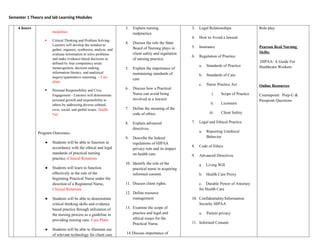
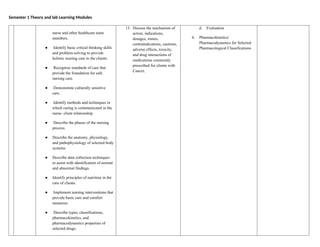
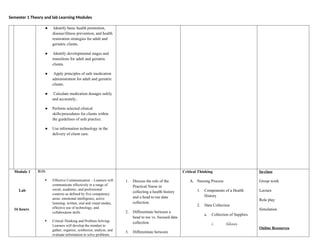
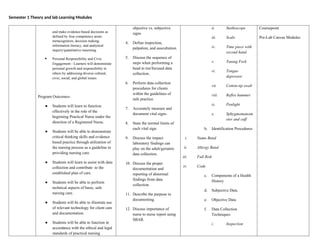
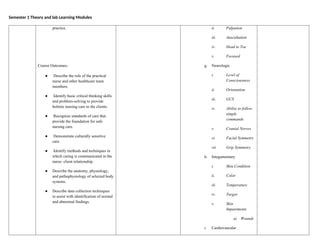
Semester 1 Theory and Lab Learning Modules
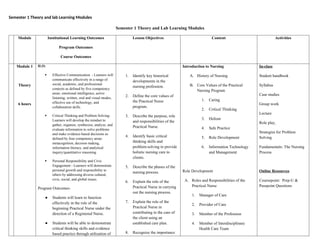
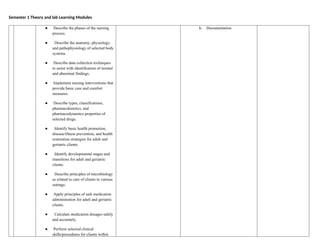
Module Institutional Learning Outcomes
Program Outcomes
Course Outcomes
Lesson Objectives Content Activities
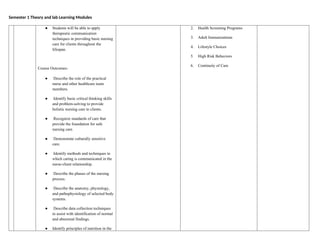
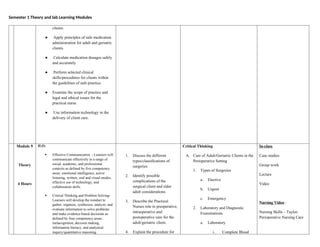
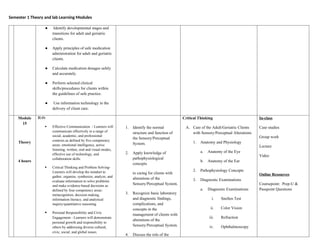
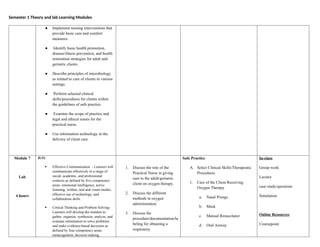
Module 1
Theory
6 hours
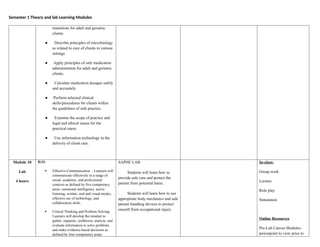
ILO:
 Effective Communication - Learners will
communicate effectively in a range of
social, academic, and professional
contexts as defined by five competency
areas: emotional intelligence, active
listening, written, oral and visual modes,
effective use of technology, and
collaboration skills.
 Critical Thinking and Problem Solving-
Learners will develop the mindset to
gather, organize, synthesize, analyze, and
evaluate information to solve problems
and make evidence-based decisions as
defined by four competency areas:
metacognition, decision making,
information literacy, and analytical
inquiry/quantitative reasoning.
 Personal Responsibility and Civic
Engagement - Learners will demonstrate
personal growth and responsibility to
others by addressing diverse cultural,
civic, social, and global issues.
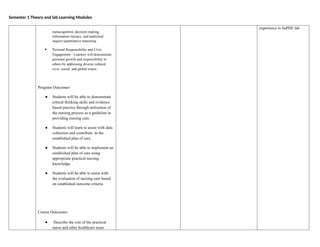
Program Outcomes-
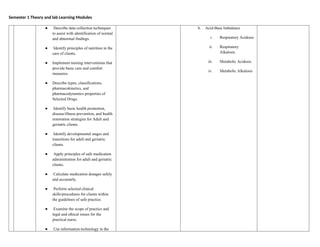
● Students will learn to function
effectively in the role of the
beginning Practical Nurse under the
direction of a Registered Nurse.
● Students will be able to demonstrate
critical thinking skills and evidence
based practice through utilization of
1. Identify key historical
developments in the
nursing profession.
2. Define the core values of
the Practical Nurse
program.
3. Describe the purpose, role
and responsibilities of the
Practical Nurse.
4. Identify basic critical
thinking skills and
problem-solving to provide
holistic nursing care to
clients.
5. Describe the phases of the
nursing process.
6. Explain the role of the
Practical Nurse in carrying
out the nursing process.
7. Explain the role of the
Practical Nurse in
contributing to the care of
the client using an
established care plan.
8. Recognize the importance
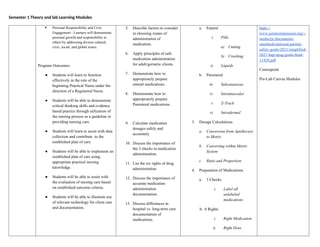
Introduction to Nursing
A. History of Nursing
B. Core Values of the Practical
Nursing Program
1. Caring
2. Critical Thinking
3. Holism
4. Safe Practice
5. Role Development
6. Information Technology
and Management
Role Development
A. Roles and Responsibilities of the
Practical Nurse
1. Manager of Care
2. Provider of Care
3. Member of the Profession
4. Member of Interdisciplinary
Health Care Team
In-class
Student handbook
Syllabus
Case studies
Group work
Lecture
Role play
Strategies for Problem
Solving
Fundamentals: The Nursing
Process
Online Resources
Coursepoint: Prep-U &
Passpoint Questions
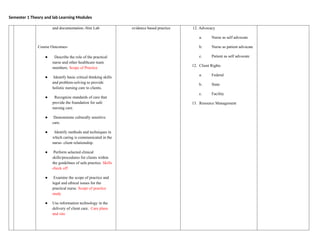
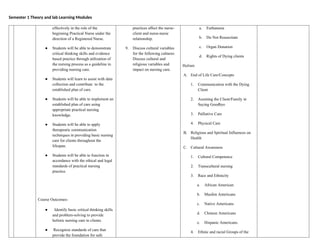
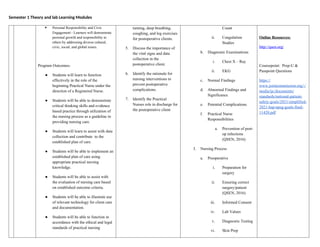
Semester 1 Theory and lab Learning Modules
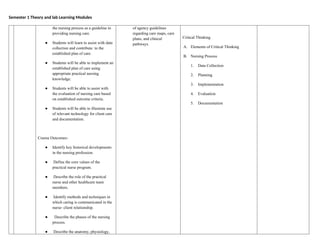
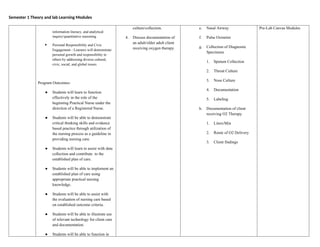
the nursing process as a guideline in
providing nursing care.
● Students will learn to assist with data
collection and contribute to the
established plan of care.
● Students will be able to implement an
established plan of care using
appropriate practical nursing
knowledge.
● Students will be able to assist with
the evaluation of nursing care based
on established outcome criteria.
● Students will be able to illustrate use
of relevant technology for client care
and documentation.
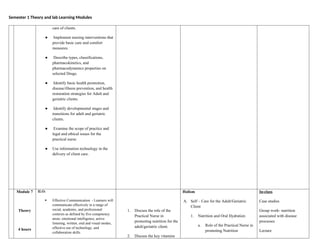
Course Outcomes-
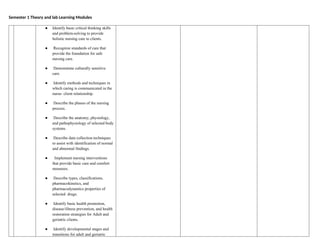
● Identify key historical developments
in the nursing profession.
● Define the core values of the
practical nurse program.
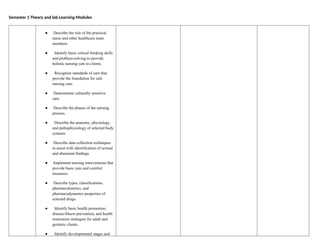
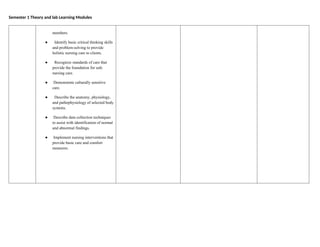
● Describe the role of the practical
nurse and other healthcare team
members.
● Identify methods and techniques in
which caring is communicated in the
nurse- client relationship.
● Describe the phases of the nursing
process.
● Describe the anatomy, physiology,
of agency guidelines
regarding care maps, care
plans, and clinical
pathways.
Critical Thinking
A. Elements of Critical Thinking
B. Nursing Process
1. Data Collection
2. Planning
3. Implementation
4. Evaluation
5. Documentation
Semester 1 Theory and lab Learning Modules
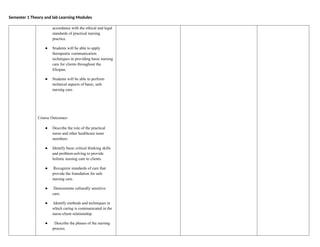
and pathophysiology of selected body
systems.
● Describe data collection techniques
to assist with identification of normal
and abnormal findings.
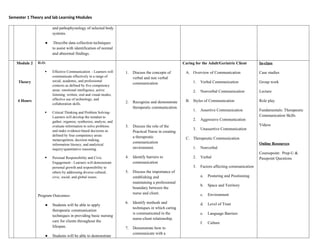
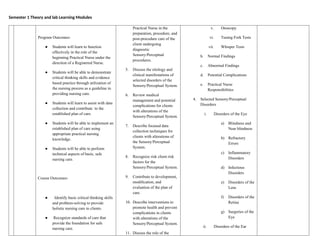
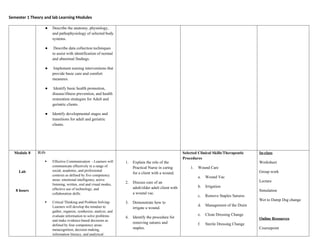
Module 2
Theory
4 Hours
ILO:
 Effective Communication - Learners will
communicate effectively in a range of
social, academic, and professional
contexts as defined by five competency
areas: emotional intelligence, active
listening, written, oral and visual modes,
effective use of technology, and
collaboration skills.
 Critical Thinking and Problem Solving-
Learners will develop the mindset to
gather, organize, synthesize, analyze, and
evaluate information to solve problems
and make evidence-based decisions as
defined by four competency areas:
metacognition, decision making,
information literacy, and analytical
inquiry/quantitative reasoning.
 Personal Responsibility and Civic
Engagement - Learners will demonstrate
personal growth and responsibility to
others by addressing diverse cultural,
civic, social, and global issues.
Program Outcomes-
● Students will be able to apply
therapeutic communication
techniques in providing basic nursing
care for clients throughout the
lifespan.
● Students will be able to demonstrate
1. Discuss the concepts of
verbal and non verbal
communication
2. Recognize and demonstrate
therapeutic communication.
3. Discuss the role of the
Practical Nurse in creating
a therapeutic
communication
environment.
4. Identify barriers to
communication
5. Discuss the importance of
establishing and
maintaining a professional
boundary between the
nurse and client.
6. Identify methods and
techniques in which caring
is communicated in the
nurse-client relationship.
7. Demonstrate how to
communicate with a
Caring for the Adult/Geriatric Client
A. Overview of Communication
1. Verbal Communication
2. Nonverbal Communication
B. Styles of Communication
1. Assertive Communication
2. Aggressive Communication
3. Unassertive Communication
C. Therapeutic Communication
1. Nonverbal
2. Verbal
3. Factors affecting communication
a. Posturing and Positioning
b. Space and Territory
c. Environment
d. Level of Trust
e. Language Barriers
f. Culture
In-class
Case studies
Group work
Lecture
Role play
Fundamentals: Therapeutic
Communication Skills
Videos
Online Resources
Coursepoint: Prep-U &
Passpoint Questions
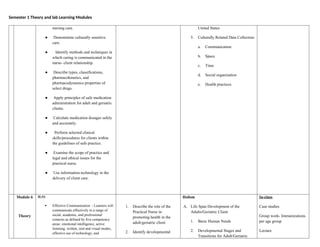
Semester 1 Theory and lab Learning Modules
critical thinking skills and evidence
based practice through utilization of
the nursing process as a guideline in
providing nursing care.
● Students will be able to illustrate use
of relevant technology for client care
and documentation.
Course Outcomes-
● Identify basic critical thinking skills
and problem-solving to provide
holistic nursing care to clients.
● Demonstrate culturally sensitive
care.- Nursing cultural day
● Identify methods and techniques in
which caring is communicated in the
nurse- client relationship.
● Implement nursing interventions that
provide basic care and comfort
measures.
● Identify basic health promotion,
disease/illness prevention, and health
restoration strategies for Adult and
geriatric clients.- Health Fair
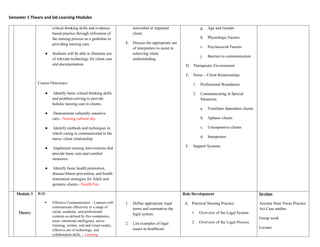
nonverbal or impaired
client.
8. Discuss the appropriate use
of interpreters to assist in
achieving client
understanding.
g. Age and Gender
h. Physiologic Factors
i. Psychosocial Factors
j. Barriers to communication
D. Therapeutic Environment
E. Nurse – Client Relationships
1. Professional Boundaries
2. Communicating in Special
Situations
a. Ventilator dependent clients
b. Aphasic clients
c. Unresponsive clients
d. Interpreters
F. Support Systems
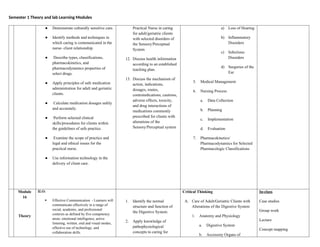
Module 3
Theory
ILO:
 Effective Communication - Learners will
communicate effectively in a range of
social, academic, and professional
contexts as defined by five competency
areas: emotional intelligence, active
listening, written, oral and visual modes,
effective use of technology, and
collaboration skills. – Learning
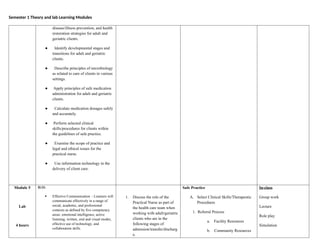
1. Define appropriate legal
terms and summarize the
legal system.
2. List examples of legal
issues in healthcare.
Role Development
A. Practical Nursing Practice
1. Overview of the Legal System
2. Overview of the Legal Process
In-class
Arizona State Nurse Practice
Act Case studies
Group work
Lecture
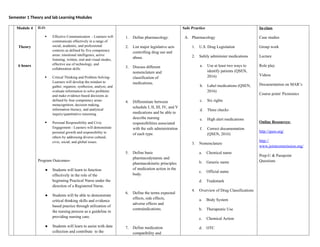
Semester 1 Theory and lab Learning Modules
4 hours
modalities
 Critical Thinking and Problem Solving-
Learners will develop the mindset to
gather, organize, synthesize, analyze, and
evaluate information to solve problems
and make evidence-based decisions as
defined by four competency areas:
metacognition, decision making,
information literacy, and analytical
inquiry/quantitative reasoning. – Care
plans
 Personal Responsibility and Civic
Engagement - Learners will demonstrate
personal growth and responsibility to
others by addressing diverse cultural,
civic, social, and global issues. Health
Fair
Program Outcomes-
● Students will be able to function in
accordance with the ethical and legal
standards of practical nursing
practice.-Clinical Rotations
● Students will learn to function
effectively in the role of the
beginning Practical Nurse under the
direction of a Registered Nurse,
Clinical Rotations
● Students will be able to demonstrate
critical thinking skills and evidence
based practice through utilization of
the nursing process as a guideline in
providing nursing care. Care Plans
● Students will be able to illustrate use
of relevant technology for client care
3. Explain nursing
malpractice
4. Discuss the role the State
Board of Nursing plays in
client safety and regulation
of nursing practice.
5. Explain the importance of
maintaining standards of
care
6. Discuss how a Practical
Nurse can avoid being
involved in a lawsuit
7. Define the meaning of the
code of ethics.
8. Explain advanced
directives.
9. Describe the federal
regulations of HIPAA
privacy rule and its impact
on health care.
10. Identify the role of the
practical nurse in acquiring
informed consent.
11. Discuss client rights.
12. Define resource
management.
13. Examine the scope of
practice and legal and
ethical issues for the
Practical Nurse.
14.Discuss importance of
3. Legal Relationships
4. How to Avoid a lawsuit
5. Insurance
6. Regulation of Practice
a. Standards of Practice
b. Standards of Care
c. Nurse Practice Act
i. Scope of Practice
ii. Licensure
iii. Client Safety
7. Legal and Ethical Practice
a. Reporting Unethical
Behavior
8. Code of Ethics
9. Advanced Directives
a. Living Will
b. Health Care Proxy
c. Durable Power of Attorney
for Health Care
10. Confidentiality/Information
Security HIPAA
a. Patient privacy
11. Informed Consent
Role play
Pearson Real Nursing
Skills:
HIPAA: A Guide For
Healthcare Workers
Online Resources
Coursepoint: Prep-U &
Passpoint Questions
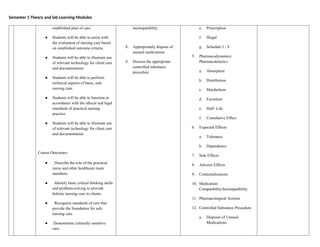
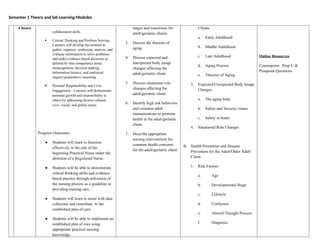
Semester 1 Theory and lab Learning Modules
and documentation.-Sim Lab
Course Outcomes-
● Describe the role of the practical
nurse and other healthcare team
members. Scope of Practice
● Identify basic critical thinking skills
and problem-solving to provide
holistic nursing care to clients.
● Recognize standards of care that
provide the foundation for safe
nursing care.
● Demonstrate culturally sensitive
care.
● Identify methods and techniques in
which caring is communicated in the
nurse- client relationship.
● Perform selected clinical
skills/procedures for clients within
the guidelines of safe practice. Skills
check off
● Examine the scope of practice and
legal and ethical issues for the
practical nurse. Scope of practice
study
● Use information technology in the
delivery of client care. Care plans
and sim
evidence based practice 12. Advocacy
a. Nurse as self advocate
b. Nurse as patient advocate
c. Patient as self advocate
12. Client Rights
a. Federal
b. State
c. Facility
13. Resource Management
Semester 1 Theory and lab Learning Modules
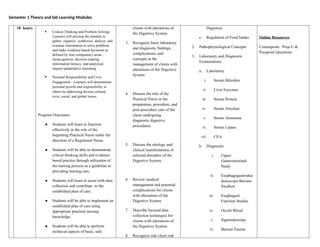
Module 4
Theory
6 hours
ILO:
 Effective Communication - Learners will
communicate effectively in a range of
social, academic, and professional
contexts as defined by five competency
areas: emotional intelligence, active
listening, written, oral and visual modes,
effective use of technology, and
collaboration skills.
 Critical Thinking and Problem Solving-
Learners will develop the mindset to
gather, organize, synthesize, analyze, and
evaluate information to solve problems
and make evidence-based decisions as
defined by four competency areas:
metacognition, decision making,
information literacy, and analytical
inquiry/quantitative reasoning.
 Personal Responsibility and Civic
Engagement - Learners will demonstrate
personal growth and responsibility to
others by addressing diverse cultural,
civic, social, and global issues.
Program Outcomes-
● Students will learn to function
effectively in the role of the
beginning Practical Nurse under the
direction of a Registered Nurse.
● Students will be able to demonstrate
critical thinking skills and evidence
based practice through utilization of
the nursing process as a guideline in
providing nursing care.
● Students will learn to assist with data
collection and contribute to the
1. Define pharmacology.
2. List major legislative acts
controlling drug use and
abuse.
3. Discuss different
nomenclature and
classification of
medications.
4. Differentiate between
schedule I, II, III, IV, and V
medications and be able to
describe nursing
responsibilities associated
with the safe administration
of each type.
5. Define basic
pharmacodynamic and
pharmacokinetic principles
of medication action in the
body.
6. Define the terms expected
effects, side effects,
adverse effects and
contraindications.
7. Define medication
compatibility and
Safe Practice
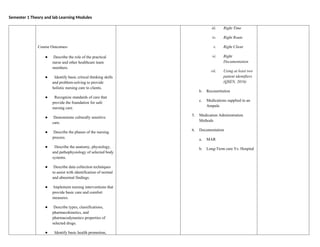
A. Pharmacology
1. U.S. Drug Legislation
2. Safely administer medications
a. Use at least two ways to
identify patients (QSEN,
2016)
b. Label medications (QSEN,
2016)
c. Six rights
d. Three checks
e. High alert medications
f. Correct documentation
(QSEN, 2016)
3. Nomenclature
a. Chemical name
b. Generic name
c. Official name
d. Trademark
4. Overview of Drug Classifications
a. Body System
b. Therapeutic Use
c. Chemical Action
d. OTC
In-class
Case studies
Group work
Lecture
Role play
Videos
Documentation on MAR’s
Course point/ Picmonics
Online Resources:
http://qsen.org/
http://
www.jointcommission.org/
Prep-U & Passpoint
Questions
Semester 1 Theory and lab Learning Modules
established plan of care.
● Students will be able to assist with
the evaluation of nursing care based
on established outcome criteria.
● Students will be able to illustrate use
of relevant technology for client care
and documentation.
● Students will be able to perform
technical aspects of basic, safe
nursing care.
● Students will be able to function in
accordance with the ethical and legal
standards of practical nursing
practice.
● Students will be able to illustrate use
of relevant technology for client care
and documentation.
Course Outcomes-
● Describe the role of the practical
nurse and other healthcare team
members.
● Identify basic critical thinking skills
and problem-solving to provide
holistic nursing care to clients.
● Recognize standards of care that
provide the foundation for safe
nursing care.
● Demonstrate culturally sensitive
care.
incompatibility.
8. Appropriately dispose of
unused medications
9. Discuss the appropriate
controlled substance
procedure
e. Prescription
f. Illegal
g. Schedule I - V
5. Pharmacodynamics/
Pharmacokinetics
a. Absorption
b. Distribution
c. Metabolism
d. Excretion
e. Half- Life
f. Cumulative Effect
6. Expected Effects
a. Tolerance
b. Dependence
7. Side Effects
8. Adverse Effects
9. Contraindications
10. Medication
Compatibility/Incompatibility
11. Pharmacological Actions
12. Controlled Substance Procedure
a. Disposal of Unused
Medications
Semester 1 Theory and lab Learning Modules
● Describe the phases of the nursing
process.
● Describe the anatomy, physiology,
and pathophysiology of selected body
systems.
● Describe data collection techniques
to assist with identification of normal
and abnormal findings.
● Implement nursing interventions that
provide basic care and comfort
measures.
● Describe types, classifications,
pharmacokinetics, and
pharmacodynamics properties of
selected drugs.
● Identify basic health promotion,
disease/illness prevention, and health
restoration strategies for adult and
geriatric clients.
● Identify developmental stages and
transitions for adult and geriatric
clients.
● Describe principles of microbiology
as related to care of clients in various
settings.
● Apply principles of safe medication
administration for adult and geriatric
clients.
● Calculate medication dosages safely
and accurately.
● Perform selected clinical
skills/procedures for clients within
b. Documentation
Semester 1 Theory and lab Learning Modules
the guidelines of safe practice.
● Examine the scope of practice and
legal and ethical issues for the
practical nurse.
● Use information technology in the
delivery of client care.
Module 5
Theory
4 hours
ILO:
 Effective Communication - Learners will
communicate effectively in a range of
social, academic, and professional
contexts as defined by five competency
areas: emotional intelligence, active
listening, written, oral and visual modes,
effective use of technology, and
collaboration skills.
 Critical Thinking and Problem Solving-
Learners will develop the mindset to
gather, organize, synthesize, analyze, and
evaluate information to solve problems
and make evidence-based decisions as
defined by four competency areas:
metacognition, decision making,
information literacy, and analytical
inquiry/quantitative reasoning.
 Personal Responsibility and Civic
Engagement - Learners will demonstrate
personal growth and responsibility to
others by addressing diverse cultural,
civic, social, and global issues.
Program Outcomes-
● Students will learn to function
1. Define the stages of dying
2. Explain the role of the
Practical Nurse with a
dying client and the dying
client’s family.
3. Discuss the role of the
Practical Nurse dealing
with grief and loss.
4. Discuss the principles of
palliative care.
5. Describe the nursing care
of the body after death
6. Identify the importance of
transcultural nursing.
7. Define culture and the ways
culture influences the
individual.
8. Explain how personal
cultural beliefs and
Critical Thinking
A. Care of Adult/Geriatric Clients with
Psychological/Mental Health
Disorders
1. Grief
a. Sense of Presence
b. Nurses’ Grief
c. Stages of Grief and Dying
d. Complicated Grief
e. Supportive care during the
dying and Grieving process
i. Grieving Family
ii. Resolution of Grief
and Loss
2. Nursing Process in Loss and Grief
a. Special situations
3. Issues Related to Dying and
Death
In-class
Case studies
Group work
Lecture
Role play
Video presentation from
Hospice
Online Resources
Coursepoint: Prep-U &
Passpoint Questions
Semester 1 Theory and lab Learning Modules
effectively in the role of the
beginning Practical Nurse under the
direction of a Registered Nurse.
● Students will be able to demonstrate
critical thinking skills and evidence
based practice through utilization of
the nursing process as a guideline in
providing nursing care.
● Students will learn to assist with data
collection and contribute to the
established plan of care.
● Students will be able to implement an
established plan of care using
appropriate practical nursing
knowledge.
● Students will be able to apply
therapeutic communication
techniques in providing basic nursing
care for clients throughout the
lifespan.
● Students will be able to function in
accordance with the ethical and legal
standards of practical nursing
practice.
Course Outcomes-
● Identify basic critical thinking skills
and problem-solving to provide
holistic nursing care to clients.
● Recognize standards of care that
provide the foundation for safe
practices affect the nurse-
client and nurse-nurse
relationship.
9. Discuss cultural variables
for the following cultures:
Discuss cultural and
religious variables and
impact on nursing care.
a. Euthanasia
b. Do Not Resuscitate
c. Organ Donation
d. Rights of Dying clients
Holism
A. End of Life Care/Concepts
1. Communication with the Dying
Client
2. Assisting the Client/Family in
Saying Goodbye
3. Palliative Care
4. Physical Care
B. Religious and Spiritual Influences on
Health
C. Cultural Awareness
1. Cultural Competence
2. Transcultural nursing
3. Race and Ethnicity
a. African American
b. Muslim Americans
c. Native Americans
d. Chinese Americans
e. Hispanic Americans.
4. Ethnic and racial Groups of the
Semester 1 Theory and lab Learning Modules
nursing care.
● Demonstrate culturally sensitive
care.
● Identify methods and techniques in
which caring is communicated in the
nurse- client relationship.
● Describe types, classifications,
pharmacokinetics, and
pharmacodynamics properties of
select drugs.
● Apply principles of safe medication
administration for adult and geriatric
clients.
● Calculate medication dosages safely
and accurately.
● Perform selected clinical
skills/procedures for clients within
the guidelines of safe practice.
● Examine the scope of practice and
legal and ethical issues for the
practical nurse.
● Use information technology in the
delivery of client care.
United States
5. Culturally Related Data Collection
a. Communication
b. Space
c. Time
d. Social organization
e. Health practices
Module 6
Theory
ILO:
 Effective Communication - Learners will
communicate effectively in a range of
social, academic, and professional
contexts as defined by five competency
areas: emotional intelligence, active
listening, written, oral and visual modes,
effective use of technology, and
1. Describe the role of the
Practical Nurse in
promoting health in the
adult/geriatric client
2. Identify developmental
Holism
A. Life Span Development of the
Adults/Geriatric Client
1. Basic Human Needs
2. Developmental Stages and
Transitions for Adult/Geriatric
In-class
Case studies
Group work- Immunizations
per age group
Lecture
Semester 1 Theory and lab Learning Modules
4 hours
collaboration skills.
 Critical Thinking and Problem Solving-
Learners will develop the mindset to
gather, organize, synthesize, analyze, and
evaluate information to solve problems
and make evidence-based decisions as
defined by four competency areas:
metacognition, decision making,
information literacy, and analytical
inquiry/quantitative reasoning.
 Personal Responsibility and Civic
Engagement - Learners will demonstrate
personal growth and responsibility to
others by addressing diverse cultural,
civic, social, and global issues.
Program Outcomes-
● Students will learn to function
effectively in the role of the
beginning Practical Nurse under the
direction of a Registered Nurse.
● Students will be able to demonstrate
critical thinking skills and evidence
based practice through utilization of
the nursing process as a guideline in
providing nursing care.
● Students will learn to assist with data
collection and contribute to the
established plan of care.
● Students will be able to implement an
established plan of care using
appropriate practical nursing
knowledge.
stages and transitions for
adult/geriatric clients.
3. Discuss the theories of
aging
4. Discuss expected and
unexpected body image
changes affecting the
adult/geriatric client.
5. Discuss situational role
changes affecting the
adult/geriatric client.
6. Identify high risk behaviors
and common adult
immunizations to promote
health in the adult/geriatric
client.
7. Describe appropriate
nursing interventions for
common health concerns
for the adult/geriatric client.
Clients
a. Early Adulthood
b. Middle Adulthood
c. Late Adulthood
d. Aging Process
e. Theories of Aging
3. Expected/Unexpected Body Image
Changes
a. The aging body
b. Safety and Security issues
c. Safety in home
4. Situational Role Changes
B. Health Promotion and Disease
Prevention for the Adult/Older Adult
Client
1. Risk Factors
a. Age
b. Developmental Stage
c. Lifestyle
d. Confusion
e. Altered Thought Process
f. Diagnosis
Online Resources
Coursepoint: Prep-U &
Passpoint Questions
Semester 1 Theory and lab Learning Modules
● Students will be able to apply
therapeutic communication
techniques in providing basic nursing
care for clients throughout the
lifespan.
Course Outcomes-
● Describe the role of the practical
nurse and other healthcare team
members.
● Identify basic critical thinking skills
and problem-solving to provide
holistic nursing care to clients.
● Recognize standards of care that
provide the foundation for safe
nursing care.
● Demonstrate culturally sensitive
care.
● Identify methods and techniques in
which caring is communicated in the
nurse-client relationship.
● Describe the phases of the nursing
process.
● Describe the anatomy, physiology,
and pathophysiology of selected body
systems.
● Describe data collection techniques
to assist with identification of normal
and abnormal findings.
● Identify principles of nutrition in the
2. Health Screening Programs
3. Adult Immunizations
4. Lifestyle Choices
5. High Risk Behaviors
6. Continuity of Care
Semester 1 Theory and lab Learning Modules
care of clients.
● Implement nursing interventions that
provide basic care and comfort
measures.
● Describe types, classifications,
pharmacokinetics, and
pharmacodynamics properties on
selected Drugs.
● Identify basic health promotion,
disease/illness prevention, and health
restoration strategies for Adult and
geriatric clients.
● Identify developmental stages and
transitions for adult and geriatric
clients.
● Examine the scope of practice and
legal and ethical issues for the
practical nurse.
● Use information technology in the
delivery of client care.
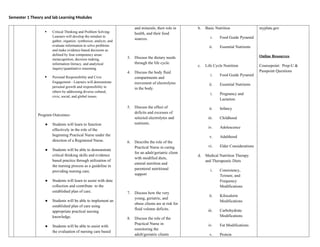
Module 7
Theory
4 hours
ILO:
 Effective Communication - Learners will
communicate effectively in a range of
social, academic, and professional
contexts as defined by five competency
areas: emotional intelligence, active
listening, written, oral and visual modes,
effective use of technology, and
collaboration skills.
1. Discuss the role of the
Practical Nurse in
promoting nutrition for the
adult/geriatric client.
2. Discuss the key vitamins
Holism
A. Self – Care for the Adult/Geriatric
Client
1. Nutrition and Oral Hydration
a. Role of the Practical Nurse in
promoting Nutrition
In-class
Case studies
Group work- nutrition
associated with disease
processes
Lecture
Semester 1 Theory and lab Learning Modules
 Critical Thinking and Problem Solving-
Learners will develop the mindset to
gather, organize, synthesize, analyze, and
evaluate information to solve problems
and make evidence-based decisions as
defined by four competency areas:
metacognition, decision making,
information literacy, and analytical
inquiry/quantitative reasoning.
 Personal Responsibility and Civic
Engagement - Learners will demonstrate
personal growth and responsibility to
others by addressing diverse cultural,
civic, social, and global issues.
Program Outcomes-
● Students will learn to function
effectively in the role of the
beginning Practical Nurse under the
direction of a Registered Nurse.
● Students will be able to demonstrate
critical thinking skills and evidence
based practice through utilization of
the nursing process as a guideline in
providing nursing care.
● Students will learn to assist with data
collection and contribute to the
established plan of care.
● Students will be able to implement an
established plan of care using
appropriate practical nursing
knowledge.
● Students will be able to assist with
the evaluation of nursing care based
and minerals, their role in
health, and their food
sources.
3. Discuss the dietary needs
through the life cycle.
4. Discuss the body fluid
compartments and
movement of electrolytes
in the body.
5. Discuss the effect of
deficits and excesses of
selected electrolytes and
nutrients.
6. Describe the role of the
Practical Nurse in caring
for an adult/geriatric client
with modified diets,
enteral nutrition and
parenteral nutritional
support
7. Discuss how the very
young, geriatric, and
obese clients are at risk for
fluid volume deficits.
8. Discuss the role of the
Practical Nurse in
monitoring the
adult/geriatric clients
b. Basic Nutrition
i. Food Guide Pyramid
ii. Essential Nutrients
c. Life Cycle Nutrition
i. Food Guide Pyramid
ii. Essential Nutrients
i. Pregnancy and
Lactation
ii. Infancy
iii. Childhood
iv. Adolescence
v. Adulthood
vi. Elder Considerations
d. Medical Nutrition Therapy
and Therapeutic Diets
i. Consistency,
Texture, and
Frequency
Modifications
ii. Kilocalorie
Modifications
iii. Carbohydrate
Modifications
iv. Fat Modifications
v. Protein
myplate.gov
Online Resources
Coursepoint: Prep-U &
Passpoint Questions
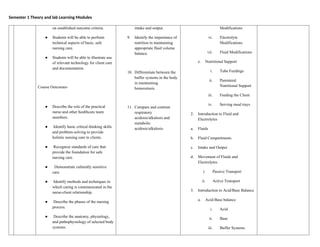
Semester 1 Theory and lab Learning Modules
on established outcome criteria.
● Students will be able to perform
technical aspects of basic, safe
nursing care.
● Students will be able to illustrate use
of relevant technology for client care
and documentation.
Course Outcomes-
● Describe the role of the practical
nurse and other healthcare team
members.
● Identify basic critical thinking skills
and problem-solving to provide
holistic nursing care to clients.
● Recognize standards of care that
provide the foundation for safe
nursing care.
● Demonstrate culturally sensitive
care.
● Identify methods and techniques in
which caring is communicated in the
nurse-client relationship.
● Describe the phases of the nursing
process.
● Describe the anatomy, physiology,
and pathophysiology of selected body
systems.
intake and output.
9. Identify the importance of
nutrition in maintaining
appropriate fluid volume
balance.
10. Differentiate between the
buffer systems in the body
in maintaining
homeostasis.
11. Compare and contrast
respiratory
acidosis/alkalosis and
metabolic
acidosis/alkalosis.
Modifications
vi. Electrolyte
Modifications
vii. Fluid Modifications
e. Nutritional Support
i. Tube Feedings
ii. Parenteral
Nutritional Support
iii. Feeding the Client
iv. Serving meal trays
2. Introduction to Fluid and
Electrolytes
a. Fluids
b. Fluid Compartments
c. Intake and Output
d. Movement of Fluids and
Electrolytes
i. Passive Transport
ii. Active Transport
3. Introduction to Acid/Base Balance
a. Acid-Base balance
i. Acid
ii. Base
iii. Buffer Systems
Semester 1 Theory and lab Learning Modules
● Describe data collection techniques
to assist with identification of normal
and abnormal findings.
● Identify principles of nutrition in the
care of clients.
● Implement nursing interventions that
provide basic care and comfort
measures.
● Describe types, classifications,
pharmacokinetics, and
pharmacodynamics properties of
Selected Drugs.
● Identify basic health promotion,
disease/illness prevention, and health
restoration strategies for Adult and
geriatric clients.
● Identify developmental stages and
transitions for adult and geriatric
clients.
● Apply principles of safe medication
administration for adult and geriatric
clients.
● Calculate medication dosages safely
and accurately.
● Perform selected clinical
skills/procedures for clients within
the guidelines of safe practice.
● Examine the scope of practice and
legal and ethical issues for the
practical nurse.
● Use information technology in the
b. Acid-Base Imbalance
i. Respiratory Acidosis
ii. Respiratory
Alkalosis
iii. Metabolic Acidosis
iv. Metabolic Alkalosis
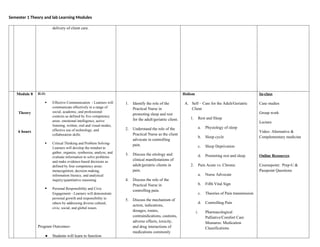
Semester 1 Theory and lab Learning Modules
delivery of client care.
Module 8
Theory
6 hours
ILO:
 Effective Communication - Learners will
communicate effectively in a range of
social, academic, and professional
contexts as defined by five competency
areas: emotional intelligence, active
listening, written, oral and visual modes,
effective use of technology, and
collaboration skills.
 Critical Thinking and Problem Solving-
Learners will develop the mindset to
gather, organize, synthesize, analyze, and
evaluate information to solve problems
and make evidence-based decisions as
defined by four competency areas:
metacognition, decision making,
information literacy, and analytical
inquiry/quantitative reasoning.
 Personal Responsibility and Civic
Engagement - Learners will demonstrate
personal growth and responsibility to
others by addressing diverse cultural,
civic, social, and global issues.
Program Outcomes-
● Students will learn to function
1. Identify the role of the
Practical Nurse in
promoting sleep and rest
for the adult/geriatric client.
2. Understand the role of the
Practical Nurse as the client
advocate in controlling
pain.
3. Discuss the etiology and
clinical manifestations of
adult/geriatric clients in
pain.
4. Discuss the role of the
Practical Nurse in
controlling pain.
5. Discuss the mechanism of
action, indications,
dosages, routes,
contraindications, cautions,
adverse effects, toxicity,
and drug interactions of
medications commonly
Holism
A. Self – Care for the Adult/Geriatric
Client
1. Rest and Sleep
a. Physiology of sleep
b. Sleep cycle
c. Sleep Deprivation
d. Promoting rest and sleep
2. Pain Acute vs. Chronic
a. Nurse Advocate
b. Fifth Vital Sign
c. Theories of Pain transmission
d. Controlling Pain
i. Pharmacological
Palliative/Comfort Care
Measures: Medication
Classifications
In-class
Case studies
Group work
Lecture
Video- Alternative &
Complementary medicine
Online Resources
Coursepoint: Prep-U &
Passpoint Questions
Semester 1 Theory and lab Learning Modules
effectively in the role of the
beginning Practical Nurse under the
direction of a Registered Nurse.
● Students will be able to demonstrate
critical thinking skills and evidence
based practice through utilization of
the nursing process as a guideline in
providing nursing care.
● Students will learn to assist with data
collection and contribute to the
established plan of care.
● Students will be able to implement an
established plan of care using
appropriate practical nursing
knowledge.
● Students will be able to assist with
the evaluation of nursing care based
on established outcome criteria.
● Students will be able to illustrate use
of relevant technology for client care
and documentation.
● Students will be able to function in
accordance with the ethical and legal
standards of practical nursing
practice.
Course Outcomes-
● Describe the role of the practical
nurse and other healthcare team
members.
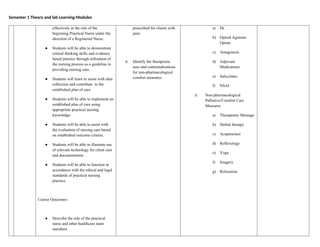
prescribed for clients with
pain.
6. Identify the therapeutic
uses and contraindications
for non-pharmacological
comfort measures.
a) Ds
b) Opioid Agonists
Opiate
c) Antagonists
d) Adjuvant
Medications
e) Salicylates
f) NSAI
ii. Non-pharmacological
Palliative/Comfort Care
Measures
a) Therapeutic Massage
b) Herbal therapy
c) Acupuncture
d) Reflexology
e) Yoga
f) Imagery
g) Relaxation
Semester 1 Theory and lab Learning Modules
● Identify basic critical thinking skills
and problem-solving to provide
holistic nursing care to clients.
● Recognize standards of care that
provide the foundation for safe
nursing care.
● Demonstrate culturally sensitive
care.
● Identify methods and techniques in
which caring is communicated in the
nurse- client relationship.
● Describe the phases of the nursing
process.
● Describe the anatomy, physiology,
and pathophysiology of selected body
systems.
● Describe data collection techniques
to assist with identification of normal
and abnormal findings.
● Implement nursing interventions
that provide basic care and comfort
measures.
● Describe types, classifications,
pharmacokinetics, and
pharmacodynamics properties of
selected drugs.
● Identify basic health promotion,
disease/illness prevention, and health
restoration strategies for Adult and
geriatric clients.
● Identify developmental stages and
transitions for adult and geriatric
Semester 1 Theory and lab Learning Modules
clients.
● Apply principles of safe medication
administration for adult and geriatric
clients.
● Calculate medication dosages safely
and accurately
● Perform selected clinical
skills/procedures for clients within
the guidelines of safe practice.
● Examine the scope of practice and
legal and ethical issues for the
practical nurse.
● Use information technology in the
delivery of client care.
Module 9
Theory
4 Hours
ILO:
 Effective Communication - Learners will
communicate effectively in a range of
social, academic, and professional
contexts as defined by five competency
areas: emotional intelligence, active
listening, written, oral and visual modes,
effective use of technology, and
collaboration skills.
 Critical Thinking and Problem Solving-
Learners will develop the mindset to
gather, organize, synthesize, analyze, and
evaluate information to solve problems
and make evidence-based decisions as
defined by four competency areas:
metacognition, decision making,
information literacy, and analytical
inquiry/quantitative reasoning.
1. Discuss the different
types/classifications of
surgeries
2. Identify possible
complications of the
surgical client and elder
adult considerations.
3. Describe the Practical
Nurses role in preoperative,
intraoperative and
postoperative care for the
adult/geriatric client.
4. Explain the procedure for
Critical Thinking
A. Care of Adult/Geriatric Clients in the
Perioperative Setting
1. Types of Surgeries
a. Elective
b. Urgent
c. Emergency
2. Laboratory and Diagnostic
Examinations
a. Laboratory
i. Complete Blood
In-class
Case studies
Group work
Lecture
Video
Nursing Video :
Nursing Skills – Taylor:
Perioperative Nursing Care
Semester 1 Theory and lab Learning Modules
 Personal Responsibility and Civic
Engagement - Learners will demonstrate
personal growth and responsibility to
others by addressing diverse cultural,
civic, social, and global issues.
Program Outcomes-
● Students will learn to function
effectively in the role of the
beginning Practical Nurse under the
direction of a Registered Nurse.
● Students will be able to demonstrate
critical thinking skills and evidence
based practice through utilization of
the nursing process as a guideline in
providing nursing care.
● Students will learn to assist with data
collection and contribute to the
established plan of care.
● Students will be able to implement an
established plan of care using
appropriate practical nursing
knowledge.
● Students will be able to assist with
the evaluation of nursing care based
on established outcome criteria.
● Students will be able to illustrate use
of relevant technology for client care
and documentation.
● Students will be able to function in
accordance with the ethical and legal
standards of practical nursing
turning, deep breathing,
coughing, and leg exercises
for postoperative clients.
5. Discuss the importance of
the vital signs and data
collection in the
postoperative client.
6. Identify the rationale for
nursing interventions to
prevent postoperative
complications.
7. Identify the Practical
Nurses role in discharge for
the postoperative client
Count
ii. Coagulation
Studies
b. Diagnostic Examinations
i. Chest X – Ray
ii. EKG
c. Normal Findings
d. Abnormal Findings and
Significance
e. Potential Complications
f. Practical Nurse
Responsibilities
a. Prevention of post-
op infections
(QSEN, 2016)
3. Nursing Process
a. Preoperative
i. Preparation for
surgery
ii. Ensuring correct
surgery/patient
(QSEN, 2016)
iii. Informed Consent
iv. Lab Values
v. Diagnostic Testing
vi. Skin Prep
Online Resources:
http://qsen.org/
Coursepoint: Prep-U &
Passpoint Questions
https://
www.jointcommission.org/-/
media/tjc/documents/
standards/national-patient-
safety-goals/2021/simplified-
2021-hap-npsg-goals-final-
11420.pdf
Semester 1 Theory and lab Learning Modules
practice.
● Students will be able to apply
therapeutic communication
techniques in providing basic nursing
care for clients throughout the
lifespan.
● Students will be able to perform
technical aspects of basic, safe
nursing care.
Course Outcomes-
● Describe the role of the practical
nurse and other healthcare team
members.
● Identify basic critical thinking skills
and problem-solving to provide
holistic nursing care to clients.
● Recognize standards of care that
provide the foundation for safe
nursing care.
● Demonstrate culturally sensitive
care.
● Identify methods and techniques in
which caring is communicated in the
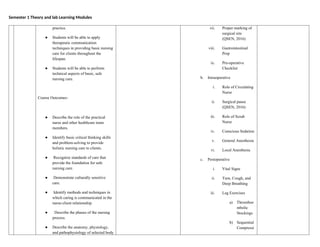
nurse-client relationship.
● Describe the phases of the nursing
process.
● Describe the anatomy, physiology,
and pathophysiology of selected body
vii. Proper marking of
surgical site
(QSEN, 2016)
viii. Gastrointestinal
Prep
ix. Pre-operative
Checklist
b. Intraoperative
i. Role of Circulating
Nurse
ii. Surgical pause
(QSEN, 2016)
iii. Role of Scrub
Nurse
iv. Conscious Sedation
v. General Anesthesia
vi. Local Anesthesia
c. Postoperative
i. Vital Signs
ii. Turn, Cough, and
Deep Breathing
iii. Leg Exercises
a) Thromboe
mbolic
Stockings
b) Sequential
Compressi
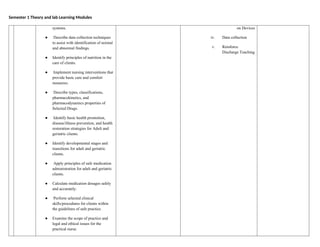
Semester 1 Theory and lab Learning Modules
systems.
● Describe data collection techniques
to assist with identification of normal
and abnormal findings.
● Identify principles of nutrition in the
care of clients.
● Implement nursing interventions that
provide basic care and comfort
measures.
● Describe types, classifications,
pharmacokinetics, and
pharmacodynamics properties of
Selected Drugs.
● Identify basic health promotion,
disease/illness prevention, and health
restoration strategies for Adult and
geriatric clients.
● Identify developmental stages and
transitions for adult and geriatric
clients.
● Apply principles of safe medication
administration for adult and geriatric
clients.
● Calculate medication dosages safely
and accurately.
● Perform selected clinical
skills/procedures for clients within
the guidelines of safe practice.
● Examine the scope of practice and
legal and ethical issues for the
practical nurse.
on Devices
iv. Data collection
v. Reinforce
Discharge Teaching
Semester 1 Theory and lab Learning Modules
● Use information technology in the
delivery of client care.
Module
10
Theory
2 hours
ILO:
 Effective Communication - Learners will
communicate effectively in a range of
social, academic, and professional
contexts as defined by five competency
areas: emotional intelligence, active
listening, written, oral and visual modes,
effective use of technology, and
collaboration skills.
 Critical Thinking and Problem Solving-
Learners will develop the mindset to
gather, organize, synthesize, analyze, and
evaluate information to solve problems
and make evidence-based decisions as
defined by four competency areas:
metacognition, decision making,
information literacy, and analytical
inquiry/quantitative reasoning.
 Personal Responsibility and Civic
Engagement - Learners will demonstrate
personal growth and responsibility to
others by addressing diverse cultural,
civic, social, and global issues.
Program Outcomes-
● Students will be able to demonstrate
critical thinking skills and evidence
based practice through utilization of
the nursing process as a guideline in
providing nursing care.
● Students will learn to assist with data
collection and contribute to the
established plan of care.
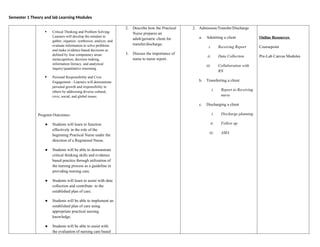
1. Identify infection.
2. Identify subjective and
objective symptoms of
infection.
3. Explain the major actions
and effects of medications
used to treat infectious
diseases.
4. Identify the various
medications that are
classified within the
antimicrobial classification.
5. Describe therapeutic
effects, side effects
associated with
antimicrobial agents.
6. Describe nursing
interventions for the
common adverse effects
associated with
antimicrobial agents.
7. Discuss the role of the
Practical Nurse in taking
care of a client taking
antimicrobial agents.
Safe Practice
A. Microbiological Principles
a. Asepsis
b. Infection
c. Infection Prevention
i. Prevention of hospital
acquired infections
(QSEN, 2016)
1. Pharmacological/
Pharmacodynamics for Selected
Pharmacological Classifications
a. Antimicrobials
i. Aminoglycosides
ii. Carbapenems
iii. Cephalosporins
iv. Macrolides
v. Oxazolidinones
vi. Penicillins
vii. Quinolones
viii. Sulfonamides
ix. Antitubercular
x. Systemic Antifungal
In-class
Case studies
Group work- pharm
Lecture
Isolation precautions
Online Resources:
http://qsen.org/
https://
www.jointcommission.org/-/
media/tjc/documents/
standards/national-patient-
safety-goals/2021/simplified-
2021-ncc-npsg-goals-final-
11420.pdf
Coursepoint: Prep-U &
Passpoint Questions
Semester 1 Theory and lab Learning Modules
● Students will be able to implement an
established plan of care using
appropriate practical nursing
knowledge.
● Students will be able to assist with
the evaluation of nursing care based
on established outcome criteria.
Course Outcomes-
● Describe the anatomy, physiology,
and pathophysiology of selected body
systems.
● Describe data collection techniques
to assist with identification of normal
and abnormal findings.
● Describe types, classifications,
pharmacokinetics, and
pharmacodynamics properties o
selected Drugs.
● Identify basic health promotion,
disease/illness prevention, and health
restoration strategies for Adult and
geriatric clients.
● Describe principles of microbiology
as related to care of clients in various
settings.
● Apply principles of safe medication
administration for adult and geriatric
clients.
● Calculate medication dosages safely
and accurately.
Agents
xi. Systemic Antivirals
Semester 1 Theory and lab Learning Modules
Module
11
Theory
4 Hours
ILO:
 Effective Communication - Learners will
communicate effectively in a range of
social, academic, and professional
contexts as defined by five competency
areas: emotional intelligence, active
listening, written, oral and visual modes,
effective use of technology, and
collaboration skills.
 Critical Thinking and Problem Solving-
Learners will develop the mindset to
gather, organize, synthesize, analyze, and
evaluate information to solve problems
and make evidence-based decisions as
defined by four competency areas:
metacognition, decision making,
information literacy, and analytical
inquiry/quantitative reasoning.
 Personal Responsibility and Civic
Engagement - Learners will demonstrate
personal growth and responsibility to
others by addressing diverse cultural,
civic, social, and global issues.
Program Outcomes-
● Students will learn to function
effectively in the role of the
beginning Practical Nurse under the
direction of a Registered Nurse.
● Students will be able to demonstrate
critical thinking skills and evidence
based practice through utilization of
the nursing process as a guideline in
providing nursing care.
● Students will learn to assist with data
collection and contribute to the
1. Identify the normal
structure and function of
the Integumentary System.
2. Apply knowledge of
pathophysiological
concepts to caring for
clients with alterations of
the Integumentary System.
3. Recognize basic laboratory
and diagnostic findings,
complications, and
concepts in the
management of clients with
alterations of the
Integumentary System.
4. Discuss the role of the
Practical Nurse in the
preparation, procedure, and
post-procedure care of the
client undergoing
diagnostic Integumentary
procedures.
5. Discuss the etiology and
clinical manifestations of
selected disorders of the
Integumentary System.
6. Review medical
management and potential
complications for clients
with alterations of the
Integumentary System.
Critical Thinking
A. Care of Adult/Geriatric Clients with
Alterations of the Integumentary
System
1. Anatomy and Physiology
a. Functions of the skin
b. Structure of the skin
c. Appendages of the skin
2. Pathophysiological Concepts
3. Laboratory and Diagnostic
Examinations
a. Laboratory
i. CBC
ii. Skin Culture
iii. Serum IgE
b. Diagnostic
i. Woods light
4. Selected Disorders of the
Integumentary System
a. Viral Disorders
b. Bacterial Disorders
c. Fungal Infections
d. Inflammatory Disorders
e. Parasitic Diseases
In-class
Case studies
Group work
Lecture
Videos
Online Resources
Coursepoint: Prep-U &
Passpoint Questions
https://
www.jointcommission.org/-/
media/tjc/documents/
standards/national-patient-
safety-goals/2021/simplified-
2021-hap-npsg-goals-final-
11420.pdf
Semester 1 Theory and lab Learning Modules
established plan of care.
● Students will be able to implement an
established plan of care using
appropriate practical nursing
knowledge.
● Students will be able to assist with
the evaluation of nursing care based
on established outcome criteria.
● Students will be able to illustrate use
of relevant technology for client care
and documentation.
● Students will be able to function in
accordance with the ethical and legal
standards of practical nursing
practice.
Course Outcomes-
● Describe the role of the practical
nurse and other healthcare team
members.
● Identify basic critical thinking skills
and problem-solving to provide
holistic nursing care to Clients.
● Recognize standards of care that
provide the foundation for safe
nursing care.
● Demonstrate culturally sensitive
care.
● Identify methods and techniques in
7. Describe focused data
collection techniques for
clients with alterations of
the Integumentary System.
8. Recognize risk client risk
factors for the
Integumentary System.
9. Contribute to development,
modification, and
evaluation of the plan of
care.
10. Describe interventions to
promote health and prevent
complications in clients
with alterations of the
Integumentary System.
11. Discuss the role of the
Practical Nurse in caring
for adult/geriatric clients
with selected disorders of
the Integumentary System
12. Discuss health information
according to an established
teaching plan.
13. Discuss the mechanism of
action, indications,
dosages, routes,
contraindications, cautions,
adverse effects, toxicity,
and drug interactions of
medications commonly
prescribed for clients with
alterations of the
Integumentary system.
f. Tumors of the skin
g. Disorders of the
Appendages
h. Burns
5. Medical Management
a. Medication
b. Treatments
6. Nursing Process
a. Data Collection
b. Planning
c. Implementation
d. Evaluation
7. Pharmacokinetics/
Pharmacodynamics for Selected
Pharmacological Classifications
a. Topical Antifungals
b. Topical Antivirals
Semester 1 Theory and lab Learning Modules
which caring is communicated in the
nurse- client relationship.
● Describe the phases of the nursing
process.
● Describe the anatomy, physiology,
and pathophysiology of selected body
systems.
● Describe data collection techniques
to assist with identification of normal
and abnormal findings.
● Identify principles of nutrition in the
care of clients.
● Implement nursing interventions that
provide basic care and comfort
measures.
● Describe types, classifications,
pharmacokinetics, and
pharmacodynamics properties of
selected drugs.
● Identify basic health promotion,
disease/illness prevention, and health
restoration strategies for adult and
geriatric clients.
● Identify developmental stages and
transitions for adult and geriatric
clients.
● Describe principles of microbiology
as related to care of clients in various
settings.
● Apply principles of safe medication
administration for adult and geriatric
Semester 1 Theory and lab Learning Modules
clients.
● Calculate medication dosages safely
and accurately.
● Perform selected clinical
skills/procedures for clients within
the guidelines of safe practice.
● Examine the scope of practice and
legal and ethical issues for the
practical nurse.
● Use information technology in the
delivery of client care.
Module
12
Theory
10 hours
ILO:
 Effective Communication - Learners will
communicate effectively in a range of
social, academic, and professional
contexts as defined by five competency
areas: emotional intelligence, active
listening, written, oral and visual modes,
effective use of technology, and
collaboration skills.
 Critical Thinking and Problem Solving-
Learners will develop the mindset to
gather, organize, synthesize, analyze, and
evaluate information to solve problems
and make evidence-based decisions as
defined by four competency areas:
metacognition, decision making,
information literacy, and analytical
inquiry/quantitative reasoning.
 Personal Responsibility and Civic
Engagement - Learners will demonstrate
personal growth and responsibility to
others by addressing diverse cultural,
1. Describe the mental health
continuum
2. Apply knowledge of
pathophysiological
concepts to caring for
clients with alterations of
the Mental health.
3. Identify ways the client
with a psychiatric disorder
can achieve self-control of
behavior
4. Discuss the use of
behavioral management
techniques when caring for
a client with a psychiatric
Critical Thinking
A. Care of Adult/Geriatric Clients with
Psychological/Mental Health
Disorders
1. Mental Illness Concepts
a. Mental health continuum
b. Personality and self-concept
c. Coping/Defense Mechanisms
d. Stress Management
i. Sources of stress
e. Anxiety
f. Motivation
In-class
Case studies
Group work
Lecture
Role play
Stress Inventory
Quick Notes
Video’s
Online Resources:
Semester 1 Theory and lab Learning Modules
civic, social, and global issues.
Program Outcomes-
● Students will learn to function
effectively in the role of the
beginning Practical Nurse under the
direction of a Registered Nurse.
● Students will be able to demonstrate
critical thinking skills and evidence
based practice through utilization of
the nursing process as a guideline in
providing nursing care.
● Students will learn to assist with data
collection and contribute to the
established plan of care.
● Students will be able to implement an
established plan of care using
appropriate practical nursing
knowledge.
● Students will be able to apply
therapeutic communication
techniques in providing basic nursing
care for clients throughout the
lifespan.
● Students will be able to function in
accordance with the ethical and legal
standards of practical nursing
practice.
Course Outcomes-
disorder
5. Describe the identification
of abuse and neglect by the
physical signs, emotional
responses, and verbal
comments an abused
person might display.
6. Discuss the importance of
reporting suspected abuse,
neglect, and the legal
requirements of reporting
abuse
7. Identify five warning signs
of suicide and how to care
for the client at risk for
suicide
8. Identify basic nursing
interventions for those
experiencing illness or
crisis
9. Identify the five axes of
DSM-IV used to examine
and treat mental illnesses
10. Discuss the etiology and
clinical manifestations of
selected psychiatric
disorders
11. Review medical
management and potential
complications for clients
with psychiatric disorders
12. Discuss the role of the
Practical Nurse in the
g. Frustration
h. Conflict
i. Adaptation and coping
2. Behavior Management
a. Contract
b. Behavior modification
c. Positive reinforcement
d. Limit setting
3. Abuse and Neglect
4. Suicide/Violence Prevention and
Precautions
a. Identifying patients at risk
for suicide (QSEN, 2016)
5. Crisis Intervention
6. Diagnostic Findings
a. Diagnostic
i. Diagnostic and
Statistical manual of
Psychiatric
Disorders, IV
b. Abnormal findings and
Significance
c. Potential Complications
d. Practical Nurse
Responsibilities
7. Selective Psychological/Mental
http://qsen.org/
https://
www.jointcommission.org/-/
media/tjc/documents/
standards/national-patient-
safety-goals/2021/simplified-
2021-bhc-npsg-goals-final-
11420.pdf
Semester 1 Theory and lab Learning Modules
● Identify basic critical thinking skills
and problem-solving to provide
holistic nursing care to clients.
● Recognize standards of care that
provide the foundation for safe
nursing care.
● Demonstrate culturally sensitive
care.
● Identify methods and techniques in
which caring is communicated in the
nurse- client relationship.
● Describe types, classifications,
pharmacokinetics, and
pharmacodynamics properties of
select drugs.
● Apply principles of safe medication
administration for adult and geriatric
clients.
● Calculate medication dosages safely
and accurately.
● Perform selected clinical
skills/procedures for clients within
the guidelines of safe practice.
● Examine the scope of practice and
legal and ethical issues for the
practical nurse.
● Use information technology in the
delivery of client care.
preparation, procedure, and
post- procedure care of the
client undergoing ECT
therapy
13. Describe focused data
collection techniques for
clients with psychiatric
disorders
14. Describe interventions to
promote health and prevent
complications in clients
with alterations of the
nervous system.
15. Discuss the role of the
Practical Nurse caring for
adult/geriatric clients with
selected psychiatric
disorders
16. Discuss the mechanism of
action, indications,
dosages, routes,
contraindications, cautions,
adverse effects, toxicity,
and drug interactions of
medications commonly
prescribed for clients with
psychiatric disorders
Health Disorders
a. Affective Disorders
ii. Organic mental
disorders
iii. Thought process
disorder
iv. Major mood
disorders
v. Anxiety Disorders
vi. Personality
disorders
vii. Sexual Disorders
viii. Somatoform
Disorders
ix. Eating Disorders
b. Cognitive Disorders
c. Substance- Related Disorders
i. Alcohol abuse and
alcoholism
ii. Drug abuse
8. Medical Management
a. Medication
b. Treatments
c. ECT Therapy
9. Practical Nurse Role in the
Semester 1 Theory and lab Learning Modules
Nursing Process
a. Assist in risk identification
b. Participate in care plan
monitoring and evaluation
i. Reporting findings
ii. Reinforcing
established care plan
i. Reinforce client
teaching on special
diets based on
client’s psychiatric
diagnosis and
nutritional needs.
ii. Assist health care
team with teaching
related to life
changes to improve
health
10. Nursing Process
a. Data collection
b. Planning
c. Implementation
d. Evaluation
11. Pharmacokinetics/
Pharmacodynamics for Selected
Pharmacological Classifications
a. Barbiturates
b. Benzodiazepines
Semester 1 Theory and lab Learning Modules
c. Non-benzodiazepines
Sedative-Hypnotic Agents
d. Selective Serotonin Reuptake
Inhibitors
e. Monoamine Oxidase
Inhibitors
f. Tricyclic Antidepressants
g. Antimanic Agents
h. Antipsychotic Agents
Module
13
Theory
4 hours
ILO:
 Effective Communication - Learners will
communicate effectively in a range of
social, academic, and professional
contexts as defined by five competency
areas: emotional intelligence, active
listening, written, oral and visual modes,
effective use of technology, and
collaboration skills.
 Critical Thinking and Problem Solving-
Learners will develop the mindset to
gather, organize, synthesize, analyze, and
evaluate information to solve problems
and make evidence-based decisions as
defined by four competency areas:
metacognition, decision making,
information literacy, and analytical
inquiry/quantitative reasoning.
 Personal Responsibility and Civic
Engagement - Learners will demonstrate
personal growth and responsibility to
others by addressing diverse cultural,
1. Identify the normal
structure and function of
the Musculoskeletal
System.
2. Apply knowledge of
pathophysiological
concepts to caring for
clients with alterations of
the Musculoskeletal
System.
3. Recognize basic laboratory
and diagnostic findings,
complications, and
concepts in the
management of clients with
alterations of the
Musculoskeletal System.
Critical Thinking
A. Care of Adult/Geriatric Clients
with Alterations of the
Musculoskeletal System
1. Anatomy and Physiology
a. Functions of the skeletal
System
b. Structure of Bones
c. Articulations
d. Divisions of the Skeleton
e. Functions of the Muscular
System
2. Pathophysiological Concepts
3. Laboratory and Diagnostic
Examinations
In-class
Case studies- ORIF, RA
Group work
Lecture
Online Resources
Coursepoint: Prep-U &
Passpoint Questions
Semester 1 Theory and lab Learning Modules
civic, social, and global issues.
Program Outcomes-
● Students will learn to function
effectively in the role of the
beginning Practical Nurse under the
direction of a Registered Nurse.
● Students will be able to demonstrate
critical thinking skills and evidence
based practice through utilization of
the nursing process as a guideline in
providing nursing care.
● Students will learn to assist with data
collection and contribute to the
established plan of care.
● Students will be able to implement an
established plan of care using
appropriate practical nursing
knowledge.
● Students will be able to perform
technical aspects of basic, safe
nursing care.
Course Outcomes-
● Describe the role of the practical
nurse and other healthcare team
members.
● Identify basic critical thinking skills
and problem-solving to provide
4. Discuss the role of the
Practical Nurse in the
preparation, procedure, and
post-procedure care of the
client undergoing
diagnostic Musculoskeletal
procedures.
5. Discuss the etiology and
clinical manifestations of
selected disorders of the
Musculoskeletal System.
6. Review medical
management and potential
complications for clients
with alterations of the
Musculoskeletal System.
7. Describe focused data
collection techniques for
clients with alterations of
the Musculoskeletal
System.
8. Recognize risk client risk
factors for the
Musculoskeletal System.
9. Contribute to development,
modification, and
evaluation of the plan of
care.
10. Describe interventions to
promote health and prevent
complications in clients
with alterations of the
Musculoskeletal System.
11. Discuss the role of the
a. Laboratory
i. Serum Uric acid
ii. Serum Calcium
iii. Serum ESR
iv. Serum Phosphorus
b. Diagnostic Examinations
i. MRI
ii. CT
iii. Myelogram
iv. Bone Scan
v. Synovial Fluid
Aspiration
c. Normal Findings
d. Abnormal Findings
e. Potential Complications
f. Practical Nurse
Responsibilities
4. Selected Disorders of the
Musculoskeletal System
a. Inflammatory Disorders
b. Other Musculoskeletal
Disorders
i. Osteoporosis
ii. Osteomyelitis
Semester 1 Theory and lab Learning Modules
holistic nursing care to the clients.
● Recognize standards of care that
provide the foundation for safe
nursing care.
● Demonstrate culturally sensitive care.
● Identify methods and techniques in
which caring is communicated in the
nurse- client relationship.
● Describe the phases of the nursing
process.
● Describe the anatomy, physiology,
and pathophysiology of selected body
systems.
● Describe data collection techniques
to assist with identification of normal
and abnormal findings.
● Identify principles of nutrition in the
care of clients.
● Implement nursing interventions that
provide basic care and comfort
measures.
● Describe types, classifications,
pharmacokinetics, and
pharmacodynamics properties of
selected drugs.
● Identify basic health promotion,
disease/illness prevention, and health
restoration strategies for adult and
geriatric clients.
● Identify developmental stages and
transitions for adult and geriatric
Practical Nurse in caring
for adult/geriatric clients
with selected disorders of
the Musculoskeletal System
12. Discuss health information
according to an established
teaching plan.
13. Discuss the mechanism of
action, indications,
dosages, routes,
contraindications, cautions,
adverse effects, toxicity,
and drug interactions of
medications commonly
prescribed for clients with
alterations of the
Musculoskeletal system.
iii. Fibromyalgia
c. Surgical Interventions for
Total Knee or Hip
Replacement
d. Fractures
e. Complications of Fractures
f. Skeletal Fixation Devices
g. Traumatic Injuries
5. Medical Management
6. Nursing Process
a. Data Collection
b. Planning
c. Implementation
d. Evaluation
7. Pharmacokinetics/
Pharmacodynamics for Selected
Pharmacological Classifications
a. Muscle Relaxants
Semester 1 Theory and lab Learning Modules
clients.
● Apply principles of safe medication
administration for adult and geriatric
clients.
● Calculate medication dosages safely
and accurately.
● Perform selected clinical
skills/procedures for clients within
the guidelines of safe practice.
● Use information technology in the
delivery of client care.
Module
14
Theory
10 hours
ILO:
 Effective Communication - Learners will
communicate effectively in a range of
social, academic, and professional
contexts as defined by five competency
areas: emotional intelligence, active
listening, written, oral and visual modes,
effective use of technology, and
collaboration skills.
 Critical Thinking and Problem Solving-
Learners will develop the mindset to
gather, organize, synthesize, analyze, and
evaluate information to solve problems
and make evidence-based decisions as
defined by four competency areas:
metacognition, decision making,
information literacy, and analytical
inquiry/quantitative reasoning.
 Personal Responsibility and Civic
Engagement - Learners will demonstrate
personal growth and responsibility to
others by addressing diverse cultural,
1. Identify the normal
structure and function of
the Endocrine System.
2. Apply knowledge of
pathophysiological
concepts to caring for
clients with alterations of
the Endocrine System.
3. Recognize basic laboratory
and diagnostic findings,
complications, and
concepts in the
management of clients with
alterations of the Endocrine
System.
Critical Thinking
A. Care of Adult/Geriatric Clients with
Alterations of the Endocrine System
1. Anatomy and Physiology
a. Endocrine Glands
b. Hormones
2. Pathophysiological Concepts
3. Laboratory and Diagnostic
Examinations
a. Laboratory
i. HGA1C
ii. Blood Glucose
iii. Serum Thyroid
In-class
Case studies
Group work-Disease
processes, Insulins
Lecture
concept mapping
Online Resources
Coursepoint: Prep-U &
Passpoint Questions
Semester 1 Theory and lab Learning Modules
civic, social, and global issues.
Program Outcomes-
● Students will learn to function
effectively in the role of the
beginning Practical Nurse under the
direction of a Registered Nurse.
● Students will be able to demonstrate
critical thinking skills and evidence
based practice through utilization of
the nursing process as a guideline in
providing nursing care.
● Students will learn to assist with data
collection and contribute to the
established plan of care.
● Students will be able to implement an
established plan of care using
appropriate practical nursing
knowledge.
● Students will be able to perform
technical aspects of basic, safe
nursing care.
● Students will be able to illustrate use
of relevant technology for client care
and documentation.
Course Outcomes-
● Describe the role of the practical
nurse and other healthcare team
members.
4. Discuss the role of the
Practical Nurse in the
preparation, procedure, and
post-procedure care of the
client undergoing
diagnostic Endocrine
procedures.
5. Discuss the etiology and
clinical manifestations of
selected disorders of the
Endocrine System.
6. Review medical
management and potential
complications for clients
with alterations of the
Endocrine System.
7. Describe focused data
collection techniques for
clients with alterations of
the Endocrine System.
8. Recognize risk client risk
factors for the Endocrine
System.
9. Contribute to development,
modification, and
evaluation of the plan of
care.
10. Describe interventions to
promote health and prevent
complications in clients
with alterations of the
Endocrine System.
11. Discuss the role of the
Practical Nurse in caring
Stimulating
Hormone
iv. Serum ADH
v. Serum Growth
Hormone
vi. Serum ACTH
vii. Serum Sodium
viii. Serum Potassium
b. Diagnostic Examinations
i. CT
ii. MRI
iii. Thyroid Scan
c. Normal Findings
d. Abnormal Findings
e. Potential Complications
f. Practical Nurse
Responsibilities
4. Selected Disorders of the
Endocrine System
i. Disorders of the Pituitary
Gland
ii. Disorders of the Thyroid
and Parathyroid Glands
iii. Disorders of the Adrenal
Glands
iv. Disorders of the
Semester 1 Theory and lab Learning Modules
● Identify basic critical thinking skills
and problem-solving to provide
holistic nursing care to the clients.
● Recognize standards of care that
provide the foundation for safe
nursing care.
● Demonstrate culturally sensitive care.
● Identify methods and techniques in
which caring is communicated in the
nurse- client relationship.
● Describe the phases of the nursing
process.
● Describe the anatomy, physiology,
and pathophysiology of selected body
systems.
● Describe data collection techniques
to assist with identification of normal
and abnormal findings.
● Identify principles of nutrition in the
care of clients.
● Implement nursing interventions that
provide basic care and comfort
measures.
● Describe types, classifications,
pharmacokinetics, and
pharmacodynamics properties of
selected drugs.
● Identify basic health promotion,
disease/illness prevention, and health
restoration strategies for adult and
geriatric clients.
for adult/geriatric clients
with selected disorders of
the Endocrine System
12. Discuss health information
according to an established
teaching plan.
13. Discuss the mechanism of
action, indications,
dosages, routes,
contraindications, cautions,
adverse effects, toxicity,
and drug interactions of
medications commonly
prescribed for clients with
alterations of the Endocrine
system.
Pancreas
a. Diabetes type 1
b. Diabetes Type 2
c. Ketoacidosis
d. Hyperosmolar
NonKetotic Coma
5. Medical Management
6. Nursing Process
a. Data Collection
b. Planning
c. Implementation
d. Evaluation
7. Pharmacokinetics/
Pharmacodynamics for Selected
Pharmacological Classifications
a. Insulins
b. Biguanide Oral Antidiabetic
Agents
c. Sulfonylurea Oral
Hypoglycemic Agents
d. Antithyroid Agents
e. Mineralocorticoids
f. Glucocorticoids
Semester 1 Theory and lab Learning Modules
● Identify developmental stages and
transitions for adult and geriatric
clients.
● Apply principles of safe medication
administration for adult and geriatric
clients.
● Calculate medication dosages safely
and accurately.
● Perform selected clinical
skills/procedures for clients within
the guidelines of safe practice.
● Use information technology in the
delivery of client care.
Module
15
Theory
4 hours
ILO:
 Effective Communication - Learners will
communicate effectively in a range of
social, academic, and professional
contexts as defined by five competency
areas: emotional intelligence, active
listening, written, oral and visual modes,
effective use of technology, and
collaboration skills.
 Critical Thinking and Problem Solving-
Learners will develop the mindset to
gather, organize, synthesize, analyze, and
evaluate information to solve problems
and make evidence-based decisions as
defined by four competency areas:
metacognition, decision making,
information literacy, and analytical
inquiry/quantitative reasoning.
 Personal Responsibility and Civic
Engagement - Learners will demonstrate
personal growth and responsibility to
others by addressing diverse cultural,
civic, social, and global issues.
1. Identify the normal
structure and function of
the Sensory/Perceptual
System.
2. Apply knowledge of
pathophysiological
concepts
to caring for clients with
alterations of the
Sensory/Perceptual System.
3. Recognize basic laboratory
and diagnostic findings,
complications, and
concepts in the
management of clients with
alterations of the
Sensory/Perceptual System.
4. Discuss the role of the
Critical Thinking
A. Care of the Adult/Geriatric Clients
with Sensory/Perceptual Alterations
1. Anatomy and Physiology
a. Anatomy of the Eye
b. Anatomy of the Ear
2. Pathophysiology Concepts
3. Diagnostic Examinations
a. Diagnostic Examinations
i. Snellen Test
ii. Color Vision
iii. Refraction
iv. Ophthalmoscopy
In-class
Case studies
Group work
Lecture
Video
Online Resources
Coursepoint: Prep-U &
Passpoint Questions
Semester 1 Theory and lab Learning Modules
Program Outcomes-
● Students will learn to function
effectively in the role of the
beginning Practical Nurse under the
direction of a Registered Nurse.
● Students will be able to demonstrate
critical thinking skills and evidence
based practice through utilization of
the nursing process as a guideline in
providing nursing care.
● Students will learn to assist with data
collection and contribute to the
established plan of care.
● Students will be able to implement an
established plan of care using
appropriate practical nursing
knowledge.
● Students will be able to perform
technical aspects of basic, safe
nursing care.
Course Outcomes-
● Identify basic critical thinking skills
and problem-solving to provide
holistic nursing care to clients.
● Recognize standards of care that
provide the foundation for safe
nursing care.
Practical Nurse in the
preparation, procedure, and
post-procedure care of the
client undergoing
diagnostic
Sensory/Perceptual
procedures.
5. Discuss the etiology and
clinical manifestations of
selected disorders of the
Sensory/Perceptual System.
6. Review medical
management and potential
complications for clients
with alterations of the
Sensory/Perceptual System.
7. Describe focused data
collection techniques for
clients with alterations of
the Sensory/Perceptual
System.
8. Recognize risk client risk
factors for the
Sensory/Perceptual System.
9. Contribute to development,
modification, and
evaluation of the plan of
care.
10. Describe interventions to
promote health and prevent
complications in clients
with alterations of the
Sensory/Perceptual System.
11. Discuss the role of the
v. Otoscopy
vi. Tuning Fork Tests
vii. Whisper Tests
b. Normal Findings
c. Abnormal Findings
d. Potential Complications
e. Practical Nurse
Responsibilities
4. Selected Sensory/Perceptual
Disorders
i. Disorders of the Eye
a) Blindness and
Near blindness
b) Refractory
Errors
c) Inflammatory
Disorders
d) Infectious
Disorders
e) Disorders of the
Lens
f) Disorders of the
Retina
g) Surgeries of the
Eye
ii. Disorders of the Ear
Semester 1 Theory and lab Learning Modules
● Demonstrate culturally sensitive care.
● Identify methods and techniques in
which caring is communicated in the
nurse- client relationship.
● Describe types, classifications,
pharmacokinetics, and
pharmacodynamics properties of
select drugs.
● Apply principles of safe medication
administration for adult and geriatric
clients.
● Calculate medication dosages safely
and accurately.
● Perform selected clinical
skills/procedures for clients within
the guidelines of safe practice.
● Examine the scope of practice and
legal and ethical issues for the
practical nurse.
● Use information technology in the
delivery of client care.
Practical Nurse in caring
for adult/geriatric clients
with selected disorders of
the Sensory/Perceptual
System
12. Discuss health information
according to an established
teaching plan.
13. Discuss the mechanism of
action, indications,
dosages, routes,
contraindications, cautions,
adverse effects, toxicity,
and drug interactions of
medications commonly
prescribed for clients with
alterations of the
Sensory/Perceptual system
a) Loss of Hearing
b) Inflammatory
Disorders
c) Infectious
Disorders
d) Surgeries of the
Ear
5. Medical Management
6. Nursing Process
a. Data Collection
b. Planning
c. Implementation
d. Evaluation
7. Pharmacokinetics/
Pharmacodynamics for Selected
Pharmacologic Classifications
Module
16
Theory
ILO:
 Effective Communication - Learners will
communicate effectively in a range of
social, academic, and professional
contexts as defined by five competency
areas: emotional intelligence, active
listening, written, oral and visual modes,
effective use of technology, and
collaboration skills.
1. Identify the normal
structure and function of
the Digestive System.
2. Apply knowledge of
pathophysiological
concepts to caring for
Critical Thinking
A. Care of Adult/Geriatric Clients with
Alterations of the Digestive System
1. Anatomy and Physiology
a. Digestive System
b. Accessory Organs of
In-class
Case studies
Group work
Lecture
Concept mapping
Semester 1 Theory and lab Learning Modules
10 hours
 Critical Thinking and Problem Solving-
Learners will develop the mindset to
gather, organize, synthesize, analyze, and
evaluate information to solve problems
and make evidence-based decisions as
defined by four competency areas:
metacognition, decision making,
information literacy, and analytical
inquiry/quantitative reasoning.
 Personal Responsibility and Civic
Engagement - Learners will demonstrate
personal growth and responsibility to
others by addressing diverse cultural,
civic, social, and global issues.
Program Outcomes-
● Students will learn to function
effectively in the role of the
beginning Practical Nurse under the
direction of a Registered Nurse.
● Students will be able to demonstrate
critical thinking skills and evidence
based practice through utilization of
the nursing process as a guideline in
providing nursing care.
● Students will learn to assist with data
collection and contribute to the
established plan of care.
● Students will be able to implement an
established plan of care using
appropriate practical nursing
knowledge.
● Students will be able to perform
technical aspects of basic, safe
clients with alterations of
the Digestive System.
3. Recognize basic laboratory
and diagnostic findings,
complications, and
concepts in the
management of clients with
alterations of the Digestive
System.
4. Discuss the role of the
Practical Nurse in the
preparation, procedure, and
post-procedure care of the
client undergoing
diagnostic digestive
procedures.
5. Discuss the etiology and
clinical manifestations of
selected disorders of the
Digestive System.
6. Review medical
management and potential
complications for clients
with alterations of the
Digestive System.
7. Describe focused data
collection techniques for
clients with alterations of
the Digestive System.
8. Recognize risk client risk
Digestion
c. Regulation of Food Intake
2. Pathophysiological Concepts
3. Laboratory and Diagnostic
Examinations
a. Laboratory
i. Serum Bilirubin
ii. Liver Enzymes
iii. Serum Protein
iv. Serum Amylase
v. Serum Ammonia
vi. Serum Lipase
vii. CEA
b. Diagnostic
i. Upper
Gastrointestinal
Study
ii. Esophagogastroduo
denoscopyBarium
Swallow
iii. Esophageal
Function Studies
iv. Occult Blood
v. Sigmoidoscopy
vi. Barium Enema
Online Resources
Coursepoint: Prep-U &
Passpoint Questions
Semester 1 Theory and lab Learning Modules
nursing care.
● Students will be able to illustrate use
of relevant technology for client care
and documentation.
Course Outcomes-
● Describe the role of the practical
nurse and other healthcare team
members.
● Identify basic critical thinking skills
and problem-solving to provide
holistic nursing care to the clients.
● Recognize standards of care that
provide the foundation for safe
nursing care.
● Demonstrate culturally sensitive care.
● Identify methods and techniques in
which caring is communicated in the
nurse- client relationship.
● Describe the phases of the nursing
process.
● Describe the anatomy, physiology,
and pathophysiology of selected body
systems.
● Describe data collection techniques
to assist with identification of normal
and abnormal findings.
● Identify principles of nutrition in the
care of clients.
factors for the Digestive
System.
9. Contribute to development,
modification, and
evaluation of the plan of
care.
10. Describe interventions to
promote health and prevent
complications in clients
with alterations of the
Digestive System.
11. Discuss the role of the
Practical Nurse in caring
for adult/geriatric clients
with selected disorders of
the Digestive System
12. Discuss health information
according to an established
teaching plan.
13. Discuss the mechanism of
action, indications,
dosages, routes,
contraindications, cautions,
adverse effects, toxicity,
and drug interactions of
medications commonly
prescribed for clients with
alterations of the Digestive
system
vii. Colonoscopy
viii. Stool Culture
ix. Obstructive Series
x. X-Ray
xi. CT
xii. Needle Liver Biopsy
xiii. Oral
Cholecystography
xiv. Ultrasound
xv. Endoscopic
Retrograde
xvi. HIDA Scan
xvii. Cholangiopancreato
graphy of the
Pancreatic Duct
xviii. Paracentesis
c. Normal Findings
d. Abnormal Findings
e. Potential Complications
f. Practical Nurse
Responsibilities
4. Selected Disorders of the
Digestive System
a. Disorders of the Mouth
b. Disorders of the Esophagus
Semester 1 Theory and lab Learning Modules
● Implement nursing interventions that
provide basic care and comfort
measures.
● Describe types, classifications,
pharmacokinetics, and
pharmacodynamics properties of
selected drugs.
● Identify basic health promotion,
disease/illness prevention, and health
restoration strategies for adult and
geriatric clients.
● Identify developmental stages and
transitions for adult and geriatric
clients.
● Apply principles of safe medication
administration for adult and geriatric
clients.
● Calculate medication dosages safely
and accurately.
● Perform selected clinical
skills/procedures for clients within
the guidelines of safe practice.
● Use information technology in the
delivery of client care.
c. Disorders of the Stomach
d. Disorders of the Intestines
e. Disorders of the Biliary Tract
f. Disorders of the Gallbladder
g. Disorders of the Pancreas
h. Surgical Disorders
i. Hernia Repair
ii. Bowel Obstruction
5. Medical Management
6. Nursing Process
a. Data Collection
b. Planning
c. Implementation
d. Evaluation
7. Pharmacokinetics/
Pharmacodynamics for Selected
Pharmacological Classifications
a. Antacids
b. Histamine – 2 Receptor
Antagonists
c. Coating Agents
d. Prokinetic Agents
e. Antispasmodic Agents
Semester 1 Theory and lab Learning Modules
f. Dopamine Antagonists
g. Anticholinergic Agents
h. Cannabinoids
i. Laxatives
j. Antidiarrheals
Module
17
Theory
4 hours
ILO:
 Effective Communication - Learners will
communicate effectively in a range of
social, academic, and professional
contexts as defined by five competency
areas: emotional intelligence, active
listening, written, oral and visual modes,
effective use of technology, and
collaboration skills.
 Critical Thinking and Problem Solving-
Learners will develop the mindset to
gather, organize, synthesize, analyze, and
evaluate information to solve problems
and make evidence-based decisions as
defined by four competency areas:
metacognition, decision making,
information literacy, and analytical
inquiry/quantitative reasoning.
 Personal Responsibility and Civic
Engagement - Learners will demonstrate
personal growth and responsibility to
others by addressing diverse cultural,
civic, social, and global issues.
1. Identify the normal
structure and function of
cell growth and
development
2. Apply knowledge of
pathophysiological
concepts to caring for
clients with Cancer
3. Recognize basic laboratory
and diagnostic findings,
complications, and
concepts in the
management of a client
with Cancer.
4. Discuss the role of the
Practical Nurse in the
Critical Thinking
A. Care of Adult/Geriatric Clients with
Cancer
1. Anatomy and Physiology
a. Cell Mechanism and Growth
b. Description, Grading, and
Staging of Tumors
2. Pathophysiological Concepts
3. Laboratory and Diagnostic
Examinations
a. Laboratory
i. CEA Lab
ii. Prostatic Specific
Antigen (PSA)
In-class
Case studies/worksheet
Group work
Lecture
Online Resources
Coursepoint: Prep-U &
Passpoint Questions
Semester 1 Theory and lab Learning Modules
Program Outcomes-
● Students will learn to function
effectively in the role of the
beginning Practical Nurse under the
direction of a Registered Nurse.
● Students will be able to demonstrate
critical thinking skills and evidence
based practice through utilization of
the nursing process as a guideline in
providing nursing care.
● Students will learn to assist with data
collection and contribute to the
established plan of care.
● Students will be able to implement an
established plan of care using
appropriate practical nursing
knowledge.
● Students will be able to perform
technical aspects of basic, safe
nursing care.
● Students will be able to illustrate use
of relevant technology for client care
and documentation.
● Students will be able to function in
accordance with the ethical and legal
standards of practical nursing
practice.
Course Outcomes-
● Describe the role of the practical
preparation, procedure, and
post-procedure care of the
client undergoing
diagnostic cancer
procedures.
5. Discuss the etiology and
clinical manifestations of a
client with Cancer.
6. Review medical
management and potential
complications for clients
with Cancer.
7. Describe focused data
collection techniques for
clients with Cancer.
8. Recognize risk client risk
factors for clients with
Cancer.
9. Contribute to development,
modification, and
evaluation of the plan of
care.
10. Describe interventions to
promote health and prevent
complications in clients
with Cancer.
11. Discuss the role of the
Practical Nurse in caring
for clients with Cancer
12. Discuss health information
according to an established
teaching plan.
iii. CA - 125
b. Diagnostic Examinations
i. Biopsy
ii. Endoscopy
iii. Ultrasound
iv. CT Scan
v. MRI
c. Abnormal Findings
d. Potential Complications
e. Practical Nurse
Responsibilities
4. Medical Management
a. Medication
b. Treatments
c. Diet Considerations
d. Surgical Interventions
e. Radiation
i. Internal
ii. External
5. Nursing Process
a. Data Collection
b. Planning
c. Implementation
Semester 1 Theory and lab Learning Modules
nurse and other healthcare team
members.
● Identify basic critical thinking skills
and problem-solving to provide
holistic nursing care to the clients.
● Recognize standards of care that
provide the foundation for safe
nursing care.
● Demonstrate culturally sensitive
care.
● Identify methods and techniques in
which caring is communicated in the
nurse- client relationship.
● Describe the phases of the nursing
process.
● Describe the anatomy, physiology,
and pathophysiology of selected body
systems.
● Describe data collection techniques
to assist with identification of normal
and abnormal findings.
● Identify principles of nutrition in the
care of clients.
● Implement nursing interventions that
provide basic care and comfort
measures.
● Describe types, classifications,
pharmacokinetics, and
pharmacodynamics properties of
selected drugs.
13. Discuss the mechanism of
action, indications,
dosages, routes,
contraindications, cautions,
adverse effects, toxicity,
and drug interactions of
medications commonly
prescribed for clients with
Cancer.
d. Evaluation
6. Pharmacokinetics/
Pharmacodynamics for Selected
Pharmacological Classifications
Semester 1 Theory and lab Learning Modules
● Identify basic health promotion,
disease/illness prevention, and health
restoration strategies for adult and
geriatric clients.
● Identify developmental stages and
transitions for adult and geriatric
clients.
● Apply principles of safe medication
administration for adult and geriatric
clients.
● Calculate medication dosages safely
and accurately..
● Perform selected clinical
skills/procedures for clients within
the guidelines of safe practice.
● Use information technology in the
delivery of client care.
Module 1
Lab
16 hours
ILO:
 Effective Communication - Learners will
communicate effectively in a range of
social, academic, and professional
contexts as defined by five competency
areas: emotional intelligence, active
listening, written, oral and visual modes,
effective use of technology, and
collaboration skills.
 Critical Thinking and Problem Solving-
Learners will develop the mindset to
gather, organize, synthesize, analyze, and
evaluate information to solve problems
1. Discuss the role of the
Practical Nurse in
collecting a health history
and a head to toe data
collection.
2. Differentiate between a
head to toe vs. focused data
collection.
3. Differentiate between
Critical Thinking
A. Nursing Process
1. Components of a Health
History
2. Data Collection
a. Collection of Supplies
i. Gloves
In-class
Group work
Lecture
Role play
Simulation
Online Resources
Semester 1 Theory and lab Learning Modules
and make evidence-based decisions as
defined by four competency areas:
metacognition, decision making,
information literacy, and analytical
inquiry/quantitative reasoning.
 Personal Responsibility and Civic
Engagement - Learners will demonstrate
personal growth and responsibility to
others by addressing diverse cultural,
civic, social, and global issues.
Program Outcomes-
● Students will learn to function
effectively in the role of the
beginning Practical Nurse under the
direction of a Registered Nurse.
● Students will be able to demonstrate
critical thinking skills and evidence
based practice through utilization of
the nursing process as a guideline in
providing nursing care.
● Students will learn to assist with data
collection and contribute to the
established plan of care.
● Students will be able to perform
technical aspects of basic, safe
nursing care.
● Students will be able to illustrate use
of relevant technology for client care
and documentation.
● Students will be able to function in
accordance with the ethical and legal
standards of practical nursing
objective vs. subjective
signs
4. Define inspection,
palpation, and auscultation.
5. Discuss the sequence of
steps when performing a
head to toe/focused data
collection.
6. Perform data collection
procedures for clients
within the guidelines of
safe practice.
7. Accurately measure and
document vital signs.
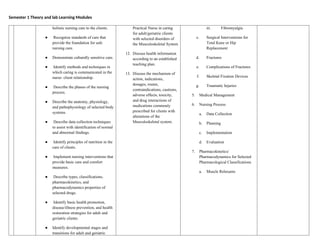
8. State the normal limits of
each vital sign.
9. Discuss the impact
laboratory findings can
play on the adult/geriatric
data collection.
10. Discuss the proper
documentation and
reporting of abnormal
findings from data
collection.
11. Describe the purpose in
documenting.
12. Discuss importance of
nurse to nurse report using
SBAR.
ii. Stethoscope
iii. Scale
iv. Time piece with
second hand
v. Tuning Fork
vi. Tongue
depressor
vii. Cotton-tip swab
viii. Reflex hammer
ix. Penlight
x. Sphygmomanom
eter and cuff
b. Identification Procedures
i. Name Band
ii. Allergy Band
iii. Fall Risk
iv. Code
c. Components of a Health
History
d. Subjective Data
e. Objective Data
f. Data Collection
Techniques
i. Inspection
Coursepoint
Pre-Lab Canvas Modules
Semester 1 Theory and lab Learning Modules
practice.
Course Outcomes-
● Describe the role of the practical
nurse and other healthcare team
members.
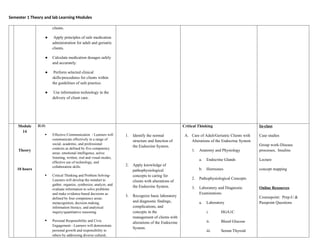
● Identify basic critical thinking skills
and problem-solving to provide
holistic nursing care to the clients.
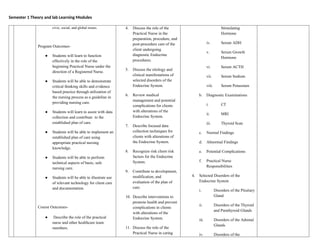
● Recognize standards of care that
provide the foundation for safe
nursing care.
● Demonstrate culturally sensitive
care.
● Identify methods and techniques in
which caring is communicated in the
nurse- client relationship.
● Describe the anatomy, physiology,
and pathophysiology of selected body
systems.
● Describe data collection techniques
to assist with identification of normal
and abnormal findings.
ii. Palpation
iii. Auscultation
iv. Head to Toe
v. Focused
g. Neurologic
i. Level of
Consciousness
ii. Orientation
iii. GCS
iv. Ability to follow
simple
commands
v. Cranial Nerves
vi. Facial Symmetry
vii. Grip Symmetry
h. Integumentary
i. Skin Condition
ii. Color
iii. Temperature
iv. Turgor
v. Skin
Impairments
a) Wounds
i. Cardiovascular
Semester 1 Theory and lab Learning Modules
i. Auscultate heart
sounds
ii. Capillary refill
iii. Pulse Points
iv. Presence of
edema
j. Respiratory
i. Auscultate
posterior/anterio
r sounds
ii. Respiratory
character
iii. Pulse Oximetry
iv. Presence of
accessory muscle
use
k. Gastrointestinal
i. Diet
ii. Appetite
iii. Fluid intake
iv. Visualize
distention
v. Auscultate bowel
sounds
vi. Presence of
gastrointestinal
diversion
Semester 1 Theory and lab Learning Modules
l. Urinary
i. Urine amount
ii. Color
iii. Odor
m. Mobility
i. Activity level
ii. Gait
iii. Tolerance level
iv. Ambulation Aids
n. Drains
i. IV present
ii. Oxygen
iii. Foley Catheter
iv. Colostomy
v. NGT
3. Vital Signs
a. Blood Pressure
b. Heart Rate
c. Respiratory Rate
d. Pain
e. Height
f. Weight
Semester 1 Theory and lab Learning Modules
4. Laboratory Values
5. Evaluation
Module 2
Lab
8 Hours
ILO:
 Effective Communication - Learners will
communicate effectively in a range of
social, academic, and professional
contexts as defined by five competency
areas: emotional intelligence, active
listening, written, oral and visual modes,
effective use of technology, and
collaboration skills.
 Critical Thinking and Problem Solving-
Learners will develop the mindset to
gather, organize, synthesize, analyze, and
evaluate information to solve problems
and make evidence-based decisions as
defined by four competency areas:
metacognition, decision making,
information literacy, and analytical
inquiry/quantitative reasoning.
 Personal Responsibility and Civic
Engagement - Learners will demonstrate
personal growth and responsibility to
others by addressing diverse cultural,
civic, social, and global issues.
1. Use information technology
in the delivery of client
care.
Information Management and
Technology
A. Documentation
1.Methods
a. SBAR
b. Problem-Oriented Medical
Record (POMR)
i. SOAPE
ii. SOAPIER
c. Focus Charting
i. DARE
d. Narrative
2. Electronic Medical Records
(EMR)
B. Client Report
C. Online Databases and Library
In-class
Group work
Lecture
Role play
Simulation
Online Resources
Coursepoint
Pre-Lab Canvas Module
Semester 1 Theory and lab Learning Modules
Program Outcomes-
● Students will learn to function
effectively in the role of the
beginning Practical Nurse under the
direction of a Registered Nurse.
● Students will be able to demonstrate
critical thinking skills and evidence
based practice through utilization of
the nursing process as a guideline in
providing nursing care.
● Students will learn to assist with data
collection and contribute to the
established plan of care.
● Students will be able to perform
technical aspects of basic, safe
nursing care.
● Students will be able to illustrate use
of relevant technology for client care
and documentation.
● Students will be able to function in
accordance with the ethical and legal
standards of practical nursing
practice.
Course Outcomes-
● Describe the role of the practical
nurse and other healthcare team
members.
1. Implement nursing
interventions that provide
basic care and comfort
measures.
2. Discuss the purpose of
using assistive devices
3. Perform how to administer
an enema within the
guidelines of safe practice.
4. Discuss the
procedure/documentation/la
beling for obtaining a stool
specimen/checking for
occult blood in stool.
5. Discuss importance of
performing ROM/AROM
exercises.
6. Identify complications
caused by inactivity.
7. Identify nursing
interventions for the
prevention of skin
breakdown.
Resources
Holism
A. Self-Care for Adult/Geriatric Client
1. Basic Care and Comfort
2. Assistive Devices
a. Pillow
b. Trapeze bar
c. Wedge pillow
d. Hand roll
e. Trochanter roll
3. Elimination
a. Administering an enema
b. Stool Specimen
c. Stool for Occult Blood
4. Mobility/Immobility
a. ROM
b. AROM
5. Skin Care
a. Personal Hygiene
b. Bathing
Semester 1 Theory and lab Learning Modules
● Identify basic critical thinking skills
and problem-solving to provide
holistic nursing care to the clients.
● Recognize standards of care that
provide the foundation for safe
nursing care.
● Demonstrate culturally sensitive
care.
● Identify methods and techniques in
which caring is communicated in the
nurse- client relationship.
● Describe the anatomy, physiology,
and pathophysiology of selected body
systems.
● Describe data collection techniques
to assist with identification of normal
and abnormal findings.
● Identify basic health promotion,
disease/illness prevention, and health
restoration strategies for adult and
geriatric clients.
● Identify developmental stages and
transitions for adult and geriatric
clients.
● Perform selected clinical
skills/procedures for clients within
the guidelines of safe practice.
● Use information technology in the
delivery of client care.
8. Demonstrate positioning
for clients in promoting
comfort.
9. Perform how to administer
an enema within the
guidelines of safe practice.
10. Discuss the
procedure/documentation/la
beling for obtaining a stool
specimen/checking for
occult blood in stool.
11. Discuss the importance of
performing ROM/AROM
exercises.
12. Identify complications
caused by inactivity.
13. Identify nursing
interventions for the
prevention of skin
breakdown.
14. Demonstrate positioning
for clients in promoting
comfort.
15. Describe the nursing
responsibilities in care of
the body after death.
16. Discuss appropriate
ergonomic principles while
c. Perineal care
d. Care of incontinent client
6. Positioning
a. Fowler’s
b. Supine
c. Sim’s
d. Side-lying
e. Prone
f. Dorsal recumbent
g. Lithotomy
h. Orthopnic
a. Bathing
7. End of Life Care/Concepts
a. Bathing
b. Removal of Lines
c. Positioning of body
Safe Practice
A. Ergonomic Principles
1. Moving clients
a. Gait/Transfer Belt
b. Slide Board
c. Using mechanical lifts
Semester 1 Theory and lab Learning Modules
turning, moving, lifting,
and transporting clients.
d. Pull sheets
2. Body Positioning
3. Reducing Stress Injuries
Module 3
Lab
8 hours
ILO:
 Effective Communication - Learners will
communicate effectively in a range of
social, academic, and professional
contexts as defined by five competency
areas: emotional intelligence, active
listening, written, oral and visual modes,
effective use of technology, and
collaboration skills.
 Critical Thinking and Problem Solving-
Learners will develop the mindset to
gather, organize, synthesize, analyze, and
evaluate information to solve problems
and make evidence-based decisions as
defined by four competency areas:
metacognition, decision making,
information literacy, and analytical
inquiry/quantitative reasoning.
 Personal Responsibility and Civic
Engagement - Learners will demonstrate
personal growth and responsibility to
1. Describe principles of
microbiology as related to
care of clients in various
settings.
2. Identify the factors in the
chain of transmission.
3. Explain how each element
in the chain of transmission
contributes to infection.
4. Discuss nursing
interventions used to
interrupt the chain of
transmission.
5. Explain the difference
Safe Practice
A. Microbiology Principles
1. Chain of Transmission
a. Infectious Agent
b. Reservoir
c. Exit Route
d. Method of transmission
e. Entrance of
Microorganism
f. Host
g. Infectious Process
h. Inflammatory Response
In-class
Case studies
Group work
Lecture
Simulation
Online Resources
Coursepoint
Semester 1 Theory and lab Learning Modules
others by addressing diverse cultural,
civic, social, and global issues.
Program Outcomes-
● Students will be able to demonstrate
critical thinking skills and evidence
based practice through utilization of
the nursing process as a guideline in
providing nursing care.
● Students will learn to assist with data
collection and contribute to the
established plan of care.
● Students will be able to implement an
established plan of care using
appropriate practical nursing
knowledge.
● Students will be able to assist with
the evaluation of nursing care based
on established outcome criteria.
● Students will be able to perform
technical aspects of basic, safe
nursing care.
Course Outcomes-
● Identify basic critical thinking skills
and problem-solving to provide
holistic nursing care to Clients.
● Recognize standards of care that
provide the foundation for safe
between medical and
surgical asepsis.
6. Discuss the recommended
guidelines and types of
isolation precautions
7. Demonstrate how to
properly apply PPE.
8. Demonstrate how to
appropriately take off PPE.
9. Demonstrate how to
correctly don sterile gloves
using the open technique.
10. Identify principles of
creating and maintaining a
sterile field.
11. Discuss the appropriate
way to handle and dispose
of hazardous and infectious
materials.
i. Hand Hygiene
2. Medical and Surgical Asepsis
a. Proper hand cleaning
guidelines (WHO, 2016;
CDC, 2016)
3. Standard/Transmission-
Based/Other Precautions
a. Contact
b. Airborne
c. Droplet
4. Application of PPE
a. Gloving
b. Gowning
c. Mask
d. Protective Eyewear
5. Apply Sterile Gloves
a. Principles of Sterile
technique
b. Donning Sterile Gloves
6. Maintain Sterile Field
a. Preparing a Sterile Field
b. Pouring Sterile Solutions
c. Managing Sterile
Packages
d. Prevention of health care–
Pre-Lab Canvas Modules
https://
www.jointcommission.org/-/
media/tjc/documents/
standards/national-patient-
safety-goals/2021/simplified-
2021-hap-npsg-goals-final-
11420.pdf
Semester 1 Theory and lab Learning Modules
nursing care.
● Demonstrate culturally sensitive
care.
● Describe the anatomy, physiology,
and pathophysiology of selected body
systems.
● Describe data collection techniques
to assist with identification of normal
and abnormal findings.
● Describe principles of microbiology
as related to care of clients in various
settings.
● Perform selected clinical
skills/procedures for clients within
the guidelines of safe practice.
associated infections
(QSEN, 2016)
B. Handling Hazardous and Infectious
Materials
1. Disposing of
Contaminated Equipment
a. Biohazard
b. Chemical
2. Double bagging
C. Mandatory Reporting of Designated
Communicable Diseases
Module 4
Lab
16 hours
ILO:
 Effective Communication - Learners will
communicate effectively in a range of
social, academic, and professional
contexts as defined by five competency
areas: emotional intelligence, active
listening, written, oral and visual modes,
effective use of technology, and
collaboration skills.
 Critical Thinking and Problem Solving-
Learners will develop the mindset to
gather, organize, synthesize, analyze, and
evaluate information to solve problems
and make evidence-based decisions as
defined by four competency areas:
metacognition, decision making,
information literacy, and analytical
inquiry/quantitative reasoning.
1. Discuss the role and
responsibility of the
Practical Nurse in
medication administration.
2. List the factors that must be
present in a medication
order
3. Discuss the importance of
reading back and clarifying
orders.
4. Discuss the role of the
Practical Nurse in phoning
in prescriptions.
Safe Practice
A. Medication Administration of
Parenteral and Enteral Medications
1. Medication Orders
a. Provider Orders
i. Transcription
Verbal/Phone
ii. Phone in
Prescriptions
iii. Order clarification
2. Drug Preparations
In-class
Group work
Lecture
Role play
Simulation
Online Resources:
http://qsen.org/
Semester 1 Theory and lab Learning Modules
 Personal Responsibility and Civic
Engagement - Learners will demonstrate
personal growth and responsibility to
others by addressing diverse cultural,
civic, social, and global issues.
Program Outcomes-
● Students will learn to function
effectively in the role of the
beginning Practical Nurse under the
direction of a Registered Nurse.
● Students will be able to demonstrate
critical thinking skills and evidence
based practice through utilization of
the nursing process as a guideline in
providing nursing care.
● Students will learn to assist with data
collection and contribute to the
established plan of care.
● Students will be able to implement an
established plan of care using
appropriate practical nursing
knowledge.
● Students will be able to assist with
the evaluation of nursing care based
on established outcome criteria.
● Students will be able to illustrate use
of relevant technology for client care
and documentation.
5. Describe factors to consider
in choosing routes of
administration of
medication.
6. Apply principles of safe
medication administration
for adult/geriatric clients.
7. Demonstrate how to
appropriately prepare
enteral medications.
8. Demonstrate how to
appropriately prepare
Parenteral medications.
9. Calculate medication
dosages safely and
accurately
10. Discuss the importance of
the 3 checks in medication
administration.
11. List the six rights of drug
administration.
12. Discuss the importance of
accurate medication
administration
documentation.
13. Discuss differences in
hospital vs. long-term care
documentation of
medications.
a. Enteral
i. Pills
a) Cutting
b) Crushing
ii. Liquids
b. Parenteral
iii. Subcutaneous
iv. Intramuscular
v. Z-Track
vi. Intradermal
3. Dosage Calculations
a. Conversion from Apothecary
to Metric
b. Converting within Metric
System
c. Ratio and Proportion
4. Preparation of Medications
a. 3 Checks
i. Label all
unlabeled
medications
b. 6 Rights
i. Right Medication
ii. Right Dose
https://
www.jointcommission.org/-/
media/tjc/documents/
standards/national-patient-
safety-goals/2021/simplified-
2021-hap-npsg-goals-final-
11420.pdf
Coursepoint
Pre-Lab Canvas Modules
Semester 1 Theory and lab Learning Modules
Course Outcomes-
● Describe the role of the practical
nurse and other healthcare team
members.
● Identify basic critical thinking skills
and problem-solving to provide
holistic nursing care to clients.
● Recognize standards of care that
provide the foundation for safe
nursing care.
● Demonstrate culturally sensitive
care.
● Describe the phases of the nursing
process.
● Describe the anatomy, physiology,
and pathophysiology of selected body
systems.
● Describe data collection techniques
to assist with identification of normal
and abnormal findings.
● Implement nursing interventions that
provide basic care and comfort
measures.
● Describe types, classifications,
pharmacokinetics, and
pharmacodynamics properties of
selected drugs.
● Identify basic health promotion,
iii. Right Time
iv. Right Route
v. Right Client
vi. Right
Documentation
vii. Using at least two
patient identifiers
(QSEN, 2016)
b. Reconstitution
c. Medications supplied in an
Ampule
5. Medication Administration
Methods
6. Documentation
a. MAR
b. Long-Term care Vs. Hospital
Semester 1 Theory and lab Learning Modules
disease/illness prevention, and health
restoration strategies for adult and
geriatric clients.
● Identify developmental stages and
transitions for adult and geriatric
clients.
● Describe principles of microbiology
as related to care of clients in various
settings.
● Apply principles of safe medication
administration for adult and geriatric
clients.
● Calculate medication dosages safely
and accurately.
● Perform selected clinical
skills/procedures for clients within
the guidelines of safe practice.
● Examine the scope of practice and
legal and ethical issues for the
practical nurse.
● Use information technology in the
delivery of client care.
Module 5
Lab
4 hours
ILO:
 Effective Communication - Learners will
communicate effectively in a range of
social, academic, and professional
contexts as defined by five competency
areas: emotional intelligence, active
listening, written, oral and visual modes,
effective use of technology, and
collaboration skills.
1. Discuss the role of the
Practical Nurse as part of
the health care team when
working with adult/geriatric
clients who are in the
following stages of
admission/transfer/discharg
e.
Safe Practice
A. Select Clinical Skills/Therapeutic
Procedures
1. Referral Process
a. Facility Resources
b. Community Resources
In-class
Group work
Lecture
Role play
Simulation
Semester 1 Theory and lab Learning Modules
 Critical Thinking and Problem Solving-
Learners will develop the mindset to
gather, organize, synthesize, analyze, and
evaluate information to solve problems
and make evidence-based decisions as
defined by four competency areas:
metacognition, decision making,
information literacy, and analytical
inquiry/quantitative reasoning.
 Personal Responsibility and Civic
Engagement - Learners will demonstrate
personal growth and responsibility to
others by addressing diverse cultural,
civic, social, and global issues.
Program Outcomes-
● Students will learn to function
effectively in the role of the
beginning Practical Nurse under the
direction of a Registered Nurse.
● Students will be able to demonstrate
critical thinking skills and evidence
based practice through utilization of
the nursing process as a guideline in
providing nursing care.
● Students will learn to assist with data
collection and contribute to the
established plan of care.
● Students will be able to implement an
established plan of care using
appropriate practical nursing
knowledge.
● Students will be able to assist with
the evaluation of nursing care based
2. Describe how the Practical
Nurse prepares an
adult/geriatric client for
transfer/discharge.
3. Discuss the importance of
nurse to nurse report.
2. Admission/Transfer/Discharge
a. Admitting a client
i. Receiving Report
ii. Data Collection
iii. Collaboration with
RN
b. Transferring a client
i. Report to Receiving
nurse
c. Discharging a client
i. Discharge planning
ii. Follow up
iii. AMA
Online Resources
Coursepoint
Pre-Lab Canvas Modules
Semester 1 Theory and lab Learning Modules
on established outcome criteria.
● Students will be able to illustrate use
of relevant technology for client care
and documentation.
● Students will be able to function in
accordance with the ethical and legal
standards of practical nursing
practice.
● Students will be able to apply
therapeutic communication
techniques in providing basic nursing
care for clients throughout the
lifespan.
● Students will be able to perform
technical aspects of basic, safe
nursing care.
Course Outcomes-
● Describe the role of the practical
nurse and other healthcare team
members.
● Identify basic critical thinking skills
and problem-solving to provide
holistic nursing care to clients.
● Recognize standards of care that
provide the foundation for safe
nursing care.
● Demonstrate culturally sensitive
care.
● Identify methods and techniques in
which caring is communicated in the
Semester 1 Theory and lab Learning Modules
nurse-client relationship.
● Describe the phases of the nursing
process.
● Describe the anatomy, physiology,
and pathophysiology of selected body
systems.
● Describe data collection techniques
to assist with identification of normal
and abnormal findings.
● Implement nursing interventions that
provide basic care and comfort
measures.
● Identify basic health promotion,
disease/illness prevention, and health
restoration strategies for Adult and
geriatric clients.
● Identify developmental stages and
transitions for adult and geriatric
clients.
Module 6
Lab
8 hours
ILO:
 Effective Communication - Learners will
communicate effectively in a range of
social, academic, and professional
contexts as defined by five competency
areas: emotional intelligence, active
listening, written, oral and visual modes,
effective use of technology, and
collaboration skills.
 Critical Thinking and Problem Solving-
Learners will develop the mindset to
gather, organize, synthesize, analyze, and
1. Perform how to use sterile
technique to insert and
manage an indwelling and
straight catheter within the
guidelines of safe practice.
2. Demonstrate how to
discontinue an
indwelling/straight catheter
Safe Practice
3. Select Clinical Skills/Therapeutic
Procedures
1. Care of the Client with a Urinary
Catheter
a. Indwelling Catheter Insertion
i. Male – Foley
In-class
Group work
Lecture
Check list- foley insertion
Simulation
Semester 1 Theory and lab Learning Modules
evaluate information to solve problems
and make evidence-based decisions as
defined by four competency areas:
metacognition, decision making,
information literacy, and analytical
inquiry/quantitative reasoning.
 Personal Responsibility and Civic
Engagement - Learners will demonstrate
personal growth and responsibility to
others by addressing diverse cultural,
civic, social, and global issues.
Program Outcomes-
● Students will learn to function
effectively in the role of the
beginning Practical Nurse under the
direction of a Registered Nurse.
● Students will be able to demonstrate
critical thinking skills and evidence
based practice through utilization of
the nursing process as a guideline in
providing nursing care.
● Students will learn to assist with data
collection and contribute to the
established plan of care.
● Students will be able to implement an
established plan of care using
appropriate practical nursing
knowledge.
● Students will be able to assist with
the evaluation of nursing care based
on established outcome criteria.
● Students will be able to illustrate use
3. Demonstrate how to
correctly place a condom
catheter.
4. Discuss how to accurately
use a bladder scanner on an
adult/geriatric client.
5. Discuss documentation of
catheter/condom catheter
insertion.
6. Discuss the
procedure/documentation/la
beling for obtaining a urine
specimen.
ii. Female – Foley
b. Catheter Irrigation
c. Straight Catheter Insertion
d. Catheter Removal
e. Prevention of infections of the
urinary tract caused by
catheters (QSEN, 2016)
f. Condom Catheter
g. Bladder Scan
h. Documentation
Collection of Diagnostic Specimens
1. Urine
a. Midstream
b. 24 Hour Urine
c. Closed Catheter System
2. Documentation
3. Labeling
Online Resources:
http://qsen.org/
Coursepoint
Pre-Lab Canvas Modules
https://
www.jointcommission.org/-/
media/tjc/documents/
standards/national-patient-
safety-goals/2021/simplified-
2021-hap-npsg-goals-final-
11420.pdf
Semester 1 Theory and lab Learning Modules
of relevant technology for client care
and documentation.
● Students will be able to function in
accordance with the ethical and legal
standards of practical nursing
practice.
Course Outcomes-
● Describe the role of the practical
nurse and other healthcare team
members.
● Identify basic critical thinking skills
and problem-solving to provide
holistic nursing care to Clients.
● Recognize standards of care that
provide the foundation for safe
nursing care.
● Demonstrate culturally sensitive
care.
● Identify methods and techniques in
which caring is communicated in the
nurse- client relationship.
● Describe the phases of the nursing
process.
● Describe the anatomy, physiology,
and pathophysiology of selected body
systems.
● Describe data collection techniques
to assist with identification of normal
and abnormal findings.
Semester 1 Theory and lab Learning Modules
● Implement nursing interventions that
provide basic care and comfort
measures.
● Identify basic health promotion,
disease/illness prevention, and health
restoration strategies for adult and
geriatric clients.
● Describe principles of microbiology
as related to care of clients in various
settings.
● Perform selected clinical
skills/procedures for clients within
the guidelines of safe practice.
● Examine the scope of practice and
legal and ethical issues for the
practical nurse.
● Use information technology in the
delivery of client care.
Module 7
Lab
4 hours
ILO:
 Effective Communication - Learners will
communicate effectively in a range of
social, academic, and professional
contexts as defined by five competency
areas: emotional intelligence, active
listening, written, oral and visual modes,
effective use of technology, and
collaboration skills.
 Critical Thinking and Problem Solving-
Learners will develop the mindset to
gather, organize, synthesize, analyze, and
evaluate information to solve problems
and make evidence-based decisions as
defined by four competency areas:
metacognition, decision making,
1. Discuss the role of the
Practical Nurse in giving
care to the adult/geriatric
client on oxygen therapy.
2. Discuss the different
methods in oxygen
administration.
3. Discuss the
procedure/documentation/la
beling for obtaining a
respiratory
Safe Practice
A. Select Clinical Skills/Therapeutic
Procedures
1. Care of the Client Receiving
Oxygen Therapy
a. Nasal Prongs
b. Mask
c. Manual Resuscitator
d. Oral Airway
In-class
Group work
Lecture
case study/questions
Simulation
Online Resources
Coursepoint
Semester 1 Theory and lab Learning Modules
information literacy, and analytical
inquiry/quantitative reasoning.
 Personal Responsibility and Civic
Engagement - Learners will demonstrate
personal growth and responsibility to
others by addressing diverse cultural,
civic, social, and global issues.
Program Outcomes-
● Students will learn to function
effectively in the role of the
beginning Practical Nurse under the
direction of a Registered Nurse.
● Students will be able to demonstrate
critical thinking skills and evidence
based practice through utilization of
the nursing process as a guideline in
providing nursing care.
● Students will learn to assist with data
collection and contribute to the
established plan of care.
● Students will be able to implement an
established plan of care using
appropriate practical nursing
knowledge.
● Students will be able to assist with
the evaluation of nursing care based
on established outcome criteria.
● Students will be able to illustrate use
of relevant technology for client care
and documentation.
● Students will be able to function in
culture/collection.
4. Discuss documentation of
an adult/older adult client
receiving oxygen therapy.
e. Nasal Airway
f. Pulse Oximiter
g. Collection of Diagnostic
Specimens
1. Sputum Collection
2. Throat Culture
3. Nose Culture
4. Documentation
5. Labeling
h. Documentation of client
receiving O2 Therapy
1. Liters/Min
2. Route of O2 Delivery
3. Client findings
Pre-Lab Canvas Modules
Semester 1 Theory and lab Learning Modules
accordance with the ethical and legal
standards of practical nursing
practice.
● Students will be able to apply
therapeutic communication
techniques in providing basic nursing
care for clients throughout the
lifespan.
● Students will be able to perform
technical aspects of basic, safe
nursing care.
Course Outcomes-
● Describe the role of the practical
nurse and other healthcare team
members.
● Identify basic critical thinking skills
and problem-solving to provide
holistic nursing care to clients.
● Recognize standards of care that
provide the foundation for safe
nursing care.
● Demonstrate culturally sensitive
care.
● Identify methods and techniques in
which caring is communicated in the
nurse-client relationship.
● Describe the phases of the nursing
process.
Semester 1 Theory and lab Learning Modules
● Describe the anatomy, physiology,
and pathophysiology of selected body
systems.
● Describe data collection techniques
to assist with identification of normal
and abnormal findings.
● Implement nursing interventions that
provide basic care and comfort
measures.
● Identify basic health promotion,
disease/illness prevention, and health
restoration strategies for Adult and
geriatric clients.
● Identify developmental stages and
transitions for adult and geriatric
clients.
Module 8
Lab
8 hours
ILO:
 Effective Communication - Learners will
communicate effectively in a range of
social, academic, and professional
contexts as defined by five competency
areas: emotional intelligence, active
listening, written, oral and visual modes,
effective use of technology, and
collaboration skills.
 Critical Thinking and Problem Solving-
Learners will develop the mindset to
gather, organize, synthesize, analyze, and
evaluate information to solve problems
and make evidence-based decisions as
defined by four competency areas:
metacognition, decision making,
information literacy, and analytical
1. Explain the role of the
Practical Nurse in caring
for a client with a wound.
2. Discuss care of an
adult/older adult client with
a wound vac.
3. Demonstrate how to
irrigate a wound.
4. Identify the procedure for
removing sutures and
staples.
Selected Clinical Skills/Therapeutic
Procedures
1. Wound Care
a. Wound Vac
b. Irrigation
c. Remove Staples Sutures
d. Management of the Drain
e. Clean Dressing Change
f. Sterile Dressing Change
In-class
Worksheet
Group work
Lecture
Simulation
Wet to Damp Dsg change
Online Resources
Coursepoint
Semester 1 Theory and lab Learning Modules
inquiry/quantitative reasoning.
 Personal Responsibility and Civic
Engagement - Learners will demonstrate
personal growth and responsibility to
others by addressing diverse cultural,
civic, social, and global issues.
Program Outcomes-
● Students will learn to function
effectively in the role of the
beginning Practical Nurse under the
direction of a Registered Nurse.
● Students will be able to demonstrate
critical thinking skills and evidence
based practice through utilization of
the nursing process as a guideline in
providing nursing care.
● Students will learn to assist with data
collection and contribute to the
established plan of care.
● Students will be able to implement an
established plan of care using
appropriate practical nursing
knowledge.
● Students will be able to assist with
the evaluation of nursing care based
on established outcome criteria.
● Students will be able to illustrate use
of relevant technology for client care
and documentation.
● Students will be able to function in
accordance with the ethical and legal
5. Explain procedure for
applying clean, sterile, wet
to dry dressings.
6. Discuss how to manage a
drain.
7. Discuss the
procedure/documentation/la
beling for obtaining a
wound culture.
8. Discuss heat and cold
therapy/procedures.
9. Discuss the role of the
Practical Nurse in caring
for a client with an ostomy.
g. Wet to Dry Dressing
h. Drain Removal
i. Wound Culture
i. Documentation
ii. Labeling
2. Care of the Client Receiving
Heat/Cold Therapy
a. Local effects of heat and cold
b. Client safety
i. Maintenance of skin
integrity
c. Moist or dry application
d. Heat
i. Compresses
ii. Warm soaks
iii. Commercial hot
packs
iv. Electric Heating pads
e. Cold
i. Ice packs
3. Care of the Client with an Ostomy
a. Irrigation
b. Changing bag
Pre-Lab Canvas Modules
https://
www.jointcommission.org/-/
media/tjc/documents/
standards/national-patient-
safety-goals/2021/simplified-
2021-hap-npsg-goals-final-
11420.pdf
Semester 1 Theory and lab Learning Modules
standards of practical nursing
practice.
Course Outcomes-
● Describe the role of the practical
nurse and other healthcare team
members.
● Identify basic critical thinking skills
and problem-solving to provide
holistic nursing care to Clients.
● Recognize standards of care that
provide the foundation for safe
nursing care.
● Demonstrate culturally sensitive
care.
● Identify methods and techniques in
which caring is communicated in the
nurse- client relationship.
● Describe the phases of the nursing
process.
● Describe the anatomy, physiology,
and pathophysiology of selected body
systems.
● Describe data collection techniques
to assist with identification of normal
and abnormal findings.
● Implement nursing interventions that
provide basic care and comfort
measures.
● Identify basic health promotion,
Semester 1 Theory and lab Learning Modules
disease/illness prevention, and health
restoration strategies for adult and
geriatric clients.
● Describe principles of microbiology
as related to care of clients in various
settings.
● Perform selected clinical
skills/procedures for clients within
the guidelines of safe practice.
● Examine the scope of practice and
legal and ethical issues for the
practical nurse.
● Use information technology in the
delivery of client care
Module 9
Lab
4 hours
ILO:
 Effective Communication - Learners will
communicate effectively in a range of
social, academic, and professional
contexts as defined by five competency
areas: emotional intelligence, active
listening, written, oral and visual modes,
effective use of technology, and
collaboration skills.
 Critical Thinking and Problem Solving-
Learners will develop the mindset to
gather, organize, synthesize, analyze, and
evaluate information to solve problems
and make evidence-based decisions as
defined by four competency areas:
metacognition, decision making,
information literacy, and analytical
inquiry/quantitative reasoning.
 Personal Responsibility and Civic
Engagement - Learners will demonstrate
1. Discuss the role of the
Practical Nurse in giving
safe care to the adult/older
adult client with a
Nasogastric/Feeding Tube.
2. Discuss the purpose for
irrigation and checking
residual for a client with a
nasogastric tube.
3. Demonstrate how to
remove a Nasogastric tube.
4. Discuss how to
appropriately administer
medications through a
Selected Clinical Skills/Therapeutic
Procedures
1. Care of the Client with a
Nasogastric/Feeding Tube
a. Insertion
i. Gathering supplies
ii. Client positioning
iii. Measuring NGT
b. Irrigation
c. Removal
d. Medication Administration
e. Enteral Feeding
In-class
Checklist-insertion of NGT
Group work
Lecture
Simulation
Online Resources
Coursepoint
Pre-Lab Canvas Modules
Semester 1 Theory and lab Learning Modules
personal growth and responsibility to
others by addressing diverse cultural,
civic, social, and global issues.
Program Outcomes-
● Students will learn to function
effectively in the role of the
beginning Practical Nurse under the
direction of a Registered Nurse.
● Students will be able to demonstrate
critical thinking skills and evidence
based practice through utilization of
the nursing process as a guideline in
providing nursing care.
● Students will learn to assist with data
collection and contribute to the
established plan of care.
● Students will be able to implement an
established plan of care using
appropriate practical nursing
knowledge.
● Students will be able to assist with
the evaluation of nursing care based
on established outcome criteria.
● Students will be able to illustrate use
of relevant technology for client care
and documentation.
Course Outcomes-
nasogastric/feeding tube.
5. Discuss how to
appropriately initiate and
monitor an adult/geriatric
client who is on a
continuous vs. bolus
feeding.
i. Setting up pump
ii. Bolus
iii. Continuous
iv. Checking residual
Semester 1 Theory and lab Learning Modules
● Describe the role of the practical
nurse and other healthcare team
members.
● Identify basic critical thinking skills
and problem-solving to provide
holistic nursing care to clients.
● Recognize standards of care that
provide the foundation for safe
nursing care.
● Demonstrate culturally sensitive
care.
● Describe the phases of the nursing
process.
● Describe the anatomy, physiology,
and pathophysiology of selected body
systems.
● Describe data collection techniques
to assist with identification of normal
and abnormal findings.
● Implement nursing interventions that
provide basic care and comfort
measures.
● Describe types, classifications,
pharmacokinetics, and
pharmacodynamics properties of
selected drugs.
● Identify basic health promotion,
disease/illness prevention, and health
restoration strategies for adult and
geriatric clients.
● Identify developmental stages and
Semester 1 Theory and lab Learning Modules
transitions for adult and geriatric
clients.
● Describe principles of microbiology
as related to care of clients in various
settings.
● Apply principles of safe medication
administration for adult and geriatric
clients.
● Calculate medication dosages safely
and accurately.
● Perform selected clinical
skills/procedures for clients within
the guidelines of safe practice.
● Examine the scope of practice and
legal and ethical issues for the
practical nurse.
● Use information technology in the
delivery of client care.
Module 10
Lab
4 hours
ILO:
 Effective Communication - Learners will
communicate effectively in a range of
social, academic, and professional
contexts as defined by five competency
areas: emotional intelligence, active
listening, written, oral and visual modes,
effective use of technology, and
collaboration skills.
 Critical Thinking and Problem Solving-
Learners will develop the mindset to
gather, organize, synthesize, analyze, and
evaluate information to solve problems
and make evidence-based decisions as
defined by four competency areas:
SAPHE LAB
· Students will learn how to
provide safe care and protect the
patient from potential harm.
· Students will learn how to use
appropriate body mechanics and safe
patient handling devices to protect
oneself from occupational injury.
In-class-
Group work
Lecture
Role play
Simulation
Online Resources
Pre-Lab Canvas Modules-
powerpoint to view prior to
Semester 1 Theory and lab Learning Modules
metacognition, decision making,
information literacy, and analytical
inquiry/quantitative reasoning.
 Personal Responsibility and Civic
Engagement - Learners will demonstrate
personal growth and responsibility to
others by addressing diverse cultural,
civic, social, and global issues.
Program Outcomes-
● Students will be able to demonstrate
critical thinking skills and evidence
based practice through utilization of
the nursing process as a guideline in
providing nursing care.
● Students will learn to assist with data
collection and contribute to the
established plan of care.
● Students will be able to implement an
established plan of care using
appropriate practical nursing
knowledge.
● Students will be able to assist with
the evaluation of nursing care based
on established outcome criteria.
Course Outcomes-
● Describe the role of the practical
nurse and other healthcare team
experience in SaPHE lab
Semester 1 Theory and lab Learning Modules
members.
● Identify basic critical thinking skills
and problem-solving to provide
holistic nursing care to clients.
● Recognize standards of care that
provide the foundation for safe
nursing care.
● Demonstrate culturally sensitive
care.
● Describe the anatomy, physiology,
and pathophysiology of selected body
systems.
● Describe data collection techniques
to assist with identification of normal
and abnormal findings.
● Implement nursing interventions that
provide basic care and comfort
measures.

NUR160PN nursing Teaching Guide for instructors

  • 1.
    Semester 1 Theoryand lab Learning Modules Semester 1 Theory and Lab Learning Modules Module Institutional Learning Outcomes Program Outcomes Course Outcomes Lesson Objectives Content Activities Module 1 Theory 6 hours ILO:  Effective Communication - Learners will communicate effectively in a range of social, academic, and professional contexts as defined by five competency areas: emotional intelligence, active listening, written, oral and visual modes, effective use of technology, and collaboration skills.  Critical Thinking and Problem Solving- Learners will develop the mindset to gather, organize, synthesize, analyze, and evaluate information to solve problems and make evidence-based decisions as defined by four competency areas: metacognition, decision making, information literacy, and analytical inquiry/quantitative reasoning.  Personal Responsibility and Civic Engagement - Learners will demonstrate personal growth and responsibility to others by addressing diverse cultural, civic, social, and global issues. Program Outcomes- ● Students will learn to function effectively in the role of the beginning Practical Nurse under the direction of a Registered Nurse. ● Students will be able to demonstrate critical thinking skills and evidence based practice through utilization of 1. Identify key historical developments in the nursing profession. 2. Define the core values of the Practical Nurse program. 3. Describe the purpose, role and responsibilities of the Practical Nurse. 4. Identify basic critical thinking skills and problem-solving to provide holistic nursing care to clients. 5. Describe the phases of the nursing process. 6. Explain the role of the Practical Nurse in carrying out the nursing process. 7. Explain the role of the Practical Nurse in contributing to the care of the client using an established care plan. 8. Recognize the importance Introduction to Nursing A. History of Nursing B. Core Values of the Practical Nursing Program 1. Caring 2. Critical Thinking 3. Holism 4. Safe Practice 5. Role Development 6. Information Technology and Management Role Development A. Roles and Responsibilities of the Practical Nurse 1. Manager of Care 2. Provider of Care 3. Member of the Profession 4. Member of Interdisciplinary Health Care Team In-class Student handbook Syllabus Case studies Group work Lecture Role play Strategies for Problem Solving Fundamentals: The Nursing Process Online Resources Coursepoint: Prep-U & Passpoint Questions
  • 2.
    Semester 1 Theoryand lab Learning Modules the nursing process as a guideline in providing nursing care. ● Students will learn to assist with data collection and contribute to the established plan of care. ● Students will be able to implement an established plan of care using appropriate practical nursing knowledge. ● Students will be able to assist with the evaluation of nursing care based on established outcome criteria. ● Students will be able to illustrate use of relevant technology for client care and documentation. Course Outcomes- ● Identify key historical developments in the nursing profession. ● Define the core values of the practical nurse program. ● Describe the role of the practical nurse and other healthcare team members. ● Identify methods and techniques in which caring is communicated in the nurse- client relationship. ● Describe the phases of the nursing process. ● Describe the anatomy, physiology, of agency guidelines regarding care maps, care plans, and clinical pathways. Critical Thinking A. Elements of Critical Thinking B. Nursing Process 1. Data Collection 2. Planning 3. Implementation 4. Evaluation 5. Documentation
  • 3.
    Semester 1 Theoryand lab Learning Modules and pathophysiology of selected body systems. ● Describe data collection techniques to assist with identification of normal and abnormal findings. Module 2 Theory 4 Hours ILO:  Effective Communication - Learners will communicate effectively in a range of social, academic, and professional contexts as defined by five competency areas: emotional intelligence, active listening, written, oral and visual modes, effective use of technology, and collaboration skills.  Critical Thinking and Problem Solving- Learners will develop the mindset to gather, organize, synthesize, analyze, and evaluate information to solve problems and make evidence-based decisions as defined by four competency areas: metacognition, decision making, information literacy, and analytical inquiry/quantitative reasoning.  Personal Responsibility and Civic Engagement - Learners will demonstrate personal growth and responsibility to others by addressing diverse cultural, civic, social, and global issues. Program Outcomes- ● Students will be able to apply therapeutic communication techniques in providing basic nursing care for clients throughout the lifespan. ● Students will be able to demonstrate 1. Discuss the concepts of verbal and non verbal communication 2. Recognize and demonstrate therapeutic communication. 3. Discuss the role of the Practical Nurse in creating a therapeutic communication environment. 4. Identify barriers to communication 5. Discuss the importance of establishing and maintaining a professional boundary between the nurse and client. 6. Identify methods and techniques in which caring is communicated in the nurse-client relationship. 7. Demonstrate how to communicate with a Caring for the Adult/Geriatric Client A. Overview of Communication 1. Verbal Communication 2. Nonverbal Communication B. Styles of Communication 1. Assertive Communication 2. Aggressive Communication 3. Unassertive Communication C. Therapeutic Communication 1. Nonverbal 2. Verbal 3. Factors affecting communication a. Posturing and Positioning b. Space and Territory c. Environment d. Level of Trust e. Language Barriers f. Culture In-class Case studies Group work Lecture Role play Fundamentals: Therapeutic Communication Skills Videos Online Resources Coursepoint: Prep-U & Passpoint Questions
  • 4.
    Semester 1 Theoryand lab Learning Modules critical thinking skills and evidence based practice through utilization of the nursing process as a guideline in providing nursing care. ● Students will be able to illustrate use of relevant technology for client care and documentation. Course Outcomes- ● Identify basic critical thinking skills and problem-solving to provide holistic nursing care to clients. ● Demonstrate culturally sensitive care.- Nursing cultural day ● Identify methods and techniques in which caring is communicated in the nurse- client relationship. ● Implement nursing interventions that provide basic care and comfort measures. ● Identify basic health promotion, disease/illness prevention, and health restoration strategies for Adult and geriatric clients.- Health Fair nonverbal or impaired client. 8. Discuss the appropriate use of interpreters to assist in achieving client understanding. g. Age and Gender h. Physiologic Factors i. Psychosocial Factors j. Barriers to communication D. Therapeutic Environment E. Nurse – Client Relationships 1. Professional Boundaries 2. Communicating in Special Situations a. Ventilator dependent clients b. Aphasic clients c. Unresponsive clients d. Interpreters F. Support Systems Module 3 Theory ILO:  Effective Communication - Learners will communicate effectively in a range of social, academic, and professional contexts as defined by five competency areas: emotional intelligence, active listening, written, oral and visual modes, effective use of technology, and collaboration skills. – Learning 1. Define appropriate legal terms and summarize the legal system. 2. List examples of legal issues in healthcare. Role Development A. Practical Nursing Practice 1. Overview of the Legal System 2. Overview of the Legal Process In-class Arizona State Nurse Practice Act Case studies Group work Lecture
  • 5.
    Semester 1 Theoryand lab Learning Modules 4 hours modalities  Critical Thinking and Problem Solving- Learners will develop the mindset to gather, organize, synthesize, analyze, and evaluate information to solve problems and make evidence-based decisions as defined by four competency areas: metacognition, decision making, information literacy, and analytical inquiry/quantitative reasoning. – Care plans  Personal Responsibility and Civic Engagement - Learners will demonstrate personal growth and responsibility to others by addressing diverse cultural, civic, social, and global issues. Health Fair Program Outcomes- ● Students will be able to function in accordance with the ethical and legal standards of practical nursing practice.-Clinical Rotations ● Students will learn to function effectively in the role of the beginning Practical Nurse under the direction of a Registered Nurse, Clinical Rotations ● Students will be able to demonstrate critical thinking skills and evidence based practice through utilization of the nursing process as a guideline in providing nursing care. Care Plans ● Students will be able to illustrate use of relevant technology for client care 3. Explain nursing malpractice 4. Discuss the role the State Board of Nursing plays in client safety and regulation of nursing practice. 5. Explain the importance of maintaining standards of care 6. Discuss how a Practical Nurse can avoid being involved in a lawsuit 7. Define the meaning of the code of ethics. 8. Explain advanced directives. 9. Describe the federal regulations of HIPAA privacy rule and its impact on health care. 10. Identify the role of the practical nurse in acquiring informed consent. 11. Discuss client rights. 12. Define resource management. 13. Examine the scope of practice and legal and ethical issues for the Practical Nurse. 14.Discuss importance of 3. Legal Relationships 4. How to Avoid a lawsuit 5. Insurance 6. Regulation of Practice a. Standards of Practice b. Standards of Care c. Nurse Practice Act i. Scope of Practice ii. Licensure iii. Client Safety 7. Legal and Ethical Practice a. Reporting Unethical Behavior 8. Code of Ethics 9. Advanced Directives a. Living Will b. Health Care Proxy c. Durable Power of Attorney for Health Care 10. Confidentiality/Information Security HIPAA a. Patient privacy 11. Informed Consent Role play Pearson Real Nursing Skills: HIPAA: A Guide For Healthcare Workers Online Resources Coursepoint: Prep-U & Passpoint Questions
  • 6.
    Semester 1 Theoryand lab Learning Modules and documentation.-Sim Lab Course Outcomes- ● Describe the role of the practical nurse and other healthcare team members. Scope of Practice ● Identify basic critical thinking skills and problem-solving to provide holistic nursing care to clients. ● Recognize standards of care that provide the foundation for safe nursing care. ● Demonstrate culturally sensitive care. ● Identify methods and techniques in which caring is communicated in the nurse- client relationship. ● Perform selected clinical skills/procedures for clients within the guidelines of safe practice. Skills check off ● Examine the scope of practice and legal and ethical issues for the practical nurse. Scope of practice study ● Use information technology in the delivery of client care. Care plans and sim evidence based practice 12. Advocacy a. Nurse as self advocate b. Nurse as patient advocate c. Patient as self advocate 12. Client Rights a. Federal b. State c. Facility 13. Resource Management
  • 7.
    Semester 1 Theoryand lab Learning Modules Module 4 Theory 6 hours ILO:  Effective Communication - Learners will communicate effectively in a range of social, academic, and professional contexts as defined by five competency areas: emotional intelligence, active listening, written, oral and visual modes, effective use of technology, and collaboration skills.  Critical Thinking and Problem Solving- Learners will develop the mindset to gather, organize, synthesize, analyze, and evaluate information to solve problems and make evidence-based decisions as defined by four competency areas: metacognition, decision making, information literacy, and analytical inquiry/quantitative reasoning.  Personal Responsibility and Civic Engagement - Learners will demonstrate personal growth and responsibility to others by addressing diverse cultural, civic, social, and global issues. Program Outcomes- ● Students will learn to function effectively in the role of the beginning Practical Nurse under the direction of a Registered Nurse. ● Students will be able to demonstrate critical thinking skills and evidence based practice through utilization of the nursing process as a guideline in providing nursing care. ● Students will learn to assist with data collection and contribute to the 1. Define pharmacology. 2. List major legislative acts controlling drug use and abuse. 3. Discuss different nomenclature and classification of medications. 4. Differentiate between schedule I, II, III, IV, and V medications and be able to describe nursing responsibilities associated with the safe administration of each type. 5. Define basic pharmacodynamic and pharmacokinetic principles of medication action in the body. 6. Define the terms expected effects, side effects, adverse effects and contraindications. 7. Define medication compatibility and Safe Practice A. Pharmacology 1. U.S. Drug Legislation 2. Safely administer medications a. Use at least two ways to identify patients (QSEN, 2016) b. Label medications (QSEN, 2016) c. Six rights d. Three checks e. High alert medications f. Correct documentation (QSEN, 2016) 3. Nomenclature a. Chemical name b. Generic name c. Official name d. Trademark 4. Overview of Drug Classifications a. Body System b. Therapeutic Use c. Chemical Action d. OTC In-class Case studies Group work Lecture Role play Videos Documentation on MAR’s Course point/ Picmonics Online Resources: http://qsen.org/ http:// www.jointcommission.org/ Prep-U & Passpoint Questions
  • 8.
    Semester 1 Theoryand lab Learning Modules established plan of care. ● Students will be able to assist with the evaluation of nursing care based on established outcome criteria. ● Students will be able to illustrate use of relevant technology for client care and documentation. ● Students will be able to perform technical aspects of basic, safe nursing care. ● Students will be able to function in accordance with the ethical and legal standards of practical nursing practice. ● Students will be able to illustrate use of relevant technology for client care and documentation. Course Outcomes- ● Describe the role of the practical nurse and other healthcare team members. ● Identify basic critical thinking skills and problem-solving to provide holistic nursing care to clients. ● Recognize standards of care that provide the foundation for safe nursing care. ● Demonstrate culturally sensitive care. incompatibility. 8. Appropriately dispose of unused medications 9. Discuss the appropriate controlled substance procedure e. Prescription f. Illegal g. Schedule I - V 5. Pharmacodynamics/ Pharmacokinetics a. Absorption b. Distribution c. Metabolism d. Excretion e. Half- Life f. Cumulative Effect 6. Expected Effects a. Tolerance b. Dependence 7. Side Effects 8. Adverse Effects 9. Contraindications 10. Medication Compatibility/Incompatibility 11. Pharmacological Actions 12. Controlled Substance Procedure a. Disposal of Unused Medications
  • 9.
    Semester 1 Theoryand lab Learning Modules ● Describe the phases of the nursing process. ● Describe the anatomy, physiology, and pathophysiology of selected body systems. ● Describe data collection techniques to assist with identification of normal and abnormal findings. ● Implement nursing interventions that provide basic care and comfort measures. ● Describe types, classifications, pharmacokinetics, and pharmacodynamics properties of selected drugs. ● Identify basic health promotion, disease/illness prevention, and health restoration strategies for adult and geriatric clients. ● Identify developmental stages and transitions for adult and geriatric clients. ● Describe principles of microbiology as related to care of clients in various settings. ● Apply principles of safe medication administration for adult and geriatric clients. ● Calculate medication dosages safely and accurately. ● Perform selected clinical skills/procedures for clients within b. Documentation
  • 10.
    Semester 1 Theoryand lab Learning Modules the guidelines of safe practice. ● Examine the scope of practice and legal and ethical issues for the practical nurse. ● Use information technology in the delivery of client care. Module 5 Theory 4 hours ILO:  Effective Communication - Learners will communicate effectively in a range of social, academic, and professional contexts as defined by five competency areas: emotional intelligence, active listening, written, oral and visual modes, effective use of technology, and collaboration skills.  Critical Thinking and Problem Solving- Learners will develop the mindset to gather, organize, synthesize, analyze, and evaluate information to solve problems and make evidence-based decisions as defined by four competency areas: metacognition, decision making, information literacy, and analytical inquiry/quantitative reasoning.  Personal Responsibility and Civic Engagement - Learners will demonstrate personal growth and responsibility to others by addressing diverse cultural, civic, social, and global issues. Program Outcomes- ● Students will learn to function 1. Define the stages of dying 2. Explain the role of the Practical Nurse with a dying client and the dying client’s family. 3. Discuss the role of the Practical Nurse dealing with grief and loss. 4. Discuss the principles of palliative care. 5. Describe the nursing care of the body after death 6. Identify the importance of transcultural nursing. 7. Define culture and the ways culture influences the individual. 8. Explain how personal cultural beliefs and Critical Thinking A. Care of Adult/Geriatric Clients with Psychological/Mental Health Disorders 1. Grief a. Sense of Presence b. Nurses’ Grief c. Stages of Grief and Dying d. Complicated Grief e. Supportive care during the dying and Grieving process i. Grieving Family ii. Resolution of Grief and Loss 2. Nursing Process in Loss and Grief a. Special situations 3. Issues Related to Dying and Death In-class Case studies Group work Lecture Role play Video presentation from Hospice Online Resources Coursepoint: Prep-U & Passpoint Questions
  • 11.
    Semester 1 Theoryand lab Learning Modules effectively in the role of the beginning Practical Nurse under the direction of a Registered Nurse. ● Students will be able to demonstrate critical thinking skills and evidence based practice through utilization of the nursing process as a guideline in providing nursing care. ● Students will learn to assist with data collection and contribute to the established plan of care. ● Students will be able to implement an established plan of care using appropriate practical nursing knowledge. ● Students will be able to apply therapeutic communication techniques in providing basic nursing care for clients throughout the lifespan. ● Students will be able to function in accordance with the ethical and legal standards of practical nursing practice. Course Outcomes- ● Identify basic critical thinking skills and problem-solving to provide holistic nursing care to clients. ● Recognize standards of care that provide the foundation for safe practices affect the nurse- client and nurse-nurse relationship. 9. Discuss cultural variables for the following cultures: Discuss cultural and religious variables and impact on nursing care. a. Euthanasia b. Do Not Resuscitate c. Organ Donation d. Rights of Dying clients Holism A. End of Life Care/Concepts 1. Communication with the Dying Client 2. Assisting the Client/Family in Saying Goodbye 3. Palliative Care 4. Physical Care B. Religious and Spiritual Influences on Health C. Cultural Awareness 1. Cultural Competence 2. Transcultural nursing 3. Race and Ethnicity a. African American b. Muslim Americans c. Native Americans d. Chinese Americans e. Hispanic Americans. 4. Ethnic and racial Groups of the
  • 12.
    Semester 1 Theoryand lab Learning Modules nursing care. ● Demonstrate culturally sensitive care. ● Identify methods and techniques in which caring is communicated in the nurse- client relationship. ● Describe types, classifications, pharmacokinetics, and pharmacodynamics properties of select drugs. ● Apply principles of safe medication administration for adult and geriatric clients. ● Calculate medication dosages safely and accurately. ● Perform selected clinical skills/procedures for clients within the guidelines of safe practice. ● Examine the scope of practice and legal and ethical issues for the practical nurse. ● Use information technology in the delivery of client care. United States 5. Culturally Related Data Collection a. Communication b. Space c. Time d. Social organization e. Health practices Module 6 Theory ILO:  Effective Communication - Learners will communicate effectively in a range of social, academic, and professional contexts as defined by five competency areas: emotional intelligence, active listening, written, oral and visual modes, effective use of technology, and 1. Describe the role of the Practical Nurse in promoting health in the adult/geriatric client 2. Identify developmental Holism A. Life Span Development of the Adults/Geriatric Client 1. Basic Human Needs 2. Developmental Stages and Transitions for Adult/Geriatric In-class Case studies Group work- Immunizations per age group Lecture
  • 13.
    Semester 1 Theoryand lab Learning Modules 4 hours collaboration skills.  Critical Thinking and Problem Solving- Learners will develop the mindset to gather, organize, synthesize, analyze, and evaluate information to solve problems and make evidence-based decisions as defined by four competency areas: metacognition, decision making, information literacy, and analytical inquiry/quantitative reasoning.  Personal Responsibility and Civic Engagement - Learners will demonstrate personal growth and responsibility to others by addressing diverse cultural, civic, social, and global issues. Program Outcomes- ● Students will learn to function effectively in the role of the beginning Practical Nurse under the direction of a Registered Nurse. ● Students will be able to demonstrate critical thinking skills and evidence based practice through utilization of the nursing process as a guideline in providing nursing care. ● Students will learn to assist with data collection and contribute to the established plan of care. ● Students will be able to implement an established plan of care using appropriate practical nursing knowledge. stages and transitions for adult/geriatric clients. 3. Discuss the theories of aging 4. Discuss expected and unexpected body image changes affecting the adult/geriatric client. 5. Discuss situational role changes affecting the adult/geriatric client. 6. Identify high risk behaviors and common adult immunizations to promote health in the adult/geriatric client. 7. Describe appropriate nursing interventions for common health concerns for the adult/geriatric client. Clients a. Early Adulthood b. Middle Adulthood c. Late Adulthood d. Aging Process e. Theories of Aging 3. Expected/Unexpected Body Image Changes a. The aging body b. Safety and Security issues c. Safety in home 4. Situational Role Changes B. Health Promotion and Disease Prevention for the Adult/Older Adult Client 1. Risk Factors a. Age b. Developmental Stage c. Lifestyle d. Confusion e. Altered Thought Process f. Diagnosis Online Resources Coursepoint: Prep-U & Passpoint Questions
  • 14.
    Semester 1 Theoryand lab Learning Modules ● Students will be able to apply therapeutic communication techniques in providing basic nursing care for clients throughout the lifespan. Course Outcomes- ● Describe the role of the practical nurse and other healthcare team members. ● Identify basic critical thinking skills and problem-solving to provide holistic nursing care to clients. ● Recognize standards of care that provide the foundation for safe nursing care. ● Demonstrate culturally sensitive care. ● Identify methods and techniques in which caring is communicated in the nurse-client relationship. ● Describe the phases of the nursing process. ● Describe the anatomy, physiology, and pathophysiology of selected body systems. ● Describe data collection techniques to assist with identification of normal and abnormal findings. ● Identify principles of nutrition in the 2. Health Screening Programs 3. Adult Immunizations 4. Lifestyle Choices 5. High Risk Behaviors 6. Continuity of Care
  • 15.
    Semester 1 Theoryand lab Learning Modules care of clients. ● Implement nursing interventions that provide basic care and comfort measures. ● Describe types, classifications, pharmacokinetics, and pharmacodynamics properties on selected Drugs. ● Identify basic health promotion, disease/illness prevention, and health restoration strategies for Adult and geriatric clients. ● Identify developmental stages and transitions for adult and geriatric clients. ● Examine the scope of practice and legal and ethical issues for the practical nurse. ● Use information technology in the delivery of client care. Module 7 Theory 4 hours ILO:  Effective Communication - Learners will communicate effectively in a range of social, academic, and professional contexts as defined by five competency areas: emotional intelligence, active listening, written, oral and visual modes, effective use of technology, and collaboration skills. 1. Discuss the role of the Practical Nurse in promoting nutrition for the adult/geriatric client. 2. Discuss the key vitamins Holism A. Self – Care for the Adult/Geriatric Client 1. Nutrition and Oral Hydration a. Role of the Practical Nurse in promoting Nutrition In-class Case studies Group work- nutrition associated with disease processes Lecture
  • 16.
    Semester 1 Theoryand lab Learning Modules  Critical Thinking and Problem Solving- Learners will develop the mindset to gather, organize, synthesize, analyze, and evaluate information to solve problems and make evidence-based decisions as defined by four competency areas: metacognition, decision making, information literacy, and analytical inquiry/quantitative reasoning.  Personal Responsibility and Civic Engagement - Learners will demonstrate personal growth and responsibility to others by addressing diverse cultural, civic, social, and global issues. Program Outcomes- ● Students will learn to function effectively in the role of the beginning Practical Nurse under the direction of a Registered Nurse. ● Students will be able to demonstrate critical thinking skills and evidence based practice through utilization of the nursing process as a guideline in providing nursing care. ● Students will learn to assist with data collection and contribute to the established plan of care. ● Students will be able to implement an established plan of care using appropriate practical nursing knowledge. ● Students will be able to assist with the evaluation of nursing care based and minerals, their role in health, and their food sources. 3. Discuss the dietary needs through the life cycle. 4. Discuss the body fluid compartments and movement of electrolytes in the body. 5. Discuss the effect of deficits and excesses of selected electrolytes and nutrients. 6. Describe the role of the Practical Nurse in caring for an adult/geriatric client with modified diets, enteral nutrition and parenteral nutritional support 7. Discuss how the very young, geriatric, and obese clients are at risk for fluid volume deficits. 8. Discuss the role of the Practical Nurse in monitoring the adult/geriatric clients b. Basic Nutrition i. Food Guide Pyramid ii. Essential Nutrients c. Life Cycle Nutrition i. Food Guide Pyramid ii. Essential Nutrients i. Pregnancy and Lactation ii. Infancy iii. Childhood iv. Adolescence v. Adulthood vi. Elder Considerations d. Medical Nutrition Therapy and Therapeutic Diets i. Consistency, Texture, and Frequency Modifications ii. Kilocalorie Modifications iii. Carbohydrate Modifications iv. Fat Modifications v. Protein myplate.gov Online Resources Coursepoint: Prep-U & Passpoint Questions
  • 17.
    Semester 1 Theoryand lab Learning Modules on established outcome criteria. ● Students will be able to perform technical aspects of basic, safe nursing care. ● Students will be able to illustrate use of relevant technology for client care and documentation. Course Outcomes- ● Describe the role of the practical nurse and other healthcare team members. ● Identify basic critical thinking skills and problem-solving to provide holistic nursing care to clients. ● Recognize standards of care that provide the foundation for safe nursing care. ● Demonstrate culturally sensitive care. ● Identify methods and techniques in which caring is communicated in the nurse-client relationship. ● Describe the phases of the nursing process. ● Describe the anatomy, physiology, and pathophysiology of selected body systems. intake and output. 9. Identify the importance of nutrition in maintaining appropriate fluid volume balance. 10. Differentiate between the buffer systems in the body in maintaining homeostasis. 11. Compare and contrast respiratory acidosis/alkalosis and metabolic acidosis/alkalosis. Modifications vi. Electrolyte Modifications vii. Fluid Modifications e. Nutritional Support i. Tube Feedings ii. Parenteral Nutritional Support iii. Feeding the Client iv. Serving meal trays 2. Introduction to Fluid and Electrolytes a. Fluids b. Fluid Compartments c. Intake and Output d. Movement of Fluids and Electrolytes i. Passive Transport ii. Active Transport 3. Introduction to Acid/Base Balance a. Acid-Base balance i. Acid ii. Base iii. Buffer Systems
  • 18.
    Semester 1 Theoryand lab Learning Modules ● Describe data collection techniques to assist with identification of normal and abnormal findings. ● Identify principles of nutrition in the care of clients. ● Implement nursing interventions that provide basic care and comfort measures. ● Describe types, classifications, pharmacokinetics, and pharmacodynamics properties of Selected Drugs. ● Identify basic health promotion, disease/illness prevention, and health restoration strategies for Adult and geriatric clients. ● Identify developmental stages and transitions for adult and geriatric clients. ● Apply principles of safe medication administration for adult and geriatric clients. ● Calculate medication dosages safely and accurately. ● Perform selected clinical skills/procedures for clients within the guidelines of safe practice. ● Examine the scope of practice and legal and ethical issues for the practical nurse. ● Use information technology in the b. Acid-Base Imbalance i. Respiratory Acidosis ii. Respiratory Alkalosis iii. Metabolic Acidosis iv. Metabolic Alkalosis
  • 19.
    Semester 1 Theoryand lab Learning Modules delivery of client care. Module 8 Theory 6 hours ILO:  Effective Communication - Learners will communicate effectively in a range of social, academic, and professional contexts as defined by five competency areas: emotional intelligence, active listening, written, oral and visual modes, effective use of technology, and collaboration skills.  Critical Thinking and Problem Solving- Learners will develop the mindset to gather, organize, synthesize, analyze, and evaluate information to solve problems and make evidence-based decisions as defined by four competency areas: metacognition, decision making, information literacy, and analytical inquiry/quantitative reasoning.  Personal Responsibility and Civic Engagement - Learners will demonstrate personal growth and responsibility to others by addressing diverse cultural, civic, social, and global issues. Program Outcomes- ● Students will learn to function 1. Identify the role of the Practical Nurse in promoting sleep and rest for the adult/geriatric client. 2. Understand the role of the Practical Nurse as the client advocate in controlling pain. 3. Discuss the etiology and clinical manifestations of adult/geriatric clients in pain. 4. Discuss the role of the Practical Nurse in controlling pain. 5. Discuss the mechanism of action, indications, dosages, routes, contraindications, cautions, adverse effects, toxicity, and drug interactions of medications commonly Holism A. Self – Care for the Adult/Geriatric Client 1. Rest and Sleep a. Physiology of sleep b. Sleep cycle c. Sleep Deprivation d. Promoting rest and sleep 2. Pain Acute vs. Chronic a. Nurse Advocate b. Fifth Vital Sign c. Theories of Pain transmission d. Controlling Pain i. Pharmacological Palliative/Comfort Care Measures: Medication Classifications In-class Case studies Group work Lecture Video- Alternative & Complementary medicine Online Resources Coursepoint: Prep-U & Passpoint Questions
  • 20.
    Semester 1 Theoryand lab Learning Modules effectively in the role of the beginning Practical Nurse under the direction of a Registered Nurse. ● Students will be able to demonstrate critical thinking skills and evidence based practice through utilization of the nursing process as a guideline in providing nursing care. ● Students will learn to assist with data collection and contribute to the established plan of care. ● Students will be able to implement an established plan of care using appropriate practical nursing knowledge. ● Students will be able to assist with the evaluation of nursing care based on established outcome criteria. ● Students will be able to illustrate use of relevant technology for client care and documentation. ● Students will be able to function in accordance with the ethical and legal standards of practical nursing practice. Course Outcomes- ● Describe the role of the practical nurse and other healthcare team members. prescribed for clients with pain. 6. Identify the therapeutic uses and contraindications for non-pharmacological comfort measures. a) Ds b) Opioid Agonists Opiate c) Antagonists d) Adjuvant Medications e) Salicylates f) NSAI ii. Non-pharmacological Palliative/Comfort Care Measures a) Therapeutic Massage b) Herbal therapy c) Acupuncture d) Reflexology e) Yoga f) Imagery g) Relaxation
  • 21.
    Semester 1 Theoryand lab Learning Modules ● Identify basic critical thinking skills and problem-solving to provide holistic nursing care to clients. ● Recognize standards of care that provide the foundation for safe nursing care. ● Demonstrate culturally sensitive care. ● Identify methods and techniques in which caring is communicated in the nurse- client relationship. ● Describe the phases of the nursing process. ● Describe the anatomy, physiology, and pathophysiology of selected body systems. ● Describe data collection techniques to assist with identification of normal and abnormal findings. ● Implement nursing interventions that provide basic care and comfort measures. ● Describe types, classifications, pharmacokinetics, and pharmacodynamics properties of selected drugs. ● Identify basic health promotion, disease/illness prevention, and health restoration strategies for Adult and geriatric clients. ● Identify developmental stages and transitions for adult and geriatric
  • 22.
    Semester 1 Theoryand lab Learning Modules clients. ● Apply principles of safe medication administration for adult and geriatric clients. ● Calculate medication dosages safely and accurately ● Perform selected clinical skills/procedures for clients within the guidelines of safe practice. ● Examine the scope of practice and legal and ethical issues for the practical nurse. ● Use information technology in the delivery of client care. Module 9 Theory 4 Hours ILO:  Effective Communication - Learners will communicate effectively in a range of social, academic, and professional contexts as defined by five competency areas: emotional intelligence, active listening, written, oral and visual modes, effective use of technology, and collaboration skills.  Critical Thinking and Problem Solving- Learners will develop the mindset to gather, organize, synthesize, analyze, and evaluate information to solve problems and make evidence-based decisions as defined by four competency areas: metacognition, decision making, information literacy, and analytical inquiry/quantitative reasoning. 1. Discuss the different types/classifications of surgeries 2. Identify possible complications of the surgical client and elder adult considerations. 3. Describe the Practical Nurses role in preoperative, intraoperative and postoperative care for the adult/geriatric client. 4. Explain the procedure for Critical Thinking A. Care of Adult/Geriatric Clients in the Perioperative Setting 1. Types of Surgeries a. Elective b. Urgent c. Emergency 2. Laboratory and Diagnostic Examinations a. Laboratory i. Complete Blood In-class Case studies Group work Lecture Video Nursing Video : Nursing Skills – Taylor: Perioperative Nursing Care
  • 23.
    Semester 1 Theoryand lab Learning Modules  Personal Responsibility and Civic Engagement - Learners will demonstrate personal growth and responsibility to others by addressing diverse cultural, civic, social, and global issues. Program Outcomes- ● Students will learn to function effectively in the role of the beginning Practical Nurse under the direction of a Registered Nurse. ● Students will be able to demonstrate critical thinking skills and evidence based practice through utilization of the nursing process as a guideline in providing nursing care. ● Students will learn to assist with data collection and contribute to the established plan of care. ● Students will be able to implement an established plan of care using appropriate practical nursing knowledge. ● Students will be able to assist with the evaluation of nursing care based on established outcome criteria. ● Students will be able to illustrate use of relevant technology for client care and documentation. ● Students will be able to function in accordance with the ethical and legal standards of practical nursing turning, deep breathing, coughing, and leg exercises for postoperative clients. 5. Discuss the importance of the vital signs and data collection in the postoperative client. 6. Identify the rationale for nursing interventions to prevent postoperative complications. 7. Identify the Practical Nurses role in discharge for the postoperative client Count ii. Coagulation Studies b. Diagnostic Examinations i. Chest X – Ray ii. EKG c. Normal Findings d. Abnormal Findings and Significance e. Potential Complications f. Practical Nurse Responsibilities a. Prevention of post- op infections (QSEN, 2016) 3. Nursing Process a. Preoperative i. Preparation for surgery ii. Ensuring correct surgery/patient (QSEN, 2016) iii. Informed Consent iv. Lab Values v. Diagnostic Testing vi. Skin Prep Online Resources: http://qsen.org/ Coursepoint: Prep-U & Passpoint Questions https:// www.jointcommission.org/-/ media/tjc/documents/ standards/national-patient- safety-goals/2021/simplified- 2021-hap-npsg-goals-final- 11420.pdf
  • 24.
    Semester 1 Theoryand lab Learning Modules practice. ● Students will be able to apply therapeutic communication techniques in providing basic nursing care for clients throughout the lifespan. ● Students will be able to perform technical aspects of basic, safe nursing care. Course Outcomes- ● Describe the role of the practical nurse and other healthcare team members. ● Identify basic critical thinking skills and problem-solving to provide holistic nursing care to clients. ● Recognize standards of care that provide the foundation for safe nursing care. ● Demonstrate culturally sensitive care. ● Identify methods and techniques in which caring is communicated in the nurse-client relationship. ● Describe the phases of the nursing process. ● Describe the anatomy, physiology, and pathophysiology of selected body vii. Proper marking of surgical site (QSEN, 2016) viii. Gastrointestinal Prep ix. Pre-operative Checklist b. Intraoperative i. Role of Circulating Nurse ii. Surgical pause (QSEN, 2016) iii. Role of Scrub Nurse iv. Conscious Sedation v. General Anesthesia vi. Local Anesthesia c. Postoperative i. Vital Signs ii. Turn, Cough, and Deep Breathing iii. Leg Exercises a) Thromboe mbolic Stockings b) Sequential Compressi
  • 25.
    Semester 1 Theoryand lab Learning Modules systems. ● Describe data collection techniques to assist with identification of normal and abnormal findings. ● Identify principles of nutrition in the care of clients. ● Implement nursing interventions that provide basic care and comfort measures. ● Describe types, classifications, pharmacokinetics, and pharmacodynamics properties of Selected Drugs. ● Identify basic health promotion, disease/illness prevention, and health restoration strategies for Adult and geriatric clients. ● Identify developmental stages and transitions for adult and geriatric clients. ● Apply principles of safe medication administration for adult and geriatric clients. ● Calculate medication dosages safely and accurately. ● Perform selected clinical skills/procedures for clients within the guidelines of safe practice. ● Examine the scope of practice and legal and ethical issues for the practical nurse. on Devices iv. Data collection v. Reinforce Discharge Teaching
  • 26.
    Semester 1 Theoryand lab Learning Modules ● Use information technology in the delivery of client care. Module 10 Theory 2 hours ILO:  Effective Communication - Learners will communicate effectively in a range of social, academic, and professional contexts as defined by five competency areas: emotional intelligence, active listening, written, oral and visual modes, effective use of technology, and collaboration skills.  Critical Thinking and Problem Solving- Learners will develop the mindset to gather, organize, synthesize, analyze, and evaluate information to solve problems and make evidence-based decisions as defined by four competency areas: metacognition, decision making, information literacy, and analytical inquiry/quantitative reasoning.  Personal Responsibility and Civic Engagement - Learners will demonstrate personal growth and responsibility to others by addressing diverse cultural, civic, social, and global issues. Program Outcomes- ● Students will be able to demonstrate critical thinking skills and evidence based practice through utilization of the nursing process as a guideline in providing nursing care. ● Students will learn to assist with data collection and contribute to the established plan of care. 1. Identify infection. 2. Identify subjective and objective symptoms of infection. 3. Explain the major actions and effects of medications used to treat infectious diseases. 4. Identify the various medications that are classified within the antimicrobial classification. 5. Describe therapeutic effects, side effects associated with antimicrobial agents. 6. Describe nursing interventions for the common adverse effects associated with antimicrobial agents. 7. Discuss the role of the Practical Nurse in taking care of a client taking antimicrobial agents. Safe Practice A. Microbiological Principles a. Asepsis b. Infection c. Infection Prevention i. Prevention of hospital acquired infections (QSEN, 2016) 1. Pharmacological/ Pharmacodynamics for Selected Pharmacological Classifications a. Antimicrobials i. Aminoglycosides ii. Carbapenems iii. Cephalosporins iv. Macrolides v. Oxazolidinones vi. Penicillins vii. Quinolones viii. Sulfonamides ix. Antitubercular x. Systemic Antifungal In-class Case studies Group work- pharm Lecture Isolation precautions Online Resources: http://qsen.org/ https:// www.jointcommission.org/-/ media/tjc/documents/ standards/national-patient- safety-goals/2021/simplified- 2021-ncc-npsg-goals-final- 11420.pdf Coursepoint: Prep-U & Passpoint Questions
  • 27.
    Semester 1 Theoryand lab Learning Modules ● Students will be able to implement an established plan of care using appropriate practical nursing knowledge. ● Students will be able to assist with the evaluation of nursing care based on established outcome criteria. Course Outcomes- ● Describe the anatomy, physiology, and pathophysiology of selected body systems. ● Describe data collection techniques to assist with identification of normal and abnormal findings. ● Describe types, classifications, pharmacokinetics, and pharmacodynamics properties o selected Drugs. ● Identify basic health promotion, disease/illness prevention, and health restoration strategies for Adult and geriatric clients. ● Describe principles of microbiology as related to care of clients in various settings. ● Apply principles of safe medication administration for adult and geriatric clients. ● Calculate medication dosages safely and accurately. Agents xi. Systemic Antivirals
  • 28.
    Semester 1 Theoryand lab Learning Modules Module 11 Theory 4 Hours ILO:  Effective Communication - Learners will communicate effectively in a range of social, academic, and professional contexts as defined by five competency areas: emotional intelligence, active listening, written, oral and visual modes, effective use of technology, and collaboration skills.  Critical Thinking and Problem Solving- Learners will develop the mindset to gather, organize, synthesize, analyze, and evaluate information to solve problems and make evidence-based decisions as defined by four competency areas: metacognition, decision making, information literacy, and analytical inquiry/quantitative reasoning.  Personal Responsibility and Civic Engagement - Learners will demonstrate personal growth and responsibility to others by addressing diverse cultural, civic, social, and global issues. Program Outcomes- ● Students will learn to function effectively in the role of the beginning Practical Nurse under the direction of a Registered Nurse. ● Students will be able to demonstrate critical thinking skills and evidence based practice through utilization of the nursing process as a guideline in providing nursing care. ● Students will learn to assist with data collection and contribute to the 1. Identify the normal structure and function of the Integumentary System. 2. Apply knowledge of pathophysiological concepts to caring for clients with alterations of the Integumentary System. 3. Recognize basic laboratory and diagnostic findings, complications, and concepts in the management of clients with alterations of the Integumentary System. 4. Discuss the role of the Practical Nurse in the preparation, procedure, and post-procedure care of the client undergoing diagnostic Integumentary procedures. 5. Discuss the etiology and clinical manifestations of selected disorders of the Integumentary System. 6. Review medical management and potential complications for clients with alterations of the Integumentary System. Critical Thinking A. Care of Adult/Geriatric Clients with Alterations of the Integumentary System 1. Anatomy and Physiology a. Functions of the skin b. Structure of the skin c. Appendages of the skin 2. Pathophysiological Concepts 3. Laboratory and Diagnostic Examinations a. Laboratory i. CBC ii. Skin Culture iii. Serum IgE b. Diagnostic i. Woods light 4. Selected Disorders of the Integumentary System a. Viral Disorders b. Bacterial Disorders c. Fungal Infections d. Inflammatory Disorders e. Parasitic Diseases In-class Case studies Group work Lecture Videos Online Resources Coursepoint: Prep-U & Passpoint Questions https:// www.jointcommission.org/-/ media/tjc/documents/ standards/national-patient- safety-goals/2021/simplified- 2021-hap-npsg-goals-final- 11420.pdf
  • 29.
    Semester 1 Theoryand lab Learning Modules established plan of care. ● Students will be able to implement an established plan of care using appropriate practical nursing knowledge. ● Students will be able to assist with the evaluation of nursing care based on established outcome criteria. ● Students will be able to illustrate use of relevant technology for client care and documentation. ● Students will be able to function in accordance with the ethical and legal standards of practical nursing practice. Course Outcomes- ● Describe the role of the practical nurse and other healthcare team members. ● Identify basic critical thinking skills and problem-solving to provide holistic nursing care to Clients. ● Recognize standards of care that provide the foundation for safe nursing care. ● Demonstrate culturally sensitive care. ● Identify methods and techniques in 7. Describe focused data collection techniques for clients with alterations of the Integumentary System. 8. Recognize risk client risk factors for the Integumentary System. 9. Contribute to development, modification, and evaluation of the plan of care. 10. Describe interventions to promote health and prevent complications in clients with alterations of the Integumentary System. 11. Discuss the role of the Practical Nurse in caring for adult/geriatric clients with selected disorders of the Integumentary System 12. Discuss health information according to an established teaching plan. 13. Discuss the mechanism of action, indications, dosages, routes, contraindications, cautions, adverse effects, toxicity, and drug interactions of medications commonly prescribed for clients with alterations of the Integumentary system. f. Tumors of the skin g. Disorders of the Appendages h. Burns 5. Medical Management a. Medication b. Treatments 6. Nursing Process a. Data Collection b. Planning c. Implementation d. Evaluation 7. Pharmacokinetics/ Pharmacodynamics for Selected Pharmacological Classifications a. Topical Antifungals b. Topical Antivirals
  • 30.
    Semester 1 Theoryand lab Learning Modules which caring is communicated in the nurse- client relationship. ● Describe the phases of the nursing process. ● Describe the anatomy, physiology, and pathophysiology of selected body systems. ● Describe data collection techniques to assist with identification of normal and abnormal findings. ● Identify principles of nutrition in the care of clients. ● Implement nursing interventions that provide basic care and comfort measures. ● Describe types, classifications, pharmacokinetics, and pharmacodynamics properties of selected drugs. ● Identify basic health promotion, disease/illness prevention, and health restoration strategies for adult and geriatric clients. ● Identify developmental stages and transitions for adult and geriatric clients. ● Describe principles of microbiology as related to care of clients in various settings. ● Apply principles of safe medication administration for adult and geriatric
  • 31.
    Semester 1 Theoryand lab Learning Modules clients. ● Calculate medication dosages safely and accurately. ● Perform selected clinical skills/procedures for clients within the guidelines of safe practice. ● Examine the scope of practice and legal and ethical issues for the practical nurse. ● Use information technology in the delivery of client care. Module 12 Theory 10 hours ILO:  Effective Communication - Learners will communicate effectively in a range of social, academic, and professional contexts as defined by five competency areas: emotional intelligence, active listening, written, oral and visual modes, effective use of technology, and collaboration skills.  Critical Thinking and Problem Solving- Learners will develop the mindset to gather, organize, synthesize, analyze, and evaluate information to solve problems and make evidence-based decisions as defined by four competency areas: metacognition, decision making, information literacy, and analytical inquiry/quantitative reasoning.  Personal Responsibility and Civic Engagement - Learners will demonstrate personal growth and responsibility to others by addressing diverse cultural, 1. Describe the mental health continuum 2. Apply knowledge of pathophysiological concepts to caring for clients with alterations of the Mental health. 3. Identify ways the client with a psychiatric disorder can achieve self-control of behavior 4. Discuss the use of behavioral management techniques when caring for a client with a psychiatric Critical Thinking A. Care of Adult/Geriatric Clients with Psychological/Mental Health Disorders 1. Mental Illness Concepts a. Mental health continuum b. Personality and self-concept c. Coping/Defense Mechanisms d. Stress Management i. Sources of stress e. Anxiety f. Motivation In-class Case studies Group work Lecture Role play Stress Inventory Quick Notes Video’s Online Resources:
  • 32.
    Semester 1 Theoryand lab Learning Modules civic, social, and global issues. Program Outcomes- ● Students will learn to function effectively in the role of the beginning Practical Nurse under the direction of a Registered Nurse. ● Students will be able to demonstrate critical thinking skills and evidence based practice through utilization of the nursing process as a guideline in providing nursing care. ● Students will learn to assist with data collection and contribute to the established plan of care. ● Students will be able to implement an established plan of care using appropriate practical nursing knowledge. ● Students will be able to apply therapeutic communication techniques in providing basic nursing care for clients throughout the lifespan. ● Students will be able to function in accordance with the ethical and legal standards of practical nursing practice. Course Outcomes- disorder 5. Describe the identification of abuse and neglect by the physical signs, emotional responses, and verbal comments an abused person might display. 6. Discuss the importance of reporting suspected abuse, neglect, and the legal requirements of reporting abuse 7. Identify five warning signs of suicide and how to care for the client at risk for suicide 8. Identify basic nursing interventions for those experiencing illness or crisis 9. Identify the five axes of DSM-IV used to examine and treat mental illnesses 10. Discuss the etiology and clinical manifestations of selected psychiatric disorders 11. Review medical management and potential complications for clients with psychiatric disorders 12. Discuss the role of the Practical Nurse in the g. Frustration h. Conflict i. Adaptation and coping 2. Behavior Management a. Contract b. Behavior modification c. Positive reinforcement d. Limit setting 3. Abuse and Neglect 4. Suicide/Violence Prevention and Precautions a. Identifying patients at risk for suicide (QSEN, 2016) 5. Crisis Intervention 6. Diagnostic Findings a. Diagnostic i. Diagnostic and Statistical manual of Psychiatric Disorders, IV b. Abnormal findings and Significance c. Potential Complications d. Practical Nurse Responsibilities 7. Selective Psychological/Mental http://qsen.org/ https:// www.jointcommission.org/-/ media/tjc/documents/ standards/national-patient- safety-goals/2021/simplified- 2021-bhc-npsg-goals-final- 11420.pdf
  • 33.
    Semester 1 Theoryand lab Learning Modules ● Identify basic critical thinking skills and problem-solving to provide holistic nursing care to clients. ● Recognize standards of care that provide the foundation for safe nursing care. ● Demonstrate culturally sensitive care. ● Identify methods and techniques in which caring is communicated in the nurse- client relationship. ● Describe types, classifications, pharmacokinetics, and pharmacodynamics properties of select drugs. ● Apply principles of safe medication administration for adult and geriatric clients. ● Calculate medication dosages safely and accurately. ● Perform selected clinical skills/procedures for clients within the guidelines of safe practice. ● Examine the scope of practice and legal and ethical issues for the practical nurse. ● Use information technology in the delivery of client care. preparation, procedure, and post- procedure care of the client undergoing ECT therapy 13. Describe focused data collection techniques for clients with psychiatric disorders 14. Describe interventions to promote health and prevent complications in clients with alterations of the nervous system. 15. Discuss the role of the Practical Nurse caring for adult/geriatric clients with selected psychiatric disorders 16. Discuss the mechanism of action, indications, dosages, routes, contraindications, cautions, adverse effects, toxicity, and drug interactions of medications commonly prescribed for clients with psychiatric disorders Health Disorders a. Affective Disorders ii. Organic mental disorders iii. Thought process disorder iv. Major mood disorders v. Anxiety Disorders vi. Personality disorders vii. Sexual Disorders viii. Somatoform Disorders ix. Eating Disorders b. Cognitive Disorders c. Substance- Related Disorders i. Alcohol abuse and alcoholism ii. Drug abuse 8. Medical Management a. Medication b. Treatments c. ECT Therapy 9. Practical Nurse Role in the
  • 34.
    Semester 1 Theoryand lab Learning Modules Nursing Process a. Assist in risk identification b. Participate in care plan monitoring and evaluation i. Reporting findings ii. Reinforcing established care plan i. Reinforce client teaching on special diets based on client’s psychiatric diagnosis and nutritional needs. ii. Assist health care team with teaching related to life changes to improve health 10. Nursing Process a. Data collection b. Planning c. Implementation d. Evaluation 11. Pharmacokinetics/ Pharmacodynamics for Selected Pharmacological Classifications a. Barbiturates b. Benzodiazepines
  • 35.
    Semester 1 Theoryand lab Learning Modules c. Non-benzodiazepines Sedative-Hypnotic Agents d. Selective Serotonin Reuptake Inhibitors e. Monoamine Oxidase Inhibitors f. Tricyclic Antidepressants g. Antimanic Agents h. Antipsychotic Agents Module 13 Theory 4 hours ILO:  Effective Communication - Learners will communicate effectively in a range of social, academic, and professional contexts as defined by five competency areas: emotional intelligence, active listening, written, oral and visual modes, effective use of technology, and collaboration skills.  Critical Thinking and Problem Solving- Learners will develop the mindset to gather, organize, synthesize, analyze, and evaluate information to solve problems and make evidence-based decisions as defined by four competency areas: metacognition, decision making, information literacy, and analytical inquiry/quantitative reasoning.  Personal Responsibility and Civic Engagement - Learners will demonstrate personal growth and responsibility to others by addressing diverse cultural, 1. Identify the normal structure and function of the Musculoskeletal System. 2. Apply knowledge of pathophysiological concepts to caring for clients with alterations of the Musculoskeletal System. 3. Recognize basic laboratory and diagnostic findings, complications, and concepts in the management of clients with alterations of the Musculoskeletal System. Critical Thinking A. Care of Adult/Geriatric Clients with Alterations of the Musculoskeletal System 1. Anatomy and Physiology a. Functions of the skeletal System b. Structure of Bones c. Articulations d. Divisions of the Skeleton e. Functions of the Muscular System 2. Pathophysiological Concepts 3. Laboratory and Diagnostic Examinations In-class Case studies- ORIF, RA Group work Lecture Online Resources Coursepoint: Prep-U & Passpoint Questions
  • 36.
    Semester 1 Theoryand lab Learning Modules civic, social, and global issues. Program Outcomes- ● Students will learn to function effectively in the role of the beginning Practical Nurse under the direction of a Registered Nurse. ● Students will be able to demonstrate critical thinking skills and evidence based practice through utilization of the nursing process as a guideline in providing nursing care. ● Students will learn to assist with data collection and contribute to the established plan of care. ● Students will be able to implement an established plan of care using appropriate practical nursing knowledge. ● Students will be able to perform technical aspects of basic, safe nursing care. Course Outcomes- ● Describe the role of the practical nurse and other healthcare team members. ● Identify basic critical thinking skills and problem-solving to provide 4. Discuss the role of the Practical Nurse in the preparation, procedure, and post-procedure care of the client undergoing diagnostic Musculoskeletal procedures. 5. Discuss the etiology and clinical manifestations of selected disorders of the Musculoskeletal System. 6. Review medical management and potential complications for clients with alterations of the Musculoskeletal System. 7. Describe focused data collection techniques for clients with alterations of the Musculoskeletal System. 8. Recognize risk client risk factors for the Musculoskeletal System. 9. Contribute to development, modification, and evaluation of the plan of care. 10. Describe interventions to promote health and prevent complications in clients with alterations of the Musculoskeletal System. 11. Discuss the role of the a. Laboratory i. Serum Uric acid ii. Serum Calcium iii. Serum ESR iv. Serum Phosphorus b. Diagnostic Examinations i. MRI ii. CT iii. Myelogram iv. Bone Scan v. Synovial Fluid Aspiration c. Normal Findings d. Abnormal Findings e. Potential Complications f. Practical Nurse Responsibilities 4. Selected Disorders of the Musculoskeletal System a. Inflammatory Disorders b. Other Musculoskeletal Disorders i. Osteoporosis ii. Osteomyelitis
  • 37.
    Semester 1 Theoryand lab Learning Modules holistic nursing care to the clients. ● Recognize standards of care that provide the foundation for safe nursing care. ● Demonstrate culturally sensitive care. ● Identify methods and techniques in which caring is communicated in the nurse- client relationship. ● Describe the phases of the nursing process. ● Describe the anatomy, physiology, and pathophysiology of selected body systems. ● Describe data collection techniques to assist with identification of normal and abnormal findings. ● Identify principles of nutrition in the care of clients. ● Implement nursing interventions that provide basic care and comfort measures. ● Describe types, classifications, pharmacokinetics, and pharmacodynamics properties of selected drugs. ● Identify basic health promotion, disease/illness prevention, and health restoration strategies for adult and geriatric clients. ● Identify developmental stages and transitions for adult and geriatric Practical Nurse in caring for adult/geriatric clients with selected disorders of the Musculoskeletal System 12. Discuss health information according to an established teaching plan. 13. Discuss the mechanism of action, indications, dosages, routes, contraindications, cautions, adverse effects, toxicity, and drug interactions of medications commonly prescribed for clients with alterations of the Musculoskeletal system. iii. Fibromyalgia c. Surgical Interventions for Total Knee or Hip Replacement d. Fractures e. Complications of Fractures f. Skeletal Fixation Devices g. Traumatic Injuries 5. Medical Management 6. Nursing Process a. Data Collection b. Planning c. Implementation d. Evaluation 7. Pharmacokinetics/ Pharmacodynamics for Selected Pharmacological Classifications a. Muscle Relaxants
  • 38.
    Semester 1 Theoryand lab Learning Modules clients. ● Apply principles of safe medication administration for adult and geriatric clients. ● Calculate medication dosages safely and accurately. ● Perform selected clinical skills/procedures for clients within the guidelines of safe practice. ● Use information technology in the delivery of client care. Module 14 Theory 10 hours ILO:  Effective Communication - Learners will communicate effectively in a range of social, academic, and professional contexts as defined by five competency areas: emotional intelligence, active listening, written, oral and visual modes, effective use of technology, and collaboration skills.  Critical Thinking and Problem Solving- Learners will develop the mindset to gather, organize, synthesize, analyze, and evaluate information to solve problems and make evidence-based decisions as defined by four competency areas: metacognition, decision making, information literacy, and analytical inquiry/quantitative reasoning.  Personal Responsibility and Civic Engagement - Learners will demonstrate personal growth and responsibility to others by addressing diverse cultural, 1. Identify the normal structure and function of the Endocrine System. 2. Apply knowledge of pathophysiological concepts to caring for clients with alterations of the Endocrine System. 3. Recognize basic laboratory and diagnostic findings, complications, and concepts in the management of clients with alterations of the Endocrine System. Critical Thinking A. Care of Adult/Geriatric Clients with Alterations of the Endocrine System 1. Anatomy and Physiology a. Endocrine Glands b. Hormones 2. Pathophysiological Concepts 3. Laboratory and Diagnostic Examinations a. Laboratory i. HGA1C ii. Blood Glucose iii. Serum Thyroid In-class Case studies Group work-Disease processes, Insulins Lecture concept mapping Online Resources Coursepoint: Prep-U & Passpoint Questions
  • 39.
    Semester 1 Theoryand lab Learning Modules civic, social, and global issues. Program Outcomes- ● Students will learn to function effectively in the role of the beginning Practical Nurse under the direction of a Registered Nurse. ● Students will be able to demonstrate critical thinking skills and evidence based practice through utilization of the nursing process as a guideline in providing nursing care. ● Students will learn to assist with data collection and contribute to the established plan of care. ● Students will be able to implement an established plan of care using appropriate practical nursing knowledge. ● Students will be able to perform technical aspects of basic, safe nursing care. ● Students will be able to illustrate use of relevant technology for client care and documentation. Course Outcomes- ● Describe the role of the practical nurse and other healthcare team members. 4. Discuss the role of the Practical Nurse in the preparation, procedure, and post-procedure care of the client undergoing diagnostic Endocrine procedures. 5. Discuss the etiology and clinical manifestations of selected disorders of the Endocrine System. 6. Review medical management and potential complications for clients with alterations of the Endocrine System. 7. Describe focused data collection techniques for clients with alterations of the Endocrine System. 8. Recognize risk client risk factors for the Endocrine System. 9. Contribute to development, modification, and evaluation of the plan of care. 10. Describe interventions to promote health and prevent complications in clients with alterations of the Endocrine System. 11. Discuss the role of the Practical Nurse in caring Stimulating Hormone iv. Serum ADH v. Serum Growth Hormone vi. Serum ACTH vii. Serum Sodium viii. Serum Potassium b. Diagnostic Examinations i. CT ii. MRI iii. Thyroid Scan c. Normal Findings d. Abnormal Findings e. Potential Complications f. Practical Nurse Responsibilities 4. Selected Disorders of the Endocrine System i. Disorders of the Pituitary Gland ii. Disorders of the Thyroid and Parathyroid Glands iii. Disorders of the Adrenal Glands iv. Disorders of the
  • 40.
    Semester 1 Theoryand lab Learning Modules ● Identify basic critical thinking skills and problem-solving to provide holistic nursing care to the clients. ● Recognize standards of care that provide the foundation for safe nursing care. ● Demonstrate culturally sensitive care. ● Identify methods and techniques in which caring is communicated in the nurse- client relationship. ● Describe the phases of the nursing process. ● Describe the anatomy, physiology, and pathophysiology of selected body systems. ● Describe data collection techniques to assist with identification of normal and abnormal findings. ● Identify principles of nutrition in the care of clients. ● Implement nursing interventions that provide basic care and comfort measures. ● Describe types, classifications, pharmacokinetics, and pharmacodynamics properties of selected drugs. ● Identify basic health promotion, disease/illness prevention, and health restoration strategies for adult and geriatric clients. for adult/geriatric clients with selected disorders of the Endocrine System 12. Discuss health information according to an established teaching plan. 13. Discuss the mechanism of action, indications, dosages, routes, contraindications, cautions, adverse effects, toxicity, and drug interactions of medications commonly prescribed for clients with alterations of the Endocrine system. Pancreas a. Diabetes type 1 b. Diabetes Type 2 c. Ketoacidosis d. Hyperosmolar NonKetotic Coma 5. Medical Management 6. Nursing Process a. Data Collection b. Planning c. Implementation d. Evaluation 7. Pharmacokinetics/ Pharmacodynamics for Selected Pharmacological Classifications a. Insulins b. Biguanide Oral Antidiabetic Agents c. Sulfonylurea Oral Hypoglycemic Agents d. Antithyroid Agents e. Mineralocorticoids f. Glucocorticoids
  • 41.
    Semester 1 Theoryand lab Learning Modules ● Identify developmental stages and transitions for adult and geriatric clients. ● Apply principles of safe medication administration for adult and geriatric clients. ● Calculate medication dosages safely and accurately. ● Perform selected clinical skills/procedures for clients within the guidelines of safe practice. ● Use information technology in the delivery of client care. Module 15 Theory 4 hours ILO:  Effective Communication - Learners will communicate effectively in a range of social, academic, and professional contexts as defined by five competency areas: emotional intelligence, active listening, written, oral and visual modes, effective use of technology, and collaboration skills.  Critical Thinking and Problem Solving- Learners will develop the mindset to gather, organize, synthesize, analyze, and evaluate information to solve problems and make evidence-based decisions as defined by four competency areas: metacognition, decision making, information literacy, and analytical inquiry/quantitative reasoning.  Personal Responsibility and Civic Engagement - Learners will demonstrate personal growth and responsibility to others by addressing diverse cultural, civic, social, and global issues. 1. Identify the normal structure and function of the Sensory/Perceptual System. 2. Apply knowledge of pathophysiological concepts to caring for clients with alterations of the Sensory/Perceptual System. 3. Recognize basic laboratory and diagnostic findings, complications, and concepts in the management of clients with alterations of the Sensory/Perceptual System. 4. Discuss the role of the Critical Thinking A. Care of the Adult/Geriatric Clients with Sensory/Perceptual Alterations 1. Anatomy and Physiology a. Anatomy of the Eye b. Anatomy of the Ear 2. Pathophysiology Concepts 3. Diagnostic Examinations a. Diagnostic Examinations i. Snellen Test ii. Color Vision iii. Refraction iv. Ophthalmoscopy In-class Case studies Group work Lecture Video Online Resources Coursepoint: Prep-U & Passpoint Questions
  • 42.
    Semester 1 Theoryand lab Learning Modules Program Outcomes- ● Students will learn to function effectively in the role of the beginning Practical Nurse under the direction of a Registered Nurse. ● Students will be able to demonstrate critical thinking skills and evidence based practice through utilization of the nursing process as a guideline in providing nursing care. ● Students will learn to assist with data collection and contribute to the established plan of care. ● Students will be able to implement an established plan of care using appropriate practical nursing knowledge. ● Students will be able to perform technical aspects of basic, safe nursing care. Course Outcomes- ● Identify basic critical thinking skills and problem-solving to provide holistic nursing care to clients. ● Recognize standards of care that provide the foundation for safe nursing care. Practical Nurse in the preparation, procedure, and post-procedure care of the client undergoing diagnostic Sensory/Perceptual procedures. 5. Discuss the etiology and clinical manifestations of selected disorders of the Sensory/Perceptual System. 6. Review medical management and potential complications for clients with alterations of the Sensory/Perceptual System. 7. Describe focused data collection techniques for clients with alterations of the Sensory/Perceptual System. 8. Recognize risk client risk factors for the Sensory/Perceptual System. 9. Contribute to development, modification, and evaluation of the plan of care. 10. Describe interventions to promote health and prevent complications in clients with alterations of the Sensory/Perceptual System. 11. Discuss the role of the v. Otoscopy vi. Tuning Fork Tests vii. Whisper Tests b. Normal Findings c. Abnormal Findings d. Potential Complications e. Practical Nurse Responsibilities 4. Selected Sensory/Perceptual Disorders i. Disorders of the Eye a) Blindness and Near blindness b) Refractory Errors c) Inflammatory Disorders d) Infectious Disorders e) Disorders of the Lens f) Disorders of the Retina g) Surgeries of the Eye ii. Disorders of the Ear
  • 43.
    Semester 1 Theoryand lab Learning Modules ● Demonstrate culturally sensitive care. ● Identify methods and techniques in which caring is communicated in the nurse- client relationship. ● Describe types, classifications, pharmacokinetics, and pharmacodynamics properties of select drugs. ● Apply principles of safe medication administration for adult and geriatric clients. ● Calculate medication dosages safely and accurately. ● Perform selected clinical skills/procedures for clients within the guidelines of safe practice. ● Examine the scope of practice and legal and ethical issues for the practical nurse. ● Use information technology in the delivery of client care. Practical Nurse in caring for adult/geriatric clients with selected disorders of the Sensory/Perceptual System 12. Discuss health information according to an established teaching plan. 13. Discuss the mechanism of action, indications, dosages, routes, contraindications, cautions, adverse effects, toxicity, and drug interactions of medications commonly prescribed for clients with alterations of the Sensory/Perceptual system a) Loss of Hearing b) Inflammatory Disorders c) Infectious Disorders d) Surgeries of the Ear 5. Medical Management 6. Nursing Process a. Data Collection b. Planning c. Implementation d. Evaluation 7. Pharmacokinetics/ Pharmacodynamics for Selected Pharmacologic Classifications Module 16 Theory ILO:  Effective Communication - Learners will communicate effectively in a range of social, academic, and professional contexts as defined by five competency areas: emotional intelligence, active listening, written, oral and visual modes, effective use of technology, and collaboration skills. 1. Identify the normal structure and function of the Digestive System. 2. Apply knowledge of pathophysiological concepts to caring for Critical Thinking A. Care of Adult/Geriatric Clients with Alterations of the Digestive System 1. Anatomy and Physiology a. Digestive System b. Accessory Organs of In-class Case studies Group work Lecture Concept mapping
  • 44.
    Semester 1 Theoryand lab Learning Modules 10 hours  Critical Thinking and Problem Solving- Learners will develop the mindset to gather, organize, synthesize, analyze, and evaluate information to solve problems and make evidence-based decisions as defined by four competency areas: metacognition, decision making, information literacy, and analytical inquiry/quantitative reasoning.  Personal Responsibility and Civic Engagement - Learners will demonstrate personal growth and responsibility to others by addressing diverse cultural, civic, social, and global issues. Program Outcomes- ● Students will learn to function effectively in the role of the beginning Practical Nurse under the direction of a Registered Nurse. ● Students will be able to demonstrate critical thinking skills and evidence based practice through utilization of the nursing process as a guideline in providing nursing care. ● Students will learn to assist with data collection and contribute to the established plan of care. ● Students will be able to implement an established plan of care using appropriate practical nursing knowledge. ● Students will be able to perform technical aspects of basic, safe clients with alterations of the Digestive System. 3. Recognize basic laboratory and diagnostic findings, complications, and concepts in the management of clients with alterations of the Digestive System. 4. Discuss the role of the Practical Nurse in the preparation, procedure, and post-procedure care of the client undergoing diagnostic digestive procedures. 5. Discuss the etiology and clinical manifestations of selected disorders of the Digestive System. 6. Review medical management and potential complications for clients with alterations of the Digestive System. 7. Describe focused data collection techniques for clients with alterations of the Digestive System. 8. Recognize risk client risk Digestion c. Regulation of Food Intake 2. Pathophysiological Concepts 3. Laboratory and Diagnostic Examinations a. Laboratory i. Serum Bilirubin ii. Liver Enzymes iii. Serum Protein iv. Serum Amylase v. Serum Ammonia vi. Serum Lipase vii. CEA b. Diagnostic i. Upper Gastrointestinal Study ii. Esophagogastroduo denoscopyBarium Swallow iii. Esophageal Function Studies iv. Occult Blood v. Sigmoidoscopy vi. Barium Enema Online Resources Coursepoint: Prep-U & Passpoint Questions
  • 45.
    Semester 1 Theoryand lab Learning Modules nursing care. ● Students will be able to illustrate use of relevant technology for client care and documentation. Course Outcomes- ● Describe the role of the practical nurse and other healthcare team members. ● Identify basic critical thinking skills and problem-solving to provide holistic nursing care to the clients. ● Recognize standards of care that provide the foundation for safe nursing care. ● Demonstrate culturally sensitive care. ● Identify methods and techniques in which caring is communicated in the nurse- client relationship. ● Describe the phases of the nursing process. ● Describe the anatomy, physiology, and pathophysiology of selected body systems. ● Describe data collection techniques to assist with identification of normal and abnormal findings. ● Identify principles of nutrition in the care of clients. factors for the Digestive System. 9. Contribute to development, modification, and evaluation of the plan of care. 10. Describe interventions to promote health and prevent complications in clients with alterations of the Digestive System. 11. Discuss the role of the Practical Nurse in caring for adult/geriatric clients with selected disorders of the Digestive System 12. Discuss health information according to an established teaching plan. 13. Discuss the mechanism of action, indications, dosages, routes, contraindications, cautions, adverse effects, toxicity, and drug interactions of medications commonly prescribed for clients with alterations of the Digestive system vii. Colonoscopy viii. Stool Culture ix. Obstructive Series x. X-Ray xi. CT xii. Needle Liver Biopsy xiii. Oral Cholecystography xiv. Ultrasound xv. Endoscopic Retrograde xvi. HIDA Scan xvii. Cholangiopancreato graphy of the Pancreatic Duct xviii. Paracentesis c. Normal Findings d. Abnormal Findings e. Potential Complications f. Practical Nurse Responsibilities 4. Selected Disorders of the Digestive System a. Disorders of the Mouth b. Disorders of the Esophagus
  • 46.
    Semester 1 Theoryand lab Learning Modules ● Implement nursing interventions that provide basic care and comfort measures. ● Describe types, classifications, pharmacokinetics, and pharmacodynamics properties of selected drugs. ● Identify basic health promotion, disease/illness prevention, and health restoration strategies for adult and geriatric clients. ● Identify developmental stages and transitions for adult and geriatric clients. ● Apply principles of safe medication administration for adult and geriatric clients. ● Calculate medication dosages safely and accurately. ● Perform selected clinical skills/procedures for clients within the guidelines of safe practice. ● Use information technology in the delivery of client care. c. Disorders of the Stomach d. Disorders of the Intestines e. Disorders of the Biliary Tract f. Disorders of the Gallbladder g. Disorders of the Pancreas h. Surgical Disorders i. Hernia Repair ii. Bowel Obstruction 5. Medical Management 6. Nursing Process a. Data Collection b. Planning c. Implementation d. Evaluation 7. Pharmacokinetics/ Pharmacodynamics for Selected Pharmacological Classifications a. Antacids b. Histamine – 2 Receptor Antagonists c. Coating Agents d. Prokinetic Agents e. Antispasmodic Agents
  • 47.
    Semester 1 Theoryand lab Learning Modules f. Dopamine Antagonists g. Anticholinergic Agents h. Cannabinoids i. Laxatives j. Antidiarrheals Module 17 Theory 4 hours ILO:  Effective Communication - Learners will communicate effectively in a range of social, academic, and professional contexts as defined by five competency areas: emotional intelligence, active listening, written, oral and visual modes, effective use of technology, and collaboration skills.  Critical Thinking and Problem Solving- Learners will develop the mindset to gather, organize, synthesize, analyze, and evaluate information to solve problems and make evidence-based decisions as defined by four competency areas: metacognition, decision making, information literacy, and analytical inquiry/quantitative reasoning.  Personal Responsibility and Civic Engagement - Learners will demonstrate personal growth and responsibility to others by addressing diverse cultural, civic, social, and global issues. 1. Identify the normal structure and function of cell growth and development 2. Apply knowledge of pathophysiological concepts to caring for clients with Cancer 3. Recognize basic laboratory and diagnostic findings, complications, and concepts in the management of a client with Cancer. 4. Discuss the role of the Practical Nurse in the Critical Thinking A. Care of Adult/Geriatric Clients with Cancer 1. Anatomy and Physiology a. Cell Mechanism and Growth b. Description, Grading, and Staging of Tumors 2. Pathophysiological Concepts 3. Laboratory and Diagnostic Examinations a. Laboratory i. CEA Lab ii. Prostatic Specific Antigen (PSA) In-class Case studies/worksheet Group work Lecture Online Resources Coursepoint: Prep-U & Passpoint Questions
  • 48.
    Semester 1 Theoryand lab Learning Modules Program Outcomes- ● Students will learn to function effectively in the role of the beginning Practical Nurse under the direction of a Registered Nurse. ● Students will be able to demonstrate critical thinking skills and evidence based practice through utilization of the nursing process as a guideline in providing nursing care. ● Students will learn to assist with data collection and contribute to the established plan of care. ● Students will be able to implement an established plan of care using appropriate practical nursing knowledge. ● Students will be able to perform technical aspects of basic, safe nursing care. ● Students will be able to illustrate use of relevant technology for client care and documentation. ● Students will be able to function in accordance with the ethical and legal standards of practical nursing practice. Course Outcomes- ● Describe the role of the practical preparation, procedure, and post-procedure care of the client undergoing diagnostic cancer procedures. 5. Discuss the etiology and clinical manifestations of a client with Cancer. 6. Review medical management and potential complications for clients with Cancer. 7. Describe focused data collection techniques for clients with Cancer. 8. Recognize risk client risk factors for clients with Cancer. 9. Contribute to development, modification, and evaluation of the plan of care. 10. Describe interventions to promote health and prevent complications in clients with Cancer. 11. Discuss the role of the Practical Nurse in caring for clients with Cancer 12. Discuss health information according to an established teaching plan. iii. CA - 125 b. Diagnostic Examinations i. Biopsy ii. Endoscopy iii. Ultrasound iv. CT Scan v. MRI c. Abnormal Findings d. Potential Complications e. Practical Nurse Responsibilities 4. Medical Management a. Medication b. Treatments c. Diet Considerations d. Surgical Interventions e. Radiation i. Internal ii. External 5. Nursing Process a. Data Collection b. Planning c. Implementation
  • 49.
    Semester 1 Theoryand lab Learning Modules nurse and other healthcare team members. ● Identify basic critical thinking skills and problem-solving to provide holistic nursing care to the clients. ● Recognize standards of care that provide the foundation for safe nursing care. ● Demonstrate culturally sensitive care. ● Identify methods and techniques in which caring is communicated in the nurse- client relationship. ● Describe the phases of the nursing process. ● Describe the anatomy, physiology, and pathophysiology of selected body systems. ● Describe data collection techniques to assist with identification of normal and abnormal findings. ● Identify principles of nutrition in the care of clients. ● Implement nursing interventions that provide basic care and comfort measures. ● Describe types, classifications, pharmacokinetics, and pharmacodynamics properties of selected drugs. 13. Discuss the mechanism of action, indications, dosages, routes, contraindications, cautions, adverse effects, toxicity, and drug interactions of medications commonly prescribed for clients with Cancer. d. Evaluation 6. Pharmacokinetics/ Pharmacodynamics for Selected Pharmacological Classifications
  • 50.
    Semester 1 Theoryand lab Learning Modules ● Identify basic health promotion, disease/illness prevention, and health restoration strategies for adult and geriatric clients. ● Identify developmental stages and transitions for adult and geriatric clients. ● Apply principles of safe medication administration for adult and geriatric clients. ● Calculate medication dosages safely and accurately.. ● Perform selected clinical skills/procedures for clients within the guidelines of safe practice. ● Use information technology in the delivery of client care. Module 1 Lab 16 hours ILO:  Effective Communication - Learners will communicate effectively in a range of social, academic, and professional contexts as defined by five competency areas: emotional intelligence, active listening, written, oral and visual modes, effective use of technology, and collaboration skills.  Critical Thinking and Problem Solving- Learners will develop the mindset to gather, organize, synthesize, analyze, and evaluate information to solve problems 1. Discuss the role of the Practical Nurse in collecting a health history and a head to toe data collection. 2. Differentiate between a head to toe vs. focused data collection. 3. Differentiate between Critical Thinking A. Nursing Process 1. Components of a Health History 2. Data Collection a. Collection of Supplies i. Gloves In-class Group work Lecture Role play Simulation Online Resources
  • 51.
    Semester 1 Theoryand lab Learning Modules and make evidence-based decisions as defined by four competency areas: metacognition, decision making, information literacy, and analytical inquiry/quantitative reasoning.  Personal Responsibility and Civic Engagement - Learners will demonstrate personal growth and responsibility to others by addressing diverse cultural, civic, social, and global issues. Program Outcomes- ● Students will learn to function effectively in the role of the beginning Practical Nurse under the direction of a Registered Nurse. ● Students will be able to demonstrate critical thinking skills and evidence based practice through utilization of the nursing process as a guideline in providing nursing care. ● Students will learn to assist with data collection and contribute to the established plan of care. ● Students will be able to perform technical aspects of basic, safe nursing care. ● Students will be able to illustrate use of relevant technology for client care and documentation. ● Students will be able to function in accordance with the ethical and legal standards of practical nursing objective vs. subjective signs 4. Define inspection, palpation, and auscultation. 5. Discuss the sequence of steps when performing a head to toe/focused data collection. 6. Perform data collection procedures for clients within the guidelines of safe practice. 7. Accurately measure and document vital signs. 8. State the normal limits of each vital sign. 9. Discuss the impact laboratory findings can play on the adult/geriatric data collection. 10. Discuss the proper documentation and reporting of abnormal findings from data collection. 11. Describe the purpose in documenting. 12. Discuss importance of nurse to nurse report using SBAR. ii. Stethoscope iii. Scale iv. Time piece with second hand v. Tuning Fork vi. Tongue depressor vii. Cotton-tip swab viii. Reflex hammer ix. Penlight x. Sphygmomanom eter and cuff b. Identification Procedures i. Name Band ii. Allergy Band iii. Fall Risk iv. Code c. Components of a Health History d. Subjective Data e. Objective Data f. Data Collection Techniques i. Inspection Coursepoint Pre-Lab Canvas Modules
  • 52.
    Semester 1 Theoryand lab Learning Modules practice. Course Outcomes- ● Describe the role of the practical nurse and other healthcare team members. ● Identify basic critical thinking skills and problem-solving to provide holistic nursing care to the clients. ● Recognize standards of care that provide the foundation for safe nursing care. ● Demonstrate culturally sensitive care. ● Identify methods and techniques in which caring is communicated in the nurse- client relationship. ● Describe the anatomy, physiology, and pathophysiology of selected body systems. ● Describe data collection techniques to assist with identification of normal and abnormal findings. ii. Palpation iii. Auscultation iv. Head to Toe v. Focused g. Neurologic i. Level of Consciousness ii. Orientation iii. GCS iv. Ability to follow simple commands v. Cranial Nerves vi. Facial Symmetry vii. Grip Symmetry h. Integumentary i. Skin Condition ii. Color iii. Temperature iv. Turgor v. Skin Impairments a) Wounds i. Cardiovascular
  • 53.
    Semester 1 Theoryand lab Learning Modules i. Auscultate heart sounds ii. Capillary refill iii. Pulse Points iv. Presence of edema j. Respiratory i. Auscultate posterior/anterio r sounds ii. Respiratory character iii. Pulse Oximetry iv. Presence of accessory muscle use k. Gastrointestinal i. Diet ii. Appetite iii. Fluid intake iv. Visualize distention v. Auscultate bowel sounds vi. Presence of gastrointestinal diversion
  • 54.
    Semester 1 Theoryand lab Learning Modules l. Urinary i. Urine amount ii. Color iii. Odor m. Mobility i. Activity level ii. Gait iii. Tolerance level iv. Ambulation Aids n. Drains i. IV present ii. Oxygen iii. Foley Catheter iv. Colostomy v. NGT 3. Vital Signs a. Blood Pressure b. Heart Rate c. Respiratory Rate d. Pain e. Height f. Weight
  • 55.
    Semester 1 Theoryand lab Learning Modules 4. Laboratory Values 5. Evaluation Module 2 Lab 8 Hours ILO:  Effective Communication - Learners will communicate effectively in a range of social, academic, and professional contexts as defined by five competency areas: emotional intelligence, active listening, written, oral and visual modes, effective use of technology, and collaboration skills.  Critical Thinking and Problem Solving- Learners will develop the mindset to gather, organize, synthesize, analyze, and evaluate information to solve problems and make evidence-based decisions as defined by four competency areas: metacognition, decision making, information literacy, and analytical inquiry/quantitative reasoning.  Personal Responsibility and Civic Engagement - Learners will demonstrate personal growth and responsibility to others by addressing diverse cultural, civic, social, and global issues. 1. Use information technology in the delivery of client care. Information Management and Technology A. Documentation 1.Methods a. SBAR b. Problem-Oriented Medical Record (POMR) i. SOAPE ii. SOAPIER c. Focus Charting i. DARE d. Narrative 2. Electronic Medical Records (EMR) B. Client Report C. Online Databases and Library In-class Group work Lecture Role play Simulation Online Resources Coursepoint Pre-Lab Canvas Module
  • 56.
    Semester 1 Theoryand lab Learning Modules Program Outcomes- ● Students will learn to function effectively in the role of the beginning Practical Nurse under the direction of a Registered Nurse. ● Students will be able to demonstrate critical thinking skills and evidence based practice through utilization of the nursing process as a guideline in providing nursing care. ● Students will learn to assist with data collection and contribute to the established plan of care. ● Students will be able to perform technical aspects of basic, safe nursing care. ● Students will be able to illustrate use of relevant technology for client care and documentation. ● Students will be able to function in accordance with the ethical and legal standards of practical nursing practice. Course Outcomes- ● Describe the role of the practical nurse and other healthcare team members. 1. Implement nursing interventions that provide basic care and comfort measures. 2. Discuss the purpose of using assistive devices 3. Perform how to administer an enema within the guidelines of safe practice. 4. Discuss the procedure/documentation/la beling for obtaining a stool specimen/checking for occult blood in stool. 5. Discuss importance of performing ROM/AROM exercises. 6. Identify complications caused by inactivity. 7. Identify nursing interventions for the prevention of skin breakdown. Resources Holism A. Self-Care for Adult/Geriatric Client 1. Basic Care and Comfort 2. Assistive Devices a. Pillow b. Trapeze bar c. Wedge pillow d. Hand roll e. Trochanter roll 3. Elimination a. Administering an enema b. Stool Specimen c. Stool for Occult Blood 4. Mobility/Immobility a. ROM b. AROM 5. Skin Care a. Personal Hygiene b. Bathing
  • 57.
    Semester 1 Theoryand lab Learning Modules ● Identify basic critical thinking skills and problem-solving to provide holistic nursing care to the clients. ● Recognize standards of care that provide the foundation for safe nursing care. ● Demonstrate culturally sensitive care. ● Identify methods and techniques in which caring is communicated in the nurse- client relationship. ● Describe the anatomy, physiology, and pathophysiology of selected body systems. ● Describe data collection techniques to assist with identification of normal and abnormal findings. ● Identify basic health promotion, disease/illness prevention, and health restoration strategies for adult and geriatric clients. ● Identify developmental stages and transitions for adult and geriatric clients. ● Perform selected clinical skills/procedures for clients within the guidelines of safe practice. ● Use information technology in the delivery of client care. 8. Demonstrate positioning for clients in promoting comfort. 9. Perform how to administer an enema within the guidelines of safe practice. 10. Discuss the procedure/documentation/la beling for obtaining a stool specimen/checking for occult blood in stool. 11. Discuss the importance of performing ROM/AROM exercises. 12. Identify complications caused by inactivity. 13. Identify nursing interventions for the prevention of skin breakdown. 14. Demonstrate positioning for clients in promoting comfort. 15. Describe the nursing responsibilities in care of the body after death. 16. Discuss appropriate ergonomic principles while c. Perineal care d. Care of incontinent client 6. Positioning a. Fowler’s b. Supine c. Sim’s d. Side-lying e. Prone f. Dorsal recumbent g. Lithotomy h. Orthopnic a. Bathing 7. End of Life Care/Concepts a. Bathing b. Removal of Lines c. Positioning of body Safe Practice A. Ergonomic Principles 1. Moving clients a. Gait/Transfer Belt b. Slide Board c. Using mechanical lifts
  • 58.
    Semester 1 Theoryand lab Learning Modules turning, moving, lifting, and transporting clients. d. Pull sheets 2. Body Positioning 3. Reducing Stress Injuries Module 3 Lab 8 hours ILO:  Effective Communication - Learners will communicate effectively in a range of social, academic, and professional contexts as defined by five competency areas: emotional intelligence, active listening, written, oral and visual modes, effective use of technology, and collaboration skills.  Critical Thinking and Problem Solving- Learners will develop the mindset to gather, organize, synthesize, analyze, and evaluate information to solve problems and make evidence-based decisions as defined by four competency areas: metacognition, decision making, information literacy, and analytical inquiry/quantitative reasoning.  Personal Responsibility and Civic Engagement - Learners will demonstrate personal growth and responsibility to 1. Describe principles of microbiology as related to care of clients in various settings. 2. Identify the factors in the chain of transmission. 3. Explain how each element in the chain of transmission contributes to infection. 4. Discuss nursing interventions used to interrupt the chain of transmission. 5. Explain the difference Safe Practice A. Microbiology Principles 1. Chain of Transmission a. Infectious Agent b. Reservoir c. Exit Route d. Method of transmission e. Entrance of Microorganism f. Host g. Infectious Process h. Inflammatory Response In-class Case studies Group work Lecture Simulation Online Resources Coursepoint
  • 59.
    Semester 1 Theoryand lab Learning Modules others by addressing diverse cultural, civic, social, and global issues. Program Outcomes- ● Students will be able to demonstrate critical thinking skills and evidence based practice through utilization of the nursing process as a guideline in providing nursing care. ● Students will learn to assist with data collection and contribute to the established plan of care. ● Students will be able to implement an established plan of care using appropriate practical nursing knowledge. ● Students will be able to assist with the evaluation of nursing care based on established outcome criteria. ● Students will be able to perform technical aspects of basic, safe nursing care. Course Outcomes- ● Identify basic critical thinking skills and problem-solving to provide holistic nursing care to Clients. ● Recognize standards of care that provide the foundation for safe between medical and surgical asepsis. 6. Discuss the recommended guidelines and types of isolation precautions 7. Demonstrate how to properly apply PPE. 8. Demonstrate how to appropriately take off PPE. 9. Demonstrate how to correctly don sterile gloves using the open technique. 10. Identify principles of creating and maintaining a sterile field. 11. Discuss the appropriate way to handle and dispose of hazardous and infectious materials. i. Hand Hygiene 2. Medical and Surgical Asepsis a. Proper hand cleaning guidelines (WHO, 2016; CDC, 2016) 3. Standard/Transmission- Based/Other Precautions a. Contact b. Airborne c. Droplet 4. Application of PPE a. Gloving b. Gowning c. Mask d. Protective Eyewear 5. Apply Sterile Gloves a. Principles of Sterile technique b. Donning Sterile Gloves 6. Maintain Sterile Field a. Preparing a Sterile Field b. Pouring Sterile Solutions c. Managing Sterile Packages d. Prevention of health care– Pre-Lab Canvas Modules https:// www.jointcommission.org/-/ media/tjc/documents/ standards/national-patient- safety-goals/2021/simplified- 2021-hap-npsg-goals-final- 11420.pdf
  • 60.
    Semester 1 Theoryand lab Learning Modules nursing care. ● Demonstrate culturally sensitive care. ● Describe the anatomy, physiology, and pathophysiology of selected body systems. ● Describe data collection techniques to assist with identification of normal and abnormal findings. ● Describe principles of microbiology as related to care of clients in various settings. ● Perform selected clinical skills/procedures for clients within the guidelines of safe practice. associated infections (QSEN, 2016) B. Handling Hazardous and Infectious Materials 1. Disposing of Contaminated Equipment a. Biohazard b. Chemical 2. Double bagging C. Mandatory Reporting of Designated Communicable Diseases Module 4 Lab 16 hours ILO:  Effective Communication - Learners will communicate effectively in a range of social, academic, and professional contexts as defined by five competency areas: emotional intelligence, active listening, written, oral and visual modes, effective use of technology, and collaboration skills.  Critical Thinking and Problem Solving- Learners will develop the mindset to gather, organize, synthesize, analyze, and evaluate information to solve problems and make evidence-based decisions as defined by four competency areas: metacognition, decision making, information literacy, and analytical inquiry/quantitative reasoning. 1. Discuss the role and responsibility of the Practical Nurse in medication administration. 2. List the factors that must be present in a medication order 3. Discuss the importance of reading back and clarifying orders. 4. Discuss the role of the Practical Nurse in phoning in prescriptions. Safe Practice A. Medication Administration of Parenteral and Enteral Medications 1. Medication Orders a. Provider Orders i. Transcription Verbal/Phone ii. Phone in Prescriptions iii. Order clarification 2. Drug Preparations In-class Group work Lecture Role play Simulation Online Resources: http://qsen.org/
  • 61.
    Semester 1 Theoryand lab Learning Modules  Personal Responsibility and Civic Engagement - Learners will demonstrate personal growth and responsibility to others by addressing diverse cultural, civic, social, and global issues. Program Outcomes- ● Students will learn to function effectively in the role of the beginning Practical Nurse under the direction of a Registered Nurse. ● Students will be able to demonstrate critical thinking skills and evidence based practice through utilization of the nursing process as a guideline in providing nursing care. ● Students will learn to assist with data collection and contribute to the established plan of care. ● Students will be able to implement an established plan of care using appropriate practical nursing knowledge. ● Students will be able to assist with the evaluation of nursing care based on established outcome criteria. ● Students will be able to illustrate use of relevant technology for client care and documentation. 5. Describe factors to consider in choosing routes of administration of medication. 6. Apply principles of safe medication administration for adult/geriatric clients. 7. Demonstrate how to appropriately prepare enteral medications. 8. Demonstrate how to appropriately prepare Parenteral medications. 9. Calculate medication dosages safely and accurately 10. Discuss the importance of the 3 checks in medication administration. 11. List the six rights of drug administration. 12. Discuss the importance of accurate medication administration documentation. 13. Discuss differences in hospital vs. long-term care documentation of medications. a. Enteral i. Pills a) Cutting b) Crushing ii. Liquids b. Parenteral iii. Subcutaneous iv. Intramuscular v. Z-Track vi. Intradermal 3. Dosage Calculations a. Conversion from Apothecary to Metric b. Converting within Metric System c. Ratio and Proportion 4. Preparation of Medications a. 3 Checks i. Label all unlabeled medications b. 6 Rights i. Right Medication ii. Right Dose https:// www.jointcommission.org/-/ media/tjc/documents/ standards/national-patient- safety-goals/2021/simplified- 2021-hap-npsg-goals-final- 11420.pdf Coursepoint Pre-Lab Canvas Modules
  • 62.
    Semester 1 Theoryand lab Learning Modules Course Outcomes- ● Describe the role of the practical nurse and other healthcare team members. ● Identify basic critical thinking skills and problem-solving to provide holistic nursing care to clients. ● Recognize standards of care that provide the foundation for safe nursing care. ● Demonstrate culturally sensitive care. ● Describe the phases of the nursing process. ● Describe the anatomy, physiology, and pathophysiology of selected body systems. ● Describe data collection techniques to assist with identification of normal and abnormal findings. ● Implement nursing interventions that provide basic care and comfort measures. ● Describe types, classifications, pharmacokinetics, and pharmacodynamics properties of selected drugs. ● Identify basic health promotion, iii. Right Time iv. Right Route v. Right Client vi. Right Documentation vii. Using at least two patient identifiers (QSEN, 2016) b. Reconstitution c. Medications supplied in an Ampule 5. Medication Administration Methods 6. Documentation a. MAR b. Long-Term care Vs. Hospital
  • 63.
    Semester 1 Theoryand lab Learning Modules disease/illness prevention, and health restoration strategies for adult and geriatric clients. ● Identify developmental stages and transitions for adult and geriatric clients. ● Describe principles of microbiology as related to care of clients in various settings. ● Apply principles of safe medication administration for adult and geriatric clients. ● Calculate medication dosages safely and accurately. ● Perform selected clinical skills/procedures for clients within the guidelines of safe practice. ● Examine the scope of practice and legal and ethical issues for the practical nurse. ● Use information technology in the delivery of client care. Module 5 Lab 4 hours ILO:  Effective Communication - Learners will communicate effectively in a range of social, academic, and professional contexts as defined by five competency areas: emotional intelligence, active listening, written, oral and visual modes, effective use of technology, and collaboration skills. 1. Discuss the role of the Practical Nurse as part of the health care team when working with adult/geriatric clients who are in the following stages of admission/transfer/discharg e. Safe Practice A. Select Clinical Skills/Therapeutic Procedures 1. Referral Process a. Facility Resources b. Community Resources In-class Group work Lecture Role play Simulation
  • 64.
    Semester 1 Theoryand lab Learning Modules  Critical Thinking and Problem Solving- Learners will develop the mindset to gather, organize, synthesize, analyze, and evaluate information to solve problems and make evidence-based decisions as defined by four competency areas: metacognition, decision making, information literacy, and analytical inquiry/quantitative reasoning.  Personal Responsibility and Civic Engagement - Learners will demonstrate personal growth and responsibility to others by addressing diverse cultural, civic, social, and global issues. Program Outcomes- ● Students will learn to function effectively in the role of the beginning Practical Nurse under the direction of a Registered Nurse. ● Students will be able to demonstrate critical thinking skills and evidence based practice through utilization of the nursing process as a guideline in providing nursing care. ● Students will learn to assist with data collection and contribute to the established plan of care. ● Students will be able to implement an established plan of care using appropriate practical nursing knowledge. ● Students will be able to assist with the evaluation of nursing care based 2. Describe how the Practical Nurse prepares an adult/geriatric client for transfer/discharge. 3. Discuss the importance of nurse to nurse report. 2. Admission/Transfer/Discharge a. Admitting a client i. Receiving Report ii. Data Collection iii. Collaboration with RN b. Transferring a client i. Report to Receiving nurse c. Discharging a client i. Discharge planning ii. Follow up iii. AMA Online Resources Coursepoint Pre-Lab Canvas Modules
  • 65.
    Semester 1 Theoryand lab Learning Modules on established outcome criteria. ● Students will be able to illustrate use of relevant technology for client care and documentation. ● Students will be able to function in accordance with the ethical and legal standards of practical nursing practice. ● Students will be able to apply therapeutic communication techniques in providing basic nursing care for clients throughout the lifespan. ● Students will be able to perform technical aspects of basic, safe nursing care. Course Outcomes- ● Describe the role of the practical nurse and other healthcare team members. ● Identify basic critical thinking skills and problem-solving to provide holistic nursing care to clients. ● Recognize standards of care that provide the foundation for safe nursing care. ● Demonstrate culturally sensitive care. ● Identify methods and techniques in which caring is communicated in the
  • 66.
    Semester 1 Theoryand lab Learning Modules nurse-client relationship. ● Describe the phases of the nursing process. ● Describe the anatomy, physiology, and pathophysiology of selected body systems. ● Describe data collection techniques to assist with identification of normal and abnormal findings. ● Implement nursing interventions that provide basic care and comfort measures. ● Identify basic health promotion, disease/illness prevention, and health restoration strategies for Adult and geriatric clients. ● Identify developmental stages and transitions for adult and geriatric clients. Module 6 Lab 8 hours ILO:  Effective Communication - Learners will communicate effectively in a range of social, academic, and professional contexts as defined by five competency areas: emotional intelligence, active listening, written, oral and visual modes, effective use of technology, and collaboration skills.  Critical Thinking and Problem Solving- Learners will develop the mindset to gather, organize, synthesize, analyze, and 1. Perform how to use sterile technique to insert and manage an indwelling and straight catheter within the guidelines of safe practice. 2. Demonstrate how to discontinue an indwelling/straight catheter Safe Practice 3. Select Clinical Skills/Therapeutic Procedures 1. Care of the Client with a Urinary Catheter a. Indwelling Catheter Insertion i. Male – Foley In-class Group work Lecture Check list- foley insertion Simulation
  • 67.
    Semester 1 Theoryand lab Learning Modules evaluate information to solve problems and make evidence-based decisions as defined by four competency areas: metacognition, decision making, information literacy, and analytical inquiry/quantitative reasoning.  Personal Responsibility and Civic Engagement - Learners will demonstrate personal growth and responsibility to others by addressing diverse cultural, civic, social, and global issues. Program Outcomes- ● Students will learn to function effectively in the role of the beginning Practical Nurse under the direction of a Registered Nurse. ● Students will be able to demonstrate critical thinking skills and evidence based practice through utilization of the nursing process as a guideline in providing nursing care. ● Students will learn to assist with data collection and contribute to the established plan of care. ● Students will be able to implement an established plan of care using appropriate practical nursing knowledge. ● Students will be able to assist with the evaluation of nursing care based on established outcome criteria. ● Students will be able to illustrate use 3. Demonstrate how to correctly place a condom catheter. 4. Discuss how to accurately use a bladder scanner on an adult/geriatric client. 5. Discuss documentation of catheter/condom catheter insertion. 6. Discuss the procedure/documentation/la beling for obtaining a urine specimen. ii. Female – Foley b. Catheter Irrigation c. Straight Catheter Insertion d. Catheter Removal e. Prevention of infections of the urinary tract caused by catheters (QSEN, 2016) f. Condom Catheter g. Bladder Scan h. Documentation Collection of Diagnostic Specimens 1. Urine a. Midstream b. 24 Hour Urine c. Closed Catheter System 2. Documentation 3. Labeling Online Resources: http://qsen.org/ Coursepoint Pre-Lab Canvas Modules https:// www.jointcommission.org/-/ media/tjc/documents/ standards/national-patient- safety-goals/2021/simplified- 2021-hap-npsg-goals-final- 11420.pdf
  • 68.
    Semester 1 Theoryand lab Learning Modules of relevant technology for client care and documentation. ● Students will be able to function in accordance with the ethical and legal standards of practical nursing practice. Course Outcomes- ● Describe the role of the practical nurse and other healthcare team members. ● Identify basic critical thinking skills and problem-solving to provide holistic nursing care to Clients. ● Recognize standards of care that provide the foundation for safe nursing care. ● Demonstrate culturally sensitive care. ● Identify methods and techniques in which caring is communicated in the nurse- client relationship. ● Describe the phases of the nursing process. ● Describe the anatomy, physiology, and pathophysiology of selected body systems. ● Describe data collection techniques to assist with identification of normal and abnormal findings.
  • 69.
    Semester 1 Theoryand lab Learning Modules ● Implement nursing interventions that provide basic care and comfort measures. ● Identify basic health promotion, disease/illness prevention, and health restoration strategies for adult and geriatric clients. ● Describe principles of microbiology as related to care of clients in various settings. ● Perform selected clinical skills/procedures for clients within the guidelines of safe practice. ● Examine the scope of practice and legal and ethical issues for the practical nurse. ● Use information technology in the delivery of client care. Module 7 Lab 4 hours ILO:  Effective Communication - Learners will communicate effectively in a range of social, academic, and professional contexts as defined by five competency areas: emotional intelligence, active listening, written, oral and visual modes, effective use of technology, and collaboration skills.  Critical Thinking and Problem Solving- Learners will develop the mindset to gather, organize, synthesize, analyze, and evaluate information to solve problems and make evidence-based decisions as defined by four competency areas: metacognition, decision making, 1. Discuss the role of the Practical Nurse in giving care to the adult/geriatric client on oxygen therapy. 2. Discuss the different methods in oxygen administration. 3. Discuss the procedure/documentation/la beling for obtaining a respiratory Safe Practice A. Select Clinical Skills/Therapeutic Procedures 1. Care of the Client Receiving Oxygen Therapy a. Nasal Prongs b. Mask c. Manual Resuscitator d. Oral Airway In-class Group work Lecture case study/questions Simulation Online Resources Coursepoint
  • 70.
    Semester 1 Theoryand lab Learning Modules information literacy, and analytical inquiry/quantitative reasoning.  Personal Responsibility and Civic Engagement - Learners will demonstrate personal growth and responsibility to others by addressing diverse cultural, civic, social, and global issues. Program Outcomes- ● Students will learn to function effectively in the role of the beginning Practical Nurse under the direction of a Registered Nurse. ● Students will be able to demonstrate critical thinking skills and evidence based practice through utilization of the nursing process as a guideline in providing nursing care. ● Students will learn to assist with data collection and contribute to the established plan of care. ● Students will be able to implement an established plan of care using appropriate practical nursing knowledge. ● Students will be able to assist with the evaluation of nursing care based on established outcome criteria. ● Students will be able to illustrate use of relevant technology for client care and documentation. ● Students will be able to function in culture/collection. 4. Discuss documentation of an adult/older adult client receiving oxygen therapy. e. Nasal Airway f. Pulse Oximiter g. Collection of Diagnostic Specimens 1. Sputum Collection 2. Throat Culture 3. Nose Culture 4. Documentation 5. Labeling h. Documentation of client receiving O2 Therapy 1. Liters/Min 2. Route of O2 Delivery 3. Client findings Pre-Lab Canvas Modules
  • 71.
    Semester 1 Theoryand lab Learning Modules accordance with the ethical and legal standards of practical nursing practice. ● Students will be able to apply therapeutic communication techniques in providing basic nursing care for clients throughout the lifespan. ● Students will be able to perform technical aspects of basic, safe nursing care. Course Outcomes- ● Describe the role of the practical nurse and other healthcare team members. ● Identify basic critical thinking skills and problem-solving to provide holistic nursing care to clients. ● Recognize standards of care that provide the foundation for safe nursing care. ● Demonstrate culturally sensitive care. ● Identify methods and techniques in which caring is communicated in the nurse-client relationship. ● Describe the phases of the nursing process.
  • 72.
    Semester 1 Theoryand lab Learning Modules ● Describe the anatomy, physiology, and pathophysiology of selected body systems. ● Describe data collection techniques to assist with identification of normal and abnormal findings. ● Implement nursing interventions that provide basic care and comfort measures. ● Identify basic health promotion, disease/illness prevention, and health restoration strategies for Adult and geriatric clients. ● Identify developmental stages and transitions for adult and geriatric clients. Module 8 Lab 8 hours ILO:  Effective Communication - Learners will communicate effectively in a range of social, academic, and professional contexts as defined by five competency areas: emotional intelligence, active listening, written, oral and visual modes, effective use of technology, and collaboration skills.  Critical Thinking and Problem Solving- Learners will develop the mindset to gather, organize, synthesize, analyze, and evaluate information to solve problems and make evidence-based decisions as defined by four competency areas: metacognition, decision making, information literacy, and analytical 1. Explain the role of the Practical Nurse in caring for a client with a wound. 2. Discuss care of an adult/older adult client with a wound vac. 3. Demonstrate how to irrigate a wound. 4. Identify the procedure for removing sutures and staples. Selected Clinical Skills/Therapeutic Procedures 1. Wound Care a. Wound Vac b. Irrigation c. Remove Staples Sutures d. Management of the Drain e. Clean Dressing Change f. Sterile Dressing Change In-class Worksheet Group work Lecture Simulation Wet to Damp Dsg change Online Resources Coursepoint
  • 73.
    Semester 1 Theoryand lab Learning Modules inquiry/quantitative reasoning.  Personal Responsibility and Civic Engagement - Learners will demonstrate personal growth and responsibility to others by addressing diverse cultural, civic, social, and global issues. Program Outcomes- ● Students will learn to function effectively in the role of the beginning Practical Nurse under the direction of a Registered Nurse. ● Students will be able to demonstrate critical thinking skills and evidence based practice through utilization of the nursing process as a guideline in providing nursing care. ● Students will learn to assist with data collection and contribute to the established plan of care. ● Students will be able to implement an established plan of care using appropriate practical nursing knowledge. ● Students will be able to assist with the evaluation of nursing care based on established outcome criteria. ● Students will be able to illustrate use of relevant technology for client care and documentation. ● Students will be able to function in accordance with the ethical and legal 5. Explain procedure for applying clean, sterile, wet to dry dressings. 6. Discuss how to manage a drain. 7. Discuss the procedure/documentation/la beling for obtaining a wound culture. 8. Discuss heat and cold therapy/procedures. 9. Discuss the role of the Practical Nurse in caring for a client with an ostomy. g. Wet to Dry Dressing h. Drain Removal i. Wound Culture i. Documentation ii. Labeling 2. Care of the Client Receiving Heat/Cold Therapy a. Local effects of heat and cold b. Client safety i. Maintenance of skin integrity c. Moist or dry application d. Heat i. Compresses ii. Warm soaks iii. Commercial hot packs iv. Electric Heating pads e. Cold i. Ice packs 3. Care of the Client with an Ostomy a. Irrigation b. Changing bag Pre-Lab Canvas Modules https:// www.jointcommission.org/-/ media/tjc/documents/ standards/national-patient- safety-goals/2021/simplified- 2021-hap-npsg-goals-final- 11420.pdf
  • 74.
    Semester 1 Theoryand lab Learning Modules standards of practical nursing practice. Course Outcomes- ● Describe the role of the practical nurse and other healthcare team members. ● Identify basic critical thinking skills and problem-solving to provide holistic nursing care to Clients. ● Recognize standards of care that provide the foundation for safe nursing care. ● Demonstrate culturally sensitive care. ● Identify methods and techniques in which caring is communicated in the nurse- client relationship. ● Describe the phases of the nursing process. ● Describe the anatomy, physiology, and pathophysiology of selected body systems. ● Describe data collection techniques to assist with identification of normal and abnormal findings. ● Implement nursing interventions that provide basic care and comfort measures. ● Identify basic health promotion,
  • 75.
    Semester 1 Theoryand lab Learning Modules disease/illness prevention, and health restoration strategies for adult and geriatric clients. ● Describe principles of microbiology as related to care of clients in various settings. ● Perform selected clinical skills/procedures for clients within the guidelines of safe practice. ● Examine the scope of practice and legal and ethical issues for the practical nurse. ● Use information technology in the delivery of client care Module 9 Lab 4 hours ILO:  Effective Communication - Learners will communicate effectively in a range of social, academic, and professional contexts as defined by five competency areas: emotional intelligence, active listening, written, oral and visual modes, effective use of technology, and collaboration skills.  Critical Thinking and Problem Solving- Learners will develop the mindset to gather, organize, synthesize, analyze, and evaluate information to solve problems and make evidence-based decisions as defined by four competency areas: metacognition, decision making, information literacy, and analytical inquiry/quantitative reasoning.  Personal Responsibility and Civic Engagement - Learners will demonstrate 1. Discuss the role of the Practical Nurse in giving safe care to the adult/older adult client with a Nasogastric/Feeding Tube. 2. Discuss the purpose for irrigation and checking residual for a client with a nasogastric tube. 3. Demonstrate how to remove a Nasogastric tube. 4. Discuss how to appropriately administer medications through a Selected Clinical Skills/Therapeutic Procedures 1. Care of the Client with a Nasogastric/Feeding Tube a. Insertion i. Gathering supplies ii. Client positioning iii. Measuring NGT b. Irrigation c. Removal d. Medication Administration e. Enteral Feeding In-class Checklist-insertion of NGT Group work Lecture Simulation Online Resources Coursepoint Pre-Lab Canvas Modules
  • 76.
    Semester 1 Theoryand lab Learning Modules personal growth and responsibility to others by addressing diverse cultural, civic, social, and global issues. Program Outcomes- ● Students will learn to function effectively in the role of the beginning Practical Nurse under the direction of a Registered Nurse. ● Students will be able to demonstrate critical thinking skills and evidence based practice through utilization of the nursing process as a guideline in providing nursing care. ● Students will learn to assist with data collection and contribute to the established plan of care. ● Students will be able to implement an established plan of care using appropriate practical nursing knowledge. ● Students will be able to assist with the evaluation of nursing care based on established outcome criteria. ● Students will be able to illustrate use of relevant technology for client care and documentation. Course Outcomes- nasogastric/feeding tube. 5. Discuss how to appropriately initiate and monitor an adult/geriatric client who is on a continuous vs. bolus feeding. i. Setting up pump ii. Bolus iii. Continuous iv. Checking residual
  • 77.
    Semester 1 Theoryand lab Learning Modules ● Describe the role of the practical nurse and other healthcare team members. ● Identify basic critical thinking skills and problem-solving to provide holistic nursing care to clients. ● Recognize standards of care that provide the foundation for safe nursing care. ● Demonstrate culturally sensitive care. ● Describe the phases of the nursing process. ● Describe the anatomy, physiology, and pathophysiology of selected body systems. ● Describe data collection techniques to assist with identification of normal and abnormal findings. ● Implement nursing interventions that provide basic care and comfort measures. ● Describe types, classifications, pharmacokinetics, and pharmacodynamics properties of selected drugs. ● Identify basic health promotion, disease/illness prevention, and health restoration strategies for adult and geriatric clients. ● Identify developmental stages and
  • 78.
    Semester 1 Theoryand lab Learning Modules transitions for adult and geriatric clients. ● Describe principles of microbiology as related to care of clients in various settings. ● Apply principles of safe medication administration for adult and geriatric clients. ● Calculate medication dosages safely and accurately. ● Perform selected clinical skills/procedures for clients within the guidelines of safe practice. ● Examine the scope of practice and legal and ethical issues for the practical nurse. ● Use information technology in the delivery of client care. Module 10 Lab 4 hours ILO:  Effective Communication - Learners will communicate effectively in a range of social, academic, and professional contexts as defined by five competency areas: emotional intelligence, active listening, written, oral and visual modes, effective use of technology, and collaboration skills.  Critical Thinking and Problem Solving- Learners will develop the mindset to gather, organize, synthesize, analyze, and evaluate information to solve problems and make evidence-based decisions as defined by four competency areas: SAPHE LAB · Students will learn how to provide safe care and protect the patient from potential harm. · Students will learn how to use appropriate body mechanics and safe patient handling devices to protect oneself from occupational injury. In-class- Group work Lecture Role play Simulation Online Resources Pre-Lab Canvas Modules- powerpoint to view prior to
  • 79.
    Semester 1 Theoryand lab Learning Modules metacognition, decision making, information literacy, and analytical inquiry/quantitative reasoning.  Personal Responsibility and Civic Engagement - Learners will demonstrate personal growth and responsibility to others by addressing diverse cultural, civic, social, and global issues. Program Outcomes- ● Students will be able to demonstrate critical thinking skills and evidence based practice through utilization of the nursing process as a guideline in providing nursing care. ● Students will learn to assist with data collection and contribute to the established plan of care. ● Students will be able to implement an established plan of care using appropriate practical nursing knowledge. ● Students will be able to assist with the evaluation of nursing care based on established outcome criteria. Course Outcomes- ● Describe the role of the practical nurse and other healthcare team experience in SaPHE lab
  • 80.
    Semester 1 Theoryand lab Learning Modules members. ● Identify basic critical thinking skills and problem-solving to provide holistic nursing care to clients. ● Recognize standards of care that provide the foundation for safe nursing care. ● Demonstrate culturally sensitive care. ● Describe the anatomy, physiology, and pathophysiology of selected body systems. ● Describe data collection techniques to assist with identification of normal and abnormal findings. ● Implement nursing interventions that provide basic care and comfort measures.