INTEGERS
Chris-Ann Kim A. Sarmiento
BSEd-Math3
NUMBER THEORY
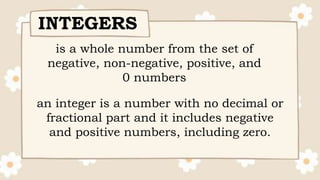
INTEGERS
is a whole number from the set of
negative, non-negative, positive, and
0 numbers
an integer is a number with no decimal or
fractional part and it includes negative
and positive numbers, including zero.
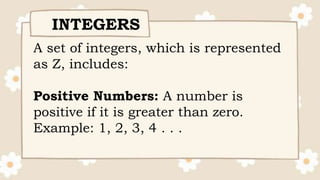
A set of integers, which is represented
as Z, includes:
Positive Numbers: A number is
positive if it is greater than zero.
Example: 1, 2, 3, 4 . . .
INTEGERS
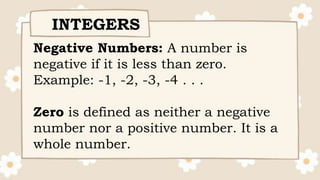
Negative Numbers: A number is
negative if it is less than zero.
Example: -1, -2, -3, -4 . . .
Zero is defined as neither a negative
number nor a positive number. It is a
whole number.
INTEGERS
Z = {… -7, -6, -5, -4, -3, -2, -1, 0, 1,
2, 3, …}
A few examples of integers are: -5, 0,
1, 5, 8, 97, and 3,043.
Example
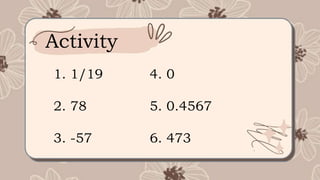
1. 1/19
2. 78
3. -57
4. 0
5. 0.4567
6. 473
Activity

Number Theory.pptx

  • 1.
    INTEGERS Chris-Ann Kim A.Sarmiento BSEd-Math3 NUMBER THEORY
  • 2.
    INTEGERS is a wholenumber from the set of negative, non-negative, positive, and 0 numbers an integer is a number with no decimal or fractional part and it includes negative and positive numbers, including zero.
  • 3.
    A set ofintegers, which is represented as Z, includes: Positive Numbers: A number is positive if it is greater than zero. Example: 1, 2, 3, 4 . . . INTEGERS
  • 4.
    Negative Numbers: Anumber is negative if it is less than zero. Example: -1, -2, -3, -4 . . . Zero is defined as neither a negative number nor a positive number. It is a whole number. INTEGERS
  • 5.
    Z = {…-7, -6, -5, -4, -3, -2, -1, 0, 1, 2, 3, …} A few examples of integers are: -5, 0, 1, 5, 8, 97, and 3,043. Example
  • 6.
    1. 1/19 2. 78 3.-57 4. 0 5. 0.4567 6. 473 Activity