Success Story: Ireland Leap Card
Release Date: May 2018
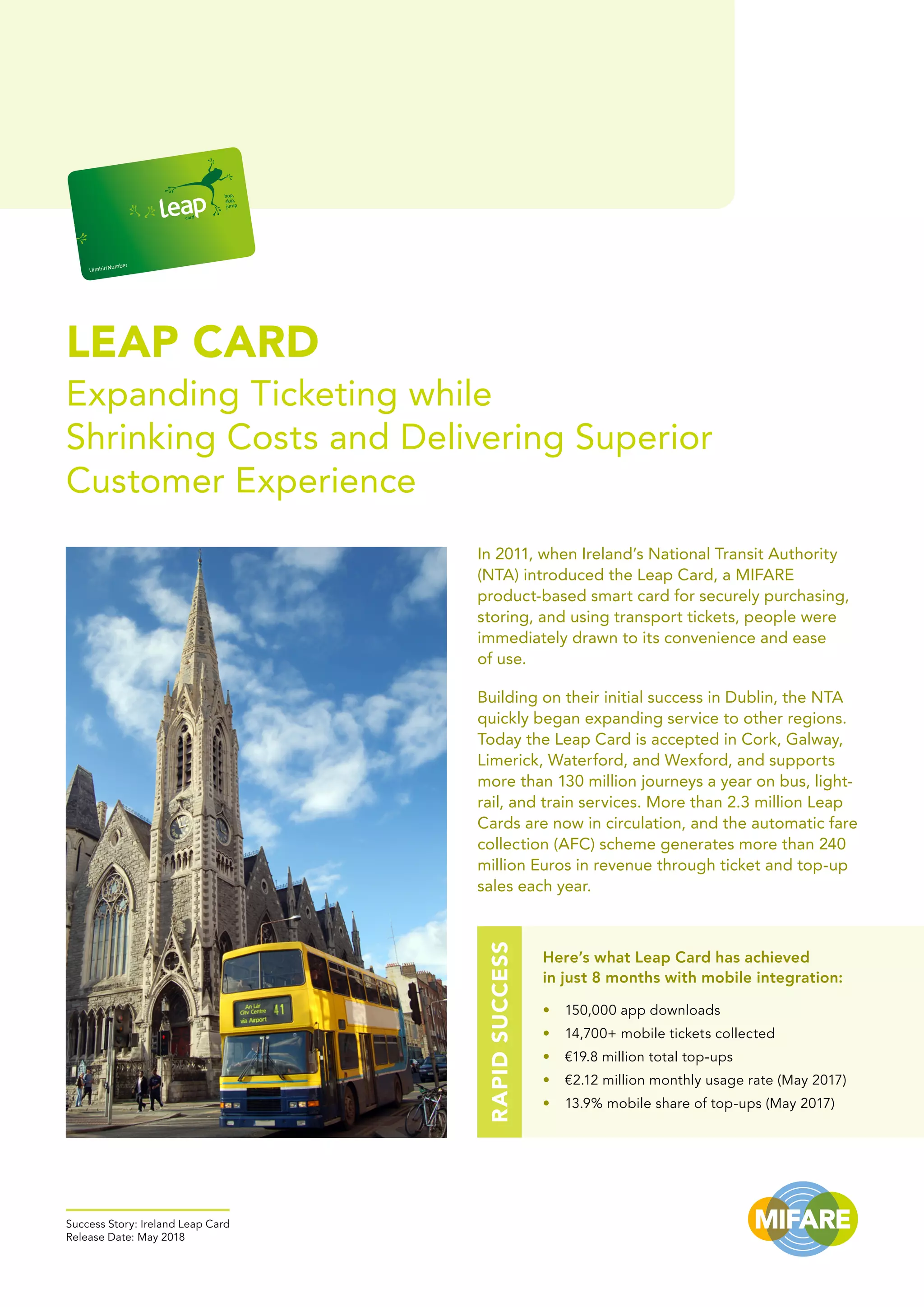
In 2011, when Ireland’s National Transit Authority
(NTA) introduced the Leap Card, a MIFARE
product-based smart card for securely purchasing,
storing, and using transport tickets, people were
immediately drawn to its convenience and ease
of use.
Building on their initial success in Dublin, the NTA
quickly began expanding service to other regions.
Today the Leap Card is accepted in Cork, Galway,
Limerick, Waterford, and Wexford, and supports
more than 130 million journeys a year on bus, light-
rail, and train services. More than 2.3 million Leap
Cards are now in circulation, and the automatic fare
collection (AFC) scheme generates more than 240
million Euros in revenue through ticket and top-up
sales each year.
Expanding Ticketing while
Shrinking Costs and Delivering Superior
Customer Experience
Here’s what Leap Card has achieved
in just 8 months with mobile integration:
•	 150,000 app downloads
•	 14,700+ mobile tickets collected	
•	 €19.8 million total top-ups
•	 €2.12 million monthly usage rate (May 2017)
•	 13.9% mobile share of top-ups (May 2017)
RAPIDSUCCESS
Uimhir/Number
LEAP CARD
NXP, MIFARE, DESFire and the MIFARE logo are registered trademarks of NXP B.V.
All other trademark or service names are the property of their respective owners. © 2018 NXP B.V.
The Reload Challenge
The Leap Card was introduced in 2011 and with its rapid
expansion, however, came new challenges in terms of coverage
and convenience. It wasn’t always easy for people to reload
credits or top up their cards using physical ticket-vending
machines.
For example, a number of Irish employers offer monthly
Leap tickets to their employees, but reloading credits onto
the cards involved someone having to go to a Leap ticket
machine and add credits to each individually. The budget
for smart ticketing machines was another consideration.
The average cost of installing a ticket-vending machine
is around 20,000 Euros, which meant that extending
the network to include load services and retail top-up points
in rural and remote areas was an expensive proposition.
Not wanting to rely solely on vending machines, the NTA
began looking at online services for ticketing and top-ups.
One option was the popular programming interface, called
ActionLists, which pushes ticket purchases to the reader
network so the network can update the smart card the next
time it’s used. But the technical requirements for ActionLists
didn’t match what was already installed on NTA buses, making
it both impractical and expensive to implement.
Failing to find a good option with off-the-shelf infrastructure
solutions, the NTA decided to pursue a more innovative
approach. Taking advantage of the widespread adoption
of NFC-enabled devices, they decided to use what most
people already carry with them – their mobile phones.
MIFARE for Secure Mobile Top-ups
By using NXP’s MIFARE DESFire EV1 contactless ICs
to power their Leap Cards, the NTA could take advantage
of two features that would make smartphone interactions
a safe and convenient choice. First, MIFARE DESFire EV1
is compatible with ISO/IEC 18902, the standard for Near Field
Communication (NFC), so any NFC-enabled device can interact
with a Leap Card. Second, the security features in MIFARE
DESFire EV1 create a secure channel between the smart card
and the server, even if a smartphone is used as the card reader,
so Leap Card users can be confident that their transactions will
remain private and protected.
When the NTA began working on the Leap Card, they found
that their legacy contactless format, MIFARE Classic®
, was too
difficult to scale and, perhaps more important, didn’t provide
the necessary level of security. They chose to use MIFARE
DESFire EV1 instead, because it offers a much higher degree
of protection and supports a wider variety of customer-centric
services. In particular, MIFARE DESFire EV1 safeguards transit-
agency data while letting consumers use their NFC-enabled
phones for secure interactions with the system. (Please contact
NXP for more information on a smooth migration from MIFARE
Classic to MIFARE DESFire.)
More Coverage with Less Investment
In the end, the NTA was able to create their mobile top-up
solution with an investment that represented a single-digit
percent of the overall rollout of the AFC system. What’s more,
it took only a few weeks to prepare the solution for launch,
and the go-live team consisted of only four people. To save
on long-term operating costs, and make it easier to keep
expanding the online services, the NTA now manages
the mobile service themselves, in the cloud.
Big Returns
Only eight months after rollout, the mobile application
has been downloaded by 150,000 users who have used it
for an aggregated top-up value of 19.8 million Euros.
(According to NTA, a smartphone is enabled for contactless
communication with a Leap Card about once every second.)
A total of nearly 15,000 tickets have been collected with
the mobile service, and an additional 6,000 ticket renewals
have been carried out from remote locations. The monthly
top-up rate is growing quickly, with the numbers for May 2017
amounting to 2.12 million Euros, or nearly 14% of all top-ups.
Using MIFARE DESFire EV1 ICs as the basis for the Leap
Card let the NTA dramatically increase their coverage while
keeping large infrastructure investments at bay. Having
invested in only a transparent client application, for user
interaction with mobile devices, and a central, secure, cloud-
based management solution, the NTA has kept their costs
to an absolute minimum, while creating a direct customer-
relationship management platform that delivers best-in-class
service and convenience.
Leap Card
www.leapcard.ie
Ireland’s National Transport Authority (NTA)
www.nationaltransport.ie
NXP’s MIFARE DESFire EV1 Contactless IC
www.mifare.net/mifare-desfire-ev1
DISCOVER
MORE

NTA's Leap Card - Expanding Ticketing while Shrinking Costs

  • 1.
    Success Story: IrelandLeap Card Release Date: May 2018 In 2011, when Ireland’s National Transit Authority (NTA) introduced the Leap Card, a MIFARE product-based smart card for securely purchasing, storing, and using transport tickets, people were immediately drawn to its convenience and ease of use. Building on their initial success in Dublin, the NTA quickly began expanding service to other regions. Today the Leap Card is accepted in Cork, Galway, Limerick, Waterford, and Wexford, and supports more than 130 million journeys a year on bus, light- rail, and train services. More than 2.3 million Leap Cards are now in circulation, and the automatic fare collection (AFC) scheme generates more than 240 million Euros in revenue through ticket and top-up sales each year. Expanding Ticketing while Shrinking Costs and Delivering Superior Customer Experience Here’s what Leap Card has achieved in just 8 months with mobile integration: • 150,000 app downloads • 14,700+ mobile tickets collected • €19.8 million total top-ups • €2.12 million monthly usage rate (May 2017) • 13.9% mobile share of top-ups (May 2017) RAPIDSUCCESS Uimhir/Number LEAP CARD
  • 2.
    NXP, MIFARE, DESFireand the MIFARE logo are registered trademarks of NXP B.V. All other trademark or service names are the property of their respective owners. © 2018 NXP B.V. The Reload Challenge The Leap Card was introduced in 2011 and with its rapid expansion, however, came new challenges in terms of coverage and convenience. It wasn’t always easy for people to reload credits or top up their cards using physical ticket-vending machines. For example, a number of Irish employers offer monthly Leap tickets to their employees, but reloading credits onto the cards involved someone having to go to a Leap ticket machine and add credits to each individually. The budget for smart ticketing machines was another consideration. The average cost of installing a ticket-vending machine is around 20,000 Euros, which meant that extending the network to include load services and retail top-up points in rural and remote areas was an expensive proposition. Not wanting to rely solely on vending machines, the NTA began looking at online services for ticketing and top-ups. One option was the popular programming interface, called ActionLists, which pushes ticket purchases to the reader network so the network can update the smart card the next time it’s used. But the technical requirements for ActionLists didn’t match what was already installed on NTA buses, making it both impractical and expensive to implement. Failing to find a good option with off-the-shelf infrastructure solutions, the NTA decided to pursue a more innovative approach. Taking advantage of the widespread adoption of NFC-enabled devices, they decided to use what most people already carry with them – their mobile phones. MIFARE for Secure Mobile Top-ups By using NXP’s MIFARE DESFire EV1 contactless ICs to power their Leap Cards, the NTA could take advantage of two features that would make smartphone interactions a safe and convenient choice. First, MIFARE DESFire EV1 is compatible with ISO/IEC 18902, the standard for Near Field Communication (NFC), so any NFC-enabled device can interact with a Leap Card. Second, the security features in MIFARE DESFire EV1 create a secure channel between the smart card and the server, even if a smartphone is used as the card reader, so Leap Card users can be confident that their transactions will remain private and protected. When the NTA began working on the Leap Card, they found that their legacy contactless format, MIFARE Classic® , was too difficult to scale and, perhaps more important, didn’t provide the necessary level of security. They chose to use MIFARE DESFire EV1 instead, because it offers a much higher degree of protection and supports a wider variety of customer-centric services. In particular, MIFARE DESFire EV1 safeguards transit- agency data while letting consumers use their NFC-enabled phones for secure interactions with the system. (Please contact NXP for more information on a smooth migration from MIFARE Classic to MIFARE DESFire.) More Coverage with Less Investment In the end, the NTA was able to create their mobile top-up solution with an investment that represented a single-digit percent of the overall rollout of the AFC system. What’s more, it took only a few weeks to prepare the solution for launch, and the go-live team consisted of only four people. To save on long-term operating costs, and make it easier to keep expanding the online services, the NTA now manages the mobile service themselves, in the cloud. Big Returns Only eight months after rollout, the mobile application has been downloaded by 150,000 users who have used it for an aggregated top-up value of 19.8 million Euros. (According to NTA, a smartphone is enabled for contactless communication with a Leap Card about once every second.) A total of nearly 15,000 tickets have been collected with the mobile service, and an additional 6,000 ticket renewals have been carried out from remote locations. The monthly top-up rate is growing quickly, with the numbers for May 2017 amounting to 2.12 million Euros, or nearly 14% of all top-ups. Using MIFARE DESFire EV1 ICs as the basis for the Leap Card let the NTA dramatically increase their coverage while keeping large infrastructure investments at bay. Having invested in only a transparent client application, for user interaction with mobile devices, and a central, secure, cloud- based management solution, the NTA has kept their costs to an absolute minimum, while creating a direct customer- relationship management platform that delivers best-in-class service and convenience. Leap Card www.leapcard.ie Ireland’s National Transport Authority (NTA) www.nationaltransport.ie NXP’s MIFARE DESFire EV1 Contactless IC www.mifare.net/mifare-desfire-ev1 DISCOVER MORE