Topic
NP- Hard/NP-Complete Problems
Zohra Naim- M77
Mehwish Basheer- M29
Problems that Cross the Line
• What if a problem has:
– An exponential upper bound
– A polynomial lower bound
• We have only found exponential algorithms, so it
appears to be intractable.
NP-Complete Problems
• The upper bound suggests the
problem is intractable
• The lower bound suggests the
problem is tractable
• The lower bound is linear: O(N)
• They are all reducible to each other
– If we find a reasonable algorithm
(or prove intractability) for one,
then we can do it for all of them!
Example NP-Complete Problems
• Path-Finding (Traveling salesman)
• Map coloring
• Scheduling and Matching (bin packing)
• 2-D arrangement problems
• Planning problems (pert planning)
• Clique
Traveling Salesman
5-Clique
Map Coloring
Class Scheduling Problem
• With N teachers with certain hour
restrictions M classes to be scheduled,
can we:
– Schedule all the classes
– Make sure that no two teachers teach
the same class at the same time
– No teacher is scheduled to teach two
classes at once
Certificates
• Returning true: in order to show that the
schedule can be made, we only have to
show one schedule that works
– This is called a certificate.
• Returning false: in order to show that
the schedule cannot be made, we must
test all schedules.
Determinism vs. Nondeterminism
• Nondeterministic algorithms produce an
answer by a series of “correct guesses”
• Deterministic algorithms (like those that a
computer executes) make decisions
based on information.
NP-Complete
“NP-Complete” comes from:
– Nondeterministic Polynomial
– Complete - “Solve one, Solve them all”
There are more NP-Complete problems than
provably intractable problems.
NP-Complete
for any NP-Complete problem:
– Raise the lower bound
(via a stronger proof)
– Lower the upper bound
(via a better algorithm)
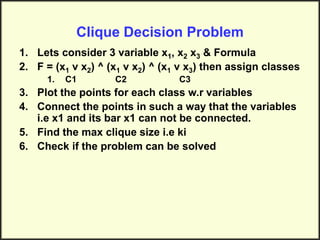
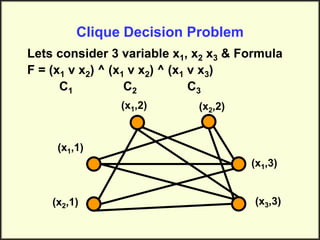
Clique Decision Problem
1. Lets consider 3 variable x1, x2 x3 & Formula
2. F = (x1 v x2) ^ (x1 v x2) ^ (x1 v x3) then assign classes
1. C1 C2 C3
3. Plot the points for each class w.r variables
4. Connect the points in such a way that the variables
i.e x1 and its bar x1 can not be connected.
5. Find the max clique size i.e ki
6. Check if the problem can be solved
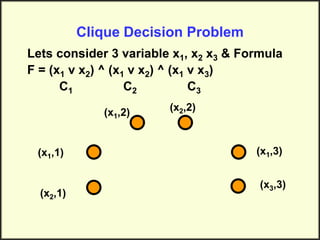
Clique Decision Problem
Lets consider 3 variable x1, x2 x3 & Formula
F = (x1 v x2) ^ (x1 v x2) ^ (x1 v x3)
C1 C2 C3
(x1,1)
(x2,1)
(x1,2) (x2,2)
(x1,3)
(x3,3)
Clique Decision Problem
Lets consider 3 variable x1, x2 x3 & Formula
F = (x1 v x2) ^ (x1 v x2) ^ (x1 v x3)
C1 C2 C3
(x1,1)
(x2,1)
(x1,2) (x2,2)
(x1,3)
(x3,3)
Clique Decision Problem
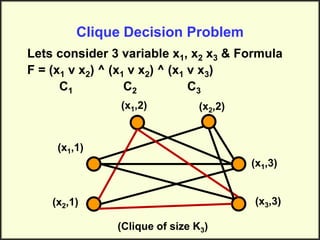
Lets consider 3 variable x1, x2 x3 & Formula
F = (x1 v x2) ^ (x1 v x2) ^ (x1 v x3)
C1 C2 C3
(x1,1)
(x2,1)
(x1,2) (x2,2)
(x1,3)
(x3,3)
(Clique of size K3)
Clique Decision Problem
Lets consider 3 variable x1, x2 x3 & Formula
F = (x1 v x2) ^ (x1 v x2) ^ (x1 v x3)
C1 C2 C3
(x1,1)
(x2,1)
(x1,2) (x2,2)
(x1,3)
(x3,3)
Now
x1 x2 x3
0 1 1
1 = true
O = false
(Clique of size K3)
Clique Decision Problem
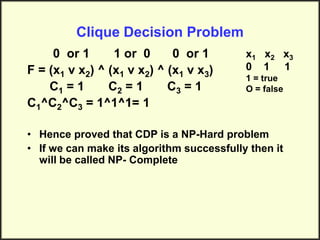
0 or 1 1 or 0 0 or 1
F = (x1 v x2) ^ (x1 v x2) ^ (x1 v x3)
C1 = 1 C2 = 1 C3 = 1
C1^C2^C3 = 1^1^1= 1
• Hence proved that CDP is a NP-Hard problem
• If we can make its algorithm successfully then it
will be called NP- Complete
x1 x2 x3
0 1 1
1 = true
O = false
Questions?

NP Complete.ppt

  • 1.
    Topic NP- Hard/NP-Complete Problems ZohraNaim- M77 Mehwish Basheer- M29
  • 2.
    Problems that Crossthe Line • What if a problem has: – An exponential upper bound – A polynomial lower bound • We have only found exponential algorithms, so it appears to be intractable.
  • 3.
    NP-Complete Problems • Theupper bound suggests the problem is intractable • The lower bound suggests the problem is tractable • The lower bound is linear: O(N) • They are all reducible to each other – If we find a reasonable algorithm (or prove intractability) for one, then we can do it for all of them!
  • 4.
    Example NP-Complete Problems •Path-Finding (Traveling salesman) • Map coloring • Scheduling and Matching (bin packing) • 2-D arrangement problems • Planning problems (pert planning) • Clique
  • 5.
  • 6.
  • 7.
  • 8.
    Class Scheduling Problem •With N teachers with certain hour restrictions M classes to be scheduled, can we: – Schedule all the classes – Make sure that no two teachers teach the same class at the same time – No teacher is scheduled to teach two classes at once
  • 9.
    Certificates • Returning true:in order to show that the schedule can be made, we only have to show one schedule that works – This is called a certificate. • Returning false: in order to show that the schedule cannot be made, we must test all schedules.
  • 10.
    Determinism vs. Nondeterminism •Nondeterministic algorithms produce an answer by a series of “correct guesses” • Deterministic algorithms (like those that a computer executes) make decisions based on information.
  • 11.
    NP-Complete “NP-Complete” comes from: –Nondeterministic Polynomial – Complete - “Solve one, Solve them all” There are more NP-Complete problems than provably intractable problems.
  • 12.
    NP-Complete for any NP-Completeproblem: – Raise the lower bound (via a stronger proof) – Lower the upper bound (via a better algorithm)
  • 13.
    Clique Decision Problem 1.Lets consider 3 variable x1, x2 x3 & Formula 2. F = (x1 v x2) ^ (x1 v x2) ^ (x1 v x3) then assign classes 1. C1 C2 C3 3. Plot the points for each class w.r variables 4. Connect the points in such a way that the variables i.e x1 and its bar x1 can not be connected. 5. Find the max clique size i.e ki 6. Check if the problem can be solved
  • 14.
    Clique Decision Problem Letsconsider 3 variable x1, x2 x3 & Formula F = (x1 v x2) ^ (x1 v x2) ^ (x1 v x3) C1 C2 C3 (x1,1) (x2,1) (x1,2) (x2,2) (x1,3) (x3,3)
  • 15.
    Clique Decision Problem Letsconsider 3 variable x1, x2 x3 & Formula F = (x1 v x2) ^ (x1 v x2) ^ (x1 v x3) C1 C2 C3 (x1,1) (x2,1) (x1,2) (x2,2) (x1,3) (x3,3)
  • 16.
    Clique Decision Problem Letsconsider 3 variable x1, x2 x3 & Formula F = (x1 v x2) ^ (x1 v x2) ^ (x1 v x3) C1 C2 C3 (x1,1) (x2,1) (x1,2) (x2,2) (x1,3) (x3,3) (Clique of size K3)
  • 17.
    Clique Decision Problem Letsconsider 3 variable x1, x2 x3 & Formula F = (x1 v x2) ^ (x1 v x2) ^ (x1 v x3) C1 C2 C3 (x1,1) (x2,1) (x1,2) (x2,2) (x1,3) (x3,3) Now x1 x2 x3 0 1 1 1 = true O = false (Clique of size K3)
  • 18.
    Clique Decision Problem 0or 1 1 or 0 0 or 1 F = (x1 v x2) ^ (x1 v x2) ^ (x1 v x3) C1 = 1 C2 = 1 C3 = 1 C1^C2^C3 = 1^1^1= 1 • Hence proved that CDP is a NP-Hard problem • If we can make its algorithm successfully then it will be called NP- Complete x1 x2 x3 0 1 1 1 = true O = false
  • 19.