#1 Welcome to the Bringing OT Threat Detection and Response to the Next Level webinar from Fortinet and Nozomi Networks
We are so glad you joined us today.
#6 OT industries we target:
power generation, load dispatch centers, Transmission and Distribution, wind power, solar, hydropower, gas turbines, steam turbines, etc.
Oil and gas, upstream exploration, production, refining, chemicals, petrochemicals
Manufacturing: food and beverage, pharma, discrete and process industries; water/wastewater
Logistics, ports, etc.
Other critical infrastructure
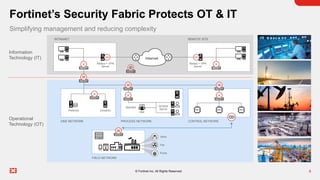
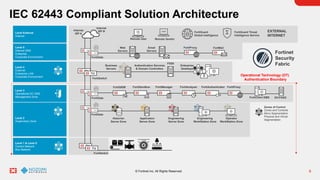
On the screen here you see a high-level enterprise view of an industrial plant. It could be a water treatment facility, a wind farm, an oil drilling rig, a food and beverage plant or a maritime port. Or it could be a “smart truck” for that matter. Fundamentally all of these kinds of operational networks tend to have similar technologies and structures.
OT is all the hardware, software and network technology we find south of the dotted red line.
North of the red line is the IT world or business zone with your corporate network, CRM, ERP, email, etc.
South of the red line is what OT people call the secure perimeter. This is where you'll find actuators and sensors that are connected to assets such as pumps valves and motors. These are connected to controllers that are supervised by HMI, Engineering Workstations and Supervisory Control OR SCADA systems. Here you will find event collectors, Alarm Systems and Data Historians. While OT used to be almost synonymous with Industrial Control System there is also a newcomer disrupting this space which is IIOT - industrial internet of things. These devices are IOT devices within the OT secure perimeter. These IIOT devices such as smart sensors are growing very fast alongside the emergence of 5G.
These two worlds used to be separated or "air gapped" but due to digitization trends driven by plant optimization, asset utilization and condition-based maintenance they are now converging.
Convergence with IT and the emergence of IIOT and 5G are two major trends that bring major security challenges.
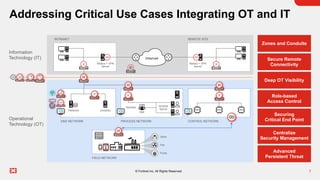
#7 Le’ts look at the most typical use cases we deploy
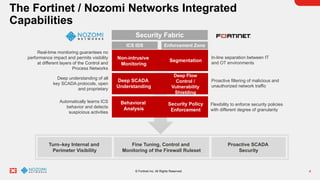
- First, segmentation and secure remote connectivity. We do this with our next generation firewalls, switches and access points.
- Second is deep OT visibility for asset inventory and breach detection. We can set policies on over 1800 signatures, provide virtual patching against 400 known OT vulnerabilities and even more capabilities we can provide with our tech alliance and fabric integrations.
- Third is role-based access control for users, devices and applications done inside the secure perimeter. We enable this with FortiAuthenticator, FortiNAC, and FortiToken.
- Fourth we can secure critical endpoints like engineering workstations, HMIs, or even controllers with FortiEDR.
- Then OT SOC environment and sometimes enterprise SOC with both IT and OT can be enabled with solutions such as FortiSIEM and FortiSOAR.
- Finally, we can cover Advanced Persistent Threats with our Sandbox and Deception technologies.
The key is that OT, just like IT, is networked. We end up selling the same products there. There are specifics like industrial protocols and sometimes special environmental conditions that require ruggedized hardware. and to read industrial protocols such as Modbus and OPC UA. But at the end of the day it is defense and depth adding layers of security to secure the critical perimeter.
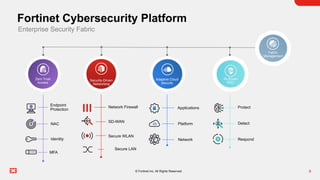
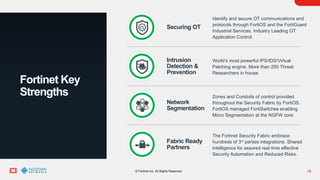
#8 Let's break down the fortinet security fabric into its constituent pillars.
For effective security, organizations have to shift from protecting security perimeters to protecting data spread across the billion of edges, users, systems, devices and critical applications.
A platform provides comprehensive visibility and protection across devices, users, endpoint, cloud, SaaS, and infrastructure, covering the entire attack surface.
The Fortinet platform consists of four key components:
At the core of the platform is the network which remains a critical piece. Our security-driven networking provides secure high-performance connectivity between users, applications and devices into the cloud.
Manage internal and external risk with internal segmentation, threat detection and automated threat protection and policy enforcement.
Our zero trust access network enables identification of all users, applications and devices on and off the network.
Our adaptive cloud security provides protection across all cloud environments including hybrid, public and private cloud
Our cloud security solutions, including virtual appliances and hosted solutions, extend the core capabilities of the Fortinet Security Fabric platform to provide businesses with the same level of cybersecurity and threat intelligence in and across cloud environments that they receive on their physical networks.
AI-driven security operations provides faster response and remediation including actionable, customized threat intelligence and insights.
The Fabric Management Center provides a single pane of glass, simplifying operations and enabling automation of workflows.
#12 Blue lines represent normal network communication
Solid red lines are the attacker attempting to gain access to SIEMENS PLC
Dotted red line is logs sent to FortiSIEM
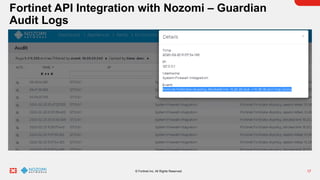
Green line is FortiSIEM API call to FortiGate blocking the Attacker IP address
#13 Blue lines represent normal network communication
Solid red lines are the attacker attempting to gain access to SIEMENS PLC
Dotted red line is logs sent to FortiSIEM
Green line is FortiSIEM API call to FortiGate blocking the Attacker IP address
#18 For effective security, organizations have to shift from protecting security perimeters to protecting data spread across the billion of edges, users, systems, devices and critical applications.
A platform provides comprehensive visibility and protection across devices, users, endpoint, cloud, SaaS, and infrastructure, covering the entire attack surface.
The Fortinet platform consists of four key components:
At the core of the platform is the network which remains a critical piece. Our security-driven networking provides secure high-performance connectivity between users, applications and devices into the cloud.
Manage internal and external risk with internal segmentation, threat detection and automated threat protection and policy enforcement.
Our zero trust access network enables identification of all users, applications and devices on and off the network.
Our dynamic cloud security provides protection across all cloud environments including hybrid, public and private cloud
Our cloud security solutions, including virtual appliances and hosted solutions, extend the core capabilities of the Fortinet Security Fabric platform to provide businesses with the same level of cybersecurity and threat intelligence in and across cloud environments that they receive on their physical networks.
AI-driven security operations provides faster response and remediation including actionable, customized threat intelligence and insights.


![Het ecosysteem als complete bescherming tegen cybercriminaliteit [pvh]](https://cdn.slidesharecdn.com/ss_thumbnails/hetecosysteemalscompletebeschermingtegencybercriminaliteitpvh-160621130244-thumbnail.jpg?width=640&height=640&fit=bounds)


![5G Explained! A High Level Overview [Introduction]](https://cdn.slidesharecdn.com/ss_thumbnails/5gexplainedahighleveloverview-260119165306-cc137a3e-thumbnail.jpg?width=640&height=640&fit=bounds)


