METU Department of
Mechanical Engineering ME300
Summer Practice Report
by
Samet Baykul
October 12, 2016
ii
ME 300 Summer Practice Report October 19, 2016
I hereby declare that all information in this document has been obtained
and presented in accordance with academic rules and ethical conduct. I also
declare that, as require by these rules and conduct, I have fully cited and
referenced all material and results that are not original to this work.
Name, Last Name : Samet Baykul
Signature :
iii
ME 300 Summer Practice Report October 19, 2016
iv
ME 300 Summer Practice Report October 19, 2016
TABLE OF CONTENTS
1. Description of the company ........................................................................ 1
1.1. Company Name and Location .............................................................. 1
1.2. Organizational Structure of the Company ....................................... 1
1.3. Engineers and Their Duties.................................................................. 3
1.4. Main Area of Business............................................................................ 3
1.5. History of the Company......................................................................... 4
2. Introduction ................................................................................................... 5
3. Report .............................................................................................................. 6
3.1. General Project Cycle ............................................................................ 6
3.2. Manufacturing Processes...................................................................... 8
3.2.1. Shearing ............................................................................................... 9
3.2.2. Drilling ................................................................................................. 9
3.2.3. Bending ................................................................................................ 9
3.2.4. Welding............................................................................................... 10
3.2.5. Grinding ............................................................................................. 10
3.2.6. Plasma Arc Cutting ........................................................................... 10
3.2.7. Painting.............................................................................................. 11
3.3. Machines and Machine Tools ............................................................. 12
3.3.1. Plasma Arc Cutting Machine ............................................................ 12
3.3.2. Shearing Machine.............................................................................. 13
3.3.3. CNC Syncro Press Brake................................................................... 13
3.3.4. Eccentric Press................................................................................... 14
3.3.5. Bandsaw ............................................................................................. 15
3.3.6. Other Machines.................................................................................. 15
3.4. Sample Workpieces............................................................................... 16
3.4.1. Workpiece 1 - Guide Rail Bracket..................................................... 16
3.4.2. Workpiece 2 - Wall Rail Bracket ....................................................... 17
3.4.3. Workpiece 3 - Mechanical Gear Lock................................................ 17
3.4.4. Workpiece 4 - Pit Suspansion............................................................ 18
3.4.5. Workpiece 5 - Car Stabilizing Joint .................................................. 18
3.5. Cost Analysis.......................................................................................... 19
3.5.1. Workpiece 1 - Guide Rail Bracket..................................................... 20
3.5.2. Workpiece 2 - Wall Rail Bracket ....................................................... 20
3.6. Production Line .................................................................................... 21
3.7. Classification of Elevator Components............................................ 22
3.8. Customer Offer Program..................................................................... 23
v
ME 300 Summer Practice Report October 19, 2016
3.9. Analysis of the Company Performance............................................ 26
3.9.1. Manufacturing Problems and Suggestions....................................... 27
3.9.2. Management Problems and Suggestions.......................................... 28
3.9.3. Employee Problems and Suggestions................................................ 29
3.9.4. Specific Problems and Suggestions................................................... 29
3.9.5. Liftsoft Project.................................................................................... 31
4. Conclusion..................................................................................................... 33
Appendices............................................................................................................ 36
A. Map Location ................................................................................................. 1
B. Organizational Structure of the Company ................................................... 2
C. General Project Cycle Diagram..................................................................... 3
D. Manufacturing Line Diagram....................................................................... 4
E. Technical Drawings ....................................................................................... 5
E.1.Technical Drawing of Workpiece 1 ......................................................... 5
E.2.Technical Drawing of Workpiece 2 ......................................................... 6
E.3.Technical Drawing of Workpiece 3 ......................................................... 7
E.4.Technical Drawing of Workpiece 4 ......................................................... 8
E.5.Technical Drawing of Workpiece 5 ......................................................... 9
E.6.Technical Drawing Example for Elevetor Well Conditions................. 10
E.7.Technical Drawing Example for Special Customer Requests ............. 11
F. Machines and Machine Tools ...................................................................... 12
F.1.Plasma Arc Cutting Tools...................................................................... 12
F.2.Plasma Arc Cutting Machine................................................................ 13
F.3.Shearing Machine.................................................................................. 14
F.4.CNC Syncro Press Machine .................................................................. 15
F.5.Eccentric Press....................................................................................... 16
F.6.Bandsaw................................................................................................. 17
G. Classification of Elevator Components....................................................... 18
G.1.General Components of Elevator.......................................................... 18
G.2.Elevator Car .......................................................................................... 19
G.3.Elevator Car Frame .............................................................................. 20
G.4.Package 1............................................................................................... 21
G.5.Package 2............................................................................................... 22
H. Customer Offer Program............................................................................. 23
References............................................................................................................. 25
vi
ME 300 Summer Practice Report October 19, 2016
1. Description of the company
This chapter is prepared to supply general opinion about the company.
1.1. Company Name and Location
Company Name
Note Elevator - Note Asansör Ekipmanlari San. ve Tic. Ltd. Şti.
Company Adress
Yalı Mah. Ziya Gökalp Cad. 5 D:3 Maltepe, İstanbul
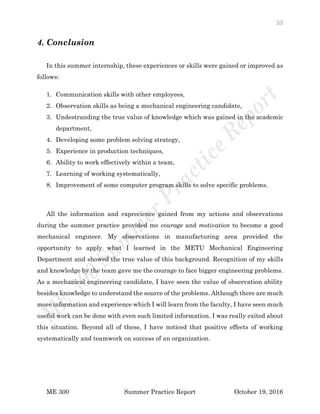
The location map is provided in Appendix A.
1.2. Organizational Structure of the Company
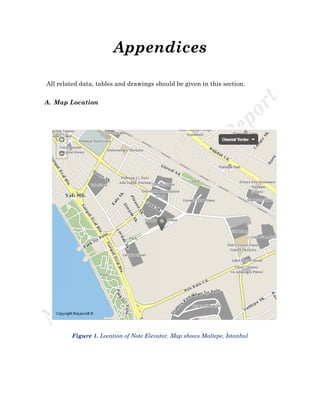
Note Elevator has a small but an effective team. This team consists of the general
company manager, manager assistant, planning department, storage manager,
manufacturing department and accountant. In order to see overall organizational
structure, please look up the chart in Appendix B.
The company manager is also owner of the company, Nilüfer Aydoğmuş. She is
responsible for the regularity and the profit of the company as first order. All the
problems which cannot be solved by any department itself, should be solved by her
assists. If this is not possible, she arranges a meeting with the participation of all the
team in order to solve the problem.
2
ME 300 Summer Practice Report October 19, 2016
Manager assistant is Ferhat Elban. He has a great experience in the elevator
industry. For this reason, he helps the management. He is also responsible for sales
and marketting. Advertising and relations with customers are also under his
responsibilities. Besides, he does research and follows the development in the
industry, closely. In this way, he contributes the development of the company.
There are three team members under the ‘Planning Department’. Each member
uses CAD programs like SolidWorks® and AutoCad®. Kübra Aydoğmuş is an
architect and is responsible for elevator well where is the place to do elevator
construction. Mustafa Cavit Özdal is an engineer and is responsible for special
customer orders in engineering aspects. Rıza Aydoğdu is supervisor of this
department. He contributes the design with his experiences. He checks the results
and connects between ‘Planning Department’ and the ‘Manufacturing Department’.
Storage manager is Gönül Çağlayan. She checks stock status of all the
components for each project. If it is necessary, she orders new components. She makes
price and quality optimization for these imported component. She is also responsible
for shipping of products.
Manufacturing Department is the largest section of the company. There are
about 40 workers and 2 headworkers. These headworkers are highly experienced in
the industry. They analayse the technical drawings which come from the ‘Planning
Department’ and organize the manufacturing operations as quickly as possible in
current circumstances. They have own their intiatives to solve production defects or
planning mistakes. After the work, they give reports for each completed products to
the management.
Accountant Ms. Canan, is responsible for the financial transactions of the
company. Apart from the earning statement, she regulates the relation between the
company and the government.
3
ME 300 Summer Practice Report October 19, 2016
1.3. Engineers and Their Duties
Table 1 : Number of Engineers
Engineer Number
Mechanical 1
Material 1
Eray Baykul is a mechanical engineer. He is quality supervisor. He checks the
products if its are appropriate for industy standards or not. He inspects the possible
defects in the last stage. He also offers consulting service for more specific projects.
Mustafa Cavit Özdal is a material engineer. He analyses the feasibility of the given
projects and makes technical drawings with SolidWorks®. In this way, he contributes
the planning and design of the products.
1.4. Main Area of Business
Note Elevator is a company which manufactures elevator components. This
company offers planning and sells package elevator to installation and construction
companies. The company is not capable of mass production. Instead of this, it offers
flexible solutions for specific problems. In this regard, Note Elevator is considered as
a jop shop manufacturer.
More detailed business focus of Note Elevator is explained in the section of 3.1.
General Project Cycle.
4
ME 300 Summer Practice Report October 19, 2016
1.5. History of the Company
Note Elevator was founded in 2014 and started to manufacture elevator
components in order to find solutions which can be applied easily and bring innovative
values to the elevator industry in Turkey. “Production with information” and
“Perspective of organization” comprised basics of Note Elevator. They have developed
their own machine-room-less elevator designs with using expert programs.
Some essentials of Note Elevator are as follows:
 Best product for flexible projects,
 Optimized quality,
 Reliable partnership.
5
ME 300 Summer Practice Report October 19, 2016
2. Introduction
This report covers my all personal observations and actions in Note Elevator as a
mechanical engineering student during 20 business days.
My personal observations:
1. General Project Cycle: It covers how the company starts and finishes a project
and intermediate steps.
2. Manufacturing processes: Detailed explanation of manufacturing processes.
3. Machines and Machine Tools: All used machines and tools in manufacturing.
My personal actions:
1. Sample Workpieces: Technical drawings for 5 different products.
2. Cost Analysis: Cost analysis for 2 different products.
3. Production Line: Production lines in manufacturing area which identified
personally.
4. Classification of Elevator Components: Classification of all the products
according to their assemling groups and translation according to international
elevator industry terminology.
5. Customer Offer Program: A new excel software program for project proposal.
(This task has been given by the manager of the company.)
6. Analysis of the Company Performance: This is related to the efficiency of the
team as a foreign observer. (This task has been given by the team in a company
meeting.)
6
ME 300 Summer Practice Report October 19, 2016
3. Report
3.1. General Project Cycle
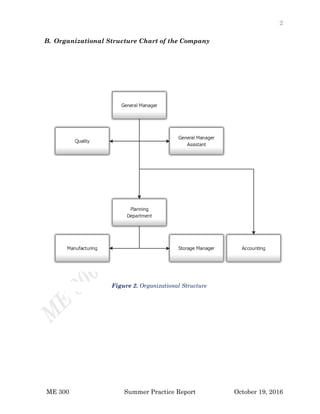
A sample project has been given in this section. If you would like to see General
Project Cycle please look up Appendix C.
Note Elevator manufactures some components for particular types of elevator as
follows:
According to hoist mechanism:
1. Hydraulic elevators: Supported by a piston at the bottom of the elevator that
pushes the elevator up. They are used for low-rise applications of 2-8 stories
and travel at a maximum speed of 1 m/s.
2. Traction elevators: Lifted by ropes, which pass over a wheel attached to an
electric motor above the elevator shaft.
a. Geared traction elevators: They have a gearbox that is attached to the
motor, which drives the wheel that moves the ropes. They are capable
of travel speeds up to 2.5 m/s.
b. Gear-less traction elevators: They have the wheel attached directly to
the motor. They are capable of speeds up to 10 m/s. But they have
lower carrying capacity than geared traction elevators.
c. Machine-room-less elevators: They are typically traction elevators
that do not have a dedicated machine room above the elevator shaft.
They are becoming more common because of decreasing construction
cost.
7
ME 300 Summer Practice Report October 19, 2016
According to building type:
1. Hospital elevators,
2. Residential/domestic elevators,
3. Industrial elevators,
4. Commercial elevators,
5. Parking buildings elevators.
Note Elevator do not work for end users. Construction companies work with
elevator installation companies, and these installation companies imports package
elevators from manufacturers like Note Elevator.
For installation companies, the biggest advantage of work with small companies
like Note Elevator is the capable of production for flexible projects. Altough Note
Elevator can produce only 50 package elevators, but all of these products may be
different from each other. In this way, Note Elevator has a wide-range business area.
In other words, Note Elevator has great opportunuties to work with different
companies.
In the company, all orders which come from the installation companies are
accepted in selling and marketing and send to planning in order to make desgin
and projecting.
In planning, there are two different parameter pools. First one is the technical
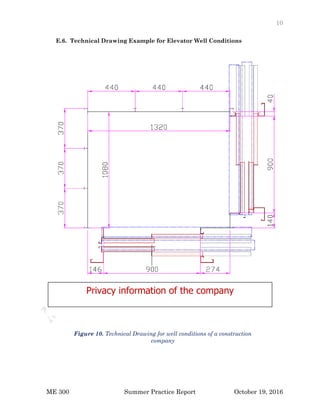
data which comes from the elevator well conditions (For example see Appendix
E.6). These are mandatory parameters and cannot be changed. All components which
will be produced must fit into the well. For example, the place of the machine (traction
motor) shaft is calculated according to height of the well or maximum cabin width
should not exceed the bottleneck dimensions of the well. The second pool involves the
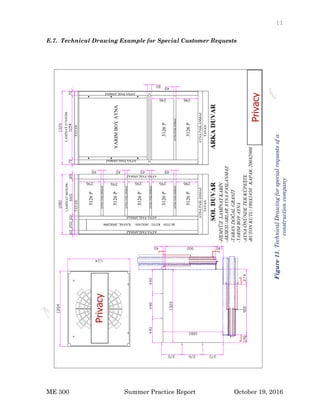
special customer requests (For example see Appendix E.7). This requests may
cover speed and carrying capacity of the elevator, interior decoration, quality of inner
materials and trademarks of some components like machine and brake mechanism.
8
ME 300 Summer Practice Report October 19, 2016
These requests must not conflict with the first parameter pool. For example, in such
a small elevator well which has not enough area to cover bigger frame, the request of
higher carrying capacity is inacceptable.
All the components should be designed according to these pools in the planning
department. Some necessary outside-production components like traction machines,
electrical boards are listed for the storage management, and imported from different
manufacturers. All necessary technical drawings for the other components are send
to the manufacturing department and manufatured. Details of manufacturing are
explained in the section of 3.2. Manufactıring Process.
After the manufacturing processes, all components are assembled and checked
by experts. After all of these steps, the product, which is called package elevator, is
ready to the installation. All the components are reassembled and packaged for
shipping. Shipping processes are organized by storage management.
Elevator components are provided in Appendix G.
3.2. Manufacturing Processes
Note Elevator use these manufacturing techniques as follows:
1. Shearing,
2. Drilling,
3. Bending,
4. Welding,
5. Grinding,
6. Plasma Arc Cutting,
7. Painting.
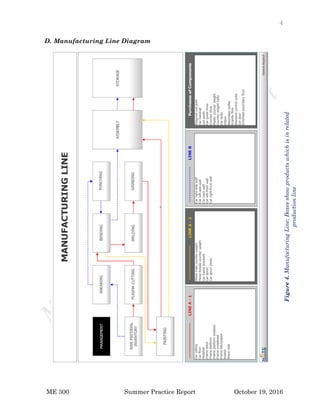
Please look up Appendix D in order to see overall manufacturing line diagram.
9
ME 300 Summer Practice Report October 19, 2016
3.2.1. Shearing
Shearing is a forming process. It is also known as die cutting. Shearing is the
chipless mechanical cutting of a workpiece which is generally sheet metal. There is
also no burning or melting like no chip formation.
Shearing is used by Note Elevator in order to prepare thin sheet metals (These
metals are approximately 2.5 mm) for next operations like drilling and bending. These
thin sheet metals are used for only side walls for elevator cabins.
3.2.2. Drilling
Drilling is making cylindrical holes on any workpiece. This is generally
accomplished by using a twist drill. Drilling is the most common machining process.
In the company, drilling is made by both hand tools and a drilling machine.
Drilling machine is used for thin sheet metals. On the other hand, drilling hand
tools are used for thick metal plates. Thick metal plates are approximatley 6-8 mm
and used for brackets, frames and bedplates for traction machines.
3.2.3. Bending
Bending is the plastic deformation of metals about a linear axis. There may be
little change in the surface area because of the deformation.
Bending is a very important process for elevator manufacturers. The result
products of this process will supply the link between the elevator components and
the walls of the construction well. All these bended products must transfer all the
loads correctly. Because of this safety reason, even a small incorrect bending can send
the expensive materials to the scrapyard.
The lack of skilled labor for bending process in the sector, constitutes a serious
problem for Note Elavator. Because of this reason within the safety importance of the
result products, the company compulsorily places one of the most talented and
experienced two foremen, on this section. In somedays, this forman is so bussy with
10
ME 300 Summer Practice Report October 19, 2016
this bending work that he cannot do his actual supervising work. This means there is
a huge loss for the company, in this section. In order to see other troubles Note
Elevator has like this, please look up the section of 3.9. Analysis of the Company
Performance.
3.2.4. Welding
Welding is a process involves joining of materials which are generally metals
or plastics by using different welding methods. If the melting method is used, the
based metal should not be melted. Instead of this, a filler material is added to the
joint as the complement. Filler materials have a lower melting point than the base
materials. After heating of base material and melting the filler material in the
welding area, this mixture is cooled. In sometimes, the pressure may help to
correctness of welding.
In the company, arc welding is used for thick-sheet-metal components. These
components may bended or not. Welding is very important for the safety. Because
of this reason, in the stage of safety control the most considered critical points are
welding areas.
3.2.5. Grinding
Grinding is the most common abrasive machining process which is made by
using grinding wheel as a cutting tool.
In the company, grinding is only used for improving welding areas by welder.
Welder generally uses a hand grinder for this process.
3.2.6. Plasma Arc Cutting
Plasma arc cutting (PAC) uses a superheated stream of electrically ionized gas
to melt and remove material. PAC is sometimes called plasma-beam machining. The
10,000° to 28,000°C plasma is created inside a water-cooled nozzle by electrically
ionizing a suitable gas such as nitrogen, hydrogen, argon, or mixtures of these gases.
11
ME 300 Summer Practice Report October 19, 2016
The process can be used on almost any conductive metal. The plasma arc is a
mixture of free electrons, positively charged ions, and neutral atoms. The high-
velocity gases melt and blow away the molten metal “chips.” The process may be
performed underwater, using a large tank to hold the plates being cut. The water
assists in confining the arc and reducing smoke.
The main advantage of PAC is speed. Mild steel 6 mm thick can be cut at 5 m/s.
Speed decreases with thickness. Some of the drawbacks of the PAC process include
poor tolerances, tapered cuts, and double arcing, leading to premature wear on the
nozzle. (Black & Kohser, 2008, pp.518-520)
In the company, plasma arc cutting is used for two dimensional machining of
6mm or 8mm sheet metals. In this stage, these metals are prepared for next
bending, welding, grinding and painting proccesses. In a completed elevator, these
componenents are used for brackets, frames and bedplates for traction machines.
Plasma arc cutting process is certainly the most exotic process in the
company. It is very quick and easy way to cut any thick sheet metals by using this
process altough it is not fast as the description above. Also, water is not used for the
process. But, any smoke has been not observed.
3.2.7. Painting
Painting is a coating process by using some chemical or natural pigments. For this
process some tools are used like brush, roller or spray gun. Paint is applied in order
to protect the surface of the workpiece. And this process also provides visual
improvements. It may be applied to different surfaces such as metals, thermoplastics,
stones or woods etc.
In the company, primary purpose of the painting process is to protect the surface
of some vital components like brackets and frames against corrosion. Especially,
protection of weldings are very crucial. Only one colour is used, it is black.
12
ME 300 Summer Practice Report October 19, 2016
3.3. Machines and Machine Tools
3.3.1. Plasma Arc Cutting Machine
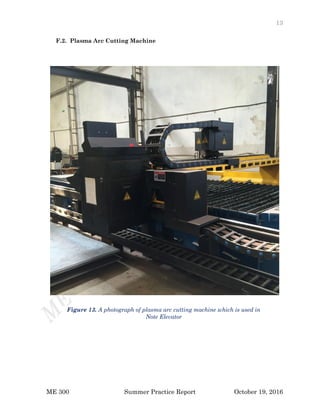
Ajan CNC branded plasma cutting machine which include a Siemens motion
control system and a Hypertherm supply source. According to the operator, some
qualifications which should be considered in such machines are as follows:
 Cut angle,
 Edge quality,
 Precision and speed of positioning,
 Consumable life,
 Easy programming,
 Easy setup,
 Reliability,
 Energy efficiency,
 Clean operation.
This plasma cutting machine are designed to cut a wide range of mild steel,
stainless steel and aluminum. Only 2D cutting system is available for this machine.
6mm or 8mm thick sheet metals are machined easily. According to authorities in
the company, using this machine is not suitable for thinner sheet metals (1-2 mm)
because of the melting problems.
One operator uses this machine according to technical drawings which comes
from planning department. This machine almost never stands idle. This is an
important indicator for the manufacturing organization in Note Elevator especially
for such an expensive machine.
13
ME 300 Summer Practice Report October 19, 2016
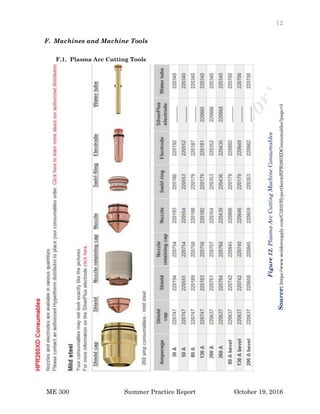
Consumable machine tools used in CNC Plasma Arc Cutting Machine are as
follows: (Please look up in Appendix F.1 to see machine tools)
 Electrode,
 Swirl ring,
 Nozzle,
 Nozlle retaining cap,
 Shield,
 Shield cap.
Images related to this machine are provided in Appendix F.2.
3.3.2. Shearing Machine
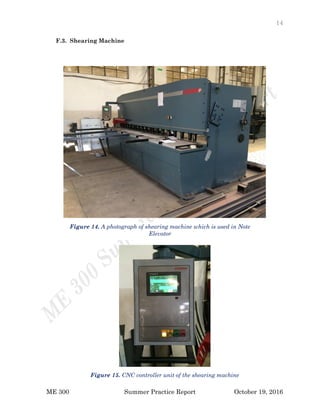
This is a Durma branded VS series variable rake CNC shear.
In this machine, cutting angle and blade gap can be adjusted by CNC
automatically for flexible and precise cutting processes. Some qualifications which
should be considered in such machines are as follows:
 Precision of cutting,
 Easy of use,
 Flexibility for thin or thick, narrow or wide sheets.
This machine is used for cutting 2mm thin sheet metals.
Images related to this machine are provided in Appendix F.3.
3.3.3. CNC Syncro Press Brake
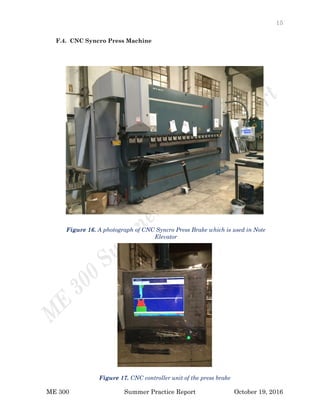
Durma branded three axes press brake is used in production of simple or complex
large shaped materials that require large dimensions for handling and removal.
The manufacturer of this machine promises that the specially designed control
unit and software reduces the required operator level. Although this promise, Note
14
ME 300 Summer Practice Report October 19, 2016
Elevator cannot find suitable skilled operator for this machine rather than one of the
most experienced foremen.
Some qualifications which should be considered in such machines are as follows:
 Easy of use,
 Bending results.
This machine also provides standardly three axes Y1, Y2, X and R manually
adjustable.
Images related to this machine are provided in Appendix F.4.
3.3.4. Eccentric Press
Press machines are used in order to change the shape of a workpiece by pressure.
There are different kinds of press machines according to their mechanism.
 Mechanical,
o Crank press,
o Knuckle joint press,
o Eccentric press,
o Rack and pinion press,
o Screw press,
 Preumatic,
 Hydaulic.
Presses can also be classified in different purpose of using. For example, forging
presses, stamping presses, punch presses etc. Apart from these, there are so many
different kinds of press machines.
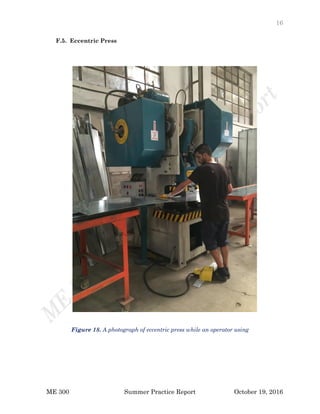
The press machine which is used in Note Elevator is Gümüş Makina branded 60
tons eccentric punch press. Making holes on 2mm thin sheet metal, which is used in
15
ME 300 Summer Practice Report October 19, 2016
side walls of the elevator cabins, bu using plasma machine is impossible because of
the melting problem. In this reason, this press machine is used for this purpose.
Images related to this machine are provided in Appendix F.5.
3.3.5. Bandsaw
Bandsaws offer one of the easiest and fastest way to cut metal. They are used in
cutting for wide range materials from iron to aluminum compounds. It can cut one
by one and also multiple. Bandsaws are fast and relatively inexpensive. They are
used in different places like steel plants, automotive manufacturers and
construction. Some qualifications which there should be in such machines are as
follows:
 Durability,
 Precision,
 Motor power,
 Speed of cutting.
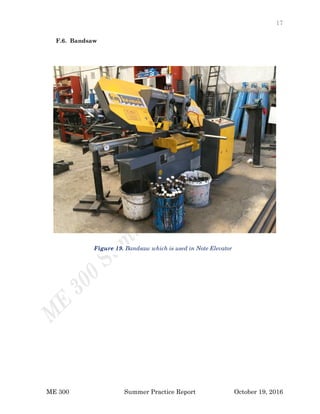
In Note Elevator uses Kesmak branded KSY 550x700 semi automatic bandsaw for
cutting bended materials. This is not one of the most frequently used machines.
Images related to this machine are provided in Appendix F.6.
3.3.6. Other Machines
Other than what mentioned above there are some machines and hand tools in the
company for different purposes. For instance, table saw is used in cutting of cipboards.
These cipboards are used in interior walls of elevator cabins as filler materials. Arc
welding machine is used in joining of 6mm thin sheet metals. Hand grinding is used
in order to improve these welding areas. Hand drilling is used in openning holes on
the surface of worpieces with thin sheet metals. Hand drilling is only used in
unectpected situations which occurred in a mistaken technical drawing.
16
ME 300 Summer Practice Report October 19, 2016
3.4. Sample Workpieces
In this section, there are five components were examined. When selection of these
components, importance of the components were considered. Because of this reason,
most of these components are related with safety. All techical drawings were made
with SolidWorks®. These components are as follows:
1. Guide rail bracket,
2. Wall rail bracket,
3. Mechanical gear lock,
4. Pit suspansion,
5. Car stabilizing joint.
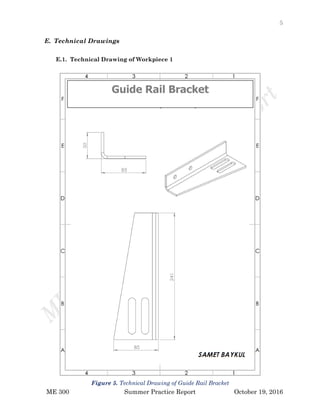
3.4.1. Workpiece 1 - Guide Rail Bracket
This is a connector component which is called as guide rail bracket. This is a joint
element which used in a link between the wall bracket and the rail. It keeps the rails
properly in vertical position. Rails guide the car (i.e. Elevator cabin) and CWT
(Counter Weight) mechanism.
6-mm sheet metal is used for production. Production steps are as follows:
a) Plasma arc cutting,
b) Bending,
c) Painting
The technical drawing of guide rail bracket is provided in Appendix E.1.
17
ME 300 Summer Practice Report October 19, 2016
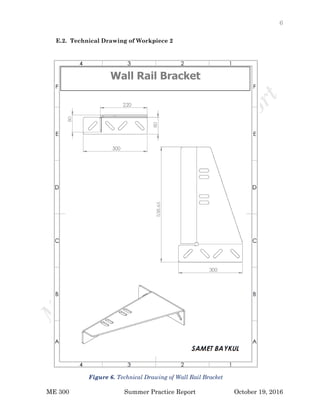
3.4.2. Workpiece 2 – Wall Rail Bracket
This is an another connection component which is called as wall rail bracket. This
bracket is used to link the guide rail bracket to the surface of the elevator wall. Steel
dowels are used in the holes of brackets.
6-mm sheet metal is used for production. Production steps are as follows:
a) Plasma arc cutting,
b) Bending,
c) Painting.
The technical drawing of wall rail bracket is provided in Appendix E.2.
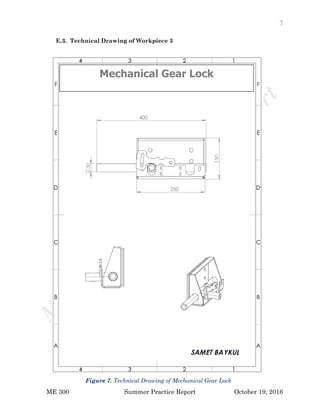
3.4.3. Workpiece 3 – Mechanical Gear Lock
This is a safety component is called as mechanical gear lock. This is a mechanical
brake system which is used to stop the car in machine-room-less elevators. When a
technical response is necessary, this brake system is positioned in desired location to
supply living space to the technical crew. Once the system is activated, any undesired
movenet in the elevator is prevented.
6-mm sheet metal and 30-mm transmission steel shaft are used for production.
Production steps are as follows:
a) Plasma arc cutting,
b) Bending,
c) Welding,
d) Grinding,
e) Painting,
f) Assembling.
The technical drawing of mechanical gear lock is provided in Appendix E.3.
18
ME 300 Summer Practice Report October 19, 2016
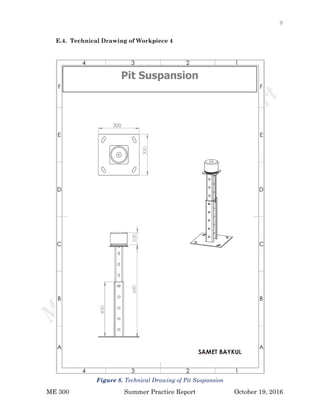
3.4.4. Workpiece 4 – Pit Suspansion
This component is called as pit suspansion. This is a safety element with soft and
elastic rubber-made buffer which is used to absorb the energy of car or CWT
mechanisms if they have still extra kinetic energy in the bottom line of the pit.
6-mm sheet metal and Has branded buffer are used for production. Production
steps are as follows:
a) Plasma arc cutting,
b) Bending,
c) Welding,
d) Grinding,
e) Painting,
f) Assembling.
The technical drawing of pit suspansion is provided in Appendix E.4.
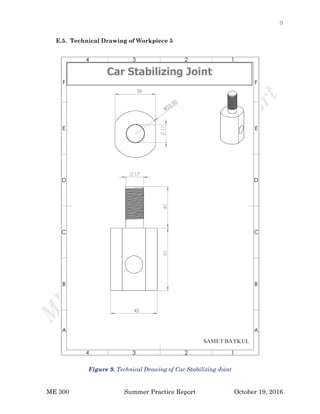
3.4.5. Workpiece 5 – Car Stabilizing Joint
This component is called as car stabilizing joint. It connects the car and the frame
which is the main skeleton to lift the car with a steel rod. This component is used for
elevators which has relatively bigger cars (i.e. elevator cabin). For instance, in car
elevators in parking buildings, elevator cabins are longer than regular human
elevators. If an unbalanced load distribution in elevator cabin, rods keep the cabin in
safe. These components are used in ends of these rods as a joint. Transmission steel
shaft is used for production. Production steps are as follows:
a) Turning,
b) Milling,
c) Tapping,
d) Drilling.
The technical drawing of car stabilizing joint is provided in Appendix E.5.
19
ME 300 Summer Practice Report October 19, 2016
3.5. Cost Analysis
In this section all given data is obtained according to wages of employees and bills
of utility expenses in Note Elevator. In order to reach more accurate cost analysis of
each component, the cost of time devoted to this component is also required. The cost
analysis based on the following system:
Note Elevator pays money for wages, raw materials and utility (electricity, water,
gas, oxygen and other consumables). Cost of raw materials should be calculated
seperately for each components. These estimated numbers are given in Table 2 in
below:
Table 2: Estimated Expenditures of Note Elevator
Name Cost
Wages 120.000 ₺
Raw Materials 60.000 ₺
Utility (Electricity, water, gas etc.) 30.000 ₺
TOTAL 210.000 ₺
Note Elevator has 50 employees. This means, the company has approximately 9000
hours of workforce per month (50 employees x 8 hours per day x 22 business day per
month + some extra workhours).
If we exclude the cost of raw materils (This will be added to the cost analysis for
each component seperately), Note Elevator pays 180.000 ₺ for 9.000 hours of work. This
means that, the cost of one single minute is roughly 0.3 ₺. Nevertheless, all estimated data
has high possibility of error.
20
ME 300 Summer Practice Report October 19, 2016
3.5.1. Workpiece 1 – Guide Rail Bracket
6-mm sheet metal is used for production of this component. This components is
roughy 30.000 mm2 including wasted material and 1.4 kg in weight. The price of 1 kg
sheet metal is 2 ₺. The cost of raw material is 2.8 ₺. Production of this part takes 5 minutes of
workforce. Thus, the cost of workforce and utility is 1.5 ₺ (5 minutes x 0.3 workforce cost per
minute).
As a result, estimated total cost of this product is 4.3 ₺.
The technical drawing of guide rail bracket is provided in Appendix E.1.
3.5.2. Workpiece 2 – Wall Rail Bracket
6-mm sheet metal is used for production of this component. This components is
roughy 150.000 mm2 including wasted material and 7 kg in weight. The price of 1 kg
sheet metal is 2 ₺. The cost of raw material is 14 ₺. Production of this part takes 15 minutes of
workforce. Thus, the cost of workforce and utility is 4.5 ₺ (15 minutes x 0.3 workforce cost per
minute).
As a result, estimated total cost of this product is 18.5 ₺.
The technical drawing of wall rail bracket is provided in Appendix E.2.
21
ME 300 Summer Practice Report October 19, 2016
3.6. Production Line
A production line is a set of sequential operations established in a factory which
manufactures products by passing work from one station to the next until product is
finished. The manufacturing line diagram has been showed in Appendix D.
Reasons why to make production line chart for Note Elevator:
 Absence of such a production line chart in the company,
 To know the products better in the manufacturing area,
 Be considered of the help for classification of the elevator components,
 Undestanding the relationship between the manufacturing operations,
 If there is, trying to identify some problems in manufacturing organization.
Descriptions for the production line chart:
In this chart, there are three diffirent production lines. Each of them is coloured
differently. A-1 line is blue, B-1 line is red and finally B-2 line is yellow.
The production on A-1 line, starts with 2mm thin sheet metal as raw material and
finishes as components which are used in the construction of side walls of the elevator
cabins.
On the B-1 line, 6mm shet metal is bended. As outputs, brackets are produced.
Brackets are used in transferring of weight of all the elevator components to the walls.
These components are very critical in safety concerns.
On the B-2 line, 6mm shet metal is not bended and these metals are converted to
ceiling and floor of the elevator cabins. And also bedplates are produced for traction
machine.
22
ME 300 Summer Practice Report October 19, 2016
Details in manufacturing processes in each station are explained in 3.2
Manufacturing Processes. And also some identified troubles in production lines are
showed in 3.9 Analysis of the Company Performance.
Results:
 It was effective to see the big picture in the manufacturing of Note Elevator,
 This chart may shorten the adaptaion of time for new employees,
 This may be the first step for optimization of the organization,
 Some identified manufacturing problems may help the company.
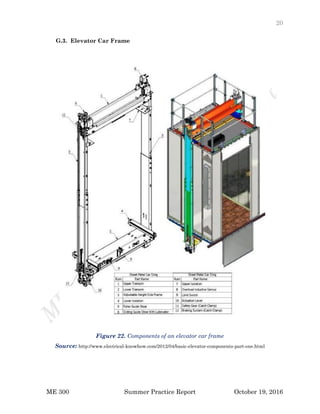
3.7. Classification of Elevator Components
This section contains classification studies of all the components of an elevator
including products manufactured by Note Elevator. The classification has been made
according to their assembling groups in the elevator. This study contains also
translation of this parts according to international elevator industry terminology. The
table of classification of the elevator components has been showed in Appendix G.
Reasons of this study:
 Absence of such a classification table in the company,
 Understanding the elevator components as a whole,
 Be considered as a first step for optimization of the components,
 Translation study was considered of the help to make it easier to follow the
developments of the componens in abroad.
23
ME 300 Summer Practice Report October 19, 2016
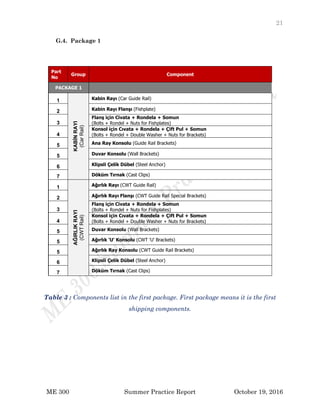
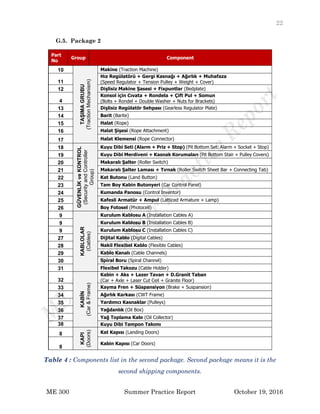
Descriptions of the classification table:
There are seven assembling groups in an elevator. All the components were
classified according these groups. These groups are as follows:
1. Car Rail,
2. CWT (Counter Weight) Rail,
3. Traction Mechanism,
4. Security and Controller Group,
5. Cables,
6. Car & Frame,
7. Doors.
Results:
 This table was helpful to make the customer offer program,
 It may shorten the adaptaiton of time for new employees,
 This may be the first step for optimization of design of the components,
 It filled an important void of research and development for the components in
the company.
3.8. Customer Offer Program
As mentioned before, Note Elevator manufactures elevator components for
installation companies. In the company, all the products are sold in packages. Altough
Note Elevator cannot manufacture all the components for installation of an elevator,
they have to put all the necessary components in these packages. For instance,
traction machine, electrical boards, steel ropes, interior decoration elements such as
mirrors, marbles, lighting systems, brake systems are all sold in these packages
altough not manufactured by themselves. These packages are called “package
elevator” in the industy.
24
ME 300 Summer Practice Report October 19, 2016
All the necessary components must be determined and offered to customers
correctly. For this purpose, the company follows these steps:
1. Understanding the customer and their work,
2. To determine all the necessary parts,
3. To calculate the correct number of these parts,
4. To make cost analysis of these parts according to the numbers, brands and
models.
5. Optimization of commissions and discounts rates as customer-oriented.
The company struggles to make true offer bid because of the sensivity of these
steps. Even lack of a small bolt in the package may cause serious problems for the
installation companies. Therefore, all the shipping packages, especially those going to
abroad, have to be checked in many times. But if there is an error in the plan, it can
make the checks meaningless and ruin everything. As a result, instead of performing
these steps by hand, the need has arisen for a reliable computer program.
The general manager in Note Elevator asked me to build such a computer program
and I have accepted.
Making such a computer program actually meant that making steps from step 2 to
step 5 automatically. Step 1 was different from the others because of making of this
step meant using fuzzy logic. Insufficiency of today’s computer technology makes it
impossible for now. By considering all the other steps, some parameters, formulas,
algoritms and databases were required. For all of these ingredients, using Microsoft®
Office Excel® was thought as the best suitable development environment.
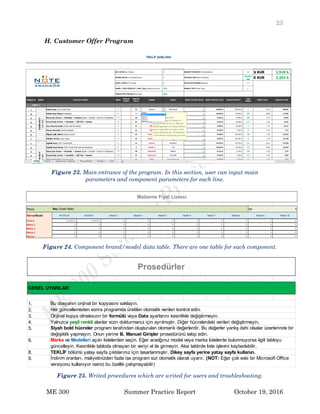
For making step 2, some parameters and algoritms were used. There are nine
system parameters. These parameters are as follows:
1. Number of stops,
2. Number of landing doors,
25
ME 300 Summer Practice Report October 19, 2016
3. Number of ropes,
4. Weight of the car (elevator cabin),
5. Duty load,
6. Travel distance,
7. Place of pulleys,
8. Ropping mechanism,
9. Frame type.
All the parameters are entered to the system by a person who talked with the
customers. These parameters are sufficient data to calculate the correct numbers of
the components. But apart from this, some algoritms are required for the calculations.
And also some formulas were required to build these algorithms. Formulas which is
used in these algoritms were obtained from an installation company, Römay Elevator
Systems. Only this way could meet all the expectations of the installation companies.
Except these system parameteres, parameters of brands and models for each
components were required to continue to build. Therefore, database of models and
database of brands were created according to the catalogs of companies which sells
these products. And drop list menus were build for easily selection of these data.
For using this program by employees, clear interface and clear procedures were
prepared to perform operations easy and quick. Fast and easy of use were priorities
of the program. For this reason, classification and translation works were also
included. Interface of the program is provided in Appendix H.
Briefly some features of Customer Offer Software:
 Easy of use,
 Has a clean interface and procedures,
 Open to improvements,
 Fast and reliable,
 Mobile.
26
ME 300 Summer Practice Report October 19, 2016
Results:
 The interface and functionality of the program was appreciated by the team,
 The program was began to used by the team immidiately,
 The program has shorten the time of offering operations as expected,
 Examination of components seperately helped me to obtain more information
about the industry, personally.
3.9. Analysis of the Company Performance
On the end of my first internship day, company manager asked me to attend their
ordinary meeting. They showed me a few videos and allowed me to gain some insight
about the industry. Then, they would liked to make a plan about my tasks in coming
days. In first, They asked me my requests. I would liked to such requests to make my
summer practice reports better. These are as follows:
1. History of the company,
2. Organizational structure,
3. Production line chart,
4. Information about machines,
5. Information about products.
They have told verbally. Unfortunately, lack of these documents about these
information caused me to make these documents myself.
And then, they would liked to give me two tasks as follows:
1. Customer Offer Program,
2. An analysis of the company performance.
27
ME 300 Summer Practice Report October 19, 2016
All of the above tasks are mentioned so far except for the performance analysis.
Because of the concerning of this task a bit with each subjects, this title was placed in
last.
After the acceptence of this task, these steps were followed:
1. Trying to understand the manufacturing problems,
2. Trying to understand the management problems,
3. Trying to understand the employee problems,
4. Trying to make suggestions for improvements.
3.9.1. Manufacturing Problems and Suggestions:
One problem was detected.
Problem 1: The lack of skilled labor for bending process. (This problem was
mentioned in the sections of 3.2.3. Bending and 3.3.3. CNC Syncro Press Brake in
detail.)
Suggestion 1: The company cannot find the appropriate skilled labor for this area
despite placing a jop advertisement. In this situation, they can educate their own
skilled labor for this area rather than finding a new one. Education task could be
given to a foreman. In this way, the forman just try to show this work to a worker
while he is working. If an appropriate worker is selected, this worker will be a
sufficient operator in a short time. They just need to spend one or two hours a day for
this task.
28
ME 300 Summer Practice Report October 19, 2016
3.9.2. Management Problems and Suggestions:
Two problem were detected.
Problem 1: Communication problems between the team members. In a very simple
example scenario, sales manager would like to learn when the components will arrive.
Because, he have to give a due date to the customer. But he cannot find the shipping
and storage manager on her place. Because, at that moment she is giving orders to
workers for the delivery work in the outside. Sales manager cannot reach the storage
manager and cannot learn the shipping date. As a result, sales manager cannot give
the due date to the customer for a certain time. This situation affects the sales
negatively.
Suggestion 1: The team can use some softwares for this issue. For example, Trello
may be a suitable program for this purpose. It is a web-based project management
application. It is a collaboration tool that organizes projects into boards. In one
glance, Trello tells somebody what is being worked on, who is working on what, and
where something is in a process.
Problem 2: Note Elevator manufactures hundreds of components in large and small
on everyday. These components are arranged to their similar groups but not in
technical sense. Most of them are very similar to each other but must be used in
different assembly groups. In both process of assemby and installation, detection of
correct component takes longer time than we expect.
Suggestion 2: Almost every component is painted for protection. But only black
colour is used. Instead of this, different colours could be preferred for each different
assembly groups. For instance, car frame components are painted in blue and CWT
(counter weight) elements are painted in red. This may help to workers and boost the
speed of the assembly and installation processes.
29
ME 300 Summer Practice Report October 19, 2016
3.9.3. Employee Problems and Suggestions:
One problem was detected.
Problem 1: Bad working conditions like poor ventilation and dirty floor in the
manufacturing area. The ground which is filled with dust may cause some serious
safety problems.
Suggestion 1: The front door of the building is always open. But there is only one
window in the back. And this window is too small to allow a healthy airflow. A
vacumm motor is needed according to the volume of the building. On the other hand,
the floor must be swept in every day.
3.9.4. Specific Problems and Suggestions:
Two problems were detected.
Problem 1: This problem was identified while researching of worlds developments of
elevator industry. Elevator manufacturers in Turkey including also Note Elevator are
seem to remain a little behind of the current technology. According to the information
provided by Otis Elevators, it has been three major changes in the world’s elevator
industry since 2000s. These are as follows:
1. Machine Room – Less Elevators: In this type of elevators, there is no
external rooftop machine room as like traditional elevators. This leads
construction companies save space in the buildings. As a result, cost of the
construction of elevators is decreased. Note Elevator already provides this
technology.
2. Gearless Traction Machines: As a traction source, compact servo motors are
used instead of traditional machines. Servo motors are more reliable and more
30
ME 300 Summer Practice Report October 19, 2016
efficient compared to the predecessors. And also these motors requires less
space and it said to be enviromentally-friendly in this way. Note Elevator do
not manufacture gearless traction machines but imports these machines to sell.
3. Coated Steel Elevator Belts: Zinc-plated steel wires have been started to use
instead of using traditional steel ropes. Twelve smaller cords and flat
arrangement provide better flexibility than conventional ropes. These
innovative wires minimize the corrosion. Tough polyurethane coating avoids
metal-to-metal contact. This reduces noise and vibration. Belt comprises high-
tensile strength steel wires. There is also no lubrication requirement for these
durable wires. Note Elevator still uses conventional ropes.
Suggestion 1: Note Elevator should accelerate their research and provide this
technology as soon as possible.
Problem 2: Note Elevator is a company which is not capable of mass production.
Instead of this, it offers flexible solutions for specific problems. This situation is
mentioned in the sections of 1.4 Main Area of Business and 3.1 General Project Cycle
in detail. The actual problem related to planning department. Because of the flexible
working requirements of the company, the planning department is forced to re-design
for each jop when there is even a small difference. In sometimes, a small different
dimensions in the elevator wall causes re-drawing of 20 - 30 components. This is a
serious time-consuming process and has potential of high risk of failure.
Suggestion 2: Rather than re-design of these components, using an expert computer
program may solve the problem completely. This software can be build in a project,
by engineers and software experts. This project is called “Liftsoft Project”.
31
ME 300 Summer Practice Report October 19, 2016
3.9.5. Liftsoft Project
Basically, data of elevator well conditions (For example see Appendix E.6) and
special customer requests (For example see Appendix E.7) are used as parameters.
These parameters are entered to the program by a user. Firstly, the program decides
which components are suitable for this project according to these parameters. It
chooses the component templates from the database of component pools in network of
the software. All the designs of these templates are optimised by engineers and also
updated periodically to meet current industry requirements before using of the
program. Secondly, the program calculates dimensions of selected templates and
generates all the technical drawings of them. These technical drawings formats
should support the instructions to operate CNC machines. Apart from these drawings,
the program can also generate printed customer proposal document and cost analysis
report.
In this way, without any requirements of skilled employee, engineeringly-
optimised designs and manufacturing instructions are generated easily. This makes
the company to save serious time, money and accuracy.
After exposing personal ideas, the team of Note Elevator asked me to research
about this issue. After some researching some similar softwares were detected. For
example ESM® (Elevator Service Manager), DigiPara® Liftdesigner®, Fieldboss Lift®
etc. These softwares have strong partnerships like Microsoft® and Autodesk®. This
cannot be considered as a negative portrait to start such a project. On the other side,
commercial potentials of this project can be considered as a great motivator. According
to Nilüfer Aydoğmuş, the general manager of Note Elevator, in even a small elevator
manufacturers like their company, which manufactures 600 package elevators in a
year, can save 60.000 dollars for a year because of cutting wages of three skilled
labors. By making some inferences, a manufacturer can save 100 dollars directly per
one package elevator by using this software. This does not mean dismissal. This
situation can support the hand of the company to even providing of more employees.
32
ME 300 Summer Practice Report October 19, 2016
These employees can do more specific woks rather than doing of computer works for
example attending to fair areas or making more researching. While considering other
indirect effects of using this software, such as saving time and providing more
accuracy, this number can be high as 200 dollars per package.
In macro-economic aspects, this program can provide significant benefits to the
national economy. According to Bora Gülan, global manager assistant of Otis, which
is one the world’s leading elevator companies, Turkey manufactures up to 15.000
elevators in a year. This roughly means that the elevator industry in Turkey can save
up to 3 millinons of dollars. Manufacturers can stop importing the softwares from
abroad while increasing of reliability of the turkish brands.
Nevertheless, we need to make a check-list to be sure to decision of beginning
of such a complex project. This check-list is here:
1. List of all required elevator components to build,
2. Technical drawings of these components,
3. Analysis of these components,
4. Analysis of a general project cycle,
5. To idendify limits of the current CAD programs for industry-based specific
problems,
6. Analysis of similar softwares in detail,
7. Analysis of commercial potentials of this project in detail,
8. Evaluation of expert opinions,
9. Providing mutual partnership,
10.Evaluation of ideal start-up programs.
After all of these tasks, beginning of this project may be considered in correct
conditions.
33
ME 300 Summer Practice Report October 19, 2016
4. Conclusion
In this summer internship, these experiences or skills were gained or improved as
follows:
1. Communication skills with other employees,
2. Observation skills as being a mechanical engineering candidate,
3. Undestranding the true value of knowledge which was gained in the academic
department,
4. Developing some problem solving strategy,
5. Experience in production techniques,
6. Ability to work effectively within a team,
7. Learning of working systematically,
8. Improvement of some computer program skills to solve specific problems.
All the information and exprecience gained from my actions and observations
during the summer practice provided me courage and motivation to become a good
mechanical engineer. My observations in manufacturing area provided the
opportunity to apply what I learned in the METU Mechanical Engineering
Department and showed the true value of this background. Recognition of my skills
and knowledge by the team gave me the courage to face bigger engineering problems.
As a mechanical engineering candidate, I have seen the value of observation ability
besides knowledge to understand the source of the problems. Although there are much
more information and experience which I will learn from the faculty, I have seen much
useful work can be done with even such limited information. I was really exited about
this situation. Beyond all of these, I have noticed that positive effects of working
systematically and teamwork on success of an organization.
34
ME 300 Summer Practice Report October 19, 2016
35
ME 300 Summer Practice Report October 19, 2016
Appendices
All related data, tables and drawings should be given in this section.
A. Map Location
Figure 1. Location of Note Elevator. Map shows Maltepe, İstanbul
2
ME 300 Summer Practice Report October 19, 2016
B. Organizational Structure Chart of the Company
Figure 2. Organizational Structure
3
ME 300 Summer Practice Report October 19, 2016
C. General Project Cycle Diagram
Figure3.GeneralProjectCycle
4
ME 300 Summer Practice Report October 19, 2016
D. Manufacturing Line Diagram
Figure4.ManufacturingLine:Boxesshowproductswhichisinrelated
productionline
5
ME 300 Summer Practice Report October 19, 2016
E. Technical Drawings
E.1. Technical Drawing of Workpiece 1
Guide Rail Bracket
Figure 5. Technical Drawing of Guide Rail Bracket
6
ME 300 Summer Practice Report October 19, 2016
E.2. Technical Drawing of Workpiece 2
Wall Rail Bracket
Figure 6. Technical Drawing of Wall Rail Bracket
7
ME 300 Summer Practice Report October 19, 2016
E.3. Technical Drawing of Workpiece 3
Mechanical Gear Lock
Figure 7. Technical Drawing of Mechanical Gear Lock
8
ME 300 Summer Practice Report October 19, 2016
E.4. Technical Drawing of Workpiece 4
Pit Suspansion
Figure 8. Technical Drawing of Pit Suspansion
9
ME 300 Summer Practice Report October 19, 2016
E.5. Technical Drawing of Workpiece 5
Car Stabilizing Joint
Figure 9. Technical Drawing of Car Stabilizing Joint
10
ME 300 Summer Practice Report October 19, 2016
E.6. Technical Drawing Example for Elevator Well Conditions
Figure 10. Technical Drawing for well conditions of a construction
company
Privacy information of the company
11
ME 300 Summer Practice Report October 19, 2016
E.7. Technical Drawing Example for Special Customer Requests
Figure11.TechnicalDrawingforspecialrequestsofa
constructioncompany
Privacy
Privacy
12
ME 300 Summer Practice Report October 19, 2016
F. Machines and Machine Tools
F.1. Plasma Arc Cutting Tools
Figure12.PlasmaArcCuttingMachineConsumables
Source:https://www.weldersupply.com/C/202/HyperthermHPR260XDConsumables?page=3
13
ME 300 Summer Practice Report October 19, 2016
F.2. Plasma Arc Cutting Machine
Figure 13. A photograph of plasma arc cutting machine which is used in
Note Elevator
14
ME 300 Summer Practice Report October 19, 2016
F.3. Shearing Machine
Figure 15. CNC controller unit of the shearing machine
Figure 14. A photograph of shearing machine which is used in Note
Elevator
15
ME 300 Summer Practice Report October 19, 2016
F.4. CNC Syncro Press Machine
Figure 17. CNC controller unit of the press brake
Figure 16. A photograph of CNC Syncro Press Brake which is used in Note
Elevator
16
ME 300 Summer Practice Report October 19, 2016
F.5. Eccentric Press
Figure 18. A photograph of eccentric press while an operator using
17
ME 300 Summer Practice Report October 19, 2016
F.6. Bandsaw
Figure 19. Bandsaw which is used in Note Elevator
18
ME 300 Summer Practice Report October 19, 2016
G. Classification of Elevator Components
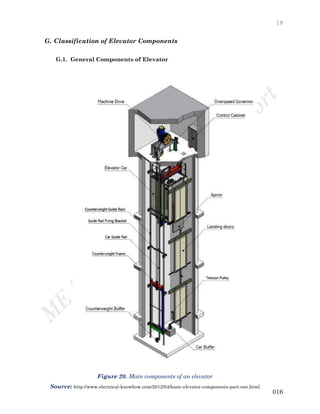
G.1. General Components of Elevator
Figure 20. Main components of an elevator
Source: http://www.electrical-knowhow.com/2012/04/basic-elevator-components-part-one.html
19
ME 300 Summer Practice Report October 19, 2016
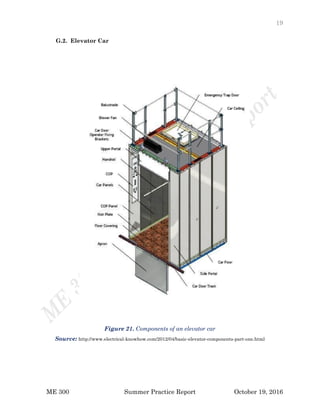
G.2. Elevator Car
Figure 21. Components of an elevator car
Source: http://www.electrical-knowhow.com/2012/04/basic-elevator-components-part-one.html
20
ME 300 Summer Practice Report October 19, 2016
G.3. Elevator Car Frame
Figure 22. Components of an elevator car frame
Source: http://www.electrical-knowhow.com/2012/04/basic-elevator-components-part-one.html
21
ME 300 Summer Practice Report October 19, 2016
G.4. Package 1
Part
No
Group Component
PACKAGE 1
1
KABİNRAYI
(CarRail)
Kabin Rayı (Car Guide Rail)
2 Kabin Rayı Flanşı (Fishplate)
3
Flanş için Civata + Rondela + Somun
(Bolts + Rondel + Nuts for Fishplates)
4
Konsol için Cıvata + Rondela + Çift Pul + Somun
(Bolts + Rondel + Double Washer + Nuts for Brackets)
5 Ana Ray Konsolu (Guide Rail Brackets)
5 Duvar Konsolu (Wall Brackets)
6 Klipsli Çelik Dübel (Steel Anchor)
7 Döküm Tırnak (Cast Clips)
1
AĞIRLIKRAYI
(CWTRail)
Ağırlık Rayı (CWT Guide Rail)
2 Ağırlık Rayı Flanşı (CWT Guide Rail Special Brackets)
3
Flanş için Civata + Rondela + Somun
(Bolts + Rondel + Nuts for Fishplates)
4
Konsol için Cıvata + Rondela + Çift Pul + Somun
(Bolts + Rondel + Double Washer + Nuts for Brackets)
5 Duvar Konsolu (Wall Brackets)
5 Ağırlık 'U' Konsolu (CWT 'U' Brackets)
5 Ağırlık Ray Konsolu (CWT Guide Rail Brackets)
6 Klipsli Çelik Dübel (Steel Anchor)
7 Döküm Tırnak (Cast Clips)
Table 3 : Components list in the first package. First package means it is the first
shipping components.
22
ME 300 Summer Practice Report October 19, 2016
G.5. Package 2
Part
No
Group Component
10
TAŞIMAGRUBU
(TractionMechanism)
Makine (Traction Machine)
11
Hız Regülatörü + Gergi Kasnağı + Ağırlık + Muhafaza
(Speed Regulator + Tension Pulley + Weight + Cover)
12 Dişlisiz Makine Şasesi + Fixpuntlar (Bedplate)
4
Konsol için Cıvata + Rondela + Çift Pul + Somun
(Bolts + Rondel + Double Washer + Nuts for Brackets)
13 Dişlisiz Regülatör Sehpası (Gearless Regulator Plate)
14 Barit (Barite)
15 Halat (Rope)
16 Halat Şişesi (Rope Attachment)
17 Halat Klemensi (Rope Connector)
18
GÜVENLİKveKONTROL
(SecurityandController
Group)
Kuyu Dibi Seti (Alarm + Priz + Stop) (Pit Bottom Set: Alarm + Socket + Stop)
19 Kuyu Dibi Merdiveni + Kasnak Korumaları (Pit Bottom Stair + Pulley Covers)
20 Makaralı Şalter (Roller Switch)
21 Makaralı Şalter Laması + Tırnak (Roller Switch Sheet Bar + Connecting Tab)
22 Kat Butonu (Land Button)
23 Tam Boy Kabin Butonyeri (Car Control Panel)
24 Kumanda Panosu (Control Inventor)
25 Kafesli Armatür + Ampul (Latticed Armature + Lamp)
26 Boy Fotosel (Photocell)
9
KABLOLAR
(Cables)
Kurulum Kablosu A (Installation Cables A)
9 Kurulum Kablosu B (Installation Cables B)
9 Kurulum Kablosu C (Installation Cables C)
27 Dijital Kablo (Digital Cables)
28 Nakil Flexibel Kablo (Flexible Cables)
29 Kablo Kanalı (Cable Channels)
30 Spiral Boru (Spiral Channel)
31 Flexibel Takozu (Cable Holder)
32
KABİN
(Car&Frame)
Kabin + Aks + Lazer Tavan + D.Granit Taban
(Car + Axle + Laser Cut Ceil + Granite Floor)
33 Kayma Fren + Süspansiyon (Brake + Suspansion)
34 Ağırlık Karkası (CWT Frame)
35 Yardımcı Kasnaklar (Pulleys)
36 Yağdanlık (Oil Box)
37 Yağ Toplama Kabı (Oil Collector)
38 Kuyu Dibi Tampon Takımı
8
KAPI
(Doors)
Kat Kapısı (Landing Doors)
8
Kabin Kapısı (Car Doors)
Table 4 : Components list in the second package. Second package means it is the
second shipping components.
23
ME 300 Summer Practice Report October 19, 2016
H. Customer Offer Program
Parça: No: 1
Marka/Model 90x75x16 50x50x5 Model 3 Model 4 Model 5 Model 6 Model 7 Model 8 Model 9 Model 10
Savera 24,000 ₺ 14,650 ₺ - ₺ - ₺ - ₺ - ₺ - ₺ - ₺ - ₺ - ₺
Marka 2 - ₺ - ₺ - ₺ - ₺ - ₺ - ₺ - ₺ - ₺ - ₺ - ₺
Marka 3 - ₺ - ₺ - ₺ - ₺ - ₺ - ₺ - ₺ - ₺ - ₺ - ₺
Marka 4 - ₺ - ₺ - ₺ - ₺ - ₺ - ₺ - ₺ - ₺ - ₺ - ₺
Manual - ₺ - ₺ - ₺ - ₺ - ₺ - ₺ - ₺ - ₺ - ₺ - ₺
Malzeme Fiyat Listesi
Ray (Guide Rails)
1.
2.
3.
4.
5.
6.
8.
9.
1.
2.
3.
GENEL UYARILAR:
Bu dosyanın orijinal bir kopyasını saklayın.
Her güncellemeden sonra programda üretilen otomatik verileri kontrol edin.
Orijinal kopya olmaksızın bir formülü veya Data ayarlarını kesinlikle değiştirmeyin.
Yalnızca yeşil renkli alanlar sizin doldurmanız için ayrılmıştır. Diğer hücrelerdeki verileri değiştirmeyin.
Herbir parça için açılır liste menülerinden Marka ve Model seçiminizi yapın.
Herbir parça için kullanılması gereken miktar, sizin yerinize otomatik olarak doldurulur. Kontrol edin.
Kat Sayısı, Durak Sayısı gibi temel parametreleri girin.
A. Normal Liste Hazırlama:
Prosedürler
TEKLİF bölümü yatay sayfa çıktılarınız için tasarlanmıştır. Dikey sayfa yerine yatay sayfa kullanın.
Siyah bold hücreler program tarafından oluşturulan otomarik değerlerdir. Bu değerler yanlış dahi olsalar üzerlerinde bir
değişiklik yapmayın. Onun yerine B. Manuel Girişler prosedürünü takip edin.
Marka ve Modelleri açılır listelerden seçin. Eğer aradğınız model veya marka listelerde bulunmuyorsa ilgili tabloyu
güncelleyin. Kesinlikle tabloda olmayan bir veriyi el ile girmeyin. Aksi taktirde liste işlevini kaybedebilir.
İndirim oranları, maliyetinizden fazla ise program sizi otomatik olarak uyarır. (NOT: Eğer çok eski bir Microsoft Office
versiyonu kullanıyor iseniz bu özellik çalışmayabilir)
Figure 23. Main entrance of the program. In this section, user can input main
parameters and component parameters for each line.
Figure 24. Component brand/model data table. There are one table for each component.
Figure 25. Writed procedures which are writed for users and troubleshooting.
ii
ME 300 Summer Practice Report October 19, 2016
References
Asansör Sektörü Raporu (Sektörel Raporlar ve Analizler Serisi) [2]. (2015). Retrieved
from http://aysad.org.tr/Document/NoticeDocumentGalery/2015-2 Asansor-
sektoru-raporu-20-2112015133019.pdf
Black, J.T., & Kohser R.A. (2008). Materials & Processes in Manufacturing. U.S: Wiley.
Otis Elevator. Elevator 101 Introduction to Elevator Technology Technology. Retrieved
October 12, 2016, from Mass,
http://www.mass.gov/anf/docs/dcam/mafma/tutorials/elevator-101.pdf
Hypertherm HPR260XD Consumable Parts
https://www.weldersupply.com/C/202/HyperthermHPR260XDConsumables?page=3
Shaun. (2013, January 29). Basic elevator components - part One. Retrieved October 12,
2016, from electrical-knowhow, http://www.electrical-
knowhow.com/2012/04/basic-elevator-components-part-one.html
iii
ME 300 Summer Practice Report October 19, 2016

Note Elevator - Summer Practice Report

  • 1.
    METU Department of MechanicalEngineering ME300 Summer Practice Report by Samet Baykul October 12, 2016
  • 3.
    ii ME 300 SummerPractice Report October 19, 2016 I hereby declare that all information in this document has been obtained and presented in accordance with academic rules and ethical conduct. I also declare that, as require by these rules and conduct, I have fully cited and referenced all material and results that are not original to this work. Name, Last Name : Samet Baykul Signature :
  • 4.
    iii ME 300 SummerPractice Report October 19, 2016
  • 5.
    iv ME 300 SummerPractice Report October 19, 2016 TABLE OF CONTENTS 1. Description of the company ........................................................................ 1 1.1. Company Name and Location .............................................................. 1 1.2. Organizational Structure of the Company ....................................... 1 1.3. Engineers and Their Duties.................................................................. 3 1.4. Main Area of Business............................................................................ 3 1.5. History of the Company......................................................................... 4 2. Introduction ................................................................................................... 5 3. Report .............................................................................................................. 6 3.1. General Project Cycle ............................................................................ 6 3.2. Manufacturing Processes...................................................................... 8 3.2.1. Shearing ............................................................................................... 9 3.2.2. Drilling ................................................................................................. 9 3.2.3. Bending ................................................................................................ 9 3.2.4. Welding............................................................................................... 10 3.2.5. Grinding ............................................................................................. 10 3.2.6. Plasma Arc Cutting ........................................................................... 10 3.2.7. Painting.............................................................................................. 11 3.3. Machines and Machine Tools ............................................................. 12 3.3.1. Plasma Arc Cutting Machine ............................................................ 12 3.3.2. Shearing Machine.............................................................................. 13 3.3.3. CNC Syncro Press Brake................................................................... 13 3.3.4. Eccentric Press................................................................................... 14 3.3.5. Bandsaw ............................................................................................. 15 3.3.6. Other Machines.................................................................................. 15 3.4. Sample Workpieces............................................................................... 16 3.4.1. Workpiece 1 - Guide Rail Bracket..................................................... 16 3.4.2. Workpiece 2 - Wall Rail Bracket ....................................................... 17 3.4.3. Workpiece 3 - Mechanical Gear Lock................................................ 17 3.4.4. Workpiece 4 - Pit Suspansion............................................................ 18 3.4.5. Workpiece 5 - Car Stabilizing Joint .................................................. 18 3.5. Cost Analysis.......................................................................................... 19 3.5.1. Workpiece 1 - Guide Rail Bracket..................................................... 20 3.5.2. Workpiece 2 - Wall Rail Bracket ....................................................... 20 3.6. Production Line .................................................................................... 21 3.7. Classification of Elevator Components............................................ 22 3.8. Customer Offer Program..................................................................... 23
  • 6.
    v ME 300 SummerPractice Report October 19, 2016 3.9. Analysis of the Company Performance............................................ 26 3.9.1. Manufacturing Problems and Suggestions....................................... 27 3.9.2. Management Problems and Suggestions.......................................... 28 3.9.3. Employee Problems and Suggestions................................................ 29 3.9.4. Specific Problems and Suggestions................................................... 29 3.9.5. Liftsoft Project.................................................................................... 31 4. Conclusion..................................................................................................... 33 Appendices............................................................................................................ 36 A. Map Location ................................................................................................. 1 B. Organizational Structure of the Company ................................................... 2 C. General Project Cycle Diagram..................................................................... 3 D. Manufacturing Line Diagram....................................................................... 4 E. Technical Drawings ....................................................................................... 5 E.1.Technical Drawing of Workpiece 1 ......................................................... 5 E.2.Technical Drawing of Workpiece 2 ......................................................... 6 E.3.Technical Drawing of Workpiece 3 ......................................................... 7 E.4.Technical Drawing of Workpiece 4 ......................................................... 8 E.5.Technical Drawing of Workpiece 5 ......................................................... 9 E.6.Technical Drawing Example for Elevetor Well Conditions................. 10 E.7.Technical Drawing Example for Special Customer Requests ............. 11 F. Machines and Machine Tools ...................................................................... 12 F.1.Plasma Arc Cutting Tools...................................................................... 12 F.2.Plasma Arc Cutting Machine................................................................ 13 F.3.Shearing Machine.................................................................................. 14 F.4.CNC Syncro Press Machine .................................................................. 15 F.5.Eccentric Press....................................................................................... 16 F.6.Bandsaw................................................................................................. 17 G. Classification of Elevator Components....................................................... 18 G.1.General Components of Elevator.......................................................... 18 G.2.Elevator Car .......................................................................................... 19 G.3.Elevator Car Frame .............................................................................. 20 G.4.Package 1............................................................................................... 21 G.5.Package 2............................................................................................... 22 H. Customer Offer Program............................................................................. 23 References............................................................................................................. 25
  • 7.
    vi ME 300 SummerPractice Report October 19, 2016
  • 8.
    1. Description ofthe company This chapter is prepared to supply general opinion about the company. 1.1. Company Name and Location Company Name Note Elevator - Note Asansör Ekipmanlari San. ve Tic. Ltd. Şti. Company Adress Yalı Mah. Ziya Gökalp Cad. 5 D:3 Maltepe, İstanbul The location map is provided in Appendix A. 1.2. Organizational Structure of the Company Note Elevator has a small but an effective team. This team consists of the general company manager, manager assistant, planning department, storage manager, manufacturing department and accountant. In order to see overall organizational structure, please look up the chart in Appendix B. The company manager is also owner of the company, Nilüfer Aydoğmuş. She is responsible for the regularity and the profit of the company as first order. All the problems which cannot be solved by any department itself, should be solved by her assists. If this is not possible, she arranges a meeting with the participation of all the team in order to solve the problem.
  • 9.
    2 ME 300 SummerPractice Report October 19, 2016 Manager assistant is Ferhat Elban. He has a great experience in the elevator industry. For this reason, he helps the management. He is also responsible for sales and marketting. Advertising and relations with customers are also under his responsibilities. Besides, he does research and follows the development in the industry, closely. In this way, he contributes the development of the company. There are three team members under the ‘Planning Department’. Each member uses CAD programs like SolidWorks® and AutoCad®. Kübra Aydoğmuş is an architect and is responsible for elevator well where is the place to do elevator construction. Mustafa Cavit Özdal is an engineer and is responsible for special customer orders in engineering aspects. Rıza Aydoğdu is supervisor of this department. He contributes the design with his experiences. He checks the results and connects between ‘Planning Department’ and the ‘Manufacturing Department’. Storage manager is Gönül Çağlayan. She checks stock status of all the components for each project. If it is necessary, she orders new components. She makes price and quality optimization for these imported component. She is also responsible for shipping of products. Manufacturing Department is the largest section of the company. There are about 40 workers and 2 headworkers. These headworkers are highly experienced in the industry. They analayse the technical drawings which come from the ‘Planning Department’ and organize the manufacturing operations as quickly as possible in current circumstances. They have own their intiatives to solve production defects or planning mistakes. After the work, they give reports for each completed products to the management. Accountant Ms. Canan, is responsible for the financial transactions of the company. Apart from the earning statement, she regulates the relation between the company and the government.
  • 10.
    3 ME 300 SummerPractice Report October 19, 2016 1.3. Engineers and Their Duties Table 1 : Number of Engineers Engineer Number Mechanical 1 Material 1 Eray Baykul is a mechanical engineer. He is quality supervisor. He checks the products if its are appropriate for industy standards or not. He inspects the possible defects in the last stage. He also offers consulting service for more specific projects. Mustafa Cavit Özdal is a material engineer. He analyses the feasibility of the given projects and makes technical drawings with SolidWorks®. In this way, he contributes the planning and design of the products. 1.4. Main Area of Business Note Elevator is a company which manufactures elevator components. This company offers planning and sells package elevator to installation and construction companies. The company is not capable of mass production. Instead of this, it offers flexible solutions for specific problems. In this regard, Note Elevator is considered as a jop shop manufacturer. More detailed business focus of Note Elevator is explained in the section of 3.1. General Project Cycle.
  • 11.
    4 ME 300 SummerPractice Report October 19, 2016 1.5. History of the Company Note Elevator was founded in 2014 and started to manufacture elevator components in order to find solutions which can be applied easily and bring innovative values to the elevator industry in Turkey. “Production with information” and “Perspective of organization” comprised basics of Note Elevator. They have developed their own machine-room-less elevator designs with using expert programs. Some essentials of Note Elevator are as follows:  Best product for flexible projects,  Optimized quality,  Reliable partnership.
  • 12.
    5 ME 300 SummerPractice Report October 19, 2016 2. Introduction This report covers my all personal observations and actions in Note Elevator as a mechanical engineering student during 20 business days. My personal observations: 1. General Project Cycle: It covers how the company starts and finishes a project and intermediate steps. 2. Manufacturing processes: Detailed explanation of manufacturing processes. 3. Machines and Machine Tools: All used machines and tools in manufacturing. My personal actions: 1. Sample Workpieces: Technical drawings for 5 different products. 2. Cost Analysis: Cost analysis for 2 different products. 3. Production Line: Production lines in manufacturing area which identified personally. 4. Classification of Elevator Components: Classification of all the products according to their assemling groups and translation according to international elevator industry terminology. 5. Customer Offer Program: A new excel software program for project proposal. (This task has been given by the manager of the company.) 6. Analysis of the Company Performance: This is related to the efficiency of the team as a foreign observer. (This task has been given by the team in a company meeting.)
  • 13.
    6 ME 300 SummerPractice Report October 19, 2016 3. Report 3.1. General Project Cycle A sample project has been given in this section. If you would like to see General Project Cycle please look up Appendix C. Note Elevator manufactures some components for particular types of elevator as follows: According to hoist mechanism: 1. Hydraulic elevators: Supported by a piston at the bottom of the elevator that pushes the elevator up. They are used for low-rise applications of 2-8 stories and travel at a maximum speed of 1 m/s. 2. Traction elevators: Lifted by ropes, which pass over a wheel attached to an electric motor above the elevator shaft. a. Geared traction elevators: They have a gearbox that is attached to the motor, which drives the wheel that moves the ropes. They are capable of travel speeds up to 2.5 m/s. b. Gear-less traction elevators: They have the wheel attached directly to the motor. They are capable of speeds up to 10 m/s. But they have lower carrying capacity than geared traction elevators. c. Machine-room-less elevators: They are typically traction elevators that do not have a dedicated machine room above the elevator shaft. They are becoming more common because of decreasing construction cost.
  • 14.
    7 ME 300 SummerPractice Report October 19, 2016 According to building type: 1. Hospital elevators, 2. Residential/domestic elevators, 3. Industrial elevators, 4. Commercial elevators, 5. Parking buildings elevators. Note Elevator do not work for end users. Construction companies work with elevator installation companies, and these installation companies imports package elevators from manufacturers like Note Elevator. For installation companies, the biggest advantage of work with small companies like Note Elevator is the capable of production for flexible projects. Altough Note Elevator can produce only 50 package elevators, but all of these products may be different from each other. In this way, Note Elevator has a wide-range business area. In other words, Note Elevator has great opportunuties to work with different companies. In the company, all orders which come from the installation companies are accepted in selling and marketing and send to planning in order to make desgin and projecting. In planning, there are two different parameter pools. First one is the technical data which comes from the elevator well conditions (For example see Appendix E.6). These are mandatory parameters and cannot be changed. All components which will be produced must fit into the well. For example, the place of the machine (traction motor) shaft is calculated according to height of the well or maximum cabin width should not exceed the bottleneck dimensions of the well. The second pool involves the special customer requests (For example see Appendix E.7). This requests may cover speed and carrying capacity of the elevator, interior decoration, quality of inner materials and trademarks of some components like machine and brake mechanism.
  • 15.
    8 ME 300 SummerPractice Report October 19, 2016 These requests must not conflict with the first parameter pool. For example, in such a small elevator well which has not enough area to cover bigger frame, the request of higher carrying capacity is inacceptable. All the components should be designed according to these pools in the planning department. Some necessary outside-production components like traction machines, electrical boards are listed for the storage management, and imported from different manufacturers. All necessary technical drawings for the other components are send to the manufacturing department and manufatured. Details of manufacturing are explained in the section of 3.2. Manufactıring Process. After the manufacturing processes, all components are assembled and checked by experts. After all of these steps, the product, which is called package elevator, is ready to the installation. All the components are reassembled and packaged for shipping. Shipping processes are organized by storage management. Elevator components are provided in Appendix G. 3.2. Manufacturing Processes Note Elevator use these manufacturing techniques as follows: 1. Shearing, 2. Drilling, 3. Bending, 4. Welding, 5. Grinding, 6. Plasma Arc Cutting, 7. Painting. Please look up Appendix D in order to see overall manufacturing line diagram.
  • 16.
    9 ME 300 SummerPractice Report October 19, 2016 3.2.1. Shearing Shearing is a forming process. It is also known as die cutting. Shearing is the chipless mechanical cutting of a workpiece which is generally sheet metal. There is also no burning or melting like no chip formation. Shearing is used by Note Elevator in order to prepare thin sheet metals (These metals are approximately 2.5 mm) for next operations like drilling and bending. These thin sheet metals are used for only side walls for elevator cabins. 3.2.2. Drilling Drilling is making cylindrical holes on any workpiece. This is generally accomplished by using a twist drill. Drilling is the most common machining process. In the company, drilling is made by both hand tools and a drilling machine. Drilling machine is used for thin sheet metals. On the other hand, drilling hand tools are used for thick metal plates. Thick metal plates are approximatley 6-8 mm and used for brackets, frames and bedplates for traction machines. 3.2.3. Bending Bending is the plastic deformation of metals about a linear axis. There may be little change in the surface area because of the deformation. Bending is a very important process for elevator manufacturers. The result products of this process will supply the link between the elevator components and the walls of the construction well. All these bended products must transfer all the loads correctly. Because of this safety reason, even a small incorrect bending can send the expensive materials to the scrapyard. The lack of skilled labor for bending process in the sector, constitutes a serious problem for Note Elavator. Because of this reason within the safety importance of the result products, the company compulsorily places one of the most talented and experienced two foremen, on this section. In somedays, this forman is so bussy with
  • 17.
    10 ME 300 SummerPractice Report October 19, 2016 this bending work that he cannot do his actual supervising work. This means there is a huge loss for the company, in this section. In order to see other troubles Note Elevator has like this, please look up the section of 3.9. Analysis of the Company Performance. 3.2.4. Welding Welding is a process involves joining of materials which are generally metals or plastics by using different welding methods. If the melting method is used, the based metal should not be melted. Instead of this, a filler material is added to the joint as the complement. Filler materials have a lower melting point than the base materials. After heating of base material and melting the filler material in the welding area, this mixture is cooled. In sometimes, the pressure may help to correctness of welding. In the company, arc welding is used for thick-sheet-metal components. These components may bended or not. Welding is very important for the safety. Because of this reason, in the stage of safety control the most considered critical points are welding areas. 3.2.5. Grinding Grinding is the most common abrasive machining process which is made by using grinding wheel as a cutting tool. In the company, grinding is only used for improving welding areas by welder. Welder generally uses a hand grinder for this process. 3.2.6. Plasma Arc Cutting Plasma arc cutting (PAC) uses a superheated stream of electrically ionized gas to melt and remove material. PAC is sometimes called plasma-beam machining. The 10,000° to 28,000°C plasma is created inside a water-cooled nozzle by electrically ionizing a suitable gas such as nitrogen, hydrogen, argon, or mixtures of these gases.
  • 18.
    11 ME 300 SummerPractice Report October 19, 2016 The process can be used on almost any conductive metal. The plasma arc is a mixture of free electrons, positively charged ions, and neutral atoms. The high- velocity gases melt and blow away the molten metal “chips.” The process may be performed underwater, using a large tank to hold the plates being cut. The water assists in confining the arc and reducing smoke. The main advantage of PAC is speed. Mild steel 6 mm thick can be cut at 5 m/s. Speed decreases with thickness. Some of the drawbacks of the PAC process include poor tolerances, tapered cuts, and double arcing, leading to premature wear on the nozzle. (Black & Kohser, 2008, pp.518-520) In the company, plasma arc cutting is used for two dimensional machining of 6mm or 8mm sheet metals. In this stage, these metals are prepared for next bending, welding, grinding and painting proccesses. In a completed elevator, these componenents are used for brackets, frames and bedplates for traction machines. Plasma arc cutting process is certainly the most exotic process in the company. It is very quick and easy way to cut any thick sheet metals by using this process altough it is not fast as the description above. Also, water is not used for the process. But, any smoke has been not observed. 3.2.7. Painting Painting is a coating process by using some chemical or natural pigments. For this process some tools are used like brush, roller or spray gun. Paint is applied in order to protect the surface of the workpiece. And this process also provides visual improvements. It may be applied to different surfaces such as metals, thermoplastics, stones or woods etc. In the company, primary purpose of the painting process is to protect the surface of some vital components like brackets and frames against corrosion. Especially, protection of weldings are very crucial. Only one colour is used, it is black.
  • 19.
    12 ME 300 SummerPractice Report October 19, 2016 3.3. Machines and Machine Tools 3.3.1. Plasma Arc Cutting Machine Ajan CNC branded plasma cutting machine which include a Siemens motion control system and a Hypertherm supply source. According to the operator, some qualifications which should be considered in such machines are as follows:  Cut angle,  Edge quality,  Precision and speed of positioning,  Consumable life,  Easy programming,  Easy setup,  Reliability,  Energy efficiency,  Clean operation. This plasma cutting machine are designed to cut a wide range of mild steel, stainless steel and aluminum. Only 2D cutting system is available for this machine. 6mm or 8mm thick sheet metals are machined easily. According to authorities in the company, using this machine is not suitable for thinner sheet metals (1-2 mm) because of the melting problems. One operator uses this machine according to technical drawings which comes from planning department. This machine almost never stands idle. This is an important indicator for the manufacturing organization in Note Elevator especially for such an expensive machine.
  • 20.
    13 ME 300 SummerPractice Report October 19, 2016 Consumable machine tools used in CNC Plasma Arc Cutting Machine are as follows: (Please look up in Appendix F.1 to see machine tools)  Electrode,  Swirl ring,  Nozzle,  Nozlle retaining cap,  Shield,  Shield cap. Images related to this machine are provided in Appendix F.2. 3.3.2. Shearing Machine This is a Durma branded VS series variable rake CNC shear. In this machine, cutting angle and blade gap can be adjusted by CNC automatically for flexible and precise cutting processes. Some qualifications which should be considered in such machines are as follows:  Precision of cutting,  Easy of use,  Flexibility for thin or thick, narrow or wide sheets. This machine is used for cutting 2mm thin sheet metals. Images related to this machine are provided in Appendix F.3. 3.3.3. CNC Syncro Press Brake Durma branded three axes press brake is used in production of simple or complex large shaped materials that require large dimensions for handling and removal. The manufacturer of this machine promises that the specially designed control unit and software reduces the required operator level. Although this promise, Note
  • 21.
    14 ME 300 SummerPractice Report October 19, 2016 Elevator cannot find suitable skilled operator for this machine rather than one of the most experienced foremen. Some qualifications which should be considered in such machines are as follows:  Easy of use,  Bending results. This machine also provides standardly three axes Y1, Y2, X and R manually adjustable. Images related to this machine are provided in Appendix F.4. 3.3.4. Eccentric Press Press machines are used in order to change the shape of a workpiece by pressure. There are different kinds of press machines according to their mechanism.  Mechanical, o Crank press, o Knuckle joint press, o Eccentric press, o Rack and pinion press, o Screw press,  Preumatic,  Hydaulic. Presses can also be classified in different purpose of using. For example, forging presses, stamping presses, punch presses etc. Apart from these, there are so many different kinds of press machines. The press machine which is used in Note Elevator is Gümüş Makina branded 60 tons eccentric punch press. Making holes on 2mm thin sheet metal, which is used in
  • 22.
    15 ME 300 SummerPractice Report October 19, 2016 side walls of the elevator cabins, bu using plasma machine is impossible because of the melting problem. In this reason, this press machine is used for this purpose. Images related to this machine are provided in Appendix F.5. 3.3.5. Bandsaw Bandsaws offer one of the easiest and fastest way to cut metal. They are used in cutting for wide range materials from iron to aluminum compounds. It can cut one by one and also multiple. Bandsaws are fast and relatively inexpensive. They are used in different places like steel plants, automotive manufacturers and construction. Some qualifications which there should be in such machines are as follows:  Durability,  Precision,  Motor power,  Speed of cutting. In Note Elevator uses Kesmak branded KSY 550x700 semi automatic bandsaw for cutting bended materials. This is not one of the most frequently used machines. Images related to this machine are provided in Appendix F.6. 3.3.6. Other Machines Other than what mentioned above there are some machines and hand tools in the company for different purposes. For instance, table saw is used in cutting of cipboards. These cipboards are used in interior walls of elevator cabins as filler materials. Arc welding machine is used in joining of 6mm thin sheet metals. Hand grinding is used in order to improve these welding areas. Hand drilling is used in openning holes on the surface of worpieces with thin sheet metals. Hand drilling is only used in unectpected situations which occurred in a mistaken technical drawing.
  • 23.
    16 ME 300 SummerPractice Report October 19, 2016 3.4. Sample Workpieces In this section, there are five components were examined. When selection of these components, importance of the components were considered. Because of this reason, most of these components are related with safety. All techical drawings were made with SolidWorks®. These components are as follows: 1. Guide rail bracket, 2. Wall rail bracket, 3. Mechanical gear lock, 4. Pit suspansion, 5. Car stabilizing joint. 3.4.1. Workpiece 1 - Guide Rail Bracket This is a connector component which is called as guide rail bracket. This is a joint element which used in a link between the wall bracket and the rail. It keeps the rails properly in vertical position. Rails guide the car (i.e. Elevator cabin) and CWT (Counter Weight) mechanism. 6-mm sheet metal is used for production. Production steps are as follows: a) Plasma arc cutting, b) Bending, c) Painting The technical drawing of guide rail bracket is provided in Appendix E.1.
  • 24.
    17 ME 300 SummerPractice Report October 19, 2016 3.4.2. Workpiece 2 – Wall Rail Bracket This is an another connection component which is called as wall rail bracket. This bracket is used to link the guide rail bracket to the surface of the elevator wall. Steel dowels are used in the holes of brackets. 6-mm sheet metal is used for production. Production steps are as follows: a) Plasma arc cutting, b) Bending, c) Painting. The technical drawing of wall rail bracket is provided in Appendix E.2. 3.4.3. Workpiece 3 – Mechanical Gear Lock This is a safety component is called as mechanical gear lock. This is a mechanical brake system which is used to stop the car in machine-room-less elevators. When a technical response is necessary, this brake system is positioned in desired location to supply living space to the technical crew. Once the system is activated, any undesired movenet in the elevator is prevented. 6-mm sheet metal and 30-mm transmission steel shaft are used for production. Production steps are as follows: a) Plasma arc cutting, b) Bending, c) Welding, d) Grinding, e) Painting, f) Assembling. The technical drawing of mechanical gear lock is provided in Appendix E.3.
  • 25.
    18 ME 300 SummerPractice Report October 19, 2016 3.4.4. Workpiece 4 – Pit Suspansion This component is called as pit suspansion. This is a safety element with soft and elastic rubber-made buffer which is used to absorb the energy of car or CWT mechanisms if they have still extra kinetic energy in the bottom line of the pit. 6-mm sheet metal and Has branded buffer are used for production. Production steps are as follows: a) Plasma arc cutting, b) Bending, c) Welding, d) Grinding, e) Painting, f) Assembling. The technical drawing of pit suspansion is provided in Appendix E.4. 3.4.5. Workpiece 5 – Car Stabilizing Joint This component is called as car stabilizing joint. It connects the car and the frame which is the main skeleton to lift the car with a steel rod. This component is used for elevators which has relatively bigger cars (i.e. elevator cabin). For instance, in car elevators in parking buildings, elevator cabins are longer than regular human elevators. If an unbalanced load distribution in elevator cabin, rods keep the cabin in safe. These components are used in ends of these rods as a joint. Transmission steel shaft is used for production. Production steps are as follows: a) Turning, b) Milling, c) Tapping, d) Drilling. The technical drawing of car stabilizing joint is provided in Appendix E.5.
  • 26.
    19 ME 300 SummerPractice Report October 19, 2016 3.5. Cost Analysis In this section all given data is obtained according to wages of employees and bills of utility expenses in Note Elevator. In order to reach more accurate cost analysis of each component, the cost of time devoted to this component is also required. The cost analysis based on the following system: Note Elevator pays money for wages, raw materials and utility (electricity, water, gas, oxygen and other consumables). Cost of raw materials should be calculated seperately for each components. These estimated numbers are given in Table 2 in below: Table 2: Estimated Expenditures of Note Elevator Name Cost Wages 120.000 ₺ Raw Materials 60.000 ₺ Utility (Electricity, water, gas etc.) 30.000 ₺ TOTAL 210.000 ₺ Note Elevator has 50 employees. This means, the company has approximately 9000 hours of workforce per month (50 employees x 8 hours per day x 22 business day per month + some extra workhours). If we exclude the cost of raw materils (This will be added to the cost analysis for each component seperately), Note Elevator pays 180.000 ₺ for 9.000 hours of work. This means that, the cost of one single minute is roughly 0.3 ₺. Nevertheless, all estimated data has high possibility of error.
  • 27.
    20 ME 300 SummerPractice Report October 19, 2016 3.5.1. Workpiece 1 – Guide Rail Bracket 6-mm sheet metal is used for production of this component. This components is roughy 30.000 mm2 including wasted material and 1.4 kg in weight. The price of 1 kg sheet metal is 2 ₺. The cost of raw material is 2.8 ₺. Production of this part takes 5 minutes of workforce. Thus, the cost of workforce and utility is 1.5 ₺ (5 minutes x 0.3 workforce cost per minute). As a result, estimated total cost of this product is 4.3 ₺. The technical drawing of guide rail bracket is provided in Appendix E.1. 3.5.2. Workpiece 2 – Wall Rail Bracket 6-mm sheet metal is used for production of this component. This components is roughy 150.000 mm2 including wasted material and 7 kg in weight. The price of 1 kg sheet metal is 2 ₺. The cost of raw material is 14 ₺. Production of this part takes 15 minutes of workforce. Thus, the cost of workforce and utility is 4.5 ₺ (15 minutes x 0.3 workforce cost per minute). As a result, estimated total cost of this product is 18.5 ₺. The technical drawing of wall rail bracket is provided in Appendix E.2.
  • 28.
    21 ME 300 SummerPractice Report October 19, 2016 3.6. Production Line A production line is a set of sequential operations established in a factory which manufactures products by passing work from one station to the next until product is finished. The manufacturing line diagram has been showed in Appendix D. Reasons why to make production line chart for Note Elevator:  Absence of such a production line chart in the company,  To know the products better in the manufacturing area,  Be considered of the help for classification of the elevator components,  Undestanding the relationship between the manufacturing operations,  If there is, trying to identify some problems in manufacturing organization. Descriptions for the production line chart: In this chart, there are three diffirent production lines. Each of them is coloured differently. A-1 line is blue, B-1 line is red and finally B-2 line is yellow. The production on A-1 line, starts with 2mm thin sheet metal as raw material and finishes as components which are used in the construction of side walls of the elevator cabins. On the B-1 line, 6mm shet metal is bended. As outputs, brackets are produced. Brackets are used in transferring of weight of all the elevator components to the walls. These components are very critical in safety concerns. On the B-2 line, 6mm shet metal is not bended and these metals are converted to ceiling and floor of the elevator cabins. And also bedplates are produced for traction machine.
  • 29.
    22 ME 300 SummerPractice Report October 19, 2016 Details in manufacturing processes in each station are explained in 3.2 Manufacturing Processes. And also some identified troubles in production lines are showed in 3.9 Analysis of the Company Performance. Results:  It was effective to see the big picture in the manufacturing of Note Elevator,  This chart may shorten the adaptaion of time for new employees,  This may be the first step for optimization of the organization,  Some identified manufacturing problems may help the company. 3.7. Classification of Elevator Components This section contains classification studies of all the components of an elevator including products manufactured by Note Elevator. The classification has been made according to their assembling groups in the elevator. This study contains also translation of this parts according to international elevator industry terminology. The table of classification of the elevator components has been showed in Appendix G. Reasons of this study:  Absence of such a classification table in the company,  Understanding the elevator components as a whole,  Be considered as a first step for optimization of the components,  Translation study was considered of the help to make it easier to follow the developments of the componens in abroad.
  • 30.
    23 ME 300 SummerPractice Report October 19, 2016 Descriptions of the classification table: There are seven assembling groups in an elevator. All the components were classified according these groups. These groups are as follows: 1. Car Rail, 2. CWT (Counter Weight) Rail, 3. Traction Mechanism, 4. Security and Controller Group, 5. Cables, 6. Car & Frame, 7. Doors. Results:  This table was helpful to make the customer offer program,  It may shorten the adaptaiton of time for new employees,  This may be the first step for optimization of design of the components,  It filled an important void of research and development for the components in the company. 3.8. Customer Offer Program As mentioned before, Note Elevator manufactures elevator components for installation companies. In the company, all the products are sold in packages. Altough Note Elevator cannot manufacture all the components for installation of an elevator, they have to put all the necessary components in these packages. For instance, traction machine, electrical boards, steel ropes, interior decoration elements such as mirrors, marbles, lighting systems, brake systems are all sold in these packages altough not manufactured by themselves. These packages are called “package elevator” in the industy.
  • 31.
    24 ME 300 SummerPractice Report October 19, 2016 All the necessary components must be determined and offered to customers correctly. For this purpose, the company follows these steps: 1. Understanding the customer and their work, 2. To determine all the necessary parts, 3. To calculate the correct number of these parts, 4. To make cost analysis of these parts according to the numbers, brands and models. 5. Optimization of commissions and discounts rates as customer-oriented. The company struggles to make true offer bid because of the sensivity of these steps. Even lack of a small bolt in the package may cause serious problems for the installation companies. Therefore, all the shipping packages, especially those going to abroad, have to be checked in many times. But if there is an error in the plan, it can make the checks meaningless and ruin everything. As a result, instead of performing these steps by hand, the need has arisen for a reliable computer program. The general manager in Note Elevator asked me to build such a computer program and I have accepted. Making such a computer program actually meant that making steps from step 2 to step 5 automatically. Step 1 was different from the others because of making of this step meant using fuzzy logic. Insufficiency of today’s computer technology makes it impossible for now. By considering all the other steps, some parameters, formulas, algoritms and databases were required. For all of these ingredients, using Microsoft® Office Excel® was thought as the best suitable development environment. For making step 2, some parameters and algoritms were used. There are nine system parameters. These parameters are as follows: 1. Number of stops, 2. Number of landing doors,
  • 32.
    25 ME 300 SummerPractice Report October 19, 2016 3. Number of ropes, 4. Weight of the car (elevator cabin), 5. Duty load, 6. Travel distance, 7. Place of pulleys, 8. Ropping mechanism, 9. Frame type. All the parameters are entered to the system by a person who talked with the customers. These parameters are sufficient data to calculate the correct numbers of the components. But apart from this, some algoritms are required for the calculations. And also some formulas were required to build these algorithms. Formulas which is used in these algoritms were obtained from an installation company, Römay Elevator Systems. Only this way could meet all the expectations of the installation companies. Except these system parameteres, parameters of brands and models for each components were required to continue to build. Therefore, database of models and database of brands were created according to the catalogs of companies which sells these products. And drop list menus were build for easily selection of these data. For using this program by employees, clear interface and clear procedures were prepared to perform operations easy and quick. Fast and easy of use were priorities of the program. For this reason, classification and translation works were also included. Interface of the program is provided in Appendix H. Briefly some features of Customer Offer Software:  Easy of use,  Has a clean interface and procedures,  Open to improvements,  Fast and reliable,  Mobile.
  • 33.
    26 ME 300 SummerPractice Report October 19, 2016 Results:  The interface and functionality of the program was appreciated by the team,  The program was began to used by the team immidiately,  The program has shorten the time of offering operations as expected,  Examination of components seperately helped me to obtain more information about the industry, personally. 3.9. Analysis of the Company Performance On the end of my first internship day, company manager asked me to attend their ordinary meeting. They showed me a few videos and allowed me to gain some insight about the industry. Then, they would liked to make a plan about my tasks in coming days. In first, They asked me my requests. I would liked to such requests to make my summer practice reports better. These are as follows: 1. History of the company, 2. Organizational structure, 3. Production line chart, 4. Information about machines, 5. Information about products. They have told verbally. Unfortunately, lack of these documents about these information caused me to make these documents myself. And then, they would liked to give me two tasks as follows: 1. Customer Offer Program, 2. An analysis of the company performance.
  • 34.
    27 ME 300 SummerPractice Report October 19, 2016 All of the above tasks are mentioned so far except for the performance analysis. Because of the concerning of this task a bit with each subjects, this title was placed in last. After the acceptence of this task, these steps were followed: 1. Trying to understand the manufacturing problems, 2. Trying to understand the management problems, 3. Trying to understand the employee problems, 4. Trying to make suggestions for improvements. 3.9.1. Manufacturing Problems and Suggestions: One problem was detected. Problem 1: The lack of skilled labor for bending process. (This problem was mentioned in the sections of 3.2.3. Bending and 3.3.3. CNC Syncro Press Brake in detail.) Suggestion 1: The company cannot find the appropriate skilled labor for this area despite placing a jop advertisement. In this situation, they can educate their own skilled labor for this area rather than finding a new one. Education task could be given to a foreman. In this way, the forman just try to show this work to a worker while he is working. If an appropriate worker is selected, this worker will be a sufficient operator in a short time. They just need to spend one or two hours a day for this task.
  • 35.
    28 ME 300 SummerPractice Report October 19, 2016 3.9.2. Management Problems and Suggestions: Two problem were detected. Problem 1: Communication problems between the team members. In a very simple example scenario, sales manager would like to learn when the components will arrive. Because, he have to give a due date to the customer. But he cannot find the shipping and storage manager on her place. Because, at that moment she is giving orders to workers for the delivery work in the outside. Sales manager cannot reach the storage manager and cannot learn the shipping date. As a result, sales manager cannot give the due date to the customer for a certain time. This situation affects the sales negatively. Suggestion 1: The team can use some softwares for this issue. For example, Trello may be a suitable program for this purpose. It is a web-based project management application. It is a collaboration tool that organizes projects into boards. In one glance, Trello tells somebody what is being worked on, who is working on what, and where something is in a process. Problem 2: Note Elevator manufactures hundreds of components in large and small on everyday. These components are arranged to their similar groups but not in technical sense. Most of them are very similar to each other but must be used in different assembly groups. In both process of assemby and installation, detection of correct component takes longer time than we expect. Suggestion 2: Almost every component is painted for protection. But only black colour is used. Instead of this, different colours could be preferred for each different assembly groups. For instance, car frame components are painted in blue and CWT (counter weight) elements are painted in red. This may help to workers and boost the speed of the assembly and installation processes.
  • 36.
    29 ME 300 SummerPractice Report October 19, 2016 3.9.3. Employee Problems and Suggestions: One problem was detected. Problem 1: Bad working conditions like poor ventilation and dirty floor in the manufacturing area. The ground which is filled with dust may cause some serious safety problems. Suggestion 1: The front door of the building is always open. But there is only one window in the back. And this window is too small to allow a healthy airflow. A vacumm motor is needed according to the volume of the building. On the other hand, the floor must be swept in every day. 3.9.4. Specific Problems and Suggestions: Two problems were detected. Problem 1: This problem was identified while researching of worlds developments of elevator industry. Elevator manufacturers in Turkey including also Note Elevator are seem to remain a little behind of the current technology. According to the information provided by Otis Elevators, it has been three major changes in the world’s elevator industry since 2000s. These are as follows: 1. Machine Room – Less Elevators: In this type of elevators, there is no external rooftop machine room as like traditional elevators. This leads construction companies save space in the buildings. As a result, cost of the construction of elevators is decreased. Note Elevator already provides this technology. 2. Gearless Traction Machines: As a traction source, compact servo motors are used instead of traditional machines. Servo motors are more reliable and more
  • 37.
    30 ME 300 SummerPractice Report October 19, 2016 efficient compared to the predecessors. And also these motors requires less space and it said to be enviromentally-friendly in this way. Note Elevator do not manufacture gearless traction machines but imports these machines to sell. 3. Coated Steel Elevator Belts: Zinc-plated steel wires have been started to use instead of using traditional steel ropes. Twelve smaller cords and flat arrangement provide better flexibility than conventional ropes. These innovative wires minimize the corrosion. Tough polyurethane coating avoids metal-to-metal contact. This reduces noise and vibration. Belt comprises high- tensile strength steel wires. There is also no lubrication requirement for these durable wires. Note Elevator still uses conventional ropes. Suggestion 1: Note Elevator should accelerate their research and provide this technology as soon as possible. Problem 2: Note Elevator is a company which is not capable of mass production. Instead of this, it offers flexible solutions for specific problems. This situation is mentioned in the sections of 1.4 Main Area of Business and 3.1 General Project Cycle in detail. The actual problem related to planning department. Because of the flexible working requirements of the company, the planning department is forced to re-design for each jop when there is even a small difference. In sometimes, a small different dimensions in the elevator wall causes re-drawing of 20 - 30 components. This is a serious time-consuming process and has potential of high risk of failure. Suggestion 2: Rather than re-design of these components, using an expert computer program may solve the problem completely. This software can be build in a project, by engineers and software experts. This project is called “Liftsoft Project”.
  • 38.
    31 ME 300 SummerPractice Report October 19, 2016 3.9.5. Liftsoft Project Basically, data of elevator well conditions (For example see Appendix E.6) and special customer requests (For example see Appendix E.7) are used as parameters. These parameters are entered to the program by a user. Firstly, the program decides which components are suitable for this project according to these parameters. It chooses the component templates from the database of component pools in network of the software. All the designs of these templates are optimised by engineers and also updated periodically to meet current industry requirements before using of the program. Secondly, the program calculates dimensions of selected templates and generates all the technical drawings of them. These technical drawings formats should support the instructions to operate CNC machines. Apart from these drawings, the program can also generate printed customer proposal document and cost analysis report. In this way, without any requirements of skilled employee, engineeringly- optimised designs and manufacturing instructions are generated easily. This makes the company to save serious time, money and accuracy. After exposing personal ideas, the team of Note Elevator asked me to research about this issue. After some researching some similar softwares were detected. For example ESM® (Elevator Service Manager), DigiPara® Liftdesigner®, Fieldboss Lift® etc. These softwares have strong partnerships like Microsoft® and Autodesk®. This cannot be considered as a negative portrait to start such a project. On the other side, commercial potentials of this project can be considered as a great motivator. According to Nilüfer Aydoğmuş, the general manager of Note Elevator, in even a small elevator manufacturers like their company, which manufactures 600 package elevators in a year, can save 60.000 dollars for a year because of cutting wages of three skilled labors. By making some inferences, a manufacturer can save 100 dollars directly per one package elevator by using this software. This does not mean dismissal. This situation can support the hand of the company to even providing of more employees.
  • 39.
    32 ME 300 SummerPractice Report October 19, 2016 These employees can do more specific woks rather than doing of computer works for example attending to fair areas or making more researching. While considering other indirect effects of using this software, such as saving time and providing more accuracy, this number can be high as 200 dollars per package. In macro-economic aspects, this program can provide significant benefits to the national economy. According to Bora Gülan, global manager assistant of Otis, which is one the world’s leading elevator companies, Turkey manufactures up to 15.000 elevators in a year. This roughly means that the elevator industry in Turkey can save up to 3 millinons of dollars. Manufacturers can stop importing the softwares from abroad while increasing of reliability of the turkish brands. Nevertheless, we need to make a check-list to be sure to decision of beginning of such a complex project. This check-list is here: 1. List of all required elevator components to build, 2. Technical drawings of these components, 3. Analysis of these components, 4. Analysis of a general project cycle, 5. To idendify limits of the current CAD programs for industry-based specific problems, 6. Analysis of similar softwares in detail, 7. Analysis of commercial potentials of this project in detail, 8. Evaluation of expert opinions, 9. Providing mutual partnership, 10.Evaluation of ideal start-up programs. After all of these tasks, beginning of this project may be considered in correct conditions.
  • 40.
    33 ME 300 SummerPractice Report October 19, 2016 4. Conclusion In this summer internship, these experiences or skills were gained or improved as follows: 1. Communication skills with other employees, 2. Observation skills as being a mechanical engineering candidate, 3. Undestranding the true value of knowledge which was gained in the academic department, 4. Developing some problem solving strategy, 5. Experience in production techniques, 6. Ability to work effectively within a team, 7. Learning of working systematically, 8. Improvement of some computer program skills to solve specific problems. All the information and exprecience gained from my actions and observations during the summer practice provided me courage and motivation to become a good mechanical engineer. My observations in manufacturing area provided the opportunity to apply what I learned in the METU Mechanical Engineering Department and showed the true value of this background. Recognition of my skills and knowledge by the team gave me the courage to face bigger engineering problems. As a mechanical engineering candidate, I have seen the value of observation ability besides knowledge to understand the source of the problems. Although there are much more information and experience which I will learn from the faculty, I have seen much useful work can be done with even such limited information. I was really exited about this situation. Beyond all of these, I have noticed that positive effects of working systematically and teamwork on success of an organization.
  • 41.
    34 ME 300 SummerPractice Report October 19, 2016
  • 42.
    35 ME 300 SummerPractice Report October 19, 2016
  • 43.
    Appendices All related data,tables and drawings should be given in this section. A. Map Location Figure 1. Location of Note Elevator. Map shows Maltepe, İstanbul
  • 44.
    2 ME 300 SummerPractice Report October 19, 2016 B. Organizational Structure Chart of the Company Figure 2. Organizational Structure
  • 45.
    3 ME 300 SummerPractice Report October 19, 2016 C. General Project Cycle Diagram Figure3.GeneralProjectCycle
  • 46.
    4 ME 300 SummerPractice Report October 19, 2016 D. Manufacturing Line Diagram Figure4.ManufacturingLine:Boxesshowproductswhichisinrelated productionline
  • 47.
    5 ME 300 SummerPractice Report October 19, 2016 E. Technical Drawings E.1. Technical Drawing of Workpiece 1 Guide Rail Bracket Figure 5. Technical Drawing of Guide Rail Bracket
  • 48.
    6 ME 300 SummerPractice Report October 19, 2016 E.2. Technical Drawing of Workpiece 2 Wall Rail Bracket Figure 6. Technical Drawing of Wall Rail Bracket
  • 49.
    7 ME 300 SummerPractice Report October 19, 2016 E.3. Technical Drawing of Workpiece 3 Mechanical Gear Lock Figure 7. Technical Drawing of Mechanical Gear Lock
  • 50.
    8 ME 300 SummerPractice Report October 19, 2016 E.4. Technical Drawing of Workpiece 4 Pit Suspansion Figure 8. Technical Drawing of Pit Suspansion
  • 51.
    9 ME 300 SummerPractice Report October 19, 2016 E.5. Technical Drawing of Workpiece 5 Car Stabilizing Joint Figure 9. Technical Drawing of Car Stabilizing Joint
  • 52.
    10 ME 300 SummerPractice Report October 19, 2016 E.6. Technical Drawing Example for Elevator Well Conditions Figure 10. Technical Drawing for well conditions of a construction company Privacy information of the company
  • 53.
    11 ME 300 SummerPractice Report October 19, 2016 E.7. Technical Drawing Example for Special Customer Requests Figure11.TechnicalDrawingforspecialrequestsofa constructioncompany Privacy Privacy
  • 54.
    12 ME 300 SummerPractice Report October 19, 2016 F. Machines and Machine Tools F.1. Plasma Arc Cutting Tools Figure12.PlasmaArcCuttingMachineConsumables Source:https://www.weldersupply.com/C/202/HyperthermHPR260XDConsumables?page=3
  • 55.
    13 ME 300 SummerPractice Report October 19, 2016 F.2. Plasma Arc Cutting Machine Figure 13. A photograph of plasma arc cutting machine which is used in Note Elevator
  • 56.
    14 ME 300 SummerPractice Report October 19, 2016 F.3. Shearing Machine Figure 15. CNC controller unit of the shearing machine Figure 14. A photograph of shearing machine which is used in Note Elevator
  • 57.
    15 ME 300 SummerPractice Report October 19, 2016 F.4. CNC Syncro Press Machine Figure 17. CNC controller unit of the press brake Figure 16. A photograph of CNC Syncro Press Brake which is used in Note Elevator
  • 58.
    16 ME 300 SummerPractice Report October 19, 2016 F.5. Eccentric Press Figure 18. A photograph of eccentric press while an operator using
  • 59.
    17 ME 300 SummerPractice Report October 19, 2016 F.6. Bandsaw Figure 19. Bandsaw which is used in Note Elevator
  • 60.
    18 ME 300 SummerPractice Report October 19, 2016 G. Classification of Elevator Components G.1. General Components of Elevator Figure 20. Main components of an elevator Source: http://www.electrical-knowhow.com/2012/04/basic-elevator-components-part-one.html
  • 61.
    19 ME 300 SummerPractice Report October 19, 2016 G.2. Elevator Car Figure 21. Components of an elevator car Source: http://www.electrical-knowhow.com/2012/04/basic-elevator-components-part-one.html
  • 62.
    20 ME 300 SummerPractice Report October 19, 2016 G.3. Elevator Car Frame Figure 22. Components of an elevator car frame Source: http://www.electrical-knowhow.com/2012/04/basic-elevator-components-part-one.html
  • 63.
    21 ME 300 SummerPractice Report October 19, 2016 G.4. Package 1 Part No Group Component PACKAGE 1 1 KABİNRAYI (CarRail) Kabin Rayı (Car Guide Rail) 2 Kabin Rayı Flanşı (Fishplate) 3 Flanş için Civata + Rondela + Somun (Bolts + Rondel + Nuts for Fishplates) 4 Konsol için Cıvata + Rondela + Çift Pul + Somun (Bolts + Rondel + Double Washer + Nuts for Brackets) 5 Ana Ray Konsolu (Guide Rail Brackets) 5 Duvar Konsolu (Wall Brackets) 6 Klipsli Çelik Dübel (Steel Anchor) 7 Döküm Tırnak (Cast Clips) 1 AĞIRLIKRAYI (CWTRail) Ağırlık Rayı (CWT Guide Rail) 2 Ağırlık Rayı Flanşı (CWT Guide Rail Special Brackets) 3 Flanş için Civata + Rondela + Somun (Bolts + Rondel + Nuts for Fishplates) 4 Konsol için Cıvata + Rondela + Çift Pul + Somun (Bolts + Rondel + Double Washer + Nuts for Brackets) 5 Duvar Konsolu (Wall Brackets) 5 Ağırlık 'U' Konsolu (CWT 'U' Brackets) 5 Ağırlık Ray Konsolu (CWT Guide Rail Brackets) 6 Klipsli Çelik Dübel (Steel Anchor) 7 Döküm Tırnak (Cast Clips) Table 3 : Components list in the first package. First package means it is the first shipping components.
  • 64.
    22 ME 300 SummerPractice Report October 19, 2016 G.5. Package 2 Part No Group Component 10 TAŞIMAGRUBU (TractionMechanism) Makine (Traction Machine) 11 Hız Regülatörü + Gergi Kasnağı + Ağırlık + Muhafaza (Speed Regulator + Tension Pulley + Weight + Cover) 12 Dişlisiz Makine Şasesi + Fixpuntlar (Bedplate) 4 Konsol için Cıvata + Rondela + Çift Pul + Somun (Bolts + Rondel + Double Washer + Nuts for Brackets) 13 Dişlisiz Regülatör Sehpası (Gearless Regulator Plate) 14 Barit (Barite) 15 Halat (Rope) 16 Halat Şişesi (Rope Attachment) 17 Halat Klemensi (Rope Connector) 18 GÜVENLİKveKONTROL (SecurityandController Group) Kuyu Dibi Seti (Alarm + Priz + Stop) (Pit Bottom Set: Alarm + Socket + Stop) 19 Kuyu Dibi Merdiveni + Kasnak Korumaları (Pit Bottom Stair + Pulley Covers) 20 Makaralı Şalter (Roller Switch) 21 Makaralı Şalter Laması + Tırnak (Roller Switch Sheet Bar + Connecting Tab) 22 Kat Butonu (Land Button) 23 Tam Boy Kabin Butonyeri (Car Control Panel) 24 Kumanda Panosu (Control Inventor) 25 Kafesli Armatür + Ampul (Latticed Armature + Lamp) 26 Boy Fotosel (Photocell) 9 KABLOLAR (Cables) Kurulum Kablosu A (Installation Cables A) 9 Kurulum Kablosu B (Installation Cables B) 9 Kurulum Kablosu C (Installation Cables C) 27 Dijital Kablo (Digital Cables) 28 Nakil Flexibel Kablo (Flexible Cables) 29 Kablo Kanalı (Cable Channels) 30 Spiral Boru (Spiral Channel) 31 Flexibel Takozu (Cable Holder) 32 KABİN (Car&Frame) Kabin + Aks + Lazer Tavan + D.Granit Taban (Car + Axle + Laser Cut Ceil + Granite Floor) 33 Kayma Fren + Süspansiyon (Brake + Suspansion) 34 Ağırlık Karkası (CWT Frame) 35 Yardımcı Kasnaklar (Pulleys) 36 Yağdanlık (Oil Box) 37 Yağ Toplama Kabı (Oil Collector) 38 Kuyu Dibi Tampon Takımı 8 KAPI (Doors) Kat Kapısı (Landing Doors) 8 Kabin Kapısı (Car Doors) Table 4 : Components list in the second package. Second package means it is the second shipping components.
  • 65.
    23 ME 300 SummerPractice Report October 19, 2016 H. Customer Offer Program Parça: No: 1 Marka/Model 90x75x16 50x50x5 Model 3 Model 4 Model 5 Model 6 Model 7 Model 8 Model 9 Model 10 Savera 24,000 ₺ 14,650 ₺ - ₺ - ₺ - ₺ - ₺ - ₺ - ₺ - ₺ - ₺ Marka 2 - ₺ - ₺ - ₺ - ₺ - ₺ - ₺ - ₺ - ₺ - ₺ - ₺ Marka 3 - ₺ - ₺ - ₺ - ₺ - ₺ - ₺ - ₺ - ₺ - ₺ - ₺ Marka 4 - ₺ - ₺ - ₺ - ₺ - ₺ - ₺ - ₺ - ₺ - ₺ - ₺ Manual - ₺ - ₺ - ₺ - ₺ - ₺ - ₺ - ₺ - ₺ - ₺ - ₺ Malzeme Fiyat Listesi Ray (Guide Rails) 1. 2. 3. 4. 5. 6. 8. 9. 1. 2. 3. GENEL UYARILAR: Bu dosyanın orijinal bir kopyasını saklayın. Her güncellemeden sonra programda üretilen otomatik verileri kontrol edin. Orijinal kopya olmaksızın bir formülü veya Data ayarlarını kesinlikle değiştirmeyin. Yalnızca yeşil renkli alanlar sizin doldurmanız için ayrılmıştır. Diğer hücrelerdeki verileri değiştirmeyin. Herbir parça için açılır liste menülerinden Marka ve Model seçiminizi yapın. Herbir parça için kullanılması gereken miktar, sizin yerinize otomatik olarak doldurulur. Kontrol edin. Kat Sayısı, Durak Sayısı gibi temel parametreleri girin. A. Normal Liste Hazırlama: Prosedürler TEKLİF bölümü yatay sayfa çıktılarınız için tasarlanmıştır. Dikey sayfa yerine yatay sayfa kullanın. Siyah bold hücreler program tarafından oluşturulan otomarik değerlerdir. Bu değerler yanlış dahi olsalar üzerlerinde bir değişiklik yapmayın. Onun yerine B. Manuel Girişler prosedürünü takip edin. Marka ve Modelleri açılır listelerden seçin. Eğer aradğınız model veya marka listelerde bulunmuyorsa ilgili tabloyu güncelleyin. Kesinlikle tabloda olmayan bir veriyi el ile girmeyin. Aksi taktirde liste işlevini kaybedebilir. İndirim oranları, maliyetinizden fazla ise program sizi otomatik olarak uyarır. (NOT: Eğer çok eski bir Microsoft Office versiyonu kullanıyor iseniz bu özellik çalışmayabilir) Figure 23. Main entrance of the program. In this section, user can input main parameters and component parameters for each line. Figure 24. Component brand/model data table. There are one table for each component. Figure 25. Writed procedures which are writed for users and troubleshooting.
  • 67.
    ii ME 300 SummerPractice Report October 19, 2016 References Asansör Sektörü Raporu (Sektörel Raporlar ve Analizler Serisi) [2]. (2015). Retrieved from http://aysad.org.tr/Document/NoticeDocumentGalery/2015-2 Asansor- sektoru-raporu-20-2112015133019.pdf Black, J.T., & Kohser R.A. (2008). Materials & Processes in Manufacturing. U.S: Wiley. Otis Elevator. Elevator 101 Introduction to Elevator Technology Technology. Retrieved October 12, 2016, from Mass, http://www.mass.gov/anf/docs/dcam/mafma/tutorials/elevator-101.pdf Hypertherm HPR260XD Consumable Parts https://www.weldersupply.com/C/202/HyperthermHPR260XDConsumables?page=3 Shaun. (2013, January 29). Basic elevator components - part One. Retrieved October 12, 2016, from electrical-knowhow, http://www.electrical- knowhow.com/2012/04/basic-elevator-components-part-one.html
  • 68.
    iii ME 300 SummerPractice Report October 19, 2016