Normalization_problems in Database Management Systems
1.
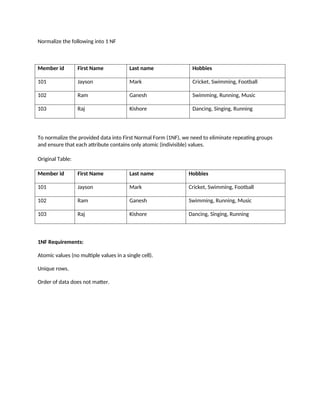
Normalize the followinginto 1 NF
Member id First Name Last name Hobbies
101 Jayson Mark Cricket, Swimming, Football
102 Ram Ganesh Swimming, Running, Music
103 Raj Kishore Dancing, Singing, Running
To normalize the provided data into First Normal Form (1NF), we need to eliminate repeating groups
and ensure that each attribute contains only atomic (indivisible) values.
Original Table:
Member id First Name Last name Hobbies
101 Jayson Mark Cricket, Swimming, Football
102 Ram Ganesh Swimming, Running, Music
103 Raj Kishore Dancing, Singing, Running
1NF Requirements:
Atomic values (no multiple values in a single cell).
Unique rows.
Order of data does not matter.
2.
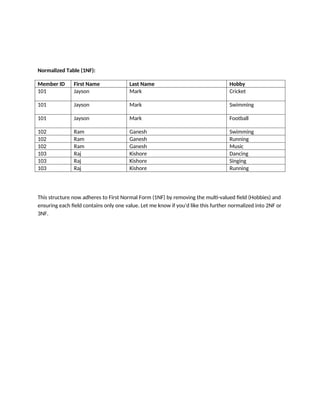
Normalized Table (1NF):
MemberID First Name Last Name Hobby
101 Jayson Mark Cricket
101 Jayson Mark Swimming
101 Jayson Mark Football
102 Ram Ganesh Swimming
102 Ram Ganesh Running
102 Ram Ganesh Music
103 Raj Kishore Dancing
103 Raj Kishore Singing
103 Raj Kishore Running
This structure now adheres to First Normal Form (1NF) by removing the multi-valued field (Hobbies) and
ensuring each field contains only one value. Let me know if you'd like this further normalized into 2NF or
3NF.
3.
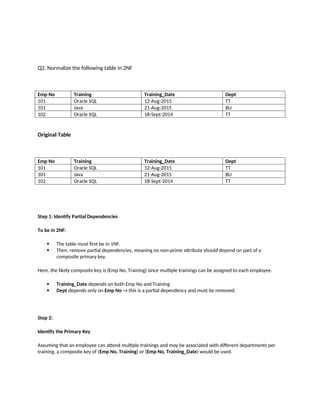
Q2. Normalize thefollowing table in 2NF
Emp No Training Training_Date Dept
101 Oracle SQL 12-Aug-2015 TT
101 Java 21-Aug-2015 BU
102 Oracle SQL 18-Sept-2014 TT
Original Table
Emp No Training Training_Date Dept
101 Oracle SQL 12-Aug-2015 TT
101 Java 21-Aug-2015 BU
102 Oracle SQL 18-Sept-2014 TT
Step 1: Identify Partial Dependencies
To be in 2NF:
The table must first be in 1NF.
Then, remove partial dependencies, meaning no non-prime attribute should depend on part of a
composite primary key.
Here, the likely composite key is (Emp No, Training) since multiple trainings can be assigned to each employee.
Training_Date depends on both Emp No and Training
Dept depends only on Emp No → this is a partial dependency and must be removed.
Step 2:
Identify the Primary Key
Assuming that an employee can attend multiple trainings and may be associated with different departments per
training, a composite key of (Emp No, Training) or (Emp No, Training_Date) would be used.
4.
Decompose into 2NF
Table1: Employee
Emp No Dept
101 TT
102 BU
102 TT
Table 2: Training_Assignments
Emp No. Training Training_Date
101 Oracle SQL 2024-08-12
101 Java 2024-08-21
102 Oracle SQL 2024-09-18
This decomposition removes the partial dependency of Dept on Emp No, achieving Second Normal Form (2NF).
5.
Q3. Normalize thegiven table into Third Normal Form (3NF),
Member id First Name Last name Sports Fees
101 Rajesh Chand Cricket 100
102 Jayesh Raj Hockey 80
103 Marks Dorson Football 90
To normalize the given table into Third Normal Form (3NF), we must go through each normalization
stage step by step.
Original Table:
Member id First Name Last name Sports Fees
101 Rajesh Chand Cricket 100
102 Jayesh Raj Hockey 80
103 Marks Dorson Football 90
1NF (First Normal Form):
Already satisfied — all values are atomic and no repeating groups.
2NF (Second Normal Form):
The primary key is likely Member ID (it's unique). All other attributes are fully dependent on it. So the
table already satisfies 2NF.
3NF (Third Normal Form):
We now remove transitive dependencies (where a non-key attribute depends on another non-key
attribute).
In this table:
Sports → Fees is a transitive dependency.
6.
Fees dependson the Sport, not directly on Member ID.
Decomposition into 3NF:
Table 1: Member
Member_id First_Name Last_name Sport
101 Rajesh Chand Cricket
102 Jayesh Raj Hockey
103 Marks Dorson Football
Table 2: Sport_Fees
Sport Fees
Cricket 100
Hockey 80
Football 90
Now:
All non-key attributes in each table depend only on the primary key.
No transitive dependencies exist.
This satisfies Third Normal Form (3NF).