Students as Scholars
Participation in open research and publishing practices:
the case of the Communications Undergraduate Journal
at Dublin City University
Alexander Kouker | Ronan Cox | Jim Rogers
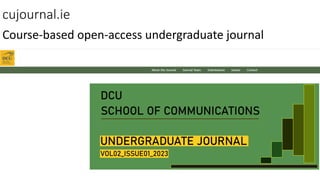
cujournal.ie
Course-based open-access undergraduate journal
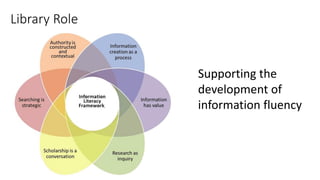
Library Role
Supporting the
development of
information fluency
• Reconceptualising the role of the student
• Developing students as ‘authors’
• Reconceptualising the role of the student/faculty relationship
• Collaborative learning and pedagogical facilitation
• Positioning students as scholars, and decentring Faculty as
information experts into a facilitation role
• So, as such, reimagining academic (social) organisation at the
undergraduate level
Faculty Role
• Expand remit of journal (content and format)
• Multimedia submissions
• Collaborate with other institutions
• Seek submissions from other third level institutions,
e.g., UK-based Comms school
What Next
alexander.kouker@dcu.ie
ronan.cox@dcu.ie
jim.rogers@dcu.ie
Sources:
• Montgomery, L. and Neylon, C. (2019) ‘The value of a journal is the community it creates, not the papers it
publishes’, Impact of Social Sciences, 29 March. Available at:
https://blogs.lse.ac.uk/impactofsocialsciences/2019/03/29/the-value-of-a-journal-is-the-community-it-creates-
not-the-papers-it-publishes/ (Accessed: 4 September 2023).
• Thorup, S. (no date) OLD -- Information Literacy Guide for Faculty: Framework for Information Literacy for Higher
Education, Northwest Arkansas Community College. Available at:
https://library.nwacc.edu/infolitforfaculty/framework (Accessed: 4 September 2023).
• Lombard, E. (2016) ‘Information Fluency: Not Information Literacy 2.0’, The Journal of Academic Librarianship,
42(3), pp. 281–283. Available at: https://doi.org/10.1016/j.acalib.2016.04.006.
Questions
5 years of HRB Open Research in 5 minutes
Hannah Wilson, Publisher, F1000
hannah.wilson@f1000.com
@HannahLuWilson
What is HRB Open Research?
• Publishing platform (journal) launched in Feb 2018 for HRB grantholders
• Run by F1000 as service provider using open publishing model:
▪ Open access, CC-BY
▪ Open data
▪ Open, post-publication, peer review
• Focus on publishing all sound science and offering a variety of article types
• Diamond model - service costs and APCs paid centrally by the HRB, zero cost to authors for publication
• 430 publications to-date
• Next few slides will look at publishing trends and common questions over the last 5 years of the platform
www.hrbopenresearch.org
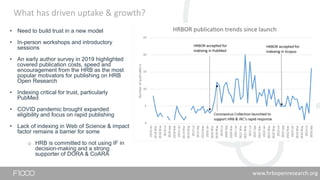
What has driven uptake & growth?
• Need to build trust in a new model
• In-person workshops and introductory
sessions
• An early author survey in 2019 highlighted
covered publication costs, speed and
encouragement from the HRB as the most
popular motivators for publishing on HRB
Open Research
• Indexing critical for trust, particularly
PubMed
• COVID pandemic brought expanded
eligibility and focus on rapid publishing
• Lack of indexing in Web of Science & impact
factor remains a barrier for some
o HRB is committed to not using IF in
decision-making and a strong
supporter of DORA & CoARA
www.hrbopenresearch.org
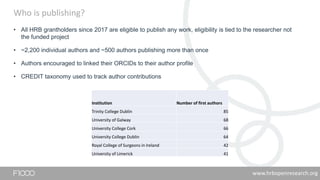
Who is publishing?
• All HRB grantholders since 2017 are eligible to publish any work, eligibility is tied to the researcher not
the funded project
• ~2,200 individual authors and ~500 authors publishing more than once
• Authors encouraged to linked their ORCIDs to their author profile
• CREDIT taxonomy used to track author contributions
Institution Number of first authors
Trinity College Dublin 85
University of Galway 68
University College Cork 66
University College Dublin 64
Royal College of Surgeons in Ireland 42
University of Limerick 41
www.hrbopenresearch.org
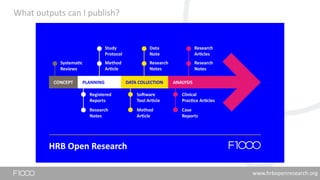
What outputs can I publish?
www.hrbopenresearch.org
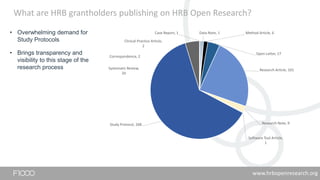
What are HRB grantholders publishing on HRB Open Research?
• Overwhelming demand for
Study Protocols
• Brings transparency and
visibility to this stage of the
research process
Case Report, 1
Clinical Practice Article,
2
Correspondence, 2
Data Note, 1 Method Article, 6
Open Letter, 17
Research Article, 101
Research Note, 9
Software Tool Article,
1
Study Protocol, 268
Systematic Review,
20
www.hrbopenresearch.org
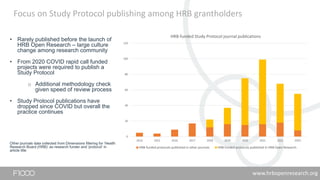
Focus on Study Protocol publishing among HRB grantholders
• Rarely published before the launch of
HRB Open Research – large culture
change among research community
• From 2020 COVID rapid call funded
projects were required to publish a
Study Protocol
o Additional methodology check
given speed of review process
• Study Protocol publications have
dropped since COVID but overall the
practice continues
Other journals data collected from Dimensions filtering for ‘Health
Research Board (HRB)’ as research funder and ‘protocol’ in
article title
0
20
40
60
80
100
120
2014 2015 2016 2017 2018 2019 2020 2021 2022 2023
HRB-funded Study Protocol journal publications
HRB-funded protocols published in other journals HRB-funded protocols published in HRB Open Research
www.hrbopenresearch.org
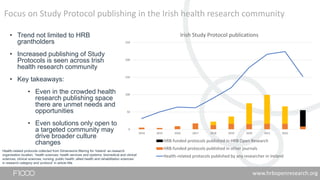
Focus on Study Protocol publishing in the Irish health research community
• Trend not limited to HRB
grantholders
• Increased publishing of Study
Protocols is seen across Irish
health research community
• Key takeaways:
• Even in the crowded health
research publishing space
there are unmet needs and
opportunities
• Even solutions only open to
a targeted community may
drive broader culture
changes
0
50
100
150
200
250
2014 2015 2016 2017 2018 2019 2020 2021 2022
Irish Study Protocol publications
HRB-funded protocols published in HRB Open Research
HRB-funded protocols published in other journals
Health-related protocols published by any researcher in Ireland
Health-related protocols collected from Dimensions filtering for ‘Ireland’ as research
organisation location, ‘health sciences; health services and systems; biomedical and clinical
sciences; clinical sciences; nursing; public health; allied health and rehabilitation sciences’
in research category and ‘protocol’ in article title
www.hrbopenresearch.org
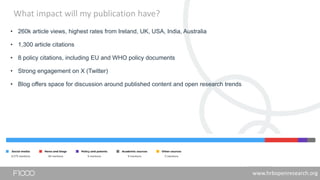
What impact will my publication have?
• 260k article views, highest rates from Ireland, UK, USA, India, Australia
• 1,300 article citations
• 8 policy citations, including EU and WHO policy documents
• Strong engagement on X (Twitter)
• Blog offers space for discussion around published content and open research trends
www.hrbopenresearch.org
In summary
• New models require time and building of trust to embed
• Indexing and proven impact are critical – new models need clear plans to gain these rapidly
• There are unmet publishing needs among Irish health researchers
• Targeted solutions can help drive broader culture changes in the research community
If anyone wants to chat about embedding a new publishing model in the research community, working
in a funder-publisher partnership, mandating open data sharing, open peer review models or anything
not covered here please reach out!
hannah.wilson@f1000.com
@HannahLuWilson
www.hrbopenresearch.org
National Open
Access Repositories
Strengthen and align
Ireland’s network of open
access repositories.
Dr Christopher Loughnane
The Project
• Dr Cillian Joy at the University of Galway
leading a two-year NORF-funded project
to align and strengthen Ireland’s network
of open access repositories metadata
standards with international best practices.
• Project team is a consortium of fourteen
institutional and organisational partners.
• https://www.universityofgalway.ie/openrepositories/
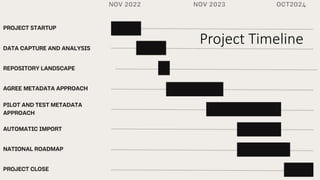
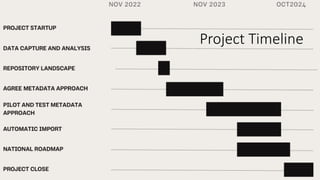
Project Timeline
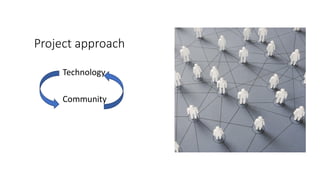
Project approach
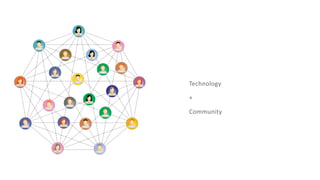
Technology
Community
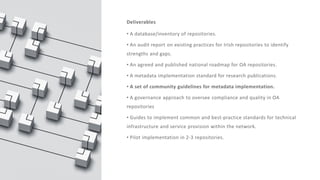
Deliverables for this phase
https://www.universityofgalway.ie/openrepositories/inventory
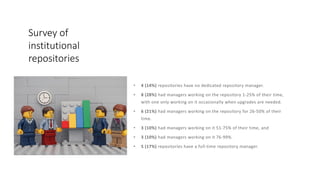
Survey of
institutional
repositories
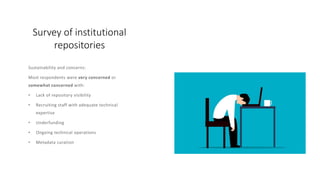
Survey of institutional repositories
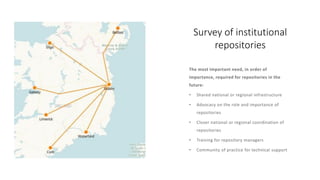
Survey of institutional
repositories
Survey of
institutional
repositories
Survey of institutional
repositories
Survey of institutional
repositories
Qualitative
Semi-structured
Interviews
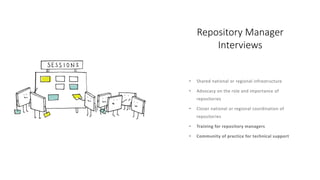
Repository Manager
Interviews
“Maybe even just an online course that could actually say, well,
there's these aspects that you need to know about. These are
the main aspects, and then there's these aspects that branch
out from that, because inevitably it's like a tree. You know,
you get to the trunk and you think that's the tree, but then
there's so many branches off it that you don't realize it
underpins everything else that you need to know about. And
you're maybe starting off at the leaf and not realizing you
have to kind of work your way back, so that for me is the issue
and obviously being quite new to the job as well in terms of
managing the repository, I find that difficult. And then also
asking questions and maybe people not knowing the answer
and people being afraid to say ‘I don't know,’ which I find is a
massive thing.”
Project Timeline
cloughnane@universityofgalway.ie
https://www.universityofgalway.ie/openrepositories/
NATIONAL OPEN
ACCESS MONITOR
PROJECT
DR CATHERINE FERRIS, NATIONAL
OPEN ACCESS MONITOR PROJECT
MANAGER
https://irel.ie/oamonitor/
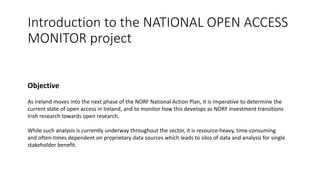
Introduction to the NATIONAL OPEN ACCESS
MONITOR project
Objective
As Ireland moves into the next phase of the NORF National Action Plan, it is imperative to determine the
current state of open access in Ireland, and to monitor how this develops as NORF investment transitions
Irish research towards open research.
Introduction to the NATIONAL OPEN ACCESS
MONITOR project
Objective
As Ireland moves into the next phase of the NORF National Action Plan, it is imperative to determine the
current state of open access in Ireland, and to monitor how this develops as NORF investment transitions
Irish research towards open research.
While such analysis is currently underway throughout the sector, it is resource-heavy, time-consuming
and often-times dependent on proprietary data sources which leads to silos of data and analysis for single
stakeholder benefit.
Introduction to the project
• Work to arrive at a community-agreed definition for open access, in this context, at the national level
• Build on previous NORF work, engaging with national stakeholders to gather and validate user requirements for open access
monitoring
• Based on those requirements, administrate the procurement, tendering and contract process
• Work with an external vendor to deliver a report and a national dashboard to help Ireland analyse and track progress towards
100% open access
• Document challenges that should be addressed in long-term monitoring solutions and recommend steps to be taken, including
workflows for data validation and enrichment
• Work to improve the quality and depth of data used for the national dashboard in line with international best practice through
stakeholder collaboration and direct input or validation
• Following NORF and Science Europe recommendations, ensure that the monitor uses data and bibliographic databases that are
openly accessible, is built using open infrastructure, and is publicly accessible to view and analyse
Introduction to the project
impact
To enable both point-in-time and longitudinal monitoring of the open access status of Irish publications
as part of the national implementation of open research practices.
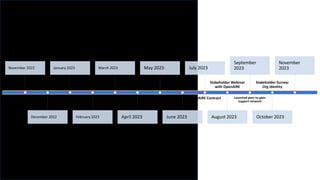
Project Launch
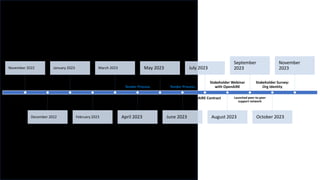
November 2022
MU Research Ethics
Process Completed
December 2022
Open Invite: Stakeholders
January 2023
Stakeholder Survey:
Tender Requirements
February 2023
Survey Analysis
March 2023
Tender Process
April 2023
Survey Results Webinar
May 2023
Tender Process
June 2023
OpenAIRE Contract
July 2023
Stakeholder Webinar
with OpenAIRE
August 2023
Launched peer-to-peer
support network
September
2023
Stakeholder Survey:
Org Identity
October 2023
November
2023
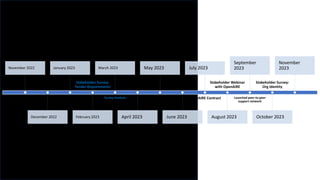
Project Launch
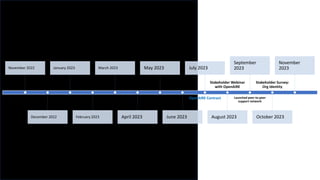
November 2022
MU Research Ethics
Process Completed
December 2022
Open Invite: Stakeholders
January 2023
Stakeholder Survey:
Tender Requirements
February 2023
Survey Analysis
March 2023
Tender Process
April 2023
Survey Results Webinar
May 2023
Tender Process
June 2023
OpenAIRE Contract
July 2023
Stakeholder Webinar
with OpenAIRE
August 2023
Launched peer-to-peer
support network
September
2023
Stakeholder Survey:
Org Identity
October 2023
November
2023
Project Launch
November 2022
MU Research Ethics
Process Completed
December 2022
Open Invite: Stakeholders
January 2023
Stakeholder Survey:
Tender Requirements
February 2023
Survey Analysis
March 2023
Tender Process
April 2023
Survey Results Webinar
May 2023
Tender Process
June 2023
OpenAIRE Contract
July 2023
Stakeholder Webinar
with OpenAIRE
August 2023
Launched peer-to-peer
support network
September
2023
Stakeholder Survey:
Org Identity
October 2023
November
2023
Project Launch
November 2022
MU Research Ethics
Process Completed
December 2022
Open Invite: Stakeholders
January 2023
Stakeholder Survey:
Tender Requirements
February 2023
Survey Analysis
March 2023
Tender Process
April 2023
Survey Results Webinar
May 2023
Tender Process
June 2023
OpenAIRE Contract
July 2023
Stakeholder Webinar
with OpenAIRE
August 2023
Launched peer-to-peer
support network
September
2023
Stakeholder Survey:
Org Identity
October 2023
November
2023
COLLABORATIVE,
STAKEHOLDER-CENTRED
National Open Access Monitor
Advisory Group
• provides expert guidance for IReL and Project
Manager
• compliments the governance role of Maynooth
University and the obligations set out by NORF
Members:
• Fran Callaghan, Maynooth University
• Edie Davis, Science Foundation Ireland
• Caleb Derven, University of Limerick
• Eoin Kenny, HEAnet
• Kevin Kiely, Trinity College Dublin
• Andrew Simpson, Royal College of Surgeons in Ireland
https://zenodo.org/doi/10.5281/zenodo.7685490;https://zenodo.org/doi/10.5281/zenodo.7685468
Stakeholders:
• anyone with a role in currently (or
potentially) monitoring open access to
research publications in Ireland, or
• who will enable monitoring of open
access in Ireland, or
• who will use the resulting open access
Monitor.
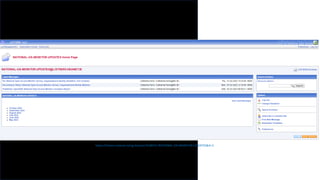
https://listserv.heanet.ie/cgi-bin/wa?SUBED1=NATIONAL-OA-MONITOR-UPDATES&A=1
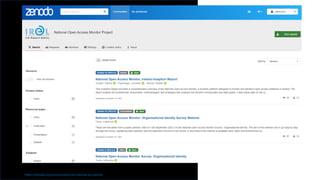
https://zenodo.org/communities/irel-national-oa-monitor
• compile a complete list of Irish RPOs and RFOs to be represented by
the Monitor
• ensure each organisation/entity is categorised correctly as RPO or
RFO (or both), as applicable
• identify if an organisation is publicly-funded
• identify formally affiliated organisations
• capture the persistent identifiers for RPOs, RFOs and Publishers, to
enable OpenAIRE to query their corpus of open data using those PIDs
and identify relevant research outputs for the Monitor.
DEADLINE EXTENDED:
COB TUESDAY 7TH
NOVEMBER
IN THE COMING WEEKS
OPENAIRE TRAINING FOR RPOS & RFOS
16TH & 23RD NOVEMBER
HTTPS://IREL.IE/NATIONAL-OA-MONITOR-OPENAIRE-
TRAINING-RPOS-RFOS/
IN THE COMING WEEKS
DRAFT OPENAIRE REPORT WITH AN
INITIAL, BASELINE ANALYSIS OF THE
STATE OF OPEN ACCESS IN IRELAND

NORFest 2023 Lightning Talks Session Two

  • 1.
    Students as Scholars Participationin open research and publishing practices: the case of the Communications Undergraduate Journal at Dublin City University Alexander Kouker | Ronan Cox | Jim Rogers
  • 2.
  • 3.
  • 4.
    • Reconceptualising therole of the student • Developing students as ‘authors’ • Reconceptualising the role of the student/faculty relationship • Collaborative learning and pedagogical facilitation • Positioning students as scholars, and decentring Faculty as information experts into a facilitation role • So, as such, reimagining academic (social) organisation at the undergraduate level Faculty Role
  • 5.
    • Expand remitof journal (content and format) • Multimedia submissions • Collaborate with other institutions • Seek submissions from other third level institutions, e.g., UK-based Comms school What Next
  • 6.
    alexander.kouker@dcu.ie ronan.cox@dcu.ie jim.rogers@dcu.ie Sources: • Montgomery, L.and Neylon, C. (2019) ‘The value of a journal is the community it creates, not the papers it publishes’, Impact of Social Sciences, 29 March. Available at: https://blogs.lse.ac.uk/impactofsocialsciences/2019/03/29/the-value-of-a-journal-is-the-community-it-creates- not-the-papers-it-publishes/ (Accessed: 4 September 2023). • Thorup, S. (no date) OLD -- Information Literacy Guide for Faculty: Framework for Information Literacy for Higher Education, Northwest Arkansas Community College. Available at: https://library.nwacc.edu/infolitforfaculty/framework (Accessed: 4 September 2023). • Lombard, E. (2016) ‘Information Fluency: Not Information Literacy 2.0’, The Journal of Academic Librarianship, 42(3), pp. 281–283. Available at: https://doi.org/10.1016/j.acalib.2016.04.006. Questions
  • 7.
    5 years ofHRB Open Research in 5 minutes Hannah Wilson, Publisher, F1000 hannah.wilson@f1000.com @HannahLuWilson
  • 8.
    What is HRBOpen Research? • Publishing platform (journal) launched in Feb 2018 for HRB grantholders • Run by F1000 as service provider using open publishing model: ▪ Open access, CC-BY ▪ Open data ▪ Open, post-publication, peer review • Focus on publishing all sound science and offering a variety of article types • Diamond model - service costs and APCs paid centrally by the HRB, zero cost to authors for publication • 430 publications to-date • Next few slides will look at publishing trends and common questions over the last 5 years of the platform www.hrbopenresearch.org
  • 9.
    What has drivenuptake & growth? • Need to build trust in a new model • In-person workshops and introductory sessions • An early author survey in 2019 highlighted covered publication costs, speed and encouragement from the HRB as the most popular motivators for publishing on HRB Open Research • Indexing critical for trust, particularly PubMed • COVID pandemic brought expanded eligibility and focus on rapid publishing • Lack of indexing in Web of Science & impact factor remains a barrier for some o HRB is committed to not using IF in decision-making and a strong supporter of DORA & CoARA www.hrbopenresearch.org
  • 10.
    Who is publishing? •All HRB grantholders since 2017 are eligible to publish any work, eligibility is tied to the researcher not the funded project • ~2,200 individual authors and ~500 authors publishing more than once • Authors encouraged to linked their ORCIDs to their author profile • CREDIT taxonomy used to track author contributions Institution Number of first authors Trinity College Dublin 85 University of Galway 68 University College Cork 66 University College Dublin 64 Royal College of Surgeons in Ireland 42 University of Limerick 41 www.hrbopenresearch.org
  • 11.
    What outputs canI publish? www.hrbopenresearch.org
  • 12.
    What are HRBgrantholders publishing on HRB Open Research? • Overwhelming demand for Study Protocols • Brings transparency and visibility to this stage of the research process Case Report, 1 Clinical Practice Article, 2 Correspondence, 2 Data Note, 1 Method Article, 6 Open Letter, 17 Research Article, 101 Research Note, 9 Software Tool Article, 1 Study Protocol, 268 Systematic Review, 20 www.hrbopenresearch.org
  • 13.
    Focus on StudyProtocol publishing among HRB grantholders • Rarely published before the launch of HRB Open Research – large culture change among research community • From 2020 COVID rapid call funded projects were required to publish a Study Protocol o Additional methodology check given speed of review process • Study Protocol publications have dropped since COVID but overall the practice continues Other journals data collected from Dimensions filtering for ‘Health Research Board (HRB)’ as research funder and ‘protocol’ in article title 0 20 40 60 80 100 120 2014 2015 2016 2017 2018 2019 2020 2021 2022 2023 HRB-funded Study Protocol journal publications HRB-funded protocols published in other journals HRB-funded protocols published in HRB Open Research www.hrbopenresearch.org
  • 14.
    Focus on StudyProtocol publishing in the Irish health research community • Trend not limited to HRB grantholders • Increased publishing of Study Protocols is seen across Irish health research community • Key takeaways: • Even in the crowded health research publishing space there are unmet needs and opportunities • Even solutions only open to a targeted community may drive broader culture changes 0 50 100 150 200 250 2014 2015 2016 2017 2018 2019 2020 2021 2022 Irish Study Protocol publications HRB-funded protocols published in HRB Open Research HRB-funded protocols published in other journals Health-related protocols published by any researcher in Ireland Health-related protocols collected from Dimensions filtering for ‘Ireland’ as research organisation location, ‘health sciences; health services and systems; biomedical and clinical sciences; clinical sciences; nursing; public health; allied health and rehabilitation sciences’ in research category and ‘protocol’ in article title www.hrbopenresearch.org
  • 15.
    What impact willmy publication have? • 260k article views, highest rates from Ireland, UK, USA, India, Australia • 1,300 article citations • 8 policy citations, including EU and WHO policy documents • Strong engagement on X (Twitter) • Blog offers space for discussion around published content and open research trends www.hrbopenresearch.org
  • 16.
    In summary • Newmodels require time and building of trust to embed • Indexing and proven impact are critical – new models need clear plans to gain these rapidly • There are unmet publishing needs among Irish health researchers • Targeted solutions can help drive broader culture changes in the research community If anyone wants to chat about embedding a new publishing model in the research community, working in a funder-publisher partnership, mandating open data sharing, open peer review models or anything not covered here please reach out! hannah.wilson@f1000.com @HannahLuWilson www.hrbopenresearch.org
  • 17.
    National Open Access Repositories Strengthenand align Ireland’s network of open access repositories. Dr Christopher Loughnane
  • 18.
    The Project • DrCillian Joy at the University of Galway leading a two-year NORF-funded project to align and strengthen Ireland’s network of open access repositories metadata standards with international best practices. • Project team is a consortium of fourteen institutional and organisational partners. • https://www.universityofgalway.ie/openrepositories/
  • 19.
  • 21.
  • 23.
    Deliverables for thisphase https://www.universityofgalway.ie/openrepositories/inventory
  • 24.
  • 25.
  • 26.
  • 27.
  • 28.
  • 29.
  • 30.
  • 31.
  • 32.
    “Maybe even justan online course that could actually say, well, there's these aspects that you need to know about. These are the main aspects, and then there's these aspects that branch out from that, because inevitably it's like a tree. You know, you get to the trunk and you think that's the tree, but then there's so many branches off it that you don't realize it underpins everything else that you need to know about. And you're maybe starting off at the leaf and not realizing you have to kind of work your way back, so that for me is the issue and obviously being quite new to the job as well in terms of managing the repository, I find that difficult. And then also asking questions and maybe people not knowing the answer and people being afraid to say ‘I don't know,’ which I find is a massive thing.”
  • 34.
  • 35.
  • 36.
    NATIONAL OPEN ACCESS MONITOR PROJECT DRCATHERINE FERRIS, NATIONAL OPEN ACCESS MONITOR PROJECT MANAGER https://irel.ie/oamonitor/
  • 37.
    Introduction to theNATIONAL OPEN ACCESS MONITOR project Objective As Ireland moves into the next phase of the NORF National Action Plan, it is imperative to determine the current state of open access in Ireland, and to monitor how this develops as NORF investment transitions Irish research towards open research.
  • 38.
    Introduction to theNATIONAL OPEN ACCESS MONITOR project Objective As Ireland moves into the next phase of the NORF National Action Plan, it is imperative to determine the current state of open access in Ireland, and to monitor how this develops as NORF investment transitions Irish research towards open research. While such analysis is currently underway throughout the sector, it is resource-heavy, time-consuming and often-times dependent on proprietary data sources which leads to silos of data and analysis for single stakeholder benefit.
  • 39.
    Introduction to theproject • Work to arrive at a community-agreed definition for open access, in this context, at the national level • Build on previous NORF work, engaging with national stakeholders to gather and validate user requirements for open access monitoring • Based on those requirements, administrate the procurement, tendering and contract process • Work with an external vendor to deliver a report and a national dashboard to help Ireland analyse and track progress towards 100% open access • Document challenges that should be addressed in long-term monitoring solutions and recommend steps to be taken, including workflows for data validation and enrichment • Work to improve the quality and depth of data used for the national dashboard in line with international best practice through stakeholder collaboration and direct input or validation • Following NORF and Science Europe recommendations, ensure that the monitor uses data and bibliographic databases that are openly accessible, is built using open infrastructure, and is publicly accessible to view and analyse
  • 40.
    Introduction to theproject impact To enable both point-in-time and longitudinal monitoring of the open access status of Irish publications as part of the national implementation of open research practices.
  • 41.
    Project Launch November 2022 MUResearch Ethics Process Completed December 2022 Open Invite: Stakeholders January 2023 Stakeholder Survey: Tender Requirements February 2023 Survey Analysis March 2023 Tender Process April 2023 Survey Results Webinar May 2023 Tender Process June 2023 OpenAIRE Contract July 2023 Stakeholder Webinar with OpenAIRE August 2023 Launched peer-to-peer support network September 2023 Stakeholder Survey: Org Identity October 2023 November 2023
  • 42.
    Project Launch November 2022 MUResearch Ethics Process Completed December 2022 Open Invite: Stakeholders January 2023 Stakeholder Survey: Tender Requirements February 2023 Survey Analysis March 2023 Tender Process April 2023 Survey Results Webinar May 2023 Tender Process June 2023 OpenAIRE Contract July 2023 Stakeholder Webinar with OpenAIRE August 2023 Launched peer-to-peer support network September 2023 Stakeholder Survey: Org Identity October 2023 November 2023
  • 43.
    Project Launch November 2022 MUResearch Ethics Process Completed December 2022 Open Invite: Stakeholders January 2023 Stakeholder Survey: Tender Requirements February 2023 Survey Analysis March 2023 Tender Process April 2023 Survey Results Webinar May 2023 Tender Process June 2023 OpenAIRE Contract July 2023 Stakeholder Webinar with OpenAIRE August 2023 Launched peer-to-peer support network September 2023 Stakeholder Survey: Org Identity October 2023 November 2023
  • 44.
    Project Launch November 2022 MUResearch Ethics Process Completed December 2022 Open Invite: Stakeholders January 2023 Stakeholder Survey: Tender Requirements February 2023 Survey Analysis March 2023 Tender Process April 2023 Survey Results Webinar May 2023 Tender Process June 2023 OpenAIRE Contract July 2023 Stakeholder Webinar with OpenAIRE August 2023 Launched peer-to-peer support network September 2023 Stakeholder Survey: Org Identity October 2023 November 2023
  • 45.
  • 46.
    National Open AccessMonitor Advisory Group • provides expert guidance for IReL and Project Manager • compliments the governance role of Maynooth University and the obligations set out by NORF Members: • Fran Callaghan, Maynooth University • Edie Davis, Science Foundation Ireland • Caleb Derven, University of Limerick • Eoin Kenny, HEAnet • Kevin Kiely, Trinity College Dublin • Andrew Simpson, Royal College of Surgeons in Ireland
  • 47.
  • 48.
    Stakeholders: • anyone witha role in currently (or potentially) monitoring open access to research publications in Ireland, or • who will enable monitoring of open access in Ireland, or • who will use the resulting open access Monitor.
  • 49.
  • 50.
  • 53.
    • compile acomplete list of Irish RPOs and RFOs to be represented by the Monitor • ensure each organisation/entity is categorised correctly as RPO or RFO (or both), as applicable • identify if an organisation is publicly-funded • identify formally affiliated organisations • capture the persistent identifiers for RPOs, RFOs and Publishers, to enable OpenAIRE to query their corpus of open data using those PIDs and identify relevant research outputs for the Monitor.
  • 54.
  • 55.
    IN THE COMINGWEEKS OPENAIRE TRAINING FOR RPOS & RFOS 16TH & 23RD NOVEMBER HTTPS://IREL.IE/NATIONAL-OA-MONITOR-OPENAIRE- TRAINING-RPOS-RFOS/
  • 56.
    IN THE COMINGWEEKS DRAFT OPENAIRE REPORT WITH AN INITIAL, BASELINE ANALYSIS OF THE STATE OF OPEN ACCESS IN IRELAND