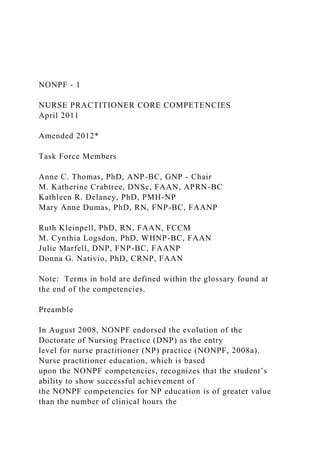
NONPF - 1
NURSE PRACTITIONER CORE COMPETENCIES
April 2011
Amended 2012*
Task Force Members
Anne C. Thomas, PhD, ANP-BC, GNP - Chair
M. Katherine Crabtree, DNSc, FAAN, APRN-BC
Kathleen R. Delaney, PhD, PMH-NP
Mary Anne Dumas, PhD, RN, FNP-BC, FAANP
Ruth Kleinpell, PhD, RN, FAAN, FCCM
M. Cynthia Logsdon, PhD, WHNP-BC, FAAN
Julie Marfell, DNP, FNP-BC, FAANP
Donna G. Nativio, PhD, CRNP, FAAN
Note: Terms in bold are defined within the glossary found at
the end of the competencies.
Preamble
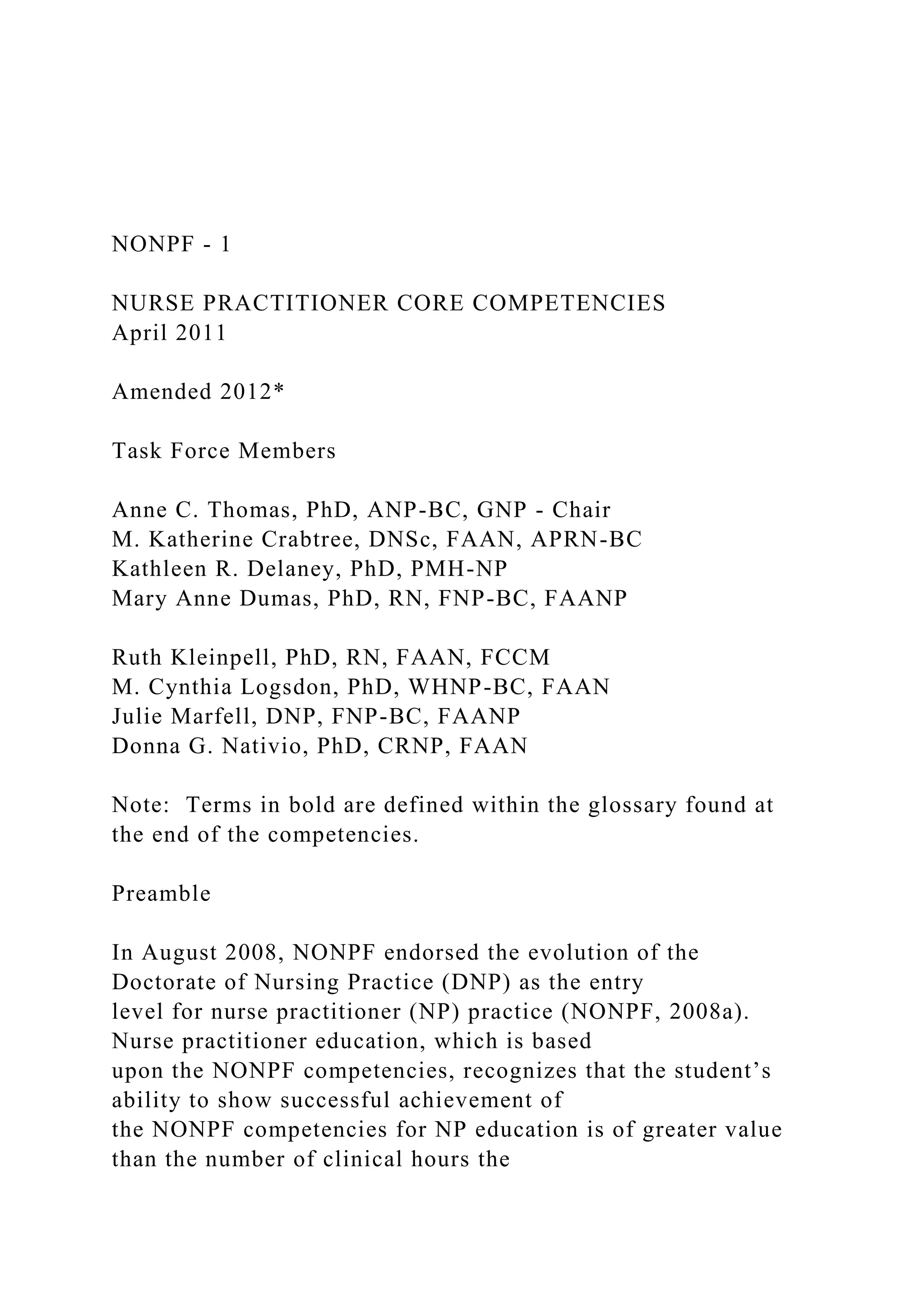
In August 2008, NONPF endorsed the evolution of the
Doctorate of Nursing Practice (DNP) as the entry
level for nurse practitioner (NP) practice (NONPF, 2008a).
Nurse practitioner education, which is based
upon the NONPF competencies, recognizes that the student’s
ability to show successful achievement of
the NONPF competencies for NP education is of greater value
than the number of clinical hours the
student has performed (NONPF, 2008b).
The Nurse Practitioner Core Competencies (NP Core
Competencies) integrate and build upon existing
Master’s and DNP core competencies and are guidelines for
educational programs preparing NPs to
implement the full scope of practice as a licensed independent
practitioner. The competencies are
essential behaviors of all NPs. These competencies are
demonstrated upon graduation regardless of the
population focus of the program and are necessary for NPs to
meet the complex challenges of translating
rapidly expanding knowledge into practice and function in a
changing health care environment.
Nurse Practitioner graduates have knowledge, skills, and
abilities that are essential to independent
clinical practice. The NP Core Competencies are acquired
through mentored patient care experiences
with emphasis on independent and interprofessional practice;
analytic skills for evaluating and
providing evidence-based, patient centered care across settings;
and advanced knowledge of the
health care delivery system. Doctorally-prepared NPs apply
knowledge of scientific foundations in
practice for quality care. They are able to apply skills in
technology and information literacy, and engage
in practice inquiry to improve health outcomes, policy, and
healthcare delivery. Areas of increased
knowledge, skills, and expertise include advanced
communication skills, collaboration, complex decision
making, leadership, and the business of health care. The
competencies elaborated here build upon
previous work that identified knowledge and skills essential to
DNP competencies (AACN 1996; AACN,
2006; NONPF & National Panel, 2006) and are consistent with
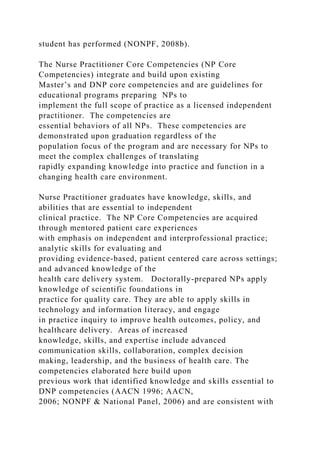
the recommendations of the Institute of
Medicine’s report, The Future of Nursing (IOM, 2011).
At completion of the NP program, the NP graduate possesses
the nine (9) core competencies regardless
of population focus.
* Amended as result of additional validation through the 2011-
2012 Population-Focused Competencies Task Force.
Competencies 7, 6, & 7 added to “Leadership,” “Practice
Inquiry,” “Health Care Delivery Systems” core, respectively,
to reflect that they cross all populations.
NONPF - 2
Nurse Practitioner Core Competencies
Scientific Foundation Competencies
1. Critically analyzes data and evidence for improving advanced
nursing practice.
2. Integrates knowledge from the humanities and sciences
within the context of nursing science.
3. Translates research and other forms of knowledge to improve
practice processes and outcomes.
4. Develops new practice approaches based on the integration of
research, theory, and practice
knowledge
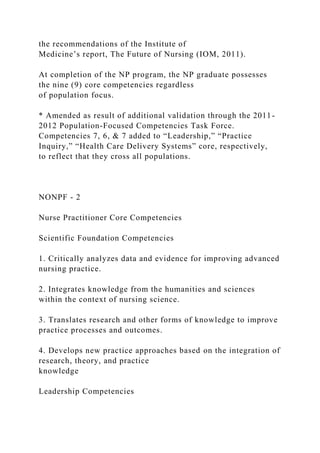
Leadership Competencies
1. Assumes complex and advanced leadership roles to initiate
and guide change.
2. Provides leadership to foster collaboration with multiple
stakeholders (e.g. patients, community,
integrated health care teams, and policy makers) to improve
health care..
3. Demonstrates leadership that uses critical and reflective
thinking.
4. Advocates for improved access, quality and cost effective
health care.
5. Advances practice through the development and
implementation of innovations incorporating principles
of change.
6. Communicates practice knowledge effectively both orally
and in writing.
7. Participates in professional organizations and activities that
influence advanced practice nursing
and/or health outcomes of a population focus.
Quality Competencies
1. Uses best available evidence to continuously improve quality
of clinical practice.
2. Evaluates the relationships among access, cost, quality, and
safety and their influence on health care.
3. Evaluates how organizational structure, care processes,
financing, marketing and policy decisions
impact the quality of health care.
4. Applies skills in peer review to promote a culture of
excellence.
5. Anticipates variations in practice and is proactive in
implementing interventions to ensure quality.
NONPF - 3
Practice Inquiry Competencies
1. Provides leadership in the translation of new knowledge into
practice.
2. Generates knowledge from clinical practice to improve
practice and patient outcomes.
3. Applies clinical investigative skills to improve health
outcomes.
4. Leads practice inquiry, individually or in partnership with
others.
5. Disseminates evidence from inquiry to diverse audiences
using multiple modalities.
6. Analyzes clinical guidelines for individualized application
into practice
Technology and Information Literacy Competencies
1. Integrates appropriate technologies for knowledge
management to improve health care.
2. Translates technical and scientific health information
appropriate for various users’ needs.
2a). Assesses the patient’s and caregiver’s educational needs to
provide effective, personalized
health care.
2b). Coaches the patient and caregiver for positive behavioral
change.
3. Demonstrates information literacy skills in complex decision
making.
4. Contributes to the design of clinical information systems that
promote safe, quality and cost effective
care.
5. Uses technology systems that capture data on variables for
the evaluation of nursing care.
Policy Competencies
1. Demonstrates an understanding of the interdependence of
policy and practice.
2. Advocates for ethical policies that promote access, equity,
quality, and cost.
3. Analyzes ethical, legal, and social factors influencing policy
development.
4. Contributes in the development of health policy.
5. Analyzes the implications of health policy across disciplines.
6. Evaluates the impact of globalization on health care policy
development.
NONPF - 4
Health Delivery System Competencies
1. Applies knowledge of organizational practices and complex
systems to improve health care delivery.
2. Effects health care change using broad based skills including
negotiating, consensus-building, and
partnering.
3. Minimizes risk to patients and providers at the individual and
systems level.
4. Facilitates the development of health care systems that
address the needs of culturally diverse
populations, providers, and other stakeholders.
5. Evaluates the impact of health care delivery on patients,
providers, other stakeholders, and the
environment.
6. Analyzes organizational structure, functions and resources to
improve the delivery of care.
7. Collaborates in planning for transitions across the continuum
of care.
Ethics Competencies
1. Integrates ethical principles in decision making.
2. Evaluates the ethical consequences of decisions.
3. Applies ethically sound solutions to complex issues related to
individuals, populations and systems of
care.
Independent Practice Competencies
1. Functions as a licensed independent practitioner.
2. Demonstrates the highest level of accountability for
professional practice.
3. Practices independently managing previously diagnosed and
undiagnosed patients.
3a). Provides the full spectrum of health care services to
include health promotion, disease
prevention, health protection, anticipatory guidance, counseling,
disease management, palliative,
and end of life care.
3b). Uses advanced health assessment skills to differentiate
between normal, variations of normal
and abnormal findings.
3c). Employs screening and diagnostic strategies in the
development of diagnoses.
3d). Prescribes medications within scope of practice.
3e). Manages the health/illness status of patients and families
over time.
NONPF - 5
4. Provides patient-centered care recognizing cultural diversity
and the patient or designee as a full
partner in decision-making.
4a). Works to establish a relationship with the patient
characterized by mutual respect, empathy, and
collaboration.
4b). Creates a climate of patient-centered care to include
confidentiality, privacy, comfort, emotional
support, mutual trust, and respect.
4c). Incorporates the patient’s cultural and spiritual
preferences, values, and beliefs into health care.
4d). Preserves the patient’s control over decision making by
negotiating a mutually acceptable plan
of care.
NONPF - 6
GLOSSARY OF TERMS
Care processes: Actions or changes that occur during the
delivery of health care.
Clinical investigative skills: Those skills needed to conduct
inquiry of practice questions/therapies,
evaluate discovered evidence, and then translate it into practice.
Cultural diversity: Common beliefs, values, practices and
behaviors shared by multiple subgroups or
individuals.
Culture of excellence: The environment developed through the
internalization of core values and a
shared commitment in which the highest standards of personal
integrity, professionalism, and clinical
expertise are upheld.
Evidence-based practice: The "conscientious, explicit and
judicious use of current best evidence in
making decisions about the care of individual patients.
Individual clinical expertise is integrated with the
best available external evidence from systematic research.”
(modified from Sackett, 1996).
Globalization: The interrelated influence of actions, resources,
cultures, and economies across nations.
Health policy: The set of decisions pertaining to health whether
made at local, state, national, and global
levels that influences health resource allocation.
Independent practice: Recognizes independent licensure of
nurse practitioners who provide
autonomous care and promote implementation of the full scope
of practice.
Independently: Having the educational preparation and
authority to make clinical decisions without the
need or requirement for supervision by others.
Information literacy: The use of digital technology,
communications tools, and/or networks to access,
manage, integrate, evaluate, create, and effectively
communicate information.
Interprofessional practice: Occurs when multiple health workers
from different professional
backgrounds work together with patients, families, and
communities to deliver the highest quality of care.
Interprofessional education: When two or more professions
learn about, from and with each other to
enable effective collaboration and improve health outcomes.
Knowledge management: Strategies that identify, create,
represent, distribute, and enable the efficient
use of all types of information.
Licensed independent practitioner: An individual with a
recognized scientific knowledge base that is
permitted by law to provide care and services without direction
or supervision.
Quality care: The degree to which health services to
individuals and populations increase the desired
health outcomes consistent with professional knowledge and
standards. Quality care also
means avoiding underuse, overuse, and misuse of health care
services.
Patient centered care: Care based on a partnership between the
patient and health care provider that is
focused on the patient’s values, preferences, and needs.
Peer review: Evaluation of the processes and/or outcomes of
care by professionals with similar
knowledge, skills and abilities.
NONPF - 7
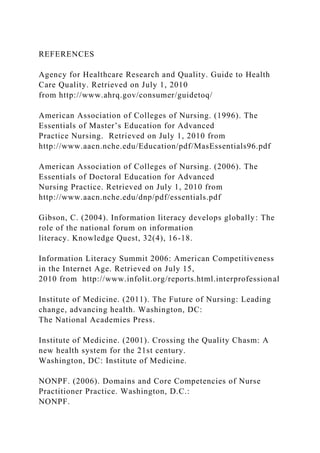
REFERENCES
Agency for Healthcare Research and Quality. Guide to Health
Care Quality. Retrieved on July 1, 2010
from http://www.ahrq.gov/consumer/guidetoq/
American Association of Colleges of Nursing. (1996). The
Essentials of Master’s Education for Advanced
Practice Nursing. Retrieved on July 1, 2010 from
http://www.aacn.nche.edu/Education/pdf/MasEssentials96.pdf
American Association of Colleges of Nursing. (2006). The
Essentials of Doctoral Education for Advanced
Nursing Practice. Retrieved on July 1, 2010 from
http://www.aacn.nche.edu/dnp/pdf/essentials.pdf
Gibson, C. (2004). Information literacy develops globally: The
role of the national forum on information
literacy. Knowledge Quest, 32(4), 16-18.
Information Literacy Summit 2006: American Competitiveness
in the Internet Age. Retrieved on July 15,
2010 from http://www.infolit.org/reports.html.interprofessional
Institute of Medicine. (2011). The Future of Nursing: Leading
change, advancing health. Washington, DC:
The National Academies Press.
Institute of Medicine. (2001). Crossing the Quality Chasm: A
new health system for the 21st century.
Washington, DC: Institute of Medicine.
NONPF. (2006). Domains and Core Competencies of Nurse
Practitioner Practice. Washington, D.C.:
NONPF.
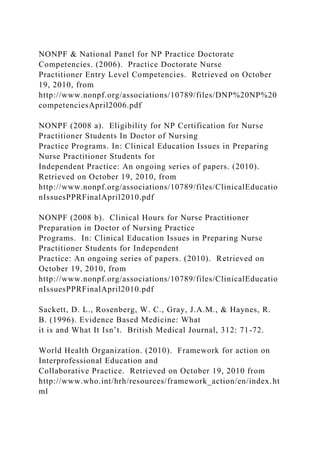
NONPF & National Panel for NP Practice Doctorate
Competencies. (2006). Practice Doctorate Nurse
Practitioner Entry Level Competencies. Retrieved on October
19, 2010, from
http://www.nonpf.org/associations/10789/files/DNP%20NP%20
competenciesApril2006.pdf
NONPF (2008 a). Eligibility for NP Certification for Nurse
Practitioner Students In Doctor of Nursing
Practice Programs. In: Clinical Education Issues in Preparing
Nurse Practitioner Students for
Independent Practice: An ongoing series of papers. (2010).
Retrieved on October 19, 2010, from
http://www.nonpf.org/associations/10789/files/ClinicalEducatio
nIssuesPPRFinalApril2010.pdf
NONPF (2008 b). Clinical Hours for Nurse Practitioner
Preparation in Doctor of Nursing Practice
Programs. In: Clinical Education Issues in Preparing Nurse
Practitioner Students for Independent
Practice: An ongoing series of papers. (2010). Retrieved on
October 19, 2010, from
http://www.nonpf.org/associations/10789/files/ClinicalEducatio
nIssuesPPRFinalApril2010.pdf
Sackett, D. L., Rosenberg, W. C., Gray, J.A.M., & Haynes, R.
B. (1996). Evidence Based Medicine: What
it is and What It Isn’t. British Medical Journal, 312: 71-72.
World Health Organization. (2010). Framework for action on
Interprofessional Education and
Collaborative Practice. Retrieved on October 19, 2010 from
http://www.who.int/hrh/resources/framework_action/en/index.ht
ml
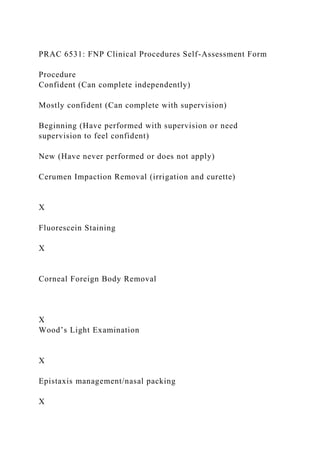
PRAC 6531: FNP Clinical Procedures Self-Assessment Form
Procedure
Confident (Can complete independently)
Mostly confident (Can complete with supervision)
Beginning (Have performed with supervision or need
supervision to feel confident)
New (Have never performed or does not apply)
Cerumen Impaction Removal (irrigation and curette)
X
Fluorescein Staining
X
Corneal Foreign Body Removal
X
Wood’s Light Examination
X
Epistaxis management/nasal packing
X
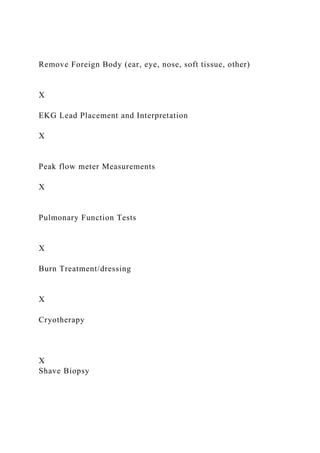
Remove Foreign Body (ear, eye, nose, soft tissue, other)
X
EKG Lead Placement and Interpretation
X
Peak flow meter Measurements
X
Pulmonary Function Tests
X
Burn Treatment/dressing
X
Cryotherapy
X
Shave Biopsy
X
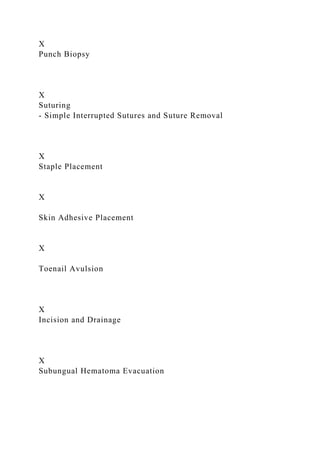
Punch Biopsy
X
Suturing
- Simple Interrupted Sutures and Suture Removal
X
Staple Placement
X
Skin Adhesive Placement
X
Toenail Avulsion
X
Incision and Drainage
X
Subungual Hematoma Evacuation
X
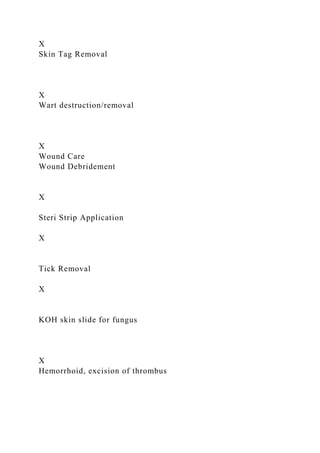
Skin Tag Removal
X
Wart destruction/removal
X
Wound Care
Wound Debridement
X
Steri Strip Application
X
Tick Removal
X
KOH skin slide for fungus
X
Hemorrhoid, excision of thrombus
X
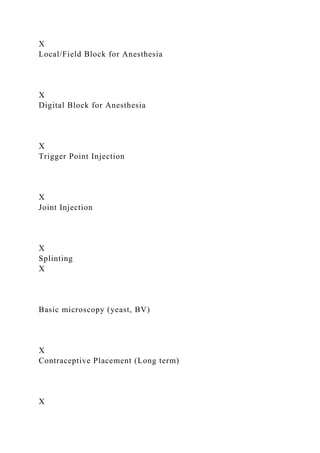
Local/Field Block for Anesthesia
X
Digital Block for Anesthesia
X
Trigger Point Injection
X
Joint Injection
X
Splinting
X
Basic microscopy (yeast, BV)
X
Contraceptive Placement (Long term)
X
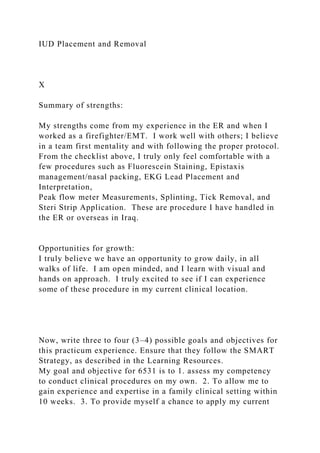
IUD Placement and Removal
X
Summary of strengths:
My strengths come from my experience in the ER and when I
worked as a firefighter/EMT. I work well with others; I believe
in a team first mentality and with following the proper protocol.
From the checklist above, I truly only feel comfortable with a
few procedures such as Fluorescein Staining, Epistaxis
management/nasal packing, EKG Lead Placement and
Interpretation,
Peak flow meter Measurements, Splinting, Tick Removal, and
Steri Strip Application. These are procedure I have handled in
the ER or overseas in Iraq.
Opportunities for growth:
I truly believe we have an opportunity to grow daily, in all
walks of life. I am open minded, and I learn with visual and
hands on approach. I truly excited to see if I can experience
some of these procedure in my current clinical location.
Now, write three to four (3–4) possible goals and objectives for
this practicum experience. Ensure that they follow the SMART
Strategy, as described in the Learning Resources.
My goal and objective for 6531 is to 1. assess my competency
to conduct clinical procedures on my own. 2. To allow me to
gain experience and expertise in a family clinical setting within
10 weeks. 3. To provide myself a chance to apply my current
level of experience with the gained knowledge from this course.
4. To learn from the professionals at my clinic as I will be
working with a very knowledgeable physician and his team.
© 2020 Walden University 1

NONPF - 1NURSE PRACTITIONER CORE COMPETENCIES April 201.docx

  • 1.
    NONPF - 1 NURSEPRACTITIONER CORE COMPETENCIES April 2011 Amended 2012* Task Force Members Anne C. Thomas, PhD, ANP-BC, GNP - Chair M. Katherine Crabtree, DNSc, FAAN, APRN-BC Kathleen R. Delaney, PhD, PMH-NP Mary Anne Dumas, PhD, RN, FNP-BC, FAANP Ruth Kleinpell, PhD, RN, FAAN, FCCM M. Cynthia Logsdon, PhD, WHNP-BC, FAAN Julie Marfell, DNP, FNP-BC, FAANP Donna G. Nativio, PhD, CRNP, FAAN Note: Terms in bold are defined within the glossary found at the end of the competencies. Preamble In August 2008, NONPF endorsed the evolution of the Doctorate of Nursing Practice (DNP) as the entry level for nurse practitioner (NP) practice (NONPF, 2008a). Nurse practitioner education, which is based upon the NONPF competencies, recognizes that the student’s ability to show successful achievement of the NONPF competencies for NP education is of greater value than the number of clinical hours the
  • 2.
    student has performed(NONPF, 2008b). The Nurse Practitioner Core Competencies (NP Core Competencies) integrate and build upon existing Master’s and DNP core competencies and are guidelines for educational programs preparing NPs to implement the full scope of practice as a licensed independent practitioner. The competencies are essential behaviors of all NPs. These competencies are demonstrated upon graduation regardless of the population focus of the program and are necessary for NPs to meet the complex challenges of translating rapidly expanding knowledge into practice and function in a changing health care environment. Nurse Practitioner graduates have knowledge, skills, and abilities that are essential to independent clinical practice. The NP Core Competencies are acquired through mentored patient care experiences with emphasis on independent and interprofessional practice; analytic skills for evaluating and providing evidence-based, patient centered care across settings; and advanced knowledge of the health care delivery system. Doctorally-prepared NPs apply knowledge of scientific foundations in practice for quality care. They are able to apply skills in technology and information literacy, and engage in practice inquiry to improve health outcomes, policy, and healthcare delivery. Areas of increased knowledge, skills, and expertise include advanced communication skills, collaboration, complex decision making, leadership, and the business of health care. The competencies elaborated here build upon previous work that identified knowledge and skills essential to DNP competencies (AACN 1996; AACN, 2006; NONPF & National Panel, 2006) and are consistent with
  • 3.
    the recommendations ofthe Institute of Medicine’s report, The Future of Nursing (IOM, 2011). At completion of the NP program, the NP graduate possesses the nine (9) core competencies regardless of population focus. * Amended as result of additional validation through the 2011- 2012 Population-Focused Competencies Task Force. Competencies 7, 6, & 7 added to “Leadership,” “Practice Inquiry,” “Health Care Delivery Systems” core, respectively, to reflect that they cross all populations. NONPF - 2 Nurse Practitioner Core Competencies Scientific Foundation Competencies 1. Critically analyzes data and evidence for improving advanced nursing practice. 2. Integrates knowledge from the humanities and sciences within the context of nursing science. 3. Translates research and other forms of knowledge to improve practice processes and outcomes. 4. Develops new practice approaches based on the integration of research, theory, and practice knowledge Leadership Competencies
  • 4.
    1. Assumes complexand advanced leadership roles to initiate and guide change. 2. Provides leadership to foster collaboration with multiple stakeholders (e.g. patients, community, integrated health care teams, and policy makers) to improve health care.. 3. Demonstrates leadership that uses critical and reflective thinking. 4. Advocates for improved access, quality and cost effective health care. 5. Advances practice through the development and implementation of innovations incorporating principles of change. 6. Communicates practice knowledge effectively both orally and in writing. 7. Participates in professional organizations and activities that influence advanced practice nursing and/or health outcomes of a population focus. Quality Competencies 1. Uses best available evidence to continuously improve quality of clinical practice. 2. Evaluates the relationships among access, cost, quality, and safety and their influence on health care. 3. Evaluates how organizational structure, care processes, financing, marketing and policy decisions impact the quality of health care.
  • 5.
    4. Applies skillsin peer review to promote a culture of excellence. 5. Anticipates variations in practice and is proactive in implementing interventions to ensure quality. NONPF - 3 Practice Inquiry Competencies 1. Provides leadership in the translation of new knowledge into practice. 2. Generates knowledge from clinical practice to improve practice and patient outcomes. 3. Applies clinical investigative skills to improve health outcomes. 4. Leads practice inquiry, individually or in partnership with others. 5. Disseminates evidence from inquiry to diverse audiences using multiple modalities. 6. Analyzes clinical guidelines for individualized application into practice Technology and Information Literacy Competencies 1. Integrates appropriate technologies for knowledge management to improve health care.
  • 6.
    2. Translates technicaland scientific health information appropriate for various users’ needs. 2a). Assesses the patient’s and caregiver’s educational needs to provide effective, personalized health care. 2b). Coaches the patient and caregiver for positive behavioral change. 3. Demonstrates information literacy skills in complex decision making. 4. Contributes to the design of clinical information systems that promote safe, quality and cost effective care. 5. Uses technology systems that capture data on variables for the evaluation of nursing care. Policy Competencies 1. Demonstrates an understanding of the interdependence of policy and practice. 2. Advocates for ethical policies that promote access, equity, quality, and cost. 3. Analyzes ethical, legal, and social factors influencing policy development. 4. Contributes in the development of health policy. 5. Analyzes the implications of health policy across disciplines. 6. Evaluates the impact of globalization on health care policy
  • 7.
    development. NONPF - 4 HealthDelivery System Competencies 1. Applies knowledge of organizational practices and complex systems to improve health care delivery. 2. Effects health care change using broad based skills including negotiating, consensus-building, and partnering. 3. Minimizes risk to patients and providers at the individual and systems level. 4. Facilitates the development of health care systems that address the needs of culturally diverse populations, providers, and other stakeholders. 5. Evaluates the impact of health care delivery on patients, providers, other stakeholders, and the environment. 6. Analyzes organizational structure, functions and resources to improve the delivery of care. 7. Collaborates in planning for transitions across the continuum of care. Ethics Competencies 1. Integrates ethical principles in decision making.
  • 8.
    2. Evaluates theethical consequences of decisions. 3. Applies ethically sound solutions to complex issues related to individuals, populations and systems of care. Independent Practice Competencies 1. Functions as a licensed independent practitioner. 2. Demonstrates the highest level of accountability for professional practice. 3. Practices independently managing previously diagnosed and undiagnosed patients. 3a). Provides the full spectrum of health care services to include health promotion, disease prevention, health protection, anticipatory guidance, counseling, disease management, palliative, and end of life care. 3b). Uses advanced health assessment skills to differentiate between normal, variations of normal and abnormal findings. 3c). Employs screening and diagnostic strategies in the development of diagnoses. 3d). Prescribes medications within scope of practice. 3e). Manages the health/illness status of patients and families over time.
  • 9.
    NONPF - 5 4.Provides patient-centered care recognizing cultural diversity and the patient or designee as a full partner in decision-making. 4a). Works to establish a relationship with the patient characterized by mutual respect, empathy, and collaboration. 4b). Creates a climate of patient-centered care to include confidentiality, privacy, comfort, emotional support, mutual trust, and respect. 4c). Incorporates the patient’s cultural and spiritual preferences, values, and beliefs into health care. 4d). Preserves the patient’s control over decision making by negotiating a mutually acceptable plan of care. NONPF - 6 GLOSSARY OF TERMS Care processes: Actions or changes that occur during the delivery of health care. Clinical investigative skills: Those skills needed to conduct inquiry of practice questions/therapies, evaluate discovered evidence, and then translate it into practice. Cultural diversity: Common beliefs, values, practices and behaviors shared by multiple subgroups or
  • 10.
    individuals. Culture of excellence:The environment developed through the internalization of core values and a shared commitment in which the highest standards of personal integrity, professionalism, and clinical expertise are upheld. Evidence-based practice: The "conscientious, explicit and judicious use of current best evidence in making decisions about the care of individual patients. Individual clinical expertise is integrated with the best available external evidence from systematic research.” (modified from Sackett, 1996). Globalization: The interrelated influence of actions, resources, cultures, and economies across nations. Health policy: The set of decisions pertaining to health whether made at local, state, national, and global levels that influences health resource allocation. Independent practice: Recognizes independent licensure of nurse practitioners who provide autonomous care and promote implementation of the full scope of practice. Independently: Having the educational preparation and authority to make clinical decisions without the need or requirement for supervision by others. Information literacy: The use of digital technology, communications tools, and/or networks to access, manage, integrate, evaluate, create, and effectively communicate information.
  • 11.
    Interprofessional practice: Occurswhen multiple health workers from different professional backgrounds work together with patients, families, and communities to deliver the highest quality of care. Interprofessional education: When two or more professions learn about, from and with each other to enable effective collaboration and improve health outcomes. Knowledge management: Strategies that identify, create, represent, distribute, and enable the efficient use of all types of information. Licensed independent practitioner: An individual with a recognized scientific knowledge base that is permitted by law to provide care and services without direction or supervision. Quality care: The degree to which health services to individuals and populations increase the desired health outcomes consistent with professional knowledge and standards. Quality care also means avoiding underuse, overuse, and misuse of health care services. Patient centered care: Care based on a partnership between the patient and health care provider that is focused on the patient’s values, preferences, and needs. Peer review: Evaluation of the processes and/or outcomes of care by professionals with similar knowledge, skills and abilities. NONPF - 7
  • 12.
    REFERENCES Agency for HealthcareResearch and Quality. Guide to Health Care Quality. Retrieved on July 1, 2010 from http://www.ahrq.gov/consumer/guidetoq/ American Association of Colleges of Nursing. (1996). The Essentials of Master’s Education for Advanced Practice Nursing. Retrieved on July 1, 2010 from http://www.aacn.nche.edu/Education/pdf/MasEssentials96.pdf American Association of Colleges of Nursing. (2006). The Essentials of Doctoral Education for Advanced Nursing Practice. Retrieved on July 1, 2010 from http://www.aacn.nche.edu/dnp/pdf/essentials.pdf Gibson, C. (2004). Information literacy develops globally: The role of the national forum on information literacy. Knowledge Quest, 32(4), 16-18. Information Literacy Summit 2006: American Competitiveness in the Internet Age. Retrieved on July 15, 2010 from http://www.infolit.org/reports.html.interprofessional Institute of Medicine. (2011). The Future of Nursing: Leading change, advancing health. Washington, DC: The National Academies Press. Institute of Medicine. (2001). Crossing the Quality Chasm: A new health system for the 21st century. Washington, DC: Institute of Medicine. NONPF. (2006). Domains and Core Competencies of Nurse Practitioner Practice. Washington, D.C.: NONPF.
  • 13.
    NONPF & NationalPanel for NP Practice Doctorate Competencies. (2006). Practice Doctorate Nurse Practitioner Entry Level Competencies. Retrieved on October 19, 2010, from http://www.nonpf.org/associations/10789/files/DNP%20NP%20 competenciesApril2006.pdf NONPF (2008 a). Eligibility for NP Certification for Nurse Practitioner Students In Doctor of Nursing Practice Programs. In: Clinical Education Issues in Preparing Nurse Practitioner Students for Independent Practice: An ongoing series of papers. (2010). Retrieved on October 19, 2010, from http://www.nonpf.org/associations/10789/files/ClinicalEducatio nIssuesPPRFinalApril2010.pdf NONPF (2008 b). Clinical Hours for Nurse Practitioner Preparation in Doctor of Nursing Practice Programs. In: Clinical Education Issues in Preparing Nurse Practitioner Students for Independent Practice: An ongoing series of papers. (2010). Retrieved on October 19, 2010, from http://www.nonpf.org/associations/10789/files/ClinicalEducatio nIssuesPPRFinalApril2010.pdf Sackett, D. L., Rosenberg, W. C., Gray, J.A.M., & Haynes, R. B. (1996). Evidence Based Medicine: What it is and What It Isn’t. British Medical Journal, 312: 71-72. World Health Organization. (2010). Framework for action on Interprofessional Education and Collaborative Practice. Retrieved on October 19, 2010 from http://www.who.int/hrh/resources/framework_action/en/index.ht ml
  • 14.
    PRAC 6531: FNPClinical Procedures Self-Assessment Form Procedure Confident (Can complete independently) Mostly confident (Can complete with supervision) Beginning (Have performed with supervision or need supervision to feel confident) New (Have never performed or does not apply) Cerumen Impaction Removal (irrigation and curette) X Fluorescein Staining X Corneal Foreign Body Removal X Wood’s Light Examination X Epistaxis management/nasal packing X
  • 15.
    Remove Foreign Body(ear, eye, nose, soft tissue, other) X EKG Lead Placement and Interpretation X Peak flow meter Measurements X Pulmonary Function Tests X Burn Treatment/dressing X Cryotherapy X Shave Biopsy
  • 16.
    X Punch Biopsy X Suturing - SimpleInterrupted Sutures and Suture Removal X Staple Placement X Skin Adhesive Placement X Toenail Avulsion X Incision and Drainage X Subungual Hematoma Evacuation
  • 17.
    X Skin Tag Removal X Wartdestruction/removal X Wound Care Wound Debridement X Steri Strip Application X Tick Removal X KOH skin slide for fungus X Hemorrhoid, excision of thrombus
  • 18.
    X Local/Field Block forAnesthesia X Digital Block for Anesthesia X Trigger Point Injection X Joint Injection X Splinting X Basic microscopy (yeast, BV) X Contraceptive Placement (Long term) X
  • 19.
    IUD Placement andRemoval X Summary of strengths: My strengths come from my experience in the ER and when I worked as a firefighter/EMT. I work well with others; I believe in a team first mentality and with following the proper protocol. From the checklist above, I truly only feel comfortable with a few procedures such as Fluorescein Staining, Epistaxis management/nasal packing, EKG Lead Placement and Interpretation, Peak flow meter Measurements, Splinting, Tick Removal, and Steri Strip Application. These are procedure I have handled in the ER or overseas in Iraq. Opportunities for growth: I truly believe we have an opportunity to grow daily, in all walks of life. I am open minded, and I learn with visual and hands on approach. I truly excited to see if I can experience some of these procedure in my current clinical location. Now, write three to four (3–4) possible goals and objectives for this practicum experience. Ensure that they follow the SMART Strategy, as described in the Learning Resources. My goal and objective for 6531 is to 1. assess my competency to conduct clinical procedures on my own. 2. To allow me to gain experience and expertise in a family clinical setting within 10 weeks. 3. To provide myself a chance to apply my current
  • 20.
    level of experiencewith the gained knowledge from this course. 4. To learn from the professionals at my clinic as I will be working with a very knowledgeable physician and his team. © 2020 Walden University 1