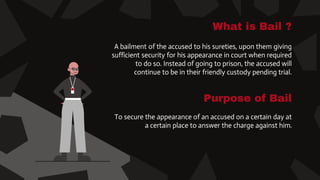
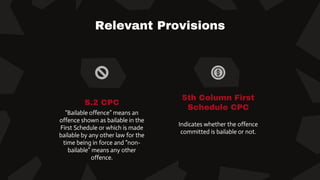
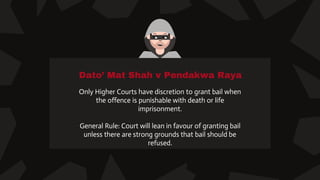
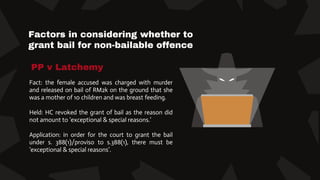
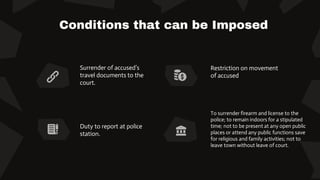
The document discusses bail provisions under criminal procedure law. It begins by defining bail and its purpose of securing an accused's appearance in court. Offences are classified as bailable, non-bailable, or unbailable. For non-bailable offences punishable by death or life imprisonment, bail is usually not granted if there are reasonable grounds to believe the accused committed the offence. However, the court may grant bail in exceptional circumstances if the accused is a minor, woman, or sick/infirm person. Case law examples provide guidance on factors considered for granting bail in non-bailable cases, such as medical conditions, age, or ensuring no interference with the case. Conditions like surrendering travel documents or regular police



![PP v Dato’ Balwant Singh (No. 1) [2002]
o Accused charged for murder.
o Applied for bail as accused was 80 years old and got medical evidence to show ill
health.
o Bail granted with conditions:
-Surrender firearms, license and passport.
-Report to the police once in two weeks.
-To remain indoors from the hours of 6pm-8am.
-Not to be present at any open public place or attend any public functions except for
religious and family activities.
-Not to leave Kuala Lumpur and Petaling Jaya without the leave of court.](https://image.slidesharecdn.com/tutorial3question5presentation1171100536-220327173417/85/Non-bailable-offences-8-320.jpg)
![Jimmy Seah Thian Heng & Ors v
Public Prosecutor [2019]
A combined consideration of the applicant’s advanced age
and his medical ailments, have rendered him someone falling
in the category of a ‘sick and infirm person’.
oCourt allowed application for bail on the following terms:
(a)bail is set at the sum of RM20,000 in two sureties;
(b)the applicant is to surrender his international passport to
the court; and
(c)the applicant is to report himself to the nearest police
station to his place of usual residence once in two weeks.](https://image.slidesharecdn.com/tutorial3question5presentation1171100536-220327173417/85/Non-bailable-offences-14-320.jpg)