WHAT IS BAIL?
❖ Bail mc:1ns entrustmem of the accused to his sureties, who :m:
bound to produce the :1ccused in court whenever required. Bail means
the security takc.:n from a pc.:rson ro appear on a fix date bc.:forc the
court. Bail is the release from the cusmdy of a person charged wirh
an offence, on that person signed undertaking that he will appear in
coun ro answer the charge.
~ V v
PURPOSE OF BAIL
❖ Secure ,he pre!>ence of accused ac the trnil while allowin~ the
accuM.:d hi!, liberty and protecting him fnr unnece!,sary detention. It
muM always he kept in mind ,hat the accused is innocent until proven
guilty. X'hcn dccidin~ to grnnt hail, any nmnunt of bond, the nun1her
of sureties or conditions imposed should only he sufficient to ensure
that the nCCll!,l'd auends the next hearing.
Bailable Offence
Vs. Non-Bailable Offence
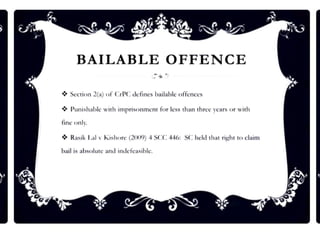
BAILABLE OFFENCE
❖ Seclion 2(a) of CrPC defines bailable offcnces
❖ Punh,hnblc wi1h imprisonment for less thnn 1hrec years or with
fine onlr,
❖ Rnsik I.al v Kishorc (2009) 4 SCC 446: SC held 1hn1riJ,thl tn clnim
hnil is nlniolutc nnd indcfcnsihlc.
'
•
...'
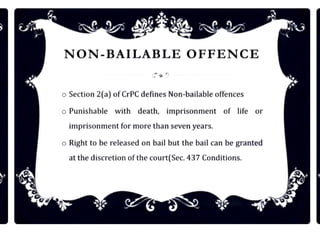
NON-BAILABLE OFFENCE
o Section 2(a) ofCrPC dennes Non-bailable offences
o Punishable with death, imprisonment of life or
imprisonment for more than sevenyears.
o Right to be released on ball but the bail can be granted
at the discretion of the court(Sec.437 Conditions.
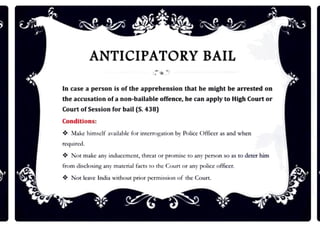
ANTICIPATORY BAIL
In case a person is of the apprehension that he might be arrested on
the accusation ofa non-bailable offence, be can apply to High Court or
Court ofSession for bail (S.438)
Conditions:
❖ :lake himself :w:tilnble for imcrrog:11ion br Police Officer as nnd when
required.
❖ Nm m:tkc any induccmcm, threat or promise to any pcrwn so as to deter him
from disclosing anr rruucrial facts to the Coun or any poLicc officcr.
❖ Not leave India without prior permission of the Court.
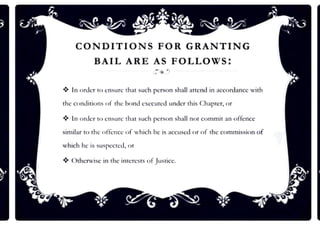
CONDITIONS FOR GRANTING
BAIL ARE AS FOLLOWS:
❖ In order to ensure that such person shall aucnd in accordance with
the condilions of the bond executed under this Chapter, or
❖ In order to ensure chat such person shall nm commit an offence
similar to the offence of which he is accused or of the commission of
which he is suspected, or
❖ Otherwise in the interests of Justice.
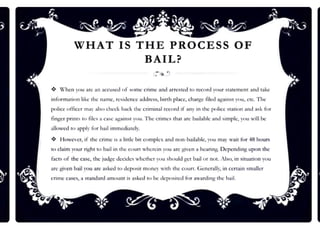
WHAT IS THE PROCESS OF
BAIL?
❖ H
hcn rou arc nn accused of some cnmc :and arrested to n:cord your srntcmcnt nnd mkc
informn1ion like the nnmc. ~idcncc ncl<lrc:ss. birth place, ch:u,:tc filed al-,111ins1 ~11u, ctc. The
police ot1iccr may nl~, ch,:ck back the crimiml record i( nny in the police suuion :mcl a.~k for
finger pnnt~ to files a c._-nsc a1,.rninM you. lbe crime,s 1ha1 arc bailable and simple, you will be
allowed w apply for bail immediately.
❖ Howc'cr. if the crime is a link bit compkx :and non-baiJ:ablc, you may wait for 48 hours
to claim your ri~h1 1
0 bail in 1he court wherein you 11re gi·cn a hcarin~ Depcndin~ upon the
facu of the case, the judge decides whether yuu should get brul o r not. Also, in situation you
arc given bail you arc asked 10 deposi1mo nc~ w11h the coun . Gt.-ncr:illy, in certain smaller
cnmc cases, a srnn<lard amoum is nskcd 1
0 be dcposi1cd for :&l,':lrding 1hc bail.
PROVISION RELATING TO BAIL
•!•Chapter 33 of Cr.P.C covers provisions as to
bail and bonds.
•!•Section 436 to 450 are sections relating to bail
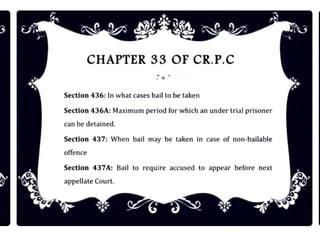
CHAPTER 33 OF CR.P.C
Section 436: In what cases ball to be taken
Section 436A: Maximum period for which an under trial prisoner
can be detained.
Section 437: When ball may be taken In case of non-bailable
offence
Section 437A: Ball to require accused to appear before next
appellate Court
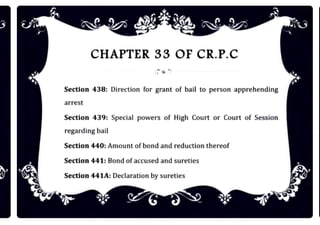
CHAPTER 33 OF CR.P.C
SectJon 438: Direction for grant of ball to person apprehending
arrest
SectJon 439: Special powers of High Court or Court of Session
regarding ball
Section 440: Amount of bond and reduction thereof
SectJon 441: Bond ofaccused and sureties
SectJon 441A: Declaration by sureties
••C
·
,..
CHAPTER 33 OF CR.P.C
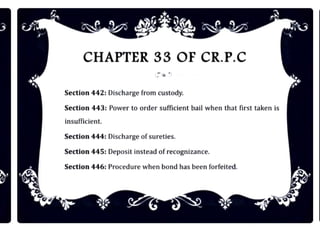
Section 442: Discharge from custody.
Section 443: Power to order sufficient ball when that flrst taken Is
Insufficient.
Section 444: Discharge ofsureties.
Section 445: Deposit Instead of recognizance.
Section 446: Procedure when bond has been forfeited.
CHAPTER 33 OF CR.P.C
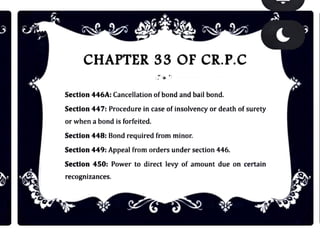
Section 446A: Cancellation of bond and bail bond.
Section 447: Procedure in case of Insolvency or death ofsurety
or when a bond is forfeited.
Section 448: Bond required from minor.
SectJon 449: Appeal from orders under section 446.
Section 450: Power to direct levy of amount due on certain
recognlzances.
Concept of Bail
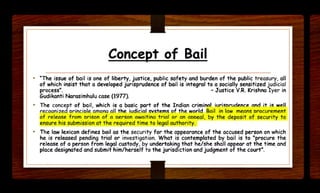
• "The issue of bail is one of liberty. justice. public safety and burden of the public treasury. all
of which insist that a developed jurisprudence of bail is integral to a socially sensitized judicial
process". - Justice V.R. Krishna Iyer in
Gudikanti Narasimhulu case (19TT).
• The concept of bail, which is a basic part of the Indian crimil'IOI iuriscrudence and it is well
recoonized crincicle omono all the iudicial svstems of the world Bail in low means crocurement
of release from orison of o cerson owoit ino trial or on acceal. by t he deposit of security to
ensure his submission at the required time to legal authority.
• The law lexicon defines bail as the security for the appearance of the accused person on which
he is released pending trial or investigation. What is contemplated by bail is to "procure the
release of a person from legal custody, by undertaking that he/she shall appear at the time and
place designated and submit him/herself to the juriscfiction and judgment of the court•.
[
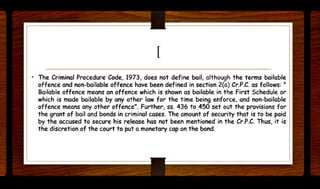
• The Criminal Procedure Code, 1973, does not define bail, although the terms bailable
offence and non-bailable offence have been defined in section 2(a) Cr.P.C. as follows: "
Bailable offence means an offence which is shown as bailable in the First Schedule or
which is made bailable by any other law for the time being enforce, and non-bailable
offence means any other offence". Further. ss. 436 to 450 set out the provisions for
the grant of bail and bonds in criminal cases. The amount of security that is to be paid
by the accused to secure his release has not been mentioned in the Cr.P.C. Thus, it is
the discretion of the court to put a monetary cap on the bond.
• In 2011, The Hon'ble apex court in Sallay Chandra vs CBI AIR (2012) 1 sec 40 also opined that :
"The grant or refusal to orant bail lies within the discretion of the Court. The grant or denial is
regulated, to a large extent. by t he facts and circumstances of each particular case. But at the some
time, right to bail is not to be denied merely because of the sentiments of the community against the
accused. The primary purposes of bail in a criminal case are to relieve the accused of imprisonment, to
relieve the State of the burden of kuping him, pending the trial, and at the same time, to keep the
accused constructively in the custody of the Court. whether before or after conviction. to assure
that he will submit to the jurisdiction of the Court and be in attendance thereon whenever his
presence is required•.
• Recently, Hon'ble Supreme Court, in Aosu vs, state of Ro,jostan (Criminal Appeal NQ.!Hl of 2017
t>t.09-03-2017) issued a direction that Bail applications shall be disposed of normally within one
week.
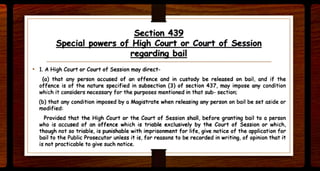
Section 439
Special powers of High Court or Court of Session
regarding bail
• 1. A High Court or Court of Session moy direct-
(a) that any person accused of an offence and in custody be released on bail. and if the
offence is of the nature specified in subsection (3) of section 437. may impose any condition
which it considers necessary for the purposes mentioned in that sub- section;
(b) that any condition imposed by a Magistrate when releasing any person on bail be set aside or
modified:
Provided that the High Court or the Court of Session shall, before granting bail to a person
who is accused of an offence which is triable ~elusively by the Court of Session or which,
though not so triable. is punishable with imprisonment for life, give notice of the application for
bail to the Public Prosecutor unless it is, for reasons to be recorded in writing, of opinion that it
is not practicable to give such notice.
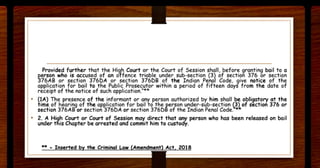
Provided further that the Hig_h Court or the Court of Ses.sion shall, before granting bail to a
person who is accused of an o~ffence triable under sub-section (3) of section 376 or section
376AB or section 376DA or section 376DB of the Indian Penal Code, give notice of the
application for bail to the Public Prosecutor within a period of fifteen days from the date of
receipt of the notice of such applicat ion."**
• (lA) The presence of the informant or any person authorized by him shall be obligatory at the
time of hearing of the apelication for bail to the pe.rson under-sub-section (3) of section 376 or
section 376AB or section 376DA or section 376DB of the Indian Penal Code. -
• 2. A High Court or Court of Session may direct that a~ person who has been released on bail
under this Chapter be arrested and commit him to custody.
- - I rt th Cri I I A 201
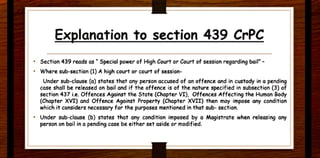
Explanation to section 439 CrPC
• Section 439 reads as • Special power of High Court or Court of session regarding bail• -
• Where sub-section (1) Ahigh court or court of session-
Under sub-clause (a) states that any person accused of an offence and in custody in a pending
case shall be released on bail and if the offence is of the nature specified in subsection (3) of
section 437 i.e. Offences Against the State (Chapter VI}, Offences Affecting the Human Body
(Chapter XVI) and Offence Against Property (Chapter XVII) then may impose any condition
which it considers necessary for the purposes mentioned in that sub- section.
• Under sub-clause (b) states that any condition imposed by a Magistrate when releasing any
person on bail in a pending case be either set aside or modified.
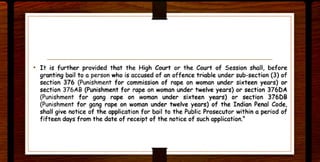
• It is further provided that the High Court or the Court of Session shall, before
granting bail to a person who is accused of an offence triable under sub-section (3) of
section 376 (Punishment for commission of rape on woman under sixteen years) or
section 376AB (Punishment for rape on woman under twelve years) or section 376DA
(Punishment for gang rape on woman under sixteen years) or section 376[)8
(Punishment for gang rape on woman under twelve years) of the Indian Penal Code,
shall give notice of the application for bail to the Public Prosecutor within a period of
fifteen days from the date of receipt of the notice of such application."
• Where clause (A) of section (1) states that the presence of the informant or any
other person authorized by him shall be obligatory at the time of hearing of the
application for bail to the person under-sub-section (3) of section 376 or section
376AB or section 376DA or section 376DB of the Indian Penal Code.
• Where section (2) states about the cancellation of bail, that the High Court or Court
of Session may direct any person who has been released on bail under this Chapter to
be arrested and to commit him to custody.
Explanation to section CrPC
• The powers of the High Court in granting bail are very wide; even so where the offence is non-
bailable, various considerations will have to be taken into account before bail is granted in case
of non-bailable offence.
• Under Section 439(1) of the Code, the High Court can only release the accused in cases pending
anywhere in the State on bail or reduce the amount of bail, but cannot order the arrest or
commitment to custody of any person who has been released on bail by the lower Court but it
can order to arrest the person who had been released on bail under Section 439(2) of the Code.
• ~n o recent iudoment in Sunduo kumor bofno vs State of fflOhoroshtro & ON' Criminal
anneal no. 689 of 2014 Hon'ble Suore.me Court has held that there ore no restrictions on the
High Court or Sessions Court to entertain an applicat ion for bail. provided, accused is in custody.
The juagment has put an to ena t Fie cfecacfes old practice of flrst filing a regular BailApplication
before a Magistrate having jurisdiction, and get it rejected for the purpose of approaching the
Sessions Court or High Court for boil.
• Now, Section 439(2) The Code of Criminal Procedure makes clear provisions for cancellation of
bail and taking accused back in custody. The power of cancellation of bail can be resorted to
broadly in the following two situations:
(i) On merits of a case mainly on the around of the order arant ina boil beina oerverse. or
passed without due application of mind or in violat ion of any substantive or procedural low; and
(ii) On the around of misuse of liberty oft er the grant of bail or other supervening
circumstances.
Bail in the first type of cases can be cancelled by superior courts only. whereas in the second
category of cases bail can be cancelled by the very court which may have granted bail.
• Cancellation of bail- certain grounds:
The arounds for cancellation of bajl under section 439(2) can be cancelled where the accused
(1) misuses his libertv bv indulaina in similar criminal activitv. (2) interferes with the course of
investiaation. (3) attemots to tamoer with evidence of witnesses. (4) threatens witnesses or
indulaes in similar activit ies which would hamoer smooth investiaation. (5) attemots to f lee to
another countrv. (6) attemots to make himself scarce bv aoina underground or becoming
unavailable to the investigating agenc)', (7) attempts to P.lace himself beyond the reach of his
surety, etc. These grounds are illustr ative and not exhaustive.
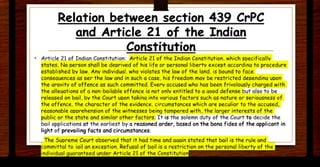
Relation between section 439 CrPC
and Article 21 of the Indian
Constitution
• Ar,J:icle 21 of Indiao Constitution: Article 21 of the Indian Constitution. which soecifically
states. No oerson shall be deorived of his life or oersonal liberty exceot accordinQ to procedure
established by law. Any individual. who violates the law of t he land. is bound to face
conseauences as oer the law and in such a case. his freedom may be restricted deoendinQ uoon
the aravitv of offence as such committed. Every accused who has been frivolously charged with
the alleaations of a non-bailable offence is not only entit led to a aood defense but alsoJ o be
released on bail. by the Court upon takina into various factors such as nature or seriousness of
the offence. the character of the evidence. circumstances which are peculiar to the accused,
reasonable a00rehension of the witnesses being tampered with, the larger interests of the
public or the state and similar other factors. It is the solemn duty of the Court to decide the
bail applications at the earliest by a reasoned order, based on the bona fides of the applicant in
light of prevailing facts and circumstances.
e Supreme Court observed that it had time and aaain stated that bail i the
ittal t iail an exceotion. Refusal of bail is a restr i ·
. . .
e t f f I
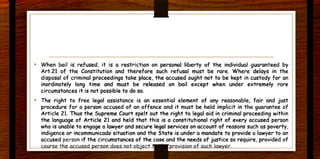
• When bail is refused. it is a restriction on personal liberty of the individual guaranteed by
Art.21 of the Constitution and therefore such refusal must be rare. Where delays in the
disposal of criminal proceedings take place. the accused ought not to be kept in custody for an
inordinately long time and must be released on bail except when under extremely rare
circumstances it is not possible to do so.
• The right to free legal assistance is an essential element of any reasonable. fair and just
procedure for a person accused of an offence and it must be held implicit in the guarantee of
Article 21. Thus the Supreme Court spelt out the right to legal aid in criminal proceeding within
the language of Article 21 and held that this is a constitutional right of every accused person
who is unable to engage a lawyer and secure l~I services on account of reasons such as poverty.
indigence or incommunicado situation and the State is under a mandate to provide a lawyer to an
accused person if the circumstances of the case and the needs of justice so require, provided of
.. ....
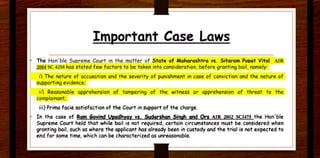
Important Case Laws
The Hon'ble Supreme Court in the matter of State of Maharashtra vs. Sitaram Pooat Vital AJR
~ SC 4258 has stated few factors to be taken ,nto consideration, before grantin9 bail, namely:
1) The nature of accusation and the severity of punishment in case of conviction and the nature of
supporting evidence;
ii) Reasonable apP.rehension of tampering of the witness or apprehension of threat to the
complainant;
iii) Prima facie satisfaction of the Court in support of the charge.
In the case of Rg,n Govind Upadhyay vs. Sydarshan Singh and Ors AlR 2002 SC1475 the Hon'ble
Supreme Court held that while bail is not required. certain circumstances must be considered when
granting bail. such as where the applicant has already been in custody and the trial is not expected to

end for some time. which can be characterized as unreasonable.
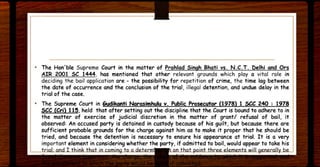
• The Hon'ble Supreme Court in the matter of Prahlad Singh Bhati vs, N.C,T. Delhi and Ors
AIR 2001 SC 1444, has mentioned that other relevant grounds which play a vital role in
deciding the bail application are - the possibility for repetition of crime, the time lag between
the date of occurrence and the conclusion of the trial, illegal detention, and undue delay in the
trial of the case.
• The Supreme Court in Gudikanti Narasimhulu v. Public Prosecutor (1978) 1 sec 240 : 1978
sec (Cri) 115, held that after setting out the discipline that the Court is bound to adhere to in
the matter of exercise of judicial discretion in the matter of grant/ refusal of bail, it
observed: An accused party is detained in custody because of his guilt, but because there are
sufficient probable grounds for the charge against him as to make it proper that he should be
tried, and because the detention is necessary to ensure his appearance at trial. It is a very
important element in considering whether the party, if admitted to bail, would appear to take his
· · · · · ents will gene';':ti • .
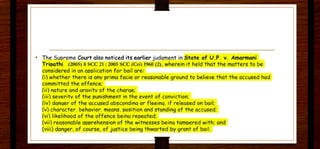
• The Suoreme Court also noticed its earlier judament in Stat~ of U.P. v. Amarmani
irriDOthi (2005) 8sec 21 : 2005 sec (Cri) 1960 (2), wherein it held that t he matters to be
considered in on aoolicotion for bail ore:
(i) whether there is any primo focie or reasonable ground to believe that the accused hod
committed the offence;
(ii) nature and arovitv of the chorae;
(iii) severity of the punishment in the event of conviction;
(iv) donaer of the accused obscondina or fleeina. if released on boil;
(v) character. behavior. means. oosition and standing of the accused;
(vi) likelihood of the offence beina reoeoted;
(vii) reasonable apprehension of the witnesses beina tampered with; and
(viii) danger, of course. of justice being thwarted by grant of boil.
• Tn ~ urrh"""" .C.innh vc C.♦~- f l'wlhi Arlfflinic♦,.,, ♦;,.,., .t.lA I Q7R ,;;r liQ• 1QiR ,;;rr rr,1 di it wnc h..lrl thnt
r nnciderotions in gront i!:19 boil which ore common both in the case of Ss.437(1) and 439(1), Cr.P.C. Code
C
,....
ti, tho n,,t11ro nnr4 nrnvitv nf tho rirr11mc't,inroc in whirh tho nffonro ic rnmmit-torl•
(ii) th.. nncitinn nnrl th.. c♦nt11c nf thP nrr11cp,i with ,.,.f,.,.,.nrP t n thP virt im nnrl th.. witnPCCPC"
(iii th.. lik..lihnnrl nf th.. nrr11-;ed flee
~ from justice;
/iv) nf ,.,.,...,ntinn th.. nfft>nrt> '
fv~ nf ;.,,,,..,.,,.,i'.-.i"" _
hie n'."'" lif.. ""'"9 faced with a grim prospect of possible convict ion in the case:
Iv,, nf t nmnor1nn w,th ..-11tnoccoc·
(vii) t h" hictn~ nf th.. rnc.. nc w ..11 n< nf it< i nvt>c♦innt inn · nnrl
fviii) other relevant grounds which. in view of so many variable factors. cannot be exhaustively set
out.
• In the case of Satish J'aggi v. State of Chattissar:h & Ors. 2008 t ALT (Crol.} 438 (SC}. it was
held by the Supreme Court that at the stage of granting of bail, the Court con only go into the
question of the prima facie case established for granting bail. It cannot go into the question of
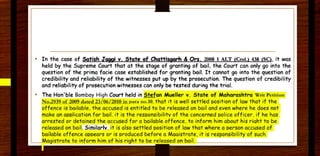
credibility and reliability of the witnesses put up by the prosecution. The question of credibility
and reliability of prosecution witnesses can only be tested during the trial.
• The Hon'ble Bombay High Court held in ,Stefan Mueller v. State of Maharashtra Wri1 Pc1irion
r-/o.2.9J.2_of 2009 chuc.d 2Jl.0.61.20L0 in oara no.10. that it is well settled position of low that if the
offence is bailable. the accused is entitled to be released on boil and even where he does not
make on application for boil. it is the responsibilitv of the concerned oolice officer. if he hos
arrested or detained the accused for a bailable offence. to inform him about his rioht to be
released on boil. Similarlv. it is also settled position of low that where a person accused of
bailable offence opoeors or is produced before a Mooistrote it is responsibility of such
Magistrate t o inform himof his right to be released on bo
::.:,
i,:.
1.,-______________.
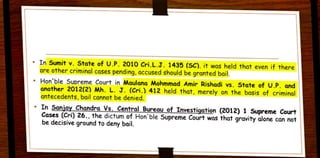
• I n Sumit v. State of U.P. 2010 Cri.L.J . 1435 (SC). it was held that even if there
are other criminal cases pending, accused should be granted bail.
• Hon'ble Supreme Court in Maulana Mohmmad Amir Rishadi vs. State of U.P. and
another 2012(2) Mh. L. J . (Cri.) 412 held that, merely on the basis of criminal
ant ecedents, bail cannot be denied.
• In San,iay Chandra Vs. Central Bureau of Investigation (2012) 1 Supreme Court
Cases (Cri) 26., t he dict um of Hon'ble Supreme Court was that gravity alone con not
be decisive ground t o deny bail.
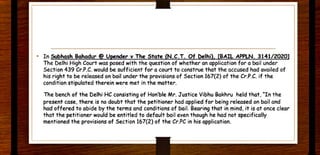
• In SubhGSh Bohadur@ U~nder v The State (N.C.T. Of t>elhi). [BAIL APPLN. 3141/20201
The Delhi High Court was posed with the question of whether an application for a bail under
Section 439 Cr.P.C. would be sufficient for a court to construe that the accused had availed of
his right to be released on bail under the provisions of Section 167(2) of the Cr.P.C. if the
condition stipulated therein were met in the matter.
The bench of the Delhi HC consisting of Hon'ble Mr. Justice Vibhu Bakhru held that, "In the
present case, there is no doubt that the petitioner had applied for being released on bail and
had offered to abide by the terms and conditions of bail. Bearing that in mind, it is at once clear
that the petitioner would be entitled to default bail even though he had not specifically
mentioned the provisions of Section 167(2) of the Cr.PC in his application.
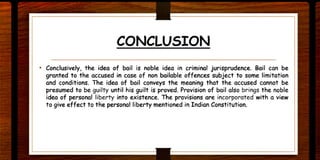
CONCLUSION
• Conclusively, the idea of bail is noble idea in criminal jurisprudence. Bail can be
granted to the accused in case of non bailable offences subject to some limitation
and conditions. The idea of bail conveys the meaning that the accused cannot be
presumed to be guilty until his guilt is proved. Provision of bail also brings the noble
idea of personal liberty into existence. The provisions are incorporated with a view
to give effect to the personal liberty mentioned in Indian Constitution.

bail crpc.pdf

  • 1.
    WHAT IS BAIL? ❖Bail mc:1ns entrustmem of the accused to his sureties, who :m: bound to produce the :1ccused in court whenever required. Bail means the security takc.:n from a pc.:rson ro appear on a fix date bc.:forc the court. Bail is the release from the cusmdy of a person charged wirh an offence, on that person signed undertaking that he will appear in coun ro answer the charge.
  • 2.
    ~ V v PURPOSEOF BAIL ❖ Secure ,he pre!>ence of accused ac the trnil while allowin~ the accuM.:d hi!, liberty and protecting him fnr unnece!,sary detention. It muM always he kept in mind ,hat the accused is innocent until proven guilty. X'hcn dccidin~ to grnnt hail, any nmnunt of bond, the nun1her of sureties or conditions imposed should only he sufficient to ensure that the nCCll!,l'd auends the next hearing.
  • 3.
  • 4.
    BAILABLE OFFENCE ❖ Seclion2(a) of CrPC defines bailable offcnces ❖ Punh,hnblc wi1h imprisonment for less thnn 1hrec years or with fine onlr, ❖ Rnsik I.al v Kishorc (2009) 4 SCC 446: SC held 1hn1riJ,thl tn clnim hnil is nlniolutc nnd indcfcnsihlc.
  • 5.
    ' • ...' NON-BAILABLE OFFENCE o Section2(a) ofCrPC dennes Non-bailable offences o Punishable with death, imprisonment of life or imprisonment for more than sevenyears. o Right to be released on ball but the bail can be granted at the discretion of the court(Sec.437 Conditions.
  • 6.
    ANTICIPATORY BAIL In casea person is of the apprehension that he might be arrested on the accusation ofa non-bailable offence, be can apply to High Court or Court ofSession for bail (S.438) Conditions: ❖ :lake himself :w:tilnble for imcrrog:11ion br Police Officer as nnd when required. ❖ Nm m:tkc any induccmcm, threat or promise to any pcrwn so as to deter him from disclosing anr rruucrial facts to the Coun or any poLicc officcr. ❖ Not leave India without prior permission of the Court.
  • 7.
    CONDITIONS FOR GRANTING BAILARE AS FOLLOWS: ❖ In order to ensure that such person shall aucnd in accordance with the condilions of the bond executed under this Chapter, or ❖ In order to ensure chat such person shall nm commit an offence similar to the offence of which he is accused or of the commission of which he is suspected, or ❖ Otherwise in the interests of Justice.
  • 8.
    WHAT IS THEPROCESS OF BAIL? ❖ H hcn rou arc nn accused of some cnmc :and arrested to n:cord your srntcmcnt nnd mkc informn1ion like the nnmc. ~idcncc ncl<lrc:ss. birth place, ch:u,:tc filed al-,111ins1 ~11u, ctc. The police ot1iccr may nl~, ch,:ck back the crimiml record i( nny in the police suuion :mcl a.~k for finger pnnt~ to files a c._-nsc a1,.rninM you. lbe crime,s 1ha1 arc bailable and simple, you will be allowed w apply for bail immediately. ❖ Howc'cr. if the crime is a link bit compkx :and non-baiJ:ablc, you may wait for 48 hours to claim your ri~h1 1 0 bail in 1he court wherein you 11re gi·cn a hcarin~ Depcndin~ upon the facu of the case, the judge decides whether yuu should get brul o r not. Also, in situation you arc given bail you arc asked 10 deposi1mo nc~ w11h the coun . Gt.-ncr:illy, in certain smaller cnmc cases, a srnn<lard amoum is nskcd 1 0 be dcposi1cd for :&l,':lrding 1hc bail.
  • 9.
    PROVISION RELATING TOBAIL •!•Chapter 33 of Cr.P.C covers provisions as to bail and bonds. •!•Section 436 to 450 are sections relating to bail
  • 10.
    CHAPTER 33 OFCR.P.C Section 436: In what cases ball to be taken Section 436A: Maximum period for which an under trial prisoner can be detained. Section 437: When ball may be taken In case of non-bailable offence Section 437A: Ball to require accused to appear before next appellate Court
  • 11.
    CHAPTER 33 OFCR.P.C SectJon 438: Direction for grant of ball to person apprehending arrest SectJon 439: Special powers of High Court or Court of Session regarding ball Section 440: Amount of bond and reduction thereof SectJon 441: Bond ofaccused and sureties SectJon 441A: Declaration by sureties ••C · ,..
  • 12.
    CHAPTER 33 OFCR.P.C Section 442: Discharge from custody. Section 443: Power to order sufficient ball when that flrst taken Is Insufficient. Section 444: Discharge ofsureties. Section 445: Deposit Instead of recognizance. Section 446: Procedure when bond has been forfeited.
  • 13.
    CHAPTER 33 OFCR.P.C Section 446A: Cancellation of bond and bail bond. Section 447: Procedure in case of Insolvency or death ofsurety or when a bond is forfeited. Section 448: Bond required from minor. SectJon 449: Appeal from orders under section 446. Section 450: Power to direct levy of amount due on certain recognlzances.
  • 14.
    Concept of Bail •"The issue of bail is one of liberty. justice. public safety and burden of the public treasury. all of which insist that a developed jurisprudence of bail is integral to a socially sensitized judicial process". - Justice V.R. Krishna Iyer in Gudikanti Narasimhulu case (19TT). • The concept of bail, which is a basic part of the Indian crimil'IOI iuriscrudence and it is well recoonized crincicle omono all the iudicial svstems of the world Bail in low means crocurement of release from orison of o cerson owoit ino trial or on acceal. by t he deposit of security to ensure his submission at the required time to legal authority. • The law lexicon defines bail as the security for the appearance of the accused person on which he is released pending trial or investigation. What is contemplated by bail is to "procure the release of a person from legal custody, by undertaking that he/she shall appear at the time and place designated and submit him/herself to the juriscfiction and judgment of the court•.
  • 15.
    [ • The CriminalProcedure Code, 1973, does not define bail, although the terms bailable offence and non-bailable offence have been defined in section 2(a) Cr.P.C. as follows: " Bailable offence means an offence which is shown as bailable in the First Schedule or which is made bailable by any other law for the time being enforce, and non-bailable offence means any other offence". Further. ss. 436 to 450 set out the provisions for the grant of bail and bonds in criminal cases. The amount of security that is to be paid by the accused to secure his release has not been mentioned in the Cr.P.C. Thus, it is the discretion of the court to put a monetary cap on the bond.
  • 16.
    • In 2011,The Hon'ble apex court in Sallay Chandra vs CBI AIR (2012) 1 sec 40 also opined that : "The grant or refusal to orant bail lies within the discretion of the Court. The grant or denial is regulated, to a large extent. by t he facts and circumstances of each particular case. But at the some time, right to bail is not to be denied merely because of the sentiments of the community against the accused. The primary purposes of bail in a criminal case are to relieve the accused of imprisonment, to relieve the State of the burden of kuping him, pending the trial, and at the same time, to keep the accused constructively in the custody of the Court. whether before or after conviction. to assure that he will submit to the jurisdiction of the Court and be in attendance thereon whenever his presence is required•. • Recently, Hon'ble Supreme Court, in Aosu vs, state of Ro,jostan (Criminal Appeal NQ.!Hl of 2017 t>t.09-03-2017) issued a direction that Bail applications shall be disposed of normally within one week.
  • 17.
    Section 439 Special powersof High Court or Court of Session regarding bail • 1. A High Court or Court of Session moy direct- (a) that any person accused of an offence and in custody be released on bail. and if the offence is of the nature specified in subsection (3) of section 437. may impose any condition which it considers necessary for the purposes mentioned in that sub- section; (b) that any condition imposed by a Magistrate when releasing any person on bail be set aside or modified: Provided that the High Court or the Court of Session shall, before granting bail to a person who is accused of an offence which is triable ~elusively by the Court of Session or which, though not so triable. is punishable with imprisonment for life, give notice of the application for bail to the Public Prosecutor unless it is, for reasons to be recorded in writing, of opinion that it is not practicable to give such notice.
  • 18.
    Provided further thatthe Hig_h Court or the Court of Ses.sion shall, before granting bail to a person who is accused of an o~ffence triable under sub-section (3) of section 376 or section 376AB or section 376DA or section 376DB of the Indian Penal Code, give notice of the application for bail to the Public Prosecutor within a period of fifteen days from the date of receipt of the notice of such applicat ion."** • (lA) The presence of the informant or any person authorized by him shall be obligatory at the time of hearing of the apelication for bail to the pe.rson under-sub-section (3) of section 376 or section 376AB or section 376DA or section 376DB of the Indian Penal Code. - • 2. A High Court or Court of Session may direct that a~ person who has been released on bail under this Chapter be arrested and commit him to custody. - - I rt th Cri I I A 201
  • 19.
    Explanation to section439 CrPC • Section 439 reads as • Special power of High Court or Court of session regarding bail• - • Where sub-section (1) Ahigh court or court of session- Under sub-clause (a) states that any person accused of an offence and in custody in a pending case shall be released on bail and if the offence is of the nature specified in subsection (3) of section 437 i.e. Offences Against the State (Chapter VI}, Offences Affecting the Human Body (Chapter XVI) and Offence Against Property (Chapter XVII) then may impose any condition which it considers necessary for the purposes mentioned in that sub- section. • Under sub-clause (b) states that any condition imposed by a Magistrate when releasing any person on bail in a pending case be either set aside or modified.
  • 20.
    • It isfurther provided that the High Court or the Court of Session shall, before granting bail to a person who is accused of an offence triable under sub-section (3) of section 376 (Punishment for commission of rape on woman under sixteen years) or section 376AB (Punishment for rape on woman under twelve years) or section 376DA (Punishment for gang rape on woman under sixteen years) or section 376[)8 (Punishment for gang rape on woman under twelve years) of the Indian Penal Code, shall give notice of the application for bail to the Public Prosecutor within a period of fifteen days from the date of receipt of the notice of such application."
  • 21.
    • Where clause(A) of section (1) states that the presence of the informant or any other person authorized by him shall be obligatory at the time of hearing of the application for bail to the person under-sub-section (3) of section 376 or section 376AB or section 376DA or section 376DB of the Indian Penal Code. • Where section (2) states about the cancellation of bail, that the High Court or Court of Session may direct any person who has been released on bail under this Chapter to be arrested and to commit him to custody.
  • 22.
    Explanation to sectionCrPC • The powers of the High Court in granting bail are very wide; even so where the offence is non- bailable, various considerations will have to be taken into account before bail is granted in case of non-bailable offence. • Under Section 439(1) of the Code, the High Court can only release the accused in cases pending anywhere in the State on bail or reduce the amount of bail, but cannot order the arrest or commitment to custody of any person who has been released on bail by the lower Court but it can order to arrest the person who had been released on bail under Section 439(2) of the Code. • ~n o recent iudoment in Sunduo kumor bofno vs State of fflOhoroshtro & ON' Criminal anneal no. 689 of 2014 Hon'ble Suore.me Court has held that there ore no restrictions on the High Court or Sessions Court to entertain an applicat ion for bail. provided, accused is in custody. The juagment has put an to ena t Fie cfecacfes old practice of flrst filing a regular BailApplication before a Magistrate having jurisdiction, and get it rejected for the purpose of approaching the Sessions Court or High Court for boil.
  • 23.
    • Now, Section439(2) The Code of Criminal Procedure makes clear provisions for cancellation of bail and taking accused back in custody. The power of cancellation of bail can be resorted to broadly in the following two situations: (i) On merits of a case mainly on the around of the order arant ina boil beina oerverse. or passed without due application of mind or in violat ion of any substantive or procedural low; and (ii) On the around of misuse of liberty oft er the grant of bail or other supervening circumstances. Bail in the first type of cases can be cancelled by superior courts only. whereas in the second category of cases bail can be cancelled by the very court which may have granted bail.
  • 24.
    • Cancellation ofbail- certain grounds: The arounds for cancellation of bajl under section 439(2) can be cancelled where the accused (1) misuses his libertv bv indulaina in similar criminal activitv. (2) interferes with the course of investiaation. (3) attemots to tamoer with evidence of witnesses. (4) threatens witnesses or indulaes in similar activit ies which would hamoer smooth investiaation. (5) attemots to f lee to another countrv. (6) attemots to make himself scarce bv aoina underground or becoming unavailable to the investigating agenc)', (7) attempts to P.lace himself beyond the reach of his surety, etc. These grounds are illustr ative and not exhaustive.
  • 25.
    Relation between section439 CrPC and Article 21 of the Indian Constitution • Ar,J:icle 21 of Indiao Constitution: Article 21 of the Indian Constitution. which soecifically states. No oerson shall be deorived of his life or oersonal liberty exceot accordinQ to procedure established by law. Any individual. who violates the law of t he land. is bound to face conseauences as oer the law and in such a case. his freedom may be restricted deoendinQ uoon the aravitv of offence as such committed. Every accused who has been frivolously charged with the alleaations of a non-bailable offence is not only entit led to a aood defense but alsoJ o be released on bail. by the Court upon takina into various factors such as nature or seriousness of the offence. the character of the evidence. circumstances which are peculiar to the accused, reasonable a00rehension of the witnesses being tampered with, the larger interests of the public or the state and similar other factors. It is the solemn duty of the Court to decide the bail applications at the earliest by a reasoned order, based on the bona fides of the applicant in light of prevailing facts and circumstances. e Supreme Court observed that it had time and aaain stated that bail i the ittal t iail an exceotion. Refusal of bail is a restr i · . . . e t f f I
  • 26.
    • When bailis refused. it is a restriction on personal liberty of the individual guaranteed by Art.21 of the Constitution and therefore such refusal must be rare. Where delays in the disposal of criminal proceedings take place. the accused ought not to be kept in custody for an inordinately long time and must be released on bail except when under extremely rare circumstances it is not possible to do so. • The right to free legal assistance is an essential element of any reasonable. fair and just procedure for a person accused of an offence and it must be held implicit in the guarantee of Article 21. Thus the Supreme Court spelt out the right to legal aid in criminal proceeding within the language of Article 21 and held that this is a constitutional right of every accused person who is unable to engage a lawyer and secure l~I services on account of reasons such as poverty. indigence or incommunicado situation and the State is under a mandate to provide a lawyer to an accused person if the circumstances of the case and the needs of justice so require, provided of .. ....
  • 27.
    Important Case Laws TheHon'ble Supreme Court in the matter of State of Maharashtra vs. Sitaram Pooat Vital AJR ~ SC 4258 has stated few factors to be taken ,nto consideration, before grantin9 bail, namely: 1) The nature of accusation and the severity of punishment in case of conviction and the nature of supporting evidence; ii) Reasonable apP.rehension of tampering of the witness or apprehension of threat to the complainant; iii) Prima facie satisfaction of the Court in support of the charge. In the case of Rg,n Govind Upadhyay vs. Sydarshan Singh and Ors AlR 2002 SC1475 the Hon'ble Supreme Court held that while bail is not required. certain circumstances must be considered when granting bail. such as where the applicant has already been in custody and the trial is not expected to end for some time. which can be characterized as unreasonable.
  • 28.
    • The Hon'bleSupreme Court in the matter of Prahlad Singh Bhati vs, N.C,T. Delhi and Ors AIR 2001 SC 1444, has mentioned that other relevant grounds which play a vital role in deciding the bail application are - the possibility for repetition of crime, the time lag between the date of occurrence and the conclusion of the trial, illegal detention, and undue delay in the trial of the case. • The Supreme Court in Gudikanti Narasimhulu v. Public Prosecutor (1978) 1 sec 240 : 1978 sec (Cri) 115, held that after setting out the discipline that the Court is bound to adhere to in the matter of exercise of judicial discretion in the matter of grant/ refusal of bail, it observed: An accused party is detained in custody because of his guilt, but because there are sufficient probable grounds for the charge against him as to make it proper that he should be tried, and because the detention is necessary to ensure his appearance at trial. It is a very important element in considering whether the party, if admitted to bail, would appear to take his · · · · · ents will gene';':ti • .
  • 29.
    • The SuoremeCourt also noticed its earlier judament in Stat~ of U.P. v. Amarmani irriDOthi (2005) 8sec 21 : 2005 sec (Cri) 1960 (2), wherein it held that t he matters to be considered in on aoolicotion for bail ore: (i) whether there is any primo focie or reasonable ground to believe that the accused hod committed the offence; (ii) nature and arovitv of the chorae; (iii) severity of the punishment in the event of conviction; (iv) donaer of the accused obscondina or fleeina. if released on boil; (v) character. behavior. means. oosition and standing of the accused; (vi) likelihood of the offence beina reoeoted; (vii) reasonable apprehension of the witnesses beina tampered with; and (viii) danger, of course. of justice being thwarted by grant of boil.
  • 30.
    • Tn ~urrh"""" .C.innh vc C.♦~- f l'wlhi Arlfflinic♦,.,, ♦;,.,., .t.lA I Q7R ,;;r liQ• 1QiR ,;;rr rr,1 di it wnc h..lrl thnt r nnciderotions in gront i!:19 boil which ore common both in the case of Ss.437(1) and 439(1), Cr.P.C. Code C ,.... ti, tho n,,t11ro nnr4 nrnvitv nf tho rirr11mc't,inroc in whirh tho nffonro ic rnmmit-torl• (ii) th.. nncitinn nnrl th.. c♦nt11c nf thP nrr11cp,i with ,.,.f,.,.,.nrP t n thP virt im nnrl th.. witnPCCPC" (iii th.. lik..lihnnrl nf th.. nrr11-;ed flee ~ from justice; /iv) nf ,.,.,...,ntinn th.. nfft>nrt> ' fv~ nf ;.,,,,..,.,,.,i'.-.i"" _ hie n'."'" lif.. ""'"9 faced with a grim prospect of possible convict ion in the case: Iv,, nf t nmnor1nn w,th ..-11tnoccoc· (vii) t h" hictn~ nf th.. rnc.. nc w ..11 n< nf it< i nvt>c♦innt inn · nnrl fviii) other relevant grounds which. in view of so many variable factors. cannot be exhaustively set out.
  • 31.
    • In thecase of Satish J'aggi v. State of Chattissar:h & Ors. 2008 t ALT (Crol.} 438 (SC}. it was held by the Supreme Court that at the stage of granting of bail, the Court con only go into the question of the prima facie case established for granting bail. It cannot go into the question of credibility and reliability of the witnesses put up by the prosecution. The question of credibility and reliability of prosecution witnesses can only be tested during the trial. • The Hon'ble Bombay High Court held in ,Stefan Mueller v. State of Maharashtra Wri1 Pc1irion r-/o.2.9J.2_of 2009 chuc.d 2Jl.0.61.20L0 in oara no.10. that it is well settled position of low that if the offence is bailable. the accused is entitled to be released on boil and even where he does not make on application for boil. it is the responsibilitv of the concerned oolice officer. if he hos arrested or detained the accused for a bailable offence. to inform him about his rioht to be released on boil. Similarlv. it is also settled position of low that where a person accused of bailable offence opoeors or is produced before a Mooistrote it is responsibility of such Magistrate t o inform himof his right to be released on bo ::.:, i,:. 1.,-______________.
  • 32.
    • I nSumit v. State of U.P. 2010 Cri.L.J . 1435 (SC). it was held that even if there are other criminal cases pending, accused should be granted bail. • Hon'ble Supreme Court in Maulana Mohmmad Amir Rishadi vs. State of U.P. and another 2012(2) Mh. L. J . (Cri.) 412 held that, merely on the basis of criminal ant ecedents, bail cannot be denied. • In San,iay Chandra Vs. Central Bureau of Investigation (2012) 1 Supreme Court Cases (Cri) 26., t he dict um of Hon'ble Supreme Court was that gravity alone con not be decisive ground t o deny bail.
  • 33.
    • In SubhGShBohadur@ U~nder v The State (N.C.T. Of t>elhi). [BAIL APPLN. 3141/20201 The Delhi High Court was posed with the question of whether an application for a bail under Section 439 Cr.P.C. would be sufficient for a court to construe that the accused had availed of his right to be released on bail under the provisions of Section 167(2) of the Cr.P.C. if the condition stipulated therein were met in the matter. The bench of the Delhi HC consisting of Hon'ble Mr. Justice Vibhu Bakhru held that, "In the present case, there is no doubt that the petitioner had applied for being released on bail and had offered to abide by the terms and conditions of bail. Bearing that in mind, it is at once clear that the petitioner would be entitled to default bail even though he had not specifically mentioned the provisions of Section 167(2) of the Cr.PC in his application.
  • 34.
    CONCLUSION • Conclusively, theidea of bail is noble idea in criminal jurisprudence. Bail can be granted to the accused in case of non bailable offences subject to some limitation and conditions. The idea of bail conveys the meaning that the accused cannot be presumed to be guilty until his guilt is proved. Provision of bail also brings the noble idea of personal liberty into existence. The provisions are incorporated with a view to give effect to the personal liberty mentioned in Indian Constitution.