1
Finite Automata
Motivation
An Example
2
Informal Explanation
Finite automata are finite collections of
states with transition rules that take
you from one state to another.
Original application was sequential
switching circuits, where the “state”
was the settings of internal bits.
Today, several kinds of software can be
modeled by FA.
3
Representing FA
Simplest representation is often a
graph.
 Nodes = states.
 Arcs indicate state transitions.
 Labels on arcs tell what causes the
transition.
4
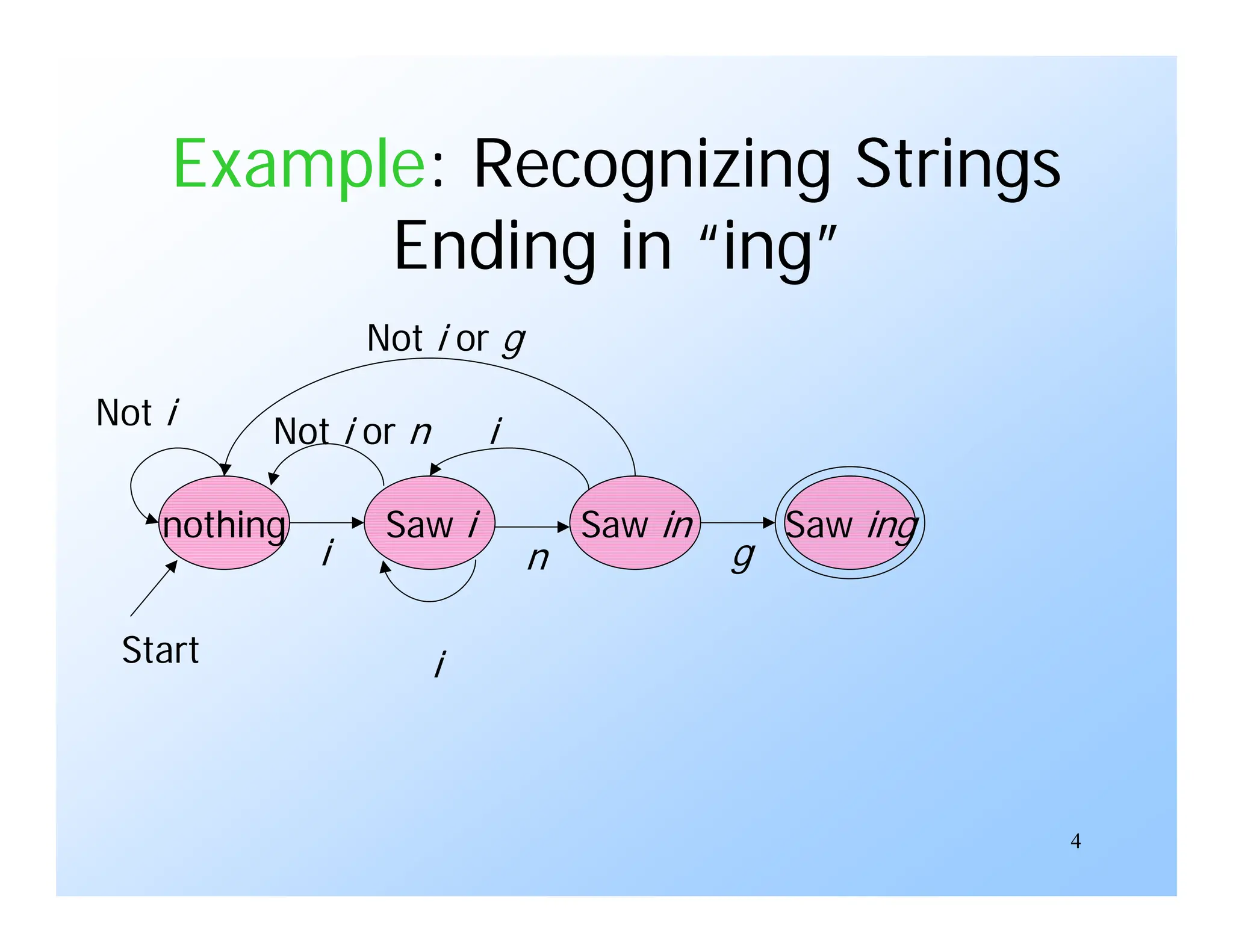
Example: Recognizing Strings
Ending in “ing”
nothing Saw i
i
Not i
Saw ing
g
i
Not i or g
Saw in
n
i
Not i or n
Start
5
Automata to Code
 In C/C++, make a piece of code for
each state. This code:
1. Reads the next input.
2. Decides on the next state.
3. Jumps to the beginning of the code for
that state.
6
Example: Automata to Code
2: /* i seen */
c = getNextInput();
if (c == ’n’) goto 3;
else if (c == ’i’) goto 2;
else goto 1;
3: /* ”in” seen */
. . .
7
Automata to Code – Thoughts
How would you do this in Java, which
has no goto?
You don’t really write code like this.
Rather, a code generator takes a
“regular expression” describing the
pattern(s) you are looking for.
 Example: .*ing works in grep.
8
Example: Protocol for Sending
Data
Ready Sending
data in
ack
timeout
Start
9
Extended Example
 Thanks to Jay Misra for this example.
 On a distant planet, there are three
species, a, b, and c.
 Any two different species can mate. If
they do:
1. The participants die.
2. Two children of the third species are
born.
10
Strange Planet – (2)
Observation: the number of individuals
never changes.
The planet fails if at some point all
individuals are of the same species.
 Then, no more breeding can take place.
State = sequence of three integers –
the numbers of individuals of species a,
b, and c.
11
Strange Planet – Questions
In a given state, must the planet
eventually fail?
In a given state, is it possible for the
planet to fail, if the wrong breeding
choices are made?
12
Questions – (2)
These questions mirror real ones about
protocols.
 “Can the planet fail?” is like asking whether
a protocol can enter some undesired or
error state.
 “Must the planet fail” is like asking whether
a protocol is guaranteed to terminate.
• Here, “failure” is really the good condition of
termination.
13
Strange Planet – Transitions
An a-event occurs when individuals of
species b and c breed and are replaced
by two a’s.
Analogously: b-events and c-events.
Represent these by symbols a, b, and
c, respectively.
14
Strange Planet with 2 Individuals
200 002
020
110
101
011
a c
b
Notice: all states are “must-fail” states.
15
Strange Planet with 3 Individuals
300 003
030
111
a c
b
Notice: four states are “must-fail” states.
The others are “can’t-fail” states.
102
210
a
c
201
021
b
b
012
120
a
c
State 111 has several transitions.
16
Strange Planet with 4 Individuals
Notice: states 400, etc. are must-fail states.
All other states are “might-fail” states.
400
022
130
103
211
a
c b
b c
a
040
202
013
310
121
b
a c
c a
b
004
220
301
031
112
c
b a
a b
c
17
Taking Advantage of Symmetry
The ability to fail depends only on the
set of numbers of the three species, not
on which species has which number.
Let’s represent states by the list of
counts, sorted by largest-first.
Only one transition symbol, x.
18
The Cases 2, 3, 4
110
200
x
111
210
300
220
400
310
211
x
x
x
x
x
x
Notice: for the case n = 4, there is nondeterminism : different
transitions are possible from 211 on the same input.
19
5 Individuals
410
500
320 311
221
Notice: 500 is a must-fail state; all others
are might-fail states.
20
6 Individuals
321
600
411 330
222
Notice: 600 is a must-fail state; 510, 420, and
321 are can’t-fail states; 411, 330, and 222 are
“might-fail” states.
420
510
21
7 Individuals
331
700
430
421
322
Notice: 700 is a must-fail state; All others
are might-fail states.
511
520
610
22
Questions for Thought
1. Without symmetry, how many states
are there with n individuals?
2. What if we use symmetry?
3. For n individuals, how do you tell
whether a state is “must-fail,” “might-
fail,” or “can’t-fail”?

Non deterministic finite automata in detail.pdf

  • 1.
  • 2.
    2 Informal Explanation Finite automataare finite collections of states with transition rules that take you from one state to another. Original application was sequential switching circuits, where the “state” was the settings of internal bits. Today, several kinds of software can be modeled by FA.
  • 3.
    3 Representing FA Simplest representationis often a graph.  Nodes = states.  Arcs indicate state transitions.  Labels on arcs tell what causes the transition.
  • 4.
    4 Example: Recognizing Strings Endingin “ing” nothing Saw i i Not i Saw ing g i Not i or g Saw in n i Not i or n Start
  • 5.
    5 Automata to Code In C/C++, make a piece of code for each state. This code: 1. Reads the next input. 2. Decides on the next state. 3. Jumps to the beginning of the code for that state.
  • 6.
    6 Example: Automata toCode 2: /* i seen */ c = getNextInput(); if (c == ’n’) goto 3; else if (c == ’i’) goto 2; else goto 1; 3: /* ”in” seen */ . . .
  • 7.
    7 Automata to Code– Thoughts How would you do this in Java, which has no goto? You don’t really write code like this. Rather, a code generator takes a “regular expression” describing the pattern(s) you are looking for.  Example: .*ing works in grep.
  • 8.
    8 Example: Protocol forSending Data Ready Sending data in ack timeout Start
  • 9.
    9 Extended Example  Thanksto Jay Misra for this example.  On a distant planet, there are three species, a, b, and c.  Any two different species can mate. If they do: 1. The participants die. 2. Two children of the third species are born.
  • 10.
    10 Strange Planet –(2) Observation: the number of individuals never changes. The planet fails if at some point all individuals are of the same species.  Then, no more breeding can take place. State = sequence of three integers – the numbers of individuals of species a, b, and c.
  • 11.
    11 Strange Planet –Questions In a given state, must the planet eventually fail? In a given state, is it possible for the planet to fail, if the wrong breeding choices are made?
  • 12.
    12 Questions – (2) Thesequestions mirror real ones about protocols.  “Can the planet fail?” is like asking whether a protocol can enter some undesired or error state.  “Must the planet fail” is like asking whether a protocol is guaranteed to terminate. • Here, “failure” is really the good condition of termination.
  • 13.
    13 Strange Planet –Transitions An a-event occurs when individuals of species b and c breed and are replaced by two a’s. Analogously: b-events and c-events. Represent these by symbols a, b, and c, respectively.
  • 14.
    14 Strange Planet with2 Individuals 200 002 020 110 101 011 a c b Notice: all states are “must-fail” states.
  • 15.
    15 Strange Planet with3 Individuals 300 003 030 111 a c b Notice: four states are “must-fail” states. The others are “can’t-fail” states. 102 210 a c 201 021 b b 012 120 a c State 111 has several transitions.
  • 16.
    16 Strange Planet with4 Individuals Notice: states 400, etc. are must-fail states. All other states are “might-fail” states. 400 022 130 103 211 a c b b c a 040 202 013 310 121 b a c c a b 004 220 301 031 112 c b a a b c
  • 17.
    17 Taking Advantage ofSymmetry The ability to fail depends only on the set of numbers of the three species, not on which species has which number. Let’s represent states by the list of counts, sorted by largest-first. Only one transition symbol, x.
  • 18.
    18 The Cases 2,3, 4 110 200 x 111 210 300 220 400 310 211 x x x x x x Notice: for the case n = 4, there is nondeterminism : different transitions are possible from 211 on the same input.
  • 19.
    19 5 Individuals 410 500 320 311 221 Notice:500 is a must-fail state; all others are might-fail states.
  • 20.
    20 6 Individuals 321 600 411 330 222 Notice:600 is a must-fail state; 510, 420, and 321 are can’t-fail states; 411, 330, and 222 are “might-fail” states. 420 510
  • 21.
    21 7 Individuals 331 700 430 421 322 Notice: 700is a must-fail state; All others are might-fail states. 511 520 610
  • 22.
    22 Questions for Thought 1.Without symmetry, how many states are there with n individuals? 2. What if we use symmetry? 3. For n individuals, how do you tell whether a state is “must-fail,” “might- fail,” or “can’t-fail”?