Presented by,
Ms. Varsha G. Jadhav
M.E.- Structural Engineering,
Civil Engineering Department
Jawaharlal Nehru Engineering College
Aurangabad
 Nondestructive testing (NDT) is the process of
inspecting, testing, or evaluating components
without or partial damage
 It analyses and suggests appropriate repairs
and retrofitting measures required for the
buildings to perform better in its service life.
2
 The issue of Structural Audit has been a
growing interest across all sectors.
 Most buildings in Aurangabad City are over 30
years old.
 The National Crime Records Bureau, in a data-
report states that in the last 10 years, up to year
2012, there has been 448 building collapses, in
Maharashtra, killing over 425 people
3
 Structural Auditing for all types of R.C.C. Structures
(Residential, Commercial and Industrial)
 Conduction of various workshops for training for
students and consultants in the area of structural
auditing.
 Useful for Projects of B. Tech. and M. Tech. students
 Research and development in the domain of
structural engineering
4
 Test on actual structure at several location
 Assessment of uniformity of concrete
 Location of cracks, voids & honey combs
 Detection of location damaged due to
overloading or other impacts
 Quality in relation to the IS requirement
5
1. Rebound Hammer
2. Ultrasonic Pulse Velocity Meter
3. Half Cell Potential Meter
4. Core cutter
5. Profometer
6
 To asses quality of concrete in relation to the
standard results
 To estimate compressive strength of concrete
with correlation between rebound index and
compressive strength
 To delineate regions of poor quality concrete
7
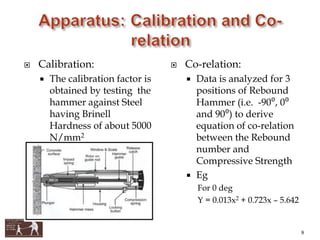
 Calibration:
 The calibration factor is
obtained by testing the
hammer against Steel
having Brinell
Hardness of about 5000
N/mm2
 Co-relation:
 Data is analyzed for 3
positions of Rebound
Hammer (i.e. -90⁰, 0⁰
and 90⁰) to derive
equation of co-relation
between the Rebound
number and
Compressive Strength
 Eg
For 0 deg
Y = 0.013x2 + 0.723x – 5.642
8
 Consider the following example
 The following 6 values are obtained in a Rebound
Hammer Test for 0⁰ position of Hammer
 29, 31,29,28,28,29 (After considering outliers as per IS
8900)
 Average = 29
 Calibration Factor = 1.036
 Average x Calibration Factor = 29 x 1.036 = 30.044
 Substituting in the co-relation equation
 Y= 0.013(30.0442)+ 0.723(30.044) – 5.642
 = 27.82 N/mm2
9
 To assess homogeneity & uniformity of
concrete
 To assess quality of concrete in relation to IS
requirement
 Detection of the presence and approximate
extent of cracks, voids
 Measurement of changes occurring with time
in the property of concrete
10
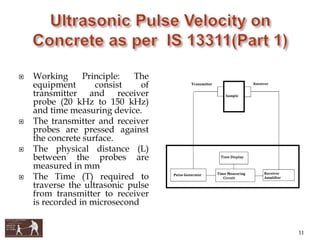
 Working Principle: The
equipment consist of
transmitter and receiver
probe (20 kHz to 150 kHz)
and time measuring device.
 The transmitter and receiver
probes are pressed against
the concrete surface.
 The physical distance (L)
between the probes are
measured in mm
 The Time (T) required to
traverse the ultrasonic pulse
from transmitter to receiver
is recorded in microsecond
11
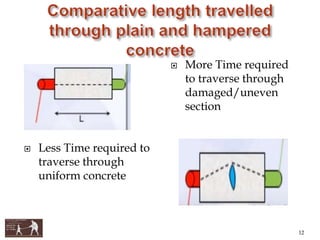
 Less Time required to
traverse through
uniform concrete
 More Time required
to traverse through
damaged/uneven
section
12
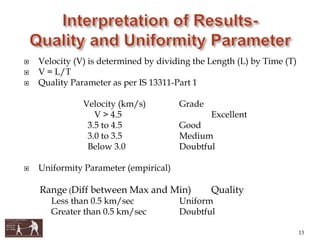
 Velocity (V) is determined by dividing the Length (L) by Time (T)
 V = L/T
 Quality Parameter as per IS 13311-Part 1
Velocity (km/s) Grade
V > 4.5 Excellent
3.5 to 4.5 Good
3.0 to 3.5 Medium
Below 3.0 Doubtful
 Uniformity Parameter (empirical)
Range (Diff between Max and Min) Quality
Less than 0.5 km/sec Uniform
Greater than 0.5 km/sec Doubtful
13
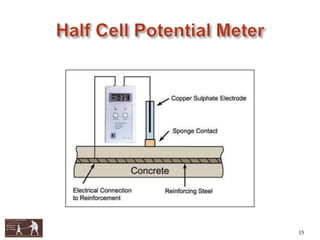
 This is electrochemical process to detect
corrosion in the reinforcement bar.
 This instrument measures the potential and the
electrical resisistance between the reinforcement
and the surface to evaluate the corrosion activity
14
15
 Core Cutting: Core should be cut from
hardened concrete having ends reasonably
even and perpendicular. A core which, before
capping has a maximum height of less than
95% of dia or after capping height less than its
diameter shall not be used.
 Capping: The cut core shall be capped with
suitable material (compressive strength greater
than the compressive strength of concrete and
shall not depart by more than 0.05 mm)
16
 Correction Factor: For specimen of
height/diameter ratio other than 2. Correction
factor shall be applied as per (Fig 1) of IS 516
 Equivalent Cube Strength of the concrete shall
be determined by multiplying the corrected
cylinder by 5/4
17
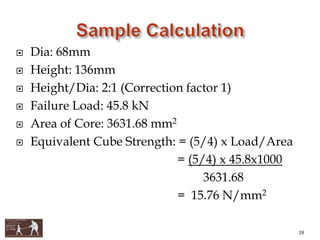
 Dia: 68mm
 Height: 136mm
 Height/Dia: 2:1 (Correction factor 1)
 Failure Load: 45.8 kN
 Area of Core: 3631.68 mm2
 Equivalent Cube Strength: = (5/4) x Load/Area
= (5/4) x 45.8x1000
3631.68
= 15.76 N/mm2
18
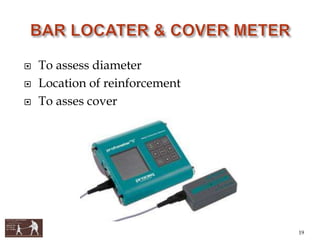
 To assess diameter
 Location of reinforcement
 To asses cover
19
THANK YOU
20

Non destructive testing ppt

  • 1.
    Presented by, Ms. VarshaG. Jadhav M.E.- Structural Engineering, Civil Engineering Department Jawaharlal Nehru Engineering College Aurangabad
  • 2.
     Nondestructive testing(NDT) is the process of inspecting, testing, or evaluating components without or partial damage  It analyses and suggests appropriate repairs and retrofitting measures required for the buildings to perform better in its service life. 2
  • 3.
     The issueof Structural Audit has been a growing interest across all sectors.  Most buildings in Aurangabad City are over 30 years old.  The National Crime Records Bureau, in a data- report states that in the last 10 years, up to year 2012, there has been 448 building collapses, in Maharashtra, killing over 425 people 3
  • 4.
     Structural Auditingfor all types of R.C.C. Structures (Residential, Commercial and Industrial)  Conduction of various workshops for training for students and consultants in the area of structural auditing.  Useful for Projects of B. Tech. and M. Tech. students  Research and development in the domain of structural engineering 4
  • 5.
     Test onactual structure at several location  Assessment of uniformity of concrete  Location of cracks, voids & honey combs  Detection of location damaged due to overloading or other impacts  Quality in relation to the IS requirement 5
  • 6.
    1. Rebound Hammer 2.Ultrasonic Pulse Velocity Meter 3. Half Cell Potential Meter 4. Core cutter 5. Profometer 6
  • 7.
     To assesquality of concrete in relation to the standard results  To estimate compressive strength of concrete with correlation between rebound index and compressive strength  To delineate regions of poor quality concrete 7
  • 8.
     Calibration:  Thecalibration factor is obtained by testing the hammer against Steel having Brinell Hardness of about 5000 N/mm2  Co-relation:  Data is analyzed for 3 positions of Rebound Hammer (i.e. -90⁰, 0⁰ and 90⁰) to derive equation of co-relation between the Rebound number and Compressive Strength  Eg For 0 deg Y = 0.013x2 + 0.723x – 5.642 8
  • 9.
     Consider thefollowing example  The following 6 values are obtained in a Rebound Hammer Test for 0⁰ position of Hammer  29, 31,29,28,28,29 (After considering outliers as per IS 8900)  Average = 29  Calibration Factor = 1.036  Average x Calibration Factor = 29 x 1.036 = 30.044  Substituting in the co-relation equation  Y= 0.013(30.0442)+ 0.723(30.044) – 5.642  = 27.82 N/mm2 9
  • 10.
     To assesshomogeneity & uniformity of concrete  To assess quality of concrete in relation to IS requirement  Detection of the presence and approximate extent of cracks, voids  Measurement of changes occurring with time in the property of concrete 10
  • 11.
     Working Principle:The equipment consist of transmitter and receiver probe (20 kHz to 150 kHz) and time measuring device.  The transmitter and receiver probes are pressed against the concrete surface.  The physical distance (L) between the probes are measured in mm  The Time (T) required to traverse the ultrasonic pulse from transmitter to receiver is recorded in microsecond 11
  • 12.
     Less Timerequired to traverse through uniform concrete  More Time required to traverse through damaged/uneven section 12
  • 13.
     Velocity (V)is determined by dividing the Length (L) by Time (T)  V = L/T  Quality Parameter as per IS 13311-Part 1 Velocity (km/s) Grade V > 4.5 Excellent 3.5 to 4.5 Good 3.0 to 3.5 Medium Below 3.0 Doubtful  Uniformity Parameter (empirical) Range (Diff between Max and Min) Quality Less than 0.5 km/sec Uniform Greater than 0.5 km/sec Doubtful 13
  • 14.
     This iselectrochemical process to detect corrosion in the reinforcement bar.  This instrument measures the potential and the electrical resisistance between the reinforcement and the surface to evaluate the corrosion activity 14
  • 15.
  • 16.
     Core Cutting:Core should be cut from hardened concrete having ends reasonably even and perpendicular. A core which, before capping has a maximum height of less than 95% of dia or after capping height less than its diameter shall not be used.  Capping: The cut core shall be capped with suitable material (compressive strength greater than the compressive strength of concrete and shall not depart by more than 0.05 mm) 16
  • 17.
     Correction Factor:For specimen of height/diameter ratio other than 2. Correction factor shall be applied as per (Fig 1) of IS 516  Equivalent Cube Strength of the concrete shall be determined by multiplying the corrected cylinder by 5/4 17
  • 18.
     Dia: 68mm Height: 136mm  Height/Dia: 2:1 (Correction factor 1)  Failure Load: 45.8 kN  Area of Core: 3631.68 mm2  Equivalent Cube Strength: = (5/4) x Load/Area = (5/4) x 45.8x1000 3631.68 = 15.76 N/mm2 18
  • 19.
     To assessdiameter  Location of reinforcement  To asses cover 19
  • 20.