NON COMMUNICABLE DISEASES
(NCDS)
Department of Community Medicine
JNIMS
OVERVIEW OF PRESENTATION
• Introduction
• Risk factors
• Prevention
NCDS: CDC
• Noncommunicable diseases (NCDs), also known as chronic,
‘life-style diseases’
• Not passed from person to person
• They are of long duration and generally slow progression
NCDS: TYPES
• Cardiovascular disease (Coronary heart disease, Stroke)
• Cancer
• Chronic lung disease
• Diabetes
• Chronic Neurologic Disorders (Alzheimer’s, dementias)
• Arthritis/Musculoskeletal diseases
• (In some, Mental Health and RTAs)
INTRODUCTION
• NCDs - kill 41 million/ year, 71% of all deaths globally
• 77% of all NCD deaths - In LMIC
• Cardiovascular diseases - 17.9 million people annually, cancers
(9.3 million), respiratory diseases (4.1 million), diabetes (1.5
million)
• These four groups of diseases account for over 80% of all
premature NCD deaths
TRANSITIONS IN SOCIETY: MAJOR SHIFT IN POPULATION’S
HEALTH
1. Demographic transition-high fertility to low fertility, increased
life-expectancy -Ageing population
2. Economic transition-Increasing per capita income
3. Social transition-Industrialisation and resulting urbanisation
4. Nutrition transition-Shift in dietary consumption
5. Epidemiologic transition-Shift from infectious to NCDs
RISK FACTORS
1. Non-Modifiable Risk Factors
2. Modifiable Risk Factors
1. Behavioural Risk Factor
2. Metabolic Risk Factor
RISK FACTORS-NON-MODIFIABLE
1. Age
2. Sex
3. Race/ Ethnicity
4. Genetics/ Family History
RISK FACTORS-MODIFIABLE
BEHAVIOURAL
1. Tobacco use
2. Physical Inactivity
3. Unhealthy Diet
4. Harmful use of alcohol
TOBACCO
• Tobacco kills up to half of its users
• Kills more than 8 million people each year
• Any amount of tobacco is harmful
• No safe way to use tobacco
TOBACCO
• Types – Smoking and Smokeless Tobacco
• Novel and emerging Nicotine and Tobacco products
• ENDS-Electronic Nicotine Delivery System, ENNDS-
Electronic Non-Nicotine Delivery System
• HTP-Heated Tobacco Products
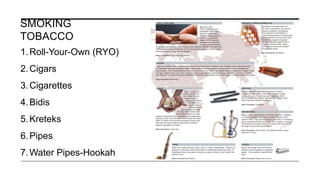
SMOKING
TOBACCO
1.Roll-Your-Own (RYO)
2.Cigars
3.Cigarettes
4.Bidis
5.Kreteks
6.Pipes
7.Water Pipes-Hookah
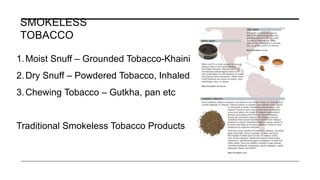
SMOKELESS
TOBACCO
1.Moist Snuff – Grounded Tobacco-Khaini
2.Dry Snuff – Powdered Tobacco, Inhaled
3.Chewing Tobacco – Gutkha, pan etc
Traditional Smokeless Tobacco Products
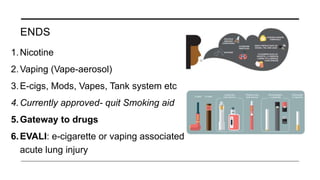
ENDS
1.Nicotine
2.Vaping (Vape-aerosol)
3.E-cigs, Mods, Vapes, Tank system etc
4.Currently approved- quit Smoking aid
5.Gateway to drugs
6.EVALI: e-cigarette or vaping associated
acute lung injury
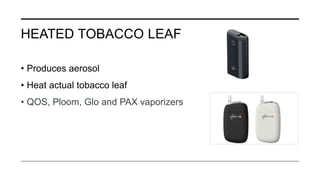
HEATED TOBACCO LEAF
• Produces aerosol
• Heat actual tobacco leaf
• QOS, Ploom, Glo and PAX vaporizers
PHYSICAL INACTIVITY
• WHO defines physical activity as any bodily movement
produced by skeletal muscles that requires energy expenditure
• Physical Activity
• Leisure time
• For transport to get to and from places
• As part of a person’s work
PHYSICAL INACTIVITY
• Obesity, Dyslipidaemia, Hyperglycaemia, Raised BP, Cancers
etc
• People who are insufficiently active have a 20% to 30%
increased risk of death compared to people who are
sufficiently active
PHYSICAL INACTIVITY
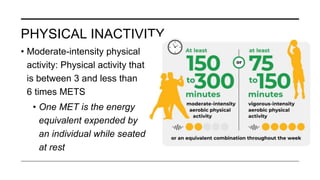
• Moderate-intensity physical
activity: Physical activity that
is between 3 and less than
6 times METS
• One MET is the energy
equivalent expended by
an individual while seated
at rest
PHYSICAL INACTIVITY
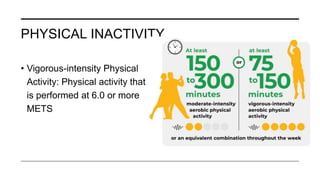
• Vigorous-intensity Physical
Activity: Physical activity that
is performed at 6.0 or more
METS
UNHEALTHY DIET
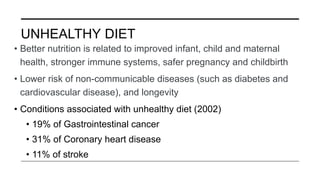
• Better nutrition is related to improved infant, child and maternal
health, stronger immune systems, safer pregnancy and childbirth
• Lower risk of non-communicable diseases (such as diabetes and
cardiovascular disease), and longevity
• Conditions associated with unhealthy diet (2002)
• 19% of Gastrointestinal cancer
• 31% of Coronary heart disease
• 11% of stroke
DIET: ENERGY
• Energy intake (calories) should be in balance with energy
expenditure
• To avoid unhealthy weight gain
• Total fat should not exceed 30% of total energy intake
• Intake of saturated fats should be less than 10% of total
energy intake
• Intake of trans-fats less than 1% of total energy intake
DIET: SUGAR AND SALT
• Limiting intake of free sugars to less than 10% of total energy
intake
• 50 g/ day (for a person requiring 2000 Kcal)
• A further reduction to less than 5% of total energy intake is
suggested
• Keeping salt intake to less than 5 g per day (equivalent to
sodium intake of less than 2 g per day)
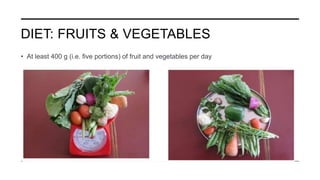
DIET: FRUITS & VEGETABLES
• At least 400 g (i.e. five portions) of fruit and vegetables per day
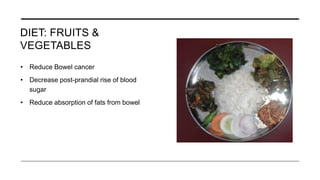
DIET: FRUITS &
VEGETABLES
• Reduce Bowel cancer
• Decrease post-prandial rise of blood
sugar
• Reduce absorption of fats from bowel
HARMFUL USE OF ALCOHOL
• 5.3 % of all deaths
• More than 200 disease and injury conditions
• Beyond health consequences, the harmful use of alcohol
brings significant social and economic losses
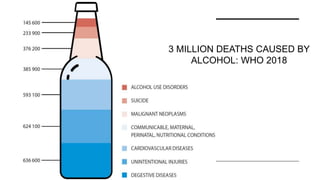
3 MILLION DEATHS CAUSED BY
ALCOHOL: WHO 2018
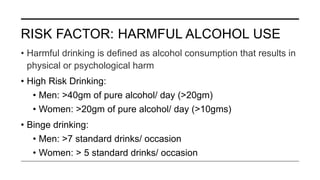
RISK FACTOR: HARMFUL ALCOHOL USE
• Harmful drinking is defined as alcohol consumption that results in
physical or psychological harm
• High Risk Drinking:
• Men: >40gm of pure alcohol/ day (>20gm)
• Women: >20gm of pure alcohol/ day (>10gms)
• Binge drinking:
• Men: >7 standard drinks/ occasion
• Women: > 5 standard drinks/ occasion
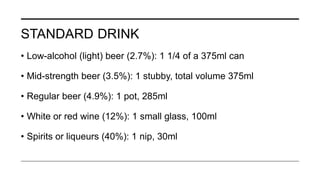
STANDARD DRINK
• Low-alcohol (light) beer (2.7%): 1 1/4 of a 375ml can
• Mid-strength beer (3.5%): 1 stubby, total volume 375ml
• Regular beer (4.9%): 1 pot, 285ml
• White or red wine (12%): 1 small glass, 100ml
• Spirits or liqueurs (40%): 1 nip, 30ml
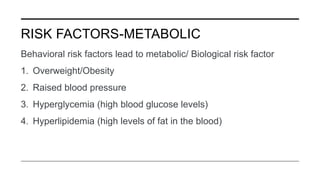
RISK FACTORS-METABOLIC
Behavioral risk factors lead to metabolic/ Biological risk factor
1. Overweight/Obesity
2. Raised blood pressure
3. Hyperglycemia (high blood glucose levels)
4. Hyperlipidemia (high levels of fat in the blood)
OVERWEIGHT/ OBESITY
• 2016
• More than 1.9 billion adults-Overweight, 650 million-Obese
• 39%-Overweight, 13%-Obese
• Overweight and obesity - abnormal or excessive fat accumulation that may
impair health
• Associated with - Cardiovascular diseases (mainly heart disease and
stroke),diabetes, musculoskeletal disorders (especially osteoarthritis), some
cancers (including endometrial, breast, ovarian, prostate, liver, gallbladder,
kidney, and colon).
RAISED BLOOD PRESSURE
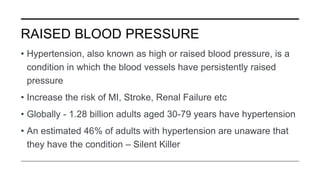
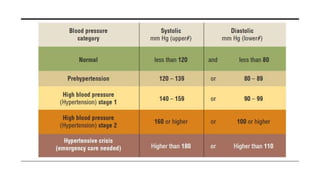
• Hypertension, also known as high or raised blood pressure, is a
condition in which the blood vessels have persistently raised
pressure
• Increase the risk of MI, Stroke, Renal Failure etc
• Globally - 1.28 billion adults aged 30-79 years have hypertension
• An estimated 46% of adults with hypertension are unaware that
they have the condition – Silent Killer
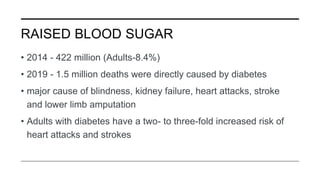
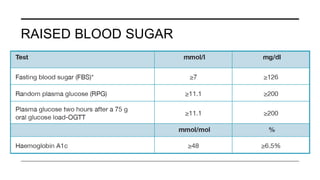
RAISED BLOOD SUGAR
• 2014 - 422 million (Adults-8.4%)
• 2019 - 1.5 million deaths were directly caused by diabetes
• major cause of blindness, kidney failure, heart attacks, stroke
and lower limb amputation
• Adults with diabetes have a two- to three-fold increased risk of
heart attacks and strokes
RAISED BLOOD SUGAR
RAISED CHOLESTEROL
• Raised cholesterol is estimated to cause 2.6 million deaths
• Raised total cholesterol among adults was 39%
• Increase the risks of heart disease and stroke
• Total cholesterol ≥5.0 mmol/L or 190 mg/dl
ENVIRONMENTAL RISK FACTORS
• Globalisation
• Urbanisation
• Poverty
• Low education
• Stress
LEVELS OF PREVENTION
• Primordial
• Primary
• Secondary
• Tertiary
THANK YOU

Non Communicable Diseases Introduction 2022.pptx

  • 1.
  • 2.
    OVERVIEW OF PRESENTATION •Introduction • Risk factors • Prevention
  • 3.
    NCDS: CDC • Noncommunicablediseases (NCDs), also known as chronic, ‘life-style diseases’ • Not passed from person to person • They are of long duration and generally slow progression
  • 4.
    NCDS: TYPES • Cardiovasculardisease (Coronary heart disease, Stroke) • Cancer • Chronic lung disease • Diabetes • Chronic Neurologic Disorders (Alzheimer’s, dementias) • Arthritis/Musculoskeletal diseases • (In some, Mental Health and RTAs)
  • 5.
    INTRODUCTION • NCDs -kill 41 million/ year, 71% of all deaths globally • 77% of all NCD deaths - In LMIC • Cardiovascular diseases - 17.9 million people annually, cancers (9.3 million), respiratory diseases (4.1 million), diabetes (1.5 million) • These four groups of diseases account for over 80% of all premature NCD deaths
  • 6.
    TRANSITIONS IN SOCIETY:MAJOR SHIFT IN POPULATION’S HEALTH 1. Demographic transition-high fertility to low fertility, increased life-expectancy -Ageing population 2. Economic transition-Increasing per capita income 3. Social transition-Industrialisation and resulting urbanisation 4. Nutrition transition-Shift in dietary consumption 5. Epidemiologic transition-Shift from infectious to NCDs
  • 7.
    RISK FACTORS 1. Non-ModifiableRisk Factors 2. Modifiable Risk Factors 1. Behavioural Risk Factor 2. Metabolic Risk Factor
  • 8.
    RISK FACTORS-NON-MODIFIABLE 1. Age 2.Sex 3. Race/ Ethnicity 4. Genetics/ Family History
  • 9.
    RISK FACTORS-MODIFIABLE BEHAVIOURAL 1. Tobaccouse 2. Physical Inactivity 3. Unhealthy Diet 4. Harmful use of alcohol
  • 10.
    TOBACCO • Tobacco killsup to half of its users • Kills more than 8 million people each year • Any amount of tobacco is harmful • No safe way to use tobacco
  • 11.
    TOBACCO • Types –Smoking and Smokeless Tobacco • Novel and emerging Nicotine and Tobacco products • ENDS-Electronic Nicotine Delivery System, ENNDS- Electronic Non-Nicotine Delivery System • HTP-Heated Tobacco Products
  • 12.
  • 13.
    SMOKELESS TOBACCO 1.Moist Snuff –Grounded Tobacco-Khaini 2.Dry Snuff – Powdered Tobacco, Inhaled 3.Chewing Tobacco – Gutkha, pan etc Traditional Smokeless Tobacco Products
  • 14.
    ENDS 1.Nicotine 2.Vaping (Vape-aerosol) 3.E-cigs, Mods,Vapes, Tank system etc 4.Currently approved- quit Smoking aid 5.Gateway to drugs 6.EVALI: e-cigarette or vaping associated acute lung injury
  • 16.
    HEATED TOBACCO LEAF •Produces aerosol • Heat actual tobacco leaf • QOS, Ploom, Glo and PAX vaporizers
  • 17.
    PHYSICAL INACTIVITY • WHOdefines physical activity as any bodily movement produced by skeletal muscles that requires energy expenditure • Physical Activity • Leisure time • For transport to get to and from places • As part of a person’s work
  • 18.
    PHYSICAL INACTIVITY • Obesity,Dyslipidaemia, Hyperglycaemia, Raised BP, Cancers etc • People who are insufficiently active have a 20% to 30% increased risk of death compared to people who are sufficiently active
  • 19.
    PHYSICAL INACTIVITY • Moderate-intensityphysical activity: Physical activity that is between 3 and less than 6 times METS • One MET is the energy equivalent expended by an individual while seated at rest
  • 20.
    PHYSICAL INACTIVITY • Vigorous-intensityPhysical Activity: Physical activity that is performed at 6.0 or more METS
  • 21.
    UNHEALTHY DIET • Betternutrition is related to improved infant, child and maternal health, stronger immune systems, safer pregnancy and childbirth • Lower risk of non-communicable diseases (such as diabetes and cardiovascular disease), and longevity • Conditions associated with unhealthy diet (2002) • 19% of Gastrointestinal cancer • 31% of Coronary heart disease • 11% of stroke
  • 22.
    DIET: ENERGY • Energyintake (calories) should be in balance with energy expenditure • To avoid unhealthy weight gain • Total fat should not exceed 30% of total energy intake • Intake of saturated fats should be less than 10% of total energy intake • Intake of trans-fats less than 1% of total energy intake
  • 23.
    DIET: SUGAR ANDSALT • Limiting intake of free sugars to less than 10% of total energy intake • 50 g/ day (for a person requiring 2000 Kcal) • A further reduction to less than 5% of total energy intake is suggested • Keeping salt intake to less than 5 g per day (equivalent to sodium intake of less than 2 g per day)
  • 24.
    DIET: FRUITS &VEGETABLES • At least 400 g (i.e. five portions) of fruit and vegetables per day
  • 25.
    DIET: FRUITS & VEGETABLES •Reduce Bowel cancer • Decrease post-prandial rise of blood sugar • Reduce absorption of fats from bowel
  • 26.
    HARMFUL USE OFALCOHOL • 5.3 % of all deaths • More than 200 disease and injury conditions • Beyond health consequences, the harmful use of alcohol brings significant social and economic losses
  • 27.
    3 MILLION DEATHSCAUSED BY ALCOHOL: WHO 2018
  • 28.
    RISK FACTOR: HARMFULALCOHOL USE • Harmful drinking is defined as alcohol consumption that results in physical or psychological harm • High Risk Drinking: • Men: >40gm of pure alcohol/ day (>20gm) • Women: >20gm of pure alcohol/ day (>10gms) • Binge drinking: • Men: >7 standard drinks/ occasion • Women: > 5 standard drinks/ occasion
  • 29.
    STANDARD DRINK • Low-alcohol(light) beer (2.7%): 1 1/4 of a 375ml can • Mid-strength beer (3.5%): 1 stubby, total volume 375ml • Regular beer (4.9%): 1 pot, 285ml • White or red wine (12%): 1 small glass, 100ml • Spirits or liqueurs (40%): 1 nip, 30ml
  • 30.
    RISK FACTORS-METABOLIC Behavioral riskfactors lead to metabolic/ Biological risk factor 1. Overweight/Obesity 2. Raised blood pressure 3. Hyperglycemia (high blood glucose levels) 4. Hyperlipidemia (high levels of fat in the blood)
  • 31.
    OVERWEIGHT/ OBESITY • 2016 •More than 1.9 billion adults-Overweight, 650 million-Obese • 39%-Overweight, 13%-Obese • Overweight and obesity - abnormal or excessive fat accumulation that may impair health • Associated with - Cardiovascular diseases (mainly heart disease and stroke),diabetes, musculoskeletal disorders (especially osteoarthritis), some cancers (including endometrial, breast, ovarian, prostate, liver, gallbladder, kidney, and colon).
  • 33.
    RAISED BLOOD PRESSURE •Hypertension, also known as high or raised blood pressure, is a condition in which the blood vessels have persistently raised pressure • Increase the risk of MI, Stroke, Renal Failure etc • Globally - 1.28 billion adults aged 30-79 years have hypertension • An estimated 46% of adults with hypertension are unaware that they have the condition – Silent Killer
  • 35.
    RAISED BLOOD SUGAR •2014 - 422 million (Adults-8.4%) • 2019 - 1.5 million deaths were directly caused by diabetes • major cause of blindness, kidney failure, heart attacks, stroke and lower limb amputation • Adults with diabetes have a two- to three-fold increased risk of heart attacks and strokes
  • 36.
  • 37.
    RAISED CHOLESTEROL • Raisedcholesterol is estimated to cause 2.6 million deaths • Raised total cholesterol among adults was 39% • Increase the risks of heart disease and stroke • Total cholesterol ≥5.0 mmol/L or 190 mg/dl
  • 38.
    ENVIRONMENTAL RISK FACTORS •Globalisation • Urbanisation • Poverty • Low education • Stress
  • 40.
    LEVELS OF PREVENTION •Primordial • Primary • Secondary • Tertiary
  • 41.

Editor's Notes

  • #7 Result of a combination of genetic, physiological, environmental and behaviours factors
  • #9 Diabetes - The so called “Asian Indian Phenotype” refers to certain unique clinical and biochemical abnormalities in Indians which include increased insulin resistance, greater abdominal adiposity i.e., higher waist circumference despite lower body mass index, lower adiponectin and higher high sensitive C-reactive protein levels.
  • #11 ENDS/ ENNDS - propylene glycol, with or without glycerol, and flavouring agents
  • #12 ENDS/ ENNDS - propylene glycol, with or without glycerol, and flavouring agents
  • #15 Helpful when used as substitute to help quit But for young population – Makes them more vulnerable to use different types of drugs Comes in different packaging – Makes it easier to hide – Pen, Pendrive etc
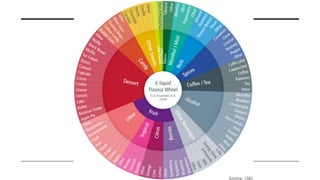
  • #16 Comes in different flavours – which makes them more attractive to younger generations and children too
  • #19 Obesity, Dyslipidaemia, Hyperglycemia, Raised BP
  • #20 Obesity, Dyslipidaemia, Hyperglycemia, Raised BP
  • #21 Light-intensity physical activity Light-intensity physical activity is between 1.5 and 3 METs, i.e. activities with energy cost less than 3 times the energy expenditure at rest for that person. This can include slow walking, bathing, or other incidental activities that do not result in a substantial increase in heart rate or breathing rate.
  • #22 Light-intensity physical activity Light-intensity physical activity is between 1.5 and 3 METs, i.e. activities with energy cost less than 3 times the energy expenditure at rest for that person. This can include slow walking, bathing, or other incidental activities that do not result in a substantial increase in heart rate or breathing rate.
  • #23 Nutrition is a critical part of health and development
  • #30 Current recommendations are to limit alcohol consumption to no more than one or two alcoholic drinks* per day for men and one drink per day for women.
  • #31 1 standard drink: 10gms of pure alcohol
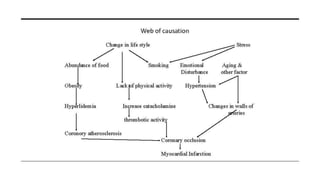
  • #41 Multicausality