0 0 0
5
3
13 14
16
6
0
5
10
15
20
Low Risk Moderate Risk High Risk
Stroke and Bleeding Risk Stratification
CHADS2 Score
CHA2DS2-VASc Score
HAS-BLED Score
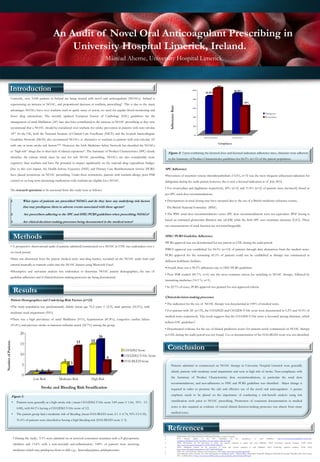
An Audit of Novel Oral Anticoagulant Prescribing in
University Hospital Limerick, Ireland.
Results
Methods
Introduction
Conclusion
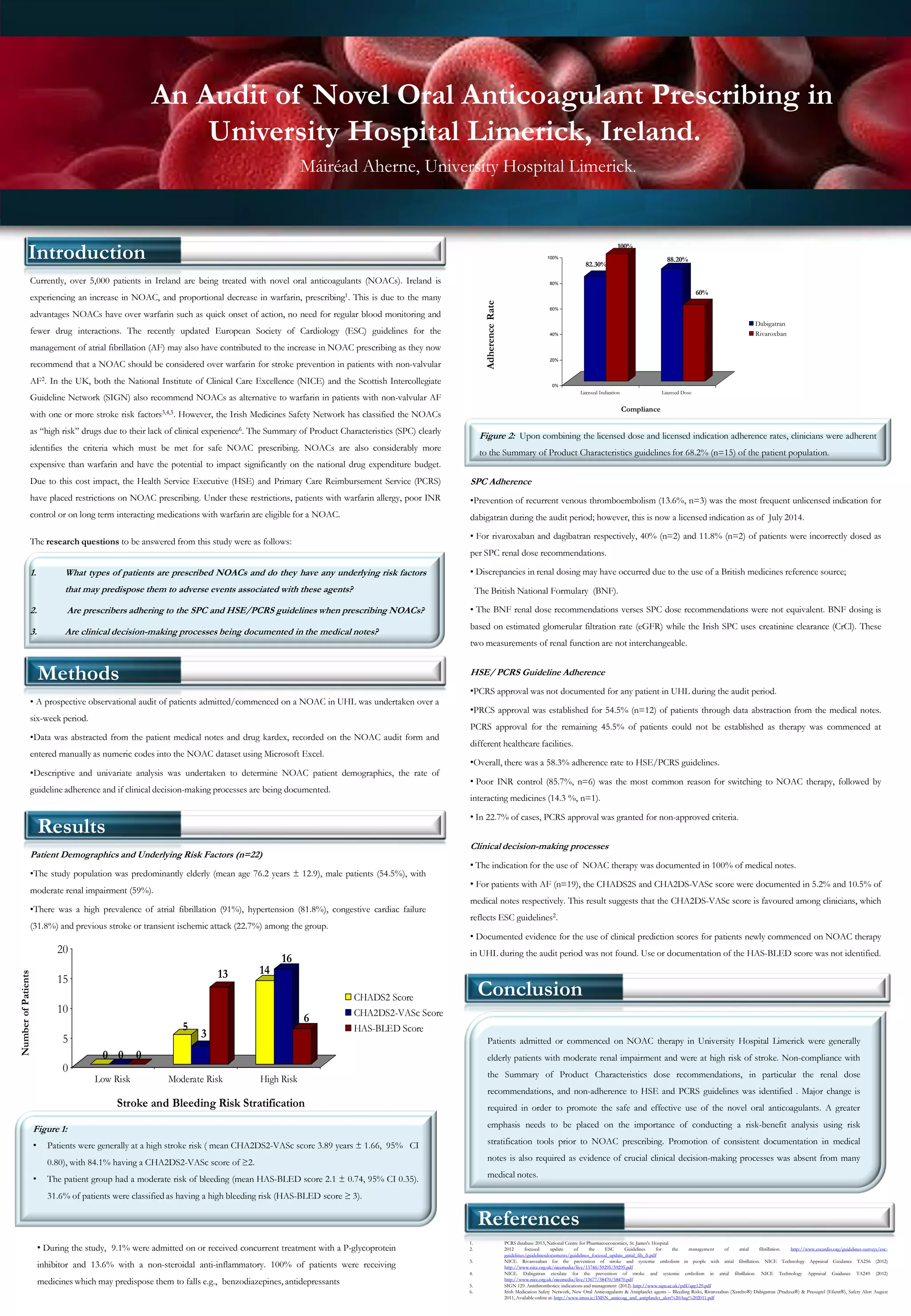
Figure 1:
• Patients were generally at a high stroke risk ( mean CHA2DS2-VASc score 3.89 years ± 1.66, 95% CI
0.80), with 84.1% having a CHA2DS2-VASc score of ≥2.
• The patient group had a moderate risk of bleeding (mean HAS-BLED score 2.1 ± 0.74, 95% CI 0.35).
31.6% of patients were classified as having a high bleeding risk (HAS-BLED score ≥ 3).
Figure 2: Upon combining the licensed dose and licensed indication adherence rates, clinicians were adherent
to the Summary of Product Characteristics guidelines for 68.2% (n=15) of the patient population.
References
Currently, over 5,000 patients in Ireland are being treated with novel oral anticoagulants (NOACs). Ireland is
experiencing an increase in NOAC, and proportional decrease in warfarin, prescribing1. This is due to the many
advantages NOACs have over warfarin such as quick onset of action, no need for regular blood monitoring and
fewer drug interactions. The recently updated European Society of Cardiology (ESC) guidelines for the
management of atrial fibrillation (AF) may also have contributed to the increase in NOAC prescribing as they now
recommend that a NOAC should be considered over warfarin for stroke prevention in patients with non-valvular
AF2. In the UK, both the National Institute of Clinical Care Excellence (NICE) and the Scottish Intercollegiate
Guideline Network (SIGN) also recommend NOACs as alternative to warfarin in patients with non-valvular AF
with one or more stroke risk factors3,4,5. However, the Irish Medicines Safety Network has classified the NOACs
as “high risk” drugs due to their lack of clinical experience6. The Summary of Product Characteristics (SPC) clearly
identifies the criteria which must be met for safe NOAC prescribing. NOACs are also considerably more
expensive than warfarin and have the potential to impact significantly on the national drug expenditure budget.
Due to this cost impact, the Health Service Executive (HSE) and Primary Care Reimbursement Service (PCRS)
have placed restrictions on NOAC prescribing. Under these restrictions, patients with warfarin allergy, poor INR
control or on long term interacting medications with warfarin are eligible for a NOAC.
Máiréad Aherne, University Hospital Limerick.
• A prospective observational audit of patients admitted/commenced on a NOAC in UHL was undertaken over a
six-week period.
•Data was abstracted from the patient medical notes and drug kardex, recorded on the NOAC audit form and
entered manually as numeric codes into the NOAC dataset using Microsoft Excel.
•Descriptive and univariate analysis was undertaken to determine NOAC patient demographics, the rate of
guideline adherence and if clinical decision-making processes are being documented.
82.30%
100%
88.20%
60%
0%
20%
40%
60%
80%
100%
Licensed Indication Licensed Dose
Compliance
Dabigatran
Rivaroxban
AdherenceRate
Patient Demographics and Underlying Risk Factors (n=22)
•The study population was predominantly elderly (mean age 76.2 years ± 12.9), male patients (54.5%), with
moderate renal impairment (59%).
•There was a high prevalence of atrial fibrillation (91%), hypertension (81.8%), congestive cardiac failure
(31.8%) and previous stroke or transient ischemic attack (22.7%) among the group.
NumberofPatients
SPC Adherence
•Prevention of recurrent venous thromboembolism (13.6%, n=3) was the most frequent unlicensed indication for
dabigatran during the audit period; however, this is now a licensed indication as of July 2014.
• For rivaroxaban and dagibatran respectively, 40% (n=2) and 11.8% (n=2) of patients were incorrectly dosed as
per SPC renal dose recommendations.
• Discrepancies in renal dosing may have occurred due to the use of a British medicines reference source;
The British National Formulary (BNF).
• The BNF renal dose recommendations verses SPC dose recommendations were not equivalent. BNF dosing is
based on estimated glomerular filtration rate (eGFR) while the Irish SPC uses creatinine clearance (CrCl). These
two measurements of renal function are not interchangeable.
HSE/ PCRS Guideline Adherence
•PCRS approval was not documented for any patient in UHL during the audit period.
•PRCS approval was established for 54.5% (n=12) of patients through data abstraction from the medical notes.
PCRS approval for the remaining 45.5% of patients could not be established as therapy was commenced at
different healthcare facilities.
•Overall, there was a 58.3% adherence rate to HSE/PCRS guidelines.
• Poor INR control (85.7%, n=6) was the most common reason for switching to NOAC therapy, followed by
interacting medicines (14.3 %, n=1).
• In 22.7% of cases, PCRS approval was granted for non-approved criteria.
Clinical decision-making processes
• The indication for the use of NOAC therapy was documented in 100% of medical notes.
• For patients with AF (n=19), the CHADS2S and CHA2DS-VASc score were documented in 5.2% and 10.5% of
medical notes respectively. This result suggests that the CHA2DS-VASc score is favoured among clinicians, which
reflects ESC guidelines2.
• Documented evidence for the use of clinical prediction scores for patients newly commenced on NOAC therapy
in UHL during the audit period was not found. Use or documentation of the HAS-BLED score was not identified.
1. PCRS database 2013,National Centre for Pharmacoeconomics, St. James's Hospital
2. 2012 focused update of the ESC Guidelines for the management of atrial fibrillation. http://www.escardio.org/guidelines-surveys/esc-
guidelines/guidelinesdocuments/guidelines_focused_update_atrial_fib_ft.pdf
3. NICE. Rivaroxaban for the prevention of stroke and systemic embolism in people with atrial fibrillation. NICE Technology Appraisal Guidance TA256 (2012)
http://www.nice.org.uk/nicemedia/live/13746/59295/59295.pdf
4. NICE. Dabigatran etexilate for the prevention of stroke and systemic embolism in atrial fibrillation. NICE Technology Appraisal Guidance TA249 (2012)
http://www.nice.org.uk/nicemedia/live/13677/58470/58470.pdf
5. SIGN 129.Antithrombotics: indications and management (2012).http://www.sign.ac.uk/pdf/qrg129.pdf
6. Irish Medication Safety Network, New Oral Anticoagulants & Antiplatelet agents – Bleeding Risks, Rivaroxaban (Xarelto®) Dabigatran (Pradaxa®) & Prasugrel (Efient®), Safety Alert August
2011,Available onlineat: http://www.imsn.ie/IMSN_anticoag_and_antiplatelet_alert%20Aug%202011.pdf
The research questions to be answered from this study were as follows:
1. What types of patients are prescribed NOACs and do they have any underlying risk factors
that may predispose them to adverse events associated with these agents?
2. Are prescribers adhering to the SPC and HSE/PCRS guidelines when prescribing NOACs?
3. Are clinical decision-making processes being documented in the medical notes?
Patients admitted or commenced on NOAC therapy in University Hospital Limerick were generally
elderly patients with moderate renal impairment and were at high risk of stroke. Non-compliance with
the Summary of Product Characteristics dose recommendations, in particular the renal dose
recommendations, and non-adherence to HSE and PCRS guidelines was identified . Major change is
required in order to promote the safe and effective use of the novel oral anticoagulants. A greater
emphasis needs to be placed on the importance of conducting a risk-benefit analysis using risk
stratification tools prior to NOAC prescribing. Promotion of consistent documentation in medical
notes is also required as evidence of crucial clinical decision-making processes was absent from many
medical notes.
• During the study, 9.1% were admitted on or received concurrent treatment with a P-glycoprotein
inhibitor and 13.6% with a non-steroidal anti-inflammatory. 100% of patients were receiving
medicines which may predispose them to falls e.g., benzodiazepines, antidepressants

NOAC poster

  • 1.
    0 0 0 5 3 1314 16 6 0 5 10 15 20 Low Risk Moderate Risk High Risk Stroke and Bleeding Risk Stratification CHADS2 Score CHA2DS2-VASc Score HAS-BLED Score An Audit of Novel Oral Anticoagulant Prescribing in University Hospital Limerick, Ireland. Results Methods Introduction Conclusion Figure 1: • Patients were generally at a high stroke risk ( mean CHA2DS2-VASc score 3.89 years ± 1.66, 95% CI 0.80), with 84.1% having a CHA2DS2-VASc score of ≥2. • The patient group had a moderate risk of bleeding (mean HAS-BLED score 2.1 ± 0.74, 95% CI 0.35). 31.6% of patients were classified as having a high bleeding risk (HAS-BLED score ≥ 3). Figure 2: Upon combining the licensed dose and licensed indication adherence rates, clinicians were adherent to the Summary of Product Characteristics guidelines for 68.2% (n=15) of the patient population. References Currently, over 5,000 patients in Ireland are being treated with novel oral anticoagulants (NOACs). Ireland is experiencing an increase in NOAC, and proportional decrease in warfarin, prescribing1. This is due to the many advantages NOACs have over warfarin such as quick onset of action, no need for regular blood monitoring and fewer drug interactions. The recently updated European Society of Cardiology (ESC) guidelines for the management of atrial fibrillation (AF) may also have contributed to the increase in NOAC prescribing as they now recommend that a NOAC should be considered over warfarin for stroke prevention in patients with non-valvular AF2. In the UK, both the National Institute of Clinical Care Excellence (NICE) and the Scottish Intercollegiate Guideline Network (SIGN) also recommend NOACs as alternative to warfarin in patients with non-valvular AF with one or more stroke risk factors3,4,5. However, the Irish Medicines Safety Network has classified the NOACs as “high risk” drugs due to their lack of clinical experience6. The Summary of Product Characteristics (SPC) clearly identifies the criteria which must be met for safe NOAC prescribing. NOACs are also considerably more expensive than warfarin and have the potential to impact significantly on the national drug expenditure budget. Due to this cost impact, the Health Service Executive (HSE) and Primary Care Reimbursement Service (PCRS) have placed restrictions on NOAC prescribing. Under these restrictions, patients with warfarin allergy, poor INR control or on long term interacting medications with warfarin are eligible for a NOAC. Máiréad Aherne, University Hospital Limerick. • A prospective observational audit of patients admitted/commenced on a NOAC in UHL was undertaken over a six-week period. •Data was abstracted from the patient medical notes and drug kardex, recorded on the NOAC audit form and entered manually as numeric codes into the NOAC dataset using Microsoft Excel. •Descriptive and univariate analysis was undertaken to determine NOAC patient demographics, the rate of guideline adherence and if clinical decision-making processes are being documented. 82.30% 100% 88.20% 60% 0% 20% 40% 60% 80% 100% Licensed Indication Licensed Dose Compliance Dabigatran Rivaroxban AdherenceRate Patient Demographics and Underlying Risk Factors (n=22) •The study population was predominantly elderly (mean age 76.2 years ± 12.9), male patients (54.5%), with moderate renal impairment (59%). •There was a high prevalence of atrial fibrillation (91%), hypertension (81.8%), congestive cardiac failure (31.8%) and previous stroke or transient ischemic attack (22.7%) among the group. NumberofPatients SPC Adherence •Prevention of recurrent venous thromboembolism (13.6%, n=3) was the most frequent unlicensed indication for dabigatran during the audit period; however, this is now a licensed indication as of July 2014. • For rivaroxaban and dagibatran respectively, 40% (n=2) and 11.8% (n=2) of patients were incorrectly dosed as per SPC renal dose recommendations. • Discrepancies in renal dosing may have occurred due to the use of a British medicines reference source; The British National Formulary (BNF). • The BNF renal dose recommendations verses SPC dose recommendations were not equivalent. BNF dosing is based on estimated glomerular filtration rate (eGFR) while the Irish SPC uses creatinine clearance (CrCl). These two measurements of renal function are not interchangeable. HSE/ PCRS Guideline Adherence •PCRS approval was not documented for any patient in UHL during the audit period. •PRCS approval was established for 54.5% (n=12) of patients through data abstraction from the medical notes. PCRS approval for the remaining 45.5% of patients could not be established as therapy was commenced at different healthcare facilities. •Overall, there was a 58.3% adherence rate to HSE/PCRS guidelines. • Poor INR control (85.7%, n=6) was the most common reason for switching to NOAC therapy, followed by interacting medicines (14.3 %, n=1). • In 22.7% of cases, PCRS approval was granted for non-approved criteria. Clinical decision-making processes • The indication for the use of NOAC therapy was documented in 100% of medical notes. • For patients with AF (n=19), the CHADS2S and CHA2DS-VASc score were documented in 5.2% and 10.5% of medical notes respectively. This result suggests that the CHA2DS-VASc score is favoured among clinicians, which reflects ESC guidelines2. • Documented evidence for the use of clinical prediction scores for patients newly commenced on NOAC therapy in UHL during the audit period was not found. Use or documentation of the HAS-BLED score was not identified. 1. PCRS database 2013,National Centre for Pharmacoeconomics, St. James's Hospital 2. 2012 focused update of the ESC Guidelines for the management of atrial fibrillation. http://www.escardio.org/guidelines-surveys/esc- guidelines/guidelinesdocuments/guidelines_focused_update_atrial_fib_ft.pdf 3. NICE. Rivaroxaban for the prevention of stroke and systemic embolism in people with atrial fibrillation. NICE Technology Appraisal Guidance TA256 (2012) http://www.nice.org.uk/nicemedia/live/13746/59295/59295.pdf 4. NICE. Dabigatran etexilate for the prevention of stroke and systemic embolism in atrial fibrillation. NICE Technology Appraisal Guidance TA249 (2012) http://www.nice.org.uk/nicemedia/live/13677/58470/58470.pdf 5. SIGN 129.Antithrombotics: indications and management (2012).http://www.sign.ac.uk/pdf/qrg129.pdf 6. Irish Medication Safety Network, New Oral Anticoagulants & Antiplatelet agents – Bleeding Risks, Rivaroxaban (Xarelto®) Dabigatran (Pradaxa®) & Prasugrel (Efient®), Safety Alert August 2011,Available onlineat: http://www.imsn.ie/IMSN_anticoag_and_antiplatelet_alert%20Aug%202011.pdf The research questions to be answered from this study were as follows: 1. What types of patients are prescribed NOACs and do they have any underlying risk factors that may predispose them to adverse events associated with these agents? 2. Are prescribers adhering to the SPC and HSE/PCRS guidelines when prescribing NOACs? 3. Are clinical decision-making processes being documented in the medical notes? Patients admitted or commenced on NOAC therapy in University Hospital Limerick were generally elderly patients with moderate renal impairment and were at high risk of stroke. Non-compliance with the Summary of Product Characteristics dose recommendations, in particular the renal dose recommendations, and non-adherence to HSE and PCRS guidelines was identified . Major change is required in order to promote the safe and effective use of the novel oral anticoagulants. A greater emphasis needs to be placed on the importance of conducting a risk-benefit analysis using risk stratification tools prior to NOAC prescribing. Promotion of consistent documentation in medical notes is also required as evidence of crucial clinical decision-making processes was absent from many medical notes. • During the study, 9.1% were admitted on or received concurrent treatment with a P-glycoprotein inhibitor and 13.6% with a non-steroidal anti-inflammatory. 100% of patients were receiving medicines which may predispose them to falls e.g., benzodiazepines, antidepressants