p. 1
S E L E C T E D WO R K S
N I C O L A L E C K
S E L E C T E D WO R K S
N I C O L A L E C K
EDUCATION
BA Graphic Design
MA Photography
@ I.S.I.A. Urbino
CONTACT
nikileck.mail@gmail.com
www.nicolaleck.com
+39 3455796229
+34 627157034
p. 17
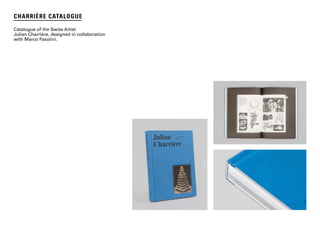
CHARRIÈRE CATALOGUE
Catalogue of the Swiss Artist
Julian Charrière, designed in collaboration
with Marco Fasolini.
p. 18
p. 19
p. 20
p. 3
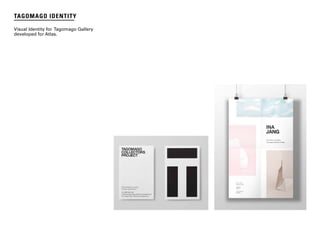
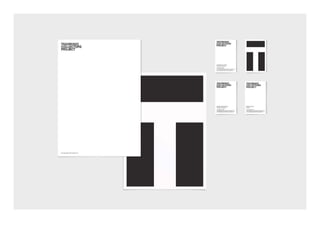
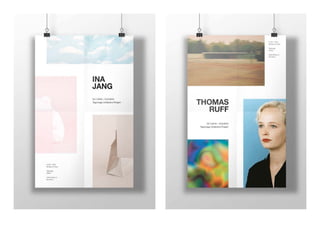
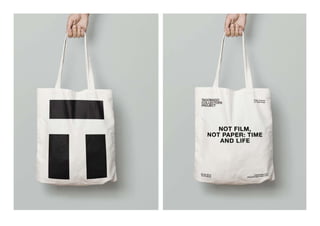
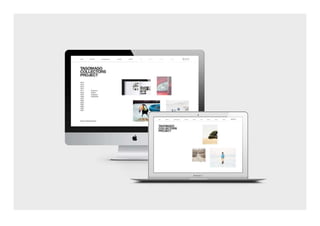
TAGOMAGO IDENTITY
Visual Identity for Tagomago Gallery
developed for Atlas.
p. 4
p. 7
p. 8
p. 5
p. 6
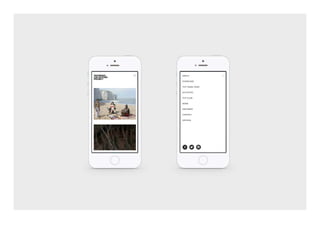
ABOUT
SHOWCASE
TCP TAKEN OVER
ACTIVITIES
TCP CLUB
NEWS
PARTNERS
CONTACT
ARCHIVE
p. 11
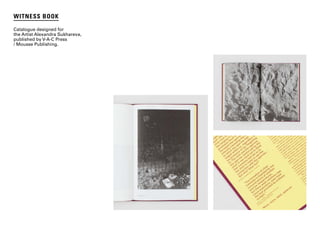
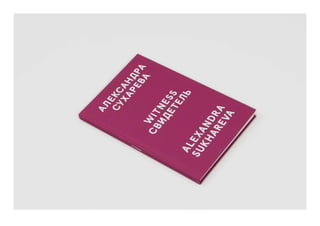
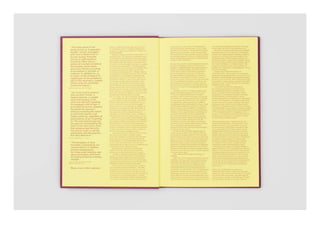
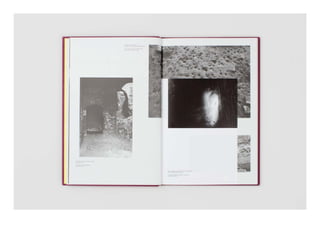
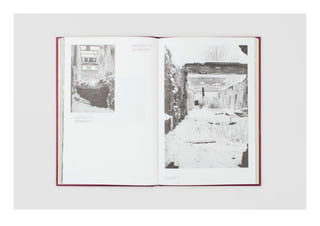
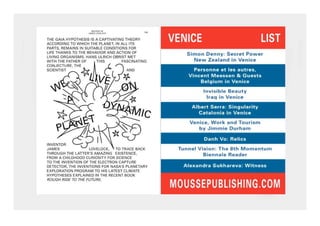
WITNESS BOOK
Catalogue designed for
the Artist Alexandra Sukhareva,
published by V-A-C Press
/ Mousse Publishing.
p. 12
p. 13
p. 14
p. 15
p. 16
p. 9
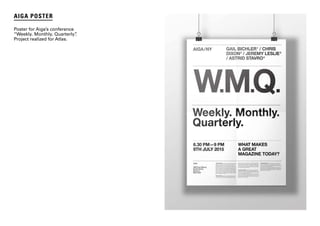
AIGA POSTER
Poster for Aiga’s conference
“Weekly. Monthly. Quarterly”.
Project realized for Atlas.
p. 21
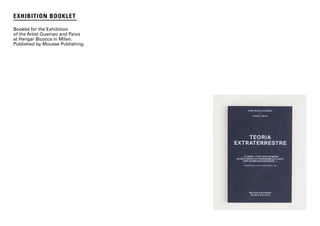
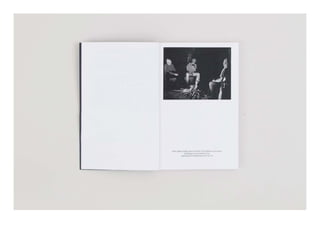
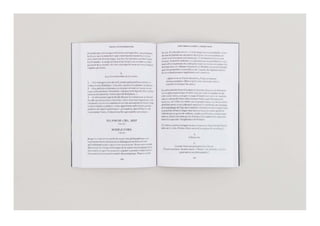
EXHIBITION BOOKLET
Booklet for the Exhibition
of the Artist Gusmao and Paiva
at Hangar Bicocca in Milan.
Published by Mousse Publishing.
p. 22
p. 23
p. 24
p. 25
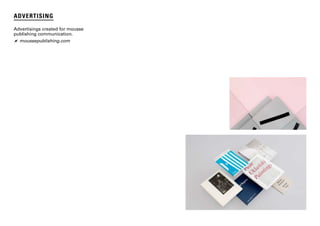
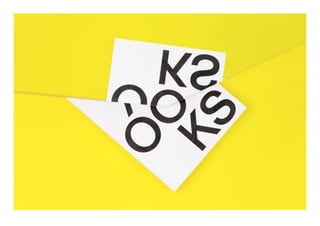
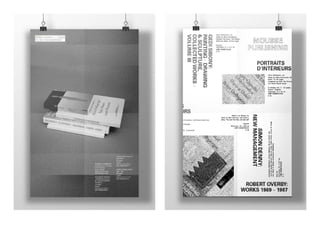
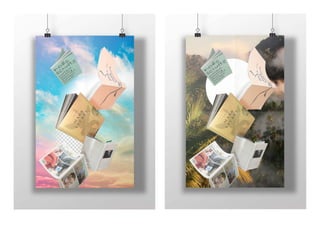
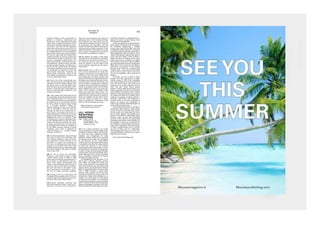
ADVERTISING
Advertisings created for mousse
publishing communication.
 moussepublishing.com
p. 26
p. 27
p. 29
p. 30
possible because of the commitment of
galleries in Germany, Switzerland and
France and of the respective institutions
which early on offered exhibitions to the
artists and published catalogues to docu-
ment them. Just think of the collections
where their works may be found. Only in a
more recent period do these artists tend to
be renationalized, but in a very superficial
way, as their country has proved unable to
do more for them than just declare them
masters of Italian art. On the contrary, the
recent interest in Italian art that you call a
revival is completely market-driven. The
high-end art market—auctions and interna-
tional galleries—needs to be fed, and after
having brought Fontana and Manzoni to
top prices, the market forces are looking
out for fresh material, even if the artists are
not historically as important as the two
great figures mentioned. Therefore, we
observe how second-rate artists of the
early 1960s are presented as masters now
in the so-called Italian sales.
AS You’re one of the international cura-
tors who has worked most frequently and
effectively with the leading figures from
the Italian scene of the last 30/40 years.
What are the unique characteristics of lan-
guage or style that have made Italian art
such an important field of study for your
practice as a curator?
DR I have always been fascinated by the
fact that Italian art has developed since the
late nineteenth century in a very autono-
mous way, different from the development
of modernist art in the countries north of
the Alps, which has been largely marked
by a formalist aesthetic. Italian art,
however, seemed to keep up its relation-
ship to Symbolism, and this goes for
Futurism as well as for Fontana and for
Arte Povera. This means that there is a
high awareness of the work as part of lan-
guage, of the levels of meaning which are
suggested by a form or a material. These
are always seen more as messengers than
as the message itself, as they are under-
stood in the formalist tradition. So in spite
of being contemporaries, Arte Povera is
the opposite of the American literalist art
of the 1960s because instead of literal
meanings, every work is designed to
unfold its rhetoric, i.e., at least a double
meaning, if not more.
AS I’m fond of anecdotes, since in the end
they help us think more intimately, with
less rhetorical distance, about the every-
day experience of being involved in the
promotion or support of art-making—in
this case, art-making whose fruits we are
looking at some 30/40 years later. What
episode exemplifies your relationship with
the artists invited to the series of exhibi-
tions in New York?
DR I’m not so much into anecdotes.
However, I recall the time when I visited
Luciano Fabro’s studio in Milan in 2003
with a class of students I was teaching. For
this occasion, he assembled his own stu-
dents, who loyally accompanied their
master to his exhibitions and lectures, in
order for them to meet with my students.
His work was there in the studio to see,
there were joyous conversations, and in
the end he kissed everyone goodbye.
AS Could you tell me a little about the
Giuseppe Penone project that will be pre-
sented in New York? And what are you pre-
paring for the Luciano Fabro show?
DS Penone’s exhibition confronts new
work with historical works in order to un-
derline the continuity of his main themes,
as he is an artist who insists on certain
ideas and invents always new means of
presenting them. On the other hand, Fabro
has produced very few works over his
whole career and each of them is unique in
its appearance and expression. For this
reason, the show will present a selection of
important pieces which represent a few
aspects of his work, while there is no ambi-
tion to create a retrospective at all, as this
is beyond the possibilities of a gallery.
AS We Italians are always a little fright-
ened about our contemporary art being in-
terpreted in an international context, so I’d
be curious to hear your point of view on
who you believe to be the Italian artist
most criminally neglected by the interna-
tional scene.
DS Generally, there is still a lot of igno-
rance on the international art scene with
regard to Arte Povera. Let me just give an
example of how two great artists of the
same generation are being treated right
now: the Carl Andre retrospective starts at
Dia Beacon and travels afterwards to three
major European museum institutions, and
so will be seen by audiences in different
countries. The Luciano Fabro retrospective
is held at the Museo Centro de Arte Reina
Sofía in Madrid and will not be seen else-
where. So its audience is limited to the
happy ones who have seen it there. The
complexity and beauty of Fabro’s work as
well as its irony and its tongue-in-cheek at-
titude are probably still not really consid-
ered and valued as highly as it would
deserve, particularly in comparison to his
peers on the international art scene.
(Dieter Schwarz in conversation
with Antonio Scoccimarro)
ULL HOHN:
PAINTING,
PAINTING
(13) PEEP-HOLE
Via Stilicone 10,
20154 Milan, Italy
peep-hole.org
With only a tinge of sarcasm, it’s a tough
time for painting. It has been battled and di-
minished by nearly a century of discourse.
Its limits have been consistently pushed,
stretched and abandoned. It’s been
deskilled, emptied, voided. Even machines
are painting, and zombies, too, and despite
its pre-eminence as the market-darling
medium du jour, it seems the medium gains
a new skeptic every day.The easiest route is
to follow suit, discount it, and continue
arts-imposed medium hierarchies, if merely
by flipping them. In this way, it’s dangerous-
ly easy to forget its hard-earned strengths
and triumphs, and most importantly, its po-
tential; painting can be a record, and what’s
more, a language—a document of thought,
friendship, courage, and love.
As highlighted by the exhibition of Ull
Hohn’s work, “painting, painting,” at Peep-
Hole, Milan, it’s exactly this ability that
comes to the forefront in the analysis of his
work, which belies its own rigor with a staid
exterior. Hohn, who studied under Gerhard
Richter in Dusseldorf before moving to New
York in 1986, occupies a unique place
between these contexts. They’re two loca-
tions that can almost be seen as poles, one
marked by a critique and a reflection on, or
negation of a recent past, the other forced
to cope with the urgency of an epidemic,
and the shortcomings of a society’s present
tense.This tension, which plays out between
places and strategies, is present in the exhi-
bition’s installation, which places two series
made in the same year (1998), Off the Wall,
and Nine Landscapes, on opposite walls, al-
lowing the work to unfurl between them
into a myriad of possibilities.
There’s something to be said for silence,
which seems to flood the works throughout
the exhibition. Maintaining a modest,
human scale, both Off the Wall, and Nine
Landscapes oscillate between a conceptual
cool and a tactile warmth that results from a
deep engagement with the medium, and a
record of an artwork’s making.They demon-
strate technical mastery, while evoking a
deeply felt sense of longing, and in some
cases, even loss. It’s not solely an engage-
ment with the material, but also an earnest,
yet constant questioning of its implications.
What does it mean to remain committed to
painting (or any medium, for that matter)
through these times? It’s a question that
rings true today—why paint? As one reflects
on this, what comes to light is that at its
core, it’s an exhibition, and a work full of
specters.
Of course, the first of these is Hohn
himself, who died prematurely of AIDS-
related causes in 1995, after witnessing
only a few exhibitions of his work in his life-
time. His elusive pulse only lends more
questions to an already enigmatic body of
work. The next, which hovers equally
present, is about what drives artistic inno-
vation, especially in the face of an adversity
both personal and political. Upon looking
closely, it’s clear that this drive and motiva-
tion results not solely from intellect, but a
mélange of impulses, including reflection,
refraction, detachment, and closeness—a
constant quest to reconcile simultaneous
desires for intimacy and knowledge, in
order to gain a deeper understanding of our
world and lived experiences.
This perhaps most evident inTom Burr’s
contribution, which follows a logic similar
to that of Hohn’s work itself. Burr, Hohn’s
former partner, has made walls that recre-
ate the same distance felt between their
studios at the Whitney Independent Study
Program, where the pair met. Grounding
the work in the context of its making (Nine
Landscapes was shown in the exhibition for
the program), it serves as a framework for
the exhibition, both physically and concep-
tually. More importantly, this intervention,
or frame, simultaneously forms a portrait
not only of Hohn, but of a relationship,
which suggests that there are more com-
monalities between criticality and vulnera-
bility than we may think.
(Text by Alex Philip Fitzgerald)
12. Giuseppe Penone, Indistinti confini - Sapina (Indistinct
Boundaries - Sapina), 2012. Photo: Cathy Carver. Courtesy: the artist
and Marian Goodman Gallery, NewYork/London/Paris
12. Giuseppe Penone, Indistinti confini - Sicla (Indistinct Boundaries
- Sicla) (detail), 2012. Photo: Cathy Carver. Courtesy: the artist and
Marian Goodman Gallery, NewYork/London/Paris
13. Ull Hohn, Untitled, 1993. Courtesy:The Estate of
Ull Hohn and Galerie Neu, Berlin
258 259
MOUSSE 48
AGENDA
MOUSSE 48
AGENDA
p. 31
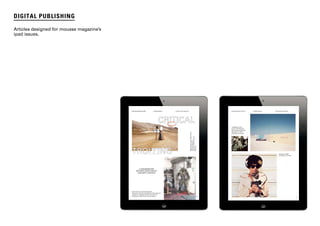
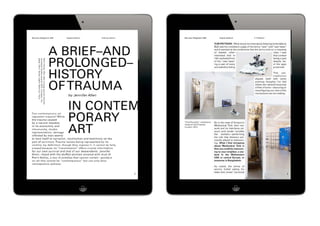
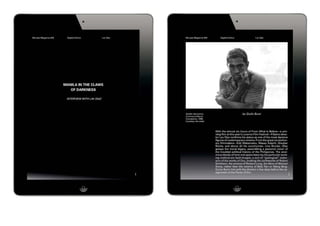
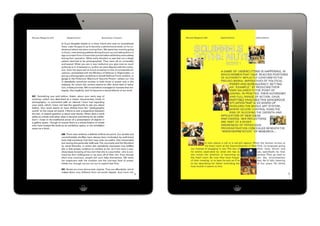
DIGITAL PUBLISHING
Articles designed for mousse magazine’s
ipad issues.
p. 32
p. 33
p. 34
p. 10
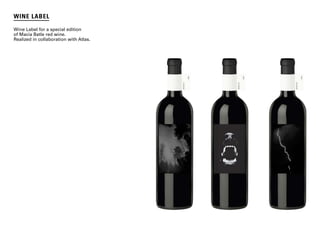
WINE LABEL
Wine Label for a special edition
of Macia Batle red wine.
Realized in collaboration with Atlas.
p. 10
WINE LABEL
Wine Label for a special edition
of Macia Batle red wine.
Realized in collaboration with Atlas.
p. 35
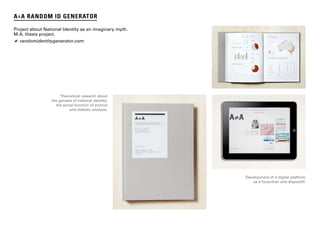
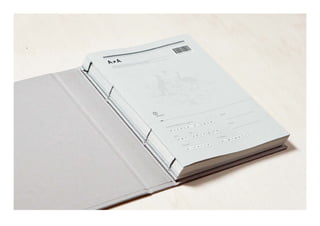
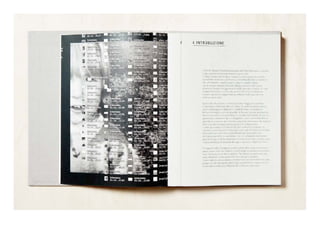
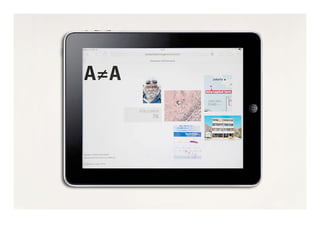
A≠A RANDOM ID GENERATOR
Project about National Identity as an imaginary myth.
M.A. thesis project.
 randomidentitygenerator.com
Theoretical research about
the genesis of national identity,
the social function of archive
and statistic analysis.
Development of a digital platform
as a focaultian anti-dispositif.
p. 36
p. 38
CONTACT
nikileck.mail@gmail.com
+39 3455796229
+34 627157034

N_Leck_portfolio

  • 1.
    p. 1 S EL E C T E D WO R K S N I C O L A L E C K
  • 2.
    S E LE C T E D WO R K S N I C O L A L E C K EDUCATION BA Graphic Design MA Photography @ I.S.I.A. Urbino CONTACT nikileck.mail@gmail.com www.nicolaleck.com +39 3455796229 +34 627157034
  • 3.
    p. 17 CHARRIÈRE CATALOGUE Catalogueof the Swiss Artist Julian Charrière, designed in collaboration with Marco Fasolini.
  • 4.
  • 5.
  • 6.
  • 7.
    p. 3 TAGOMAGO IDENTITY VisualIdentity for Tagomago Gallery developed for Atlas.
  • 8.
  • 9.
  • 10.
  • 11.
  • 12.
    p. 6 ABOUT SHOWCASE TCP TAKENOVER ACTIVITIES TCP CLUB NEWS PARTNERS CONTACT ARCHIVE
  • 13.
    p. 11 WITNESS BOOK Cataloguedesigned for the Artist Alexandra Sukhareva, published by V-A-C Press / Mousse Publishing.
  • 14.
  • 15.
  • 16.
  • 17.
  • 18.
  • 19.
    p. 9 AIGA POSTER Posterfor Aiga’s conference “Weekly. Monthly. Quarterly”. Project realized for Atlas.
  • 20.
    p. 21 EXHIBITION BOOKLET Bookletfor the Exhibition of the Artist Gusmao and Paiva at Hangar Bicocca in Milan. Published by Mousse Publishing.
  • 21.
  • 22.
  • 23.
  • 24.
    p. 25 ADVERTISING Advertisings createdfor mousse publishing communication.  moussepublishing.com
  • 25.
  • 26.
  • 28.
  • 29.
    p. 30 possible becauseof the commitment of galleries in Germany, Switzerland and France and of the respective institutions which early on offered exhibitions to the artists and published catalogues to docu- ment them. Just think of the collections where their works may be found. Only in a more recent period do these artists tend to be renationalized, but in a very superficial way, as their country has proved unable to do more for them than just declare them masters of Italian art. On the contrary, the recent interest in Italian art that you call a revival is completely market-driven. The high-end art market—auctions and interna- tional galleries—needs to be fed, and after having brought Fontana and Manzoni to top prices, the market forces are looking out for fresh material, even if the artists are not historically as important as the two great figures mentioned. Therefore, we observe how second-rate artists of the early 1960s are presented as masters now in the so-called Italian sales. AS You’re one of the international cura- tors who has worked most frequently and effectively with the leading figures from the Italian scene of the last 30/40 years. What are the unique characteristics of lan- guage or style that have made Italian art such an important field of study for your practice as a curator? DR I have always been fascinated by the fact that Italian art has developed since the late nineteenth century in a very autono- mous way, different from the development of modernist art in the countries north of the Alps, which has been largely marked by a formalist aesthetic. Italian art, however, seemed to keep up its relation- ship to Symbolism, and this goes for Futurism as well as for Fontana and for Arte Povera. This means that there is a high awareness of the work as part of lan- guage, of the levels of meaning which are suggested by a form or a material. These are always seen more as messengers than as the message itself, as they are under- stood in the formalist tradition. So in spite of being contemporaries, Arte Povera is the opposite of the American literalist art of the 1960s because instead of literal meanings, every work is designed to unfold its rhetoric, i.e., at least a double meaning, if not more. AS I’m fond of anecdotes, since in the end they help us think more intimately, with less rhetorical distance, about the every- day experience of being involved in the promotion or support of art-making—in this case, art-making whose fruits we are looking at some 30/40 years later. What episode exemplifies your relationship with the artists invited to the series of exhibi- tions in New York? DR I’m not so much into anecdotes. However, I recall the time when I visited Luciano Fabro’s studio in Milan in 2003 with a class of students I was teaching. For this occasion, he assembled his own stu- dents, who loyally accompanied their master to his exhibitions and lectures, in order for them to meet with my students. His work was there in the studio to see, there were joyous conversations, and in the end he kissed everyone goodbye. AS Could you tell me a little about the Giuseppe Penone project that will be pre- sented in New York? And what are you pre- paring for the Luciano Fabro show? DS Penone’s exhibition confronts new work with historical works in order to un- derline the continuity of his main themes, as he is an artist who insists on certain ideas and invents always new means of presenting them. On the other hand, Fabro has produced very few works over his whole career and each of them is unique in its appearance and expression. For this reason, the show will present a selection of important pieces which represent a few aspects of his work, while there is no ambi- tion to create a retrospective at all, as this is beyond the possibilities of a gallery. AS We Italians are always a little fright- ened about our contemporary art being in- terpreted in an international context, so I’d be curious to hear your point of view on who you believe to be the Italian artist most criminally neglected by the interna- tional scene. DS Generally, there is still a lot of igno- rance on the international art scene with regard to Arte Povera. Let me just give an example of how two great artists of the same generation are being treated right now: the Carl Andre retrospective starts at Dia Beacon and travels afterwards to three major European museum institutions, and so will be seen by audiences in different countries. The Luciano Fabro retrospective is held at the Museo Centro de Arte Reina Sofía in Madrid and will not be seen else- where. So its audience is limited to the happy ones who have seen it there. The complexity and beauty of Fabro’s work as well as its irony and its tongue-in-cheek at- titude are probably still not really consid- ered and valued as highly as it would deserve, particularly in comparison to his peers on the international art scene. (Dieter Schwarz in conversation with Antonio Scoccimarro) ULL HOHN: PAINTING, PAINTING (13) PEEP-HOLE Via Stilicone 10, 20154 Milan, Italy peep-hole.org With only a tinge of sarcasm, it’s a tough time for painting. It has been battled and di- minished by nearly a century of discourse. Its limits have been consistently pushed, stretched and abandoned. It’s been deskilled, emptied, voided. Even machines are painting, and zombies, too, and despite its pre-eminence as the market-darling medium du jour, it seems the medium gains a new skeptic every day.The easiest route is to follow suit, discount it, and continue arts-imposed medium hierarchies, if merely by flipping them. In this way, it’s dangerous- ly easy to forget its hard-earned strengths and triumphs, and most importantly, its po- tential; painting can be a record, and what’s more, a language—a document of thought, friendship, courage, and love. As highlighted by the exhibition of Ull Hohn’s work, “painting, painting,” at Peep- Hole, Milan, it’s exactly this ability that comes to the forefront in the analysis of his work, which belies its own rigor with a staid exterior. Hohn, who studied under Gerhard Richter in Dusseldorf before moving to New York in 1986, occupies a unique place between these contexts. They’re two loca- tions that can almost be seen as poles, one marked by a critique and a reflection on, or negation of a recent past, the other forced to cope with the urgency of an epidemic, and the shortcomings of a society’s present tense.This tension, which plays out between places and strategies, is present in the exhi- bition’s installation, which places two series made in the same year (1998), Off the Wall, and Nine Landscapes, on opposite walls, al- lowing the work to unfurl between them into a myriad of possibilities. There’s something to be said for silence, which seems to flood the works throughout the exhibition. Maintaining a modest, human scale, both Off the Wall, and Nine Landscapes oscillate between a conceptual cool and a tactile warmth that results from a deep engagement with the medium, and a record of an artwork’s making.They demon- strate technical mastery, while evoking a deeply felt sense of longing, and in some cases, even loss. It’s not solely an engage- ment with the material, but also an earnest, yet constant questioning of its implications. What does it mean to remain committed to painting (or any medium, for that matter) through these times? It’s a question that rings true today—why paint? As one reflects on this, what comes to light is that at its core, it’s an exhibition, and a work full of specters. Of course, the first of these is Hohn himself, who died prematurely of AIDS- related causes in 1995, after witnessing only a few exhibitions of his work in his life- time. His elusive pulse only lends more questions to an already enigmatic body of work. The next, which hovers equally present, is about what drives artistic inno- vation, especially in the face of an adversity both personal and political. Upon looking closely, it’s clear that this drive and motiva- tion results not solely from intellect, but a mélange of impulses, including reflection, refraction, detachment, and closeness—a constant quest to reconcile simultaneous desires for intimacy and knowledge, in order to gain a deeper understanding of our world and lived experiences. This perhaps most evident inTom Burr’s contribution, which follows a logic similar to that of Hohn’s work itself. Burr, Hohn’s former partner, has made walls that recre- ate the same distance felt between their studios at the Whitney Independent Study Program, where the pair met. Grounding the work in the context of its making (Nine Landscapes was shown in the exhibition for the program), it serves as a framework for the exhibition, both physically and concep- tually. More importantly, this intervention, or frame, simultaneously forms a portrait not only of Hohn, but of a relationship, which suggests that there are more com- monalities between criticality and vulnera- bility than we may think. (Text by Alex Philip Fitzgerald) 12. Giuseppe Penone, Indistinti confini - Sapina (Indistinct Boundaries - Sapina), 2012. Photo: Cathy Carver. Courtesy: the artist and Marian Goodman Gallery, NewYork/London/Paris 12. Giuseppe Penone, Indistinti confini - Sicla (Indistinct Boundaries - Sicla) (detail), 2012. Photo: Cathy Carver. Courtesy: the artist and Marian Goodman Gallery, NewYork/London/Paris 13. Ull Hohn, Untitled, 1993. Courtesy:The Estate of Ull Hohn and Galerie Neu, Berlin 258 259 MOUSSE 48 AGENDA MOUSSE 48 AGENDA

  • 30.
    p. 31 DIGITAL PUBLISHING Articlesdesigned for mousse magazine’s ipad issues.
  • 31.
  • 32.
  • 33.
  • 34.
    p. 10 WINE LABEL WineLabel for a special edition of Macia Batle red wine. Realized in collaboration with Atlas. p. 10 WINE LABEL Wine Label for a special edition of Macia Batle red wine. Realized in collaboration with Atlas.
  • 35.
    p. 35 A≠A RANDOMID GENERATOR Project about National Identity as an imaginary myth. M.A. thesis project.  randomidentitygenerator.com Theoretical research about the genesis of national identity, the social function of archive and statistic analysis. Development of a digital platform as a focaultian anti-dispositif.
  • 36.
  • 38.
  • 39.