
www.modelexam.in - Online Mock Tests - NISM, IIBF, JAIIB, CAIIB, IRDA, INSURANCE Exams
--------------------------------------------------------------------------------------------------------------------------------------------------
________________________________________________________________________________________
For Training videos on Stock Markets, Mutual Funds - https://www.youtube.com/@modelexam2012
Study Notes for
NISM Series V – A:
MUTUAL FUND DISTRIBUTORS Exam
(Earlier - AMFI Exam)
https://modelexam.in/nism-exams/nism-mock-test.html
Scan the following QR code for NISM Mutual Fund Exam Training Videos
YouTube Training Video Link : English
www.modelexam.in provides with basic information, study material & online model
exams to help you succeed in NISM exams. (NISM – National Institute of Securities
Markets – A SEBI Institute)
Both Premium (Paid) & Demo (Free) Versions are available in the website.
HARDCOPY / SOFTCOPY of the tests will NOT be provided
NISM Series 5A - MUTUAL FUND DISTRIBUTORS EXAM
Assessment Structure
https://youtu.be/_SmCb_UmiLA?list=PLCZvkZJiAVK56z_al_5b-
4WMMRUXMWydc
Total Questions = 100 X 1 mark each (NO NEGATIVE MARKS)
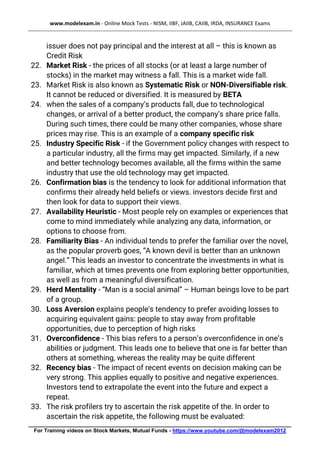
Total Duration = 2 hours.
Passing score = 50%
Certificate Validity = 3 years.
Certificate Renewal - Attend NISM CPE Session
Call Srinivasan @ 98949 49988 for NISM CPE Training details in South India.
www.modelexam.in - Online Mock Tests - NISM, IIBF, JAIIB, CAIIB, IRDA, INSURANCE Exams
--------------------------------------------------------------------------------------------------------------------------------------------------
________________________________________________________________________________________
For Training videos on Stock Markets, Mutual Funds - https://www.youtube.com/@modelexam2012
Chapterwise Weightages
Unit 1 Investment Landscape 8 %
Unit 2 Concept & Role of a Mutual Fund 6 %
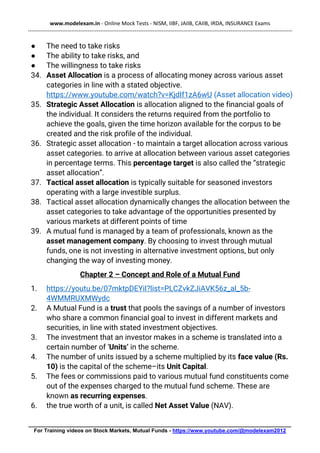
Unit 3 Legal Structure of Mutual Funds in India 4 %
Unit 4 Legal and Regulatory Framework 10 %
Unit 5 Scheme Related Information 10 %
Unit 6 Fund Distribution and Channel Management Practices 6 %
Unit 7 NAV, Total Expense Ratio and Pricing of units 8 %
Unit 8 Taxation 4 %
Unit 9 Investor Services 20 %
Unit 10 Risk, Return and Performance of Funds 7 %
Unit 11 Mutual Fund Scheme Performance 7 %
Unit 12 Mutual Fund Scheme Selection 10 %
YouTube videos – Topic wise
1. How to become a Mutual Fund Agent?
2. NISM Mutual Fund Distributors Exam Pattern
3. What is a Mutual Fund?
4. Terminologies used in Mutual Fund Industry
5. Open and Closed end funds
6. Types of Equity Funds
7. Types of Debt Mutual Funds
8. Types of Hybrid Schemes, Balanced Schemes
9. Tax Saving Scheme - ELSS
10. Gold Exchange Traded Fund
11. Passive Funds and Fixed Maturity Plans
12. Index Funds
13. Tracking Error - Index Funds
14. Mutual Fund Structure and Constituents
15. Grandfather Clause introduced in Budget and Taxation changes
16. Calculation of Long term capital gain tax using Indexation
17. Tax Deducted at Source and Securities Transaction Tax
www.modelexam.in - Online Mock Tests - NISM, IIBF, JAIIB, CAIIB, IRDA, INSURANCE Exams
--------------------------------------------------------------------------------------------------------------------------------------------------
________________________________________________________________________________________
For Training videos on Stock Markets, Mutual Funds - https://www.youtube.com/@modelexam2012
18. NAV Cut off Timing for Non Liquid Funds
19. Cutoff Time for Liquid Fund Purchase | Mutual Fund - YouTube
20. Liquid Funds - Redemption
21. Who can Invest in Mutual Funds?
22. Micro SIP and PAN Exempt Cases
23. Risk Adjusted Performance - Sharpe Ratio
24. Risk Adjusted Performance - Treynor ratio and Alpha
25. Mutual Fund Offer Document
26. Statement of Additional Information
27. NAV, Sale Price, Repurchase Price
28. NAV Calculation - Part1
29. NAV Calculation - Part2
30. Asset Allocation, Strategic Asset Allocation
31. SIP and STP
32. SWP, Dividend Payout, Dividend Reinvestment and Growth Options
33. Systematic Risk and Unsystematic Risk
34. Beta - measure of Market risk
35. Upfront Commission, Trail Commission, Transaction Charges
36. Stamp Duty on Mutual Funds
37. Mutual Fund Instant Access Facility
38. Taxation of Mutual Fund Dividend | TDS on MF Dividends
39. Direct Plan & Regular Plan of Mutual Funds
40. What is Sensex and Nifty? How it is calculated?
Chapter 1 – The Investment Landscape
1. Saving and investing are not to be considered as two completely different
things, but two steps of the same process – in order to invest money, one
needs to save first. Thus, saving precedes investing.
2. Factors to evaluate investments - Safety, Liquidity, Returns, Convenience,
Ticket size, Taxability of income, Tax deduction
3. There are four broad asset categories or asset classes i.e. Real estate,
Commodities, Equity and Fixed income.
4. Real estate could be further classified into various categories, viz.,
residential real estate, land, commercial real estate, etc.
5. Real estate is illiquid. It is not a divisible asset
6. Apart from capital appreciation, Real Estate can also generate current
income in form of rents.
www.modelexam.in - Online Mock Tests - NISM, IIBF, JAIIB, CAIIB, IRDA, INSURANCE Exams
--------------------------------------------------------------------------------------------------------------------------------------------------
________________________________________________________________________________________
For Training videos on Stock Markets, Mutual Funds - https://www.youtube.com/@modelexam2012
7. In case of real estate, the transaction costs, e.g., brokerage charges,
registration charges, etc. are quite high. This would bring down the return
on investment.
8. Bonds can be classified into subcategories on the basis of issuer type i.e.,
issued by the government or corporates or on the basis of the maturity
date: short term bonds (ideal for liquidity needs), medium term bonds,
and long-term bonds (income generation needs).
9. Bonds pay regular interest; thus, the investors can expect current income.
Bond transactions through secondary market may result into capital
gains or losses.
10. Two commodities that many investors are quite familiar with as
investment avenues, are gold and silver (Metal commodities).
11. Investments in equity and bonds can be done only in financial form,
whereas one can buy the other two assets, viz., real estate and
commodities either in financial or in physical form. It is this physical form
that gives a feeling of safety to many. Anything that is tangible is
perceived to be safer than something intangible.
12. Real estate and commodities like silver or gold could be bought as
investment or for consumption purposes
13. Equity - owner’s capital in a business. Also known as Risk Capital.
14. Apart from long term capital appreciation, equity share owners may also
receive dividends
15. Inflation or price inflation is the general rise in the prices of various
commodities, products, and services that we consume.
16. Inflation erodes the purchasing power of the money.
17. The returns on investment without factoring inflation is known as the
“nominal rate”. Returns adjusted for inflation, one gets the “real rate of
return”. If the investment returns are higher than inflation, the investor is
earning a positive real rate, and vice versa.
18. Liquidity risk is when the investor cannot liquidate their investments at
will.
19. Interest rate risk is the risk that an investment’s value will change as a
result of a change in interest rates.
20. Any reduction in interest rates will increase the value of the Bonds and
vice versa
21. Credit Risk - When someone lends money to a borrower, the borrower
commits to repay the principal as well as pay the interest as per the
agreed schedule. The issuer pays the dues, but with some delay, and the
www.modelexam.in - Online Mock Tests - NISM, IIBF, JAIIB, CAIIB, IRDA, INSURANCE Exams
--------------------------------------------------------------------------------------------------------------------------------------------------
________________________________________________________________________________________
For Training videos on Stock Markets, Mutual Funds - https://www.youtube.com/@modelexam2012
issuer does not pay principal and the interest at all – this is known as
Credit Risk
22. Market Risk - the prices of all stocks (or at least a large number of
stocks) in the market may witness a fall. This is a market wide fall.
23. Market Risk is also known as Systematic Risk or NON-Diversifiable risk.
It cannot be reduced or diversified. It is measured by BETA
24. when the sales of a company’s products fall, due to technological
changes, or arrival of a better product, the company’s share price falls.
During such times, there could be many other companies, whose share
prices may rise. This is an example of a company specific risk
25. Industry Specific Risk - if the Government policy changes with respect to
a particular industry, all the firms may get impacted. Similarly, if a new
and better technology becomes available, all the firms within the same
industry that use the old technology may get impacted.
26. Confirmation bias is the tendency to look for additional information that
confirms their already held beliefs or views. investors decide first and
then look for data to support their views.
27. Availability Heuristic - Most people rely on examples or experiences that
come to mind immediately while analyzing any data, information, or
options to choose from.
28. Familiarity Bias - An individual tends to prefer the familiar over the novel,
as the popular proverb goes, “A known devil is better than an unknown
angel.” This leads an investor to concentrate the investments in what is
familiar, which at times prevents one from exploring better opportunities,
as well as from a meaningful diversification.
29. Herd Mentality - “Man is a social animal” – Human beings love to be part
of a group.
30. Loss Aversion explains people's tendency to prefer avoiding losses to
acquiring equivalent gains: people to stay away from profitable
opportunities, due to perception of high risks
31. Overconfidence - This bias refers to a person’s overconfidence in one’s
abilities or judgment. This leads one to believe that one is far better than
others at something, whereas the reality may be quite different
32. Recency bias - The impact of recent events on decision making can be
very strong. This applies equally to positive and negative experiences.
Investors tend to extrapolate the event into the future and expect a
repeat.
33. The risk profilers try to ascertain the risk appetite of the. In order to
ascertain the risk appetite, the following must be evaluated:
www.modelexam.in - Online Mock Tests - NISM, IIBF, JAIIB, CAIIB, IRDA, INSURANCE Exams
--------------------------------------------------------------------------------------------------------------------------------------------------
________________________________________________________________________________________
For Training videos on Stock Markets, Mutual Funds - https://www.youtube.com/@modelexam2012
● The need to take risks
● The ability to take risks, and
● The willingness to take risks
34. Asset Allocation is a process of allocating money across various asset
categories in line with a stated objective.
https://www.youtube.com/watch?v=KjdIf1zA6wU (Asset allocation video)
35. Strategic Asset Allocation is allocation aligned to the financial goals of
the individual. It considers the returns required from the portfolio to
achieve the goals, given the time horizon available for the corpus to be
created and the risk profile of the individual.
36. Strategic asset allocation - to maintain a target allocation across various
asset categories. to arrive at allocation between various asset categories
in percentage terms. This percentage target is also called the “strategic
asset allocation”.
37. Tactical asset allocation is typically suitable for seasoned investors
operating with a large investible surplus.
38. Tactical asset allocation dynamically changes the allocation between the
asset categories to take advantage of the opportunities presented by
various markets at different points of time
39. A mutual fund is managed by a team of professionals, known as the
asset management company. By choosing to invest through mutual
funds, one is not investing in alternative investment options, but only
changing the way of investing money.
Chapter 2 – Concept and Role of a Mutual Fund
1. https://youtu.be/07mktpDEYiI?list=PLCZvkZJiAVK56z_al_5b-
4WMMRUXMWydc
2. A Mutual Fund is a trust that pools the savings of a number of investors
who share a common financial goal to invest in different markets and
securities, in line with stated investment objectives.
3. The investment that an investor makes in a scheme is translated into a
certain number of ‘Units’ in the scheme.
4. The number of units issued by a scheme multiplied by its face value (Rs.
10) is the capital of the scheme–its Unit Capital.
5. The fees or commissions paid to various mutual fund constituents come
out of the expenses charged to the mutual fund scheme. These are
known as recurring expenses.
6. the true worth of a unit, is called Net Asset Value (NAV).
www.modelexam.in - Online Mock Tests - NISM, IIBF, JAIIB, CAIIB, IRDA, INSURANCE Exams
--------------------------------------------------------------------------------------------------------------------------------------------------
________________________________________________________________________________________
For Training videos on Stock Markets, Mutual Funds - https://www.youtube.com/@modelexam2012
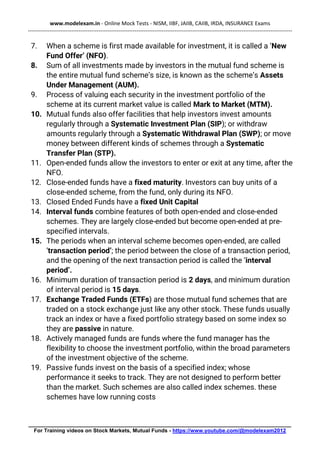
7. When a scheme is first made available for investment, it is called a ‘New
Fund Offer’ (NFO).
8. Sum of all investments made by investors in the mutual fund scheme is
the entire mutual fund scheme’s size, is known as the scheme’s Assets
Under Management (AUM).
9. Process of valuing each security in the investment portfolio of the
scheme at its current market value is called Mark to Market (MTM).
10. Mutual funds also offer facilities that help investors invest amounts
regularly through a Systematic Investment Plan (SIP); or withdraw
amounts regularly through a Systematic Withdrawal Plan (SWP); or move
money between different kinds of schemes through a Systematic
Transfer Plan (STP).
11. Open-ended funds allow the investors to enter or exit at any time, after the
NFO.
12. Close-ended funds have a fixed maturity. Investors can buy units of a
close-ended scheme, from the fund, only during its NFO.
13. Closed Ended Funds have a fixed Unit Capital
14. Interval funds combine features of both open-ended and close-ended
schemes. They are largely close-ended but become open-ended at pre-
specified intervals.
15. The periods when an interval scheme becomes open-ended, are called
‘transaction period’; the period between the close of a transaction period,
and the opening of the next transaction period is called the ‘interval
period’.
16. Minimum duration of transaction period is 2 days, and minimum duration
of interval period is 15 days.
17. Exchange Traded Funds (ETFs) are those mutual fund schemes that are
traded on a stock exchange just like any other stock. These funds usually
track an index or have a fixed portfolio strategy based on some index so
they are passive in nature.
18. Actively managed funds are funds where the fund manager has the
flexibility to choose the investment portfolio, within the broad parameters
of the investment objective of the scheme.
19. Passive funds invest on the basis of a specified index; whose
performance it seeks to track. They are not designed to perform better
than the market. Such schemes are also called index schemes. these
schemes have low running costs
www.modelexam.in - Online Mock Tests - NISM, IIBF, JAIIB, CAIIB, IRDA, INSURANCE Exams
--------------------------------------------------------------------------------------------------------------------------------------------------
________________________________________________________________________________________
For Training videos on Stock Markets, Mutual Funds - https://www.youtube.com/@modelexam2012
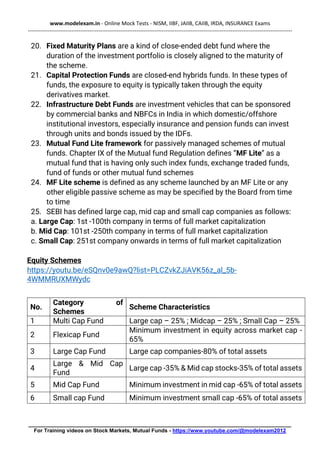
20. Fixed Maturity Plans are a kind of close-ended debt fund where the
duration of the investment portfolio is closely aligned to the maturity of
the scheme.
21. Capital Protection Funds are closed-end hybrids funds. In these types of
funds, the exposure to equity is typically taken through the equity
derivatives market.
22. Infrastructure Debt Funds are investment vehicles that can be sponsored
by commercial banks and NBFCs in India in which domestic/offshore
institutional investors, especially insurance and pension funds can invest
through units and bonds issued by the IDFs.
23. Mutual Fund Lite framework for passively managed schemes of mutual
funds. Chapter IX of the Mutual fund Regulation defines “MF Lite” as a
mutual fund that is having only such index funds, exchange traded funds,
fund of funds or other mutual fund schemes
24. MF Lite scheme is defined as any scheme launched by an MF Lite or any
other eligible passive scheme as may be specified by the Board from time
to time
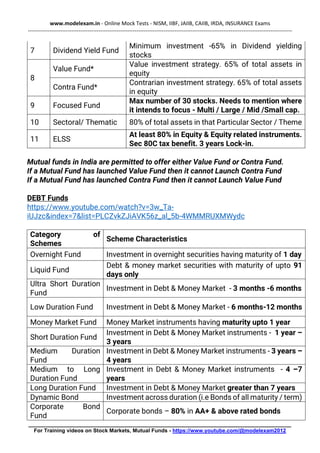
25. SEBI has defined large cap, mid cap and small cap companies as follows:
a. Large Cap: 1st -100th company in terms of full market capitalization
b. Mid Cap: 101st -250th company in terms of full market capitalization
c. Small Cap: 251st company onwards in terms of full market capitalization
Equity Schemes
https://youtu.be/eSQnv0e9awQ?list=PLCZvkZJiAVK56z_al_5b-
4WMMRUXMWydc
No.
Category of
Schemes
Scheme Characteristics
1 Multi Cap Fund Large cap – 25% ; Midcap – 25% ; Small Cap – 25%
2 Flexicap Fund
Minimum investment in equity across market cap -
65%
3 Large Cap Fund Large cap companies-80% of total assets
4
Large & Mid Cap
Fund
Large cap -35% & Mid cap stocks-35% of total assets
5 Mid Cap Fund Minimum investment in mid cap -65% of total assets
6 Small cap Fund Minimum investment small cap -65% of total assets
www.modelexam.in - Online Mock Tests - NISM, IIBF, JAIIB, CAIIB, IRDA, INSURANCE Exams
--------------------------------------------------------------------------------------------------------------------------------------------------
________________________________________________________________________________________
For Training videos on Stock Markets, Mutual Funds - https://www.youtube.com/@modelexam2012
7 Dividend Yield Fund
Minimum investment -65% in Dividend yielding
stocks
8
Value Fund*
Value investment strategy. 65% of total assets in
equity
Contra Fund*
Contrarian investment strategy. 65% of total assets
in equity
9 Focused Fund
Max number of 30 stocks. Needs to mention where
it intends to focus - Multi / Large / Mid /Small cap.
10 Sectoral/ Thematic 80% of total assets in that Particular Sector / Theme
11 ELSS
At least 80% in Equity & Equity related instruments.
Sec 80C tax benefit. 3 years Lock-in.
Mutual funds in India are permitted to offer either Value Fund or Contra Fund.
If a Mutual Fund has launched Value Fund then it cannot Launch Contra Fund
If a Mutual Fund has launched Contra Fund then it cannot Launch Value Fund
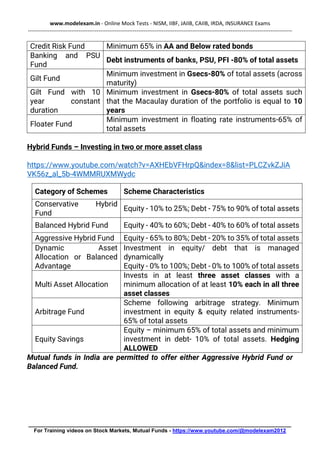
DEBT Funds
https://www.youtube.com/watch?v=3w_Ta-
iUJzc&index=7&list=PLCZvkZJiAVK56z_al_5b-4WMMRUXMWydc
Category of
Schemes
Scheme Characteristics
Overnight Fund Investment in overnight securities having maturity of 1 day
Liquid Fund
Debt & money market securities with maturity of upto 91
days only
Ultra Short Duration
Fund
Investment in Debt & Money Market - 3 months -6 months
Low Duration Fund Investment in Debt & Money Market - 6 months-12 months
Money Market Fund Money Market instruments having maturity upto 1 year
Short Duration Fund
Investment in Debt & Money Market instruments - 1 year –
3 years
Medium Duration
Fund
Investment in Debt & Money Market instruments - 3 years –
4 years
Medium to Long
Duration Fund
Investment in Debt & Money Market instruments - 4 –7
years
Long Duration Fund Investment in Debt & Money Market greater than 7 years
Dynamic Bond Investment across duration (i.e Bonds of all maturity / term)
Corporate Bond
Fund
Corporate bonds – 80% in AA+ & above rated bonds
www.modelexam.in - Online Mock Tests - NISM, IIBF, JAIIB, CAIIB, IRDA, INSURANCE Exams
--------------------------------------------------------------------------------------------------------------------------------------------------
________________________________________________________________________________________
For Training videos on Stock Markets, Mutual Funds - https://www.youtube.com/@modelexam2012
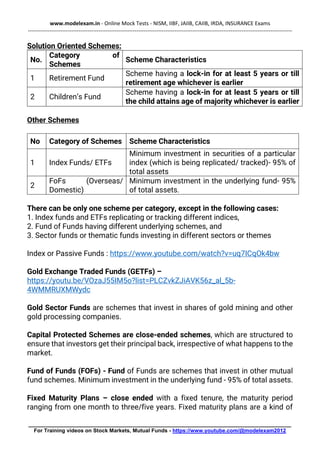
Credit Risk Fund Minimum 65% in AA and Below rated bonds
Banking and PSU
Fund
Debt instruments of banks, PSU, PFI -80% of total assets
Gilt Fund
Minimum investment in Gsecs-80% of total assets (across
maturity)
Gilt Fund with 10
year constant
duration
Minimum investment in Gsecs-80% of total assets such
that the Macaulay duration of the portfolio is equal to 10
years
Floater Fund
Minimum investment in floating rate instruments-65% of
total assets
Hybrid Funds – Investing in two or more asset class
https://www.youtube.com/watch?v=AXHEbVFHrpQ&index=8&list=PLCZvkZJiA
VK56z_al_5b-4WMMRUXMWydc
Mutual funds in India are permitted to offer either Aggressive Hybrid Fund or
Balanced Fund.
Category of Schemes Scheme Characteristics
Conservative Hybrid
Fund
Equity - 10% to 25%; Debt - 75% to 90% of total assets
Balanced Hybrid Fund Equity - 40% to 60%; Debt - 40% to 60% of total assets
Aggressive Hybrid Fund Equity - 65% to 80%; Debt - 20% to 35% of total assets
Dynamic Asset
Allocation or Balanced
Advantage
Investment in equity/ debt that is managed
dynamically
Equity - 0% to 100%; Debt - 0% to 100% of total assets
Multi Asset Allocation
Invests in at least three asset classes with a
minimum allocation of at least 10% each in all three
asset classes
Arbitrage Fund
Scheme following arbitrage strategy. Minimum
investment in equity & equity related instruments-
65% of total assets
Equity Savings
Equity – minimum 65% of total assets and minimum
investment in debt- 10% of total assets. Hedging
ALLOWED
www.modelexam.in - Online Mock Tests - NISM, IIBF, JAIIB, CAIIB, IRDA, INSURANCE Exams
--------------------------------------------------------------------------------------------------------------------------------------------------
________________________________________________________________________________________
For Training videos on Stock Markets, Mutual Funds - https://www.youtube.com/@modelexam2012
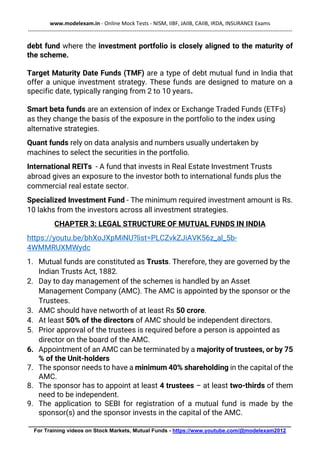
Solution Oriented Schemes:
No.
Category of
Schemes
Scheme Characteristics
1 Retirement Fund
Scheme having a lock-in for at least 5 years or till
retirement age whichever is earlier
2 Children’s Fund
Scheme having a lock-in for at least 5 years or till
the child attains age of majority whichever is earlier
Other Schemes
No Category of Schemes Scheme Characteristics
1 Index Funds/ ETFs
Minimum investment in securities of a particular
index (which is being replicated/ tracked)- 95% of
total assets
2
FoFs (Overseas/
Domestic)
Minimum investment in the underlying fund- 95%
of total assets.
There can be only one scheme per category, except in the following cases:
1. Index funds and ETFs replicating or tracking different indices,
2. Fund of Funds having different underlying schemes, and
3. Sector funds or thematic funds investing in different sectors or themes
Index or Passive Funds : https://www.youtube.com/watch?v=uq7ICqOk4bw
Gold Exchange Traded Funds (GETFs) –
https://youtu.be/VOzaJ55IM5o?list=PLCZvkZJiAVK56z_al_5b-
4WMMRUXMWydc
Gold Sector Funds are schemes that invest in shares of gold mining and other
gold processing companies.
Capital Protected Schemes are close-ended schemes, which are structured to
ensure that investors get their principal back, irrespective of what happens to the
market.
Fund of Funds (FOFs) - Fund of Funds are schemes that invest in other mutual
fund schemes. Minimum investment in the underlying fund - 95% of total assets.
Fixed Maturity Plans – close ended with a fixed tenure, the maturity period
ranging from one month to three/five years. Fixed maturity plans are a kind of
www.modelexam.in - Online Mock Tests - NISM, IIBF, JAIIB, CAIIB, IRDA, INSURANCE Exams
--------------------------------------------------------------------------------------------------------------------------------------------------
________________________________________________________________________________________
For Training videos on Stock Markets, Mutual Funds - https://www.youtube.com/@modelexam2012
debt fund where the investment portfolio is closely aligned to the maturity of
the scheme.
Target Maturity Date Funds (TMF) are a type of debt mutual fund in India that
offer a unique investment strategy. These funds are designed to mature on a
specific date, typically ranging from 2 to 10 years.
Smart beta funds are an extension of index or Exchange Traded Funds (ETFs)
as they change the basis of the exposure in the portfolio to the index using
alternative strategies.
Quant funds rely on data analysis and numbers usually undertaken by
machines to select the securities in the portfolio.
International REITs - A fund that invests in Real Estate Investment Trusts
abroad gives an exposure to the investor both to international funds plus the
commercial real estate sector.
Specialized Investment Fund - The minimum required investment amount is Rs.
10 lakhs from the investors across all investment strategies.
CHAPTER 3: LEGAL STRUCTURE OF MUTUAL FUNDS IN INDIA
https://youtu.be/bhXoJXpMiNU?list=PLCZvkZJiAVK56z_al_5b-
4WMMRUXMWydc
1. Mutual funds are constituted as Trusts. Therefore, they are governed by the
Indian Trusts Act, 1882.
2. Day to day management of the schemes is handled by an Asset
Management Company (AMC). The AMC is appointed by the sponsor or the
Trustees.
3. AMC should have networth of at least Rs 50 crore.
4. At least 50% of the directors of AMC should be independent directors.
5. Prior approval of the trustees is required before a person is appointed as
director on the board of the AMC.
6. Appointment of an AMC can be terminated by a majority of trustees, or by 75
% of the Unit-holders
7. The sponsor needs to have a minimum 40% shareholding in the capital of the
AMC.
8. The sponsor has to appoint at least 4 trustees – at least two-thirds of them
need to be independent.
9. The application to SEBI for registration of a mutual fund is made by the
sponsor(s) and the sponsor invests in the capital of the AMC.
www.modelexam.in - Online Mock Tests - NISM, IIBF, JAIIB, CAIIB, IRDA, INSURANCE Exams
--------------------------------------------------------------------------------------------------------------------------------------------------
________________________________________________________________________________________
For Training videos on Stock Markets, Mutual Funds - https://www.youtube.com/@modelexam2012
10.Association of Mutual Funds in India's (AMFI) website lists the names of all
the Asset Management Companies, which are members of AMFI, in terms
of the category of the sponsor, viz., Banks, Institutions, Private sector, etc.
11.The custodian has custody of the assets of the fund. Custodian Accept and
give delivery of securities and settles all the transactions
12.Custodian is a SEBI Registered entity appointed by Trustees and Tracks
corporate actions such as dividends, bonuses and rights
13.Scheme auditor is appointed by the Trustees, the AMC auditor is appointed
by the AMC. Auditor appointed to audit MF scheme accounts needs to be
different from the auditor of the AMC. Scheme A/c maintained
independently of AMC A/c
14.Collecting banks enable the collection and payment of funds for the
schemes
15.Depository holds the securities in dematerialised or electronic form.
National Securities Depository Limited (NSDL) and Central Depository
Services Limited (CDSL) are two depositories in India
16.The units of ETFs are compulsorily held in demat form as only demat
securities are allowed to be traded on stock exchanges
17.Fund management is the most critical function in an Asset Management
Company. It is at the core of the value proposition offered by the firm. The
main function of this team is to invest the investors' money in line with the
stated objective of the scheme and to manage the same effectively.
18.Registrar and Transfer Agency (RTA) maintains investor records as well as
allots or redeems units, processes purchase/redemption/switch requests,
dividends, etc. Appointing a Registrar & Transfer Agent (RTA) is optional.
AMC can do this in-house also.
19.Offices of RTA – Investor Service Centres
20.Dealer place orders with securities brokers based on the instructions of the
fund managers
21.Fund accountant performs the role of calculating the NAV, by collecting
information about the assets and liabilities of each scheme.
22.All distributors need to pass the NISM Certification Examination (NISM-
Series- V-A: Mutual Fund Distributors (MFD) Certification Examination)
and register with AMFI.
23.It is mandatory for all investors in the securities market, including the
mutual fund investors, to be KYC (Know Your Customer) compliant under
the provisions of the Prevention of Money Laundering Act.
24.AMFI involves the registration of mutual fund distributors, by allotting them
AMFI Registration Number (ARN), which is mandatory for becoming a
www.modelexam.in - Online Mock Tests - NISM, IIBF, JAIIB, CAIIB, IRDA, INSURANCE Exams
--------------------------------------------------------------------------------------------------------------------------------------------------
________________________________________________________________________________________
For Training videos on Stock Markets, Mutual Funds - https://www.youtube.com/@modelexam2012
mutual fund distributor. For employees of Mutual Fund Distributors AMFI
allot EUIN (Employee Unique Identification Number)
25.AMFI is neither a regulatory body nor a Self-Regulatory Organisation (SRO).
AMFI conductes nationwide investor awareness programme and also
interact with SEBI, RBI, Government on all matters concerning the mutual
fund industry
26.AMFI disseminate information on the MF industry and to undertake studies
and research
CHAPTER 4: LEGAL AND REGULATORY FRAMEWORK
1. Reserve Bank of India (RBI) that regulates the banking system, as well as
money markets; Securities and Exchange Board of India (SEBI) regulates
the securities markets; Insurance Regulatory and Development Authority
of India (IRDAI) regulates the insurance market; and Pension Fund
Regulatory and Development Authority of India (PFRDA) regulates the
pension market.
2. The Mutual Fund will buy and sell securities on delivery basis.
3. The Mutual Fund shall not advance any loans.
4. The scheme will not invest in the unlisted or privately placed securities of
any associate or group company of the sponsor.
5. Investment in the listed securities of the group companies of the sponsor
will be limited to 25 percent of the net assets
6. The Mutual Fund under all its schemes shall not own more than 10
percent of a company’s paid-up capital bearing voting rights
7. The Scheme shall not invest more than 10 percent of its NAV in the equity
shares and equity related instruments of a company except Index/
Sector/Industry Specific funds
8. No celebrities shall form part of the advertisement.
9. A mutual fund scheme shall not invest more than 10 percent of its NAV in
debt instruments comprising money market instruments and non-money
market instruments issued by a single issuer which are rated not below
investment grade
10. Non-Convertible Preference Shares are to be treated as debt instruments
11. ELSS requires that at least 80 percent of the ELSS funds should be
invested in equity and equity-linked securities.
12. Performance advertisement of mutual fund schemes shall be provided in
terms of CAGR for the past 1 year, 3 years, 5 years and since inception.
13. SEBI has mandated that the scheme performance should be compared
with the total return index, as against the price return index.
www.modelexam.in - Online Mock Tests - NISM, IIBF, JAIIB, CAIIB, IRDA, INSURANCE Exams
--------------------------------------------------------------------------------------------------------------------------------------------------
________________________________________________________________________________________
For Training videos on Stock Markets, Mutual Funds - https://www.youtube.com/@modelexam2012
14. A PRI considers only the price movement of its constituents and captures
only the capital gains of the constituents.
15. A TRI considers all dividends/interest payments that are generated from
Index Stocks.
16. The objective of Mutual fund scheme categorization and rationalization
was to reduce the number of schemes to one per category in the open-
ended arena.
17. Unit-holders have a proportionate right to the beneficial ownership of the
assets of the scheme.
18. Investors can choose to change their distributor or opt for direct
investing.
19. Unit-holders have the right to inspect key documents such as the Trust
Deed, Investment Management Agreement, Custodial Services
Agreement, RTA agreement and Memorandum & Articles of Association
of the AMC.
20. SEBI Complaint Redress System (SCORES) is a web-based centralized
grievance redress system of SEBI. SCORES enables investors to lodge,
follow up on their complaints and track the status of redressal of such
complaints online on the website (http://sebi.scores.gov.in).
21. AMFI has also framed a set of guidelines and code of conduct for
intermediaries (known as AMFI Guidelines & Norms for Intermediaries
(AGNI)), consisting of individual agents, brokers, distribution houses and
banks engaged in selling of mutual fund products.
CHAPTER 5: SCHEME RELATED INFORMATION
https://youtu.be/Yo1G_Rfg7Js
1. Mutual fund investments are subject to market risk. It is necessary to
read all scheme related documents before investing.
2. There are primarily two important documents for understanding about the
mutual fund scheme:
● Scheme Information Document (SID) has details of the particular
scheme.
● Statement of Additional Information (SAI), which has statutory
information about the mutual fund or AMC, that is offering the scheme.
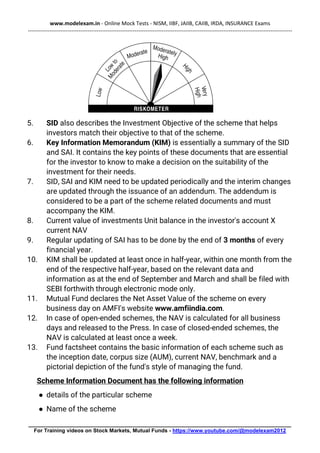
3. A pictorial representation of the risk to the principal invested in a mutual
fund product is depicted using a 'Riskometer'.
4. Risk-o-meter shall have the following six levels of risk for mutual fund
schemes i.e., low risk, low to moderate risk, moderate risk, moderately
high risk, high risk and very high risk.
www.modelexam.in - Online Mock Tests - NISM, IIBF, JAIIB, CAIIB, IRDA, INSURANCE Exams
--------------------------------------------------------------------------------------------------------------------------------------------------
________________________________________________________________________________________
For Training videos on Stock Markets, Mutual Funds - https://www.youtube.com/@modelexam2012
5. SID also describes the Investment Objective of the scheme that helps
investors match their objective to that of the scheme.
6. Key Information Memorandum (KIM) is essentially a summary of the SID
and SAI. It contains the key points of these documents that are essential
for the investor to know to make a decision on the suitability of the
investment for their needs.
7. SID, SAI and KIM need to be updated periodically and the interim changes
are updated through the issuance of an addendum. The addendum is
considered to be a part of the scheme related documents and must
accompany the KIM.
8. Current value of investments Unit balance in the investor's account X
current NAV
9. Regular updating of SAI has to be done by the end of 3 months of every
financial year.
10. KIM shall be updated at least once in half-year, within one month from the
end of the respective half-year, based on the relevant data and
information as at the end of September and March and shall be filed with
SEBI forthwith through electronic mode only.
11. Mutual Fund declares the Net Asset Value of the scheme on every
business day on AMFI's website www.amfiindia.com.
12. In case of open-ended schemes, the NAV is calculated for all business
days and released to the Press. In case of closed-ended schemes, the
NAV is calculated at least once a week.
13. Fund factsheet contains the basic information of each scheme such as
the inception date, corpus size (AUM), current NAV, benchmark and a
pictorial depiction of the fund's style of managing the fund.
Scheme Information Document has the following information
● details of the particular scheme
● Name of the scheme
www.modelexam.in - Online Mock Tests - NISM, IIBF, JAIIB, CAIIB, IRDA, INSURANCE Exams
--------------------------------------------------------------------------------------------------------------------------------------------------
________________________________________________________________________________________
For Training videos on Stock Markets, Mutual Funds - https://www.youtube.com/@modelexam2012
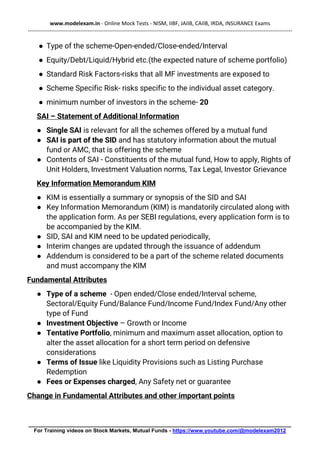
● Type of the scheme-Open-ended/Close-ended/Interval
● Equity/Debt/Liquid/Hybrid etc.(the expected nature of scheme portfolio)
● Standard Risk Factors-risks that all MF investments are exposed to
● Scheme Specific Risk- risks specific to the individual asset category.
● minimum number of investors in the scheme- 20
SAI – Statement of Additional Information
● Single SAI is relevant for all the schemes offered by a mutual fund
● SAI is part of the SID and has statutory information about the mutual
fund or AMC, that is offering the scheme
● Contents of SAI - Constituents of the mutual fund, How to apply, Rights of
Unit Holders, Investment Valuation norms, Tax Legal, Investor Grievance
Key Information Memorandum KIM
● KIM is essentially a summary or synopsis of the SID and SAI
● Key Information Memorandum (KIM) is mandatorily circulated along with
the application form. As per SEBI regulations, every application form is to
be accompanied by the KIM.
● SID, SAI and KIM need to be updated periodically,
● Interim changes are updated through the issuance of addendum
● Addendum is considered to be a part of the scheme related documents
and must accompany the KIM
Fundamental Attributes
● Type of a scheme - Open ended/Close ended/Interval scheme,
Sectoral/Equity Fund/Balance Fund/Income Fund/Index Fund/Any other
type of Fund
● Investment Objective – Growth or Income
● Tentative Portfolio, minimum and maximum asset allocation, option to
alter the asset allocation for a short term period on defensive
considerations
● Terms of Issue like Liquidity Provisions such as Listing Purchase
Redemption
● Fees or Expenses charged, Any Safety net or guarantee
Change in Fundamental Attributes and other important points
www.modelexam.in - Online Mock Tests - NISM, IIBF, JAIIB, CAIIB, IRDA, INSURANCE Exams
--------------------------------------------------------------------------------------------------------------------------------------------------
________________________________________________________________________________________
For Training videos on Stock Markets, Mutual Funds - https://www.youtube.com/@modelexam2012
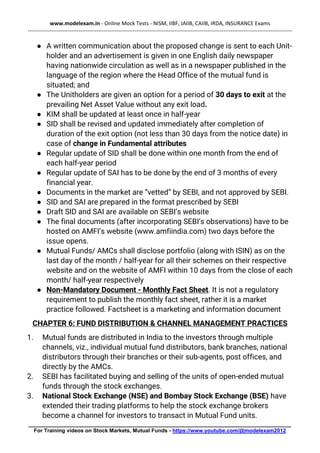
● A written communication about the proposed change is sent to each Unit-
holder and an advertisement is given in one English daily newspaper
having nationwide circulation as well as in a newspaper published in the
language of the region where the Head Office of the mutual fund is
situated; and
● The Unitholders are given an option for a period of 30 days to exit at the
prevailing Net Asset Value without any exit load.
● KIM shall be updated at least once in half-year
● SID shall be revised and updated immediately after completion of
duration of the exit option (not less than 30 days from the notice date) in
case of change in Fundamental attributes
● Regular update of SID shall be done within one month from the end of
each half-year period
● Regular update of SAI has to be done by the end of 3 months of every
financial year.
● Documents in the market are “vetted” by SEBI, and not approved by SEBI.
● SID and SAI are prepared in the format prescribed by SEBI
● Draft SID and SAI are available on SEBI’s website
● The final documents (after incorporating SEBI’s observations) have to be
hosted on AMFI’s website (www.amfiindia.com) two days before the
issue opens.
● Mutual Funds/ AMCs shall disclose portfolio (along with ISIN) as on the
last day of the month / half-year for all their schemes on their respective
website and on the website of AMFI within 10 days from the close of each
month/ half-year respectively
● Non-Mandatory Document - Monthly Fact Sheet. It is not a regulatory
requirement to publish the monthly fact sheet, rather it is a market
practice followed. Factsheet is a marketing and information document
CHAPTER 6: FUND DISTRIBUTION & CHANNEL MANAGEMENT PRACTICES
1. Mutual funds are distributed in India to the investors through multiple
channels, viz., individual mutual fund distributors, bank branches, national
distributors through their branches or their sub-agents, post offices, and
directly by the AMCs.
2. SEBI has facilitated buying and selling of the units of open-ended mutual
funds through the stock exchanges.
3. National Stock Exchange (NSE) and Bombay Stock Exchange (BSE) have
extended their trading platforms to help the stock exchange brokers
become a channel for investors to transact in Mutual Fund units.
www.modelexam.in - Online Mock Tests - NISM, IIBF, JAIIB, CAIIB, IRDA, INSURANCE Exams
--------------------------------------------------------------------------------------------------------------------------------------------------
________________________________________________________________________________________
For Training videos on Stock Markets, Mutual Funds - https://www.youtube.com/@modelexam2012
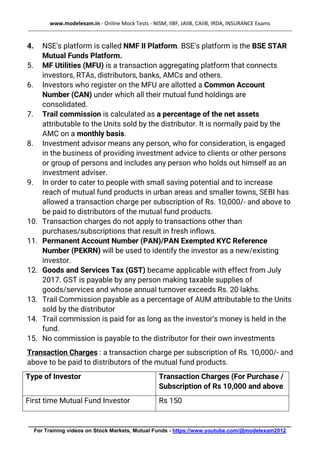
4. NSE's platform is called NMF II Platform. BSE's platform is the BSE STAR
Mutual Funds Platform.
5. MF Utilities (MFU) is a transaction aggregating platform that connects
investors, RTAs, distributors, banks, AMCs and others.
6. Investors who register on the MFU are allotted a Common Account
Number (CAN) under which all their mutual fund holdings are
consolidated.
7. Trail commission is calculated as a percentage of the net assets
attributable to the Units sold by the distributor. It is normally paid by the
AMC on a monthly basis.
8. Investment advisor means any person, who for consideration, is engaged
in the business of providing investment advice to clients or other persons
or group of persons and includes any person who holds out himself as an
investment adviser.
9. In order to cater to people with small saving potential and to increase
reach of mutual fund products in urban areas and smaller towns, SEBI has
allowed a transaction charge per subscription of Rs. 10,000/- and above to
be paid to distributors of the mutual fund products.
10. Transaction charges do not apply to transactions other than
purchases/subscriptions that result in fresh inflows.
11. Permanent Account Number (PAN)/PAN Exempted KYC Reference
Number (PEKRN) will be used to identify the investor as a new/existing
investor.
12. Goods and Services Tax (GST) became applicable with effect from July
2017. GST is payable by any person making taxable supplies of
goods/services and whose annual turnover exceeds Rs. 20 lakhs.
13. Trail Commission payable as a percentage of AUM attributable to the Units
sold by the distributor
14. Trail commission is paid for as long as the investor’s money is held in the
fund.
15. No commission is payable to the distributor for their own investments
Transaction Charges : a transaction charge per subscription of Rs. 10,000/- and
above to be paid to distributors of the mutual fund products.
Type of Investor Transaction Charges (For Purchase /
Subscription of Rs 10,000 and above
First time Mutual Fund Investor Rs 150
www.modelexam.in - Online Mock Tests - NISM, IIBF, JAIIB, CAIIB, IRDA, INSURANCE Exams
--------------------------------------------------------------------------------------------------------------------------------------------------
________________________________________________________________________________________
For Training videos on Stock Markets, Mutual Funds - https://www.youtube.com/@modelexam2012
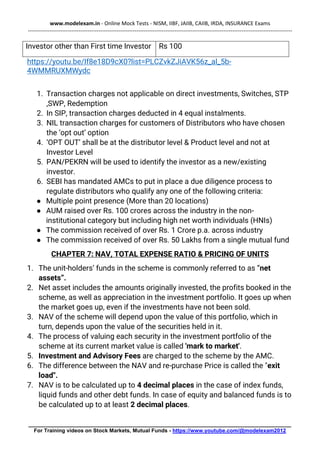
Investor other than First time Investor Rs 100
https://youtu.be/If8e18D9cX0?list=PLCZvkZJiAVK56z_al_5b-
4WMMRUXMWydc
1. Transaction charges not applicable on direct investments, Switches, STP
,SWP, Redemption
2. In SIP, transaction charges deducted in 4 equal instalments.
3. NIL transaction charges for customers of Distributors who have chosen
the ‘opt out’ option
4. ‘OPT OUT’ shall be at the distributor level & Product level and not at
Investor Level
5. PAN/PEKRN will be used to identify the investor as a new/existing
investor.
6. SEBI has mandated AMCs to put in place a due diligence process to
regulate distributors who qualify any one of the following criteria:
● Multiple point presence (More than 20 locations)
● AUM raised over Rs. 100 crores across the industry in the non-
institutional category but including high net worth individuals (HNIs)
● The commission received of over Rs. 1 Crore p.a. across industry
● The commission received of over Rs. 50 Lakhs from a single mutual fund
CHAPTER 7: NAV, TOTAL EXPENSE RATIO & PRICING OF UNITS
1. The unit-holders’ funds in the scheme is commonly referred to as “net
assets”.
2. Net asset includes the amounts originally invested, the profits booked in the
scheme, as well as appreciation in the investment portfolio. It goes up when
the market goes up, even if the investments have not been sold.
3. NAV of the scheme will depend upon the value of this portfolio, which in
turn, depends upon the value of the securities held in it.
4. The process of valuing each security in the investment portfolio of the
scheme at its current market value is called 'mark to market'.
5. Investment and Advisory Fees are charged to the scheme by the AMC.
6. The difference between the NAV and re-purchase Price is called the "exit
load".
7. NAV is to be calculated up to 4 decimal places in the case of index funds,
liquid funds and other debt funds. In case of equity and balanced funds is to
be calculated up to at least 2 decimal places.
www.modelexam.in - Online Mock Tests - NISM, IIBF, JAIIB, CAIIB, IRDA, INSURANCE Exams
--------------------------------------------------------------------------------------------------------------------------------------------------
________________________________________________________________________________________
For Training videos on Stock Markets, Mutual Funds - https://www.youtube.com/@modelexam2012
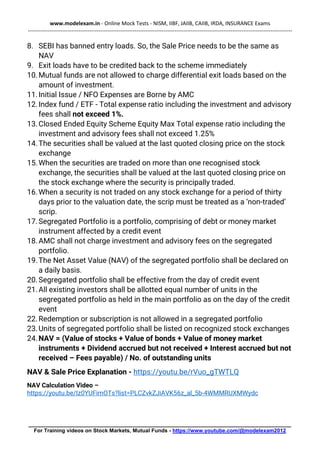
8. SEBI has banned entry loads. So, the Sale Price needs to be the same as
NAV
9. Exit loads have to be credited back to the scheme immediately
10.Mutual funds are not allowed to charge differential exit loads based on the
amount of investment.
11.Initial Issue / NFO Expenses are Borne by AMC
12.Index fund / ETF - Total expense ratio including the investment and advisory
fees shall not exceed 1%.
13.Closed Ended Equity Scheme Equity Max Total expense ratio including the
investment and advisory fees shall not exceed 1.25%
14.The securities shall be valued at the last quoted closing price on the stock
exchange
15.When the securities are traded on more than one recognised stock
exchange, the securities shall be valued at the last quoted closing price on
the stock exchange where the security is principally traded.
16.When a security is not traded on any stock exchange for a period of thirty
days prior to the valuation date, the scrip must be treated as a ‘non-traded’
scrip.
17.Segregated Portfolio is a portfolio, comprising of debt or money market
instrument affected by a credit event
18.AMC shall not charge investment and advisory fees on the segregated
portfolio.
19.The Net Asset Value (NAV) of the segregated portfolio shall be declared on
a daily basis.
20.Segregated portfolio shall be effective from the day of credit event
21.All existing investors shall be allotted equal number of units in the
segregated portfolio as held in the main portfolio as on the day of the credit
event
22.Redemption or subscription is not allowed in a segregated portfolio
23.Units of segregated portfolio shall be listed on recognized stock exchanges
24.NAV = (Value of stocks + Value of bonds + Value of money market
instruments + Dividend accrued but not received + Interest accrued but not
received – Fees payable) / No. of outstanding units
NAV & Sale Price Explanation - https://youtu.be/rVuo_gTWTLQ
NAV Calculation Video –
https://youtu.be/Iz0YUFimOTs?list=PLCZvkZJiAVK56z_al_5b-4WMMRUXMWydc
www.modelexam.in - Online Mock Tests - NISM, IIBF, JAIIB, CAIIB, IRDA, INSURANCE Exams
--------------------------------------------------------------------------------------------------------------------------------------------------
________________________________________________________________________________________
For Training videos on Stock Markets, Mutual Funds - https://www.youtube.com/@modelexam2012
CHAPTER :8 TAXATION
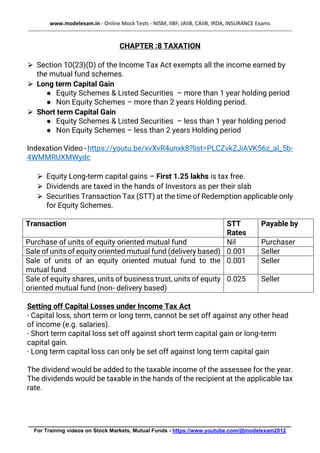
⮚ Section 10(23)(D) of the Income Tax Act exempts all the income earned by
the mutual fund schemes.
⮚ Long term Capital Gain
● Equity Schemes & Listed Securities – more than 1 year holding period
● Non Equity Schemes – more than 2 years Holding period.
⮚ Short term Capital Gain
● Equity Schemes & Listed Securities – less than 1 year holding period
● Non Equity Schemes – less than 2 years Holding period
Indexation Video - https://youtu.be/xvXvR4unxk8?list=PLCZvkZJiAVK56z_al_5b-
4WMMRUXMWydc
⮚ Equity Long-term capital gains – First 1.25 lakhs is tax free.
⮚ Dividends are taxed in the hands of Investors as per their slab
⮚ Securities Transaction Tax (STT) at the time of Redemption applicable only
for Equity Schemes.
Transaction STT
Rates
Payable by
Purchase of units of equity oriented mutual fund Nil Purchaser
Sale of units of equity oriented mutual fund (delivery based) 0.001 Seller
Sale of units of an equity oriented mutual fund to the
mutual fund
0.001 Seller
Sale of equity shares, units of business trust, units of equity
oriented mutual fund (non- delivery based)
0.025 Seller
Setting off Capital Losses under Income Tax Act
∙ Capital loss, short term or long term, cannot be set off against any other head
of income (e.g. salaries).
∙ Short term capital loss set off against short term capital gain or long-term
capital gain.
∙ Long term capital loss can only be set off against long term capital gain
The dividend would be added to the taxable income of the assessee for the year.
The dividends would be taxable in the hands of the recipient at the applicable tax
rate.
www.modelexam.in - Online Mock Tests - NISM, IIBF, JAIIB, CAIIB, IRDA, INSURANCE Exams
--------------------------------------------------------------------------------------------------------------------------------------------------
________________________________________________________________________________________
For Training videos on Stock Markets, Mutual Funds - https://www.youtube.com/@modelexam2012
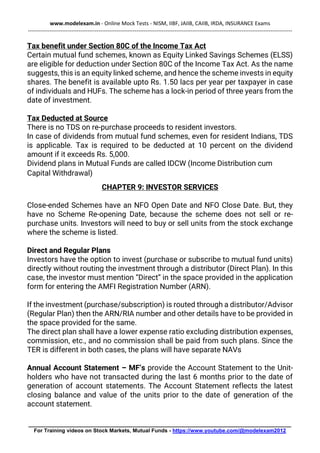
Tax benefit under Section 80C of the Income Tax Act
Certain mutual fund schemes, known as Equity Linked Savings Schemes (ELSS)
are eligible for deduction under Section 80C of the Income Tax Act. As the name
suggests, this is an equity linked scheme, and hence the scheme invests in equity
shares. The benefit is available upto Rs. 1.50 lacs per year per taxpayer in case
of individuals and HUFs. The scheme has a lock-in period of three years from the
date of investment.
Tax Deducted at Source
There is no TDS on re-purchase proceeds to resident investors.
In case of dividends from mutual fund schemes, even for resident Indians, TDS
is applicable. Tax is required to be deducted at 10 percent on the dividend
amount if it exceeds Rs. 5,000.
Dividend plans in Mutual Funds are called IDCW (Income Distribution cum
Capital Withdrawal)
CHAPTER 9: INVESTOR SERVICES
Close-ended Schemes have an NFO Open Date and NFO Close Date. But, they
have no Scheme Re-opening Date, because the scheme does not sell or re-
purchase units. Investors will need to buy or sell units from the stock exchange
where the scheme is listed.
Direct and Regular Plans
Investors have the option to invest (purchase or subscribe to mutual fund units)
directly without routing the investment through a distributor (Direct Plan). In this
case, the investor must mention “Direct” in the space provided in the application
form for entering the AMFI Registration Number (ARN).
If the investment (purchase/subscription) is routed through a distributor/Advisor
(Regular Plan) then the ARN/RIA number and other details have to be provided in
the space provided for the same.
The direct plan shall have a lower expense ratio excluding distribution expenses,
commission, etc., and no commission shall be paid from such plans. Since the
TER is different in both cases, the plans will have separate NAVs
Annual Account Statement – MF’s provide the Account Statement to the Unit-
holders who have not transacted during the last 6 months prior to the date of
generation of account statements. The Account Statement reflects the latest
closing balance and value of the units prior to the date of generation of the
account statement.
www.modelexam.in - Online Mock Tests - NISM, IIBF, JAIIB, CAIIB, IRDA, INSURANCE Exams
--------------------------------------------------------------------------------------------------------------------------------------------------
________________________________________________________________________________________
For Training videos on Stock Markets, Mutual Funds - https://www.youtube.com/@modelexam2012
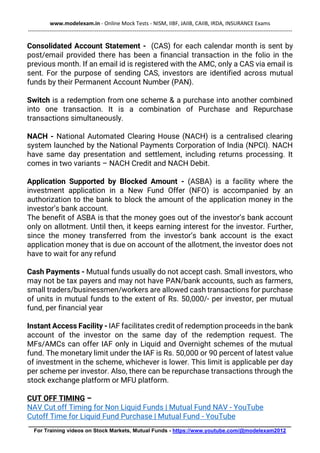
Consolidated Account Statement - (CAS) for each calendar month is sent by
post/email provided there has been a financial transaction in the folio in the
previous month. If an email id is registered with the AMC, only a CAS via email is
sent. For the purpose of sending CAS, investors are identified across mutual
funds by their Permanent Account Number (PAN).
Switch is a redemption from one scheme & a purchase into another combined
into one transaction. It is a combination of Purchase and Repurchase
transactions simultaneously.
NACH - National Automated Clearing House (NACH) is a centralised clearing
system launched by the National Payments Corporation of India (NPCI). NACH
have same day presentation and settlement, including returns processing. It
comes in two variants – NACH Credit and NACH Debit.
Application Supported by Blocked Amount - (ASBA) is a facility where the
investment application in a New Fund Offer (NFO) is accompanied by an
authorization to the bank to block the amount of the application money in the
investor’s bank account.
The benefit of ASBA is that the money goes out of the investor’s bank account
only on allotment. Until then, it keeps earning interest for the investor. Further,
since the money transferred from the investor’s bank account is the exact
application money that is due on account of the allotment, the investor does not
have to wait for any refund
Cash Payments - Mutual funds usually do not accept cash. Small investors, who
may not be tax payers and may not have PAN/bank accounts, such as farmers,
small traders/businessmen/workers are allowed cash transactions for purchase
of units in mutual funds to the extent of Rs. 50,000/- per investor, per mutual
fund, per financial year
Instant Access Facility - IAF facilitates credit of redemption proceeds in the bank
account of the investor on the same day of the redemption request. The
MFs/AMCs can offer IAF only in Liquid and Overnight schemes of the mutual
fund. The monetary limit under the IAF is Rs. 50,000 or 90 percent of latest value
of investment in the scheme, whichever is lower. This limit is applicable per day
per scheme per investor. Also, there can be repurchase transactions through the
stock exchange platform or MFU platform.
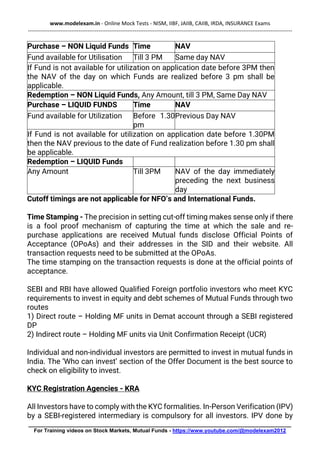
CUT OFF TIMING –
NAV Cut off Timing for Non Liquid Funds | Mutual Fund NAV - YouTube
Cutoff Time for Liquid Fund Purchase | Mutual Fund - YouTube
www.modelexam.in - Online Mock Tests - NISM, IIBF, JAIIB, CAIIB, IRDA, INSURANCE Exams
--------------------------------------------------------------------------------------------------------------------------------------------------
________________________________________________________________________________________
For Training videos on Stock Markets, Mutual Funds - https://www.youtube.com/@modelexam2012
Purchase – NON Liquid Funds Time NAV
Fund available for Utilisation Till 3 PM Same day NAV
If Fund is not available for utilization on application date before 3PM then
the NAV of the day on which Funds are realized before 3 pm shall be
applicable.
Redemption – NON Liquid Funds, Any Amount, till 3 PM, Same Day NAV
Purchase – LIQUID FUNDS Time NAV
Fund available for Utilization Before 1.30
pm
Previous Day NAV
If Fund is not available for utilization on application date before 1.30PM
then the NAV previous to the date of Fund realization before 1.30 pm shall
be applicable.
Redemption – LIQUID Funds
Any Amount Till 3PM NAV of the day immediately
preceding the next business
day
Cutoff timings are not applicable for NFO’s and International Funds.
Time Stamping - The precision in setting cut-off timing makes sense only if there
is a fool proof mechanism of capturing the time at which the sale and re-
purchase applications are received Mutual funds disclose Official Points of
Acceptance (OPoAs) and their addresses in the SID and their website. All
transaction requests need to be submitted at the OPoAs.
The time stamping on the transaction requests is done at the official points of
acceptance.
SEBI and RBI have allowed Qualified Foreign portfolio investors who meet KYC
requirements to invest in equity and debt schemes of Mutual Funds through two
routes
1) Direct route – Holding MF units in Demat account through a SEBI registered
DP
2) Indirect route – Holding MF units via Unit Confirmation Receipt (UCR)
Individual and non-individual investors are permitted to invest in mutual funds in
India. The ‘Who can invest’ section of the Offer Document is the best source to
check on eligibility to invest.
KYC Registration Agencies - KRA
All Investors have to comply with the KYC formalities. In-Person Verification (IPV)
by a SEBI-registered intermediary is compulsory for all investors. IPV done by
www.modelexam.in - Online Mock Tests - NISM, IIBF, JAIIB, CAIIB, IRDA, INSURANCE Exams
--------------------------------------------------------------------------------------------------------------------------------------------------
________________________________________________________________________________________
For Training videos on Stock Markets, Mutual Funds - https://www.youtube.com/@modelexam2012
only one SEBI-registered intermediary (broker, depository, mutual fund distributor
etc.). This IPV will be valid for transactions with other SEBI-registered
intermediaries too. Distributors who have a valid NISM-Series-V-A: Mutual Fund
Distributors certificate and a valid ARN can carry out the In-person verification if
they have completed the KYD process.
PAN Exempt Investments in Mutual Funds
Micro-SIPs i.e., SIPs where annual investment does not exceed Rs 50,000. Small
investors investing up to Rs. 50,000 per mutual fund per financial year do not
need to provide PAN Card. Rs. 50,000 is a composite limit for the small investor’s
Micro-SIP and lump sum investments together.
Government of India authorised the Central Registry of Securitisation and Asset
Reconstruction and Security Interest of India (CERSAI) to act as and to perform
the functions of the Central KYC Record Registry under the PML Rules 2005,
including receiving, storing, safeguarding and retrieving the KYC records in digital
form of all the clients in the financial sector
KYC template finalised by CERSAI has to be used by the registered
intermediaries
SIP Top-up Facility - Mutual funds provide an additional facility through an SIP
to enhance the disciplined savings of investors. It is called the SIP Top-Up facility
Nomination
● Nomination can be made in favour of a maximum of three nominees.
● Where there are multiple nominees, the unitholder(s) must define the
percentage holding for each nominee making a total of 100 percent
● Only individual investors can make a nomination. Investments by minors
cannot have a nomination. A Power of Attorney holder cannot make a
nomination.
● The nominee can be an individual, including minors and NRIs, central and
state governments and local authorities. If the nominee is a minor, then a
guardian too can be specified.
● nomination cannot be made in favour of a trust (except a religious or
charitable trust), society, body corporate, partnership, Karta of an HUF or a
Power of Attorney holder.
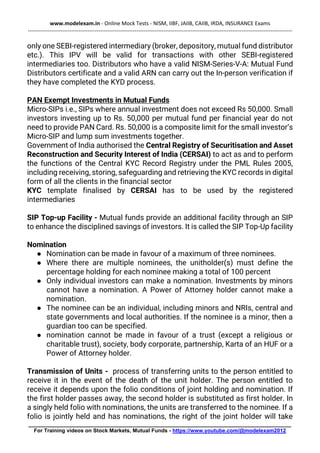
Transmission of Units - process of transferring units to the person entitled to
receive it in the event of the death of the unit holder. The person entitled to
receive it depends upon the folio conditions of joint holding and nomination. If
the first holder passes away, the second holder is substituted as first holder. In
a singly held folio with nominations, the units are transferred to the nominee. If a
folio is jointly held and has nominations, the right of the joint holder will take
www.modelexam.in - Online Mock Tests - NISM, IIBF, JAIIB, CAIIB, IRDA, INSURANCE Exams
--------------------------------------------------------------------------------------------------------------------------------------------------
________________________________________________________________________________________
For Training videos on Stock Markets, Mutual Funds - https://www.youtube.com/@modelexam2012
precedence. If there are no nominations in the folio, the units are transmitted to
the legal successors
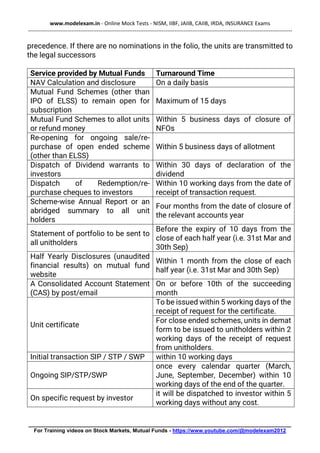
Service provided by Mutual Funds Turnaround Time
NAV Calculation and disclosure On a daily basis
Mutual Fund Schemes (other than
IPO of ELSS) to remain open for
subscription
Maximum of 15 days
Mutual Fund Schemes to allot units
or refund money
Within 5 business days of closure of
NFOs
Re-opening for ongoing sale/re-
purchase of open ended scheme
(other than ELSS)
Within 5 business days of allotment
Dispatch of Dividend warrants to
investors
Within 30 days of declaration of the
dividend
Dispatch of Redemption/re-
purchase cheques to investors
Within 10 working days from the date of
receipt of transaction request.
Scheme-wise Annual Report or an
abridged summary to all unit
holders
Four months from the date of closure of
the relevant accounts year
Statement of portfolio to be sent to
all unitholders
Before the expiry of 10 days from the
close of each half year (i.e. 31st Mar and
30th Sep)
Half Yearly Disclosures (unaudited
financial results) on mutual fund
website
Within 1 month from the close of each
half year (i.e. 31st Mar and 30th Sep)
A Consolidated Account Statement
(CAS) by post/email
On or before 10th of the succeeding
month
Unit certificate
To be issued within 5 working days of the
receipt of request for the certificate.
For close ended schemes, units in demat
form to be issued to unitholders within 2
working days of the receipt of request
from unitholders.
Initial transaction SIP / STP / SWP within 10 working days
Ongoing SIP/STP/SWP
once every calendar quarter (March,
June, September, December) within 10
working days of the end of the quarter.
On specific request by investor
it will be dispatched to investor within 5
working days without any cost.
www.modelexam.in - Online Mock Tests - NISM, IIBF, JAIIB, CAIIB, IRDA, INSURANCE Exams
--------------------------------------------------------------------------------------------------------------------------------------------------
________________________________________________________________________________________
For Training videos on Stock Markets, Mutual Funds - https://www.youtube.com/@modelexam2012
CHAPTER 10: RISK, RETURN AND PERFORMANCE OF FUNDS
https://www.youtube.com/watch?v=IuoBu2OqaCc
General Risk Factors
● Liquidity Risk
● Interest Rate Risk
● Re-investment Risk
● Political Risk
● Economic Risk
● Foreign Currency Risk
Specific Risk Factors
● Risk related to equity and equity related securities
o Risk associated with short selling and Stock Lending
o Risks associated with mid-cap and small-cap companies
o Risk associated with Dividend
o Risk associated with Derivatives
● Risks related to debt funds
o Reinvestment Risk
o Rating Migration Risk
o Term Structure of Interest Rates Risk
o Credit Risk
o Risk associated with floating rate securities
o Risk factors associated with repo transactions in Corporate Bonds
o Risks associated with Creation of Segregated portfolio
o Risks associated with investments in Securitized Assets
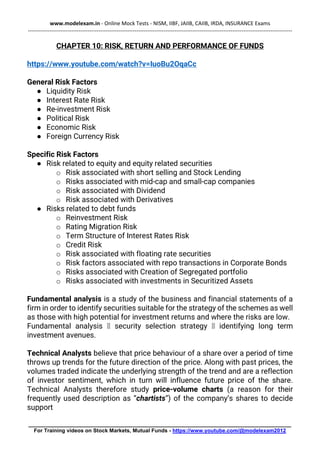
Fundamental analysis is a study of the business and financial statements of a
firm in order to identify securities suitable for the strategy of the schemes as well
as those with high potential for investment returns and where the risks are low.
Fundamental analysis 🡪 security selection strategy 🡪 identifying long term
investment avenues.
Technical Analysts believe that price behaviour of a share over a period of time
throws up trends for the future direction of the price. Along with past prices, the
volumes traded indicate the underlying strength of the trend and are a reflection
of investor sentiment, which in turn will influence future price of the share.
Technical Analysts therefore study price-volume charts (a reason for their
frequently used description as “chartists”) of the company’s shares to decide
support
www.modelexam.in - Online Mock Tests - NISM, IIBF, JAIIB, CAIIB, IRDA, INSURANCE Exams
--------------------------------------------------------------------------------------------------------------------------------------------------
________________________________________________________________________________________
For Training videos on Stock Markets, Mutual Funds - https://www.youtube.com/@modelexam2012
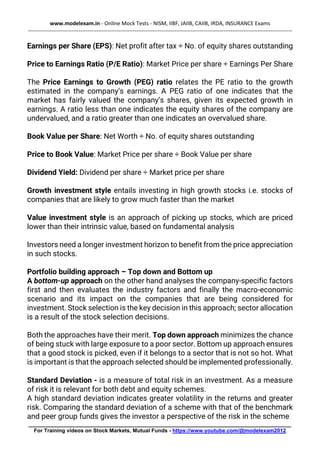
Earnings per Share (EPS): Net profit after tax ÷ No. of equity shares outstanding
Price to Earnings Ratio (P/E Ratio): Market Price per share ÷ Earnings Per Share
The Price Earnings to Growth (PEG) ratio relates the PE ratio to the growth
estimated in the company’s earnings. A PEG ratio of one indicates that the
market has fairly valued the company’s shares, given its expected growth in
earnings. A ratio less than one indicates the equity shares of the company are
undervalued, and a ratio greater than one indicates an overvalued share.
Book Value per Share: Net Worth ÷ No. of equity shares outstanding
Price to Book Value: Market Price per share ÷ Book Value per share
Dividend Yield: Dividend per share ÷ Market price per share
Growth investment style entails investing in high growth stocks i.e. stocks of
companies that are likely to grow much faster than the market
Value investment style is an approach of picking up stocks, which are priced
lower than their intrinsic value, based on fundamental analysis
Investors need a longer investment horizon to benefit from the price appreciation
in such stocks.
Portfolio building approach – Top down and Bottom up
A bottom-up approach on the other hand analyses the company-specific factors
first and then evaluates the industry factors and finally the macro-economic
scenario and its impact on the companies that are being considered for
investment. Stock selection is the key decision in this approach; sector allocation
is a result of the stock selection decisions.
Both the approaches have their merit. Top down approach minimizes the chance
of being stuck with large exposure to a poor sector. Bottom up approach ensures
that a good stock is picked, even if it belongs to a sector that is not so hot. What
is important is that the approach selected should be implemented professionally.
Standard Deviation - is a measure of total risk in an investment. As a measure
of risk it is relevant for both debt and equity schemes.
A high standard deviation indicates greater volatility in the returns and greater
risk. Comparing the standard deviation of a scheme with that of the benchmark
and peer group funds gives the investor a perspective of the risk in the scheme
www.modelexam.in - Online Mock Tests - NISM, IIBF, JAIIB, CAIIB, IRDA, INSURANCE Exams
--------------------------------------------------------------------------------------------------------------------------------------------------
________________________________________________________________________________________
For Training videos on Stock Markets, Mutual Funds - https://www.youtube.com/@modelexam2012
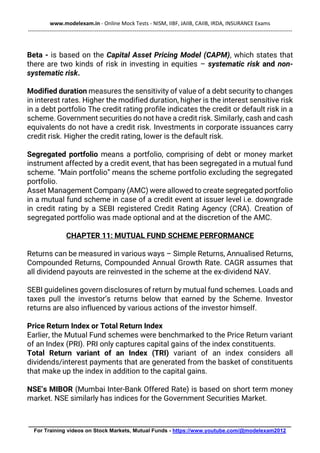
Beta - is based on the Capital Asset Pricing Model (CAPM), which states that
there are two kinds of risk in investing in equities – systematic risk and non-
systematic risk.
Modified duration measures the sensitivity of value of a debt security to changes
in interest rates. Higher the modified duration, higher is the interest sensitive risk
in a debt portfolio The credit rating profile indicates the credit or default risk in a
scheme. Government securities do not have a credit risk. Similarly, cash and cash
equivalents do not have a credit risk. Investments in corporate issuances carry
credit risk. Higher the credit rating, lower is the default risk.
Segregated portfolio means a portfolio, comprising of debt or money market
instrument affected by a credit event, that has been segregated in a mutual fund
scheme. “Main portfolio” means the scheme portfolio excluding the segregated
portfolio.
Asset Management Company (AMC) were allowed to create segregated portfolio
in a mutual fund scheme in case of a credit event at issuer level i.e. downgrade
in credit rating by a SEBI registered Credit Rating Agency (CRA). Creation of
segregated portfolio was made optional and at the discretion of the AMC.
CHAPTER 11: MUTUAL FUND SCHEME PERFORMANCE
Returns can be measured in various ways – Simple Returns, Annualised Returns,
Compounded Returns, Compounded Annual Growth Rate. CAGR assumes that
all dividend payouts are reinvested in the scheme at the ex-dividend NAV.
SEBI guidelines govern disclosures of return by mutual fund schemes. Loads and
taxes pull the investor’s returns below that earned by the Scheme. Investor
returns are also influenced by various actions of the investor himself.
Price Return Index or Total Return Index
Earlier, the Mutual Fund schemes were benchmarked to the Price Return variant
of an Index (PRI). PRI only captures capital gains of the index constituents.
Total Return variant of an Index (TRI) variant of an index considers all
dividends/interest payments that are generated from the basket of constituents
that make up the index in addition to the capital gains.
NSE’s MIBOR (Mumbai Inter-Bank Offered Rate) is based on short term money
market. NSE similarly has indices for the Government Securities Market.
www.modelexam.in - Online Mock Tests - NISM, IIBF, JAIIB, CAIIB, IRDA, INSURANCE Exams
--------------------------------------------------------------------------------------------------------------------------------------------------
________________________________________________________________________________________
For Training videos on Stock Markets, Mutual Funds - https://www.youtube.com/@modelexam2012
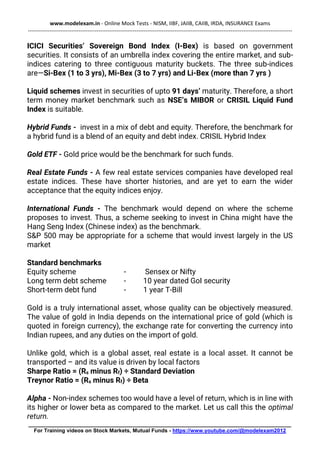
ICICI Securities’ Sovereign Bond Index (I-Bex) is based on government
securities. It consists of an umbrella index covering the entire market, and sub-
indices catering to three contiguous maturity buckets. The three sub-indices
are—Si-Bex (1 to 3 yrs), Mi-Bex (3 to 7 yrs) and Li-Bex (more than 7 yrs )
Liquid schemes invest in securities of upto 91 days’ maturity. Therefore, a short
term money market benchmark such as NSE’s MIBOR or CRISIL Liquid Fund
Index is suitable.
Hybrid Funds - invest in a mix of debt and equity. Therefore, the benchmark for
a hybrid fund is a blend of an equity and debt index. CRISIL Hybrid Index
Gold ETF - Gold price would be the benchmark for such funds.
Real Estate Funds - A few real estate services companies have developed real
estate indices. These have shorter histories, and are yet to earn the wider
acceptance that the equity indices enjoy.
International Funds - The benchmark would depend on where the scheme
proposes to invest. Thus, a scheme seeking to invest in China might have the
Hang Seng Index (Chinese index) as the benchmark.
S&P 500 may be appropriate for a scheme that would invest largely in the US
market
Standard benchmarks
Equity scheme - Sensex or Nifty
Long term debt scheme - 10 year dated GoI security
Short-term debt fund - 1 year T-Bill
Gold is a truly international asset, whose quality can be objectively measured.
The value of gold in India depends on the international price of gold (which is
quoted in foreign currency), the exchange rate for converting the currency into
Indian rupees, and any duties on the import of gold.
Unlike gold, which is a global asset, real estate is a local asset. It cannot be
transported – and its value is driven by local factors
Sharpe Ratio = (Rs minus Rf) ÷ Standard Deviation
Treynor Ratio = (Rs minus Rf) ÷ Beta
Alpha - Non-index schemes too would have a level of return, which is in line with
its higher or lower beta as compared to the market. Let us call this the optimal
return.
www.modelexam.in - Online Mock Tests - NISM, IIBF, JAIIB, CAIIB, IRDA, INSURANCE Exams
--------------------------------------------------------------------------------------------------------------------------------------------------
________________________________________________________________________________________
For Training videos on Stock Markets, Mutual Funds - https://www.youtube.com/@modelexam2012
The difference between a scheme’s actual return and its optimal return is its
Alpha—a measure of the fund manager’s performance. Alpha measures the
performance of the investment in comparison to a suitable market index.
Positive alpha is indicative of outperformance by the fund manager; negative
alpha might indicate under-performance
Tracking Error - The Beta of the market, by definition is 1. An index fund mirrors
the index. Therefore, the index fund too would have a Beta of 1, and it ought to
earn the same return as the market. The difference between an index fund’s
return and the market return is the tracking error
CHAPTER 12: MUTUAL FUND SCHEME SELECTION
International Equity funds
When an Indian investor invests in equities abroad, he is essentially taking two
exposures:
• An exposure on the international equity market.
• An exposure to the exchange rate of the rupee. If the investor invests in the US,
and the US Dollar becomes stronger during the period of his investment, he
benefits; if the US Dollar weakens (i.e. Rupee becomes stronger), he loses or the
portfolio returns will be lower.
Portfolio Turnover
Purchase and sale of securities entails broking costs for the scheme. Frequent
churning of the portfolio would not only add to the broking costs, but also be
indicative of unsteady investment management.
Portfolio Turnover Ratio is calculated as Value of Purchase and Sale of Securities
during a period divided by the average size of net assets of the scheme during
the period
The portfolio turnover needs to be viewed in the light of the investment style.
Six month holding period may be too short for a value investment style, but
perfectly acceptable for a scheme that wants to benefit from shifts in
momentum. A short holding period may indicate that the fund manager is looking
for tactical investments to take advantage of short-term market opportunities
rather than identifying and investing in fundamentally strong companies for the
long-term.
Core Portfolio
• To meet the long-term needs and goals of the investor.
• Long-term returns in broad alignment with the markets.
www.modelexam.in - Online Mock Tests - NISM, IIBF, JAIIB, CAIIB, IRDA, INSURANCE Exams
--------------------------------------------------------------------------------------------------------------------------------------------------
________________________________________________________________________________________
For Training videos on Stock Markets, Mutual Funds - https://www.youtube.com/@modelexam2012
• Diversified Equity / Large Cap / Mid Cap funds are examples
Satellite Portfolio
• Take advantage of expected short-term market movements - Tactical
Asset Allocation
• Held for the period when the conditions are suitable.
Examples
(1) Sector / Thematic Funds - Cyclical
(2) Long term GILT Funds – Interest rates are expected to come down
(3) Gold funds – Unstable Political Scenario
The division between core and satellite portfolios will depend upon each
investor’s profile. Conservative investors may like a very small proportion of their
overall portfolio to be managed tactically. A moderate investor may be
comfortable with an 80 percent allocation to core investments and a 20 percent
exposure to satellite or tactical portfolio. An investor comfortable with taking
higher risk may have an even higher exposure to tactical investments.
Significant Unit holder means any entity holding 5% or more of the total corpus
of any scheme.
Amongst index schemes, tracking error is a basis to select the better scheme.
Lower the tracking error, the better it is. Similarly, Gold ETFs need to be selected
based on how well they track gold prices.
IMPORTANT NOTE :
1. Attend ALL Questions. There is NO NEGATIVE mark.
2. For the questions you don’t know the right answer – Try to eliminate the
wrong answers and take a guess on the remaining answers.
3. DO NOT MEMORISE the question & answers. It’s not the right to way to
prepare for any NISM exam. Good understanding of Concepts is essential.
www.modelexam.in - Online Mock Tests - NISM, IIBF, JAIIB, CAIIB, IRDA, INSURANCE Exams
--------------------------------------------------------------------------------------------------------------------------------------------------
________________________________________________________________________________________
For Training videos on Stock Markets, Mutual Funds - https://www.youtube.com/@modelexam2012
Scan the following QR code for NISM Mutual Fund Exam Training Videos
YouTube Training Video Link
https://www.youtube.com/playlist?list=PLCZvkZJiAVK56z_al_5b-
4WMMRUXMWydc
All the Best ☺
MODELEXAM
Email: myakshaya@gmail.com, WhatsApp only : 98949 49988
https://modelexam.in/nism-exams/nism-mock-test.html

nism-va-mutual-fund-exam-study-notes.pdf

  • 1.
    www.modelexam.in - OnlineMock Tests - NISM, IIBF, JAIIB, CAIIB, IRDA, INSURANCE Exams -------------------------------------------------------------------------------------------------------------------------------------------------- ________________________________________________________________________________________ For Training videos on Stock Markets, Mutual Funds - https://www.youtube.com/@modelexam2012 Study Notes for NISM Series V – A: MUTUAL FUND DISTRIBUTORS Exam (Earlier - AMFI Exam) https://modelexam.in/nism-exams/nism-mock-test.html Scan the following QR code for NISM Mutual Fund Exam Training Videos YouTube Training Video Link : English www.modelexam.in provides with basic information, study material & online model exams to help you succeed in NISM exams. (NISM – National Institute of Securities Markets – A SEBI Institute) Both Premium (Paid) & Demo (Free) Versions are available in the website. HARDCOPY / SOFTCOPY of the tests will NOT be provided NISM Series 5A - MUTUAL FUND DISTRIBUTORS EXAM Assessment Structure https://youtu.be/_SmCb_UmiLA?list=PLCZvkZJiAVK56z_al_5b- 4WMMRUXMWydc Total Questions = 100 X 1 mark each (NO NEGATIVE MARKS) Total Duration = 2 hours. Passing score = 50% Certificate Validity = 3 years. Certificate Renewal - Attend NISM CPE Session Call Srinivasan @ 98949 49988 for NISM CPE Training details in South India.
  • 2.
    www.modelexam.in - OnlineMock Tests - NISM, IIBF, JAIIB, CAIIB, IRDA, INSURANCE Exams -------------------------------------------------------------------------------------------------------------------------------------------------- ________________________________________________________________________________________ For Training videos on Stock Markets, Mutual Funds - https://www.youtube.com/@modelexam2012 Chapterwise Weightages Unit 1 Investment Landscape 8 % Unit 2 Concept & Role of a Mutual Fund 6 % Unit 3 Legal Structure of Mutual Funds in India 4 % Unit 4 Legal and Regulatory Framework 10 % Unit 5 Scheme Related Information 10 % Unit 6 Fund Distribution and Channel Management Practices 6 % Unit 7 NAV, Total Expense Ratio and Pricing of units 8 % Unit 8 Taxation 4 % Unit 9 Investor Services 20 % Unit 10 Risk, Return and Performance of Funds 7 % Unit 11 Mutual Fund Scheme Performance 7 % Unit 12 Mutual Fund Scheme Selection 10 % YouTube videos – Topic wise 1. How to become a Mutual Fund Agent? 2. NISM Mutual Fund Distributors Exam Pattern 3. What is a Mutual Fund? 4. Terminologies used in Mutual Fund Industry 5. Open and Closed end funds 6. Types of Equity Funds 7. Types of Debt Mutual Funds 8. Types of Hybrid Schemes, Balanced Schemes 9. Tax Saving Scheme - ELSS 10. Gold Exchange Traded Fund 11. Passive Funds and Fixed Maturity Plans 12. Index Funds 13. Tracking Error - Index Funds 14. Mutual Fund Structure and Constituents 15. Grandfather Clause introduced in Budget and Taxation changes 16. Calculation of Long term capital gain tax using Indexation 17. Tax Deducted at Source and Securities Transaction Tax
  • 3.
    www.modelexam.in - OnlineMock Tests - NISM, IIBF, JAIIB, CAIIB, IRDA, INSURANCE Exams -------------------------------------------------------------------------------------------------------------------------------------------------- ________________________________________________________________________________________ For Training videos on Stock Markets, Mutual Funds - https://www.youtube.com/@modelexam2012 18. NAV Cut off Timing for Non Liquid Funds 19. Cutoff Time for Liquid Fund Purchase | Mutual Fund - YouTube 20. Liquid Funds - Redemption 21. Who can Invest in Mutual Funds? 22. Micro SIP and PAN Exempt Cases 23. Risk Adjusted Performance - Sharpe Ratio 24. Risk Adjusted Performance - Treynor ratio and Alpha 25. Mutual Fund Offer Document 26. Statement of Additional Information 27. NAV, Sale Price, Repurchase Price 28. NAV Calculation - Part1 29. NAV Calculation - Part2 30. Asset Allocation, Strategic Asset Allocation 31. SIP and STP 32. SWP, Dividend Payout, Dividend Reinvestment and Growth Options 33. Systematic Risk and Unsystematic Risk 34. Beta - measure of Market risk 35. Upfront Commission, Trail Commission, Transaction Charges 36. Stamp Duty on Mutual Funds 37. Mutual Fund Instant Access Facility 38. Taxation of Mutual Fund Dividend | TDS on MF Dividends 39. Direct Plan & Regular Plan of Mutual Funds 40. What is Sensex and Nifty? How it is calculated? Chapter 1 – The Investment Landscape 1. Saving and investing are not to be considered as two completely different things, but two steps of the same process – in order to invest money, one needs to save first. Thus, saving precedes investing. 2. Factors to evaluate investments - Safety, Liquidity, Returns, Convenience, Ticket size, Taxability of income, Tax deduction 3. There are four broad asset categories or asset classes i.e. Real estate, Commodities, Equity and Fixed income. 4. Real estate could be further classified into various categories, viz., residential real estate, land, commercial real estate, etc. 5. Real estate is illiquid. It is not a divisible asset 6. Apart from capital appreciation, Real Estate can also generate current income in form of rents.
  • 4.
    www.modelexam.in - OnlineMock Tests - NISM, IIBF, JAIIB, CAIIB, IRDA, INSURANCE Exams -------------------------------------------------------------------------------------------------------------------------------------------------- ________________________________________________________________________________________ For Training videos on Stock Markets, Mutual Funds - https://www.youtube.com/@modelexam2012 7. In case of real estate, the transaction costs, e.g., brokerage charges, registration charges, etc. are quite high. This would bring down the return on investment. 8. Bonds can be classified into subcategories on the basis of issuer type i.e., issued by the government or corporates or on the basis of the maturity date: short term bonds (ideal for liquidity needs), medium term bonds, and long-term bonds (income generation needs). 9. Bonds pay regular interest; thus, the investors can expect current income. Bond transactions through secondary market may result into capital gains or losses. 10. Two commodities that many investors are quite familiar with as investment avenues, are gold and silver (Metal commodities). 11. Investments in equity and bonds can be done only in financial form, whereas one can buy the other two assets, viz., real estate and commodities either in financial or in physical form. It is this physical form that gives a feeling of safety to many. Anything that is tangible is perceived to be safer than something intangible. 12. Real estate and commodities like silver or gold could be bought as investment or for consumption purposes 13. Equity - owner’s capital in a business. Also known as Risk Capital. 14. Apart from long term capital appreciation, equity share owners may also receive dividends 15. Inflation or price inflation is the general rise in the prices of various commodities, products, and services that we consume. 16. Inflation erodes the purchasing power of the money. 17. The returns on investment without factoring inflation is known as the “nominal rate”. Returns adjusted for inflation, one gets the “real rate of return”. If the investment returns are higher than inflation, the investor is earning a positive real rate, and vice versa. 18. Liquidity risk is when the investor cannot liquidate their investments at will. 19. Interest rate risk is the risk that an investment’s value will change as a result of a change in interest rates. 20. Any reduction in interest rates will increase the value of the Bonds and vice versa 21. Credit Risk - When someone lends money to a borrower, the borrower commits to repay the principal as well as pay the interest as per the agreed schedule. The issuer pays the dues, but with some delay, and the
  • 5.
    www.modelexam.in - OnlineMock Tests - NISM, IIBF, JAIIB, CAIIB, IRDA, INSURANCE Exams -------------------------------------------------------------------------------------------------------------------------------------------------- ________________________________________________________________________________________ For Training videos on Stock Markets, Mutual Funds - https://www.youtube.com/@modelexam2012 issuer does not pay principal and the interest at all – this is known as Credit Risk 22. Market Risk - the prices of all stocks (or at least a large number of stocks) in the market may witness a fall. This is a market wide fall. 23. Market Risk is also known as Systematic Risk or NON-Diversifiable risk. It cannot be reduced or diversified. It is measured by BETA 24. when the sales of a company’s products fall, due to technological changes, or arrival of a better product, the company’s share price falls. During such times, there could be many other companies, whose share prices may rise. This is an example of a company specific risk 25. Industry Specific Risk - if the Government policy changes with respect to a particular industry, all the firms may get impacted. Similarly, if a new and better technology becomes available, all the firms within the same industry that use the old technology may get impacted. 26. Confirmation bias is the tendency to look for additional information that confirms their already held beliefs or views. investors decide first and then look for data to support their views. 27. Availability Heuristic - Most people rely on examples or experiences that come to mind immediately while analyzing any data, information, or options to choose from. 28. Familiarity Bias - An individual tends to prefer the familiar over the novel, as the popular proverb goes, “A known devil is better than an unknown angel.” This leads an investor to concentrate the investments in what is familiar, which at times prevents one from exploring better opportunities, as well as from a meaningful diversification. 29. Herd Mentality - “Man is a social animal” – Human beings love to be part of a group. 30. Loss Aversion explains people's tendency to prefer avoiding losses to acquiring equivalent gains: people to stay away from profitable opportunities, due to perception of high risks 31. Overconfidence - This bias refers to a person’s overconfidence in one’s abilities or judgment. This leads one to believe that one is far better than others at something, whereas the reality may be quite different 32. Recency bias - The impact of recent events on decision making can be very strong. This applies equally to positive and negative experiences. Investors tend to extrapolate the event into the future and expect a repeat. 33. The risk profilers try to ascertain the risk appetite of the. In order to ascertain the risk appetite, the following must be evaluated:
  • 6.
    www.modelexam.in - OnlineMock Tests - NISM, IIBF, JAIIB, CAIIB, IRDA, INSURANCE Exams -------------------------------------------------------------------------------------------------------------------------------------------------- ________________________________________________________________________________________ For Training videos on Stock Markets, Mutual Funds - https://www.youtube.com/@modelexam2012 ● The need to take risks ● The ability to take risks, and ● The willingness to take risks 34. Asset Allocation is a process of allocating money across various asset categories in line with a stated objective. https://www.youtube.com/watch?v=KjdIf1zA6wU (Asset allocation video) 35. Strategic Asset Allocation is allocation aligned to the financial goals of the individual. It considers the returns required from the portfolio to achieve the goals, given the time horizon available for the corpus to be created and the risk profile of the individual. 36. Strategic asset allocation - to maintain a target allocation across various asset categories. to arrive at allocation between various asset categories in percentage terms. This percentage target is also called the “strategic asset allocation”. 37. Tactical asset allocation is typically suitable for seasoned investors operating with a large investible surplus. 38. Tactical asset allocation dynamically changes the allocation between the asset categories to take advantage of the opportunities presented by various markets at different points of time 39. A mutual fund is managed by a team of professionals, known as the asset management company. By choosing to invest through mutual funds, one is not investing in alternative investment options, but only changing the way of investing money. Chapter 2 – Concept and Role of a Mutual Fund 1. https://youtu.be/07mktpDEYiI?list=PLCZvkZJiAVK56z_al_5b- 4WMMRUXMWydc 2. A Mutual Fund is a trust that pools the savings of a number of investors who share a common financial goal to invest in different markets and securities, in line with stated investment objectives. 3. The investment that an investor makes in a scheme is translated into a certain number of ‘Units’ in the scheme. 4. The number of units issued by a scheme multiplied by its face value (Rs. 10) is the capital of the scheme–its Unit Capital. 5. The fees or commissions paid to various mutual fund constituents come out of the expenses charged to the mutual fund scheme. These are known as recurring expenses. 6. the true worth of a unit, is called Net Asset Value (NAV).
  • 7.
    www.modelexam.in - OnlineMock Tests - NISM, IIBF, JAIIB, CAIIB, IRDA, INSURANCE Exams -------------------------------------------------------------------------------------------------------------------------------------------------- ________________________________________________________________________________________ For Training videos on Stock Markets, Mutual Funds - https://www.youtube.com/@modelexam2012 7. When a scheme is first made available for investment, it is called a ‘New Fund Offer’ (NFO). 8. Sum of all investments made by investors in the mutual fund scheme is the entire mutual fund scheme’s size, is known as the scheme’s Assets Under Management (AUM). 9. Process of valuing each security in the investment portfolio of the scheme at its current market value is called Mark to Market (MTM). 10. Mutual funds also offer facilities that help investors invest amounts regularly through a Systematic Investment Plan (SIP); or withdraw amounts regularly through a Systematic Withdrawal Plan (SWP); or move money between different kinds of schemes through a Systematic Transfer Plan (STP). 11. Open-ended funds allow the investors to enter or exit at any time, after the NFO. 12. Close-ended funds have a fixed maturity. Investors can buy units of a close-ended scheme, from the fund, only during its NFO. 13. Closed Ended Funds have a fixed Unit Capital 14. Interval funds combine features of both open-ended and close-ended schemes. They are largely close-ended but become open-ended at pre- specified intervals. 15. The periods when an interval scheme becomes open-ended, are called ‘transaction period’; the period between the close of a transaction period, and the opening of the next transaction period is called the ‘interval period’. 16. Minimum duration of transaction period is 2 days, and minimum duration of interval period is 15 days. 17. Exchange Traded Funds (ETFs) are those mutual fund schemes that are traded on a stock exchange just like any other stock. These funds usually track an index or have a fixed portfolio strategy based on some index so they are passive in nature. 18. Actively managed funds are funds where the fund manager has the flexibility to choose the investment portfolio, within the broad parameters of the investment objective of the scheme. 19. Passive funds invest on the basis of a specified index; whose performance it seeks to track. They are not designed to perform better than the market. Such schemes are also called index schemes. these schemes have low running costs
  • 8.
    www.modelexam.in - OnlineMock Tests - NISM, IIBF, JAIIB, CAIIB, IRDA, INSURANCE Exams -------------------------------------------------------------------------------------------------------------------------------------------------- ________________________________________________________________________________________ For Training videos on Stock Markets, Mutual Funds - https://www.youtube.com/@modelexam2012 20. Fixed Maturity Plans are a kind of close-ended debt fund where the duration of the investment portfolio is closely aligned to the maturity of the scheme. 21. Capital Protection Funds are closed-end hybrids funds. In these types of funds, the exposure to equity is typically taken through the equity derivatives market. 22. Infrastructure Debt Funds are investment vehicles that can be sponsored by commercial banks and NBFCs in India in which domestic/offshore institutional investors, especially insurance and pension funds can invest through units and bonds issued by the IDFs. 23. Mutual Fund Lite framework for passively managed schemes of mutual funds. Chapter IX of the Mutual fund Regulation defines “MF Lite” as a mutual fund that is having only such index funds, exchange traded funds, fund of funds or other mutual fund schemes 24. MF Lite scheme is defined as any scheme launched by an MF Lite or any other eligible passive scheme as may be specified by the Board from time to time 25. SEBI has defined large cap, mid cap and small cap companies as follows: a. Large Cap: 1st -100th company in terms of full market capitalization b. Mid Cap: 101st -250th company in terms of full market capitalization c. Small Cap: 251st company onwards in terms of full market capitalization Equity Schemes https://youtu.be/eSQnv0e9awQ?list=PLCZvkZJiAVK56z_al_5b- 4WMMRUXMWydc No. Category of Schemes Scheme Characteristics 1 Multi Cap Fund Large cap – 25% ; Midcap – 25% ; Small Cap – 25% 2 Flexicap Fund Minimum investment in equity across market cap - 65% 3 Large Cap Fund Large cap companies-80% of total assets 4 Large & Mid Cap Fund Large cap -35% & Mid cap stocks-35% of total assets 5 Mid Cap Fund Minimum investment in mid cap -65% of total assets 6 Small cap Fund Minimum investment small cap -65% of total assets
  • 9.
    www.modelexam.in - OnlineMock Tests - NISM, IIBF, JAIIB, CAIIB, IRDA, INSURANCE Exams -------------------------------------------------------------------------------------------------------------------------------------------------- ________________________________________________________________________________________ For Training videos on Stock Markets, Mutual Funds - https://www.youtube.com/@modelexam2012 7 Dividend Yield Fund Minimum investment -65% in Dividend yielding stocks 8 Value Fund* Value investment strategy. 65% of total assets in equity Contra Fund* Contrarian investment strategy. 65% of total assets in equity 9 Focused Fund Max number of 30 stocks. Needs to mention where it intends to focus - Multi / Large / Mid /Small cap. 10 Sectoral/ Thematic 80% of total assets in that Particular Sector / Theme 11 ELSS At least 80% in Equity & Equity related instruments. Sec 80C tax benefit. 3 years Lock-in. Mutual funds in India are permitted to offer either Value Fund or Contra Fund. If a Mutual Fund has launched Value Fund then it cannot Launch Contra Fund If a Mutual Fund has launched Contra Fund then it cannot Launch Value Fund DEBT Funds https://www.youtube.com/watch?v=3w_Ta- iUJzc&index=7&list=PLCZvkZJiAVK56z_al_5b-4WMMRUXMWydc Category of Schemes Scheme Characteristics Overnight Fund Investment in overnight securities having maturity of 1 day Liquid Fund Debt & money market securities with maturity of upto 91 days only Ultra Short Duration Fund Investment in Debt & Money Market - 3 months -6 months Low Duration Fund Investment in Debt & Money Market - 6 months-12 months Money Market Fund Money Market instruments having maturity upto 1 year Short Duration Fund Investment in Debt & Money Market instruments - 1 year – 3 years Medium Duration Fund Investment in Debt & Money Market instruments - 3 years – 4 years Medium to Long Duration Fund Investment in Debt & Money Market instruments - 4 –7 years Long Duration Fund Investment in Debt & Money Market greater than 7 years Dynamic Bond Investment across duration (i.e Bonds of all maturity / term) Corporate Bond Fund Corporate bonds – 80% in AA+ & above rated bonds
  • 10.
    www.modelexam.in - OnlineMock Tests - NISM, IIBF, JAIIB, CAIIB, IRDA, INSURANCE Exams -------------------------------------------------------------------------------------------------------------------------------------------------- ________________________________________________________________________________________ For Training videos on Stock Markets, Mutual Funds - https://www.youtube.com/@modelexam2012 Credit Risk Fund Minimum 65% in AA and Below rated bonds Banking and PSU Fund Debt instruments of banks, PSU, PFI -80% of total assets Gilt Fund Minimum investment in Gsecs-80% of total assets (across maturity) Gilt Fund with 10 year constant duration Minimum investment in Gsecs-80% of total assets such that the Macaulay duration of the portfolio is equal to 10 years Floater Fund Minimum investment in floating rate instruments-65% of total assets Hybrid Funds – Investing in two or more asset class https://www.youtube.com/watch?v=AXHEbVFHrpQ&index=8&list=PLCZvkZJiA VK56z_al_5b-4WMMRUXMWydc Mutual funds in India are permitted to offer either Aggressive Hybrid Fund or Balanced Fund. Category of Schemes Scheme Characteristics Conservative Hybrid Fund Equity - 10% to 25%; Debt - 75% to 90% of total assets Balanced Hybrid Fund Equity - 40% to 60%; Debt - 40% to 60% of total assets Aggressive Hybrid Fund Equity - 65% to 80%; Debt - 20% to 35% of total assets Dynamic Asset Allocation or Balanced Advantage Investment in equity/ debt that is managed dynamically Equity - 0% to 100%; Debt - 0% to 100% of total assets Multi Asset Allocation Invests in at least three asset classes with a minimum allocation of at least 10% each in all three asset classes Arbitrage Fund Scheme following arbitrage strategy. Minimum investment in equity & equity related instruments- 65% of total assets Equity Savings Equity – minimum 65% of total assets and minimum investment in debt- 10% of total assets. Hedging ALLOWED
  • 11.
    www.modelexam.in - OnlineMock Tests - NISM, IIBF, JAIIB, CAIIB, IRDA, INSURANCE Exams -------------------------------------------------------------------------------------------------------------------------------------------------- ________________________________________________________________________________________ For Training videos on Stock Markets, Mutual Funds - https://www.youtube.com/@modelexam2012 Solution Oriented Schemes: No. Category of Schemes Scheme Characteristics 1 Retirement Fund Scheme having a lock-in for at least 5 years or till retirement age whichever is earlier 2 Children’s Fund Scheme having a lock-in for at least 5 years or till the child attains age of majority whichever is earlier Other Schemes No Category of Schemes Scheme Characteristics 1 Index Funds/ ETFs Minimum investment in securities of a particular index (which is being replicated/ tracked)- 95% of total assets 2 FoFs (Overseas/ Domestic) Minimum investment in the underlying fund- 95% of total assets. There can be only one scheme per category, except in the following cases: 1. Index funds and ETFs replicating or tracking different indices, 2. Fund of Funds having different underlying schemes, and 3. Sector funds or thematic funds investing in different sectors or themes Index or Passive Funds : https://www.youtube.com/watch?v=uq7ICqOk4bw Gold Exchange Traded Funds (GETFs) – https://youtu.be/VOzaJ55IM5o?list=PLCZvkZJiAVK56z_al_5b- 4WMMRUXMWydc Gold Sector Funds are schemes that invest in shares of gold mining and other gold processing companies. Capital Protected Schemes are close-ended schemes, which are structured to ensure that investors get their principal back, irrespective of what happens to the market. Fund of Funds (FOFs) - Fund of Funds are schemes that invest in other mutual fund schemes. Minimum investment in the underlying fund - 95% of total assets. Fixed Maturity Plans – close ended with a fixed tenure, the maturity period ranging from one month to three/five years. Fixed maturity plans are a kind of
  • 12.
    www.modelexam.in - OnlineMock Tests - NISM, IIBF, JAIIB, CAIIB, IRDA, INSURANCE Exams -------------------------------------------------------------------------------------------------------------------------------------------------- ________________________________________________________________________________________ For Training videos on Stock Markets, Mutual Funds - https://www.youtube.com/@modelexam2012 debt fund where the investment portfolio is closely aligned to the maturity of the scheme. Target Maturity Date Funds (TMF) are a type of debt mutual fund in India that offer a unique investment strategy. These funds are designed to mature on a specific date, typically ranging from 2 to 10 years. Smart beta funds are an extension of index or Exchange Traded Funds (ETFs) as they change the basis of the exposure in the portfolio to the index using alternative strategies. Quant funds rely on data analysis and numbers usually undertaken by machines to select the securities in the portfolio. International REITs - A fund that invests in Real Estate Investment Trusts abroad gives an exposure to the investor both to international funds plus the commercial real estate sector. Specialized Investment Fund - The minimum required investment amount is Rs. 10 lakhs from the investors across all investment strategies. CHAPTER 3: LEGAL STRUCTURE OF MUTUAL FUNDS IN INDIA https://youtu.be/bhXoJXpMiNU?list=PLCZvkZJiAVK56z_al_5b- 4WMMRUXMWydc 1. Mutual funds are constituted as Trusts. Therefore, they are governed by the Indian Trusts Act, 1882. 2. Day to day management of the schemes is handled by an Asset Management Company (AMC). The AMC is appointed by the sponsor or the Trustees. 3. AMC should have networth of at least Rs 50 crore. 4. At least 50% of the directors of AMC should be independent directors. 5. Prior approval of the trustees is required before a person is appointed as director on the board of the AMC. 6. Appointment of an AMC can be terminated by a majority of trustees, or by 75 % of the Unit-holders 7. The sponsor needs to have a minimum 40% shareholding in the capital of the AMC. 8. The sponsor has to appoint at least 4 trustees – at least two-thirds of them need to be independent. 9. The application to SEBI for registration of a mutual fund is made by the sponsor(s) and the sponsor invests in the capital of the AMC.
  • 13.
    www.modelexam.in - OnlineMock Tests - NISM, IIBF, JAIIB, CAIIB, IRDA, INSURANCE Exams -------------------------------------------------------------------------------------------------------------------------------------------------- ________________________________________________________________________________________ For Training videos on Stock Markets, Mutual Funds - https://www.youtube.com/@modelexam2012 10.Association of Mutual Funds in India's (AMFI) website lists the names of all the Asset Management Companies, which are members of AMFI, in terms of the category of the sponsor, viz., Banks, Institutions, Private sector, etc. 11.The custodian has custody of the assets of the fund. Custodian Accept and give delivery of securities and settles all the transactions 12.Custodian is a SEBI Registered entity appointed by Trustees and Tracks corporate actions such as dividends, bonuses and rights 13.Scheme auditor is appointed by the Trustees, the AMC auditor is appointed by the AMC. Auditor appointed to audit MF scheme accounts needs to be different from the auditor of the AMC. Scheme A/c maintained independently of AMC A/c 14.Collecting banks enable the collection and payment of funds for the schemes 15.Depository holds the securities in dematerialised or electronic form. National Securities Depository Limited (NSDL) and Central Depository Services Limited (CDSL) are two depositories in India 16.The units of ETFs are compulsorily held in demat form as only demat securities are allowed to be traded on stock exchanges 17.Fund management is the most critical function in an Asset Management Company. It is at the core of the value proposition offered by the firm. The main function of this team is to invest the investors' money in line with the stated objective of the scheme and to manage the same effectively. 18.Registrar and Transfer Agency (RTA) maintains investor records as well as allots or redeems units, processes purchase/redemption/switch requests, dividends, etc. Appointing a Registrar & Transfer Agent (RTA) is optional. AMC can do this in-house also. 19.Offices of RTA – Investor Service Centres 20.Dealer place orders with securities brokers based on the instructions of the fund managers 21.Fund accountant performs the role of calculating the NAV, by collecting information about the assets and liabilities of each scheme. 22.All distributors need to pass the NISM Certification Examination (NISM- Series- V-A: Mutual Fund Distributors (MFD) Certification Examination) and register with AMFI. 23.It is mandatory for all investors in the securities market, including the mutual fund investors, to be KYC (Know Your Customer) compliant under the provisions of the Prevention of Money Laundering Act. 24.AMFI involves the registration of mutual fund distributors, by allotting them AMFI Registration Number (ARN), which is mandatory for becoming a
  • 14.
    www.modelexam.in - OnlineMock Tests - NISM, IIBF, JAIIB, CAIIB, IRDA, INSURANCE Exams -------------------------------------------------------------------------------------------------------------------------------------------------- ________________________________________________________________________________________ For Training videos on Stock Markets, Mutual Funds - https://www.youtube.com/@modelexam2012 mutual fund distributor. For employees of Mutual Fund Distributors AMFI allot EUIN (Employee Unique Identification Number) 25.AMFI is neither a regulatory body nor a Self-Regulatory Organisation (SRO). AMFI conductes nationwide investor awareness programme and also interact with SEBI, RBI, Government on all matters concerning the mutual fund industry 26.AMFI disseminate information on the MF industry and to undertake studies and research CHAPTER 4: LEGAL AND REGULATORY FRAMEWORK 1. Reserve Bank of India (RBI) that regulates the banking system, as well as money markets; Securities and Exchange Board of India (SEBI) regulates the securities markets; Insurance Regulatory and Development Authority of India (IRDAI) regulates the insurance market; and Pension Fund Regulatory and Development Authority of India (PFRDA) regulates the pension market. 2. The Mutual Fund will buy and sell securities on delivery basis. 3. The Mutual Fund shall not advance any loans. 4. The scheme will not invest in the unlisted or privately placed securities of any associate or group company of the sponsor. 5. Investment in the listed securities of the group companies of the sponsor will be limited to 25 percent of the net assets 6. The Mutual Fund under all its schemes shall not own more than 10 percent of a company’s paid-up capital bearing voting rights 7. The Scheme shall not invest more than 10 percent of its NAV in the equity shares and equity related instruments of a company except Index/ Sector/Industry Specific funds 8. No celebrities shall form part of the advertisement. 9. A mutual fund scheme shall not invest more than 10 percent of its NAV in debt instruments comprising money market instruments and non-money market instruments issued by a single issuer which are rated not below investment grade 10. Non-Convertible Preference Shares are to be treated as debt instruments 11. ELSS requires that at least 80 percent of the ELSS funds should be invested in equity and equity-linked securities. 12. Performance advertisement of mutual fund schemes shall be provided in terms of CAGR for the past 1 year, 3 years, 5 years and since inception. 13. SEBI has mandated that the scheme performance should be compared with the total return index, as against the price return index.
  • 15.
    www.modelexam.in - OnlineMock Tests - NISM, IIBF, JAIIB, CAIIB, IRDA, INSURANCE Exams -------------------------------------------------------------------------------------------------------------------------------------------------- ________________________________________________________________________________________ For Training videos on Stock Markets, Mutual Funds - https://www.youtube.com/@modelexam2012 14. A PRI considers only the price movement of its constituents and captures only the capital gains of the constituents. 15. A TRI considers all dividends/interest payments that are generated from Index Stocks. 16. The objective of Mutual fund scheme categorization and rationalization was to reduce the number of schemes to one per category in the open- ended arena. 17. Unit-holders have a proportionate right to the beneficial ownership of the assets of the scheme. 18. Investors can choose to change their distributor or opt for direct investing. 19. Unit-holders have the right to inspect key documents such as the Trust Deed, Investment Management Agreement, Custodial Services Agreement, RTA agreement and Memorandum & Articles of Association of the AMC. 20. SEBI Complaint Redress System (SCORES) is a web-based centralized grievance redress system of SEBI. SCORES enables investors to lodge, follow up on their complaints and track the status of redressal of such complaints online on the website (http://sebi.scores.gov.in). 21. AMFI has also framed a set of guidelines and code of conduct for intermediaries (known as AMFI Guidelines & Norms for Intermediaries (AGNI)), consisting of individual agents, brokers, distribution houses and banks engaged in selling of mutual fund products. CHAPTER 5: SCHEME RELATED INFORMATION https://youtu.be/Yo1G_Rfg7Js 1. Mutual fund investments are subject to market risk. It is necessary to read all scheme related documents before investing. 2. There are primarily two important documents for understanding about the mutual fund scheme: ● Scheme Information Document (SID) has details of the particular scheme. ● Statement of Additional Information (SAI), which has statutory information about the mutual fund or AMC, that is offering the scheme. 3. A pictorial representation of the risk to the principal invested in a mutual fund product is depicted using a 'Riskometer'. 4. Risk-o-meter shall have the following six levels of risk for mutual fund schemes i.e., low risk, low to moderate risk, moderate risk, moderately high risk, high risk and very high risk.
  • 16.
    www.modelexam.in - OnlineMock Tests - NISM, IIBF, JAIIB, CAIIB, IRDA, INSURANCE Exams -------------------------------------------------------------------------------------------------------------------------------------------------- ________________________________________________________________________________________ For Training videos on Stock Markets, Mutual Funds - https://www.youtube.com/@modelexam2012 5. SID also describes the Investment Objective of the scheme that helps investors match their objective to that of the scheme. 6. Key Information Memorandum (KIM) is essentially a summary of the SID and SAI. It contains the key points of these documents that are essential for the investor to know to make a decision on the suitability of the investment for their needs. 7. SID, SAI and KIM need to be updated periodically and the interim changes are updated through the issuance of an addendum. The addendum is considered to be a part of the scheme related documents and must accompany the KIM. 8. Current value of investments Unit balance in the investor's account X current NAV 9. Regular updating of SAI has to be done by the end of 3 months of every financial year. 10. KIM shall be updated at least once in half-year, within one month from the end of the respective half-year, based on the relevant data and information as at the end of September and March and shall be filed with SEBI forthwith through electronic mode only. 11. Mutual Fund declares the Net Asset Value of the scheme on every business day on AMFI's website www.amfiindia.com. 12. In case of open-ended schemes, the NAV is calculated for all business days and released to the Press. In case of closed-ended schemes, the NAV is calculated at least once a week. 13. Fund factsheet contains the basic information of each scheme such as the inception date, corpus size (AUM), current NAV, benchmark and a pictorial depiction of the fund's style of managing the fund. Scheme Information Document has the following information ● details of the particular scheme ● Name of the scheme
  • 17.
    www.modelexam.in - OnlineMock Tests - NISM, IIBF, JAIIB, CAIIB, IRDA, INSURANCE Exams -------------------------------------------------------------------------------------------------------------------------------------------------- ________________________________________________________________________________________ For Training videos on Stock Markets, Mutual Funds - https://www.youtube.com/@modelexam2012 ● Type of the scheme-Open-ended/Close-ended/Interval ● Equity/Debt/Liquid/Hybrid etc.(the expected nature of scheme portfolio) ● Standard Risk Factors-risks that all MF investments are exposed to ● Scheme Specific Risk- risks specific to the individual asset category. ● minimum number of investors in the scheme- 20 SAI – Statement of Additional Information ● Single SAI is relevant for all the schemes offered by a mutual fund ● SAI is part of the SID and has statutory information about the mutual fund or AMC, that is offering the scheme ● Contents of SAI - Constituents of the mutual fund, How to apply, Rights of Unit Holders, Investment Valuation norms, Tax Legal, Investor Grievance Key Information Memorandum KIM ● KIM is essentially a summary or synopsis of the SID and SAI ● Key Information Memorandum (KIM) is mandatorily circulated along with the application form. As per SEBI regulations, every application form is to be accompanied by the KIM. ● SID, SAI and KIM need to be updated periodically, ● Interim changes are updated through the issuance of addendum ● Addendum is considered to be a part of the scheme related documents and must accompany the KIM Fundamental Attributes ● Type of a scheme - Open ended/Close ended/Interval scheme, Sectoral/Equity Fund/Balance Fund/Income Fund/Index Fund/Any other type of Fund ● Investment Objective – Growth or Income ● Tentative Portfolio, minimum and maximum asset allocation, option to alter the asset allocation for a short term period on defensive considerations ● Terms of Issue like Liquidity Provisions such as Listing Purchase Redemption ● Fees or Expenses charged, Any Safety net or guarantee Change in Fundamental Attributes and other important points
  • 18.
    www.modelexam.in - OnlineMock Tests - NISM, IIBF, JAIIB, CAIIB, IRDA, INSURANCE Exams -------------------------------------------------------------------------------------------------------------------------------------------------- ________________________________________________________________________________________ For Training videos on Stock Markets, Mutual Funds - https://www.youtube.com/@modelexam2012 ● A written communication about the proposed change is sent to each Unit- holder and an advertisement is given in one English daily newspaper having nationwide circulation as well as in a newspaper published in the language of the region where the Head Office of the mutual fund is situated; and ● The Unitholders are given an option for a period of 30 days to exit at the prevailing Net Asset Value without any exit load. ● KIM shall be updated at least once in half-year ● SID shall be revised and updated immediately after completion of duration of the exit option (not less than 30 days from the notice date) in case of change in Fundamental attributes ● Regular update of SID shall be done within one month from the end of each half-year period ● Regular update of SAI has to be done by the end of 3 months of every financial year. ● Documents in the market are “vetted” by SEBI, and not approved by SEBI. ● SID and SAI are prepared in the format prescribed by SEBI ● Draft SID and SAI are available on SEBI’s website ● The final documents (after incorporating SEBI’s observations) have to be hosted on AMFI’s website (www.amfiindia.com) two days before the issue opens. ● Mutual Funds/ AMCs shall disclose portfolio (along with ISIN) as on the last day of the month / half-year for all their schemes on their respective website and on the website of AMFI within 10 days from the close of each month/ half-year respectively ● Non-Mandatory Document - Monthly Fact Sheet. It is not a regulatory requirement to publish the monthly fact sheet, rather it is a market practice followed. Factsheet is a marketing and information document CHAPTER 6: FUND DISTRIBUTION & CHANNEL MANAGEMENT PRACTICES 1. Mutual funds are distributed in India to the investors through multiple channels, viz., individual mutual fund distributors, bank branches, national distributors through their branches or their sub-agents, post offices, and directly by the AMCs. 2. SEBI has facilitated buying and selling of the units of open-ended mutual funds through the stock exchanges. 3. National Stock Exchange (NSE) and Bombay Stock Exchange (BSE) have extended their trading platforms to help the stock exchange brokers become a channel for investors to transact in Mutual Fund units.
  • 19.
    www.modelexam.in - OnlineMock Tests - NISM, IIBF, JAIIB, CAIIB, IRDA, INSURANCE Exams -------------------------------------------------------------------------------------------------------------------------------------------------- ________________________________________________________________________________________ For Training videos on Stock Markets, Mutual Funds - https://www.youtube.com/@modelexam2012 4. NSE's platform is called NMF II Platform. BSE's platform is the BSE STAR Mutual Funds Platform. 5. MF Utilities (MFU) is a transaction aggregating platform that connects investors, RTAs, distributors, banks, AMCs and others. 6. Investors who register on the MFU are allotted a Common Account Number (CAN) under which all their mutual fund holdings are consolidated. 7. Trail commission is calculated as a percentage of the net assets attributable to the Units sold by the distributor. It is normally paid by the AMC on a monthly basis. 8. Investment advisor means any person, who for consideration, is engaged in the business of providing investment advice to clients or other persons or group of persons and includes any person who holds out himself as an investment adviser. 9. In order to cater to people with small saving potential and to increase reach of mutual fund products in urban areas and smaller towns, SEBI has allowed a transaction charge per subscription of Rs. 10,000/- and above to be paid to distributors of the mutual fund products. 10. Transaction charges do not apply to transactions other than purchases/subscriptions that result in fresh inflows. 11. Permanent Account Number (PAN)/PAN Exempted KYC Reference Number (PEKRN) will be used to identify the investor as a new/existing investor. 12. Goods and Services Tax (GST) became applicable with effect from July 2017. GST is payable by any person making taxable supplies of goods/services and whose annual turnover exceeds Rs. 20 lakhs. 13. Trail Commission payable as a percentage of AUM attributable to the Units sold by the distributor 14. Trail commission is paid for as long as the investor’s money is held in the fund. 15. No commission is payable to the distributor for their own investments Transaction Charges : a transaction charge per subscription of Rs. 10,000/- and above to be paid to distributors of the mutual fund products. Type of Investor Transaction Charges (For Purchase / Subscription of Rs 10,000 and above First time Mutual Fund Investor Rs 150
  • 20.
    www.modelexam.in - OnlineMock Tests - NISM, IIBF, JAIIB, CAIIB, IRDA, INSURANCE Exams -------------------------------------------------------------------------------------------------------------------------------------------------- ________________________________________________________________________________________ For Training videos on Stock Markets, Mutual Funds - https://www.youtube.com/@modelexam2012 Investor other than First time Investor Rs 100 https://youtu.be/If8e18D9cX0?list=PLCZvkZJiAVK56z_al_5b- 4WMMRUXMWydc 1. Transaction charges not applicable on direct investments, Switches, STP ,SWP, Redemption 2. In SIP, transaction charges deducted in 4 equal instalments. 3. NIL transaction charges for customers of Distributors who have chosen the ‘opt out’ option 4. ‘OPT OUT’ shall be at the distributor level & Product level and not at Investor Level 5. PAN/PEKRN will be used to identify the investor as a new/existing investor. 6. SEBI has mandated AMCs to put in place a due diligence process to regulate distributors who qualify any one of the following criteria: ● Multiple point presence (More than 20 locations) ● AUM raised over Rs. 100 crores across the industry in the non- institutional category but including high net worth individuals (HNIs) ● The commission received of over Rs. 1 Crore p.a. across industry ● The commission received of over Rs. 50 Lakhs from a single mutual fund CHAPTER 7: NAV, TOTAL EXPENSE RATIO & PRICING OF UNITS 1. The unit-holders’ funds in the scheme is commonly referred to as “net assets”. 2. Net asset includes the amounts originally invested, the profits booked in the scheme, as well as appreciation in the investment portfolio. It goes up when the market goes up, even if the investments have not been sold. 3. NAV of the scheme will depend upon the value of this portfolio, which in turn, depends upon the value of the securities held in it. 4. The process of valuing each security in the investment portfolio of the scheme at its current market value is called 'mark to market'. 5. Investment and Advisory Fees are charged to the scheme by the AMC. 6. The difference between the NAV and re-purchase Price is called the "exit load". 7. NAV is to be calculated up to 4 decimal places in the case of index funds, liquid funds and other debt funds. In case of equity and balanced funds is to be calculated up to at least 2 decimal places.
  • 21.
    www.modelexam.in - OnlineMock Tests - NISM, IIBF, JAIIB, CAIIB, IRDA, INSURANCE Exams -------------------------------------------------------------------------------------------------------------------------------------------------- ________________________________________________________________________________________ For Training videos on Stock Markets, Mutual Funds - https://www.youtube.com/@modelexam2012 8. SEBI has banned entry loads. So, the Sale Price needs to be the same as NAV 9. Exit loads have to be credited back to the scheme immediately 10.Mutual funds are not allowed to charge differential exit loads based on the amount of investment. 11.Initial Issue / NFO Expenses are Borne by AMC 12.Index fund / ETF - Total expense ratio including the investment and advisory fees shall not exceed 1%. 13.Closed Ended Equity Scheme Equity Max Total expense ratio including the investment and advisory fees shall not exceed 1.25% 14.The securities shall be valued at the last quoted closing price on the stock exchange 15.When the securities are traded on more than one recognised stock exchange, the securities shall be valued at the last quoted closing price on the stock exchange where the security is principally traded. 16.When a security is not traded on any stock exchange for a period of thirty days prior to the valuation date, the scrip must be treated as a ‘non-traded’ scrip. 17.Segregated Portfolio is a portfolio, comprising of debt or money market instrument affected by a credit event 18.AMC shall not charge investment and advisory fees on the segregated portfolio. 19.The Net Asset Value (NAV) of the segregated portfolio shall be declared on a daily basis. 20.Segregated portfolio shall be effective from the day of credit event 21.All existing investors shall be allotted equal number of units in the segregated portfolio as held in the main portfolio as on the day of the credit event 22.Redemption or subscription is not allowed in a segregated portfolio 23.Units of segregated portfolio shall be listed on recognized stock exchanges 24.NAV = (Value of stocks + Value of bonds + Value of money market instruments + Dividend accrued but not received + Interest accrued but not received – Fees payable) / No. of outstanding units NAV & Sale Price Explanation - https://youtu.be/rVuo_gTWTLQ NAV Calculation Video – https://youtu.be/Iz0YUFimOTs?list=PLCZvkZJiAVK56z_al_5b-4WMMRUXMWydc
  • 22.
    www.modelexam.in - OnlineMock Tests - NISM, IIBF, JAIIB, CAIIB, IRDA, INSURANCE Exams -------------------------------------------------------------------------------------------------------------------------------------------------- ________________________________________________________________________________________ For Training videos on Stock Markets, Mutual Funds - https://www.youtube.com/@modelexam2012 CHAPTER :8 TAXATION ⮚ Section 10(23)(D) of the Income Tax Act exempts all the income earned by the mutual fund schemes. ⮚ Long term Capital Gain ● Equity Schemes & Listed Securities – more than 1 year holding period ● Non Equity Schemes – more than 2 years Holding period. ⮚ Short term Capital Gain ● Equity Schemes & Listed Securities – less than 1 year holding period ● Non Equity Schemes – less than 2 years Holding period Indexation Video - https://youtu.be/xvXvR4unxk8?list=PLCZvkZJiAVK56z_al_5b- 4WMMRUXMWydc ⮚ Equity Long-term capital gains – First 1.25 lakhs is tax free. ⮚ Dividends are taxed in the hands of Investors as per their slab ⮚ Securities Transaction Tax (STT) at the time of Redemption applicable only for Equity Schemes. Transaction STT Rates Payable by Purchase of units of equity oriented mutual fund Nil Purchaser Sale of units of equity oriented mutual fund (delivery based) 0.001 Seller Sale of units of an equity oriented mutual fund to the mutual fund 0.001 Seller Sale of equity shares, units of business trust, units of equity oriented mutual fund (non- delivery based) 0.025 Seller Setting off Capital Losses under Income Tax Act ∙ Capital loss, short term or long term, cannot be set off against any other head of income (e.g. salaries). ∙ Short term capital loss set off against short term capital gain or long-term capital gain. ∙ Long term capital loss can only be set off against long term capital gain The dividend would be added to the taxable income of the assessee for the year. The dividends would be taxable in the hands of the recipient at the applicable tax rate.
  • 23.
    www.modelexam.in - OnlineMock Tests - NISM, IIBF, JAIIB, CAIIB, IRDA, INSURANCE Exams -------------------------------------------------------------------------------------------------------------------------------------------------- ________________________________________________________________________________________ For Training videos on Stock Markets, Mutual Funds - https://www.youtube.com/@modelexam2012 Tax benefit under Section 80C of the Income Tax Act Certain mutual fund schemes, known as Equity Linked Savings Schemes (ELSS) are eligible for deduction under Section 80C of the Income Tax Act. As the name suggests, this is an equity linked scheme, and hence the scheme invests in equity shares. The benefit is available upto Rs. 1.50 lacs per year per taxpayer in case of individuals and HUFs. The scheme has a lock-in period of three years from the date of investment. Tax Deducted at Source There is no TDS on re-purchase proceeds to resident investors. In case of dividends from mutual fund schemes, even for resident Indians, TDS is applicable. Tax is required to be deducted at 10 percent on the dividend amount if it exceeds Rs. 5,000. Dividend plans in Mutual Funds are called IDCW (Income Distribution cum Capital Withdrawal) CHAPTER 9: INVESTOR SERVICES Close-ended Schemes have an NFO Open Date and NFO Close Date. But, they have no Scheme Re-opening Date, because the scheme does not sell or re- purchase units. Investors will need to buy or sell units from the stock exchange where the scheme is listed. Direct and Regular Plans Investors have the option to invest (purchase or subscribe to mutual fund units) directly without routing the investment through a distributor (Direct Plan). In this case, the investor must mention “Direct” in the space provided in the application form for entering the AMFI Registration Number (ARN). If the investment (purchase/subscription) is routed through a distributor/Advisor (Regular Plan) then the ARN/RIA number and other details have to be provided in the space provided for the same. The direct plan shall have a lower expense ratio excluding distribution expenses, commission, etc., and no commission shall be paid from such plans. Since the TER is different in both cases, the plans will have separate NAVs Annual Account Statement – MF’s provide the Account Statement to the Unit- holders who have not transacted during the last 6 months prior to the date of generation of account statements. The Account Statement reflects the latest closing balance and value of the units prior to the date of generation of the account statement.
  • 24.
    www.modelexam.in - OnlineMock Tests - NISM, IIBF, JAIIB, CAIIB, IRDA, INSURANCE Exams -------------------------------------------------------------------------------------------------------------------------------------------------- ________________________________________________________________________________________ For Training videos on Stock Markets, Mutual Funds - https://www.youtube.com/@modelexam2012 Consolidated Account Statement - (CAS) for each calendar month is sent by post/email provided there has been a financial transaction in the folio in the previous month. If an email id is registered with the AMC, only a CAS via email is sent. For the purpose of sending CAS, investors are identified across mutual funds by their Permanent Account Number (PAN). Switch is a redemption from one scheme & a purchase into another combined into one transaction. It is a combination of Purchase and Repurchase transactions simultaneously. NACH - National Automated Clearing House (NACH) is a centralised clearing system launched by the National Payments Corporation of India (NPCI). NACH have same day presentation and settlement, including returns processing. It comes in two variants – NACH Credit and NACH Debit. Application Supported by Blocked Amount - (ASBA) is a facility where the investment application in a New Fund Offer (NFO) is accompanied by an authorization to the bank to block the amount of the application money in the investor’s bank account. The benefit of ASBA is that the money goes out of the investor’s bank account only on allotment. Until then, it keeps earning interest for the investor. Further, since the money transferred from the investor’s bank account is the exact application money that is due on account of the allotment, the investor does not have to wait for any refund Cash Payments - Mutual funds usually do not accept cash. Small investors, who may not be tax payers and may not have PAN/bank accounts, such as farmers, small traders/businessmen/workers are allowed cash transactions for purchase of units in mutual funds to the extent of Rs. 50,000/- per investor, per mutual fund, per financial year Instant Access Facility - IAF facilitates credit of redemption proceeds in the bank account of the investor on the same day of the redemption request. The MFs/AMCs can offer IAF only in Liquid and Overnight schemes of the mutual fund. The monetary limit under the IAF is Rs. 50,000 or 90 percent of latest value of investment in the scheme, whichever is lower. This limit is applicable per day per scheme per investor. Also, there can be repurchase transactions through the stock exchange platform or MFU platform. CUT OFF TIMING – NAV Cut off Timing for Non Liquid Funds | Mutual Fund NAV - YouTube Cutoff Time for Liquid Fund Purchase | Mutual Fund - YouTube
  • 25.
    www.modelexam.in - OnlineMock Tests - NISM, IIBF, JAIIB, CAIIB, IRDA, INSURANCE Exams -------------------------------------------------------------------------------------------------------------------------------------------------- ________________________________________________________________________________________ For Training videos on Stock Markets, Mutual Funds - https://www.youtube.com/@modelexam2012 Purchase – NON Liquid Funds Time NAV Fund available for Utilisation Till 3 PM Same day NAV If Fund is not available for utilization on application date before 3PM then the NAV of the day on which Funds are realized before 3 pm shall be applicable. Redemption – NON Liquid Funds, Any Amount, till 3 PM, Same Day NAV Purchase – LIQUID FUNDS Time NAV Fund available for Utilization Before 1.30 pm Previous Day NAV If Fund is not available for utilization on application date before 1.30PM then the NAV previous to the date of Fund realization before 1.30 pm shall be applicable. Redemption – LIQUID Funds Any Amount Till 3PM NAV of the day immediately preceding the next business day Cutoff timings are not applicable for NFO’s and International Funds. Time Stamping - The precision in setting cut-off timing makes sense only if there is a fool proof mechanism of capturing the time at which the sale and re- purchase applications are received Mutual funds disclose Official Points of Acceptance (OPoAs) and their addresses in the SID and their website. All transaction requests need to be submitted at the OPoAs. The time stamping on the transaction requests is done at the official points of acceptance. SEBI and RBI have allowed Qualified Foreign portfolio investors who meet KYC requirements to invest in equity and debt schemes of Mutual Funds through two routes 1) Direct route – Holding MF units in Demat account through a SEBI registered DP 2) Indirect route – Holding MF units via Unit Confirmation Receipt (UCR) Individual and non-individual investors are permitted to invest in mutual funds in India. The ‘Who can invest’ section of the Offer Document is the best source to check on eligibility to invest. KYC Registration Agencies - KRA All Investors have to comply with the KYC formalities. In-Person Verification (IPV) by a SEBI-registered intermediary is compulsory for all investors. IPV done by
  • 26.
    www.modelexam.in - OnlineMock Tests - NISM, IIBF, JAIIB, CAIIB, IRDA, INSURANCE Exams -------------------------------------------------------------------------------------------------------------------------------------------------- ________________________________________________________________________________________ For Training videos on Stock Markets, Mutual Funds - https://www.youtube.com/@modelexam2012 only one SEBI-registered intermediary (broker, depository, mutual fund distributor etc.). This IPV will be valid for transactions with other SEBI-registered intermediaries too. Distributors who have a valid NISM-Series-V-A: Mutual Fund Distributors certificate and a valid ARN can carry out the In-person verification if they have completed the KYD process. PAN Exempt Investments in Mutual Funds Micro-SIPs i.e., SIPs where annual investment does not exceed Rs 50,000. Small investors investing up to Rs. 50,000 per mutual fund per financial year do not need to provide PAN Card. Rs. 50,000 is a composite limit for the small investor’s Micro-SIP and lump sum investments together. Government of India authorised the Central Registry of Securitisation and Asset Reconstruction and Security Interest of India (CERSAI) to act as and to perform the functions of the Central KYC Record Registry under the PML Rules 2005, including receiving, storing, safeguarding and retrieving the KYC records in digital form of all the clients in the financial sector KYC template finalised by CERSAI has to be used by the registered intermediaries SIP Top-up Facility - Mutual funds provide an additional facility through an SIP to enhance the disciplined savings of investors. It is called the SIP Top-Up facility Nomination ● Nomination can be made in favour of a maximum of three nominees. ● Where there are multiple nominees, the unitholder(s) must define the percentage holding for each nominee making a total of 100 percent ● Only individual investors can make a nomination. Investments by minors cannot have a nomination. A Power of Attorney holder cannot make a nomination. ● The nominee can be an individual, including minors and NRIs, central and state governments and local authorities. If the nominee is a minor, then a guardian too can be specified. ● nomination cannot be made in favour of a trust (except a religious or charitable trust), society, body corporate, partnership, Karta of an HUF or a Power of Attorney holder. Transmission of Units - process of transferring units to the person entitled to receive it in the event of the death of the unit holder. The person entitled to receive it depends upon the folio conditions of joint holding and nomination. If the first holder passes away, the second holder is substituted as first holder. In a singly held folio with nominations, the units are transferred to the nominee. If a folio is jointly held and has nominations, the right of the joint holder will take
  • 27.
    www.modelexam.in - OnlineMock Tests - NISM, IIBF, JAIIB, CAIIB, IRDA, INSURANCE Exams -------------------------------------------------------------------------------------------------------------------------------------------------- ________________________________________________________________________________________ For Training videos on Stock Markets, Mutual Funds - https://www.youtube.com/@modelexam2012 precedence. If there are no nominations in the folio, the units are transmitted to the legal successors Service provided by Mutual Funds Turnaround Time NAV Calculation and disclosure On a daily basis Mutual Fund Schemes (other than IPO of ELSS) to remain open for subscription Maximum of 15 days Mutual Fund Schemes to allot units or refund money Within 5 business days of closure of NFOs Re-opening for ongoing sale/re- purchase of open ended scheme (other than ELSS) Within 5 business days of allotment Dispatch of Dividend warrants to investors Within 30 days of declaration of the dividend Dispatch of Redemption/re- purchase cheques to investors Within 10 working days from the date of receipt of transaction request. Scheme-wise Annual Report or an abridged summary to all unit holders Four months from the date of closure of the relevant accounts year Statement of portfolio to be sent to all unitholders Before the expiry of 10 days from the close of each half year (i.e. 31st Mar and 30th Sep) Half Yearly Disclosures (unaudited financial results) on mutual fund website Within 1 month from the close of each half year (i.e. 31st Mar and 30th Sep) A Consolidated Account Statement (CAS) by post/email On or before 10th of the succeeding month Unit certificate To be issued within 5 working days of the receipt of request for the certificate. For close ended schemes, units in demat form to be issued to unitholders within 2 working days of the receipt of request from unitholders. Initial transaction SIP / STP / SWP within 10 working days Ongoing SIP/STP/SWP once every calendar quarter (March, June, September, December) within 10 working days of the end of the quarter. On specific request by investor it will be dispatched to investor within 5 working days without any cost.
  • 28.
    www.modelexam.in - OnlineMock Tests - NISM, IIBF, JAIIB, CAIIB, IRDA, INSURANCE Exams -------------------------------------------------------------------------------------------------------------------------------------------------- ________________________________________________________________________________________ For Training videos on Stock Markets, Mutual Funds - https://www.youtube.com/@modelexam2012 CHAPTER 10: RISK, RETURN AND PERFORMANCE OF FUNDS https://www.youtube.com/watch?v=IuoBu2OqaCc General Risk Factors ● Liquidity Risk ● Interest Rate Risk ● Re-investment Risk ● Political Risk ● Economic Risk ● Foreign Currency Risk Specific Risk Factors ● Risk related to equity and equity related securities o Risk associated with short selling and Stock Lending o Risks associated with mid-cap and small-cap companies o Risk associated with Dividend o Risk associated with Derivatives ● Risks related to debt funds o Reinvestment Risk o Rating Migration Risk o Term Structure of Interest Rates Risk o Credit Risk o Risk associated with floating rate securities o Risk factors associated with repo transactions in Corporate Bonds o Risks associated with Creation of Segregated portfolio o Risks associated with investments in Securitized Assets Fundamental analysis is a study of the business and financial statements of a firm in order to identify securities suitable for the strategy of the schemes as well as those with high potential for investment returns and where the risks are low. Fundamental analysis 🡪 security selection strategy 🡪 identifying long term investment avenues. Technical Analysts believe that price behaviour of a share over a period of time throws up trends for the future direction of the price. Along with past prices, the volumes traded indicate the underlying strength of the trend and are a reflection of investor sentiment, which in turn will influence future price of the share. Technical Analysts therefore study price-volume charts (a reason for their frequently used description as “chartists”) of the company’s shares to decide support
  • 29.
    www.modelexam.in - OnlineMock Tests - NISM, IIBF, JAIIB, CAIIB, IRDA, INSURANCE Exams -------------------------------------------------------------------------------------------------------------------------------------------------- ________________________________________________________________________________________ For Training videos on Stock Markets, Mutual Funds - https://www.youtube.com/@modelexam2012 Earnings per Share (EPS): Net profit after tax ÷ No. of equity shares outstanding Price to Earnings Ratio (P/E Ratio): Market Price per share ÷ Earnings Per Share The Price Earnings to Growth (PEG) ratio relates the PE ratio to the growth estimated in the company’s earnings. A PEG ratio of one indicates that the market has fairly valued the company’s shares, given its expected growth in earnings. A ratio less than one indicates the equity shares of the company are undervalued, and a ratio greater than one indicates an overvalued share. Book Value per Share: Net Worth ÷ No. of equity shares outstanding Price to Book Value: Market Price per share ÷ Book Value per share Dividend Yield: Dividend per share ÷ Market price per share Growth investment style entails investing in high growth stocks i.e. stocks of companies that are likely to grow much faster than the market Value investment style is an approach of picking up stocks, which are priced lower than their intrinsic value, based on fundamental analysis Investors need a longer investment horizon to benefit from the price appreciation in such stocks. Portfolio building approach – Top down and Bottom up A bottom-up approach on the other hand analyses the company-specific factors first and then evaluates the industry factors and finally the macro-economic scenario and its impact on the companies that are being considered for investment. Stock selection is the key decision in this approach; sector allocation is a result of the stock selection decisions. Both the approaches have their merit. Top down approach minimizes the chance of being stuck with large exposure to a poor sector. Bottom up approach ensures that a good stock is picked, even if it belongs to a sector that is not so hot. What is important is that the approach selected should be implemented professionally. Standard Deviation - is a measure of total risk in an investment. As a measure of risk it is relevant for both debt and equity schemes. A high standard deviation indicates greater volatility in the returns and greater risk. Comparing the standard deviation of a scheme with that of the benchmark and peer group funds gives the investor a perspective of the risk in the scheme
  • 30.
    www.modelexam.in - OnlineMock Tests - NISM, IIBF, JAIIB, CAIIB, IRDA, INSURANCE Exams -------------------------------------------------------------------------------------------------------------------------------------------------- ________________________________________________________________________________________ For Training videos on Stock Markets, Mutual Funds - https://www.youtube.com/@modelexam2012 Beta - is based on the Capital Asset Pricing Model (CAPM), which states that there are two kinds of risk in investing in equities – systematic risk and non- systematic risk. Modified duration measures the sensitivity of value of a debt security to changes in interest rates. Higher the modified duration, higher is the interest sensitive risk in a debt portfolio The credit rating profile indicates the credit or default risk in a scheme. Government securities do not have a credit risk. Similarly, cash and cash equivalents do not have a credit risk. Investments in corporate issuances carry credit risk. Higher the credit rating, lower is the default risk. Segregated portfolio means a portfolio, comprising of debt or money market instrument affected by a credit event, that has been segregated in a mutual fund scheme. “Main portfolio” means the scheme portfolio excluding the segregated portfolio. Asset Management Company (AMC) were allowed to create segregated portfolio in a mutual fund scheme in case of a credit event at issuer level i.e. downgrade in credit rating by a SEBI registered Credit Rating Agency (CRA). Creation of segregated portfolio was made optional and at the discretion of the AMC. CHAPTER 11: MUTUAL FUND SCHEME PERFORMANCE Returns can be measured in various ways – Simple Returns, Annualised Returns, Compounded Returns, Compounded Annual Growth Rate. CAGR assumes that all dividend payouts are reinvested in the scheme at the ex-dividend NAV. SEBI guidelines govern disclosures of return by mutual fund schemes. Loads and taxes pull the investor’s returns below that earned by the Scheme. Investor returns are also influenced by various actions of the investor himself. Price Return Index or Total Return Index Earlier, the Mutual Fund schemes were benchmarked to the Price Return variant of an Index (PRI). PRI only captures capital gains of the index constituents. Total Return variant of an Index (TRI) variant of an index considers all dividends/interest payments that are generated from the basket of constituents that make up the index in addition to the capital gains. NSE’s MIBOR (Mumbai Inter-Bank Offered Rate) is based on short term money market. NSE similarly has indices for the Government Securities Market.
  • 31.
    www.modelexam.in - OnlineMock Tests - NISM, IIBF, JAIIB, CAIIB, IRDA, INSURANCE Exams -------------------------------------------------------------------------------------------------------------------------------------------------- ________________________________________________________________________________________ For Training videos on Stock Markets, Mutual Funds - https://www.youtube.com/@modelexam2012 ICICI Securities’ Sovereign Bond Index (I-Bex) is based on government securities. It consists of an umbrella index covering the entire market, and sub- indices catering to three contiguous maturity buckets. The three sub-indices are—Si-Bex (1 to 3 yrs), Mi-Bex (3 to 7 yrs) and Li-Bex (more than 7 yrs ) Liquid schemes invest in securities of upto 91 days’ maturity. Therefore, a short term money market benchmark such as NSE’s MIBOR or CRISIL Liquid Fund Index is suitable. Hybrid Funds - invest in a mix of debt and equity. Therefore, the benchmark for a hybrid fund is a blend of an equity and debt index. CRISIL Hybrid Index Gold ETF - Gold price would be the benchmark for such funds. Real Estate Funds - A few real estate services companies have developed real estate indices. These have shorter histories, and are yet to earn the wider acceptance that the equity indices enjoy. International Funds - The benchmark would depend on where the scheme proposes to invest. Thus, a scheme seeking to invest in China might have the Hang Seng Index (Chinese index) as the benchmark. S&P 500 may be appropriate for a scheme that would invest largely in the US market Standard benchmarks Equity scheme - Sensex or Nifty Long term debt scheme - 10 year dated GoI security Short-term debt fund - 1 year T-Bill Gold is a truly international asset, whose quality can be objectively measured. The value of gold in India depends on the international price of gold (which is quoted in foreign currency), the exchange rate for converting the currency into Indian rupees, and any duties on the import of gold. Unlike gold, which is a global asset, real estate is a local asset. It cannot be transported – and its value is driven by local factors Sharpe Ratio = (Rs minus Rf) ÷ Standard Deviation Treynor Ratio = (Rs minus Rf) ÷ Beta Alpha - Non-index schemes too would have a level of return, which is in line with its higher or lower beta as compared to the market. Let us call this the optimal return.
  • 32.
    www.modelexam.in - OnlineMock Tests - NISM, IIBF, JAIIB, CAIIB, IRDA, INSURANCE Exams -------------------------------------------------------------------------------------------------------------------------------------------------- ________________________________________________________________________________________ For Training videos on Stock Markets, Mutual Funds - https://www.youtube.com/@modelexam2012 The difference between a scheme’s actual return and its optimal return is its Alpha—a measure of the fund manager’s performance. Alpha measures the performance of the investment in comparison to a suitable market index. Positive alpha is indicative of outperformance by the fund manager; negative alpha might indicate under-performance Tracking Error - The Beta of the market, by definition is 1. An index fund mirrors the index. Therefore, the index fund too would have a Beta of 1, and it ought to earn the same return as the market. The difference between an index fund’s return and the market return is the tracking error CHAPTER 12: MUTUAL FUND SCHEME SELECTION International Equity funds When an Indian investor invests in equities abroad, he is essentially taking two exposures: • An exposure on the international equity market. • An exposure to the exchange rate of the rupee. If the investor invests in the US, and the US Dollar becomes stronger during the period of his investment, he benefits; if the US Dollar weakens (i.e. Rupee becomes stronger), he loses or the portfolio returns will be lower. Portfolio Turnover Purchase and sale of securities entails broking costs for the scheme. Frequent churning of the portfolio would not only add to the broking costs, but also be indicative of unsteady investment management. Portfolio Turnover Ratio is calculated as Value of Purchase and Sale of Securities during a period divided by the average size of net assets of the scheme during the period The portfolio turnover needs to be viewed in the light of the investment style. Six month holding period may be too short for a value investment style, but perfectly acceptable for a scheme that wants to benefit from shifts in momentum. A short holding period may indicate that the fund manager is looking for tactical investments to take advantage of short-term market opportunities rather than identifying and investing in fundamentally strong companies for the long-term. Core Portfolio • To meet the long-term needs and goals of the investor. • Long-term returns in broad alignment with the markets.
  • 33.
    www.modelexam.in - OnlineMock Tests - NISM, IIBF, JAIIB, CAIIB, IRDA, INSURANCE Exams -------------------------------------------------------------------------------------------------------------------------------------------------- ________________________________________________________________________________________ For Training videos on Stock Markets, Mutual Funds - https://www.youtube.com/@modelexam2012 • Diversified Equity / Large Cap / Mid Cap funds are examples Satellite Portfolio • Take advantage of expected short-term market movements - Tactical Asset Allocation • Held for the period when the conditions are suitable. Examples (1) Sector / Thematic Funds - Cyclical (2) Long term GILT Funds – Interest rates are expected to come down (3) Gold funds – Unstable Political Scenario The division between core and satellite portfolios will depend upon each investor’s profile. Conservative investors may like a very small proportion of their overall portfolio to be managed tactically. A moderate investor may be comfortable with an 80 percent allocation to core investments and a 20 percent exposure to satellite or tactical portfolio. An investor comfortable with taking higher risk may have an even higher exposure to tactical investments. Significant Unit holder means any entity holding 5% or more of the total corpus of any scheme. Amongst index schemes, tracking error is a basis to select the better scheme. Lower the tracking error, the better it is. Similarly, Gold ETFs need to be selected based on how well they track gold prices. IMPORTANT NOTE : 1. Attend ALL Questions. There is NO NEGATIVE mark. 2. For the questions you don’t know the right answer – Try to eliminate the wrong answers and take a guess on the remaining answers. 3. DO NOT MEMORISE the question & answers. It’s not the right to way to prepare for any NISM exam. Good understanding of Concepts is essential.
  • 34.
    www.modelexam.in - OnlineMock Tests - NISM, IIBF, JAIIB, CAIIB, IRDA, INSURANCE Exams -------------------------------------------------------------------------------------------------------------------------------------------------- ________________________________________________________________________________________ For Training videos on Stock Markets, Mutual Funds - https://www.youtube.com/@modelexam2012 Scan the following QR code for NISM Mutual Fund Exam Training Videos YouTube Training Video Link https://www.youtube.com/playlist?list=PLCZvkZJiAVK56z_al_5b- 4WMMRUXMWydc All the Best ☺ MODELEXAM Email: myakshaya@gmail.com, WhatsApp only : 98949 49988 https://modelexam.in/nism-exams/nism-mock-test.html