NIPD 
Ahmed El-Habashy 
A.Lect.OB/GYN.Alex.Univ.
OUTLINES 
• TERMINOLOGY 
• TICHNIQUE & 
SAMPLING 
• APPLICATION 
• ACCURACY 
• RECOMMENDATIONS
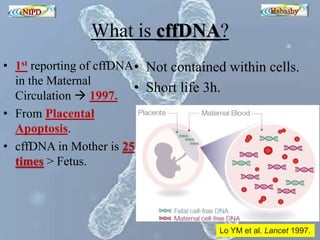
What is cffDNA? 
• 1st reporting of cffDNA 
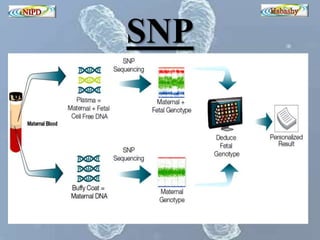
in the Maternal 
Circulation  1997. 
• From Placental 
Apoptosis. 
• cffDNA in Mother is 25 
times > Fetus. 
• Not contained within cells. 
• Short life 3h. 
Lo YM et al. Lancet 1997.
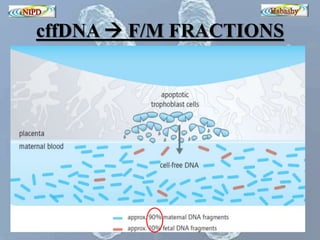
cffDNA  F/M FRACTIONS
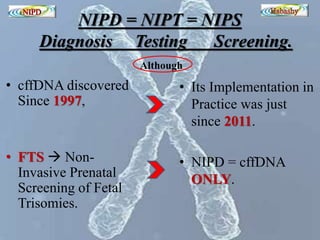
NIPD = NIPT = NIPS 
Diagnosis Testing Screening. 
Although 
• cffDNA discovered 
Since 1997, 
• FTS  Non- 
Invasive Prenatal 
Screening of Fetal 
Trisomies. 
• Its Implementation in 
Practice was just 
since 2011. 
• NIPD = cffDNA 
ONLY.
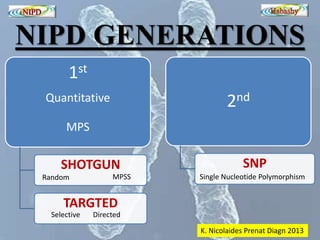
NIPD GENERATIONS 
1st 
Quantitative 
MPS 
SHOTGUN 
TARGTED 
2nd 
SNP 
K. Nicolaides Prenat Diagn 2013 
Random MPSS 
Selective Directed 
Single Nucleotide Polymorphism
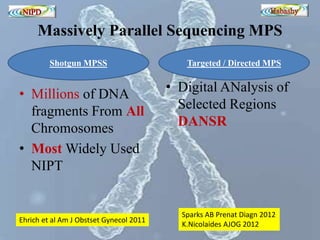
Massively Parallel Sequencing MPS 
Shotgun MPSS Targeted / Directed MPS 
• Millions of DNA 
fragments From All 
Chromosomes 
• MostWidely Used 
NIPT 
• Digital ANalysis of 
Selected Regions 
DANSR 
Sparks AB Prenat Diagn 2012 
K.Nicolaides AJOG 2012 
Ehrich et al Am J Obstset Gynecol 2011
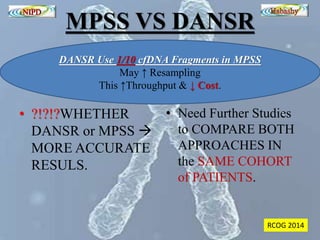
MPSS VS DANSR 
DANSR Use 1/10 cfDNA Fragments in MPSS 
May ↑ Resampling 
This ↑Throughput & ↓ Cost. 
• ?!?!?WHETHER 
DANSR or MPSS  
MORE ACCURATE 
RESULS. 
• Need Further Studies 
to COMPARE BOTH 
APPROACHES IN 
the SAME COHORT 
of PATIENTS. 
RCOG 2014
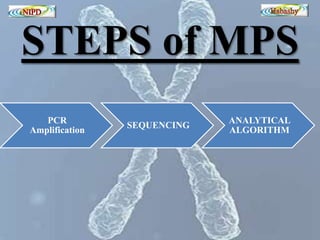
STEPS of MPS 
PCR 
Amplification 
SEQUENCING 
ANALYTICAL 
ALGORITHM
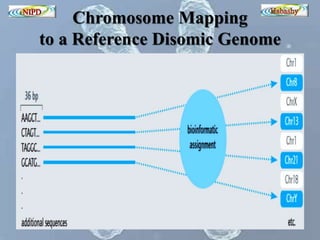
Chromosome Mapping 
to a Reference Disomic Genome
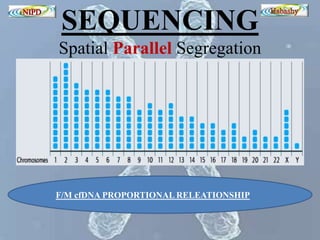
SEQUENCING 
Spatial Parallel Segregation 
F/M cfDNA PROPORTIONAL RELEATIONSHIP
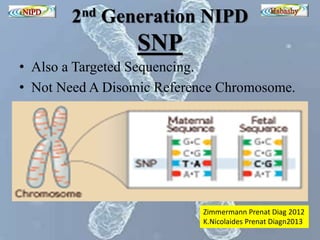
2nd Generation NIPD 
SNP 
• Also a Targeted Sequencing. 
• Not Need A Disomic Reference Chromosome. 
Zimmermann Prenat Diag 2012 
K.Nicolaides Prenat Diagn2013
SNP
cffDNA SAMPLING 
• >10w GA ( SNP can at 9w). 
• Spontaneous or Assisted Conception. 
• 10-20 cc Maternal Venous Blood. (?! 2cc)* 
• Results within 1-2 w. 
• 5 different Companies (USA,Germany,China). 
• PRICE : 800-3000 $. 
*K.Nicolaides AJOG 2012
cffDNA APPLICATIONS 
Not Present in the 
Mother 
Gender 
RH 
Paternity 
(NIPP) 
Single Gene 
Disorder 
In Relation to What is 
Present in the Mother 
Autosomal 
Trisomy 
Sex Chromosomal 
Aneuploidy 
Triploidy 
Deletion
Autosomal Aneuploidy 
Commonest 
•T21 
•T18 
•T13 
On Request in Some NIPT 
•T16 
•T22
Sex Chromosomal Aneuploidy 
(Some NIPT) 
• XO (Turner Syndrome) 
• XXX (Triple X) 
•XXY (Klienfelter Syndrome) 
•XYY (Jacob Syndrome)
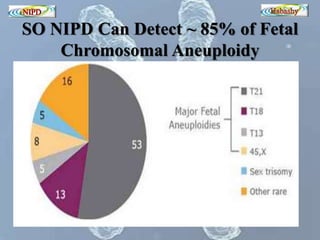
SO NIPD Can Detect ~ 85% of Fetal 
Chromosomal Aneuploidy
Deletion Syndromes 
Some NIPD 
• 22q11.2 deletion syndrome (DiGeorge) 
• Cri-du-chat syndrome (5p minus) 
• Prader-Willi/Angelman syndrome (15q) 
• 1p36 deletion syndrome
SensiGene 
• RhD –ve Mother / RhD +ve Father. 
• +ve Maternal Indirect Coomb (Sensitized). 
• ± Hetrogenous Rh +ve Father. 
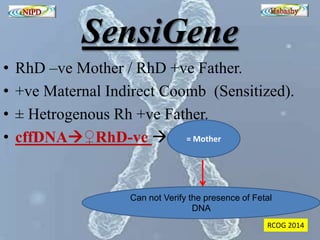
• cffDNA♀RhD-ve  
= Mother 
Can not Verify the presence of Fetal 
DNA 
RCOG 2014
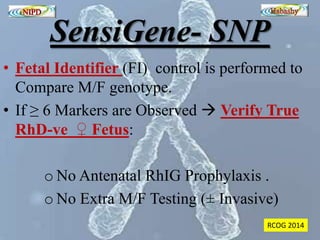
SensiGene- SNP 
• Fetal Identifier (FI) control is performed to 
Compare M/F genotype. 
• If ≥ 6 Markers are Observed  Verify True 
RhD-ve ♀ Fetus: 
o No Antenatal RhIG Prophylaxis . 
o No Extra M/F Testing (± Invasive) 
RCOG 2014
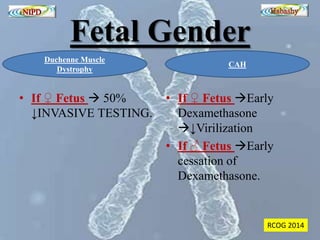
Fetal Gender 
• If ♀ Fetus  50% 
↓INVASIVE TESTING. 
• If ♀ Fetus Early 
Dexamethasone 
↓Virilization 
• If ♂ Fetus Early 
cessation of 
Dexamethasone. 
Duchenne Muscle 
Dystrophy 
CAH 
RCOG 2014
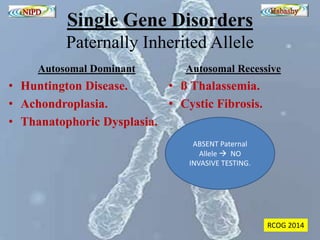
Single Gene Disorders 
Paternally Inherited Allele 
Autosomal Dominant 
• Huntington Disease. 
• Achondroplasia. 
• Thanatophoric Dysplasia. 
Autosomal Recessive 
• ß Thalassemia. 
• Cystic Fibrosis. 
ABSENT Paternal 
Allele  NO 
INVASIVE TESTING. 
RCOG 2014
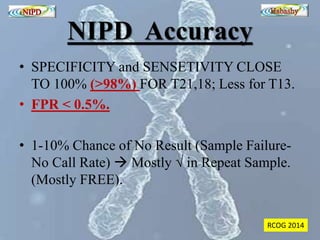
NIPD Accuracy 
• SPECIFICITY and SENSETIVITY CLOSE 
TO 100% (>98%) FOR T21,18; Less for T13. 
• FPR < 0.5%. 
• 1-10% Chance of No Result (Sample Failure- 
No Call Rate)  Mostly √ in Repeat Sample. 
(Mostly FREE). 
RCOG 2014
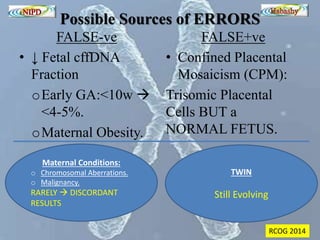
Possible Sources of ERRORS 
FALSE-ve 
• ↓ Fetal cffDNA 
Fraction 
oEarly GA:<10w  
<4-5%. 
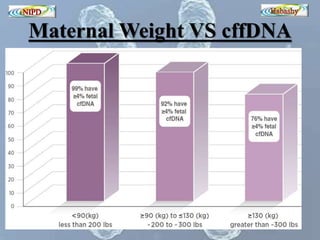
oMaternal Obesity. 
FALSE+ve 
• Confined Placental 
Mosaicism (CPM): 
Trisomic Placental 
Cells BUT a 
NORMAL FETUS. 
Maternal Conditions: 
o Chromosomal Aberrations. 
o Malignancy. 
RARELY  DISCORDANT 
RESULTS 
TWIN 
Still Evolving 
RCOG 2014
Maternal Weight VS cffDNA
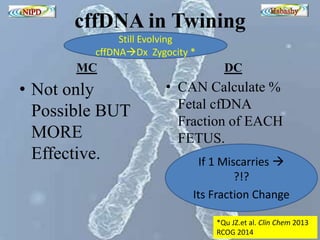
cffDNA in Twining 
MC 
• Not only 
Possible BUT 
MORE 
Effective. 
DC 
• CAN Calculate % 
Fetal cfDNA 
Fraction of EACH 
FETUS. 
If 1 Miscarries  
?!? 
Its Fraction Change 
Still Evolving 
cffDNADx Zygocity * 
*Qu JZ.et al. Clin Chem 2013 
RCOG 2014
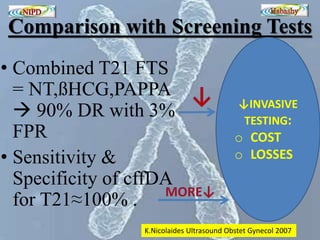
Comparison with Screening Tests 
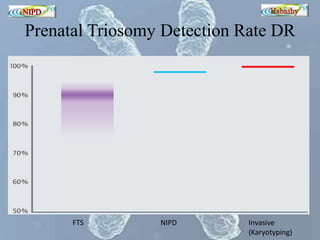
• Combined T21 FTS 
= NT,ßHCG,PAPPA 
 90% DR with 3% 
FPR 
• Sensitivity & 
Specificity of cffDA 
for T21≈100% . 
↓INVASIVE 
TESTING: 
o COST 
o LOSSES 
K.Nicolaides Ultrasound Obstet Gynecol 2007
Prenatal Triosomy Detection Rate DR 
FTS NIPD Invasive 
(Karyotyping)
ACOG,SMFM,ACMG,ISPD 
• cffDNA is some FORM 
of CONTINGENT 
Approach offering 
testing to HIGH RISK 
Pregnancies: 
• Maternal Age ≥35Ys. 
• Previous T21. 
• Parental Balanced 
Translocation. 
• US Aneuploidy 
Marker(s). 
• +ve Biochemical 
Screening test. 
THE MOST EFFECTIVE 
ANEUPLOIDY 
SCREENING IN HIGH 
RISK PREG. 
ASOG,SMFM 2012 
ACMG,ISPD 2013
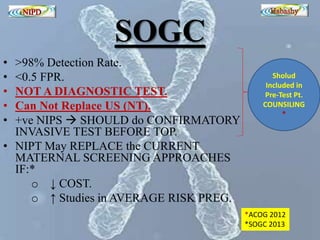
SOGC 
• >98% Detection Rate. 
• <0.5 FPR. 
• NOT A DIAGNOSTIC TEST. 
• Can Not Replace US (NT). 
• +ve NIPS  SHOULD do CONFIRMATORY 
INVASIVE TEST BEFORE TOP. 
• NIPT May REPLACE the CURRENT 
MATERNAL SCREENING APPROACHES 
IF:* 
o ↓ COST. 
o ↑ Studies in AVERAGE RISK PREG. 
Sholud 
Included in 
Pre-Test Pt. 
COUNSILING 
* 
*ACOG 2012 
*SOGC 2013
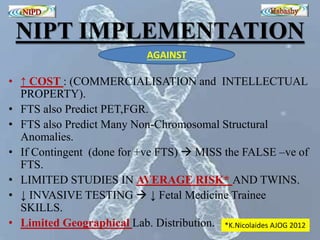
NIPT IMPLEMENTATION 
AGAINST 
• ↑ COST : (COMMERCIALISATION and INTELLECTUAL 
PROPERTY). 
• FTS also Predict PET,FGR. 
• FTS also Predict Many Non-Chromosomal Structural 
Anomalies. 
• If Contingent (done for +ve FTS)  MISS the FALSE –ve of 
FTS. 
• LIMITED STUDIES IN AVERAGE RISK* AND TWINS. 
• ↓ INVASIVE TESTING  ↓ Fetal Medicine Trainee 
SKILLS. 
• Limited Geographical Lab. Distribution. 
*K.Nicolaides AJOG 2012
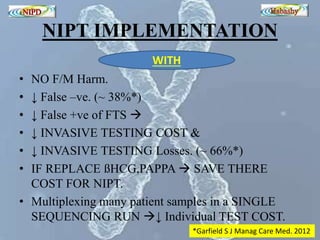
NIPT IMPLEMENTATION 
WITH 
• NO F/M Harm. 
• ↓ False –ve. (~ 38%*) 
• ↓ False +ve of FTS  
• ↓ INVASIVE TESTING COST & 
• ↓ INVASIVE TESTING Losses. (~ 66%*) 
• IF REPLACE ßHCG,PAPPA  SAVE THERE 
COST FOR NIPT. 
• Multiplexing many patient samples in a SINGLE 
SEQUENCING RUN ↓ Individual TEST COST. 
*Garfield S J Manag Care Med. 2012
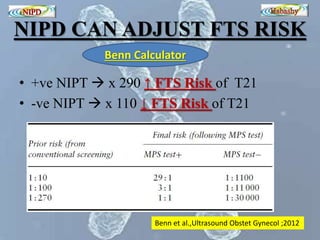
NIPD CAN ADJUST FTS RISK 
Benn Calculator 
• +ve NIPT  x 290 ↑ FTS Risk of T21 
• -ve NIPT  x 110 ↓ FTS Risk of T21 
Benn et al.,Ultrasound Obstet Gynecol ;2012
ACMG 2013 
• No Doubt NIPS Costs WILL ↓. 
• NIPS is Likely the 1st of major steps toward 
the eventual application of WHOLE FETAL 
GENOME SEQUENCING.
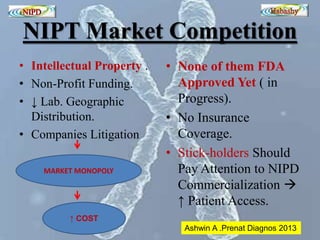
NIPT Market Competition 
• Intellectual Property . 
• Non-Profit Funding. 
• ↓ Lab. Geographic 
Distribution. 
• Companies Litigation 
• None of them FDA 
Approved Yet ( in 
Progress). 
• No Insurance 
Coverage. 
• Stick-holders Should 
Pay Attention to NIPD 
Commercialization  
↑ Patient Access. 
Ashwin A .Prenat Diagnos 2013 
MARKET MONOPOLY 
↑ COST
Trials 
• Maternal Urine : cffDNA (MPS)*. 
• Maternal Blood : 
ocffRNA (more Fetus Specific) 
oFetal Proteins. 
oFetal CELLS. 
Lo YM , K.Nicolaides Nat Med 2007
Take Home Message 
• NIPD  High Accuracy + NO F/M Harm  
REVOLUTION in FETAL MEDICINE. 
• NIPD MAJOR PROBLEM  ↑ COST  
FALLING  May REPLACE 
BIOCHEMICAL MARKERS BUT CAN 
NOT REPLACE US. 
• NIPD are NOT DIAGNOSTIC  SHOULD 
BE CONFERMED BY INVASIVE TEST.
THANK 
YOU

NIPD

  • 1.
    NIPD Ahmed El-Habashy A.Lect.OB/GYN.Alex.Univ.
  • 2.
    OUTLINES • TERMINOLOGY • TICHNIQUE & SAMPLING • APPLICATION • ACCURACY • RECOMMENDATIONS
  • 3.
    What is cffDNA? • 1st reporting of cffDNA in the Maternal Circulation  1997. • From Placental Apoptosis. • cffDNA in Mother is 25 times > Fetus. • Not contained within cells. • Short life 3h. Lo YM et al. Lancet 1997.
  • 4.
    cffDNA  F/MFRACTIONS
  • 5.
    NIPD = NIPT= NIPS Diagnosis Testing Screening. Although • cffDNA discovered Since 1997, • FTS  Non- Invasive Prenatal Screening of Fetal Trisomies. • Its Implementation in Practice was just since 2011. • NIPD = cffDNA ONLY.
  • 6.
    NIPD GENERATIONS 1st Quantitative MPS SHOTGUN TARGTED 2nd SNP K. Nicolaides Prenat Diagn 2013 Random MPSS Selective Directed Single Nucleotide Polymorphism
  • 7.
    Massively Parallel SequencingMPS Shotgun MPSS Targeted / Directed MPS • Millions of DNA fragments From All Chromosomes • MostWidely Used NIPT • Digital ANalysis of Selected Regions DANSR Sparks AB Prenat Diagn 2012 K.Nicolaides AJOG 2012 Ehrich et al Am J Obstset Gynecol 2011
  • 8.
    MPSS VS DANSR DANSR Use 1/10 cfDNA Fragments in MPSS May ↑ Resampling This ↑Throughput & ↓ Cost. • ?!?!?WHETHER DANSR or MPSS  MORE ACCURATE RESULS. • Need Further Studies to COMPARE BOTH APPROACHES IN the SAME COHORT of PATIENTS. RCOG 2014
  • 9.
    STEPS of MPS PCR Amplification SEQUENCING ANALYTICAL ALGORITHM
  • 10.
    Chromosome Mapping toa Reference Disomic Genome
  • 11.
    SEQUENCING Spatial ParallelSegregation F/M cfDNA PROPORTIONAL RELEATIONSHIP
  • 12.
    2nd Generation NIPD SNP • Also a Targeted Sequencing. • Not Need A Disomic Reference Chromosome. Zimmermann Prenat Diag 2012 K.Nicolaides Prenat Diagn2013
  • 13.
  • 14.
    cffDNA SAMPLING •>10w GA ( SNP can at 9w). • Spontaneous or Assisted Conception. • 10-20 cc Maternal Venous Blood. (?! 2cc)* • Results within 1-2 w. • 5 different Companies (USA,Germany,China). • PRICE : 800-3000 $. *K.Nicolaides AJOG 2012
  • 15.
    cffDNA APPLICATIONS NotPresent in the Mother Gender RH Paternity (NIPP) Single Gene Disorder In Relation to What is Present in the Mother Autosomal Trisomy Sex Chromosomal Aneuploidy Triploidy Deletion
  • 16.
    Autosomal Aneuploidy Commonest •T21 •T18 •T13 On Request in Some NIPT •T16 •T22
  • 17.
    Sex Chromosomal Aneuploidy (Some NIPT) • XO (Turner Syndrome) • XXX (Triple X) •XXY (Klienfelter Syndrome) •XYY (Jacob Syndrome)
  • 18.
    SO NIPD CanDetect ~ 85% of Fetal Chromosomal Aneuploidy
  • 19.
    Deletion Syndromes SomeNIPD • 22q11.2 deletion syndrome (DiGeorge) • Cri-du-chat syndrome (5p minus) • Prader-Willi/Angelman syndrome (15q) • 1p36 deletion syndrome
  • 20.
    SensiGene • RhD–ve Mother / RhD +ve Father. • +ve Maternal Indirect Coomb (Sensitized). • ± Hetrogenous Rh +ve Father. • cffDNA♀RhD-ve  = Mother Can not Verify the presence of Fetal DNA RCOG 2014
  • 21.
    SensiGene- SNP •Fetal Identifier (FI) control is performed to Compare M/F genotype. • If ≥ 6 Markers are Observed  Verify True RhD-ve ♀ Fetus: o No Antenatal RhIG Prophylaxis . o No Extra M/F Testing (± Invasive) RCOG 2014
  • 22.
    Fetal Gender •If ♀ Fetus  50% ↓INVASIVE TESTING. • If ♀ Fetus Early Dexamethasone ↓Virilization • If ♂ Fetus Early cessation of Dexamethasone. Duchenne Muscle Dystrophy CAH RCOG 2014
  • 23.
    Single Gene Disorders Paternally Inherited Allele Autosomal Dominant • Huntington Disease. • Achondroplasia. • Thanatophoric Dysplasia. Autosomal Recessive • ß Thalassemia. • Cystic Fibrosis. ABSENT Paternal Allele  NO INVASIVE TESTING. RCOG 2014
  • 24.
    NIPD Accuracy •SPECIFICITY and SENSETIVITY CLOSE TO 100% (>98%) FOR T21,18; Less for T13. • FPR < 0.5%. • 1-10% Chance of No Result (Sample Failure- No Call Rate)  Mostly √ in Repeat Sample. (Mostly FREE). RCOG 2014
  • 25.
    Possible Sources ofERRORS FALSE-ve • ↓ Fetal cffDNA Fraction oEarly GA:<10w  <4-5%. oMaternal Obesity. FALSE+ve • Confined Placental Mosaicism (CPM): Trisomic Placental Cells BUT a NORMAL FETUS. Maternal Conditions: o Chromosomal Aberrations. o Malignancy. RARELY  DISCORDANT RESULTS TWIN Still Evolving RCOG 2014
  • 26.
  • 27.
    cffDNA in Twining MC • Not only Possible BUT MORE Effective. DC • CAN Calculate % Fetal cfDNA Fraction of EACH FETUS. If 1 Miscarries  ?!? Its Fraction Change Still Evolving cffDNADx Zygocity * *Qu JZ.et al. Clin Chem 2013 RCOG 2014
  • 28.
    Comparison with ScreeningTests • Combined T21 FTS = NT,ßHCG,PAPPA  90% DR with 3% FPR • Sensitivity & Specificity of cffDA for T21≈100% . ↓INVASIVE TESTING: o COST o LOSSES K.Nicolaides Ultrasound Obstet Gynecol 2007
  • 29.
    Prenatal Triosomy DetectionRate DR FTS NIPD Invasive (Karyotyping)
  • 30.
    ACOG,SMFM,ACMG,ISPD • cffDNAis some FORM of CONTINGENT Approach offering testing to HIGH RISK Pregnancies: • Maternal Age ≥35Ys. • Previous T21. • Parental Balanced Translocation. • US Aneuploidy Marker(s). • +ve Biochemical Screening test. THE MOST EFFECTIVE ANEUPLOIDY SCREENING IN HIGH RISK PREG. ASOG,SMFM 2012 ACMG,ISPD 2013
  • 31.
    SOGC • >98%Detection Rate. • <0.5 FPR. • NOT A DIAGNOSTIC TEST. • Can Not Replace US (NT). • +ve NIPS  SHOULD do CONFIRMATORY INVASIVE TEST BEFORE TOP. • NIPT May REPLACE the CURRENT MATERNAL SCREENING APPROACHES IF:* o ↓ COST. o ↑ Studies in AVERAGE RISK PREG. Sholud Included in Pre-Test Pt. COUNSILING * *ACOG 2012 *SOGC 2013
  • 32.
    NIPT IMPLEMENTATION AGAINST • ↑ COST : (COMMERCIALISATION and INTELLECTUAL PROPERTY). • FTS also Predict PET,FGR. • FTS also Predict Many Non-Chromosomal Structural Anomalies. • If Contingent (done for +ve FTS)  MISS the FALSE –ve of FTS. • LIMITED STUDIES IN AVERAGE RISK* AND TWINS. • ↓ INVASIVE TESTING  ↓ Fetal Medicine Trainee SKILLS. • Limited Geographical Lab. Distribution. *K.Nicolaides AJOG 2012
  • 33.
    NIPT IMPLEMENTATION WITH • NO F/M Harm. • ↓ False –ve. (~ 38%*) • ↓ False +ve of FTS  • ↓ INVASIVE TESTING COST & • ↓ INVASIVE TESTING Losses. (~ 66%*) • IF REPLACE ßHCG,PAPPA  SAVE THERE COST FOR NIPT. • Multiplexing many patient samples in a SINGLE SEQUENCING RUN ↓ Individual TEST COST. *Garfield S J Manag Care Med. 2012
  • 34.
    NIPD CAN ADJUSTFTS RISK Benn Calculator • +ve NIPT  x 290 ↑ FTS Risk of T21 • -ve NIPT  x 110 ↓ FTS Risk of T21 Benn et al.,Ultrasound Obstet Gynecol ;2012
  • 35.
    ACMG 2013 •No Doubt NIPS Costs WILL ↓. • NIPS is Likely the 1st of major steps toward the eventual application of WHOLE FETAL GENOME SEQUENCING.
  • 36.
    NIPT Market Competition • Intellectual Property . • Non-Profit Funding. • ↓ Lab. Geographic Distribution. • Companies Litigation • None of them FDA Approved Yet ( in Progress). • No Insurance Coverage. • Stick-holders Should Pay Attention to NIPD Commercialization  ↑ Patient Access. Ashwin A .Prenat Diagnos 2013 MARKET MONOPOLY ↑ COST
  • 37.
    Trials • MaternalUrine : cffDNA (MPS)*. • Maternal Blood : ocffRNA (more Fetus Specific) oFetal Proteins. oFetal CELLS. Lo YM , K.Nicolaides Nat Med 2007
  • 38.
    Take Home Message • NIPD  High Accuracy + NO F/M Harm  REVOLUTION in FETAL MEDICINE. • NIPD MAJOR PROBLEM  ↑ COST  FALLING  May REPLACE BIOCHEMICAL MARKERS BUT CAN NOT REPLACE US. • NIPD are NOT DIAGNOSTIC  SHOULD BE CONFERMED BY INVASIVE TEST.
  • 39.